Snowpack/drought/runoff news: Southeastern approves 65% of Fry-Ark imports for irrigators this season

snowpackcolorad05102012.jpg

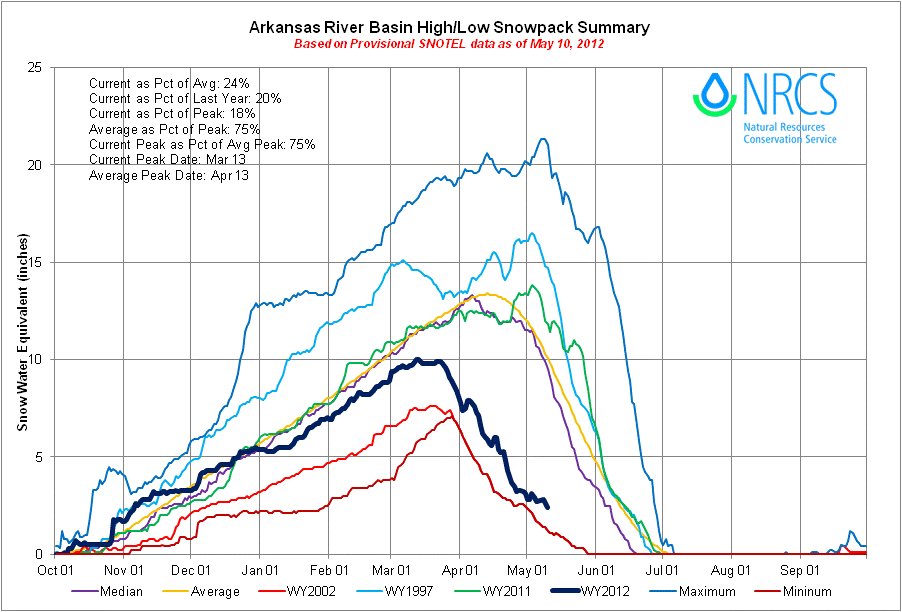
basinhighlowarkansas05102012.jpg

basinhighlowsouthplatte05102012.jpg

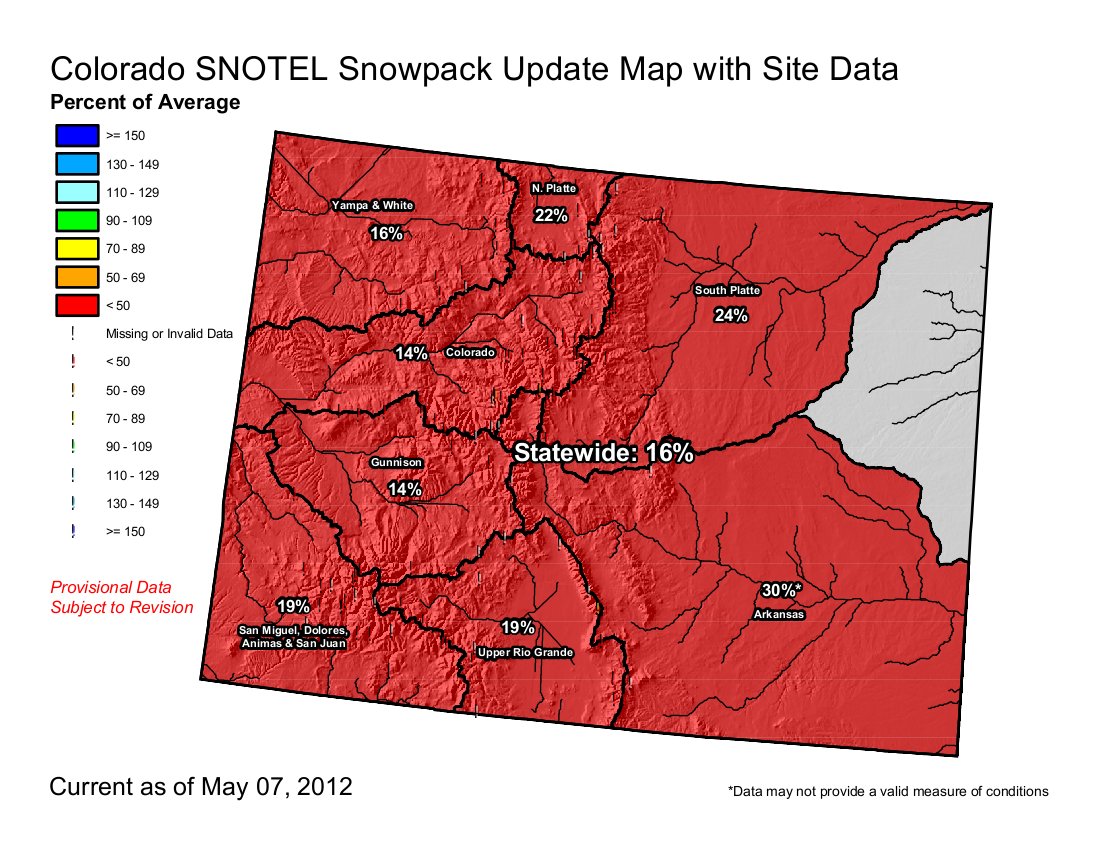
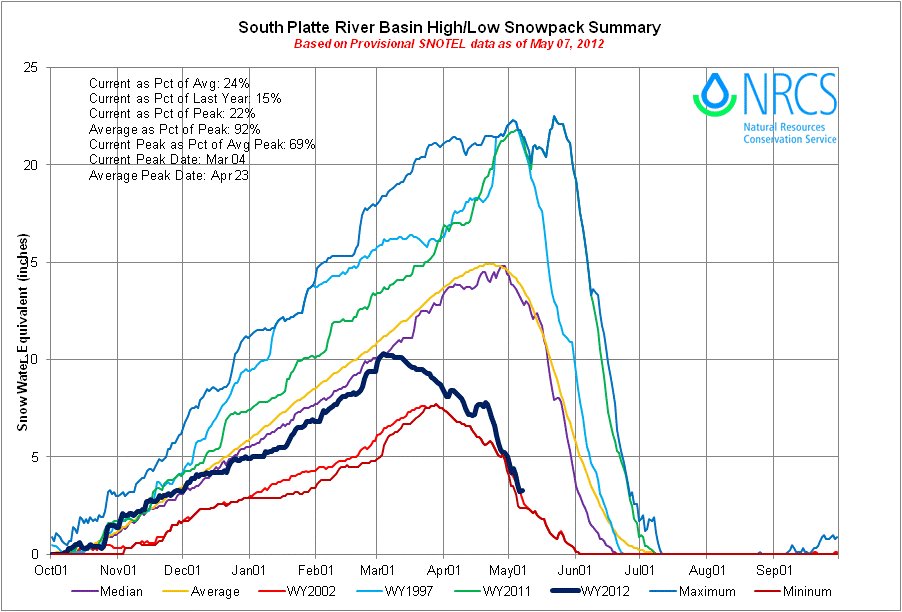
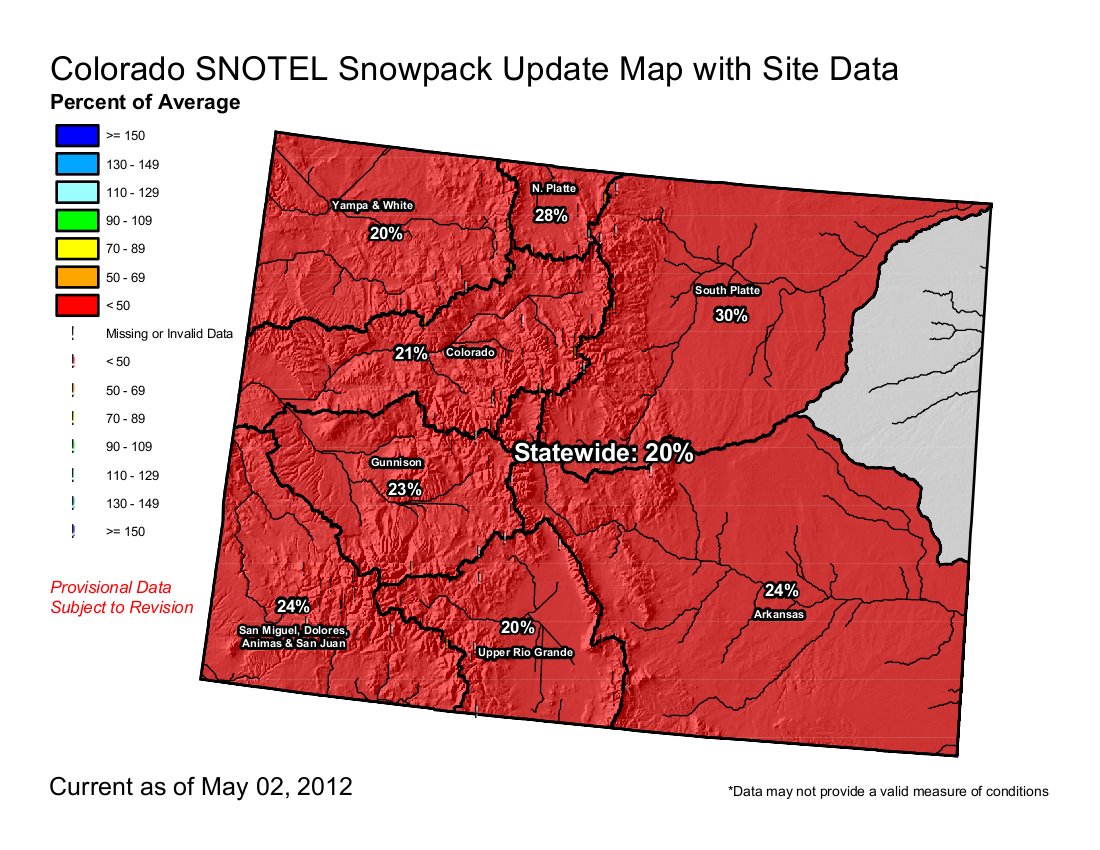
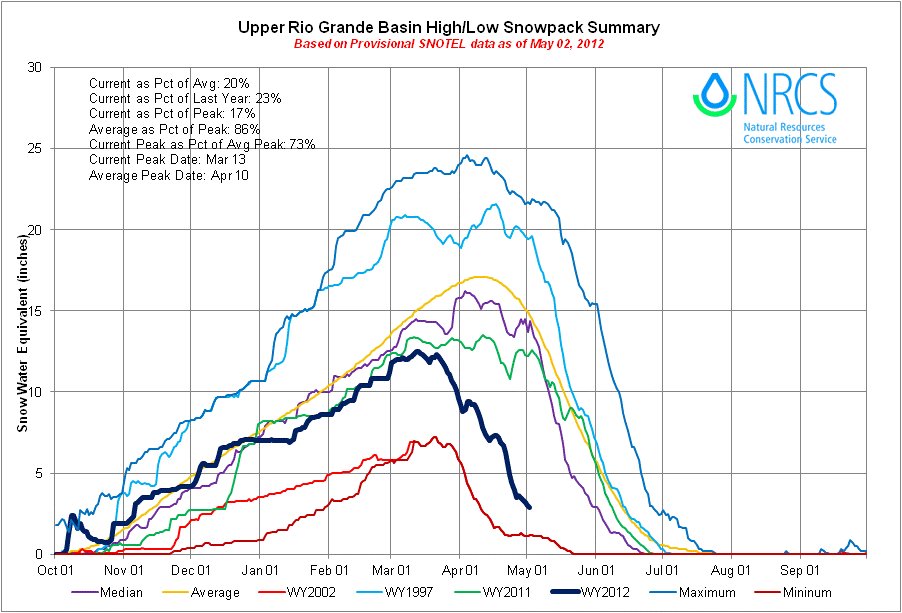
Click on the thumbnail graphics for the current statewide snowpack map along with the Basin High/Low graphs for the South Platte and Arkansas river basins from the Natural Resources Conservation Service.

From The Pueblo Chieftain (Chris Woodka):

The allocation committee of the Southeastern Colorado Water Conservancy District on Thursday voted to recommend that about 65 percent of the water from the Fryingpan-Arkansas Project go to farms this year. The district board will consider the action next week…

The bad news: There isn’t much water. The Bureau of Reclamation’s May 1 projection for Fry-Ark imports from the Colorado River basin was 12,400 acre-feet, about one-fourth of average. So far, about 4,000 acre-feet have moved — and moved earlier than usual…

In the end, the district staff estimated about 9,900 acre-feet will be available for allocation this year, after evaporation, transit loss and obligations are accounted for. Of that, about 3,500 will go to municipal use, and nearly 6,400 acre-feet to farms. The ag allocations are spread out under a formula that incorporates eligible acres among nine canals and 15 smaller ditches or farms.

There will be a ripple effect because of smaller than projected return flows, which well groups rely on for part of their augmentation water. However augmentation plans are likely to be rewritten as farmers scale back operations to match conditions.

From the Leadville Herald-Democrat:

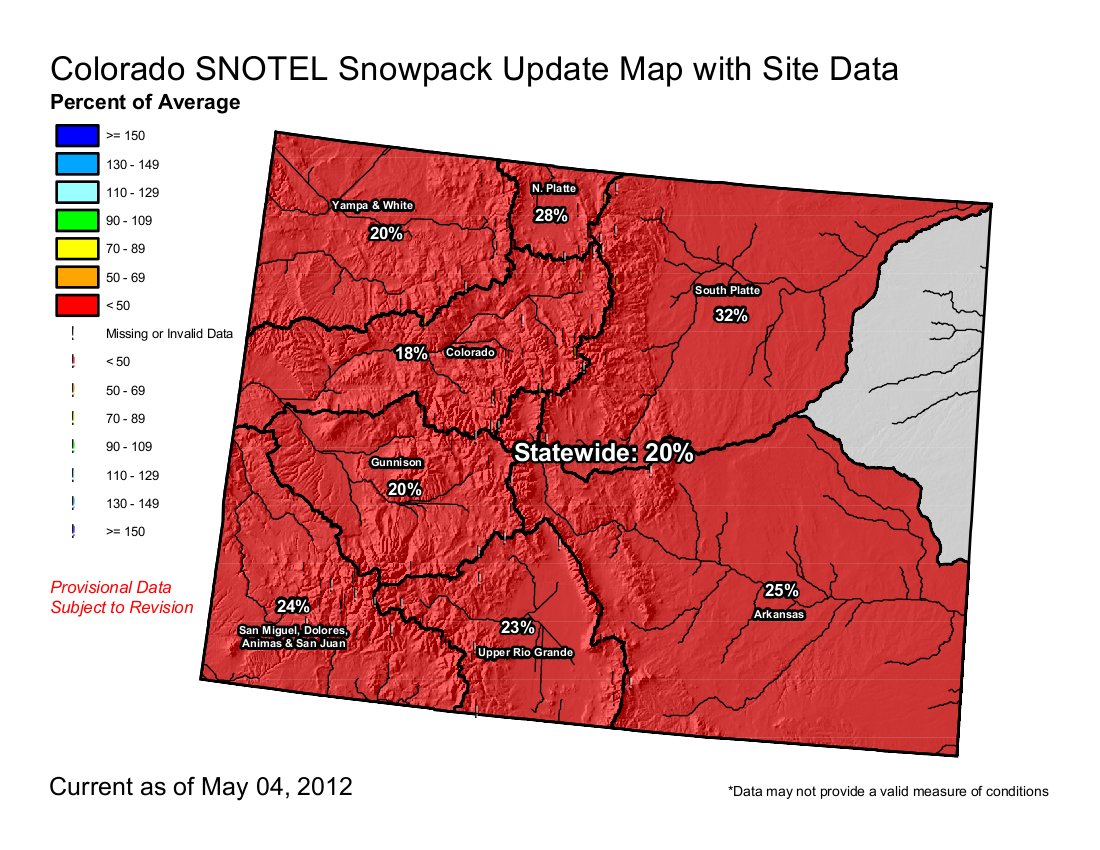
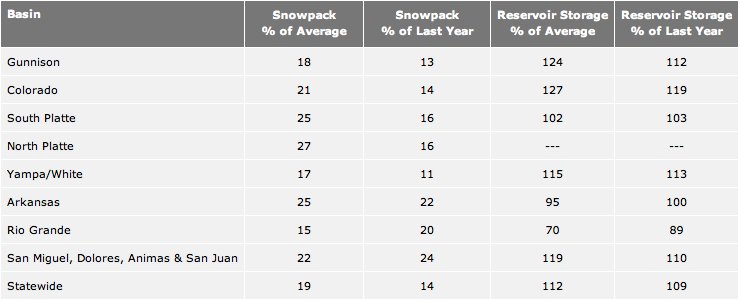
The latest snow surveys conducted by the NRCS show that most low- and mid- elevation-measurement locations have little or no snow, and the higher-elevation sites are well-below average and rapidly melting. The May 1 statewide snowpack report reflects this; measuring just 19 percent of average. For the second month in a row, statewide snowpack conditions match those recorded during the record-setting drought year of 2002. In the Arkansas River Basin, snowpack is at 25 percent of average and 22 percent of the amount measured at this time last year.

From The Aspen Times (Janet Urquhart):

This year’s runoff throughout the Colorado River Basin is expected to be about 50 percent of average. No one is predicting flows of 870 cubic feet per second in the lower Fryingpan River below the Ruedi Dam this year (it was flowing at about 120 cfs Thursday), but Ruedi Reservoir could be employed to help ease late-summer drought conditions on the Western Slope, according to Don Meyer, senior water resources engineer for the Colorado River District. The reservoir might not fill this summer but could inch above 100,000 acre-feet under the most optimistic projections, according to Tim Miller, of the Bureau of Reclamation. The reservoir is considered full at 102,369 acre-feet…

The reservoir might send very little water to the Front Range this year through the Fry-Ark transmountain diversion, Miller added. On average, 54,000 acre-feet are sent from the upper Fryingpan drainage to the far side of the Continental Divide. Last year, 98,000 acre-feet went east, but this year, about 12,430 acre-feet are expected to be diverted…

Between drought mitigation and other calls on Ruedi, flows could bump up to the 300-cfs range on the lower Fryingpan come August, which is not unusual, giving a boost to the Roaring Fork below its confluence with the Pan. The upper Fork, however, could see low flows and high enough water temperatures to harm the fishery if dry weather persists, Meyer said. The Roaring Fork at Glenwood Springs hit about 1,100 cfs last weekend, according to Meyer, and could do the same this weekend. A peak of about 1,500 is projected, he said…

The Colorado at Glenwood hit about 3,500 cfs last weekend and could do so again in the next couple of days, matching what is predicted to be the peak this season, he said. The high water is about a month ahead of last year’s peak.

From the Fort Collins Coloradodan (Kevin Duggan):

Drought conditions and historically low snowpack levels are not expected to translate into mandatory water-use restrictions this year in Fort Collins…

Supplies are strong enough that [Fort Collins] likely will be able to “carry over” up to 8,000 acre feet of water in local reservoirs for next year’s use. An acre foot of water is enough to meet the needs of two American families of four for a year…

Fort Collins’ main water sources are the Poudre River, where the city holds senior water rights, and Horsetooth Reservoir through the Colorado-Big Thompson system administered by the Northern Colorado Water Conservancy District.

Because of the dry conditions, the district has agreed to provide a high amount of water this year to share owners. With its strong supply and limited storage capacity, the city plans to rent 5,600 acre feet of water to area farmers.

The City of Pueblo files diligence application for their whitewater park instream flow right

kayaker.jpg

From The Pueblo Chieftain (Chris Woodka):

The city obtained a conditional recreational in-channel diversion right in 2006 for the kayak course built as part of the Arkansas River Legacy project. A filing in Division 2 water court seeks to make the right absolute for eight gates on the kayak course, as well as maintaining a conditional right for a ninth gate to be built at Moffat Street in the future. The first eight gates begin at the water intake for the Downtown power plant and continue to the Union Avenue bridge. The RICD right includes minimum flows for recreation that vary from 100-500 cubic feet per second, depending on conditions and the time of year, with an appropriation date of 2000…

The city also has asked the Colorado Water Conservation Board to pursue a 100 cfs in-stream flow right for the reach of the Arkansas River from Pueblo Dam through Pueblo.

More water law coverage here.

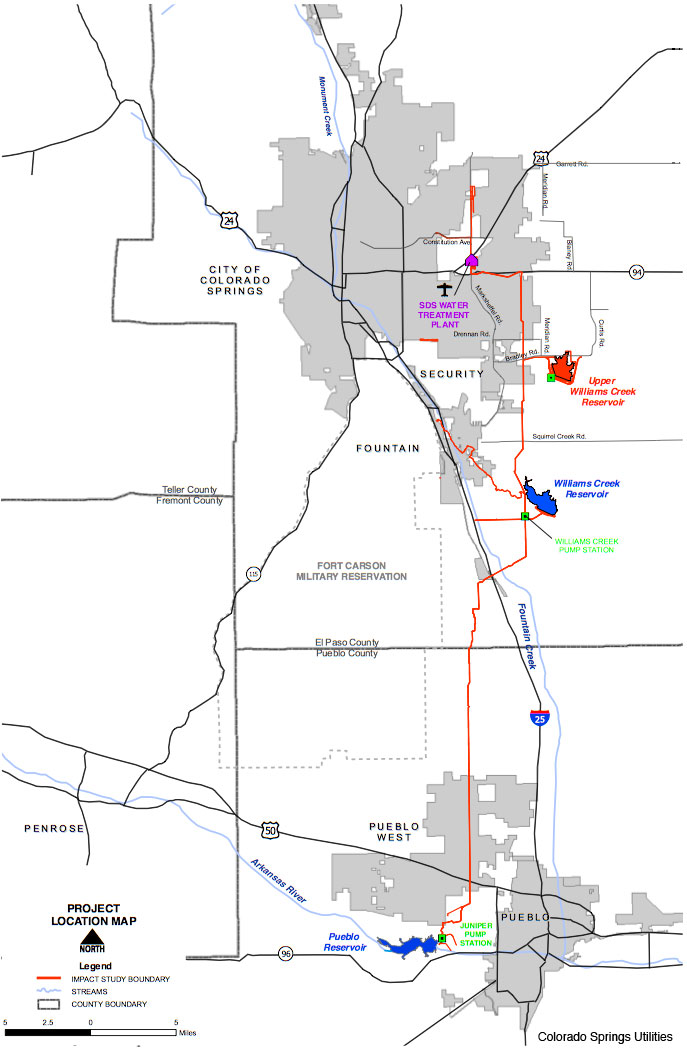
Southern Delivery System: ‘Colorado Springs remains in compliance, and is in regular contact with Reclamation’ — Kara Lamb via the Chieftain

sdspreferredalternative.jpg

Here’s a report from Chris Woodka writing for The Pueblo Chieftain. [ed. The link does not take you to the article in the Chieftain’s new format as of 5:11 AM. I had to scroll through the online paper to find it.] Here’s an excerpt:

Colorado Springs remains in compliance, and is in regular contact with Reclamation, spokeswoman Kara Lamb said this week. “Reclamation has not issued a permit. We are not a regulating agency,” Lamb explained. “What we have done is enter into a series of contracts with Colorado Springs Utilities and the other SDS participants.

“The contracts are based on the environmental compliance measures outlined in the final Environmental Impact Statement and associated record of decision and permits issued by other entities which do have regulating authority.”

More Southern Delivery System coverage here and here.

Colorado State University State Climatologist’s Office to Keep Official Hailstone Records for Colorado

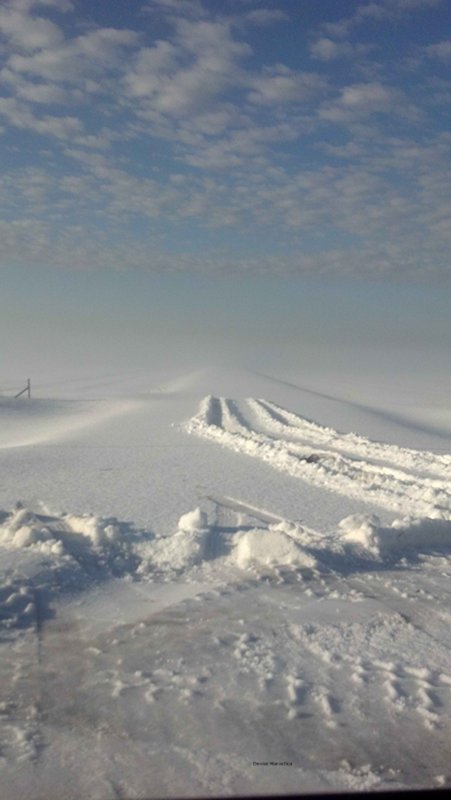
denisemarosticaphoto2012viacsu1.jpg

Here’s the release from Colorado State University (Emily Narvaes Wilmsen):

As large as a grapefruit? A DVD? A softball? Just how big is the record-holding hailstone in Colorado? Colorado State University State Climatologist Nolan Doesken can list at least 18 separate reports of hail stones as large as 4.5 inches in diameter, but few have been officially confirmed.

His office is now officially tracking these statistics – just in time for spring storms like the one that hit Colorado’s eastern Plains earlier this month, leaving piles of hail on roads and farms.

“Chances are there are at least 50 people in eastern Colorado who will say, ‘What the heck, we’ve seen way bigger hail than that!’” Doesken said. “That’s good, but they will need to prove their claim – by providing the stone itself or eyewitness reports along with excellent photos showing the stone with rulers or other known objects.”

Doesken’s Colorado Climate Center at Colorado State, working in tandem with the four National Weather Service offices that serve Colorado (Boulder, Pueblo, Grand Junction and Goodland, Kan.), have developed procedures for documenting hailstones including how to get a good photo, measure the maximum diameter and circumference, preserve the stone and contact appropriate officials. For instructions, examples and contact information, go to http://ccc.atmos.colostate.edu/hail.php.

In the meantime, Doesken encourages volunteers who observe large hail in Colorado to first report to the National Weather Service or to local law enforcement agencies. The National Weather Service can convey reports of damaging hail to a wider audience through National Weather Service alerts. Large-hail reports provide valuable ground truth which will be helpful for issuance of additional warnings.

“When it’s safe to go out again, retrieve the largest stones and freeze them as soon as possible to avoid further melting,” Doesken said. “Use a ruler to get an accurate measure of the diameter and a flexible or strong tape or string to measure the circumference. If an accurate scale is available, weigh the stone. Preserve the stone by tightly wrapping and sealing it in an air-tight bag.”

If the stone is 4.5 inches in diameter or greater, contact the Colorado Climate Center at (970) 491-8545 or nolan@atmos.colostate.edu.
People who have kept hailstones in their freezer will be disappointed to know the stones lose mass over time, Doesken said. Even if they are tightly wrapped, the ice structure changes with time. But changes will occur more slowly if they are sealed up air tight.

Doesken got the idea for a hailstone repository while he was a member of the executive committee of American Association of State Climatologists. Several neighboring states including Nebraska, South Dakota and Kansas have established new records in recent years. A stone that was eight inches in diameter fell in Vivian, S.D., on July 23, 2010 – almost the size of a football. For more information on that stone, go to http://www.crh.noaa.gov/abr/?n=stormdamagetemplate.

“I don’t believe Colorado has ever had hail that big – and I hope we never do,” Doesken said. “But stones don’t need to be that big to cause damage.

You can really get pummeled with stones that are 1 inch in diameter. Even golf-ball sized hail, which most people don’t realize is nearly 2 inches in diameter, can do serious damage. Crops and gardens can be badly damaged by hail that may only be pea-sized.”

“The motivation has been that other states have been establishing these repositories and Colorado should have done this long ago,” he said. “If you’re going to get hit with something that big, you might as well take some credit for it.”

Doesken has been tracking hail data for more than 30 years. Fort Collins was one of the locations hit with 4.5-inch diameter hail on July 30, 1979.

In 1998, Doesken established a volunteer precipitation monitoring network in Colorado known as the Community Collaborative Rain, Hail and Snow Network, or CoCoRaHS. The network is now in all 50 states with more than 15,000 volunteers. Data from the volunteers improves precipitation monitoring and helps provide detailed storm analysis, drought, water supply and other water decision-making information to municipalities, homeowners, industries, utility providers, resource managers and educators. The program continues to seek volunteers. To volunteer, go to http://www.cocorahs.org/.

Guide for hailstone size (diameter measurement listed)

Ping pong ball – 1.5 inches
Golf ball –1.75 inches
Tennis ball – 2.5 inches
Baseball – 2.75 inches
Hockey puck – 3 inches
Softball – 4 inches
Grapefruit – 4.5 inches
CD/DVD – 4.75 inches

Denver Water, et al: A historic moment for Colorado water — Signing of historic agreement for cooperative water management and supply

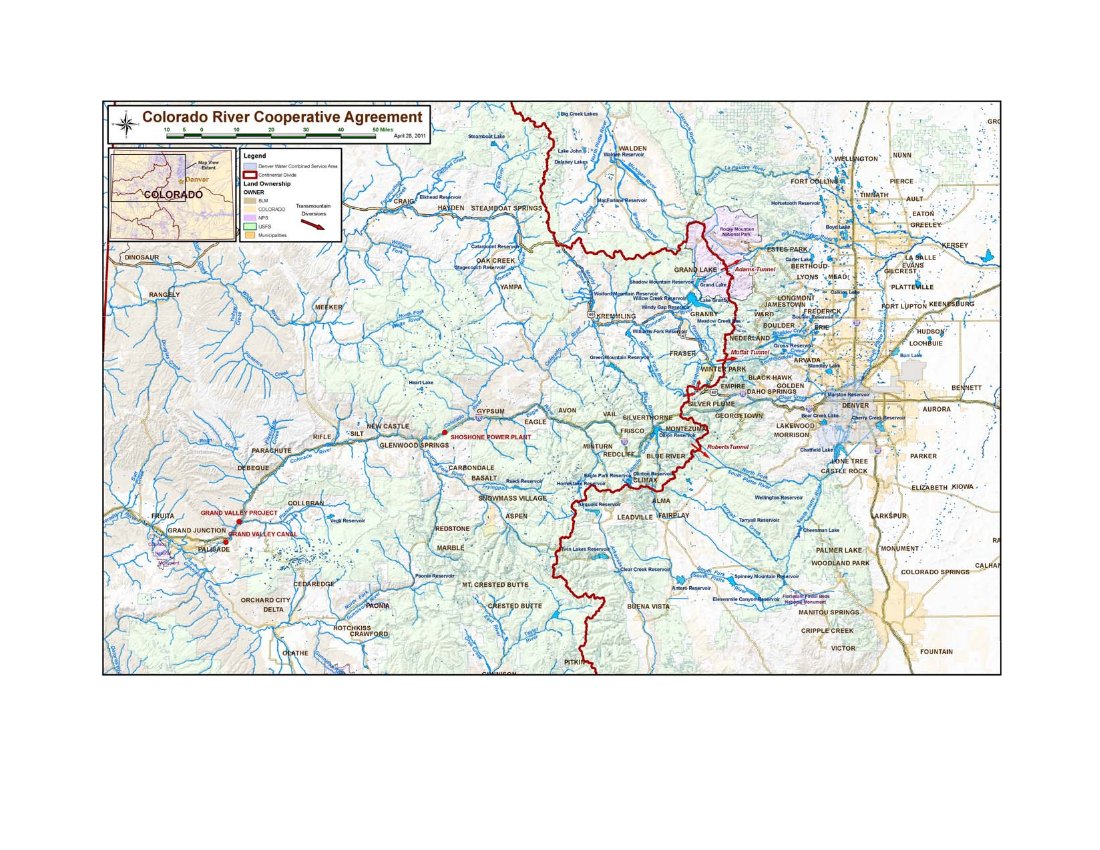
coloradorivercooperativeagreementmap.jpg

Here’s the release from Denver Water (Stacy Chesney):

WHO: Governor John Hickenlooper; Grand County Commissioners James Newberry, Nancy Stuart Gary Bumgarner; Penfield Tate, Denver Water Commissioner; Summit County Commissioners Dan Gibbs, Karn Stiegelmeier; William J. Baum, Clinton Ditch & Reservoir Co.; Eric Kuhn, Colorado River District, General Manager.

WHAT: Leaders from Grand County, Summit County, Denver Water and the Clinton Ditch & Reservoir Co. will sign the Colorado River Cooperative Agreement. This unprecedented agreement achieves better environmental health for the Colorado River Basin, maintains high-quality recreational use and improves economics for many cities, counties and businesses impacted by the river. The agreement is the result of five years of negotiations.

WHEN: Tuesday, May 15, 2012, noon

WHERE: Grand County Administration Building, 308 Byers Ave., Hot Sulphur Springs, CO 80451

More Colorado River Cooperative Agreement coverage here.

Denver, Aurora along with Colorado Parks and Wildlife are cooperating to maintain a rainbow trout spawning reach below Eleven Mile Reservoir

elevenmilereservoir.jpg

From the Aurora Sentinel (Brandon Johannson):

…because of an agreement between the two water departments, state wildlife officials say the future of the rainbow trout population in that stretch of the South Platte — one of only two natural rainbow fisheries on the river — is much brighter than it was a few years ago.

Under the agreement between Parks and Wildlife, Aurora Water and Denver Water, the three agencies are working together to make sure stream flows in the Platte remain constant during the critical spring spawning season.
Regulating the flows in the canyon required Aurora’s and Denver’s help because flows there are largely determined by the water departments’ decisions upstream. Denver Water owns Eleven Mile Reservoir, which flows into the Platte, and Aurora owns Spinney Mountain Reservoir, which feeds Eleven Mile. Because it is a designated “drought reservoir,” the output from Eleven Mile into the Platte is based on what Aurora dumps from Spinney. If Aurora dumps too much, the Platte moves too fast and the young trout are rushed downstream just as they emerge from the egg. If the water level drops too quickly, fertilized eggs could be exposed and dry up on the banks…

With a pile of numbers in hand, Spohn approached Aurora and Denver and asked them to maintain a steady flow during some crucial times. If the river could stay at about 75 cubic feet per second, it would be ideal for spawning, he said. But job No. 1 for Aurora Water and Denver Water is making sure when someone turns on their tap or their sprinkler, a steady stream comes pouring out — regardless of what that means for trout in the canyon. Sometimes that means more than 75 CFS, often as much as 200 CFS. “We can’t operate to the detriment of the citizens of Aurora,” said Brian Fitzpatrick, water resources manager for Aurora Water…

And while Spohn’s focus is on improving the trout fishery in Eleven Mile Canyon, he knows that’s not Aurora’s chief concern. “Wildlife understands that Aurora’s job is to provide water to their customers in the city,” he said. That’s where Denver Water comes in. When Aurora slows the flow from Spinney — often to levels well below what the city needs — Denver Water steps in and loans Aurora some water from Strontia Springs Reservoir. As soon as flows can be bumped up again, Aurora pays back Denver with water from other storage.

More South Platte River basin coverage here and here.

Snowpack/drought/runoff news: Dillion Reservoir at 94% of average, Green Mountain Reservoir = 59%

snowpackcolorado05092012.jpg

basinhighlowyampawhite05092012.jpg

basinhighlowgraphgunnison.jpg

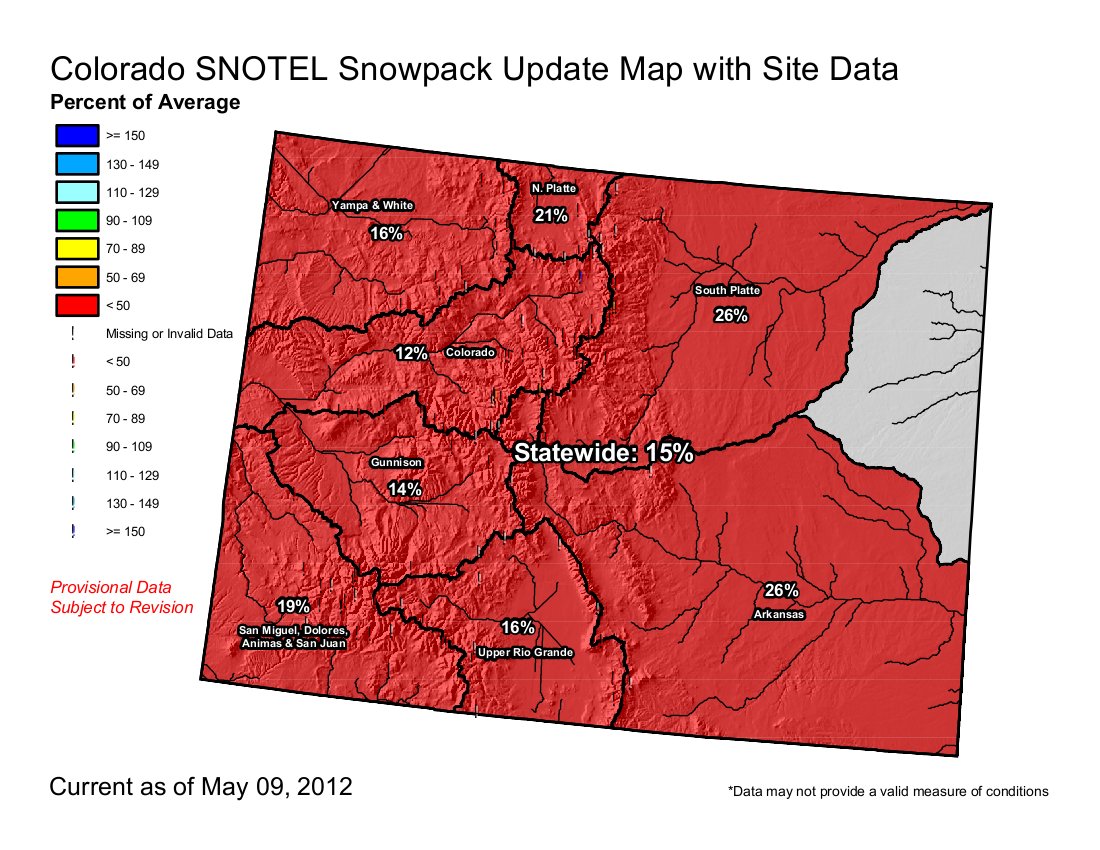
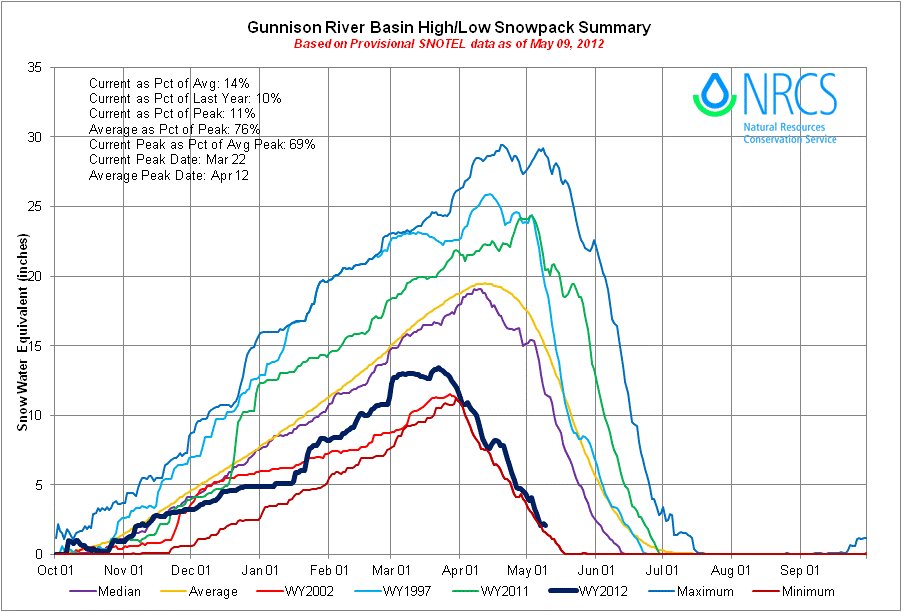
Click on the thumbnail graphics for the current statewide snowpack map, the Yampa/White Basin High/Low graph and the Gunnison Basin High/Low graph from the Natural Resources Conservation Service.

From The Aspen Times:

Some long-range forecasts call for a wet July and August following extremely dry weather in May and June — which is why Denver Water officials are using a mid-range forecast to dictate their management decisions. Still, others take a more cautious approach…

Dillon Reservoir is just one of the municipal water provider’s storage units, but it will be affected, said Bob Steger, manager of water resources for the utility. Typically, the South Platte River is the go-to source for Denver’s water, but though the basin fared better with snowfall than the Colorado River basin, it wasn’t by much. Even with modest forecasts, the Dillon Reservoir is expected to drop below Frisco Bay Marina’s operating levels — causing it to anchor docks in the deeper water to maintain customer service. Estimates are a drop of as much as 25 feet by September. Downstream from Dillon Reservoir, Green Mountain Reservoir is 59 percent full. Dillon Reservoir is 94 percent full. The average is 84 percent full.

From the Summit County Citizens Voice (Bob Berwyn):

A flow management program [ed. Arkansas River voluntary flow program] developed in the 1980s serves as a statewide model for cooperative agreements on how to meet recreational, environmental and municipal and agricultural needs during years when water is in short supply. White said he’s hopeful the stakeholders will be able to make the agreement work to the benefit of boaters this year…

The voluntary flow program was crafted in the 1990’s by what is now Colorado Parks and Wildlife, Colorado Trout Unlimited, the Southeastern Colorado Water Conservancy District, the Colorado Department of Natural Resources and the Arkansas River Outfitters Association. Administered by the Bureau of Reclamation, the Flow Program provides water management guidelines that benefit the fishery and provide for whitewater flows in the Arkansas River for recreation users, including commercial outfitters and private boaters, in the spring and summer months. Meetings throughout the month of May will help determine how much water municipalities and other water managers will be able to contribute to this year’s program.

From the Longmont Times-Call (Scott Rochat):

On Wednesday, it was time for Firestone’s town board to take up a dry topic — namely, the town’s drought management plan. Still in its draft stages, the plan would allow for restrictions if Firestone’s water supply slips below 110 percent of its demand. The restrictions could deepen further if the water supply reaches genuine shortages, getting below 100 percent or 90 percent of demand…

Both Steve Nguyen of Clear Water Solutions (who prepared the draft) and town manager Wes LaVanchy said it was good to see the town developing a plan ahead of a drought…

The plan soon will be available on the town’s website, ci.firestone.co.us/index.html. Public comment on the plan will be taken for 60 days, beginning today. A preliminary version, which will receive some minor editing this week, is already on the site in the town board’s packet; click on “Town Board,” “TB Agenda/Packet” and then “Meeting Packet.”

From The Valley Courier (Ruth Heide):

Colorado Division of Water Resources Division 3 Division Engineer Craig Cotten reported to members of the Rio Grande Roundtable on Tuesday that the Rio Grande Basin snowpack is about 18 percent of average right now. He said the basin is about a month early as far as runoff. Many of the rivers have already peaked or are at their peak this week. “It is not looking real good,” he said.

He added that the Natural Resources Conservation Service (NRCS) forecasts for both the Rio Grande and Conejos River systems dropped significantly from April to May. Last month the NRCS was predicting an annual flow for the Rio Grande of 465,000 acre feet. This week that forecast was down to 380,000 acre feet…

Of the forecasted flow, 93,200 acre feet must be delivered to the state line to meet Rio Grande Compact obligations. A large portion of that has already been delivered or will be delivered through the winter months, so the current curtailment on the Rio Grande is only 2 percent.

On the Conejos, the current curtailment is 0 percent, Cotten said. He said the Rio Grande Compact obligation to downstream states on the Conejos will be met with what has been delivered so far and what will be delivered after the irrigation season ends this winter, “so we don’t need to curtail ditches on the Conejos system at all to get water to the downstream states.”

The NRCS forecast for the Conejos River system also declined from April to May, he added. In April the NRCS predicted 215,000 acre feet on the Conejos, and this week the forecast was only 180,000 acre feet, about 54 percent of the long-term average.

From the Summit Daily News (Janice Kurbjin):

“The long-term weather forecast is for warmer, drier weather in the foreseeable future,” said Troy Wineland, the district’s new water commissioner. “The picture isn’t altogether pretty at the moment.” Wineland was one of the speakers at Tuesday’s State of the River, an annual meeting hosted by the Colorado River District and its partners. Blue River Watershed Group helped to put on the Summit County event. It’s held every spring to give citizens a chance to understand what’s happening in their watershed, the demands on water resources, and projects that are underway to facilitate water management…

Listeners at the State of the River annual meeting suggested Denver Water officials raise the drought stage to stay ahead of the problem. “It’s not good enough,” said Matt Wade of Ten Mile Creek Kayaks in Frisco. “If we don’t have a crystal ball, shouldn’t we be proactive and have stricter water regulations in Denver to play it safe?” His comment was met with a smattering of applause.

“The philosophy of our drought response plan are that our actions are commensurate with the situation,” [Bob] Steger said, adding that Denver Water board members may choose to heighten the alert, but that hasn’t happened yet.

From the Sky-Hi Daily News (Tonya Bina):

Snowpack measurements for the Upper Colorado basin are the lowest in 45 years, according to the latest Natural Resources Conservation Service readings. At 21 percent of average, the Upper Colorado is at 6 percentage points lower than the previous record set in 2002. The “melt-out at many sites in Colorado this year has been four to six weeks earlier than normal,” states a May 1 Colorado Water Supply Outlook Report produced by the Natural Resources Conservation Service. “It is likely that, barring well above-average spring and summer precipitation, peak flows have already occurred in many basins,” the report reads…

…Eric Kuhn, general manager of the Colorado River District, cautions Front Range and West Slope utilities not to be “lulled into inaction by relatively good reservoir storage,” according to a Colorado River District April newsletter reporting on the district’s quarterly board of directors meeting.

“One of the lessons of 2002 was that municipal users of West Slope water were slow to recognize the drought that year and institute watering restrictions,” the newsletter states, paraphrasing Kuhn. “The result was that reservoirs were hit hard that summer before restrictions were implemented, putting the utilities in a poor storage position for the ensuing year.”

The majority of the state’s streams and rivers are poised to produce just 20 to 40 percent of average volumes during the high water-demand season.

‘Whenever there is a rate increase, our engineers tell us you can expect a 3 to 5 percent drop in demand’ — John Hier (Rifle City Manager)

riflegap.jpg

From the Rifle Citizen Telegram (Nelson Harvey):

The project, which has been under discussion for more than six years, is motivated by the fact that the city’s Graham Mesa Water Treatment Plant is 32 years old and near the end of its useful life. The plant, city officials argue, can’t support Rifle’s growing population, or meet potential new federal water quality standards. Yet in opposing the project, [John Steele] has claimed the rate increases required to fund it would lead to a drastic drop in water demand, depriving the city of the revenue it needs to finance its loan.

Under the rate structure approved by City Council to fund the plant, water rates would rise by about 64 percent for those using up to 2,000 gallons a month, and roughly 99 percent for those using up to 4,000 gallons. Rate increases would be higher if voters do not approve a half cent sales tax increase to help fund the project. “No one has told me whether they can cover the loan with a 20 percent drop in water consumption,” said Steele, which he said could result from the rate hikes…

But City Manager John Hier, who helped design the new rate structure, said there is no way to tell how much demand would drop in response to higher water rates. His plan, he said, accounted for the fact that higher prices would prompt some consumers to use less water. “Whenever there is a rate increase, our engineers tell us you can expect a 3 to 5 percent drop in demand,” he said. “Of course, that depends on how large the increase is, but we were conservative in estimating the rates that would generate enough money to fund the new plant.” Hier said he didn’t know how much consumption would have to drop before the city would be unable to repay its loan.

More infrastructure coverage here.

NIDIS Weekly Climate, Water and Drought Assessment Summary of the Upper Colorado River Basin

wyutcoprecipitationnidis0429to0552012.jpg

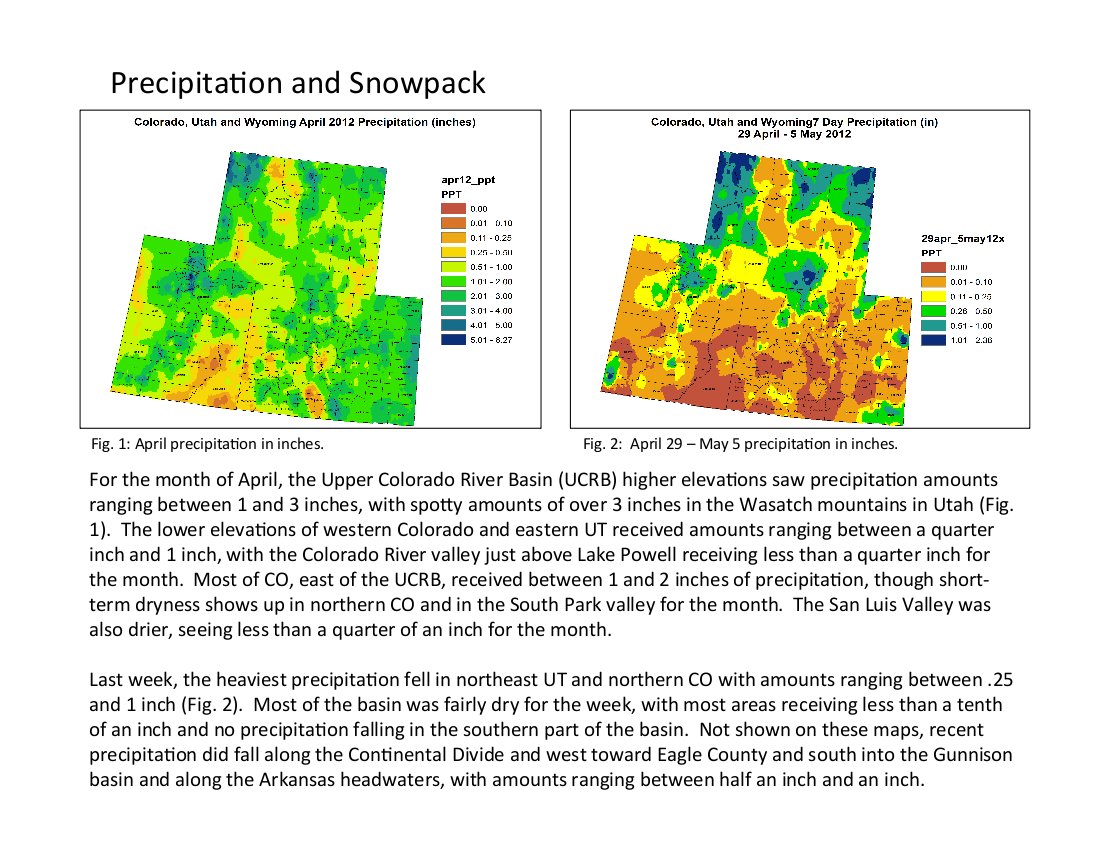
Here are the summaries from yesterday’s webinar from the Colorado Climate Center. Click on the thumbnail graphic for the precipitation summary.

Colorado TU Gives Conservation Award to Grand County

grandlake.jpg

Here’s the release from Colorado Trout Unlimited (Randy Scholfield):

Colorado Trout Unlimited today announced that Grand County government – led by County Commissioners Gary Bumgarner, James Newberry, and Nancy Stuart – is the recipient of TU’s 2012 Trout Conservation Award for its work protecting the Upper Colorado River watershed in the face of Front Range water diversions and other threats.

The award is presented each year to recognize outstanding achievements in conserving Colorado rivers and trout habitat.

“I have never seen a local government place the level of attention, resources, and overall emphasis on river conservation as has been the case with Grand County over the past five years,” said David Nickum, executive director of Colorado Trout Unlimited. “Commissioners Bumgarner, Newberry and Stuart, and County Manager Lurline Curran, have worked tirelessly to preserve healthy river flows along with the wildlife, local communities, and quality of life that depend on them. They have been true champions for the Colorado headwaters.”

“As a resident of Grand County for 40 years, and as a father who wants his children and their children to experience the same natural wonders that I’ve enjoyed here over the years, I am deeply appreciative of the unified effort from our commissioners and staff in their fight to save our rivers and lakes,” said Kirk Klancke, president of the Colorado River Headwaters Chapter of TU. “I am proud of my county for having courageous leaders like these, who are an example to all of the Davids that are facing Goliaths.”

Nickum called Grand County “a longstanding and valued partner” with Trout Unlimited in working to protect and restore the Upper Colorado River watershed. He noted that Grand County officials have invested more than $3 million into assessing and addressing the needs of its rivers, and spent thousands of hours negotiating with Front Range water users and advocating to federal permitting agencies for better protections for the Upper Colorado River watershed.

Among other accomplishments in the past year, Grand County (along with other west slope governments and Denver Water) unveiled a historic “cooperative agreement” that includes many important benefits for the Colorado River and its tributaries, including millions of dollars for river restoration and environmental enhancement; 1,000 acre-feet of water to help with low flows in the Fraser River watershed; guarantees that the vital Shoshone call continues to operate in the future to keep water in the Colorado River year-round; and an agreement that any future transbasin projects will only be pursued with the consent of the West Slope. The agreement is also important in establishing a stakeholder partnership called “Learning by Doing” to provide ongoing monitoring of river health to ensure adequate protection measures.

Grand County has also worked with the Northern Colorado Water Conservancy District to use Windy Gap pumping capabilities to re-manage some “excess” water for the benefit of flows in the Colorado River and has filed for a Recreational In Channel Diversion to help support a new in-river water right on the Colorado mainstem.

Moreover, Grand County leaders are negotiating with Northern for enhanced funding for river restoration projects—including a needed bypass around Windy Gap Reservoir to improve Colorado River habitat—and additional water for use in Grand County to boost flows and river health. Grand County is also promoting an agreement to release water for endangered fish in the downstream Colorado River out of Granby Reservoir – thereby benefiting the Colorado through miles of key trout habitat – instead of releases solely from Ruedi Reservoir, as has been done in the past.

For all the progress in recent years, the health of the Upper Colorado River ecosystem will continue to decline unless further protections are put in place to address looming impacts from two new Front Range diversion projects, Denver’s Moffat Tunnel expansion and Northern’s Windy Gap Firming Project. Nickum noted that EPA recently issued recommendations that supported Grand County and TU’s case for stronger mitigation on the Windy Gap Firming Project.

“Grand County officials understand that the Colorado headwaters are the lifeblood of their communities and of our state’s tourism economy and outdoor quality of life,” said Nickum. “They have set an example for our public leaders of what strong river stewardship looks like.”

More Colorado River basin coverage here.

Logan County approves data collection monitoring well license for high groundwater levels

groundwatermovementusgs.jpg

From the Sterling Journal-Advocate (Judy Debus):

The Logan County Commissioners once again considered a request by the Colorado Water Division to use county-owned property for the installation of monitoring wells for data collection in the groundwater-plagued area of Pawnee Ridge Subdivision and Country Club Hills. Commissioners Jim Edwards, Dave Donaldson and Debbie Zwirn were present for Tuesday’s meeting.

At a previous meeting, the request was addressed in a license agreement, but was tabled due to language problems. This week, the request from removed from the table upon motion by Edwards and then postponed indefinitely. To replace the requests, commissioners then approved lease agreements (rather than license agreements) to provide the approval for the wells to be installed. The data will be collected and then analyzed to determine the cause of the increased groundwater problems in the two areas.

The CDW held a public meeting last month to present their outline of a program to address the water issue. That program will begin with the monitoring program that will last a period of two years with an initial analysis at the end of one year.

More South Platte River basin coverage here and here.

Colorado Water 2012: The Colorado Water Conservation Board is celebrating its 75th anniversary

coloradoriveraboveshadowmountain.jpg

Here’s the latest installment in the Valley Courier’s Water 2012 series. Travis Smith details the workings and history of the Colorado Water Conservation Board. Here’s an excerpt:

The mission of the Colorado Water Conservation in 1937 is clear, as stated in the authorizing legislation House Bill 6 1937 Section 1: “for the purpose of aiding in the protection and development of the waters of the state for the benefit of the present and future inhabitants of the state, there is hereby created a Colorado Water Conservation Board with powers and duties herein set out. Said board is hereby declared to be an agency of the state and the functions it is to perform as here in set out are hereby declared to be governmental functions for the welfare and benefit of the state and its inhabitants.“

The Colorado Water Conservation Board’s mission today is the same as when written in 1937; 75 years later the CWCB mission statement is: Conserve, develop, protect and manage Colorado’s water for present and future generations.

The current board is made up of nine geographic appointees selected by the governor along with the Department of Natural Resources executive director. The five non voting members are the Commissioner of Agriculture, State Engineer, Attorney General, Director of Parks and Wildlife and CWCB executive director.

This 15 member board governs the CWCB responsibilities that range from protecting Colorado’s streams and lakes to water conservation, flood mitigation, water shed protection, stream restoration, drought planning, water supply planning and water project financing. The CWCB is ever vigilant regarding the state’s compact apportionments and issues dealing with downstream states and federal agencies.

The CWCB is self funded and does not receive money from the general fund. The majority of funding appropriation for the CWBC comes from the CWCB construction fund. This fund is the primary funding source for the state’s water user community.

More Colorado Water 2012 coverage here.

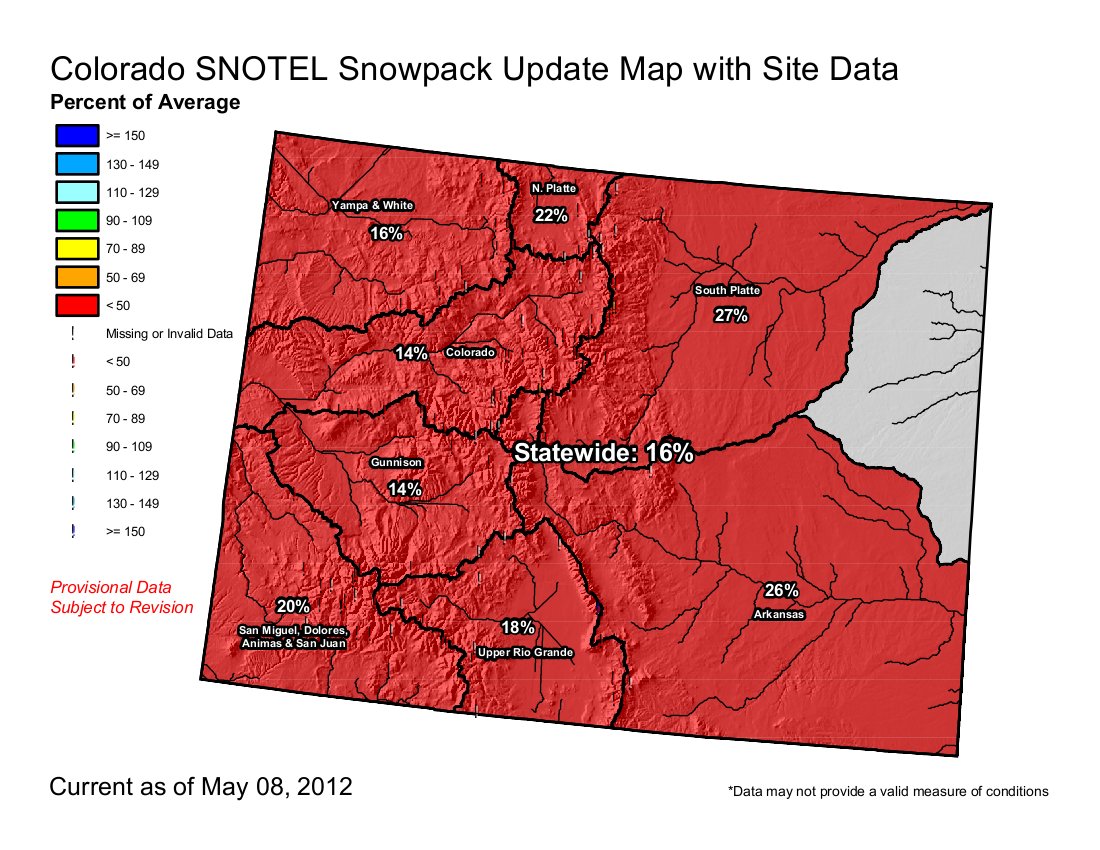
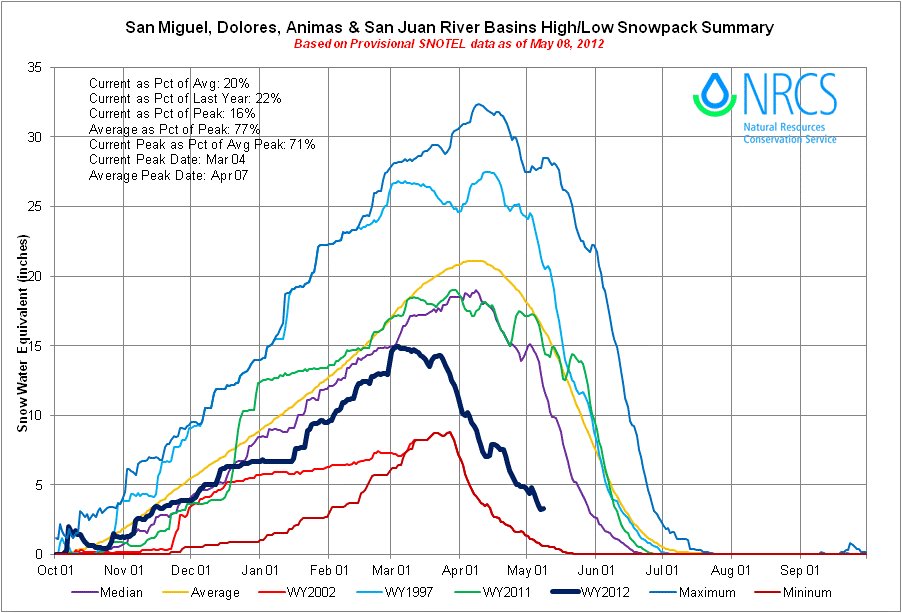
Snowpack/drought/runoff news: San Miguel/Dolores/Animas/San Juan basins are at 20% of average, statewide = 16%

snowpackcolorado05082012.jpg

basinhighlowsanmigueldoloressanimasanjuan05082012.jpg

Click on the thumbnail graphics for the current statewide snowpack map and the Basin High/Low graph for the San Miguel/Dolores/Animas/San Juan basins from the Natural Resources Conservation Service. The area is about 2 to 2.5 inches of SWE ahead of 2002.

From The Greeley Tribune (Eric Brown):

Welcome rains trickled down on a parched Weld County on Sunday night and into Monday morning, providing a bit of relief for [Dave] Petrocco, other farmers and municipal water officials who so far this year have been dealing with historically low precipitation amounts…

In Greeley, rainfall amounted to .43 inches during the 24-hour period between 5:30 p.m. Sunday and 5:30 p.m. Monday, according to figures recorded at the University of Northern Colorado. It was the most precipitation the city had received in a 24-hour period so far this year…

Until this week’s storm, the Greeley area had received only about 1.5 inches of precipitation this year — the third-lowest amount on record for the city. The average through the end of April is 3.81 inches…

City of Greeley Water and Sewer Department Director Jon Monson said that — because of the unusually dry and hot conditions, and because of extensive lawn-watering by residents — the city’s treatment facilities were releasing about 35 million gallons of water per day last week. That’s about 40 percent more than in previous years, he added.

El Jebel: Roaring Fork State of the River meeting tomorrow

roaringfork.jpg

From the Colorado River District via the Glenwood Springs Post Independent:

To help understand this epic flip-flop and anticipated low flows, the Colorado River District will host its annual “State of the River” meeting for the Roaring Fork River Basin at 6:30 p.m. on Thursday, May 10, at the Eagle County Community Center, 0020 Eagle County Drive, in El Jebel.

Topics will include anticipated reservoir operations, forecasted river conditions and management of water resources for cities, agriculture, recreation and wildlife.

This summer may see some of the lowest river and stream levels since the drought of 2002.

“The River District needs the public’s input, understanding and cooperation as we work with the water management organizations to get through this season,” said Colorado River District General Manager Eric Kuhn.

For information, contact Martha Moore, Colorado River District, 970-945-8522, ext. 226, or mmoore@crwcd.org.

Reclamation will be at the meeting with an update on the Fryingpan-Arkansas Project. From email from Kara Lamb:

A quick update on run-off operations for Ruedi Reservoir: we are still releasing about 110 cfs to the Fryingpan River. This is less than the inflow we are receiving. We are trying to fill Ruedi this year, but with the current data available, we do not anticipate we will fill. Weather is still a major factor, of course, but that is how the situation looks right now.

Along those same lines, we do not anticipate diverting much water through the Fryingpan-Arkansas Project to the east slope. We are forecasting we will only divert about 12,400 acre-feet of water. To give you an idea of where that number stands: the water right for the Fry-Ark allows for a diversion of up to 120,000 acre-feet in any one year. Our annual average over the last ten years is closer to about 54,000 acre-feet. Last year, with our incredible snowpack, we diverted around 98,000 acre-feet–and filled Ruedi Reservoir easily.

To hear the run-off story told in full, visit us Thursday night in El Jebel. We, along with other water managers, will be presenting our run-off forecast information at the Colorado River District’s State of the River meeting for the Roaring Fork Basin.

More Roaring Fork River watershed coverage here.

Frisco: ‘My best guess is we won’t fill Dillon Reservoir’ — Bob Steger (Denver Water)

Grays and Torreys, Dillon Reservoir May 2017. Photo credit Greg Hobbs.

Here’s a recap of the State of the River meeting held yesterday in Frisco, from Bob Berwyn writing for the Summit County Citizens Voice. Here’s an excerpt:

With an early March meltdown of the snowpack and continued above-average temperatures, the outlook isn’t good, said Blue River water commissioner Troy Wineland, warning that the entire state and region are facing a severe drought. “The time for action is now,” Wineland said, speaking at the annual State of the River meeting in Frisco, co-sponsored by the Colorado River Water Conservation District and the Blue River Watershed Group. Wineland commended Denver Water for its early Stage 1 drought declaration and urged the local water community in Summit County to get on the same page with conservation measures. An inconsistent response to the drought could send the wrong message to residents and visitors, he added.

While reservoir levels are still higher than average, many high country reservoirs aren’t likely to get much fuller than they are now, said Bob Steger, manager of Denver Water’s raw water supply. “My best guess is we won’t fill Dillon Reservoir,” Steger, said, pointing to a graph that suggested Dillon won’t climb much above the level it was as of May 8.

More Blue River watershed coverage here.

North Park: CDPHE issues new cease and desist order to Lone Pine Gas over releases into Spring Gulch Creek

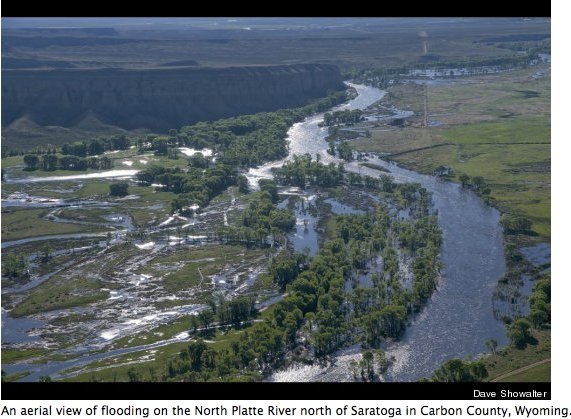
northplatteriverfloodjune2011.jpg

From the Associated Press via The Columbus Republic:

One of the company’s owners, Stephen Shute, said Tuesday he’s reviewing the order.

The company has oil and natural gas wells west of Walden in the North Park area. It has a permit to discharge treated produced water into Spring Gulch Creek, but a cease-and-desist order issued Tuesday says the company has been discharging copper and iron at levels above what’s allowed under its permit. The company received a similar order in 2010.

More oil and gas coverage here and here.

Chris Woodka: Washing away the elephant in the room

arkansasriverleadville.jpg

The Pueblo Chieftain’s excellent reporter, Chris Woodka, tackles the topic of population growth in this column. Click through and read the whole column. Here’s an excerpt:

Sometimes, a newcomer to the discussions the state is having about water will meekly raise a hand or boldly stand and say something stupid like: “You know, there is only so much water available here in Colorado. Why don’t we talk about limiting growth?”

And the water intelligentsia just roll their eyes and hold their noses as if the interloper had made the mistake of publicly using one of the low-flow toilets on display in the exhibition room across the hall.

Arkansas Valley Conduit: Reclamation to collect soil and rock samples along proposed pipeline routes

arkansasvalleyconduitproposed.jpg

Update: Here’s a report from Chris Woodka writing for The Pueblo Chieftain. From the article:

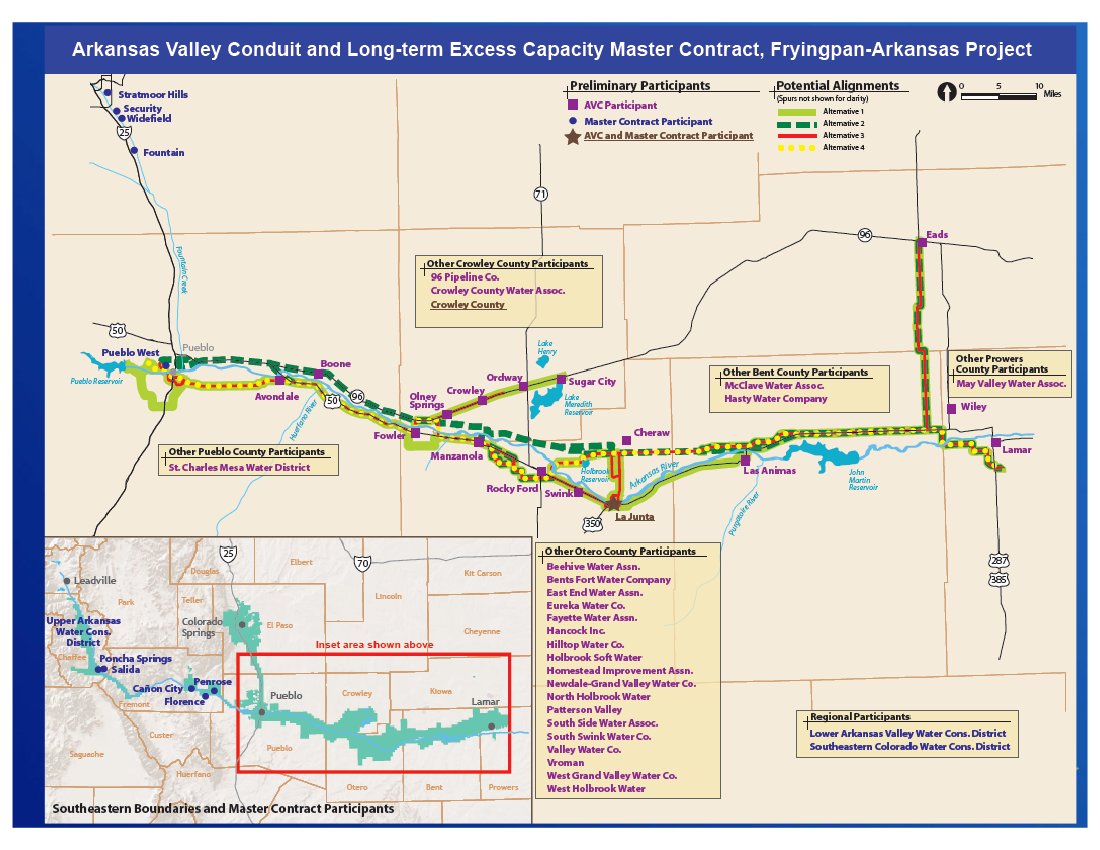
The Bureau of Reclamation will be taking samples of rock and earth as part of an Environmental Impact Study for the Arkansas Valley Conduit and a master storage contract for the Southeastern Colorado Water Conservancy District….

A Reclamation crew will use a truck-mounted, heavy duty drill rig to sample ground on about 1,600 parcels up to 120 feet deep. While most are on public rights of way, some are on private property, and Reclamation will contact landowners and provide a right-of-entry form, said Kara Lamb, spokeswoman for Reclamation.

Here’s the release from the Bureau of Reclamation (Kara Lamb):

Reclamation drill crews will begin geotechnical investigations from Pueblo to Lamar, Colo. in early May. The drill crews will be collecting soil and rock samples along the possible routes of the proposed Arkansas Valley Conduit, a water project being evaluated by Reclamation.

The investigations are part of the surveying research Reclamation is conducting for its preparation of an Environmental Impact Statement. This environmental document will evaluate three proposed federal actions: the proposed Arkansas Valley Conduit; an interconnection between the north and south outlets works of Pueblo Reservoir; and a possible long-term excess capacity Master Contract with Southeastern Colorado Water Conservancy District to store water in Pueblo Reservoir.

Drilling for geotechnical surveying is performed by Reclamation’s Great Plains Regional Geology and Exploration crew. The crew operates a truck mounted CME-85 rig for drilling up to 120 feet below the ground surface to collect samples of rock and earth. The samples are then tested for standard physical properties that will help determine design requirements for the Arkansas Valley Conduit.

While most of the 1600 parcels to be surveyed are in public right-of-ways, some may be on private land. In those cases, Reclamation will contact property owners and provide them with an explanatory letter and a Right of Entry form.

To learn more about the proposed Arkansas Valley Conduit, proposed Master Contract, and the related environmental review process, please visit: www.usbr.gov/avceis. Media is invited to contact Kara Lamb, Reclamation Public Information Officer, for follow-up questions at (970) 062-4326 or klamb@usbr.gov.

More Arkansas Valley Conduit coverage here and here.

Reclamation Releases a Record of Decision for Aspinall Unit Operations

aspinallunitdescription.jpg

Here’s the release from the Bureau of Reclamation (Steve McCall/Justyn Hock):

Reclamation’s Western Colorado Area Office announced today the release of the Record of Decision for the Aspinall Unit Operations Final Environmental Impact Statement.

The ROD outlines how Reclamation will operate the Aspinall Unit, consisting of Blue Mesa, Morrow Point and Crystal dams and reservoirs on the Gunnison River, to avoid jeopardy to downstream endangered fish species while continuing to meet the congressionally authorized purposes of the unit.

“This record of decision is a culmination of an extraordinary effort by a diverse group of interests and a major step in ongoing efforts to recover the Colorado River endangered fish,” said Assistant Secretary for Water and Science, Anne Castle. “The careful attention that has been given to meeting the goals of the Upper Colorado River Endangered Fish Recovery Program, as well as working within the constraints imposed by flood control and meeting existing water rights, ensures that the operations under the ROD are sustainable and appropriate.”

The operations outlined in the ROD will provide higher spring flows and protect the base flows in the Gunnison River. In addition to avoiding jeopardy, the goal of the operational modifications is to assist in the recovery of the endangered fish species, while continuing to meet the needs of agriculture, recreation, and sport fisheries.

The ROD is available on Reclamation’s web site in Environmental Documents). If you have questions, please contact Steve McCall at 970-248-0638 or Dan Crabtree at 970-248-0652.

More Aspinall Unit coverage here.

Sand Creek: Suncor hopes to contain plume of pollution permanently by fall

oilwatermap11292011suncorsandcreekwesternresourceadvocates.jpg

From the Commerce City Sentinel (Ben Wiebesiek):

[John Gallagher, vice president of refining for Suncor Energy] said the company built a 1000-foot trenching system on Metro Waste Water’s property in the area. “One of the trenches is a blocking wall, essential blocks all liquid hydrocarbons underground. The second, in front of that, is a collector trench, which has a number of sumps in it to take liquid materials up,” Gallagher said.

“We have also built on the same property, between Sand Creek and that wall, what we call a soil vapor extraction system where we’re taking hydrocarbon vapors up out of the soil and burning them in a gasoline engine.” Gallagher said the trenching system on the waste water treatment facility property is now 100 percent complete. Gallagher anticipates the completion of the vapor extraction system April 30. “We have 90 percent of a 2,100-foot trenching system on Suncor’s property to protect our boundaries,” Gallagher said. “If you think about it very simplistically, our overall strategy is to move off of the river, which is done, move up to the trenching system and then back onto our own property over the next several months.”

Gallagher admitted there were still trace levels of benzene going into Sand Creek. “This is within the parts per billion range,” he said. “And we are working diligently to reduce that, get it back to drinking-water quality.”

The permanent protection system will be complete by last summer, early fall, Gallagher said. “We should be seeing some very dramatic results. Right now, we’re seeing some results, some improvement, but the permanent system needs to be in play before we see everything go our way,” Gallagher said.

More oil and gas coverage here and here.

Granby: Grand County ‘State of the River’ meeting tomorrow

coloradorivergranby.jpg

From the Colorado River District (Martha Moore) via the Sky-Hi Daily News:

It was just 12 months ago that most of Grand County was under a flood watch. Today, water managers are watching for a developing drought that could exceed historical proportions.

To help understand this epic flip-flop and anticipated low flows, the Colorado River District will host their annual “Grand County State of the River” meeting on Wednesday, May 9, at 6:30 p.m. at the Grand County Library, 55 Zero Street, Granby.

Water professionals representing the U.S. Bureau of Reclamation, Northern Water, Denver Water, the Colorado River District and others will be on hand to present information on anticipated reservoir operations, forecasted river conditions and the potential impacts.

This summer may see some of the lowest river and stream levels since the drought of 2002.

“The River District needs the public’s input, understanding, and cooperation as we work with the water management organizations to get through this season,” said Colorado River District General Manager Eric Kuhn.

Presenters will educate the public on the constraints of their water resources, the demands they must meet and the complex interrelationship of Colorado’s water supplies and demands and overarching water rights system.

These meetings are open to the general public and will be of special interest to anyone involved in irrigated agriculture, water supply issues, water-based recreation or aquatic habitats.

For more information, contact Martha Moore, Colorado River District, 970-945-8522, ext. 226 or mmoore@crwcd.org.

More Colorado River basin coverage here.

2012 Colorado legislation: SB12-132 (Issue Air & Water Quality Permits Within 12 Months) defeated by the House Agriculture, Livestock and Natural Resources committee

coloradocapitolfront.jpg

From the Denver Business Journal (Ed Sealover):

Senate Bill 132, sponsored by Sen. Kevin Grantham, R-Canon City, would have required the state to approve or reject such permits within 12 months. The Senate passed it 30-5 on May 2 after Grantham said some companies have had to wait for years to find out if they were getting permits and have delayed expansions. But Rep. Jon Becker, R-Fort Morgan, told the House Agriculture, Livestock and Natural Resources committee Monday that CDPHE officials pledged to work with industry leaders to address problems that have delayed permits. A department official said the same to committee members.

More 2012 Colorado legislation coverage here.

Snowpack/drought/runoff news: Upper Colorado River basin snowpack now at 14% of average, statewide = 16%

snowpackcolorado05072012.jpg

basinhighlowuppercolorado05072012.jpg

basinhighlowsouthplatte05072012.jpg

Click on the thumbnail graphics for the statewide snowpack map, the Upper Colorado River Basin High/Low graph and the South Platte Basin High/Low graph from the Natural Resources Conservation Service.

From The Pueblo Chieftain (Chris Woodka):

Showers late Sunday night and throughout the day Monday deposited about 0.30 inches of rain in the Pueblo area, and more could be in store for the next month. “Certainly there is some short-term relief,” said Randy Gray, of the National Weather Service station at Pueblo Memorial Airport. “Until the end of the month, it looks like we’re in a good position to get more.” The weather system that produced rain in Pueblo covered most of the eastern part of the state, leaving anywhere from half an inch at Fort Collins to nearly an inch near Trinidad. Snowfall was reported in the mountains…The rainfall was the most Pueblo had seen since the beginning of April, when 0.45 inches was recorded. Still, this is the time of year when more showers are expected. Overall, April was dry, just 57 percent of average.

From the Fort Collins Coloradoan (Bobby Magill):

More than 0.6 of an inch of rain fell in most areas of [Fort Collins] y during the storm – more than the city has received since Feb. 4, said Wendy Ryan, a researcher at the Colorado Climate Center at CSU. Colorado State University climatologist Nolan Doesken said the rainfall dumped about a week’s worth of precipitation on the area in one evening. “The amount of precipitation we received (Sunday into Monday) is about what we normally get in a week-to-10-day period in an average May,” Doesken said. “It’s a week’s worth of precipitation. It’s wonderful. It’ll make things green.”[…]

Scientists who determine drought conditions in the region likely will keep the Fort Collins area listed under severe drought conditions until another wet storm moves through, he said. Ryan said only 1.79 inches of precipitation have fallen in Fort Collins since Jan. 1, putting the city 3.18 inches below normal for the year…

A chance for rain and thunderstorms in northeast Colorado will return to the forecast toward the end of the week with a cold front coming out of the northwest, meteorologist Julie Soper of DayWeaether in Cheyenne, Wyo., said.

The May 1 Basin Outlook Report (NRCS) is hot off the press: Read it and weep

streamflowforecast05012012nrcs.jpg

Click here to download your own copy. Thanks to Mage Skordahl (Natural Resources Conservation Service) for sending the link along in email. She certainly picked an interesting year to take over the snow survey reporting.

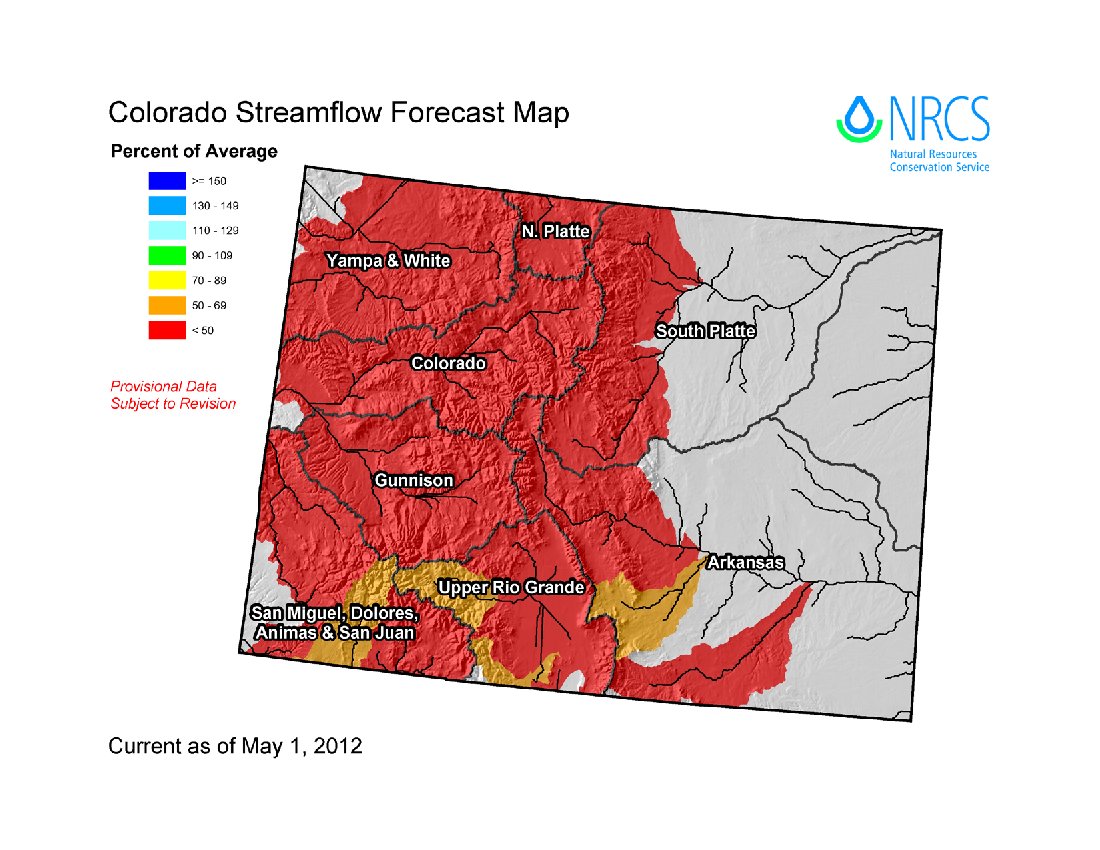
Click on the thumbnail graphic for the May 1 streamflow forecast map for Colorado. The map mirrors the snowpack map except for four sub-basins along the southern border of Colorado. Here’s a preview of the report:

As we head into the high water demand season, the prospects for improved runoff conditions continue to diminish. The continuation of dry conditions in April resulted in significant reductions in streamflow forecasts for the second month in a row. Most of those decreases ranged from 5 to 20 percentage points. The highest forecasts in the state, which are still calling for less than 50 percent of average volumes, are in the Upper Rio Grande River basin and in the rivers in the southwest corner of the state. The majority of the state’s streams and rivers are expected to produce only 20 to 40 percent of average volumes. The lowest runoff volumes are expected in northern Colorado, where streamflows are expected to be 15 to 30 percent of average. With much of the meager snowpack already melted we can only hope for abnormally wet conditions for the remainder of this spring and into the summer to alleviate shortages.

Data from the storm over the weekend and yesterday is not reflected in the report. In 2010 there were two separate peaks in the South Platte basin in May. Last year we saw three peaks during May. One of my colleagues tells me, “You sound like a farmer.” I guess it’s a glass half-full way of thinking. I have talked to one farmer who is not planting part of his place this year fearing the lack of ditch water late in the season for finishing corn.

The Colorado Water for the 21st Century Updated Roadmap is hot off the press

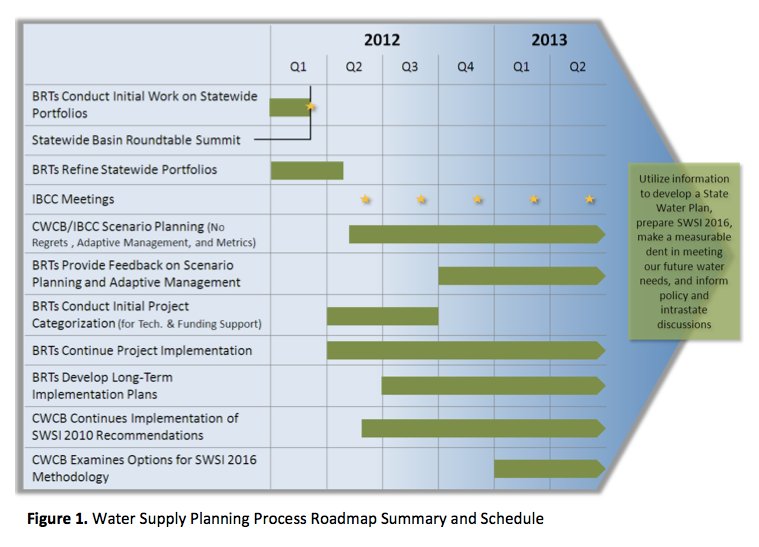
coloradowaterfor21stcenturyroadmap05022012.jpg

Click here for Director Stulp’s memo. From email from John Stulp:

More IBCC — basin roundtables coverage here.

Two reports back position that hydraulic fracturing can impact groundwater resources

gelledhyrdraulicfracturingfluid.jpg

From the Glenwood Springs Post Independent (John Colson) via The Durango Herald:

Both reports were prepared by independent hydrologist Tom Myers, Ph.D., of Reno, Nev., whose clients include government agencies and environmental groups. One report, issued April 30, summed up Myers’ assessment of the Environmental Protection Agency’s investigation into water-well contamination in 2010 and 2011 in the area around Pavillion, Wyo., a region of extensive natural-gas drilling activity…

A second report, commissioned by the National Ground Water Association, concludes that chemicals used in the fracking process would migrate upward toward drinking supplies much more quickly than earlier believed. The association is a nonprofit group that represents scientists, engineers and businesses in the groundwater industry.

The study, published in the April-May edition of the journal Ground Water, concludes that scientists incorrectly have theorized that rock layers between the deep gas-bearing zones and the shallower aquifer zones are essentially “impermeable” and protect against migration of chemicals from one zone to the other. Myers wrote in his report that, based on computer modeling, natural faults and fractures permeate the Marcellus Shale formation that lies under large parts of New York, Pennsylvania, West Virginia and nearby states. When human-made fractures intersect with the natural fault lines, Myers theorized, “contaminants could reach the surface areas in 10 years or less.”

More oil and gas coverage here and here.

Snowpack/drought/runoff news: Drought preparedness workshop May 15 in Pueblo

usdroughtmonitor05012012.jpg

From The Pueblo Chieftain (Chris Woodka):

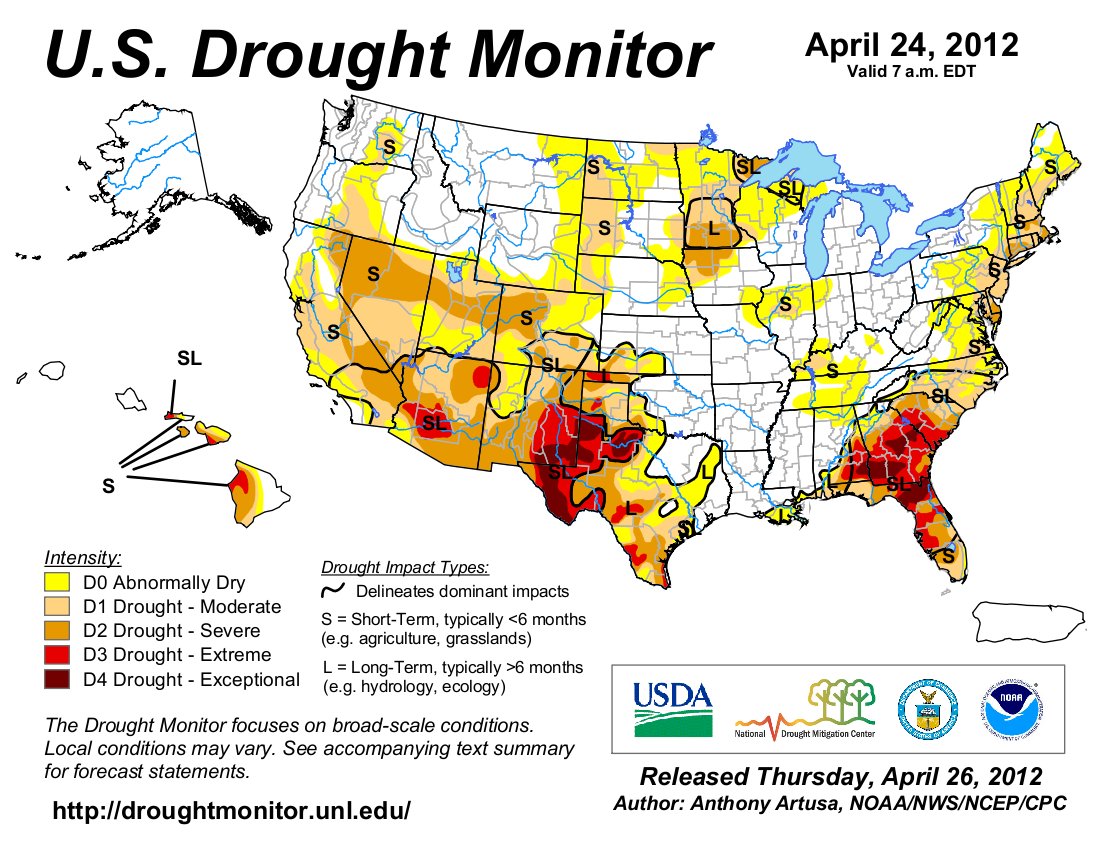
A drought preparedness workshop will be from 10 a.m. to 3:30 p.m. May 15 at the Colorado State Fairgrounds in the Creative Arts Building, 1001 Beulah Ave. Registration will start at 9:30 a.m. The outlook for water supply, agricultural risk management and managing weeds will be among the topics to be discussed.

More drought coverage from Scott N. Miller writing for the Vail Daily. From the article:

A group of representatives of those businesses — members of the local chapter of the Associated Landscape Contractors of Colorado — gathered Friday at Donovan Pavilion for updates about topics including this summer’s water supply prospects and drought-tolerant plants. When Mike Earl, of Land Designs by Ellison, was putting the May meeting together in February, Diane Johnson, of the Eagle River Water and Sanitation District, told him she didn’t really want to talk about drought just yet. After Colorado’s driest March on record, it was time to talk about water supplies, Johnson said…

Todd Fessenden, the district’s operations manager, said that for now, the standard outdoor watering regulations are in effect — people water every other day except Monday based on their street addresses. If the district declares a “supply emergency” though, virtually all outdoor watering will be banned, whether in specific areas or across the entire eastern part of the valley.

From the Estes Park Trail (Julie Harvey):

“Our source of water is more than enough,” [Estes Park Mayor Bill Pinkham] told residents attending the chat at the Art Center last Wednesday. “We’re fortunate because of the water allocation (at) headwater and leases. You’ll hear about that at the next (town) board meeting.”

From KUSA.com (Megan Fitzgerald):

Typically, the snow run off fills up ditches and farmers are able to irrigate their crops, but that’s not the case this year. Farmers say the surface water could run out at any time and their options for taking care of their fields will be limited.

“It’s a huge issue, I consider water more valuable than gold. We can’t survive without it,” Glen Fritzler, a Weld County farmer said.

Fritzler and his family have been farming for generations. He says it’s all he knows and it’s the only job he would want to do. But, now that the surface water supply is running out, Fritzler says his only option is well water. But even that is limited ever since the drought in 2002.

“We cannot operate our wells like we have in the past or like we need to to grow out produce,” Fritzler says.

From the Fairplay Flume (Lynda James):

Drought conditions in the Upper South Platte sub-basin, which includes Park County, harken back to 2002, when Colorado was hit by the largest wildfire in its history, the Hayman fire, which started in Park County. As of May 1, snowpack in the sub-basin – which also includes small portions of Jefferson, Douglas, Teller and Clear Creek counties – had dropped to 19 percent of average and 16 percent of last year’s snowpack on May 1. As of April 1, Colorado as a whole had the lowest snowpack percentage since 2002 and the second lowest in the 45 years data has been collected. In March, the South Platte River Basin, which covers the sub-basin and most of the northeastern part of Colorado, had precipitation that was 17 percent of average for that month, which was the lowest in the state…

Most of Park County is listed as D0, abnormally dry. The northwest and southeast corners of the county are classified as D1, moderate drought…

[Garver Brown, Division 1, District 23 water commissioner’s] email said that on April 1, the snowpack in the Upper South Platte watershed was 49 percent of average for April 1 and 51 percent of last year. This is 6 percent less than the average for the entire South Platte Basin. Brown wrote that on April 29 the snow water equivalent at the six Upper South Platte SNOTEL sites was 25 percent of the May 1 average. Total snow water equivalent for the entire South Platte River Basin using SNOTEL sites was 35 percent. Snow survey sites were measured on April 30. Brown personally collects data from three of the ten Upper South Platte sites. Data is collected at the end of each month from January through April. Brown said the April 30 data from snow surveys will be combined with SNOTEL data to update the May 1 snowpack and snow water equivalent maps. The May 1 maps were not available before press time. Brown emailed The Flume May 1 data for the Upper South Platte – using both SNOTEL and snow survey sites. Snowpack had dropped to 19 percent of average and 16 percent of last year’s snowpack on May 1…

Brown wrote that the river call is affecting irrigation rights in District 23, with nearly all irrigation rights “called out” by this senior call. He wrote that several river calls occur during the summer each year, but an 1871 river call at this time of year is unusual compared to a normal snowpack year. “With such a low snowpack, I would expect senior calls to last during the entire irrigation season absent significant rain events,” Brown wrote. According to the Colorado Division of Water Resources, that 1871 call extends throughout five other water districts, including District 80 in northeast Park County.

Larry Schwartz named to Water Court Division 2

arkansasbasinalluvialaquifersubregions.jpg

The Pueblo Chieftain has a new format that does not seem to allow deep links. Click here for the online article (Chris Woodka). You can then follow the links through the new online edition. From the article:

Last month, Schwartz was named the new water judge for Division 2. Unlike district courts, which follow county boundaries, the water courts are separated into seven divisions according to the drainage basins of major rivers. Division 2 covers the entire Arkansas River basin. Luckily, Schwartz’s fishing spot is near Crested Butte in the Gunnison River basin — so, no conflict of interest there…

“Water law has always been interesting to me,” Schwartz said, when asked why he applied for the water judge job. “It’s always amazing to look at the technical information and preparation that goes into these cases.”

Schwartz, 56, who studied some oil and gas law at the University of Oklahoma law school, never practiced water law. A graduate of Central High School and the University of Southern Colorado, Schwartz returned to Pueblo after law school and worked in the district attorney’s office for two years before going into private practice. He became a district court judge in 2008. He and his wife, Julie, have three grown children.

More water law coverage here.

Colorado Water 2012: The Custer County Library District is planning a special water display from May 15 – 25

wetmountainvalley.jpg

From The Wet Mountain Tribune:

From May 15 through May 25, the West Custer County Library District will be hosting a water display and film to commemorate the 75th anniversary of legislation regarding management of Colorado’s water resources. Partnering with the Natural Resources Conservation Service (NRCS), the Custer Conservation District, and the CSU Extension office, the Library is participating in Governor Hickenlooper’s “Year of Water” project.

Library director Marty Frick explains that “Colorado Water 2012” is the governor’s idea for celebrating the creation of water organizations from the three-quarter century old legislation. In a state almost entirely defined as desert or semi desert, water is precious—perhaps one of the most controversial assets the state has. Hickenlooper partnered with the Supreme Court, Colorado Art Institute and libraries across the state to create the travelling eight-foot long triptych accompanied with the film, “The American Southwest: Are We Running Dry?”

In addition to statewide information about water and The West, the display will have local information provided by NRCS, the Conservation District, and the CSU Extension office.

On the afternoon of Wednesday, May 16, Custer Conservation District Manager Carol Franta and CSU Extension Agent Robin Young will present the River Trailer Education Program at the Custer County Schools. The River Trailer travels to schools and events to teach children and adults about watersheds, the water cycle, water conservation, and stream bank restoration. It’s a very effective hands-on tool, popular with young and old alike.

A free showing of “The American Southwest: Are We Running Dry?” is scheduled for Wednesday, May 23, at 5 p.m. in the community room adjacent to the library, 209 Main St. in Westcliffe. The 80 minute movie will inform viewers about water reuse, consequences of urban growth, water policy and solutions such as desalination, rainwater harvesting and green construction.

Stop by the library to see the water display during regular library hours, Tuesday through Friday from 10 a.m. to 5:30 p.m. and Saturday from 10 a.m. until 2 p.m. Call 783-9138 for more information.

More Colorado Water 2012 coverage here.

‘It just speaks to how increasingly difficult it is to get a project like this put on line’ — Janet Rummel (Colorado Springs Utilities)

sdspreferredalternative.jpg

From the Colorado Springs Independent (Pam Zubeck):

Even with recent good news regarding interest rates, SDS is going to cost ratepayers about $1.6 billion, including interest. Complications, of course, could drive the cost higher. And quite a few have been popping up lately.

A contrary court ruling. A competing reservoir plan. Skirmishes over access to engineer the 60-mile line from Pueblo Reservoir. Unresolved deals for real estate and trenching.

Utilities thought it was home-free last year after negotiating a long-term storage deal in Pueblo Reservoir with the federal government. It’s already installed 20 miles of pipe and acquired 63 percent of the roughly 300 parcels it needs. So what could go wrong?

Plenty, apparently.

“It just speaks to how increasingly difficult it is to get a project like this put on line,” Utilities spokeswoman Janet Rummel says. “At this time, we believe we can continue to manage these risks within the approved budget.”

More coverage from Chris Vanderveen writing for 9News.com. From the article:

The Southern Delivery System will, when completed in 2016, bring 78 million gallons of water a day from the Pueblo Reservoir to Colorado Springs.

Major construction began on the 60-mile pipeline last year.

“Colorado Springs Utilities has been planning on the Southern Delivery System since really the late 80s,” SDS spokesperson Janet Rummel said. “It’s really going to help insulate us from a drought like we saw in 2002.”

It’s impossible not to notice the massive project in Pueblo West. Construction crews are feverishly digging trenches to house the pipeline. It’s often grueling work, requiring crews to dig into land that is flush with rock…

What is clear is that the project is providing much-needed relief for a construction industry that has been hit hard by the economic downturn. Jared Nessler works for HCP Constructors and is based out of Pueblo West. “We started working on SDS early in 2011,” he said. This job, he said, is right in his backyard.

More Southern Delivery System coverage here and here.

NIDIS Weekly Climate, Water and Drought Assessment Summary of the Upper Colorado River Basin

wyutcoprecipitation0401to04282012.jpg

Click on the thumbnail graphic for the precipitation summary. Click here for the summaries from the Colorado Climate Center.

More Colorado River Basin coverage here.

Habitat Work to Improve Arkansas River Below Leadville

arkansasriverleadville.jpg

From the Summit Daily News (Janice Kurbjin):

This summer, fish habitat enhancement work is slated to begin on public parts of the upper Arkansas River below the Highway 24 bridge. Biologists and engineers with Colorado Parks and Wildlife will take a hard look at what natural resource impacts are evident due to high metal content. It should set the stage for restoration alternatives to be developed.

The project continues the federal and state work to restore the California Gulch Superfund site, an 18-square mile area where historic mining activities discharged heavy metals and acid into California Gulch at the headwaters of the Arkansas River. Heavy metals make it hard for fish to sustain healthy populations.

Currently, trout can live in the river because of earlier mine cleanup efforts.

“The planning for this project has been going on for many years and people in the area (say they are) are excited to see it moving forward,” said Greg Policky, aquatic biologist for Colorado Parks and Wildlife in the area. “By this summer we hope to be in the river and physically manipulating the habitat to restore the environment for aquatic life in that section. Over the next few years, we hope anglers will start to see the benefits.”

Improvements will be centered on an 11-mile stretch of the river from California Gulch downstream to Twobit Gulch.

More restoration/reclamation coverage here.

American Water Works Association: Drinking Water Week — May 6 – 12

drinkingwaterweek2012.jpg

Click here to go to the AWWA webpage. They write:

For more than 30 years, the American Water Works Association and its members have celebrated Drinking Water Week – a unique opportunity for both water professionals and the communities they serve to join together to recognize the vital role water plays in our daily lives. Join AWWA in celebrating the essential by celebrating water.

From The Fort Morgan Times:

The City of Fort Morgan is joining with the American Water Works Association (AWWA) and water professionals across North America to celebrate Drinking Water Week May 6-12 and to highlight the importance of investing in water infrastructure.

“We all agree that water is an essential element in our daily lives, but for North Americans, water service is a convenience that we too often take for granted,” said Mitch Church, city water distribution superintendent. “Those buried pipes deliver the water that is vital to our quality of life and economic vitality. They are among our most valuable community assets, and we need to assure they are in good working order for the next generation.”

Much of the drinking water infrastructure in Fort Morgan was constructed by previous generations during the early 1900s, the 1920s and during the post-World War II boom. Many of the water mains from all three eras must be replaced or repaired in the next 25 years.

In fact, according to a recent AWWA study titled “Buried No Longer: Confronting America’s Water Infrastructure Challenge,” the cost of repairing and expanding U.S. drinking water infrastructure will top $1 trillion in the next 25 years. That figure will rise to $1.7 trillion by 2050.

The City of Fort Morgan has more than $5 million in water distribution infrastructure upgrades planned in the next five years.

Addressing these issues will be costly, but not insurmountable, according to the “Buried No Longer” report. Facing them head-on by proactively investing in tap water systems is a smart, safe, common sense investment that will pay off for generations to come.

More infrastructure coverage here.

Parker: The quest for a sustainable water supply leads to political fallout over Rueter-Hess Reservoir and water rights purchases

rueterhesswithwaterexample1.jpg

From the Parker Chronicle (Chris Michlewicz):

Tracy Hutchins, who served on Parker Town Council for eight years, has turned her attention to what she believes is negligence by the water district’s top authorities. She is decrying, among other dealings, the $7.7 million investment in farms and water rights in the Sterling area because she says the district has no way to transport the water back to Rueter-Hess Reservoir, a $105 million project that PWSD officials say is vital for storing water for Douglas County’s future. Instead of relying on underground aquifers that are rapidly being depleted, Parker Water planned Rueter-Hess as a mechanism to store water from wet years for use during times of drought. PWSD customers voted in 2004 to approve a bond issue that would use tap fees from ongoing development to pay for the reservoir construction. Hutchins says many Parker residents don’t know that when the real estate market crashed, the ratepayers were suddenly on the hook for the tab, which now stands at $97 million.

“In the bond election, we said we would use all means and methods necessary, including a tax increase in the event we could not make payments,” said Jim Nikkel, project manager and assistant district manager for PWSD. The quasi-governmental agency raised its mill levy for the 2011 tax year. Nikkel says water rate increases offset rising utility costs and don’t pay for the reservoir debt.

Hutchins says poor planning has saddled Parker’s water customers with debt, and the reservoir, which was officially opened in March, has only a puddle of water in it.

More Parker coverage here and here.

Routt County: The Board of Commissioner’s pony up $1 million in tax dough for two conservation easements

elkheadagnermountainranches052012.jpg

From Steamboat Today (Tom Ross):

The first property is Elkhead Ranch, where 1,560 acres of agricultural land will be conserved in the foothills of the Elkhead Mountains about 16 miles north of Hayden. The ranch is visible from Routt County Road 56.

The second is the Agner Mountain Ranch, where 1,337 acres of conserved agricultural land and wildlife habitat will be added to the 1,237 acres already under easement. The southern two-thirds of the ranch is typified by rolling hills covered in a mix of gambel oak and sagebrush. Calf Creek runs through the valley below, and Buck Mountain is a nearby landmark.

The Colorado Cattlemen’s Agricultural Land Trust will hold the conservation easements.

Funding for the county’s purchase of development rights program comes from 1.5 mills of voter-approved property taxes that were renewed most recently in 2006. The purchase of development rights program is intended to give landowners an economically attractive alternative to selling land for development by instead compensating them for the development rights they agree to put under a conservation easement. By giving up those future development rights, the owners typically donate more than half of the appraised value of the land.

More Yampa River basin coverage here.

A report from Protect the Flows pegs the Colorado River recreation industry at $26 billion and a quarter of a million jobs

coloradoriverincprotecttheflowsmay2012.jpg

Thanks to U.S. Senator Mark Udall for the link. Here’s the report from Udall’s Scribd page.

From The Grand Junction Daily Sentinel (Matthew Berger):

The study, commissioned by Protect the Flows, a coalition of recreation and tourism businesses, also found that the river produces $26 billion in economic output, generated primarily by the recreation and tourism industries. By far the largest share of that total, $9.6 billion, occurs in Colorado.

The 234,000 jobs that the study, through surveys and economic modelling, found the river supports would place it ahead of companies like General Motors, Boeing and Disney. “That’s a pretty conservative number,” noted Protect the Flows’ Molly Mugglestone. “These are direct jobs we’re talking about.” They do not include the less direct economic benefits the river provides to farmers, ranchers, cities and power companies, nor to river users in Mexico. In order to ensure the river continues to be able to support those jobs, a summit of business and government leaders met Friday in Denver to discuss the report’s findings.

“You don’t have to spend much time around rivers to understand their importance,” said Sen. Mark Udall, D-Boulder. “The cynics might scoff at nonconsumptive uses…but it’s tough to know the value of something until it’s gone,” he said, referring to water that is left in rivers rather than withdrawn for irrigation or other consumptive uses.

More coverage from Catharine Tsai writing for the Associated Press via The Denver Post. From the article:

Southwick Associates Inc. developed the report by first conducting a telephone survey of people in all Colorado River basin states except California from Jan. 24 to Feb. 12 to estimate how many people hike, fish, raft, camp, picnic or otherwise play on the river system and how often. President Rob Southwick said California was excluded because only a small part of the state uses the river for recreation. Then, researchers matched the survey results with data on spending on travel and equipment for outdoor activities to estimate economic impacts. The study estimates that business activity from recreation focused on the river system supports about 234,000 jobs in Arizona, Colorado, Nevada, New Mexico, Utah and Wyoming and generates more than $1.6 billion in federal taxes annually and $1.6 billion in state and local tax revenues.

The figure of $17 billion in direct spending from river recreation would likely be higher if visits from outside the region were included, said Sarah Sidwell, manager of Tag-A-Long Expeditions in Moab, Utah. Sidwell said 40 percent of customers for her rafting and off-road business are international. “Our stake in this is huge,” Sidwell said of keeping the river system healthy. “We need to have a flowing river in order for me to have a job and 100 part-time employees to have jobs.”

Rhett Bain, owner of Reel Deal Anglers in Jackson, Wyo., said a seasonal guide for his business earns about $30,000 in 90 days including tips.

More Colorado River basin coverage here.

Rifle: Council approval of a $25.5 million loan application for new water treatment plant is drawing a lot of attention

watertreatment.jpg

From the Rifle Citizen Telegram (Mike McKibbin):

The city has decided to pursue a $25.5 million loan from the Colorado Water and Power Authority to fund the proposed plant, and to ask city voters to approve a half-cent sales tax to help keep water rates from more than doubling. The issue has been appealed by Rifle resident and former Silt mayor John Steele, who turned in a petition signed by 300 people in support of his action. At the Tuesday meeting, City Manager John Hier and Louis Meyer, a professional engineer with Schmueser Gordon Meyer, the city’s design consultant on the project, detailed the history and problems with the Graham Mesa water treatment plant and the smaller Divide Creek plant.

The Graham Mesa plant was built in 1982 and uses technology from the 1970s, Meyer said. That has led to a lack of replacement parts and “fabricating” different solutions to keep the plant operating and meet water quality standards, Hier said. Meyer said the plant has a 4.5 million gallons per day treatment capacity, and the city’s peak demand in 2009 was 4.41 million gallons a day. “You don’t want to ever push a plant that close to the limit,” Meyer said. “You get all kinds of operating problems because it’s such an old plant.”

Meanwhile, some Rifle citizens want a say in the new plant at the polls so they’ve delivered enough petition signatures to force a vote. Here’s a report from Jenny Lavey writing for the Rifle Citizen Telegram. From the article:

John Steele, a 12-year Rifle resident and former mayor of Silt, submitted a petition to place a question on this November’s general election ballot regarding city council’s recent approval of a $25.5 million loan for construction of a new water treatment plant. The petition was submitted to City Clerk Lisa Cain on Monday, April 30, and requests council either rescind or review their decision authorizing the loan amount, which in turn would increase the rate of Rifle water users to repay the loan.

Additionally, the loan would require a public vote for a half-cent sales tax hike for the city to be able to keep up with operation costs of the new plant. “It was phenomenally hard work, but very enlightening,” Steele said of gathering the signatures.

Cain must now verify every signature on the petition is that of a Rifle resident and registered voter, then notify Steele of by mail if his petition was accepted or denied. As of press time, Cain said she was reviewing the petition in accordance with the city charter and state statutes.

Legally, Steele had to collect at least 265 signatures of registered voters living in Rifle city limits by April 30. The petition had to be received by Cain 10 days after publication of the ordinance, which was done on April 20, according to Steele.

More water treatment coverage here.

BLM takes cues from the Colorado Oil and Gas Conservation Commission with proposed rules for hydraulic fracturing chemical disclosure

derrick.jpg

Here’s the release from Governor Hickenlooper’s office (Eric Brown):

The U.S. Bureau of Land Management announced today new hydraulic fracturing regulations for oil and gas development on BLM-administered public lands. The rules include chemical disclosure regulations similar to those developed and implemented in Colorado. “We are pleased that the Bureau of Land Management modeled its disclosure requirements for fracturing fluids after the Colorado rule, which is the most protective and transparent in the country as it requires the disclosure of the chemicals as well as their purpose and concentrations,” Hickenlooper said. The federal rules affect activity on BLM lands, but the Colorado regulations still apply. Like the Colorado rule that took effect April 1, 2012:

· The BLM rule will require disclosure of fracturing fluids, including each chemical and additive trade name and purpose, as well as the concentration of each ingredient.

· Limited trade secret protection is provided.

· The BLM rule requires mechanical integrity testing and cement bond logs to ensure well integrity, as well as reporting on volume of fracturing fluids, proppants, chemicals and water, pressures, volume of recovered flowback fluid and methods used for managing and disposing of the flowback fluids.

Here’s the release from the U.S. Deparment of Interior (Adam Fetcher/Megan Crandall):

In support of President Obama’s all-of-the-above energy strategy, and the Obama administration’s goal of continuing to expand responsible oil and gas production, Secretary of the Interior Ken Salazar today announced the release of a proposed rule to require companies to publicly disclose the chemicals used in hydraulic fracturing operations on public and Indian lands, with appropriate protections for proprietary information.

Currently, there is no specific requirement for operators to disclose these chemicals on federal and Indian lands, where approximately 90 percent of the wells drilled use hydraulic fracturing to greatly increase the volume of oil and gas available for production. The proposed rule would require public disclosure of chemicals used during hydraulic fracturing after fracturing operations have been completed.

This common-sense measure, which builds on the preliminary input received from the public, industry, tribal representatives, and other stakeholders, supports the continued development of America’s abundant oil and gas resources on federal and Indian lands by taking steps to ensure public confidence in well stimulation techniques and technologies, including hydraulic fracturing. It is also in line with steps that some states have already taken, requiring operators to disclose the chemicals they use in activities on state lands.

The draft rule, which can be viewed here along with economic analysis and an appendix, also contains two additional, commonsense measures to ensure development continues safely and responsibly:

Improving assurances on well-bore integrity to verify that fluids used in wells during fracturing operations are not escaping; and
Confirming that oil and gas operators have a water management plan in place for handling fracturing fluids that flow back to the surface.
Already, technological advancements like hydraulic fracturing have allowed development of previously uneconomic natural gas and oil deposits. In fact, since 2008, U.S. oil and natural gas production has increased each year. In 2011, U.S. crude oil production reached its highest level in 8 years, and U.S. natural gas production grew in 2011 as well – the largest year-over-year volumetric increase in history – easily eclipsing the previous all-time production record set in 1973. Overall, oil imports have been falling since 2005, and oil import dependence declined from 57 percent in 2008 to 45 percent in 2011 – the lowest level since 1995.

During the first three years of the Obama Administration combined, federal oil production has increased by 13 percent and total natural gas production from onshore public lands has increased by six percent, compared with totals from 2006-2008. This proposed rule will strengthen the requirements for hydraulic fracturing performed on federal and Indian lands in order to build public confidence and protect the health of American communities, while ensuring continued access to the important resources that make up our energy economy.

“As the President has made clear, this administration’s energy strategy is an all-out effort to boost American production of every available source of energy,” said Secretary Salazar. “As we continue to offer millions of acres of America’s public lands for oil and gas development, it is critical that the public have full confidence that the right safety and environmental protections are in place. The proposed rule will modernize our management of well stimulation activities – including hydraulic fracturing – to make sure that fracturing operations conducted on public and Indian lands follow common-sense industry best practices.”

The measures contained in the draft rule are consistent with the goals first outlined by Secretary Salazar in November 2010 during a forum on hydraulic fracturing on public lands to examine best practices to ensure that natural gas on federal and Indian lands is developed in a safe and environmentally responsible manner.

In developing the proposed rule, Interior’s Bureau of Land Management (BLM) sought feedback from a wide range of sources, governments, industry, members of the public and other interested stakeholders.

Under the Department’s unique relationship with Indian tribes, BLM began formal tribal consultations in January 2012 – including outreach, communication and substantive discussions – with tribal governments about the proposed rule’s ongoing development, in the spirit of trust, respect and shared responsibility in providing tribal governments an expanded role in informing federal policy that impacts Indian lands. Consultation with tribal leaders remains ongoing and will continue throughout the rulemaking process.

Once the proposed rule is published in the Federal Register, a 60-day public comment period will begin, during which the public, governments, industry and other stakeholders are encouraged to provide their input.

“The BLM recognizes the importance of all domestic energy sources to the welfare and security of this nation,” said BLM Director Bob Abbey. “The proposed rule will move our nation forward as we ensure responsible development while protecting public land resources.”

Current BLM regulations governing hydraulic fracturing operations on public lands are more than 30 years old and were not written to address modern hydraulic fracturing activities.

The proposed rule seeks to maximize flexibility, minimize duplication and complement ongoing efforts in some states to regulate fracturing activities by providing a consistent standard across all federal and Indian lands and making reported information easily accessible to the public. For instance, the BLM is working closely with the Ground Water Protection Council and the Interstate Oil and Gas Commission in an effort to integrate the disclosure called for in the proposed rule with the existing program known as FracFocus.

Also in line with President Obama’s April 13 Executive Order to coordinate the efforts of federal agencies responsible for overseeing domestic natural gas development, the proposed rule released today received important interagency feedback.

Recent technology and operational improvements in extracting unconventional oil and gas resources have increased drilling activities across the country. The sharp rise in domestic production has improved U.S. energy security and created jobs, and as with any resource the administration is committed to ensuring that we continue to leverage these resources on federal and Indian lands safely and responsibly.

The proposed rule would apply to BLM-managed mineral estate, including 700 million subsurface acres of federal estate and 56 million subsurface acres of Indian mineral estate.

More coverage from The Grand Junction Daily Sentinel (Dennis Webb):

The proposal would update hydraulic fracturing rules that are more than 30 years old and don’t address modern-day fracturing activity. It also includes rules designed to ensure fracturing fluids don’t escape along well bores, and are properly handled upon their return to the surface…

The BLM measure would include a trade-secret exemption, as in the case of Colorado’s. And as with Colorado’s rule, disclosure wouldn’t have to occur until after fracturing takes place.

Critics say advance disclosure is needed in order to know what chemicals to test for to compare groundwater conditions before and after fracking.

“Communities shouldn’t have to wait for that information until after the deed is done. We hope the agency will strengthen this proposal before it becomes final,” Amy Mall, senior policy analyst at the Natural Resources Defense Council, said in a statement.

Barry Russell, president and chief executive officer of the Independent Petroleum Association of America, said in a release, “BLM’s proposed regulations, which would mandate one-size-fits-all regulations on well construction and hydraulic fracturing operations on these lands, are redundant. They will undoubtedly insert an unnecessary layer of rigidity into the permitting and development process.”

The proposal is subject to a 60-day public comment period.

More oil and gas coverage here and here.

Arkansas River Basin Water Forum recap: Dick Bratton’s keynote focused on water politics in Colorado

dickbrattongreghobbsjimpokrandtcfwepresidentsreception2011.jpg

From The Mountain Mail (Joe Stone) via Leadville Herald-Democrat:

Bratton’s talk focused on water politics in Colorado, which he summarized as “how to influence water decisions.” Because water management affects all Coloradans, Bratton said, “it becomes important for an informed public to understand the consequences of water use, which persons and entities might affect its use and how to influence their decisions.

“If you work in water, then your success could be determined by how well you utilize politics to your advantage.” Bratton emphasized the “chain of interrelationships” of multiple interests in the “limited supply of water available for increasing beneficial uses in Colorado.” The likely consequence of this is that competing interests will more readily enter into voluntary agreements to save time and money and avoid the uncertainty of litigation.

More Arkansas River basin coverage here.

Snowpack/drought/runoff news: The South Platte Basin is sitting at 32% of average, statewide = 20%

snowpackcolorado05042012.jpg

From The Greeley Tribune (Eric Brown):

Statewide snowpack as of May 1 was 19 percent of the 30-year average, according to a report released by the Natural Resources Conservation Services office in Colorado late Thursday afternoon.

That ties for the state’s worst snowpack on record for May 1.

Only May 1, 2002, — a historic drought year for the state — was as bad.

At 21 percent of average, the Colorado River Basin’s snowpack on May 1 of this year was at a record low.

While the Colorado River flows from the mountains in the opposite direction of Greeley and Weld County, the river makes up a sizeable portion of the water that goes into the Colorado-Big Thompson River Project — which transports Colorado River water from the Western Slope and flows to more than 640,000 acres of irrigated farm and ranch land and to about 850,000 people in eight northern Colorado counties.

This year’s May 1 report showed the South Platte River Basin’s snowpack — which accounts for the rest of the water supply in northern Colorado — was at 25 percent of average. That’s the third-worst mark on record for the basin on May 1.

From The Mountain Mail (Joe Stone) via the Leadville Herald Democrat:

Summer precipitation would be good news for state water managers and firefighters, but even Doesken acknowledged, “More than a week out, weather projections get really difficult.” Nonetheless, Doesken said data indicate the currently dominant La Niña weather pattern may be giving way to a wetter (for Colorado) El Niño pattern. Doesken presented data from around the state that shows below-average precipitation, which he described as “unsettling.”

March 2012, he added, is one of the three warmest and driest Marches on record in Colorado, similar to March 1910. Doesken said the Arkansas Basin has been “chronically dry since the wet summer of 2010.” Walsenburg, for example, “has large, Dust Bowl-type (precipitation) deficits.” With dwindling snowpack, Doesken said, conditions are similar to 2002.

Snowpack measurements at the Fremont Pass Snowpack Telemetry, or SNOTEL, station are slightly better than 2002 readings, he said. Unfortunately, Doesken said, snowpack at the Porphyry Creek SNOTEL station just west of Monarch Pass has already melted out, just as it did in 2002.

clearcreekatgoldengage05062012.jpg

I get alerts from the USGS when the Clear Creek at Golden gage exceeds 200 cfs. We’re seeing a bit of a meltout this weekend.

From the current Northern Colorado Water Conservancy District newsletter (Brian Werner):

Dry weather is a normal part of life in Colorado, and while we enjoy the abundant sunshine and humidity-free days, our arid climate brings risks. Farmers worry about crops getting enough moisture. Cities impose watering restrictions. Tap fees grow more costly.

This year, our snowpack is in many places lower than in 2002, the year of Colorado’s last significant drought. That’s when Colorado suffered the quadruple whammy of low snowpack, well below average stream runoff, lack of precipitation and high temperatures.

This is just part of life in Colorado. At the same time, the economic health of Colorado’s farmers, ranchers, businesses and citizens depends on a reliable water supply.

The current dry year has attention focused once again on water supplies and an opinion piece by Rep. Cory Gardner reiterates the need for storage to carry us through the dry years.

From The Aspen Times (Andre Salvail) via the Glenwood Springs Post Independent:

Typically, the 12,095-foot [Independence Pass} opens the Thursday before Memorial Day weekend, which falls this year on May 24. Thanks to the below-average snowpack this year, which high daytime temperatures had melted by Tuesday, CDOT plans to open the pass by 11 a.m. on May 11. CDOT maintenance patrol supervisor Don Poole said there was a huge difference between clearing the road this year and last year, when his crews worked feverishly through late May to open the road on the afternoon of May 26, just in time for the traditional Memorial Day weekend start. “The difference between the two years was amazing,” Poole said. “It’s clear on both sides all the way to the top. We’re just taking advantage of the good weather and time we have to get some other maintenance done up there, mainly cleaning the ditches, fixing signs, repairing the potholes, getting some other stuff done.”[…]

“About the deepest we got into this year was 12 feet,” Poole said. He said the weather atop the pass has been good but breezy in recent days.

Colorado River District news: Work is ongoing to acquire water for a drought pool in Ruedi Reservoir

coloradoriverbasincgs.jpg

You can download a copy of the newsletter here. Thanks to Jim Pokrandt (Colorado River District) for sending it along in email.

The newsletter is dominated by drought news about conditions in the Upper Colorado River basin and the need for conservation. Here’s an excerpt:

A dry year always highlights the importance of the Shoshone Hydro Plant in Glenwood Canyon and the non-consumptive flows it pulls down the river with its senior water right. In recent years, the nearly century old plant has often been offline for maintenance issues and not calling for water.

If Shoshone is not calling for water in the warm months when flows are naturally declining, the effects reach across the rafting industry, municipal water use and irrigation needs.

In recent summers, water users and reservoir owners, including the Colorado River District, the Bureau of Reclamation and Denver Water, have cooperated with a Shoshone Protocol to make the river flow as if the Shoshone Plant were operating with near its 1,250 cubic feet a second water right. The Shoshone outlook for this summer is uncertain. Currently, the plant is not operating at full capacity.

Another important effect of the Shoshone plant calling for water is that it usually holds off the Cameo water rights call by the Grand Valley irrigators. A Cameo call often rebounds up the Roaring Fork River and other tributaries as well as up the mainstem.

The board of directors voted unanimously to support the National Ski Areas Association lawsuit agains the U.S. Forest Service. Here’s the lowdown from the newsletter:

The Colorado ski industry is contesting a federal directive that water rights used in conjunction with ski area permits be assigned to the U.S. Forest Service. The National Ski Areas Association believes this usurps private property rights and has filed suit against the Forest Service.

The Colorado River District Board of Directors passed a resolution to support the ski areas’ case.

It says:

WHEREAS, permit holders that utilize federal lands have filed for and developed Colorado state water rights for the benefit and advancement of their use of the permitted lands; and

WHEREAS, these water rights have been obtained through expenditure of significant funds and are private property rights under Colorado law; and

WHEREAS, the United States Forest Service has recently issued interim directives regarding use and assignment of
water and water rights associated with federal permits for ski area operators; and

WHEREAS, these directives limit the use and assignment of privately developed and privately owned water rights; and

WHEREAS, these directives are likely to discourage private investment in ski areas and associated economic recreational activities;

NOW THEREFORE BE IT RE- SOLVED that the Colorado River Water Conservation District opposes any federal requirement that holders of land use permits assign their privately owned water rights to the United States or otherwise restricts the transfer of their water rights for the benefit of the United States in order for the permittee to obtain, modify or renew federal permits.

Legal counsel was instructed to pre- pareafilingofa“friendofthecourt”brief in the case.

More Colorado River basin coverage here.

Pueblo County officials plan to hold Colorado Springs Utilities feet to the fire for stormwater improvements for Fountain Creek

sdspreferredalternative.jpg

From The Pueblo Chieftain (Chris Woodka):

SDS, a pipeline under construction from Pueblo Dam to El Paso County, needs the federal permit in order to take water from Lake Pueblo.
The federal permit also is a key element of the Pueblo County 1041 permit issued in March 2009. In a letter to Colorado Springs Mayor Steve Bach and City Council President Scott Hente, the commissioners point out that council assured Pueblo County it would develop a replacement source of funding when it abolished the stormwater enterprise in December 2009.

“Now 2 1/2 years later, the city has yet to establish assured stormwater funding,” Commissioners Anthony Nunez, Jeff Chostner and John Cordova wrote in the letter sent Thursday. “Colorado Springs is the largest municipality in the state of Colorado without a stormwater enterprise or other assured mechanism to maintain and improve stormwater infrastructure.”

The letter makes it clear that there could be implications for the 1041 permit, a warning that Colorado Springs City Attorney Chris Melcher told the mayor and council about last month.

More Southern Delivery System coverage here and here.

Snowpack/drought/runoff news: ‘Shallow Snowpack Dwindles Quickly’ — Mage Skordahl (NRCS)

nrcssnowpackstoragechart0542012.jpg

Here’s the May 1 release from the Natural Resources Conservation Service (Mage Skordahl):

The month of April brought another significant drop in snowpack percentages across the state. Warm, dry conditions continued to prevail in the mountains of Colorado setting the stage for snowmelt to begin early and fast. “Statewide snowpack looks to have peaked around March 12, a month ahead of the average peak date, and began melting in late March at rates typically not observed until May,” said Phyllis Ann Philipps, State Conservationist with the Natural Resources Conservation Service (NRCS). The latest snow surveys conducted by the NRCS show that most low and mid elevation measurement locations have little or no snow and the higher elevation sites are well below average and rapidly melting. The May 1 statewide snowpack report reflects this; measuring just 19 percent of average. For the second month in row statewide snowpack conditions match those recorded during the record setting drought year of 2002.

The largest losses in snowpack percentage were measured in the Gunnison and the Upper Rio Grande basins; both reported drops of 38 percentage points from April 1 to May 1. The Upper Rio Grande basin now has the lowest snowpack percentage in the state, at just 15 percent of average as of May 1. The combined Yampa and White basins, while no longer the lowest in the state, are not far behind at 17 percent of average. The North Platte basin, still a dismal 27 percent of average, has the highest basin wide snowpack in the state. Snowpack reports in the other major basins range from 18 to 25 percent of average.

In an average year, the snowpack in Colorado continues to accumulate during the first half of April and then slowly begins to melt during the second half of the month. This year by April 1 the shallow snowpack had already advanced well into the melt season and melt continued progressing 4 to 6 weeks earlier than normal throughout the rest of the month. As of May 1, 55 percent of the snow survey locations throughout Colorado reported no snow.

Streamflow forecasts across Colorado have dropped significantly for the second consecutive month. At this point most forecast points in Colorado are expected to see streamflow volumes that are less than 50 percent of average for the May to July season

The state’s reservoir storage continues to provide a glimpse of hope this year, with total storage volumes across the state remaining above average. This stored water may help alleviate conditions early in the season; however water users should be aware of the potential for late season shortages

The table below shows Colorado’s snowpack and reservoir storage as of May 1, 2012.

Click on the thumbnail graphic for the table of snowpack and storage.

From The Greeley Tribune (Eric Brown):

Statewide snowpack as of May 1 was 19 percent of the 30-year average, according to a report released by the Natural Resources Conservation Services office in Colorado late Thursday afternoon. That ties for the state’s worst snowpack on record for May 1. Only May 1, 2002, — a historic drought year for the state — was as bad. At 21 percent of average, the Colorado River Basin’s snowpack on May 1 of this year was at a record low…

This year’s May 1 report showed the South Platte River Basin’s snowpack — which accounts for the rest of the water supply in northern Colorado — was at 25 percent of average. That’s the third-worst mark on record for the basin on May 1…

Many producers — who are also dealing with historically low precipitation along the Front Range and Eastern Plains — have been holding off on planting certain crops this spring, waiting to see how the water and rain situations play out.

Having enough water in the Colorado River for the four endangered species is a challenge this year. Here’s a report from Bob Berwyn writing for the Summit County Citizens Voice. Click through for the cool photos. Here’s an excerpt:

As flows are reduced to a trickle, the Colorado pikeminnow, razorback sucker, and especiallly the humpback chub and bonytail chub, will face serious threats from competing non-native species. But they’ll get a little help from Upper Colorado River Endangered Fish Recovery Program biologists, who will be doing their best to remove remove smallmouth bass, northern pike, and in some areas, white sucker, walleye and burbot. Overall, recovery program leaders say they’ll manage the little bit water they do have based on experience from the drought in the early 2000s.

“We’ve been there before,” said program director Tom Chart, explaining that low flows will likely result in a temporary setback for recovery efforts, especially in tributaries like the Yampa River. There are places we saw on Yampa in 2002 where there was virtually no surface flow,” Chart said. “It was just a connected series of pools on the river. Native fish seem to have a propensity to vacate those places … but some of them don’t, and that’s the real concern.”

From The Denver Post (Joey Bunch):

Colorado’s iconic Independence Pass will open at 9 a.m. on May 11, almost two weeks ahead of schedule.

From the Ag Journal via the Bent County Democrat:

A Drought Preparedness Workshop will be held Tuesday, May 15, from 10 a.m. to 3:30 p.m. at the Colorado State Fairgrounds in the 4-H Auditorium Building, 1001 Beulah Avenue in Pueblo. Registration will start at 9:30 a.m. with plenty of coffee to get you ready for a few hours of informative presentations. The program begins at 10 a.m. and will conclude at 3:30 p.m.

Brian Bledsoe will start by giving us insight on the weather with a Drought Outlook and his guide of what to expect in 2012-2013. His presentations will teach you about current weather patterns and help you to know what to expect in the short term and long term future. Next, Dr. Perry Cabot, Water Resource Specialist with the Colorado Water Institute and CSU Extension, will share the outlook for water supplies and methods for optimal water use. This information will be very useful as we look to our storage and irrigation needs compared to current water availability.

An update from Farm Service Agency (FSA) will be presented by Brent Fillmore, the County Director of Farm Service Agency. He will discuss Noninsured Crop Disaster Assistance Program (NAP): FSA’s Disaster Risk Management Tool. The information Brent presents will go well with Jeff Tranel, Agriculture and Business Management Economist with CSU Extension, as he speaks about Pasture, Rangeland, Forage (PRF) Insurance. Both presentations will enlighten us all on available insurance and risk management tools for agricultural producers.

From the Associated Press:

The National Weather Service pronounced the two-year La Nina (NEEN’-yah) finished on Thursday.

From the Summit County Citizens Voice (Bob Berwyn):

“Statewide snowpack looks to have peaked around March 12, a month ahead of the average peak date, and began melting in late March at rates typically not observed until May,” said Phyllis Ann Philipps, State Conservationist with the Natural Resources Conservation Service.

In some parts of the Upper Colorado, stream are flowing at October levels at a time when they should be cresting toward peak flows. For the summer, most streams are expected to flow at less than 50 percent of average.

The latest snow surveys show that most low and mid elevation measurement locations have little or no snow and the higher elevation sites are well below average and rapidly melting. The May 1 statewide snowpack report reflects this, measuring just 19 percent of average. For the second month in row statewide snowpack conditions match those recorded during the record-setting drought year of 2002.

The largest losses in snowpack percentage were measured in the Gunnison and the Upper Rio Grande basins; both reported drops of 38 percent from April 1 to May 1. The Upper Rio Grande basin now has the lowest snowpack percentage in the state, at just 15 percent of average as of May 1.

The combined Yampa and White basins, while no longer the lowest in the state, are not far behind at 17 percent of average. The North Platte basin, still a dismal 27 percent of average, has the highest basin wide snowpack in the state. Snowpack reports in the other major basins range from 18 to 25 percent of average.

From the Fort Collins Coloradoan:

Statistics released Tuesday by the Colorado Climate Center at CSU show that April’s average temperature was 54.8 degrees – 5.9 degrees higher than normal. With dry weather turning Northern Colorado into a tinderbox, a separate report issued Tuesday by the National Integrated Drought Information System recommends that a severe drought be declared for the Fort Collins area.

CSU data show high-temperature records for Fort Collins being broken by as many as 4 degrees, including the warmest day of the month, April 24. The high temperature reached 88 degrees that day, breaking the previous record of 84, set in 1996. Four high-temperature records were broken or tied in April. Three records for the warmest low temperature, called the “minimum” temperature, were also broken, one by 5 degrees. April 11’s low temperature of 50 breaks the previous minimum temperature record of 45, set in 1992.

Fort Collins received only 0.4 inches of precipitation last month, 1.66 inches below normal, making April the eighth-driest on record.

From The Pueblo Chieftain (Tracy Harmon):

Thanks to a warm spring, the excitement will start as early as mid-May when snowmelt will begin to buoy the river levels. The river should peak by early June while rafting will continue through mid-August, aided by water releases from reservoirs, said Bob Hamel of Arkansas River Tours in Cotopaxi.

Micah Salazar, operations manager for Noah’s Ark Rafting in Buena Vista, said summers seldom produce the exact same conditions on the river. He has seen everything from rousing 5,000 cubic feet per second flows in 1995 to the dismal trickle of water that came during the drought year of 2002. One thing is for sure: this year won’t be like either one, Salazar said. “With the current snowpack conditions, we can expect a low-water summer,” Salazar said.

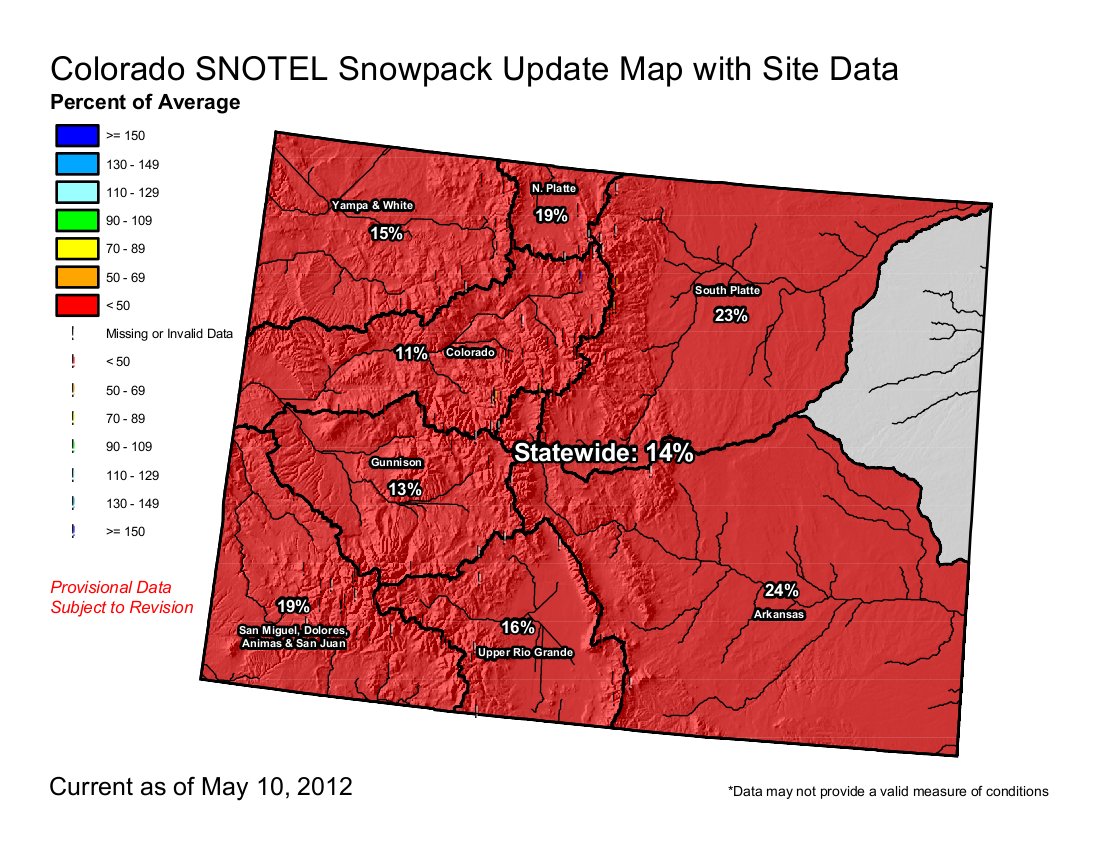
Colorado Water 2012: George Sibley is writing a weekly column about Colorado water issues starting today for the Grand Junction Free Press

coloradowater2012.jpg

This should be a real treat. Sibley is well known for his long career writing about water. He’s been featured at Colorado Central Magazine forever.

Mr. Sibley details Colorado Water 2012 in the first column of the series. Here’s an excerpt:

But why is 2012 the “Year of Colorado Water”? The idea of it began with the realization that three of Colorado’s more important water organizations are celebrating their 75th anniversaries this year — but we are not even going to say what those three organizations are right now because they all have longish titles mixing up basically the same set of words (“Colorado,” Conservation,” “Water,” etc.), and that is usually the point where eyes start to glaze over and minds wander off to images of eternally babbling streams…

Locally, Water 2012 activities will be focused on the current water situation in the Colorado and Gunnison River Basins, because that is where we live, and the rich history of water use and development by those who were here before us. You will, for example, be invited to the Upper Gunnison River in early June, and the valley of the North Fork of the Gunnison in early August, to help celebrate two important chapters in that rich history. In September, there will be a tour focusing on how water is used on farms in our region. Even if you cannot come to those events in person, you will have the opportunity through these stories in your newspapers and magazines, paper and electronic, to assemble a coherent picture of how that past has shaped the present — and what from that past we should and should not try to carry into the future.

The Colorado Foundation for Water Education has led the charge in organizing the “Year of Water,” but the Colorado and Gunnison Basin Roundtables will be carrying the torch in the Grand Valley and farther upstream. The Roundtables are two of nine representative bodies statewide, in other river basins, created by the legislature to encourage more public involvement in water decision-making for the coming decades, during which Colorado’s population may approach twice what it is now.

More Colorado Water 2012 coverage here.

Secretary Salazar, Governor Hickenlooper to Announce Next Steps in Fulfilling Vision for America’s Next Great Urban Park

rockymountainarsenal1964.jpg

Here’s the release from the Department of Interior and Governor Hickenlooper’s office:

On Friday, May 4, 2012, Secretary of the Interior Ken Salazar and Colorado Governor John Hickenlooper will announce the next steps in implementing conservation and recreation projects throughout the Denver metropolitan area and along the South Platte River, including the Rocky Mountain Greenway Project.

Last May, Gov. Hickenlooper and Sec. Salazar announced three conservation initiatives in Colorado as part of the America’s Great Outdoors Initiative, a nationwide effort to encourage and support community-driven conservation and recreation projects around the country. On Friday, they will host a meeting with elected officials, local and regional planners, and other open space leaders throughout the metropolitan area to discuss the initiatives’ ongoing progress.

The Rocky Mountain Greenway Project focuses on a federal, state, local and stakeholder partnership to enhance the Denver metropolitan area parks, open spaces, river corridors and trails—creating an uninterrupted trails/transportation link connecting the Denver metro area’s trail systems, the three National Wildlife Refuges in the metro region, Rocky Mountain National Park, and community trails systems in between.

Sec. Salazar and Gov. Hickenlooper will also be joined by Senator Mark Udall, Congressman Ed Perlmutter and Denver Mayor Michael B. Hancock to unveil a Colorado Department of Transportation directional sign for the Rocky Mountain Arsenal National Wildlife Refuge. A former chemical weapons manufacturing facility, the site has since been transformed into an urban gateway and sanctuary for residents, visitors and wildlife. The sign is part of an effort to increase the refuge’s visibility and encourage more visitors.

WHO: Ken Salazar, Secretary of the Interior
John Hickenlooper, Governor of Colorado
Michael B. Hancock, Mayor of Denver
Mark Udall, U.S. Senator
Ed Perlmutter, U.S. Representative
WHAT: Press Conference on Colorado’s Great Outdoors
WHEN: 11:30 a.m. MDT
WHERE: Rocky Mountain Arsenal National Wildlife Refuge Visitor Center
6550 Gateway Road
Commerce City, Colorado

Aspinall Unit operations meeting summary: Blue Mesa won’t fill this season

aspinallunit.jpg

From email from Reclamation (Erik Knight):

The meeting notes from the Aspinall Unit Operations Meeting have been posted to the website and are available at the following link:

http://www.usbr.gov/uc/wcao/water/rsvrs/mtgs/amcurrnt.html

Below is a summary of our April 26, 2012 meeting to coordinate Reclamation’s operation of the Aspinall Unit. The meeting was held in Reclamation’s Grand Junction Office. Significant items discussed included:

· Blue Mesa April through July inflow is predicted at 315,000 acre feet (af) based on April 15 data; in January the prediction was 450,000 af. The 315,000 af represents a dry category year and results from low precipitation over the last 4 months. This low level of inflow would be expected to be exceeded in 96-97 percent of years. In contrast, last year the inflow was 893,000 af, representing a moderately wet year.
· Blue Mesa Reservoir is not predicted to fill and releases from the Aspinall Unit to the Gunnison River will be lower than normal.
· Based on this April 2012 forecast, the Black Canyon National Park water right would call for a 1 day peak of 937 cfs and Flow Recommendations for endangered fish would call for a 900 cfs peak at Whitewater.

The forecast for runoff into the Aspinall Unit is expected to continue to drop which will result in a change to the Black Canyon National Park water right peak flow target. Currently river flows in the Gunnison River through the Black Canyon are 390 cfs. Operations during the summer months will primarily be dictated by downstream demands.

If you have any suggestions on improving the operation meetings or summaries, please let us know. The next operation meeting will be on Thursday, August 9th at the Elk Creek Visitors Center on Blue Mesa.

More Aspinall Unit coverage here.

Snowpack/drought/runoff news: The Rio Grande Basin is at 20% of average as is the statewide snowpack

snowpackcolorado05022012.jpg

basinhighlowriogrande05022012.jpg

usdroughtmonitor04242012.jpg

Click on the thumbnail graphics for the current statewide snowpack map and the Basin High/Low graph for the Rio Grande Basin along with the current U.S. Drought Monitor map (a new one is due out later today).

From The Crestone Eagle (Keno):

Drought conditions are rated on a scale from abnormally dry (D0) to exceptional (D4). As of April 1, readings across the state were as follows: Both the entire Four Corners area, along with the South Platte Basin, were rated D0, while a D2 zone covered the northwest part of Colorado. Parts of the Rio Grande and Arkansas basins have been at D2 and D3 since last summer. For the San Luis Valley, the Northern Sangre de Cristo Mountains, and the entire Crestone area, all of which is a part of the Rio Grande basin, the reading is D2.

The snowpack up in the mountains, which the entire state of Colorado relies on for its water, has been at record low levels across the state since March, thanks to the lack of snowfall. The statewide average for snowpack was at 39% as of April 19 and has been falling rapidly, dropping on average of around 10% in just a week’s time. That 39% reading is even lower for that date than what it was at in 2002, the year of one of Colorado’s worst droughts ever, when the early April snowpack measured back then was at 52% of average.

Here are a few snowpack reports from locations in Colorado: the Gunnison Basin was at 47% of average; the upper Colorado Basin, 37%; the Yampa Basin 38%; the Arkansas Basin 44%; the South Platte Basin, 52%; and the Rio Grande Basin at 45%. The Sangre de Cristo mountain peaks did see a nice amount of snow fall in mid-April that did help a bit in slowing down the snow melt, but we need to see a lot more of that in the next several weeks before any real improvement can be noted.

From Steamboat Today (Tom Ross):

The Yampa River, pushed by 0.71 inches of rain overnight Thursday, jumped to 1,570 cubic feet per second at 7:30 a.m. Friday where it flows beneath the Fifth Street Bridge in downtown Steamboat Springs. And with the benefit of hindsight, that may turn out to have been the river’s peak for spring runoff 2012. However, with high-elevation snowpack hanging on in the Park Mountains, water officials aren’t quite ready to commit.

The river had been on the way down since Friday night and was flowing at 797 cfs at 5 p.m. Monday. And the Colorado Basin River Forecast Center in Salt Lake City expects the river to remain at fairly consistent flows through May 9.

The river could rebound to just more than 1,000 cfs at midweek, then slip to 750 cfs May 8 to 9, based on the latest projections. Ashley Nielson, a hydrologist with the agency, said April 23 that based on historical data the Yampa River where it passed through Steamboat had a 90 percent chance of peaking at 1,200 cfs, and a 75 percent chance of peaking above 1,400 cfs. Thanks to last week’s rainstorm, the Yampa has beaten that 75 percent proposition. However, it might be a lot to expect it to rally to 1,800 cfs this season. Nielson rated that peak flow a 50-50 chance a week ago. The historic average peak flow for the Yampa is 3,070 cfs at the Fifth Street Bridge…

[Mage] Skordahl’s agency [NRCS] doesn’t look at peak flows in individual rivers. Instead, the NRCS is interested in the total volume of water expected to flow past the various stream measuring gauges in Colorado over the entire course of spring runoff. That number on the Yampa at Fifth Street is typically about 100,000 acre feet during the four months from April to July, Skordahl said. The river here already has seen 36 percent of that total flow in the first 25 percent of the timeframe, she said.

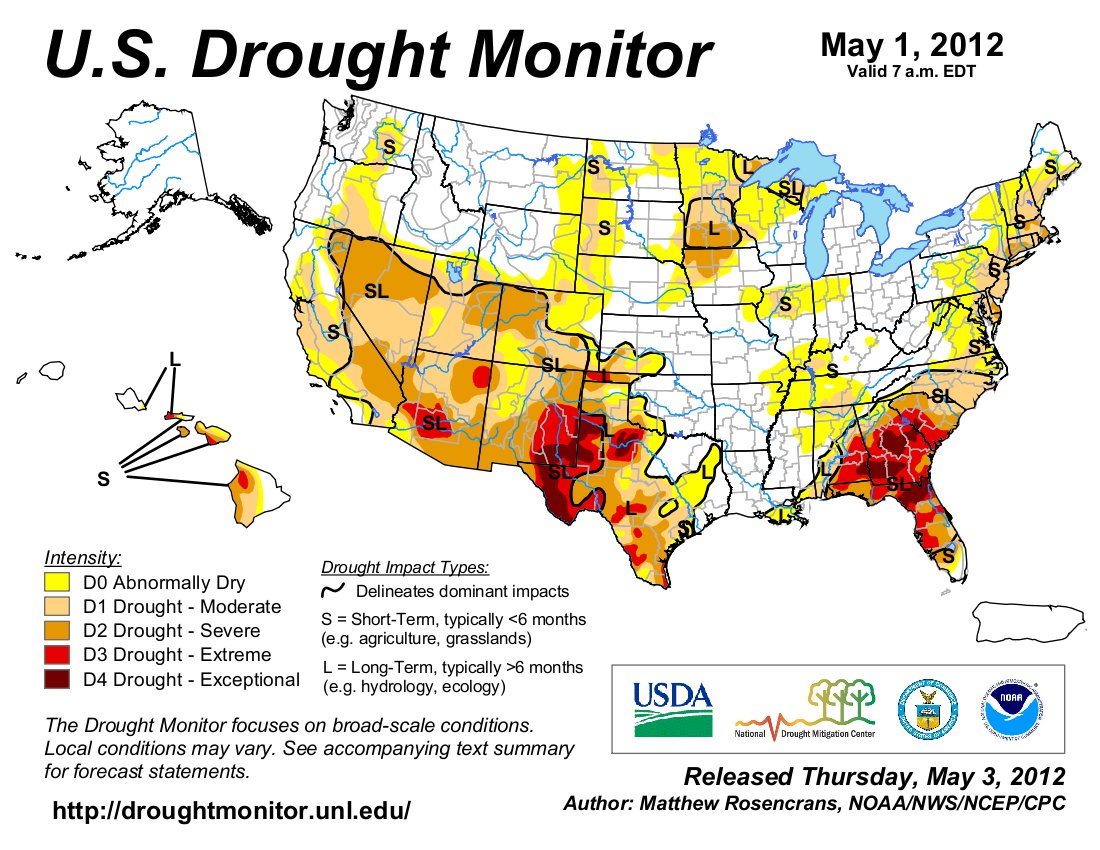
From The Telluride Daily Planet (Collin McRann):

According to data from the Colorado Snow Survey, snowpack levels reported Tuesday for the San Miguel, Dolores, Animas and San Juan river basins were sitting at 29 percent of average. Statewide, the snowpack is at 25 percent of average. The levels represent the fifth lowest year to date since snowpack record-keeping began in 1968. Last spring, following heavy storms in April, snowpack levels for the area were reported at near 100 percent of average — bringing big spring runoffs to the region.

“I’d say based on the weather that we’ve been having, that snowpack levels are not going to improve by any great means,” said Mage Skordahl with the Colorado Snow Survey program. “It looks like, from our data, that we reached peak snow-water equivalent in early to mid March. That’s around two to six weeks earlier than average.”[…]

The San Miguel River near Placerville was flowing at around 220 cubic feet per second April 30, according the U.S. Geological Survey. The river hit a high in mid April at just over 400 cubic feet per second, but it has been in decline since then, according the Survey. Last year, the San Miguel was flowing at more than 300 cubic feet per second by May 1.

Local temperature records were also broken during the months of March and April. According to a blog run by Thom Carnevale, who compiles local weather data, the temperature in Telluride reached 73 degrees on March 25, tying the record set in 1986. On April 23, he reported, a high of 79 degrees was recorded in town, which broke the previous record of 78 degrees set in 1992.

Snowfall has also been sparse this spring. Carnevale measured a total of 15.5 inches of snow in the month of March, down from the month’s average of 33.9 inches.

From The Brighton Standard-Blade (Steve Smith):

City officials see no reason to change the watering schedule that’s been in place since 2000. That means another summer of circles, diamonds and squares, depending on the last two numbers of the address. Residents can water every third day but not between the hours of 10 a.m. and 6 p.m. “That’s the warmest part of the day,” said city water specialist Dawn Hessheimer. “That’s when the water will evaporate the most.”

The Arkansas Valley Super Ditch pilot project is good to go for this water year

arkbasinditchsystem.jpg

The State Engineer can approve a substitute water supply plan if certain conditions are met. The Arkansas Valley Super Ditch pilot project is good to go this water year now that the SEO has blessed the scaled-back plan. Here’s a report from Chris Woodka writing for The Pueblo Chieftain. From the article:

“Many people said we’d never get this far in 20 years, but we’ve managed to do it in just four years,” said Jay Winner, general manager of the Lower Arkansas Valley Water Conservancy District, which is funding Super Ditch program. “This will be a benefit to every farmer in the Lower Arkansas Valley.” The transfer is seen as a test case for a much larger program that would move larger amounts of water from as many as seven ditches east of Pueblo. Under Super Ditch, water could be leased by farmers to cities, the state or even farmers on other canals without selling water rights…

Wolfe rejected an assertion by Tri-State Generation and Transmission that a water court filing must precede the substitute water supply plan, saying he has statutory authority to issue a permit as long as all conditions are met. He also rejected Tri-State’s claim that some of the return flows from the transfer will lag more than five years. The Super Ditch plans to build ponds to return water to the river over multiple years, just as the water historically would have run off the fields. The pilot program follows accepted ways to return flows to the river, Wolfe said.
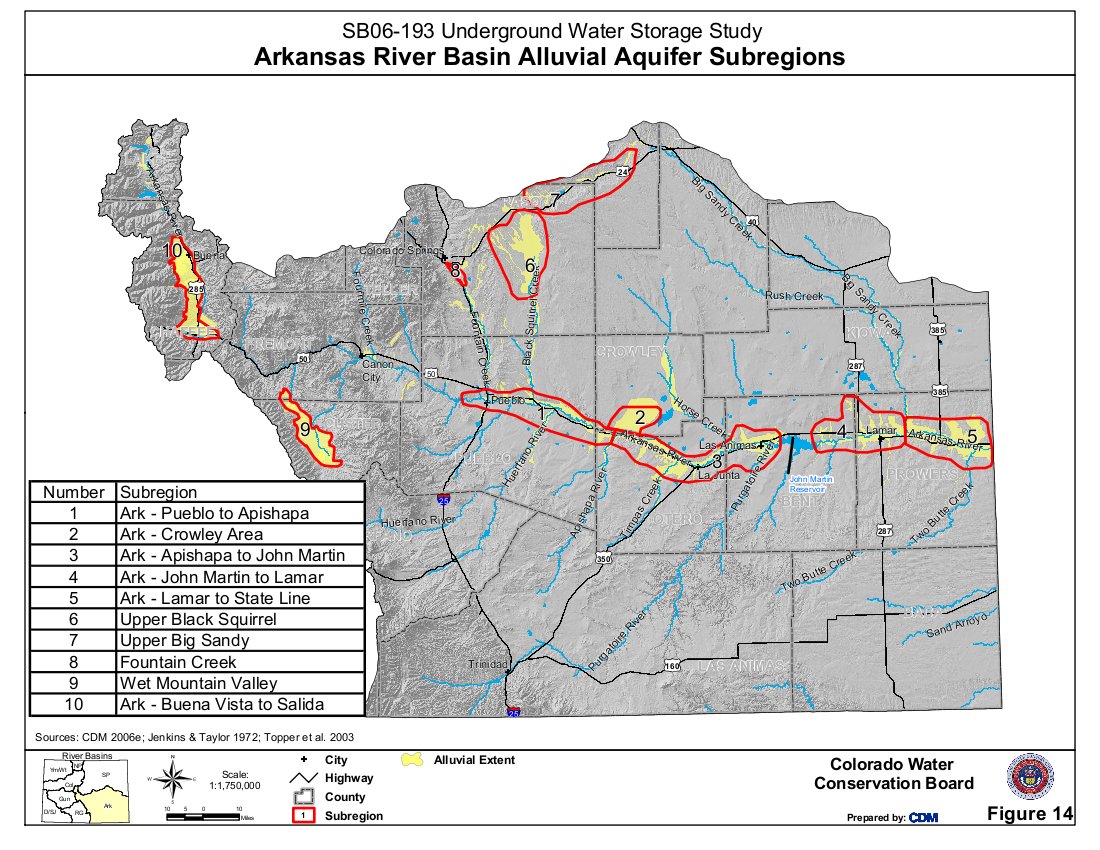
More Arkansas Valley Super Ditch coverage here and here.

Rio Grande River basin: The State Engineer has approved the groundwater Subdistrict No. 1 Annual Replacement Plan

riograndebasin.jpg

The State Engineer has approved the Rio Grande Water Conservation District’s annual replacement plan for groundwater Sub-district No. 1.

From email from the State Engineer’s office:

On May 1, 2012 State Engineer Dick Wolfe approved the Annual Replacement Plan for Subdistrict No. 1. This Approval was filed with the Division No. 3 Water Court.

All documents are located on DWR’s website at the following location:
http://water.state.co.us/DivisionsOffices/Div3RioGrandeRiverBasin/Pages/Division3EventsAndLinks.aspx

Note: these documents can also be downloaded from the DWR’s FTP site:
ftp://dwrftp.state.co.us/dwr/ARP_Subdistrict1/

More San Luis Valley groundwater coverage here and here.

It turns out that Colorado Springs did need a stormwater enterprise after all, where is Douglas Bruce?

fountaincreekflood1999apviachieftain.jpg

From The Pueblo Chieftain (Chris Woodka):

A Summit Economics study, now being reviewed by communities in El Paso County, identifies $752.5 million in unfunded stormwater management needs on Fountain Creek. Only $3.2 million of those are in Pueblo, although no assessment has been made of the parts of the creek in unincorporated Pueblo County. There are also about $13 million in annual funding needs that have not been addressed…

Nearly $500 million in projects are needed in Colorado Springs, with about $86 million considered critical needs, the study stated. That’s a significantly higher amount than reported to Colorado Springs City Council in 2005, when it created a stormwater enterprise. The enterprise was dissolved by council after the 2009 municipal election. A 2005 stormwater study identified about $300 million in Colorado Springs projects, with $66 million considered critical were presented.

In Pueblo, at that same time, there were about $65 million in needs. Pueblo instituted a stormwater fee in 2003 that generates about $2.8 million per year to begin addressing those problems. Puebloans pay about $25 per capita monthly into the fund…

Colorado Springs, with nearly four times the population, spends about $1.9 million, or $4.63 per capita monthly to address stormwater issues, mainly compliance with state or federal permits. The Front Range average is $52 per capita monthly.

More Fountain Creek coverage here and here.