Colorado-Big Thompson Project update: 100 cfs in the Big Thompson below Olympus Dam #ColoradoRiver

olympusdamrelease062011

From email from Reclamation (Kara Lamb):

We’re starting to see a little bit of run-off come down the Big Thompson River and into Lake Estes. As a result, we’ll be bumping up releases from Olympus Dam on Lake Estes to the Big Thompson Canyon later tonight to pass the native flow on downstream.

We have been releasing about 45 cfs out of Oympus Dam to the lower Big Thompson River. Tonight, April 30, at midnight, we will bump releases up by about 60 cfs to around 100 cfs.

If the forecast storm for tonight and tomorrow cools things off, we could be making another change late in the night of May 1 to reduce releases again. I will keep you posted.

Fryingpan-Arkansas Project update: 110 cfs in the Fryingpan River below Ruedi Dam #ColoradoRiver

fryingpanarkansasproject.jpg

From email from Reclamation (Kara Lamb):

It’s been an interesting couple of weeks. We will be re-evaluating our spring operations at Ruedi Reservoir once we’ve had a chance to incorporate new information from the May 1 forecast into our own models.

Meanwhile, spring is here and it is time to change the release regime from Ruedi Dam to the Fryingpan River. Most years around May 1 we make this adjustment. We are required to release the lesser of inflow or 110 cfs. As a result, today at 5 p.m. and again tomorrow and 10 a.m., we’ll increase releases from the dam to the river by about 33 cfs. By this time tomorrow, the release from Ruedi Dam to the lower Fryingpan will be about 110 cfs.

We have seen quite a bit of snow in the upper reaches of the Fryingpan River Valley. Our crews spent the last two weeks in the high country opening the sixteen diversion dams of the Fryingpan-Arkansas Project. To see photos, check out the Ruedi webpage.

Currently, Ruedi is about 60% full. It will likely continue to drop slowly until run-off. I will send notices when we make changes.

More Fryingpan-Arkansas Project coverage here and here.

El Paso County Watershed Assessment of River Stability and Sediment Supply meeting May 2

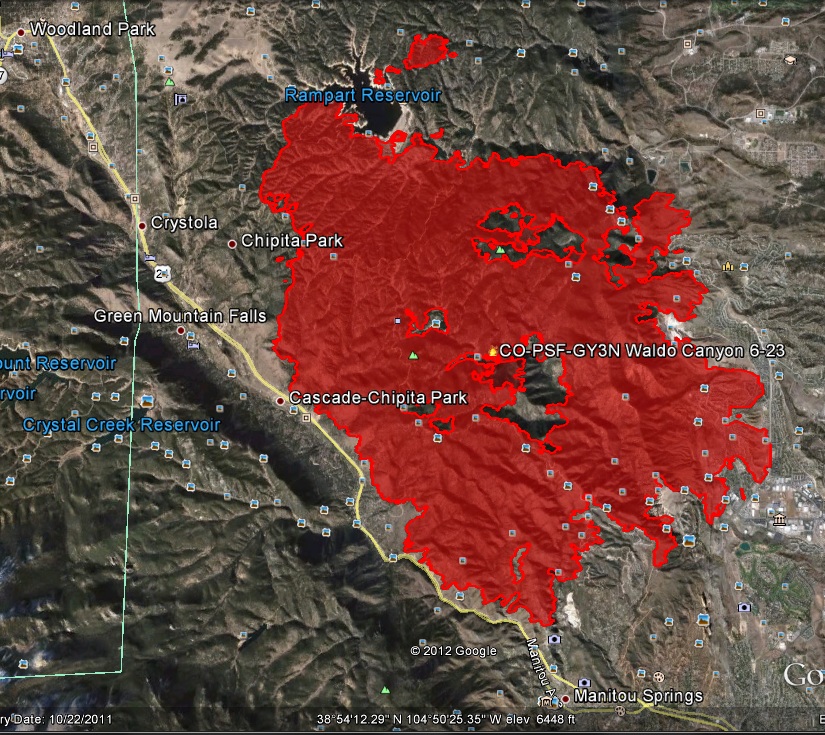
waldocanyonfirejuly2012

From the Colorado Springs Indpendent (J. Adrian Stanley):

Ever since the Waldo Canyon Fire charred our hillsides, Colorado Springs and the small communities that dot our foothills have been at extremely high risk for flooding. The WARSSS is an escape route — a detailed plan on how best to control the water, mud and debris.

The WARSSS will tell us how water moves and how to trap it. It will show us where to build the detention pond that will prevent the Pleasant Valley neighborhood from drowning, and how to control a wild rush of water out of Williams Canyon that is pointed at the center of Manitou Springs.

Thus, it is with excitement that I tell you the study will be presented to the El Paso County Commissioners on Thursday, May 2. Woo-hoo, indeed.

Waldo Canyon Fire WARSSS to be Presented May 2

Colorado Springs, CO, Thursday, April 25, 2013 — The Watershed Assessment of River Stability and Sediment Supply (WARSSS) Study will be presented by Dr. David L. Rosgen of Wildland Hydrology at 2:30 to 4:30 p.m. on Thursday, May 2, 2013, in the Hearing Room at the Pikes Peak Regional Development Center located at 2880 International Circle, Colorado Springs.

WARSSS is a technical procedure for water quality scientists use in evaluating streams and rivers impaired by excess sediment. It will predict how water, sediment and debris will move along and off the Waldo Canyon Fire burn scar. Based on its findings, it will assist in providing a list of prioritized mitigation projects.

More stormwater coverage here and here.

Forecast news: Rain turning to snow, hard freeze tonight, red flag warning southwest #COdrought #COwx

From the National Weather Service Pueblo office:

A late season winter storm will move across Southern Colorado through Thursday morning. Winter Weather Advisories have been posted for the Central and Eastern Mountains…as well as Teller and Northern El Paso counties with several inches of accumulation likely. The highest amounts will be in the mountains. Areas over the Plains will likely start out as a rain-snow mix, but change over to all snow by late this morning. In addition…very cold air will move into the region for Wednesday night into Thursday morning. A hard freeze is expected with overnight lows dropping into the lower to mid 20s. Precautions should be made to protect plants and sprinkler systems.

From the National Weather Service Grand Junction office:

A low pressure system and associated cold front will continue to push southward across the forecast area this morning. Much colder and breezy conditions will occur today behind the front. Precipitation will favor the northern Colorado mountains, where up to 6 inches of snow will fall. Isolated to scattered showers will also fall across the lower elevations of western Colorado this morning then diminish, with other areas remaining mostly dry. Across far Southwest Colorado a Red Flag Warning is in effect for this afternoon, due to gusty winds and dry conditions. Most locations will be near to below freezing on Thursday morning, which may pose problems for tender vegetation. Fair conditions with gradual warming is anticipated Thursday afternoon into Friday.

‘It’s [the current drought] right in there with some of Colorado’s worst droughts’ — Nolan Doesken #COdrought

usdroughtmonitor04232013

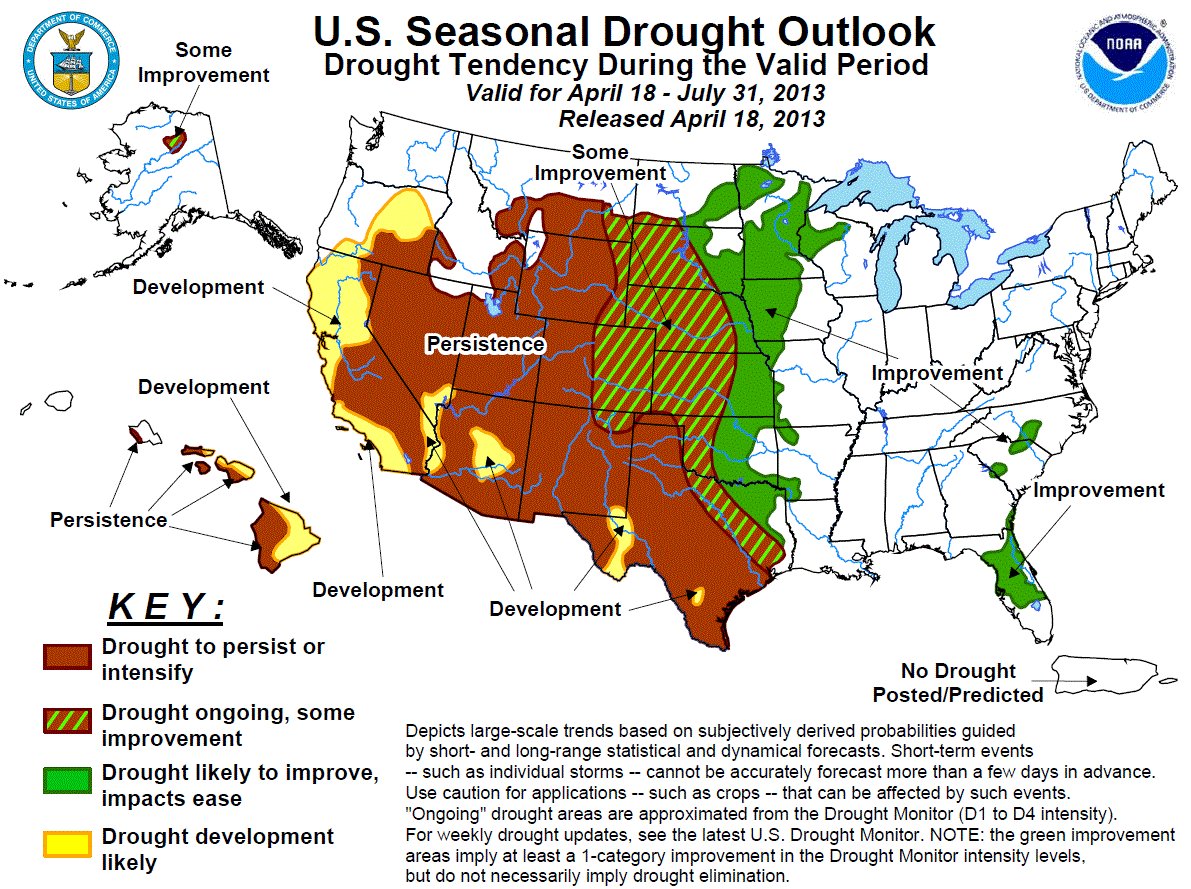
seasonaldroughtoutlookapril18tojuly312013cpc.jpg

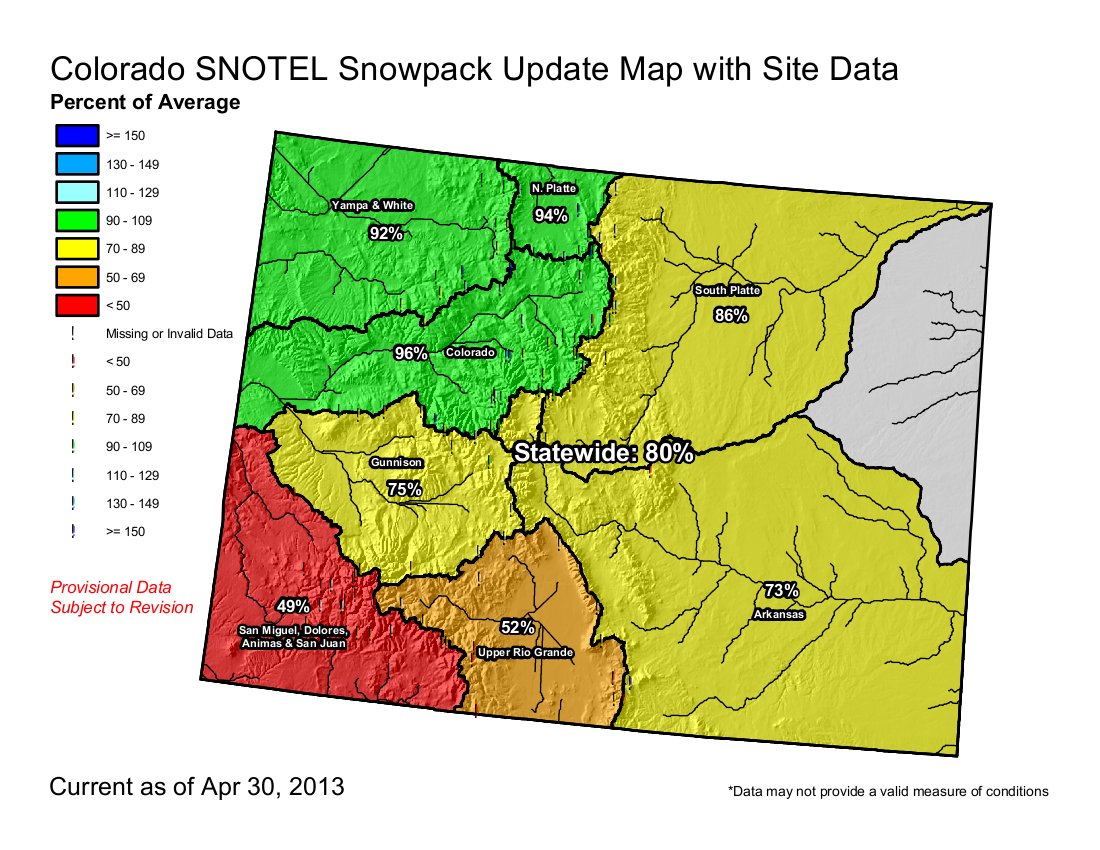
snowpackcolorado04302013

From KRDO (Rachel Plath):

ā€œIt’s right in there with some of Colorado’s worst droughts you have to give it credit for being bad. People aren’t just whining,ā€ said Doesken.

Doesken said with respect to the wind, lack of rain, humidity levels, temperature and duration, Colorado has not seen a drought of this magnitude since the 1950s.

The drought has hit ranchers and farmers especially hard, but everyone who uses water should consider themselves affected by the drought.

The recent snowstorms have also helped to provide some relief. However, in order to eliminate the drought, Doesken said the state needs to see average monthly rainfall plus an additional 6 to 12 inches of water. In Colorado Springs, that’s equivalent to 39 to near 70,000 Olympic-sized swimming pools. In Pueblo, that’s equivalent of from 10 to near 17,000 pools.

Doesken said, it is not ideal to get this kind of relief all at once, but added that many of Colorado’s past droughts have ended abruptly because of major flooding. ā€œAt this time of year, going into summer, knowing that much of this region of the state’s precipitation falls in the form of intense summer showers, be on the lookout. This could be a flood year right in the middle of a drought,ā€ said Doesken.

Drought forecasts do not look favorable for relief in the near future, but Doesken said due to the multiple factors that influence droughts, these long-term forecasts are not very reliable. ā€œQuite honestly, you get to the middle of the summer and things end up being random convection and end up being the monsoon circulation, which is very difficult to anticipate in advance. So, there’s a lot of uncertainty here,ā€ said Doesken…

ā€œEventually we’ll get out of the drought. It’s just a question of, will it be this summer? Will it be next? Will it be four years from now? We all hope it’s soon,ā€ said Doesken.

From The Colorado Statesman (Ernest Luning):

When officials at the state’s largest water utility declared a Stage 2 Drought and put in place the harshest watering restrictions in over a decade at the beginning of April, they mentioned that another seven or so feet of snow might help — and that’s nearly what Mother Nature has delivered. There’s even time left for more fresh powder, though none was in the forecast at press time.

But don’t break out the champagne or crack open the sprinkler just yet. In the complex metrics that govern water availability in the high desert, a snowpack approaching historic averages isn’t enough to overcome what everyone agrees is the persistent and longstanding drought afflicting the region.

ā€œWe don’t have all of the answers yet. It’s still too early in the season,ā€ said Denver Water’s Chris Piper, a government relations specialist, at a presentation to constituents of state Sen. Irene Aguilar, D-Denver, on Tuesday.

Denver Water, which gets about half its water from the South Platte River Basin east of the Continental Divide and the other half from the Colorado River Basin on the Western Slope, has to consider more than simply snowpack when it determines the year’s water supply, Piper told the crowd of about 50 at the Washington Street Community Center in Denver.

ā€œBy the end of May,ā€ Piper said, ā€œwe’ll be able to determine whether we’re going to have to stick with the plan and stay at Drought Stage 2, or whether things have gotten better enough we can do something different.ā€[…]

How is it, though, that unanticipated snowfall measured in feet hasn’t turned things around? For one thing, Piper said, while the South Platte and Colorado basins’ accumulated snow depth might be above historic averages, the measures for Denver’s watersheds — the portions of the basins where Denver Water draws its supply — are still lagging. As of this week, it stands at about 78 percent for the South Platte and 87 percent for the Colorado.

Cloud-seeding program for the central mountains for this season ended on April 10 #COdrought #ColoradoRiver

cloudseedingexplained.jpg

From the Summit County Citizens Voice (Bob Berwyn):

While the winter’s biggest snow totals came after the end of this year’s program, the seeding operations may have helped bring near-average snowfall to area in February and March, according to the operators, who are now measuring their efforts under a ā€œtarget and controlā€ evaluation that will be submitted to the Colorado Water Conservation Board for review.

Durango-based Western Weather Consultants, which seeds the central mountains, was able to extend operations into early April and use all its allotted operational days, said Larry Hjermstad. During the 2012-2013 season, the central mountains program cost $293,600 and targeted an area of about 1,668 square miles of the Upper Colorado River Basin, generally above elevation 8,500 feet, in parts of Pitkin, Eagle, Summit, and Grand counties. Front Range water providers and ski areas, along with other partners, help fund the program, aimed at enhancing water supplies and boosting ski conditions at A-Basin, Breckenridge, Keystone and Winter Park, all included in the target area…

In past seasons, Hjermstad estimated that cloud-seeding may have boosted snowfall by as much as 15 percent in targeted areas.

Cloud-seeding efforts in Colorado have a long, on-and-off history dating back to the 1970s, when the federal Bureau of Reclamation was active in the southwestern mountains, said state climatologist Nolan Doesken, who acknowledged that there is still a debate about the effectiveness of cloud-seeding. Doesken said that there is good evidence that cloud-seeding can work in the right conditions, with very specific requirements as to wind direction, moisture and temperatures. Outside that range, the results are less clear.

Funding comes from the Front Range Water Council including Aurora Water, Denver Water, Colorado Springs Utilities, Northern Colorado Water Conservancy District, Twin Lakes Reservoir & Canal Company, Southeastern Colorado Water Conservancy District, and Pueblo Board of Water Works. The Colorado River Water Conservation District, A-Basin, Keystone, Breckenridge, and Winter Park also participate.

The Colorado Water Conservation Board and the Lower Basin States, including the Southern Nevada Water Authority, Central Arizona Water Conservation District, and California Six Agency Committee also help fund the cloud-seeding, but don’t directly participate in the program, said program manager Maria Pastore, of Glenwood Springs-based Grand River Consulting.

More cloud-seeding coverage here and here.

Englewood rolls out draft water conservation plan #COdrought

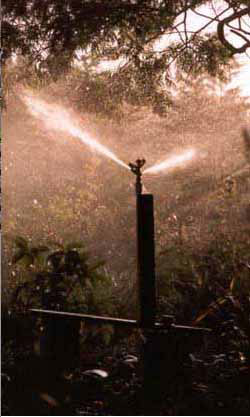
watersprinkler.jpg

From the Englewood Herald (Tom Munds):

The plan will be available for review May 1 on the city’s website at http://www.englewoodgov.org. Starting May 1, comments on the plan can be made through the website, which will be listed under the ā€œIn the Spotlightā€ portion of the home page. Residents also can make comments in person by attending one or both of the meetings of the Englewood Water and Sewer Board that will be held at 5 p.m. May 14 or at 5 p.m. June 11 in the community development conference room. The conference room is on the third floor of the Englewood Civic Center, 1000 Englewood Parkway. The deadline for public comment is July 1.

The main objective of a water conservation plan is to improve water-use efficiency, which, in turn, reduces overall water demands…

The city’s draft plan was created by staff members and conservation consultants hired using a state grant. Those working on the draft also considered input from members of Englewood’s Water and Sewer Board…

ā€œThe draft, if approved by the state, will be a 10-year plan,ā€ Abouaish said. ā€œThe plan will be reviewed once a year to see if the measures are moving toward the ultimate goal, which is a 10 percent reduction in water use over the 10-year period.ā€

More conservation coverage here.

San Luis Valley: State Engineer Approval of the 2013 Annual Replacement Plan for Subdistrict No. 1

slvdischargerecharge.jpg

From email from the State Engineer’s office (Kathryn H. Radke):

On April 30, 2013, State Engineer Dick Wolfe approved the Annual Replacement Plan for Subdistrict No.1.

This approval will be filed with the Division No. 3 Water Court later today.

All documents are located on DWR’s website at the following location:
http://water.state.co.us/DivisionsOffices/Div3RioGrandeRiverBasin/Pages/Subdistrict1ARP.aspx

Note: these documents can also be downloaded from the DWR’s FTP site:
ftp://dwrftp.state.co.us/dwr/Annual%20Replacement%20Plans/2013/Subdistrict%201

From The Pueblo Chieftain (Matt Hildner):

State Engineer Dick Wolfe approved a water replacement plan Tuesday aimed at mitigating harm from groundwater pumping in the north-central San Luis Valley.

Wolfe’s approval made few changes to the proposal from Subdistrict No. 1, which is required to lay out what sources of water it will use to replace water lost by the pumping of nearly 3,400 wells in the subdistrict’s boundaries.

He did bar the use of 86.5 acre-feet of water from Ruby Reservoir southwest of Creede until a substitute water supply plan is submitted to and approved by his office.

But that still leaves the subdistrict with a pool of more than 7,500 acre feet of water it can release into the Rio Grande to mitigate the injury to surface water rights holders.

A state computer model estimated that pumping would cause 5,389 acre-feet in depletions that the subdistrict must replace.

More San Luis Valley groundwater coverage here and here.

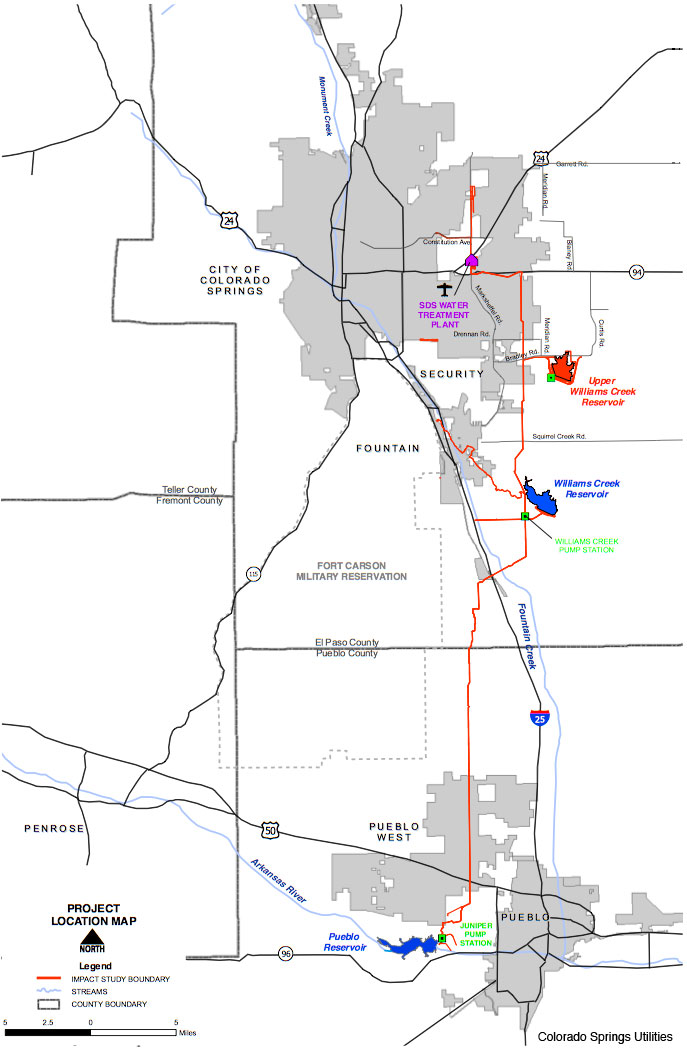
SDS: Pueblo County is looking at advance payments from Colorado Springs for Fountain Creek projects

sdspreferredalternative.jpg

From The Pueblo Chieftain (Chris Woodka):

Pueblo County commissioners want to explore the possibility of jumpstarting projects on Fountain Creek with advance payment of money promised by Colorado Springs Utilities as a condition for Southern Delivery System.

ā€œWe need clarity on the acceptability of using the $50 million, using it in advance,ā€ Commissioner Terry Hart said.

Under its 1041 permit for the Southern Delivery System, a $1 billion pipeline that takes water from Pueblo Dam to El Paso County, Colorado Springs promised to pay $50 million for flood control projects south of the city that benefit Pueblo County.

The money is scheduled to begin arriving in five installments to the Fountain Creek Watershed Flood Control and Greenway District in 2016, after SDS goes online.

But $600,000 already has been paid to the district — $300,000 for a flood control study and $300,000 that was used to complete a master corridor study and as its share to provide interim funding to the district.

Last week, Hart, who sits on the Fountain Creek board, was approached with the idea of asking for another $100,000 from the Colorado Springs fund to continue interim funding until the district settles on a strategy for securing a funding source. Commissioner Sal Pace asked attorneys if the county could ask for the entire $50 million to be paid sooner.

ā€œIf we bring it in sooner, it could be used to leverage other money,ā€ Pace said.

Commissioner Liane ā€œBuffieā€ McFadyen said flooding on Fountain Creek is likely to be more intense after the Waldo Canyon Fire and supported using the money sooner, rather than later.

Ray Petros, the county’s water attorney, was uncertain if advance payment is possible. Colorado Springs asked for the five-year schedule for mainly financial reasons, and the payment is just one of a series of conditions that must be met over time. ā€œWe’d have to be careful from our side that we weren’t acknowledging that SDS wouldn’t be suspended for some other reason,ā€ Petros said.

From The Pueblo Chieftain (Chris Woodka):

County staff and Colorado Springs Utilities are discussing the adequacy of revegetation requirements on the pipeline route of Southern Delivery System through Pueblo West.

The pipeline is buried, but cuts a 100-foot-wide swath through 7 miles of Pueblo West on its way from Pueblo Dam to Colorado Springs.

As part of Pueblo County 1041 conditions for SDS, Colorado Springs is bonded for two years while revegetation is completed. Although droughtresistant species are being used, seeds must be irrigated to sprout. That raised some questions Monday in a work session on SDS issues.

ā€œWe’re in the throes of a drought, and my question is whether this is a good time to do revegetation,ā€ Commissioner Terry Hart said. ā€œIf we’re going to be irrigating it for two years and suddenly pull off the water, what happens?ā€

Attorney Gary Raso said experts from Colorado Springs Utilities and the county’s consultant, Warren Keammerer, are meeting on the issue, but the results likely won’t be known at the end of two years. The county is concerned that too many ā€œweedyā€ species will take hold, rather than beneficial grasses.

ā€œIt became clear to me that at the end of two years, the best you could conclude is that it was going in the right direction,ā€ Raso said. ā€œThe experts don’t like being tied to (the two-year limit).ā€

Hart questioned what recourse the county would have if problems surfaced five years after revegetation was deemed complete. The county has in the past altered the 1041 conditions with Colorado Springs on $2.2 million for dredging Fountain Creek through Pueblo and accepting a $15 million payment for restoration of Pueblo West roads damaged during construction.

There also are unresolved revegetation issues with the portion of the pipeline that crosses Walker Ranches north of Pueblo West.

Commissioners agreed that they need to further discuss issues with Keammerer.

More Southern Delivery System coverage here and here.