From The Grand Junction Daily Sentinel (Dennis Webb):
A state regulator recently acknowledged the lack of clarity over what agency, if any, regulates pipelines like the one that’s the source of a natural gas liquids leak in the Parachute Creek watershed northwest of Parachute. The comments by Jim Milne, environmental manager for the Colorado Oil and Gas Conservation Commission, came in response to a question by Commissioner DeAnn Craig at the commission’s meeting last week. Milne was providing an update on the investigation into the leak from a pipeline leaving Williams’ gas processing plant. “I’m just curious who writes the rules for pipeline integrity of this type of system?” Craig asked.
“I don’t have an answer to that,” Milne responded. “I think the agencies have all been looking at that question.” He said he knows the Occupational Safety and Health Administration (OSHA) has some level of involvement with the plant, but added, “I think the question you ask is a good one.” He said he and commission Director Matt Lepore have discussed the need to contact any agencies that could be involved and get a better understanding of who has responsibility over the line.
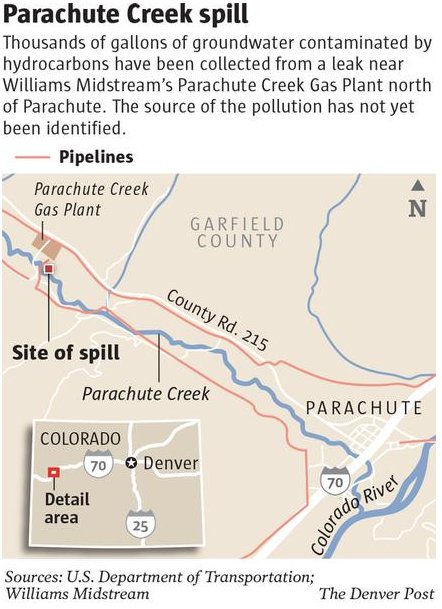
Williams believes a faulty gauge on the pipeline leaked about 10,000 gallons into the soil and groundwater. Carcinogenic benzene has contaminated groundwater and the creek. Williams has pointed to OSHA regulatory oversight of the pipeline. But OSHA has said it doesn’t regulate things such as what pipeline materials and welding should be used, and that its regulations are geared toward safety considerations such as protecting laborers working in pipeline trenches. The natural gas liquids pipeline runs from the plant and beneath the creek to tanks on the other side.
Williams says the federal Pipeline and Hazardous Materials Safety Administration regulates the pipeline running from the tanks to another plant in Rio Blanco County, from which the liquids are then shipped out of state. That agency covers aspects such as pipeline construction, testing, inspection and maintenance.
The question of jurisdiction over the Williams line takes on additional significance because the company wants to install a second natural gas liquids line in the same corridor going beneath the creek to accommodate an expansion of its plant. It recently announced a delay in the expansion for reasons it says relate to the local drilling slowdown and not the leak. That expansion plan went through a Garfield County review process, but a county planning staff report to county commissioners made no apparent mention of the new pipeline.
The oil and gas commission’s ability to regulate the existing or planned pipeline appears to be limited. It recently handed off lead authority over the leak investigation to the Colorado Department of Public Health and Environment because it determined it didn’t have primary jurisdiction over the matter.
Oil and Gas Commissioner Rich Alward of Grand Junction told Milne that despite the jurisdictional issues, he’d be interested in any recommendations about what the commission can do “to minimize the risk of this happening again.” Alward mentioned reporting requirements as one possible area to be addressed.
Williams didn’t initially report the leak because it thought it involved less than 25 gallons, far below the minimum five barrels (210 gallons) that trigger a reporting requirement. It also didn’t consider the spill to be a threat to surface waters, something that triggers a commission requirement of immediate reporting of a spill of any size.
A bill awaiting action by Gov. John Hickenlooper would require reporting within 24 hours of all waste spills of a barrel or more if they take place outside berms or secondary containment systems. But a barrel, or 42 gallons, is still more than what Williams initially thought had leaked.
In addition, the commission determined the liquids that leaked, as a product leaving a gas plant, don’t involve exploration and production waste, which is why it gave up jurisdictional authority.
Meanwhile, Williams reports that the highest benzene reading in the creek as of Thursday was 4.4 parts per billion. The level last week remained below the state drinking water standard of 5 ppb in the creek, after barely exceeding that standard the week before, although the standard doesn’t apply to the creek because it’s not considered a drinking water source. There continue to be no signs of benzene in the creek at the point downstream where the town of Parachute diverts irrigation water.
On Tuesday, a new well was installed to recover contaminants from the soil.
Also completed this week was installation of vertical air sparge wells designed to enhance the removal, through aeration, of benzene in groundwater once they are hooked up to a blower motor.
Those wells are part of a plan, newly approved by the health department and Environmental Protection Agency, under which Williams is upgrading its treatment system at the point where contaminated groundwater is entering the creek.
All containment booms in the creek were replaced Tueday with fresh ones. Work also began last week on sampling contaminated groundwater. The work is necessary to characterize the contamination before the water can be properly treated and disposed of, the health department said.
Williams said Friday that it so far has recovered about 6,300 gallons of natural gas liquids. It also plans to construct by month’s end a water treatment system to remove hydrocarbons from the aquifer and from recovered water that then can be returned to the aquifer. The water will be subject to continuous testing to assure it meets state and EPA requirements before being discharged back to the surface.
Meanwhile, the Clifton Water District is keeping an eye on the spill. They pull off the Colorado River downstream of the confluence of Parachute Creek. Here’s a recent release:
The Clifton Water District has continued to monitor the developments related to the contamination of Parachute Creek with Benzene. Parachute Creek is a very small tributary to the Colorado River which is the water supply for the Clifton Water District. No reports have indicated that Benzene has reached the Colorado River and the District’s monitoring efforts have not detected the presence of Benzene.
Even though there is no indication that Benzene has reached the Colorado River, the Clifton Water District has been proactively monitoring the Colorado River in multiple locations for the presence of 25 Volatile Organic Compounds (VOC’s), including Benzene. The Clifton Water District’s Certified Laboratory has not detected the presence of Benzene or any other Volatile Organic Compound in any of the samples. Monitoring of the Colorado River for Volatile Organic Compounds has been a regular and routine event since 1986 and is a fundamental commitment in providing safe drinking water for our customers.
In addition to being mindful of source water quality, the District has been diligent to implement advanced water treatment technology which is very effective in treating the Colorado River. The District has worked to improve its water treatment system to a “state-of-the-art” facility utilizing Enhanced Coagulation/sedimentation, Rapid Sand Filtration, Reverse Osmosis and Nanofiltration. These processes are instrumental to the success of a multi-barrier treatment approach. Continuation of the District’s effort the next generation of “state-of-the-art” water treatment technology, Micro/Ultra Filtration Treatment Facility, is currently in design and projected to be constructed by 2015.
It is not anticipated that Benzene will be present in the Colorado River because of its volatility characteristics. The District will continue to maintain routine monitoring procedures for Benzene and other Volatile Organic Compounds even after this situation has been resolved demonstrating our commitment to provide high quality water to our customers.
Here’s a report from Dennis Webb writing for The Grand Junction Daily Sentinel:
The Clifton Water District said Tuesday it has been monitoring the benzene contamination in Parachute Creek, but tests of the Colorado River continue to show no evidence of the carcinogen. A leak of natural gas liquids leaving the Williams gas processing plant has resulted in small amounts of benzene reaching the creek. However, samples farther down the creek show no sign of the substance, which readily dissipates in moving water.
Clifton Water said in a news release that it doesn’t anticipate benzene reaching the river because of its volatility.
The creek “is a very small tributary to the Colorado River, which is the water supply for the Clifton Water District,” the utility added.
It said it “has been proactively monitoring the Colorado River in multiple locations for 25 volatile organic compounds, including benzene. But its certified lab has found no VOCs in any of the samples.
The district has routinely tested the river for VOCs since 1986 and will continue doing so after the leak situation is resolved, it noted. It also has been installing advanced water treatment technology to better address sediment and other issues involving the river water.
Last week, benzene in Parachute Creek barely exceeded the state drinking water maximum of 5 parts per billion. However, the creek isn’t designated as a drinking water source by Colorado’s Water Quality Control Commission, and instead a 5,300-ppb standard applies to protect aquatic life. Williams reports that benzene readings at the highest point of contamination in the creek from Saturday through Monday were all above 4 but below 5 ppb, with Monday’s level at 4.7 ppb.
From the Associated Press (Alexandra Tilsley) via The Denver Post:
One of the main contaminants in the groundwater is benzene, according to Mark Salley, a spokesman for the Colorado Department of Public Health and Environment, which is currently overseeing the remediation efforts. Benzene, a known carcinogen, was also found earlier this month in Parachute Creek in concentrations above the state’s health standard, but levels have since dropped and officials insist there is no threat.
To remove the benzene from the creek, Williams injected air into the surface water to strip the hydrocarbons, a process known as air-sparging. The same technique is to remove surface hydrocarbons that are floating on top of the groundwater.
How to handle all the benzene-infected groundwater is the next question. The recovered water is currently being stored in tanks, and Williams said Friday it is planning to install a water treatment system that can separate the benzene from the water. “They’re working on the plans right now for a water treatment system,” said Tom Droege, a Williams spokesman. “It’s not in place yet, but once it’s up and running, then they’ll begin to treat the groundwater on a regular basis.”
The system will remove the benzene and any other hydrocarbons from the water through a multistep process. Contaminated water will first go through an oil and water separator. Then, it will move through an air stripper, which works like air-sparging. Finally, the water will be moved through activated carbon polishing tanks. The treated water will then return to a holding tank, where it will be tested to ensure it meets state health department and U.S. Environmental Protection Agency standards. Once officials have confirmed the water is safe, it will be returned to the aquifer. Any air emissions from the treatment system will be captured and treated according to the procedures approved by the Air Pollution Control Division of the state’s health department, Salley said.
The system is expected to be functional by the end of May.
More oil and gas coverage here and here.