Arkansas River: ‘We’ll supply 10,000 acre-feet for rafting and the fishery’ — Roy Vaughan

kayaker.jpg

From The Mountain Mail (Casey Kelly):

Arkansas River boaters can expect to see flows bolstered this summer by 10,000 acre-feet of water from the Voluntary Flow Management Program. Roy Vaughan, facility manager for the Bureau of Reclamation’s Pueblo Field Office, confirmed Monday that water will be available for the Voluntary Flow Management Program. “We’ll supply 10,000 acre-feet for rafting and the fishery,” Vaughan said.

The program will supply enough water to keep flows at the Wellsville station at 700 cubic feet per second from July 1 through Aug. 15 this year, according to Vaughan.

He said the bureau’s April 1 forecast called for bringing more than 24,700 acre-feet of water over from the Western Slope. Its May 1 forecast called for 47,230 acre-feet. “That’s almost double what we were forecasting,” Vaughan said. He said recent moisture “changed the outlook for us.”

Rob White, Arkansas Headwaters Recreation Area park manager, told a May 7 Salida City Council work session that outfitters were worried about another low water season and had been told a few months ago that water may not be available this summer for the Voluntary Flow Management Program. “Luckily we were saved by the late-season storms in both March and April,” White said. “As a matter of fact, I got a call from the Bureau of Reclamation (May 6), and they believe they’ll be able to deliver the full 10,000 acre-feet of water for us for the summer flow program.”

Rafting outfitter Mark Hammer, owner of The Adventure Company in Johnson Village, said he does about 75 percent of his summer business during the 6 weeks that augmentation flows will be available. “(The Voluntary Flow Management Program) is extremely helpful,” Hammer said. “The bell curve of river flows doesn’t necessarily coincide with our peak tourism, so this ensures we have enough water in the Arkansas during the later period of our season.”

He said a more average water flow season this year will help outfitters predict when river flows will peak, how high they will be and how long they will last. “We certainly appreciate the collaborative effort of the flow program,” Hammer said. “It’s a benefit to the public, outfitting companies and the whole area’s economy which relies on the river.”

Greg Felt, co-owner of ArkAnglers, said this year is shaping up to be a good year for the fishery. “We’ve been able to see some good hatches and good aquatic insect activity,” Felt said. “Looking ahead, it’s great to see snowpack improve as it has.”

Kara Lamb, Bureau of Reclamation spokeswoman, said, “What makes this program possible is the cooperation, understanding and willingness of those involved to work together. Their cooperation helps the diverse groups reach the mutual goals of the water owners, operators and users, municipalities and government agencies. The Flow Program has created a model for all rivers in the West, and one Coloradans can be proud of.”

More Fryingpan-Arkansas Project coverage here.

Searching for Colorado’s Water Future: Q&A with professor Mark Eiswerth

suburbs.jpg

From Northern Vision from the University of Northern Colorado the introduction:

Colorado’s population is expected to reach 10 million residents by 2050. The projected increase, double what it was in 2008, along with competing water needs and periods of drought will present a challenge. “Even if water providers are completely successful in implementing [planned] projects, state water experts predict that we will meet only about 80 percent of the forecasted needs in the municipal and industrial sectors by 2050,” says UNC Economics professor and water expert Mark Eiswerth, who moderated a conversation on Colorado’s water future during a campus forum. Eiswerth elaborates on the topic, including solutions being discussed, in a Q&A at northernvision.unco.edu

NV: How does winter precipitation affect Colorado’s water resources in the summer?

Dr. Eiswerth: Our winter precipitation and snowpack levels play key roles in determining how much water will be available for use during upcoming summer seasons, as well as throughout the year. In Colorado, about 80 percent of surface water supplies originate from melting snowpack.

NV: What can the four main water stakeholders—agricultural, industrial, municipal and recreational users—do when confronted with an especially dry year?

Dr. Eiswerth: Generally, there are three alternatives to employ during the course of a dry year. First, agricultural, municipal and industrial users will rely to a greater extent on water storage supplies that we have accumulated in prior years, for example, in reservoirs and aquifers. However, this depends on the specific water rights of individual users—that is, exactly where they get their water. The second alternative is to use less water in a dry year (conservation). The third alternative is to transfer water from one sector to another. We have seen this in recent years in Colorado when water is transferred, in some fashion, from agricultural uses to municipal uses, either temporarily or permanently. None of these short-term options works for recreational water users who rely upon water flows in rivers and streams and who depend on current-year precipitation.

NV: Is Colorado in a drought? If so, can scientists predict how long it will last?

Dr. Eiswerth: Most scientists who follow these matters agree that Colorado is currently in its third consecutive year of drought—the worst since 1977—and its fifth year of below-average snowpack levels. Scientists have improved their ability to predict some types of trends but it still remains a very tricky business laden with a lot of uncertainty.

NV: What long-term solutions could help ease the effects of drought?

Dr. Eiswerth: In Colorado, institutions and processes have been developed to bring together different water stakeholders to discuss approaches that could reduce projected gaps between water supply and demand. At the level of river basins, there are Basin Roundtables and, at the state level, we have the Interbasin Compact Committee. These groups, with the support of the Colorado Water Conservation Board, are developing ways to better evaluate future uncertainties about water supply and demand. With these tools, they can examine how particular combinations of new water supply projects, conservation, and agricultural transfers might work to reduce water shortfalls in various scenarios, such as climate change and population growth. Although many people are working on these challenges, projected supply and demand gaps are still substantial. Even if we find a partial solution that would decrease the gap significantly, it is almost certain that not everyone would be happy with the approach.

NV: At the Community Conversation, more and bigger water storage reservoirs were discussed as a possible solution. Is this a promising and viable answer?

Dr. Eiswerth: Many who study the issue believe that, to sustain the projected levels of population growth along Colorado’s Front Range and, at the same time, minimize the dry-up of agricultural lands, it will be necessary to invest in more and bigger water storage reservoirs. In addition, building extra storage capacity helps keep more of Colorado’s water in Colorado in wet years, rather than allowing it to leave the state. Lastly, new reservoirs would offer new locations for recreation. At the same time, many citizens have concerns that new water storage projects could have adverse impacts on the rivers that would feed new reservoirs, including reduced streamflows and negative consequences for species, ecosystems, and the quality of river-based recreation. Some who oppose either new water storage or new water supply development may also have concerns that it would simply enable more population growth in Colorado, which some people oppose. Some observers are asking, “What is the maximum population that can or should be sustained in Colorado?”

NV: What does the future hold for Colorado’s water? Can we “run out?”

Dr. Eiswerth: The population of Colorado passed five million in 2008, and experts expect it to double to 10 million by 2050. This growth will be a major determinant of the need for additional water.

To address increasing demands, many water providers have developed Identified Projects and Processes (IPPs). Some of these fall into the categories I mentioned earlier—new water supply projects, conservation, and agricultural transfers—but other projects involve things such as the reuse of consumable water supplies or growth into existing supplies.

However, even if water providers are completely successful in implementing all of these projects, state water experts predict that we will meet only about 80 percent of the forecasted needs in the municipal and industrial sectors by 2050. If some of the IPPs are not implemented or are not successful, then the 20 percent municipal and industrial water supply and demand gap will be even larger and will be encountered sooner. It is, or should be, the job of policymakers to strive to balance the different, and sometimes competing, wants and needs of different citizens and stakeholders.

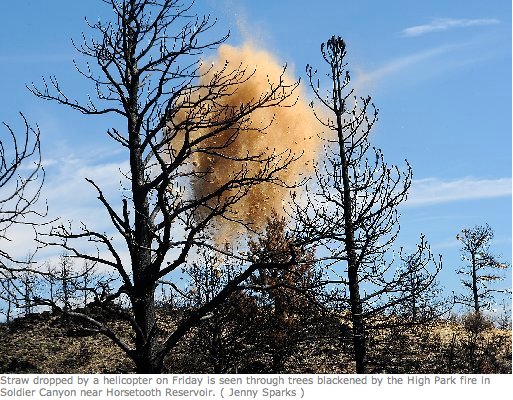
Wildland Restoration Volunteers High Park Post-Fire Restoration, May 23

strawdroppedbyhelicoptersoldiercanyonhighparkfire.jpg

From Wildland Restoration Volunteers:

WRV is working with our partners to address the long-term restoration needs caused by the High Park Fire. Our goals are to protect downstream water quality, prevent erosion, and stabilize slopes. To achieve this, we distribute native grass seeds, lay out mulch and install erosion control structures We believe this will help rivers, roads, water infrastructure, and communities.

For this project, we will be finishing the installation of wattles on a hill slope to stabilize the slope. We would love to have your help!

More restoration/reclamation coverage here.

Lake Powell: Quaggas in the pipes? #ColoradoRiver

lakepowell.jpg

From the Summit County Citizens Voice (Bob Berwyn):

The National Park Service recently identified 14 adult quagga mussels attached to moored vessels and dock structures at the Wahweap Marina in Lake Powell. None of the adult mussels were close enough together to mate for successful reproduction. All of the mussels were physically removed from the lake. The first four mussels were found when a local marine service business noticed the small shells on a boat that had been pulled for maintenance and then notified the park service. “We really appreciate the report of this finding since it will help in the removal of the adult mussels before they can reproduce,” said Mark Anderson, a Glen Canyon ecologist. “It’s likely that the mussels were introduced via ballast or bilge water from a boat that was not cleaned, drained, or dried.”

Boats, docks, and cables in Wahweap Bay will continue to be assessed by the NPS dive team. The Antelope Point area was inspected beginning in December of 2012 with no mussels discovered.

Click here to read the March 27, 2013 Mussel Monitoring Update for Lake Powell from the National Park Service:

Mussel Monitoring Update for Lake Powell

1. What was found?
Fourteen widely dispersed adult quagga mussels were found attached to moored houseboats and dock structures. The mussels were alive, but too far apart to successfully reproduce.

2. Where were they found?
The adult mussels were found at the Waheap Marina. Surveys were conducted in the Antelope Point area beginning in December, 2012 and no mussels were detected.

3. How were they found?
Employees of a local marine services business discovered the first four mussels on a single houseboat that had been removed from moorage for annual cleaning and maintenance. They contacted Glen Canyon National Recreation Area staff on March 18th to identify the organisms. NPS staff confirmed they were quagga mussels. Divers discovered the additional mussels as they searched nearby.

4. Why is this important?
No adult mussels have been found in Lake Powell prior to last week. The mussels appear to have attached and grown on the boats and structures while they were in the lake. The mussels were too far apart, however, to reproduce.

5. What are the next steps?
Diver surveys will continue in the coming weeks to determine the extent of the number of mussels. When found, mussels are physically removed from the lake to prevent reproduction. The NPS will continue all of our mussel prevention activities including inspections of boats. Preventing the spread of Quagga mussels and other aquatic invasive species is more important than ever.

6. If control strategies are not effective, how soon could Lake Powell start experiencing mussel impacts?
Should a mussel population get established and spread, it could be several years before their presence would be obvious. Spreading lake-wide could take considerably longer.

7. What can the public do to help?
Clean, drain, and dry! The spread of mussels and other aquatic invasive species is preventable. Cooperate with prevention program efforts at Lake Powell and other places where people are trying to protect their waters. Always make sure your vessels and equipment are not causing the problem. Spread the message, not the mussels.
rch 27, 2013

8. Are boat inspections still required at Lake Powell? Yes.

9. Can boats leaving Lake Powell spread mussels to other waters now?
Not if boaters practice “Clean, Drain, and Dry” and treat their boats and equipment to prevent spreading aquatic species.

10. What effect will this have on the Colorado River below the dam in Glen and Grand canyons? These detections are so low that no effect will occur. If a large infestation of Quagga mussels existed in Lake Powell, large numbers of mussel larvae might travel through the dam. The larvae that survived would seek to attach in low flow areas. It is not known if they could reach high numbers. The Arizona Canal has not yet developed large populations of mussels despite larvae being delivered from the Lower Colorado River.

11. What has the NPS done to stop mussels at Lake Powell?
The NPS has operated a mussel prevention program at Lake Powell since 2000. Over a decade ago, scientists predicted that Lake Powell would be the first lake in the western U.S. to get mussels. The number of high-risk boats coming to the park has increased exponentially in that time. Prior to 2007 and the discovery of mussels in the west, Lake Powell was threatened by about 50 high-risk boats per year from eastern states. In 2011 alone, that number was 17,000. 38 boats with mussels were stopped from launching in 2012, over twice the number in 2011. The increased pressure has required the park to screen boats to determine the highest risks and focus our limited capability where it was needed most. At busy times, as few as 15% of boats may actually get inspected.

12. How does NPS monitoring at Lake Powell compare to other mussel monitoring programs?
No other lake on earth is as intensely monitored for mussels as Lake Powell. The NPS processes hundreds of samples each year. The NPS uses 4 early detection methods, including microscopic analysis, automated particle analysis (FlowCAM), Polymerase Chain Reaction (the DNA test), and deployment of artificial substrates to detect early colonization. Sampling occurs lake-wide at routine sites like marinas and the dam; computers are also used to determine random sampling locations throughout the lake. More samples collected are from areas where there are the most boats. Using both routine and random sampling as well as multiple early detection methodologies is expected to increase the chances of very early detection. Control of any invasive species is easiest when caught early. If these current findings represent a population, the best chances have been created for successful control.

More invasive species coverage here.

2013 Colorado legislation: Governor Hickenlooper signs HB13-1044 (Authorize Graywater Use) #COleg

graywatersystem.jpg

From the Northern Colorado Business Report (Steve Lynn):

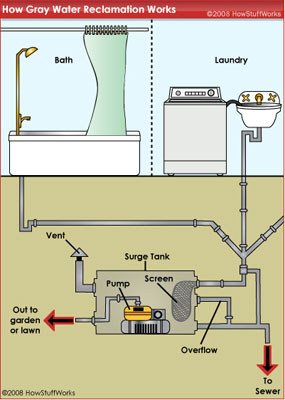
Rep. Randy Fischer, D-Fort Collins, and Sen. Gail Schwartz, D-Snowmass Village, introduced House Bill 1044. Hickenlooper signed the bill at Colorado State University on Wednesday. The bill directs the Colorado Water Control Commission to create statewide standards for gray water systems. It defines graywater as water coming from bathroom and laundry room sinks, bathtubs, showers and laundry machines. “Graywater does not include the wastewater from toilets, urinals, kitchen sinks, dishwashers or non-laundry utility sinks,” the bill states…

The new law lets cities, towns and counties decide whether to approve graywater use in residential and commercial settings.

More HB13-1044 coverage here. More 2013 Colorado legislation coverage here.