
Drought/runoff news: ‘I’m worried that the dirt is going to catch fire’ — Adrian Oglesby #COdrought #NMdrought

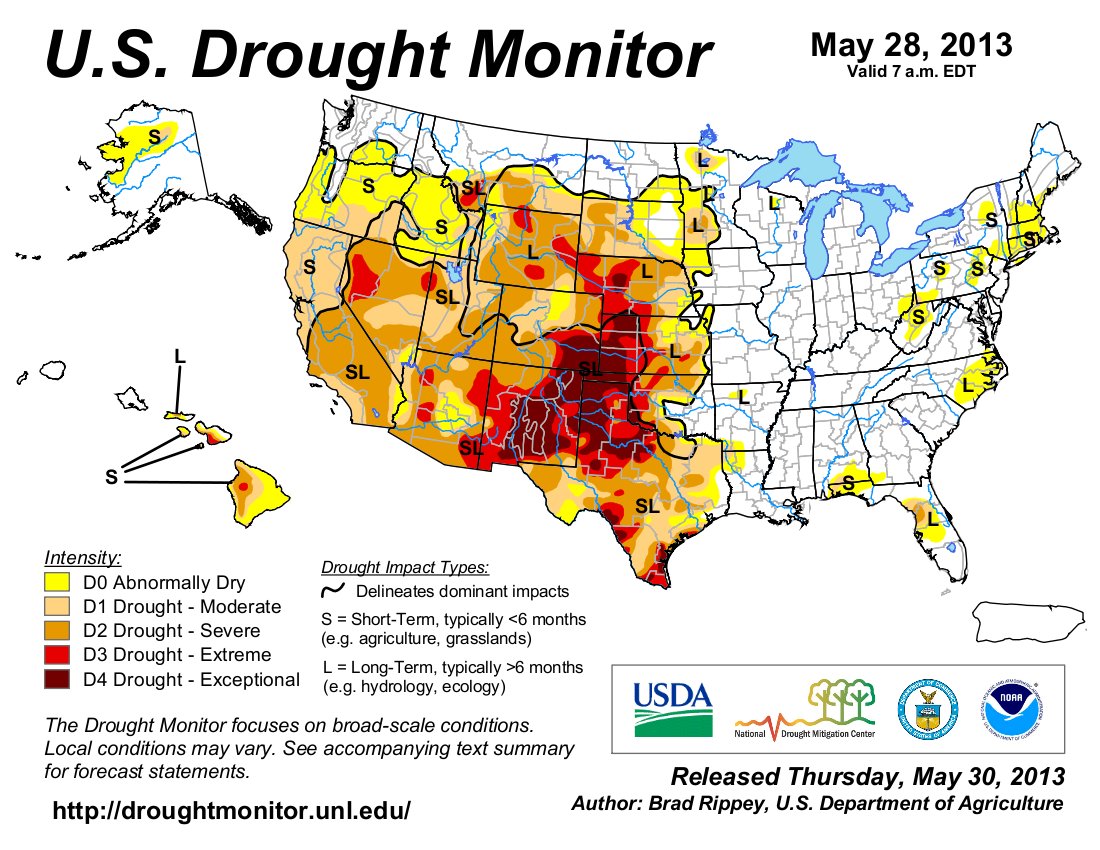
usdroughtmonitor05302013

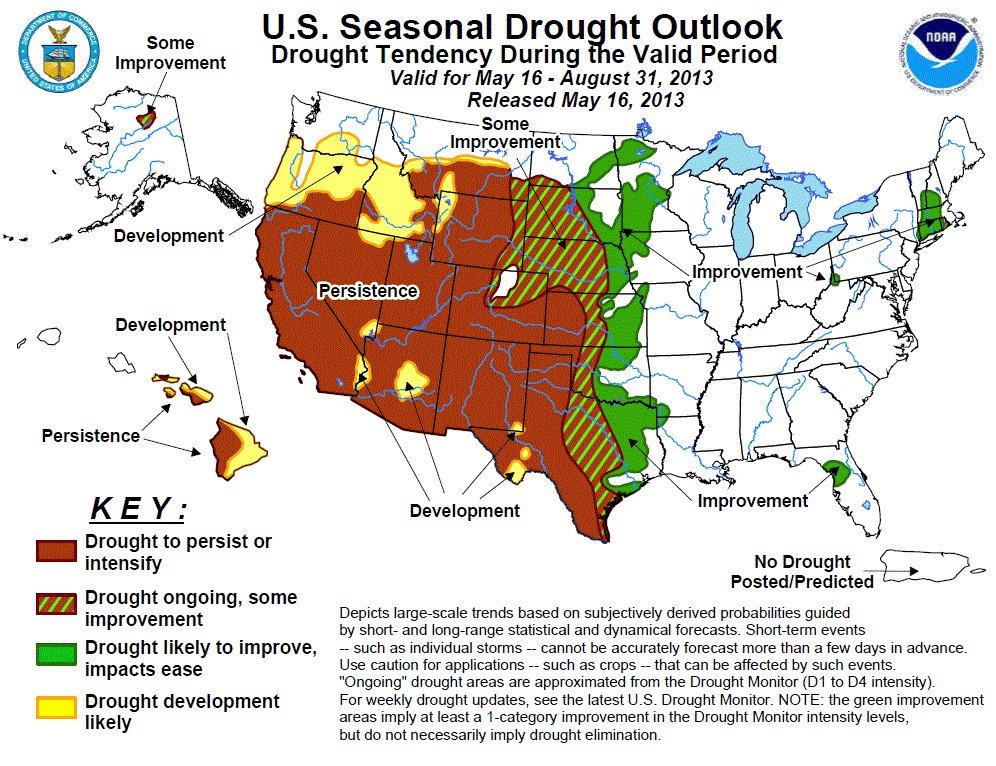
seasonaldroughtoutlookcpc0516to08312013

From the Fort Collins Coloradoan (Bobby Magill):

The city now has enough water supplies to lift the restrictions following big snows in April and early May, said Fort Collins Water Resources Manager Donnie Dustin. The city wants residents to conserve water, but a balance must be struck between mandatory water restrictions and voluntary water conservation measures, said Lisa Rosintoski, customer connections manager for Fort Collins Utilities.

“Restrictions are mandatory for when we’re in a shortage situation, so it’s a short-term thing,” Dustin said. “Conservation is long-term, working towards reducing that use so it’s reduced every year.”

“This by no means advocates guilt-free water use,” Dustin said. The city is recommending residents water lawns no more than one or two days each week, but it’s no longer mandatory, he said.

The lifting of the water restrictions will not affect water rates, he said. Lost revenue due to mandatory water conservation measures was not a factor in the city’s decision to lift the restrictions, Dustin said.

Meanwhile conditions are terrible in southeastern Colorado and New Mexico. Here’s a report from John Fleck writing for the Albuquerque Journal. Here’s an excerpt:

In the eight months since Oct. 1, just 0.91 of an inch of rain has fallen at the Weather Service’s Albuquerque station, less than a quarter of average and the third-driest start to the city’s “water year” since record-keeping began in Albuquerque in the late 1800s. “I’m worried that the dirt’s gonna catch fire,” said Adrian Oglesby, a member of the Middle Rio Grande Conservancy District’s board of directors…

While Albuquerque is one of the drier spots in the state, all of New Mexico is suffering, said Deirdre Kann at the National Weather Service’s Albuquerque office, who provided the latest numbers Thursday. “No part of the state has been spared,” Kann said. According to the weekly federal Drought Monitor, 98 percent of New Mexico is in “severe” drought, the worst conditions in the country.

“It’s forgotten how to rain down here,” said Phil King, a hydrologist at New Mexico State University in Las Cruces and water management consultant to the Elephant Butte Irrigation District. The Rio Grande through Las Cruces has been dry since last autumn. The district, which provides Rio Grande water to southern New Mexico farmers, normally starts irrigation deliveries in February or March. King and his colleagues will finally begin releasing water from Caballo Reservoir into the Rio Grande, beginning Saturday, with farmers in the famous chile-growing region of Hatch seeing their first Rio Grande water of the season, beginning Sunday or early next week, King said…

Upstream, water managers are scrambling to find enough water for farmers in the Middle Rio Grande Conservancy District, as well as supplies to keep enough flow in the Rio Grande to avoid problems for the endangered Rio Grande silvery minnow. The district has already cut off water deliveries to some low-priority water users, and might have to curtail deliveries to other farmers as early as the middle of June as supplies run low, according to David Gensler, the agency’s water manager…

While there is a slight chance of scattered showers over southern and eastern New Mexico on Sunday, the real hope for a break in the long term pattern comes with the arrival of the summer rainy season, usually in late June or July. In that regard, the long range outlook is not encouraging. Odds favor dry conditions and persistent drought at least through the end of August, according to federal forecasters.

Denver Water: Western water agencies respond to federal efforts to protect Colorado River #ColoradoRiver

uppercoloradoriverbasinstatesultimatum09011925denverpost.jpg

Here’s the release from Denver Water (Stacy Chesney):

Officials from several of the West’s largest municipal water agencies today joined forces with the U.S. Bureau of Reclamation (Reclamation) to find a long-term, systematic solution to the potential long-term imbalance between the Colorado River’s future supply and projected demands.

In the Colorado River Basin Water Supply & Demand Study released last December, Reclamation demonstrated through modeling efforts a possible long-term resource imbalance that could seriously affect both the region’s economy and the more than 30 million people who rely upon the Colorado River. Reclamation’s latest effort outlined three major areas — agricultural conservation and transfers, municipal/industrial conservation and reuse, and environmental flows — that will be the subjects of immediate focus. Municipal agencies throughout the Colorado River system have already taken steps in that direction, collaborating on several water efficiency and conservation projects to increase the river’s reliability both now and into the future, but have vowed to do more.

“The study underscores the importance of working together to meet our collective future water supply needs,” said Southern Nevada Water Authority (SNWA) General Manager Patricia Mulroy. “While the solutions won’t be easy for anyone involved, the consequences of failure are too dire to ignore. All of us who depend upon the Colorado River — from the suburbs of Denver to the California coast — need to step up and meet this challenge.”

Denver Water CEO/Manager Jim Lochhead stressed that while cities alone cannot alleviate the river’s projected shortfall — municipal use of the Colorado River accounts for less than 15 percent of its depletions, while agriculture uses more than 75 percent — they must be involved in helping find solutions. As the study shows, the biggest driver of the potential imbalance is not increased use but rather reduced Colorado River inflows due to a warmer, drier climate.

“While everybody knows that this problem can’t be solved solely by the cities because we use a relatively small percentage of Colorado River water, that fact does not absolve us from our duty to use this resource responsibly and do our part,” Lochhead said. “We have already made great strides in water efficiency, and our work will continue. We want the agricultural and environmental interests to know that we’re in this with them, and we’re going to hold up our end.”

During the past decade, major cities throughout the Colorado River Basin have slashed their water use and found creative ways to extend their supplies through reuse and augmentation projects. Denver, for instance, decreased its consumption by 20 percent. In Las Vegas, virtually all indoor water is captured and directly or indirectly recycled, while community-wide conservation efforts have included the removal of more than 150 million square feet of grass. These efforts, combined with strict water use policies, reduced the desert city’s annual water consumption by 29 billion gallons during the past decade despite the addition of 400,000 new residents during that span.

All Central Arizona Project (CAP)-supplied municipal customers, including Phoenix and Tucson, have been successful in reducing per capita consumption by making significant investments in conservation, reuse and infrastructure. For example, average residential water use in the City of Phoenix has dropped by more than 26 percent over the past 15 years, while approximately 97 percent of Scottsdale’s reclaimed water is reused for turf irrigation or recharge efforts. At the same time, CAP, along with the Metropolitan Water District of Southern California (Metropolitan) and SNWA, has invested extensively in large-scale water efficiency projects such as the Brock (Drop 2) Reservoir, which has already saved more than 250,000 acre-feet of water.

In California, urban agencies have funded agricultural conservation measures to reduce the state’s use of Colorado River water by 20 percent over the last decade. In addition, through investments in water conservation and local supply management, including recycling, urban Southern California imports less water today than it did 20 years ago, despite the region having added more than 4 million people.

“Southern California has long been a leader in water conservation, having invested more than $300 million on water-saving projects and programs over the past two decades,” said Jeffrey Kightlinger, general manager of Metropolitan. “Water-use efficiency remains a core element of our long-term water management strategy, placing equal weight on local and imported resource development.”

While conservation measures and investments have been effective, urban agencies acknowledge more must be done to reduce the anticipated Colorado River imbalance, which is largely driven by a decrease in Colorado River flows rather than increased demand but is projected to dwarf the total combined consumption of all of these cities. Still, CAP General Manager David Modeer said a continued commitment to conservation and coordination between the water agencies is critical to a cohesive basin-wide demand management strategy.

Solutions that offer the greatest potential to yield additional water supplies are also important.

“Augmentation projects and water conservation can restore the reliability and sustainability of the Colorado River to meet current and future water needs,” said Modeer. “These efforts are needed immediately and include feasibility studies and, potentially, legislation and policy development.”

The economic stakes involved are difficult to overstate. According to data compiled by the United States Conference of Mayors, the combined metropolitan areas utilizing Colorado River represent the world’s 12th largest economy, generating more than $1.7 trillion in Gross Metropolitan Product a year and supporting millions of jobs. [ed. emphasis mine]

“While people east of the Mississippi might look at this as a Western problem, the reality is that our national economy is integrated,” said Mulroy. “If these cities’ economies are curtailed by water shortages, the shockwave is going to be felt throughout the country.”

More Colorado River Basin coverage here and here.

Reclamation allocates $40 million for water projects

piedrariver.jpg

From the American Water Works Association:

Water and energy management projects in the western United States will share nearly $40 million in funds provided by the Bureau of Reclamation.

As announced by Reclamation:

  • Five authorized water reuse projects in California and New Mexico will receive $15.6 million through the WaterSMART porgram. They include the Albuquerque Metropolitan Area Water Reclamation and Reuse Project ($1.89 million), the North Bay Water Reuse Program ($4 million), the Long Beach Area Water Reclamation Project ($1.7 million), the San Jose Area Water Reclamation and Reuse Program ($4 million) and the Watsonville Area Water Recycling Project ($4 million).
  • 44 projects in 11 states will receive $20.8 million in WaterSMART and Energy Efficiency Grants. Reclamation estimates that together the 44 projects could save more than 100,000 acre-feet of water and 10.8 million kilowatt-hours annually.
  • $2.1 million will be made available under the WaterSMART Basin Study program to enable Reclamation to partner with local entities to conduct comprehensive studies of river basins in Arizona, California, Colorado, Kansas, Nevada and Oregon.
  • More conservation coverage here.

    Aspinall Unit operations update: The Black Canyon Water Right one day peak flow target is 685 cfs #COdrought

    aspinallunit.jpg

    From email from Reclamation (Dan Crabtree)

    Based on the May 1st April-through-July runoff forecast of 335,000 ac-ft for Blue Mesa Reservoir, the Black Canyon Water Right one day peak flow target is 685 cfs. Today’s flow through the Black Canyon is 300 cfs.

    Due to the dry conditions and low Blue Mesa Reservoir content, the Whitewater baseflow target for June and July is 900 cfs. Current flows at Whitewater are around 1600 cfs. As tributary flows to the Gunnison diminish, and Whitewater flows approach 900 cfs, Reclamation will increase releases to attempt to maintain the target at Whitewater. We will provide as much advanced notice as possible regarding these release changes. We anticipate this operation will allow the Black Canyon one day peak target to be met sometime in the latter part of June, however, if insufficient, we intend to supplement releases with additional power releases as necessary to meet the target. We will keep you updated as things progress.

    More Aspinall Unit coverage here and here.

    Northern Water ponies up dough to keep NISP on schedule

    gladereservoirsitenorthernwater.jpg

    From the Fort Collins Coloradoan (Bobby Magill):

    Keeping the Glade Reservoir environmental review on schedule is worth $139,254.95 to Northern Water. That’s how much the Northern Colorado Water Conservancy District is giving the U.S. Army Corps of Engineers to pay for a project manager who will help complete the supplemental environmental review for the Northern Integrated Supply Project, or NISP.

    A draft of the review, part of the yearslong permitting process for NISP, had been expected to be released to the public sometime this year, but now the Army Corps is saying it’ll be sometime in early 2014, said Northern Water spokesman Brian Werner. Northern Water and the Army Corps signed an agreement May 17 for the Army Corps to take Northern Water’s money to pay for a part-time project manager for two years. The money is coming from all the cities and water and irrigation districts that are participating in NISP…

    In the Army Corps’ May 23 announcement that it had decided to take the money, the agency said it would take numerous steps to prevent the permitting process from being biased toward the approval of NISP. Northern Water’s money will not pay for any work done by people high up in the Army Corps’ chain of command who will be making final decisions on NISP, the announcement said. Franklin said the Army Corps will be unbiased in its decision-making process regardless who pays for the NISP permitting process.

    Environmentalists opposing NISP said the money creates the appearance that the Army Corps will have a conflict of interest when decideing whether to give final approval to Glade Reservoir and NISP.

    More Northern Integrated Supply Project coverage here and here.