Douglas County Water Resource Authority video: Saving Water in Your Yard? It’s So Easy A Kid Can Do It

From email from the Douglas County Water Resource Authority:

As spring snow and rain showers give way to warmer days, your thoughts may be turning to enjoying your yard this summer. If you’re over watering your lawn, you may want to consider taking a few minutes this weekend to install rotary sprinkler nozzles. These nozzles reduce the amount of water applied to your lawn by up to 30% over traditional designs. A simple change-out of nozzles can Save Water, and Save Money. It’s so easy, a kid can do it!

More conservation coverage here.

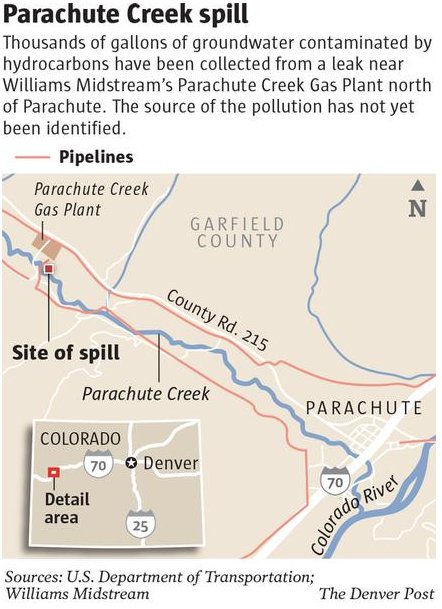
Parachute Creek spill: Testing shows ‘consistent’ drop in benzene levels recently #ColoradoRiver

parachutecreekspillmarch2013

From The Grand Junction Daily Sentinel (Dennis Webb):

Benzene levels in Parachute Creek have shown consistent reductions in recent days, according to test results. The reductions come as Williams continues to work with state regulators to strip the carcinogen from groundwater before it reaches the creek, and to also remove benzene from the creek. The work follows the leaking this winter of what Williams estimates was about 10,000 gallons of natural gas liquids into soil and groundwater from a pipeline leaving its gas processing plant northwest of Parachute.

The leak resulted in high benzene levels in groundwater, and benzene in the creek that at one point barely topped the state drinking water standard of 5 parts per billion, although that standard doesn’t apply to the creek. The Colorado Department of Public Health and Environment said Tuesday the high daily measurement in the creek had fallen from 4.4 ppb on Thursday to 2.6 ppb on Sunday. Williams said it was 2.2 ppb on Monday.

That measurement site is about 1,300 linear feet downstream of the approximate spill location. Starting on Friday, a test site 2,158 feet downstream has no longer shown the presence of the substance, after having consistently tested positive. Likewise, Williams reported on Monday a site 1,643 feet downstream also tested negative.

Williams has been using aeration and pumping hydrocarbons from wells to help remove benzene and other contaminants. Newly installed vertical air sparge wells to treat groundwater benzene near the benzene’s point of entry into the creek went into operation Friday.

CDPHE said the domestic well of Howard Orona, who lives near the creek downstream of the leak site, again has tested negative for benzene.

More oil and gas coverage here and here.

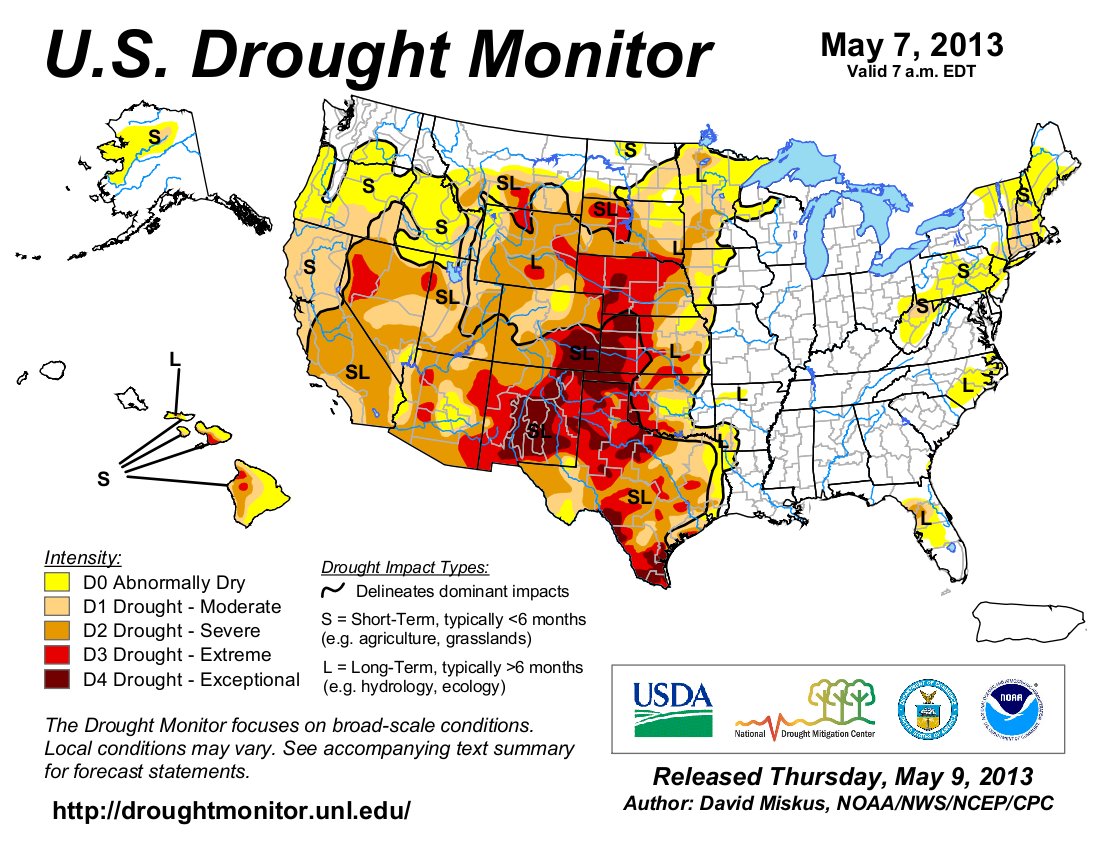
Drought news: ‘The ground is so hard, so dry, that the water runs right off’ — Cindy Schleining #COdrought

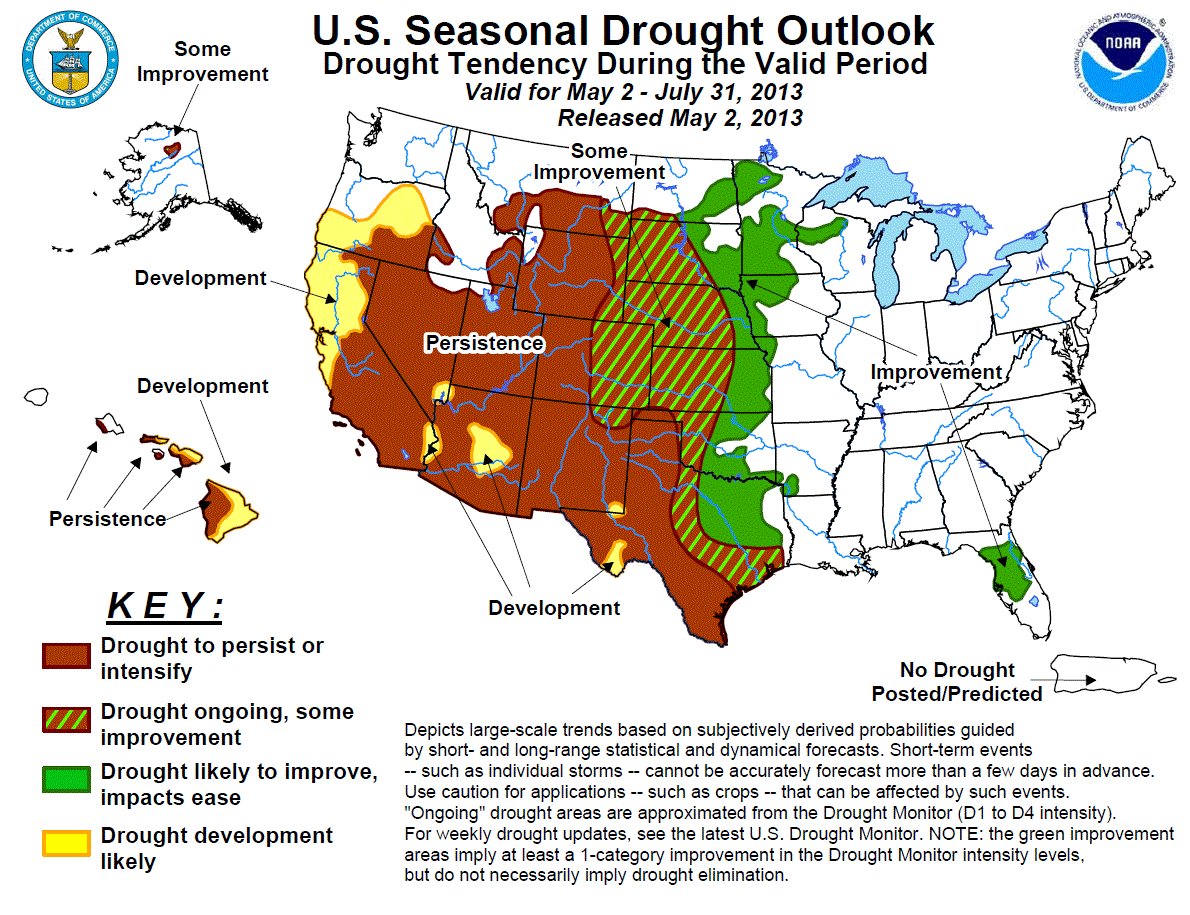
seasondroughtforecastcpc90daymay22013

usdroughtmonitor05072013

From The Pueblo Chieftain (Chris Woodka):

The agency Cindy Schleining works for was formed in response to the disastrous drought of the 1930s. But even the Natural Resources Conservation Service might be running out of options as the Arkansas Valley enters its third year of drought. “The ground is so hard, so dry, that the water runs right off,” Mrs. Schleining said. “Last year, it was so hot and windy.”

She knows the problems too well. She and her husband Jim — who works in the same building for the Farm Service Agency — started farming between McClave and Wiley 32 years ago, getting into the game when farmers faced a different problem — the financial storm of exorbitant interest rates.

But without water, either from the sky or the canals, these times are even more desperate. Like most of their neighbors, the Schleinings have sold off some cattle, keeping a few heifers to rebuild the herd when the time is right. They have a strategy to survive and hang on through tough times and are waiting for the drought to break. “What really concerns me is our young farmers. They’ve come in and put in irrigation systems and are carrying loans. I wonder how they will make it. . . . The older farmers have been through droughts, but not at this extreme,” Mrs. Schleining said.

She tells a story of one neighbor who found a job in town, just so he would not have to lay off his hired men. “He basically had to fire himself,” she said.

Most farmers carry insurance, but the payments are at best 60 percent of what they could make growing a crop. And the number is based on a five-year rolling average, Jim Schleining said. In 2011, many had already planted crops, so losses may have been higher than in 2012, when farmers could see the drought coming. But every year that pops up zero hurts the average.

Usually, either the price of cattle or feed is up, while the other is down. But for the past few years, both are high. Faced with more cost to feed cattle and fewer resources to grow crops, farmers are selling off herds or shipping them out of state to graze. “We’ve never been in a position like we are this year,” Schleining said.

From The Pueblo Chieftain (Chris Woodka):

On the road to Wesley Eck’s farm, there were no farmers riding tractors, even though it was a dry, partly sunny May day.

Clouds swirled around, but once again, they failed to deliver.

“I think a year ago, we were optimistic,” said Eck, who is president of the Fort Lyon Canal Co. “Here it is planting time, and some of the optimism is gone from the equation.”

Eck has lived in the area since 1958, and counts himself lucky for the opportunities he’s had as a farmer. He still has the equipment he used to raise vegetables for his roadside produce stand, as well as the equipment he still uses to grow hay, corn and wheat. He still owns land and water rights. “There are still farms, but fewer people. One guy can farm 10 times as much,” Eck said. “But there’s no alternative to water.”

He sold off all of his cattle this year because it was becoming too expensive to feed them. The wells he relies on to irrigate some of the land he farms, augmented by his Fort Lyon shares, have all been curtailed. Usually they would produce 90-120 acre-feet of water, but this year it will only be 18 acre-feet. “There’s hardly enough to know what to do with; hardly enough to pay the electric costs,” Eck said.

Farmers who flood-irrigate on the Fort Lyon are in no better shape. There have been only three runs this year, after a horrible season in 2012, when the water quit coming in mid-June. “It’s a big, long ditch,” Eck said of the 113-mile canal. “We lose 37 percent of the water in transit.”

Eck isn’t quite ready to give up on optimism, or maybe appeals to a higher power. “The other day, I was saying what we need is a good hard rain, and my 5-year-old granddaughter told me, ‘Only God can make it rain.’”

From The Pueblo Chieftain (Chris Woodka):

The cottonwoods along the Purgatoire River are dying, and John Davidson’s cattle are running out of grass. “It’s the worst it’s ever been. Two or three years of every 10 are bad, but there’s never been anything like this,” the 71-yearold rancher said last week over lunch in Las Animas. “We’ve had less than an inch of rain on the Picketwire (Purgatoire River) and the wind has taken that.”

Some areas along the Purgatoire where tamarisk were removed actually have more water than in past years, proof that removing invasive species increases water supply. Otherwise, the river is drying up. “There are 10 to 12 miles of the Picketwire that have dried up since Nov. 1,” Davidson said. “The cottonwoods are dying. The water table is dropping.”

During the 2000-02 drought, Davidson shipped some cattle to Oklahoma. He also ships some of the herd to Monte Vista, where it’s been at least as dry. His herd is down to about 900 head, from an average of 1,500. “If we go any lower, all of them will have to go,” Davidson said. “Next fall, it could be a situation of no feed, with winter looking you in the eye.”

One of the things that has kept Bent County landowners going this year are oil and gas leases. Some, like Davidson, own the mineral rights to land and have benefited from the boom in exploration. “You can’t bank on them, however. You don’t know what’s going to happen,” he said.

From The Pueblo Chieftain (Chris Woodka):

Recently, Glen Brown saw dirt blowing off grasslands near where he ranches in southern Bent County. “I’ve seen a few places where it’s blowing on native grass that I’ve never seen in my lifetime. It’s kind of scary,” Brown said.

His family has ranched in the area for more than 100 years. He also farms some ground under the Las Animas Consolidated Ditch.

After losing 35 percent of his calves in the 2007 blizzard, Brown was just getting back to normal in his operations when the drought started three years ago. This year, the herd is down to 230 mother cows, from the normal level of about 300. “We reduced the herd by 25 percent, and kept 25 percent fewer replacement heifers,” Brown said. “Last Tuesday, we sold all of the replacement heifers we did keep. If this continues, we will start thinning the herd.”

The Colorado River District board news summary for April is hot off the press #ColoradoRiver

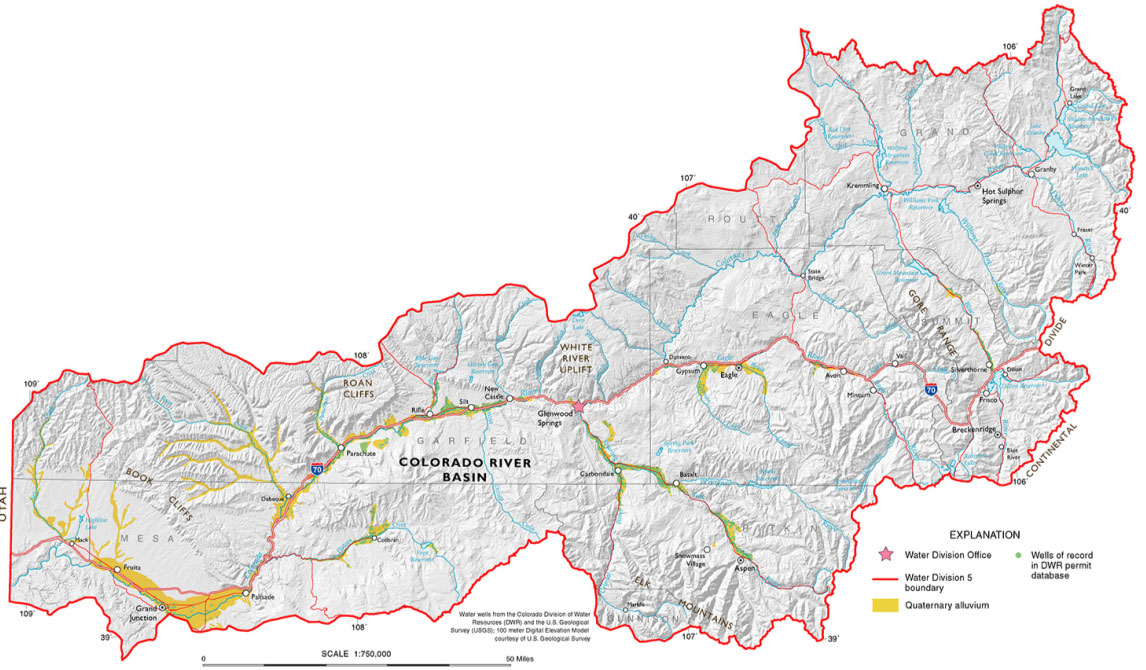
coloradoriverbasincgs.jpg

Click here to read the summary. Here’s an excerpt:

April’s snowstorms improved the water supply prospects in the Colorado River Basin, but the effects were uneven across the 15 counties of the Colorado River District.

Receiving the biggest boosts were the Colorado, White and Yampa Basins. The Gunnison Basin was not as fortunate and will likely experience water supply problems this summer, according to General Manager Eric Kuhn, reporting to the Colorado River District Board at its April 16 meeting.

For most of the winter, Western Colorado was track- ing even with the abysmal snow year of 2012, the fourth worst on record. But where it had stopped snowing in March of 2012, this past March experienced a wave of storms, a pattern that accelerated in April.

In fact, the April 14-15 storm forced the Colorado River District to abbreviate its agenda and defer a number of discussions until its July meeting.

“This time last year, 90 percent had run off and we about 10 to 20 percent of normal snowpack,” Kuhn said. “This April, the curve was still going up. Still, district wide it is not an above average year. We will have some problems down the road but they will not be as severe as it seemed earlier in the year.”

More Colorado River Basin coverage here and here.

Runoff news: May 1 streamflow forecast for the Cache la Poudre River is 89% of avg #COdrought

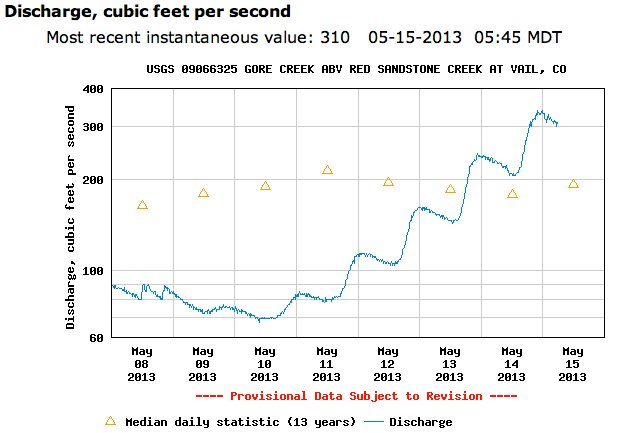
gorecreekaboveredsandstonecreek05152013

Click on the thumbnail graphic for the hydrograph for Gore Creek above Red Sandstone Creek from earlier today. You’ll be able to see how streamflow has increased with the onset of warmer weather.

From the Fort Collins Coloradoan (Robert Allen):

At the mouth of the Poudre Canyon, flows are at 577 cubic feet per second. They remain below the 130-year average of about 675 cfs, but the increase the past three days has narrowed the gap. Brian Werner with the Northern Water Conservancy District said the Poudre River is forecast to flow about 89 percent of normal this year. That’s up from the forecast April 1, which said it would be 65 percent of normal.

Whitewater boaters were already riding the river down Poudre Canyon on Tuesday, and fishers were reeling in trout. The vegetation is more lush, and the river looks bigger.

From email from the USGS this morning:

Streamflow of 444 cfs exceeds subscriber threshold of 250 at 2013-05-15 04:15:00 MDT 06752260 00060 CACHE LA POUDRE RIVER AT FORT COLLINS, CO

From email from the USGS this morning:

Streamflow of 302 cfs exceeds subscriber threshold of 200 at 2013-05-15 02:45:00 MDT 06719505 00060 CLEAR CREEK AT GOLDEN, CO

Meanwhile the Eagle River Water and Sanitation District has bookmarked the gages that they watch this time of year:

The District monitors streamflow levels using data from United States Geological Survey (USGS) gauges in specific locations below, which are pertinent to District operations. Streamflow data is used for a variety of reasons including operational strategies, water quality purposes, historical comparison, and water rights administration, among others.

Weekly Climate, Water and Drought Assessment of the Upper Colorado River Region #ColoradoRiver #CODrought

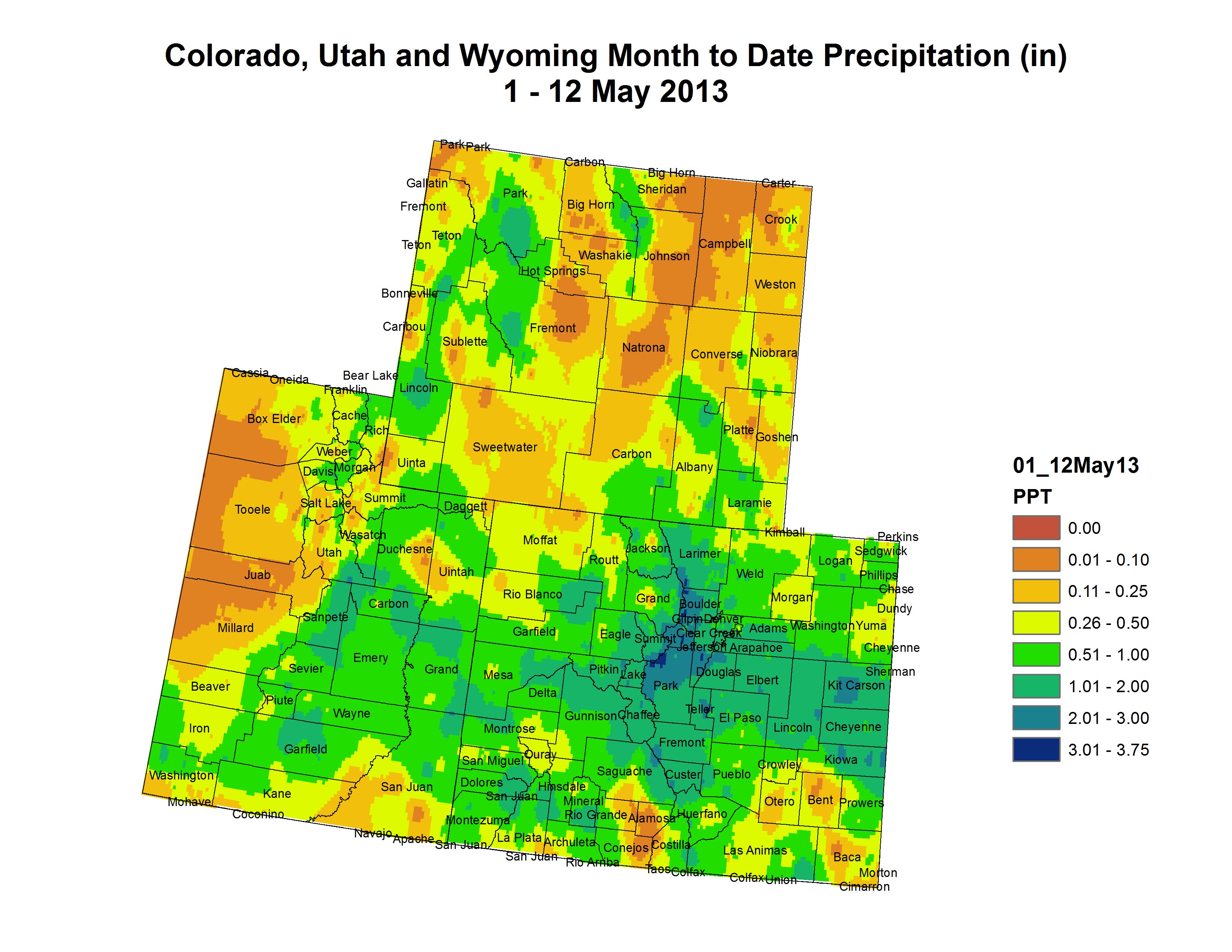
wyutcoprecipitationmay1to122013

Click on the thumbnail graphic for the May 1 through 12 precipitation summary. Click here for all the summaries from the Colorado Climate Center.

More Colorado River Basin coverage here and here.