
Snowpack/drought news: ‘We went from really, really bad to pretty good’ — Todd Boldt #COdrought

usdroughtmonitor04232013

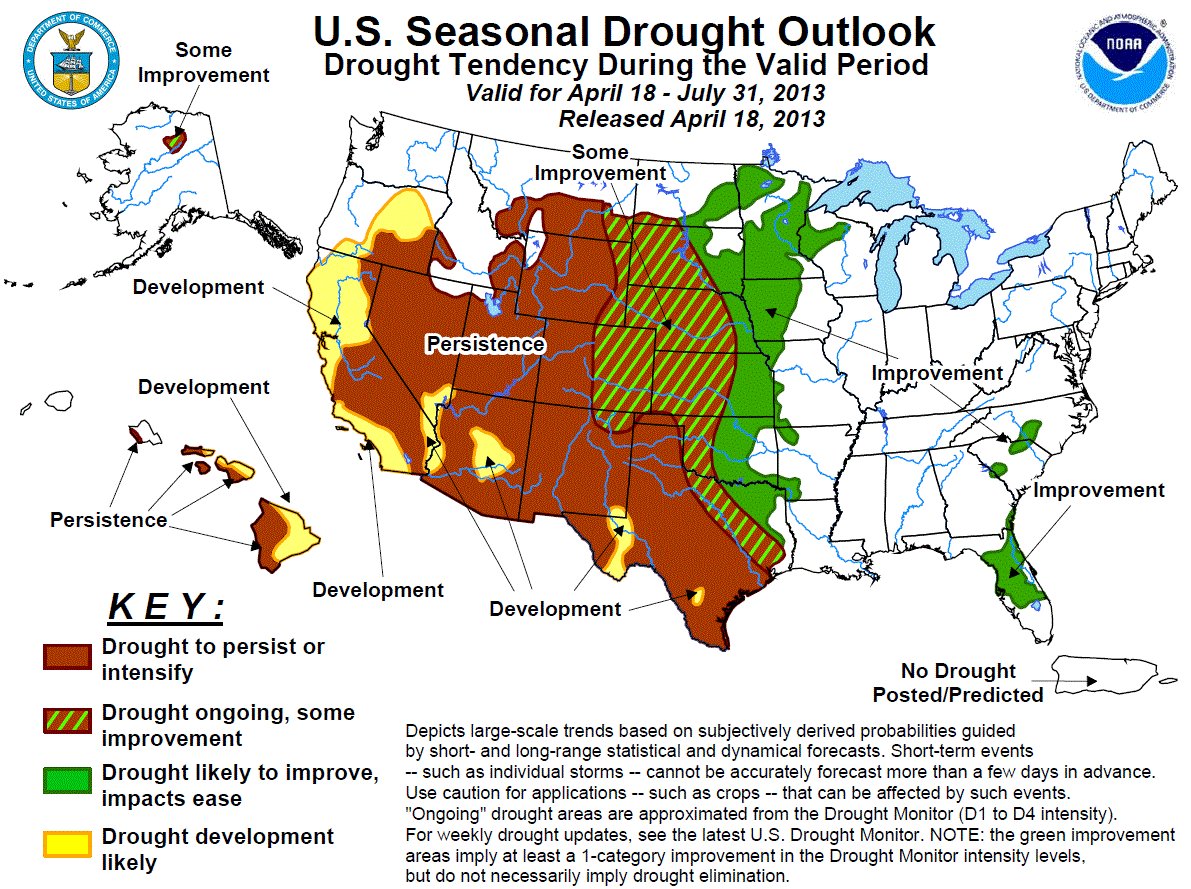
seasonaldroughtoutlookapril18tojuly312013cpc.jpg

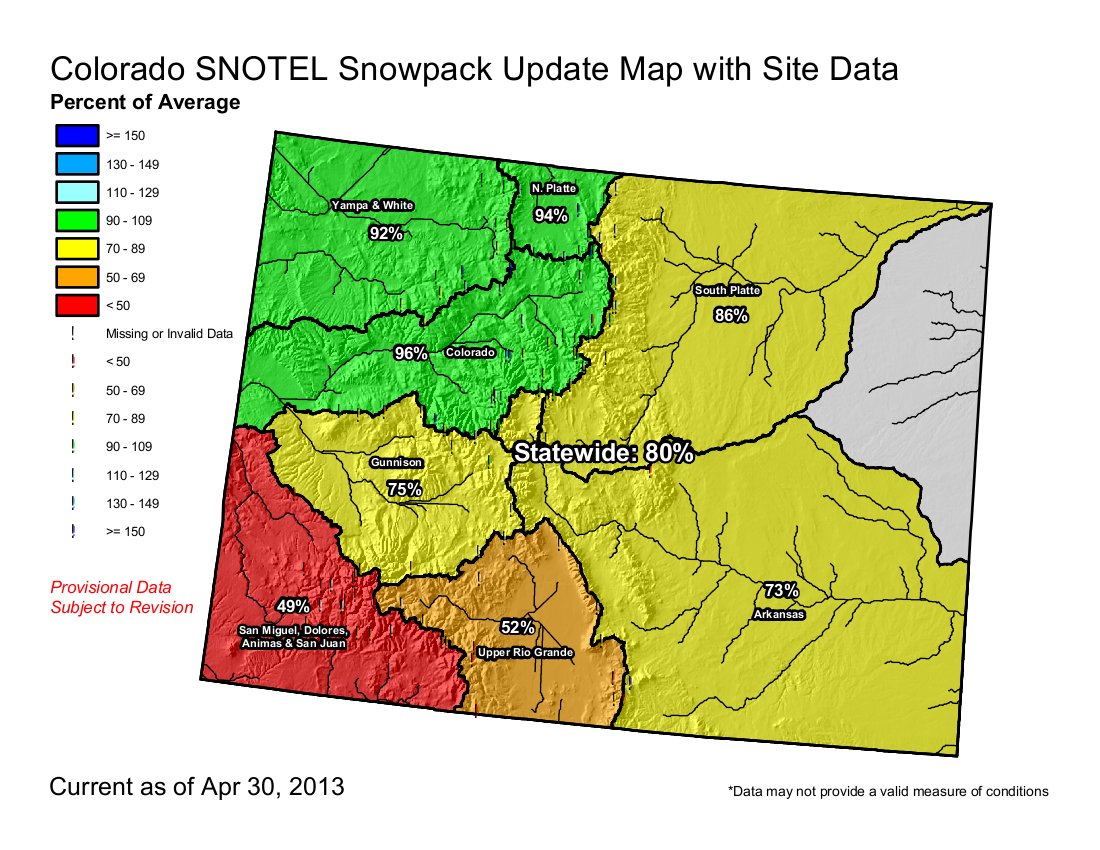
snowpackcolorado04302013

From the Fort Collins Coloradoan (Bobby Magill):

Last month was the fourth-snowiest April in Fort Collins’ history, with a wet and sloppy 29.4 inches of snow piling up at the Colorado Climate Center weather station on the Colorado State University campus. That’s a whopping 23.2 inches above normal for the month. You’ll have to go back to 1945 to find an April at least that snowy.

Climate Center researcher Wendy Ryan made that official Wednesday in her monthly Fort Collins weather summary report, which also revealed that this is the 16th snowiest winter season since record keeping began here in 1890. By April 30, a respectable 66.3 inches of snow had fallen since the snowfall season began. That’s 11.2 inches above normal for the season, a figure that doesn’t include snow totals from the city’s snowstorm Wednesday…

As of April 30, Northern Colorado remains in a moderate drought, which in recent weeks has been downgraded from a severe drought, according to the weekly drought update report from the National Integrated Drought Information System.

The region’s snowpack remains below normal, with the Laramie River Basin showing Colorado’s most water-laden snowpack at about 96 percent of normal, according to May 1 Natural Resources Conservation Service Snotel data.

From the Loveland Reporter-Herald (Tom Hacker):

“Overall, everyone should be pretty ecstatic,” said Todd Boldt, an NRCS surveyor who spent Monday in Rocky Mountain National Park and Tuesday on the upper Poudre River taking measurements. “We went from really, really bad to pretty good.”[…]

Measures taken at four stations inside Rocky Mountain National Park showed a broad range of results. The water content of the snow at 9,000-foot Deer Ridge, near Moraine Park, was 50 percent above normal. Hidden Valley’s number matched the 30-year average exactly. Bear Lake’s total, after 36 inches of snow during just three April days, was still lagging slightly at 75 percent of normal…

Snow at the Big South Fork of the Poudre contained 144 percent of the average year’s water content. The Chambers Lake reading was 104 percent, and the Cameron Pass snowpack was 91 percent of normal.

The additional snow might lead Northern Water, the agency that manages the water supply from the Colorado-Big Thompson project, to ratchet up the quota that it grants its customers annually.

Aspinall Unit update: Blue Mesa is expected to reach 7465 feet in elevation (400,000 af) at the end of June

aspinallunitdescription.jpg

Click here to read the notes from the recent operations meeting. Here’s an excerpt:

Precipitation in the Gunnison Basin in October and November, 2012 was well below 50% of normal; December precipitation was near normal. January precipitation was in 70-90% range and February dropped to 50-70%. Conditions improved in March and April with April precipitation at 150% of average to date. March and April temperatures have been below average which delays the runoff.

As of April 23rd, snowpack in the Gunnison Basin is 83% of the long-term average for that date. The current inflow forecast to Blue Mesa for April through July is 50% of the long-term average.

Blue Mesa content is now 340,583 af and has gained only 13,000 af through the winter. April 2012 content was around 533,000 af.

As of April 15th, the forecasted April-July inflow to Blue Mesa is 340,000 af, down from 370,000 af in January. 2013 falls in the Dry Year category and would be expected to be exceeded in 93% of years.

If this inflow forecast is maintained, it would represent the 5th lowest inflow since Blue Mesa was constructed (1977, 1981, 2002, and 2012 were lower).

The Black Canyon National Park peak flow will be based on the May 1 forecast; if the present forecast is maintained the peak would be 973 cfs. However, the drought provision in the water right (based on prior dry year and low Blue Mesa content) reduces this peak to 697 cfs. It is expected this flow will be achieved through normal operations; however a small increase may be necessary if conditions dictate otherwise.

Flow Recommendations call for a 900 cfs peak at Whitewater in a Dry Year based on the present forecasted inflow. Base flow targets at Whitewater are 890-900 cfs from May- August in this type year.

Under most probable conditions, Blue Mesa is expected to reach 7465 feet in elevation (400,000 af content) at the end of June which is 54 feet short of filling. By the end of the year, Blue Mesa is predicted to be 6 feet lower than the 2012 end of the year elevation.

Black Canyon flows January to April were around 300 cfs and may increase to 400-500 cfs in the summer. A peak of around 700 cfs will occur. Changing conditions always have the potential to affect these early predictions.

More Aspinall Unit coverage here and here.

Say hello to ColoradoFloodThreat.com #COwx

Here’s the pitch:

The CWCB offers a daily assessment of flood potential around the state, issued at 11:00 am each day from May through September.

Durango: Ambitious restoration/construction project for the city’s whitewater park to kick off in November

durangowhitewaterparkplansmay2013durangoherald.jpg

From The Durango Herald (Jim Haug):

By using berms or coffer dams, sections of the river will be split into dry and wet sides to allow workers to get to the river bottom of the whitewater park, also known as Smelter Rapid, by Santa Rita Park and Durango’s wastewater-treatment plant.

Contractors then will do restoration and maintenance work, such as grouting boulders into place, as well as creating a new underwater structure to allow for gentler rapids and to accommodate beginner and intermediate ability levels.

The work is scheduled to begin in November and wrap up by next March, which also will result in a temporary diversion of the Animas River Trail to the other side of the wastewater-treatment plant and away from the river construction. This section of river trail is scheduled to get an upgrade, too, widening from 10 to 14 feet to accommodate an anticipated increase in traffic to the river.

Plans also call for a partial relocation of the equipment yard for the wastewater-treatment plant to create a more park-like setting by the river entrance. Erosion of the shoreline would be mitigated with boulders. Officials hope to create a more graded or level access to the river that would be in compliance with the Americans With Disabilities Act.

The city’s hired mastermind is Scott Shipley, a World Cup champion kayaker who also competed in three Summer Olympics and whose firm, S2O Design, also developed the hydraulic features in the whitewater course for the London Olympics. The firm currently is a consultant for the whitewater course for the 2016 Olympics in Rio de Janeiro…

Trying to place rocks strategically without knowledge of the river bottom was “always a roll of the dice,” Brennan said. “You’re not sure what the (rock) is hitting,” Brennan said. “You’re hoping it stays.” With this construction plan, “we’ll see how the rocks are touching each other. We’ll be able to put it together like a jigsaw puzzle.”[…]

The $1.3 million project is funded by a half-cent sales tax that voters approved in 2005 for parks and recreation purposes, but the project has ramifications bigger than minimizing maintenance and hopefully getting Durango “back on the map” as a destination for whitewater competitions. It fulfills a mandate of the city’s Recreational In-Channel Diversion right, which was granted by the Colorado Water Conservation Board about six years ago. “By completing the whitewater park, it gives us the right to protect the (river) forever,” said Cathy Metz, director of Parks and Recreation. “So we could never have a diversion of the Animas upstream or a dam on the Animas. It’s a big deal for our community, not only for paddling but for environmental reasons, as well.”[…]

“This is the flagship of the whitewater parks, or it was,” [Shipley] said. “It will be the flagship of whitewater parks again. So I hear from you. This is not a project we’re going to fall asleep on.”

More whitewater coverage here and here.

Expanded groundwater testing for Wattenburg field puts Dems on a collision course with Governor Hickenlooper #COleg

hickenlooperstulpsalazarcoloradowaterbraintrust2012

From the Associated Press via The Denver Post:

Colorado Democrats are closer to an intraparty clash over oil and gas drilling after a House vote to forward a water-testing bill opposed by Democratic Gov. John Hickenlooper.

The House gave preliminary approval Tuesday evening to a bill to require more water testing in the state’s most active oil and gas drilling field, the Greater Wattenburg Area in northern Colorado. The field currently has lighter water-testing requirements than other areas of the state. The rules are set by the Colorado Oil & Gas Conservation Commission.
Hickenlooper has informed legislators he opposes the bill. The governor believes current water testing guidelines are adequate.

More 2013 Colorado legislation coverage here.

Lincoln Park/Cotter Mill update: Cotter officials want to resume decommissioning the site

cottercontamination.jpg

From The Pueblo Chieftain (Tracy Harmon):

Cotter Corp. Uranium Mill officials want to get back to work at the now-defunct mill site and have asked the state health department to allow it. The mill site and a portion of the neighboring Lincoln Park community have been an EPA Superfund site since 1988 due to uranium and molybdenum contamination in groundwater and soils. Mill Manager John Hamrick said most work at the mill has been paused by the state health department to allow for decommissioning planning. “In recent meetings with the state and U.S. Environmental Protection Agency, Cotter has been directed not to conduct any activities that could be considered clean-up,” Hamrick wrote in a letter to the state Monday.

Hamrick said Cotter was able to remove ore from a storage pad at the mill and ship it to the White Mesa Mill in Blanding, Utah. Now he would like the staff to excavate the ore pad area to remove uranium contamination and place fill material over the dried-out primary impoundment to reduce radon emissions. “Short-term (radon) control measures currently in place are adequate. However, the long-term presence of these materials is not in keeping with standards,” Hamrick wrote.

Hamrick said he believes the pad clean-up falls under “any steps necessary to control contamination or provide worker and public health protection.” But he pointed out that Cotter is in the midst of “regulatory uncertainty” as work is paused.

More Lincoln Park/Cotter Mill superfund site coverage here and here.

‘Sprawl will destroy what makes Colorado Colorado’ — Jim Lochhead

suburbs.jpg

The Denver University Sturm College of Law was the location for a forum on water issues recently. Here’s a report from Ernest Luning writing for The Colorado Statesman. Click through and read the whole article. Here’s an excerpt:

Despite increasing pressures on Colorado’s fragile water supply in the coming decades, competing interests — cities, industries, agriculture, recreation and environmental groups — could all be satisfied if the state takes a smart approach to growth combined with revamping antiquated policies governing how the precious resource gets used.

That’s the conclusion shared by a panel of water experts who discussed the topic at forum on Tuesday at the University of Denver’s Sturm College of Law. The panel featured Colorado Department of Agriculture Commissioner John Salazar, Denver Water CEO Jim Lochhead and Bart Miller, who directs the water program at Western Resource Advocates. It was organized by the Denver-based law firm Brownstein Hyatt Farber Schreck and moderated by the firm’s Michelle Kales…

“Water should not be a limiting factor for growth. It’s how you use that water,” [John Salazar] said. “As long as that water’s not used consumptively, it can be used over and over and over again to infinity,” he said, pointing to the reuse of “every single molecule” of water on the space station.

Although farms and ranches use most of the state’s water, Salazar said, the equation could change in coming years as the state loses as much as 3 million acres of agricultural land over the next decade. And as urban and industrial users gobble up water rights, that could dry up an additional half million acres of agricultural land by mid-century.

“We have to make every single effort we can possibly can to make sure that we keep water on the land, farming and raising crops,” he said, noting that agriculture makes up the second-largest slice of the state’s economy.

Coloradans have to stop encouraging urban sprawl, Salazar said. “Instead of growing out, we should talk about planning our cities and growing upwards,” he said, noting that condominium dwellers, for instance, use as much as 70 percent less water than their neighbors in single-family homes surrounded by thirsty lawns…

Lochhead made a similar point later.

“If we continue the western ethic of sprawl, if we are developing quarter-acre, third-acre, half-acre lots half way out to Kansas, we will not have a sustainable environment, both environmentally, and particularly from a water-use standpoint,” Lochhead said. He added, “Sprawl will destroy what makes Colorado Colorado.”[…]

Scientists are projecting significant increases in temperature, particularly in the spring months, which could have a devastating effect on snowmelt, Miller said. Add in a future where “decreasing snowpack is the norm” and the West’s water landscape could change dramatically. “We are facing a future where Lake Powell and Lake Mead may not function the way they have,” he said.

“What climate change does is forces us to think longer-term,” Miller said after the discussion. “On top of the fact it’s more people, we have to deal with this long-term drought issue. I think it heightens the need for us to have smaller water footprints, have new developments that don’t use as much water so they won’t be impacted by drought or climate change as much. If your dependency on water is lower, you won’t be as affected by climate change.”

“Water is not only a scarce resource but it is potentially a diminishing resource if you look at the effects of a warming climate,” said Lochhead, noting that Denver Water recently hired a climate scientist to help grapple with the looming challenges…

The panelists agreed that water law needs reforming, with Lochhead — himself a former water lawyer — calling it “way more complicated than it needs to be.”

As the only panelist who isn’t a water lawyer — although his brother, former Interior Secretary Ken Salazar more than makes up for it — Salazar said that complex and expensive water law too often stymies practical solutions to water problems.

“If there was less water attorneys in the state, I think we’d get along a little better,” he said. “You can get two people in the room, and you can discuss and figure out a solution, and then one water attorney walks in the room and everything goes to hell in a hand basket.”

More infrastructure coverage here.