
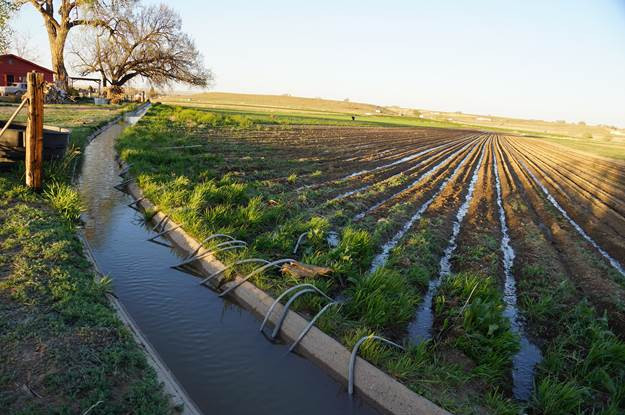
From The Greeley Tribune (Eric Brown):
A northern Colorado water official expressed concern this week that talks of bringing more Western Slope water across the Continental Divide might take a backseat to other aspects of the long-term, comprehensive Colorado Water Plan.
The statewide water plan — put in motion by Gov. John Hickenlooper and expected to be complete in 2015 — takes into account all aspects of water use in the state, such as further conservation efforts and new water-sharing arrangements between cities and agriculture, among many other efforts aimed at avoiding the large water shortages the state is forecast to face by 2050.
A number of things have been agreed upon in the talks, but building new water-supply projects has long been a hot-button issue — particularly projects that would bring water from the Western Slope to Eastern Slope users.
Discussions Tuesday and Wednesday between representatives of all of Colorado’s river basins made limited progress on the topic.
During the meeting, Eric Wilkinson, general manager of the Northern Colorado Water Conservancy District in Berthoud, expressed concern Tuesday that, because of its controversial nature, trans-mountain water diversions seem to be taking a backseat to other aspects of the long-term water plan.
Wilkinson stressed that without more water going to Eastern Slope users, agriculture in particular will suffer.
“We’ve gotten awfully good at taking water away from agriculture,” said Wilkinson, referring to the ongoing buy-and-dry issue taking place in Colorado, particularly on the Eastern Slope.
The purchasing of water rights from ag producers leaving the land is a comparatively inexpensive way for cities to acquire needed water.
Because of that, however, Colorado is on pace to see as many as 500,000 to 700,000 acres of irrigated farmland dry up by 2050, according to the Statewide Water Supply Initiative study, released in 2010.
With much of Colorado’s ag production taking place in northeast Colorado — particularly in Weld County, which ranks in eighth in the nation for its production — it’s the region that could be hit the hardest.
“If we investigate the possibility of bringing more water over here from the West Slope, and we’re told ‘it can’t be done,’ that’s fine,” Wilkinson said in an interview after the meeting. “But we at least need to be looking into it … and putting as much effort into that as we are other things, like conservation, and every other leg of the stool in these water talks.”
A commitment in the Colorado Water Plan to at least explore trans-mountain water diversions could help such projects, if feasible, get off the ground quicker, which is vital, Wilkinson said, considering that those projects — when factoring in planning, permitting and actual construction — take decades to complete.
The disagreement over trans-mountain water diversions between Eastern Slope and Western Slope water officials and users goes way back.
About 80 percent of the state’s population lives on the Eastern Slope but about 80 percent of the state’s water supplies — primarily snowmelt in the mountains — sits on the West Slope.
To meet the needs of the growing Front Range and northeast Colorado’s robust ag industry, Eastern Slope water providers have long built projects that bring water across the Continental Divide.
There are now more than 30 such projects bringing about 450,000 to 500,000 acre feet of water each year from the Western Slope to the Eastern Slope, Wilkinson noted.
Many on the Western Slope have expressed concern and want the Eastern Slope to stop diverting more of its water.
While only about 20 percent of the population lives on the Western Slope, the Western Slope has its own water demands to meet, mainly its legal obligation to make sure several states downstream from Colorado receive certain amounts of water.
Meeting those needs, while also contributing to those of Colorado’s Eastern Slope, is stretching the Western Slope thin, water officials from that part of the state say.
At the same time, though, many northeast Colorado water officials stress they’re set to face their own water crises, and more trans-mountain diversions, if feasible, would make a huge dent in solving the problem.
From The Grand Junction Daily Sentinel (Dennis Webb):
A representative of Front Range water providers told a Western Slope contingent Monday that Colorado can’t close its future supply gap through conservation alone, and other efforts need to include working on a potential new transmountain diversion project. But several participants at a meeting of the Colorado River Roundtable remained leery of any such idea, including what’s being called a breakthrough proposal that would limit such a project to diverting water only in wet years. The roundtable, covering the six-county mainstem of the Colorado River Basin, was meeting as it continues to prepare final recommendations for what it wants to see in a state water plan to meet future needs.
Much of the debate in that planning process has centered on the potential for further Front Range diversions of Western Slope water. Early this month, the Front Range Water Council told the Colorado Water Conservation Board that plan needs to contain an assurance rather than just the hope that a new Colorado River diversion project would be part of the plan.
Mark Pifher of Colorado Springs Utilities told those attending Monday’s meeting that the concern stemmed from an idea discussed by basin roundtable leaders that water supply might be put at the bottom of a sequential list starting first with conservation, then transfers of agricultural water, then completion of already-planned projects, with no assured pursuit of new supply. Instead, all four concepts should be worked at simultaneously so Front Range utilities can know that “there’s some certainty that new supply will be there when you need it, if you need it,” he said.
He outlined a number of ways those utilities already are pursuing all four approaches to addressing water needs, including by having cut per-capita water use by 20 percent. But he said studies suggesting the Front Range can entirely meet future needs through conservation is wrong, and that it’s just a question of when more supply will be needed.
“The world’s not going to stop in 2040 or 2050 or 2060. Demand is going to develop,” he said.
While Front Range utilities want to be able to count on Western Slope water to help meet that demand, one of the themes the Colorado River Roundtable is settling on is that at least the mainstem six-county basin already has given up plenty of water to the Front Range and has no more left to develop.
The state Interbasin Compact Committee is hoping a compromise might be reached through the idea of a new water project providing no firm yield of water, with diversions occurring only in years of above-average precipitation. The concept is receiving some Front Range support.
Carlyle Currier, a Mesa County resident who sits on the committee, said many on the Western Slope long have said it needs protection from diversions in dry years.
“I think this (new idea) offer certainly opened the door to that and went in the direction we’ve been talking” about, he said.
But several who attended Monday’s session questioned whether the region can afford to give up water even in wet years. They pointed to low water levels at Lake Powell, which states in the Upper Colorado River Basin use to help meet compact obligations to states in the Lower Basin.
“Shouldn’t high-water years be when we start to replenish Lake Powell?” asked Rachel Richards, a Pitkin County commissioner.
She said wet years also provide the environmental benefit of variety in stream flows from year to year if the water isn’t being diverted. And if the Western Slope builds more storage of its own, it needs to make sure it has the ability in high-water years to fill those reservoirs, she said.
Despite the widespread reservations within the roundtable about more transmountain diversions, they generally agreed Monday that they need to at least be willing to discuss the possible conditions of such diversions so decisions aren’t made without their involvement. Several suggested that one condition governing wet-year diversions should be the current water level at Lake Powell.
More Colorado Water Plan coverage here.