Gross Reservoir Expansion Project update

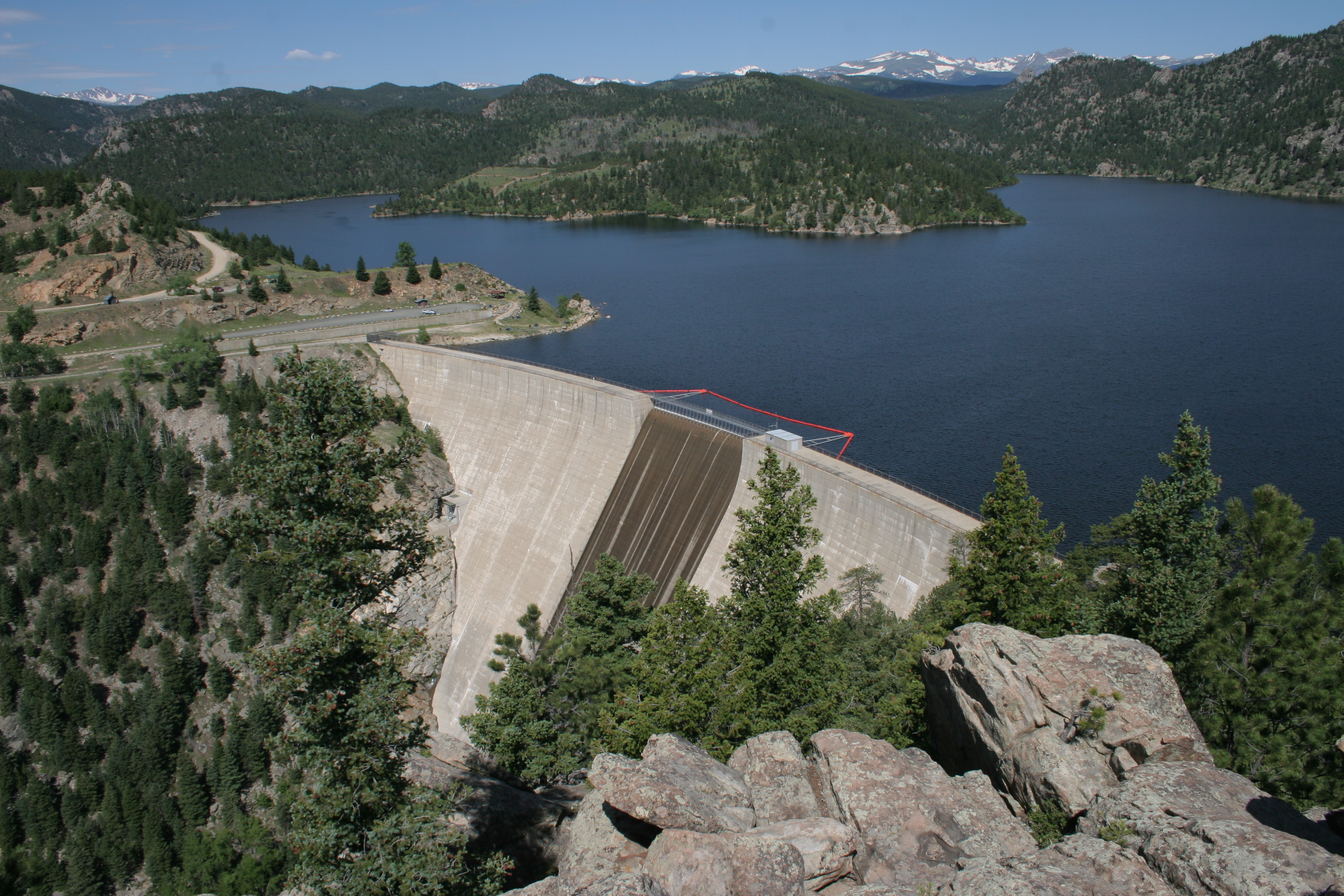
Gross Dam enlargement concept graphic via Denver Water

From The Summit Daily News (Kevin Fixler):

The U.S. Army of Corps of Engineers officially threw its support behind the proposed expansion of Denver Water-owned Gross Reservoir, aka the Moffat Collection System Project, to triple capacity of the storage facility this past Friday. The review process has been nearly a decade and a half in the making as the Front Range tries to keep pace with population and expected water consumption growth by pulling more of the resource off the Colorado River in headwater communities along the Western Slope.

Just to reach the milestone and obtain buy-in from the region, Denver Water spent six years in negotiations with Summit, Grand and Eagle counties and 14 other stakeholders, as well as several other subsidiary entities. The result was the Colorado River Cooperative Agreement, which gave way to the impacted counties accepting the terms to allow the metro area’s municipal water agency to remove water to which it already owned the rights.

“While some may say 14 years is too long, I believe complicated issues deserve thorough study,” Jim Lochhead, Denver Water CEO and manager, said in a news release. “In accordance with other agreements we’ve implemented along the way, Denver Water will provide millions of dollars to improve watershed health in the critical Colorado and South Platte River Basins. The project enjoys broad, bipartisan support from lawmakers, major environmental groups, chambers of commerce and water interests on both sides of the Continental Divide.”

An environmental group that does not share in the reverie, however, is Save The Colorado, a nonprofit water advocacy organization against the project to divert 15,000 more acre-feet of water from the Colorado River…

Save The Colorado’s attorneys are presently reviewing the Army Corps’ record of decision in anticipation of a suit to be filed in federal district court in Denver as part of a larger coalition that may include Boulder homeowners who live around the reservoir’s perimeter. A requested injunction may be part of the legal strategy should Denver Water begin construction on the 131-foot heightening of the existing 340-foot dam wall if a few other smaller-scale permits are secured, but the aim is preventing it from ever coming to fruition.

“Our goal is stop the project, not slow it down,” said [Gary] Wockner…

Summit’s Board of County Commissioners believes the complex deal is a fair one, considering what the area’s water future may have looked like without it in place. Aside from other considerations to keep Denver Water’s appetite in check in the years to come, $11 million in cash — $2 million of which has already been paid — will ultimately be split evenly among the county government and its four major towns of Breckenridge, Dillon, Frisco and Silverthorne for future water and other environmental enhancement projects.

Various county entities, including Summit’s four ski resorts, also stand to receive access to a combined 1,700 acre-feet (approaching 570 millions of gallons) of water annually not previously available out of Denver Water-owned Dillon Reservoir. Grand County is to receive $6 million in payments upon the bypassing of possible legal barriers and final execution of all permits, on top of additional water and adaptive management assistance, while Eagle received some legal assurances of its own.

“This agreement provides for our economy, our environment, our way of life and are things we could have never gotten had we fought Denver Water in court,” said County Commissioner Thomas Davidson. “Denver Water already had these water rights, and that was something we from the Western Slope had to keep reminding ourselves of. Each side had to give up or give in on things they felt very passionately about not wanting to give up.”

With some exceptions, the compromise also better defines Denver Water’s service area to help prevent the expansion of those boundaries and the thirst for even more regional waters. The agency has committed to maintaining conservation activities and increasing reuse of water from the Blue River to reduce the need for more Western Slope water as part of these efforts. A guarantee to hold Dillon Reservoir at an accepted level for ideal aesthetic and recreational purposes from June 18 to Labor Day is a guarantee written into the agreement as well.

With the Army Corps’ endorsement as follow up to a prior certification granted by the Colorado Water Quality Control Division, Denver Water next needs a few remaining approvals from the Federal Energy Regulatory Commission, U.S. Forest Service and most likely a permit from Boulder’s Board of County Commissioners.
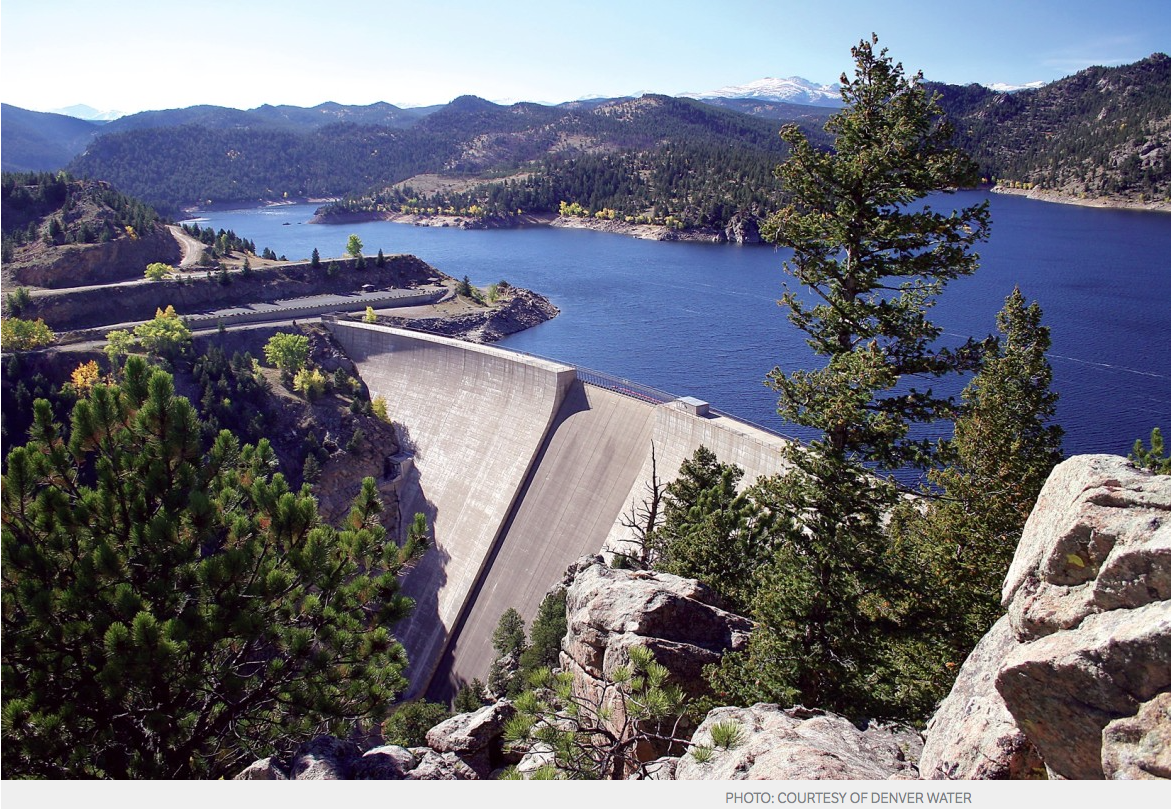
Denver Water is seeking approvals from the U.S. Army Corps of Engineers, the U.S. Fish and Wildlife Service, and the state of Colorado to expand Gross Reservoir, which is southwest of Boulder. The 77,000 acre-foot expansion would help forestall shortages in Denver Water’s water system and offer flood and drought protection, according to Denver Water.

From The Denver Post (Danika Worthington):

Denver Water CEO Jim Lochhead said the project, which was approved late Friday, was important to add balance and resiliency to the agency’s system. The dam expansion still needs approval from the Federal Energy Regulatory Commission to increase its hydropower capacity.

“It’s been a long haul,” Denver Water Board President Paula Herzmark said of Friday’s decision. “We are just ecstatic, just elated that this permit is now in place and we can begin. To have the insurance that we’re going to have this additional source of supply as our community grows.”

[…]

Colorado Trout Unlimited was happy with the news. The group has been working with Denver Water to make the project environmentally friendly, Trout Unlimited counsel Mely Whiting said.

The project includes an environmental pool to divert water to streams that need it. It also led to the Learning By Doing Cooperative Effort that brings together groups to monitor stream conditions and quickly take action when needed. Denver Water is also giving about $25 million to Grand County and other counties for environmental advancements…

Lochhead countered that the extra water will be needed as current conservation efforts won’t be enough to cover the growing population and effects of climate change. He added that Denver Water has been working with environmental groups and local and federal governments since the start to not just mitigate damage, but rather improve rivers.

Lochhead acknowledged that the five years of construction will be hefty, especially the three years of intensive concrete placing. He said Denver Water worked with the local residents to mitigate impacts and said an onsite quarry will be built to reduce truck trips.

“With a warming climate and with growth and other issues in our system, we need to make sure that our system is resilient in the long term,” he said.

From The Jackson Hole News & Guide (Allen Best):

Denver Water finally has a key permit that it needed to begin raising Gross Dam, located in the foothills northwest of Denver. The purpose is to triple the amount of water that can be stored there, including greater volumes of water diverted from the Winter Park area.

But the city still needs several more federal permits and may get caught in a legal fight. Unlike some water battles of the past, however, this one will come from elsewhere along the Front Range…

Denver Water has been working on this plan since the great drought of 2002 caused city water officials to realize the vulnerabilities of their system. The agency provides water not only to Denver, but many suburbs — altogether about a quarter of all Colorado residents.

“While some may say 14 years is too long, I believe complicated issues deserve thorough study,” said Jim Lochhead, Denver Water chief executive.

Denver has diverted water from the Fraser River and its tributaries since 1936 through the pioneer bore of a railroad tunnel under the Continental Divide. The water is impounded at Gross Dam. The dam already stands 340 feet tall, and Denver wants to raise the dam another 131 feet, to accommodate increased diversions.

Grand County, whose water will be diverted, has not opposed the project…

These diversions were mostly engineered in the 1930s. “Denver had a vision; we had none,” summarized Lurline Curran, who is the now-retired county manager of Grand County, at a water conference about a decade ago.

This time, Grand County sat down with Denver and brokered a deal. Denver gets more water, but it also agrees to work with Trout Unlimited and other local groups to try to take the water in ways that are least impactful to fish and other components of the ecosystem.

Gov. Hickenlooper says #Colorado will #ActOnClimate and join #USClimateAlliance

Here’s the release from Governor Hickenlooper’s office:

Gov. John Hickenlooper today signed an executive order committing the state to climate action. He also announced that Colorado will join the U.S. Climate Alliance.

“Coloradans value clean air and clean water. Our strong economy is a reflection of how our exhilarating outdoors attracts young entrepreneurs and the talent they need for their businesses,” said Governor John Hickenlooper. “The vast majority of our residents, and indeed the country, expect us to help lead the way toward a clean and affordable energy future. In this process, we no doubt can address climate change while keeping a priority on household budgets.”

The executive order declares it to be the goal of the State of Colorado to achieve the following:

  • Reduce statewide greenhouse gas emissions by more than 26 percent from 2005 levels by 2025;
  • Reduce carbon dioxide emissions from the electricity sector by 25 percent by 2025 and 35 percent by 2030 from 2012 levels; and
  • Achieve electricity savings of two percent of total electricity sales per year by 2020.
  • Colorado also is committing to:

  • Work strategically with any interested utility or electric cooperative on a voluntary basis to maximize use of renewable energy without increasing costs to taxpayers;
  • Create a statewide electric vehicle plan by January 1, 2018;
  • Develop a greenhouse gas emissions tracking rule through the Department of Public Health and Environment;
  • Identify opportunities to partner with local governments on locally-led climate resilience actions;
  • Institutionalize the state’s greening government initiative;
  • Formalize and expand upon cross-agency actions to provide economic development strategies and other supportive services to communities impacted by the changing energy landscape, and submit a written annual report detailing those efforts and accomplishments;
  • Incorporate the emissions reductions goals into the Colorado Climate Plan and solicit stakeholder input regarding additional measures or strategies to advance these goals.
  • To view the complete executive order, click here.

    From DenverRite (Andrew Kenney):

    Gov. John Hickenlooper announced Tuesday that Colorado will join the U.S. Climate Alliance — a coalition of states pledging to uphold the climate goals of the Paris Agreement after President Donald Trump withdrew the country from the agreement — and that by executive order, he will create a specific goal for carbon reduction.

    Hickenlooper spoke about Colorado and its relationship to the climate at a news conference today at Red Rocks.

    “The order sets concrete, measurable goals for the state,” he said.

    Specifically, Colorado will try to cut greenhouse gases by 26 percent from 2005 levels by 2025, and cut carbon from the electricity sector by 25 percent compared to 2012 by 2025 and 35 percent by 2030…

    Hickenlooper said that a new electric vehicle plan to be created next year could link into nationwide plans to create a better electric infrastructure network. “You’ll be able to drive an electric car from Colorado to the Pacific and from Denver to Moffat County without fear.”

    “We can no longer rely on what happens or doesn’t happen in Washington DC. … We need to have state leadership,” Aurora Mayor Steve Hogan said in introducing Hickenlooper.

    From Western Resource Advocates:

    Governor Hickenlooper announced an Executive Order that sets Colorado on a course to reduce Colorado’s greenhouse gas emissions by 26% by 2025, exceeding actions established by the Paris Climate Agreement.

    Today Governor Hickenlooper announced an Executive Order that sets Colorado on a course to reduce Colorado’s greenhouse gas emissions by 26% by 2025, exceeding actions established by the Paris Climate Agreement. The Order includes goals for the utility sector and our buildings, and it advances clean electric cars.

    Jon Goldin-Dubois, President of Western Resource Advocates, made the following statement in response:

    “Governor Hickenlooper’s action today on climate continues to show the West and the world that Colorado can reduce our carbon pollution while keeping our electricity rates low, growing our economy and building new clean energy sectors that have already created tens of thousands of good paying jobs. Colorado has led in addressing climate change before with the state’s Renewable Energy Standard, the Clean Air-Clean Jobs Act and state methane rules—and now we will continue to show that the Colorado way protects our health, our environment and our economy. The Governor’s leadership in reducing emissions in our state, joining with other states across the country through the Climate Alliance, demonstrates that we take climate impacts very seriously. Longer and hotter droughts, severe storms, flooding and increased wildfires are too harmful to stand by and do nothing.

    “We praise Governor Hickenlooper for his leadership in setting strong and measurable actions addressing climate change and ensuring Colorado acts to achieve needed greenhouse gas reductions. This shows that our state joins with other countries and states heeding the advice of the world’s scientists on what is necessary to avoid 2 degrees Celsius in warming. We know from the Western States Survey conducted by Colorado College and released in 2017 that two-thirds of Colorado voters believe dependence on fossil fuels is a problem and a majority want to see more solar and wind power. The Governor is representing our citizens well in taking clear action to clean our air. We urge President Trump and other Governors, mayors and elected leaders to take heed and follow suit in immediately taking effective action.”

    From Real Vail (David O. Williams):

    Fast forward to July of 2017. Donald Trump is president, the CPP is dead, the EPA has been gutted, Trump is pulling the United States out of the Paris accords, and Hickenlooper on Tuesday announced an executive order reducing Colorado’s greenhouse gas emissions 26 percent by 2025, exceeding the targets of the Paris accords.

    The order focuses on the state’s utility sector and energy efficiency in Colorado buildings, and it accelerates the state’s move toward electric cars. Now Hickenlooper is receiving some praise from the conservation community…

    The U.S. Climate Alliance, a bipartisan coalition of 13 states and Puerto Rico committed to meeting the goals of the Paris agreement. Conservation Colorado issued this statement:

    “Times like these demand decisive action, and we are pleased to see Governor Hickenlooper join the burgeoning movement among states, cities, and businesses to tackle climate change,” said Pete Maysmith, executive director of Conservation Colorado. “The actions that the governor has announced will not only help us fight climate change, but will bring clean energy jobs and business innovation to the Centennial State. With today’s announcement, President Trump has become even more isolated from the world, whose leaders are taking aggressive action to fight climate change. We are excited to work with Governor Hickenlooper to meet or exceed all of these important targets.”

    From the Associated Press via the Fort Collins Coloradoan:

    Colorado’s Democratic governor has added his state to a dozen others endorsing the Paris global accord on climate change as President Donald Trump withdraws the nation from the agreement.

    Gov. John Hickenlooper said Tuesday the state would also set a goal of reducing its greenhouse gas emissions from electrical generation while keeping energy affordable, citing cheap natural gas and declining costs of wind and solar power.

    He says Colorado will reduce vehicle pollution by adding charging stations for electric cars and use state-owned buildings to showcase energy efficiency.

    Hickenlooper acknowledged that at least some Republicans would oppose his plan but predicted many would come around because of lure of job creation in renewable energy.

    He says the state is already working to help communities replace lost jobs in the coal industry.

    @RockiesProject: The fourth section of the 2017 State of the Rockies Report is now available online

    Many Indian reservations are located in or near contentious river basins where demand for water outstrips supply. Map courtesy of the Bureau of Reclamation.

    Click here to read the section, “Reservations and Reservoirs: Deferred Tribal Justice on the Columbia and Colorado River,” from the State of the Rockies Project (Emelie Frojen).

    Folks battle leafy spurge on the Yampa River

    From the Craig Daily Press (Lauren Blair):

    A coalition of ranchers and environmentalists, politicians and bureaucrats, and Jimmy-Buffett-loving river recreationalists came together Friday to learn about a quiet scourge overtaking the banks of the Yampa River known as the leafy spurge.

    The plant itself looks innocent enough, with little yellow flowers that turn entire sections of river bank into a sea of green and yellow. But the demure-looking weed is extremely aggressive and invasive, and has wreaked havoc in states like Montana and North Dakota, where more than 2 million acres of ranch land have been put out of production due to the noxious weed.

    Formed in 2015, the Yampa River Leafy Spurge Project brought together partners in Routt and Moffat counties to tackle the growing infestation, which first took root more than 40 years ago…

    The problem has eluded an effective solution for decades, as the conditions unique to river banks challenge all variety of treatments from chemical to biological to mechanical.

    The result is that debate continues about how to deal with the destructive plant, and for now, officials have focused on keeping the infestation from spreading…

    The project received $30,000 in funding from the Colorado Department of Agriculture in 2016; Moffat and Routt counties each received $10,000 to fund projects to target infestations, and $10,000 went to landowner education and outreach.

    Additional county and federal funds also flow towards containment efforts on private, county and federal lands, but for a weed that sends roots as deep as 60 feet down and is able to broadcast its seeds up to 30 feet, as well as send them downriver, available resources have been outmatched.

    “For our economy’s sake, from a recreational standpoint, an agricultural standpoint and an environmental standpoint, it’s a big issue,” said Todd Hagenbuch with Natural Resources Conservation Services.

    Federal resolution aims to streamline water storage permits

    Northern Integrated Supply Project (NISP) map July 27, 2016 via Northern Water.

    From The Fort Morgan Times (Jenni Grubbs):

    House Resolution 1654 would set the U.S. Bureau of Reclamation as the agency in charge of permitting water storage projects. That agency then would coordinate all the federal agencies involved in that process, as well as the reducing redundant requirements at state and local levels that currently are part of the permitting process.

    While this legislation becoming law could have substantial impacts on some proposed water storage projects in Colorado, it would not be likely to impact the process for the proposed Northern Integrated Supply Project (NISP)…

    “Obviously we support the basic idea of streamlining the permit process,” Brian Werner from Northern Water said of the legislation. “We’re all for finding out how we can tweak this process.”

    For example, many of the studies and other preparatory work on a large water storage project like NISP could have been conducted concurrently, rather than sequentially, Werner suggested.

    “Streamlining doesn’t mean that we don’t do the studies,” he said, “but we could do it more efficiently.”

    […]

    Congressman Ken Buck, R-CD4, voted in favor of the resolution, even speaking for it on the House floor and mentioning proposed water storage projects in Colorado, like NISP, as why he supported it…

    House Resolution 1654 would set the U.S. Bureau of Reclamation as the agency in charge of permitting water storage projects. That agency then would coordinate all the federal agencies involved in that process, as well as the reducing redundant requirements at state and local levels that currently are part of the permitting process.

    While this legislation becoming law could have substantial impacts on some proposed water storage projects in Colorado, it would not be likely to impact the process for the proposed Northern Integrated Supply Project (NISP).

    That proposed water storage project would have Northern Water build two reservoirs, Galeton northeast of Greeley and Glade northwest of Fort Collins. They would provide water to the 15 NISP participants, including the city of Fort Morgan and Morgan County Quality Water District.

    “Obviously we support the basic idea of streamlining the permit process,” Brian Werner from Northern Water said of the legislation. “We’re all for finding out how we can tweak this process.”

    For example, many of the studies and other preparatory work on a large water storage project like NISP could have been conducted concurrently, rather than sequentially, Werner suggested.

    “Streamlining doesn’t mean that we don’t do the studies,” he said, “but we could do it more efficiently.”

    Congressman Ken Buck, R-CD4, voted in favor of the resolution, even speaking for it on the House floor and mentioning proposed water storage projects in Colorado, like NISP, as why he supported it.

    “Unfortunately, many water storage projects in my state face significant setbacks in permitting due to a long list of regulatory checkboxes,” he said in prepared remarks. “Much of this delay occurs because each level of government-local, state, and federal-requires (its) own studies and permitting checklists, even though many of those requirements are the same or only slightly different.”

    The goal would not be to eliminate environmental or safety requirements for getting the permits, Buck pointed out. Instead it would be to seek to get the “different levels of government to work together so that our water projects can earn the permits they rightly qualify for” during the initial permitting process.

    The legislation next faces debate in the Senate Committee on Energy and Natural Resources, but a hearing date had not yet been set as of Monday afternoon. That committee includes Colorado’s Sen. Cory Gardner as a member.

    Unique agreement supports the longest rafting season on Colorado’s Arkansas River —

    Browns Canyon via BrownsCanyon.org

    Here’s the release from the Arkansas River Outfitters Association via PR Newswire:

    A successful water management agreement on the Arkansas River exemplifies Colorado’s dedication to its natural resources and the visitor experiences they support, according to the Arkansas River Outfitters Association (AROA).

    The Arkansas River Voluntary Flow Management Program helps ensure there is water for whitewater rafting on the river well into August. The cooperative agreement among water users is unique in that it includes recreation in water management decisions.

    AROA is part of the agreement with the Colorado Department of Natural Resources and other agencies that not only supports summer flows for whitewater rafting, but also manages water year-round for a healthy fishery.

    The program, which started in 1990, is a model management technique for all other rivers in the American West. It allows whitewater rafting outfitters to offer the longest boating season in Colorado, AROA Executive Director Bob Hamel said.

    “The water program recognizes that recreation is part of our lifestyle, and that its economic impact is important,” Hamel said.

    Whitewater rafting generated $179.8 million in spending among the state’s commercial users last year, according to the Colorado River Outfitters Association.

    The Arkansas River is America’s most popular whitewater rafting destination, hosting nearly a quarter of a million visitors last season and attracting kayakers and private rafters from around the world. The river hosts more than 40 percent of the state’s commercial rafting market, in part due to the longer season, but also because its 100-plus miles of whitewater rapids offer something for nearly everyone.

    Technical boating, mild family float trips, multi-day camping and inn-to-inn rafting, plus standup paddle boarding and kayaking, are popular trips among families and friends of all ages.

    With the mountain towns of Salida, Buena Vista and Cañon City nearby, visitors lengthen their stays and plan additional outdoor fun like horseback riding, ATV tours and hiking the area’s concentration of 14,000-foot peaks.

    More than 100 miles of the Arkansas River was designated Gold Medal in 2014, meaning anglers can expect trophy trout fishing on a long, contiguous river segment that constitutes nearly a third of the state’s Gold Medal miles.

    For information about current water levels and booking a Colorado whitewater rafting adventure, contact an Arkansas River outfitter at http://www.ArkansasRiverOutfitters.org.

    Potential wide-ranging effects of @EPA redo of #WOTUS rule

    Farmers Highline Canal Arvada.

    From The Denver Post (Bruce Finley):

    Less than 30 percent of Colorado’s estimated 95,000 miles of streams are likely to qualify for protection if the current system is changed as proposed, according to a 2009 study by the conservation group Trout Unlimited. EPA data show that 77,850 miles of waterways in Colorado are ephemeral, only flowing seasonally or during rain.

    Federal environmental officials must protect “waters of the United States” under the nation’s landmark 1972 Clean Water Act — by requiring property owners to obtain permits designed to minimize impact before water can be polluted or wetlands destroyed. The U.S. Army Corps of Engineers administers these permits, typically requiring six months or more for processing — a source of frustration for some.

    Trump’s team has proposed to repeal a broader definition of “waters of the United States” that the EPA and Army Corps adopted in 2015 under President Barack Obama — one that expanded protection following U.S. Supreme Court decisions in 2001 and 2006 that created confusion. The court ruled that federal authorities could only require permits for pollution and dredging of “navigable waters.” The Obama-era approach, still not implemented due to lawsuits, allows regulation of flowing water, including ephemeral streams, with exemptions for agriculture.

    Publication in the federal register on June 27 of the Trump administration’s proposal to repeal and replace clean water standards triggered a 30-day period for public comment. Then the rollback would take effect. However, more than 70 members of Congress last week requested an extension to no less than six months. On Thursday, the League of Conservation Voters and 18 other environment groups sent Pruitt a letter requesting the same.

    While Colorado has state-level rules limiting water pollution that still could apply, there is no state rule against dredging and filling that destroys wetlands and streams.

    Beer brewers were among the first to object. Eight craft brewers in Colorado, joined by counterparts nationwide, sent a letter to EPA and Army Corps leaders urging maximum protection.

    “Beer is mostly water, so the quality of our source water affects our finished product. Even small chemical disruptions in our water supply can alter the taste of a brew or influence factors like shelf life and foam pattern,” they wrote. “We need reliable sources of clean water to consistently produce the great beer that is key to our success.”

    In western Colorado, a growing reliance on pristine water for the economy — depending more on recreation and tourism — compelled concern. The fuzzy meaning of “waters of the United States” and delays issuing federal permits are a problem, many agree, and local officials would welcome greater clarity, said Torie Jarvis, co-director of the Water Quantity and Quality Committee (QQ) of the Northwest Colorado Council of Governments. But most favor greater protection, not less.

    “While QQ supports increased clarity for the definition of ‘waters of the United States,’ this clarity should not mean reduced water quality protection under the Clean Water Act,” Jarvis and the other local leaders told EPA officials June 19, after the feds had asked for input for their proposed repeal and overhaul of clean water rules.

    “Water quality in the headwaters of Colorado is critically important for our regional tourism economy as much as for environmental protection. Tourism is the largest employment sector in the headwaters region, comprising 48 percent of all jobs,” local officials wrote. “Tourism in the region includes fishing, hunting, kayaking, rafting, wading, lake and reservoir recreation, wildlife watching, hiking, and snowmaking for ski resorts, all of which depend on clean water.”

    Some local officials reckon they could protect cherished watersheds on their own, without robust federal clean water rules, by using their power to regulate land use.

    Environment groups last week argued that a federal role is necessary to buttress local power.

    “Local governments may be able to control some impacts based on conditions they might impose on developments, but they do not have a statutory obligation to do so — so the ability to protect these important resources ends up relying on their level of commitment to protecting water quality, and their ability to have the expertise and resources to do so, which for smaller local governments can be a real limitation,” Colorado Trout Unlimited director David Nickum said.

    “Our main practical concern with the change in these federal standards is that we would lose the protection for seasonal streams and for wetlands from being dredged or filled in — protection that currently is provided. … Allowing those areas to be degraded will in turn have ripple effects downstream onto our drinking water supplies and our important fishing and recreation rivers,” Nickum said.

    “Colorado’s outdoor economy and quality of life depend on healthy, clean watersheds, and anglers know that starts at the source: the small, unassuming streams, headwaters and wetlands that rescinding the Clean Water Rule puts at risk,” he said.

    “President Trump promised to drain the swamp. Instead, this EPA proposal aims to drain our wetlands and pollute our streams,” he said. “Coloradans deserve better.”

    @USGS: High Plains Aquifer Groundwater Levels Continue to Decline

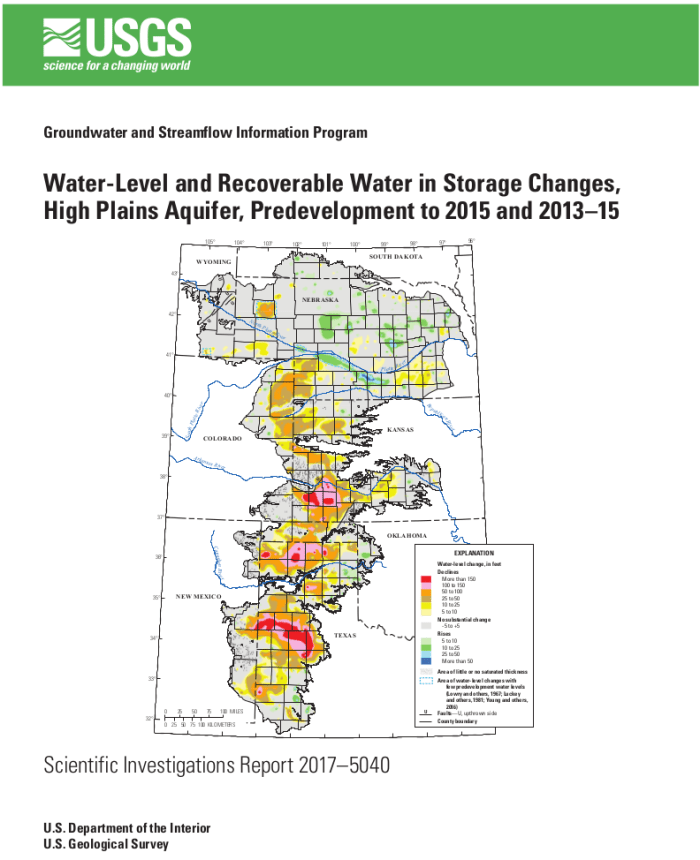
    High Plains aquifer water-level changes, predevelopment (about 1950) to 2015. Figure 1 from USGS SIR 2017-5040.(Public domain.)

    Here’s the release from the USGS:

    The U.S. Geological Survey has released a new report detailing changes of groundwater levels in the High Plains aquifer. The report presents water-level change data in the aquifer for two separate periods: from 1950 – the time prior to significant groundwater irrigation development – to 2015, and from 2013 to 2015.

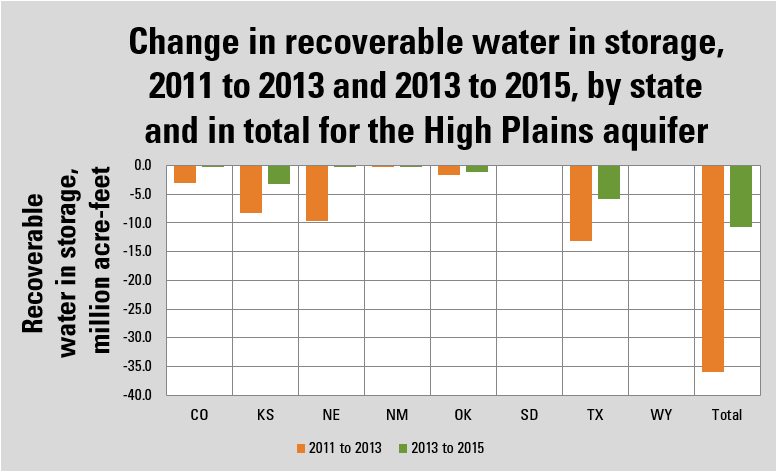
    “Change in storage for the 2013 to 2015 comparison period was a decline of 10.7 million acre-feet, which is about 30 percent of the change in recoverable water in storage calculated for the 2011 to 2013 comparison period,” said Virginia McGuire, USGS scientist and lead author of the study. “The smaller decline for the 2013 to 2015 comparison period is likely related to reduced groundwater pumping.”

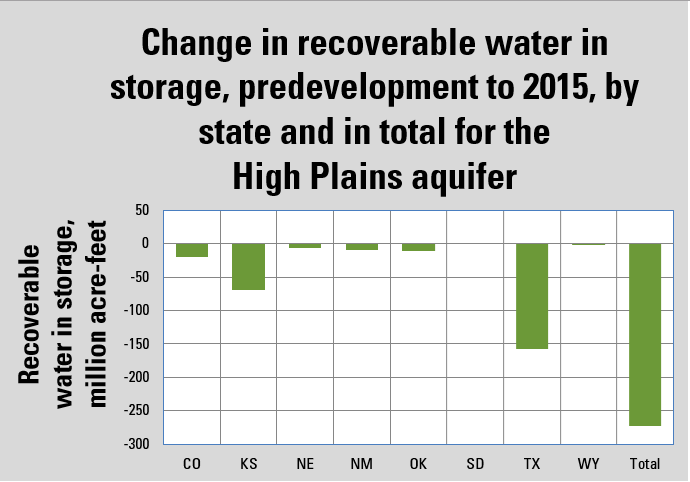
    In 2015, total recoverable water in storage in the aquifer was about 2.91 billion acre-feet, which is an overall decline of about 273.2 million acre-feet, or 9 percent, since predevelopment. Average area-weighted water-level change in the aquifer was a decline of 15.8 feet from predevelopment to 2015 and a decline of 0.6 feet from 2013 to 2015.

    The USGS study used water-level measurements from 3,164 wells for predevelopment to 2015 and 7,524 wells for the 2013 to 2015 study period.

    The High Plains aquifer, also known as the Ogallala aquifer, underlies about 112 million acres, or 175,000 square miles, in parts of eight states, including: Colorado, Kansas, Nebraska, New Mexico, Oklahoma, South Dakota, Texas and Wyoming. The USGS, at the request of the U.S. Congress and in cooperation with numerous state, local, and federal entities, has published reports on water-level changes in the High Plains aquifer since 1988 in response to substantial water-level declines in large areas of the aquifer.

    “This multi-state, groundwater-level monitoring study tracks water-level changes in wells screened in the High Plains aquifer and located in all eight states that overlie the aquifer. The study has provided data critical to evaluating different options for groundwater management,” said McGuire. “This level of coordinated groundwater-level monitoring is unique among major, multi-state regional aquifers in the country.”

    High Plains aquifer water-level changes, predevelopment (about 1950) to 2015. Figure 1 from USGS SIR 2017-5040.(Public domain.)
    Bar graph showing change in water-in-storage, predevelopment to 2015, by state and in total for the High Plains aquifer. States in region include Colorado, Kansas, Nebraska, New Mexico, Oklahoma, South Dakota, Texas and Wyoming. (Public domain.)
    Bar graph showing change in recoverable water in storage, 2011 to 2013 (orange) and 2013 to 2015 (green), in million acre-feet by state and in total for the High Plains aquifer. Recoverable water in storage from 2013 to 2015 for the aquifer declined 10.7 million acre-feet, which is about 30 percent of the recoverable water in storage change from 2011 to 2013. This difference is likely related to reduced groundwater pumpage during the 2013 and 2014 irrigation seasons as compared to the 2011 and 2012 irrigation seasons. (Public domain.)

    Late May precipitation breaks most of the W. U.S. #drought

    West Drought Monitor July 4, 2017.

    From The La Junta Tribune-Democrat (Candace Krebs):

    From Colorado to California, a snowy late spring finally broke through what was left of the drought’s fierce grip. Soil is saturated again, reservoirs are full and water worries have temporarily receded as farms return to their full productive capability.

    Even so, wrestling over water during the recent shortages was a wake-up call for agricultural leaders who are now putting heightened importance on developing better outreach to the public while still pushing long-term resource planning.

    “Consumers enjoy what we produce but they don’t really understand what it takes to do it,” summarized Alicia Rockwell, the director of corporate communications for Blue Diamond, a large almond growing cooperative with more than 3,000 members who each farm on average 50 to 70 acres of trees. Agricultural groups in the two states are undertaking new forms of what Rockwell calls “ag reputation management” while looking ahead at how to address future water needs…

    In Colorado, the Ag Water Alliance, a decade-long collaboration among representatives of the state’s agricultural groups, has put much of their emphasis in recent years on educating farmers and water-users on water rights issues and exploring new alternatives for sharing water between high priority uses.

    In recent weeks the group hosted two bus tours, geared specifically to the general public, which traveled through some of the most highly productive irrigated farmland in the state. By demonstrating how irrigation systems work, explaining terminology and discussing evolving conservation practices, growers of high value crops like fruit and vegetables, wine grapes, dairy products and feed hope to begin a long-term dialogue that will pay off down the road.

    During the tours, participants had a chance to learn more about alternative transfer methods, which make it possible for farmers to lease water rights to municipalities for use in times of scarcity. It is one of the most innovative and promising solutions to come out of the water shortages of the last two decades.

    “We’re just trying to keep the water tied to the land,” explained Phil Brink, director of the Ag Water NetWORK, a collaborative project funded by a grant from the Partners for Western Conservation and the Walton Family Foundation. “We want to avoid what happened in Crowley County, where the county was dried up and it never recovered from that.”

    Not only do these flexible leasing arrangements give farmers the option to lease water without selling it outright, they also help enhance revenue for ditch companies and irrigation districts. Municipalities use it like an insurance policy, knowing they can make a call on the water during critical shortages, while farmers rotate into low-water crops or fallow marginal land.

    “We know it’s better than buy-and-dry, because as a farmer you maintain ownership of the water,” said Gene Manuello, a farmer-feeder from Sterling, past president of the Colorado Cattlemen’s Association and a long-time member of the ag water alliance. “But whenever water is transferred, you’re still drying up agricultural acres. As a farmer, I don’t like to think of myself as being in the business of leasing water.”

    In short, Manuello doesn’t want to see these new leasing arrangements take the emphasis away from something better: building more storage to capture ample spring runoff before it leaves the state, which would expand the total amount of available water and help alleviate recurring shortfalls.

    Building new reservoirs is a lengthy, expensive process and an increasingly hard sell with the public. That’s what makes interaction and education so important.

    California is in a similar quandary, as Jim Morris, communications manager for the California Rice Commission, explained recently.

    “We’re both an agricultural state and an urban state, and there are challenges that go with that,” he said.

    Ag groups there are backing the Sites project, a large reservoir planned for the foothills west of the Sacramento Valley that would increase water storage in northern California by 23 percent, in part by expanding flexibility to leverage additional storage from existing reservoirs as well.

    Billed as meeting “co-equal” goals of water supply enhancement and ecosystem improvements, it has been carefully designed not to dam an existing river or block fish migration.

    Colorado, too, appears to be making slow progress toward its own goal of increasing water storage.

    In 2016, a bill instructed the state legislature to examine 72 sites for future reservoirs, a list that has since been winnowed down to 12 of the most promising locations. Meanwhile, the Windy Gap project near Granby received its final permit in May.

    In addition, the state’s water conservation board is investing $25 million of new grant money over five years in exploring “multi-partner, multi-benefit” pilot projects, according to John Stulp, the state’s water czar.

    When a collaborative approach is taken, surprising synergies can emerge. In California, Morris describes an interesting case concerning rice-growing practices. After Northern California rice growers were forced to stop burning their straw, due to air quality concerns, and began flooding their fields in the winter with about four inches of water to aid the straw’s decomposition, birds and wildlife suddenly flourished. While the new production method is more costly, it has paid unexpected dividends in support from conservation and wildlife groups, Morris said.

    “Having the Audubon Society lobbying on behalf of rice is much more effective than if we do it ourselves,” he said. “The story that moves the needle with the public is the environment.”

    Morris said the benefits discovered so far are likely to lead to other breakthroughs. For example, University of California-Davis researchers are now looking into whether flooded rice fields can be used to raise threatened species of Pacific salmon and other types of fish.

    “There’s a lot of research going on and it’s really exciting,” Morris said. “People are receptive, which is encouraging. It just shows you that communication is everything.”

    New director of Colorado Water Conservation Board gets to work — @AspenJournalism

    The building in Denver, not far from the state capital, that houses the Colorado Water Conservation Board.

    From Aspen Journalism (Brent Gardner-Smith):

    Rebecca “Becky” Mitchell, the new director of the Colorado Water Conservation Board, got right to work this past week.

    But she didn’t have to go far, as she was in the same office in Denver she was Wednesday, when she learned that she was selected by the CWCB’s board of directors to serve as the state’s top water official.

    Wednesday afternoon, Mitchell was responsible for managing nine employees as head of the CWCB’s water supply planning section.

    But Thursday morning, she was responsible for 45 employees across various departments working on climate change, flood restoration, instream flows, loans and grants, the Colorado River compact, and other issues and projects.

    Becky Mitchell

    Asked midday how her first day on the new job was going, an exuberant Mitchell said, “I’m really nervous and I’m scared” before laughing, and not sounding either nervous or scared.

    “I want to do right by the people of the state,” she added.

    Range of issues

    In her new role, Mitchell, 43, is responsible for small things that can affect regional watersheds, including the Roaring Fork River region, such as grants to help fix irrigation ditches, to big things, like avoiding a compact call from California and Arizona, which could turn off many junior water rights.

    The broad priorities of the Colorado Water Plan as put forward by Becky Mitchell in a June 20, 2017 presentation to three Front Range roundtables. The slide reflects the competing priorities in Colorado when it comes to water and rivers.

    “I think it’s an excellent choice,” said Jim Pokrandt, director of community affairs for the Colorado River District in Glenwood Springs, who also serves as the chairman of the Colorado River basin roundtable. “And it won’t take any time for her to get to know the issues.”

    Praised by CWCB board members for her personality and ability to get things done, Mitchell is the second woman to serve as CWCB director since the agency’s founding in 1937. Jennifer Gimble lead the CWCB from 2008 to ’13 and is now at the Colorado Water Institute at Colorado State University.

    More meaningful to Mitchell than gender is that she is the first CWCB department head to rise through the ranks and become director.

    She said her first priority is to “get staff set in place and make sure that the goals and directions are clear.”

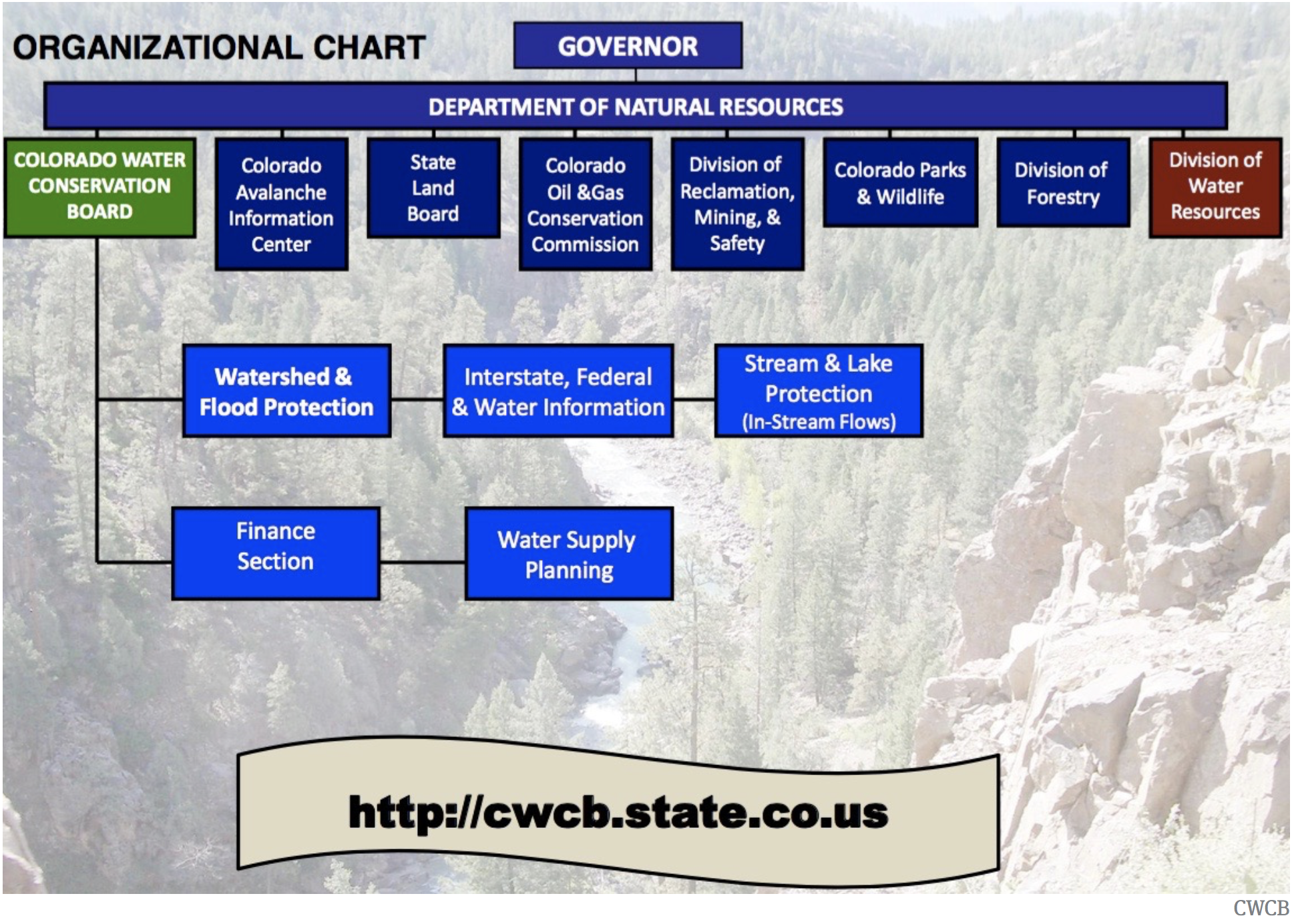
    An organizational chart from a presentation by Chris Sturm of CWCB shows how the agency it fits within the Colorado Dept. of Natural Resources.

    Heavy lifter

    Mitchell has worked at the CWCB since 2012 and was instrumental in bringing forth the 2015 Colorado Water Plan after an intense, three-year planning exercise.

    James Eklund, who served as CWCB director from 2013 until March, and was ultimately responsible for producing the water plan, also praised Mitchell.

    “She did a ton of heavy lifting on the water plan, had a great outlook the whole time, and had people working at a high level,” said Eklund, who is now an attorney at the Denver office of Squire Patton Boggs. “That’s not easy to do.”

    Patricia Wells, the general legal counsel for Denver Water, who represents the city and county of Denver on the CWCB’s board of directors, added: “Becky was largely responsible for the state water plan, which was an enormous undertaking, and she did it with style and good nature. And even though (she and her staff) worked themselves practically to death — sleeping on cots at the end there — they managed to do it in good spirits.”

    She ticked off three challenges Mitchell will face: implementation of the 2015 water plan; producing the next iteration of the Statewide Water Supply Initiative, which is more technical in nature than the policy-driven water plan; and helping to develop a permanent and reliable source of funding to meet the state’s water needs.

    Before joining CWCB, Mitchell worked on water policy in the executive director’s office at the Department of Natural Resources. And she’s been a consulting engineer, with bachelor’s and master’s degrees from the Colorado School of Mines.

    Mitchell, one of three finalists for the director’s job, was interviewed by the CWCB board in an executive session June 23 and gained the support of the full board, according to board member Heather Dutton, who is manager of the San Luis Valley Water Conservancy District, and represents the Rio Grande River basin on the CWCB board.

    “Becky brings with her an incredible intelligence but also a personality that makes her unique and approachable, and she has a big heart,” Dutton said. “Those attributes are going to go really far.”

    Mitchell will begin her tenure as head of CWCB with the benefit of the state Legislature having just approved $164 million in the agency’s annual “projects bill.”

    The bill includes $130 million for loans for water projects, $9 million for CWCB operations and $25 million to help implement aspects of the water plan.

    Mitchell said one of her early goals is to let people know that the water plan is not solely the CWCB’s plan.

    “Just because the CWCB was leading the charge to develop the plan, it’s important to recognize that it wasn’t developed only within CWCB, and the responsibility is beyond CWCB,” she said. “It includes all of the people that can make a difference in reducing the supply and demand gap and solving the future of Colorado water. It’s everyone’s responsibility to play a role in that.”

    Editor’s note: Aspen Journalism is collaborating with The Aspen Times, the Glenwood Springs Post Independent, the Vail Daily and the Summit Daily News on the coverage of water and rivers. The Times published this story on Saturday, July 8, 2017.

    From The Summit Daily News (Kevin Fixler):

    The Colorado Water Conservation Board is under new management after a rare internal promotion announced this week elevated Becky Mitchell into the director role…

    “I’m most excited about building on existing relationships and hopefully working more on those, to locate solutions where people’s needs and desires intercept — that’s where we’re going to find solutions,” said Mitchell. “A benefit of being involved in the water plan’s development is understanding how we move forward with it, and I have some ideas with that.”

    Specifically, Mitchell imagines boosting ownership and responsibility from various interests in achieving conservation and storage goals set forth in the plan through increased collaboration. Education and outreach campaigns to produce methods that help address the supply-demand gap as the state’s population is projected to more than double to 10.5 million by 2050 are other components she sees as key parts of her job…

    Mitchell, who holds a bachelor’s of science and master’s in environmental science and engineering from the Colorado School of Mines, and has worked in both the public and private sectors as a consulting engineer, agrees that the obstacle in financing is the largest to overcome to expand implementation. She believes, however, that a large budgetary commitment — tens of millions of dollars toward projects — from the state Legislature in the most recent session speaks volumes about its commitment to ultimately seeing the plan through.

    “Funding was definitely called out in the water plan and is something we’re aware of, because it’s expensive to implement all of these things on the ground,” said Mitchell. “It’s not just the Water Conservation Board’s responsibility, though. The Legislature said very loudly and clearly there needed to be a diverse focus on use of those funds, to address the supply-demand gap, storage, and strategies for conservation, land-use and drought planning. The funding is set aside to tap storage, but also for across the board to find ways to move the needle on our water future.”

    Colorado Water Plan website screen shot November 1, 2013

    Army Corps of Engineers approves Gross Dam expansion — @DenverWater

    The Gross Reservoir Expansion Project will add 77,000 total acre feet — 72,000 for Denver Water use and 5,000 for an environmental pool that provides additional water for South Boulder Creek during low-flow periods — nearly tripling reservoir capacity.

    Here’s the release from Denver Water (Stacy Chesney):

    Army Corps of Engineers issues record of decision and 404 Permit

    Following 14 years of careful study, evaluation and deliberation, the Army Corps of Engineers has approved Denver Water’s request to raise Gross Dam in Boulder County. The additional water stored in Gross Reservoir will help prevent future shortfalls during droughts and helps offset an imbalance in Denver Water’s collection system.
    The approval comes in the form of a record of decision and 404 Permit — two documents required by the federal government as part of the National Environmental Policy Act.

    “Denver Water appreciates the Corps’ dedication and commitment to careful study of the anticipated impacts of this project,” said Denver Water CEO Jim Lochhead. “We will complete this project responsibly, as evidenced by our actions during the public process and the resulting robust environmental protections we’ve agreed to along the way. We’re proud to be doing the right thing.”

    The existing dam was built in the early 1950s and was designed to be expanded in the future to increase water storage capacity. The Gross Reservoir Expansion Project approval completes this original vision.

    Expanding Gross Reservoir is a major part of Denver Water’s long-term plan to deliver safe, reliable water to the people it serves now and into the future. The project is part of Denver Water’s multi-pronged approach that includes conservation, reuse and responsibly sourcing new supply.

    “Issuance of this permit will unlock significant resources that will allow us to do good things for the river and the environment,” said Mely Whiting, counsel for Trout Unlimited.

    In accordance with existing agreements, including the Colorado River Cooperative Agreement and Grand County’s Learning By Doing, and conditions in the 404 Permit, Denver Water will provide millions of dollars to improve watershed health in the critical Colorado and South Platte River Basins. Lochhead said these commitments are one reason that last year Colorado Department of Public Health and Environment found that the project will have a “net environmental benefit” on the state.

    The project has earned key endorsements from Gov. Hickenlooper, state and federal lawmakers, major environmental groups, local mayors and city councils, chambers of commerce and economic development corporations, county elected officials and water interests on both sides of the divide.

    “The next milestone we anticipate is approval by the Federal Energy Regulatory Commission of Denver Water’s hydropower license amendment application at some point next year,” said Jeff Martin, Gross Reservoir Expansion program manager. “In the meantime, Denver Water continues to make significant investments in setting a firm foundation for the project’s overall success by recently hiring Black and Veatch as the owner’s representative. We are also in the process of procuring a design engineer.”

    Preconstruction activities, including dam design and geotechnical work, are expected to begin in 2018. The entire project is expected to be completed in 2025.

    Visit http://grossreservoir.org to read more about the project and http://denverwaterTAP.org for additional information.

    From The Associated Press via The U.S. News & World Report:

    The Army Corps of Engineers announced late Friday it granted the project a permit under the federal Clean Water Act.

    The $380 million project involves Gross Dam in the foothills about 5 miles southwest of Boulder.

    CPW bid dollars come up short, Lonetree Reservoir to close to the public next season

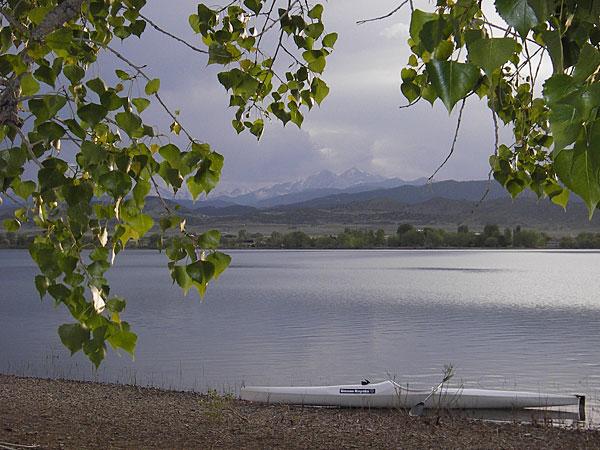
    Lonetree Reservoir near Loveland, Colorado | Photo credit photokayaker via Flickr.

    From The Longmont Times-Call (Pamela Johnson):

    Lonetree Reservoir will close to the public next summer as Colorado Parks and Wildlife, which has operated a recreation area there since the 1970s, was outbid for the lease by a private bidder.

    “We’re certainly disappointed,” Mark Leslie, northeast regional manager for Colorado Parks and Wildlife, said in a press release. “We negotiated as best we could for a 20-year lease, but we were outbid in the end.”

    Colorado Parks and Wildlife did not identify who won the bid, and representatives of the Consolidated Home Supply Ditch Co, owner of the reservoir southwest of Loveland, could not be reached Friday…

    Lonetree Reservoir has been open to the public for fishing, nonmotorized boating and other outdoor activities for decades as Colorado Parks and Wildlife, formerly the Colorado Division of Wildlife, has held the lease there since the 1970s.

    The state agency’s 20-year-lease expired last summer, and the parks agency negotiated a one-year extension to this summer to work on negotiations.

    The public agency, however, was not able to bid as much as a private entity and will hold the lease only through June 30, 2018. No public access will be allowed after that date.

    For now, fishing and recreation will remain as under the existing regulations…

    fish biologists are working on a plan for the best method and time to remove all the fish and stock them in other public waters.

    Army Corps of Engineers approves Gross Dam expansion – News on TAP

    Long-awaited project will increase water storage on north side of collection system and deliver environmental benefits.

    Source: Army Corps of Engineers approves Gross Dam expansion – News on TAP

    Environmental policy in the current administration

    Science Senator. It’s called science.

    You owe it to yourself to come up to speed about the rollback of environmental protections over the first 6 months of the new administration. Focus on the protection of the water supply, then contact your elected officials about the problem. Water is a great way to find common ground with folks. It’s more important than ever to support the role of local and state government in regulating air and water pollution.

    Here’s a list of changes in policy from Mother Jones:

    Timeline of the rollbacks

    14 February Trump signs a bill repealing an anti-corruption rule that required energy companies to disclose payments to foreign governments. The regulation was scrapped under the Congressional Review Act.

    16 February The stream protection rule, which prevented mining companies dumping their waste into streams, is axed under the Congressional Review Act. Trump calls it a “terrible job-killing rule.”

    28 February Trump instructs the EPA to rewrite the ‘waters of the United States’ rule, which expanded the definition of the Clean Water Act to protect the water supply for around 117 million Americans. Many farmers, real estate developers and golf course owners opposed the rule.

    2 March On 1 March, governors and attorneys general from several Republican-led states write to Scott Pruitt to request the EPA stop collecting methane emissions data from around 15,000 oil and gas operations. A day later, Pruitt says he has decided to oblige “after hearing from industry.”

    15 March Trump announces a review of vehicle fuel efficiency standards that are designed to push down greenhouse gases and other pollutants. More than a dozen car company chief executives asked the president to revisit an Obama-era decision to mandate improved fuel economy by 2025. Pruitt calls the standards “costly for automakers and the American people.”

    28 March A sweeping executive order penned by Trump orders a rewrite of the EPA’s clean power plan, which was Obama’s centerpiece climate policy, an end to the moratorium on coal mining on public land and the removal of climate change as a consideration when approving federal projects.

    29 March Pruitt denies a bid to halt the use of chlorpyrifos, a widely used pesticide. The chemical has been linked to damage to the nervous system and last year EPA scientists said a ban was warranted. Household use of the chemical was phased out a decade ago but it is still used in farms across the US.

    11 April A court grants an EPA request to delay the implementation of ozone pollution standards that were made stricter in 2015. The EPA intends to review the rules around ozone, which is created when sunlight reacts with pollutants from vehicles exhausts and other sources. Ozone can create smogs and can trigger a raft of health ailments, especially among children, the elderly and those with respiratory problems.

    13 April The EPA pauses a regulation that curbs the dumping of toxic metals such as arsenic and mercury by power plants into public waterways. The Obama-era rule, set to commence in 2018, would’ve destroyed jobs, according to Pruitt.

    27 April The EPA successfully convinces a US appeals court to halt a challenge by states and industry groups to an Obama administration rule aimed at reducing toxic emissions from power stations. Pruitt, in his previous role as attorney general of Oklahoma, had sued the EPA to stop the rule, which is known as MATS.

    23 May A three-month pause is put on landfill methane rules so they EPA can “reconsider certain aspects” of the regulation. Methane is a powerful greenhouse gas and is emitted from rotting garbage in landfills, as well as other sources such as agriculture.

    13 June The EPA announces plans for a two-year pause on regulations that would reduce emissions leaks from oil and gas operators. The regulator acknowledges that pollution from the leaks results in “disproportionate” harm to children but proposes to go ahead with the suspension of the rule anyway.

    27 June The EPA, along with the US army, proposes to scrap the clean water rule. This would reverse an Obama-era move that expanded federal government protections to the drinking water of around a third of all Americans. Pruitt said the rollback will provide “regulatory certainty to our nation’s farmers and businesses.” The announcement didn’t reference public health.

    Collaboration in times of #drought to bolster the food supply and support the environment

    From the Environmental Defense Fund (Ann Hayden):

    During times of water scarcity, like California’s recent drought, it’s tempting to take on a binary view of the world. This was definitely the case with agriculture, which appeared to be at odds with everyone: farms vs. fish, farm vs. cities, farms vs. regulators. As a dominant water user in the state, they were easy targets.

    But when one digs deeper, it’s obvious that many in the agricultural community want to move beyond this debate and do things differently. Yes growing food and fiber takes water, but there are plenty of farmers laser-focused on improving efficiency, maximizing multi-benefit solutions and striking a balance between growing crops and preserving the environment.

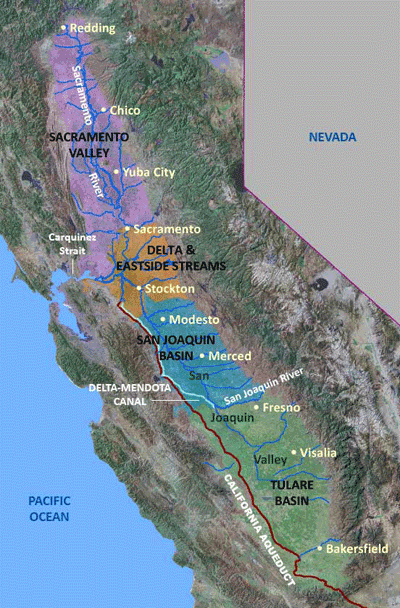
    California Central Valley graphic credit USGS.

    I recently visited with Cannon Michael, president of Bowles Farming Company, which oversees an 11,000-acre farm near Los Banos in California’s San Joaquin Valley. He is the great, great, great grandson of Henry Miller, “the Cattle King of California,” so farming is in his blood. He has senior water rights, and while he still had to make difficult management decisions during the drought, he ended up with more water than many of his neighbors and found ways to share it, a tremendous display of collaboration in the farming community…

    It’s important to remember that there are intelligent and motivated people on both sides. The environmental community brings a lot of information and expertise on habitat and riparian restoration. Farmers know how to get projects done, and they know the local context. So there’s a really great synergy happening between the two groups. At the end of the day, we all want a vibrant and healthy environment in California and a reliable and safe food supply.

    RRWCD meeting in holyoke Thurs., july 13

    Holyoke photo credit dankalal.net.

    From the Holyoke Enterprise:

    The Board of Directors of the Republican River Water Conservation District will be holding its regular quarterly meeting in Holyoke Thursday, July 13, from 10 a.m.-4 p.m. at the Phillips County Event Center Biesemeier Room.

    The agenda includes board president’s report; general manager’s report; quarterly financial report and expenditures; report regarding the Compact Compliance Pipeline; program updates and reports, including reports from the RRWCD’s engineer and legal counsel; RRWCD committee reports; Associated Organization Reports, including Colorado Water Congress, South Platte Roundtable, Water Preservation Partnership, Yuma County Water Authority and Yuma County Weed Control; report on South Fork Project by Nancy Smith, The Nature’s Conservancy; report by Yuma County Pest District; report by Mike Sullivan, assistant state engineer, and Scott Steinbrecher, Colorado attorney general assistant on negotiations with Kansas regarding Bonny; donation to Yuma County Pest District, WPP Resolution 17-01; and engagement letter for 2017 audit with Winfrey, County and Hays.

    Hermosa Trail to be Impacted by Construction of Fish Barrier

    Proposed Hermosa Creek watershed protection area via The Durango Herald

    Here’s the release from the San Juan National Forest:

    Construction activities will begin in the Hermosa Creek Special Management Area on Monday, July 10, 2017 to erect a fish-migration barrier on Hermosa Creek as part of the ongoing Colorado River Cutthroat Trout Reintroduction Project. Trail users and visitors to the area should expect to encounter delays and closures until October 1, 2017. The barrier is being installed on the main stem of Hermosa Creek downstream of its confluence with the East Fork of Hermosa Creek. About one-half mile of the Hermosa Creek Trail from its northern trailhead must be widened to allow heavy equipment to access the construction site. The trail widening is temporary and will be rehabilitated to the extent possible. Tree removal is expected to be minimal.

    Throughout the construction project, trail users traveling in both directions may encounter temporary delays of up to one hour. Short-term closures lasting up to a full day are also possible, especially when heavy equipment is being moved in and out of the area. No more than four days of closures are expected during the three-month project, but construction schedules are subject to changing conditions. Public notices will be posted when trail closures are expected. The project is not expected to affect fishing, because flows will be bypassed above the construction site; however, some sedimentation is expected downstream. The barrier represents the final and most important phase of the Hermosa Creek Colorado River Cutthroat Trout Reintroduction Project, which began almost 30 years ago. The goal is to protect native cutthroat trout above the barrier from non-native fish located downstream.

    For more information, please contact the Columbine Ranger District at 970 884-2512 or Clay Kampf at 970-884-1403.

    Cutthroat trout historic range via Western Trout

    US Supreme Court declines to hear #GoldKingMine lawsuit, #NM v. #Colorado

    This image was taken during the peak outflow from the Gold King Mine spill at 10:57 a.m. Aug. 5. The waste-rock dump can be seen eroding on the right. Federal investigators placed blame for the blowout squarely on engineering errors made by the Environmental Protection Agency’s-contracted company in a 132-page report released Thursday [October 22, 2015]

    From The Naitional Law Review:

    On June 26, the US Supreme Court denied New Mexico’s petition seeking to institute an original action against Colorado for the 2015 Gold King Mine spill. An original action in the US Supreme Court is a lawsuit between states. Invoking that rarely used procedure, New Mexico sought to hold Colorado liable for the Gold King Mine spill. New Mexico asserted claims under the intricate provisions of the Comprehensive Environmental Response, Compensation, and Liability Act of 1980 (CERCLA) and the Resource Conservation and Recovery Act of 1976 (RCRA). New Mexico also sought analogous relief against Colorado under federal interstate common law.

    Attorneys assisting the State of Colorado, successfully argued that the US Supreme Court should not entertain New Mexico’s novel lawsuit. As explained in Colorado’s briefing, New Mexico’s RCRA claim failed because a CERCLA response action had been initiated to address the relevant hazardous substance release. New Mexico’s CERCLA claim failed, Colorado argued, for a number of reasons, including that once a site is under investigation under CERCLA authority, several of New Mexico’s claims are barred because they would interfere with the CERCLA investigation and remedy decision making. Colorado additionally argued that Congress displaced New Mexico’s putative federal common law claims through its enactment of comprehensive environmental statutes, most importantly the Clean Water Act, but also CERCLA and RCRA. Finally, Colorado’s briefing also explained that Colorado should not be held liable for its regulatory activities in remediating and managing abandoned mines…

    Colorado’s victory at the US Supreme Court protects Congress’s carefully constructed statutory scheme for the effective management and remediation of water pollution across the country. It also protects Colorado’s sovereign ability to remediate abandoned mines.

    On April 7, 2016, the Environmental Protection Agency proposed adding the “Bonita Peak Mining District” to the National Priorities List, making it eligible for Superfund. Forty-eight mine portals and tailings piles are “under consideration” to be included. The Gold King Mine will almost certainly be on the final list, as will the nearby American Tunnel. The Mayflower Mill #4 tailings repository, just outside Silverton, is another likely candidate, given that it appears to be leaching large quantities of metals into the Animas River. What Superfund will entail for the area beyond that, and when the actual cleanup will begin, remains unclear.
    Eric Baker

    #ColoradoRiver: Happy Birthday Boulder (Hoover) Dam, construction started on this day in 1930

    This slideshow requires JavaScript.

    Click here to view a gallery of photos of Lake Mead National Recreation Area from the USGS>

    The #California #drought isn’t over, it just went underground — @HighCountry News

    Typical water well

    From News Deeply (Mark Grossi) via the High Country News:

    The race to dig deeper wells is a losing game for small rural communities.

    Evelyn Rios wept in 2014 when the well went dry at her home of 46 years – the home where she and husband Joe raised five children on farm-worker wages. They cannot afford another well, so they do without. Her angst only grew as California’s five-year drought dragged on.

    Finally, after one of the wettest winters on record, Gov. Jerry Brown announced in April that the drought had ended. But situation remains grim, says Rios, 80, who lives in rural Madera County in California’s San Joaquin Valley. She thought she was being hooked up to the city of Madera’s water system. Now the emergency money for such projects has dried up.
    “So, the drought is over?” she asks. “What about us? What about the plans to hook up to Madera’s water? How long will we have to wait now? The drought might be over for you, but it isn’t over for me.”

    Full reservoirs and swollen rivers don’t mean that much to people living in rural San Joaquin Valley, where about 1,000 people still have dry wells. Their water sits underground in the nation’s second-largest groundwater aquifer, which was mined and dramatically drawn down by farmers protecting the valley’s $40 billion-a-year agriculture industry.

    Legislation passed in 2014 will help regulate groundwater pumping, but it will be at least two decades before the law is fully implemented, leaving communities vulnerable to further groundwater shortages and having to compete with big farms digging deeper wells. In addition, many of those people live in small, unincorporated communities, which often lack the resources to properly maintain community water systems.

    Waiting years for safe drinking water has now become a way of life in the valley. It’s one more stress for people who live in California’s most vulnerable social and environmental conditions. They face contaminated water, dirty air, lack of healthcare and language barriers, according to a state environmental screening tool called CalEnivroScreen.

    People of color in this farm country die up to 15 years sooner than people who live in more affluent areas of Fresno, according to the Central Valley Health Policy Institute at Fresno State.

    Many of these rural residents will still be without reliable water this year while the rest of California debates landscape watering rules.

    The state is trying not to abandon people with dry wells. Starting July 1, an additional year of free water will be delivered to massive tanks that were placed at many dwellings with dry wells, including the Rios’ home.

    Which only raises more questions, say water advocates in Central California. One year won’t be enough time to fix all the problems out there. What will happen afterward? Will the state continue to buy water?

    El Niño/La Niña update: 50-60% chance for continuation of ENSO neutral

    From the World Meteorological Organization:

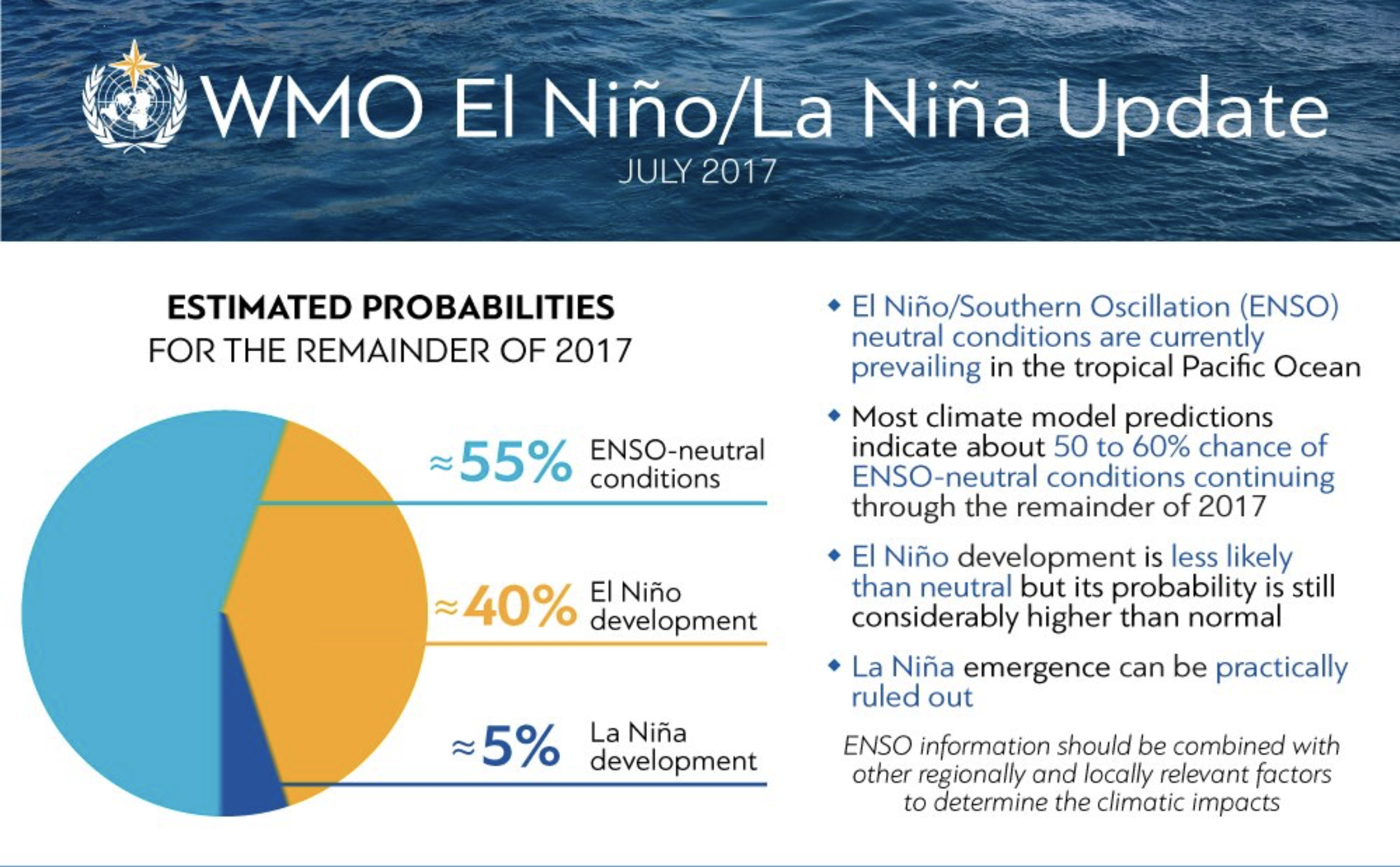
    ENSO neutral conditions currently prevail in the tropical Pacific Ocean, despite sea surface temperatures being near the El Niño threshold. Most climate models surveyed indicate that ENSO-neutral conditions will continue through July-September 2017, followed by a 50-60% chance of a continuation of ENSO-neutral during the subsequent months of 2017. The development of El Niño conditions is slightly less likely, while the emergence of La Niña appears unlikely. National Meteorological and Hydrological Services will continue to closely monitor changes in the state of ENSO over the coming months.

    Two water agencies petition U.S. Supremes to rule on tribal groundwater rights

    Coachella Valley photo credit the Water Education Foundation.

    From The Palm Springs Desert Sun (Ian James and Jay Calderon):

    The U.S. Supreme Court has never ruled on whether Indian tribes hold special rights to the groundwater beneath their reservations, and the court will now have a chance to settle the question in a case that could redraw the lines in water disputes across the country.

    The case revolves around whether the Agua Caliente Band of Cahuilla Indians has a federally established “reserved right” to groundwater on its reservation in Palm Springs and surrounding areas in the desert.

    Two water districts have been fighting the tribe in court for four years, and on Wednesday the districts filed petitions to appeal to the Supreme Court. The Desert Water Agency and the Coachella Valley Water District are challenging a decision by the Ninth Circuit Court of Appeals, which ruled the tribe has a right to groundwater that was established when the federal government created the reservation in the 1870s.

    Managers of the water agencies argue the aquifer is a public resource and the tribe has the same rights under California law as all other landowners to use water pumped from the aquifer.

    “This case is important because it’s about the shared resource,” said James Cioffi, president of DWA’s board of directors. “We think it’s our duty to maintain the ownership of the water for everyone.”

    Cioffi pointed out that the agency has long provided water to the Agua Caliente tribe for its hotels, casinos and golf courses. He said the motivations behind the tribe’s lawsuit remain unclear.

    “Certainly it’s not about access to the water because they along with everyone else in this community has access to all the water they want,” Cioffi said. “We have been partners with the tribe on a lot of their projects and will continue to do so.”

    He and other board members at the water agencies say they worry that if the tribe prevails, its privileged rights could drive up water costs for customers and complicate efforts to manage groundwater.

    The Coachella Valley Water District’s legal team said in their 47-page petition to the Supreme Court that water scarcity is one of the most pressing problems facing the western U.S. and that if the appeals court’s ruling is allowed to stand, Indian reservations “would have preemptive federal rights that override the vigorous and ongoing state and local efforts to ensure the future availability of groundwater in the West.”

    The Supreme Court hears a small number of the cases that are petitioned for review, and the court is expected to announce in the fall whether it will take up the Agua Caliente case.

    Groundwater movement via the USGS

    @ColoradoStateU: Register for the July 24 Western Water Symposium and Barbecue

    Here’s the release from Colorado State University (Jessica Mendoza):

    At the 2017 Western Water Symposium and Barbecue, Colorado State University Libraries will be hosting conversations that make waves about new innovations surrounding water law, policy and technology, while benefiting its Water Resources Archive, an irreplaceable collection of historical documents pertaining to water in Colorado.

    Jennifer Gimbel, Gregory J. Hobbs Jr., John Stulp, Jennifer Pitt and Patrick O’Toole are scheduled to speak at this year’s Western Water Symposium and Barbecue on Monday, July 24, at CSU’s Morgan Library. These renowned experts will share their knowledge and lead important conversations on the theme of water optimism and innovation.

    The speakers

    CSU Senior Water Policy Scholar Gimbel will emcee the program.

    Hobbs, author of The Public’s Water Resource, Articles on Water Law, History, and Culture, will share his 20 years of experiences as a Colorado Supreme Court Justice and discuss historical water developments in the Cache la Poudre River Basin. His talk is titled, “The Poudre River’s Heritage: Turn Back or Move Forward?”

    Stulp, special policy advisor to the governor for water and director of the Interbasin Compact Committee, will discuss “Water’s Innovative Future,” covering statewide innovations and the collaborative efforts required to achieve them.

    Following the barbecue lunch, the National Audubon Society’s Colorado River Program Director Pitt, who has worked to protect and restore Colorado rivers, will share her exceptional experiences surrounding management approaches for the Colorado River in “We’re All in It Together: Crafting Colorado River Management for the 21st Century.”

    O’Toole, president of the Family Farm Alliance, will tackle a broader perspective and outlook on water innovation and optimism in a national context. His talk is titled, “What’s Old is New, What’s New is Old.”

    A special panel of innovators will follow the symposium with their unique perspectives, and a tour of the Water Resources Archive will conclude the day. A reception immediately follows. The event begins at 9 a.m. and concludes at 6 p.m.

    The cost to attend is $100 and includes the symposium, reception, and lunch; student admission is $50. All proceeds benefit the Water Resources Archive.

    Click here for more information and to register.

    My summer mixtape: Getting in the irrigation mood – News on TAP

    In the spirit of Smart Irrigation Month, I created a water-wise lawn care playlist.

    Source: My summer mixtape: Getting in the irrigation mood – News on TAP

    Audubon: Diverted Water, Longer Droughts and Climate Change Threaten Birds in the Arid West

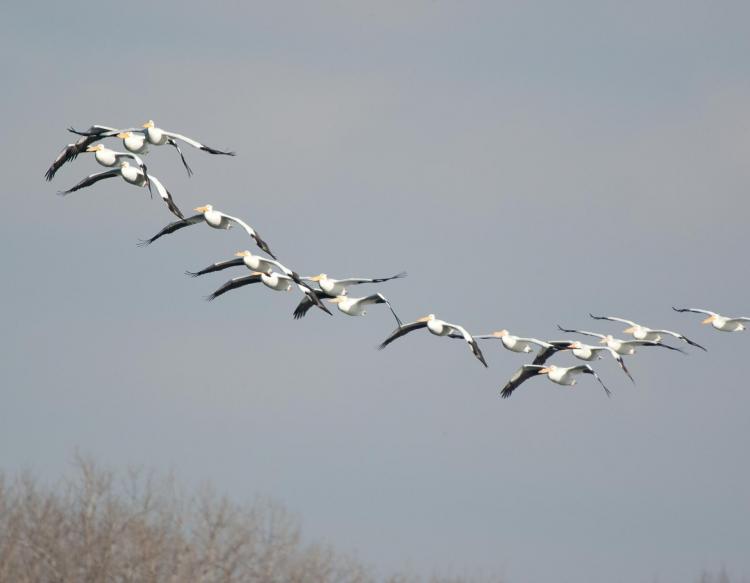
    American White Pelicans flying in formation. Photo credit Missouri Department of Conservation.

    From the Audubon Society:

    In the arid West of the United States, water sustains tens of millions of people as well as some of America’s richest diversity of birdlife. Today, the National Audubon Society published Water and Birds in the Arid West: Habitats in Decline, the first comprehensive look at the unprecedented impact of western water loss and climate change on birds. Focusing on the Colorado River basin as well as the network of saline lakes across eight Western states (Arizona, California, Colorado, New Mexico, Nevada, Oregon, Utah and Wyoming), Audubon determined that a combination of water development, drought and climate change threaten these habitats and put millions of birds at risk: U.S. and global populations of many birds that depend on these habitats for resting, feeding and nesting hang in the balance.

    “The most urgent threat facing birds and people in the West is a precipitous decline in water quality and availability,” said Dr. Chad Wilsey, Audubon’s director of bird conservation and main author of the Audubon report. “Both rivers and saline lakes across the West need reliable sources of fresh water to continue sustaining not only a rich diversity of birdlife but also the millions of people across rural and urban areas that depend on these systems.”

    The future of seven bird species, including several species protected by the Endangered Species Act—Eared Grebe, Wilson’s Phalarope, American Avocet, American White Pelican, Southwestern Willow Flycatcher, Western Yellow-billed Cuckoo and Yuma Ridgway’s Rail—is tied to the rivers of the Colorado River basin, western saline lakes and scarce wetlands across the West.

    Longmont Councillors approve asking voters for Windy Gap bond issue

    Map from Northern Water via the Fort Collins Coloradan.

    From The Longmont Times-Call (John Fryar):

    A 5-2 Longmont City Council majority decided Wednesday night to ask voters’ authorization to sell an estimated $36.3 million in bonds to help finance the city’s share of costs for the Windy Gap Firming Project…

    …the city’s water customers would pay higher rates in 2018, with rates increasing by an average 13 percent above 2017 levels. There would be another 10 percent increase in 2019 and a 6 percent increase in 2020 as the city makes annual principal and interest repayments on the 20-year bonds.

    The water rate-backed bonds, along with about $6.2 million the city projects it will be getting from development fees and other sources, would cover Longmont’s costs of paying for the project that would be able to provide the city with about 10,000 acre-feet of water. A council majority continued to endorse the 10,000 acre-feet level on Wednesday night.

    Mayor Dennis Coombs and council members Brian Bagley, Bonnie Finley, Jeff Moore and Gabe Santos voted Tuesday to direct the city staff to prepare an ordinance that will, when adopted, advance the bonding question to November’s ballot.

    Council members Polly Christensen and Joan Peck voted against the $36.3 million bonding scenario.

    Christensen and Peck instead tried to get the council to support an alternative that would have lowered Longmont’s Windy Gap Firming Project level from 10,000 acre-feet of water to an 8,000 acre-foot participation. That option would have maintained a set of 9 percent annual water rate increases that already are to take place at the start of 2018 and again in 2019, but with no rate increases above that 9 percent level in either of those years.

    The Christensen-Peck approach, however, failed on a 5-2 vote, with all other council members voting against that option.

    Santos said that when it comes to water delivery and supplies, “it’s incumbent on us to make decisions for the future, for the next generations.”

    Coombs noted that under Longmont’s tiered water-rate system, with residents’ and businesses’ actual water bills based on how much water they actually use, “people have some control,” even with the pending increases ahead.

    Customers “can take some responsibility” for conserving water, and thereby reducing the water bills they get, even with the higher rates ahead in future years, he said.

    Peck, however, said she was concerned that “we’re buying more (water) than we actually need” if Longmont sticks with the 10,000 acre-feet participation level from the Windy Gap Firming Project, which is to include construction of a new Chimney Hollow Reservoir southwest of Loveland.

    Colorado transmountain diversions via the State Engineer’s office

    Prior to the council’s Wednesday night action to direct the staff to prepare the ballot measure language for the bonding option, a number of residents spoke about their opposition to that project and questioned its need. Some also objected to the entire concept of diverting water from the Western Slope to the Front Range.

    The path to a new @EPA #CleanWaterRule will be through the courts

    Photo via Greag Hobbs March 29, 2015.

    Scott Pruitt now faces an uncertain outcome in the courts. Here’s a report from Patrick Parenteau (Vermont Law School) writing for The Conversation. Here’s an excerpt:

    EPA developed the Clean Water Rule in an attempt to resolve uncertainty created by a fractured 2006 Supreme Court decision, Rapanos v. United States. The Rapanos ruling caused widespread confusion about which waters were covered [Click through for the Reagan Waskom and David J. Cooper explainer about Ag and the rule], creating uncertainty for farmers, developers and conservation groups. Efforts to clarify it through informal guidance or congressional action had failed, and EPA acted under mounting pressure from various quarters, including some members of the court.

    As Oklahoma’s attorney general, Pruitt unsuccessfully sued to kill the rule, which he has called “the greatest blow to private property rights the modern era has seen.” Now he is seeking to accomplish by administrative fiat what he failed to achieve in court. However, he faces a stiff challenge from supporters of the rule, and the courts may not buy his arguments for wiping a rule off the books.

    Under the Administrative Procedure Act, federal agencies must follow specific steps when they seek to establish or repeal a regulation. These procedures are meant to establish efficiency, consistency and accountability. To promote fairness and transparency, the law requires that the public must have meaningful opportunity to comment on proposed rules before they take effect.

    The Clean Water Rule emerged from an extensive rule-making process that featured over 400 meetings with state, tribal and local officials and numerous stakeholders representing business, environmental and public health organizations. It generated over one million comments, the bulk of which supported the rule.

    This process was preceded by a comprehensive peer-reviewed scientific assessment that synthesized over a thousand studies documenting the importance of small streams and wetlands to the health of large rivers, lakes and estuaries. According to a 2015 fact sheet, which has been scrubbed from EPA’s website but is archived here, the rule protects streams that roughly one in three Americans depend upon for their drinking water.

    To undo the Clean Water Rule, EPA will have to go through the same notice-and-comment process. Pruitt’s proposal to rescind the rule will be published in the Federal Register sometime in the near future. From that date, the public will have just 30 days to file written comments electronically. (Normally public comment periods last for 60 days, and the Clean Water Rule was open for comment for 120 days.)

    […]

    EPA must then review and respond to the comments, make any changes it deems necessary and publish a final rule. Parties with standing can then challenge the final rule, although there is a question as to which court will have jurisdiction to hear them. The Supreme Court is scheduled to hear arguments on this issue in the fall. In weighing challenges, the key question the court must address is whether EPA’s action is “arbitrary and capricious,” meaning that the agency has failed to consider important aspects of the problem or explain its reasoning.

    In a seminal 1983 decision, the Supreme Court ruled that an agency must supply a “reasoned analysis” when it rescinds a rule adopted by a previous administration. The court acknowledged that agencies have some discretion to change direction in response to changing circumstances. However, it noted that “the forces of change do not always or necessarily point in the direction of deregulation.” Further, the court said that a decision to rescind a rule would be arbitrary and capricious if it offers an explanation “that runs counter to the evidence before the agency.”

    Pruitt asserts that his repeal “need not be based upon a change of facts or circumstances,” citing a 2009 opinion by Justice Antonin Scalia. But in my view, Pruitt reads too much into that decision, which simply held that an agency did not face “heightened scrutiny” – that is, an extra-high bar – when changing policy, but must still “show that there are good reasons for the new policy.” As Justice Breyer observed, dissenting in the same case, “Where does, and why would, the Administrative Procedure Act grant agencies the freedom to change major policies on the basis of nothing more than political considerations or even personal whim?”

    #Drought news: D0 (Abnormally Dry) expanded in NW #Colorado, monsoon on the way

    Click here to go to the US Drought Monitor Website. Here’s an excerpt:

    Summary

    This U.S. Drought Monitor week saw scattered showers and thunderstorm activity across portions of the central and southern Plains, Gulf Coast, lower Midwest, northern half of New England and the Southeast. Heavy rainfall was observed across northern Missouri where severe thunderstorms produced widespread accumulations ranging from 3 to 5 inches as well as two isolated areas receiving 8 to 10 inches. In the southern Plains, some improvement in drought conditions occurred in southeastern Oklahoma where 4 to 11 inches of rain fell during the past week. In the drought-stricken northern Plains and eastern Montana, rainfall accumulations were generally less than 1 inch providing little relief. Early this week, temperatures in eastern Montana soared into the 90s exacerbating already dry conditions and further stressing crops, pastures, and rangelands. Across the remainder of the West, generally hot and dry conditions prevailed with areas of the Pacific Northwest experiencing temperatures up to 10 degrees above normal. In the desert Southwest and Great Basin, firefighters have been battling large wildland fires in Arizona, Nevada, and Utah. In the South, heavy rains fells across the Gulf Coast of Alabama, Louisiana, and Mississippi. In the Mid-Atlantic, some areas of dryness have developed in portions of Delaware, Maryland, and northern Virginia. In the Northeast, heavy rains were observed in Upstate New York as well as northern portions of New Hampshire and Vermont…

    The Plains

    On this week’s map, areas of Severe Drought (D2) and Extreme Drought (D3) expanded across eastern Montana, south-central North Dakota, and northwestern South Dakota where hot and dry conditions persisted. In northwestern South Dakota, South Dakota State University Extension staff reported poor pasture and range conditions as well as deteriorating crop conditions (corn). In eastern Montana, hot and dry weather continued to deteriorate pasture, rangeland, and crop conditions as temperatures soared above 90 degrees. On July 1st, the National Weather Service Office in Glasgow, Montana reported several dry precipitation records were broken for Glasgow including: the driest May and June (0.72 inches) since 1918; the driest April, May, and June (1.24 inches) since 1918; and the driest January through June (2.75 inches) since 1983. According to the USDA for the week ending June 25th, topsoil moisture (percent short to very short) is as follows: Montana – 69%, Nebraska – 56%, North Dakota – 53%, and South Dakota – 63%. In the southern Plains, areas of Abnormally Dry (D0) and Moderate Drought (D1) were reduced in eastern and southern portions of Oklahoma where heavy rainfall accumulations were observed with some localized accumulations in south-central Oklahoma ranging from 8 to 10 inches. Across most of the region with exception of western portions of the Dakotas, average temperatures were slightly below normal (1 to 4 degrees)…

    The West

    During the past week, a dry pattern continued across most of the West. Some lesser rainfall accumulation (less than 1 inch) were observed across northern New Mexico, northern Wyoming, and southwestern Montana. In the Pacific Northwest, hot and dry conditions prevailed with average temperatures 2 to 10 degrees above normal. In the Southwest, a number of large wildland fires continued to burn in Arizona, Nevada, and Utah where monsoon moisture has been limited during the past week. In southeastern Arizona, the Frye Fire has burned ~46,000 acres (51% contained) of timber, brush, and chaparral according to the National Interagency Coordination Center. In southwestern Utah, the Brianhead Fire has burned approximately 67,000 acres and is currently 75% contained. On this week’s map, areas of Abnormally Dry (D0) were added in western Arizona, northwestern Colorado, southeastern Nevada, northeastern Utah, and southern Wyoming in response to above average temperatures (past 30 days), short-term dryness, and below normal soil moisture…

    Looking Ahead

    The NWS WPC 7-Day Quantitative Precipitation Forecast (QPF) calls for moderate precipitation accumulations (1 to 3 inches) across much of the Eastern Tier of the conterminous U.S. with some heavier accumulations (3 to 4 inches) forecasted for portions of the Mid-Atlantic. Lesser accumulations (less than 1.5 inches) are forecasted for the central and southern Rockies as well as portions of the desert Southwest including eastern Arizona and southwestern New Mexico as monsoonal moisture returns to the region. The CPC 6–10 day outlooks call for a high probability of above-normal temperatures across the western half of the conterminous U.S., upper Midwest, and Florida while the Eastern U.S. is forecast to be normal. Below-normal precipitation is forecast for the Pacific Northwest, northern Rockies, and the Plains while above-normal precipitation is expected in the portions of the Intermountain West, Arizona, western Colorado, Utah, and the eastern third of the U.S.

    North American Monsoon graphic via Hunter College.

    Drinking water at risk with new @EPA proposals #WOTUS

    Middle Dutch Creek near the Grand River Ditch. Photo credit Greg Hobbs.

    From The Colorado Connection (Josephine Peterson) via The Durango Herald:

    The American public will have 30 days to comment on the Trump administration’s plan to repeal and replace the 2015 Clean Water Rule, once it’s published in the Federal Register.

    Jan Goldman-Carter, wetlands and water resources director for the National Wildlife Federation, said the move would remove pollution limits from streams and wetlands that supply a third of the nation’s drinking water and which also are home to countless fish and wildlife species.

    “The American public has long thought – since the 1972 act – that their water is protected, their wetlands are protected, their streams are protected from pollution,” she said. “None of us can really take that for granted anymore.”

    The Clean Water Rule restored protections under the Clean Water Act for headwaters, streams and wetland habitat that had been left uncertain because of convoluted U.S. Supreme Court rulings. Current Environmental Protection Agency Administrator Scott Pruitt has argued that rolling back the measure will provide certainty to farmers and other businesses by returning regulatory authority to states.

    Carter said western states rely on clean water to fuel their multi-billion-dollar outdoor recreation industries. She pointed to polls that show nearly 80 percent of hunters and anglers favor Clean Water Act protections. Dozens of craft brewers also have come out in support of the 2015 measure. Carter said a majority of the nation’s stream miles and wetland acres are at stake…

    But some Colorado legislators see the beginning of the process to rollback this rule as a victory for private water rights.

    Sen. Cory Gardner, R-Colo., called the withdraw of this rule as “a victory for agriculture, rural communities, and all Coloradans.”

    […]

    Gardner has been a consistent opponent of the administrative rule from the beginning.

    Rep. Scott Tipton, R-Cortez, said he also welcomed the news and that the rule was a threat to private water rights…

    Samantha Slater, a spokeswoman for Sen. Michael Bennet, D-Colo., said the senator is opposed to the rule’s full appeal, and wants only what is best for the state.

    According to the Environment America Research and Policy Center, the Clean Water Rule, supported by more than 80 percent of small-business owners, was expected to generate more than $400 million annually in economic benefits. Public comments can be submitted at http://www.regulations.gov.

    The EPA plan is online at epa.gov/wotus-rule, and the Environment America brief is at environmentamericacenter.org.

    Piping ditches to improve water quality

    Photo credit NRCS via the Julesburg Advocate.

    From the Natural Resources Conservation Service via The Julesburg Advocate:

    LSPW Receives 2016 Funding for Targeted Conservation Efforts

    Improving water quality and water efficiency use is a top priority for the Natural Resources Conservation Service (NRCS). As a result, NRCS continues its partnership and support to help landowners in eastern Colorado in their effort to improve irrigation water delivery methods within the Lower South Platte Watershed (LSPW).

    2016 marks the second round of targeted conservation funds NRCS has allocated specifically for the installation of underground pipe within Sedgwick County. The pipeline will replace the use of earthen ditches for 20 landowner’s.

    “In Colorado, we divert almost 90% of all agricultural irrigation water,” shares Daniel Palic, NRCS District Conservationist for Julesburg and Holyoke. “When water is moved, water is lost, so to help ensuring the least amount of loss during its transport is essential and requires effective and efficient methods. The underground pipeline increases that assurance.”

    Through the Agency’s 2016 targeted conservation efforts, using NRCS’s Environmental Quality Incentives Program (EQIP), over 50,000 feet of earthen ditch was replaced with underground pipeline servicing over 1300 acres. This means NRCS’s targeted conservation investment in the LSPW has funded a total of 38 contracts and nearly 90,000 feet of underground pipeline.

    NRCS provides farmers, ranchers and forest managers with free technical assistance, or advice, for their land. Conservationists provide technical expertise and conservation planning for those wanting to make voluntary conservation improvements to their land not only helping the environment but agricultural operations, too. The Agency may also provide financial assistance to make those improvements to their land.

    For more information about NRCS and how its conservation programs and initiatives can help you, please visit http://www.co.nrcs.udsa.gov or contact the NRCS field office located in the USDA service center within your county.

    Rebecca Mitchell selected as new CWCB director — @COindependent

    Photo of Becky Mitchell at Main Reservoir, Lakewood by Marianne Goodland

    From The Colorado Independent (Marianne Goodland):

    Rebecca “Becky” Mitchell, who currently heads up the water supply planning section of the Colorado Water Conservation Board, today was named the agency’s new director, effective immediately.

    Mitchell has been with the Department of Natural Resources since 2008 and joined the CWCB in 2009. She was selected as the next director by the agency’s 15-member board. The CWCB provides guidance on state water policy and is the state’s comprehensive source for water information, including technical assistance and training.

    A native of Hawaii, Mitchell has lived in Colorado for the past 20 years. Colorado water has been the focus of her entire career.

    She started off with an interest in the environment and biology but found water was her real passion. “Water is the corner in which I can make a difference,” she said.

    That interest has taken her all over the world, but especially to Africa, and Ethiopia. Mitchell has five children, including several adopted from Ethiopia. She says she believes in giving back and has traveled to Ethiopia to help the country with water treatment as well as work on water systems for orphanages.

    “It keeps you grounded in terms of why what you do is important,” she said.

    “I’m excited and fortunate to have an opportunity to serve a state agency filled with committed and thoughtful stewards of Colorado’s precious water resources,” Mitchell said in a statement. “Coloradans and our water communities are working like never before to solve our state’s challenges collaboratively. The same kind of cooperation that led to Colorado’s Water Plan will fuel the long-running effort necessary to continue putting the plan into action. What a privilege to be part of this process.”

    As section chief over water planning for the past five years, Mitchell has been a key liaison with water groups around the state, such as the basin roundtables, which represent environmental, recreational, agricultural, municipal and industrial water users in each of the state’s eight major river basins plus a separate group for metro Denver. She also has been responsible for directing and implementing the Statewide Water Supply Initiative, which provided some of the critical background data for the state water plan on water supply and demand.

    Prior to joining CWCB, Mitchell served served as the Water Policy and Issues Coordinator within the Department of Natural Resources’ executive director’s office and in both the public and private sectors as a consulting engineer. She received her bachelor’s and master’s degrees from the Colorado School of Mines.

    Senate President Pro tem Jerry Sonnenberg of Sterling, a critic of the previous director, James Eklund, greeted the news of Mitchell’s appointment with enthusiasm. “I’m confident the new director will rebuild the relationships with the legislature and work with us rather than working on their own,” he said.

    Conservation Colorado also viewed Mitchell’s appointment as a positive. “Our number one priority is to see the water plan implemented,” said Kristen Green of Conservation Colorado. Mitchell “knows the plan inside-out. She’s great at being collaborative and reaching out to different stakeholders.”

    Here’s the release from the Colorado Division of Water Resources (Todd Hartman):

    Rebecca Mitchell, who played an instrumental role in production of Colorado’s Water Plan, has been named the new director of the Colorado Water Conservation Board.

    Mitchell, who was selected by the CWCB’s 15-member board, will oversee CWCB’s 45-member staff as it provides statewide policy direction on water issues and continues implementation of the water plan. Mitchell replaces James Eklund, who left recently for private law practice after serving nearly four years as the agency’s director.

    “I’m excited and fortunate to have an opportunity to serve a state agency filled with committed and thoughtful stewards of Colorado’s precious water resources,” Mitchell said. “Coloradans and our water communities are working like never before to solve our state’s challenges collaboratively. The same kind of cooperation that led to Colorado’s Water Plan will fuel the long-running effort necessary to continue putting the plan into action. What a privilege to be part of this process.”

    Mitchell previously served as the Section Chief for CWCB’s Water Supply Planning section, which includes the Office of Water Conservation & Drought Planning and focuses on ensuring sufficient water supplies for Colorado’s citizens and the environment. Mitchell played a significant part in working with the state’s Basin Roundtables, the Interbasin Compact Committee, the public at large and CWCB staff in producing Colorado’s Water Plan following Gov. John HIckenlooper’s executive order in 2013 directing CWCB to facilitate the development of the plan.

    Mitchell has also served as the Water Policy and Issues Coordinator within the Colorado Department of Natural Resources’ executive director’s office. Before joining DNR she worked in both the public and private sectors as a consulting engineer. She received her bachelor’s and master’s degrees from the Colorado School of Mines.

    The Colorado Water Conservation Board (CWCB) was created over 75 years ago to provide policy direction on water issues. The CWCB is Colorado’s most comprehensive water information resource. The agency maintains expertise in a broad range of programs and provides technical assistance to further the utilization of Colorado’s waters. It is one of six divisions housed within the Colorado Department of Natural Resources.

    Aspen Moves Toward 100 Percent Renewable Energy #ActOnClimate #KeepItInTheGround

    Aspen

    From NPR (Grace Hood):

    More than 30 cities, including Atlanta and San Diego, have declared 100 percent renewable energy goals in the coming decades.

    But is that really possible?

    The story of Aspen’s path to 100 percent renewable electricity shows it’s complicated.

    In 2006, the Colorado city’s utility was one of the first in the country to declare a 100 percent renewable energy goal as part of its climate action plan to reduce overall greenhouse gas emissions.

    Aspen is built around the ski industry. Mayor Steve Skadron says that behind the glitz of downtown stores like Prada and Gucci is an environmental mission.

    “Put aside crazy climate zealots telling everybody to sell their cars and eat tofu,” he says. “It makes economic sense for us to support these values because our economy’s based on the natural environment.”

    The town had a good start with two hydroelectric plants it built in the 1980s. To get closer to 100 percent renewable energy, the city wanted to revive another hydroplant.

    As part of that proposal, it spent millions on things like a custom turbine and generator, a move that Aspen voters approved. But some residents and groups ultimately worried the plan would reduce stream flows, and that would harm the environment. In 2012, Aspen voters reversed course and rejected the plan.

    Instead, Aspen signed contracts to bring in hydropower, wind and biogas from other regions and states.

    In 2015, the city utility became the third in the nation to be powered completely by renewable energy, Skadron says…

    [A Coyote Gulch reader warns that it is just the utility not the entire city that is 100%.]

    All that renewable power keeps the lights on downtown. But Aspen still uses natural gas to heat homes. And when you go to ski resorts or outlying homes, the power comes from a different utility that uses some fossil fuels…

    Today, only a few cities besides Aspen have achieved 100 percent renewable electricity or energy: Georgetown, Texas; Burlington, Vt.; Greensburg, Kan.; and Rockport, Mo. Kodiak Island, Alaska, is 99 percent renewable energy but uses small amounts of diesel as a backup fuel source.

    Van Horn says the Sierra Club pushes cities to create their own renewable energy. But even when they buy it from faraway places, like Aspen does, it has a wider impact…

    The Sierra Club hopes all this will add up to lower carbon emissions for cities, and the country.

    In Aspen, that’s still a challenge. A decade ago the city set out to bring down all its emissions 30 percent by 2020. Despite Aspen Utilities’ success, the city is not there by a long shot. Skadron says his next goal is the transportation sector. He’s talking with companies about using Aspen to experiment with lowering carbon emissions from cars…

    After transportation, there are still emissions from the local airport and the natural gas used to heat homes. The city is working on a new climate action plan that it plans to issue this fall.

    HydroVision conference recap

    Here’s a guest column from Bob Gallo writing in the Denver Business Journal. Here’s an excerpt:

    While the groundwork to unlock hydropower’s full potential has been laid, there is much more left to be done. The manufacturers, developers, engineers, consultants, utility managers, and others who came to Denver last week certainly agreed.

    Congress also agrees that hydropower should be an important part of the country’s energy future. Last year, the Energy Policy Modernization Act (EPMA) nearly made it across the finish line before running out of time as Congress adjourned for the year. EPMA enjoyed broad bipartisan support, and contained many hydropower provisions long sought by the industry, including designating the Federal Energy Regulatory Commission (FERC) as the lead agency for licensing hydropower projects. These changes would reduce unnecessary delays and uncertainty.

    Though that effort ultimately fell short, hydropower remains the one energy source that can narrow the massive chasm between the two political parties on energy. Just six months into the current legislative session, no less than 33 bills focused on hydropower have been introduced. Nearly every week, committees in the House and Senate are holding hearings or markups on hydro legislation. Republicans and Democrats alike are seeing the value in hydropower and exploring more ways to get this valuable energy source online.

    This is particularly true for the Colorado delegation. Earlier this year, Rep. Doug Lamborn, R-Colorado, introduced legislation that would encourage pumped storage hydropower at U.S. Bureau of Reclamation facilities. Pumped storage is the only proven large-scale energy storage technology and should be utilized to a much greater extent than it is currently.

    Sen. Cory Gardner, R-Colorado, recently sponsored a bill that would reauthorize a Department of Energy Waterpower program that provides funding to retrofit dams and river conduits with electricity. There are over 80,000 dams in the country, and only 3 percent produce power. These non-powered dams hold great promise for additional generation.

    Rep. DeGette has continued her leadership on hydropower, co-sponsoring new legislation earlier this month that would reduce the timeframe for approval of conduit hydro projects on Bureau facilities. The Colorado Small Hydro Association estimates that these types of canals and conduits could power an additional 65,000 Colorado homes…

    The hydropower licensing process is one major roadblock to increasing our current installed hydropower capacity from 100 gigawatts to 150 gigawatts by 2050 – a goal set forth in the Department of Energy’s 2016 Hydropower Vision report. By utilizing some of those tens of thousands of untapped dams in the U.S., boosting pumped storage, and efficiency upgrades at existing facilities, hydropower can be a big part of our energy future. According to an earlier report, Colorado alone could produce 3.8 gigawatts of additional hydropower.

    There’s an important side benefit to hydropower: infrastructure investment and job creation.

    @ColoradoClimate: Weekly Climate, Water and #Drought Assessment of the Intermountain West

    Upper Colorado River Basin precipitation as a percent of normal June 2017 via the Colorado Climate Center.

    Click here to view the current assessment. Click here to go to the NIDIS website hosted by the Colorado Climate Center.

    From Steamboat Today (Scott Franz):

    The current weather forecast doesn’t show a big chance for a downpour in Steamboat anytime soon.

    The National Weather Service is calling for just a 20 percent chance of showers and thunderstorms on Friday. Otherwise, the forecast calls for sunny skies and highs in the mid 80s through Monday…

    Steamboat cancelled its annual Fourth of July fireworks show because of ongoing fire danger.

    As thousands of people watched the holiday parade in downtown Steamboat on Tuesday morning, dozens of firefighters were working to try to contain the Mill Creek Fire burning in California Park near Hayden.

    Department of the Interior Awards $6.9 Million to 17 Projects for Drought Preparation — @USBR

    Augmentation pond photo via Irrigation Doctor, Inc.

    Here’s the release from the US Bureau of Reclamation (Peter Soeth):

    Entities in California, Colorado, Nevada, Oklahoma and Montana will receive funding to prepare for and address drought in advance of a crisis

    U.S. Secretary of the Interior Ryan Zinke announced today that the Bureau of Reclamation is awarding 17 projects in California, Colorado, Nevada, Oklahoma, and Montana a total of $6.9 million to proactively prepare for and address drought in their communities. The federal funding will be leveraged to support more than $47.9 million for the development of drought contingency plans and implementation of drought resiliency projects.

    “Drought continues to have serious adverse impacts throughout the West,” Secretary Zinke said. “Reclamation and its partners have been leaders in combating this drought for a hundred years. The newest infusion of Reclamation funds announced today will help communities in five states prepare for and respond to drought.”

    Reclamation’s Drought Response Program supports a proactive approach to drought. It aids water users for drought contingency planning. The Drought Response Program also provides funding for the implementation of mitigation actions through drought resiliency projects, giving priority to projects that are supported by a drought planning effort.

    Complete descriptions of all the selected projects are available at http://www.usbr.gov/drought.

    Five projects in California and one project in Montana were selected through a competitive process to receive funding to develop drought contingency plans. They are:

  • Bella Vista Water District (California)
    Reclamation funding: $86,580; Total Project Cost: $173,160
  • City of Rialto, California
    Reclamation funding: $200,000; Total Project Cost: $404,474
  • Montana Department of Natural Resources and Conservation
    Reclamation funding: $150,000; Total Project Cost: $300,000
  • Schafter-Wasco Irrigation District (California)
    Reclamation Funding: $200,000; Total Project Cost: $456,500
  • Sonoma County Water Agency (California)
    Reclamation Funding: $200,000; Total Project Cost: $501,196
  • Southern California Edison Company (California)
    Reclamation Funding: $100,000; Total Project Cost: $200,000
  • Eleven projects in California, Colorado, Nevada and Oklahoma were selected through a competitive process to receive Drought Resiliency Project grants. They are:

  • Alameda County Water District (California), Rubber Dam #3 Fish Ladder
    Reclamation Funding: $750,000; Total Project Cost: $7,121,600
  • Central Colorado Water Conservancy District, Northeast Colorado Walker Recharge Project – Phase I
    Reclamation Funding: $750,000; Total Project Cost: $7,000,000
  • City of Bartlesville, Oklahoma, Caney River Water Augmentation and Intake Improvements
    Reclamation Funding: $750,000; Total Project Cost: $7,152,097
  • City of Torrance, California, Torrance Van Ness Well Field
    Reclamation Funding: $750,000; Total Project Cost: $16,703,900
  • Coyote Valley Band of Pomo Indians (California), West Fork Russian River Bank Stabilization and Habitat Restoration
    Reclamation Funding: $300,000; Total Project Cost: $600,000
  • Merced Irrigation District (California), Merced River Instream & Off-Channel Drought Habitat Project
    Reclamation Funding: $744,489; Total Project Cost: $2,707,763
  • Mountain Park Master Conservancy District (Oklahoma), Groundwater Supply Augmentation Project
    Reclamation Funding: $300,000; Total Project Cost: $618,500
  • Round Valley Indian Tribes (California), Mill Creek Streamflow & Riparian Corridor Restoration Project
    Reclamation Funding: $689,101; Total Project Cost: $1,444,461
  • San Gabriel River Water Committee (California), San Gabriel Inlet Structure Project
    Reclamation Funding: $300,000; Total Project Cost: $689,093
  • To learn more about Reclamation’s Drought Response Program and to see a complete description of all the projects, visit https://www.usbr.gov/drought.

    #ClimateChange exacerbates SW #drought

    Las Vegas Lake Mead intake schematic, courtesy SNWA.

    From The Las Vegas Sun (Mick Akers):

    [Colby] Pelligrino said the average temperature was up 8 degrees during March in Colorado, home of the snowcap that feeds the Colorado River and, in turn, Lake Mead. “It clocked in as the warmest temperature for the month in the state of Colorado ever.”

    This year’s unseasonably warm temperatures in the West have had sizable impacts on the snowpack in the Rockies this year, Pelligrino said.

    “It caused an adjustment in the forecast of over 2 million acre-feet just as a result of the temperatures in March,” she said.

    Data recently published on the issue said the drought was caused by temperature changes. In contrast, there was a similar shortage of water in the 1950s, which was caused by the lack of precipitation.

    Dr. Matthew Lachniet, a UNLV geoscience expert, said Pelligrino was alluding to what is known as a hot drought. Studying cave deposits from various areas in Nevada, Lachniet and his associates have been able to create a climate history showing how temperature and precipitation have changed over a span of 11,000 years…

    A temperature curve created for the 11,000 years of data shows that temperatures peaked about 8,000 years ago and dropped thereafter, but recently the temperature is beginning to rise again, which Lachniet said is the effect of global warming.

    “The answer is, yes, it’s really unquestionable that climate is changing and humans are driving it,” he said. “We know that since the 1980s that temperatures have exceeded the long- term means.”

    When it gets hot, it gets drier, and the data show that Nevadans can expect to see hotter and drier conditions to persist heading into the future, Lachniet said.

    Those higher temperatures will play a big role in the flow of the Colorado River going forward.

    “As the temperature increases, we have a greater evaporate and demand and lots of reasons that water gets used up faster,” Lachniet said. “That leads to less water staying in the river system.”

    The worst-case scenario shows the Colorado River being at 50 percent less volume in 2100 than what the current levels are.

    Lachniet said that humans can play a role in how hot it gets and, in turn, how much water is lost, by reducing greenhouse gases to keep the temperature from rising too dramatically.

    States that depend on the Colorado River have worked together to ensure everyone involved is doing their part to conserve as much water as they can.

    “The Colorado River is really the hallmark of cooperation for river basins working together,” Pelligrino said. “People from the Colorado River Basin are asked to come all around the world to talk about the way we work together and they way we cooperate.”

    Through that work, Pelligrino said they have aggressively advanced the tools needed to adapt to drought,” she said.

    They are continuing to work to enforce current guidelines that address shortage in Lake Mead.

    “Since 2007, since shortage probabilities of hitting low lake elevations were figured out, we’ve doubled and tripled the probabilities of hitting those same elevations,” she said. “This current drought is throwing us in a place we never thought we would be this quickly.”

    Drought contingency planning is the major initiative for the Colorado River Basin members.

    The SNWA, the Governor’s Office of Economic Development, UNLV, UNR, and MGM Resorts International are among the partners in WaterStart. Initially started to spur economic growth by bringing in new water-smart technology, it has evolved into allowing those entities to develop water-conservation technology.

    “We provide grant funding to help get those things off the ground and are able to test them,” Pelligrino said.

    The latest project being tested is a water-smart meter used by some of Nevada’s largest water users.

    The meters provide information about water usage at large resorts and institutions. The data can then be used to address any issues relating to water conservation to be as efficient as possible.

    “We can go back and digest it and evolve our programs to continue to tackle water use and achieve conservation where it makes sense,” she said.

    Infrastructure improvements such as adding a third intake at Lake Mead and a new associated pumping station with that are other ways SNWA is taking the proactive approach.

    “By the end of 2020 we’ll be able to pump from a level in Lake Mead that provides better water quality than we have now,” she said. “We’re already starting to access that portion of a project — the ability to pump water from the Colorado River, even if there’s not enough water in Lake Mead to deliver it downstream.”

    The project’s $1.4 billion cost was financed without any state or federal funding.

    Upper Colorado River Basin March 2017 precipitation as a percent of normal via the Colorado Climate Center.

    City of Aspen eyes storing water under golf course in lieu of dams, reservoirs

    A view of the Aspen municipal golf course from Red Butte. A consulting engineer for the city of Aspen has found that an 'in-situ' reservoir could likely be built to store water under the golf course, which sits on about 75 feet of glacially-deposited rock and gravel. A trench filled in with a clay-like material could be dug around the perimeter of the golf course and water could be poured into the open space in the remaining gravel, and pumped back out as necessary.

    ASPEN – In their ongoing search for alternatives to building dams and reservoirs on Maroon and Castle creeks, Aspen officials continue to explore other options, including an underground reservoir that would store water below the city’s golf course.

    Aspen City Council reacted favorably to a presentation in May about an “in-situ” or underground reservoir beneath the Aspen Golf Club, with one council member saying it was a “great introductory lesson.”

    Aspen City Manager Steve Barwick said last week there is plenty more work to be done.

    “City Council had a lot of questions regarding the viability, impact and cost of in-situ storage,” Barwick said, “and they have not yet even begun their review of the storage needs.”

    Barwick also said recently that the city does not know exactly how much water it needs to store to meet future needs, but the council is set to hear a presentation on the subject at a July 11 work session.

    “All of this, this whole notion of how much water do we need and how much water do we need to store, and all of that, has been based upon very preliminary analysis,” Barwick told the Pitkin County Healthy Rivers and Streams Board on March 16. “And now it’s time to tighten up the whole analysis and do a rational set of studies so we can have a rational discussion with the entire valley about what are we going to do here. How much storage do we need, and where do we want to put it?”

    Loose rock and gravel on the edge of the Aspen golf course, showing a glimpse of what might lie below the surface of the course.

    Feasible

    Don Deere, a geotechnical engineer who has worked on a long list of water storage projects in Colorado, said during his presentation to the council in May that the city’s golf course has the right combination of bedrock and “terraced gravels” required for an in-situ reservoir, in which claylike walls are built in trenches around a rock-filled area to hold water.

    “Engineering-wise, it’s feasible,” Deere confirmed this week in a phone interview. “You’ve got to drill it to know for sure if the site’s going to work, but there are some favorable aspects to that site, for sure.”

    The 148-acre public golf course is located between lower Castle and Maroon creeks and sits on top of about 75 feet of gravel and river rock left by retreating Ice Age glaciers, said Deere, who is chairman of the civil engineering firm Deere and Ault Consultants, Inc. in Longmont.

    An in-situ reservoir under the golf course could hold about 1,200 acre-feet of water, Deere said, which the city could then pump back up to its water-treatment plant if needed.

    By comparison, the city has a 10 acre-foot reservoir at its water-treatment plant, which it says amounts to about a day’s use of water for the city’s water system. For comparison, Ruedi Reservoir holds about 100,000 acre-feet of water. Deere called a 1,200 acre-foot reservoir “a small reservoir.”
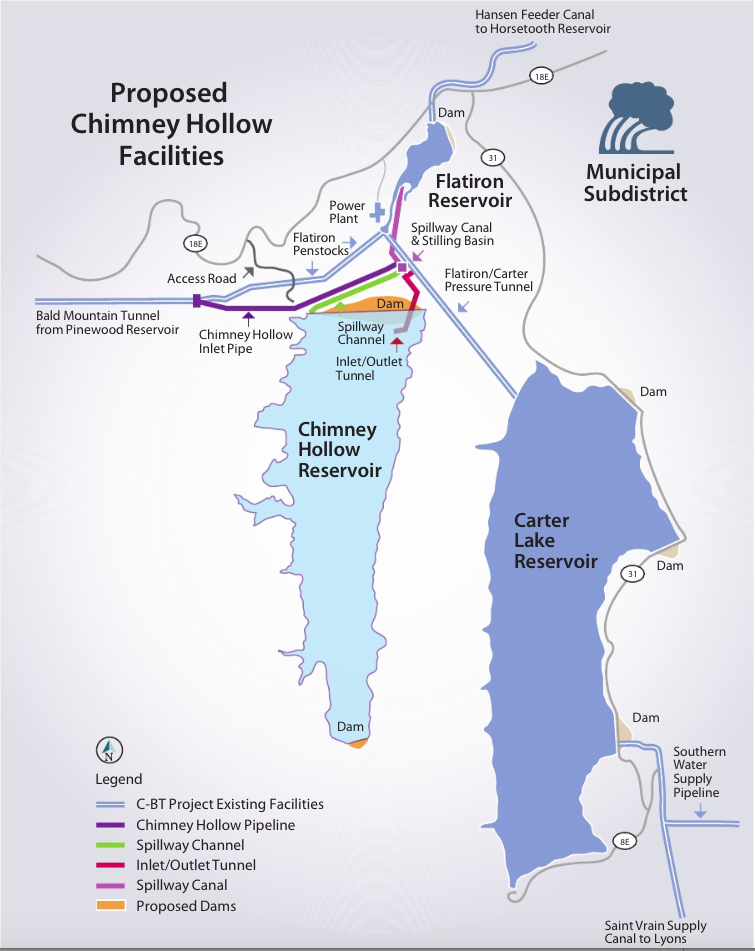
    A potential 170-foot tall dam near Ashcroft on Castle Creek would create a reservoir that holds 9,062 acre-feet of water; a 155-foot dam on Maroon Creek near the Bells would hold 4,567 acre-feet.

    The city applied to Division 5 water court in October to maintain its conditional water rights for the two reservoirs on Maroon and Castle creeks, and is facing opposition from 10 parties, including the U.S. Forest Service and Pitkin County.

    Much of the opposition is because of the locations of the potential dams and reservoirs, both of which would inundate portions of the Maroon Bells-Snowmass Wilderness. Some opposers also are questioning whether the city really needs to store nearly 14,000 acre-feet of water.

    And as the city tries to answer the “how much” question, they’ve also been looking at the “where” and “how” questions.

    A graphic from Wilderness Workshop that shows how the potential Maroon Creek Reservoir would behind a 155-foot-tall dam just below the confluence of East and West Maroon creeks.

    Exploring options

    A study of the idea of storing water in old silver mines around Aspen was also presented at the May 15 work session by another Deere and Ault engineer, Victor deWolfe III.

    He said it likely would be expensive and complicated for the city to use the old mines, especially as it would be difficult to maintain control of the water in the complex maze of old shafts and tunnels.

    The in-situ option, by comparison, sounded more feasible.

    Deere looked at two potential locations for an in-situ reservoir, both on city-owned property, the golf course and the city’s Cozy Point Ranch property at the intersection of Brush Creek Road and Highway 82.

    The Cozy Point has a better combination of gravel and bedrock for an in-situ reservoir than the golf course, Deere said, but most of the focus at the work session was on the golf course site, in part because the city currently delivers water from Castle and Maroon creeks to irrigate the golf course.

    A graphic from a paper authored by Don Deere shows how the walls of an in-situ reservoir are formed. The paper is called 'Gravel Pit Reservoirs, Colorado's Water Storage Solution.'

    A trench, filled in

    Deere told the council a reservoir under the golf course could be built by using a long-armed excavator to dig a 3-foot-wide trench around the course through the estimated 75 feet of gravel and river rock down to a solid layer of bedrock.

    The trench, which would encircle the golf course, would be filled in with a claylike substance (a soil-bentonite mix) that would hold water. Deere said under the right conditions, such a deep trench, sometimes called a slurry wall, can be dug and filled back in with the claylike material at the rate of about 100 feet a day.

    “In a couple of months, on a typical site, I can have a completely lined vessel,” he said.

    City-owned water from Castle and Maroon creeks could then be delivered to new and existing ponds on the golf course and allowed to slowly infiltrate into the spaces between the loose rock left in the vessel.

    If the city needed to during a drought, it could then pump the water from the new underground reservoir to its water treatment-plant located on a hill behind Aspen Valley Hospital. It’s about a mile from the center of the golf course to the treatment plant.

    Water hazards

    Councilwoman Anne Mullins asked Deere if the golf course would look the same after an in-situ reservoir was installed.

    “I think we’d need to add some ponds, so there would be more water hazards when we’re done,” Deere said, but other than that, “it’s out of sight, out of mind.” And he said this week that after revegetation, no one would even know the in-situ reservoir was there.

    As a general rule, Deere said it costs about $10,000 per acre-foot-of water stored to build an in-situ reservoir ­— if favorable soil conditions allow for the standard use of an excavator. But if conditions such as deeper gravel or harder bedrock require a crane and a platform to be used instead, the cost can go up by a multiple of five or six, he said.

    Conceptually then, the construction costs of a 1,200 acre-foot in-situ reservoir could range from $12 million to $72 million, according to Deere.

    “But we haven’t done a site specific cost estimate for the golf course,” Deere said this week.

    He said it would require drilling test holes to know more about the feasibility and potential cost, as it would reveal the true depth of the gravel and the condition of the underlying bedrock.

    In May, city officials told the parties in the water court cases that it expected to finish its study of in-situ storage by July. The next settlement conference in the cases is set for the first week of August.

    Editor’s note: Aspen Journalism is collaborating with The Aspen Times, the Glenwood Springs Post Independent, the Vail Daily and the Summit Daily on the coverage of water and rivers. The Times published this story on Monday, July 3, 2017.

    Update on chatfield storage reallocation project

    Proposed reallocation pool — Graphic/USACE

    From The Denver Post (Joe Rubino):

    After more than a decade of discussion and planning, the Chatfield Storage Reallocation Project is set to begin later this year. The more than two-year construction effort will prepare the reservoir to accommodate an additional 20,600 acre feet of water to meet a variety of municipal, agricultural and industrial needs. Currently, the reservoir holds about 27,000 acre feet of water. Eventually it will hold up to another 20,600 acre feet of water and the the water level could rise as much as 12 vertical feet, officials said.

    Beginning in winter and continuing through spring, the swim beach and north boat ramp will be reconstructed to accommodate the future shoreline. By the end of 2019, many other features of the park, including the marina, day use areas and South Platte bridge will be visited by construction crews and earth movers.

    The park will remain open throughout construction. Higher water levels will change features along the reservoir’s shore…

    The project will cost an estimated $160 million, said Tim Feehan, general manager of the Chatfield Reservoir Mitigation Co., whose eight partners — including Castle Rock, Centennial Water and Sanitation District and the Castle Pines Metropolitan District — will pay that tab in proportion to the amount of water storage each will be granted. Of that, $140 million has already been set aside in escrow.

    Groundbreaking awaits final design approval from the Army Corps of Engineers, which built, owns and leases the reservoir to Colorado Parks and Wildlife for recreational use, Roush said. Preliminary designs and a tentative construction schedule are available online at Chatfieldreallocation.org, a project website created by Chatfield Reservoir Mitigation Co.

    The swim beach is scheduled to close for reconstruction in late fall and reopen for use by Memorial Day weekend 2018. The beach and park perimeter road will be moved to the west, away from the present shoreline, to accommodate greater water fluctuations, effectively creating another 200 feet of beach area at low water. The parking lot will be expanded and the shower, restrooms and other features will be rebuilt. The north boat ramp also is scheduled to reopen to use by next Memorial Day weekend.

    “A lot of the work is going to be done over the wintertime when the visitation is down and when the swim beach is closed and when the boat ramps are closed,” Roush said. “It’s about minimizing the time when the users would not be able to use those areas.”

    Fed. appeals court snarls Trump’s directive to rollback environmental regulations — @HighCountryNews

    Natural gas flares near a community in Colorado. Federal rules aim to lower risks of natural gas development. Photo credit the Environmental Defense Fund.

    From The High Country News (Elizabeth Shogren):

    A federal appeals court today dealt a setback to the Trump administration’s broad effort to rollback environmental regulations. The U.S. Court of Appeals for the District of Columbia Circuit blocked the Environmental Protection Agency’s 90-day delay on an Obama administration rule that requires the oil and gas industry to find and clean up leaks that send methane into the air.

    The decision reinstates the methane rule but will not end its peril. EPA administrator Scott Pruitt last month proposed delaying the rule for two years while his agency goes through the process of permanently rewriting the rule.

    Under the EPA’s Methane rule, the industry had until June 3 to detect leaks on new and modified wells and then 30 days to fix them. Then industry has to detect and repair leaks four times a year.
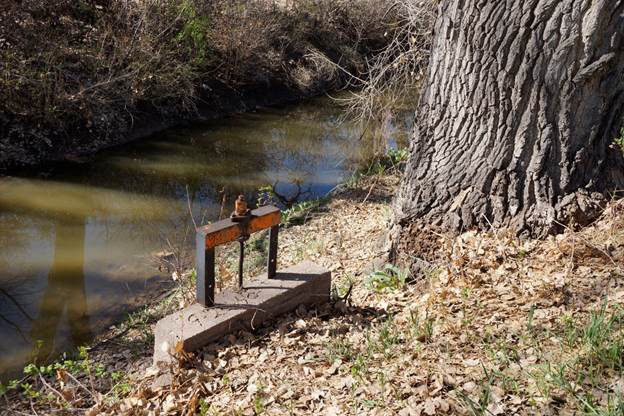
    In general, the Administrative Procedure Act requires agencies to go through a full rule-making process to rescind a rule. That means they have to draft a proposed rule and take public comment before writing a final one. That takes many months. With this and other rules, the Trump administration has tried to temporarily delay them while going through the longer process of erasing them.

    “(The) EPA was basically trying to do an end-run around that,” says David Doniger, a lawyer for Natural Resources Defense Council, who worked on the case. “The agency wanted to do anything in its power to keep industry from having to comply.”

    In response to questions about how the court’s ruling will impact industry’s requirements under this rule and the agency’s strategy to rollback this and other rules, the EPA press office offered only a brief statement: “We are reviewing the opinion and examining our options.”

    Happy Independence Day Our Public Lands! — Greg Hobbs

    Happy Independence Day Our Public Lands!

    Staunton State Park Wildflower Report July 4, 2017

    This slideshow requires JavaScript.

    USAF delivers new carbon filter to Fountain

    Widefield aquifer via the Colorado Water Institute.

    From The Denver Post (Bruce Finley):

    U.S. Air Force contractors on Thursday delivered the first of two $400,000 carbon filters designed to strip away two perfluorinated chemicals contaminating city water supply wells…

    “We’re a public water system making sure we meet the regulations, even the health-advisory level. Our community — this is a priority for them. We’re going to deal with this,” Fountain utilities director Curtis Mitchell said, watching as a crane lowered two 19-foot-tall filtration tanks near a public library.

    “This is a huge step forward,” he said, “because it will give us access to some of our groundwater again.”

    But farmer Susan Gordon and other residents of the Fountain Creek watershed still are raising questions about the human-health impact of exposure through drinking water.

    Gordon for years drank contaminated water from domestic wells and recently received results from a workers comp blood test showing a PFC called PFHxS in her blood at more than 100 times normal level. Three family members and some people who work on the farm with her also had elevated perfluorinated chemicals in their blood.

    While she’s healthy now, “who knows what it could mean 10 years from now?” Gordon said. “Not just me, but lots of people living in these communities have been exposed.”

    […]

    Fountain shifted city supplies to surface water sources after contamination was detected last year at levels above the EPA limit of 70 parts per trillion. But nearly 80,000 people in Fountain, Security and Widefield, as well as other communities south of Colorado Springs, long have relied on groundwater as a primary source of drinking water.

    Water providers in Security have shifted to surface water delivered from a reservoir west of Pueblo along the Arkansas River, and those in Widefield and Stratmoor Hills have put in water-cleaning systems…

    It was unclear whether Fountain’s filters would remove PFHxS. Karl Kuching, business development for the Air Force contractor TIGG, said the filters have proved successful removing some of the PFHxS at a site in Washington state.

    Removing short-chain PFCs may require more frequent changing of the carbon, which is injected into the tops of tanks in a slurry and, when exhausted, drained out the bottoms, he said. Two tanks are used. When system operators detect a contaminant “breakthrough,” one tank still filters out contaminants while carbon in the first tank is replaced…

    Water restrictions last summer reduced water use so that surface water sources met most of the demand. The restrictions might be imposed again after Tuesday, Mitchell said, so untreated well water isn’t tapped.

    @EPA’s methane rule back on — DC Circuit Court

    Natural gas flares near a community in Colorado. Federal rules aim to lower risks of natural gas development. Photo credit the Environmental Defense Fund.

    From The Hill (Timothy Cama):

    The Trump administration cannot delay an Environmental Protection Agency (EPA) rule limiting methane pollution from oil and natural gas drilling, a federal court ruled Monday.

    In an early court loss for President Trump’s aggressive agenda of environmental deregulation, the Court of Appeals for the District of Columbia Circuit said the EPA didn’t meet the requirements for a two-year stay of the Obama administration’s methane rule.

    EPA Administrator Scott Pruitt’s decision to delay enforcement of the provision was based on arguments that when the Obama administration wrote the rule, it violated procedures by not allowing stakeholders to comment on some parts of what became the final regulation. The agency used that reasoning to formally reconsider the rule and to pause enforcement.

    But the court said the argument doesn’t withstand scrutiny.

    “The administrative record thus makes clear that industry groups had ample opportunity to comment on all four issues on which EPA granted reconsideration, and indeed, that in several instances the agency incorporated those comments directly into the final rule,” two of the judges on the three-judge panel wrote.

    “Because it was thus not ‘impracticable’ for industry groups to have raised such objections during the notice and comment period [the Clean Air Act] did not require reconsideration and did not authorize the stay.”

    Environmental groups led by the Environmental Defense Fund had sued the EPA after its delay, asking for quick emergency action from the court on the matter.

    The latest newsletter from the CCWCD is hot off the presses

    Crop circles — irrigated agriculture

    Click here to read the newsletter. Here’s an excerpt:

    109 Wells Added to WAS Plan

    In 2004 and 2005 many WAS contract holders had multiple irrigation wells included in a Substitute Water Supply Plan operated by the Well Augmentation Subdistrict while the Subdistrict worked to obtain a permanent augmentation plan. The permanent plan of augmentation was granted by the Water Court in 2006, however Subdistrict members were notified that WAS was unable to allow them to include more than one well per contract in the decreed plan for augmentation. The deleted wells were placed on a waiting list with every intention to incorporate those back into the decreed augmentation plan as the Subdistrict worked to secure additional augmentation supplies.

    June 21, 2016 , after ten years of development of water supplies the CCWCD Board of Directors voted to direct staff to proceed with the incorporation of the waiting list wells into the WAS augmentation decree. February 28, 2017, the Water Court application to formally add these 109 wells was filed. Statements of opposition to the application were received from City of Sterling, City of Boulder, Centennial Water & Sanitation District, Public Service, The Irrigationists (lower South Platte River water users), Farmers Reservoir & Irrigation Company, South Adams Water & Sanitation District, and Northern Colorado Water Conservancy District.

    In order to allow operation of these wells during the 2017 irrigation season, WAS filed an application seeking temporary approval from the Water Court on March 16, 2017. A few months later on June 29, 2017 the Substitute Water Supply Plan (SWSP) was approved by the State and Division Engineers which authorizes pumping from June 29, 2017 through June 28, 2018. The Central Board and Staff anticipated a more rapid approval for the SWSP, however the City of Sterling provided comments in lieu of the request sought by WAS. Fortunately the State and Division Engineer granted the approval and processed the request with fair reasoning and timely consideration. No additional pumping will be added to the contract holder’s allocation, but they now have the flexibility of pumping from either of their wells on the WAS Contract.