
From Nature Communications (Keith S. Jennings, Taylor S. Winchell, Ben Livneh & Noah P. Molotch):
Abstract
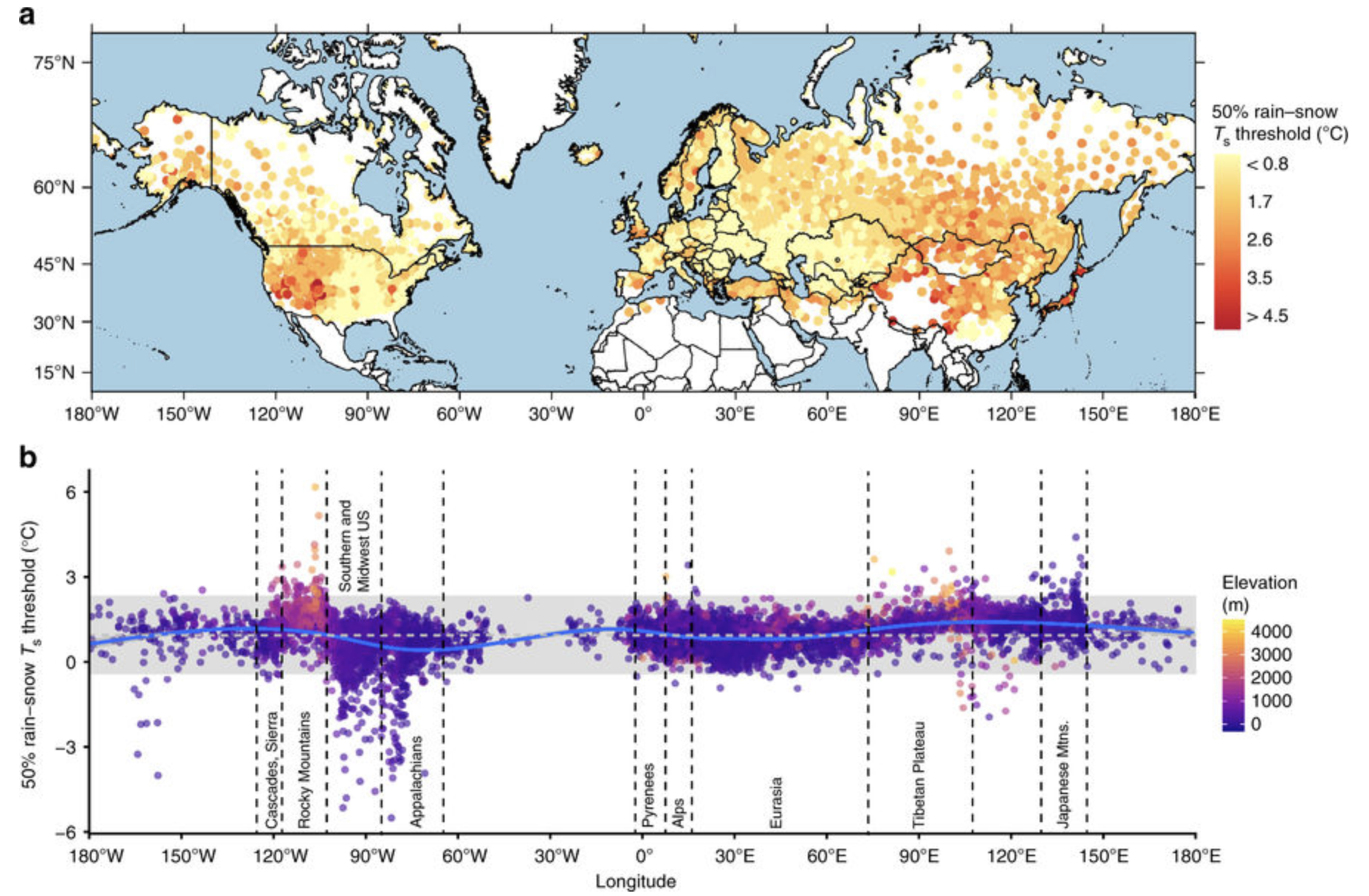
Despite the importance of precipitation phase to global hydroclimate simulations, many land surface models use spatially uniform air temperature thresholds to partition rain and snow. Here we show, through the analysis of a 29-year observational dataset (n = 17.8 million), that the air temperature at which rain and snow fall in equal frequency varies significantly across the Northern Hemisphere, averaging 1.0 °C and ranging from –0.4 to 2.4 °C for 95% of the stations. Continental climates generally exhibit the warmest rain–snow thresholds and maritime the coolest. Simulations show precipitation phase methods incorporating humidity perform better than air temperature-only methods, particularly at relative humidity values below saturation and air temperatures between 0.6 and 3.4 °C. We also present the first continuous Northern Hemisphere map of rain–snow thresholds, underlining the spatial variability of precipitation phase partitioning. These results suggest precipitation phase could be better predicted using humidity and air temperature in large-scale land surface model runs.
From 9News.com (Cory Reppenhagen):
“One of the big surprises was that zero degrees Celsius or 32 Fahrenheit was not a very good predictor at all of the rain-snow transition temperature, and actually that transition almost always occurs at a much warmer temperature: 1 degree Celsius, as high as almost 4 degrees Celsius depending on where you are,” said Ben Livneh, an assistant professor in CU Boulder’s Department of Civil, Environmental and Architectural Engineering and a co-author of the study.
For snow to form naturally in a cloud, the temperature must be 32 degrees Fahrenheit or lower, but the atmospheric conditions can vary greatly as that snow falls to the ground. The key for that snowflake remaining a snowflake is very low relative humidity.
“You’re giving the snowflake more of an opportunity to cool itself as it falls through the atmosphere, like on a warm day you’re body sweats to cool itself, and it’s more efficient if you’re in a drier place like Colorado,” Jennings said.
It’s a process called evaporative cooling. Ski area’s use this knowledge to create snow early in the season when the air temperature is above freezing, but the relative humidity is still very low.
“We’ve sort of synthesized the state of the science in a way that extends what the ski areas have kind of known for a long time, and we’ve kind of brought it to the scientific community,” said Livneh.