Colorado River Dry Delta, terminus of the Colorado River in the Sonoran Desert of Baja California and Sonora, Mexico, ending about 5 miles north of the Sea of Cortez (Gulf of California). Date: 12 January 2009. Photographer: Pete McBride, U.S. Geological Survey
More than a century ago, the river’s delta spread across 1.9 million acres of wetlands and forests. The conservationist Aldo Leopold, who canoed through the delta in 1922, described it as “a hundred green lagoons” and said he paddled through waters “of a deep emerald hue.” He described it as an oasis that teemed with fish, birds, beavers, deer and jaguars. In the years after his visit, the river was dammed and its waters were sent flowing in canals to farms and cities…
A Vermilion Flycatcher along the Laguna Grande Restauration Site in Baja California, Mexico. Photo: Claudio Contreras Koob
Restauremos El Colorado manages one of three habitat restoration areas in the delta, where native trees that were planted six years ago have grown into a forest that drapes the wetland in shade. Last spring, a stream of water was released from a canal and flowed into the wetland, restoring a stretch of river where previously there had been miles of desert sand. The water was released for a second straight year as part of an agreement between the Mexican and U.S. governments and with support from environmental groups…After the pulses of water, De la Parra and his colleagues have seen vegetation flourish along the river channel. Biologists have counted about 120 species of birds. And motion-activated wildlife cameras have captured images of beavers swimming and gnawing on tree trunks. De la Parra and others say the efforts in the delta have been a resounding success, showing that even small amounts of water can be used to revive ecosystems that were largely destroyed decades ago. De la Parra said he believes it’s crucial that the restoration work continue. But although the conservation groups have water rights to maintain some wetlands, the river’s decline poses challenges for their efforts…
The river’s crisis also presents a pivotal moment for farms and cities to adapt, De la Parra said.
“I’m hoping that we can really understand that crisis is not something that we ought to waste,” he said. “We need to use it to thrust ourselves into a different model.”
For cities, De la Parra said, that means initiatives such as recycling wastewater, capturing stormwater and probably investing in building a new desalination plant in Baja California.
For farmers, he said, there are opportunities to save water by installing efficient irrigation systems and moving away from thirsty crops like alfalfa to ones that use less water.
“It is a water revolution that needs to happen,” De la Parra said.
The CharBoss made its initial debut in Bandon, Oregon in the fall of 2020 by tackling Gorse, an invasive woody shrub, and demonstrating how this technology can be used to also improve wildlife habitat. The CharBoss team recorded the demonstration and it is available online. Photo credit: USFS
Click the link to read the article on the USFS website:
Forest management activities create valuable wood products like lumber, but can also generate woody residues with little or no economic value. This waste material is generally burnt or must be hauled away to reduce wildfire risk. The USDA Forest Service and a private company, Air Burners Inc., teamed up to help find a solution to this problem. CharBoss is a mobile machine that converts waste-wood products into biochar, a nutrient-rich product that can be used for soil restoration or to enhance agricultural land.
Debbie Page-Dumroese is a researcher with the USDA Forest Service Rocky Mountain Research Station who helped develop and patent the technology and is a leading expert in the use of biochar. She shared her excitement in the latest developments, “The ability to process woody residues on-site reduces open burning or the need to transport materials off-site, so there is less smoke and air pollution. Even better, we can create this terrific product that can be used to restore damaged soil.”
The CharBoss made its initial debut in Bandon, Oregon in the fall of 2020 by tackling Gorse, an invasive woody shrub, and demonstrating how this technology can be used to also improve wildlife habitat. The CharBoss team recorded the demonstration and it is available online.
Seeing an opportunity to make improvements, the team re-engineered the CharBoss to be more efficient and increase its production volume. The updated CharBoss is being transported from Florida to Idaho this week and when it arrives, the University of Idaho and Rocky Mountain Research Station will host a demonstration for interested land managers and researchers. The event is scheduled to take place at the University of Idaho Experimental Forest near Princeton, Idaho Friday afternoon January 13, 2023. This time it will be chewing up slash created by forest thinning and fuel reduction and turning it into “black gold” – biochar, that is.
Science suggests that biochar can increase seedling quality and enhance degraded soils with its rich carbon content and moisture retention properties. Land managers can use the CharBoss to create biochar on-site without worrying about the logistics of off-site production and transportation. Mobile processing can also help rural economies by providing local materials and jobs for forest restoration or reclaiming abandoned mine sites.
Jim Archuleta is a Forest Service regional biomass coordinator who helped pioneer the innovation of CharBoss. He talks about its potential for mitigating climate change by reducing unnecessary smoke and emissions and returning carbon to soils and vegetation at larger landscape scales, “Making biochar production part and parcel of normal Forest Service activities is the best way to make the seismic changes needed to help adapt to our changing climate.”
CharBoss will be demoed at various workshops across the western United States and Pacific Northwest regions, traveling from Idaho to Montana, Oregon and beyond. It will be moving to a site on the Flathead National Forest next. You can learn more about the technology behind CharBoss here.
After reevaluating an original layout for a new water treatment plant for over a year, Westminster City Council approved general plans for a new plant on Jan 23 – one that will cost $100 million less than originally planned…
According to Stephanie Bleiker, capital projects administrator, the improved plant will use existing infrastructure, can treat wildfire-contaminated water, is flexible for future replacement and has robust infrastructure. It’s estimated to cost $196 million, plus an additional $15 million for ozonation, though it may cost more with inflation. Ozonation is a process that injects pure oxygen into the water to kill a wide range of biological contaminants and to oxidize metals. The budget is supported by the current water rate structure, she said…
Concerns over water affordability stopped the project on Nov. 29, 2021. Over the past year, the plant’s capacity, locations and other supporting infrastructure have all been re-evaluated. That resulted in a call for less water treatment capacity at the new plant, from 60 million gallons of demand per day to 44 million. The location remained on Westminster Boulevard. Much of that lower demand is due to conservation measures for commercial and residential zones, said Bleiker…
Right now, Semper doesn’t have the ability to do ozonation, to handle solids easily, to do deep bed filtration or mechanical flocculation – a water treatment process where solids form larger clusters that are easier to filter out – or to treat emerging contaminants, such as so-called forever chemicals or PFAs. The new treatment plant would be able to do these things. Treating emerging contaminants comes down to having the space that will be provided with the new plant, she said. Bleiker mentioned some contaminants are known today, but more will come in the future that are not known. She said it’s the decision of the EPA and CDPHE to decide what’s regulated, and it’s not optional for the city to comply.
Thankfully, researchers, governments and everyday people around the world are putting more effort and money into conservation and restoration every year. But the task is large. How do you plant a billion trees? How do you restore thousands of square miles of wetlands? How do you turn a barren ocean floor back into a thriving reef? In some cases, the answer lies with certain plants or animals – called ecosystem engineers – that can kick-start the healing.
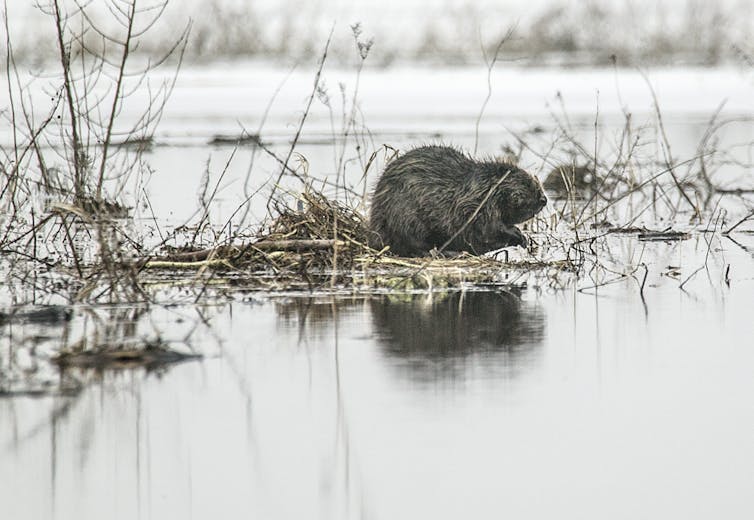
Ecosystem engineers are plants or animals that create, modify or maintain habitats. As Joshua Larsen, an associate professor at the University of Birmingham, explains, beavers are a perfect example of an ecosystem engineer because of the dams and ponds they build.
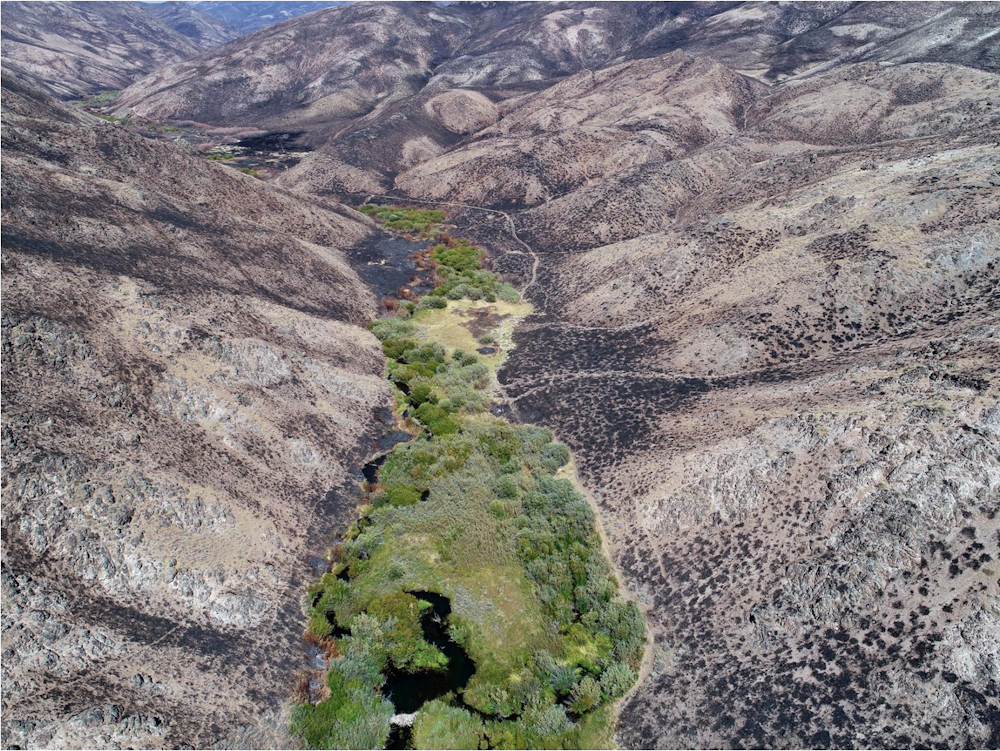
“They create this pocket of still water, which allows aquatic vegetation to start to colonize that wouldn’t otherwise be there,” says Larsen. Once a beaver establishes a pond, the surrounding area begins to change from a creek or river into a wetland.
Larsen is part of an effort to reintroduce beavers into Britain, a place where they have been extinct for over 500 years and the landscape reflects that loss. There used to be hundreds of thousands of beavers – and hundreds of thousands of beaver ponds – all across Britain. Without beavers, it would be prohibitively difficult to restore wetlands at that scale. But, as Larsen explains, “Beavers are doing this engineering of the landscape for free. And more importantly, they’re doing the maintenance for free.”
This idea of using ecosystem engineers to do the labor-intensive work of restoration for free is not limited to beavers. Dominic McAfee is a researcher at the University of Adelaide in Australia. He studies oysters and is leading a project to restore oyster reefs on the eastern and southern coasts of Australia.
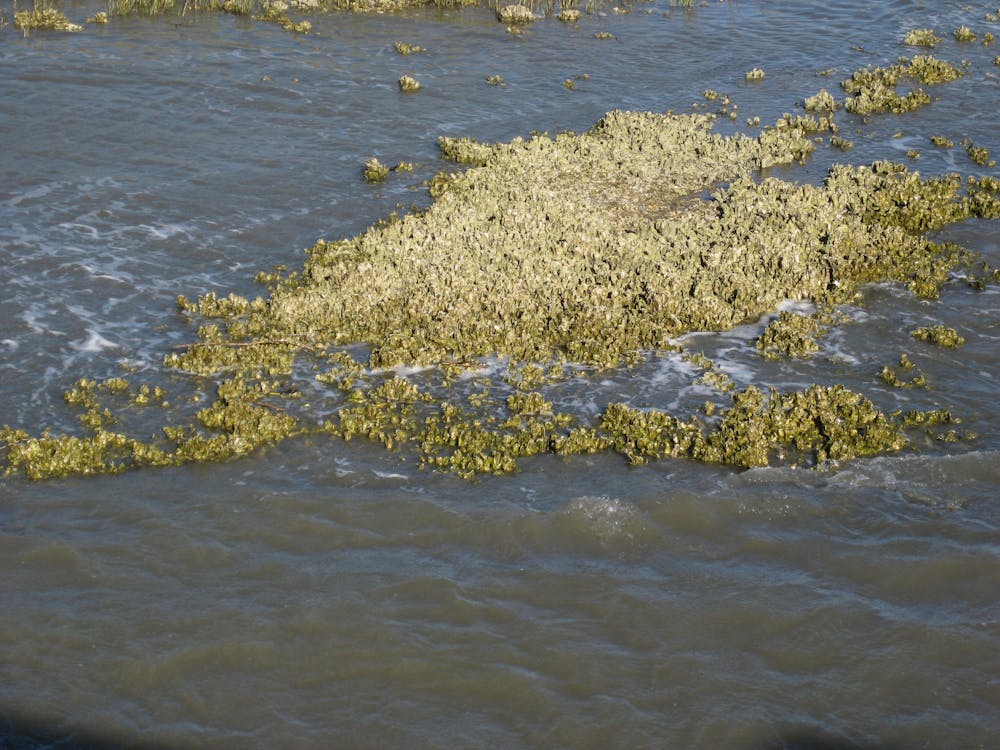
Oyster reefs provide important structure that supports entire ecosystems. Jstuby/Wikimedia Commons
“These reefs were the primary sort of marine habitat in coasts, coastal bays and estuaries over about 7,000 kilometers (4,350 miles) of Australian coastline,” says McAfee. But today, “They’re all gone. All those reefs were scraped from the seafloor over the last 200 years.”
When you lose the oysters, you lose the entire reef ecosystem they support. So, a few years ago, McAfee and his colleagues decided to start bringing these reefs back. Oysters need a hard surface – like a rock, or historically, other oysters – to grow on. But all those old oyster reefs are gone and only sand remains. “So the first step to restore oysters is to provide those hard foundations. We’ve been doing that in South Australia by deploying limestone boulders,” explains McAfee. After just a year, McAfee and his colleagues are starting to see results, with millions of oyster larva sticking to these boulders.
At this point, McAfee says that challenges are less about the science and more about getting community and political support. And that is where Andrew Kliskey comes in. Kliskey is a professor of community and landscape resilience at the University of Idaho in the U.S. He approaches restoration and conservation projects by looking at what are called social-ecological systems. As Kliskey explains, “That means looking at environmental issues not just from a single disciplinary point of view, but thinking that many things are often occurring in a town and in a community. Really, social-ecological systems means thinking about people and the landscape as being intertwined and how one interacts with the other.”
For scientists, this type of approach involves sociology, economics, indigenous knowledge and listening to communities that they are working with. Kliskey explains that it’s not always easy: “Doing this sort transdisciplinary work means being prepared to be uncomfortable. Maybe you’re trained as a hydrologist and you have to work with an economist. Or you work in a university and you want to work with people in a community with very real issues, that speak a different language and who have very different cultural norms. That can be uncomfortable.”
Having done this work for years, Kliskey has found that building trust is critical to any project and that the communities have a lot to teach researchers. “If you’re a scientist, it doesn’t matter which community you work with, you have to be prepared to listen.”
This episode was produced by Katie Flood and Daniel Merino, with sound design by Eloise Stevens. It was written by Katie Flood and Daniel Merino. Mend Mariwany is the show’s executive producer. Our theme music is by Neeta Sarl.
Honeybees, which pollinate one-third of the crops Americans eat, face many threats, including infectious diseases. On Jan. 4, 2023, a Georgia biotechnology company called Dalan Animal Health announced that it had received a conditional license from the U.S. Department of Agriculture for a vaccine designed to protect honeybees against American foulbrood, a highly destructive infection.
To receive a conditional license, which usually lasts for one year and is subject to further evaluation by the USDA, veterinary biological products must be shown to be pure, safe and reasonably likely to be effective. Dr. Jennie Durant, an agriculture researcher at the University of California, Davis, who specializes in honeybee health, explains why this vaccine is potentially an important step in ongoing efforts to protect pollinators.
1. What threat does this vaccine address?
The new bee vaccine, Paenibacillus Larvae Bacterin, aims to protect honeybees from American foulbrood. This highly destructive bacterial disease gets its name from the foul scent honeybee larvae exude when infected.
An outbreak of American foulbrood is effectively a death sentence for a bee colony and can economically devastate a beekeeping operation. The spores from the bacteria, Paenibacillus larvae, are highly transmissible and can remain virulent for decades after infection. https://www.youtube.com/embed/VENKKufzMAE?wmode=transparent&start=0 How American foulbrood affects honeybee colonies.
Once an outbreak occurs, beekeepers typically have to destroy any bee colonies that they know were infected to avoid spreading the disease. They also have to destroy the hive boxes the colonies were stored in and any equipment that may have touched infected colonies.
Beekeepers have used antibiotics preventively for decades to keep foulbrood in check and treat infected colonies. Often they mix the antibiotics with powdered sugar and sprinkle it inside the colony box. As often happens when antibiotics are overused, scientists and beekeepers are seeing antibiotic resistance and negative impacts on hive health, such as disruption of the helpful microbes that live in bees’ guts.
2. How effectively does the vaccine prevent infection?
Studies are still analyzing its effectiveness. One published study demonstrated a 30% to 50% increase in resistance to American foulbrood in a vaccinated queen’s offspring.
While this might seem low, it’s important to put the results in context. Given how deadly and contagious American foulbrood is, researchers did not want to directly expose an outdoor hive to foulbrood with an unproven vaccine. Instead, they conducted lab studies where they exposed test hives to around 1,000 times the number of American foulbrood spores a colony would typically be exposed to in the field. Dalan, the manufacturer, has field trials planned for 2023.
3. How do you vaccinate honeybees?
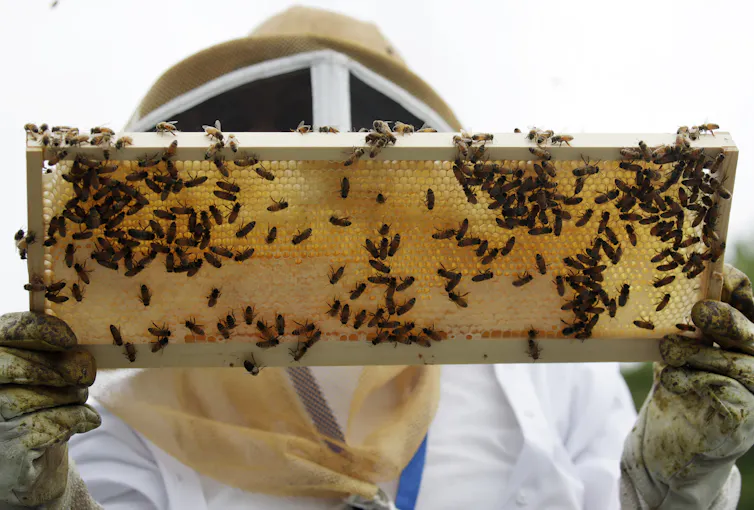
It’s not done with tiny needles – beekeepers mix the vaccine into bee food. This approach exposes queen bees to inactive Paenibacillus larvae bacteria, which helps larvae hatched in the hive to resist infection.
This is not a mRNA vaccine, like the Pfizer and Moderna COVID vaccines. It’s a more traditional inactive vaccine like the one we use against polio. To understand how the vaccine works, it’s helpful to know what queen bees eat: a protein-rich substance called “royal jelly” that is secreted from glands on the heads of young worker bees.
When queen bees are shipped to a beekeeper, they are typically placed in a small cage with 50 to 200 worker bees that have been fed something called queen candy. This substance is often made with powdered sugar and corn syrup and has the consistency of sugar cookie dough or modeling clay. Worker bees consume the candy, produce royal jelly and feed it to the queen.
The vaccine’s delivery method uses this unique system. A beekeeper can mix the vaccine with the queen candy, which is then digested by worker bees. They produce royal jelly and feed it to the queen, who digests it and then transfers the vaccine to her ovaries. Once she is transferred to the hive and begins laying eggs, the larvae that hatch from those eggs have a heightened immunity to American foulbrood. https://www.youtube.com/embed/PcDF23HdlUY?wmode=transparent&start=0 The new vaccine takes advantage of the queen’s central role in the hive.
4. Who will use the vaccine?
According to representatives at Dalan, limited quantities of the vaccine should be available starting in spring 2023 to commercial beekeepers and bee producers, with the aim of supplying smaller-scale beekeepers and hobbyists in the future.
5. How long will a dose last?
Dalan is still researching the specifics. Its current understanding is that it will last as long as the queen bee can lay eggs. If she dies, is killed or is replaced, the beekeeper will have to purchase a new vaccinated queen.
6. Is this a big scientific advance?
Yes – it is the first vaccine for any insect in the U.S. and could help pave the way for new vaccines to treat other issues that have plagued the beekeeping industry for decades. Honeybees face many urgent threats, including Varroa mites, climate change and poor nutrition, which makes this vaccine an exciting new development.
Dalan is also working on a vaccine to protect bees against European foulbrood. This disease is less fatal than American foulbrood, but is still highly infectious. Beekeepers have been able to treat it with antibiotics but, as with American foulbrood, they are seeing signs of resistance.



,_Narew_River,_Poland.jpg#/media/File:Castor_fiber_04(js),_Narew_River,_Poland.jpg)

