
Conservation Organizations Emphasize Need to Protect Environmental Priorities in #ColoradoRiver Basin — Audubon #COriver #aridification

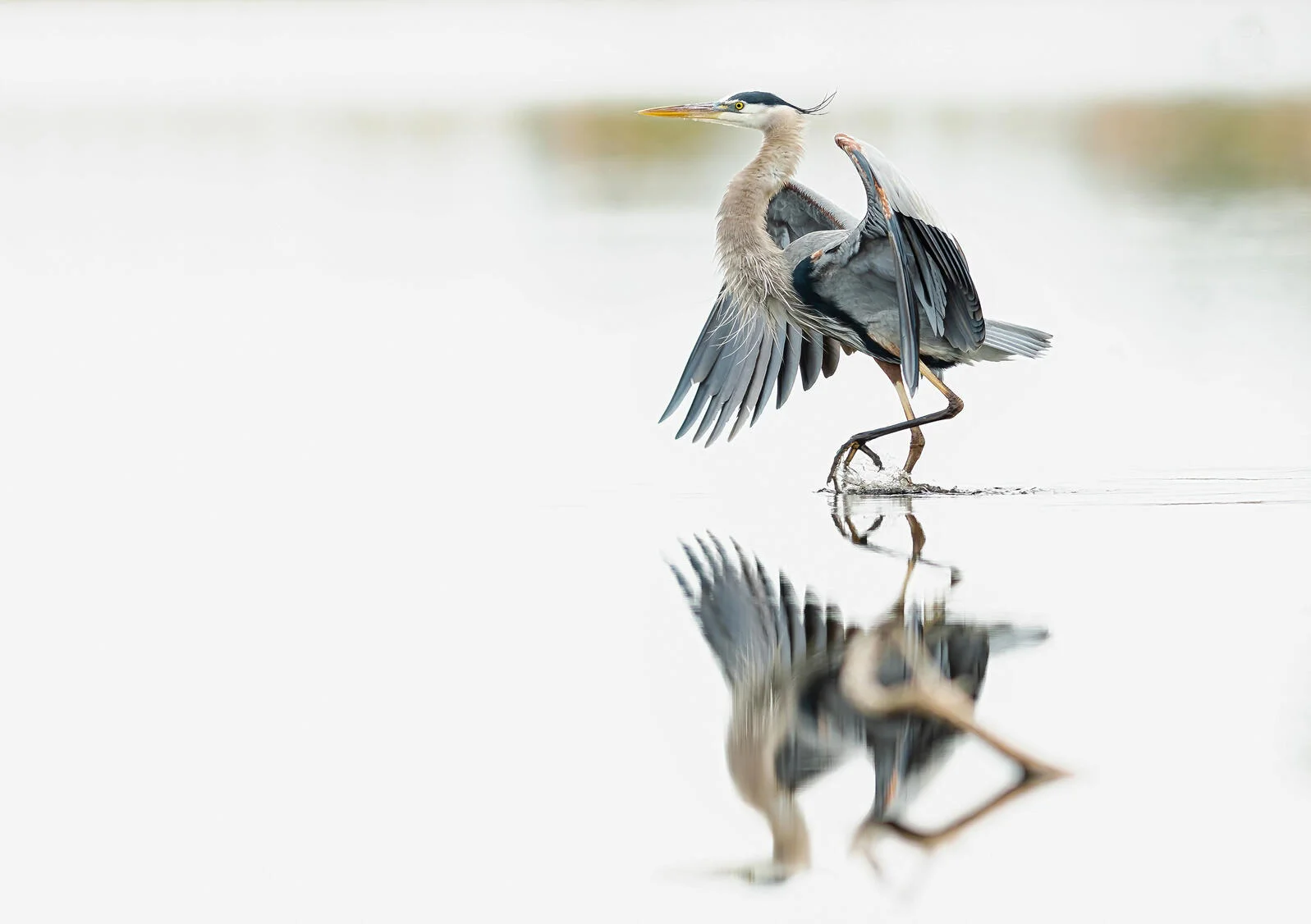
Great Blue Heron. Photo: Patricia Kappmeyer/Audubon Photography Awards

Click the link to read the release on the Audubon website:

Several conservation organizations today [February 2, 2023] urge Colorado River Basin decision-makers to protect critical environmental priorities as they wrestle with Basin management decisions being made over the next several months. The groups warn that ignoring these priorities risks further damage to the Basin’s environment and natural heritage, the foundation of the iconic Colorado River system. 

The U.S. Bureau of Reclamation is pursuing a supplemental Environmental Impact Statement (SEIS) process to evaluate the need to partially modify operating criteria for primary Colorado River reservoirs given extreme drought conditions and historically low reservoir levels at Lake Powell and Lake Mead.

While the groups are encouraged to see six of the Basin states put forward a “consensus based modeling alternative” for Reclamation to consider in the SEIS process, the groups seek to ensure that critical environmental concerns are considered in any operational actions that Reclamation models and evaluates.

As the Colorado River community considers operational changes, seven conservation organizations identify five (5) environmental priorities that are most directly linked to or implicated by the SEIS process, which is expected to be completed in the summer of 2023:

  • Investing federal funds in watershed health, long term resilience, and agricultural innovation in the Upper Basin tributaries with high fish and wildlife and recreational value;
  • Preserving the Endangered Fish Recovery Programs in the Upper Basin and the Lower Colorado River Multi-Species Conservation Program;
  • Safeguarding the integrity of the Grand Canyon ecosystem and recreational values;
  • Restoring wetlands at the Salton Sea to minimize toxic dust and benefit bird habitat along the Pacific Flyway;
  • Forestalling the loss and continuing restoration of the Colorado River Delta.

“We highlight these particular priorities because, for the Colorado River community, they are closely tied to the continued integrity of the Colorado River Basin and are potentially most affected by the current SEIS process,” said Jennifer Pitt, Colorado River Program Director for National Audubon Society. “In the face of a hotter, drier climate, the Colorado River—and all of the living things depending on it—require that we stay focused on these priorities.”

“Whatever options Reclamation ultimately considers as part of the SEIS process, these environmental priorities cannot be lost in the mix or sacrificed in the name of a crisis, or we risk making the entire situation worse,” said Christy Plumer, chief conservation officer for Theodore Roosevelt Conservation Partnership.

“These and related priorities are essential to the continued sustainability of the Colorado River system.  Failing to consider them when making basin management decisions would undermine the ecological health of the Colorado River Basin, adding more potential for controversy in a Basin that needs to move forward—urgently—with consensus efforts to reduce water demand and restore the health of the watershed,” said Sara Porterfield, western water policy advisor for Trout Unlimited. 

“Our groups have worked hard over the last decade to find environmental solutions that also benefit water users. We want to ensure those hard-won solutions and benefits aren’t sacrificed because of interstate disputes over water allocations,” said Taylor Hawes, director of the Colorado River Program at The Nature Conservancy. “We know the Basin’s stakeholders are facing difficult decisions with dropping reservoir levels, drier soils, hotter temperatures, and that adjustments are needed now to deal with those issues in both the Upper and Lower Basins. Nevertheless, we don’t want to lose sight of the risks to the extraordinary natural heritage of the Colorado River,” Hawes added.

“We stand ready to work with Basin states, Tribes, water users, and the federal government to ensure that the SEIS process is sufficiently transparent, efficient, and comprehensive,” said Kevin Moran, associate vice president of regional affairs for Environmental Defense Fund.
As #ClimateChange and overuse shrink #LakePowell, the emergent landscape is coming back to life – and posing new challenges #ColoradoRiver #COriver #aridification

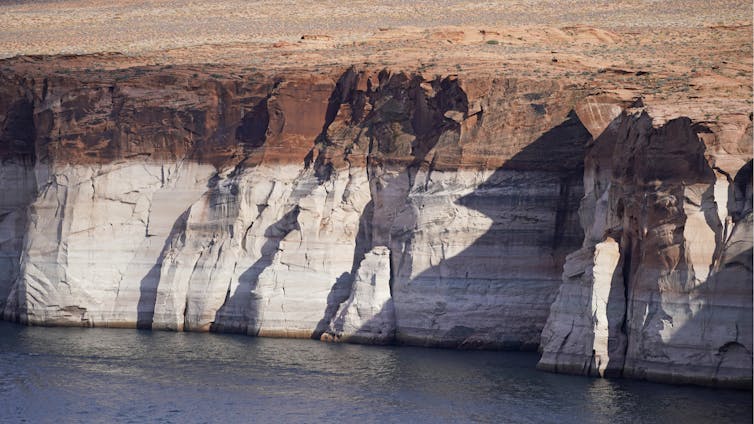
The white ‘bathtub ring’ around Lake Powell, which is roughly 110 feet high, shows the former high water mark. AP Photo/Rick Bowmer

Daniel Craig McCool, University of Utah

As Western states haggle over reducing water use because of declining flows in the Colorado River Basin, a more hopeful drama is playing out in Glen Canyon.

Lake Powell, the second-largest U.S. reservoir, extends from northern Arizona into southern Utah. A critical water source for seven Colorado River Basin states, it has shrunk dramatically over the past 40 years.

An ongoing 22-year megadrought has lowered the water level to just 22.6% of “full pool,” and that trend is expected to continue. Federal officials assert that there are no plans to drain Lake Powell, but overuse and climate change are draining it anyway.

As the water drops, Glen Canyon – one of the most scenic areas in the U.S. West – is reappearing.

This landscape, which includes the Colorado River’s main channel and about 100 side canyons, was flooded starting in the mid-1960s with the completion of Glen Canyon Dam in northern Arizona. The area’s stunning beauty and unique features have led observers to call it “America’s lost national park.”

Lake Powell’s decline offers an unprecedented opportunity to recover the unique landscape at Glen Canyon. But managing this emergent landscape also presents serious political and environmental challenges. In my view, government agencies should start planning for them now.

Department of Interior funds 5 tribal #water rights settlements in #Arizona — The Arizona Mirror

From the 2018 Tribal Water Study, this graphic shows the location of the 29 federally-recognized tribes in the Colorado River Basin. Map credit: USBR

by Shondiin Silversmith, Arizona Mirror
February 10, 2023

Several tribal nations will start seeing some funding as part of their water rights settlements, as the U.S. Department of the Interior has allocated nearly $580 million to start fulfilling Indian water rights claims. 

“Water is a sacred resource, and water rights are crucial to ensuring the health, safety, and empowerment of Tribal communities,” Secretary Deb Haaland said. “Through this funding, the Interior Department will continue to uphold our trust responsibilities and ensure that Tribal communities receive the water resources they have long been promised.”

Five tribes in Arizona will receive more than $306 million in funding from the settlement: the Ak-Chin Indian Community, Gila River Indian Community, Navajo Nation, San Carlos Apache Tribe and Tohono O’odham Nation.

The money will help each tribe develop infrastructure projects that will fulfill the terms of their water rights settlements.

“I am grateful that Tribes, some of whom have been waiting for this funding for decades, are finally getting the resources they are owed with the help of this crucial funding from President Biden’s Bipartisan Infrastructure Law,” Haaland said.

Part of the funding comes from the Bipartisan Infrastructure Law’s Indian Water Rights Settlement Completion Fund, where nearly $460 million will be applied to settlements enacted before Nov. 15, 2021. 

An additional $120 million has been allocated from the Reclamation Water Settlement Fund, a fund created by Congress in 2009 that receives $120 million in mandatory funding annually from 2020 through 2029. 

Together, both funds allocated nearly $580 million to fulfill 14 tribal water settlement claims from 12 tribal nations.

“The federal government’s trust responsibility to Native communities includes providing Tribes with access to clean, reliable water,” said U.S. Sen. Brian Schatz, D-Hawaii, the chairman of the United States Senate Committee on Indian Affairs. 

Schatz said the Department of Interior’s funding announcement shows leaders following through on the work legislatures did to” pass and fund Indian water rights settlements to ensure water security for Tribes and surrounding communities.”

There are 34 congressionally enacted Indian Water Rights settlements as of Nov. 15, 2021, when the Bipartisan Infrastructure Law was signed, which included $2.5 billion to implement the Indian Water Rights Settlement Completion Fund. 

The Department of Interior stated that it will help deliver long-promised water resources to Tribes, certainty to all their non-Native neighbors, and a solid foundation for future economic development for entire communities dependent on common water resources.

“As a champion of the Bipartisan Infrastructure Law in the House, I’m excited to see this significant investment in Arizona’s Tribal communities,” U.S. Rep. Ruban Gallego said in a statement.

Gallego, a Phoenix Democrat, said that Arizona is experiencing the devastating impacts of a 1,200-year drought, but the funding will go a long way to help secure Arizona’s water which ensures a sustainable water future and follows through on tribal water settlements.

Indian reserved water rights are vested property rights for which the United States has a trust responsibility, according to the department. The federal policy supports the resolution of disputes regarding Indian water rights through negotiated settlements. 

For Arizona, this funding supports five specific settlements:

  • $22,000,000: Ak-Chin Indian Water Rights Settlement Operations, Maintenance & Replacement
  • $18,225,000: AZ Water Settlements Act Implementation – San Carlos Irrigation Project Rehabilitation
  • $79,000,000: Gila River Indian Community – Pima Maricopa Irrigation Project
  • $1,500,000: San Carlos Apache Tribe Distribution System
  • $8,000,000: So. Arizona Water Rights Settlement – Farm Extension

The Navajo Nation is included in these settlements, and their funding will support projects they have established in the New Mexico and Utah portions of their tribal land. The settlements include:

  • $2,000,000: Navajo-Gallup Water Supply Operations, Maintenance & Replacement   
  • $137,000,000: Navajo-Gallup Water Supply Project 
  • $39,114,000: Navajo-Utah Water Settlement