
Click the link to read the article on The Durango Herald website (Reuben Schafir). Here’s an excerpt:
The Southwestern Water Conservation District held its 39th annual seminar Friday [March 31, 2023] in Ignacio to address the topic of “seeking common ground in crisis.”
About 300 people were in attendance, including both chairmen of the Southern Ute and Ute Mountain Ute Indian tribes, ranchers, farmers and officials from agencies involved in water conservation at the federal level all the way down to local districts. U.S. Rep. Lauren Boebert was a surprise guest…The event’s schedule included panels on reusing treated wastewater, seeking common ground in the distribution of the river’s resources, and the connection been food and water for agricultural producers on the Western Slope, Front Range, and the upper and lower Colorado River Basin…From the Front Range farmers, like panelist Robert Sakata, the owner of a 2,400-acre farm nestled in the expanding urban boundaries of Brighton, to lower basin users such as panelist Bart Fisher, a farmer and former chairman of the Colorado River Board of California, the impacts of the historic drought are top of mind. The need to reduce water use has affected what they grow as well as the quantity…
“Buy-and-dry” programs have become a tense topic of conversation among farmers. The concept is to reduce water consumption by paying farmers annually for water to which they have a right but do not use. Although this can be done in any number of ways, the program’s epithet refers to the common method of fallowing – or intentionally not cultivating – land. Despite protections that ensure unused water rights will not be forfeited, as is historically the case, farmers are skeptical. From a financial perspective, the incentive is small. The upper basin program offers only $150 to farmers per acre-foot of water saved (an acre-foot is the amount needed to submerge an acre of land in 1 foot of water), while farmers can typically harness far more in profits from that water if they use it for irrigation.
“When you diminish agriculture significantly by fallowing, you diminish the economic engine of the community that supports agriculture,” Fisher said…

Simon Martinez, the general manager of Ute Mountain Ute Farm and Ranch, said he is more interested in testing out water-efficient crops…Like many farmers looking to save water, the Ute Mountain Ute Farm and Ranch is experimenting with Kernza. The wheatgrass variant can significantly reduce water consumption compared to a crop such as alfalfa…Martinez hopes to test the new grain as potential cattle feed and intends on sowing 46 acres with the seed, likely this spring. Although the concept is experimental – Martinez said the crop has not been grown in the region and its exact efficacy as a cattle feed is unclear – success could mean a significant water savings for the farm. In addition to reducing the amount of water needed to irrigate, which Martinez estimated could near 50% compared to alfalfa, grazing the farm’s herd on Kernza would increase profits by enabling the farm to sell more of the alfalfa that it does produce. The perennial grain has grown in popularity as its viability as an alternative crop becomes increasingly intriguing to farmers. The outdoor brand Patagonia adopted it into the company’s line of sustainable foods and now produces pasta and beer with the grain. Martinez said he is unsure of how the experiment will go. But to test out the grain on 46 acres of the 7,700-acre farm is a small sacrifice…
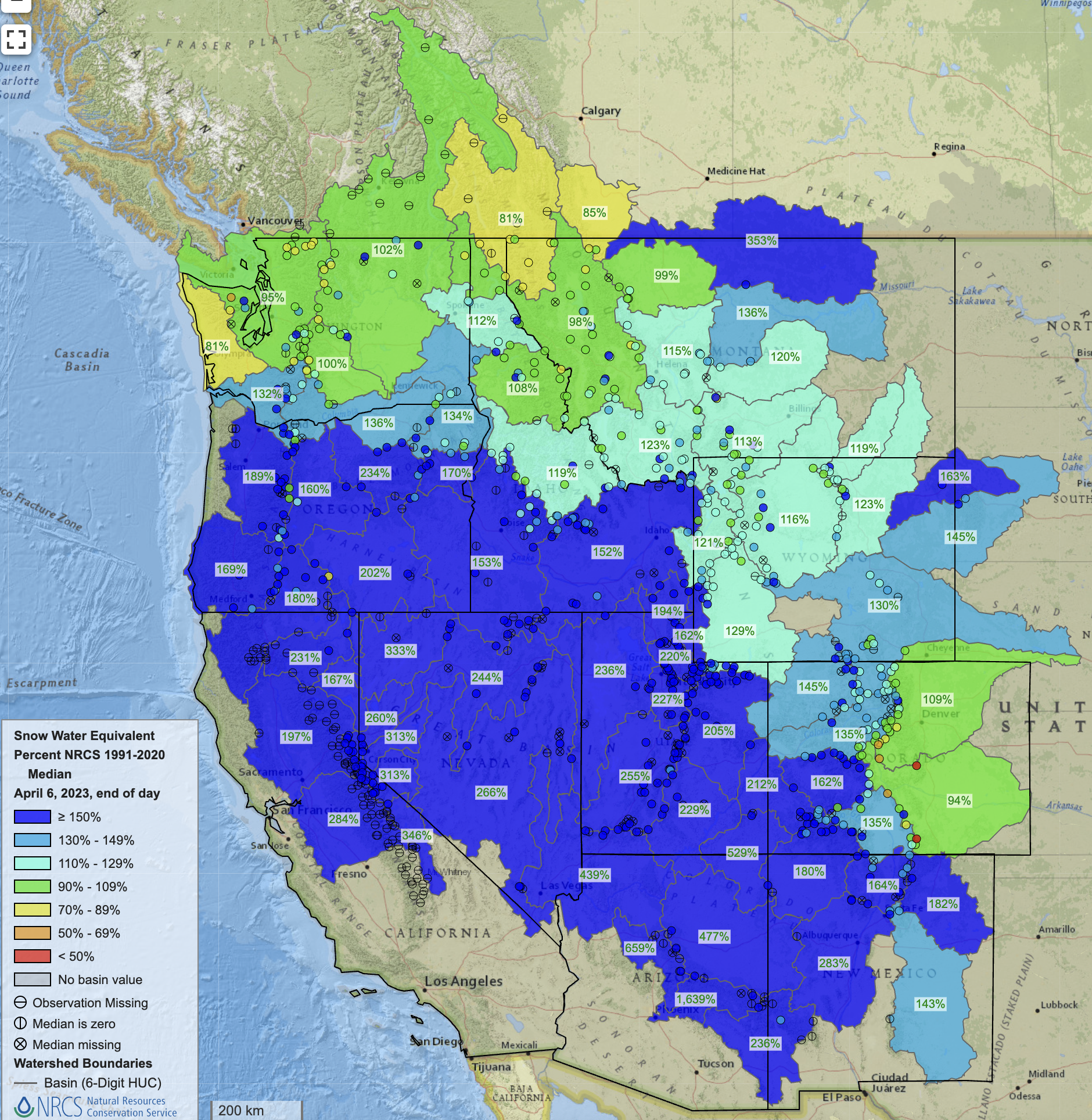
With future weather predictions becoming increasingly unpredictable, farmers are endorsing an array of solutions. Although this year’s ample snowfall does little to reverse the long-term impacts of the historic drought, water aficionados in the Four Corners are nonetheless grateful for the supply.