

Click the link to access the paper on the AGU website (Benjamin Bass, Naomi Goldenson, Stefan Rahimi, Alex Hall). Here’s the abstract, key points, and plain language summary:
Abstract
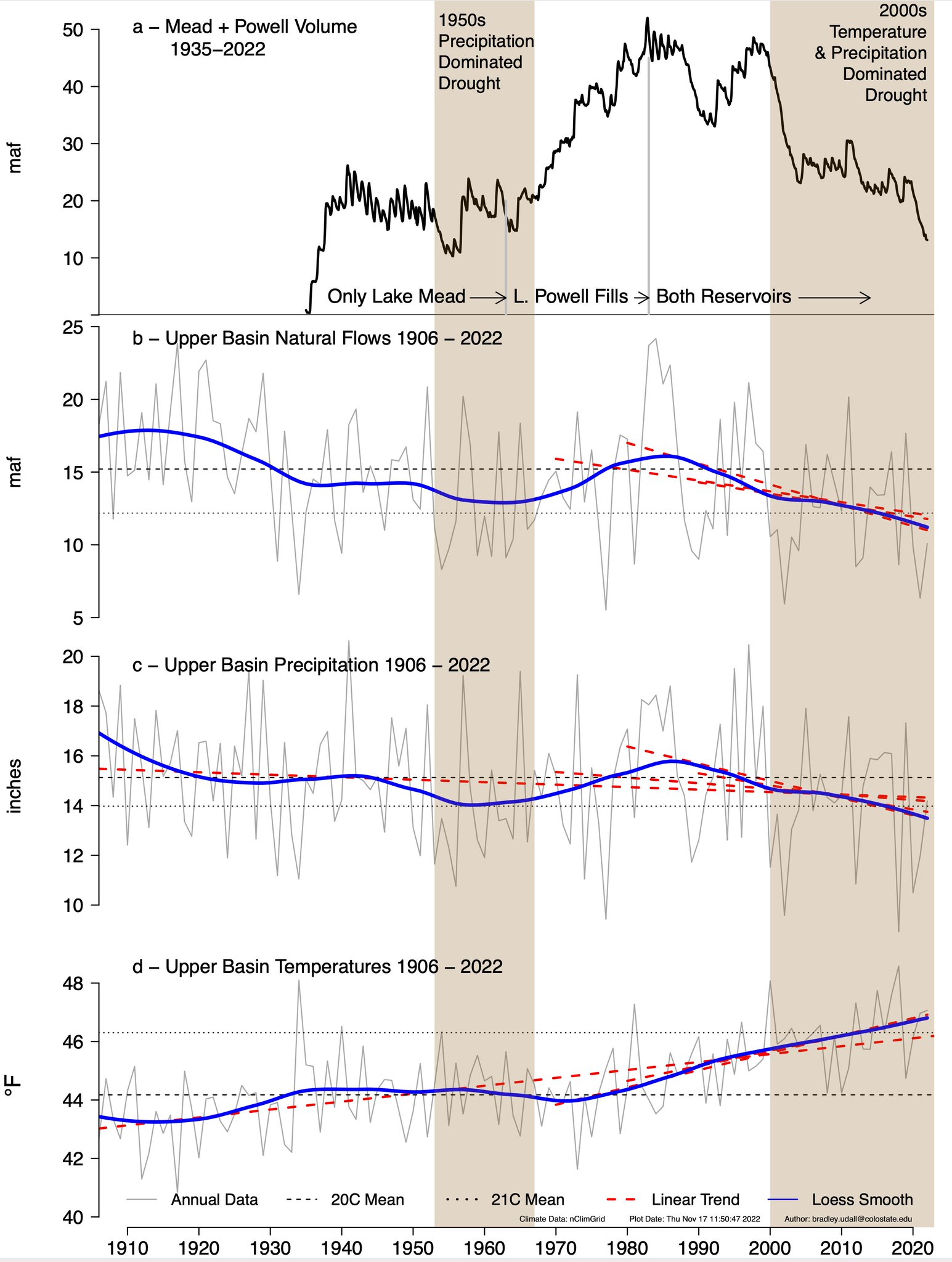
The Colorado River Basin is an important natural resource for the semi-arid southwestern United States (US), where it provides water to more than 40 million people. While nearly 1.5°C of anthropogenic warming has occurred across this region from the 1880s to 2021, climate models show little agreement in the precipitation change during the same historical period, with no trend in the mean of the latest (sixth) generation of Global Climate Models. As such, here we focus on how the CO2 increase and associated anthropogenic warming over the historical period has impacted runoff across the Colorado Basin. We find that the Colorado Basin’s runoff over the historical period has decreased by 8.1% per degree Celsius of warming (°C−1). However, the magnitude of this sensitivity is reduced to 6.8% °C−1 when considering vegetation response to historical CO2. For present-day conditions, this translates to runoff reductions of 10.3% due to anthropogenic increases in both temperature and CO2 since 1880. We demonstrate that Colorado Basin’s natural flow has been decreased by roughly the storage of Lake Mead during the 2000–2021 megadrought due to this long term anthropogenic influence, suggesting the basin’s first shortage in 2021 would likely not have occurred without anthropogenic warming. We further show warming has led to disproportionate aridification in snowpack regions, causing runoff to decline at double the rate relative to non-snowpack regions. Thus, despite only making up ∼30% of the basin’s drainage area, 86% of runoff decreases in the Colorado Basin is driven by water loss in snowpack regions.
Key Points
- A 10.3% reduction in Colorado Basin’s present-day natural flow exists due to anthropogenic warming despite vegetation response to CO2
- Anthropogenic warming reduced Colorado Basin’s natural flow by roughly the storage of Lake Mead during the ongoing megadrought (2000–2021)
- Greater aridification in snowpack regions is causing water losses to occur roughly twice as fast compared to non-snowpack regions
Plain Language Summary
The Colorado River Basin provides a crucial source of water for an expansive water-limited region covering the southwestern US and its major cities. Several studies have demonstrated that this basin has experienced substantial reductions in water availability due to warming. Here, we quantify how reductions in water availability have varied from 1954 to 2021 across this basin due to human-driven warming that has occurred since 1880. As a part of this analysis, we include how the vegetation response to historical increases in CO2 has impacted water losses. We find that the basin has roughly 10% less water available under present-day conditions due to warming since the 1880s. The majority of water loss has occurred due to a heightened sensitivity to warming in the basin’s regions associated with snowpack, compared to regions without snowpack. We also demonstrate that without this warming, the Colorado Basin would have had significantly larger amounts of water available, equal to the size of Lake Mead, over the duration of the 2000–2021 megadrought.
