From Coors to Leprino, #Colorado companies dial down water use as water shortages loom — Fresh Water News

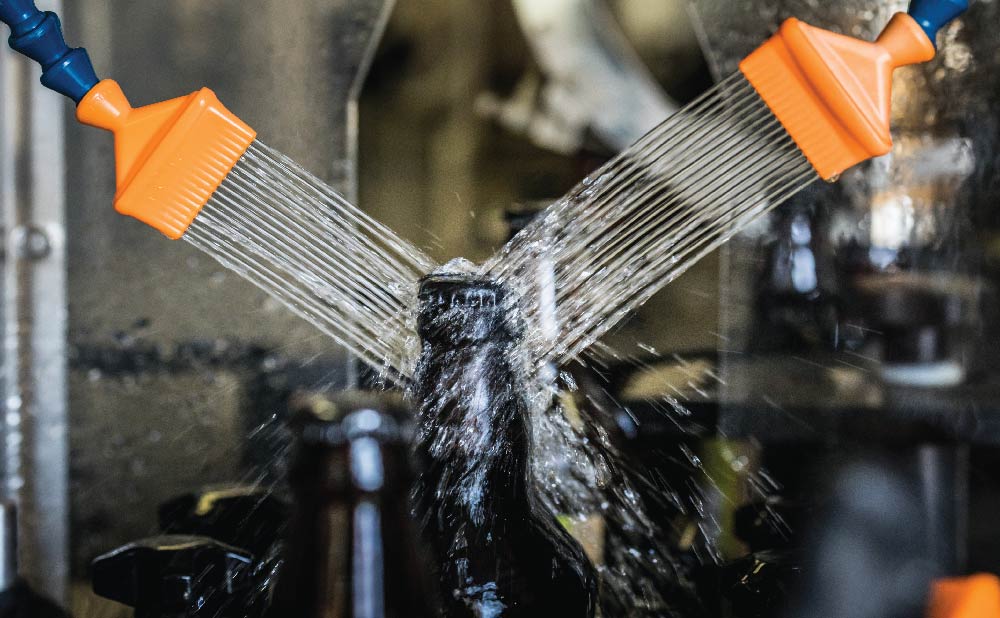
Beer bottles are washed on a conveyor belt in a microbrewery. Less water used in the cleaning process is one way factories are trying to increase water savings. Photo by AETB

Click the link to read the article on the Water Education Colorado website (Emily Payne):

September 5, 2024

Denver-based Leprino Foods Company generates some of its own water. In fact, the company holds a water right for water developed at its Greeley manufacturing facility.

“We actually are contributing more water to the river than we take in from our municipal source,” says Erik Nielsen, associate general counsel at Leprino Foods, which is the world’s largest producer of mozzarella cheese and a global producer of whey protein and other dairy ingredients.

Leprino has been a net contributor to Colorado watersheds since at least 2017. In 2020, the company was granted a water right associated with the quantity of water that it conveys to the Poudre River after deducting the amount of water that it takes in from municipal sources.

Milk is about 87% water. The process of evaporating or concentrating milk products produces condensate of whey water. Leprino recovers this water and stores it on-site in silos, often reusing it multiple times. Later, it is cleaned to stream quality standards and discharged. This, in addition to other water efficiency and recovery projects, generates about 600 acre-feet per year, or enough water to supply around 1,000 homes for a year. Leprino licenses most of this byproduct water to the City of Greeley for municipal uses, says Nielsen.

These water-saving processes not only reduce the company’s environmental footprint but are also critical to Leprino’s manufacturing future in Colorado.

“It seems like you shouldn’t be doing business in Colorado if you’re not thinking really deeply about water,” says Nielsen. “You’ve probably heard the saying, you never think about the value of water until the well runs dry.”

Water is required for cooling, heating, washing, diluting and other processes at nearly 6,000 manufacturing facilities in Colorado. As historic droughts threaten water availability across the state, consumers increasingly demand water-smart practices, and inflation continues to squeeze the private sector, many manufacturers are shifting their approach to water use and conservation.

“Manufacturers are increasingly becoming good stewards of water,” says JC Ye, corporate business director of water reuse at Veolia, a global water services company. “Many have a strong incentive to implement water stewardship practices and invest in improving the reliability of water supply. In most industrial processes, disruption of water availability has an immediate, acute impact on manufacturing operations.”

But water is highly contextual. Every river and stream has a unique ecosystem and different needs depending on the season. Solutions to protect and restore these resources are just as complex. Companies are taking a variety of approaches to water stewardship, from investing millions in local conservation work to making small but impactful infrastructure upgrades.

Leprino Foods processing facility. Photo Courtesy Leprino Foods

A reputational imperative

The original Coors brewery was built in Golden specifically for Clear Creek’s remarkable water quality. The company has a history of conducting projects aimed at protecting this water, which ends up in its product. As a founding member of the Clear Creek Watershed Foundation, the Molson Coors Beverage Company has helped to clean up some of the estimated 1,600 orphaned mines in the watershed, which threaten water quality by overflowing and discharging heavy metals and mine drainage into the river.

These days, water stewardship is about both public perception and product quality: Consumer-facing brands like Coors know that they face a reputational risk if they don’t invest in water-use reduction and watershed protection.

“[People] need to have confidence that we are serious about our water use, that we’re serious about protecting the watershed,” says Ben Moline, director of water resources and environmental policy for Molson Coors Beverage Company.

The entire state of Colorado has experienced severe to extreme drought on and off for more than two decades. The public is watching water use more closely as resource scarcity becomes a more serious concern. Recently, some communities have pushed back against water consumption for manufacturing.

BlueTriton — the owner of major U.S. bottled water brands, including Poland Spring — has been embroiled in legal battles with water boards, environmentalists, and other activists across the country for years. The company pumps water from Colorado’s Upper Arkansas River Basin, a semi-arid region particularly impacted by historic drought. In July 2021, about 20 community members protested outside of the Chaffee County Courthouse, opposing the renewal of a permit that allows BlueTriton to export 65 million gallons of water per year. After negotiating more than $1.25 million in community contributions from BlueTriton, county commissioners approved the permit the following month.

Veolia found in a 2023 study that fewer than 30% of surveyed companies had set water conservation goals, with water lagging behind carbon and waste as the environmental priority for companies. But Ye notes a recent shift in the way companies approach sustainability. Water scarcity concerns, public pressure, reputational risk, and cost-saving opportunities are leading to the proliferation of water initiatives across the private sector.

Michael Kiparsky, founding director of the Wheeler Water Institute at the University of California Berkeley School of Law, sees this as an opportunity: “Can we use transparency coupled with some degree of public awareness of water as a resource to put pressure on corporate entities to do something that might not be strictly in their economic interest otherwise?”

Small changes, big impact

The Coors brewery in Golden uses an estimated 2.7 billion gallons of water from Clear Creek each year: about 782 million gallons for its products, and 2 billion gallons for brewing processes, including production and malting. Of those 2 billion gallons of process water, 95% is cleaned and returned to Clear Creek.

This is representative of manufacturers at large: According to the Colorado Water Plan, industrial users account for only 3% of Colorado’s total annual water consumption, or water that is permanently removed from its source.

“We are diversion heavy, but depletion light,” says Moline, noting that Molson Coors is actively working to bring its water consumption rate even lower, while continuing to work with the Colorado Department of Public Health and Environment (CDPHE) to ensure wastewater discharged back to Clear Creek after treatment meets permit requirements.

Molson Coors treats wastewater from its operations as well as much of the City of Golden’s wastewater. The company entered into a consent order with CDPHE earlier this year to address permit exceedences for total suspended solids, metals, oil and grease, and whole effluent toxicity in its discharge water. Even before the consent order, the brewery began upgrading its wastewater treatment plant in preparation for meeting tightening water quality limits. Water treatment improvements are big changes with big impact, but small infrastructure changes also lead to big results — for example, fermentation tank design.

A few times per month, depending on the type of beer, the brewing team empties each fermentation tank through a valve on its side, leaving a small amount of beer just below the valve’s opening. The team clears the excess beer and thoroughly cleans the floor of the tank to prepare for the next batch, using water and a squeegee multiple times over. Across more than 100 fermentation tanks of varying sizes, which produce approximately 9.7 million barrels of beer per year, a portion of beer is lost in the cleaning process.

Molson Coors Beverage Company is updating its fermentation tanks to a new, vertical design with a cone-shaped bottom, through which a valve completely empties the beer directly below the tank. Now, the brewery can produce the same number of barrels for less, because beer — and water — isn’t left on the tank floor. This means less water used for malting, heating and cooling beer that ultimately doesn’t make it to consumers, and less water used in the cleaning process.

The upgrades are a part of Molson Coors Beverage Company’s G150 project, in honor of the 150-year anniversary of the Coors brewery’s inception. The company has invested “several hundred million dollars” in the project, which is expected to save 80 million gallons of water annually after its completion by the end of 2024. Moline says that upgrading its fermentation tanks is contributing a large part of these water savings.

Other food and beverage manufacturers are updating infrastructure to save water: Swire Coca-Cola, which produces, sells, and distributes Coca-Cola and other beverages in 13 states across the American West, says that it installed a new filtration and recovery system at its Denver plant to reduce water usage by about 20%. And Bellvue-based Morning Fresh Dairy, a fifth-generation dairy farm that produces the nationally popular Noosa Yogurt brand, installed an automated clean-in-place system to clean the interior of food and beverage process pipes, reducing water consumption by 30%.

Corporate mandates

PepsiCo, Amazon, Google and Facebook have all committed to being water-positive, or replenishing more water than they use from natural systems, by 2030. In addition to water-efficiency projects, much of this work is done through cross-sector partnerships, which have provided critical support to local water stewardship efforts.

“Corporate support has been very important to our ability to staff project work and, even more so, to purchase water for streamflow restoration,” says Kate Ryan, executive director of the Colorado Water Trust.

For example, the tech giant Intel relies on the Colorado River and the Rio Grande to supply water downstream to its Arizona and New Mexico manufacturing facilities. The company has partnered with the Colorado Water Trust and Trout Unlimited on multiple projects to support the Colorado River watershed. Intel reports that 120% of the water it used across the U.S. in 2023 was either returned to the source or restored through investment in water stewardship projects.

The Colorado Water Trust has received more than $421,000 in corporate funding from companies like Intel, Coca-Cola, MCBC, Seltzer, and Niagara Cares, a philanthropic arm of Niagara Water, since 2019. This money, in addition to foundation funding, individual contributions, and water donations, has enabled the organization to lease well over 10,000 acre-feet of water, which would typically cost $400,000 to $2,500,000, depending on the water right, says Ryan. The projects improved flows on the 15-Mile Reach of the Colorado River — a critical stretch of river for endangered fish species near Grand Junction, Colorado — as well as on the Yampa River and tributaries to the Fraser River.

And while BlueTriton has received pushback from community members on its water use, the company has partnered with Colorado Parks and Wildlife to dedicate a conservation easement to preserve 122 acres of wildlife habitat and protect groundwater resources along the Arkansas River.

“These sustainability programs work well, and Western rivers would benefit from more of them,” says Ryan. “The amount of water they have made possible for streamflow restoration in recent years is significant.”

But experts agree that the pathway to meet water-positive goals, or even water-neutral goals, is not straightforward.

Context is key

A Colorado Water Trust project benefits the Little Cimarron River using a senior water right that keeps productive land irrigated in a split-season arrangement, where water is applied to fields in the first part of the season, then left in the river during later summer months when fish need it most. The trust also partners with corporations, such as Coca Cola, to secure funding for water conservation work. Courtesy Colorado Water Trust

“Being ‘water neutral’ in an honest way requires a great amount of thought and engagement with people who have direct interest or represent the interest of the communities and environment that might be affected,” says Kiparsky.

In 2023, the nonprofit Ceres published a benchmark analysis of 72 companies from four water-intensive industries — apparel, beverage, food, and high-tech — and found that only 35% consider contextual factors such as local watershed conditions, regulatory dynamics, and community water needs when assessing water use risks. Only 14% consider contextual factors when assessing water quality risks.

“[We] found that while many companies are setting goals aimed at using less water, most are not setting strong targets to reduce water pollution,” says Kirsten James, senior program director for water at Ceres. “We also noted a lack of commitment around protecting freshwater ecosystems and clean water supplies for communities.”

Where and when water is replenished makes a significant difference for water systems. Simply measuring the amount of water a company uses and returns to its source each year, for example, does not account for when that water was used or returned. If most water is pumped during the summer and returned during the winter, these activities could still be disruptive to wildlife, ecosystems, and overall river flow rates.

“Unlike in sustainability efforts involving carbon offsets, there is no single atmosphere to improve. Every river has different needs at different times of the year,” says Ryan.

Implementation of corporate water goals requires detailed reporting and independent validation to ensure the efforts are sustaining or restoring and not damaging ecosystems.

“It’s a simple concept, becoming water neutral, but putting it in practice is not simple,” says Kiparsky. “A lot of the implications are going to rely on analysis by third parties that are experts in understanding water impact.”

This year, the U.S. Securities and Exchange Commission (SEC) began requiring most public companies to disclose climate-related information, including water-related financial risks, so investors can consider how companies are managing climate risks when making investment decisions. James says this is an important step that will help raise the bar with U.S. companies on water-related disclosures.

“As water risk continues to escalate, investors and companies need full transparency to be able to manage and adapt to these threats,” says James.
What tribal leaders think about Interior’s dams report: The federal government has acknowledged the harms of #ColumbiaRiver dams. Now what? — @HighCountryNews

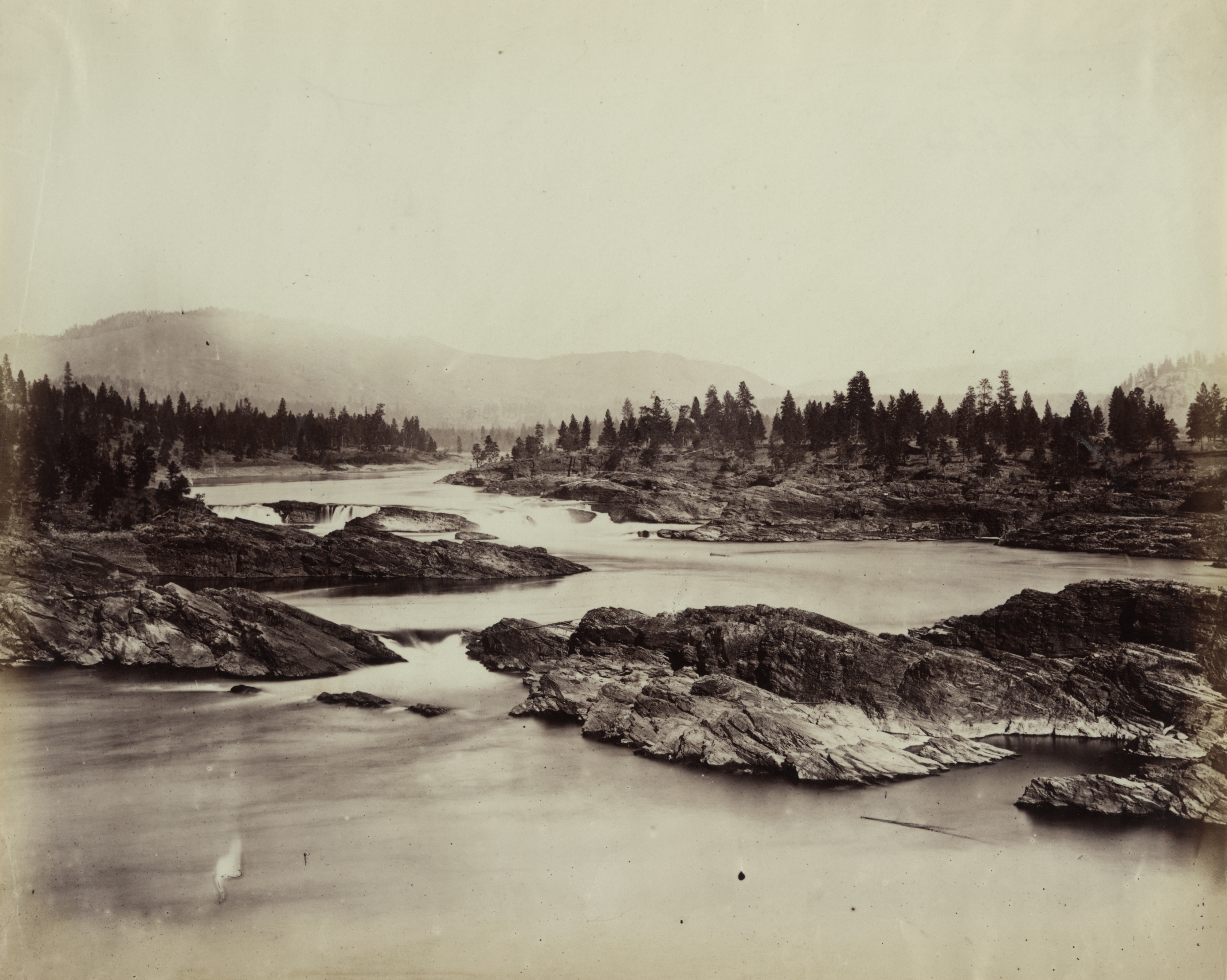
Kettle Falls in 1860. By Unknown author – Library of Congress archives at http://hdl.loc.gov/loc.pnp/ppmsca.03399, Public Domain, https://commons.wikimedia.org/w/index.php?curid=3923552

Click the link to read the article on the High Country News website (B. ‘Toastie’ Oaster):

September 1, 2024

There was a time you could catch tons of salmon in a single day at Kettle Falls, a series of pools cascading into each other on the Columbia River in northern Washington. That was before the U.S. government built Grand Coulee Dam in 1942. After 82 years, in June of this year, the Department of Interior published Historic and Ongoing Impacts of Federal Dams on the Columbia River Basin Tribesan analysis that explores how 11 hydropower dams on the mainstem Columbia, Snake and North Fork Clearwater rivers have hurt Indigenous economies, cultures, spiritual practices, environments and healthThose historic and ongoing harms include the destruction of important cultural sites like Kettle, as well as Celilo Falls, another ancient fishery that was also a magnificent international marketplace. Dams are also famously driving the basin’s salmon stocks toward extinction. “Of sixteen once existing salmonid stocks, four have been extirpated — Mid-Columbia River Coho, Mid-Columbia River Sockeye, Upper Columbia River Coho, and Snake River Coho,” the report reads. All but five of the remaining stocks are now endangered or threatened. 

Indigenous people have long known about the damage dams cause, but to hear the federal government admit it is another thing. HCN spoke to Shannon Wheeler, chair of the Nez Perce Tribe; Phil Rigdon, superintendent of the Natural Resources Department at the Confederated Tribes and Bands of the Yakama Nation; and Corinne Sams, who’s on the board of trustees for the Confederated Tribes of the Umatilla Indian Reservation and is also chair of the Umatilla Fish and Wildlife Commission and the tribal nation’s representative at the Columbia River Inter-Tribal Fish Commission. Here’s what they have to say about Interior’s report.

These conversations have been edited for brevity and clarity.

High Country News: What was tribal involvement in creating the Interior Department’s report?

Shannon Wheeler: We are the ones that submitted (it) to them. We had already completed this in the 1990s. We revamped it and gave them the newest version over the past eight months, and that’s what they have been working (from).

Corinne Sams: We’ve always been heavily engaged with the Department of Interior, along with the recent Columbia Basin Restoration Initiative, which is now being called the Resilient Columbia Basin Agreement, with the United States government. That was solidified in January of this year. Over the last three years, Umatilla Tribe and our staff have worked vigorously to ensure that the United States government understands the impacts and the losses that have occurred to salmon and other anadromous fish within the Columbia and Snake Basin. So we’ve played an enormous role.

Phil Rigdon: The Department of Interior came, and we did a consultation with the federal government on (the report). Our leadership expressed concerns (about) the impacts that the dams have had on our salmon, lamprey, sturgeon and fish species, but also the knowledge of our connection to the Columbia River. Our lives have changed forever, ever since those (dams) were in. But we continue to advocate and go fish and continue to practice our culture and our way of life. This report comes out in a manner that highlights a lot of broken promises to our people, but we continue to push and advocate on behalf of resources that we hope will be returned back to the levels they should be

HCN: Is there anything you think the report gets wrong or leaves out?

SW: No.

CS: No. This is the first time the federal government has ever recognized the true impacts to our people and to our ecosystem in regard to hydro systems, so we’re very optimistic and encourage individuals to read the report, to become informed. Because our ultimate goal is to decarbonize and replace the energy sector, which will eventually, hopefully, replace those hydro systems. We recognize that this isn’t only about fish. We have several other interests in the basin: transportation, recreation, irrigation. All of those components are important, and we don’t want to leave one out. We’re really pushing for everybody within the basin to remain whole. 

PR: These reports are important. But sometimes (it’s) tough to understand the heart of it. Our people are still down (there) fishing right now. Our people continue to carry our way. But the report is an important step into highlighting those things that we consider problematic over the history of the dams.

HCN: What kinds of federal actions do you want to see based on this report?

SW: Consideration for breaching of the four Lower Snake River dams.

CS: There’s a billion-dollar backlog on infrastructure and hatchery maintenance, and we utilize those hatcheries as mitigation fish, for the loss of the abundant natural runs. But our ultimate goal is to get our natural runs back to healthy and harvestable levels. We’ve done a significant amount of work and have been co-managing these resources (with government agencies) for decades, but the tribes have been managing these resources for millennia. This isn’t just a tribal effort. This is for all Americans that live within the basin.

PR: There’s Bateman Island Causeway down at the mouth of the Yakima (River) that causes the thermal block that causes enormous problems for juvenile and adult fish migration up to the Yakima Basin. The small things really need to be invested in and done now. Some of these things that have been a problem for a long time are critical. And then to look at the big things, like the Lower Snake River dams, and really come up with solutions. But we also believe it can’t be like it was for us. We can’t leave people behind in the manner that we were left behind, putting the dams in for the energy development. There is a balance here that needs to be achieved through what these reports do, but also what we’re trying to do as a people.

HCN: Do you think any federal action hinges on Democrats winning the upcoming presidential election?

SW: Tribal nations across the country have all had impacts one way or another regardless of what type of administration is in. But I also believe that this administration understands that there’s impacts that the United States has had on its people.

CS: Absolutely. If we see a shift in administration, all of these agreements, all of these reports, become uncertain.

PR: I think it’s not important. Republicans fish, and Democrats fish, too. We need to come together to find solutions. I don’t think we should make it all dependent on who wins an election, but we should be thinking about how we solve long-term problems. The polarization that you see is sad, in a lot of ways, because I don’t think we’re getting to the right conversations. I don’t think we want to go political. I have red-state Republicans advocating for our work in the Yakima. That’s unique because of our partnerships, but also how we’re trying to build trust within our local communities. We’re from rural communities, rural America, tribal people. Sometimes we’re less concerned about the politics. We’re thankful for the Biden administration and the leadership they’re showing in doing these studies. I don’t want to discount that at all. But we want to make sure it’s not dependent upon who gets elected, but that we continue moving forward as a people.

Native salmon fishermen at Celilo Falls. Russell Lee, September 1941. By Russell Lee – This image is available from the United States Library of Congress’s Prints and Photographs divisionunder the digital ID fsa.8c22374.This tag does not indicate the copyright status of the attached work. A normal copyright tag is still required. See Commons:Licensing., Public Domain, https://commons.wikimedia.org/w/index.php?curid=3923525

HCN: Do you think there’s a path here to bringing back Celilo Falls?

CS: When they inundated Celilo Falls, several years after that they did sonograms. And they say the falls are still under there. I think deep in our hearts we always hope to see the return of that fishery, that place. Our ancestors and our old people talk about just the sound alone, the sound of those falls. They miss that sound. 

PR: I would love to see that. I don’t want to get our hopes up, either.    

We welcome reader letters. Email High Country News at editor@hcn.org or submit a letter to the editor. See our letters to the editor policy.

This article appeared in the September 2024 print edition of the magazine with the headline “What tribal leaders think about Interior’s dams report.”

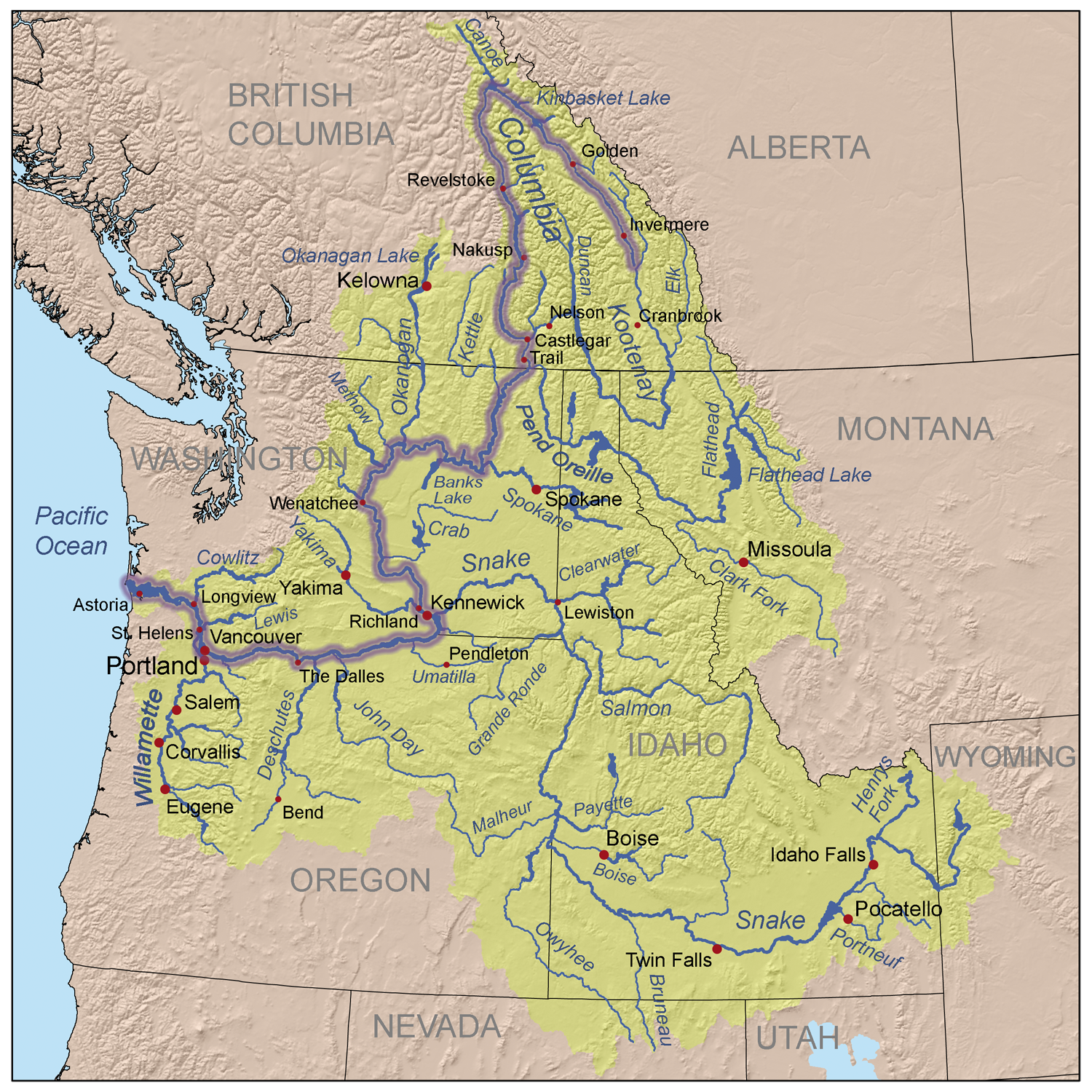
Map of the Columbia River watershed with the Columbia River highlighted. By Kmusser – self-made, based on USGS and Digital Chart of the World data., CC BY-SA 3.0, https://commons.wikimedia.org/w/index.php?curid=3844725

Denver measures second hottest summer on record: “Four of the top five are in the last five years” — The #Denver Post

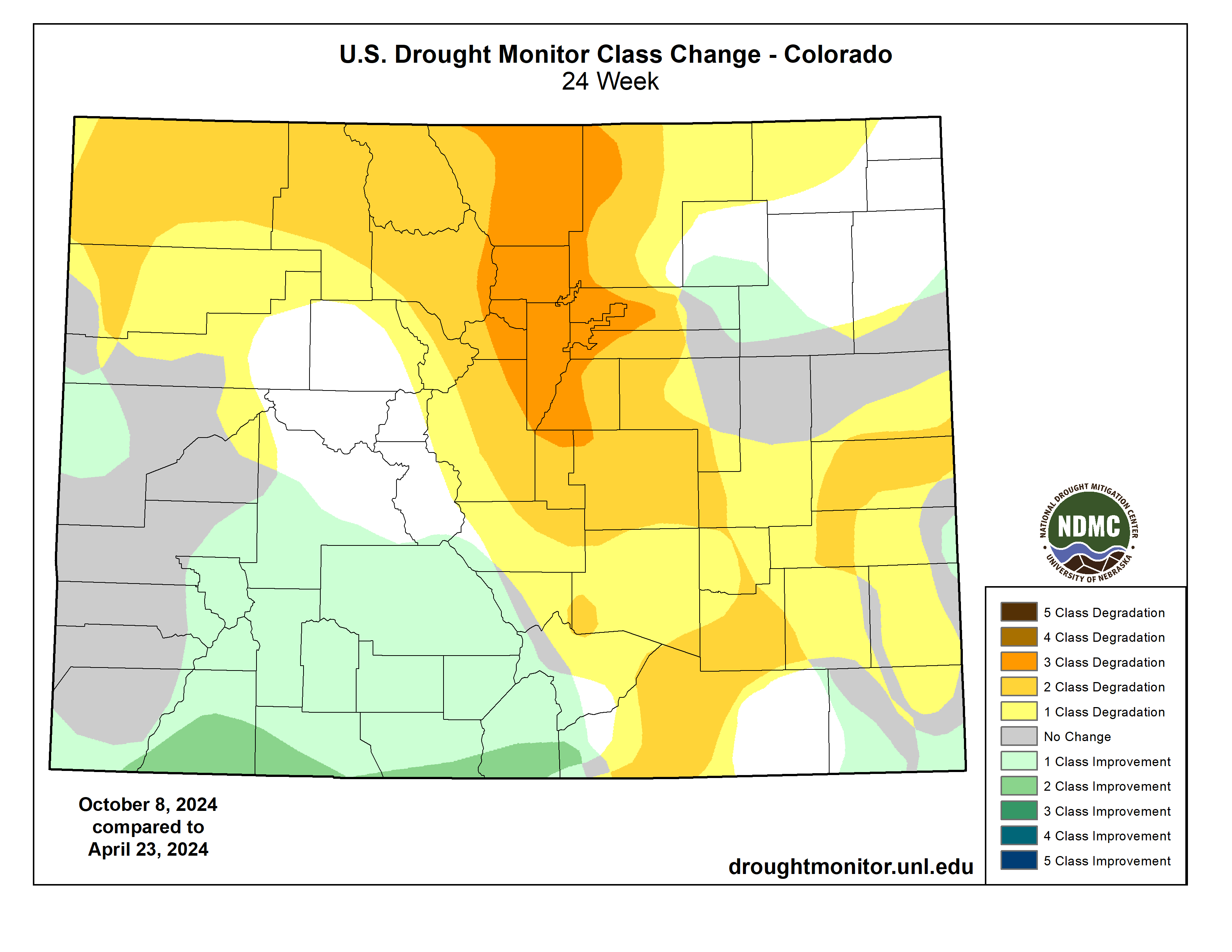
Colorado Drought Monitor 6 month change map ending October 8, 2024.

Click the link to read the article on The Denver Post website (Bruce Finley). Here’s an excerpt:

September 4, 2024

This summer in metro Denver ranks as the second hottest on record, in line with global warming, according to the National Weather Service. A hot, dry July extended through August. While much of northcentral and northeastern Colorado had above-normal rain in August, most of the metro Denver area received less than 1.5 inches. High temperatures reached 100 degrees on six days and topped 90 degrees on 57 days as of Tuesday, weather service records from June 1 through August 31st show. Denver’s average summer temperature measured 75 degrees — which is 2.7 degrees above the norm, meteorologists said. Only the summer of 2012 measured hotter, with an average temperature of 76.3 degrees. The other three hottest summers occurred in 2020 (74.9 degrees), 2021 (74.6 degrees), and 2022 (74.8 degrees).

“Four of the top five are in the last five years, and number one was 12 years ago,” NWS meteorologist Paul Schlatter said. “We keep breaking temperature records globally. Same thing in Denver, especially in the summer. We’re matching what is happening on a global scale. Some parts of the world are warming faster than others. It is definitely hitting our summers.”

Metro Denver’s night temperatures generally cooled off with an average of 59.2 degrees this summer, records show. The government’s drought index on Wednesday designated 40% of Colorado as “abnormally dry” with  8.5% of the state registering in drought.

Opinion: Time is now for a new #ColoradoRiver Basin process to bring together and engage sovereigns and stakeholders — Lorelai Cloud #COriver #aridification

Animas River. Photo credit: The Southern Ute Indian Tribe

From email from John Berrgren:

August 15, 2024

The foundation of the laws, treaties, acts and policies that govern the Colorado River is the Colorado River Compact of 1922. Over the past 100 hundred years, dozens of additional agreements and decisions have been layered on top, providing for the management framework we know today. 

As we look to the future, and as individuals who represent Tribal and environmental interests in the Colorado River Basin, we believe it is time to return to — and reimagine — one of the primary stated purposes of the 1922 Compact: to provide for the equitable use of water.

For me, Lorelei, it’s personal. Rooted in the Southern Ute Indian Tribe and raised on the Reservation in southwestern Colorado, my life has been deeply intertwined with water. 

We lived in one of the first adobe houses on the Reservation and did not have running water. We relied in part on groundwater, but the well often dried up. So, we hauled water once a week and my grandmother boiled ditch water for drinking water as needed. 

Water was a scarce resource, and we often had to choose between using water for drinking, taking showers or flushing the toilet. This scarcity is still a reality for many Native Americans today across the country.

I grew up knowing that water is a living, sacred being. Our Ute (Nuuchiu) culture centers around water, and we offer prayers for and with it. Water is the heart of our ceremonies. We were taught early on to take and use only what is needed. Above all else, we must care for the spirit of the water.

From the 2018 Tribal Water Study, this graphic shows the location of the 29 federally-recognized tribes in the Colorado River Basin. Map credit: USBR

When I was first elected to the Southern Ute Tribal Council in 2015, I was asked to participate in the Ten Tribes Partnership, or TTP, which is a coalition of the 10 Tribes along the Colorado River focused on securing and using tribal water. After one year, I was asked to chair TTP.

I drew on my personal and spiritual connection to water and started learning about the complex legal and technical issues related to managing water in the American West. I was stunned to learn that Tribes have historically delegated to have little to no role in managing Western water, and that tribal needs and interests are often marginalized.

In recent years, I have had the opportunity to work alongside many people from diverse walks of life to begin addressing these inequities: lack of inclusion in decision-making; lack of access to clean water; and lack of capacity to manage, develop and use water. 

I became a founding member of the Water and Tribes Initiative, or WTI, for the Colorado River Basin; was the first Native American appointed to the Colorado Water Conservation Board and the Colorado Chapter of The Nature Conservancy; co-founded the Indigenous Women’s Leadership Network, a program of WTI; and helped forge an historic agreement among the six tribes in the Upper Basin the Colorado River and the states of Wyoming, Colorado, Utah, and New Mexico to allow Tribes to be more meaningfully involved in collaborative problem-solving (but not decision-making per se).

Like Tribes, environmental interests have mostly taken a backseat to the use of the Colorado River for municipal and agricultural purposes. Most adjustments to address cultural and ecological values have been treated as subservient to the allocative laws that largely service municipal and agricultural interests.

Returning to the primary purpose of the 1922 Compact, we believe that providing for the equitable use of water includes substantive and procedural elements. There’s a huge difference between how the Colorado River is managed for multiple values (substance) and how people who care about such issues determine what ought to happen (process). 

We are offering a process improvement. We believe it’s time to establish an ongoing, whole-basin roundtable that would embrace the entire transboundary watershed, address the major water issues facing the basin, and, importantly, provide an equitable process to engage all four sets of sovereigns (United States, Mexico, seven basin states and 30 Tribal nations), water users and stakeholders. 

The late University of Colorado law professor David Getches, an astute observer of Colorado River law, noted in 1997 that “the awkwardness and the intractability of most of the Colorado River’s problems reflect the absence of a venue to deal comprehensively with Colorado River basin issues.” He called for “the establishment of a new entity that recognizes and integrates the interests and people who are most affected by the outcome of decisions on major Colorado River issues.” 

Many other scholars and professionals have supported a whole-basin approach to complement, not duplicate, other forums for engagement and problem-solving in the basin. Establishing a whole-basin forum is also consistent with international best practices, as most transboundary river basins throughout the world have some type of river basin commission. 

A whole-basin forum would be a safe place to have difficult conversations, to exchange information, build trust and relationships, and to develop collaborative solutions. It should rely on the best available information, including Indigenous knowledge.

Addressing the historic inequities built into the fabric of governing the Colorado River requires innovative substantive tools as well as procedural reforms focused on engagement and problem-solving. We look forward to working with all of you to shape a more equitable, more sustainable future for the Colorado River.

Vice Chairman Lorelei Cloud lives on the Southern Ute Indian Reservation and is the first Native American appointed to the Colorado Water Conservation Board and the Colorado Chapter of The Nature Conservancy.

John Berggren lives in Boulder and is the Regional Policy Manager, Healthy Rivers for Western Resource Advocates.

Map credit: AGU