NREL has developed a tool that enables developers to evaluate the life cycle greenhouse gas emissions associated with new, domestic closed-loop pumped storage hydropower facilities.
In a 2023 study, NREL researchers compared the life cycle greenhouse gas emissions of closed-loop PSH with other energy storage technologies, finding PSH to have the lowest life cycle emissions among the technologies studied. The black bars represent a range of scenarios explored in the study. Graphic by Tara Smith, NREL
Pumped storage hydropower (PSH) is an established technology that can provide grid-scale energy storage and support an electrical grid powered in part by variable renewable energy sources such as wind and solar. Despite recent interest in PSH, questions remain regarding the overall sustainability of PSH projects, and information about the life cycle of greenhouse gas (GHG) emissions associated with PSH technologies has been limited—until now.
In 2023, NREL researchers published a wide-ranging study that included a full life cycle assessment of new closed-loop PSH projects in development in the United States. The majority of GHG emissions from PSH are attributed to the grid mix of energy used to pump water from a facility’s lower reservoir to its upper one, as this mix is not usually made of 100% carbon-free energy sources. As such, GHG emission levels decrease in locations with a higher level of renewable energy sources in the grid mix. Additional emissions stem from a plant’s construction (e.g., from diesel-powered equipment, concrete, or steel) and ongoing plant operations.
In the study, researchers compared their results to published data on the GHG emissions of other energy storage technologies, including compressed air energy storage and different battery types. The results showed that GHG emissions associated with PSH were lowest among the group studied.
JOAN CARSTENSEN
Interactive Data
The success of the study inspired the creation of an interactive tool on OpenEI that uses the study data to enable developers to calculate the GHG emissions of potential PSH sites in the United States—with the goal of promoting PSH development with configurations and locations with the lowest global warming potential.
Users can input specifications for PSH facilities at varying levels of detail, such as reservoir volume, dam material and dimensions, number and capacity of turbines, and the length of the transmission line that connects the PSH system to the grid. They can then compare different PSH scenarios side by side and view the emissions by component, material, and life cycle phase.
Using the Tool
To use the tool, users first select between a Basic and an Advanced scenario, in which they can specify a site configuration and explore GHG outcomes. Basic mode offers a smaller set of options for a simpler user experience, whereas Advanced mode allows the user to submit detailed specifications for PSH system components (e.g., number of reservoirs being built, dam material, and distance to grid connection).
Multiple scenarios with different inputs can then be viewed side by side and subsequently edited with different inputs to produce the desired outcome.
Tool Methodology
The tool was built using the data and methods from the 2023 study, where researchers conducted a life cycle assessment of closed-loop PSH under a variety of assumptions. This data includes all GHG emissions from facility construction, operation, and maintenance and exclude any emissions that might occur during decommissioning or any reservoir-based emissions. We do not consider nonpower uses of the PSH site, which in practice could bear some responsibility for life cycle GHG emissions.
Western science structures are embedded in a deeply rooted settler-colonial mindset. Indigenous traditional knowledge has the potential to overturn western systems destined for doom.
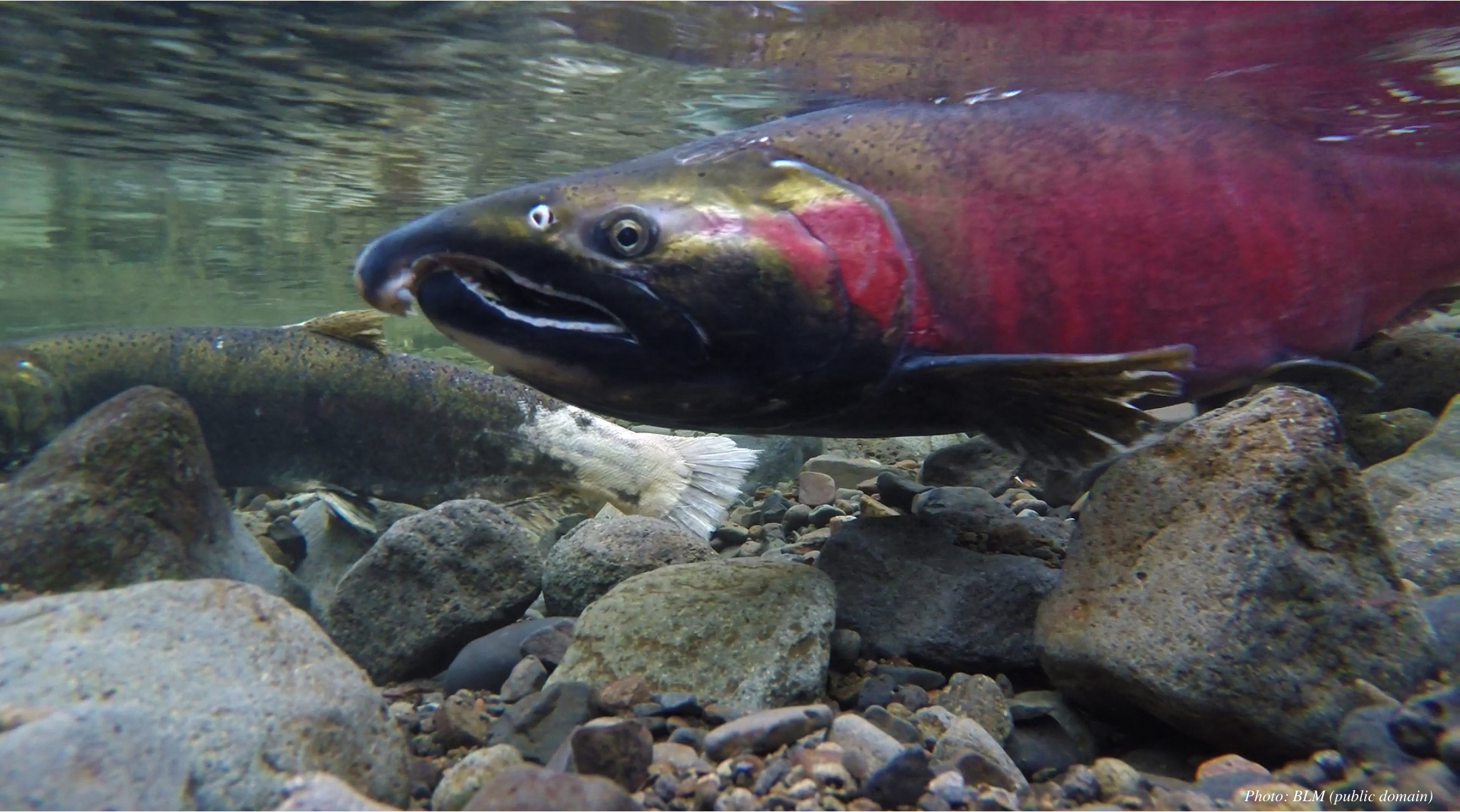
As a legislative policy fellow and anthropologist who studies women’s well-being in coastal communities of Chile and Indigenous salmon management in Alaska and Canada, I’ve witnessed how genocidal attempts to eradicate Indigenous peoples and their cultures have also damaged the environment. We see it in current management’s low returns in fish, high levels of runoff and nutrient input into ocean systems, and generally unsustainable levels of resource extraction.
I’ve also seen the opposite: I interviewed managers and biologists in Vancouver, Canada, who described the substantial improvements of Indigenous-led, bottom-up approaches to conservation. They see fish return and people fulfilling their well-being and nutrition needs. They see political and economic reform and a revitalization of social and cultural practices.
Unfortunately this is still not the norm, as we saw in a recent international agreement between the United States and Canada that placed a seven-year fishing moratorium on Chinook salmon to encourage fish populations to rebound. Most people would agree that this is a worthy goal for the conservation of both the species and the people who depend on Chinook. However, the new agreement fails to factor in Indigenous access to resources for ceremonial and subsistence harvest, which is mandated by law, nor did legislators acknowledge public comment that supported that access.
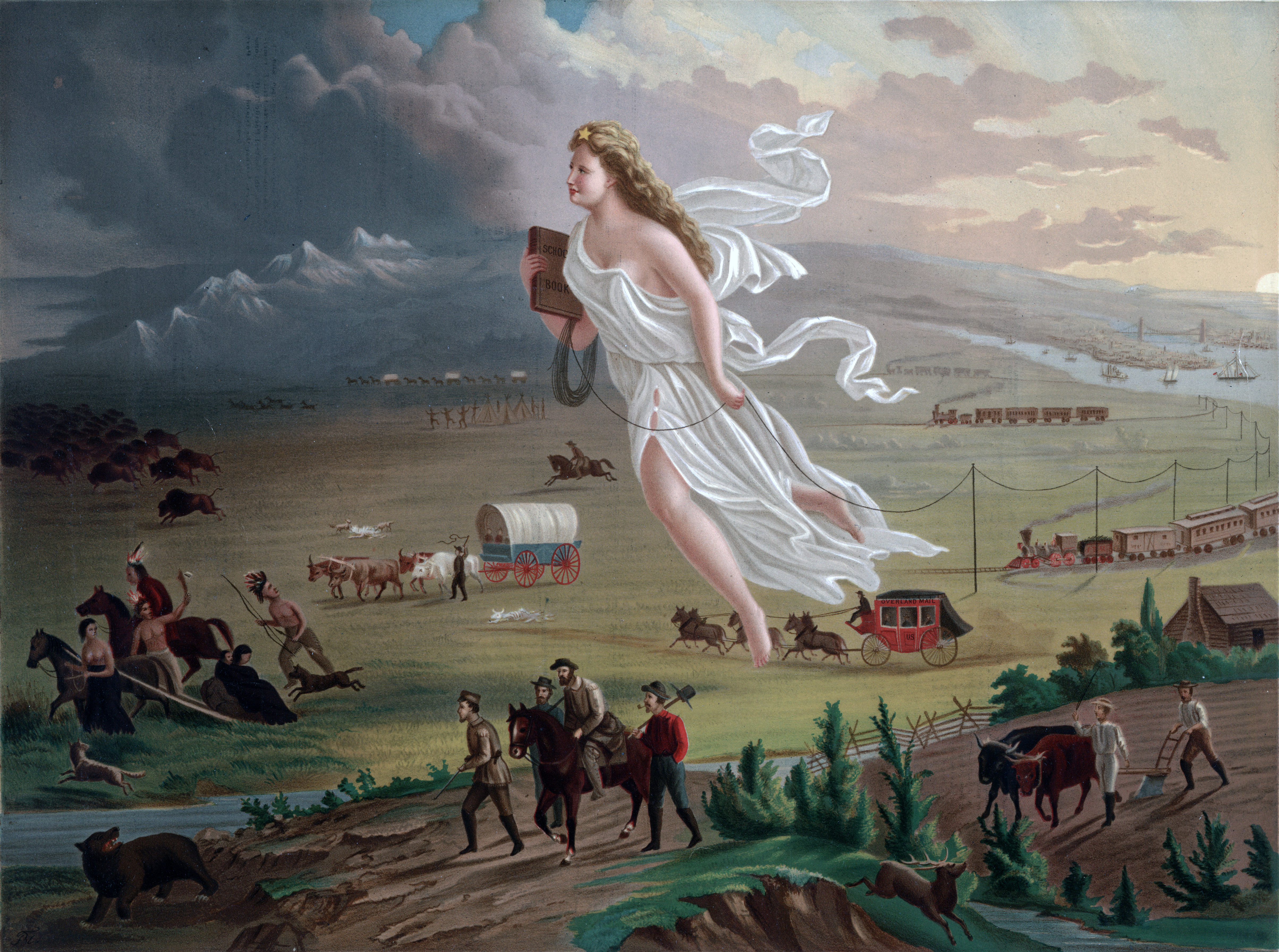
American Progress (1872) by John Gast is an allegorical representation of the modernization of the new west. Columbia, a personification of the United States, is shown leading civilization westward with the American settlers. She is shown bringing light from east to west, stringing telegraph wire, holding a book, and highlighting different stages of economic activity and evolving forms of transportation. By John Gast – This image is available from the United States Library of Congress’s Prints and Photographs division under the digital ID 09855, Public Domain, https://commons.wikimedia.org/w/index.php?curid=373152
The marginalization of Indigenous peoples today, as seen in this agreement’s failures, can be traced back to colonialism.
The history of colonialism is steeped in human-rights violations such as the outlawing of Indigenous salmon-management practices that settlers later appropriated for their own economic gain. Settler wealth was achieved only through the exploitation of resources and forced relocation of Indigenous peoples out of economically advantageous spaces and acculturation into oppressive colonial ones.
“Settler governments [are] primarily concerned with economic gain,” a British Columbia-based project manager focused on salmon restoration told me during an interview. “Their mandate is to work commercial fisheries or recreational ones that generate economic value for their states, provinces, or countries…That’s the starting point; when human well-being is the starting point — like it is with Indigenous people — then it leads to a very different kind of management.”
A Broader Worldview
Indigenous traditional knowledge incorporates a worldview that recognizes humans as a part of, rather than separate from, the animal family. As the restoration manager explained: “That changes everything if you really think it through, because we’re no longer in control. We’re not in charge, nature doesn’t exist to serve us, nature isn’t there to be exploited for our own benefit.”
For example, the Nisga’a Nation — whose treaty with the government of British Columbia and Canada protects their right to manage and harvest fish species and other resources — place value on what’s left behind, not how much is extracted. Here, colonial extractive ideologies are challenged by traditional regenerative strategies that have sustained fisheries and Indigenous societies for thousands of years.
Nisga’a Museum sign. Photo credit: Connie Azak via Flickr
Incorporating an embedded subsistence culture and traditional knowledge into ongoing and future reconciliation and restoration efforts would benefit from a concept called transformative conservation.
Transformative conservation recognizes environmental contexts as inextricably linked to cultural, social, economic, and political ones, confront issues as they arise, and therefore operate in less limited, binding boundaries.
As the project manager explained: “Epistemologically, western science is very naïve about how the world actually functions. Indigenous people have much more sophisticated (in my view) worldviews that are quite effective in actually integrating western science outputs into their management systems. Western science is by its nature a methodology that’s reductionist. It operates most effectively when it can reduce problems to very simple systems, models, variables and then test them out. It’s a very powerful knowledge creation system but it has real limitations when it comes to then building back up again, to develop an integrated view of ecosystems and how they function.”
We can see this at work in Canada’s Department of Fisheries and Oceans. On its website the agency says it “helps to ensure healthy and sustainable aquatic ecosystems through habitat protection and sound science. We support economic growth in the marine and fisheries sectors, and innovation in areas such as aquaculture and biotechnology.” In practice this appears to give little attention to the needs of Indigenous peoples.
My interviewee described the agency’s purpose as obsolete. “There are times when institutions are too far gone to rehabilitate, and DFO’s raison d’etre has ceased to hold true.”
For everything there is a season, and “government organization has a shelf life,” the manager said.
DFO is not alone. Structural change and institutional reform, not merely Indigenous inclusion, are necessary for true representation of Indigenous people in all forms of governance. Writing in the book Pathways of Reconciliation, scholars Melanie Zurba and John Sinclair argue “structural forms of oppression” in state-sanctioned, top-down forms of governance “inhibit meaningful First Nations participation” and wield “Indigenous people into becoming instruments of their own dispossession” — thus reproducing colonial violence and marginalization against Indigenous people while moving away from ecological resilience fulfilled only in tandem with Indigenous self-determination and agency in decision-making.
In addition to institutional reform, Indigenous self-determination requires capacity building made possible with funding and resources devoted to tangible improvements through bottom-up, grassroots co-management approaches within and between First Nations and Tribes. The Kuskokwim Intertribal Fish Commission is an example of successful co-management between Tribes and the U.S. Fish and Wildlife Service.
Change Is Necessary
These approaches would serve the needs of both Chinook and people. In this case, there’s great potential for DFO and the Alaska Department of Fish and Game to adopt co-management agreements similar to the Kuskokwim to reach holistic approaches to salmon management. My interviewee elaborated: “I’d suggest the best thing DFO and all those other orgs could do would be go to Indigenous scientists and managers and say: ‘You guys set up a system and tell us how we can feed into that, because we trust you.’ That’s how I do it.”
The unwillingness of settler governments to resign their power to Indigenous people has strained the potential of climate adaptation and species and habitat preservation. Complex, multiscale problems require complex solutions — discussion across geographical boundaries and multiple scales of formal and informal governance, a discourse around institutional reform, a sticky un-meshing and remeshing of knowledge systems, and an overall willingness for actors to learn, fail, re-learn, and think beyond self-imposed boundaries with enduring hope.
Current methods are simply not working. It’s time we look to those who view salmon survival through a holistic lens, those who are dependent on salmon both economically and culturally, and those Indigenous peoples who have successfully managed, protected, and cared for salmon for thousands of years. An active rather than passive representation of Indigenous voices and an incorporation of their worldviews into policy and management initiatives will not only establish a starting point to solve complex ecological problems such as climate change but also lead down a long-ignored path toward true reconciliation.
The opinions expressed above are those of the author and do not necessarily reflect those of The Revelator, the Center for Biological Diversity or their employees.
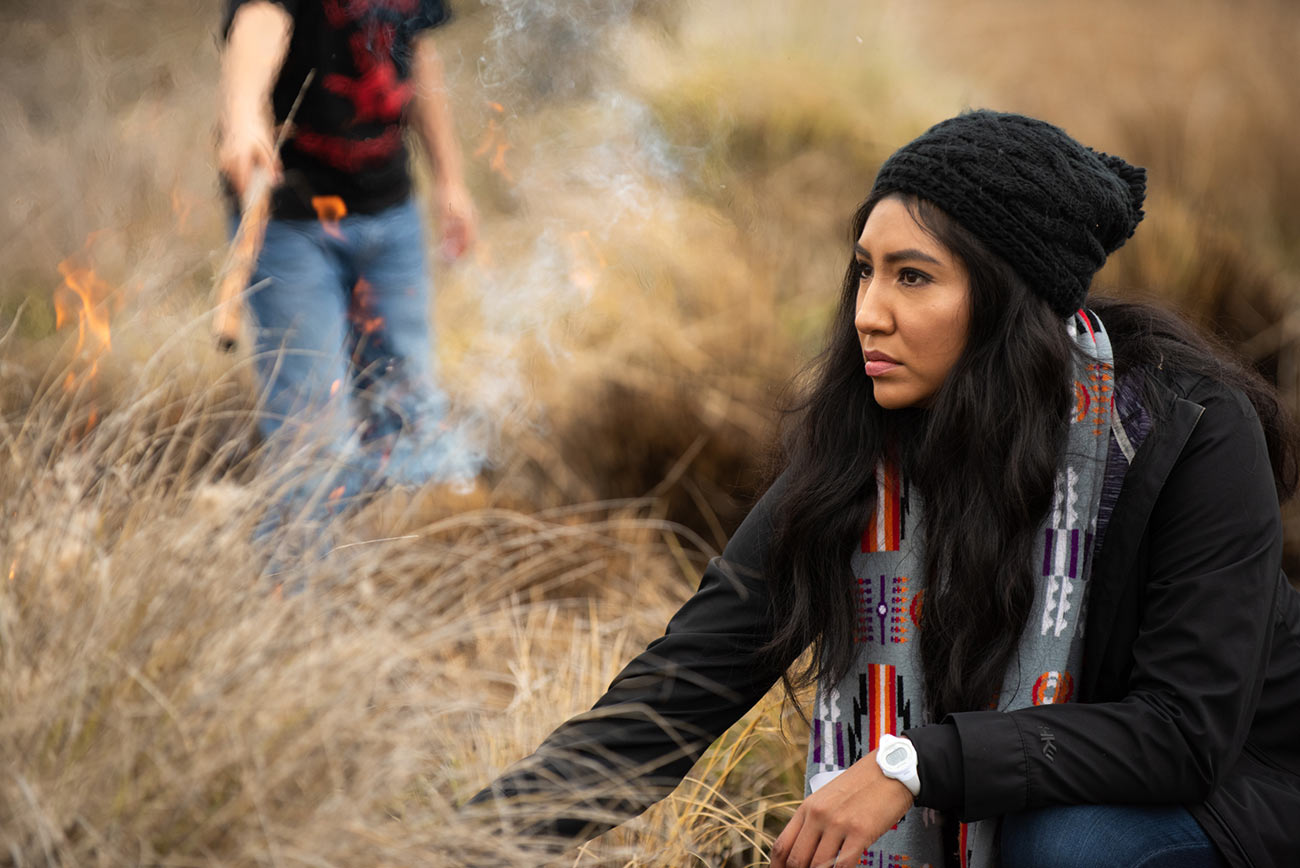
Melinda Adams lights a field of deergrass on fire during the Tending and Gathering Garden Indigenous fire Workshop at the Cache Creek Nature Preserve in Woodland, Calif. Photo: Alysha Beck/UC Davis
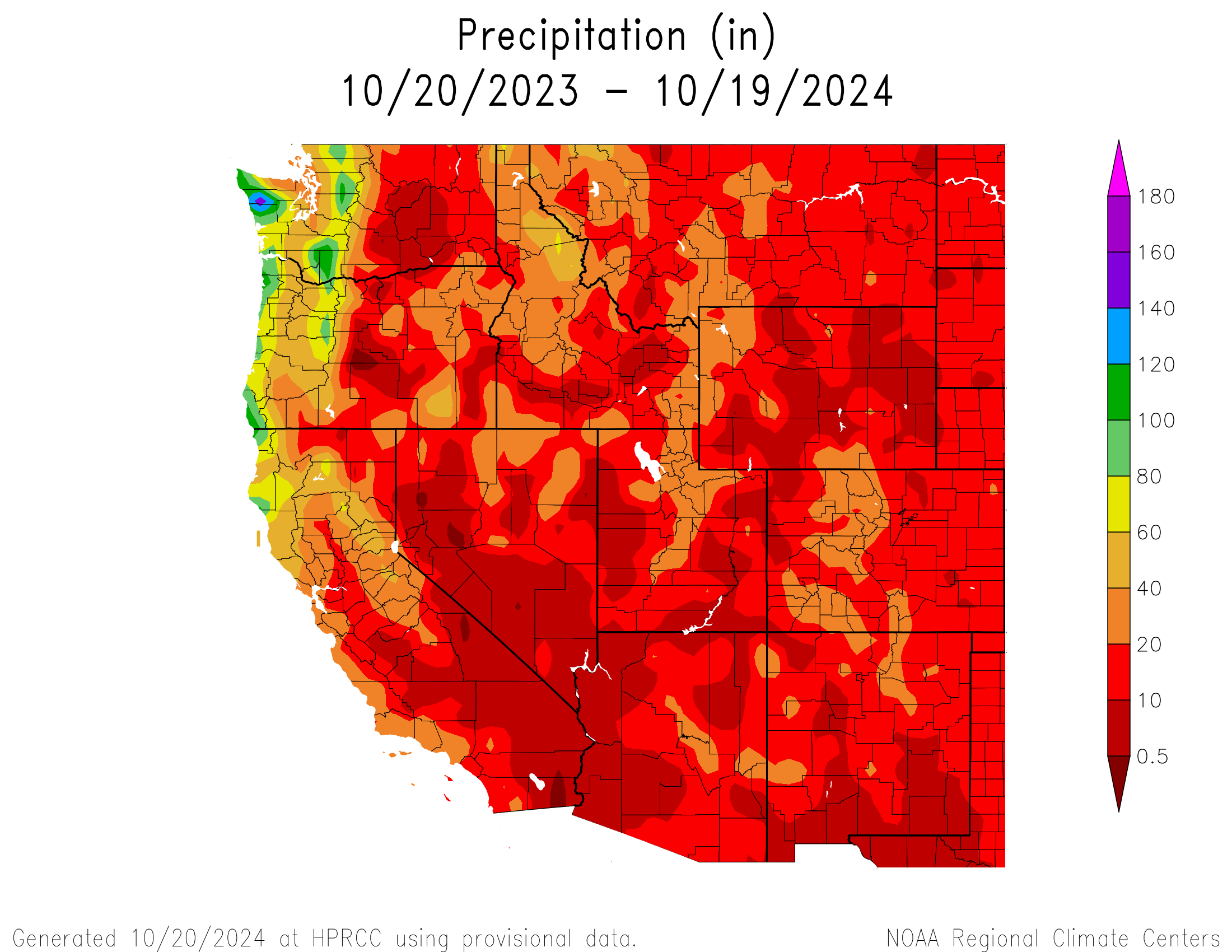
In the case of the Upper Rio Grande Basin, two conflicting conditions can both be true at once. On one hand, the year has brought much more rain than is typical. With more than an inch of rain over the weekend, the San Luis Valley has seen more than 10 inches of total precipitation so far in 2024, or 3 inches above what’s normal, according to the National Weather Service. On the other hand, low snowpack in the San Juans and Sangre de Cristos from a winter ago left Valley farmers with less than a normal water year for irrigation. On May 6, the Rio Grande Basin had half of the typical snowpack, according to the Colorado Climate Center, and we know the unconfined aquifer relied on by so many irrigators remains a major problem. The state currently has a five percent curtailment on groundwater wells in the San Luis Valley. In calculating its downstream water obligations to New Mexico under the Rio Grande Compact, Colorado is anticipating the Rio Grande to finish the irrigation season at 78 percent of what’s normal for flows and 80 percent on the Conejos River, according to Craig Cotten, division engineer for the Colorado Division of Water Resources.
San Luis Valley Groundwater
New conservancy district forms
Winding its way through Colorado Division 3 Water Court is an application from a group of Valley irrigators to form the Southern Colorado Water Conservancy District and Groundwater Management Subdistrict. The initial board of directors would be Art Artaechevarria, William Meyers, and Les Alderete, according to the application submitted to state water court in Alamosa. The formation of a new water conservancy district will allow the group of farmers to manage their own affairs when it comes to meeting Colorado’s rules governing groundwater pumping in the San Luis Valley. Like the Rio Grande Water Conservation District and its subdistrict formations, the new SOCO Water Conservancy District would impose a mill levy tax upon the farms operating within it to pay for its operations and strategy to adhere to the state’s groundwater pumping rules. The Southern Colorado Water Conservancy District has membership among farmers in Saguache, Rio Grande and Alamosa counties. The new water conservancy district will include approximately 250 wells, and in its application it tells the water court that the subdistrict plans to obtain approximately 6,000 acre-feet to augment depletions from wells and estimates it will cost $40 million to obtain the water. There’s a lot more to this developing water story. More in the coming week.
Rio Grande and Pecos River basins. Map credit: By Kmusser – Own work, Elevation data from SRTM, drainage basin from GTOPO [1], U.S. stream from the National Atlas [2], all other features from Vector Map., CC BY-SA 3.0, https://commons.wikimedia.org/w/index.php?curid=11218868
Hearing this week on Rio Grande Compact case
The decade-long Rio Grande Compact case of Texas v. New Mexico and Colorado will have a hearing before retired Chief Judge D. Brooks Smith on Wednesday, Oct. 23, in Denver. Smith, who retired as chief judge of the U.S. Third Circuit Court of Appeals in 2021, was appointed new Special Master in the case by the U.S. Supreme Court in July. The appointment came after the U.S. Supreme Court agreed with the U.S. Department of Interior and denied a consent decree that the states had negotiated which would have settled the case. Smith now takes over the case and is expected to set a course of action during the hearing this week.