
Click the link to read the article on the Land Desk website (Jonathan P. Thompson):
February 11, 2025
🗺️ Messing with Maps 🧭

On the afternoon of December 5, 2024 at least seven homes were evacuated in rural La Plata County, Colorado, after a major pipeline ruptured and spilled some 23,000 gallons of gasoline 1. Two months later, lingering fumes and contamination kept at least one of the evacuated households from returning home, according to the Durango Herald.
The spill tainted nine domestic wells with benzene concentrations of up to 300 parts per billion; the carcinogen’s maximum allowable level is 5 parts per billion. And the nearby Rainbow Springs trout farm suffered an 80,000 fingerling die-off in the days following the spill, according to the Herald, though a conclusive link between the two has yet to be made.
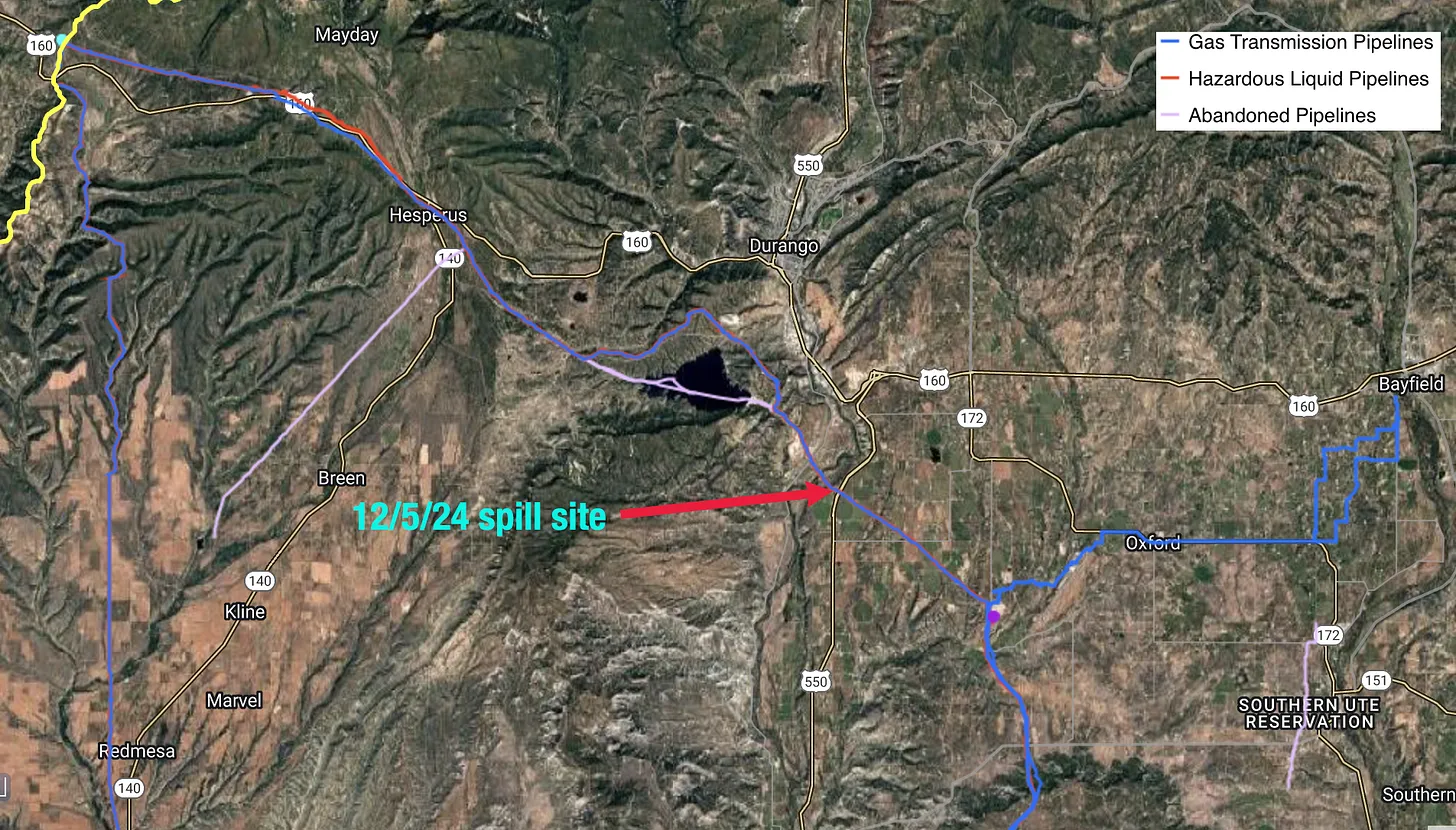
That a bunch of hydrocarbons broke free from their confines in that part of the country didn’t shock me: La Plata County is in the San Juan Basin, where oodles of natural gas has been pumped from the ground over the last century or so, and leaks, breaches, and spills have been frequent — sometimes with deleterious results. But I was a bit taken aback to read that the material that spilled was gasoline that came from a major, interstate pipeline.
In fact, several Facebook commenters expressed their doubts, saying it must have been drip condensates or liquid natural gas, instead, coming from one of the lines associated with the gas fields or the processing plant nearby. But the Herald reporter got his info directly from the pipeline operator (and they should know). And I double-checked the Pipeline and Hazardous Materials Safety Administration incident report, which said Enerprise Products’ Four Corners Lateral Loop pipeline, which was installed in 1980, had spilled 544 barrels (or 22,848 gallons) of non-ethanol gasoline.
Curiously, both Energy Information Administration and PHMSA records show that only natural gas-carrying lines pass through the county. But apparently the line now carries auto fuel from Texas to New Mexico, Colorado, and Wyoming, where it helps keep pump prices affordable, or so the pipeline operator told the Herald.
It’s one of seven natural gas, carbon dioxide, or hazardous liquids pipelines — totaling 225 miles — that cross La Plata County. The Western states contain about 93,024 miles of these long-distance methane and petroleum carrying lines (this does not include local gathering systems that web their way through the oil and gas fields or natural gas distribution lines that run through towns and cities).
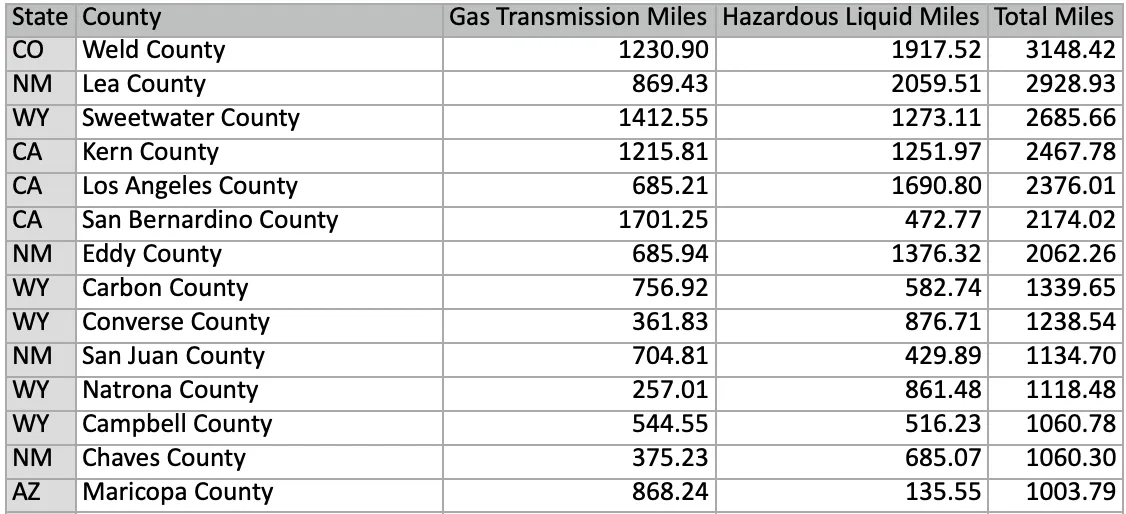
That’s one of those things about pipelines. You might be subtly aware they exist, thanks to the strips of land that have been cleared of vegetation and the signs warning you not to dig there. But the fact that there are large quantities of flammable, sometimes explosive, climate-altering substances rushing beneath your feet on their way to distant destinations is not something that is often at the top of one’s mind. At least not until they leak, rupture, or explode.
And they do, more often than most of us would hope. Usually the cause is corrosion, a failed weld, or some other type of equipment or material failure, though excavation-caused ruptures are also up there. Cars and trucks run into pipelines and break them, floods or seismic activity can tear them apart, and sometimes lightning strikes them.
Natural gas is composed mostly of methane, a potent greenhouse gas with about 86 times the atmospheric warming potential than carbon dioxide. So every release is contributing to climate change. A major breach or a slow leak that goes undetected can emit massive amounts of methane; in April, a construction worker breached a pipeline that released 118,000 MCF (thousand cubic feet) of natural gas before it was shut off 2. Plus, when the stuff builds up it can explode, which makes gas line leaks especially dangerous. Crude oil and gasoline spills, meanwhile, can harm wildlife, waterways, and people, and even carbon dioxide pipeline ruptures can be fatal.
So it’s good to have strong regulations around pipelines, as well as a well-staffed agency to enforce those regulations. It’s also nice to know where the major pipelines are around you. And for now, at least, you can find out by consulting the PHMSA’s National Pipeline Mapping System. Just enter your state and county and you get a map of the big hazardous liquid and natural gas transmission lines. You can also do an accident query and see where there have been accidents near you. One drawback is that the system limits how far you can zoom in on the map, apparently because they’re worried about saboteurs using it to locate targets. Here’s what the zoomed in map looks like. This is about the same view as the opening image from 1931.

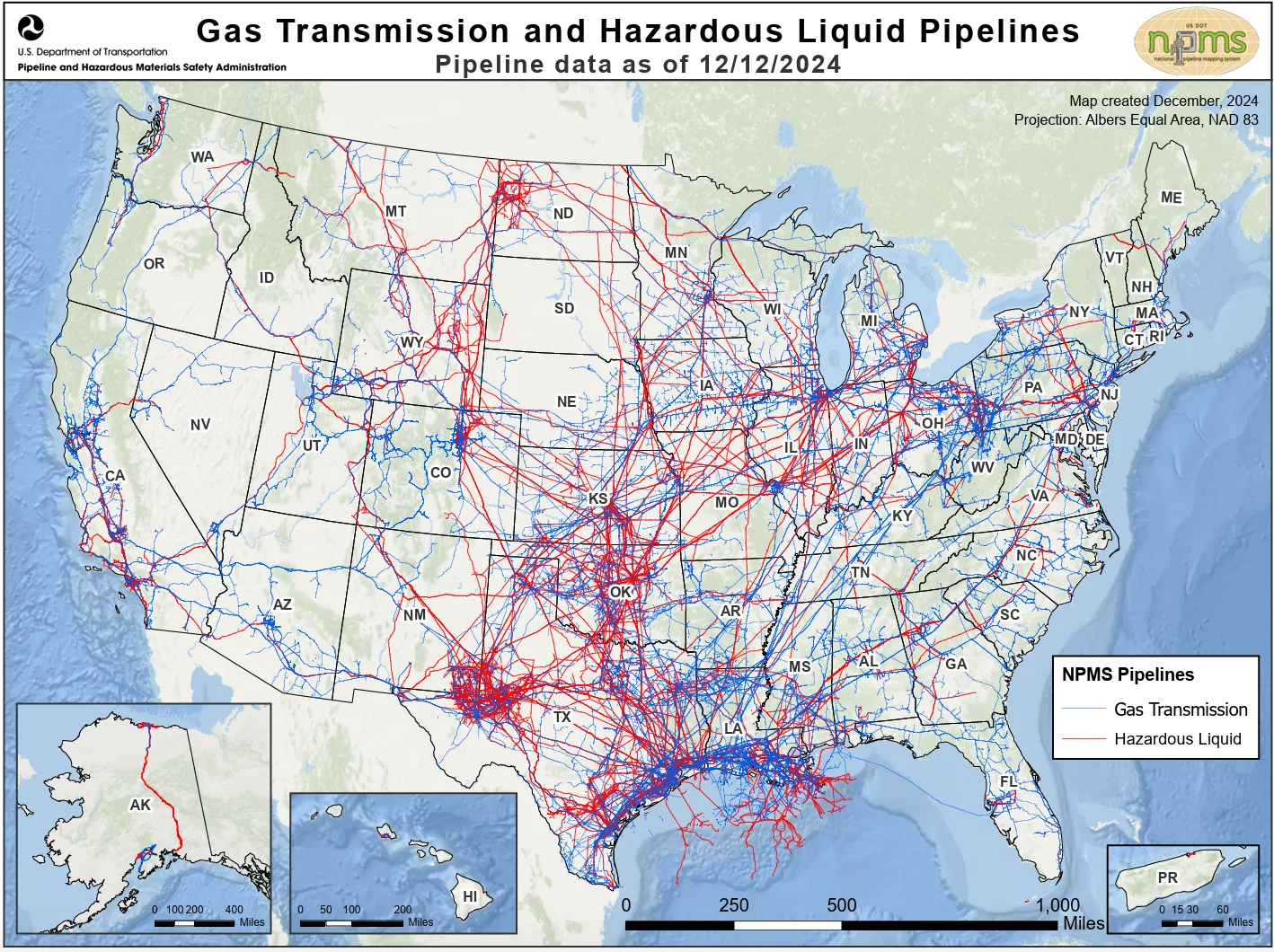
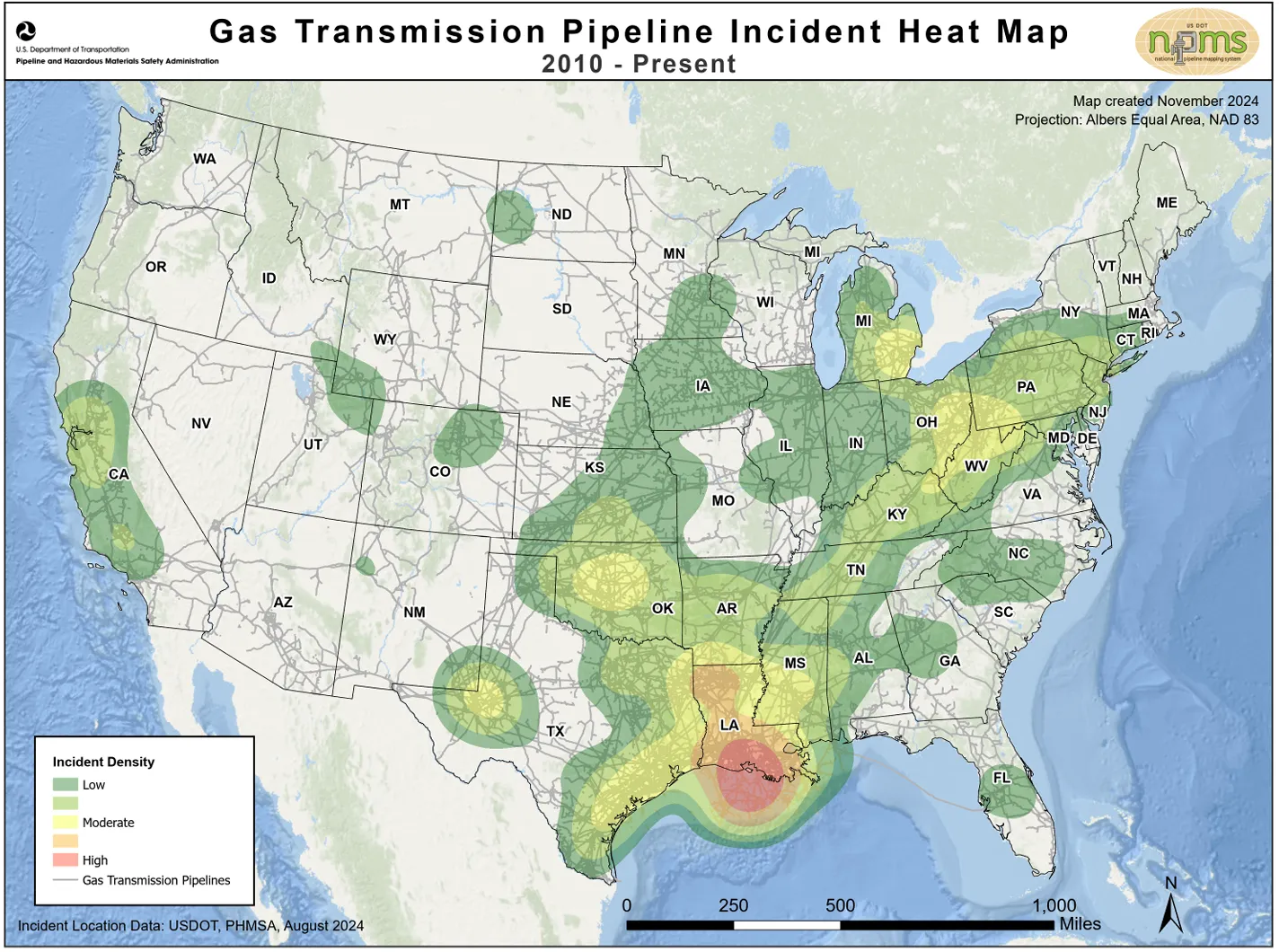
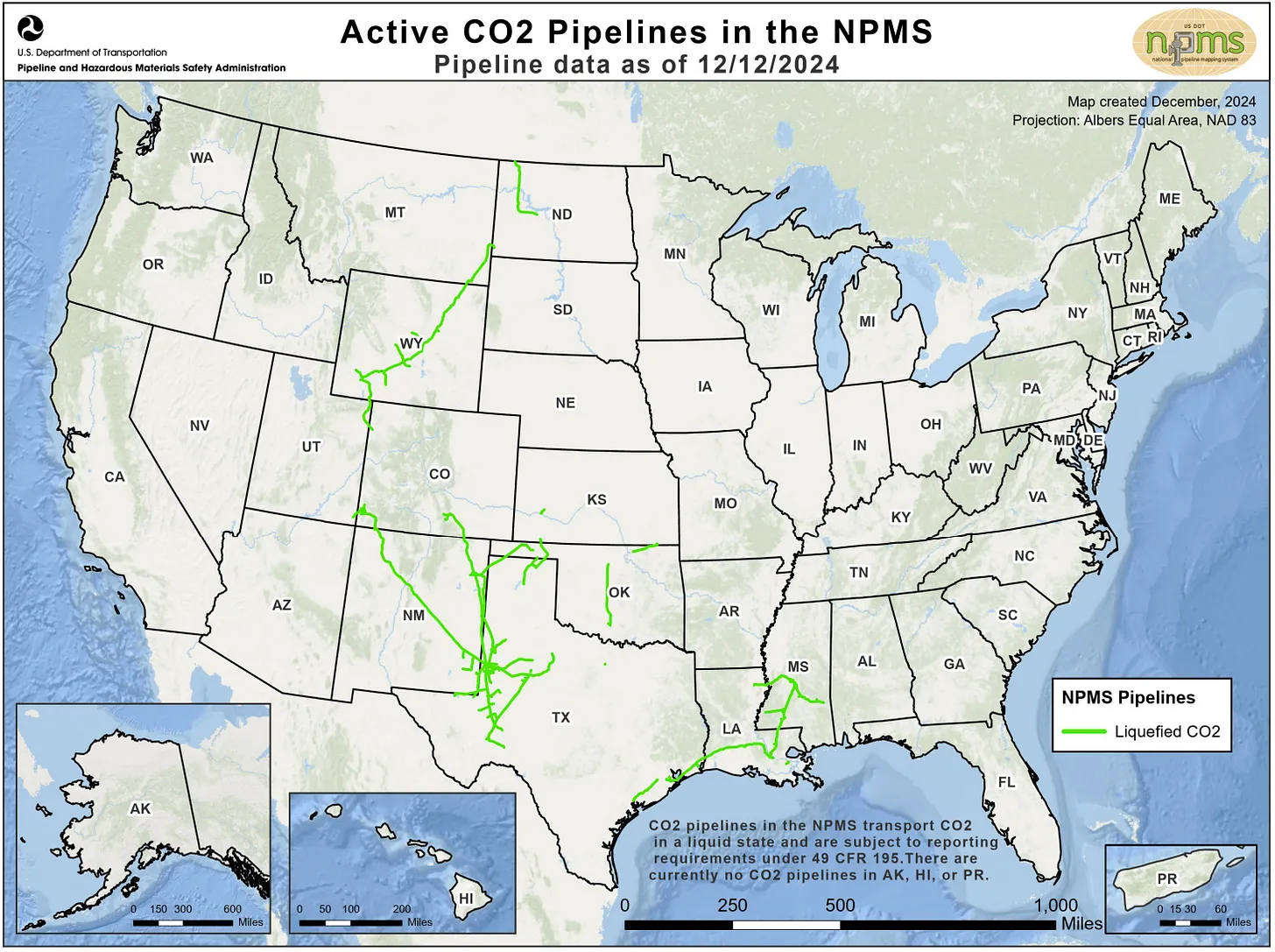
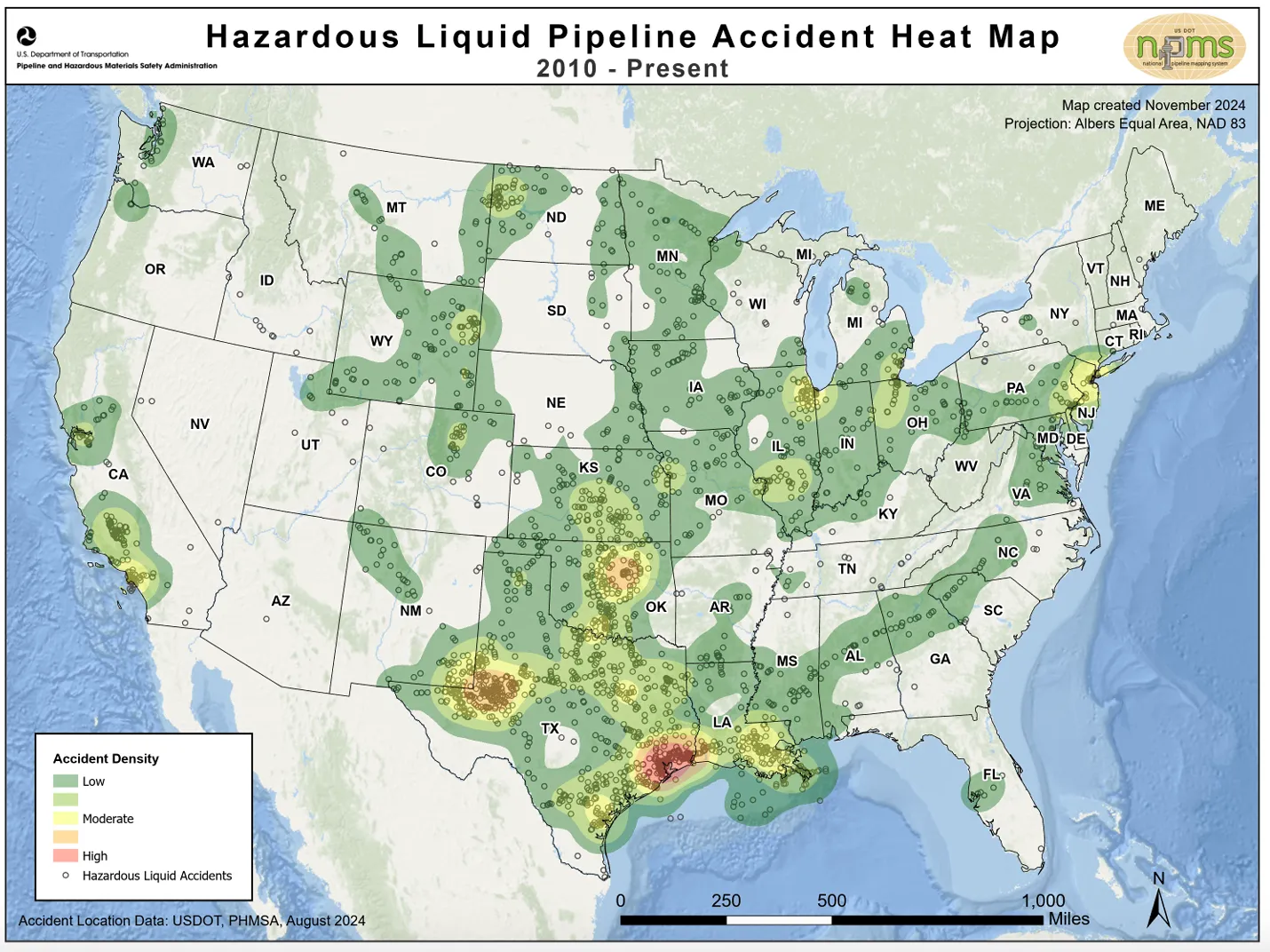
Here are some zoomed out maps to give you a sense of where the pipelines are concentrated, with the highest densities in the Permian Basin and Louisiana.

DATA DUMP:
- 122 Number of U.S. interstate natural gas transmission system incidents, accidents, and spills in 2024, resulting in 7 injuries.
- 1.82 million MCF Volume of natural gas released during those incidents.
- Corrosion The leading cause of natural gas transmission pipeline incidents.
- 13, 28 Number of fatalities and injuries, respectively, resulting from natural gas distribution system incidents nationwide in 2024.
- 309,560 MCF Volume of natural gas released during distribution system incidents.
- $549,000 Total damages, as of early February, resulting from the Enterprise pipeline spill in La Plata County in December.
- 192 Number of incidents reported on Enterprise Products Operating pipelines between 2017 and 2025.
- 294 Number of incidents in interstate hazardous liquid pipelines nationwide in 2024.
- 80 Number of hazardous liquids incidents in 2024 that occurred in pipelines that were installed prior to 1985. Ten of the damaged lines were installed prior to 1940.
- 16,708 Barrels of crude oil spilled in 2024 pipeline incidents.
- 3,333 Barrels of refined petroleum products spilled or lost in 2024 pipeline incidents.
- $70 million Total damages resulting from hazardous liquid (crude oil, gasoline, and other products) pipeline incidents in 2024.
Parting Poem
Now for something completely different, I’d like to leave you with this lovely poem by Richard Shelton. It’s from his Selected Poems, 1969-1981, which is easily my most read book, as I come back to it time after time. No one captures the essence of the desert like Shelton.

1 Which is about enough gasoline to fuel the ol’ Silver Bullet (the Land Desk’s official mascot) for another 800,000 miles or so.
2 The average U.S. residence uses about 65 MCF of natural gas per year.