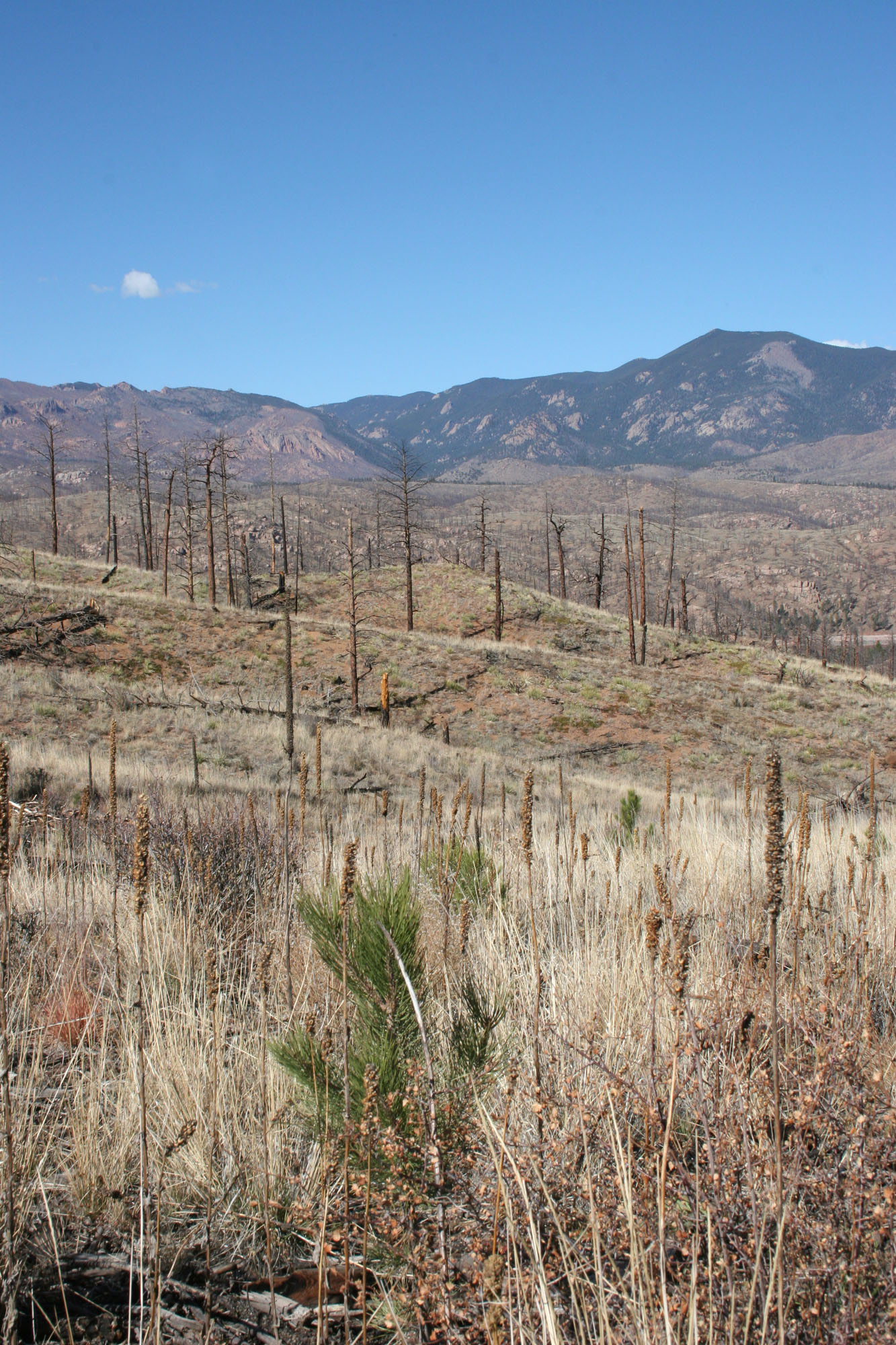
A ponderosa pine seedling peeks out of the Hayman-Fire scarred landscape near Cheesman Reservoir. After the fire, Denver Water spent more than 10 years working with volunteers and Colorado State Forest Service crews to plant about 25,000 trees per year on the 7,500 acres of Denver Water property destroyed by Hayman. Photo credit: Denver Water
Forests around the world are taking longer to recover from severe wildfires – potentially indicating forest decline, according to a new study.
The research, published in Nature Ecology & Evolution, finds a “significant increase” in the severity of forest fires from 2001-10 to 2010-21 – especially in western North America, parts of Siberia and south-eastern Australia. It also finds that recovery from large fires has become “more difficult” for forests in recent years, particularly in the boreal forests of the far-northern latitudes. Furthermore, fewer than one-third of all forests studied recovered successfully within seven years of a “megafire” – a broad term used to refer to extreme fires. A “surprising discovery” was that fire severity had the largest impact on forest recovery – even more than climate change, one of the study authors tells Carbon Brief.
Udall/Overpeck 4-panel Figure Colorado River temperature/precipitation/natural flows with trend. Lake Mead and Lake Powell storage. Updated through Water Year 2024. Credit: Brad Udall
Click the link to read the article on the InkStain website (John Fleck):
April 25, 2025
A group* of my Colorado River collaborators has put together what we hope can be a useful set of foundational principles as the basin states and federal leadership search for a path toward a negotiated agreement for post-2026 Colorado River management. They’re based on a number of key premises:
The Colorado River Compact will remain the foundation of the river’s management, but we have to find a way past the deep disagreement between Upper and Lower basin states on what the Compact actually says.
Colorado River Basin tribes must be essential partners in crafting the next set of guidelines, including through compensation for foregone water use.
Shared pain is essential. The path toward a sustainable river system requires everyone to contribute to the solution to the problem of the river we all share.
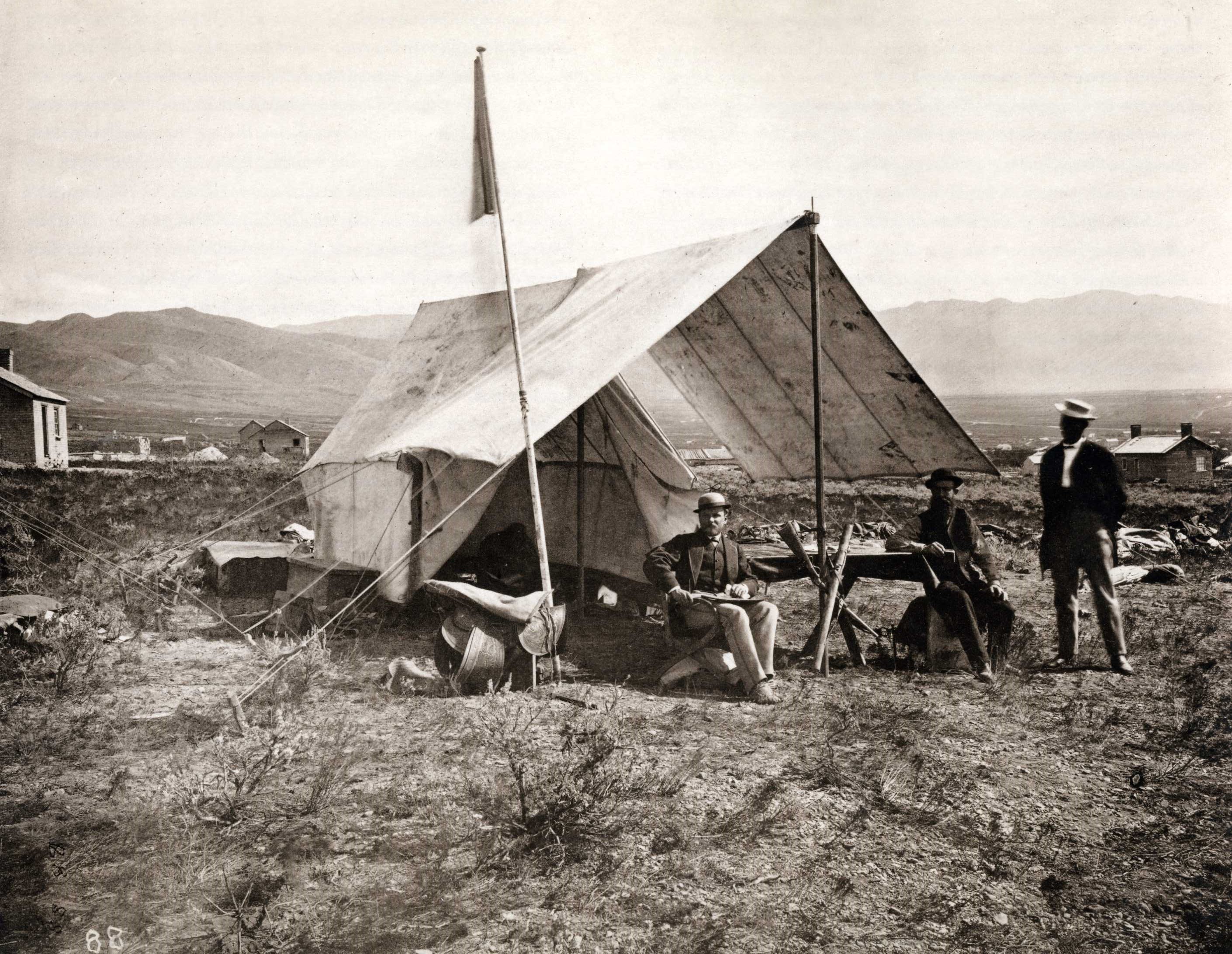
Clarence King; Camp near Salt Lake City, Utah. The exploration of the Survey of the Fortieth Parallel. Photo by Timothy H. O’Sullivan, October 1868. By Timothy H. O’Sullivan – Davis, Keith F., Timothy H. O'Sullivan, Jane Lee Aspinwall, François Brunet, John P. Herron, Mark Klett, and Julián Zugazagoitia. Timothy H. O'Sullivan: The King Survey Photographs. Yale University Press Mass. Published:2011., Public Domain, https://commons.wikimedia.org/w/index.php?curid=56679730
For several years I served on the board of a rural school district, and every year, when our draft budget was presented at our monthly public meeting, the audience would fill with people concerned about higher taxes. Seniors on fixed incomes spoke about the precarity of their budgets, while people of significantly greater means railed against “irresponsible” spending. As a board, we were trying to keep class sizes small enough for good learning outcomes and to avoid having to cut art and music and Spanish classes. I typically let the more senior board members handle the tough questions, but one year, as a young mom, I felt compelled to speak on behalf of the intergenerational social contract: the idea that when we were in school, we benefited from the investment of the generations before us, and it is therefore our moral obligation as adults today to invest in schools for the generations coming after us.
The intergenerational social contract is an old idea, far older than the U.S. government, Social Security and Medicare. It is not about entitlement. It’s about intergenerational caretaking — the recognition that there are no isolated moments of history, that we are obliged to pass on a world of hope and possibility to future generations. Indigenous communities have always understood this, which is why traditional ecological knowledge is increasingly being looked to for ways of managing the land for long-term health and sustainability. It’s a line of thinking that respects, and assumes a responsibility to, future inhabitants of Earth.
The intergenerational social contract also applies to public lands. Land-management agencies in the U.S., including the Bureau of Land Management, Department of the Interior and the Forest Service, have a legal responsibility to manage lands and resources with the future in mind. The words “to the benefit of present and future generations” are all over the charters and laws governing these agencies. Current proposals to sell off public land are not only a blatant violation of the social contract, but a violation of the very idea of public land. Transferring a public good into private hands is a crime against future generations.
The reckless actions of the Department of Government Efficiency (DOGE), as charted by Jonathan Thompson in this issue, are another blatant assault on the public good, slashing budgets for public land and firing its caretakers. Cutting funds for cancer and climate research is an assault on present and future generations, as is defanging the Endangered Species Act and the National Environmental Policy Act. This activity should be considered un-American: enriching the wealthiest while stealing from the everyday Americans of today, tomorrow and as long as our republic shall stand.
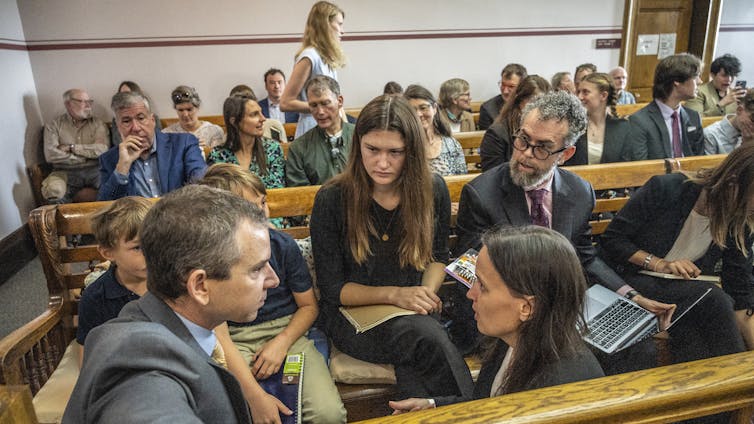
Young Montanans, including Rikki Held, center, sued their state government and won a key ruling forcing the state government to consider greenhouse gas emissions when reviewing proposed development projects. William Campbell/Getty Images
An ancient legal principle has become a key strategy of American children seeking to reduce the effects of climate change in the 21st century. A defeat at the U.S. Supreme Court in March 2025 has not stopped the effort, which has several legal actions continuing in the courts.
The legal basis for these cases is called the “public trust doctrine,” the principle that certain natural resources – historically, navigable waters such as lakes, rivers and streams and the lands under them – must be maintained in government ownership and held in trust for present and future generations of the public.
For the past decade, a nonprofit called Our Children’s Trust has argued for a 21st-century interpretation of the public trust doctrine to support lawsuits against state and federal agencies and officials, seeking to force them to take specific actions to fight climate change. Our Children’s Trust has focused on children, saying they are particularly vulnerable to the effects of climate change because their futures, which the public trust doctrine protects, will be lived in an unsafe and unhealthy climate unless governments take action. Children around the world have filed similar lawsuits against their governments on alternate legal grounds, including claims of constitutional and human rights violations.
Initial uses of the public trust doctrine in the US
The U.S. Supreme Court first endorsed the public trust doctrine in 1892, when it ruled that the doctrine prevented the Illinois legislature from selling virtually the entire Chicago harbor in Lake Michigan to a private railroad company. In the 20th century, state courts have ruled that the doctrine bars states and local governments from selling off lakefront property or harbors to private owners and protects public access to beaches, lakes and oceans.
The public trust doctrine had little to do with environmental protection until the 1970s, however, after law professor Joseph Sax wrote an influential article arguing that the doctrine could form the basis for lawsuits to protect water and other natural resources from pollution, destruction and other threats.
Over the past five decades, some states’ courts have expanded the public trust doctrine’s application beyond access to water-based resources, ruling it can also require governments to protect parks and wildlife from development. And Montana, Minnesota and several other states followed Sax’s recommendation to pass laws or amend their state constitutions to impose broader obligations on states to protect natural resources.
In 2011, Our Children’s Trust argued for the first time that governments had a legal obligation to protect the atmosphere as a public trust resource. The group filed lawsuits in all 50 states on behalf of children. Most state courts dismissed the lawsuits quickly, holding that there were no court decisions in their states that supported extending the public trust doctrine to claims involving the climate or the atmosphere.
In 2015 the group filed a similar lawsuit in federal court in Oregon, this time against the federal government. That lawsuit, Juliana v. United States, alleged that the federal government’s inaction to address climate change violated the public trust doctrine as well as the 21 young plaintiffs’ rights to life, liberty and property under the U.S. Constitution.
The plaintiffs asked the court to order the federal government to prepare an inventory of U.S. carbon dioxide emissions and to implement a national plan to phase out fossil fuels to “stabilize the climate system and protect the vital resources on which Plaintiffs now and in the future will depend.”
Since the initial wave of litigation, Our Children’s Trust has continued to file lawsuits to force governments to address climate change. These newer ones are more narrowly tailored to state-specific constitutional and statutory provisions that protect environmental and public trust resources. And, so far, they have been more successful.
The plaintiffs won at trial, and in a landmark opinion in 2024 the Montana Supreme Court upheld the trial court’s finding that greenhouse gases were harmful to the state’s “climate, rivers, lakes, groundwater, atmospheric waters, forests, glaciers, fish, wildlife, air quality, and ecosystem.” The court similarly found that “a stable climate system … is clearly within the object and true principles” of the state’s constitution.
Children in Hawaii filed a similar lawsuit in 2022 against the state Department of Transportation, alleging that its failure to reduce transportation emissions in the state violated the state public trust doctrine and the state’s constitution. The lawsuit relied on Hawaii courts’ previous rulings that the state’s public trust doctrine and state constitution broadly protect natural resources for present and future generations. In 2024, days before trial was to begin, the parties reached a landmark settlement in which the state agreed to take concrete actions to significantly reduce greenhouse gas emissions from the transportation sector. https://www.youtube.com/embed/VjHqeNB89L0?wmode=transparent&start=0 In the Montana lawsuit, a U.S. court ruled that the government had failed to protect the rights of children by failing to take action to reduce or prevent climate change.
The road ahead
Looking back, it was perhaps not surprising that a one-size-fits-all nationwide legal strategy based on a doctrine that varies widely state by state would face long odds. But the public trust doctrine itself has been historically incremental, expanding and contracting as society and the needs of its citizens change over time. And Our Children’s Trust has several cases still pending, including in Alaska and Utah state courts, and in a federal court in California.
The campaign’s successes broke new legal ground: Montana courts held the first trial in the United States that examined evidence of the effects of climate change and states’ obligations to address them. The Hawaii settlement set concrete benchmarks and included provisions for continued feedback on state policies by the youth plaintiffs.
More broadly, Our Children’s Trust’s campaign demonstrates that a combination of legal advocacy and nationwide publicity over the plight of young people in a rapidly changing climate have the potential to result in real change, both in the law and in public perception of the importance of addressing climate change.
The “Bonita Peak Mining District” superfund site. Map via the Environmental Protection Agency
Click the link to read the article on The Durango Herald website (Reuben M. Schafir) Here’s an excerpt:
April 29, 2025
The Bureau of Land Management is restoring up to 11 cubic feet per second of water previously diverted to the Uncompahgre River Basin back to the headwaters of the Animas River north of Silverton. That’s a win for fish, other aquatic wildlife and mining remediation, said Trout Unlimited’s Mining Coordinator Ty Churchwell, because the water will dilute heavy metals to less toxic concentrations. Both the national organization of Trout Unlimited and the local Five Rivers chapter provided financial assistance with the acquisition. The 11-cubic-foot diversion is about 10% of the river’s total current flows in Silverton before the confluence with Cement Creek…
The previous owner held the rights to divert the water through the Mineral Point Ditch – before it entered Burrows Creek – over into the Uncompahgre Basin for agricultural use. This resulted in a 100% depletion of that water from the Animas River…The BLM paid $297,000 – fair market value – to buy the water right from a willing seller, agency spokeswoman Katie Palubicki said in an email to The Durango Herald, using funding from the Land and Water Conservation Fund and the agency’s Abandoned Mine Lands program to acquire the right.