From email from the Upper Gunnison River Water Conservancy District (Sue Uerling):
Please see the attached notice for the May Upper Gunnison River Water Conservancy District and Lake San Cristobal Water Activity Enterprise Meetings in Lake City, Colorado on Tuesday, May 20th, 2025 with lunch beginning at noon. If you would like to join the meeting via Zoom, please use the following link to pre-register for the meeting:
President Donald Trump and his team have signaled a strong interest in continuing to strengthen federal support for nuclear power, an energy source Democratic states are increasingly open to expanding.
The administration’s loudly pro-nuclear position creates a rare point of overlap between Trump and his predecessor, Joe Biden, whose signature legislation funded hundreds of millions in tax credits for low-carbon energy sources, including nuclear power.
Trump during his first roughly three months in office issued multiple executive orders mentioning nuclear energy, casting his broad energy strategy as a way to expand the country’s power resources and shore up its security. State lawmakers are also pushing their own policy moves, sometimes just in an effort to set themselves up to embrace nuclear power at some point in the future.
“There are a lot of really positive signals,” said Rowen Price, senior policy adviser for nuclear energy at Third Way, a centrist policy think tank.
Nuclear in Colorado
From Colorado Newsline
A new law that Colorado state leaders enacted this year, House Bill 25-1040, designates nuclear energy as clean. That means utilities can meet clean-energy targets with nuclear power, and it also allows private projects access to financing that’s earmarked for clean energy development.
But Price said she’s concerned that support for nuclear power could be swept up in bigger political fights, such as many congressional Republicans’ goal of axing clean-energy tax credits in Democrats’ 2022 Inflation Reduction Act. The administration’s broad cuts to the federal workforce could also eventually hurt the government’s nuclear ambitions, she added.
The promise of a nuclear resurgence in the United States isn’t a new goal for the industry or its backers in Washington, D.C., but how successful efforts to expand nuclear power generation will be in the U.S. — a metric that hasn’t budged from around 20% in decades — remains to be seen.
Americans’ support for the energy source, meanwhile, is just short of its record high, a recent Gallup Poll found. And more blue states have also started to embrace nuclear power, which has traditionally been more favored by Republicans, to reach climate goals and grow electricity capacity amid anticipated increases in demand.
But even as interest in states grows, the cost of building nuclear infrastructure remains an impediment only the federal government is positioned to help scale.
‘Renaissance of nuclear’
Energy Secretary Chris Wright in April talked about the administration’s desire to elevate nuclear power by making it easier to test reactors, delivering fuel to next-generation nuclear firms and utilizing the department’s Loan Programs Office to help bring nuclear power projects online.
“We would like to see a renaissance of nuclear,” Wright said at the news outlet Semafor’s World Economy Summit in Washington. “The conditions are there and the administration is going to do everything we can to lean in to help commercial businesses and customers launch nuclear.”
The Palisades Nuclear Plant in Covert, Michigan. (U.S. Nuclear Regulatory Commission photo)
Wright said he wants the department to help launch 10 to 20 new nuclear reactors to get the industry moving again and to bring down costs. The department’s loan office could make debt investments alongside large-scale data center companies that use massive amounts of power to build nuclear projects and then exit those deals after the projects are built, allowing the office to recycle that funding, he said.
The department recently announced that it approved a third loan disbursement to reopen the Palisades Nuclear Plant in Covert, Michigan, which Holtec has been working on doing for the last few years.
Last month, the department said it was reopening $900 million in funding to help companies working on small modular reactors after changing some of the Biden administration’s guidance on the program.
Federal workforce cuts
Third Way’s Price noted that a portion of staffers at the Nuclear Regulatory Commission — which she described as already “tightly constrained” — are eligible for retirement either now or in the next five years.
Workforce cuts at the Energy Department and elsewhere could also hurt efforts to grow the nuclear power sector, she said.
“Frankly, all of the verbal support from this administration for nuclear only matters if they’re actually going to put forward and implement policies that support it,” Price said. “We need to make sure that they do it.”
An Energy Department spokesperson said in an email that it “is conducting a department-wide review to ensure all activities follow the law, comply with applicable court orders and align with the Trump administration’s priorities.”
The agency said it didn’t have a final count on how many staffers have left the department through its resignation program, but noted that it doesn’t necessarily approve all requests. The department didn’t comment on how many staffers focused on nuclear energy have been laid off.
Nuclear programs were among those affected by the Trump administration’s pausing of federal programs and funding, said David Brown, senior vice president of federal government affairs and public policy at Constellation Energy, which runs the biggest fleet of nuclear plants in the country. But Brown said that even so, the industry is coming out on top.
“I think what we are seeing is that as they work through their various review(s) of programs that they’re greenlighting the nuclear stuff,” Brown said.
Federal support crucial, but politics tricky
Lawmakers on Capitol Hill could also change the outcome for industry, for better or worse.
Wright, in his remarks last month, said he hopes Congress will take action to help expand nuclear energy, and said lawmakers could do so in the budget reconciliation package on which the U.S. House has started to work.
Republican House members have not yet released text of the sections of the package that will deal with energy policy. Wright said support for nuclear power could be included in the reconciliation package, but some advocates are also worried that the package, or the annual appropriations bills, are the exact kind of political battles that efforts to support nuclear power, like the tax credits, could get tied up in.
Some state lawmakers point to financial support from the federal government as essential for the industry to grow, even if states make their own headway to build support for nuclear power.
Colorado state Rep. Alex Valdez, a Democrat who sponsored a bill signed into law this session to include nuclear in the state’s definition of clean energy, said he hopes the administration follows through on its admiration of nuclear power with funding for states.
“Generally, states do not have the financial resources the federal government does,” Valdez said. “It’s going to be the federal government that puts their investments behind these things, and that’s what’s going to enable states as a whole to be able to move forward on them.”
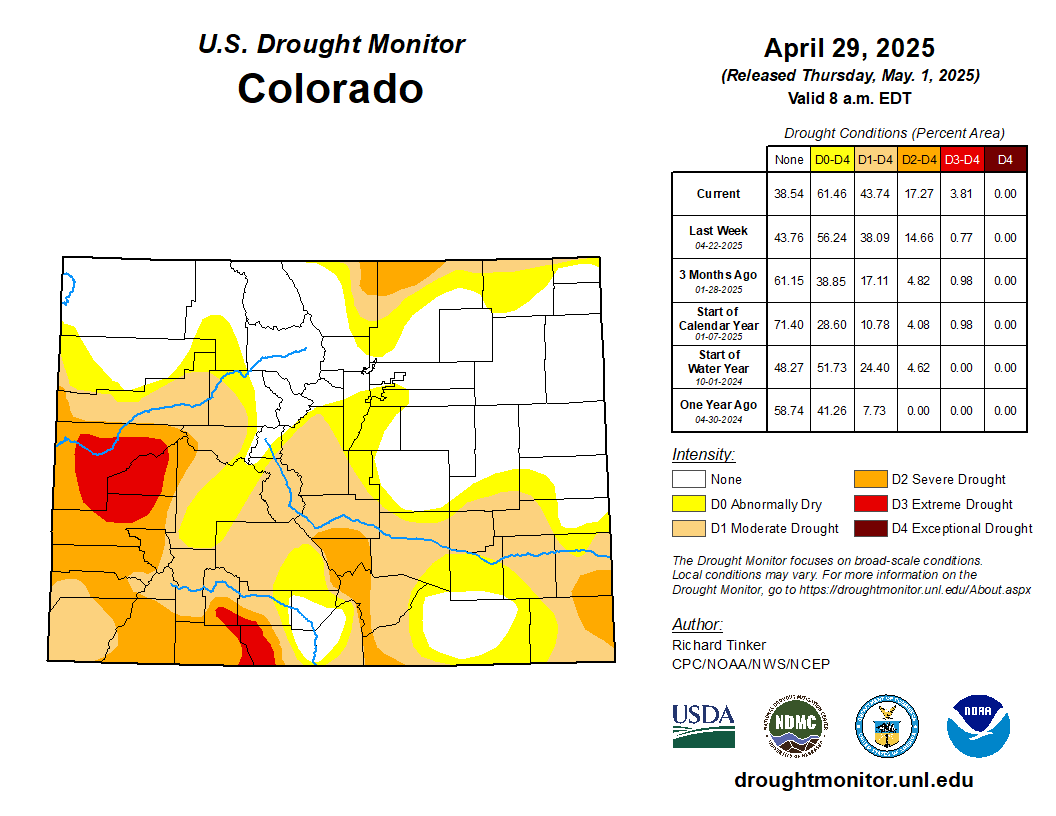
Aerial images of the Gunnison Basin revealed that much of the rolling lowlands had already melted out by the end of March. With warmer-than-usual temperatures lingering most of April, the high country is also on track for a speedy melt, triggering the potential for a short water supply this summer. Snowfall was sporadic across much of the valley and Colorado this winter.
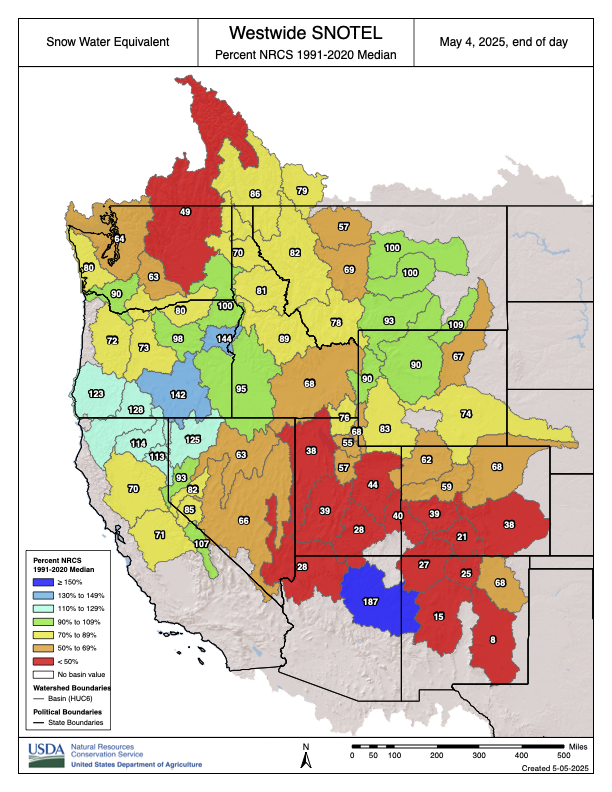
Westwide SNOTEL basin-filled map May 4, 2025 via the NRCS.
According to the Natural Resources Conservation Service, on April 30 snowpack statewide is 57% of normal, with the southwestern portion of the state faring far worse than its northern neighbors. These are the lowest snowpack levels for this time of year since the 2014-15 water year. Marked on the map in hues of red and orange — signaling a drought is in place — the snowpack this week in the Gunnison Basin sat at 47% of normal, the Upper Rio Grande at 23% and the San Miguel-Dolores-Animas-San Juan at 28%. There is little moisture in the current forecast, and the NOAA Climate Prediction Center outlook continues to show a warm and dry spring.. Winter 2024-25 started off with momentum with a huge early-season storm around Thanksgiving. Headed into the spring runoff season, near- to above-normal soil moisture conditions were also present in the Gunnison Basin, Cody Moser said during a water supply update on April 24. Moser is a senior hydrologist with the Colorado Basin River Forecast Center. Positive soil moisture conditions impact the water supply outlook as these areas can expect increased runoff. But over the last four months, the valley dried out, Moser said. Precipitation levels October through March across the Gunnison Basin were 88% of the 30-year average (this spans from 1991-2020, some of the driest years on record). December was by far the worst, at 48% of average. The arrival of spring brought no relief. The dry trend continued in April and brought record-high temperatures. The heat resulted in an early melt, draining some of the high-altitude areas that usually hang onto snow much later in the season.
According to the 10-day forecast the melt is expected to pick up this week. Water supply projections across the Gunnison River Basin are below normal, ranging from between 50-80% of average. At Blue Mesa Reservoir, projections show an inflow of just under 500,000 acre-feet of water as the snow melts. This runoff year falls into the “moderately dry” category, similar to 2020 and 2022. Blue Mesa is currently 61% full, and is expected to fill to 80%.
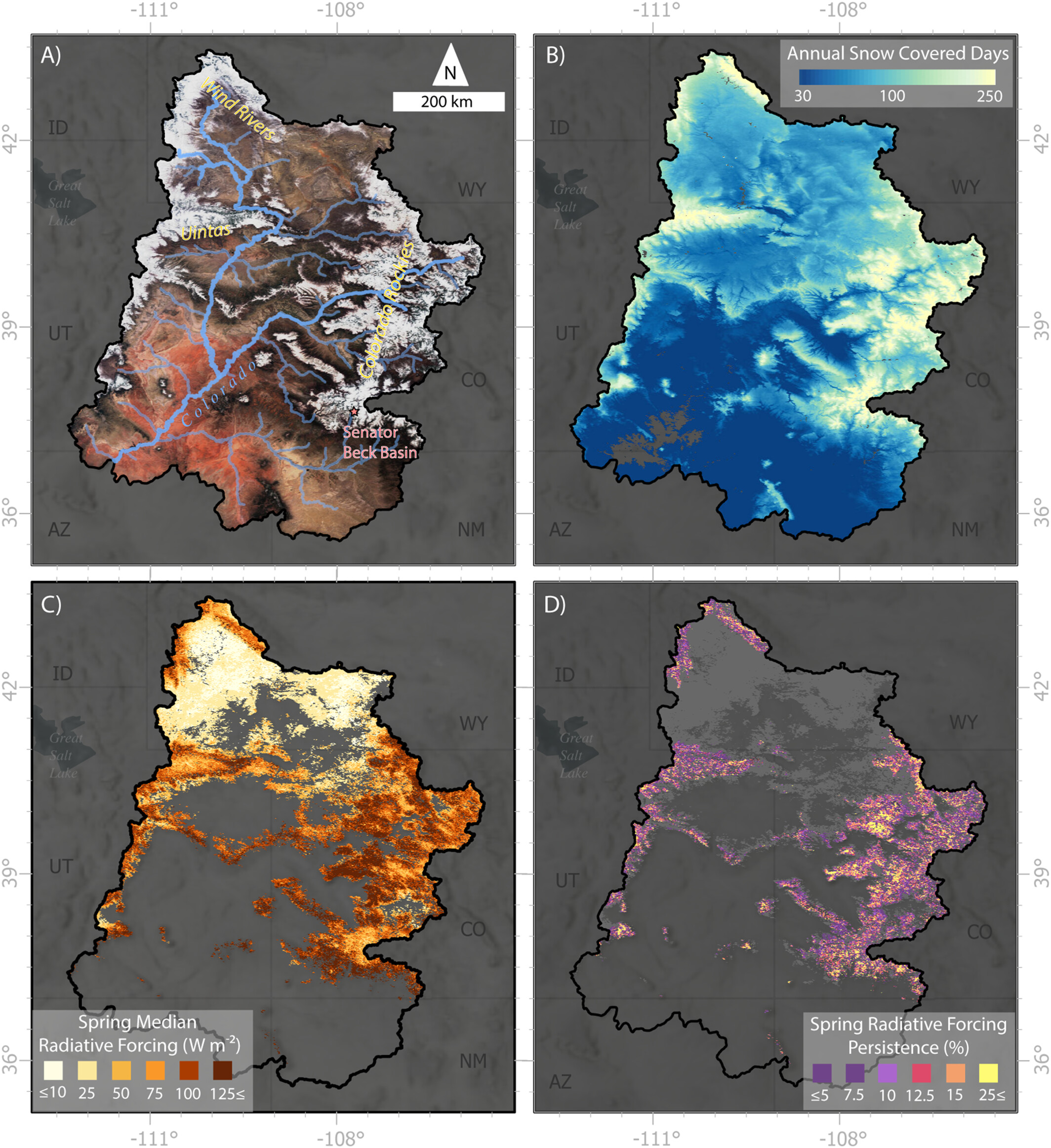
Overview maps of the Upper Colorado Basin (UCRB), outlined in black. (a) The major UCRB waterways overlaid on satellite imagery from April 2022 visualizing typical extent of springtime snow cover. Over the MODIS record, (b) annual snow covered days visualizing extent and duration of snow cover, (c) spring RFdust, and (d) persistence of RFdust (% of time above 50 Wm−2).
Click the link to read the letter on the AGU website (Patrick Naple, S. McKenzie Skiles, Otto I. Lang, Karl Rittger, Sebastien J. P. Lenard, Annie Burgess, Thomas H. Painter). Here’s an excerpt:
Abstract
In the mountainous headwaters of the Colorado River episodic dust deposition from adjacent arid and disturbed landscapes darkens snow and accelerates snowmelt, impacting basin hydrology. Patterns and impacts across the heterogenous landscape cannot be inferred from current in situ observations. To fill this gap daily remotely sensed retrievals of radiative forcing and contribution to melt were analyzed over the MODIS period of record (2001–2023) to quantify spatiotemporal impacts of snow darkening. Each season radiative forcing magnitudes were lowest in early spring and intensified as snowmelt progressed, with interannual variability in timing and magnitude of peak impact. Over the full record, radiative forcing was elevated in the first decade relative to the last decade. Snowmelt was accelerated in all years and impacts were most intense in the central to southern headwaters. The spatiotemporal patterns motivate further study to understand controls on variability and related perturbations to snow water resources.
Key Points
Spatiotemporal patterns in dust on snow radiative forcing and melt contribution assessed over the MODIS period of record
Dust darkens snow every year and impacts were generally higher in the first half of the record
The dust on snow radiative impacts accelerate snowmelt every spring with relevant melt contribution even in lower magnitude years
Plain Language Summary
Seasonal melt from mountain snowpacks dominates water resource availability in the Upper Colorado River Basin (UCRB). The mountainous Colorado River headwaters are adjacent to arid regions that regularly emit dust that darkens the snow. Darker snow melts earlier and faster due to the snowpack absorbing more of the sun’s energy. This study uses 23 years of daily remotely sensed images to observe patterns in dust on snow impacts during the melt season across the UCRB. Results showed that impacts were greatest in the central-southern Rocky Mountains at mid-alpine elevations. Over time, snow darkening and accelerated melt were generally higher in the first half of the record with a slight declining trend across the full record. However, dust contributed to accelerating melt every spring over the record. Results suggest the need for further study to understand what controls dust on snow variability and magnitude of impact from year to year.