
Click the link to read the letter on the AGU website (Patrick Naple, S. McKenzie Skiles, Otto I. Lang, Karl Rittger, Sebastien J. P. Lenard, Annie Burgess, Thomas H. Painter). Here’s an excerpt:
Abstract
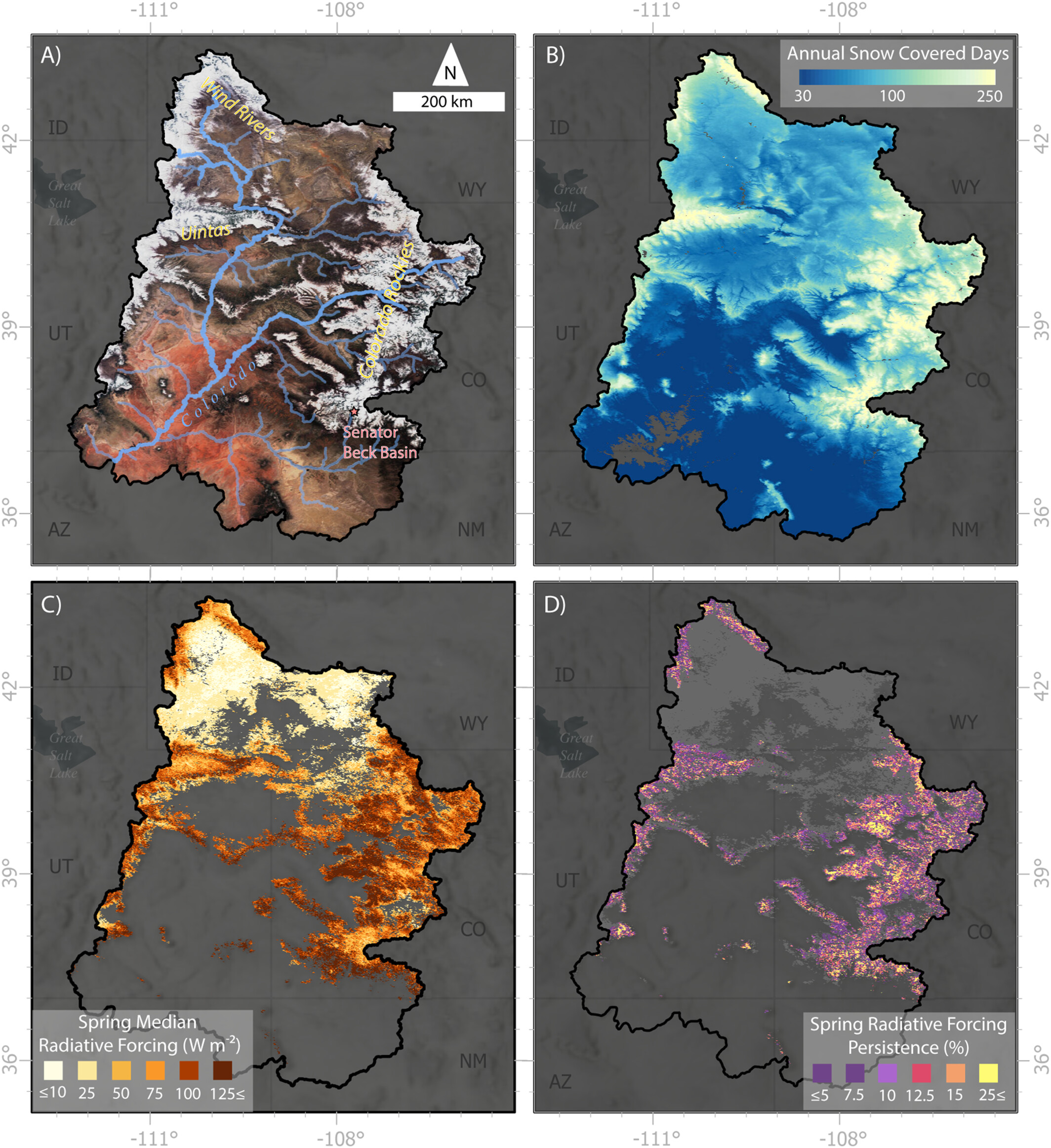
In the mountainous headwaters of the Colorado River episodic dust deposition from adjacent arid and disturbed landscapes darkens snow and accelerates snowmelt, impacting basin hydrology. Patterns and impacts across the heterogenous landscape cannot be inferred from current in situ observations. To fill this gap daily remotely sensed retrievals of radiative forcing and contribution to melt were analyzed over the MODIS period of record (2001–2023) to quantify spatiotemporal impacts of snow darkening. Each season radiative forcing magnitudes were lowest in early spring and intensified as snowmelt progressed, with interannual variability in timing and magnitude of peak impact. Over the full record, radiative forcing was elevated in the first decade relative to the last decade. Snowmelt was accelerated in all years and impacts were most intense in the central to southern headwaters. The spatiotemporal patterns motivate further study to understand controls on variability and related perturbations to snow water resources.
Key Points
- Spatiotemporal patterns in dust on snow radiative forcing and melt contribution assessed over the MODIS period of record
- Dust darkens snow every year and impacts were generally higher in the first half of the record
- The dust on snow radiative impacts accelerate snowmelt every spring with relevant melt contribution even in lower magnitude years
Plain Language Summary
Seasonal melt from mountain snowpacks dominates water resource availability in the Upper Colorado River Basin (UCRB). The mountainous Colorado River headwaters are adjacent to arid regions that regularly emit dust that darkens the snow. Darker snow melts earlier and faster due to the snowpack absorbing more of the sun’s energy. This study uses 23 years of daily remotely sensed images to observe patterns in dust on snow impacts during the melt season across the UCRB. Results showed that impacts were greatest in the central-southern Rocky Mountains at mid-alpine elevations. Over time, snow darkening and accelerated melt were generally higher in the first half of the record with a slight declining trend across the full record. However, dust contributed to accelerating melt every spring over the record. Results suggest the need for further study to understand what controls dust on snow variability and magnitude of impact from year to year.