
Click the link to read the article on the Summit Daily website (Ryan Spencer). Here’s an excerpt:
August 9, 2025
Colorado state climatologist says the weather has been hot and the monsoon season weak, with little signs of relief anytime soon
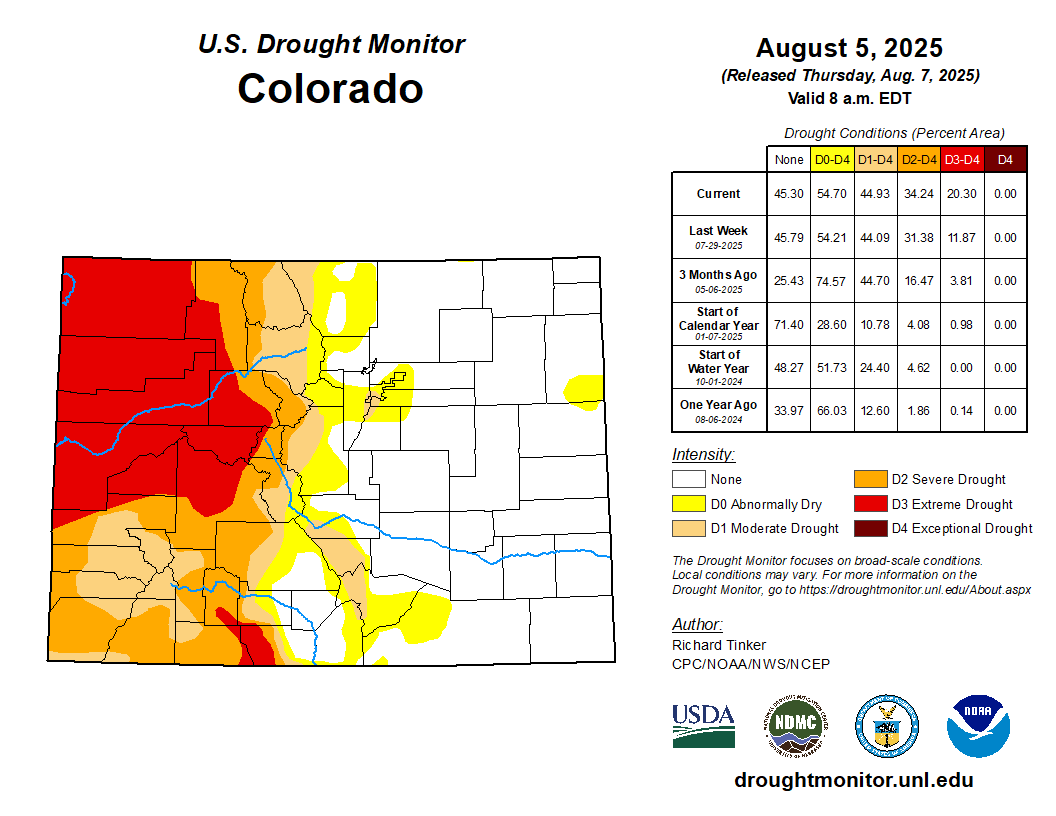
Drought conditions are getting worse on Colorado’s Western Slope, increasing the risk of wildfires, even as several large fires are already burning, scorching thousands of acres and forcing evacuations. Colorado State Climatologist Russ Schumacher said the extended dry period on the Western Slope contains “echoes” of the climate patterns in 2020, the worst wildfire season in Colorado history, when the three largest wildfires recorded in the state occurred…Like 2020, this summer has been hot, with above-average temperatures across much of the Western Slope, Schumacher said. The monsoon season has also been lackluster, with little precipitation and hot, dry weather coming on the heels of a winter with a poor snowpack. This June and July were among the 10 hottest on record in the northwestern corner of the state, where some of the largest wildfires are now raging, according to the Colorado Climate Center at Colorado State University. While the southern mountains got above-average precipitation in June, things remained dry in the northwest, where precipitation was less than 50% of average. In July, precipitation was below-average across the entire Western Slope…Extreme drought is now impacting all of Moffat, Rio Blanco, Garfield, Pitkin, Teller and Delta counties and part of Eagle County, according to the U.S. Drought Monitor. Severe drought has spread east into Summit, Routt and Lake counties and across the southwestern part of the state…
Lightning has sparked several wildfires in Colorado, including wildfires burning in the northwest near Meeker, in the southwest near Gatewayand in the Black Canyon of the Gunnison National Park, according to InciWeb.Wildfire.gov. Over the past week, high winds and low relative humidity that dries out vegetation have been stacked on top of the heat, leading to red flag warnings across the Western Slope and fueling extreme fire behavior. After lightning sparked the Lee Fire in Rio Blanco County on Aug. 2, it exploded to more than 58,700 acres — making it the eighth largest wildfire in the state’s history — in just six days as high winds allowed the fire to surge through dry vegetation.