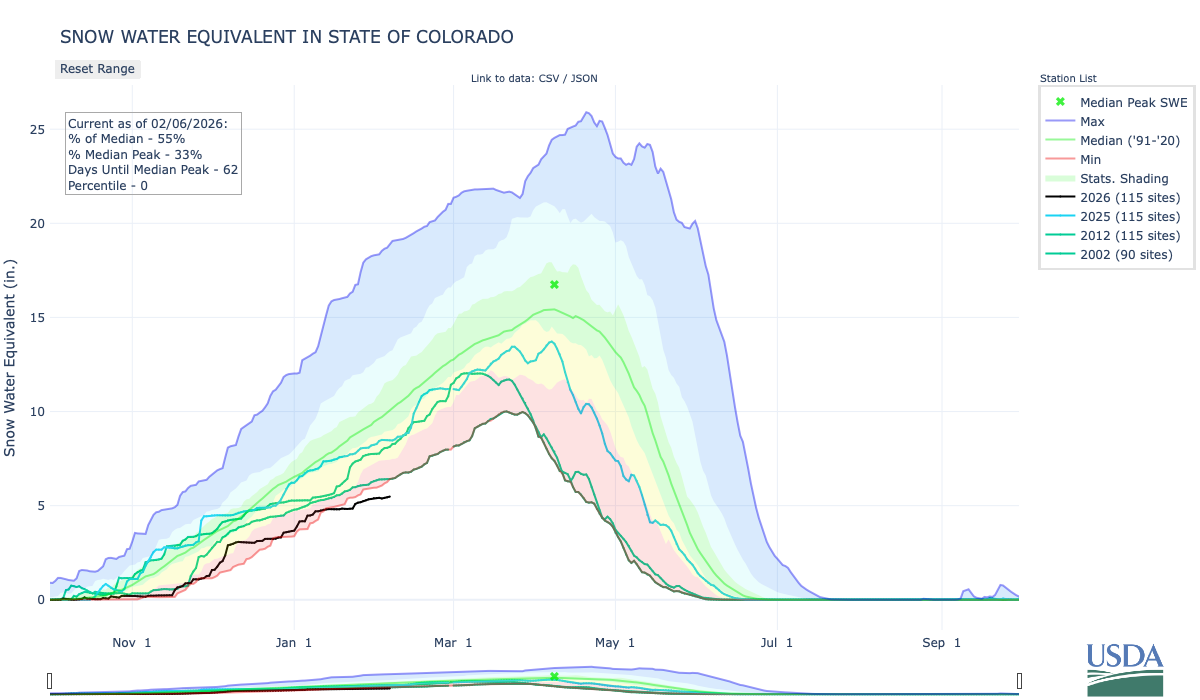
Colorado’s snowpack has remained at the zeroth percentile since about Jan. 15, 2026. While this snow telemetry data shows a record-low snowpack, longer term snow course measurements show the years of 1976-77 and 1980-81 may have been worse. Credit: NRCS
Click the link to read the article on The Aspen Times website (Ryan Spencer). Here’s an excerpt:
February 6, 2026
At some long-term snow measurement sites, the winters of 1976-77 and 1980-81 were worse than this year, but not by much
Across Colorado, the state’s array of snow telemetry, or SNOTEL systems, have documented record-low snowpack conditionsin numerous river basins and on a statewide level several times this winter. Since about Jan. 15, the snow telemetry system has had Colorado’s snowpack statewide sitting at the zeroth percentile, or the worst on record compared to the 30-year period from 1991 to 2020…
“We’ve been stuck for the most part in this warm and dry pattern across the West, going back really to the fall,” Colorado Climatologist Russ Schumacher said. “The snowpack numbers pretty much everywhere in Colorado are pretty ugly right now.”
Denver Water crews use a special tube [Federal Sampler] to gather snow samples near Winter Park as part of pre-set snow courses. Photo credit: Denver Water.
But going back in Colorado’s history, 1976-77 and 1980-81 are two winters often considered “the worst” for snow. Schumacher noted that the state’s snow telemetry system only began to be built out in the 1980s, so comparison can be difficult. That’s where snow course measurements come in. Snow course measurements, which have been taken by hand about once a month at some sites in Colorado since the 1930s, allow for more direct comparisons to those historically bad snow years.
“That allows you to actually make some comparisons to those really, really awful years from the 76-77, 80-81 that the longtimers there in the mountains will remember,” he said. “This year’s not as bad as those, but in a lot of places, it’s the second or third worst when you include those years.”
At Independence Pass, one site where snow course measurements have been taken for well over half a century, this is the second-worst snowpack on record, according to the data. The only year when Independence Pass had a worse snowpack was the winter of 1976-77. At a snow course measurement site in Blue River in Summit County that has about 70 years of data, this year was also the second-lowest snowpack on record, behind only the winter of 1980-81…Yet, at a snow course measurement site at Berthoud Pass, this year is only the 12th worst on record. The worst February snowpack on record at Berthoud Pass was, once again, during the winter of 1980-81.
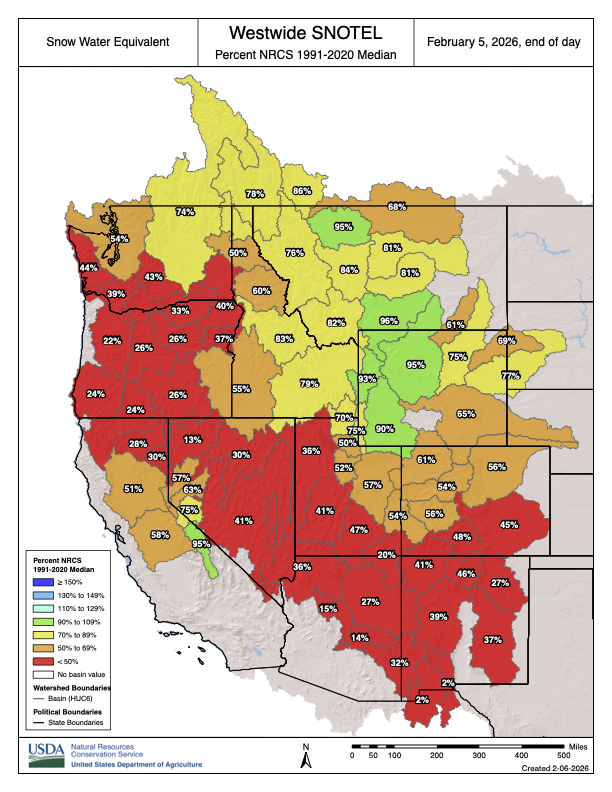
Westwide SNOTEL basin-filled map February 5, 2026.
There is another emerging issue that decades of drought and the warming climate is causing in the San Luis Valley – elevated levels of heavy metals in drinking wells that can cause health issues for households that rely on them.
It’s a topic Kathy James, Ph.D., and associate professor with the Colorado School of Public Health, knows well after spending the past three years working with families in the Valley that rely on private drinking wells.
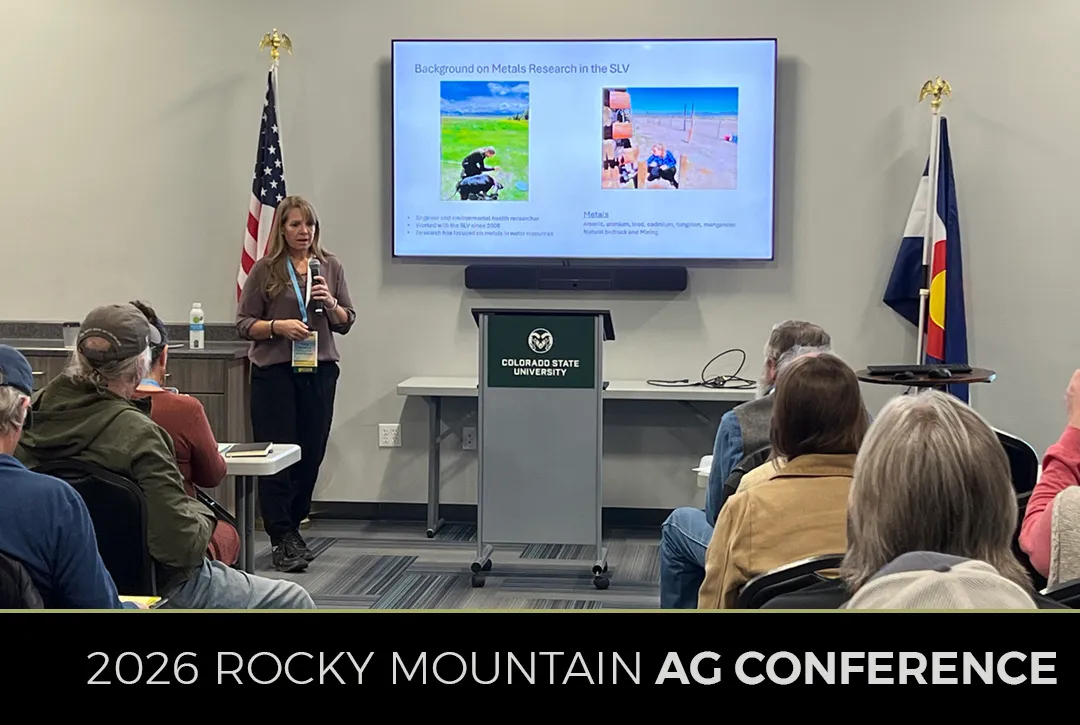
James provided an update to the work during Tuesday’s opening day of the 2026 Southern Rocky Mountain Ag Conference. She reported that 15 to 25 percent of the private groundwater wells used for drinking water in the San Luis Valley contain elevated levels of arsenic, uranium and other heavy metals.
Her confidence in the findings is bolstered by the fact that 850 households in the different counties of the Valley participated in the study and provided samples to help James and her team evaluate the effect drought is having on water quantity and water quality.
“The comprehensive information that we have about distribution of metals across the Valley is by far one of the best we’ve seen in most western states that do experience elevated metals,” James said.
She noted how low snowpack impacts the age of water underground and ultimately the quality of water people are drinking from a private well.
The Upper Rio Grande Basin, like the Colorado River, is suffering from snow droughtsin the high elevations of the west and below-normal spring runoff levels.
Less snow, less spring runoff for recharge of the aquifers, and higher levels of arsenic, uranium and other heavy metals is the emerging issue. James talks more about the study and the team’s findings in the next episode of The Valley Pod, which streams Wednesday on AlamosaCitizen.com.
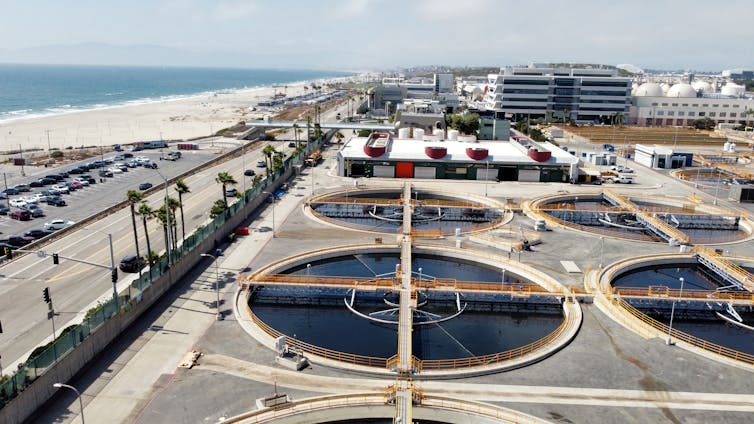
Under pressure to provide water for drinking and irrigation, people around the globe are trying to figure out how to save, conserve and reuse water in a variety of ways, including reusing treated sewage wastewater and removing valuable salts from seawater.
But for all the clean water they may produce, those processes, as well as water-intensive industries like mining, manufacturing and energy production, inevitably leave behind a type of liquid called brine: water that contains high concentrations of salt, metals and other contaminants. I’m working on getting the water out of that potential source, too.
However, most of these methods require strict environmental protections and monitoring strategies to reduce harm to the environment.
For instance, the extremely high salt content in brine from desalination plants can kill fish or drive them away, as has happened increasingly since the 1980s off the coast of Bahrain.
Brine injected into the earth in Oklahoma, including into wells used for hydraulic fracking of oil and natural gas, was one of several factors that led to a 40-fold increase in earthquake activity in the five-year period from 2008 to 2013, as compared to the preceding 31 years. And wastewater has been documented to leak from the underground wells up to the surface as well.
Researchers like me are increasingly exploring brine’s potential not as waste but as a source of water – and of valuable materials, such as sodium, lithium, magnesium and calcium.
Currently, the most effective brine reclamation methods use heat and pressure to boil the water out of brine, capturing the water as vapor and leaving the metals and salts behind as solids. But those systems are expensive to build, energy-intensive to run and physically large.
Other treatment methods come with unique trade-offs. Electrodialysis uses electricity to pull salt and charged particles out of water through special membranes, separating cleaner water from a more concentrated salty stream. This process works best when the water is already relatively clean, because dirt, oils and minerals can quickly clog or damage the membranes, reducing the performance of the equipment.
Membrane distillation, in contrast, heats water so that only water vapor passes through a water-repelling membrane, leaving salts and other contaminants behind. While effective in principle, this approach can be slow, energy-intensive and expensive, limiting its use at larger scale.
A trailer containing a small water reclamation system. Mervin XuYang Lim, CC BY-SA
A look at smaller, decentralized systems
Smaller systems can be effective, with lower initial costs and quicker start-up processes.
At the University of Arizona, I am leading the testing of a six-step brine reclamation system known as STREAM – for Separation, Treatment, Recovery via Electrochemistry and Membrane – to continuously reclaim municipal brine, which is salty water left over from sewage treatment.
The system combines conventional methods such as ultrafiltration, which removes particles and microbes using fine filters, and reverse osmosis, which removes dissolved salts by forcing water through a dense membrane, alongside an electrolytic cell – a method not typically employed in water treatment.
Our previous study showed that we can recover usable quantities of chemicals such as sodium hydroxide and hydrochloric acid at one-sixth the cost of purchasing them commercially. And our initial calculations indicated the integrated system can reclaim as much as 90% of the water, greatly reducing the volume of what remains to be disposed. The cleaned water in turn is suitable for drinking after final disinfection using ultraviolet or chlorine.
We are currently building a larger pilot system in Tucson for further study by researchers. We hope to learn if we can use this system to reclaim other sources of brine and study its efficacy in eliminating viruses and bacteria for human consumption.