
by Robert Marcos, photojournalist
The Gold King Mine spill happened on August 5, 2015, when EPA contractors accidentally released approximately 3 million gallons of contaminated wastewater into Cement Creek – a tributary of the Animas River in Colorado. The plume, containing heavy metals, flowed into the Animas and San Juan rivers. 1 The USGS – in cooperation with the EPA, gathered streamgage data in order to confirm the origin of the stream flow spike at Cement Creek and the volume of the spike estimated at three million gallons. USGS also took water and sediment samples and provided both current and historical water quality data to EPA.2
Four months later during her address to a House Committee on Natural Resources, the Secretary of the Interior Sally Jewell said, “As is so often the case, it is unfortunate that an incident like this has to happen to highlight an issue that land managers in both the state and federal governments have been grappling with for years – that addressing abandoned mine lands is a nationwide problem, and mitigating toxic substances released from many of them is a significant undertaking. Abandoned mine lands are located on private, state, federal, and tribal lands. There are tens of thousands of abandoned hardrock sites on federal lands alone. Many of these abandoned mine land sites were mined prior to the implementation of federal surface management environmental laws that require reclamation and remediation to take place. For those mine sites where no viable potentially responsible party can be determined, the federal government, and ultimately the taxpayer, often bears the burden of addressing these threats to public safety, human health, the environment, and wildlife, rather than the entities that developed and profited from the operations.”3
In 2018 the U.S. Geological Survey, the Utah Department of Environmental Quality, U.S. Bureau of Reclamation, and National Park Service, initiated the Lake Powell Coring Project.4 Its purpose was to retrieve and analyze hydraulic piston cores from Lake Powell sediments—primarily targeting the San Juan River delta—to reconstruct the history of sediment and contaminant deposition, including assessing whether material from the 2015 Gold King Mine spill had been sequestered there. Cores taken from 40 holes penetrated up to the pre-Glen Canyon Dam surface to evaluate metal concentrations, distribution, and bioavailability for water quality impacts.5
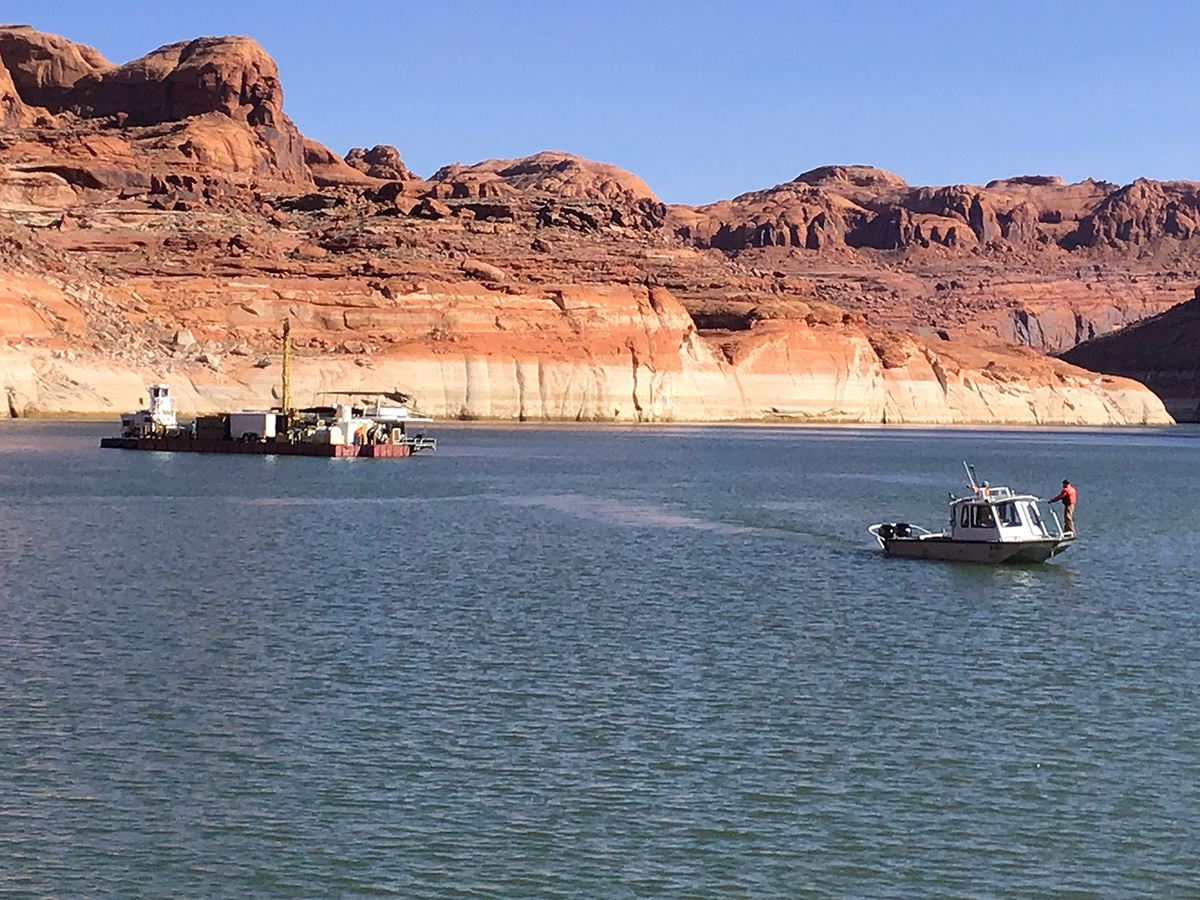
Preliminary results shared by USGS scientists in late 2021 shared significant findings: while the 2015 Gold King Mine spill caused detectable spikes in lead and zinc, much larger and “more concerning” spikes were identified from mining waste disasters that occurred in the 1970s. The following contaminants were found in core samples:6
Lead: Found in significant spikes, particularly in deeper sediment layers corresponding to mid-20th-century mining disasters.
Zinc: Often found in conjunction with lead; used as a primary indicator of mine waste runoff.
Arsenic: A major concern in the San Juan River delta, often naturally occurring but concentrated by mining processes.
Cadmium: A toxic metal frequently associated with zinc mining that was identified in the core samples.
Copper: Present in the sediment, reflecting the region’s extensive copper mining history.
Mercury: Studied due to its ability to bioaccumulate in the food chain (fish), though much of the mercury in the system is attributed to atmospheric deposition and older mining practices.
Now as Lake Powell’s water levels continue to recede amid prolonged drought and heavy upstream water use, vast expanses of toxic sediments—laden with heavy metals like arsenic, cadmium, copper, mercury, lead, selenium, and zinc from historical mining discharges including the 2015 Gold King spill—are increasingly exposed. This drying creates a heightened risk of human exposure through direct contact during boating, fishing, or shoreline recreation, as well as inhalation of windblown dust carrying bioavailable toxins, potentially leading to respiratory issues, skin irritation, and chronic health effects with repeated exposure. Without expanded monitoring or mitigation measures, these once-submerged hazards now pose an urgent public safety threat to the millions of annual visitors in this popular Southwestern reservoir. 7