
by Robert Marcos
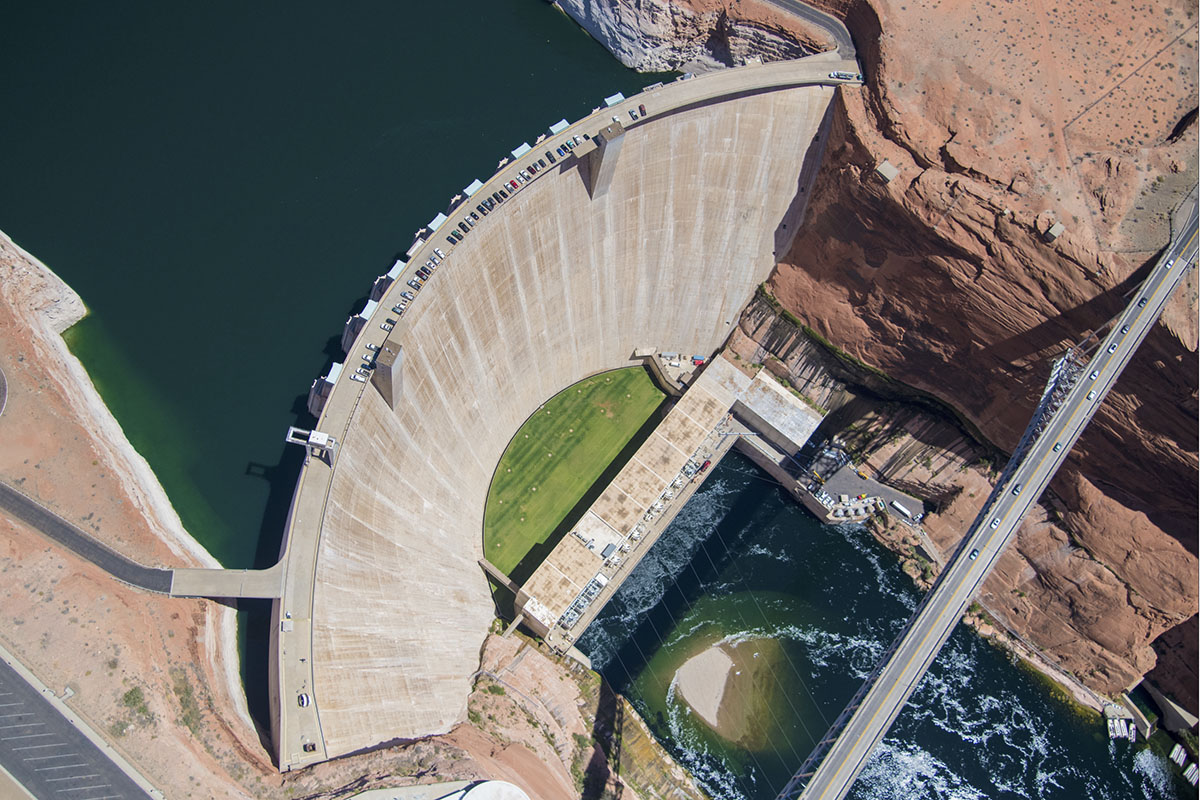
The electrical power that’s being produced by new wind and solar farms cannot fully replace the power being lost as the output of the Glen Canyon Powerplant continues to fall.
As of March 11, 2026, the Powerplant is producing only 60% to 65% of its maximum output. At full capacity the plant can produce 1,320 megawatts. But because of Lake Powell’s low water level it’s currently producing between 800 and 870 megawatts. While new wind and solar power will cushion the impact of Glen Canyon’s decline, the hydroelectric power is a critical component of the regional power grid. Electricity from the Glen Canyon Powerplant is operationally superior to wind and solar mainly because it is dispatchable, highly flexible, and provides critical grid‑stability services that variable renewables cannot provide on their own.
Dispatchability and reliability
Glen Canyon can generate on demand, ramping output up or down quickly to follow load; flows and generation are deliberately increased during weekday business hours to match demand.
Hydropower at Glen Canyon is not dependent on real‑time sun or wind conditions, so it can produce power at night, during calm periods, and in cloudy weather, as long as water is available in Lake Powell.
The plant provides both energy and dependable capacity for resource adequacy, which is essential during extreme heat waves and other system‑stress events when solar and wind output may not align with peak demand.
Flexibility and ramping
Glen Canyon is explicitly operated for load following: its turbines adjust automatic generation control signals to continuously balance supply and demand, so actual output can be above or below the hourly schedule at any moment.
The dam is allowed to fluctuate releases to provide about 40 MW of regulation capacity, with short‑lived flow changes of roughly 1,200 cfs up or down that help stabilize the grid against second‑to‑second and minute‑to‑minute imbalances.
Turbines can ramp thousands of cubic feet per second within an hour (subject to environmental constraints), providing fast ramping that complements slower, weather‑dependent changes in wind and solar output.
Grid‑stability and system services
Conventional hydropower units like those at Glen Canyon provide inertia, frequency regulation, spinning reserve, voltage support, and black‑start capability, all of which are necessary to keep the system stable as variable renewables grow.
These services are inherently available from large synchronous hydro generators without needing extensive additional power‑electronics‑based equipment that wind and solar typically require for similar functions.
Glen Canyon’s participation in automatic generation control helps maintain area control error near zero, directly supporting system frequency and reliability.
Scale, efficiency, and cost characteristics
Glen Canyon has a total capacity on the order of 1,300 MW and produces roughly 4–5 billion kWh per year, enough for hundreds of thousands of households across seven Western states.
Modern hydro units have high conversion efficiency and very long lifetimes (often 50–100 years), which spreads capital costs over decades and yields low long‑run levelized cost of electricity compared with many newer wind and solar plus storage builds.
Revenues from Glen Canyon hydropower also fund environmental and river‑management programs in Glen and Grand Canyons, a co‑benefit not typically associated with individual wind or solar plants.