

by Robert Marcos, photojournalist
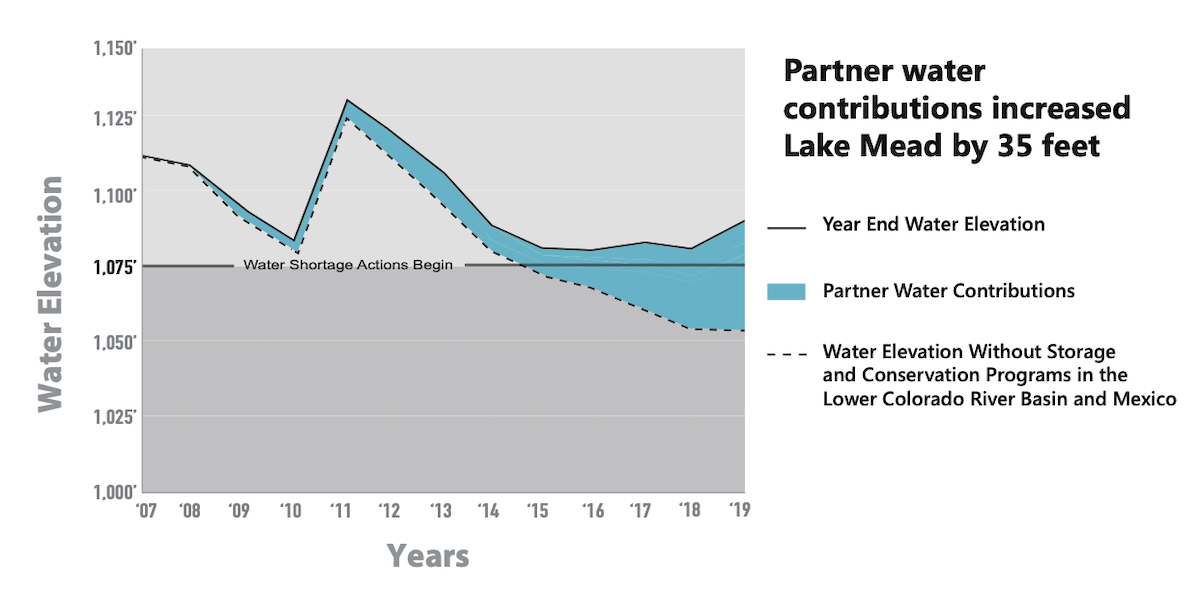
Water that’s banked in Lake Mead is officially called “Intentionally Created Surplus“, or ICS. The ICS allows major water users in the lower basin to store conserved or unused Colorado River water in the reservoir for their future use.
As of May 2026, Lake Mead’s water volume was 8.3 million acre-feet – or roughly a third of its total capacity. But after publishing this article we were made aware that we should subtract Lake Mead’s 2.3 MAF deadpool from that amount, which brings it down to about 6 MAF. Currently the ICS holds about 2.3 million acre feet of that water, which represents about 38% of Lake Mead’s available water.
Here’s a list of the water agencies and the estimated amount of water that each of them have currently banked in Lake Mead –
Arizona: According to official tracking from the USBR and the CAP, the state of Arizona’s total balance of accumulated Intentionally Created Surplus water stored in Lake Mead as of May 15th is approximately 310,000 to 350,000 acre-feet.
California: As of May 2026, California has roughly 1.2 to 1.4 million acre-feet of water banked in Lake Mead through the ICS and other conservation programs. Major participants include the Metropolitan Water District of Southern California, the Imperial Irrigation District, and the Palo Verde Irrigation District.4
Nevada: As of May 2026, Nevada has approximately 479,184 acre-feet of water banked in Lake Mead through the ICS program. This total represents a major portion of Nevada’s overall “water savings account,” which includes several different banking locations and programs.5
Mexico: As of May 2026, Mexico has approximately 200,000 acre feet of water banked in Lake Mead through the ICS program and related binational agreements. Mexico was granted the right to store water in Lake Mead following a 2010 earthquake that damaged its irrigation infrastructure. By 2026, these stored volumes have stabilized at around 200,000 acre-feet as Mexico uses the lake as a buffer against shortages.7
I love this article and this is a question I’ve been interested in, but the math in this article is weird. It says together it all adds up to 2.67 million af, but when I add up the numbers listed in the paragraphs, I get 3.47 million. Thanks
Peter,
Thanks for doing the math? I will email Robert Marcos and ask him to reply in the comments.
John Orr
https://coyotegulch.blog/
Thanks gentlemen. Peter, as a water engineer I’d value greatly value your input. Here’s what my second “data run” came up with, compliments of the MWD:
“Approximately 1.3 million acre-feet of Lake Mead’s current water supply is attributable to the ICS program, based on the Metropolitan Water District’s 2025 analysis showing that 1.3 MAF of EC ICS currently resides in Lake Mead. That figure is the best direct estimate of the amount of Lake Mead storage contributed by ICS, though the paper notes that total EC ICS remaining in the system is about 2.8 MAF and that some additional water has become system water through assessments and losses.”
“EC ICS” means Extraordinary Conservation Intentionally Created Surplus in Colorado River water management. It refers to water savings created through approved conservation actions, such as fallowing land or using another water source instead of Colorado River water, so the saved water can be stored in Lake Mead”.
I hope there’s someone who understands this!
Robert Marcos