Tomatos being sorted by a farmer in the Mexicali Valley. Photo from Storyblocks
by Robert Marcos
Last week the lower basin states of Arizona, California, and Nevada, along with tribal leaders, offered to leave somewhere between 700,000 to a million acre-feet of water in the Colorado River system through 2027–2028. The states described it as more than 3.2 million acre-feet of savings by 2028 and a way to stabilize Lake Mead and Lake Powell while longer-term negotiations continue.1
What caught my eye about this story is that Mexico – which by law had received 1.5 million acre feet of Colorado River water annually, was already conserving some of that water due to a previous agreement that promised to conserve 400,000 acre-feet between 2023–2026.2
Reportedly, farmers south of the border are unhappy with these arrangements. Farmers in Mexicali Valley said they feel frustrated with the mandatory Colorado River water conservation, and they reported that they’ve been “cheated” out of resources they desperately need to survive. While Mexico agreed to specific water reductions as part of a binational plan with the U.S., many farmers in the Valle de Mexicali have reached a breaking point due to unpaid compensation.3
The prevailing sentiment of farmers in Mexicali Valley is characterized by the following:
Financial Betrayal: Many farmers in Northern Baja’s district 14 agreed to leave thousands of acres of land fallowed in order to conserve Colorado River water – in exchange for $4.5 million dollars in direct payments. However, they claim the Mexican government failed to pay them, which has left these farmers without any income whatsoever.4
Opposition to New Water Laws: Recent sweeping changes to Mexico’s national water law have stripped long-held water rights away from farmers, consolidating control in the hands of the federal government. Farmers view this as a move to prioritize urban centers like Tijuana and Ensenada over agricultural needs.
Sovereignty Concerns: There is a strong feeling that the Mexican government is surrendering national sovereignty by complying with U.S. water demands while its own agricultural sector suffers from “death” through deprivation.
Escalating Resistance: Farmers have responded with aggressive protests, including blockading major trade routes at the U.S.-Mexico border with semi-trucks and seizing control of critical dams. Some have even threatened to “spill” their water or return to farming—even if unprofitable—just to prevent the government from redirecting it elsewhere.5
Frisco’s town manager can now implement water conservation measures outside of the standard triggers outlined in the town’s water code after an ordinance under consideration officially passed. Frisco Town Council approved Ordinance 26-10 on first reading at its April 14 meeting and adopted it on second reading at its April 28 meeting. The ordinance amends Article V of Chapter 171 in the town code to add the ability for the town to implement levels of its water restrictions if it’s determined that “significantly below-average snowpack” or “significantly above average temperatures” or a combination of these factors, both existing or anticipated, pose a risk to the town’s ability to provide water.
Prior to the amendment, the code used certain streamflow and water well storage levels to trigger levels of the water restrictions…A town meeting recap stated that “as of March 31, the North Ten Mile Creek watershed, which provides Frisco with much of its water,” had only roughly 7.3 inches of snow-water equivalent, which is about half as much liquid water stored in the snow compared to the five-year average.
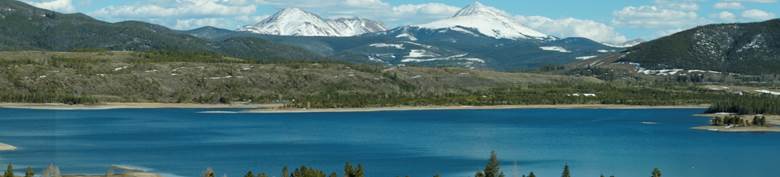
“The 2025–2026 winter season produced historically low snowfall across the Rocky Mountain region, resulting in well-below-average snowpack levels that are critical to the Town of Frisco’s municipal water supply. Above-average spring temperatures have further exacerbated these conditions by accelerating snowmelt, increasing evapotranspiration, and driving higher wildfire conditions. These combined factors are significantly reducing available water supply at a time when seasonal demand will be increasing the Town’s daily water production by over 100%. Dillon Reservoir remains below historical storage levels, underscoring the vulnerability of the Town’s water resources and providing a real time visual reminder of just how limited the local hydrologic cycle is this year.”
Due to the historically low snowfall, which has led to the most severe drought designation by the U.S. Drought Monitor, town staff recommended moving from the current Phase 1 voluntary measures to Phase 3 mandatory restrictions, which limits “non-essential outdoor irrigation to two days per week in addition to other restrictions,” according to the town recap. Staff explained it’s possible that North Ten Mile Creek may run dry due to the current conditions and forecasts, which would require the town to rely on its wells, “which have been resilient even when the reservoir has been very low.”
While some major fossil fuel producers keep pushing for expanded oil and gas use, which is linked to warfare, economic shocks and ecological damage, more than 50 countries at the first Conference on Transitioning Away From Fossil Fuels began developing plans to shift toward renewable energy systems designed for stability and abundance rather than scarcity and conflict.
At the end of the conference, France, where fossil fuels still power about 60 percent of the world’s seventh-largest economy, unveiled a pilot roadmapto phase out coal by 2030, oil by 2045 and gas by 2050, and to electrify sectors such as heating and transport. Colombia’s draft roadmap to largely ditch fossil fuels by 2050 emphasizes that transitioning to renewables could deliver $280 billion for the country in economic benefits.
The countries represented in Santa Marta, Colombia, generate about one-third of global economic activity. They broadly agreed to align their trade and finance policies with their transition plans, potentially creating significant economic momentum toward the faster decarbonization needed to avoid overcooking the planet with greenhouse gases.
The conference can be seen as a climate diplomacy track running parallel with the United Nations Framework Convention on Climate Change, but on a faster train with friendlier passengers, said Ralph Regenvanu, Vanuatu’s minister for climate change adaptation and a leader in efforts to accelerate climate action.
“It’s very heartening to have the Global North and the Global South in the same room, countries willing to talk about transitioning away from fossil fuels,” he said.
Participants and observers described the meeting as a space where fossil fuels themselves, and not just their emissions, were discussed as the root cause of overlapping crises, from conflict and displacement to economic instability. At past UNFCCC climate talks, those connections were often downplayed, especially in official documents.
The conference was convened by the Netherlands and Colombia during the closing days of COP30 in Belém, Brazil, late last year, as frustration grew over a small number of countries blocking any detailed discussions of phasing out fossil fuels. A follow-up meeting is set for early 2027 in Tuvalu, in the Pacific.
Organizers of the Santa Marta meeting also said the work of a special science panel associated with the conference is critical because media ecosystems are overloaded with climate and energy disinformation. Beyond policy details, discussions at the conference also revealed a shift in how energy is understood, shaped by lived experience and generational memory as much as by economics or technology.
Avoiding Past Mistakes
Until a few decades ago, coal miners were celebrated as heroes of prosperity, while kids grew up with “Put a Tiger in Your Tank” ads promising open-road freedom. Fossil fuels were synonymous with progress; many of the people now shaping energy policy came of age in that world, and the story wasn’t necessarily wrong for that time. But in a more crowded, connected world, that same system is now driving instability and climate degradation, and resisting the transition away from fossil fuels seems like longing for horse-and-buggy transport.
For the countries in Santa Marta, it’s not a question of whether to change, it’s how to change without repeating past mistakes. Veteran policy makers shared space with a younger cohort of advocates and negotiators for whom renewable energy systems are a baseline assumption, not an aspirational goal. Many are from developing countries and experience the risks of fossil fuels as immediate rather than as theoretical, and they challenge the fossil fuel industry’s misleading narrative that their products are needed to alleviate poverty.
“War right now is one of the largest contributors to the climate crisis,” said Faotu Jeng, founder of Clean Earth Gambia, a nonprofit group that has sparked environmental progress. Jeng noted that military emissions are not accurately accounted for under the Paris Agreement, which aims to limit global warming.
What will Xcel propose for Pueblo as it makes plans for the retirement of the last of the Comanche coal-burning units in 2030? Photo credit: Allen Best/Big Pivots
The Bureau of Reclamation has adjusted the release schedule from Navajo Dam due to downstream maintenance activities. On Tuesday, May 5th at 4:00 AM, the release will increase from 450 to 500 cubic feet per second (cfs). A further increase to 550 cfs is planned for Thursday, May 7th at 4:00 AM.
Releases are made for the authorized purposes of the Navajo Unit, and to attempt to maintain a target base flow through the endangered fish critical habitat reach of the San Juan River (Farmington to Lake Powell). The San Juan River Basin Recovery Implementation Program recommends a target base flow of between 500 cfs and 1,000 cfs through the critical habitat area. The target base flow is calculated as the weekly average of gaged flows throughout the critical habitat area from Farmington to Lake Powell.
This scheduled release change is subject to changes in river flows and weather conditions. If you have any questions, please contact Conor Felletter (cfelletter@usbr.gov or 970-637-1985), or visit Reclamation’s Navajo Dam website at https://www.usbr.gov/uc/water/crsp/cs/nvd.html
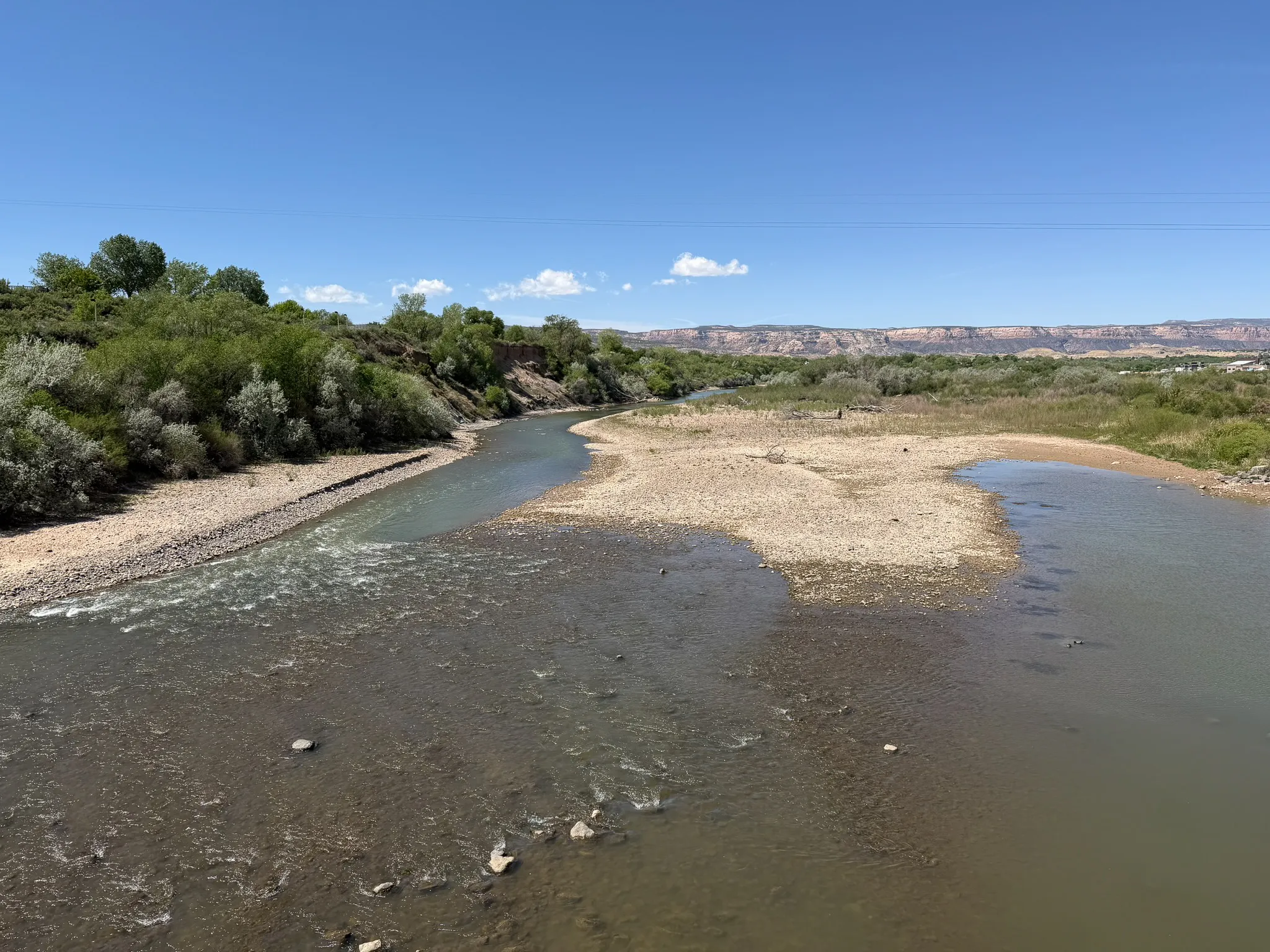
The Colorado River flows through Las Colonias Park in Grand Junction, Colo. on April 22, 2026. The river reached an extremely low level due to heavy diversion upstream and record low snowpack. CREDIT: LUKE RUNYON/THE WATER DESK
With drought and high temperatures putting unprecedented pressure on water users throughout Colorado, from cities to agriculture, there’s one segment that can be affected first — and maybe worst — when it comes to a lack of water: rivers themselves and the ecosystems that depend on them.
As cities enact water restrictions and farmers and ranchers prepare for the worst, impacts of the water shortage are readily apparent in a chronically dry stretch of the Colorado River between Palisade and the confluence of the Gunnison River that is critical habitat for endangered fish, known as the 15-mile reach.
The Upper Colorado River Endangered Fish Recovery Program works to return water to this stretch of river in the Grand Valley, but because of this year’s historically dry conditions, the program could have only 16,000 acre-feet, half its typical amount of water for fish.
Beyond that guaranteed amount, the program mostly uses water-sharing agreements that can secure additional acre-feet to boost flows — but only when other users don’t need the water and can voluntarily loan it. This year finds nearly everyone who depends on the Colorado River and its tributaries in dire straits.
Ruedi Reservoir, above Basalt, on the Fryingpan River, April 22, 2026. Photo: Brent Gardner-Smith
There won’t be any surplus water for fish in the Historic Users Pool, which is stored in Green Mountain Reservoir and is the largest source of water to potentially augment fish flows. A pool of water in Ruedi Reservoir that is available in four out of five years isn’t there, and the program could get only about 340 acre-feet from a pool in Wolford Reservoir upstream of Kremmling that typically has up to 6,000 acre-feet.
“It is really clear to me that we do not have enough tools in our toolbox to be able to manage for conditions like we have this year in the 15-mile reach,” said Julie Stahli, recovery program director. “We are so far outside the bounds of what we have ever seen before, that it’s really just hard to be able to make any good decisions.”
Stahli said she anticipates the program can contribute about 75 cubic feet per second through mid-July, at which point they will drop it down to 50 cfs, a bare-bones amount that is just enough to keep the riverbed wet.
This map shows the 15-mile reach of the Colorado River near Grand Junction, home to four species of endangered fish. Map credit: CWCB
“That is what we are anticipating being able to have for the entirety of the season in the 15-mile reach,” she said.
Side channels on the Colorado River ran dry early during spring runoff on April 22, 2026. Cobble bars and muddy banks emerged as the river receded near Dos Rios Park in Grand Junction, Colo. CREDIT: LUKE RUNYON/THE WATER DESK
As flows plummet, fish could become stranded in pools that are disconnected from the rest of the river, and program managers say they will try to prevent fish from using that stretch of river during times when flows are predicted to be at their lowest. Crews could use netting to keep fish out of the reach or close the flow of water that returns fish to the river after they accidentally enter an irrigation canal, which would keep them in the stretch of river above the diversion that has more water.
“Our main goal at this point is just to keep fish out of that reach,” Stahli said. “There is not a whole lot of attractive habitat in there right now for fish. Flows dropped so early in the season. We’re already seeing some pretty dire conditions in April.”
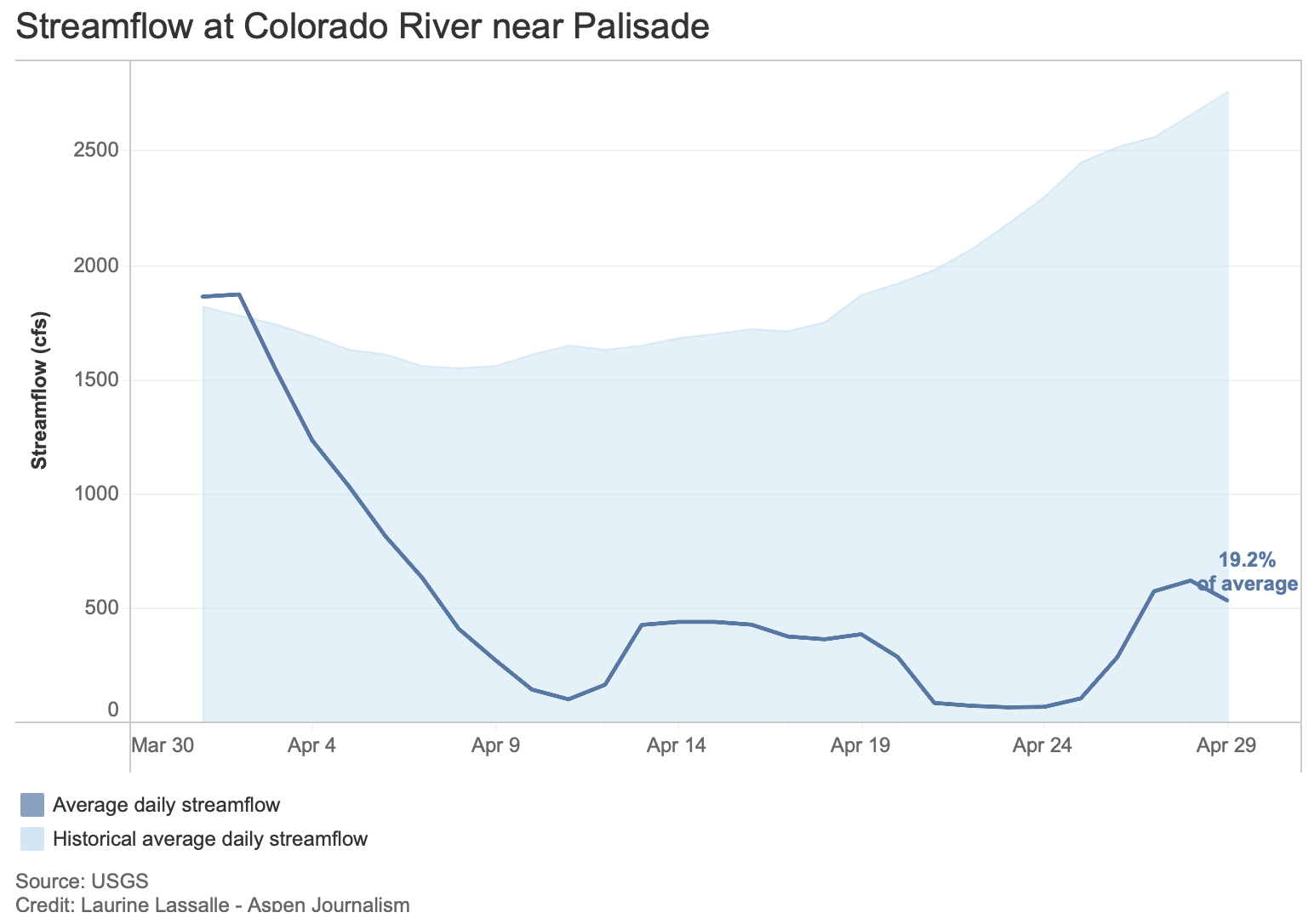
For several days in April, flows fell to just over 50 cfs, among the lowest levels in recorded history and far below the recovery program’s target flow for April in a dry year of 1,240 cfs. According to Stahli, the river’s flow at that low point could be solely attributed to recovery-program water that it had released from upstream reservoirs.
The goal of the recovery program when it was created in 1988 was to protect the humpback chub, razorback sucker, bonytail and Colorado pikeminnow, while also allowing the seemingly opposing goal of developing more water. An aim of the program was to allow farms and cities to continue using water and even expand their use without violating the Endangered Species Act.
Credit: The Land Desk
And the program has had some success, with one of the four species — the humpback chub — being downlisted from endangered to threatened in 2021. (The U.S. Fish and Wildlife Service has also proposed downlisting the razorback sucker.) These fish evolved over millions of years and are only found in the Colorado River basin. In today’s highly engineered and managed river ecosystem, they live mostly in just a few key locations in the Upper Basin, including the 15-mile reach, and in parts of the Yampa and Green rivers. Grand Junction’s minor league baseball team has adopted the charismatic fish as its team name and mascot; last year it was the humpback chubs, and now it’s the razorback suckers.
But the program has had trouble meeting target minimum flows in the 15-mile reach, even though upstream water development has not kept pace the way it was expected to. A main culprit is climate change, which has robbed the river of about 20% of its flows during the 21stcentury.
“We just don’t have the tools as a society to be able to handle what’s happening right now in any cohesive way,” Stahli said. “This isn’t an endangered fish problem; this is an everyone problem.”
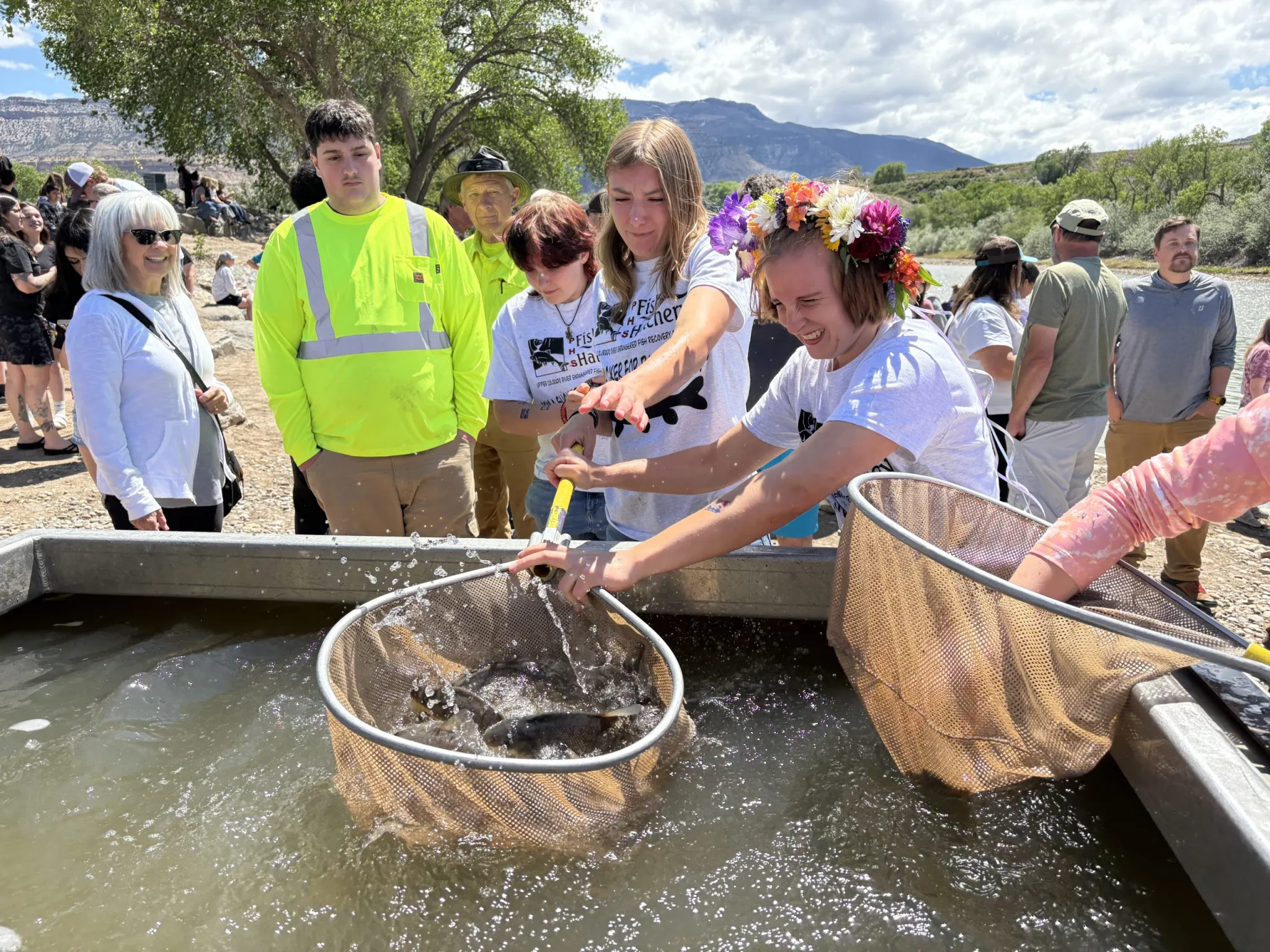
Palisade High School students released razorback suckers and bonytails they helped raise into the Colorado River on Friday, May 1. The two species live only in the Colorado River Basin and are endangered. CREDIT: HEATHER SACKETT/ASPEN JOURNALISM
Why is the river dry?
The reach is just downstream of large Grand Valley agricultural diversions, which are used to grow crops such as corn, alfalfa and the famous Palisade peaches, and which can take a combined 1,950 cfs from the river. At certain times of year, there can be more water in the Grand Valley’s canals than there is in the nearby Colorado River. Collectively, they are the biggest agricultural diversion from the Colorado River on the Western Slope.
“There has been so much diversion and damming of the river farther upstream,” said Bart Miller, healthy rivers director at environmental group Western Resource Advocates. “There are a lot of uses right there, and you’re seeing the impacts of all the Front Range diversions. [The 15-mile reach] is a pinch point in the system based on all the water development we’ve done.”
Water rights for the environment and recreation were latecomers to the legal system. It wasn’t until the 1970s — nearly 100 years after the most-senior agricultural rights on the Western Slope were established — that Colorado began protecting the value of water in streams with its instream flow program. Under Colorado’s system of water law, those who use water by taking it out of the river — including farmers, cities and industry — usually have the oldest rights, giving them first use of the resource. There’s nothing illegal about drying up a river.
“It’s like you’re running in a race and it’s four laps around the track,” Miller said. “The folks with the instream, recreational, environmental values are there at the starting line, but they’re held back for the first two or three laps. Everyone else is already running. And that’s why the environment often ends up in a really bad place.”
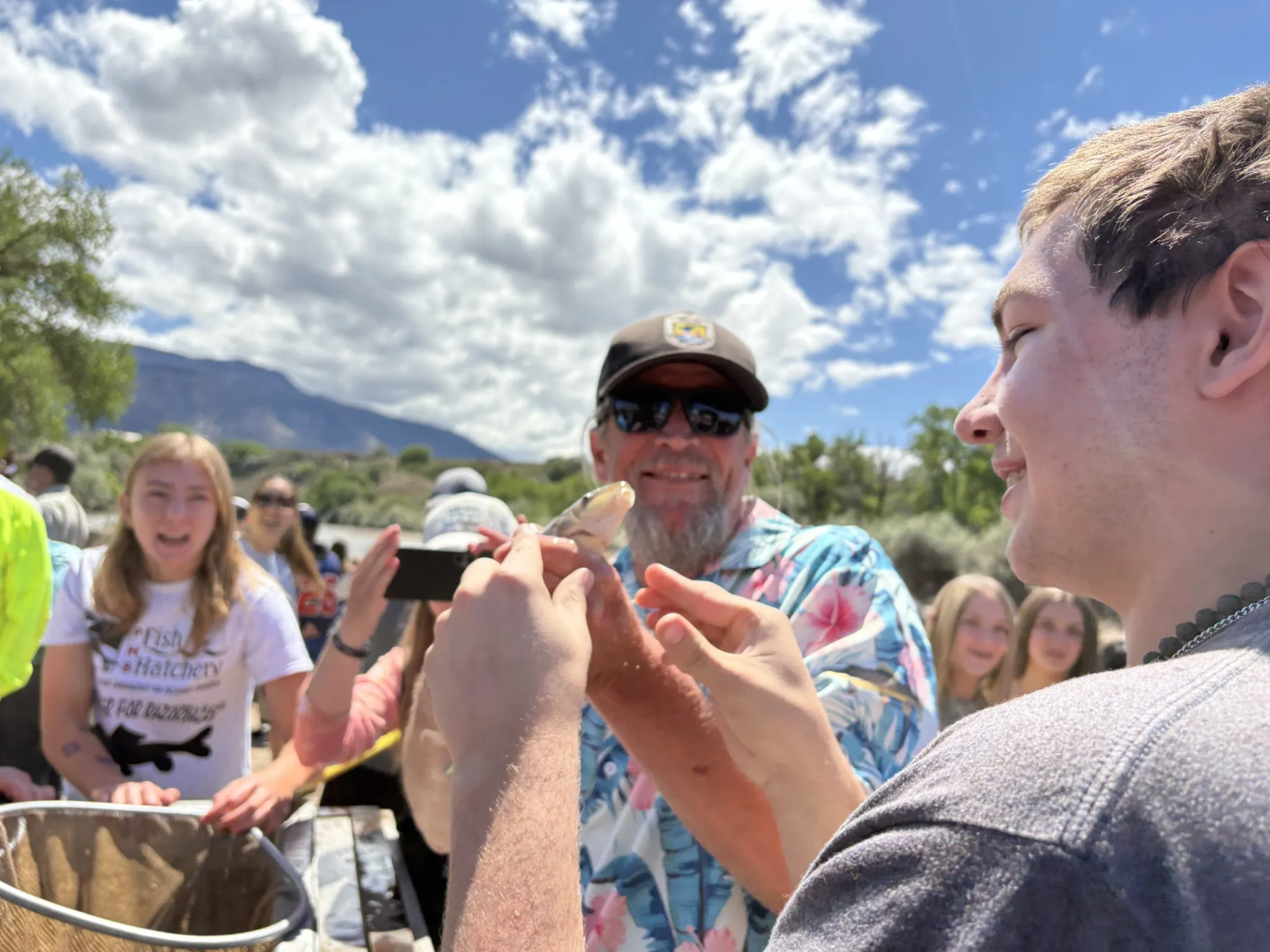
A Palisade High School student puckers up and prepares to kiss a fish goodbye on Friday, May 1 at Riverbend Park in Palisade. About 1,500 juvenile razorback suckers and bonytail, two species of endangered fish that students helped raise in a hatchery, were released into the 15-mile reach of the Colorado River. CREDIT: HEATHER SACKETT/ASPEN JOURNALISM
‘April hole’?
It’s not totally unheard of to have a small window of diminished streamflows in April. In a phenomenon known as the “April hole,” irrigation demands in the Grand Valley ramp up, while the needed water remains frozen solid as high-country snowpack. This problem remedies itself within a couple weeks as the snow begins melting. But this year, little snowpack remained by April and water managers think spring runoff at Cameo, where the big Grand Valley diversions are located, peaked during the March heatwave.
Kate Ryan is executive director of the Colorado Water Trust, which works to put water back into streams through temporary water sharing agreements with agricultural, municipal and industrial water users. Although the Water Trust is still finalizing contracts for this year, Ryan said she expects the Water Trust to add about 4,700 acre-feet of water to the 15-mile reach by leasing water from Ruedi Reservoir owned by the town of Palisade, and oil-and-gas company QB Energy.
In past years, water from this project has been released between the end of July and beginning of October. But that timing may change if the recovery program is trying to keep fish out of the reach.
“We will make sure that we deliver water at a point that complements the work of the recovery program,” Ryan said.
The Water Trust has also used the Colorado River Water Conservation District’s water marketing program — where acre-feet are available for purchase — to restore water to streams. But the River District board at its April meeting voted to freeze all new contracts, which are usually doled out first come, first served, while staff figures out the best use of the limited water supply.
The move was part of a series of drought mitigation actions aimed at easing shortages for water users. The board last month also approved a system for prioritizing water sectors, with keeping water in rivers at the bottom of the list: municipal and domestic water needs over agricultural and industrial needs; and agricultural and industrial needs over in-channel uses such as those that benefit the environment, endangered fish and recreation.
The Water Trust this week sent a letter to some water managers recognizing the historic drought and acknowledging that many of its temporary water sharing agreements, which pay water rights holders to leave water in streams, may not operate this year because their agricultural partners may not have enough water for their own use. Projects are voluntary and happen only in years when participants have enough water to share and it can benefit a stream.
But the letter also said there may be others who are interested in using their water rights to help prop up a stream this year.
“There is just so much uncertainty right now that we are trying to be as flexible and responsive as possible,” Ryan said.
Palisade High School students released two species of endangered fish into the Colorado River on Friday, May 1, 2026. Target flows for these fish in the 15-mile reach are often not met. CREDIT: HEATHER SACKETT/ASPEN JOURNALISM
Recovery-program officials said this year they will double down on other actions that benefit endangered fish, including removing nonnative predator species such as smallmouth bass and stocking the river with hatchery-raised fish. On Friday, students at Palisade High School released 1,500 young razorback suckers and bonytails that they helped raise into the Colorado River at Riverbend Park in Palisade.
Recovery-program staff said managing the 15-mile reach this year is about preventing the worst impacts and seeing what lessons can be learned from one of the driest years on record.
“It is just new terrain,” said David Graf, instream flow coordinator for the recovery program. “I think we are just flying by the seat of our pants in a lot of ways trying to do triage management as opposed to really adapt.”
For now, one of the few ways to add water back to a depleted river remains borrowing it from other, more senior users.
“I think until our water suppliers and state government hear from people that the environment really is a priority, not just the recovery program and need to support endangered species, but also for communities and local economies across the board, it’s going to stay that way,” Ryan said.
Bicycling the Colorado National Monument, Grand Valley in the distance via Colorado.com