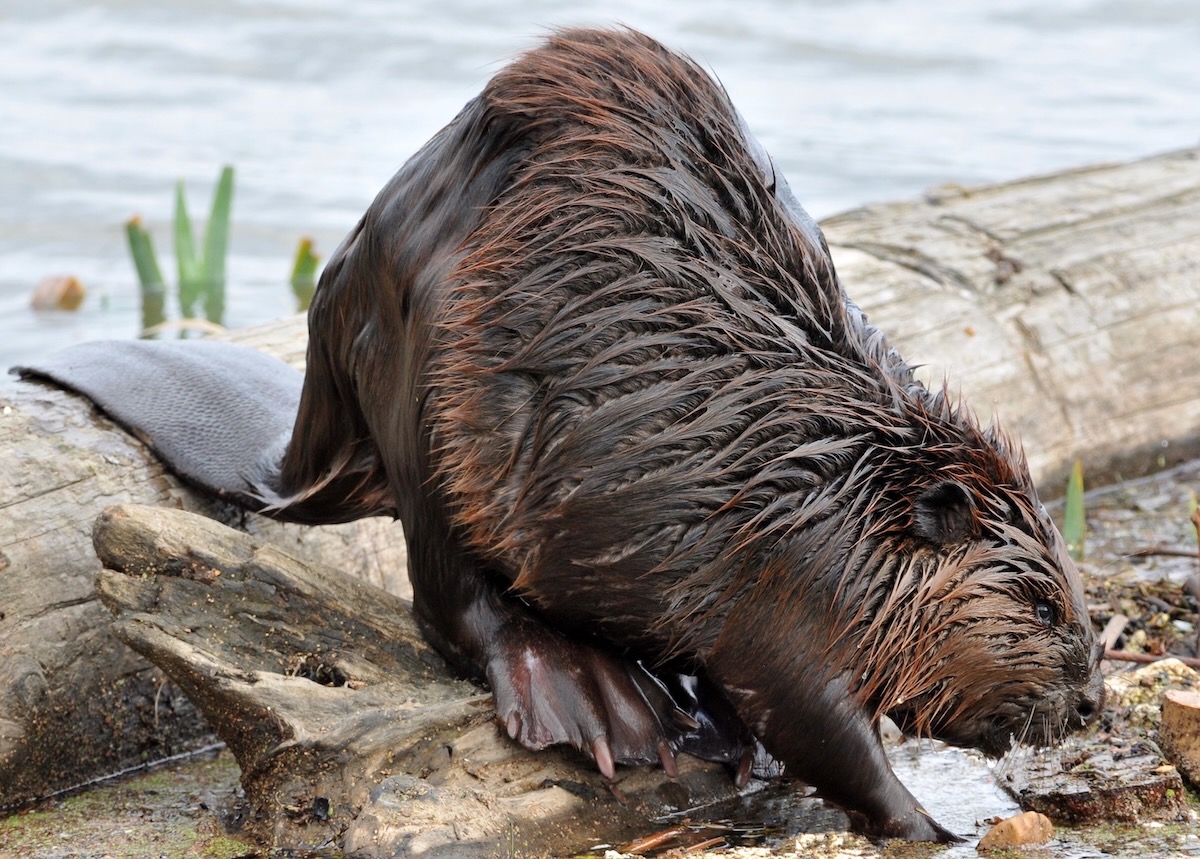
Wikipedia photo of Castor canadensis taken by Minette Layne in 2009.
by Robert Marcos
Beavers are experiencing a resurgence across much of the contiguous United States, most visibly in the Pacific Northwest (including parts of Oregon and Washington), the Mountain West (such as Yellowstone and adjacent basins), and the arid Southwest, where they are being actively reintroduced into degraded desert streams to restore wetlands and water storage. They have also rebounded in many eastern and midwestern states, forming thriving populations along rivers, streams, and ponds from the Northeast through the Midwest, while remaining sparse or absent only in a few deep‑South regions.1
The resurgence of beavers is creating a wide range of ecological, hydrological, and sometimes economic benefits because they act as “ecosystem engineers” that reshape streams and wetlands in ways that support many other species and services.2
Water storage and drought resilience
Beaver dams slow runoff and create ponds and wetlands that store rain and snowmelt on the landscape, which helps maintain base flows during dry periods. In some basins, beaver activity has been linked with up to about 60% more open water during drought compared with pre‑beaver conditions, effectively deepening local water storage and raising groundwater levels.3
Flood and erosion control
By temporarily holding back pulse flows, beaver‑engineered wetlands reduce peak flood volumes downstream, sometimes cutting flood flows by around 50–60% in trials. They also trap sediment and slow the movement of eroded material after storms or fires, which helps protect stream channels and reservoirs from siltation.4
Biodiversity and habitat
Beaver‑created wetlands and ponds increase habitat complexity, supporting more insects, amphibians, fish, birds, and other wildlife than comparable un‑dammed reaches. The mosaic of ponds, canals, log jams, and oxidized–reduced microhabitats boosts species richness and can benefit runs of fish such as salmon and trout by creating refuge pools and cooler water refugia.5
Water quality improvements
Beaver ponds act as low‑tech filters: sediments and attached pollutants settle out, and microbes in pond sediments help break down nitrogen and other contaminants. This has been documented in both agricultural and urban settings, where beaver‑modified reaches show reduced sediment loads and lower nutrient export downstream.6
Climate and carbon resilience
Beaver‑engineered wetlands can store carbon in pond sediments and surrounding vegetation, and their slow‑release hydrology helps buffer landscapes against both floods and droughts—a key feature in climate‑change‑adapted watersheds. In the American West and other arid regions, that “nature‑based” storage is increasingly seen as a low‑cost tool for watershed resilience and water‑supply augmentation.7
A new concept paper from experts at Western Resource Advocates and Water Balance Consulting shows that flexible water conservation pools can help get the Colorado River through dry years like this one.
The Colorado River’s two major reservoirs are approaching historic lows, threatening the infrastructure that delivers water and hydropower to communities across the West. The current tools to address the problem are limited.
The guidelines for managing the river expire this year. There are several management alternatives being considered that incorporate new flexible conservation pools.
A new concept paper shows how these pools can protect the Colorado River Basin and minimize conflict in critically dry years.
Imagine that you’re about to overdraw your checking account. Would you transfer money from your savings to avoid overdraft fees? Cut back on your spending?
Water managers on the Colorado River are faced with a similar problem, and few people are happy with the options available.
The Colorado River Basin just experienced its warmest winter on record. Snow water equivalent, or the amount of water in snowpack, is on track to be one of the lowest on record. An unprecedented March heat wave quickly melted much of what little snow was available to feed the river. And the West is projected to continue getting hotter and drier in the coming years.
The Colorado River Basin isn’t dealing with a temporary water shortage, it’s bankrupt.
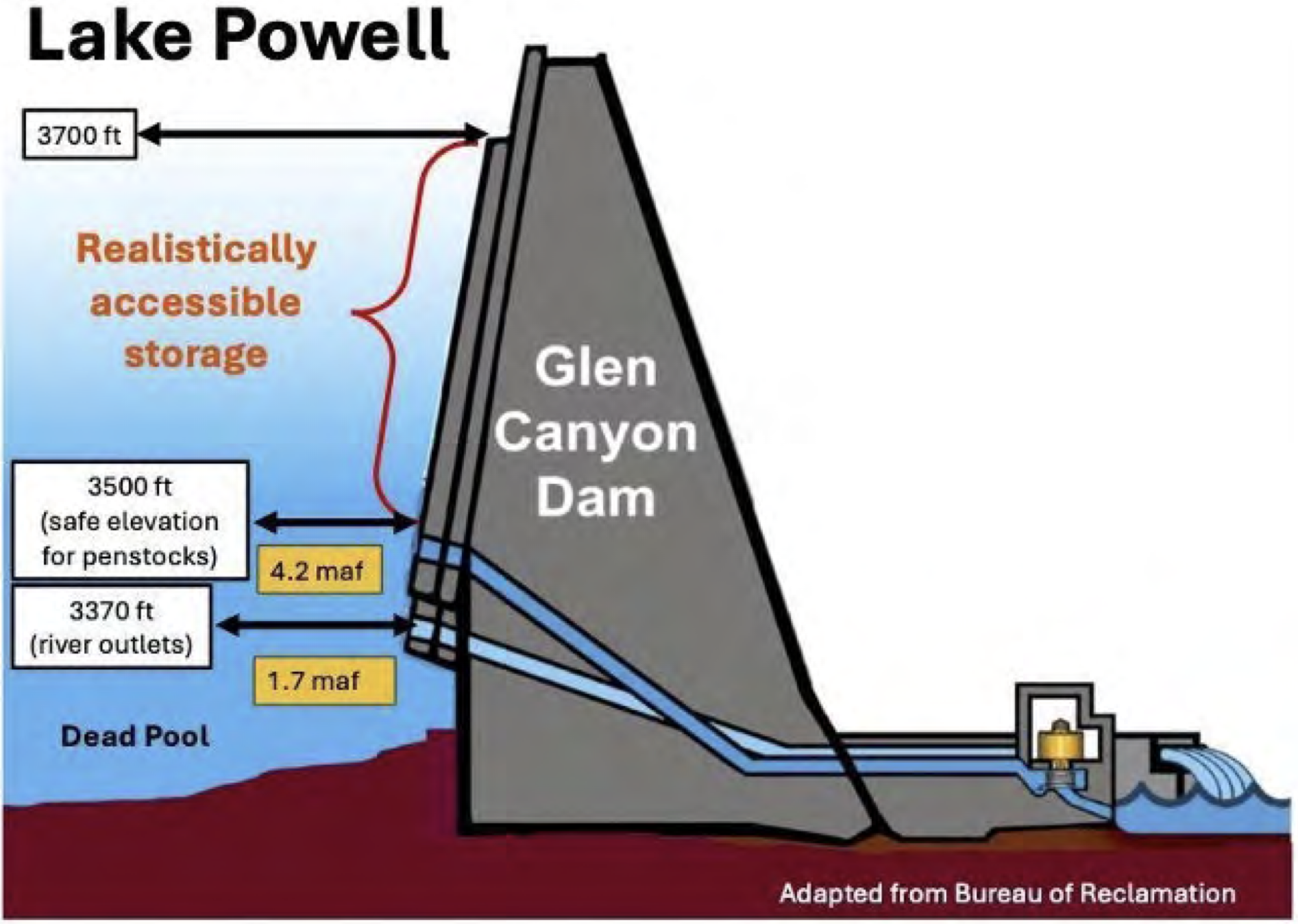
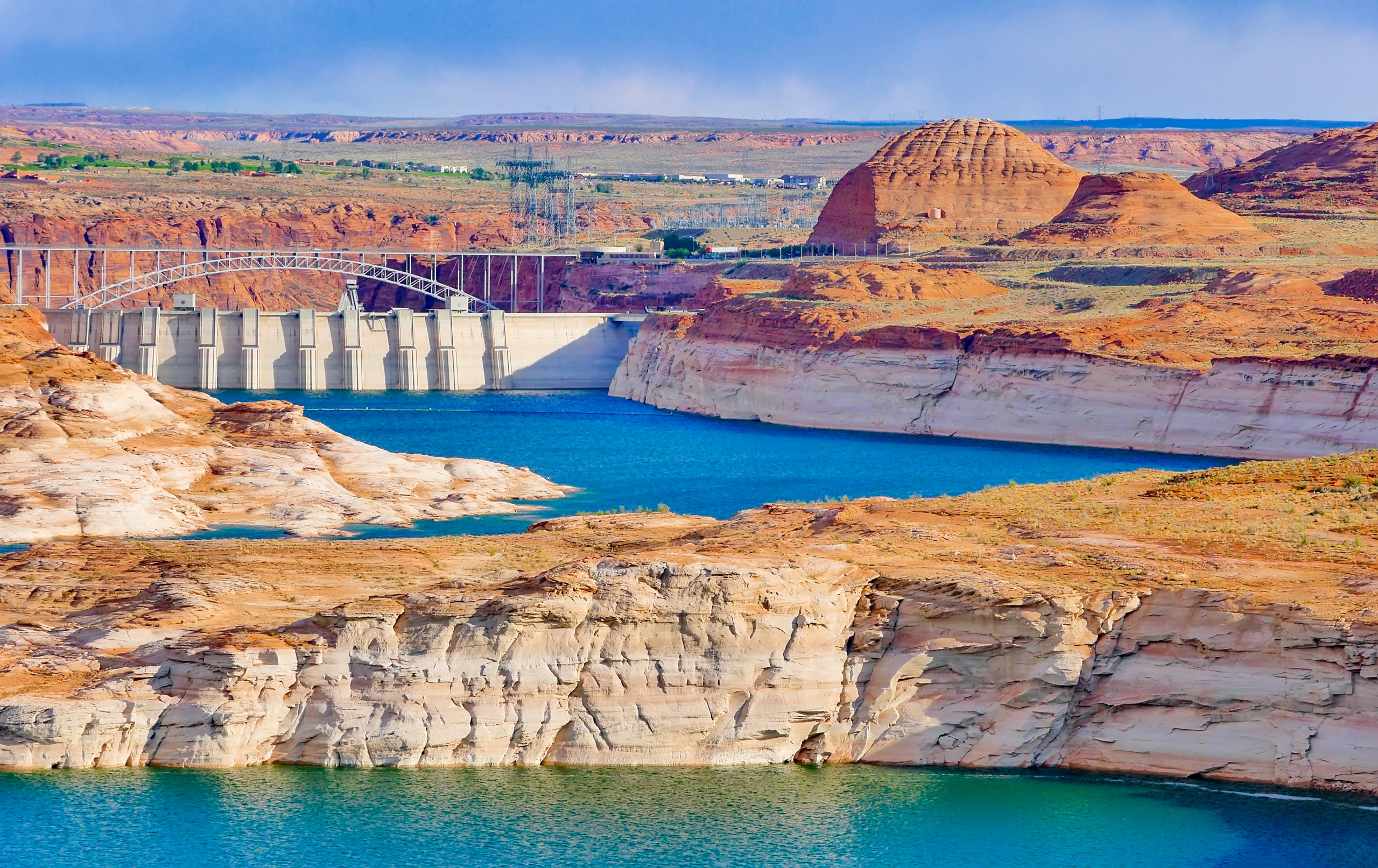
The river’s two major reservoirs — Lake Powell and Lake Mead — were constructed with a much bigger river in mind. Today, these reservoirs are approaching historic lows, threatening the infrastructure that delivers water and power to communities across the West. The Bureau of Reclamation forecasted that Lake Powell could drop below 3,500 feet, or the level needed to protect hydropower production, this summer if no actions were taken.
We are about to overdraw the account, resulting in significant consequences for the West.
Figure 2. Diagram showing schematic of Glen Canyon Dam elevations at which Lake Powell’s waters can be released downstream, and the volumes of water defined by these elevations. Active storage between 3370 and 3500 ft is not realistically accessible for continuous downstream release without risk to engineering infrastructure at the dam and powerplant. Hydroelectricity cannot be produced below 3490 ft, and 3500 ft has been established as a minimum safe level for intake through the penstocks.
Under current management guidelines, Reclamation only has two options to put more water in Lake Powell, and both come with drawbacks. The first is to release water from upstream reservoirs into Lake Powell. This is a stopgap measure — like drawing on your savings account to cover an unexpected expense. There are limits to how much water can be moved and how often. Upstream reservoirs must be allowed to refill after the water is transferred to Lake Powell.
The second option is to reduce Lake Powell releases. However, holding too much water in Lake Powell could trigger litigation from the Lower Basin states as soon as this fall, claiming that the Upper Basin is violating the Colorado River Compact.
Reclamation announced in late April that it will be using both options simultaneously keep water levels in Lake Powell from dropping below 3,500 feet. The agency plans to release between 660,000 and 1 million acre-feet of water from an upstream reservoir while reducing Lake Powell releases by 1.48 million acre-feet. While Reclamation is trying to protect the river with limited tools, the Basin states are not thrilled with the plan. The Upper Basin was quick to point out that increased releases from upstream reservoirs will have significant impacts on local economies and is not an action that can be taken year after year. Meanwhile, the Lower Basin says withholding additional water in Lake Powell could lead to the Upper Basin violating the Colorado River Compact.
The plan also might not work. It is expected to keep Lake Powell just above 3,500 feet — dangerously close to the hydropower intakes. This could potentially draw air into the intakes, damaging equipment and resulting in a complete loss of hydropower production.
The river’s current management guidelines are clearly no match for climate change. We are drawing down our savings in the hope of just barely making ends meet. It might not be enough, and it’s not something we can afford to do every year.
A NEW WAY FORWARD
The river is undergoing dramatic changes. What if we had a new management tool that allowed us to change with it?
WRA worked with Kevin Wheeler at Water Balance Consulting to find out.
We found that flexible water conservation pools can help maintain critical reservoir elevations and minimize the need to release large volumes of water from upstream reservoirs, while also not exasperating compact compliance issues.
We looked at the Intentionally Created Surplus (ICS) program — an existing water conservation program in the Lower Basin — to explore how this might work.
Currently, the ICS program allows water users in the Lower Basin to save water and store it in Lake Mead through actions like increasing irrigation efficiency or fallowing farmland. There is a little over 3 million acre-feet of ICS water currently being stored in Lake Mead.
This water has the potential to provide enormous benefit to Lake Powell as well, but there are institutional barriers to moving it. The water level in Lake Mead is currently used to determine how much water is released to the Lower Basin. Under the current guidelines, moving ICS water out of the reservoir would lower Lake Mead and impact Lower Basin shortages.
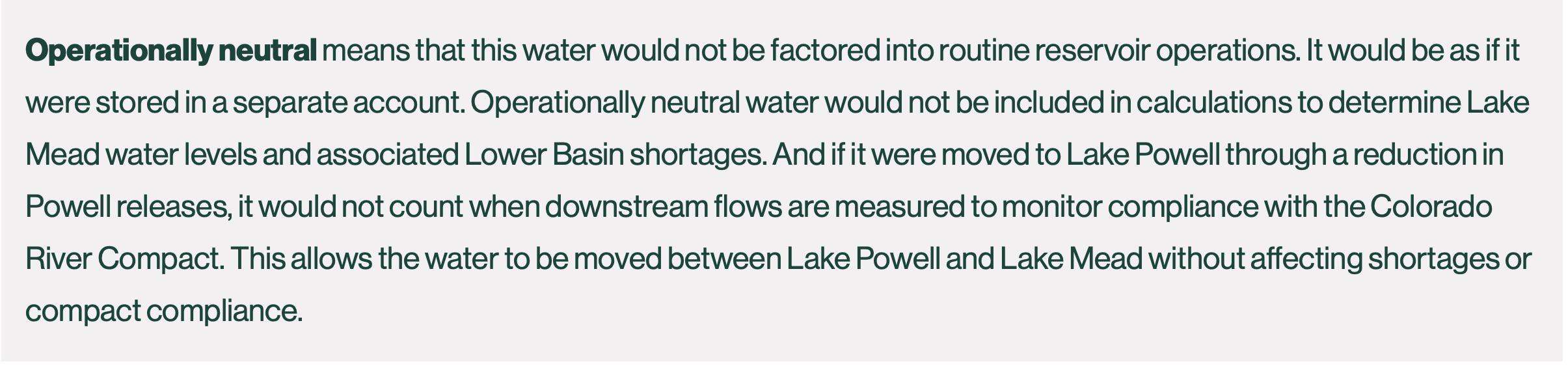
The key to solving this problem is creating a conservation pool that is “operationally neutral,” allowing saved water to be moved between reservoirs without impacting Lower Basin shortages or affecting compact compliance. This would allow ICS water to be stored in Lake Mead or Lake Powell — wherever it is needed to protect infrastructure and river health.
There is no infrastructure on the Colorado River to physically move water upstream; however, water can be transferred between reservoirs through adjustments to dam releases and careful accounting. For example, reservoir releases from Lake Powell could be physically reduced by 1 million acre-feet to “move” 1 million acre-feet of ICS water upstream from Lake Mead to Lake Powell. Releases from Lake Powell could later be increased by 1 million acre-feet to physically transfer the water downstream back to Lake Mead.
Because this water is operationally neutral, it would not be considered when calculating Lake Mead water levels and so moving it would not affect Lower Basin shortages. It also would not affect the 10-year Lee Ferry average. On paper, it would be as though there was no reduction in Lake Powell releases to “move” water upstream. This avoids exasperating compact compliance issues. This is in contrast to the operations Reclamation is undertaking this year, which will result in actual decreased Lake Powell releases, affect the 10-year Lee Ferry average, and bring compact implications as a result.
Our analysis shows that if a flexible conservation pool had been available this year, it could have significantly reduced the need to pull additional water from upstream reservoirs — helping to address concerns raised by the Upper Basin states. It also would have minimized compact compliance implications — helping to address issues raised by the Lower Basin.
The guidelines for managing the river expire this year, and there are several new management alternatives on the tablethat incorporate flexible conservation pools. Our analysis shows how these pools could work to protect the river and our communities in critically hot and dry years like this one.
Drawing down our savings isn’t going to work in the long term. We need sustainable solutions to ensure the infrastructure that delivers water and power to the West can function in dry years.
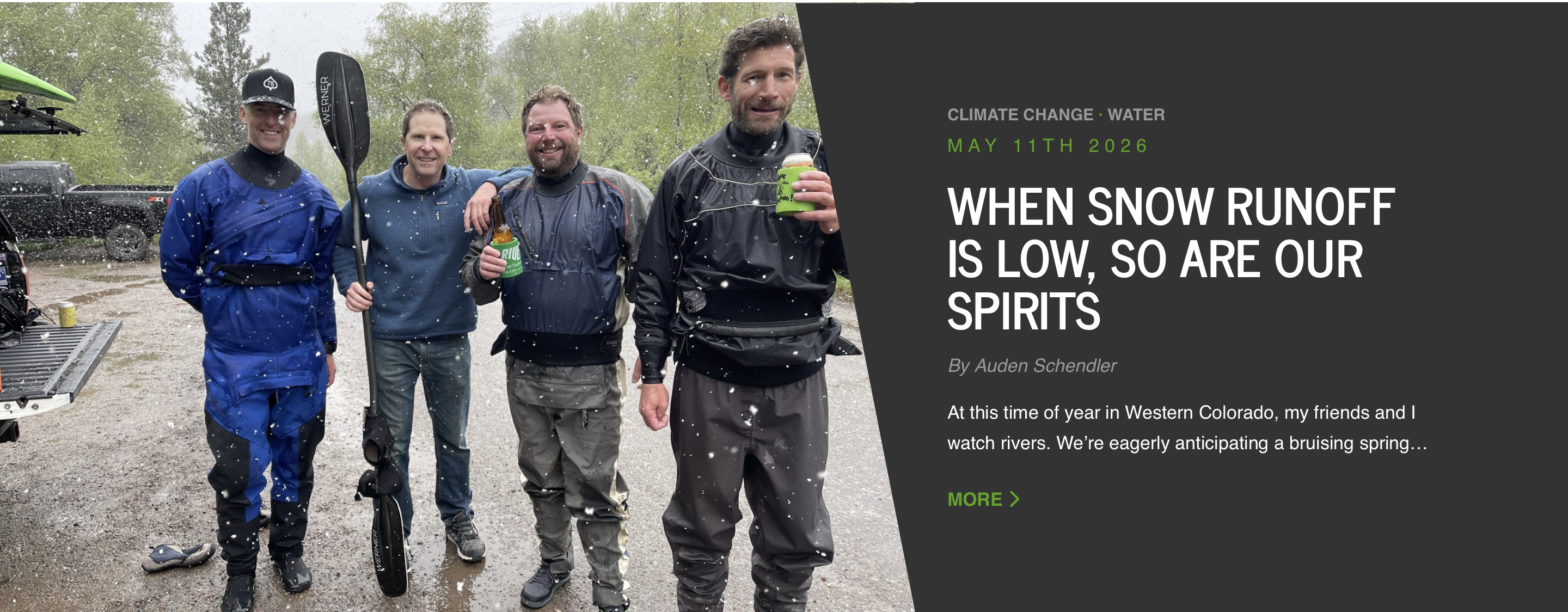
At this time of year in Western Colorado, my friends and I watch rivers. We’re eagerly anticipating a bruising spring runoff and the start of kayak season. When it arrives, many of us become obsessive, meeting daily after work to paddle.
Not this year. In one of the driest springs in Colorado history, our watershed’s snowpack was 26% of normal on April 1. The impact on fire danger, drought, agriculture, economy, and ecology is going to be profound.
Colorado statewide annual temperature anomaly (°F) with respect to the 1901-2000 average. Graphic credit: Colorado Climate Center
But this is the new normal in a climate-changed world. Colorado has warmed 2.3° F since only 1980. The Upper Colorado River Basin suffered close to record-low precipitation in March—normally our snowiest month—and record heat. Snowpack peaked at the earliest date and lowest amount ever. This collapsed the ski industry, and many resorts closed in what is typically their most profitable month.
A kayaker runs the 6-foot drop of Slaughterhouse Falls on the Roaring Fork River near Aspen in June 2021. Recreation proponents gave six recommendations to the CWCB to better elevate recreation in the update to Colorado’s Water Plan. CREDIT: BRENT GARDNER-SMITH/ASPEN JOURNALISM
The kayak run my friends and I like best is called, ominously, “Slaughterhouse.” It flows through an alpine forest at 7,000 feet, near the town of Woody Creek. Kayakers must navigate tight channels and churning holes, steering around boulders the size of VW buses.
Though many of us have kayaked this stretch hundreds of times, we never paddle the same river twice, to echo Heraclitus, because flows are always minutely different, as is the turbidity of the water, the quality of sun, or clouds. At the same time, there is a Zen to the repetitiveness: a remembered left turn below a spruce tree to hit an eddy; a crucial line that splits two rocks; the plant smells we recall from last year and the previous 30.
This friend group of men in their forties and fifties—a photographer, a paramedic, a ski mountain manager, a caterer—has become attuned to the river. We continuously observe snowpack and storm cycles throughout winter, with an eye to runoff. We know that when it reaches 500 cubic feet per second (cfs) we can float Slaughterhouse for the first time. 800 to 1000 cfs is juicy, a joyous party, and that level often holds steady for many weeks. The water gets pushy around 1300 cfs, and some of us stop paddling when it gets too scary. No need to worry this spring: Slaughterhouse, which can peak above 7,000 cfs, topped out at about 250 cfs.
We know each other like we do the river. Banter focuses on making fun of our paddling. One meme of an upside-down kayak shared on a group chat read: “Roses are red, violets are blue, I lied about having a solid roll…where are you?” If you do happen to swim out of your boat, the group instantly switches from a bunch of jerks to a coordinated rescue team. Expect to hear “Are you doing OK?” for the rest of the day.
Later, expect to be made fun of at that location for the rest of your life. When we gather at the takeout, we drink beer and reflect on our glories and failures, loitering past dinnertime.
To be a good kayaker, you have to be willing to suffer the consequences of a mistake. Typically, that means being upside down in cold water, unable to breathe or see. Boaters call this underwater experience “the white room,” or “being Maytagged.” You accept the fact of an inevitable frigid swim, because, as old kayakers say, “We’re all between swims.” This season, the mistake we must endure is a societal one.
In a sense, kayakers are prepared for the hot, smoky summer ahead: We’ve learned to endure some inevitable pain. Harder to manage will be the loss. We’ll have to forgo the camaraderie, ritual and traditions that come from decades of recreation tied to seasons, place and environment. The truth is, as the planet warms, we’re in danger of losing a sense of who we are.
Auden Schendler
The philosopher Glenn Albrecht coined a term for this: solastalgia, the distress caused by environmental change, creating a “homesickness you feel while still at home.”
It is widely understood that climate change will forever alter our physical world. Indeed, it already has. It’s less obvious that it’s also coming for our friendships, our identity and the spirit and rhythm of our lives.
Auden Schendler is a contributor to Writers on the Range, writersontherange.org, an independent nonprofit dedicated to spurring lively conversation about the West. He lives in Basalt, Colorado, and is the author of Terrible Beauty: Reckoning with Climate Complicity and Rediscovering Our Soul.
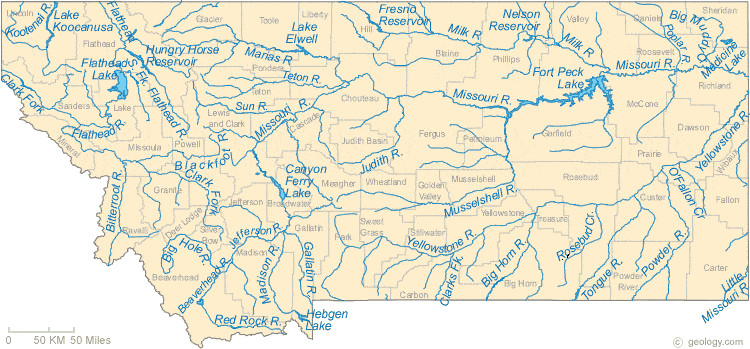
Steve Held of Broadus, Montana, comes from a long line of ranchers going back to the late 1800s.
Held: “We do love the lifestyle. People who do it for a living have to love it, but it’s not because it’s easy or beautiful.”
He says ranching is tough. And the warming climate is making it even harder.
As temperatures rise, winter snowpack is shrinking – which reduces water supplies in the spring and summer.
Held recalls that when he was growing up …
Held: “We would get a snow around Christmas that would last until the end of March. The snow would melt off … come running down the creeks and the hills and fill up all of our ponds, and that’s what we relied on for water. It doesn’t happen anymore.”
And more intense storms, floods, and wildfires have put his cattle in danger and caused expensive damage to the ranch.
Held says it’s no mystery what’s happening. Scientists have been warning about climate change for decades, so he says it should not be a partisan issue.
Held: “And it’s absolutely shameful that politics have turned this into a kicking ball. And the people who are suffering are the people on the land.”
So Held wants people from all walks of life to come together, acknowledge the danger of climate change, and take action.