The other big story of the decade was the environment. As the drought steadily worsened in the early teens, President Ben Shelly found himself between a rock and a hard place. A proposed settlement of the water rights on the Little Colorado River, which would have included the Nation sacrificing a portion of its water rights in exchange for infrastructure, proved so wildly unpopular that he was forced to back down, leaving the Nation to take its chances in court.
A plan to round up Dinétah’s feral horses, which ranchers accused of drinking up and fouling the ever-scarcer watering holes, stirred an international uproar from humane organizations and even actor Robert Redford. It was eventually abandoned and the animals remain a problem, now numbering in the tens of thousands with few natural predators.
Water issues continued in 2015 as an estimated several hundred Navajos — including President Jonathan Nez and Vice President Myron Lizer — joined the Standing Rock Sioux Tribe in protesting the construction of an oil pipeline beneath the tribe’s main water source, braving sub-zero temperatures, tear gas and rubber bullets.
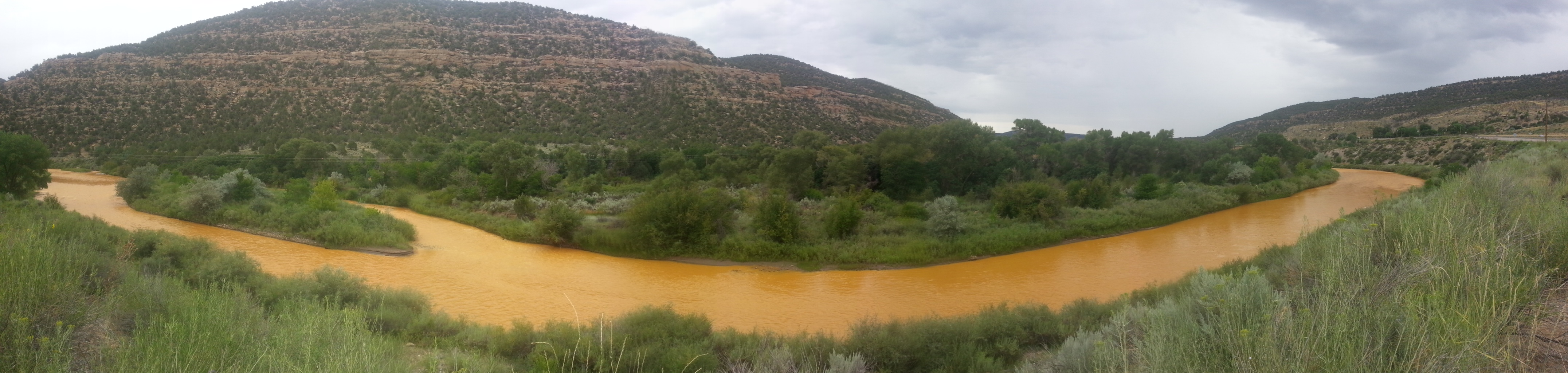
The orange plume flows through the Animas across the Colorado/New Mexico state line the afternoon of Aug. 7, 2015. (Photo by Melissa May, San Juan Soil and Conservation District)
In the summer of that year, the Diné had their own water issue to contend with, watching in amazement as the Animas River ran orange with dissolved metal compounds from an abandoned gold mine near Silverton, Colorado — the result of a botched containment effort by the US. Environmental Protection Agency.
The Navajo Nation joined the states of New Mexico and Utah in suing the agency and its contractor. As of this writing the litigation is still pending.
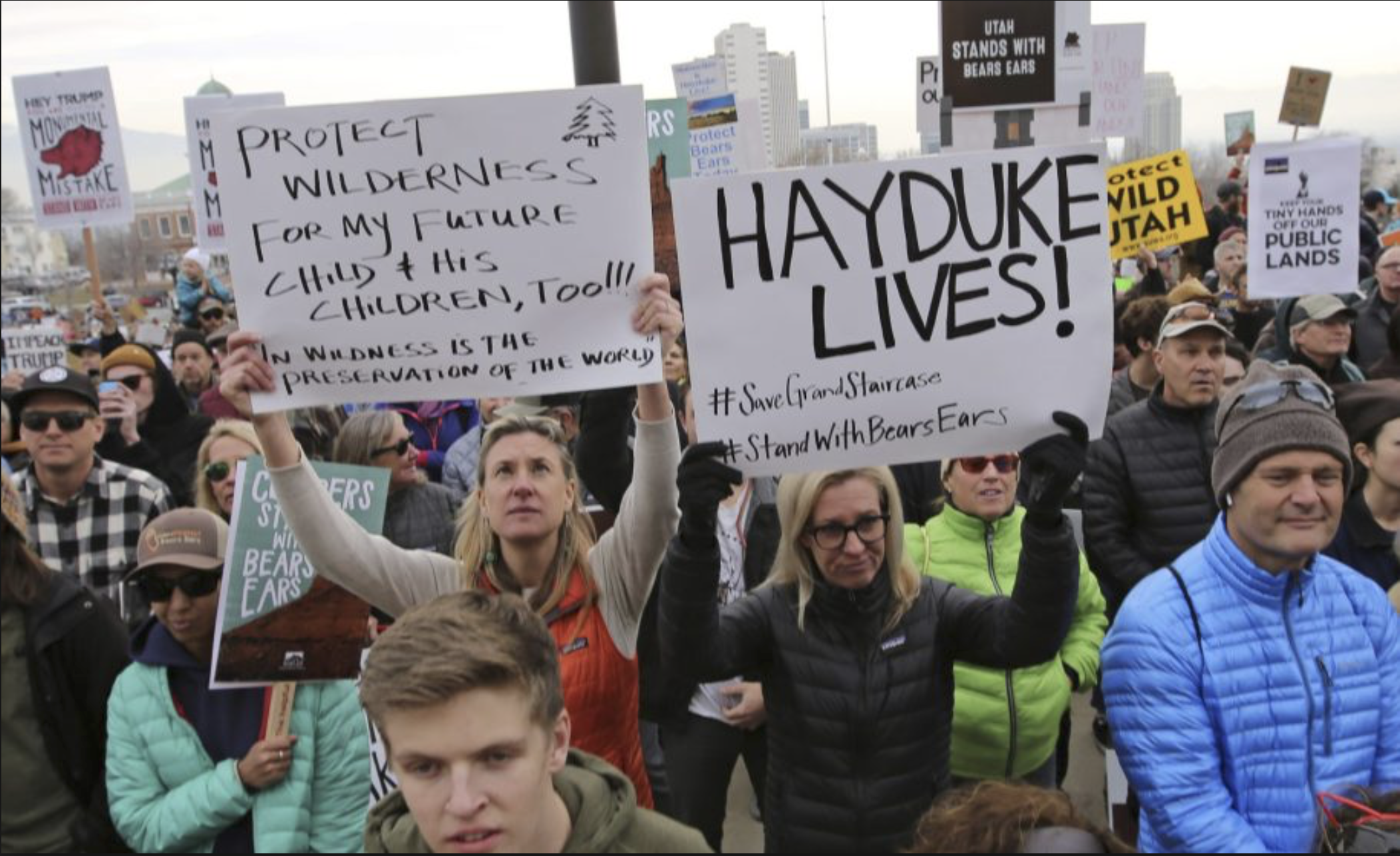
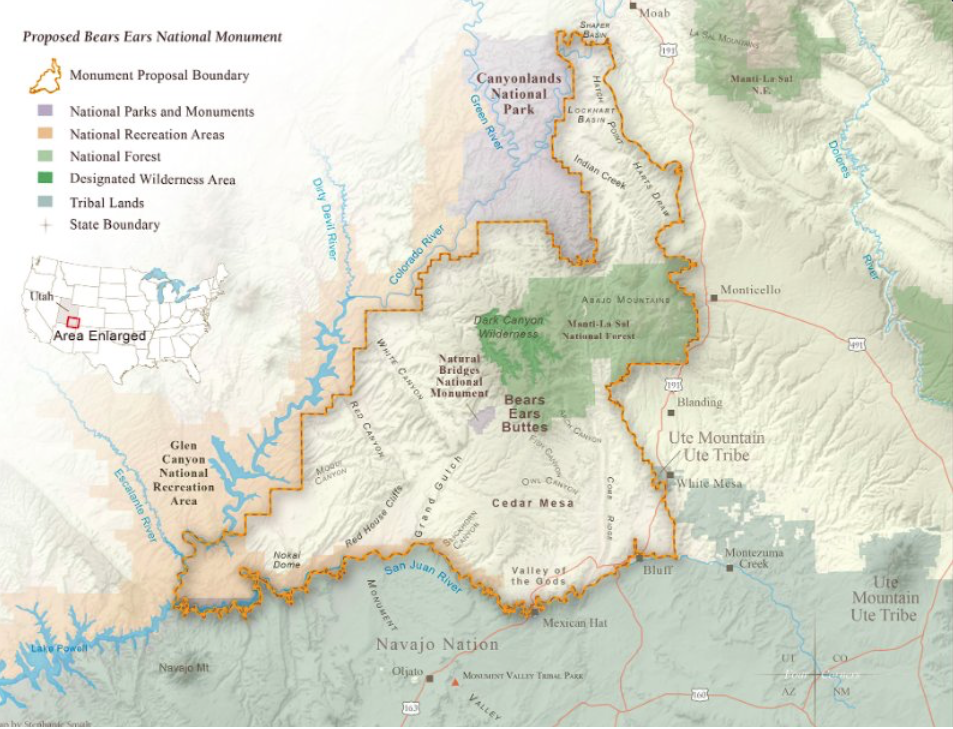
Then there was Bears Ears National Monument, created by President Barack Obama on Dec. 28, 2016, and reduced by 85 percent by President Donald Trump less than a year later. That’s also slogging through the courts.
But by far the biggest environmental story was the rapid dethronement of King Coal, which for decades had propped up state, local, and tribal economies in the Four Corners.
As prices for natural gas and renewable energy declined, power plant owners beat a hasty retreat from the dirty fossil fuel that had sustained generations of Navajo miners and a good chunk of the Navajo and Hopi tribes’ budgets.
In 2013, the Navajo Nation managed to stave off the closure of BHP Billiton’s Navajo Mine by creating a company to buy it, but there was no stopping the demise of the Navajo Generating Station and the two mines on Black Mesa that fed it.
Environmentalists had for years been pressuring the tribal government to create a plan to replace the revenue that would be lost when the plant closed, preferably by converting it to a sustainable energy producer, but as the last coal shovelful of coal was turned this past November, the only plan was to dig into the Permanent Trust Fund former President Peterson Zah had created in 1985 for just this eventuality.
Meanwhile the Navajo Transitional Energy Company, the tribal enterprise created to buy the Navajo Mine and then lead the Nation into a more sustainable energy future, purchased three more coal mines in Wyoming and Montana — a move that shocked not only environmentalists but the president and Council.
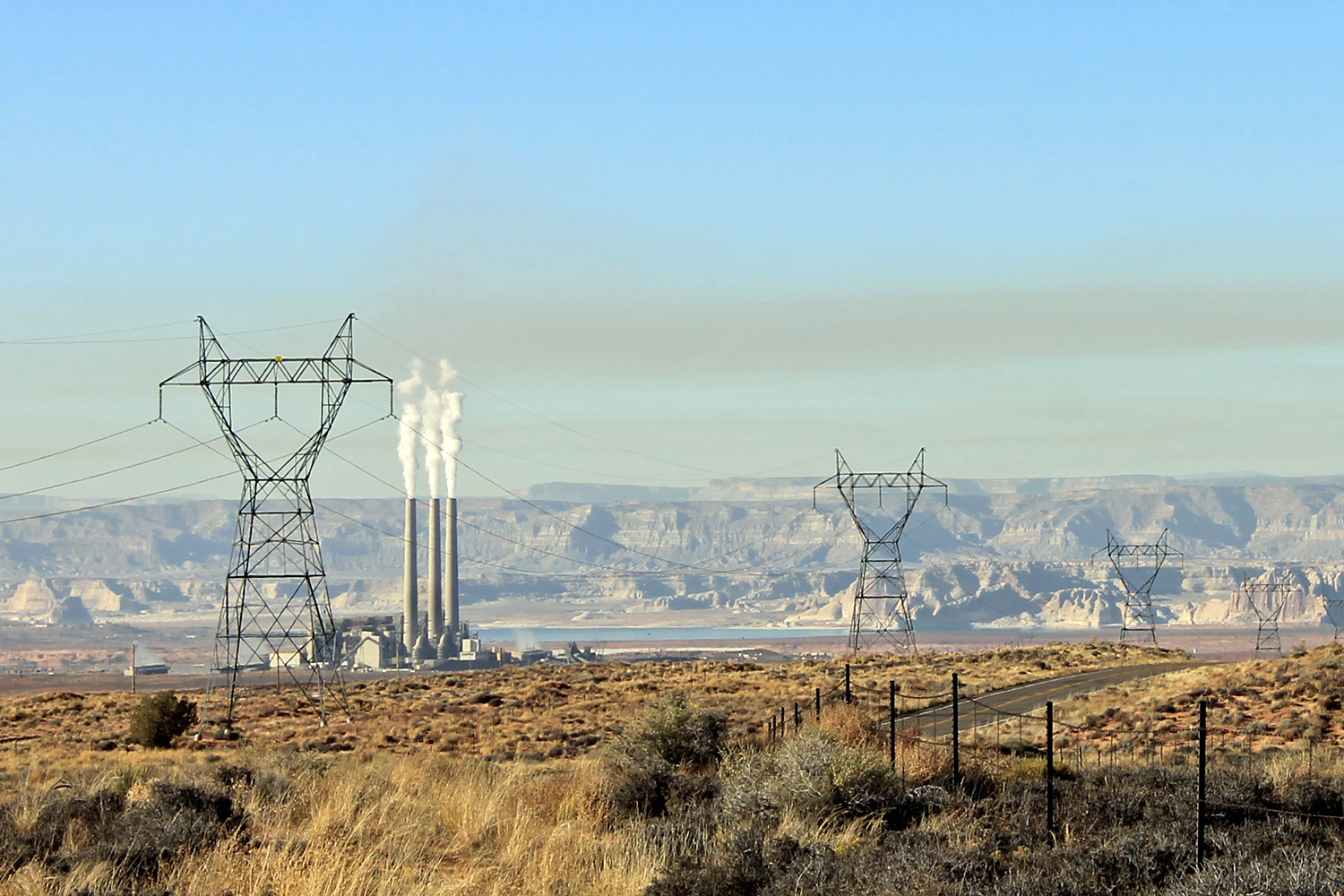
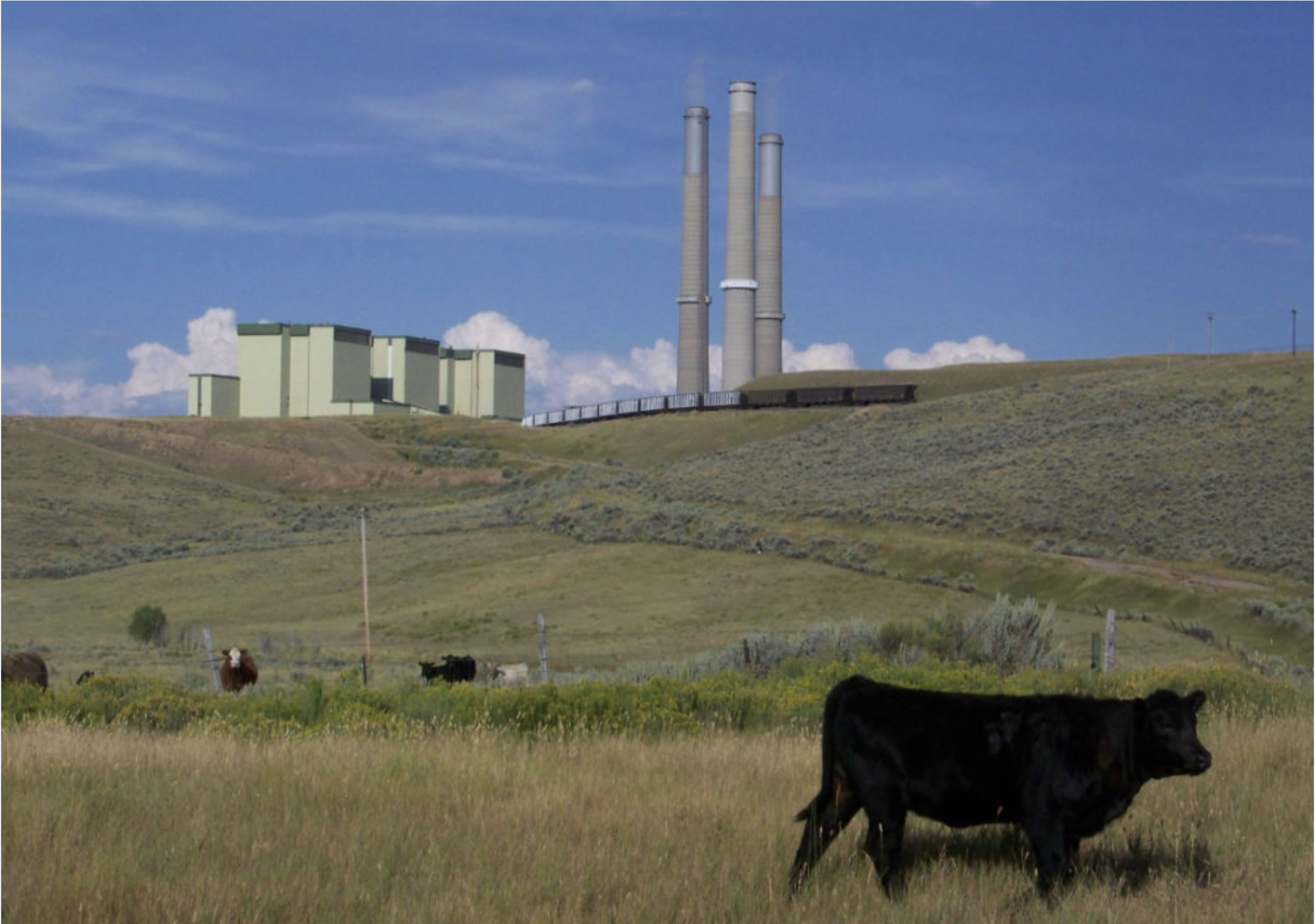
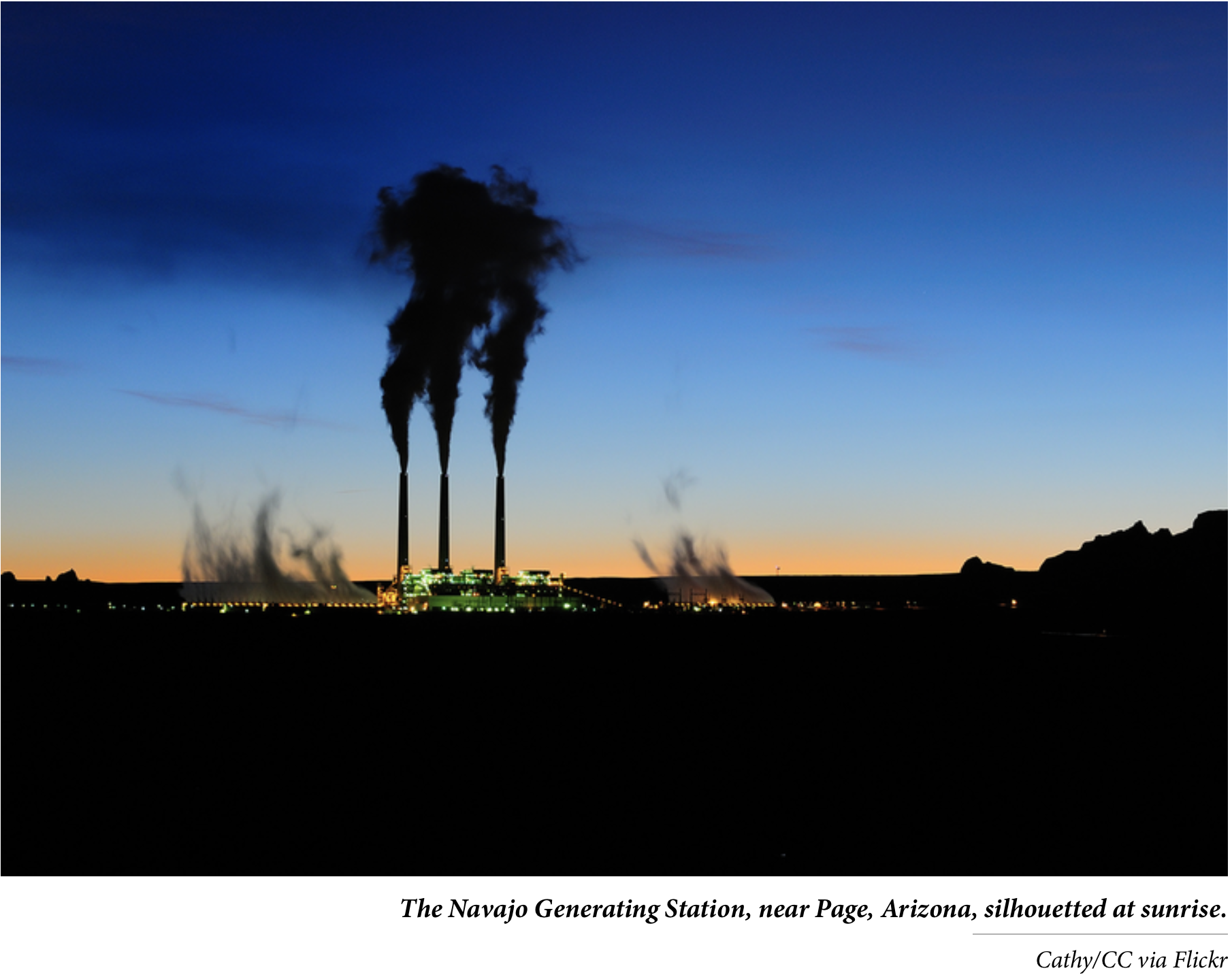
Navajo Generating Station and the cloud of smog with which it blankets the region. Photo credit: Jonathan Thompson via The High Country News
The San Juan Generating Station in Waterflow, New Mexico, is next on the chopping block, slated to close in 2022 unless the state’s Public Regulation Commission approves a plan to convert it to a carbon capture facility.
We’re reporters of the news, not prognosticators. But it’s not too risky to predict that all these environmental issues will extend into 2020 and most likely beyond, joined by ones no one has even thought of yet as irreversible climate change takes hold.
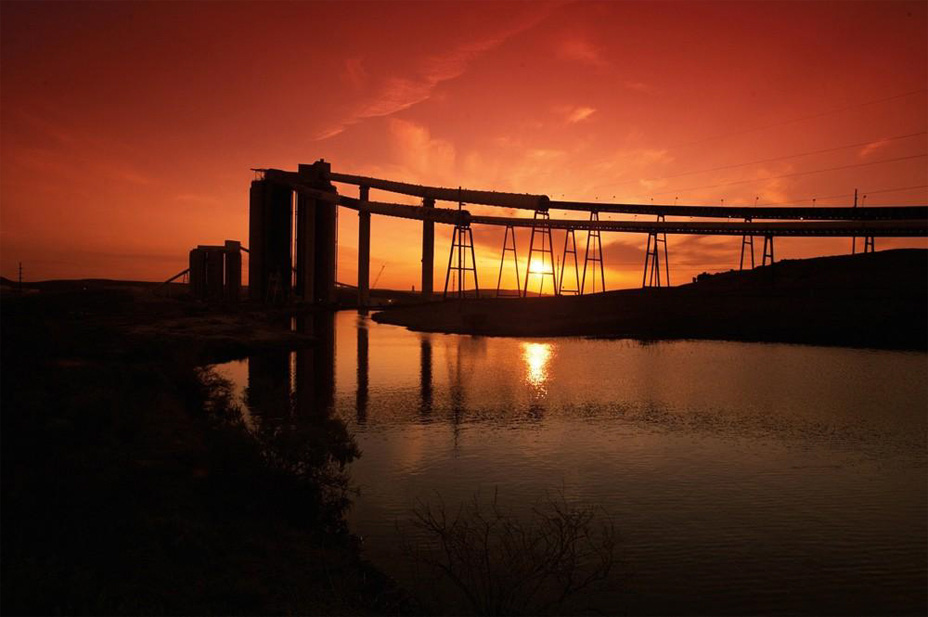
Driving down Highway 133 from the craggy wilds of the West Elk Mountains in central Colorado, one of the first signs of civilization is a mile-long coal train on a siding, along with the rusting steel framework of a canyon-spanning loading station that still dumps the black rock into trains at the rate of 50 cars per hour.
This nearly relict fossil fuel infrastructure is an improbable gateway to the orchards and vineyards of North Fork Valley. The few miles between the mine and Paonia mark a transition from the fossil fuel era into an uncertain post-carbon age, defined by climate change.
In Paonia, the air around Big B’s fruit stand is scented sweet-sour from the harvest of ripe apples. There are four types of cider on tap and nearly all the food on the menu is grown within a few miles of the local gathering spot.
The Mountain Harvest Festival is underway, and the place is buzzing, as community catalyzer Pete Kolbenschlag starts explaining how Paonia is building a sustainable future.
This community once relied heavily on coal mining jobs. Now it is developing a path toward a sustainable local economy based partly on organic agriculture and local renewable energy. It also must find ways to navigate challenges like global warming—and the growing threat of new fossil fuel development.
About eight years ago, the federal government proposed major oil and gas drilling in the North Fork Valley, and the plan roared to life this past summer, just as the organic food industry was really starting to take off. New drilling would take up land and threaten to bring more air pollution and potentially groundwater contamination that could put organic crops in jeopardy, while also contributing to climate change.
That’s not a mix that can work, said Kolbenschlag, who’s been working on community sustainability in the North Fork Valley for 20 years.
Many proposed drilling areas are right next to organic farms or ranches, and even directly on top of community drinking water springs, according to the Western Environmental Law Center, which is supporting the community’s legal challenges to fracking. Leaks from drilling could threaten local and regional water supplies. Industrial emissions and dust from increased traffic could taint fruits and vegetables, and energy infrastructure could harm wildlife habitat and diminish the area’s tourism appeal, along with the direct climate-harming impacts of more fossil fuel development.
“Leases were proposed in a ring around my house for 2 miles in every direction,” Kolbenschlag said. “We were able to stop that lease sale twice because the underlying land plan was outdated. There’s millions of dollars of agriculture on the line, even in a small area like this.”
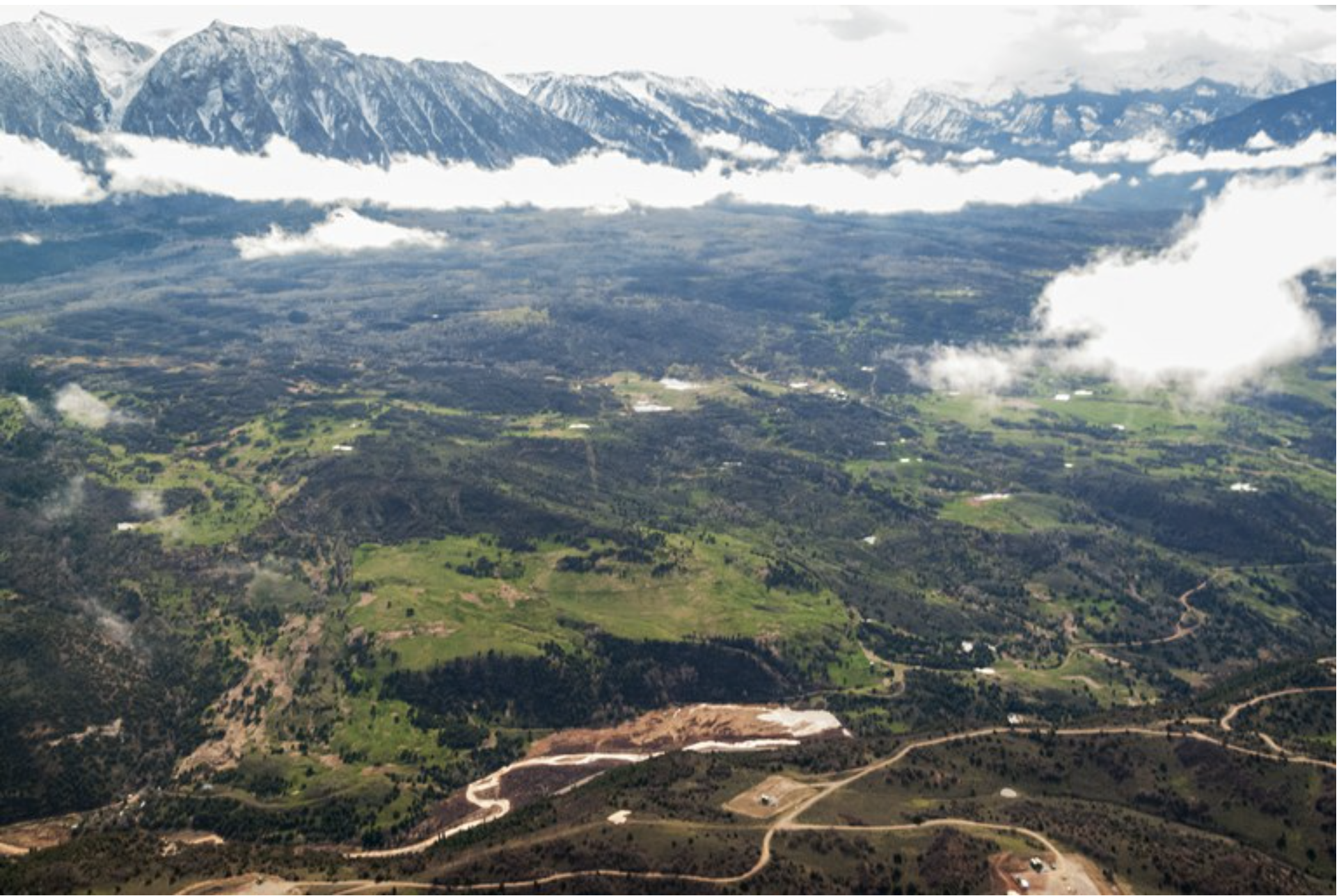
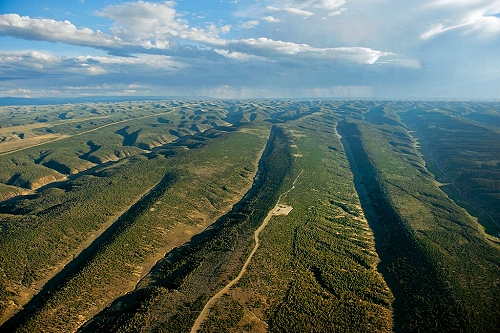
Oil and gas drilling has been delayed above Paonia, Colorado because agencies didn’t adequately analyze climate and wildlife impacts. Courtesy of EcoFlight via The High Country News.
After World War II, the federal government, utilities, and developers embarked on a project to build dams, mines, power plants, and high-transmission lines across the Interior West in order to electrify and deliver water to the cities that were sprawling across the desert. The intent of what scholar and law professor Charles Wilkinson called “The Big Buildup” was both to meet the demand created by the huge post-War migration, and to create new demand — to lure more people, and therefore more money, to the Southwest. The likes of Phoenix and Las Vegas as we know them today were made possible by the Big Buildup, and the Big Buildup, in turn, was enabled by theft of land, cheating tribal nations out of royalties, government subsidies, and lax regulations.
For five decades this coal-fired machine churned away, pumping electricity into the cities, cash into state and tribal coffers, and pollution into the water, land, and air. Those of us born during or after 1970 would never know a Four Corners Country without economies that relied on coal, or without the yellow-gray gauze that obscures every vista. The machine seemed invincible, stable, recession proof, and immune to boom and bust cycles. The growing populations of the West would continue to demand more and more electricity, meaning the plants would burn more and more coal.
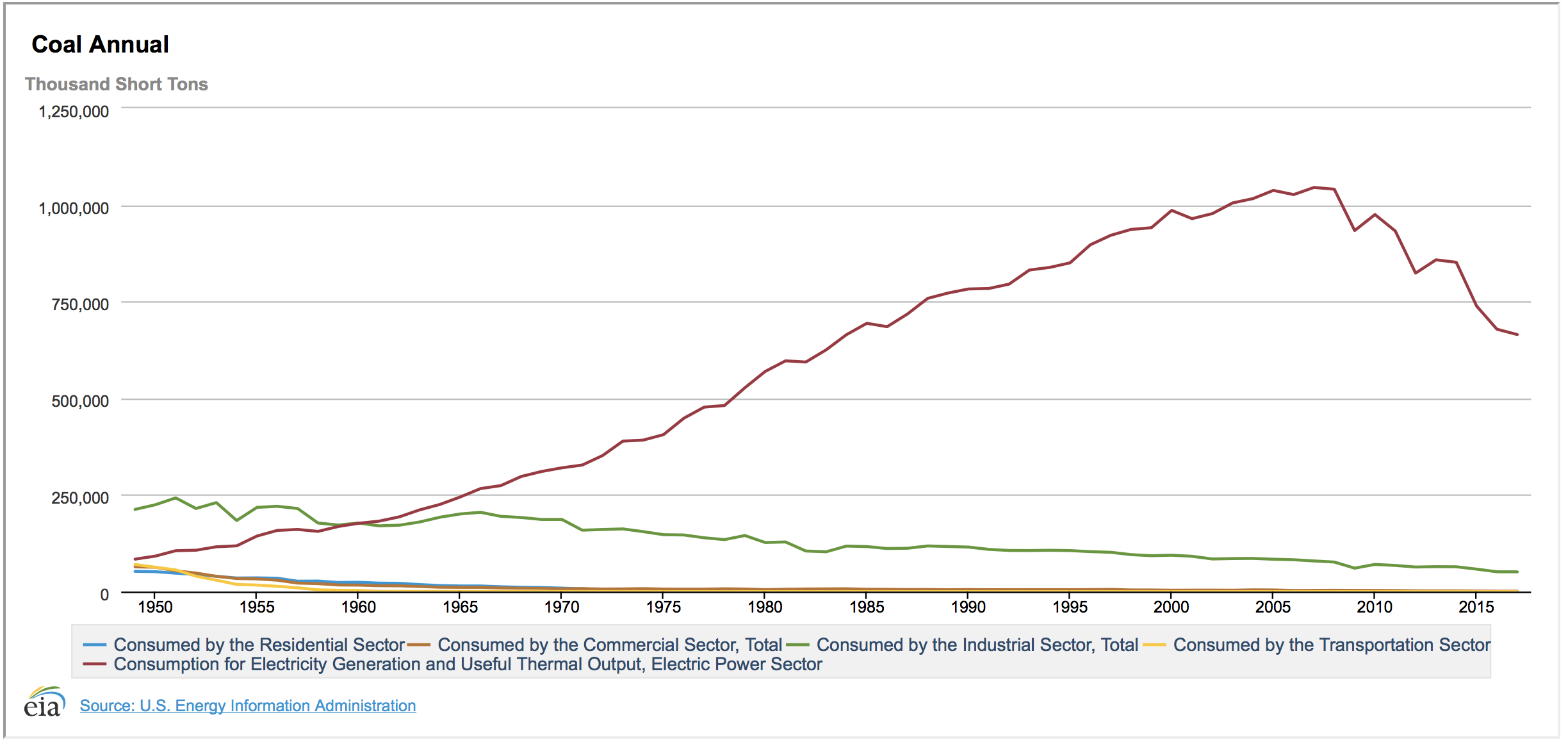
In 2008, recession washed over the nation like a wave, putting a damper on demand for electricity — and thus coal. There was nothing surprising about that. But what happened next was astounding: As the economy recovered, and demand for power stopped dropping, coal consumption kept plummeting. For the first time in sixty years, for a variety of reasons, the fortunes of coal and electricity had been decoupled.
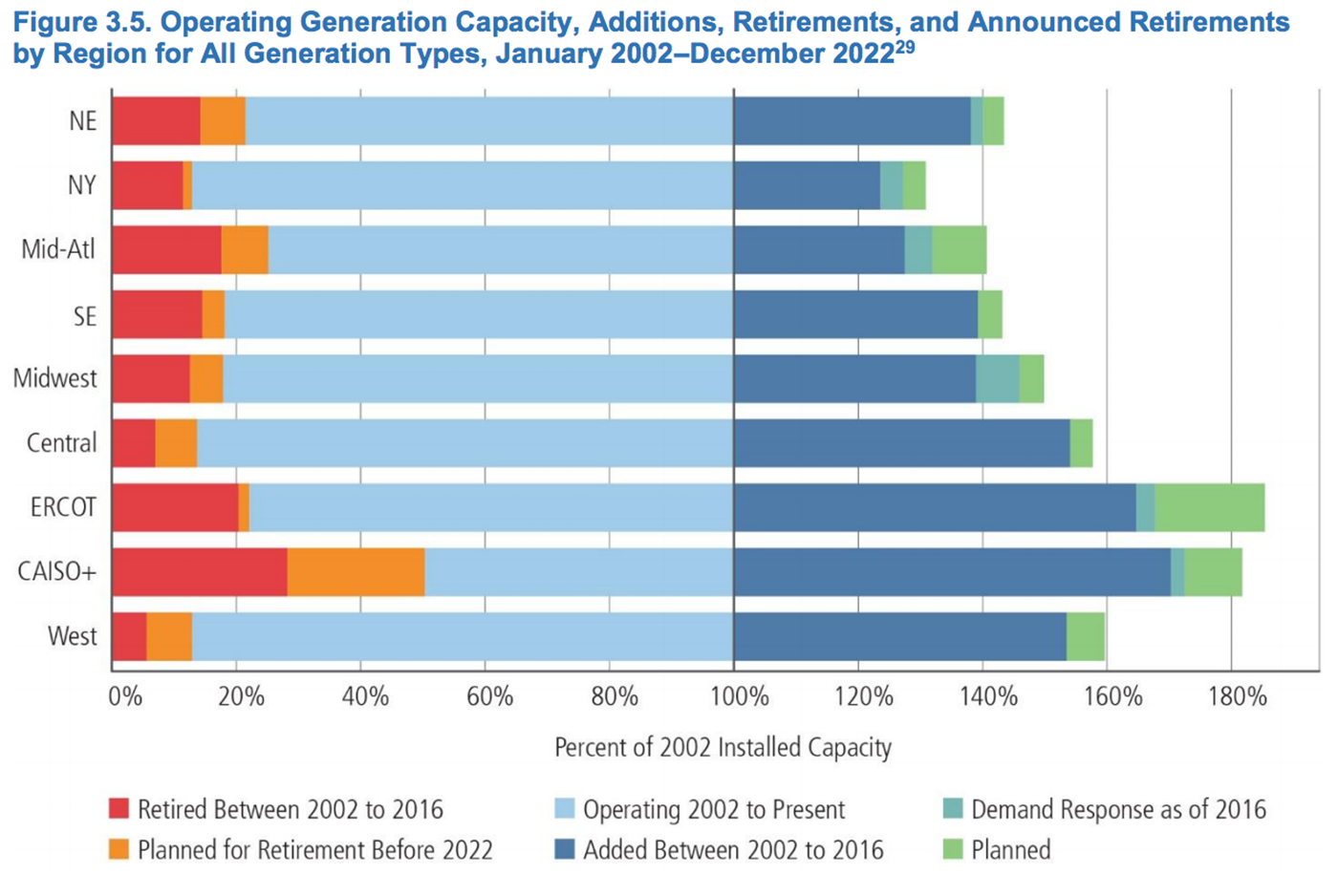
Now the machine assembled by the Big Buildup is breaking down in dramatic fashion, with coal plants retiring left and right, and those that remain burning less and less coal.
This is not merely another downward swing in the extractive industries’ boom-bust cycle. It’s the death of an entire economic sector, a paradigm shift, if you will. Its effects will be every bit as profound as the Big Buildup’s. Call it the Big Breakdown. I’ll be covering the phenomenon here and elsewhere over the coming months and years — this is not a fast death.
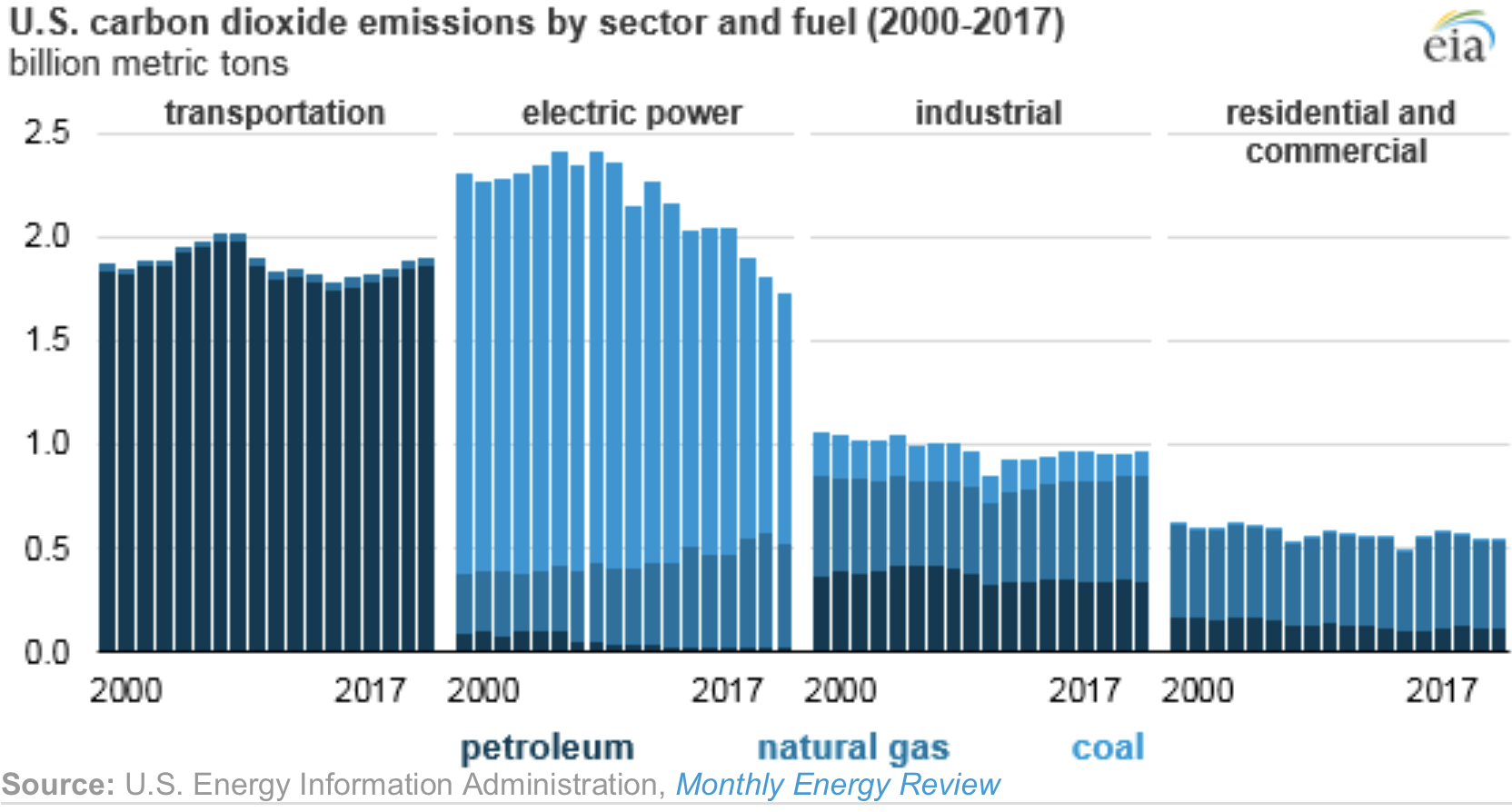
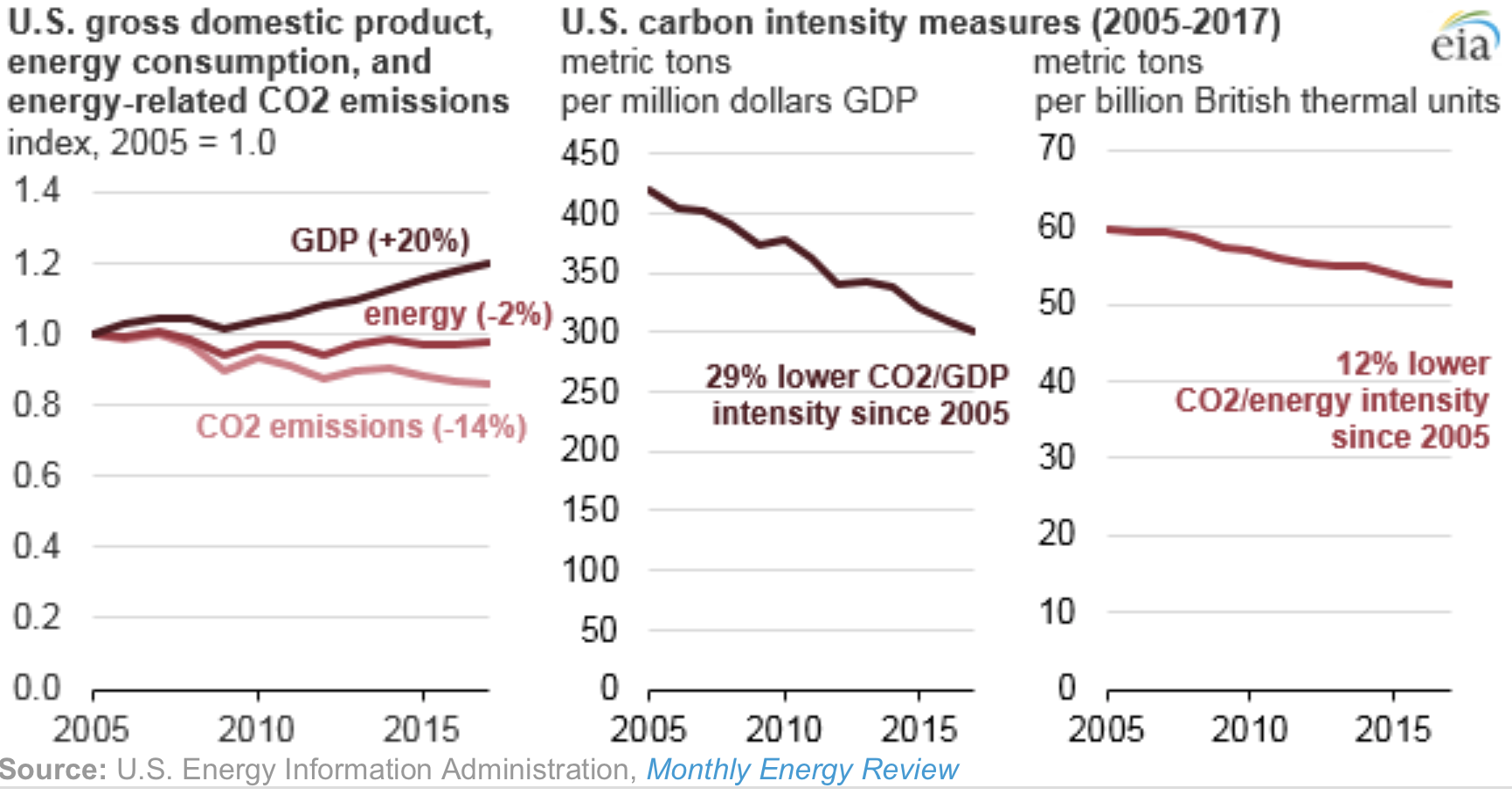
But for now I’ll just leave you the chart above, which so clearly illustrates the great decoupling and the underlying cause of the Big Breakdown.
A massive coal-fired power plant that served customers in the West for nearly 50 years shut down Monday, the latest closure in a shift away from coal and toward renewable energy and cheaper power.
The Navajo Generating Station near the Arizona-Utah line was expected to shutter by the end of the year, but the exact day hadn’t been certain as the plant worked to deplete a stockpile of coal.
It stopped producing electricity shortly after noon Monday when shift supervisor Fred Larson, a 41-year employee, put the plant permanently offline…
Coal was delivered to the power plant by a dedicated, electric railway that snakes 78 miles (126 kilometers) through the high desert in the Navajo Nation. By next fall, the poles and overhead electrical lines that served the railway will be gone. The Navajo Nation has not decided whether to keep the railway and use it for tourism or sell it.
A trio of towering concrete stacks with flashing lights that served as a beacon in the community will be demolished by next fall.
Decommissioning will take up to three years, after which the land is supposed to be returned to the condition it was before the plant was built.
Steve Yazzie, a former power plant employee who now works for a tribal energy company, said biologists from the Navajo Nation and the Salt River Project, which operates the plant, recently met to talk about reseeding the land with plants used for dying wool, making tea and traditional medicines.
Reclamation work also is being done at Peabody Energy’s Kayenta Mine, which pulled coal from land owned by the Navajo and Hopi tribes. It closed months ahead of the power plant because it had no other customers.
Navajo Generating Station and the cloud of smog with which it blankets the region. Photo credit: Jonathan Thompson via The High Country News
Aurora Organic Dairy today published its 2019 Sustainability Report. The report provides a detailed and transparent update on the Company and its progress toward goals to improve its sustainability performance around three core pillars of Animals, People and Planet.
The Company announced updated goals that encompass three key areas:
Caring for the comfort and well-being of its cows and calves, always putting animal care at the forefront of farming practices.
Employee safety and wellness, and local community support.
Commitments to greenhouse gas (GHG) reduction, water efficiency and waste reduction, and one important new goal to commit to 100% carbon-neutral energy by the end of 2020.
“At Aurora Organic Dairy, we have a longstanding commitment to continuous improvement when it comes to our animals, people and planet,” said Scott McGinty, CEO of Aurora Organic Dairy. “While we are proud of our achievements, in today’s world, we cannot rest. We must continue to do more to support our animals and people, the environment and our local communities. Our updated sustainability goals strengthen this commitment.”
The Company’s sustainability goals – established against 2012 baseline data – include many initiatives that have bolstered Aurora Organic Dairy’s sustainability performance:
Aurora Organic Dairy farms improved the overall welfare of its animals through goals to reduce lameness, to perform fewer dehorning procedures, to used paired calf housing and to increase video monitoring.
Significant progress against People goals was made with increased training programs, communications around the value of benefits, bilingual communication and community centers in remote farm locations. Going forward, Aurora Organic Dairy will continue its focus on safety and on employee volunteerism.
For the Planet, Aurora Organic Dairy achieved significant reductions in water and energy. Its milk plant achieved a 71% solid waste landfill diversion rate, and normalized GHG emissions were down 11%. The Company is committed to reducing its GHG emissions by 30% by 2025. Given the urgent need to address climate change globally, Aurora Organic Dairy has made an important commitment to 100% carbon-neutral energy by the end of 2020.
“This last year was a milestone for Aurora Organic Dairy in terms of environmental stewardship,” said Craig Edwards, Director of Sustainability for Aurora Organic Dairy. “We installed solar arrays at our High Plains and High Ridge Dairies in Gill, Colo. and we committed to 100% carbon-neutral energy by the end of 2020. To get there, we will invest in renewable energy projects directly and will support additional projects by purchasing Renewable Energy Certificates and Verified Emission Reductions to address 100% of our electricity and fuels use across our Company farms, raw milk transport, milk plants and headquarters.”
One coal mine remains open in the North Fork Valley. Photo/Allen Best
FromThe Grand Junction Daily Sentinel (Dennis Webb):
The decision Friday by Judge R. Brooke Jackson in the U.S. District Court of Colorado applies to the West Elk Mine’s efforts to begin mining as early as January beneath some 2,000 acres in what’s known as the Sunset Roadless Area in the Gunnison National Forest.
Ruling in a lawsuit brought by conservation groups, Jackson found that the federal Office of Surface Mining Reclamation and Enforcement violated federal law by failing to consider requiring the mine to burn off the methane produced during mining operations. Methane is a potent greenhouse gas. A supplemental environmental impact statement issued by the U.S. Forest Service and Bureau of Land Management had estimated that flaring could reduce the total global warming potential of the gas by about 87%.
That document didn’t draw conclusions about the feasibility or economic viability of flaring, saying it was premature to consider at the coal leasing stage and should be considered later.
But in recommending that the Interior Department approve the mining plan for the expansion, the mining reclamation office said the earlier environmental document sufficiently addressed the methane flaring alternative.
Jackson found that neither the mining reclamation office, the BLM or the Forest Service “put on the record any conclusions that justify excluding methane flaring from consideration as an alternative. Instead, it appears that one agency drew a faulty conclusion on the basis of other agencies’ explicit lack of conclusion.”
The mine is the largest single industrial point source of methane pollution in the state. The Forest Service has estimated the mine expansion would result in the release of nearly 12 million tons of methane. While the mining will take place underground, the mine has begun surface work in the roadless area, where it plans to build about 8.4 miles of roads and install 43 methane drainage wells.
The mine is owned by Arch Coal. It began pursuing the expansion a decade ago but has faced protracted legal challenges.
Jackson previously ruled that federal agencies failed to account for the environmental costs of leasing and other decisions related to the mine expansion. That led to the supplemental environmental document being released.
Conservation groups then sued to challenge that new environmental analysis and another federal judge ruled against them. That ruling is under appeal.
Jackson also ruled Friday in favor of conservationists over their contention that the mining reclamation office didn’t take a hard look at impacts to water resources from mining activities. The mining reclamation office both relied on the supplemental environmental review’s conclusion that there are no known perennial springs in the expansion area, and said perennial springs likely exist there.
The Colorado legislature has had an extraordinarily productive year so far, passing a stunning array of climate and clean energy bills covering everything from clean electricity to utilities, energy efficiency, and a just transition. The list is really pretty amazing…
It got me thinking: Just how big a role are EVs going to play in decarbonization? How should policymakers be prioritizing them relative to, say, renewable energy? Obviously, every state and country is going to need to do both eventually — fully electrify transportation and fully decarbonize electricity — but it would still be helpful to better understand their relative impacts.
Nerds to the rescue!
A new bit of research commissioned by Community Energy (a renewable energy project developer) casts light on this question. It models the carbon and financial impacts of large-scale vehicle electrification in Colorado and comes to two main conclusions.
First, electrifying vehicles would reduce carbon more than completely decarbonizing the state electricity sector, pushing state emissions down 42 percent from 2018 levels by 2040 — not enough to hit the targets on its own, but a huge chunk. Second, electrifying vehicles saves consumers money by reducing the cost of transportation almost $600 a year on average.
Rapid electrification is a win-win for Colorado, a driver of decarbonization and a transfer of wealth from oil companies to consumers — but only if charging is managed intelligently.
EVs bring carbon and consumer benefits
First, the headline: Electrifying EVs…reduces emissions a lot.
In the EV-grid scenario, electricity sector emissions fall 46 percent — the number is lower because about a third of the additional electricity demand from EVs is satisfied by natural gas — but overall state emissions drop 42 percent, more than two and a half times as much, representing 37 million metric tons of carbon dioxide. That’s thanks to an 80 percent drop in transportation emissions…
As I said, that in itself is not enough to meet the state’s emissions target. The state will have to force some additional cleaning of the electricity sector (and deal with other sectors) to do that, as this year’s package of legislation reflects. (I asked Clack if Vibrant ran a scenario without any new natural gas. Yes, he said. “It was $1 billion per year more expensive [around 1¢/kWh, or 15.9 percent more] and decreased emissions by an additional 14.8 metric tons per year.”)
But the drop in transportation emissions in the EV-grid scenario is sufficient to reduce more overall emissions than the entire Colorado electricity sector produces. EVs are a vital piece of the decarbonization puzzle.
The effect of all the new EVs on electricity generation is pretty simple: There will be more of it…
As you can see, in the cleaner-grid scenario, lost coal generation is replaced by a mix of natural gas, wind, and solar. In the EV-grid scenario, it’s roughly the same mix, just a little more of each — the addition of EVs raises total electricity demand by about 20 percent.
Bonus result: “The increase in generation capacity increases employment in Colorado’s electricity sector by approximately 68 percent by 2040.”
[…]
And now, here are the fun parts.
Shifting from internal combustion engine vehicles (ICEV) to EVs would save Colorado consumers a whole boatload of money, for the simple reason that electricity is a cheaper fuel than gasoline. Here are the average savings for a Coloradan that switches from ICEV to EV between 2018 and 2040…
So the average Coloradan will save between $590 and $645 a year — nothing to sneeze at. “The total savings between 2018 and 2040 are estimated to be $16 billion,” Vibrant says, “which equates to a savings of almost $700 million per year.”
You might think, with all the new EV demand added to the grid, electricity rates would go up. In fact, relative to the cleaner-grid scenario, the EV-grid scenario has an extremely small impact on rates (0.7 percent difference at the extreme)…
EVs are a climate triple threat
What this modeling makes clear is that when it comes to clean energy policy, EVs are a triple threat for Colorado (and, obviously, for other states, though the impacts will vary with weather and electricity mix).
For the electricity sector, as long as their charging is properly managed, EVs can provide much-needed new tools to help manage the influx of renewable energy…
For the transportation sector, EVs can radically reduce carbon emissions and local pollution. (Yes, EVs reduce carbon emissions even in areas with lots of coal on the grid.)
And for consumers, EVs save money, not only because the fuel is cheaper (and getting cheaper all the time) but because EVs are much simpler machines, with fewer moving parts and much lower maintenance costs.
Especially in states with electricity sector emissions that are already low or falling, transportation is the next big place to look for emission reductions, and EVs are one of the few options that can reduce emissions at the necessary scale and speed. Colorado is right to encourage them.
Deal sealed for electrical co-op’s exit from Tri-State but the fee unknown
Tri-State Generation and Transmission and one of its 43 member co-operatives, Delta-Montrose Electric Association, have come to terms. Delta-Montrose will be leaving the “family,” as Tri-State members are sometimes called, on about May 1, 2022.
What it cost Delta-Montrose to exit its all-requirements contract with Tri-State, however, will remain a secret until then. The figure was redacted in the settlement agreement filed with the Colorado Public Utilities Commission last Friday. The figure can become public after the split occurs next year, according to Virginia Harman, the chief operating officer for Delta-Montrose.
The split reflects a fundamental disagreement over the future of electrical generation and the pace of change that has festered for about 15 years. Those different visions became apparent in about 2005 as Tri-State managers sought to build a major new coal plant near Holcomb, Kan., in partnership with Sunflower Electric.
The utilities were shocked when Kansas denied a permit for the plant, based on the time at the still-novel grounds of its carbon dioxide pollution. When Tri-State finally got its permit for the coal plant in 2017, it had spent nearly $100 million with nothing to show.
Meanwhile, the electrical world had turned upside down. Wind had become the cheap energy, not coal, and it was being integrated into power supplies effectively. Even solar was in cost competitive in places.
Along among the then 44 member cooperatives, only Kit Carson and Delta-Montrose had refused the 10-year contact extensions to 2050 that Tri-State had wanted to satisfy money markets for long-term loans. Their contracts remained at 2040. The contracts of other member co-ops—including those serving Durango, Telluride, Crested Butte and Winter Park—go until 2050.
Kit Carson was the first to get out. In 2016, assisted by Guzman, it paid the $37 million exit fee required by Tri-State and set out, also with the assistance of Guzman, to develop solar farms in dispersed parts of its service territory in northern New Mexico. It aims to have 100% solar capability by the end of 2022.
In November 2016, Delta-Montrose informed Tri-State it wanted to buy out its contract, too. It asked for exit figure. The negotiations did not yield an acceptable number to both, and in December Delta-Montrose asked the Colorado Public Utilities Commission to arbitrate. The PUC agreed over protests by Tri-State that the PUC had no authority. A week was set aside in June, later delayed to begin Aug. 12, for the case.
No figures have ever been publicly revealed by either Tri-State or Delta-Montrose, although a court document filed early in July reported that Tri-State’s price had been reduced 40%.
Meanwhile, Tri-State got approval from its members to seek regulation for rate making by the Federal Energy Regulatory Commission. That could possibly have moved the jurisdiction over the Delta-Montrose exit to Washington. It would not affect review by Colorado, New Mexico or other states in which Tri-State operators of resource planning.
Delta-Montrose and Guzman have not completed plans for how the co-operative may develop its local energy resources. The co-op had reached Tri-State’s 5% allowance for local generation by harnessing of fast-moving water in an irrigation conveyance called the South Canal.
For Tri-State’s new chief executive, Duane Highley, the task at hand may be how to discourage more exits by other member co-op. Tri-State has argued that it moved slowly but has now is in a position to realize much lower prices for renewable energy generation. It is moving forward on both wind and solar projects in eastern Colorado.
Delta-Montrose, with 33,000 members, is among the larger co-ops in Tri-State. But even larger one, who together represent nearly half the electrical load supplied by Tri-STate have all dissatisfaction with Tri-State’s slow movement away from coal-fired generation.
In Southwestern Colorado, Durango-based La Plata Electric recently asked for an exit figure, too.
Along the Front Range of Colorado, United Power, by far the largest-coop, with 91,000 members and booming demand from oil and gas operators north of Denver, has wanted more renewable energy and greater ability to develop its own resources. Poudre Valley has adopted a 100% clean energy goal.
Delta-Montrose, with 33,000 members, is easily among the 10 largest co-ops.
The settlement agreement filed with the PUC says DMEA “shall not assist any other Tri-State member in pursuing withdrawal from Tri-State. The agreement also says that DMEA and Tri-State agree to not disparage each other.
More than 30% of Tri-State’s generation comes from renewables, mostly from hydropower. This total is little different from that of Xcel Energy. But Xcel in 2017 announced plans to close two of its aging coal plants, leaving it at 55 percent renewable generation in Colorado.
Tri-State, too, is closing coal plants. A coal plant at Nucla, in southwestern Colorado, west of Telluride, will close early next year, several years earlier than previously scheduled. However, it’s small by coal plant standards, with a nameplate capacity of 114 megawatts, and operates only part time.
A larger reduction is scheduled to occur by 2025 when one of three coal units at Craig, in northwestern Colorado, will be retired. But a Tri-State official, speaking at a beneficial electrification conference in Denver during June, suggested that a second coal plant could also be retired early. That second coal unit is co-owned with other utilities in Colorado and other states, all of whom have indicated plans to hasten their retreats from coal.
Tri-State last week also announced a partnership with former Colorado Gov. Bill Ritter’s Center for the New Energy Economy to facilitate a stakeholder process intended to help define what Tri-State calls a Responsible Energy Plan. See: Tri-State Announces Responsible Energy Plan 20190717
A long-standing legal dispute in the Colorado energy industry came to an end Monday when Delta-Montrose Electric Association announced it would withdraw from its membership in Tri-State Generation & Transmission, effective May 1, 2020.
The early withdrawal is part of a definitive settlement agreement between the two energy companies.
Delta-Montrose Electric Association, a rural utility provider on the Western Slope, said it underwent the effort to secure cheaper rates for customers and purchase more renewable energy.
As demand shrinks and the industry retracts, counties and the state are in an untenable situation.
Over the last few months, Wyoming’s struggling coal industry has gone from bad to worse. In May, the third-largest mining company, Cloud Peak, filed for bankruptcy, leaving the pensions and future of hundreds of employees in jeopardy. Less than two months later, Blackjewel, Wyoming’s fourth-largest coal company, abruptly declared bankruptcy, idling mines and putting hundreds out of work.
As the hits against coal pile up, so do questions about the future of Wyoming’s coal mines and the economy they support. With even the Trump administration’s regulatory rollback’s offering no relief, the largest coal-producing state in the country is being forced to grapple with the decline of the industry that has long undergirded its economy.
Spring Creek Coal Mine. Photo credit: Cloud Peak Energy
Wyoming’s politicians have gone to considerable lengths to prop up the coal industry. Now, the state is walking an increasingly threadbare tightrope as it manages coal’s future. Lean too far towards promoting mining, with lax tax collection standards and cleanup requirements, and state and local governments may get stuck with cleaning up the mess the failed businesses leave behind. Tilt towards proactive tax collection and strong reclamation requirements, and risk becoming another factor pushing the coal economy into oblivion.
The depth of the current downturn was unforeseen even a couple years ago, said University of Wyoming economist Rob Godby. The Obama administration’s Clean Power Plan, which sought carbon emission reductions from the power sector, was expected to deal the industry a blow, and it was discarded by the Trump administration, anyway. Instead, it was cheap natural gas and to a lesser extent renewable energy sources — and the resulting shrink in demand for coal — that ended up knocking coal companies to their knees, said Godby.
The diminishing value of coal draws ominous parallels to the subprime mortgage bubble that precipitated the Great Recession of 2008. But the coal free-fall is likely to be even worse than the housing market crash, because houses always retained some value, while coal mines could end up worthless if investors see costs that outstrip potential income, said energy analyst Clark Williams-Derry of the Sightline Institute, a sustainability think tank.
With mines likely to close, Wyoming is entering a new and untested paradigm for coal — reclamation without production. Typically, mines clean up their mess as they go; if they don’t, then the state can shut down operations until they do. But once a company goes broke and the mine shuts down, the only funds for cleanup are reclamation bonds, which critics say are inadequate in Wyoming.
The Powder River Basin Resource Council has been pushing Wyoming’s Department of Environmental Quality to look harder at the balance sheet of companies before it allows them to buy mines. This effort has kept cleanup obligations from being transferred to Blackjewel and then possibly going unfunded during the company’s bankruptcy. Williams-Derry called that a “heroically smart move,” because now the cleanup costs are staying with the mines’ former owner instead of potentially ending up with the state.
In pushing for strong cleanup requirements, resource council Executive Director Joyce Evans said that requiring mines to do proper reclamation would create more jobs for out-of-work miners. Still, she said she doesn’t expect miners to embrace the prospect, even if the reclamation jobs pay just as well as mining, because of Wyoming’s history of “social dependency on coal and energy.”
Meanwhile, coal’s collapse is delivering a one-two punch of unemployment and unpaid taxes to Campbell County, where more than one-third of all coal in the U.S. is mined from the Powder River Basin. The Blackjewel bankruptcy put nearly 600 miners out of work, and the county may never get $37 million in taxes owed by the company, which was run by Appalachian coal executive Jeff Hoops. This is partly because of the county’s lenient approach to collecting back taxes. “We’ve been dealing with delinquent taxes and Mr. Hoops for several months in an amicable way to try and resolve (the unpaid taxes) without pushing them into what has happened now and keep our miners working,” said County Commissioner Del Shelstad in a July 3 meeting in Gillette.
Now, creditors are in line before the county to collect in bankruptcy court. For Gillette’s state Sen. Michael Von Flatern, an ex-coal miner, the delayed county tax payments and ongoing dependence on minerals “is starting not to make sense.” He described the current bankruptcies as the canary in the coal mine for the industry’s long-term decline. “We need to truly diversify our economy,” Von Flatern said. “We have a minerals, minerals, minerals economy.” But over next couple decades, it’s possible that there won’t be a market for Wyoming coal anymore, he said. “If Wyoming can’t do what we need to do to diversify our economy and change our tax structure, then we’ll be in the same place next time we go bust.”
Carl Segerstrom is an assistant editor at High Country News, covering Alaska, the Pacific Northwest and the Northern Rockies from Spokane, Washington. Email him at carls@hcn.org.
“If I had to sum it up in a word, I think I’d say ‘transformative.’ It’s a real shift in our policy, and I think it really shows the direction that Colorado is headed,” said Erin Overturf, chief energy counsel for the conservation group Western Resource Advocates. “I think it shows that we’re starting to take climate change seriously and recognize the task that’s truly ahead of us if we’re going to do our part to help solve this problem.”
The bills include efforts to make houses and appliances — from refrigerators, to light bulbs to air conditioners and furnaces — more energy-efficient…
Lawmakers extended state tax credits for buying electric vehicles and allowed regulated electric utilities to own and operate vehicle charging stations to try to encourage people to buy and drive zero-emission vehicles.
One of the things that sets Colorado apart from other states working to boost the use of renewable energy and reduce greenhouse gas emissions is its efforts to look out for affected workers and communities, said Anna McDevitt, an organizer with the Sierra Club’s Beyond Coal Campaign.
The bill reauthorizing the PUC has a provision requiring utilities to include a workforce transition plan when they propose shutting down a power plant. Another section on low-cost bonds to retire power plants for cleaner, cheaper alternatives also provides that a portion of the proceeds helps workers and communities affected by the closures…
Referring to the PUC bill and its carbon-reduction targets, Xcel Energy said in a statement Friday that the legislation was “heavily negotiated with a broad set of stakeholders” and protects safety reliability and customer costs…
One bill expands the size of community solar gardens, which are centralized arrays of solar panels that users “subscribe” to. They are intended for people who want to use solar power but whose roofs aren’t suitable, who live in an apartment or can’t afford to install a system.
Other legislation directs the PUC to study regional transmission organizations that would make it easier for utilities or municipalities to buy wholesale power. Another section requires regulators to take on planning to help facilitate rooftop solar and other distributed-energy installations.
The PUC also will have to look into so-called “performance-based ratemaking.” That would allow utilities to earn a certain rate of return on things such as increasing energy efficiency or installing a certain amount of rooftop solar rather than just on construction of plants or other infrastructure.
Sen. John Barrasso, R-Wyo., argued in a recent op-ed that fossil fuels, like the coal processed at this Wyoming plant, will continue to power the world for decades, and that the solution to climate change is “investment, invention and innovation,” not regulation. Photo credit: BLM Wyoming
On Saturday (May 11), the levels of the greenhouse gas reached 415 parts per million (ppm), as measured by the National Oceanic and Atmospheric Administration’s Mauna Loa Observatory in Hawaii. Scientists at the observatory have been measuring atmospheric carbon dioxide levels since 1958. But because of other kinds of analysis, such as those done on ancient air bubbles trapped in ice cores, they have data on levels reaching back 800,000 years…
During the ice ages, carbon dioxide levels in the atmosphere were around 200 ppm. And during the interglacial periods — the planet is currently in an interglacial period — levels were around 280 ppm, according to NASA.
But every story has its villains: Humans are burning fossil fuels, causing the release of carbon dioxide and other greenhouse gases, which are adding an extra blanket on an already feverish planet. So far, global temperatures have risen by about 1.8 degrees Fahrenheit (1 degree Celsius) since the 19th century or pre-industrial times, according to a special report released last year by the United Nation’s Intergovernmental Panel on Climate Change.
Every year, the Earth sees about 3 ppm more carbon dioxide in the air, said Michael Mann, a distinguished professor of meteorology at Penn State University. “If you do the math, well, it’s pretty sobering,” he said. “We’ll cross 450 ppm in just over a decade.”
[…]
“CO2 levels will continue to increase for at least the next decade and likely much longer, because not enough is being done worldwide,” said Donald Wuebbles, a professor of atmospheric sciences at the University of Illinois at Urbana-Champaign. “The long-term increase is due to human-related emissions, especially the emissions of our burning of fossil fuels.”
However, he noted that the annual peak in carbon dioxide, which fluctuates throughout the year as plants change their breathing rhythms, occurs right now. The annual average value will be more like 410 to 412 ppm, he said. Which … is still very high.
“We keep breaking records, but what makes the current levels of CO2 in the atmosphere most troubling is that we are now well into the ‘danger zone’ where large tipping points in the Earth’s climate could be crossed,” said Jonathan Overpeck, the dean of the School for Environment and Sustainability at the University of Michigan. “This is particularly true when you factor in the additional warming potential of the other greenhouse gases, including methane, that are now in the atmosphere.”
The last time atmospheric carbon dioxide levels were this high, way before Homo sapiens walked the planet, the Antarctic Ice Sheet was much smaller and sea levels were up to 65 feet (20 meters) higher than they are today, Overpeck told Live Science.
“Thus, we could soon be at the point where comparable reductions in ice sheet size, and corresponding increases in sea level, are both inevitable and irreversible over the next few centuries,” he said. Smaller ice sheets, in turn, might reduce the reflectivity of the planet and potentially accelerate the warming even more, he added.
“It’s like we’re playing with a loaded gun and don’t know how it works.”
Global CO2 emissions by world region 1751 through 2015.
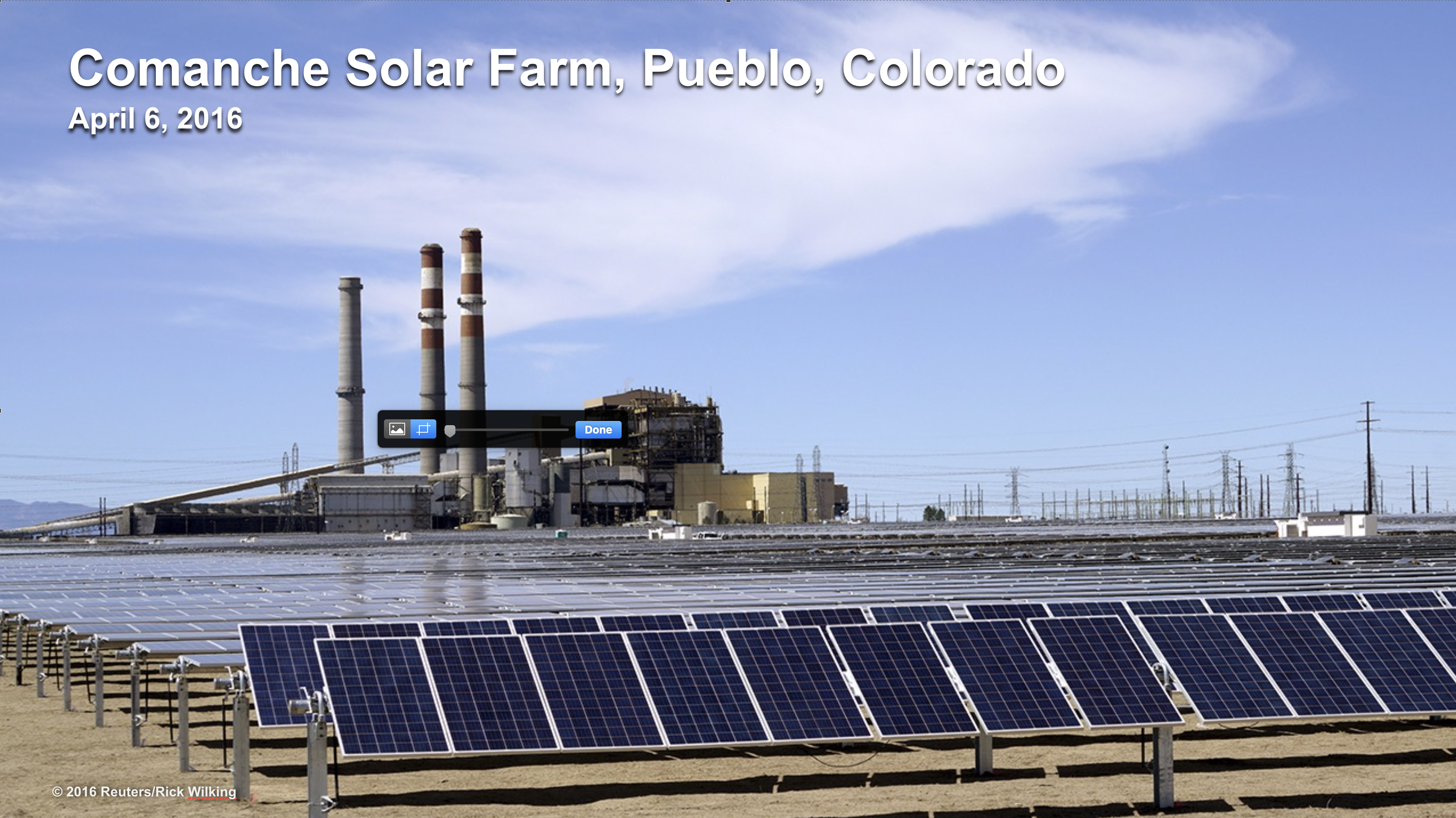
Comasche Solar Farm near Pueblo April 6, 2016. Photo credit: Reuters via The Climate Reality Project
From the Yale School of Forestry & Environmental Studies:
Nearly 75 percent of coal-fired power plants in the United States generate electricity that is more expensive than local wind and solar energy resources, according to a new report from Energy Innovation, a renewables analysis firm. Wind power, in particular, can at times provide electricity at half the cost of coal, the report found.
By 2025, enough wind and solar power will be generated at low enough prices in the U.S. that it could theoretically replace 86 percent of the U.S. coal fleet with lower-cost electricity, The Guardian reported.
“We’ve seen we are at the ‘coal crossover’ point in many parts of the country, but this is actually more widespread than previously thought,” Mike O’Boyle, the co-author of the report for Energy Innovation, told The Guardian. “There is a huge potential for wind and solar to replace coal, while saving people money.”
Using public financial filings and data from the U.S. Energy Information Agency, O’Boyle and his colleagues analyzed the cost of coal-fired power plants compared with wind and solar options within a 35-mile radius. The report found that North Carolina, Florida, Georgia, and Texas have the greatest amount of coal capacity currently at risk of being outcompeted by local wind and solar. By 2025, Indiana, Michigan, Ohio, and Wisconsin will be in a similar situation.
“Coal’s biggest threat is now economics, not regulations,” O’Boyle told CNN Business.
Coal currently makes up just 28 percent of total U.S. power generation, down from 48 percent in 2008. Renewables, meanwhile, now account for 17 percent of electricity generation, dominated by hydro and wind, with solar capacity quickly growing.
Washington blocked a coal terminal under the Clean Water Act. New rules could subvert that authority.
At nearly 17 million acres, the Tongass National Forest in Southeast Alaska is part of the largest intact temperate rainforest in the world. Meanwhile, about a thousand miles south in Longview, Washington, on the banks of the Columbia River, decades of industrial waste mar the proposed site for the largest bulk coal terminal in North America.
On the surface, these places may not have much in common, but they’re both part of a simmering nationwide conflict over state and federal power. In the Tongass, that means the Administration deferring to Alaska’s desire to rewrite federal rules to promote logging, while in Longview, that looks like an executive order designed to limit a state’s ability to block fossil fuel projects — including the Millennium coal export terminal.
A recently signed executive order looks to fast-track permitting for coal terminals. Photo credit: Peabody Energy, Inc./Wikipedia Commons
The [President’s] administration’s treatment of these areas demonstrates its all-in support for extractive industries. In the name of energy dominance, the federal government is looking to curtail state environmental reviews and promote fossil fuel exports. By doing so, it’s wading into an ongoing fight between coastal and Interior West states over permit denials for export facilities on the West Coast. Where the administration stands on that battle — and its apparent willingness to trample on some states’ regulatory authority — exposes the uniquely flexible nature of its support for states’ rights: It appears interested in shifting power to states only when the goal is less environmental protection.
[The President’s] April 10 executive order was part of a package of directives designed to pave the way for infrastructure like the Millenium coal terminal. In the order, [the President] asked the Environmental Protection Agency to rewrite the policies for how Section 401 of the Clean Water Act is implemented. That section of the linchpin federal law gives states and tribes authority over whether to permit facilities that release pollution into federally protected waters within their borders. [The President’s] directive declares that the current process “cause(s) confusion and uncertainty, leading to project delays, lost jobs, and reduced economic performance.”
While it’s unclear exactly how the EPA will change the guidelines, environmental lawyers are skeptical that the executive branch has the authority to weaken state and tribal oversight. That’s because the right of states to protect their rivers, lakes and coastal waters is fundamental to the Clean Water Act, and the 401 certification process gives affected communities a voice in that process. Andrew Hawley, a lawyer with the Western Environmental Law Center, put it bluntly: “To undermine that goes straight to the heart of the Clean Water Act.”
The orders come as states are battling over export infrastructure along the Pacific Coast. Fossil fuel-producing states in the Interior West — frustrated that local and state governments in Washington, Oregon and California have stymied a string of projects — see [the President’s] directives as a crack in the coast’s green wall. “I stand with governors across the land in asserting our states’ rights to access markets foreign and domestic,” said Wyoming Gov. Mark Gordon, R, following the orders’ announcement. “The states along the West Coast have abused their authority under section 401 of the Clean Water Act to unfairly discriminate against Wyoming coal.”
Gordon blamed the blocking of export facilities on climate politics, but Washington denied the Longview permit because of local impacts, not big-picture threats. In a summary of the decision, the state’s Department of Ecology wrote that the project “would cause irreparable and unavoidable harm to the Columbia River,” by driving hundreds of pilings into the riverbed, destroying nearly 30 acres of wetlands and aquatic habitat, increasing ship traffic on the Columbia River by 1,680 trips a year, and impairing tribal access to protected fishing sites.
Elsewhere, the…administration has sought to shift power to the states — so long as the end result would slash environmental protections. In the past couple years, the Interior Department has implemented policies that defer wildlife management to states, thus allowing controversial hunting practices like killing coyotes and wolves during denning season on national wildlife refuges in Alaska. And the Forest Service is working with Utah and Alaska to weaken restrictions on carving roads into roadless forests. That would mean major changes in areas like the Tongass, where most of the forest is inaccessible to industry.
As some Western states get more leeway to weaken environmental safeguards, green activists are left wondering how far the federal government will go to subvert state regulatory authority in their communities. Diane Dick, who lives just outside the Longview city limits, has spent the better part of a decade fighting the Millenium coal terminal. From the beginning, she said, the fight over the terminal felt bigger than just one project; she’s watched it become a poster child for a national debate over energy infrastructure. Now, as the executive branch tilts the scales against local environmental protection, Dick sees a larger question looming: When and based on what can a community protect itself?
Longview, Washington, residents gather to protest the coal terminal project. The community has been fighting the proposed terminal for years. Photo credit: Power Past Coal
Carl Segerstrom is an assistant editor at High Country News, covering Alaska, the Pacific Northwest and the Northern Rockies from Spokane, WA.
A spokesperson for Denver’s Department of Finance confirmed that the city’s fossil fuel investments have been sold. As of earlier this year, its various portfolios had included about $50 million in corporate bonds issued by fossil fuel giants Exxon Mobil and Chevron, though in previous years that figure had been higher.
“This is a powerful statement to our children, grandchildren and future generations that we care about them and want to invest in their future,” said 350 Colorado boardmember Barbara Donachy.
One coal mine remains open in the North Fork Valley. Photo/Allen Best
Oil and gas development on the Roan via Airphotona
Over the last few years, residents of the western Colorado town of Paonia, the longtime headquarters of High Country News, have planted yard signs, skipped ultimate frisbee to attend public meetings, and embarrassed themselves and each other during a karaoke-themed fundraiser — all in the name of preventing oil and gas development in their watershed. Despite their efforts, the Bureau of Land Management and Forest Service approved major fracking projects, in 2015 and 2017, just above this small community, where agritourism and a renewable energy training facility are growing as coal jobs fade.
What public pushback didn’t stop, a federal court in Denver has temporarily halted. In late March, Colorado U.S. District Judge Lewis Babcock ruled the agencies failed to fully consider climate and wildlife impacts in approving the projects, and ordered them to rework their environmental reviews. It is the latest in a string of decisions regarding federal environmental planning for oil and gas development and leasing on public lands. Another judge also recently rejected oil and gas leases in Wyoming, citing an inadequate analysis of how they would harm the climate; together, the rulings have blocked development approved by both the Obama and Trump administrations.
Environmentalists see the decisions as major victories and an opportunity to slow down the “energy dominance” agenda of the Trump administration. At the same time, they’re aware that courts alone can’t prevent the administration from increasing leasing and drilling on public lands. But in the details of the decisions, and in growing public awareness and activism around climate action, they see a chance to slow or stop oil and gas development on public land.
Oil and gas drilling has been delayed above Paonia, Colorado because agencies didn’t adequately analyze climate and wildlife impacts. Courtesy of EcoFlight via The High Country News.
The courts are merely delaying, rather than actually preventing fossil fuel development over climate concerns. That’s because the National Environmental Policy Act of 1970 (NEPA) governs process, not outcomes. The law requires disclosure, “but NEPA doesn’t have the kind of teeth to force agencies to act on climate change,” said Clare Lakewood, a lawyer for the Center for Biological Diversity. “Practically speaking, (BLM) will do the analysis the court directed,” and likely continue with the fracking project in western Colorado, said Laura King, a lawyer for the Western Environmental Law Center. Steven Hall, the BLM Colorado communications director, said the agency will work with the groups that sued to address the issues identified by the court.
While it would be foolhardy to expect the Trump administration to change its plans based on a climate analysis, just a few years ago the Interior Department appeared to be taking climate change more seriously. In 2016, Interior Secretary Sally Jewell issued a moratorium on federal coal auctions and initiated an environmental review of the entire federal coal-leasing program. Though that review was never completed — and the moratorium was overturned in short order by Trump’s then-secretary, Ryan Zinke — the data collected during it were published late last year in a report by the U.S. Geological Survey. That report shows that the extraction and combustion of fossil fuels from federal lands is responsible for approximately one-fourth of the carbon dioxide emissions produced in the United States.
The report not only showed that federal lands are a major contributor to climate change, it also demonstrated that tools exist to track and estimate how they contribute to greenhouse gas emissions. Now, federal judges are keen to see those tools employed to inform agency decision-making. In a ruling that is delaying 303,000 acres of oil and gas leases in Wyoming, U.S. District Judge Rudolph Contreras wrote that by omitting analysis of the cumulative impacts of greenhouse gas emissions, the BLM failed to abide by environmental laws. He also wrote, “BLM could decline to sell the oil and gas leases at issue here if the environmental impact of those leases — including use of the oil and gas produced — would not be in the public’s long-term interest.”
The judge’s assertion is critical for activists who want to keep fossil fuels in the ground. The Interior Secretary is directed by law to hold quarterly oil and gas lease sales. But if the BLM has the power to decline to issue the leases based on their ultimate contribution to climate change, that could pave the way for future administrations to phase-out or even eliminate fossil fuel leasing on public lands. “We think the agencies have complete discretion,” to issue a moratorium on new federal fossil fuel leasing, said Jeremy Nichols, the climate and energy program director for WildEarth Guardians.
Climate action is not coming from the current partisan Congress, an Interior Department led by former industry lobbyists, or a president who blames wind turbines for cancer while praising the beauty of coal. But recent court decisions are giving future administrations a legal footing to phase out fossil fuel development on public lands, and bolstering environmental activists like the karaoke-singers in Paonia by posing an important question: Is fossil fuel development a sensible way to manage public land for future generations?
Carl Segerstrom is an assistant editor at High Country News, covering Alaska, the Pacific Northwest and the Northern Rockies from Spokane, WA. Email him at carls@hcn.org.
The Energy Transition Act could be a model for ambitious policies of the future.
On March 23, New Mexico Gov. Michelle Lujan Grisham signed into law the Energy Transition Act, a complex bill that will move the state toward cleaner electricity generation, clear the way for the state’s biggest utility to shutter one of the West’s largest coal-fired power plants in 2022, and provide mechanisms for a just transition for economically affected communities.
The bill has the support of the state’s biggest utility — Public Service Company of New Mexico, or PNM — as well as environmental groups such as the Natural Resources Defense Council, Western Resource Advocates and the San Juan Citizens Alliance. National media are hailing it as a mini-Green New Deal.
San Juan Generating Station. Photo credit: Jonathan Thompson
Here’s a breakdown of what the bill does — and doesn’t — do:
Perhaps most significantly, the bill mandates that New Mexico electricity providers get 80 percent of their electricity from renewable sources by 2040, and 100 percent from carbon-free sources by 2045. Those are ambitious goals that will result in huge cuts in greenhouse gas emissions in a state that currently gets half its electricity from coal and a third from natural gas.
That said, it’s important to remember that “carbon-free” and “renewable” are not synonyms. The 20 percent of carbon-free electricity can include nuclear, since no greenhouse gases are emitted during fission, as well as coal and natural gas equipped with carbon capture and sequestration technologies. Carbon capture is prohibitively expensive — and unproven — but nuclear power is readily available from Palo Verde Generating Station in Arizona, where PNM currently gets about 18 percent of its power.
Also, “electricity” and “energy” are two distinct concepts — a common source of confusion. This bill applies only to electricity consumed by New Mexicans and has no direct bearing on the state’s burgeoning oil or natural gas production. Meanwhile, the Four Corners Power Plant, located in New Mexico but owned by Arizona Public Service, can continue to burn coal under the renewable standards as long as the electricity is exported to other states. But PNM plans to divest its 13 percent ownership in Four Corners Power Plant in 2031, leaving the plant on shakier economic ground.
The bill helps pave the way for the planned closure of San Juan Generating Station, located just north of the Navajo Nation in northwestern New Mexico.
The station’s owner, PNM, announced two years ago that it would likely shut down the plant in 2022 because it was no longer economically viable. Many aspects of this bill are a direct reaction to the pending closure, particularly the sections that allow the utility to take out “energy transition bonds” to cover costs associated with abandonment. Those bonds will be paid off by ratepayers, but not taxpayers.
This has irked New Energy Economy, a Santa Fe-based group that has been pushing PNM to clean up its act for years. The group, a critic of the bill, would rather see PNM’s investors shoulder the cost of the bonds. After all, the investors are the ones who have profited handsomely off the power plant for nearly half a century, even as it pumped millions of tons of climate warming gases into the air, along with acid rain-forming sulfur dioxide, health-harming particulates, mercury, arsenic and other toxic materials.
While the bill does not specifically force the plant’s closure, it does mandate the creation of standards that limit carbon dioxide emissions from large coal-burning plants to about half of what coal emits per megawatt-hour — effectively killing any possibility of keeping the generating station operating.
The energy transition bonds will help fund a just transition away from coal. Some 450 jobs— about one-fourth of them held by Native Americans — will be lost when the San Juan Generating Station and the associated San Juan Mine close, together with an estimated $356 million in economic activity annually.
The bill allocates up to $30 million for reclamation costs, and up to $40 million to help displaced workers and affected communities, to be shared by the Energy Transition Indian Affairs Fund, Economic Development Assistance Fund and Displaced Worker Assistance Fund. The Indian Affairs Fund will be spent according to a plan developed by the state, in consultation with area tribal governments and with input from affected communities, and the economic development fund will help local officials diversify the local economy. The bill also requires PNM to replace a portion of the area’s lost generation capacity, in the process creating jobs and tax revenue.
The new bill has some missing elements. There’s no provision for making amends to the people who have lived near the plant for years and suffered ill health, such as high asthma rates, as a result. It won’t stop Four Corners Power Plant, located just 10 miles from San Juan Generating Station, from belching out pollution (though it does provide for a just transition away from that plant if it closes by 2031), and it doesn’t address the massive climate impact from oil and gas development or transportation. The act is merely an official acknowledgment that coal is dying, and that coal communities could die, too, without help.
Nevertheless, the Energy Transition Act is remarkable in that it promises to totally decarbonize electricity in a state that has leaned heavily on fossil fuel for decades, while also lending a hand to communities that would otherwise be left behind. It is a good template, or at least a decent sketch, for a national Green New Deal.
Extra: Listen to High Country News Contributing Editor Cally Carswell’s new Hot & Dry Podcast for even more context on New Mexico’s Energy Transition Act:
Jonathan Thompson is a contributing editor at High Country News. He is the author of River of Lost Souls: The Science, Politics and Greed Behind the Gold King Mine Disaster. Email him at jonathan@hcn.org.
The Four Corners methane hotspot is yet another environmental climate and public health disaster served to our community by industry. But now that we’ve identified the sources we can begin to hold those responsible accountable for cleaning up after themselves. The BLM methane rule and EPA methane rule are more clearly essential than ever. Photo credit: San Juan Citizens Alliance
Effort worries coal counties on Western Slope; seen as duplicate by some
Lawmakers gave initial approval to a bill Thursday that orders the state to expand its tracking and possibly regulations of greenhouse gas emissions through 2050, an effort to buck the Trump administration’s disinterest in tackling climate change.
Colorado has been tracking greenhouse gas emissions by sector since 2008, but Senate Bill 096 greatly expands an existing effort by the Air Quality Control Commission. Under the bill, the commission would collect data and propose rules to address emissions by July 2020. The Colorado Department of Public Health and Environment would be required to collect annual greenhouse gas data by sector and publish it; the department would also be required to forecast emissions through 2050.
The bill’s opponents say it would generate more regulations that could push coal-fired power plants closer to extinction, killing jobs and further raising electricity costs on the Western Slope…
…Sen. Kerry Donovan, D-Vail, the bill’s sponsor, said the measure would help Colorado reach its 2025 goal of cutting greenhouse gas emissions by at least a quarter. It would also ensure that greenhouse gas emission data would not depend on the federal government, which under President Donald Trump has abandoned its commitment to the Paris climate change accords.
The bill passed the Senate Transportation and Energy Committee on a party-line vote of 5-2; it now heads to the Appropriations Committee…
Southwest Colorado greenhouse gas emissions attracted global attention in 2014, when NASA scientists discovered a 2,500-square-mile methane cloud over the Four Corners caused in part by natural gas production. Methane is one of the most potent greenhouse gases.
Even as Colorado grapples with methane emissions from oil and gas operations and a power mix still mostly reliant on coal, Sen. Ray Scott, a Mesa County Republican, questioned why SB 096 would have the state spend nearly $2 million to duplicate data already being tracked by the federal agencies and local universities.
Local plants vow to minimize coal-ash contamination to meet new EPA rules; report finds cases much worse in other states
Since federal regulations kicked in a few years ago, coal-fired power plants are required to monitor and publicly report what happens to the residue from burning coal and determine whether chemicals are seeping from the coal-ash disposal sites into the groundwater.
But the reporting process is inconsistent between facilities and the data collected is often complicated to interpret. So a group of environmentalists culled the data from 265 coal-fired power plants or ash dumps, including seven in Colorado, and found 91 percent had unsafe levels of one or more chemicals in nearby groundwater.
“This is only the beginning of the end,” said Abel Russ, a senior attorney for The Environmental Integrity Project, which published the report as part of a collaboration between the Sierra Club, Earthjustice and other environmental organizations. “If it’s gradually leaking and if you don’t do anything about it now, future generations will have to deal with it. And it’s not any one chemical but a bunch. Most had four different chemicals (contaminating groundwater). The coal-ash rule and our report are looking at drinking water standards, but there’s the whole fish and wildlife (ecosystem) that this doesn’t address.”
Where coal-state Sen. John Barrasso got it wrong in a recent New York Times op-ed.
In December, after world leaders adjourned a major climate conference in Poland, Sen. John Barrasso, a Wyoming Republican, penned an opinion piece in the New York Times headlined “Cut carbon through innovation, not regulation.”
Those first two words were enough to get me to continue reading. After all, when was the last time you heard a conservative Republican, particularly one who represents a state that produces more than 300 million tons of coal per year, advocate for cutting carbon?
“… the climate is changing,” he wrote, “and we, collectively, have a responsibility to do something about it.” What?! In one sentence he not only acknowledged the reality of climate change, but also admitted, obliquely, that humans are causing it — and have a responsibility to act. I had to re-read the byline. Had someone hacked the senator from Wyoming?
Unfortunately, no, as became clear in the rest of the op-ed. The “responsibility” thing was just the first of three “truths” that Barrasso gleaned from the climate conference. He continued: “Second, the United States and the world will continue to rely on affordable and abundant fossil fuels, including coal, to power our economies for decades to come. And third, innovation, not new taxes or punishing global agreements, is the ultimate solution.” Ah, yes, there’s the sophistry we have come to expect from the petrocracy.
Sen. John Barrasso, R-Wyo., argued in a recent op-ed that fossil fuels, like the coal processed at this Wyoming plant, will continue to power the world for decades, and that the solution to climate change is “investment, invention and innovation,” not regulation. Photo credit: BLM Wyoming
Translation: We’ve got to stem climate change, but we have to do it by plowing forward with the very same activities that are causing it. And we have to take responsibility by, well, shirking that same responsibility and hefting it off on “innovation” instead.
Fine. Meanwhile, I’ll be over here getting rid of my growing love handles while I continue to eat three pints of Chunky Monkey per day.
Aside from the abstract answer of innovation, Barrasso offers two specific solutions to take the place of regulations or carbon taxes. The first is nuclear power. Aside from the waste and the uranium mining and milling problems, nuclear power can be a great way to cut emissions — as long as it displaces coal or natural gas, which doesn’t seem to be what Barrasso has in mind.
His primary solution, however, is carbon capture and sequestration. It sounds great. Just catch that carbon and other pollutants emitted during coal or natural gas combustion and pump it right back underground to where it came from. Problem solved, without building any fancy new wind or solar plants. But there are currently only 18 commercial-scale carbon capture operations worldwide, and they’re not being used on coal power plants, where they’re most needed, because of technical challenges and high costs.
Once the carbon is captured from a facility, it must be sequestered, or stored away somewhere, perhaps in a leak-free geologic cavern. Most current carbon-capture projects, however, pump the carbon into active oil and gas wells, a technique known as enhanced oil recovery. This widespread method of boosting an old well’s production usually uses carbon dioxide that has been mined from a natural reservoir, the most productive of which is the McElmo Dome, located in southwestern Colorado under Canyons of the Ancients National Monument.
Using captured carbon instead makes sense. It obviates the need to drill for carbon dioxide under sensitive landscapes, and it can help pay for carbon capture projects. But none of that changes the underlying logical flaw in the whole endeavor, which amounts to removing carbon emitted from a coal plant only to pump it underground in order to produce and burn more oil and therefore emit more carbon.
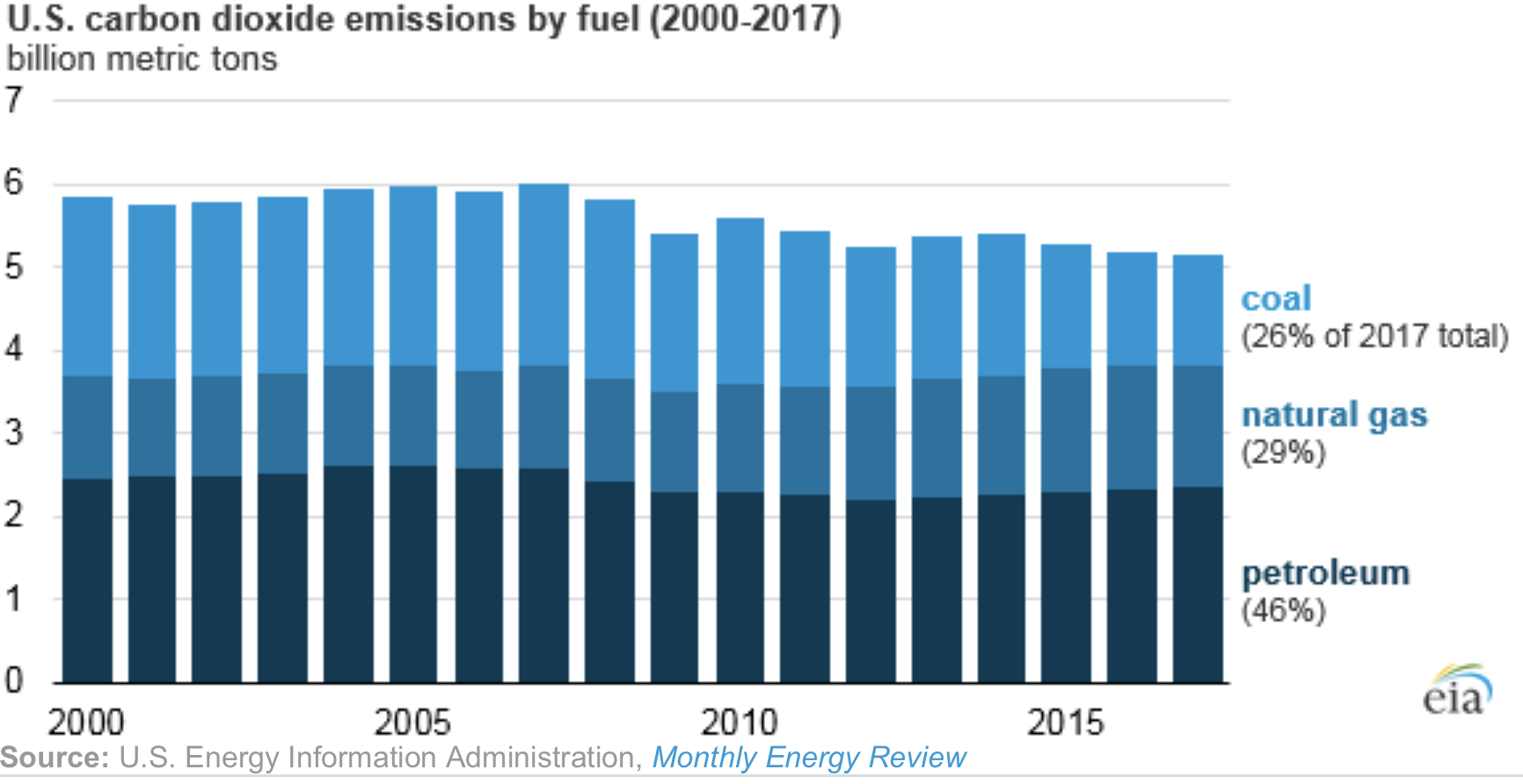
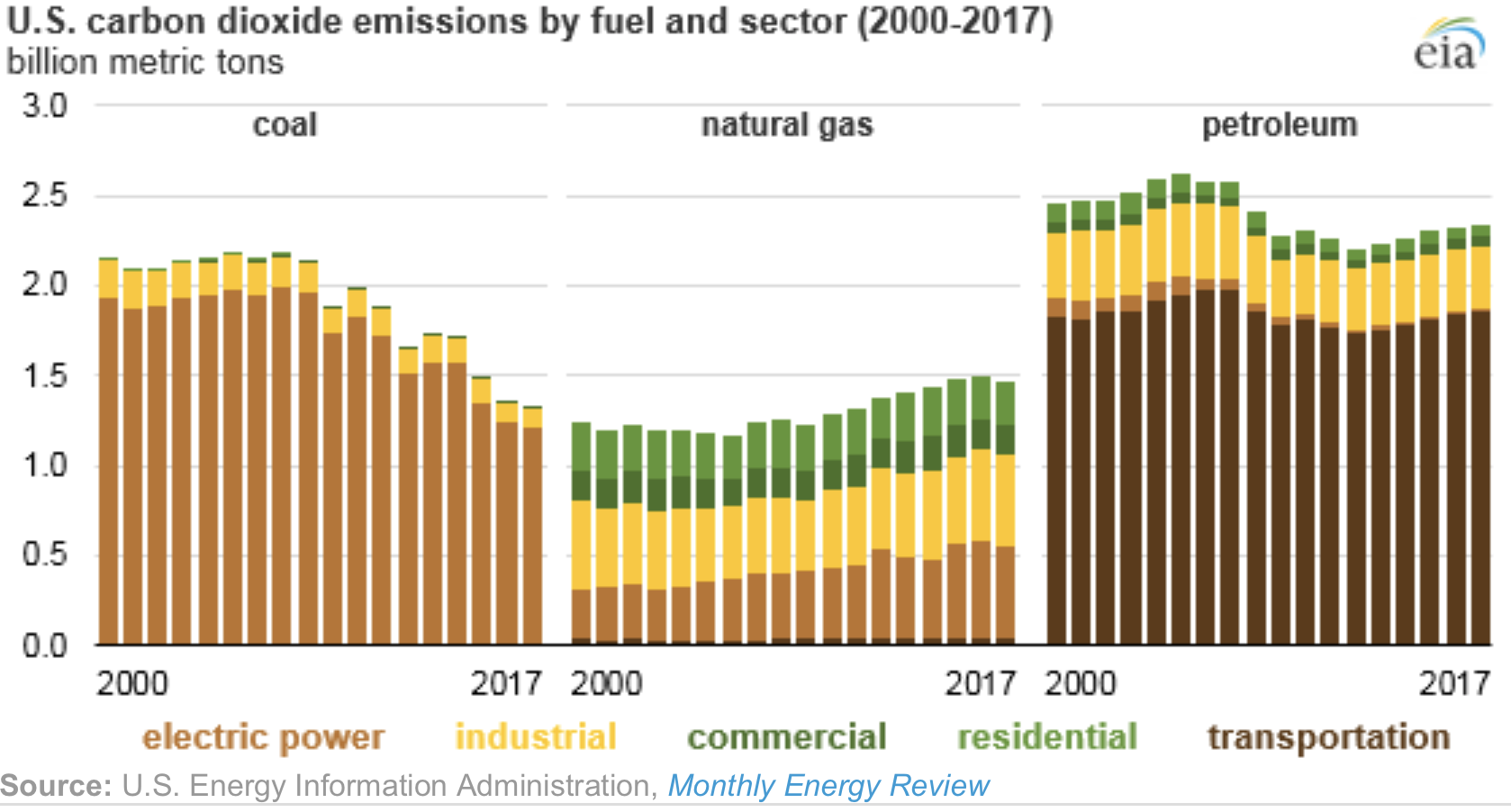
Barrasso writes: “The United States is currently on track to reduce emissions to 17 percent below 2005 levels by 2025, … not because of punishing regulations, restrictive laws or carbon taxes but because of innovation and advanced technology…” And he’s right. Carbon emissions from the electricity sector have dropped by some 700 million tons per year over the last decade. But it wasn’t because of carbon capture, or more nuclear power. It was because U.S. utilities burned far less coal, period.
Sure, innovation played a role. New drilling techniques brought down the price of natural gas, and advances in solar- and wind-power did the same with those technologies, making them all more cost competitive, displacing some coal. But Barrasso seems not to understand whence that innovation comes. It doesn’t happen in a vacuum. More often than not, innovation is driven by money, regulations, or a combination of both. Fracking was a way to increase profits in old oil and gas fields. Renewable technologies moved forward in response to state energy requirements. Carbon taxes would encourage renewables, nuclear and, yes, carbon capture, by making them more competitive with fossil fuels.
“People across the world,” Barrasso writes, “are rejecting the idea that carbon taxes and raising the cost of energy is the answer to lowering emissions.” He mentions France, and the Gilet Jaune, or Yellow Vest, movement, the members of which have passionately protested against higher taxes on fuel, among other things. But the yellow vests aren’t opposed to carbon-cutting or environmental regulations. They were demonstrating against inequality, and against the fact that the fuel tax was structured in a regressive way, hurting the poor far more than the rich. The lesson is not that regulations are bad, but that they must be applied equitably and justly. That, in turn, will drive innovation, and hopefully more thoughtful op-eds.
Jonathan Thompson is a contributing editor at High Country News. He is the author of River of Lost Souls: The Science, Politics and Greed Behind the Gold King Mine Disaster. Email him at jonathan@hcn.org.
The San Juan County commission voted two-to-one in favor of a resolution that rescinds the county’s previous opposition to the monument and condemns its reduction by Donald Trump.
The county commission of Utah’s San Juan County—home of Bears Ears National Monument, which President Donald Trump vastly reduced in 2017—has historically opposed the designation of the land as a national monument. But it has now changed its tune: On Tuesday, the commission voted two-to-one in favor of a resolution that rescinds the county’s previous opposition to the monument and condemns its reduction.
Specifically, the https://www.utah.gov/pmn/files/467927.pdf rescinds all prior resolutions opposing the establishment of the monument, or calling for the dissolution or reduction of it. Most notably, it also “condemn[s] the actions of President Donald Trump in violating the Antiquities Act of 1906 by unlawfully reducing the Bears Ears National Monument” in his December 4th, 2017, proclamation, and “call[s] upon the United States to fully restore” the monument.
The vote does not signal a change of heart, but rather reflects a major shift in the county commission’s make-up: Thanks to recent redistricting, it is now Utah’s first-ever majority-Navajo county commission. Previously, the county’s three districts were drawn such that most Native American voters were grouped into one district, but in 2016, a federal judge ruled that the voting districts were unconstitutional and ordered the county to redraw them. (According to the census, Navajos make up the majority of the county’s population by a small margin.) In response to the shift in representation, Utah state representative and former San Juan County commissioner Phil Lyman—notorious for the time he rode an ATV down a trail that was closed to motorized vehicles in protest of federal land control—has raised the possibility of splitting the county in two to bring power back to his white-majority hometown of Blanding.
Both of the Navajo members of the commission, Willie Grayeyes and Kenneth Maryboy, voted in favor of the Bears Ears resolution. The dissenting vote came from the commission’s white member, Bruce Adams. (When I was in San Juan County for then-Secretary of the Interior Ryan Zinke’s visit to Bears Ears during his monuments review in 2017, Adams greeted Zinke wearing a white “MAKE SAN JUAN COUNTY GREAT AGAIN” cowboy hat—and gave Zinke one too.)
Without a just transition, the Navajo Generating Station closure will have harmful consequences.
Last year, climate-hawk billionaire Tom Steyer forked out more than $23 million to support an Arizona ballot initiative that would have required the state’s utilities to get half their power from renewable sources by 2035. Arizonans for Affordable Energy, a front-group for the state’s largest utility, Arizona Public Service, spent nearly $38 million in opposition. The initiative — which failed — was the most expensive ballot measure campaign in the state’s history.
Meanwhile, a group called Save Native American Families, funded by the Navajo Nation, spent an additional $785,000 opposing the measure. This might seem odd. After all, it’s becoming more and more clear that the ravages of environmental degradation — climate change included — have a disproportionately large impact on Indigenous people, people of color and the poor.
Yet too often, the victims of the very efforts to stem that degradation come from disadvantaged communities. A fuel tax takes a greater portion of the income of someone driving an old beater between two jobs than it does from a wealthy, SUV-driving gas-guzzler. If you don’t own a house, you can’t take advantage of rooftop solar incentives, and yet may have to pay for your wealthier neighbors via increased electricity costs. And the great coal phase-out has failed to faze coal corporation executives, who pay themselves multimillion-dollar bonuses while yanking health insurance and retirement benefits out from under retired miners.
This can be the result of badly crafted policies or of wily corporate polluters who have managed to shift the burden of environmental policies onto those in the lower income brackets. Regardless, the dynamic often results in environmental justice coming at the expense of economic justice. But it doesn’t have to be that way.
Take the case of the Navajo Generating Station in northern Arizona. In early 2017, the majority owner of the plant, the Salt River Project, announced that it would shut down the plant at the end of this year, forcing the closure of the Kayenta Mine on Black Mesa, which is currently operated by Peabody Energy. The closure comes primarily because the plant is no longer profitable, but pollution-control requirements played an indirect role by increasing the operating costs. It is a major environmental victory, keeping more than 14 million tons of greenhouse gases out of the atmosphere annually along with a slew of other harmful pollutants. It also represents a dire threat to the communities that have come to rely on the revenue from the plant and the mine. The closure will do away with as many as 900 jobs, 90 percent of which are currently held by Native American workers, in a region where unemployment hovers around 50 percent. It would also eliminate more than $50 million in royalties and other revenue to the Navajo Nation and Hopi Tribe.
As a result, members of both tribal governments have fought to keep the plant open. They’ve sought outside purchasers to no avail, and they’ve appealed to the federal government, which owns 25 percent of the plant, to intervene. And now the tribe’s own Navajo Transitional Energy Company is looking to purchase both coal mine and power plant and keep it running — and polluting — for decades to come.
Indigenous opposition groups, such as ToNizhoniAni, Diné CARE and Black Mesa Water Coalition, have made concerted efforts to stop the purchase, because it would mean taking on financial risk while also allowing the plant and mine to continue to inflict harm. Meanwhile, the major outside environmental groups that have badgered the Navajo Generating Station for years — and remain deeply invested in keeping the plant closed — are in a difficult position. Any interference with the plant’s purchase would constitute an attack on sovereignty and a continuation of the same resource colonization that brought the power plants and mines to the Navajo Nation in the first place. Yet if the environmental groups stand idly by, they risk allowing serious environmental and human harm to continue.
There is a middle way, though. Environmental groups can work with the affected communities, the polluting companies and the relevant governments to push the current owners to live up to their moral duty and repair the damage they’ve done, to make amends for historical land and resource theft, and to patch up the economic hole their departure leaves. They can help pave the way for a just transition away from coal, one in which a solid framework is provided for affected communities to exercise agency and move forward to a greener and more economically robust future.
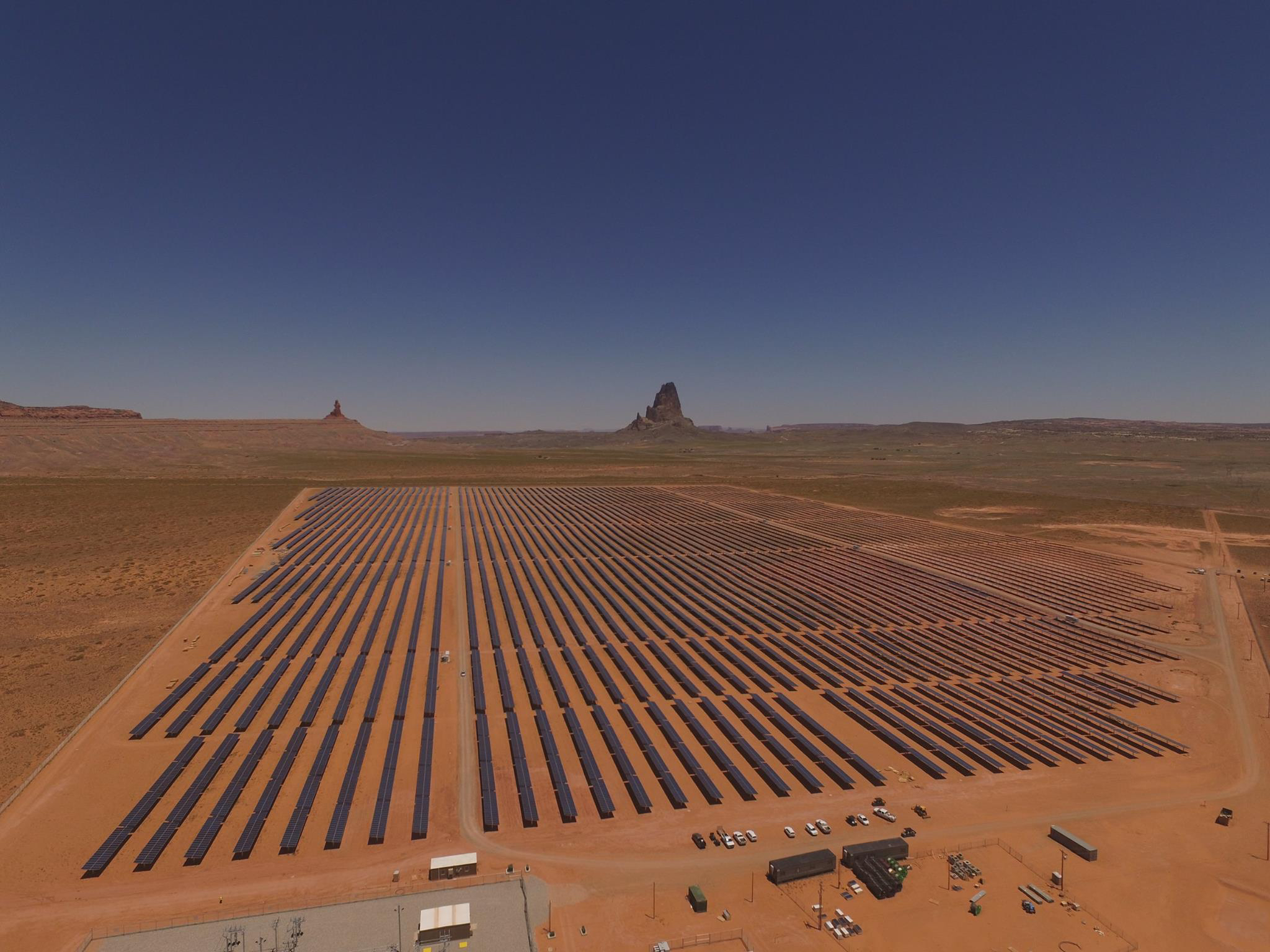
The initial pain of closure can be soothed by ensuring that the corporate owners live up to their legal obligation to adequately reclaim both the power plant and mine sites, a commitment that will keep hundreds of jobs active for several years after closure. And even though they are not legally obliged to do so, the corporate owners have a moral duty to take the reclamation further by healing the damage caused by dumping nearly 1 billion metric tons of greenhouse gases into the atmosphere and poisoning the land, the air and the water — along with the people and other creatures — in the plant’s vicinity. The damage can’t be reversed, nor can much of the mess be cleaned up. But the corporations that are responsible can contribute to the healing by creating a just transition fund that could retrain power plant workers, provide loans for green energy entrepreneurs in the affected community, or perhaps go toward tribally developed utility-scale projects, such as the solar plant recently constructed by the Navajo Tribal Utility Authority near Kayenta, Arizona. This healing process can begin by restoring water rights and transferring transmission lines to the Navajo and Hopi nations as soon as the plant closes.
Such an initiative does not come cheap. But the money not only exists; it is owed to the tribal citizens who have been bilked by corporations for decades. Peabody began mining on Navajo and Hopi land on Black Mesa in the 1960s, displacing families and destroying grazing lands and cultural artifacts, sucking up groundwater at a rate of 1.3 billion gallons per year, and shipping the coal — which was owned by the tribes — off to the Navajo and Mojave power plants. In return, the tribes received just 2 to 6 percent royalty for the coal, an amount that was finally increased to the still-below-standard rate of 12.5 percent in 1984. There it has stood since, another product of the bad-faith negotiations that were facilitated by the federal government.
“Royalty” is a euphemism that is employed to obscure what is really going on here: For nearly five decades, these corporations have paid mere pennies on the dollar to wreck tribal land, take the coal that belongs to the citizens of the Hopi and Navajo nations and burn it in power plants that, in turn, poison the land and people of those very same nations. By not adequately compensating the tribes for their coal, the coal company and its customers have cheated the tribes’ citizens out of billions of dollars.
The resulting cheap power lights up the neon of Las Vegas, while the Colorado River water that the plant’s electricity pumps has enabled Phoenix and Tucson to sprawl into the desert, enriching the operators of the Southwest’s growth machine: real estate developers, mass-production homebuilders, the automotive industry, the corporate shareholders, the ratepayers and the executives. Arizona Public Service, 14 percent owner of the generating station, raked in half a billion dollars in profit last year. Peabody’s CEO is paid $20 million a year to run a company that just emerged from bankruptcy. They are all beneficiaries of outright theft.
And then there’s that $63 million squandered on the renewable energy initiative campaign. That money could have offset a year of the tribal government revenue lost owing to the plant’s closure. That same amount could have bought and installed more than 4,000 solar systems in low-income households, providing hundreds of jobs while cutting emissions. Or the money could have been put into a just transition fund. Instead it was squandered on public relations campaigns that certainly brought no environmental gain.
The Navajo Generating Station and the coal mines on Black Mesa were built on a foundation of theft and colonialism. But closing them down will not help unless it is done in a just way, one that heals old wounds rather than opening new ones.
Jonathan Thompson is a contributing editor at High Country News. He is the author of River of Lost Souls: The Science, Politics and Greed Behind the Gold King Mine Disaster. Email him at jonathan@hcn.org.
Read the resolution here. Thanks NPR for posting it and thank you Representative Alexandria Ocasio-Cortez for your leadership on this issue.
Youth activists rally for climate justice in front of the US Capitol in Washington,DC (photo from earlier in the year). Image: Lorie Shaull,CC BY-SA 2.0, via Wikimedia Commons
Boulder County Solar Contractor Residential Commerical. Photo credit: Flatiron Solar
Oil and gas development on the Roan via Airphotona
FromThe Grand Junction Daily Sentinel (Dennis Webb):
Bernhardt — the department’s deputy secretary, who has been acting secretary since Ryan Zinke’s departure from the top job at the end of the year amidst ethics probes — was announced as the President’s choice to replace Zinke…
It’s believed that if Bernhardt is confirmed, he would be the first Western Slope native to hold a Cabinet-level position, at least in recent history.
His nomination was heralded in some quarters Monday and met with staunch criticism in others, reflecting that Bernhardt, like Zinke, has been a somewhat polarizing figure at Interior.
“This is fantastic news for Colorado,” U.S. Sen. Cory Gardner, R-Colo., said in a news release. “I’ve known David Bernhardt for many years and have worked closely with him over the last two years to advance Colorado priorities. As a native Coloradan from the Western Slope, David knows how important public lands are to our state and has a keen understanding of the issues Coloradans face every day.”
[…]
But Jennifer Rokala, executive director of the Center for Western Priorities, called Bernhardt’s nomination “an affront to America’s parks and public lands.”
She calls Bernhardt a “walking conflict of interest” because of his prior work as an attorney representing oil and gas, water and other industries and interests.
“As an oil and gas lobbyist, Bernhardt pushed to open vast swaths of public lands for drilling and mining. As deputy secretary, he was behind some of the worst policy decisions of Secretary Zinke’s sad tenure, including stripping protections for imperiled wildlife. Bernhardt even used the government shutdown to approve drilling permits for companies linked to his former clients,” Rokala said in a news release.
“As senators consider Bernhardt’s nomination, it’s crucial they remember that the ongoing investigations into Ryan Zinke’s conduct intersect with policies that David Bernhardt has helped enact. Otherwise, we’ll see another Interior secretary fall into the same ethical abyss that ended Ryan Zinke’s political career.”
Chris Saeger, executive director of the Western Values Project, said in a statement, “Bernhardt is an ex-lobbyist and the ultimate DC-swamp creature with so many potential conflicts of interest that he has to carry around a list of his former clients. He is simply too conflicted to be our next Interior Secretary, and the Senate should vote his nomination down.”
Last week, the Center for Western Priorities released a poll by Keating Research that it said showed more than 60 percent of Coloradans were extremely or somewhat concerned that clients Bernhardt once lobbied for have business before the department he now runs.
The poll reportedly found that just 18 percent of Coloradans think increasing oil and gas development should be Interior’s most important issue, while 74 percent said what matters most is striking a better balance between preserving public lands and responsible oil and gas development.
Bernhardt has sought to recuse himself at times from potential conflicts of interest. In September, he bowed out of tentative plans to speak at a water forum in Grand Junction because of a potential conflict.
Mike Samson, a Garfield County commissioner who taught Bernhardt at Rifle High School, said he thinks anyone in government faces the potential for conflicts of interest to some degree.
He said Bernhardt, who was “a great student,” is smart enough to make sure that what he does is right, so as not to create problems down the road.
Bonnie Petersen, executive director of Associated Governments of Northwest Colorado, said that based on her limited interactions with Bernhardt, he is strict about avoiding conflicts of interest.
“He seems to be very adamant in that regard,” she said.
Local government representatives such as Samson and Petersen are thrilled at the prospect of a western Coloradan running a department so influential in the West.
“We had thought that he would be a good candidate for the position and apparently the president thinks so as well,” Petersen said…
Bernhardt has worked in roles including serving on the staff of Mesa County Commissioner Scott McInnis when McInnis served in the U.S. House of Representatives, and as Interior’s solicitor during the George W. Bush administration. More recently he has been instrumental in carrying out the Trump administration’s energy-dominance agenda.
Gardner, Samson and Petersen all credit him for the role he played during the Trump administration in getting oil and gas revenue returned to western Colorado governments that was left over after the cleanup of the Anvil Points oil shale research site near Rifle.
Petersen said he worked closely with governor offices in the West to consider comments from local governments regarding revising greater sage-grouse management plans, after local governments weren’t listened to when the plans were first issued in 2015.
Whit Fosburgh, president and chief executive officer of the Theodore Roosevelt Conservation Partnership, said that his group has worked closely with Bernhardt, “and we have found him to be accessible, fair, and true to his word,” and the group supports his nomination.
He said the nomination “places him in an unenviable position to balance the priorities of the Trump Administration with the mission of the (Interior) Department. We have often disagreed on policies, such as the pace and siting of energy development and the failure of the department to require developers to mitigate the damage they do to the lands that belong to all Americans. At the same time we have worked productively with Mr. Bernhardt to expand recreational access to public lands and protect big-game migration corridors.”
On the second day of 2019, Interior Secretary Ryan Zinke tweeted out his resignation letter to President Donald Trump. After less than two years in office, he claimed to have “restored public lands ‘for the benefit & enjoyment of the people,’ improved public access & shall never be held hostage again for our energy needs.”
That appears to be Zinke’s view of the legacy his abbreviated tenure will leave on the Interior Department’s more than 500 million acres of land and roughly 70,000 employees. Critics might interpret his garbled syntax as a confession: that he turned over public land to industry — pushing oil and gas leases in sensitive habitat, rescinding environmental protections and shrinking national monuments. But what, really, did Zinke accomplish?
Ryan Zinke wore many hats as Interior Department Secretary, effective bureaucrat wasn’t one of them. Credit: Department of the Interior via The High Country News
The answer: Probably not much. The methane Zinke allowed gas drillers to flare can’t be unburnt, the oil and gas leases he sold are probably good for at least 10 years, and the institutional knowledge of departed agency workers will be difficult to restore. Still, the flippant way Zinke executed his many rollbacks and policy changes leaves them vulnerable to be overturned, either by the next administration, Congress or the courts.
“The cumulative landscape impact is significant,” said Brett Hartl, the government affairs director for the Center for Biological Diversity. “(But) I am optimistic that almost everything they’ve done can be undone. We can win in court because most of the things they are doing violate the laws they are addressing.”
Zinke — a Navy veteran, former oil pipeline functionary and Montana congressman — was not coy about his determination to achieve something he called “energy dominance.” Nor was he shy about favoring industry over all other public-lands users. Following the lead and executive orders of President Donald Trump, Zinke cut environmental regulations, shrank Bears Ears and Grand Staircase-Escalante national monuments, and censored climate science while pushing out agency scientists and staff. By reducing fracking safeguards, slashing methane waste regulations and cutting protections for migratory birds, Zinke’s Interior Department has made it easier to develop oil and gas on public lands.
Yet only a handful of rules — which create policies that require a lengthy and public process to undo — have been finalized in the last two years. Many of the actions taken by the administration have been done through secretarial orders, internal memos and staffing decisions, many of which can be reversed on day one of a new administration.
For example, policies that have lead to the censoring of climate science could be immediately discarded. New leadership at Interior could also terminate every politically appointed agency head and staffer. For instance, Zinke’s childhood friend Steve Howke, a former credit union executive with no Interior Department experience, would no longer be in charge of reviewing the department’s grant applications.
From a staffing standpoint, Zinke’s legacy will come less from temporary political appointees than from the loss of rank-and-file workers. The departures of career staffers, who left after questionable reassignments, interference in climate research, and policies that incentivized early retirements, will make it harder to rebuild a workforce that is shrinking despite increased visitation on public lands.
The legal actions of the Trump administration’s Interior Department are also vulnerable in federal courts. “We see a pattern of attempts to suspend compliance with agency rules” that doesn’t adhere to the Administrative Procedures Act, said Hana Vizcarra, the staff attorney for Harvard Law’s Environmental and Energy Law Program.
As Rep. Raúl Grijalva, D-Ariz., takes the lead oversight role as the chairman of the House Committee on Natural Resources, Trump’s opponents could gain more leverage. “Information from oversight in the house could give ammunition to litigants or spur interest in further lawsuits,” Vizcarra said. If, for example, the committee unveiled new information that showed rules were made at the request of regulated industries, “it could impact what a court considers reasonable or arbitrary,” and undermine the agency’s ability to defend its actions, she said.
In the end, Zinke will probably be remembered more for his hat collection, bluster, multiple scandals and ethics investigations and vacations taken on the taxpayer dime than for any policies he implemented, good or bad. One thing is certain, though: The drive for “energy dominance” at the expense of the environment will endure for as long as Trump remains president, particularly under the leadership of now acting-Interior Secretary David Bernhardt, who is generally seen to be more competent than Zinke.
“In some sense, Ryan Zinke really was Trump’s mini-me in terms of flailing around and fumbling very loudly, but really not having a clear policy direction other than deregulation and handing over federal authority to manage public lands,” said Erik Molvar, the executive director of Western Watersheds, a conservation group that opposes grazing and energy development on public land. “Now, we could be turning over the helm to cold-blooded professionals who are industry lobbyists that really know how to get things done.”
Carl Segerstrom is a contributing editor at High Country News, covering Alaska, the Pacific Northwest and the Northern Rockies from Spokane, Washington. Email him at carls@hcn.org.
“The world will be moving away from fossil fuel production,” David Gutzler, a professor at the University of New Mexico and member of the Intergovernmental Panel on Climate Change, told members of the House Energy, Environment and Natural Resources Committee.
Gutzler went on to paint a stark picture of New Mexico in a changing climate.
The mountains outside Albuquerque will look like the mountains outside El Paso by the end of the century if current trends continue, he said.
There will not be any snowpack in the mountains above Santa Fe by the end of the century, Gutzler added.
We have already seen more land burned by wildfires, partly because of changes in forest management and partly because of climate change, Gutzler said.
Water supply will be negatively affected in what is already an arid state, he said.
“It’s real. It’s happening. We see it in the data. … This is not hypothetical in any way. This is real and we would be foolish to ignore it,” Gutzler said.
The professor warned lawmakers that the state must get serious about greenhouse gas emissions now by expanding clean energy sources and mitigating the societal costs of moving away from fossil fuels.
That cost, though, will be a sticking point for Republicans. Many of them represent southeastern New Mexico and the Four Corners, where oil and mining are big industries.
The initiative, led by Alexandria Ocasio-Cortez, is ambitious, but some in the outdoor industry argue it’s the only hope for saving wild places from climate change
When 27-year-old climate activist Evan Weber thinks about climate change, he thinks about his childhood in Hawaii. He spent those years in the mountains, on beaches, and in the ocean. “Now the beaches that I grew up on don’t exist anymore,” he says. “Sea-level rise has swallowed them into the ocean. The mountains are green for much less of the year. The coral reefs are dying from ocean acidification killing both marine life and surf breaks.”
That’s what brought him, on November 13, to march on soon-to-be House Majority Leader Nancy Pelosi’s Capitol Hill office with around 150 other activists from a progressive group he cofounded called Sunrise Movement. They were demonstrating for a sweeping policy plan championed by congresswoman Alexandria Ocasio-Cortez called the Green New Deal. It is pitched as an economy-wide climate mobilization to connect environmental, social, and economic policies through legislation and would create everything from investment in federal green jobs for all who want them to a massive green-infrastructure program. The end result would be an overhauled national economy run on 100 percent renewable energy.
While these are lofty goals, and many are skeptical of the plan’s feasibility, advocates see it as setting the bar for a sufficient response to climate change that politicians can be held to. And the proposal is already gaining steam in Washington, D.C., as a platform to rally around heading into 2020: more than 40 lawmakers have endorsed Ocasio-Cortez’s call for a congressional select committee to map out the Green New Deal. Many in the outdoor industry are also paying attention to what could be the best hope to save our ski seasons and protect our public lands.
“It’s an approach that’s so comprehensive that it could be a way for the United States to lead in the direction of stabilizing the climate at two degrees Celsius,” says Mario Molina, executive director of the advocacy group Protect Our Winters. According to a climate assessment put out by the federal government last month, warming above that threshold (35.6 degrees Fahrenheit) could shorten ski seasons by half in some parts of the U.S. before 2050.
Climate change is already impacting snowpack, and ski resorts across America are scrambling to adapt. This past year, Aspen Snowmass launched a political campaign called Give a Flake to get its customers engaged in climate action, Squaw Valley spent $10 million on snowmaking equipment in 2017, and Vail is pursuing a sweeping program to weatherproof its operations. But, Molina explains, there’s a long way to go to address the ski industry’s fossil-fuel-intensive operations. He believes that something like the economy-wide transition to renewable energy proposed in the Green New Deal is the best way ski resorts will be able to significantly lower their carbon footprints. It would allow them, for example, to hook their resorts up to a central power grid that would spin their lifts with renewable energy and create more sustainable transit options to and from the slopes.
Amy Roberts, executive director of the Outdoor Industry Association (OIA), also sees the opportunity to link this kind of large-scale climate action with the outdoor economy, especially when it comes to public lands. An economy powered on 100 percent renewables would obviously erase any incentive for fossil-fuel companies to drill in places like the Arctic National Wildlife Refuge and Bears Ears National Monument. But the OIA is still watching to see how the politics around the Green New Deal shape up. The early support from lawmakers is encouraging, but they’re mostly Democrats. Roberts insists that policies to protect the climate and public lands need bipartisan support, but she thinks that the outdoor industry can help make that happen. “When you look at who takes part in our activities, whether it’s hiking, camping, hunting, or fishing, there are both Republicans and Democrats,” she says. “That’s an opportunity to unite and bring a compelling message that’s separate and apart from what the environmental community is doing.”
As proof, she points to the Georgia Outdoor Stewardship Act. In November, Peach State voters passed the measure, in which sales tax from sporting goods and outdoor equipment is used to fund parks and trails, with 83 percent support. In the same election, the governor’s race was so divided that it went to a recount.
Even with glimpses of bipartisan support for the environment, Molina worries that the main hurdle Green New Deal legislation will face is influence from the fossil-fuel industry. Its lobbyists donated more than $100 million to campaigns in the 2016 election, and in 2018 raised $30 million to defeat a Washington State ballot measure that would have added a modest carbon tax on emissions and used the revenue to fund environmental and social programs. Additionally, former oil lobbyist David Bernhardt was tapped to replace Ryan Zinke as interior secretary in December.
But activists like Weber are not giving up. As part of their push for a Green New Deal, they have called for members of the Democratic leadership to reject campaign contributions from fossil-fuel interests. And a few weeks after Weber was in Nancy Pelosi’s office, he and more than 1,000 young people were back in Washington, D.C., this time storming Capitol Hill in a daylong push to get lawmakers to endorse the Green New Deal, an effort that resulted in nearly 150 arrests. They remain unfazed by claims that the plan’s goals are too large. “A Green New Deal is the only proposal put forth by an American politician that’s in line with what the latest science says is necessary to prevent irreversible climate change,” Weber says. “It could mean the difference between whether future generations around the world get to have the same formative experiences in nature that I did—or not.”
Alexandria Ocasio-Cortez. Elizabeth Warren. Beto O’Rourke. Those are just a few of the high-profile names either leading the development of or jumping to endorse today’s environmental cause célèbre, the Green New Deal. Inside congressional halls, at street protests, and, of course, on climate Twitter — it’s hard to avoid the idea, which aims to re-package ambitious climate actions into a single, wide-ranging stimulus program.
The Green New Deal is being promoted as a kind of progressive beacon of a greener America, promising jobs and social justice for all on top of a shift away from fossil fuels. It’s a proposal largely driven by newcomers to politics and environmental activism (and supported, however tentatively, by several potential presidential candidates and members of the Democratic political establishment). The plan aspires to bring together the needs of people and the environment, outlining “a historic opportunity to virtually eliminate poverty.”
But within the broader environmental movement, not everyone was initially gung-ho on the Green New Deal — at least not without some stipulations.
To understand the debate surrounding the Green New Deal, you need to look beyond its recent prominence in Beltway political circles to the on-the-ground organizations that make up the environmental justice movement. Newcomers like Ocasio-Cortez may be leading the charge, but grassroots leaders who have spent years advocating for low-income families and neighborhoods of color most impacted by fossil fuels say their communities weren’t consulted when the idea first took shape.
For all the fanfare, there isn’t a package of policies that make up a Green New Deal just yet. And that’s why community-level activists are clamoring to get involved, help shape the effort, and ensure the deal leaves no one behind.
Something Old, Something New
Although the term “Green New Deal” has evolved over time, its current embodiment as a complete overhaul of U.S. energy infrastructure was spearheaded by two high profile entities: progressive darling and first-term Representative Alexandria Ocasio-Cortez, and the Sunrise Movement, an organization formed in 2017 by young people hellbent on making climate change the “it” issue.
In November 2018, Ocasio-Cortez, with support from Sunrise, called for a House select committee to formulate the package of policies. More than 40 lawmakers signed on to support the draft text. Then shortly before the end of the year, Nancy Pelosi, now the speaker of the House, announced the formation instead of a “Select Committee on the Climate Crisis.”
It wasn’t exactly a win for the leaders of the new environmental vanguard. Sunrise tweeted its displeasure at the committee’s pared-down ambition, taking umbrage with its lack of power to subpoena (a condition for which Ocasio-Cortez had advocated) and the fact that politicians who take money from fossil fuel interests would not be excluded from sitting on it.
The fuss over who gets a say in the formation of the Green New Deal goes back further than Ocasio-Cortez’s or Sunrise’s friendly-ish feud with establishment Democrats. The Climate Justice Alliance, a network of groups representing indigenous peoples, workers, and frontline communities, says its gut reaction to the Green New Deal was that it had been crafted at the “grasstops” (as opposed to the grassroots).
Shortly after Ocasio-Cortez put out her proposal for a select committee, the alliance released a statement largely in support of the concept, but with a “word of caution”: “When we consulted with many of our own communities, they were neither aware of, nor had they been consulted about, the launch of the GND.”
Leaders at the alliance surveyed its member organizations — there are more than 60 across the U.S. — and put together a list of their concerns. Unless the Green New Deal addresses those key points, the alliance says, the plan won’t meet its proponents’ lofty goal of tackling poverty and injustice. Nor will the deal gain the grassroots support it will likely need to become a reality.
“What we want to do is strengthen and center the Green New Deal in environmental justice communities that have both experience and lived history of confronting the struggle against fossil fuel industries,” Angela Adrar, executive director of the alliance, told Grist.
Grist asked several indigenous and environmental justice leaders: If the Green New Deal is going to make good on its promises, what will it take? Here’s what they said.
A more inclusive and democratic process that respects tribal sovereignty
As details get hashed out on what a Green New Deal would actually include, longtime environmental justice organizers say their communities need to be the ones guiding the way forward. “The way that the plan was developed and shared is one of its greatest weaknesses,” Adrar says. “We want to be able to act quickly, but we also want to act democratically.”
She adds that involving the grassroots is especially important in the wake of the 2018 midterm elections, which ushered in many new congressional members pledging to focus on the underrepresented communities they come from. The Climate Justice Alliance is calling for town halls (with interpreters for several languages) to allow communities to help flesh out policies to include in the Green New Deal.
Some of the disconnect could be generational, says Tom Goldtooth, executive director of the Indigenous Environmental Network. Many of the leaders espousing the Green New Deal are young people. He says that he and his colleagues were caught off-guard when they saw the plan on social media and that when his network reached out to its members, there was little familiarity or understanding of the Green New Deal.
“Maybe the way of communication of youth is different than what we’ve found in the environmental justice movement and our native movement around the value of human contact — face-to-face human contact,” he says. “We’re asking that leadership of the Green New Deal meet with us and have a discussion how we can strengthen this campaign with the participation of the communities most impacted.”
Any retooling of America’s energy infrastructure will undoubtedly venture into Native American tribes’ lands, where there are already long-standing battles over existing and proposed pipeline expansions, as well as fossil fuel facilities. The United Nations Declaration on the Rights of Indigenous Peoples calls for “free, prior, and informed consent” from tribes before developers begin any project on their land. So indigenous environmental groups say there needs to be respect for tribal sovereignty and buy-in from tribes for a Green New Deal to fulfill its promise of being just and equitable.
Green jobs should be great jobs
There has been a lot of talk in Green New Deal circles about uplifting poor and working-class communities. Advocates have floated ideas ranging from a job-guarantee program offering a living wage to anyone who wants one to explicitly ensuring the rights of workers to form a union.
But as workers’ rights organizations point out, energy and extractive industries have provided unionized, high-paying jobs for a long time — and they want to make sure workers can have the same or a better quality of life within green industries.
“There’s been a long history of workers that have been left hanging in transition in the past,” says Michael Leon Guerrero, executive director of the Labor Network for Sustainability, which has been working to bridge divides between labor and environmental issues. “For that reason, there’s quite a bit of skepticism in the labor sector.”
Joseph Uehlein, who founded the Labor Network for Sustainability, adds that there needs to be more than just the promise of jobs to entice labor to support a Green New Deal. “Every presidential candidate in my lifetime talks about job creation as their top priority,” he says. “Over the last 40 years, those jobs have gotten worse and worse. A lot of jobs are not so good, requiring two or three breadwinners to do what one used to be able to do.”
Uehlein hopes an eventual Green New Deal will ensure not just jobs that guarantee a living wage, but will go one step further. “We always talk about family-supporting jobs,” he says. “It’s not just about living, it’s about supporting families.”
Do No Harm
Any version of a Green New Deal would likely ensure that the U.S. transitions away from fossil fuels and toward renewable sources of energy — with Ocasio-Cortez setting the bold target of the nation getting 100 percent of its energy from renewables within 10 years.
But defining what exactly counts as “renewable energy” has been tricky. There are plenty of sources of energy that aren’t in danger of running out and don’t put out as many greenhouse gases as coal or oil, but are still disruptive to frontline communities. Garbage incineration is considered a renewable energy in some states, but it still emits harmful pollutants. And when it comes to nuclear energy or large-scale hydropower, the associated uranium extraction and dam construction have destroyed indigenous peoples’ homes and flooded their lands.
The Climate Justice Alliance is also pushing to exclude global warming interventions like geoengineering and carbon capture and sequestration, which they believe don’t do enough to address the root causes of global warming. Both technologies have to do with re-trapping or curbing the effects of greenhouse gases after they’ve been produced. “Carbon capture and sequestration, it’s a false solution from our analysis,” Goldtooth says. The focus needs to be on stopping greenhouse gases from getting into the atmosphere in the first place, he and other critics argue.
As the alliance sees it, a future in which the planet survives requires a complete transition away from fossil fuels and an extractive economy, and toward a regenerative economy with less consumption and more ecological resilience.
Goldtooth and his colleagues are calling for solutions that rein in damaging co-pollutants on top of greenhouse gases. And they support scalable solutions — like community solar projects — that are are popping up in some of the neighborhoods that are most affected by climate change.
A good start
Even though the Green New Deal faces many political obstacles, its proponents are still pushing forward at full speed. “We are calling for a wartime-level, just economic mobilization plan to get to 100% renewable energy ASAP,” Ocasio-Cortez tweeted on New Year’s Day.
Scientists recently estimated that the world has only 12 years to keep average global temperatures from increasing beyond 1.5 degrees Celsius (2.7 degrees Fahrenheit) — the upper limit which many agree we can’t surpass if we want to avoid a climate crisis. The urgency around the latest climate change timeline has brought a lot of new advocates to the table.
According to John Harrity, chair of the Connecticut Roundtable on Climate and Jobs and a board member at the Labor Network for Sustainability, the labor movement is becoming more willing to engage on ways to address climate change. “I think the Green New Deal becomes a really good way to put all of that together in a package,” he says. “That evokes for a lot of people the image of a time when people did all pull together for the common good.”
Elizabeth Yeampierre, steering committee co-chair of the Climate Justice Alliance and executive director of the Brooklyn-based grassroots organization, UPROSE, which works on issues cutting across climate change and racial justice, calls the Green New Deal “a good beginning for developing something that could really have lasting impacts and transformation in local communities and nationwide.”
Since the alliance put out its recommendations, Yeampierre says she’s been in regular contact with both the Sunrise Movement and Ocasio-Cortez’s office. “To their credit they were responsive and have made themselves available to figure out how we move forward in a way that doesn’t really step over the people,” she explains.
The language in Ocasio-Cortez’ draft proposal has already changed — it now includes clauses to “protect and enforce sovereign rights and land rights of tribal nations” and “recognize the rights of workers to organize and unionize.” The document has doubled in length since it was put out in November (at time of publication, it is 11 pages long) and will likely include new edits in the coming days.
Varshini Prakash, a founding member of the Sunrise Movement (and a 2018 Grist 50 Fixer), says she agrees with the Climate Justice Alliance’s recommendation that a Green New Deal prioritize the needs of workers, frontline communities, communities of color, and low-income communities. “Their critiques,” Prakash tells Grist, “are fully valid, and I appreciate what they’re bringing.”
The broad overview of a Green New Deal in Ocasio-Cortez’s proposal for a select committee, Prakash says, was hashed out quickly after the representative’s team approached Sunrise late last year. (Ocasio-Cortez did not immediately respond to Grist’s inquiry). “This was very rapid fire, it happened on an extremely tight timescale,” she says. “We didn’t have a lot of time to do the broad consultation we wanted.”
But Prakash, Yeampierre, and other leaders in the movements for environmental and climate justice are working to make sure there are more folks on board moving forward.
“Climate change isn’t just going to threaten our communities — it’s also going to test our solidarity, it’s going to test how we build relationships with each other,” Yeampierre says. “So I think the Green New Deal can be used as an opportunity to show that we can pass that test.”
In early December, Xcel Energy, a sprawling utility that provides electricity to customers in eight states, including Colorado and New Mexico, announced that it planned to go carbon-free by 2050. In what has been a rough year for climate hawks, this was welcome news. After all, here was a large corporation pledging to go where no utility of its scale has gone before, regardless of the technical hurdles in its path, and under an administration that is doing all it can to encourage continuing use of fossil fuels.
At the Dec. 4 announcement in Denver, Xcel CEO Bob Fowkes said that he and his team were motivated in part by the dire projections in recent reports from the Intergovernmental Panel on Climate Change and the U.S. government’s Fourth National Climate Assessment. “When I looked at that and my team looked at that, we thought to ourselves, ‘What else can we do?’ ” Fowkes said. “And the reality is, we knew we could step up and do more at little or no extra cost.”
Xcel committed to 100 percent carbon-free power generation by 2050 through solar, wind, nuclear and hydropower plants like Shoshone Generating Station (middle left of photo). Fossil fuel burning may still be part of the mix if they use carbon capture and sequestration technology. Shoshone Falls, Idaho. By Frank Schulenburg – Own work, CC BY-SA 4.0, https://commons.wikimedia.org/w/index.php?curid=71359770
It was a big step, and apparently inspiring. A couple of days later, the Platte River Power Authority, which powers four municipalities on Colorado’s Front Range, pledged to go carbon-free by 2030. Here are seven things to keep in mind about Xcel’s pledge:
Xcel is going 100-percent carbon-free, not 100 percent renewable. There’s a big difference between the two, with the former being far easier to accomplish, because it allows the utility to use not only wind and solar power, but also nuclear and large hydropower. It can also burn some fossil fuels if plants are equipped with carbon capture and sequestration technology.
No current power source is truly clean. Solar, wind, nuclear and hydropower plants have zero emissions from the electricity generation stage. However, other phases of their life cycles do result in greenhouse gas emissions and other pollutants — think uranium mining, solar panel manufacturing and wind turbine transportation. Even the decay of organic material in reservoirs emits methane. But even when their full life cycles are considered, nuclear, wind, solar and hydropower all still emit at least 100 times less carbon than coal.
Carbon capture and sequestration techniques don’t do a lot for the big picture. Even if all of the carbon emitted from a natural gas- or coal-fired power plant is captured and successfully sequestered without any leakage — and that remains a big “if” — huge amounts of methane, a potent greenhouse gas, are released during the coal mining and natural gas extraction, processing and transportation phases.
Even though carbon sequestration qualifies as “clean energy,” Xcel is unlikely to utilize the technology on any large scale with coal because of the cost. Even without carbon capture, coal is more expensive than other power sources, so why spend all that money just to keep burning expensive fuel? On the other hand, natural gas is relatively cheap, so it makes more sense for Xcel to continue burning the fossil fuel with carbon capture.
Economics play as much a role in this decision as environmentalism. Even as Xcel was making its announcement, executives from PacifiCorp, one of the West’s largest utilities, were telling stakeholders that more than half of its coal fleet was uneconomical, and that cleaner power options were cheaper. So even without the zero carbon pledge, Xcel likely would have abandoned coal in the next couple of decades, regardless of how many regulations the Trump administration rolls back. Meanwhile, renewable power continues to get cheaper, making it competitive with natural gas. And without some kind of big gesture, Xcel risked losing major customers. (The city of Boulder, Colorado, defected from Xcel, a process that has been going on for the last several years, because the utility wasn’t decarbonizing quickly enough.)
Xcel’s move, and others like it, will pressure grid operators to work toward a more integrated Western electrical grid. A better-designed grid would allow a utility like Xcel to purchase surplus power from California solar installations, for example, or the Palo Verde nuclear plant in Arizona, and to sell its wind power back in that direction when it’s needed.
Xcel needs better technology to meet its goal. Xcel admits that “achieving the long-term vision of zero-carbon electricity requires technologies that are not cost-effective or commercially available today.” It is banking on the development of commercially viable utility-scale batteries and other storage technologies to smooth out the ups and downs of renewable energy sources. If Xcel is serious about its goal, though, it will need to embrace approaches that don’t necessarily boost the bottom line. That could mean incentivizing efficient energy use, promoting rooftop solar, and implementing rate schedules that discourage electricity use during times of peak demand. It will also need to get comfortable with paying big customers not to use electricity during certain times.
Xcel’s pledge is a big step in the right direction, and it has the potential of becoming a giant leap if other major utilities follow suit. But it also underscores a sad fact: While our elected officials twiddle their thumbs and play golf with oil and gas oligarchs, the very corporations that helped get us into this mess are the ones who are left to take the lead on getting us out.
Jonathan Thompson is a contributing editor at High Country News. He is the author of River of Lost Souls: The Science, Politics and Greed Behind the Gold King Mine Disaster. Email him at jonathan@hcn.org or submit a letter to the editor.
Climate change will hammer the U.S. economy unless there’s swift action to rein in greenhouse gas emissions from burning fossil fuels, according to the latest National Climate Assessment report.
But [the] President…has dismissed this forecast, even though his own administration released a comprehensive synthesis of the best available science, written by hundreds of climate scientists and other experts from academia, government, the private sector and nonprofits. Like most opponents of policies aimed at slowing the pace of climate change, he has long wanted actions to reduce these emissions off the table because, in his opinion, they are “job-killing.”
As an environmental economist who is studying the relationship between regulations and employment, I find this question vitally important both economically and politically. What does the research on this question say?
THE ARGUMENTS
Opponents of climate regulations embrace a straightforward and long-standing argument. In their view, anything the government forces businesses to do will negatively affect their ability to employ workers. To them, everything from safety regulations to raising taxes makes it costlier and harder for businesses to operate.
[The President] has taken this philosophy to heart by pledging to eliminate what he calls “job-killing regulations” across the board.
Some supporters of strong climate policies counter that the costs of climate change are high enough to justify climate policies even though they might negatively affect workers.
They base this argument on observations that environmental rules and clean energy can benefit public health, even by saving lives. They also point out that these policies could counter the economic damage the National Climate Assessment forecasts.
The U.S. is the second-largest producer of coal in the world, thanks in part to massive surface mines like this one in Wyoming. Photo courtesy BLM.
EVIDENCE
What about those jobs, though?
The evidence on how environmental policies affect unemployment is generally mixed. The book “Does Regulation Kill Jobs?,” edited by University of Pennsylvania professor Cary Coglianese, covers regulations generally. It concludes that “regulation overall is neither a prime job killer nor a key job creator.”
Michael Greenstone, a University of Chicago economist, found that 1970s-era environmental regulations, which in some ways resemble the climate-related rules debated today, led to the loss of more than half-a-million manufacturing jobs over 15 years.
Another team of researchers, which reviewed the impact of environmental policies on four heavily polluting industries, found that environmental regulations have no significant effect on employment.
But this mainly has to do with two other factors. Due to increasing automation, it now takes far fewer workers to mine coal than it used to.
And a drilling boom has increased not just oil output but natural gas production. The increased natural gas supply cut prices for that fuel, prompting a raft of coal-fired power plant closures. It also eroded coal’s market share for electricity generation while creating new jobs in other energy industries.
GREENER JOB GROWTH
A weakness I often see in the standard regulations-kill-jobs argument is a focus on the regulated industries that ignores the fact that those same regulations tend to spur growth in other industries.
In this case, climate policies are proving to be a boon for jobs in renewable energy industries like wind and solar, as well as in efficiency efforts like weatherization.
For example, the stimulus bill enacted during the Great Recession included provisions designed to bolster renewable energy.
That spending helped spur the creation of millions of new jobs. The Bureau of Labor Statistics, a federal agency, predicts that the number of solar panel installers will increase by 105 percent and the number of wind turbine technician jobs will rise by 96 percent between 2016 and 2026, making those the nation’s two fastest-growing professions.
One study concluded that retraining all coal workers to become solar panel installers is feasible and in fact would mean a raise for most of these American workers. More than twice as many Americans work in the solar energy industry than in the coal industry.
THE WHOLE EMPLOYMENT PICTURE
So what is the net effect on jobs when some energy industries shrink and others grow?
Resources for the Future, a think tank that researches economic, environmental, energy and natural resource issues, has developed complex computational models of the economy that clarify the whole picture on the connection between regulations and jobs.
The nonprofit, nonpartisan group assessed the impact on unemployment, something that – believe it or not – these large-scale economic simulations usually don’t do.
The think tank predicts that a hypothetical $40 per ton carbon tax, which would translate into an increase of about 36 cents per gallon of gasoline, would increase the overall unemployment rate by just 0.3 percentage points. The effect is even smaller, at just 0.05 percentage points, if the government were to uses the carbon tax’s revenue to cut other tax rates.
This effect is one-third as large as previous estimates, such as a 2017 study from NERA Economic Consulting, a global firm, that were not as detailed in their unemployment modeling.
Some studies have even detected a net gain in jobs from climate policies.
For example, University of California, Berkeley researchers found that California’s efforts to cut emissions have bolstered the state’s economy and created more than 37,000 jobs. And the University of Massachusetts, Amherst Political Economy Research Institute has determined that every $1 million shifted from fossil fuel-generated power to “green energy” creates a net increase of 5 jobs.
Based on my review of the research, I see little evidence that policies to reduce pollution from fossil fuels have or will likely result in widespread job losses.
DIFFERENT OPTIONS
Different types of policies can have different effects – and some can minimize labor market disruption more than others.
A carbon tax, like other revenue-raising policies such as cap-and-trade systems with auctioned permits, has the advantage of generating revenue that can be used to offset any economic harm from job losses. Policies that do not generate revenue, such as renewable portfolio standards, which require utilities to get a set proportion of their electricity from renewable energy, lack this advantage.
The evidence suggests that climate policies will cause some industries to lose workers, while others will employ more people and that the overall employment effects are modest. But what is going on with displaced workers? Are solar and wind companies hiring all the jobless coal miners?
My current research is examining how easy – or hard – it is for workers to move between industries due to changes brought on by these regulations. So far, my colleagues and I are finding that when we account for the costs of workers switching jobs, unemployment rates rise slightly more than predicted when ignoring those costs, but the overall effect on unemployment is still just 0.5 percent.
As the owners of the largest coal-burning power plant in the West map out the details of closing in the next two years, the Navajo Nation has taken its next step in its energy development by starting operations at a new 27-megawatt solar farm not far from the source of the coal that fuels Navajo Generating Station. The Kayenta solar project, owned by the Navajo Tribal Utility Authority and operated by First solar, is the first large-scale solar energy facility on the reservation. The electricity is sold to the Salt River Project for distribution. The project’s 120,000 photovoltaic panels sit on 200 acres and are mounted on single-axis trackers that follow the movement of the sun. It provides enough electricity to power approximately 7,700 households. The tribe entered a lease agreement with NTUA in 2015 for the location, a groundbreaking ceremony was held in April 2016, followed by six months of construction that started last September. The $60 million facility was built using a construction loan from the National Rural Utilities Cooperative Finance Corporation.
The month of December 2018 is probably going to go down in history as the month when all things climate and energy truly and irreversibly changed for the better in the American West.
From bold carbon reduction commitments by big utilities to the fact that the economics of renewables are unbelievably great (and seem to be getting better by the day), this month has been a watershed moment.
Given this, we thought it’d be useful to dive in more deeply and really explore what all these announcements mean. Below, our top ten takeaways from these latest developments:
10. Xcel Energy Will be Shutting Down all its Remaining Coal-fired Power Plants in Colorado
The big news in early December was Xcel Energy’s announcement of its goals to reduce carbon emissions 80% by 2030 and to become completely carbon-free in its generation of electricity by 2050.
Bold. There’s no other way to put it. Xcel Energy is not only the first utility in the nation to commit to becoming carbon-free, but did so even as the company currently generates power from many coal-fired power plants.
This was not an announcement from some flaming progressive utility. This was an announcement from a utility that still generates huge amounts of power from carbon-intensive fossil fuels. In fact, Xcel still generates more than 50% of its power from coal in Colorado.
And in the wake of this bold commitment, there’s really no escaping the real implications. If Xcel has any chance of reducing carbon emissions 80% by 2030 and going carbon-free by 2050, the company is going to have to shutter all of its remaining coal-fired power plants in Colorado.
That includes the Hayden power plant outside of Steamboat Springs, the Pawnee power plant northeast of Denver, and the entirety of the Comanche 3 plant in Pueblo.
And in all likelihood, to meet their 2030 goal of reducing carbon emissions 80%, it means these plants are going away by 2030.
It may seem drastic, but there’s really no other viable option. As Xcel’s CEO commented, this is about doing something for the climate. And as the economics of coal worsen, Xcel will surely soon be followed by other utilities looking to shed the mounting liabilities of fossil fuels.
9. Platte River Power Authority Will be Shutting Down its Coal-fired Power Plant north of Fort Collins, as well as Divesting its Share of Craig
Xcel’s announcement was big, but Platte River Power Authority’s was bigger.
The Colorado power agency, which serves Fort Collins, Loveland, Longmont and Estes Park, announced its goal of eliminating 100% of its carbon emissions by 2030.
While that’s an astounding goal that almost puts Xcel’s commitments to shame, what’s more significant about Platte River Power Authority’s announcement is that will mean a wholesale transformation in the utility’s generating portfolio.
Currently, nearly 90% of Platte River Power Authority’s electricity is generated by coal or natural gas. And of its fossil fuel-generating portfolio, more than half is provided by the Rawhide power plant north of Fort Collins and a portion of the Craig power plant in northwest Colorado.
Transmission towers near the Rawhide power plant near Fort Collins, Colo. Photo/Allen Best
The utility’s announcement all but guarantees the Rawhide plant will be shut down and that it will divest of its ownership in the Craig plant, all by 2030.
Coupled with Xcel’s plans, it means that Colorado will be virtually coal-free by 2030.
8. Pacificorp Has no Economic Choice but to Retire a lot of Coal
Pacificorp, a Portland, Oregon-based utility, owns all or portions of 10 coal-fired power plants in Arizona, Colorado, Montana, Utah, and Wyoming (they used to own 11, but shut down an aging plant in Utah in 2015).
To boot, they own coal mines in both Utah and Wyoming.
Yet even this captain of coal in the American West is coming to terms with the reality that its massive fossil fuel enterprise makes no economic sense.
Earlier in the month, the company released a report showing that 60% of its coal-fired generating units are more expensive to operate than developing new alternative sources of power, namely renewable energy.
However, that was just the headline. A closer look at Pacificorp’s report actually reveals that, taken together, all of the company’s coal-fired units are not remotely cost-effective.
Under a base scenario, while some of the company’s coal-fired units are cheaper to operate than alternatives, the savings from retiring uneconomic units would actually offset the costs of retiring the utility’s entire fleet of coal.
Pacificorp has made no decisions or announcements yet. However, in the wake of Xcel Energy’s carbon-free commitment, it seems inevitable the utility will make a similarly bold proclamation in 2019.
Ultimately, we’re likely to see Pacificorp make a big move away from coal in the very near future. Because of the company’s massive coal footprint in the American West, this move promises a massive move to renewable energy in the western U.S.
7. People Served by Colorado Springs Utilities Should be Worried
Colorado Springs Utilities serves the City of Colorado Springs, Colorado and surrounding communities. And while the municipal utility seems innocuous, they generate more than 40% of their power from coal from two coal-fired power plants, including one—Martin Drake power—right in the middle of the City’s downtown.
For years now, residents and ratepayers have sounded the alarm over the Martin Drake power plant, which sours the skies with toxic emissions.
Equally alarming is the fact that Martin Drake is one of the least efficient and most expensive municipally owned power plants to operate in the United States.
In spite of this, the utility seems to have no plans for addressing the rising costs of power except a vague and unenforceable commitment to retire Martin Drake by 2035. What’s more, the utility seems to have no plans to retire its other coal-fired power plant, the Ray Nixon plant located south of Colorado Springs.
So, while other utilities in Colorado are making big moves away from coal, Colorado Springs Utilities is staying firmly committed, at least for the time being, to costly coal.
It’s no wonder why people in Colorado Springs are increasingly incensed over their utility’s inaction.
The unrest will only grow as Colorado Springs Utilities delays providing its customers with cleaner and more affordable power.
6. This is the Beginning of the End for Tri-State Generation and Transmission
Tri-State Generation and Transmission is a utility company that provides wholesale power to 43 member rural electric cooperatives in Colorado, Nebraska, New Mexico, and Wyoming.
And while Tri-State has a noble goal of energizing rural communities within its service area, the company is facing growing resistance over rising costs.
The reason for rising costs: the company’s heavy reliance on coal-fired power, as well as Tri-State’s investments in coal mines.
Because of this, the utility is facing the prospect of a mass exodus of its customer base.
In 2016, one of its former members, the Kit Carson Electric Cooperative in northern New Mexico, bought out its contract with Tri-State. This month, another member, the Delta Montrose Electric Association in western Colorado, filed a complaint with state utility regulators to do the same.
Not only that, but other members, including the United Power Cooperative, La Plata Electric Cooperative, and the Poudre Valley Electric Cooperative, all of which are major revenue generators for Tri-State, are also exploring alternatives to the utility company.
Coupled with the fact that Tri-State’s utility partners, including co-owners of the Craig coal-fired power plant in northwestern Colorado, are moving away from coal, the company is facing a bleak future.
As its members and partners bail, Tri-State’s business model seems doomed to collapse.
That’s not all bad news. As Tri-State declines, its members stand to enjoy more energy freedom and to reap the economic rewards of local renewable energy development.
5. Salt River Project and Arizona Public Service Likely to be Next to Announce Big Moves from Coal
Salt River Project and Arizona Public Service are both large utilities primarily serving Arizona. And both utilities know that the economics of coal simply aren’t worth it.
As the primary owner of the Navajo Generating Station in Arizona, the largest coal-fired power plant in the American West, Salt River Project decided to shutter the facility by the end of 2019.
Arizona Public Service, is also getting out of the Navajo Generating Station after retiring portions of the nearby Four Corners power plant in northwest New Mexico.
Navajo Generating Station. Photo credit: Wolfgang Moroder.
So far, neither Salt River Project nor Arizona Public Service has made any further announcements to move away from coal. However, given that both of the utilities are clearly seeing the reality of coal costs, we should see some additional major shifts away from coal in the west.
Arizona Public Service also owns a portion of the Cholla coal-fired power plant in Arizona. The other owner of Cholla is Pacificorp. And with Pacificorp already seemingly making a move away from coal, it’s hard to believe Arizona Public Service won’t follow.
Salt River Project owns portions of the Hayden and Craig power plants in western Colorado, as well as portions of the Four Corners power plant in New Mexico and Springerville power plant in Arizona. They also fully own the Coronado power plant in Arizona.
Every one of these power plants has been identified as economically costly and risky by financial analysts.
Given all this, it’s hard to believe that Arizona Public Service and Salt River Project will continue to maintain their investments in coal.
4. New Utilities Emerging, Giving Old a Run For Their Money
This is beyond huge.
With the decline in renewable prices, new utilities are actually emerging in the American West.
At the forefront is Guzman Energy, whose stated goal is to “transition an outdated energy economy into the renewable age.”
And just last week, Guzman released a request for proposals to build 250 megawatts of renewable energy in the American West, including 200 megawatts of wind and 50 megawatts of solar.
3. This isn’t Just a Climate Opportunity, it’s a Huge Economic Development Opportunity
More renewable energy means more economic development, particularly in rural communities.
Already in Colorado, the state’s move away from coal to more renewable energy promises more jobs, more local revenue, and overall a huge net economic benefit.
It’s really a no-brainer when you think about it.
For one, developing renewable energy means developing more distributed generating sources, including rooftop solar, wind, and batteries, which are ideally situated in the communities they serve.
For another, as more renewable energy takes hold, energy prices stand to stabilize, if not decline, saving communities in the long run.
Colorado rural electric cooperative Delta Montrose Electric Association’s effort to break free from Tri-State is in fact being driven by the prospect of greater economic prosperity. As the co-op’s CEO stated:
“The decision to separate from Tri-State allows for significant economic benefit for our members – including stabilized rates, development of diverse and low-cost local energy, and the creation of new local jobs.” – Jasen Bronec, chief executive officer, Delta Montrose Electric Association
As utilities throughout the American West make the transition to clean energy, it will inevitably open the door for more economic opportunity.
Rural communities in particular stand to reap big rewards as more generation is built locally, sustaining affordable energy, creating jobs, and creating new revenue.
2. No New Gas is on the Horizon
Don’t think natural gas is getting a pass in all this.
The reality is, in the face of utilities’ carbon-free announcements and acknowledgment of economic truths, there does not seem to be a future for this fossil fuel.
It’s telling that although Xcel Energy announced in 2017 plans to construct new natural gas-fired generating facilities in Colorado, the company ultimately abandoned that plan and instead forecasts a decline in natural gas burning.
It’s no wonder. While the economic of coal are the worst, the economics of natural gas aren’t far behind. Xcel’s own data showed that gas simply couldn’t compete with renewables.
Although natural gas is often thought of as a “bridge” from coal to renewables, it seems the whole notion of a bridge is absurd at this point.
And with the economics being what they are, it seems that utilities are going to start shutting down existing gas plants, effectively demolishing the bridge.
That’s great news for the climate. Despite the assertion that natural gas is cleaner than coal, it actually has an outsized carbon footprint largely because of methane releases associated with fracking.
Methane has 86 times more heat-trapping capacity than carbon dioxide, making it a potent climate pollutant.
1. There’s a Good Chance the American West Will be Coal-free by 2030
Given that all the American West’s most significant coal burning utilities are making or will very likely make big near-term moves away from coal, there’s no doubt that we are likely to see a coal-free American West within a decade.
Sure, not every utility has stepped up to announce bold climate action or a move toward more renewable energy. However, the writing on the wall seems very clear that if utilities don’t go down this path, it could mean their demise.
Tri-State Generation and Transmission is already staring at a bleak future due to its unwillingness to move beyond coal.
Other coal burning utilities in the western U.S., including Deseret Power Electric Cooperative, Utah Associated Municipal Power Systems, Basin Electric, Idaho Power, Black Hills Corporation, and others are undoubtedly be staring at the same future. Their failure to move beyond coal could very well be their undoing.
That means whether they like it or not, utilities face the prospect of their coal going away and soon.
And that’s why the American West is very likely to be 100% coal-free as early as 2030.
Epilogue: What About Natural Gas Systems?
Amidst the big energy announcements, there’s a conspicuous lack of focus on utilities’ natural gas services. Xcel, Pacificorp, and others aren’t just electricity providers, they also provide gas to homes, businesses, and industry for heating, cooking, and other uses.
While natural gas systems are more distributed and less high profile than huge, filthy coal-fired smokestacks, they’re equally destructive and disconcerting from a climate standpoint.
In fact, from the point of fracking to the point at which natural gas is consumed, massive amounts of carbon emissions are released from our natural gas systems.
While nationwide, methane leaks and combustion at natural gas well and processing plants release more than 200 million metric tons of carbon annually in the U.S., the consumption of natural gas at homes, businesses, and factories releases nearly 800 million metric tons.
In total, carbon pollution associated with natural gas production and consumption in non-power plant sources accounts for more than 15% of all U.S. climate emissions.
Cleaner electricity generation is critical to saving our climate. However, utilities can’t ignore their overall carbon footprints. That means Xcel, Pacificorp, and others need to start paying attention to natural gas.
And who better than to take action to help our nation move away from natural gas than our electric utilities?
They, more than anyone else, have the means to develop the renewable energy to generate the power needed to run electric furnaces, stoves, ovens, hot water heaters, and other appliances.
Truly, utilities like Xcel and others can transition their customers from gas to electricity and ultimately, be as lucrative as ever.
What a month it’s been. Here’s hoping for more progress for the climate, for 100% fossil fuel-free, and for real economic prosperity in the American West. Stay tuned for more!
Holy Cross Energy, which supplies seven ski areas including Vail and Aspen, recently announced the goal of achieving 70 percent clean energy by 2030, compared to 39 percent now.
That goal articulates unusual ambition even in a time of rapidly plunging prices of renewables. Unlike the spurt of 100 percent goals adopted by towns and cities, Holy Cross has the responsibility for actually delivering. This 2030 goal also pushes beyond those adopted by New York and New Jersey of 50 percent renewables for the same year and California’s 60 percent. Hawaii, which is heavily dependent upon burning expensive oil to produce electricity, has a higher but longer term goal: 100 percent by 2045.
Bryan Hannagen, the chief executive, says Holy Cross has a more ambitious goal in that it thinks it can achieve 70 percent clean energy without raising prices.
“What makes this more ambitious is that we said that we will do it without any increases in power costs. Nobody else has committed to doing that,” says Hannagen, who joined Holy Cross in late 2016 after a stint at the National Renewable Energy Laboratory.
To achieve the goal, Hannagen will also have to figure out how to shed the Holy Cross ownership in a coal-fired power plant. It has an 8 percent stake in Comanche 3, which is located in Pueblo, Colo., and is among the newest coal plants in the country. The plant, which opened in 2010, delivers 60 megawatts to Holy Cross and its 52,000 metered customers. The eastern end of Eagle County, including Vail, has a peak winter load of 10 to 15 megawatts.
Xcel’s big step
Holy Cross can make a big step toward its goal without lifting a finger. The electrical co-operative—all of the customers of Holy Cross are also members and hence owners—gets a fifth of its power from Xcel Energy.
Xcel, in turn, gets much of its energy from two older coal plants, Comanche 1 and 2, also in Pueblo. They began operations in 1973 and 1975. In early September, the Colorado Public Utilities Commission authorized Xcel Energy to close them about a decade early. Xcel plans to replace the lost generation with mostly renewables: wind and solar, backed by batteries but also additional natural gas generation, all of this by the end of 2026. That alone pushes Holy Cross’s current 39 percent clean energy portfolio to 51 percent.
But the Glenwood Springs-based utility wants to dive deeper into decarbonization. The plan, called Seventy70thirty, identifies two tracks.
One component calls for adding renewables from elsewhere, both wind and solar, using Xcel’s transmission capacity. Xcel will be adding wind and solar from the Pueblo area, and Holy Cross might well, too. As with Xcel, Holy Cross has cause to act quickly. The federal production tax credit for wind energy expires in 2019 and the investment tax credit for solar energy expires in 2023.
“We see an opportunity to move right now and lock in some prices of renewables that are at historical low prices,” says Hannegan. He expects prices will continue to decline but more slowly as technology advances and the scale of renewable projects expands.
In this strategy, Holy Cross benefits from a contract negotiated in 1992 with Xcel that gives it more flexibility than other co-operatives in Colorado. Steamboat Springs-based Yampa Valley Electric Association and Grand Valley Electric Association also get electricity from Xcel, but their contracts are all inclusive, unlike that of Holy Cross.
Local renewable generation
The second broad component of Holy Cross’s strategy calls for substantial local renewable generation. The goal calls for 2 megawatts annually of new rooftop solar systems on homes and businesses. But solar farms, such as are now being considered in Pitkin County, are another component. The 5-megawatt solar farm proposed for 34 acres next to a sewage treatment plant several miles down-valley from Aspen is an example of what Holy Cross hopes to see happen every three years beginning in 2020.
Where will the other solar farms go in the mountain valleys that prize open space and where land itself tends to be extremely expensive? There’s no clear answer.
Hannegan says communities served by Holy Cross must ask themselves whether they want a portion of their electricity from local sources or whether they will be content to draw power from outside the region.
Although these projects are more expensive than imported power, “we believe the local economic and resilience benefits they can provide will justify the added costs,” says Holy Cross.
“That is part of a much larger and detailed conversation that we’d like to have over the next few months,” says Hannegan.
The Lake Lake Christine fire that burned 12,588 acres last summer in the Basalt area will certainly be part of the conversation. Electrical lines to Aspen were imperiled. Local renewable generation can make communities, and not just Aspen, more resilient, says Hannegan. Battery storage—if still more pricey—could be part of this conversation of local renewables and resiliency.
The impacts of transmission are already being debated in eastern Eagle County. There, Holy Cross wants to add transmission through Minturn. It has committed to a mile and a half of underground, which is far more expensive than overhead transmission. Conversations are continuing: the argument for the transmission fundamentally comes down to improved resiliency.
About Comanche 3
But about that 750-megawatt coal plant in Pueblo that Holy Cross co-owns? Comanche 3 is the largest in Colorado, the newest, but also likely to be the last to close down. It ranks among the top 10 percent of coal plants with respect to low emissions of its nitrous oxide and sulfur oxide. In carbon dioxide pollution, however, it ranks only middling among coal plants.
To attain its goals, Holy Cross hopes to sell the generation from the coal plant. Better would be to sell the 8 percent share if it’s to attain another goal, reducing greenhouse gas emissions of its power supply by 70 percent as compared to 2014 level.
According to the WRI Greenhouse Gas Protocol Corporate Accounting and Reporting Standards, the utility will still be on the hook for greenhouse gas emissions for its share of Comanche 3 as long as it continues to have that 8 percent ownership. Unlike large utilities, the Environmental Protection Agency does not require utilities the size of Holy Cross to track their greenhouse gas emissions. Holy Cross has chosen to do so anyway.
In charting this strategy of deep decarbonization, says Hannegan, Holy Cross believes it is executing the dominant wish of members, as reflected in a poll of 500 members.
“It’s important to them that we conduct our business in the most environmentally sustainable way possible while maintaining reliability, affordability and safety,” says Hannegan. “Our members are our owners, and when the owners tell the company that this what we want to do, we would be foolish not to give them what they want before somebody else does.”
Big hydro delivers big portion of renewables
Holy Cross Energy currently gets 39 percent of its electricity from what it calls clean sources.
The largest chunk 26 percent, comes from Glen Canyon and other giant dams of the West operated by the federal government and distributed by the Western Area Power Administration. Aspen Electric and other municipal and co-operative suppliers also benefit from the WAPA power.
Another 13 percent of Holy Cross power comes from local renewable generation: dabbles of solar here and there, but also the generation from a 10.2-megawatt biomass plant at Gypsum that burns dead beetle-killed wood.
The most unusual project, pushed hard by the late Randy Udall, was capturing methane from a coal mine near Somerset. The methane has far more powerful heat-trapping properties than simple carbon emissions. The Aspen Skiing Co. agreed to provide a price support needed to subsidize the methane-capture project. This is not a renewable resource, but accomplishes the same thing, hence falls under the head of what Holy Cross calls clean energy.
Glen Canyon Dam releases. Photo via Twitter and Reclamation
In an upstairs ballroom of downtown Seattle’s Arctic Club, where polar bears and maps of the Arctic decorate the walls, volunteers and activists who campaigned for Washington’s first carbon fee waited cheerfully for election results on Tuesday night. Just after 8 p.m., a first wash of returns that had the initiative on track to pass sent ripples through the room. But as more counties reported in, the likelihood dropped. By 9 p.m., the mood turned, and clusters of supporters retreated to bars across downtown to mourn. On Wednesday morning, 56 percent of Washington voters had rejected the state’s second attempt to tax carbon emissions.
Tuesday night’s returns offered a mixed message on whether states have the momentum to regulate fossil fuels without federal backing. Candidates who support action on climate change won gubernatorial races in Colorado and Oregon, while in Washington, Democratic incumbent Sen. Maria Cantwell, who has backed climate initiatives in the Senate, held her seat by a comfortable margin. But ballot initiatives intended to regulate fossil fuel emissions and boost renewable energy sources fell flat.
Arizona’s push for renewables stalls
Proposition 127 would have required electric utilities to purchase 50 percent of their power from renewable sources, such as wind and solar. It excluded nuclear power as a renewable source, which stoked fears that its passage would lead to the closure of the Palo Verde Nuclear Generating Station. A lawsuit from the state’s largest utility muddied Proposition 127’s progress to the ballot, while out-of-state money helped make it the most expensive proposition in state history. A group backed by California-based billionaire Tom Steyer’s political action committee, NextGen Climate Action, poured $23.2 million into efforts to pass the initiative; Arizona utilities, as well as the Navajo Nation, spent nearly $30 million to oppose it.
Colorado won’t tighten fracking restrictions
A pair of dueling initiatives, Proposition 112 and Amendment 74, dealt with regulating the state’s fracking boom, which has butted up against sprawling suburbs. Proposition 112 would have required new oil and gas wells and production facilities to be built at least 2,500 feet away from schools, drinking water sources and homes, a significant increase from current set-back requirements. Amendment 74 would have required payments for any lost property values due to government action, including regulations that affect mineral rights – like Proposition 112.
The result: Both initiatives failed, leaving the state where it started on oil and gas regulations.
Here’s the release from Governor Hickenlooper’s office:
Gov. John Hickenlooper today joined governors from California, Hawaii, Oregon, and Washington in signing a letter committing to upholding the standards set forth in the Clean Air and Water Acts, despite changes to federal standards in Washington D.C.
“We will not run from our responsibility to protect and improve clean air and water for future generations,” said Governor John Hickenlooper. “We know it will take collaboration just like this to make it happen. Changes at the federal level will not distract from our goals.”
Colorado continues efforts to reduce greenhouse gas emissions as outlined by the state’s Colorado Climate Plan. Last week Colorado submitted comments pushing back on the Trump administration’s proposal to weaken federal auto standards. State agencies continue work on finalizing a low emissions vehicle plan by the end of the year.
In their letter, the governors wrote “Each of our states has a unique administrative and regulatory structure established to protect clean air and clean water, but we share a commitment to science-based standards that protect human health and the environment. As governors, we pledge to be diligent environmental stewards of our natural resources to ensure that current and future generations can enjoy the bounty of clean air, clean water and the highest quality of life.”
Click here to go to the website. Here’s an excerpt:
As the world gets hotter and more crowded, our engines continue to pump out dirty emissions, and half the world has no access to clean fuels or technologies (e.g. stoves, lamps), the very air we breathe is growing dangerously polluted: nine out of ten people now breathe polluted air, which kills 7 million people every year. The health effects of air pollution are serious – one third of deaths from stroke, lung cancer and heart disease are due to air pollution. This is an equivalent effect to that of smoking tobacco, and much higher than, say, the effects of eating too much salt.
Air pollution is hard to escape, no matter how rich an area you live in. It is all around us. Microscopic pollutants in the air can slip past our body’s defences, penetrating deep into our respiratory and circulatory system, damaging our lungs, heart and brain.
FromThe Guardian (Damian Carrington and Matthew Taylor):
Simple act of breathing is killing 7 million people a year and harming billions more, but ‘a smog of complacency pervades the planet’, says Dr Tedros Adhanom
Air pollution is the “new tobacco”, the head of the World Health Organization has warned, saying the simple act of breathing is killing 7 million people a year and harming billions more.
Over 90% of the world’s population suffers toxic air and research is increasingly revealing the profound impacts on the health of people, especially children.
“The world has turned the corner on tobacco. Now it must do the same for the ‘new tobacco’ – the toxic air that billions breathe every day,” said Dr Tedros Adhanom Ghebreyesus, the WHO’s director general. “No one, rich or poor, can escape air pollution. It is a silent public health emergency.”
Click through and read the whole article from The New York Times (Auden Schendler and Andrew P. Jones). Here’s an excerpt:
Mr. Schendler is a climate activist and businessman. Mr. Jones creates climate simulations for the nonprofit Climate Interactive.
On Monday, the world’s leading climate scientists are expected to release a report on how to protect civilization by limiting global warming to 1.5 degrees Celsius, or 2.7 degrees Fahrenheit. Given the rise already in the global temperature average, this critical goal is 50 percent more stringent than the current target of 2 degrees Celsius, which many scientists were already skeptical we could meet. So we’re going to have to really want it, and even then it will be tough.
The world would need to reduce greenhouse gas emissions faster than has ever been achieved, and do it everywhere, for 50 years. Northern European countries reduced emissions about 4 to 5 percent per year in the 1970s. We’d need reductions of 6 to 9 percent. Every year, in every country, for half a century.
We’d need to spread the world’s best climate practices globally — like electric cars in Norway, energy efficiency in California, land protection in Costa Rica, solar and wind power in China, vegetarianism in India, bicycle use in the Netherlands.
We’d face opposition the whole way. To have a prayer of 1.5 degrees Celsius, we would need to leave most of the remaining coal, oil and gas underground, compelling the Exxon Mobils and Saudi Aramcos to forgo anticipated revenues of over $33 trillion over the next 25 years.
Left: Fossil fuel emissions 1850 to 2010 and since 2000. Right: Amount of fossil fuel emissions to keep warming under 2 C, vs. potential emissions from proven reserves. Fossil fuel companies know that they cannot compete with renewable energy v. cost. The competitive cost advantage will be advanced if the fossil fuel companies are compelled to pay a cost for their pollution.
In an old school gymnasium in Paonia that one speaker commented looked like it had been constructed during the Great Depression, 120 people gathered last week to sort out the future of energy in the 21st century.
The town in west-central Colorado is surrounded by peach and apple orchards, peaks of the West Elk Mountains looming in the background. It’s not really a tourist town, as witnessed by the fact that there’s just one motel.
Paonia. Photo credit: Allen Best
Paonia used to be a coal town. The West Elk Mine still operates just a few miles away, but the miners have been laid off in droves as giant central-station coal-fired coal plants get shut down in favor of cheaper natural gas but also renewables in more dispersed locations. In 2012, nearly 1,000 people had been employed in the local mines. By 2017, the employment had fallen to just 220.
Many key figures in Paonia and other local communities want to be at the front of that shift, not at the dirty backend. Among them is John Gavan, who semi-retired to the Paonia area after a career in technology. A member of the board of directors for the local electrical provider, Delta-Montrose Electric Association, Gavan organized the conference, which is called Engage.
“We have an energy legacy, because of coal. But we now we are transitioning to a new distributed and renewable model,” he said in an interview afterwards. “We want to be sure we are economically engaged.”
Gavan believes that Delta-Montrose is one of the most aggressive electrical co-operatives in the country. A decade ago it began developing electricity using the fast-flowing waters of an agricultural canal.
Elsewhere in Colorado, a utility drew national attention last year when it announced it was planning to close two coal plants and replace the lost generation with primarily wind and solar with some battery storage. Xcel Energy said it could do this and save money for ratepayers and investors. The proposal was approved earlier this month by the Colorado Public Utilities Commission.
One coal mine remains open in the North Fork Valley. Photo/Allen Best
Colorado is particularly blessed with a diversity of renewable resources, but the same declining prices have roiled the electrical sector across North America.
Tom Plant, the keynote speaker at Engage, painted a picture of changes being driven from the grassroots. “Congress last year introduced how many energy bills?” he asked rhetorically. None, he answered. But legislators around the country introduced 3,433 bills.
Plant, who is with former Colorado Gov. Bill Ritter’s Center for the New Energy Economy, described the “mainstreaming of renewables.” Wind prices have declined by 67 percent in the last eight years and solar 86 percent. “This changes the economics of the entire marketplace.”
As a state legislator in 2000, Plant introduced a bill proposing a renewable portfolio standard. It got little support. So he did it again. Again, other legislators batted the idea down.
Then, in 2004 voters, bypassed the legislator, requiring Xcel to achieve 10 percent renewable generation. Xcel, which had opposed the mandate, then got to work, meeting its goals years ahead of its deadline. It then met the next, steeper renewables portfolio. It’s now at 30 percent renewables and, with the changes recently approved, by late 2025 expects to hit 55 percent renewables.
“That’s an incredible shift in such a short amount of time,” said Plant of this and other changes. Electricity, he said, has decreased 17 percent in price during the 21st century even as there has been a shift to natural gas and now to renewables.
Tom Plant via the Center for the New Energy Economy.
Plant also took a few shots at Tri-State, the wholesale supplier for several of the mountain towns, including Durango, Crested Butte, and Paonia, too. “They have the highest carbon intensity of any power provider in the country,” Plant said.
A recent report conducted by the Rocky Mountain Institute found that Tri-State could close its coal mines and still save money for members in the long run. See story.
Tri-State, for its part, points out that 30 percent of its portfolio is renewables, same as Xcel Energy now. In addition, Xcel is at 44 percent coal powered in Colorado. However, Tri-State benefits from hydroelectricity from federal dams, something not available to the investor-owned Xcel. In addition to that difference, there’s also the difference in the pace of the shift. Tri-State has added renewables, but at a far slower pace than Xcel.
Another way that utilities will add more renewables is if the power can be moved around the country better to match supplies with demands. Hence the wind of the Great Plains could be paired with the sunshine of California and the desert Southwest in places like Park City and Sun Valley. But there are roughly eight markets in the Western states currently, too small to effectively integrate renewables to maximum efficient. Ultimately, said Plant, it will happen.
Plant said that the Obama Administration’s Clean Power Plan—which President Donald Trump has set out to dismantle—was intended to bring everybody altogether to talk about stuff like energy markets.
“But without that federal push, the question is where will the push come from?” he said. The utilities haven’t really stepped up, at least to the level that Plant and others would like, “so the question is what will cause the utilities to step up?”
Gavan, the conference organizer, compares what is happening now in energy to the giant changes in telecommunications that began in the 1980s.
At the time, AT&T had a monopoly and, with its “baby bells” such as Mountain Bell in Colorado, resisted innovation. Phone calls were also extremely expensive. In the late 1970s, it costs 30 cents a minute to talk to somebody just 5 or 10 miles away.
For example, Colorado’s Grand County had six different prefixes, each one a long-distance call from the next. Winter Park was a long distance call from Granby, and Granby a long distance call from Grand Lake—at 30 cents a minute.
“AT&T acted exactly as Tri-State is acting today: protective, anticompetitive and punitive,” said Gavan. “That’s exactly the wrong game plan.”
The telephone monopoly, he said, had few services available and they were very expensive. Innovators foresaw many possibilities: advanced networking services, voice mail, and then exotic call-handling services of value to businesses.
Gavan was among the challengers of AT&T. In his career he was IT director for the National Aeronautics and Space Administration headquarters in Washington D.C. For 18 yeas, he was system engineer and IT director of MCI Telecommunications and later WorldCommunications after its acquisition of MCI. He owns seven patents associated with new technology.
Looking back to the 1980s, he sees many parallels between telecommunications giant AT&T and some of the big utilities of today.
“AT&T tried to throw up roadblock after roadblock after roadblock to slow the change in the telephone business model, and in the process they wound up shorting themselves. The same thing is happening here.”
Much of the conference was devoted to discussions about what those futures might look like. Nobody tried to argue that anything short of massive changes were afoot.
To see the PowerPoints presented at the conference by Plant and others, go to the Engage Delta County website.
Xcel Energy’s Greater Sandhill Solar Farm north of Alamosa, Colo. Colorado’s San Luis Valley has some of the nation’s best solar resource. Photo/Allen Best
On Sept. 20, the Colorado Springs Utilities Board approved adding 150 megawatts of new solar generation, plus battery storage, by 2024. The change means 20 percent of Utilities’ energy will come from renewables. That project, coupled with two others totaling 95 megawatts, will power more than 75,000 homes. The hit to customer billings is an increase of 1 percent over 10 years, Utilities said in a release.
Meantime, Xcel Energy Colorado, serving 1.5 million electric customers in the state, completed a 600-megawatt wind farm, the Rush Creek Wind Project, covering 100,000 acres in five counties: Lincoln, Arapahoe, Elbert, Kit Carson and Cheyenne, The Denver Post reported. Xcel plans to generate most of its power from renewables by 2026.
Below is an excerpt from Jonathan Thompson’s beautiful book about the people and the historic economies of the Four Corners area and the resultant water pollution, health problems, and climate effects left over from the extractive industries that flourished there. The book centers around the Gold King Mine spill in August 2015 and that is the context Thompson uses to explain the area’s history. He even introduces you to his grandmother and that’s quite a story in itself. River of Lost Souls is an important book. The reader ends up smarter about dealing with folks that disregard environmental issues in the name of economic gain.
Jonathan’s Note: Among the many things in the path of Florence, the tropical storm that battered North Carolina in September, were coal ash dumps. A lot of folks don’t know what those are, or why they are cause for concern. So I’m running this long excerpt from River of Lost Souls: The Science, Politics, and Greed Behind the Gold King Mine Disaster to shine some light on the issue of coal combustion waste.
To drive west out of Farmington is to travel through the borderland, where the northeastern edge of the Navajo Nation melds with the non-Indian world. It’s a cultural and economic mishmash. Here’s a sex store next to a plumbing supply shop across the highway from a sprawling automobile burial ground not far from a Mennonite church. Justalaundry, Zia Liquors, Family Dollar, and numerous little booths or shacks where Diné sell kneel down bread or tamales or piñon nuts to passersby. And the “quick cash” joints that have sprouted like weeds in Gallup, Farmington, and other reservation border towns, preying on the poor, the desperate, and the “unbanked” with their thousand-percent interest loans. It’s just an update of the exploitative pawn shops of yore. “It’s a border town, and tribes around it constitute economic colonies,” John Redhouse, who grew up in Farmington, told me, adding that things haven’t improved that much since the 1970s.
Trailers perched on cinder blocks, tires on a roof. An old man in a recliner, sipping a tumbler of warm whiskey, selling his junk. Down in the lush Jewett Valley a sign pointing to an old metal building reads: “RABBITS GOATS CHICKS AVON AT DOUBLEWIDE.” Just up the road, the Original Sweetmeat Inc., aka “Mutton Lover’s Heaven,” a slaughterhouse and butcher shop, sits alongside the highway and the Shumway Arroyo.
A few miles north looms the San Juan Generating Station, built in 1973 in the arroyo. Eight miles away, on the Navajo side of the river, sits the older, larger Four Corners Power Plant.
The Original Sweetmeats is owned and run by Raymond “Squeak” Hunt, a tall, gruff man prone to muttering inscrutable aphorisms, who deals mostly with mutton, or sheep (as opposed to lamb), and sells to a mostly Diné clientele. “You may think I’m one hard, mean son-of-a-bitch,” Hunt told me when I first met him in 2002, as he unloaded a trailer full of sheep, bound for slaughter. “But it hurts me every time I kill one of these animals.”
I wasn’t there for the sheep, though. I was visiting because Hunt is surely the most stubborn—if unlikely—thorn in the corporate side of Public Service Company of New Mexico, the operators of San Juan Generating Station and the supplier of electricity to the entire state. That doesn’t make him unique; hundreds of activists have agitated against the air pollution from the two coal plants’ smokestacks over the decades. But Hunt was one of the most ferocious fighters against a rarely noticed form of pollution spilling out of the plants: the slag, ash, and dust left over from burning coal, otherwise known as coal combustion waste.
Hunt has lived here, along the banks of the Shumway Arroyo, for much of his life. Prior to 1973 the upper reaches of the Shumway contained water only after rains. Once the arroyo reaches the San Juan River Valley near Hunt’s place, however, irrigation return and groundwater resulted in the arroyo’s transformation to a perennial stream. The stream was a source for both domestic and livestock water for early settlers of the Jewett Valley, including Hunt’s family.
When construction began on the large, mine-mouth, coal-burning power plant a few miles upstream alongside the arroyo, the arroyo changed. Coal power plants require vast amounts of water to function, and when SJGS went on-line in 1973, the plant dumped its wastewater and just about everything else into the Shumway. From that time on, the previously dry arroyo became a perennial stream from the plant to the river. Downstream users in Waterflow, in the meantime, continued to drink out of wells fed by the arroyo’s flows and their livestock kept drinking straight out of the stream.
Like the slightly larger Four Corners Power Plant, which was constructed a decade earlier, San Juan Generating Station’s smokestacks were subject to virtually no regulation. During its first decades of operation, Four Corners became notorious for the black plume of smoke—hundreds of tons of sulfur dioxide and fly ash each day—that it sent into the region’s previously crystal clear skies. One account says that one plant produced more smog than New York City. With the addition of SJGS, the air quality in the region deteriorated, vistas were cut short by smog, and the one thing that remained visible from far away were the plumes emitted by the stacks.
It did not take long for citizen groups from around the region to protest the deterioration in the quality of their air. General citizen pressure and lawsuits forced the 1977 Clean Air Act to include a policy preventing the degradation of air quality. In 1978, San Juan Generating Station installed controls to reduce smokestack emissions and Four Corners followed in 1980. Air pollution from the plants was significantly reduced. Other pollution was not.
When coal is burned the carbon reacts with oxygen to form carbon dioxide. But coal is a lot more than just carbon. It’s got sulfur in it, which becomes sulfur dioxide during combustion, the main cause of acid rain. It contains a host of other elements, most notably arsenic, mercury, and selenium, some of which waft from the stack as smoke and particulates. Most end up as solid waste of one form or another. Each year, power plants in the United States collectively kick out enough of this stuff to fill a train of coal cars stretching from Manhattan to Los Angeles and back three times. It’s stored in lagoons next to power plants, buried in old coal mines, and sometimes piled up in the open. It is the largest waste stream of most power plants, and a study by the Environmental Protection Agency found that people exposed to it had a much higher than average risk of getting cancer.
“Anybody who knows anything about coal ash chemistry knows that when you burn coal, what you have leftover is dramatically different from what you had originally,” Jeff Stant, a geologist with the Clean Air Task Force, told me back in 2002. Coal ash can contain seventeen metals. Some, like mercury or arsenic, are already toxic, others become more so during combustion.
Because every pound of pollution kept out of the air ends up in the solid waste stream, the pollution control methods in the stacks only made the problem on the ground worse. The solid waste consists of fine and dusty fly ash; a gravelly, gray material called bottom ash; and the relatively benign glassy clinkers or boiler slag. The stack scrubbers that pull sulfur dioxide and nitrogen oxide out of the smoke create perhaps the most malignant material, called scrubber sludge. All of that was typically piled up near the plant, where it could blow into the air, or get washed into an arroyo, or leach into the ground. In San Juan Generating Station’s case, the stuff was dumped right into or near Shumway Arroyo—an echo of the hardrock mining tailings that had been similarly dumped for decades one hundred miles upstream.
In the early 1980s, people who lived along the Shumway Arroyo and drank from wells began getting sick. Hunt suffered from muscle spasms, lost sixty pounds, and had a cornucopia of other problems. “I looked like a POW after World War II,” he said. His wife and kids got sick; his neighbors, too.
Though Hunt’s illness was never definitively traced to a specific cause, he and other activists are pretty sure some of the stuff in coal combustion waste made it into his water. Around the time Hunt got sick, researchers found extraordinarily high levels of selenium—which tends to be highly concentrated in coal combustion waste—in the Shumway Arroyo. His symptoms match those of selenium poisoning. His illness may have also come from ingesting too much lead, cadmium, arsenic, mercury, or sulfates, all of which are commonly concentrated in coal combustion waste.
Whatever the poison, it soon became clear that the water was tainted. Those who were sick sued the Public Service Company of New Mexico, which operates the plant; the company never admitted fault, but ultimately settled with the affected families. It also tightened up its waste disposal, becoming one of the first power plants in the nation to go to a zero discharge permit, which means it can’t release any water onto the land. After a lot of legal wrangling, Hunt settled, too.
Hunt, however, remains convinced that the power plant continues to sully the water in the arroyo. He says that water leaks from retention ponds, coal-washing, and dust-control spraying, and even if it’s clean, it picks up and remobilizes contaminants in the sediments of the arroyo, left by the dumping in the 1970s and ’80s. During the late 1990s and early 2000s, 1,400 of Hunt’s sheep, all of which had drunk from the Shumway Arroyo, got sick and died or had to be killed. Hunt blamed Public Service Company of New Mexico, or PNM, the state’s biggest electricity provider. The utility said negligence on Hunt’s part killed the sheep, with the help of minerals occurring naturally in the arroyo and the water. The utility and Hunt have been at loggerheads for years in very public ways. On their way home from work every day, the power plant’s employees have no choice but to see a giant billboard erected by Hunt on his property, bashing both PNM and New Mexico’s environmental regulators. A smaller sign above the big billboard reads: “WAKE UP you bunch of NUTS we ALL live DOWNSTREAM.”
Hunt’s fight isn’t limited to his own situation, though. He’s also worked to shine a light on the coal combustion waste issue in general. Despite the magnitude of the waste stream, and its potentially deleterious effects on human and environmental health, coal combustion waste disposal is regulated much like normal landfills are. The EPA has for decades worked on new rules, implementing some, letting others fall by the wayside.
“I hope you have a cast-iron stomach,” said Hunt as we walked over to the little stand by the road where a Diné couple was selling, along with jewelry, bowls of extremely hot chili and kneel down bread. The lamb sandwiches inside looked good at first, but after a tour of the slaughterhouse and witnessing a sheep get stunned, decapitated, and dressed, I opted for the chili. We sat in a shady spot next to the parking lot and watched a steady stream of customers go into the butcher shop and haul out racks of lamb and mutton, chops, and something a Diné man called b’chee, little strips of meat or fat wrapped up in sheep intestines that Hunt’s wife prepared.
After eating, as the afternoon clouds moved in along with a stiff breeze, we climbed into Hunt’s truck and he drove us to the south side of the river, toward Four Corners Power Plant. We followed a dirt road skirting Morgan Lake, in the shadow of the soot-stained smokestacks of the plant. Each year about nine billion gallons of water are brought up from the San Juan River to form this reservoir, then it’s circulated through the plant to cool the massive generators and for other purposes. The hot water is discharged back into the reservoir, so Lake Morgan is warm and steamy, even in winter, making it a popular, if surreal, windsurfing and fishing spot.
On their way home from work every day, the power plant’s employees have no choice but to see a giant billboard erected by Hunt on his property, bashing both PNM and New Mexico’s environmental regulators. A smaller sign above the big billboard reads: “WAKE UP you bunch of NUTS we ALL live DOWNSTREAM.” Photo credit: Jonathan Thompson
When early provisions of the 1970 Clean Air Act first were being implemented in the early 1970s, the smokestacks looming over Lake Morgan kicked out more than four thousand pounds of mercury each year, along with thousands of pounds of selenium and copper and hundreds more pounds of lead, arsenic, and cadmium, not to mention sulfur dioxide, nitrogen oxides, and other pollutants. Thanks to federal air pollution regulations, and to activists who push the government to enforce those rules, emissions have decreased considerably over the years. Now, with only two of five units still in operation, the plant puts out about 150 pounds of mercury and 520 pounds of selenium each year, along with varying quantities of other toxic metals. Most of these pollutants are then deposited in the surrounding water, on the land, and on homes. For years, rain and snow falling on Mesa Verde National Park—its backside visible from the shores of Morgan Lake—have contained some of the highest levels of mercury in the nation, and elevated levels have even been found on Molas Pass, just south of Silverton. The mercury is then taken up by bacteria in lakes and rivers, which convert it to highly toxic methylmercury, which then enters the food chain. Mercury messes with fishes’ brains, and even at relatively low concentrations can impair bird and fish reproduction and health. It’s not so good for people, either.
We continued out into the desert toward the Chaco River and the Hogback, and as we came over a rise an incongruous scene unfolded before us: a flat-topped, uniformly shaped mesa, its dusty soil gray and smooth, with eerie-looking deep-orange water pools on its surface. Nothing was growing there. I wondered if maybe it was this that I needed a strong stomach for, not the chili.
We were looking at the Four Corners Power Plant’s dump, made up of ash impoundment piles, decant water, and evaporation ponds, containing some forty years’ worth of accumulated coal combustion waste—tens of millions of tons of it—from three of the plant’s five generators. At the time, Four Corners was burning about 8.5 million tons of coal each year, some 3.3 million tons of which were leftover as coal combustion waste, dumped both here and back into the nearby mine. A trio of unlined sludge-disposal ponds sat less than five hundred yards from the Chaco River, which empties into the San Juan River a few miles away. Two miles upstream is the Hogback Outlier, a Chacoan-era pueblo. A crescent-shaped structure known as a herradura—a piece of AWUF associated with Chacoan roads—sits atop the Hogback nearby.
Darker clouds headed our way and the wind kicked up, whipping the fine, gray ash and dust off the top of the piles and into the air, reducing visibility to thirty feet or so. When the dust cleared we saw a sign stuck into the base of one of the piles. It read: “No Trash Dumping. Walk in Beauty.”
For people who worry about coal combustion waste and the way it’s regulated, this place is Exhibit A. “My first thought when I saw this,” Lisa Evans, an attorney for Earthjustice, told me, “was, this can’t be the United States.”
Like the Shumway Arroyo which runs past Hunt’s home, the Chaco River downstream from this complex of ponds and piles has contained extremely high levels of selenium, as does the groundwater beneath the ponds. When ingested, selenium can adversely affect reproduction in fish, birds, and mammals. Fish along this stretch of the San Juan River often contain elevated levels of mercury, lead, selenium, and copper. In 1992 a U.S. Fish and Wildlife biologist surveyed fish downstream on the San Juan River from the Four Corners Power Plant to Mexican Hat and found that a majority of them had lesions, damaged livers, deformities, or other signs of disease. While the culprit appeared to be bacteria, the particular strains need the fish to be otherwise impaired, by contaminants, for example, in order to invade.
When I returned to Hunt’s place in 2007, he gave me the same tour. Nothing had changed, but the spokesman for the plant’s operator, Arizona Public Service, assured me that they were no longer dumping their coal ash in the piles Hunt and I toured, and that the company planned to clean up the nasty piles and ponds and replace them with lined impoundments. Since then, the piles have been covered, and the old ponds removed. Dumping continues here, but under more controlled conditions. Ash is also dumped back into the nearby coal mine, which has been owned by a Navajo Nation-owned company since the end of 2013. This alleviates some of the problems associated with dumping, but doesn’t solve all of them, critics say. Chemicals can still leach into groundwater (though it’s less likely here, where it’s so arid), and unless the ash is covered, it can still blow around in the air, settling on nearby homes.
Arizona Public Service, which is owned by Pinnacle West Capital Corporation, sells electricity to nearly 1.2 million people across Arizona. The corporation raked in over $400 million in profit in 2015. At the same time, it lobbied hard to change state rules on net metering, which determine how much the utility must compensate homeowners for electricity generated by rooftop solar panels. They’ve managed to chip away at the incentives, thus discouraging people from installing their own panels and generating a bit of their own electricity.
As we drove back around the plant, seemingly to provoke the security guards, Hunt treated me to another rhetorical geode. “It’s just like asking Patty Hearst’s mother what happened…all you get is a bunch of excuses,” he said. “These are some nasty sons-a-bitches. It’s all about profit. They don’t care about anything or anyone, they just care about their profits.” As crude as the delivery might have been, it was hard to refute the concept.
When we arrived back at Original Sweetmeats, the after-work rush was on. We hung back by the truck and watched. It was late afternoon. The cottonwoods cast long shadows on the ground. “If I’m lucky, one day I’ll die of a heart attack,” Hunt said.
After a pause, he perked up to tell me about the petroglyphs that are pecked into the sandstone cliff band that runs up and down the San Juan for miles. I looked out at the valley, sliced up by the four-lane highway and the big transmission towers, and wondered why the Pueblo people would leave such a place, and I tried to imagine what the first Diné people, coming from the North, out of the cold mountains and across the parched high desert, thought when they came upon the silty river and the trees and the willows on its banks. It must have felt like home.
Up on the desert on either side of the valley, the plants chugged on, each burning twenty thousand tons of coal per day. They’ve brought jobs and industry to a once-impoverished and undeveloped place and keep the people in faraway cities cool in the unforgiving summer heat. They each send millions of dollars of property taxes and royalties to various governments. They also spew out thousands of tons of toxic waste each year. Power is not free.
An old pickup truck pulled into the parking lot, several cages holding roosters in the back. A large man tumbled out, wearing safety glasses and a dirty jumpsuit, his face spattered with some kind of black soot: a power plant employee, selling his chickens after work.
“Five dollars for the little ones,” he told a man and wife who were inspecting the birds. Then he turned to Hunt and me and told us about how he can no longer smell anything after years at the plant, and about how his friend who lived nearby had to clean his television screen daily to wipe away the buildup of fly ash.
“I won’t make it to sixty, I can guarantee that,” he said, matter-of-factly. His wife sat in the cab of the pickup, smiling and quiet.
The haze seemed to be getting thicker in the west, the sun taking on an orange glow. Under my breath, to no one in particular, I said, “Looks like it will be a nice sunset tonight.”
“(Thompson) combines science, law, metallurgy, water pollution, bar fights and the occasional murder into one of the best books written about the Southwest in years.”
— Andrew Gulliford, historian and writer, in The Gulch magazine.
FromThe High Country News (Jonathan Thompson). This article first appeared in The High Country New on Sept. 21, 2017:
Coal. Guns. Freedom.
I saw these three words on a little sticker affixed, discordantly, to the window of a car in a small Colorado town. It struck me as funny at first: Coal and guns being elevated to the status of platonic ideals or, even more loftily, the refrain of a bad country song. All it was missing was Jesus, beer and Wrangler butts. A few days later, though, as I sat on a desert promontory overlooking northwestern New Mexico, the sticker didn’t seem so funny. As the sunrise spilled across sagebrush plains and irrigated cornfields, it also illuminated a narrow band of yellow-brown clouds on the horizon.
The clouds were smog, a soup of sulfur dioxide, particulates, nitrogen oxide and other pollutants emanating from the smokestacks of the coal-burning Four Corners Power Plant and San Juan Generating Station, on either side of the San Juan River Valley. The people of the Four Corners have experienced that cloud in one form or another nearly every day for the past half century. Our skies have been sullied, as have our lungs; mercury wafts from these and other smokestacks and falls with rain on Mesa Verde National Park and in the clear, icy streams of the San Juan Mountains. The plants suck millions of gallons of water from the river each day for steam production and cooling, and they leave behind mountains of ash, clinkers and sludge, tainted with mercury, arsenic, selenium and other toxic material. That’s all in addition to the tens of millions of tons of climate-altering carbon dioxide the stacks release each year.
We’ve been told that this is just the price we pay for power, that this is what it costs to keep the lights on in Phoenix, Las Vegas, Los Angeles, that we have no choice but to live with it. To stop burning coal, or even try to mitigate the harm, we’ve been told, will put thousands of hard-working Americans out of a job, skyrocket electricity costs, and black-out our lights and computers.
Coal. Guns. Freedom.
Now, however, as many of the biggest coal plants near the end of their lives, coal-fired electricity is going the way of the steam locomotive and manual typewriter. It’s becoming clear that King Coal was a big lie, a long-standing myth. For decades, we’ve been hoodwinked by the fetishization of coal, to the detriment of us all.
Navajo Generating Station and the cloud of smog with which it blankets the region. Photo credit: Jonathan Thompson via The High Country News
Coal fueled the white invasion of the West. It stoked smelters, powered locomotives and generated steam, driving mills that processed tons and tons of rock. Newcomers heated their homes and cooked with coal, thousands of them toiling in mines to keep the fires going. The coal industry rose up on those miners’ backs, reaping enormous profits that lined politicians’ pockets. These lawmakers returned the favor by keeping regulations minimal and royalties low on federal mineral reserves, and by sending in troops to murder striking miners. “Coal is the fuel of the present,” crowed the author of a 1906 US Geological Survey report, “and so far as can be seen, will continue to lead … for a long time to come.”
Yet even then, Westerners were slowly shifting away from the expensive, dirty and inconvenient fuel. The electricity that powered the mines and towns was, by and large, generated from falling water. And when the pipelined bounty of the 1920s’ natural gas boom spread from New Mexico and Texas across the West, homeowners switched en masse to gas for cooking and heating, saying goodbye to stokers, clinkers and coal’s pervasive, greasy film.
By 1950, coal provided a mere 10 percent of the West’s electricity. Natural gas generation was eating into that slice, and plans for a network of dams along the Colorado River threatened to flood the grid with even more cheap, coal-displacing hydropower. Steam locomotives went the way of the dinosaurs, driven to extinction by diesel. American coal consumption fell by 20 percent in the 1950s alone; in the West it plummeted by 40 percent.
Facing an existential crisis, the coal industry executives knew they could not compete based on the merits of their fuel. Instead, they set out to imbue it with symbolism and mythology. Coal was not just coal, the lobbyists argued. It was abundant, reliable and deserving of a seat in the pantheon of American culture, alongside cowboys, guns — and, yes, freedom. (They also managed to convince the Sierra Club that coal plants were a green alternative to river-ruining dams.)
Most of all, coal was equated with honest jobs for hard-working miners (and voters) — never mind that mechanization and efficiency had been killing off mining jobs since the early 1900s. The shift from coal to diesel and natural gas was framed not as mere consumer choice between commodities, but as an attack on some ineffable American value.
Coal. Guns. Freedom.
The industry enlisted Sen. Wayne Aspinall, a Democrat from the coal state of Colorado, to its cause, and Congress created the Office of Coal Research in 1960 “to encourage and stimulate the production of coal in the United States through research and development … and maximize the contribution of coal to the overall energy market.” Lawmakers from coal-producing counties and states ganged up on other forms of energy, taxing natural gas, for example, or requiring public institutions to heat with coal, free market be damned.
In 1952, the U.S. Bureau of Reclamation released its “Study of Future Power Transmission for the West.” It revealed the perverse logic that prevailed at the time: Since both the population and per capita electricity use were rapidly increasing, new power plants were needed. The new power supplies would lower electricity prices, thus drawing more people and encouraging more consumption, which would then spur the building of more power plants, and so on. It was a recipe for a slow-building disaster, regardless of what fueled the power plants. Pushing coal as the main ingredient made it that much more catastrophic.
The authors of the report acknowledged that natural gas was relatively cheap and clean, easy to transport and abundant. Nevertheless, they recommended coal to power the massive fleet of new plants, because they worried that natural gas supplies might someday run short. In so doing, they signaled that the federal government, far from being “fuel neutral,” had a strong preference for coal. The mythology around coal became policy.
Starting in the mid-1960s, coal plants were built across the nation at a rapid rate, with more than 10,000 megawatts of coal-generated capacity — the equivalent of about five Four Corners power plants — added annually. Smoke-belching plants rose up from the deserts of Utah, Arizona and New Mexico, including several on or near the Navajo Nation, sending their juice to the air conditioners, televisions and “electrified homes” of Los Angeles, Phoenix and Las Vegas. Monstrous draglines gouged into spare mesas, and smog settled over valleys and obscured mesa and mountain views. Each of the new plants emitted at least 10 million tons of greenhouse gases annually.
The coal frenzy was not dampened by the passage of the Clean Air Act of 1970 — it took years to implement the law, and even longer to enforce it. In 1977, Congress strengthened the act in ways that would give cleaner-burning natural gas a leg up. But that was nullified by another law, the Powerplant and Industrial Fuel Use Act of 1978, which prohibited the use of natural gas as a primary fuel for generating electricity. It was a blatant act of market interference, in which the government chose coal over cleaner-burning natural gas. Lawmakers and lobbyists argued the law would help the U.S. achieve energy independence, but that was yet another myth. All it really did was double down on coal, thus tightening a stranglehold on the nation’s grid that would take decades to loosen.
This April, in a move that harkens back to the 1950s, Energy Secretary Rick Perry launched a review of the electrical grid, clearly looking to kill regulations and otherwise prop up the flagging coal industry. Perry presumed that reliable and “critical baseload resources,” such as coal-power, were being unfairly bullied off the grid by “regulatory burdens” and “the market-distorting effects of federal subsidies that boost one form of energy at the expense of others.” Meanwhile, long before the review was complete, the Trump administration went about killing environmental protections aimed at keeping harmful pollutants out of the air, rescinded an initiative to get corporations to pay their fair share for mining coal owned by U.S. taxpayers, and halted a study of the effects of mountaintop mining — all in the name of reliability, affordability and, of course, jobs.
It must have been a shock, therefore, when Perry’s own experts concluded in August that government interference isn’t killing coal; the free market is. “The biggest contributor to coal and nuclear plant retirements has been the advantaged economics of natural gas-fired generation,” the study’s authors wrote, essentially repeating common knowledge. Furthermore, coal’s phase-out and the increase in renewable energy on the grid have not hurt reliability or, for that matter, caused a net loss in jobs.
The findings were of little surprise to industry watchers. Coal’s foreseeable decline began when Congress repealed the Fuel Use Act in 1987. That opened the way for a huge buildup of natural gas-generated capacity. When the shale drilling revolution glutted the market with natural gas beginning in 2008, an abundance of power plants were already on hand to put it to use. The Great Recession caused electricity demand to plateau at about the same time, and the combination of factors caused wholesale electricity prices to fall. The myth of coal as the most affordable fuel perished, though its greater symbolism has proven more stubborn.
The buildup of wind and solar power further decreased overall electricity prices in relation to coal. Playing a minor role in coal’s misfortune were “a suite of environmental regulations” — from the Clean Power Plan to the Mercury and Air Toxics Standard — that, Perry’s review says, “had varying degrees of effects on the cost of generation.” While these rules do affect coal more than other fuels, they aren’t “unfairly” targeting coal, as the industry and its boosters contend. Rather, they target air pollution, and coal happens to be the most polluting fuel currently in use. Other Obama-era regulations are harder on natural gas — both the Environmental Protection Agency and Bureau of Land Management’s methane rules targeted oil and gas production, leaving methane-venting coal mines alone.
Between 2002 and 2016, some 59,000 megawatts of coal-generated capacity were taken off the grid nationwide due to plant retirements. Salt River Project announced it would shut down its Navajo Generating Station in 2019 because the plant no longer made economic sense. Colstrip in Montana is slated to go dark in 2027, and Intermountain Power Project in Utah will close in 2025. Public Service Company of New Mexico wants to phase coal out altogether over the next 15 years, which includes shutting down San Juan Generating Station in 2022 and divesting from Four Corners Power Plant. It won’t be an easy task, since the utility currently gets 54 percent of its electricity from coal, but PNM analysts insist that more efficiency and a switch to natural gas, nuclear and renewables will cost their ratepayers less in the long-run.
Energy Information Administration
Even the coal plants that continue to run are seeing less use, and different uses, causing coal to lose ground. The Navajo Generating Station put out 30 percent less power in 2015 than it did two years earlier, for example, so if it weren’t scheduled to be shut down, it might just fade away. Two decades ago, coal plants were mainly used as a baseload power source, meaning they’d run at maximum output around the clock in order to supply the minimum demand on the grid. Yet in 2016, according to a Western Interstate Energy Board analysis, only a small handful of plants spent more than half the year in baseload operation.
So when coal plants go dark, the grid won’t lose much in the way of baseload power or the reliability it purportedly provides. “Reliability is adequate today,” Perry’s review concludes, going on to say that the loss of capacity due to retirements has been replaced, and that energy-source diversity is as high as ever. Another piece of the coal myth, smashed.
One of the few things that coal-generation has going for it is “fuel assurance.” That is, coal plants can stockpile fuel on site. Natural gas is more difficult to store, and relies on vulnerable pipeline networks. Solar and wind power are weather dependent. For the centralized coal plants of the Interior West, however, fuel assurance is offset by the fact that the plants rely on long-distance powerlines to deliver the goods, and those not only leak a lot of electricity, they can be taken out by extreme weather, wildfire, saboteurs and even squirrels.
Such practical considerations, however, do not make for powerful myth. Symbolism does. And the coal industry seethes with symbolism.
Coal. Guns. Freedom.
Perry’s grid review found that the coal industry has shed nearly 40,000 jobs over the last 15 years, but attributes those losses not only to the downturn in demand but also “increased mechanization and a shift to western coal” — the massive mines of Wyoming’s Powder River Basin need fewer workers than those in Appalachia to extract each ton of coal. For each job lost due to displacement of coal by natural gas, solar or wind power, another rose to take its place in an electricity generation-related industry. The Energy Department’s 2017 employment report found that coal power plants and mines employed about 160,000 people, while the wind and solar industry provided more than 475,000 jobs. Coal jobs carry far more symbolic and therefore political heft, however, since no one has yet figured out how to romanticize solar-panel installation.
When Obama was castigated for a so-called war on coal, it was not for trying to mitigate a catastrophic global habit, but for attacking miners, a powerful symbol in rural, white, American culture (85 percent of coal miners are white men, according to the Bureau of Labor Statistics). When Trump demonstrates that he “digs coal” by rolling back regulations, he’s banking on rural nostalgia and pushing back against Obama, who for portions of white America became a symbol of urban elitism, progressivism and blackness.
Coal boosters have meanwhile seized upon this mythology for cynical ends. Trump has used it to blot out Obama’s legacy (one of his few discernible policy goals), and to solidify his base of white, male voters. The regulation rollback is good for coal’s bottom line, yet instead of using the savings to hire more workers, companies have poured the extra revenue into executive pay and bonuses. Top executives in the industry make, on average, $200,000 per year, plus millions of dollars in bonuses, while a miner toiling in dangerous conditions gets just $55,000 — if he hasn’t been replaced by a machine. The pay gap has only grown as the industry has faded, as though the folks at the top are grabbing all they can before the industry crumbles.
Meanwhile, neither Trump nor anyone else is helping out the miners themselves, the humans behind the symbolism. The Trump administration has delayed or rolled back a number of rules aimed at miner health and safety and nominated a former coal executive to head up the Mine Safety and Health Administration. Mining-related fatalities are up this year, with 20 deaths overall, 12 of which were in coal mines. And the Republicans in Congress are working hard to lower taxes on the rich — which doesn’t include most coal miners — at the expense of the rest of us, and to dismantle the Affordable Care Act, which although flawed and fragile, remains the best safety net many have.
If anything, the Energy Department’s review of the grid made it clear that rescinding regulations would do nothing to save the coal industry, or the miners who make it run. It offered very few justifications for saving coal plants. But that’s unlikely to stop Trump, Perry and friends from doing what they can to prop up the coal industry. After all, they’ve got the myth behind them. As for the land, the air, the water, and the people who live near and work in the plants and mines, they’ll continue to pay the price for coal, guns, and freedom. And if those ever become the lyrics of a country song, it will be a tragic one indeed.
Jonathan Thompson is a contributing editor at High Country News. He is the author of a book about the Gold King Mine spill. [ed. It is interesting how the fossil fuel industry is using many of the same arguments in 2018 that were used by the extractive industries that Thompson chronicles. I guess they work.] Follow @jonnypeace
Here’s the release from Colorado Springs Utilities:
Board extends offer for CEO
In an open session on Sept. 17, the Utilities Board unanimously voted to extend an offer to Aram Benyamin to be the next Chief Executive Officer (CEO) of Colorado Springs Utilities.
Nearly 130 candidates from across the United States submitted their resumes for consideration. In June, the Utilities Board reviewed the top candidates and determined which candidates should complete advanced screening. In July, the Board reviewed the information and selected seven candidates to proceed as semifinalists.
Over the last few weeks, the full Utilities Board conducted seven semi-finalist interviews with internal and external candidates. Deliberations on who would be moving on as finalists were concluded prior to the Aug. 22 Board meeting.
As part of the process, there were opportunities for employees and the public to meet the CEO finalists and provide feedback to the Board. The Utilities Board incorporated the feedback they received from employees and the public and considered the information as they interviewed the candidates.
Aram Benyamin, P.E.
General Manager of Energy Supply
Colorado Springs Utilities
Aram Benyamin currently serves as the General Manager of the Energy Supply Department at Colorado Springs Utilities.
Prior to Colorado Springs Utilities, Mr. Benyamin was the Senior Assistant General Manager, head of the Los Angeles Department of Water and Power’s (LADWP) power system, the nation’s largest municipal utility.
At LADWP, Mr. Benyamin was responsible for 4,000 employees with an annual budget of $3.9 billion, serving more than four million residents of Los Angeles.
LADWP’s power system spans over four states. It includes 7,327 megawatts of generation capacity, 3,507 miles of high-voltage 500, 230 and 138 kV AC transmission lines, two 900 miles of 500 kV DC lines and a 465 square mile area of overhead and underground power distribution network.
Mr. Benyamin is a Professional Engineer and has a bachelor’s of science degree in engineering from California State University, Los Angeles. He also has a master’s degree in business administration (MBA) from University of La Verne and a master’s degree in public of administration (MPA) from California State University, Northridge.
He has also earned a Certificate, Senior Executives in State and Local Government, Harvard University, Kennedy School of Government; Certificate, Executive Business Management Program, University of California Los Angeles (UCLA), Anderson School of Management; Certificate, Engineering and Technical Management, UCLA; Certificate, Business Management Program, UCLA; Certificate, Leadership for the 21st Century, UCLA; Certificate, Total Quality Management, UCLA; Certificate, Construction Management, UCLA.
Mr. Benyamin’s current and past board member and trustee affiliations include YMCA Downtown Colorado Springs Board Member, Armenian General Benevolent Union, Worldwide District Committee Board Member, Boys and Girls Scouts commissioner, troop committee member and volunteer, Trustee of Joint Safety and Training Institutes, Southern California Public Power Association board member, Large Public Power Council board member and California Municipal Utilities Association board member.
Monday, Sept. 17, the Colorado Springs Utilities Board voted to offer the energy supply general manager, Aram Benyamin, a contract as the new CEO of the $2 billion enterprise.
Benyamin would replace Jerry Forte, who retired in May after more than 12 years as CEO.
He came to Utilities in 2015 from Los Angeles Department of Water and Power after he was ousted the previous year due to his close association with the electrical workers union, according to media reports. He also had supported the challenger of Eric Garcetti, who was elected as mayor.
Benyamin tells the Independent that he will accept the offer, although details are being worked out, including the salary. Forte was paid $447,175 a year.
Benyamin will take his cues on major policy issues from the Utilities Board but does have thoughts on power supply, water rights and other issues involving the four services offered by Utilities: water, wastewater, electricity and gas.
He says he hopes to see more options emerge for Drake Power Plant, a downtown coal-fired plant that’s been targeted for retirement in 2035. That’s way too late, according to some residents who have pushed for an earlier decommissioning date…
Utilities has been slower than some to embrace solar and wind, because of the price point, but Benyamin says prices are going down. “Every time we put out an RFP [request for proposals] the prices are less,” he says, adding that renewables will play a key role in replacing Drake’s generation capacity, which at present provides a quarter to a third of the city’s power.
While sources are studied, he says the city is moving ahead with “rewiring the system” to prepare for shutting down the plant. But he predicted a new source of generation will be necessary.
Though he acknowledged he’s not fully versed in Utilities’ water issues, he says it’s his goal to “serve the city first.”
“Any resources we have we need to prioritize them to the need of the city today and the future growth and then decide what level of support we can give to anybody else,” he says.
The Utilities Policy Advisory Committee earlier this year called for lowering the cost of water and wastewater service for outsiders — notably bedroom communities outside the city limits which are running lower on water or face water contamination issues.
Benyamin also says he’s open to further studying reuse of water. “Any chance we have to recycle water or use gray water for irrigation or any other use that would take pressure off our supplies, that’s always a great idea to look into,” he says.
“My short-term vision is to take a look at the organization and kind of recalibrate the vision of what a public utility should be and how a public utility should fit into the vision of the city itself,” Benyamin said.
Long-term goals include identifying what fuel changes Utilities will face and examining the water supply and transmission, he said.
Benyamin said he wants to insert leadership that will boost revenues while maintaining competitive rates. He also foresees increasing renewable energy production and energy storage.
“Renewables and storage are the trend of the future,” he said. “That’s where we’re going.”
Technology for storage and renewable energy, such as wind and solar, are becoming more efficient and affordable, Benyamin said. Combining those two factors with improved distribution of electricity will enable Utilities to be more versatile, he said.
The coal-fired Martin Drake Power Plant downtown is to be closed no later than 2035, but Benyamin said that date could be moved up significantly with more technology, storage and transmission options.
Colorado Springs with the Front Range in background. Photo credit Wikipedia.
From the U.S. Energy Information Administration (Laura Singer):
U.S. energy-related carbon dioxide (CO2) emissions in 2017 fell to 5.14 billion metric tons, 0.9% lower than their 2016 levels, and coal emissions were the primary driver behind the decline. U.S. energy-related CO2 emissions have declined in 7 of the past 10 years, and they are now 14% lower than in 2005.
Both coal and natural gas consumption in the United States were lower in 2017 than in 2016, and as a result, coal- and natural gas-related CO2 emissions decreased 2.6% and 1.5%, respectively. Natural gas consumption has displaced coal consumption in the electric power sector in recent years, and total U.S. emissions from natural gas first surpassed emissions from coal in 2015. U.S. petroleum consumption increased in 2017, contributing to a 0.5% increase in energy-related CO2 emissions from petroleum, but this increase was offset by the decrease in coal and natural gas emissions.
The electric power sector was the only U.S. sector in which energy-related emissions decreased in 2017, and the 4.6% decline was enough to offset increases in all other sectors. In recent years, the generation mix has shifted away from coal and toward natural gas and renewables. The shift toward natural gas from coal lowers CO2 emissions because natural gas produces fewer emissions per unit of energy consumed than coal and because natural gas generators typically use less energy than coal plants to generate each kilowatthour of electricity. Electricity generation from renewable energy technologies has increased; these technologies do not directly emit CO2 as part of their electricity generation. In EIA’s emissions data series, emissions from biomass combustion are excluded from reported energy-related emissions according to international convention.
In addition to reduced CO2 emissions as a result of utilization of less carbon-intensive generation sources, CO2 emissions were also lower in 2017 because of lower electricity sales, which in 2017 experienced the largest drop since the economic recession in 2009. The decline in CO2 emissions in the residential and commercial sectors was largely attributable to milder weather. Cooler summers reduce electricity consumption for cooling, and warmer winters reduce electricity consumption for heating (and also reduce heating-related consumption of natural gas and petroleum). Electricity sales to the industrial sector were also lower in 2017, despite an overall increase in manufacturing output.
Energy-related CO2 emissions trends are often related to trends in energy consumption and economic growth. Trends in energy consumption and related CO2 emissions relative to economic activity can be measured in several ways. Energy intensity is the amount of energy consumed relative to economic activity, measured in British thermal units per dollar of gross domestic product. Carbon intensity of energy consumed relates CO2 emissions to the amount of energy consumed in a year, measured in metric tons of CO2 per billion British thermal units.
From 2005 to 2017, the U.S. economy grew by 20%, while U.S. energy consumption fell by 2%. Energy-related CO2 emissions also decreased during that time period, and as of 2017, they were 14% lower than their 2005 levels. Compared with the levels in 2005, U.S. economic growth in 2017 was 29% less carbon-intensive, and overall U.S. energy consumption was 12% less carbon-intensive.
Western Resource Advocates President Jon Goldin-Dubois released the following statement today on the Trump administration’s proposal to gut the Clean Power Plan by dismantling the federal government’s framework for cutting greenhouse gas pollution.
“The Trump administration is backing away from action on climate change as communities across the West struggle through years of record drought and a summer choked with wildfire smoke – both fueled by global warming. We need leadership on climate change at the federal level. Today’s action is further abdication of the responsibility to act on climate to protect our health, livelihoods, and future generations. Fortunately, smart utilities in the West and nationwide are moving in the opposite direction, motivated by market forces and public demand for clean energy. We urge the administration to take its head out of the sand, listen to Westerners, consumers, and the marketplace, and honor its responsibility to cut carbon emissions.”
Bill passed by parliament means more than €300m shares in coal, oil, peat and gas will be sold ‘as soon as practicable’
The Republic of Ireland will become the world’s first country to sell off its investments in fossil fuel companies, after a bill was passed with all-party support in the lower house of parliament.
The state’s €8bn national investment fund will be required to sell all investments in coal, oil, gas and peat “as soon as is practicable”, which is expected to mean within five years. Norway’s huge $1tn sovereign wealth fund has only partially divested from fossil fuels, targeting some coal companies, and is still considering its oil and gas holdings.
The fossil fuel divestment movement has grown rapidly and trillions of dollars of investment funds have been divested, including large pension funds and insurers, cities such as New York, churches and universities.
Supporters of divestment say existing fossil fuel resources are already far greater than can be burned without causing catastrophic climate change and that exploring and producing more fossil fuels is therefore morally wrong and economically risky… [ed. emphasis mine]
The Irish fossil fuel divestment bill was passed in the lower house of parliament on Thursday and it is expected to pass rapidly through the upper house, meaning it could become law before the end of the year. The Irish state investment fund holds more than €300m in fossil fuel investments in 150 companies.
“The [divestment] movement is highlighting the need to stop investing in the expansion of a global industry which must be brought into managed decline if catastrophic climate change is to be averted,” said Thomas Pringle, the independent member of parliament who introduced the bill. “Ireland by divesting is sending a clear message that the Irish public and the international community are ready to think and act beyond narrow short term vested interests.”
Éamonn Meehan, executive director of international development charity Trócaire, said: “Today the Oireachtas [Irish parliament] has sent a powerful signal to the international community about the need to speed up the phase-out of fossil fuels.”
[…]
The bill defines a fossil fuel company as a company that derives 20% or more of its revenue from exploration, extraction or refinement of fossil fuels. The bill also allows investment in Irish fossil fuel companies if this funds their move away from fossil fuels.
Gerry Liston at Global Legal Action Network, who drafted the bill, said: “Governments will not meet their obligations under the Paris agreement on climate change if they continue to financially sustain the fossil fuel industry. Countries the world over must now urgently follow Ireland’s lead and divest from fossil fuels.”
In one of the latest bids to save the Navajo Generating Station, the West’s largest coal-burning power plant, the Department of Interior has stepped in to try and stave off its closure. Last week, Timothy Petty, the Interior Department’s assistant secretary for water and science, sent a letter to the Central Arizona Project, a regional water utility, pressuring it to continue purchasing electricity from the power plant, which is slated to close in 2019.
In the past, the water project, which is operated by the Central Arizona Water Conservation District, has purchased most of its power from the generating station. However, with the impending closure of the plant, the utility began looking to new and cheaper energy sources, including renewables like solar. On Thursday, despite the Interior Department’s recommendation, CAP’s board voted to sign a 20-year power purchase agreement with a solar company.
Navajo Generating Station. Photo credit: Wolfgang Moroder.
Those working to save the plant fear that CAP’s decision to move forward with alternative suppliers will prevent any potential investors from coming forward to buy the generating station. However, the utility has said it will still consider purchasing electricity from the power plant if a new owner can “provide competitively priced power,” CAP spokeswoman DeEtte Person said in an email.
The battle to keep the coal-fired power plant running is emblematic of a larger national effort to keep coal in operation, despite market forces that favor natural gas. As part of his “energy dominance” mandate, President Donald Trump’s administration has tried to bolster the country’s coal production, moving to lift regulatory burdens to increase the profitability of the energy source. Time and again those efforts have proven inadequate to save the struggling industry.
Several attempts have already been made in the case of the Navajo Generating Station. In April, Arizona Gov. Doug Ducey signed a bill that would provide a multi-million dollar tax break for coal in Arizona, as a way to attract a potential buyer for the generating station. A few weeks ago, Rep. Paul Gosar, R-Ariz., revealed a draft bill that would require the operator of CAP to purchase as “much of its total power requirements as possible” from the station until the utility has paid off its $1.1 billion debt. In addition to that mandate, the bill would temporarily exempt any potential new owner of the plant from having to conduct a National Environmental Policy Act review, and would waive Clean Air Act requirements, according to AZ Central.
If no buyer comes forward — a Chicago-based company has said it might make an offer — the plant will close in December 2019. The generating station supplies over 700 jobs, 90 percent of which are held by citizens of the Navajo Nation. In a statement, Navajo Nation President Russell Begaye asked for more time to find a buyer before utilities like the CAP pursue alternatives. “We should continue to work to find solutions to keep the plant operating while supporting both the Navajo economy and families,” he said. Both the Hopi Tribe and Navajo Nation also receive royalties from coal production, with 85 percent of the Hopi Tribe’s annual budget coming from the generating station.
In the same week that the Interior Department put pressure on the Arizona utility to buy power from the generating station, a leaked White House draft memo directed the Department of Energy to save struggling coal and nuclear plants across the country. The memo described plans to order grid operators to buy energy from coal and nuclear plants for at least two years, allegedly to boost the resilience of the power grid, according to a statement from the White House.
Despite a coal-friendly administration, Thursday’s vote for solar by the CAP board suggests that coal is no longer considered an economically viable option for future energy generation. Addressing representatives from both the Hopi Tribe and Navajo Nation at Thursday’s board meeting, CAP’s Board President Lisa Atkins stated that the utility was “not at war with coal.” Rather, it was seeking a “long-term, cost-effective, reliable and diverse power portfolio.” Coal, it would appear, no longer has a prime spot in that energy mix.
Jessica Kutz is an editorial intern at High Country News.
This article was first published June 8, 2018 on The High Country News.
As the owners of the largest coal-burning power plant in the West map out the details of closing in the next two years, the Navajo Nation has taken its next step in its energy development by starting operations at a new 27-megawatt solar farm not far from the source of the coal that fuels Navajo Generating Station. The Kayenta solar project, owned by the Navajo Tribal Utility Authority and operated by First solar, is the first large-scale solar energy facility on the reservation. The electricity is sold to the Salt River Project for distribution. The project’s 120,000 photovoltaic panels sit on 200 acres and are mounted on single-axis trackers that follow the movement of the sun. It provides enough electricity to power approximately 7,700 households. The tribe entered a lease agreement with NTUA in 2015 for the location, a groundbreaking ceremony was held in April 2016, followed by six months of construction that started last September. The $60 million facility was built using a construction loan from the National Rural Utilities Cooperative Finance Corporation.
In December, the state’s largest utility — Xcel Energy — released a short report summarizing the responses to the solicitation it had issued to power suppliers for bids to bring new sources of electricity to the grid. The utility received 430 bids, and 350 of those were for renewable energy projects.
That was remarkable on its own, but what surprised people even more were the bids for projects that added battery storage to the mix. They were cheaper than anyone expected.
“It’s a testament to how quickly the market is changing,” Pierce says.
Changing Attitudes
For years, renewable energy advocates have pushed utilities and regulators to consider adding battery storage to their electrical generation portfolios for flexibility and to reduce intermittency problems that come with solar and wind. Until recently, it wasn’t considered a realistic option: Batteries were expensive and largely untested by utilities, and risk-averse regulators mostly let grid managers ignore them in their bids, statements and long-term planning documents.
Analysts say that’s starting to change as batteries come down in price, as momentum builds behind renewables and as renewables create a natural market for storage. Utilities are increasingly looking at batteries as a tool for leveling out power available over the course of the day and for replacing bulky and expensive peaking power plants that have high costs but only occasionally run at or near full capacity to meet peak demand (in the Southwest, this might be one hot day in the summer when everyone has their air conditioning turned up).
Some see the Xcel Energy report as the most recent case in a growing trend. Xcel’s preliminary analysis from December (a more thorough report is expected to come out June 6) showed that the median bids for battery storage projects coupled with solar and wind generation came in at about US$36 and US$21 per megawatt-hour, respectively. The prices of projects that combined solar or wind with storage, according to the report, were still more expensive than conventional fuels but only marginally more expensive than bids for standalone solar or wind projects. What it shows, analysts say, is that utilities can use batteries without adding huge costs to renewable projects.
Xcel is not alone. Utilities across the country appear to be more receptive to the idea of adding storage to their portfolios. Tucson Electric Power’s decision to build a solar-plus-storage project for US$45 per megawatt-hour generated dozens of headlines last year — and that price-point is higher than the Xcel median. Earlier this year, NV Energy, an affiliate of Berkshire Hathaway Energy, announced it would include battery storage in its bidding process for the first time. Around the same time, California regulators pushed a utility to procure energy storage as a replacement to natural gas. A few months later, Florida Light & Power announced a project adding storage to an existing solar plant.
Kate McGinnis, the Western U.S. market director for Fluence Energy, a global battery storage provider that Siemens and AES Corporation launched last year, says it’s clear that attitudes toward storage are changing. “We’re seeing utilities talk directly to us to learn more about what storage can do and how it can help them to meet the various grid challenges they are experiencing,” McGinnis says.
But she also offered the following warning: The Xcel numbers, as medians, reveal difficulties in comparing different energy storage projects. Batteries are diverse and complex. Different batteries have different capacities — some might be able to hold enough energy so they could discharge power over five hours. Others might be able to store enough for 10 hours…
Boosting Efficiency, Replacing Gas
A big driver of the shift in energy storage is cost, says Yayoi Sekine, an analyst for Bloomberg New Energy Finance. She notes that the price of lithium-ion batteries has dropped from about $1,000 per kilowatt-hour in 2010 to about $209 per kWh in 2017. The decreases came as more batteries were produced at a more efficient scale to accommodate a growing electric vehicle market.
“That’s a massive decrease in prices over not that long of a period,” she says.
Utilities, Sekine says, see an opportunity to use storage to make the grid more efficient. Adding more solar to the grid has created big issues for how grid operators manage a utility’s generation portfolio, the biggest of which is commonly known as the “duck curve” (the name comes from the a graph of net load on the grid; it forms what looks like the outline of a duck). It occurs when so much solar power is produced during the day that it creates a slew of issues for meeting demand at night. The thinking is that if some of that solar power were stored in a battery, it could be dispatched with more flexibility and deployed more gradually to better balance supply and demand.
Others want to take storage and solar a step further. They believe that, as prices become more competitive, the two together can obviate the need for some natural gas plants. According to a new report from Greentech Media, solar and storage together are expected to compete directly with natural gas peakers — plants built to meet peak electricity demand — by 2022.
“That is an application where we think [battery] storage can be highly competitive,” says Ravi Manghani, an industry analyst who directs Greentech Media’s energy storage research.
The industry still faces some headwinds. Analysts say costs need to decrease even more for batteries plus renewables to compete head-on with most conventional fuels. David Hart, a professor at George Mason University and a co-author on a recent working paper on energy storage, says that more research and development is necessary. He proposes that government mechanisms encourage innovation, especially research in battery types other than lithium-ion.
Another challenge, Hart says, is the fact that electricity prices vary based on time and location.
Colorado Green, located between Springfield and Lamar, was Colorado’s first, large wind farm. Photo/Allen Best
Here’s the release from the University of Colorado (Andrew Sorensen):
Cheap natural gas prices and the increasing availability of wind energy are pummeling the coal industry more than regulation, according to a new economic analysis from the University of Colorado Boulder and North Carolina State University.
Co-lead author Daniel Kaffine, CU Boulder associate professor in economics, looked at natural gas, wind and coal-fired power generation across 20 U.S. states from 2008 to 2013 in the study, which was published in the American Economic Journal this month.
The study found a “significant” link between plummeting natural gas prices, increased wind generation capability and the drop-off in U.S. coal burning.
“While either factor in isolation would have cut into coal’s share of the market, the combination of the two factors proved to be a potent one-two punch,” Kaffine said.
When the researchers applied 2013 natural gas prices and wind generation levels to the 2008 energy market, they found utilities likely would have cut coal-fired generation overnight. That suggests federal regulations like the 2014 Clean Power Plan have not been main drivers in the decline of coal-generated electricity in the U.S.
“The biggest single factor here is the decline in natural gas prices due to advances in drilling and production technologies used in natural gas extraction,” Kaffine said. “To the extent there is a ‘war on coal’, it’s a war being fought primarily in the marketplace between gas and coal.”
Coal-fired generation, according to the paper, dropped roughly 25 percent from 2007 to 2013, while natural gas prices decreased dramatically, largely due to hydraulic fracturing, or fracking. Wind generation increased over that period thanks to state-level renewable energy portfolio standards and declining costs.
“In the eastern U.S., where wind generation is less prominent and natural gas was particularly cheap, the fall in coal generation is almost completely driven by declining natural gas prices,” Kaffine explained. “However, in the central part of the U.S., wind played a more important role, though was still relatively less important than falling gas prices.”
Along with the blame for killing coal, natural gas and renewables also deserve some credit. According to the study, the decrease in coal burning from 2007 to 2013 curbed carbon dioxide emissions by 500 million tons annually, the equivalent of taking more than 100 million cars off the road each year.
Kaffine and his co-author Harrison Fell plan to follow up their research by diving into the local environmental impacts of wind generation in densely populated areas.
EVs improve our air quality. Vehicles are one of the two largest sources of air pollution, and a majority of Colorado residents live in areas of the Front Range that violate federal air quality standards. Dirty air is unhealthy for all of us, and it has a particularly negative impact on children, the elderly, and people suffering from asthma or lung disease. Electric vehicles have no emissions from the tailpipe and are so much more efficient than gas cars. A 2017 study for the Regional Air Quality Council found that EVs emit 99 percent less volatile organic compounds and 30 percent less nitrogen oxides than a new gas car today.
EVs bring real economic benefits to consumers. Fuel cost savings can approach $1,000 per year for every electric vehicle. If Colorado is able to achieve the goals set out in the state’s recently adopted EV plan, consumers will save over $500 million per year by 2030. Those consumer dollars will be reinvested in our communities, supporting local businesses and creating jobs…
But the economic benefits don’t just help EV drivers; getting more EVs on the road also will lower everyone’s electric bills. EVs help utilities make more efficient use of their existing power plants and grid infrastructure (which all of us have to pay for), thereby spreading out the costs more and reducing the share that each of us pay.
Here’s how that works. Utilities have to build their power plants for peak electrical use, which normally happens during the day – and all of us pay a portion of that infrastructure cost. But most EV drivers charge at night in preparation for the next morning’s drive, and night is when other electrical demands are low and power plants have excess capacity. So by charging their cars at night, EV drivers help utilities pay down their fixed costs. A study by a national consulting firm found that every EV on the road drives down the total electricity costs paid by other customers by $650 — and by 2030, ratepayers could be saving $70 million per year! The same study found that high levels of EV adoption would lead to total net economic benefits across Colorado of $43 billion by 2050.
Despite all of these benefits, the state Senate recently voted in a party line vote to end the state electric vehicle tax credits (the House rejected this bill). Others have called for new fees on EVs, based on the argument that EV drivers don’t pay gas tax. But EV owners already pay an extra vehicle registration fee, that is designed to pay the same amount into the highway fund as a gasoline vehicle that is as efficient as an EV would pay. It doesn’t make sense to add even more fees at a time when EVs still make up a very small part of the market.
If we want to achieve all the benefits that EVs bring, we need to get a lot more on the road. Because Colorado has supported EVs with a tax credit and state investment in charging stations, the EV market here is one of the best in the country, with the sixth-highest market share of any state in 2017. Sales are growing by over 50 percent per year.
FromColorado Public Radio (Nathan Heffel). Click through to listen to the interview:
A new book puts the Gold King Mine spill within the long history of mining and pollution in Southwest Colorado.
Jonathan Thompson will be at the Book Bar tonight. I wonder if Denver is a bit of a shock to his system even though he’s a sixth-generation Coloradan?
I am so happy to finally get to finally meet Jonathan. His new book, River of Lost Souls, is an important read. Understanding the industrialization of our state over the years will help us chart a less destructive course.
I loved the passages where Jonathan reminisces about spending time around the Four Corners and in the San Juans. He transports you to those times in your life spent next to the river or exploring what sights the land has to offer. He connects you to the Four Corners in a way that only a son of the San Juans could.
Cement Creek aerial photo — Jonathan Thompson via Twitter
Prices for solar, wind, and battery storage are dropping so rapidly that renewables are increasingly squeezing out all forms of fossil fuel power, including natural gas.
The cost of new solar plants dropped 20 percent over the past 12 months, while onshore wind prices dropped 12 percent, according to the latest Bloomberg New Energy Finance (BNEF) report. Since 2010, the prices for lithium-ion batteries — crucial to energy storage — have plummeted a stunning 79 percent.
“The economic case for building new coal and gas capacity is crumbling,” as BNEF’s chief of energy economics, Elena Giannakopoulou, told Bloomberg.
At the same time, solar and wind plants — which are increasingly being built with battery storage — are eating into the utilization of existing coal and gas plants, making them far less profitable. For instance, the super-efficient combined-cycle gas turbine (CCGT) plants that have been popular in recent decades, were designed to be used at full power between 60 percent and 90 percent of the time.
But their actual utilization rate (also called the “capacity factor”) has been plummeting in recent years, and is now close to a mere 20 percent in countries as diverse as China, Germany, and India.
Newly released documents show that locals had little voice in monument decisions.
In April 2017, Sen. Orrin Hatch, a Utah Republican, said of former President Barack Obama and the newly designated Bears Ears National Monument: “In making this unilateral decision, our former president either failed to heed the concerns of San Juan County residents, or ignored them completely.”
If Hatch were an honest man, he would say exactly the same about President Donald Trump’s drastic shrinkage of the monument late last year. Documents recently released by the Department of Interior show that when drawing the new boundaries, Trump and his Interior secretary, Ryan Zinke, ignored not only the pleas of five Native American tribal nations, but also proposals from local county commissioners and the state of Utah.
That’s just one of the takeaways from a trove of documents regarding the Trump administration’s multi-monument review that the Interior Department coughed up to the New York Times. Here are the top 8 nuggets HCN has gleaned so far from the tens of thousands of documents:
1. The shrinkage of Bears Ears hurt Utah schools more than it helped.
Hatch has argued that the monument took needed cash from Utah school children because it “captured” over 100,000 acres of Utah School and Institutional Trust Lands (SITLA), which are leased out or sold to help fund schools. But SITLA itself has never outright opposed the monument designation. Why? Because with designation came the promise of a lucrative land exchange with the feds.
When the monument was designated, SITLA officials said they were “disappointed” in the way it was done, but went on to ask Obama “to promptly address the issue by making Utah’s school children whole through an exchange of comparable lands.” In fact, some six months before Obama designated the monument, SITLA already had the details of a swap in mind. The state would give up the land within the proposed monument, most of which had only marginal potential for development, and it would receive oil- and gas-rich federal land, much of it in other counties, in exchange.
A decade earlier, after the designation of Grand Staircase Escalante National Monument, a similar swap proved quite profitable, according to an email in the document dump from SITLA Associate Director John Andrews. Andrews wrote that the exchange netted SITLA $135.2 million in mineral leases alone, plus $50 million in cash from the federal government as part of the deal. Adding in investment earnings and other lease revenues, Andrews concluded that a total haul of $500 million from the exchange would be a “conservative guesstimate.”
So, when Trump set out to shrink the monument, SITLA asked only that a sliver of the monument’s southeast corner be removed so as to keep a block of land near Bluff, Utah, in SITLA hands. A representative from Hatch’s office sent a map showing this change and a message to Interior: “The new boundary depicted on the map would resolve all known mineral conflicts for SITLA within the Bears Ears.”
In the end, Zinke granted this part of SITLA’s wish. Unfortunately for the state’s school children, he did a lot more than that, cutting most of the state lands out of the monument, thus shutting down any hopes for a large-scale land exchange. That leaves the state holding on to more than 80,000 acres of isolated parcels that are unlikely to generate much revenue.
2. Zinke ignored local county commissioners.
Trump ordered the monument review amid claims that local voices had been steamrolled by Obama’s unilateral designation. So when, in March 2017, the San Juan County Commission sent maps to Interior showing their proposed boundaries, they might have expected that it would influence Zinke’s recommended boundaries. It did not.
The commission’s proposed boundaries would have covered 422,600 acres across Cedar Mesa. Cut by spectacular canyons and with a high density of archaeological resources, Cedar Mesa was at the heart of Obama’s Bears Ears designation. Under the commissioners’ plans, the eastern boundary would have been Comb Wash, leaving out the sandstone wave known as Comb Ridge, as well as motorized route up Arch Canyon. Zinke’s boundaries contain only half as much land. They leave Cedar Mesa out entirely, unlike the county commissioners’ plans, but they include as part of the monument Comb Ridge and Arch Canyon. It’s almost as if the new boundaries were drawn in defiance of the county commission’s proposal. So much for local voices.
3. The voice of Energy Fuels, the most active uranium company in the Bears Ears region, appears to have been heard.
Representatives of the Canadian company met with Obama administration officials during the lead-up to designation, and the administration ultimately excluded Energy Fuels’ Daneros uranium mine from the monument. However, the company lamented the fact that seven miles of the mine’s one access road still fell within the boundaries, and that its White Mesa mill property abutted the eastern monument boundary.
Energy Fuels lobbyists, including former U.S. Rep. Mary Bono, R-Calif., met with Trump administration officials in July 2017, and the company’s official comment on the monument review stated: “There are also many other known uranium and vanadium deposits located within the newly created (Bears Ears National Monument) that could provide valuable energy and mineral resources in the future. … EFR respectfully requests that DOI reduce the size of the (Bears Ears National Monument) to only those specific resource areas or sites, if any, deemed to need additional protection beyond what is already available to Federal land management agencies.”
Trump’s shrinkage removed the entire White Canyon uranium district and other known deposits from the monument.
4. The new boundaries correlate closely with known oil, gas, uranium and potash deposits.
During his review last year, Zinke specifically asked for information on mineral extraction potential within the monuments. Uranium mining has long been dormant in the Bears Ears monument due to low prices, and only three of the 250 oil and gas wells drilled within the monument have yielded significant quantities of oil or gas. Nevertheless, industry has nominated some 63,657 acres within the national monument for oil and gas leases since 2014. With the new boundaries drawn to exclude even areas with only marginal potential for oil, gas or uranium, those leases could now go forward.
Proposed Bears Ears National Monument July 2016 via Elizabeth Shogren.
5. At Grand Staircase-Escalante, the new boundaries are mostly about coal.
When the monument was designated, Andalex, a Swiss company, was looking to mine a 23,800-acre swath of the Kaiparowits Plateau, which contains one of the biggest coal deposits in the United States. Clinton’s monument designation didn’t kill those plans, though it did make access and transportation to the deposits more difficult, so the feds used $19 million from the Land and Water Conservation Funds to buy out Andalex’s leases. Now, some 11 billion or more tons of coal are once again accessible. Also freed up with Trump’s monument shrinkage: Up to 10.5 trillion cubic feet of coalbed methane and 550 million barrels of oil from tar sands.
6. Visitation at Bears Ears area ratcheted up alongside the debate over designation.
Since there are no monument headquarters, the best indicator is the number of visitors at Kane Gulch Ranger Station on Cedar Mesa, which nearly doubled between 2013, when Bears Ears was little in the news, and 2017, when it became a signature issue for Trump as he attempted to dismantle many of Obama’s legacies.
Visits per year:
2013: 3,484
2014: 3,730
2015: 4,344
2016: 4,844
2017: 6,535
The jump in visitation in 2017 will be used by both anti- and pro-monument advocates. The former will argue that extra visitors mean extra impacts, the latter that more visitors add up to greater economic benefits for neighboring communities.
7. The designation of Grand Staircase-Escalante didn’t significantly impact grazing.
There were 77,400 active AUMs, or Animal Unit Months, the bureaucrat’s way of counting livestock on public lands, when the monument was designated in 1996. As of 2017, the number had only slightly dropped to 76,957 active AUMs. “Although grazing use levels have varied considerably from year to year due to factors like drought,” an Interior staff report says, “no reductions in permitted livestock grazing use have been made as a result of the Monument designation.” Claims to the contrary have long been used to argue for the monument’s reduction.
8. Obama’s staffers were in constant contact with Utah congressional staffers and other officials for months prior to monument designation.
And they often went out of their way to accommodate them. In fact, Interior Secretary Sally Jewell’s deputy chief of staff, Nicole Buffa, became quite chummy with Fred Ferguson, the chief of staff for Rep. Jason Chaffetz, and Cody Stewart, policy director for Gov. Gary Herbert.
After Jewell’s visit to southeastern Utah, Buffa wrote to Ferguson, Stewart and others: “I’m looking forward to many more conversations about Utah with each of you, but in far less pretty places.”
As the debate on the ground heated up, Ferguson wrote to Buffa: “I grow more and more frustrated by the day regarding the situation in San Juan County. You and I … have been thrust into this umpire-type-role where we are supposed to determine which group is most sincere, most legit, and most deserving of ‘winning’. We’re witnessing a race to the bottom by all involved as the monument threat heats up and groups are positioning themselves for success. My ultimate thoughts are to do nothing and force all of these players to work together and resolve these issues amongst themselves in the new year when there isn’t an arbitrary deadline driving action.”
Buffa responded: “We can’t get bogged down by the side-shows, and that is what some of this is.”
FromColorado Politics (Marianne Goodland) via The Durango Herald:
Hickenlooper, speaking to an audience at the 27th annual Governor’s Forum on Agriculture this week, said that the Colorado Outdoor Recreation Industry Office met with representatives from recreation offices and outdoor recreation companies from eight states, and the result was something called the Colorado Accord. It’s a nonpartisan effort to work on issues related to clean air, water and public land – areas the trade association strongly supports and part of the reason the trade show moved to Colorado, he said.
This accord is the start of an opportunity for Colorado to be a national leader in outdoor recreation, Hickenlooper said. The companies involved are small – around 10 to 15 employees.
“They don’t want to live in the cities or their businesses to be in the cities,” he said. “These are companies that are naturals for smaller communities … . This is a chance to build a relationship between farms and ranches and outdoor recreation. If you want more jobs in your towns, there will never be a better chance.”
The governor also addressed the ongoing negotiations over the North American Free Trade Agreement, and the importance of maintaining partnerships with Canada and Mexico, which are NAFTA partners. The renegotiation of the 22-year old agreement hasn’t gone as quickly as he would like, Hickenlooper said.
“Our relationships with Canada and Mexico need to remain strong,” given that more than half of Colorado agricultural exports go to those two countries, he said, adding that NAFTA has the potential to do so many good things for Colorado, and that he has talked with officials from both countries.
“They just want a deal,” Hickenlooper said.
Hickenlooper said he recently spoke with the U.S. Secretary of Agriculture Sonny Perdue and their positions align on several issues, such as the need for better and faster negotiations with South Korea, China and India on agricultural trade; about volatility in the labor market for ag, and for a more balanced approach on agricultural regulations.
One of the state’s highest priorities for global exports, he said, is to open up Asia. “There’s an insatiable appetite for beef and pork” in South Korea, China and Japan, and the U.S. needs a fair deal with those countries.
Hickenlooper also made a push for a long-term funding solution for the Colorado water plan. Last month, the governor said he favored a change in how the state collects severance taxes on oil and gas, saying, among other things, that Colorado has the lowest severance taxes on oil and gas in the region.
A court case two years ago with oil giant BP dramatically reduced the amount of severance taxes the state can collect, which has been used in the past to mitigate oil and gas activities in rural communities and to pay for water projects around the state. The state had to take money out of its general fund to pay for the property tax deductions the court decided BP was owed. After that, the state’s share of severance taxes dropped from around $150 to $200 million per year in 2016 to about $25 million last year, Hickenlooper said.
Without a structural change in how severance taxes are levied, he warned, severance taxes could come to an end. “But let’s get a referred measure on the ballot” that will provide a fair tax structure for oil and gas, he said. “It’s a social contract with the state of Colorado. If it were presented properly,” voters would not walk away from it.
That didn’t fly with Senate President Pro tem Jerry Sonnenberg of Sterling, who was in the audience and is president of the board of the Colorado Agricultural Leadership Program, which hosts the annual agriculture forum. Sonnenberg disputed the governor’s claim that Colorado has the lowest severance taxes in the region.
Sonnenberg told Colorado Politics that “we have robbed $400 million from severance taxes” to cover budget shortfalls, including $100 million to pay BP for the lawsuit. “We need to figure out how not to rob Peter to pay Paul,” Sonnenberg added. “If we truly want to do something about severance tax, maybe we add all energy: wind, solar, nuclear and hydroelectric.”