Flaming Gorge pipeline: Opposition to the transmountain diversion project grows

Say hello to the temporary home for OurDamWater.org. They’re online to spread the word against the Million Resources Group’s plans to build a pipeline from the Green River in Southwest Wyoming to Colorado’s Front Range and points south. Thanks to CBS4Denver.com for the link.

More Flaming Gorge pipeline coverage here and here.

Energy policy — nuclear: Powertech sues Colorado over new in-situ mining rules

A picture named uraniuminsitu.jpg

From the Fort Collins Coloradoan (Bobby Magill):

Powertech, which previously called some of the provisions of the rules “fatal” to future in situ uranium mining in Colorado, proposes to open the Centennial Project uranium mine about 15 miles northeast of Fort Collins in Weld County.

The rules, mandated by House Bill 1161, signed by Gov. Bill Ritter in 2008, require Powertech to establish the level of groundwater purity before it begins prospecting for uranium and then establish a similar baseline for water quality before mining begins…

When the company is finished mining, it must fully decontaminate the groundwater and return it to its original purity to ensure the water is no longer polluted. Powertech’s lawsuit calls that rule irrational. Fully cleaning up the groundwater will be too expensive and will require the use of too much water from somewhere else to do the job, the lawsuit claims. And, Powertech claims, making the company completely decontaminate the water will hold the company to a higher standard than any other mining company in Colorado…

The lawsuit alleges [Rep. Randy Fischer, Rep. John Kefalas], Rep. Kathleen Curry and Sen. Gayle Schwartz violated the separation of powers under the state Constitution by writing a March 15 letter to the Mined Land Reclamation Board providing them direction on how to implement HB 1161.

Powertech’s lawsuit claims the state has no authority to require mining companies to test groundwater purity before it begins prospecting for uranium, and it says the state’s rule to show how other mines have reclaimed the groundwater is arbitrary. “These rules require information about other operations permitted at some time in the past or at other locations by an operator unrelated” to Powertech, the lawsuit claims, dismissing the rules as overly burdensome.

More coverage from the Loveland Reporter-Herald (Tom Hacker):

Powertech Uranium Corp., the Canadian uranium prospecting company that plans the Centennial mine, filed suit in Denver District Court claiming rules adopted by regulators during the past two years designed to protect groundwater are “arbitrary and capricious.” But members of Citizens Against Resource Destruction, the group aligned to fight the mine plan, say Powertech’s legal action stands in contrast to its stated commitment to protect the environment. Moreover, Powertech officials had said in published comments they “can live with” the new rules, and they are “not fatal to the project.”[…]

A lawyer representing the Western Mining Action Project said Thursday the lawsuit’s progress would be difficult to predict. “These cases can move quickly or they can take some time,” said Jeff Parsons, a Loveland resident who commutes to the mining watchdog group’s headquarters in Lyons. “It can be a very long, drawn-out process.”

The Weld County rancher who founded the opposition group, and whose land is adjacent to the mine site, said the lawsuit flies in the face of the company’s assurances to protect water resources. “It’s insulting,” Robin Davis said. “Powertech has told us from the very beginning they could and would restore our water. Now that we have regulations in place that will hold them accountable to their word, they sue the state of Colorado for protecting its resources.” The rule-making process took two years. It included a trip to Loveland by members of the mine reclamation board in April to gather public comment.

Conservationists were joined by water utilities, local governments and affected communities in crafting the regulations. Parsons said Powertech’s suit will face obstacles in the legal process as it progresses. “Anytime you sue the state over a regulatory issue, it’s an uphill battle,” he said.

More coverage from Monte Whaley writing for The Denver Post. From the article:

The lawsuit, filed Monday in Denver District Court by Powertech Inc., names the Colorado Mined Land Reclamation Board and Mike King, executive director of the Colorado Department of Natural Resources, as defendants. The company claims that rules and regulations adopted in August by the state to protect groundwater against damage created by the “in-situ” method of uranium mining are too restrictive. The lawsuit asks the court to examine the rules adopted by the board to determine whether it violated Colorado statutory rulemaking requirements and the state’s constitution. “We feel some improvements can be made and others are outside the bounds of what the Colorado legislature intended,” said Powertech attorney John Fognani…

[Jeff Parsons, a lawyer for the Western Mining Action Project] said this is the second time in recent weeks the uranium mining industry has sued state mining regulators to weaken groundwater protections. In September, Cotter Corp. sued the state mining board over cleanup orders at Cotter’s Schwartzwalder Mine, which drains into Denver Water supplies on Ralston Creek near Golden. “The uranium mining industry in Colorado is wrong to keep fighting water-quality protections and better public involvement,” Parsons said…

According to the lawsuit, one of the rules requires applicants to document reclamation work at five in-situ mining operations, not necessarily their own. “These rules require information about other operations permitted some time in the past, or at other locations by an operator unrelated to the applicant, and are therefore arbitrary, capricious, prejudicial and void for vagueness.” Another rule authorizes a “discretionary denial of a permit” if the mining reclamation board has “uncertainty” about the feasibility of a reclamation. “This provision is confusing, vague and unnecessary,” since the agency already has the authority, and responsibility, to deny a permit if an applicant can’t reach reclamation standards, according to the lawsuit.

Fognani said Powertech would still be able to meet the requirements of any state permitting process if the rules remain intact. “We just believe some certain improvement can be made,” he said.

More coverage from the Northern Colorado Business Journal. From the article:

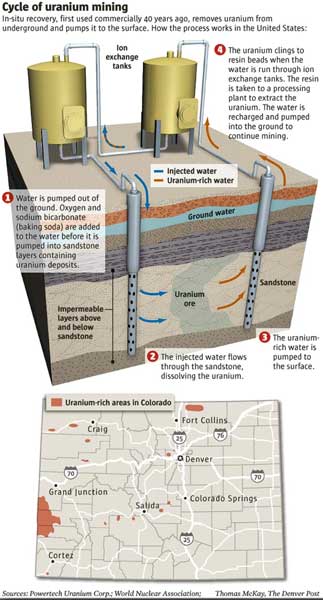
The Powertech suit alleges that the rules go too far in restricting the company’s ability to mine uranium. It plans to use an in-situ process that removes underground uranium deposits by injecting a solution into the deposits to loosen them so they can be pumped to the surface. The rules require denial of a permit if a mining company cannot first demonstrate it will restore groundwater quality to baseline quality or better. The suit further alleges that another rule is a “blackball” provision that allows the denial of a reclamation permit because of “one or more past or current violations by an applicant or by an entity or individual who is very loosely related, if at all, to the applicant.” “These provisions are overly broad and punitive and could prevent a good company from conducting a mining operation because of isolated or administrative-type violations that may not even be related to that company,” the suit states.

More nuclear coverage here and here. More HB 08-1161 coverage here.

Castle Rock: The town council passes 5-year 30 percent increase for water rates on first reading

A picture named waterfromtap.jpg

From The Douglas County News Press (Rhonda Moore):

On Oct. 26, Utilities Director Ron Redd proposed to increase water rates over a five-year period, beginning in 2011. Redd presented a plan to introduce a tiered approach that by 2015 will have a net affect of a 30 percent rate increase for residential customers. Over that period of time, commercial customers will experience a drop in their water bills of more than 2 percent, beginning with a 17 percent rate decrease in year one and continuing with annual rate increases through year five. The reason for the decrease to the commercial rates is an adjustment to the fixed costs associated with its customer base, Redd said…

If town council approves the rate increases at second and final reading, customers will begin seeing changes to their water bills beginning in January, 2011. The average residential customer will pay about $6.25 more per month for water, or a 5.88 percent increase. Those increases will continue through 2015, when residential customers will be paying about $32 more each month, or $384 per year, than they pay today. In the first year of the rate increases, commercial customers will save abouyt $50 each month, with a 17 percent decrease in their bills. The commercial rates will then undergo various rate increases over the next four years, resulting in a two-percent decrease from what they pay today.

More infrastructure coverage here.

Energy policy — oil and gas: The Colorado Oil and Gas Conservation Commission is asking oil companies to develop baseline water data prior to drilling

A picture named derrick.jpg

From the Fort Collins Coloradodan (Bobby Magill):

The tests, which will establish a baseline for water quality where oil and gas companies are rushing to buy up mineral leases so they can drill the potentially oil-rich Niobrara Formation, are a protective measure required in southern Weld County but not yet in far Northern Colorado. “It’s an area where we don’t have a lot of baseline information at this time, and where we are anticipating significant oil and gas development in the future,” said David Neslin, Colorado Oil and Gas Conservation Commission director.

The information will help the state respond to residents’ complaints about suspected domestic water well contamination from nearby oil and gas development, he said.

The region between Grover and Wellington and around the Pawnee Buttes is becoming a hotspot for oil drilling after a new oil well in northern Weld County gushed 1,700 barrels of oil in one day last year.

More oil and gas coverage here and here.

Energy policy — nuclear: Powertech plans ‘aquifer enhancement’ at proposed Centennial Project operation

A picture named uraniuminsituleaching.jpg

From the Fort Collins Coloradoan (Bobby Magill):

Powertech’s plan for in situ leaching now includes a process called “aquifer enhancement.” The report says aquifer enhancement involves raising the water table beneath the mine site by injecting fresh water into the ground around the perimeter of each field of wells used for uranium extraction. The fresh water, which will likely come from the Colorado-Big Thompson Project once water rights are purchased, will keep the oxygen levels around the uranium ore at the correct level so the ore can be extracted. The aquifer enhancement process will create a “hydraulic fence” around each well field, but the report says, “No modeling has been completed by Powertech to assess the effect of the hydraulic fence on the surrounding water resources during operation.”

David Berry, director of the Colorado Mined Land Reclamation Office, said he is uncomfortable speculating on what Powertech’s aquifer enhancement process might mean. “Regardless, state standards apply,” he said.

More nuclear coverage here and here.

Energy policy — nuclear: The Colorado Mined Land Reclamation Board approves new rules for in situ uranium mining

A picture named uraniuminsituleaching.jpg

Update From the Associated Press via Business Week:

The requirements approved Thursday by the Mined Land Reclamation Board include detailed environmental protection plans for uranium mines and maintaining existing groundwater quality or at state standards. Mine applications must include detailed information on the pre-mining water quality. Public input will be allowed.

From the Fort Collins Coloradoan (Bobby Magill):

The Colorado Mined Land Reclamation Board on Thursday put its final stamp of approval on a set of rules that will govern how British Columbia-based Powertech Uranium Corp. will be allowed to mine using an in situ leaching process and provide the public with a way to appeal state decisions on uranium prospecting. “It’s been what we’ve been effectively fighting for, for over three years now,” said Jay Davis, whose property is adjacent to the Centennial Project uranium mining site northeast of Fort Collins in Weld County…

The new rules permit the Colorado Division of Reclamation, Mining and Safety to require Powertech and other companies hoping to mine uranium using in situ leaching to establish “baseline” water quality before they begin prospecting for uranium. Baseline water quality is the quality of the groundwater as it exists before any mining or prospecting begins. The rules, which implement a 2008 state mining law, require Powertech, once mining is complete, to return the contaminated groundwater beneath the mine site to its original baseline condition…

“At the end of the day, they’ll realize this will provide additional protection to them and insulate them from assertions that prospecting released uranium into the groundwater,” said Mike King, executive director of the Colorado Department of Natural Resources and a member of the MLRB. “This will provide a level of comfort and insurance to well owners, land owners in the area that they will have all the information (on groundwater quality) up front before the prospecting and mining process.”[…]

“They hit it out of the park,” said Matt Garrington of Environment Colorado, a Denver environmental group championing strong restrictions on mining companies in Colorado. “For the first time ever, local governments can appeal mine prospecting decisions.” King said the rules take effect Sept. 15.

More coverage from Bruce Finley writing for The Denver Post. From the article:

The rules approved by the Colorado Mined Land Reclamation Board require companies to test groundwater at mining sites before prospecting. Regulators can use test data to ensure companies don’t leave groundwater degraded. The rules also require companies hunting for minerals to disclose more information about when and how mining would be done. And communities affected by mining now have greater rights to appeal state decisions.

“We’ve established an appropriate level of oversight” and also “pulled back some of the veil that has led to concern about these activities,” said Mike King, director of the Colorado Department of Natural Resources. “I don’t think we are hostile to mining at all,” King said. “What we are expecting is that mining activity that takes place in this state is done under controls that protect our environment.”[…]

This might mean Colorado is not at the cutting edge of what is called in-situ leach mining, which uses wells instead of tunnels to extract the mineral, King said. “When the industry gets to the point that they can demonstrate that they can do this in an environmentally responsible manner, then they can apply for a prospecting permit in Colorado,” he said.

More nuclear coverage here.

Energy policy — nuclear: Powertech’s Richard Clement says that proposed uranium in situ mining rules would be, ‘fatal to any serious potential in situ recovery project’

A picture named uraniuminsitu

From the Fort Collins Coloradoan (Bobby Magill):

The state is in the process of finalizing rules that will govern how the law is implemented and how Powertech will be able to extract uranium at the Centennial Project site in Weld County. A revised version of the proposed rules was issued in July, and Powertech’s response minced few words. “This results in an obvious ‘Catch 22,’ which would be fatal to any serious potential in situ recovery project,” Clement and Powertech’s attorney, John D. Fognani, wrote to Colorado Division of Reclamation, Mining and Safety officials Aug. 6.

The rule in question would allow the state to force Powertech to test groundwater quality before the company could begin prospecting for uranium. Under the new law, Powertech is required to test the groundwater before mining begins to determine “baseline” water quality. The in situ leaching process is expected to stir up at least some contaminants in groundwater beneath the mining site; but once Powertech finishes mining, it has to return the underground water quality to baseline contamination levels.

Powertech objects to the revised rule allowing the state at its discretion to force the company to test for baseline water quality prior to prospecting, the process Powertech uses to determine whether the uranium ore underground is economically feasible to extract. “As Powertech and others have explained throughout this rulemaking process, it will be economically and technically impracticable at best – impossible at worst – for in situ operators to gather the necessary data for a baseline site characterization until after conducting time-consuming and expensive prospecting activities,” Clement and Fognani wrote. “It would be impossible for a potential prospector to gather this information without conducting prospecting work, and DRMS would have it that prospecting work cannot begin until the information is gathered.”[…]

“If a company is serious about mining and serious about engaging with the local community, they would be more than willing to agree to this baseline data collection prior to prospecting,” [Jeffrey Parsons, attorney for the environmental group Western Mining Action Project] said.

More nuclear coverage here and here.

Southern Delivery System: Pueblo County plans to hold Colorado Springs Utilities to the requirement not to use SDS to move water out of basin

A picture named sdspreferredalternative

From The Pueblo Chieftain:

“Any use of SDS to take water out of the basin is a violation of their 1041 permit,” County Commissioner Jeff Chostner said Wednesday…

Chostner was referring to news reports that Colorado Springs may sell excess space in the SDS pipeline to other users, including the Woodmoor Water and Sanitation District in northern El Paso County. “Any uses of SDS water to supply Woodmoor would be a violation of Colorado Springs’ permit,” Chostner said, noting that such a violation would be grounds for the county revoking the SDS permit. The reason for concern is that part of Woodmoor, an upscale housing development near the El Paso-Douglas County line, is outside the Arkansas basin. But in applying for its land-use permit to take water out of Lake Pueblo and through Pueblo West, Colorado Springs pledged not to use SDS to deliver water outside this basin.

More Southern Delivery System coverage here and here.

Energy policy — nuclear: Should the public be allowed to comment on the Colorado’s new uranium mining rules?

A picture named uraniuminsituleaching

From The Denver Post (Monte Whaley):

“Time is money,” said Richard Clement, president and chief executive of Powertech USA, which has plans for a huge in-situ uranium mine in Weld County. “And unless you are Exxon Mobil and can stand five or six years of review on a project, most mining companies can’t tolerate that kind of delay.” Clement spoke before the Colorado Mined Land Reclamation Board, which is considering rules for in-situ mining in Colorado. This week’s hearings are part of a year-long effort to frame mining regulations as stipulated by a law signed by Gov. Bill Ritter in 2008…

Several groups lobbied the board Tuesday in hopes of influencing the final draft of the rules. Industry representatives said in-situ extraction is already safe and heavily regulated by federal and state agencies. A proposed 10-working-day public-comment period about mining prospecting — as well as a review of those comments by the state Division of Reclamation, Mining and Safety — would add another layer of bureaucracy that critics say could discourage any exploration for uranium.

More nuclear coverage here and here.

Castle Rock: Water Wiser workshops

A picture named denveraquifer

From The Douglas County News Press (Rhonda Moore):

Castle Rock offers Water Wiser workshops for free, courtesy of the utilities department. Participants learn irrigation tips, sprinkler system management and how to tap into the town’s water conservation resources. What they walk away with is a greater awareness of fundamental water-saving measures and a window sticker identifying them as a participant.

The sticker is the key to grant participants a waiver from the town’s three-day-per-week watering restrictions.

The town takes a proactive stance when it comes to water conservation, and part of its effort includes watering restrictions between May and August each year. The restrictions limit landscape watering to every three days for Castle Rock residents…

While the town aims for a zero penalty community for watering infractions, the penalty-financed rebates include the popular rebate for high efficiency washing machines and a rebate for replacing turf with drought-tolerant landscaping.

Of the several rebates available for water saving measures, all are exhausted for 2010 except the rebate for Smartscape renovation. The Smartscape rebate reimburses residents who replace their turf with water wise landscapes at a rate of $1 per square foot.

Department personnel rely on drive-by inspections and neighborhood watches to ensure residents are watering within their schedule, said Rick Schultz, water conservation specialist for the town’s utilities department. Those inspections are a thing of the past for Water Wiser participants.

“The main goal is to open people’s eyes to the common sense of irrigation and the common sense of managing your sprinkler,” Schultz said. “As a benefit we’ll exempt them from every third day watering schedule. By taking them off that schedule they have the flexibility to say, ‘it’s my watering day but it’s going to rain so I’m not going to water,’ and wait for another day.”

More conservation coverage here.

CWCB: Supply uncertainty dogs the Colorado River Water Availability Study

A picture named coloradoriverbasin

From The Pueblo Chieftain (Chris Woodka):

The final version of phase one of the study will be considered by the Colorado Water Conservation Board after a four-month review period ends on July 21. The study received $700,000 in legislative funding in 2007-08. But the conclusions of the study provide little certainty about the amount of water left for Colorado to develop under the Colorado River Compact — it could be anywhere from nothing to 900,000 acre-feet — or how the water would be used…

In the last five years, there has been a heightened concern about the ability of the river to deliver water if there were a call from downstream states, as well as the possibility of changing climate conditions that could alter the hydrology of the Colorado River. Politically, the study has been a sort of hinge in discussions on future water projects that could take even more water over the Continental Divide. Two water projects are looking at bringing water to Colorado from the Flaming Gorge Reservoir and the Green River in Wyoming, and at least four other concepts have been proposed to deliver water from various points in the basin. “The Colorado River is one of the most important sources of water supply for the state,” said Jennifer Gimbel, executive director of the CWCB in January. “Colorado needs solid information in order to make smart decisions about future water development.”[…]

[Study] conclusions:

– Basin roundtables need to refine state estimates about future use.

– Climate change will affect both future water supply and demand, but models do not agree on what the impact will be.

– Some of the models suggest Colorado has no water left for development.

– Models of water use in the study do not take into account changes in future use, but only extend historic use patterns.

– Decision support systems need to reflect transmountain diversions.

More Colorado River Basin coverage here.

Energy policy — nuclear: Locals debate Powertech’s proposed uranium in-situ mine near Nunn

A picture named uraniuminsituleaching

From KUNC (Kirk Siegler):

“People have a misunderstanding about uranium and nuclear power in general,” says Powertech CEO Richard Clement. “People conceive of uranium being a major radioactive substance where if you just become associated with it you’re going to be radiated and killed.”[…]

“People just don’t understand what we’re trying to accomplish here, really it’s a very non invasive type of development,” Clement says. A fire hose would be injected a couple hundred feet below the ground to break up the uranium, and pump it back to the surface…

Colorado environmental officials appear poised to make sure those things won’t happen again, as uranium mining appears poised for a comeback. The state is currently rewriting regulations to protect groundwater from toxic runoff. That could be one more road block in front of President Obama’s push for more nuclear power. But State Department of Natural Resources spokesman Theo Stein says the intent is not to stop uranium mining, but make sure it’s done safely. “Groundwater in that part of the state is precious and limited, and it’s important to make sure that any industrial activity does not adversely impact that groundwater,” Stein says.

[Joe Bagby] says he thinks the mine will happen anyway, because he says it’s a top down push from president Obama, a push that may get more of boost in Colorado and nationwide in light of the oil spill in the Gulf of Mexico.

More nuclear coverage here and here.

Centennial: New $30 million Joint Water Purification Plant completed

A picture named watertreatment

From the Centennial Citizen (Peter Jones):

The facility on Jordan Road, a few miles south of Arapahoe Road, will provide up to 12 million gallons a day of potable water from Cherry Creek to about 12,000 residents and 30,000 employees in the area. [Arapahoe County Water and Wastewater Authority and Cottonwood Water and Sanitation District] say they entered into the cooperative venture to meet customers’ increasing potable water demands and to reduce reliance on nonrenewing deep-ground water supplies. “This plant is a major step in being able to supply our customers with the growing demand of water,” Authority general manager Gary Atkin said. “The new plant will also increase the quality of the water we provide.”

Unlike other reverse-osmosis plants in the state, the Joint Water Purification Plant is incorporating a process for disinfection called “advanced oxidation” that eliminates pharmaceuticals and other industrial chemicals that can show up in a water supply. “Microfiltration” will be used to clean up the portion of the water that is returned to Cherry Creek.

More water treatment coverage here.

Arkansas Valley water officials worry that Woodmoor plans will dry up more ag land in the valley

A picture named denveraquifer

From The Pueblo Chieftain (Chris Woodka):

“These gravel pits are for one thing: To transfer water out of the Arkansas River,” said Jay Winner, general manager of the Lower Arkansas Valley Water Conservancy District. “They scare me.” Winner said gravel pit reservoirs would help communities like Woodmoor, located on the Douglas County line in northern El Paso County, move water rights which have been purchased on canals in the Lower Arkansas Valley.

In fact, Woodmoor Water and Sanitation District board has voted to buy land on the Excelsior Ditch now owned by Stonewall Springs LLC. Stonewall has plans to develop three reservoirs on former farmland. There are also potential reservoir sites at gravel pits near Pueblo Memorial Airport and on other privately owned land on the Excelsior. Woodmoor also intends to purchase water rights on the Holbrook, High Line and Excelsior ditch systems as a way of making up for depletions to the Denver Basin aquifers caused by excessive pumping. The Woodmoor district late last year filed for a decree that would allow it to move water upstream through exchanges…

Winner applauded the commissioners’ recent resolution opposing the dry-up of agriculture. The commissioners in May passed a measure supporting water lease-land fallowing programs, such as Super Ditch, that keep water rights in the hands of irrigators. The resolution supports water leasing — sales of water that do not change ownership — as a way to prevent permanent dry-up of agricultural resources. “The Lower Ark is against these types of buy-and-dry activities,” Winner said.

The Woodmoor Water and Santiation District purchases additional ag water rights on the Holbrook Canal

A picture named arkbasinditchsystem

From The Pueblo Chieftain (Chris Woodka):

Woodmoor, located north of Colorado Springs on the Douglas-El Paso county line, has approved spending almost $10 million this year for the purchase of water rights on the High Line, Excelsior and Holbrook ditch systems east of Pueblo. On Monday, its board approved spending another $1.7 million to buy 931.7 shares of the Holbrook Canal, about 5.8 percent of the ditch. Each share irrigates an acre. “We expect the yield to be about 800 acre-feet annually,” [Jessie Shaffer, manager of the district] said.

Earlier this year, the Woodmoor board voted to buy 47.8 shares of the High Line Canal, roughly 2 percent of the ditch. Each share irrigates 10 acres. The cost was a little more than $2 million, with an expected yield of about 700 acre-feet. The board also voted to buy part of the Stonewall Springs reservoir site and 771 shares of the Excelsior Ditch in Pueblo County for $5.85 million. That is expected to yield 380 acre-feet. “If everything goes through, we would be right at $10 million in assets,” Shaffer said. That works out to about $3,000 for each of the 3,300 taps in the district. Water users now pay a base fee of $6.81, with charges from $4.91 to $14.18 per gallon on a tiered scale that charges more per gallon as more water is used.

More Arkansas Basin coverage here.

Arapahoe County Water and Wastewater Authority plans to show off their shiny new water treatment plant on June 18

A picture named acwwaserviceboundary

From email from the ACWWA:

You are cordially invited to the Joint Water Purification Plant Ribbon Cutting Ceremony, the ceremony will be on June 18th, at 10:00 am. For more information please visit our website, under Meetings & Events.

More water treatment coverage here.

Southern Delivery System: What are the impacts from sharing project facilities with providers that were not included in the Reclamation evaluation?

A picture named sdspreferredalternative

From The Pueblo Chieftain (Chris Woodka):

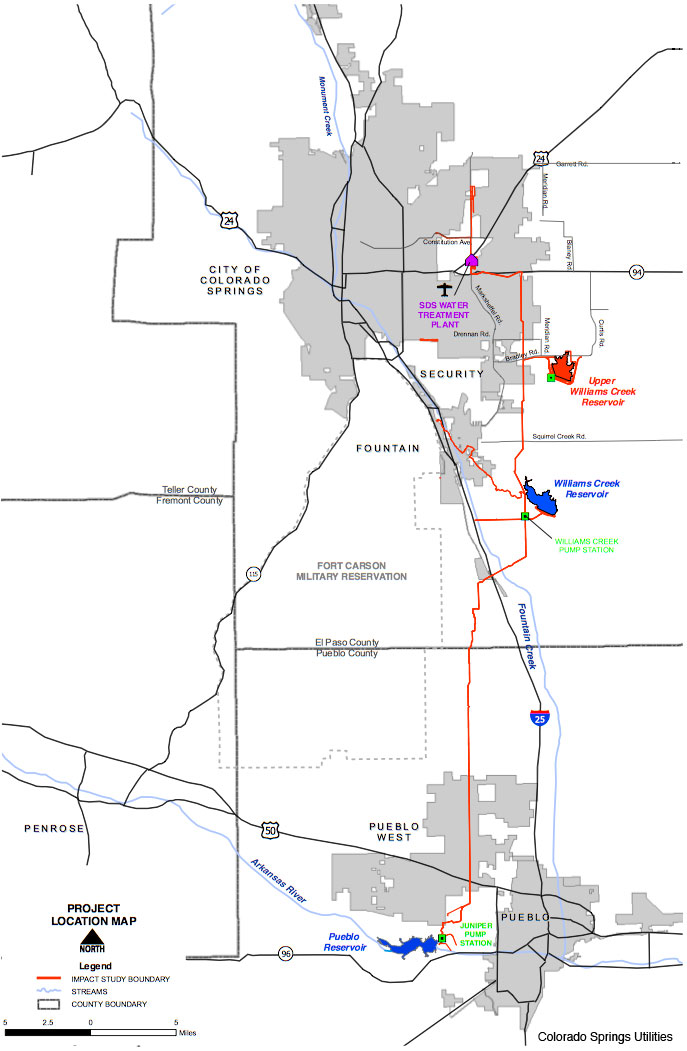
…at contract negotiations last week, Colorado Springs worked very hard to insert provisions that would allow the use of excess capacity of SDS, partly to help pay for the expense. “We need to be clear that there are plans on the part of several SDS participants to serve others through the project,” Colorado Springs water attorney David Robbins told the Bureau of Reclamation at the negotiations in Pueblo. While Colorado Springs and its SDS partners intend to stay within the limit of taking a maximum of 78 million gallons of water a day from Lake Pueblo into El Paso County, more water could be wheeled through the pipeline than was envisioned in Reclamation’s environmental impact study. Colorado Springs wants to build in the ability to use the project for neighboring communities in El Paso County, asking for changes in Reclamation’s proposed contract to allow for “excess-capacity” users.

That point was raised two years ago by Pueblo County water attorney Ray Petros during the EIS comment period.

Petros pointed out environmental impacts were modeled on moving an average of 52,900 acre-feet of water delivered annually through the pipeline, with a firm yield of 42,400 acre-feet. That is only about 60 percent of the capacity of the pipeline and pumping stations to move 87,000 acre-feet per year. “Any approval should condition the use of the project on the use of only existing water rights without further environmental study and review,” Petros told Reclamation in June 2008. At the time, he also advised against allowing additional users on the pipeline. “The draft EIS does not consider the impacts associated with Colorado Springs supplying raw water or substantial amounts of treated water outside its city boundaries. Such water contracts could increase the amount of water projected to be delivered through the pipeline,” Petros said. “Additional taps to the pipeline could mean unplanned growth and impacts along the pipeline.”

Reclamation responded to Petros’ comments by saying the final EIS would have commitments that require Colorado Springs to stay within the limits modeled. “A commitment not to contract or operate the preferred alternative in a manner that differs substantively from that evaluated in the final EIS, except under emergency conditions, has been included,” Reclamation replied. “Because of this commitment only the water supplies analyzed in this final EIS could be delivered through SDS facilities without NEPA analysis.” Petros brought up the concerns again when Pueblo County’s hearings began for a 1041 permit in December 2008. Throughout the hearings, the concern never went away, and it led to a procedure to deal with new water rights added to SDS or third-party users. Under one condition, Pueblo County can reopen 1041 hearings if new water rights are added. Third-party contracts would require support for the Fountain Creek Watershed Flood Control and Greenway District, a commitment not to serve customers outside the Arkansas River basin, adoption of stormwater controls similar to the now-defunct stormwater enterprise in Colorado Springs, cooperation in the Pueblo flow program, participation in water-quality monitoring and support of studies for a flood control dams on Fountain Creek…

During last week’s negotiations, Reclamation asked Colorado Springs to provide an inventory of the water rights that were used to develop the EIS during discussions about excess capacity. In its statement of purpose and need for SDS, Colorado Springs said it was needed to meet future needs of participants, provide redundant systems and develop existing water rights. Nothing was mentioned about supplying the water needs of neighboring communities in the statement…

“If Colorado Springs Utilities doesn’t become the regional water supplier, someone else will step in and do it,” Tony Elia, chairman of the Utilities Policy Advisory Council, told Colorado Springs City Council last July, on the day it decided to delay SDS completion until 2016. The council pushed back SDS to provide breathing room for ratepayers, who nevertheless will be looking at a doubling in water rates by the time SDS is projected to go online.

More Southern Delivery System coverage here and here.

Colorado Springs Utilities board approves entering into water supply contracts with other area providers

A picture named denveraquifer

From The Tri-Lakes Tribune (Nicole Chillino):

After discussing the policy change for about a year-and-a-half, the utilities board approved an agreement that permits the utilities provider to, with approval, enter into contracts with other water purveyors to lease, store, treat and transport water through its system to entities, according to the May 19 agenda. The price for tapping into Colorado Springs’ system would be paid by the entity connecting to it and there would be a premium paid on top of the cost of providing the water. “The concept is any additional cost would be born by the entity that is causing that,” said Gary Bostrom, the utility provider’s water resource manager.

Donala Water and Sanitation District General Manager Dana Duthie attended the meeting at which the regional cooperation was approved as a representative of the Pikes Peak Regional Water Authority. He said the authority endorses the Utilities Policy Advisory Committee’s recommendations for the item. “We think it establishes a basis for collaboration that will definitely benefit everybody,” he said.

More Denver Basin Aquifer System coverage here and here.

Southern Delivery System: Details of Colorado Springs Utilities’ plans for the Pueblo Dam north outlet works include others in the service area

A picture named sdspreferredalternative

From The Pueblo Chieftain (Chris Woodka):

Colorado Springs Utilities water attorney David Robbins took pains to explain that excess capacity in the North Outlet Works, pumping station and pipeline would be different than the concept currently used by Reclamation. “We need to be clear that there are plans on the part of several SDS participants to serve others through the project,” Robbins said.

In fact, contracts being sought by Colorado Springs, Security, Fountain and Pueblo West would use excess capacity of the Fryingpan-Arkansas Project in Lake Pueblo. Colorado Springs wants to apply the same concept to the North Outlet Works, which it would build at its own expense and deed to the Bureau of Reclamation. While a maximum of 96 million gallons a day could be diverted through the new structure Colorado Springs intends to build at the base of Pueblo Dam, not all of it would be needed immediately, and over time the full amount would not be needed every day. Of the capacity, up to 78 million gallons daily would go to El Paso County, and up to 18 million gallons daily to Pueblo West. Colorado Springs City Council has discussed the possibility of allowing El Paso County water users other than Security and Fountain to use the pipeline, but would stay within the 78 million gallon per day limit, Fredell said.

Colorado Springs also wants to build a pipeline from the dam to its connection with Pueblo West’s intake larger than it needs to be to serve the needs of SDS. During negotiations, Colorado Springs revealed it intends to recoup costs for building the North Outlet Works by selling the excess capacity for hydroelectric projects or future connections to the line. The first portion of the pipeline would be 90 inches in diameter, narrowing to 66 inches in diameter as it heads north through Pueblo West. Only about 25 percent of the maximum capacity would be used, said Keith Riley, SDS project manager. The cost for that part of SDS would be about $30 million. “It would be a multiuse pipeline with the potential for others to tie on,” Riley said. “The SDS participants wouldrecapture revenue from it.”[…]

Colorado Springs also asked for changes in the contract that would allow it to use water from any source, rather than just native Arkansas River flows as the contract originally stated. Fredell said water from any source could be used in the pipeline, and those uses might be for augmentation as well as municipal needs. Reclamation officials asked Colorado Springs to review all of the water rights that would be used in SDS at the next negotiating session to verify what was studied in the EIS.

More Southern Delivery System coverage here and here.

Flaming Gorge pipeline: Lower Arkansas Valley Water Conservancy District looks favorably on the project

A picture named flaminggorgepipelinemillion.gif

From The Pueblo Chieftain (Chris Woodka):

The [Lower Ark] district board voted to back a plan by Fort Collins entrepreneur Aaron Million to build a 560-mile pipeline that could bring water into the Arkansas River basin. The U.S. Army Corps of Engineers is evaluating the project under the National Environmental Policy Act. “This is a letter indicating interest, and there is no commitment to the project,” said Pete Moore, chairman of the Lower Ark board…

Million came to the board seeking endorsement at its April meeting. Million Resource Conservation Group is raising $18 million to finance permits for the project, and has already put $2 million into the effort. Investors are being lined up for the second phase of the project, which would begin in 2013, if the environmental impact statement is complete at that time. Million’s plan is to build a project that would deliver 165,000-250,000 acre-feet of water from the Green River and Flaming Gorge at a cost of $2.5 billion-$3.4 billion.

A request for a water supply contract was made to the Bureau of Reclamation, which operates Flaming Gorge, in 2006. Million filed for a water rights permit in Wyoming in 2007.

Meanwhile, Steve Witte, Water Division 2 engineer briefed the Lower Ark on the proposed Arkansas Valley irrigation efficiency rules water court case on Wednesday. Here’s a report from Chris Woodka writing for The Pueblo Chieftain. From the article:

After the consumptive use rules were filed in September, more than 20 statements of opposition were filed in Division 2 Water Court at Pueblo. That resulted in a case management order to attempt to work out issues identified in the objections, Witte said. The state met with attorneys in the case on April 29, and with technical advisers of the objectors on May 3 to sort through the issues. “The discussion was good, and helped to resolve the misunderstanding of the rules by some of those who were not on the advisory committee,” Witte said. The committee changed the rules as Witte originally proposed them in 2006, more closely defining which on-farm or canal changes would be addressed.

Basically, surface-fed sprinklers or drip irrigation systems on farms are regulated, while canal lining or pipes ditchwide are subject to regulation. The rules are meant to avoid violation of the Arkansas River Compact with Kansas as well as to protect senior water rights in Colorado, Witte said.

At the meetings, Witte also explained how compliance plans outlined in the rules would work, and clarified that the state’s model of consumptive use, called the Irrigation Systems Analysis Model, would only be one way by which use is calculated.

More Flaming Gorge pipeline coverage here and here. More Arkansas Valley consumptive use rules coverage here and here

Donala Water and Sanitation District’s special election recap

A picture named denveraquifer.jpg

From The Tri-Lakes Tribune (Nicole Chillino):

Voters approved a measure to allow the district to expand its debt by up to $20 million, with about 67 percent of votes, or 1020 out of 1515, being cast in favor of the measure. The district also received permission to increase the district’s mill levy up to five mills, with nearly 73 percent of votes, or 1098 out of 1508, supporting the ballot question. Approximately 33 percent of the district’s residents participated in the election, according to general manager Dana Duthie. “The number of voters is phenomenal,” he said…

Now that the measures have passed, the district is waiting on a decision from Colorado Springs Utilities regarding whether to relax its limitations and city code to allow it to engage in regional partnerships, Duthie said. If the change comes through, Donala hopes it will allow the district to hookup to the utility district to move water from the Arkansas River, its access point to the water rights it purchased on Mount Massive Ranch near Leadville.

The district’s future actions with regard to its potential use of at least a portion of the money approved by voters will also partially depend on whether it can get water from the Flaming Gorge Reservoir, Duthie said. While the district might have to wait for either of its potential uses of the money, it wanted to receive voter approval to increase its debt and increase its mill rate prior to the passage of several pieces of legislation coming down the pipe that, according to Duthie, would curtail the financing of infrastructure for small districts like Donala. Donala Water and Sanitation District also elected three members, including William Nance, David Powell and incumbent Timothy Murphy, to its board of directors for four-year terms.

More infrastructure coverage here.

Colorado Springs: Council poised to raise water rates May 11

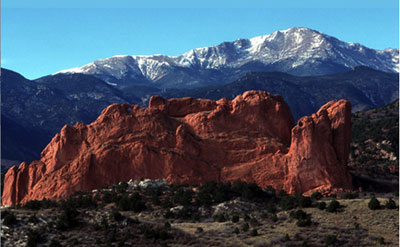
A picture named pikespeak.jpg

From The Colorado Springs Gazette (Eileen Welsome):

The rate hikes are the first of six planned increases through 2016, documents submitted to the City Clerk’s Office show. If approved, water bills will more than double.

More Southern Delivery System coverage here and here.

Castle Rock voluntary water conservation rebates

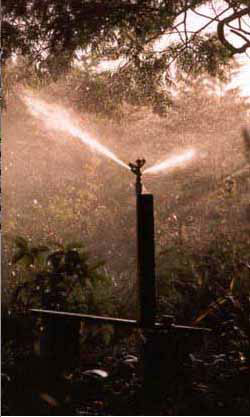
A picture named watersprinkler.jpg

Click here for the lowdown on the rebates from the Douglas County News Press.

More conservation coverage here.

Energy policy — nuclear: Colorado Land Reclamation Board uranium production rules public meeting recap

A picture named uraniuminsituleaching.jpg

From the North Forty News (Dan MacArthur):

Despite the intensity of opposition, just 26 residents registered their concerns at the April public hearing scheduled from 1 p.m. to 9 p.m. at a Loveland hotel’s conference hall capable of seating more than 100. The lack of testimony prompted the board to cut the session short at 6:30 p.m. The hearing may have been subdued in part because the board already had received some 3,500 written comments, which are posted on the board’s web site.

Speakers urged the board to affirm proposed regulations developed to reflect the intent of three bills approved by the legislature applying to hard-rock and in situ uranium mining. Notably, the regulations require in situ mine applicants to establish a baseline of existing conditions for ongoing monitoring of surface and groundwater. The state can hire an independent agency at the applicant’s expense to oversee development of such plans. Reclamation to those baseline standards must be completed within five years following the mining of each phase. Any effect on groundwater beyond the mined land that fails to meet established standards could require immediate reclamation.

Jay Davis, a Weld County resident who lives next to the proposed Centennial Mine project, urged the board to adopt the rules as proposed and resist any attempts to dilute them. “Colorado water is far too valuable to be compromised from being used as a mining tool,” he said.

More nuclear coverage here and here.

Energy policy — nuclear: Colorado University grad student to map groundwater flow at Powertech’s Centennial Project

A picture named groundwater.jpg

From the Fort Collins Coloradoan (Bobby Magill):

CU master’s student Miori Yoshino is studying groundwater flow at Powertech’s Centennial Project site, a project she expects to be complete by the end of the year…

Yoshino said her study will look at only how groundwater flows directly above the uranium ore body at the mine site, but not beyond it. The study will involve “synthesizing modeling results and assessing potential impact on groundwater quality,” CU geological sciences professor Shemin Ge said. Yoshino said she will look at the horizontal flow of water to find out if the mining solution will be pulled down-gradient. She also will study the vertical flow of water at the mine site to find out if there is a connection between the aquifer above the uranium ore and the aquifer beneath it. As part of the study, she said she’ll try to learn how the geochemistry of the water in the underlying rock will be changed by the uranium mining. Yoshino is using data from five wells at the site. The data, she said, will be provided by Powertech.

More nuclear coverage here and here.

Centennial Water & Sanitation District names Tim Gotheer as Director of Operations

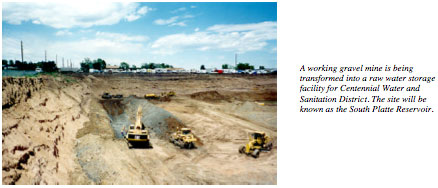
A picture named southplattereservoir.jpg

Here’s the release from the district:

Centennial Water & Sanitation District has named Tim Grotheer as Director of Operations. Grotheer will oversee operations of the water and wastewater plants that serve Highlands Ranch.

Grotheer brings 21 years of responsibility for all aspects of operations, maintenance, and administration of the Plum Creek Wastewater Authority (PCWA) in Douglas County. Duringhis tenure, PCWA received the Environmental Protection Agency’s Region VIII award for Excellence in Operations and Maintenance in 1994, and the National Award for Excellence in Operations and Maintenance from the EPA in 2000.

“Tim brings a long history of plant operations through his prior role as manager of the PCWA. He has been active in several regional organizations focused on water quality. His most recent role was managing a major construction contract for the Aurora Reservoir Water Purification Facility as an employee of Carollo Engineers,” said Centennial Water General Manager John Hendrick.

Grotheer gained familiarity with Centennial Water through his leadership in the Pankake Ranch land application project. He will be responsible for both water and wastewater plant operations in addition to other department leadership and administrative functions.

Grotheer is a graduate of Southern Illinois University with a BS in Industrial Technology. He earned an MS in Management from Regis University, and holds certifications in water and wastewater treatment, and water distribution and collection systems. Grotheer has been a member of the board and is also a past chair of the Chatfield Watershed Authority, and for four years chaired the Colorado Wastewater Utility Council. He served 10 years on the Colorado Water and Wastewater Plant Operator’s Certification Board and is involved in a number of water and wastewater organizations.

Over the past 30 years, Centennial Water has built a reliable and highly-respected water portfolio, based on a conjunctive use system, to serve its customers. Its major water source is surface water from the South Platte River, supplemented with groundwater from deep aquifer wells throughout Highlands Ranch.

For more information about Centennial Water & Sanitation District, which serves Highlands Ranch, please visit http://www.highlandsranch.org, or call 303-791-0430.

More South Platte River Basin coverage here.

Energy policy — nuclear: Colorado Mined Land Recreation Board uranium mining rules public meeting recap

A picture named uraniuminsituleaching.jpg

From the Loveland Reporter-Herald (Tom Hacker):

The seven-member Colorado Mined Land Reclamation Board rented a spacious conference room at the Embassy Suites Hotel in Loveland, believing that controversy surrounding a uranium mining proposal in Northern Colorado would drive attendance. But two hours into the hearing, billed to run 1-9 p.m., only four people had shown up to offer testimony in the room that would accommodate more than 150. “I’m shocked,” board chairwoman Catherine Kraeger-Rovey said in an interview after declaring a recess following the four brief comments. “I was sure there would be more than this,” she said. “Where are they? I should have brought a book.” But by 5 p.m., the room had nearly filled with opponents of a Canadian mining company’s plan for a large mining operation in northwestern Weld County near Wellington…

“It’s not that I oppose nuclear power, or that I oppose mining,” Fort Collins resident John Dixon said. “This is about quality of the groundwater contained in an aquifer that’s within 15 miles of a population of 300,000 people.” Dixon said Powertech had failed in its assurances that groundwater quality would not be harmed during the mining process, nor in the early prospecting operations that pull water out of test bore holes to measure uranium content…

The reclamation board will gather public input in other Colorado communities affected by uranium development, including Grand Junction and Salida, and conclude its public comment period in Denver in June. The board will issue rules in July following hearings.

More coverage from the Fort Collins Coloradoan (Bobby Magill):

Uranium mining proponents lambasted state mining regulators Thursday for attempting to stall any attempt to mine uranium in Northern Colorado, while others accused the mining industry of trying to weaken proposed uranium mining regulations…

The Colorado Mined Land Reclamation Board’s proposed rules will govern how Powertech Uranium Inc. and other companies will be able to mine using a process called in situ leaching, or ISL mining. Powertech is proposing to open such a mine in Weld County, a few miles northeast of Fort Collins at the company’s Centennial Project site. The proposed rules will implement a 2009 state law requiring uranium mining companies to fully clean up groundwater near their mine sites after mining is complete. The rules are also expected to provide a measure of transparency to the uranium prospecting process and implement other environmental safeguards…

“This in situ mining is a great opportunity,” said Bill Bibbey of Greeley, who called the proposed rules onerous and too restrictive for mining companies. Comparing the rules to the recently-passed federal health-care bill, Bibbey said they’re full of pages of “stuff” meant to stall the mining process.

Likewise, University of Denver law professor and former uranium geologist K.K. DuVivier said in situ leach mining is a much cleaner method of extracting uranium than the underground mining methods used elsewhere in the West. Uranium, she said, is likely already in groundwater, and extracting it via in situ leaching won’t necessarily make water quality any worse. “I would just like to specifically say I have some concern about rules that really don’t help with monitoring the water, that are just there to delay things, to make it economically infeasible for Powertech to come in,” she said…

Cañon City resident Kay Hockley said she’s afraid that mining companies prospecting for uranium won’t be held to the same environmental standards as oil and gas explorers under the new rules. The rules, she said, don’t require companies to measure how pristine groundwater is prior to prospecting, preventing regulators and water well owners from ever knowing the true extent to which the mining companies have contaminated the groundwater.

More coverage from The Greeley Tribune (Colin Lindenmayer):

[Wallace Mays], the chief operating officer, chairman and director of Powertech USA, made a rare appearance Thursday at one of the many gatherings where residents have expressed opinions about the proposed uranium mine Mays hopes to build near Nunn. In his southern accent — Mays is from Texas — he explained he wanted to hear what the locals were saying about his company…

After three more public hearings hosted by the Colorado Mined Land Reclamation Board, Mays will have an opportunity to share his thoughts on the situation, which so far has raised loud opinions from several angles.

More nuclear coverage here and here.

Woodmoor Water and Sanitation District approves purchase of three High Line Canal farms

A picture named arkbasinditchsystem.jpg

From The Pueblo Chieftain (Chris Woodka):

he water district will pay three sellers $1.79 million for 41.2 shares of High Line Canal water rights if the sales are closed following due diligence investigations. The purchase would amount to $4,300 per acre. A smaller water right is also included in the package. The farms are a small part of the High Line’s 2,250 shares, and all are near the end of the 85-mile long ditch in Otero County. The High Line diverts south of the Arkansas River east of Boone and ends at Timpas Creek.

“We anticipate using the water in accordance with our exchange decree filed in December,” said Jessie Shaffer, manager of the Woodmoor district. Under that application, water would be exchanged upstream along the Arkansas River and Fountain Creek to Woodmoor, which is in the far northern part of El Paso County, just east of Interstate 25…

Woodmoor would still need to obtain approval from the High Line board and obtain a change of use decree in Division 2 Water Court to move the water. The district does not know when it would seek those changes, Shaffer said…

Two conservancy districts are opposing Woodmoor’s exchange application in Water Court. The Southeastern Colorado Water Conservancy District board voted to file a statement of opposition in the case in January in order to protect its own exchange capacity on the Arkansas River below Pueblo Dam, which eventually will be needed for the Arkansas Valley Conduit. The district also is concerned the Woodmoor exchange could use Lake Pueblo, part of the Fryingpan-Arkansas Project, to take water outside the district’s boundaries. The Lower Arkansas Valley Conservancy District opposed the Woodmoor exchange application largely because it could be used to move water outside the Arkansas River basin…

Woodmoor serves 8,400 people in 3,300 homes. About 400 of the homes are on the other side of the Palmer Divide in the South Platte River basin. All sewer return flows from the district come down Monument Creek, but flows from lawn watering on some homes would end up in the South Platte basin, Shaffer said…

Woodmoor, a part of the [Pikes Peak Regional Water Authority], dropped out of Super Ditch negotiations because of the objections to taking water over the Palmer Divide.

More infrastructure coverage here.

Flaming Gorge pipeline: Drew Peternell — ‘It’s time to stick a fork in it’

A picture named flaminggorgepipelinemillion.jpg

Here’s an opinion piece listing some of the reasons that should keep the project from moving forward, from Colorado Trout Unlimited’s Drew Peternell running in the Fort Collins Coloradoan. From the article:

> Exorbitant cost. Million recently released a list of potential project customers. Almost all are irrigators. According to a recent analysis by Western Resource Advocates, the value of irrigation water in eastern Colorado is less than $100 per acre-foot. By comparison, water from the $3 billion pipeline would cost an estimated $2,200 per acre-foot. There’s not an agricultural operation in the state that could afford Million’s water, and few municipalities have expressed interest in the project. The economics don’t add up, and it appears Million is engaging in water speculation, which is illegal according to Colorado law…

> Environmental impacts. Million has said that if the pipeline proposal has adverse environmental impacts, he’ll be the first to “stick a fork in it.” It’s time to stick a fork in it…The pipeline itself would cut across and degrade sensitive wildlife habitat, such as Wyoming’s spectacular Little Mountain area, renowned for its trophy elk and native cutthroat trout populations. And it could spread invasive aquatic species – such as zebra mussels and burbot – to Wyoming and Colorado waters…

> Economic fallout. The pipeline could inflict an economic double whammy on the region. Communities in Utah and Wyoming that depend heavily on tourism and recreation dollars associated with Flaming Gorge Reservoir and the Green River could see their economic livelihood dry up. But the other shoe would eventually fall in Colorado, too, when water users in Colorado find that Million’s go-for-broke pipeline has used Colorado’s last remaining allocation of water under the Colorado River Compact, effectively shutting off the tap on other municipal water development projects on both sides of the Continental Divide…

> Missed opportunities. With their enormous economic and environmental costs, big dams and pipelines are water-supply solutions of the past. The West is entering a challenging new era of water scarcity and limits, one that requires a new spirit of cooperation, pragmatism and innovation. We have cost-effective and common-sense water solutions available to us, such as voluntary leasing arrangements with irrigators, aquifer recharge, water reuse and municipal conservation.

More Flaming Gorge pipeline coverage here and here.

Energy policy — nuclear: Powertech releases revised estimate of recoverable uranium at Centennial Project

A picture named uraniuminsituleaching.jpg

From the Fort Collins Coloradoan (Bobby Magill):

The British Columbia-based company now estimates it will be able to recover more than 12.6 million pounds of uranium, up from the 11.5 million pounds it reported last summer, according to a technical report filed in February with the Canadian government. The higher uranium resources estimate comes after the company purchased more than 3,500 acres from two local landowners last summer, said Powertech President Richard Clement. “Anytime you have an increase in size of your resource, you increase the economic value of your prop-erty,” Clement said Monday. “It becomes that much more viable and capable of being developed.”

More nuclear coverage here.

Colorado-Wyoming Coalition and the Pikes Peak Water Authority are chatting

A picture named denveraquifer.jpg

From the Tri-Lakes Tribune (Nicole Chillino):

Parker Water & Sanitation District Manager Frank Jaeger spoke to the authority’s board of directors at its monthly meeting about efforts being made by the Colorado-Wyoming Coalition to assess the potential availability of pumping water from the Flaming Gorge Reservoir to both states, with the emphasis in Colorado placed on supplying the Front Range. “I recommend signing up with these guys,” said the authority’s manager Gary Barber. “I think it’s the right project and the right leadership.”

Barber added he does not believe an interstate water deal will be accomplished without getting the government involved, which is where another group he has been part of — the Interbasin Compact Committee Arkansas Basin Roundtable — comes in. Working with the entity, he believes, would be the project’s ticket to working with the state’s general assembly and he would like to see the organization used as a forum for interest groups and others with interest in the project to gather questions about the project.

Jaeger agreed that later in the process, once the initial information has been gathered it would be appropriate to address questions and concerns, but he does not want to have this happen before the coalition knows whether the project will be feasible and has information about the details of the project, such as how much water will be available and how much water providers are going to want to use.

Jaeger is collecting signatures and $20,000 from each of the interested water providing entities in both states to help fund a study to examine the feasibility of setting up the project. He said the money will go toward determining who the players are and how much water each one will want from the project.

More Colorado-Wyoming coalition coverage here.

Parker: Rueter-Hess Reservoir ready to store water

A picture named rueter-hessplans.jpg

From The Denver Post:

Parker Water & Sanitation District officials announced that construction of the Rueter-Hess Reservoir — which is 180 feet deep and spans 1,400 acres — has reached a stage where water can be received. State officials have approved a request to allow water in nearby Newlin Gulch to be stored in the reservoir.

More Rueter-Hess Reservoir coverage here and here.

Southern Delivery System: Colorado Springs weighing the synergies of allowing northern El Paso County water providers to use project for raw water transport

A picture named sdspreferredalternative.jpg

From the Colorado Springs Independent (Pam Zubeck):

All concerned say that cooperation would help water districts that rely on dwindling groundwater supplies, while stemming sharp rate hikes for Utilities’ customers in coming years. From now until 2016, when water is first delivered, rates will increase 12 percent a year. And that’s just for half the project; the other half, which includes a reservoir, will be built later. If other communities pay to piggy-back onto the pipeline, say some city officials, everybody wins. “That’s the whole goal, is to use that pipeline to its maximum capacity to reduce the impact of SDS on ratepayers,” Vice Mayor Larry Small says…

…recent analysis shows the SDS pipeline won’t be fully used year round, says Gary Bostrom, with Utilities’ water services division. Between November and April, when water demand is low, consumers will use 10 million to 20 million gallons a day from Pueblo Reservoir. That leaves plenty of room for more water to be pumped into storage, whether for pipeline customers or others, to be used during summer months, Bostrom says. “There is ample space in Southern Delivery for regional purposes,” he says…

Bostrom insists the city doesn’t intend to sell its water rights, only to deliver water for others. But even that might bring a squall of costs and red tape. First, city codes restrict water service to within the city limits or to subdivisions agreeing to be annexed. To accommodate outlying partnerships requires changes to the code, and perhaps the City Charter. Second, Pueblo Reservoir storage contracts are available only for those entities located within the Southeastern Colorado Water Conservancy District, a multi-county area that’s been taxed for years to build and maintain the reservoir. Some subdivisions interested in SDS don’t lie within the district, Utilities officials say. Then there’s return flows. Fountain Creek is subject to government protection against pollution and erosion. Lastly, the Bureau of Reclamation, which runs Pueblo Reservoir and permits water projects, might need a say-so about new partners’ plans, such as Petersen’s idea to enlarge Upper Williams Creek reservoir. That would take time and money. Colorado Springs’ arduous application process, which included a National Environmental Policy Act study, took nearly six years and cost $19 million. Bostrom says the city will try to recoup a portion of that from any future partners, and Utilities spokeswoman Janet Rummel says SDS construction costs also could become part of any partnership deal…

A fly in the ointment is a recent analysis showing that if [Colorado Springs’] 200 square miles are built out in 30 to 40 years, the city will need 17 million gallons more water than SDS can deliver. The city’s federal application predicted SDS would satisfy needs through 2046. That leads Wayne Vanderschuere with Utilities’ water services division to warn, “I would be concerned about making promises that we may not be able to keep.”

More Southern Delivery System coverage here and here.

Flaming Gorge pipeline: Douglas County Commissioners are on board for the project no matter who builds it

A picture named flaminggorgepipelinemillion.jpg

From The Pueblo Chieftain (Chris Woodka):

A conflict between entrepreneur Aaron Million and the South Metro Water Supply Authority has spilled over into the U.S. Army Corps of Engineers’ evaluation of a 560-mile pipeline proposed from Flaming Gorge Reservoir to Colorado’s Front Range. After Douglas County commissioners wrote a letter expressing interest in the project, South Metro President Charlie Krogh and Executive Director Rod Kuharich sent a letter to the Corps saying the district has “no interest” in the Million Project. “The South Metro Water Supply Authority future water supply plans do not include, nor do we wish to be considered part of this project,” the letter stated…

Last year, Million accused Parker Water Director Frank Jaeger and the South Metro district of attempting to “high-jack” the project.

Douglas County commissioners in a Dec. 29 letter to the Corps said the project would be interested in 40,000 acre-feet from the proposed Flaming Gorge pipeline. It was one of a series of letters identifying the need for more than 375,000 acre-feet of municipal or agricultural water in Colorado and Wyoming…

[Commissioner Steve Boand] confirmed that Douglas County remains interested in any water supply that brings in more water. “We view the Flaming Gorge Project(s) as a single enterprise regardless of whether it is called the ‘Million’ or ‘Jaeger’ project,” Boand said.

Meanwhile the project’s visionary, Aaron Million, is touting the potential for preventing ag dry-ups as a reason that the Arkansas Valley should get on board, according to Chris Woodka writing for The Pueblo Chieftain. From the article:

“The project has tremendous benefits to preventing ag dry-ups,” said Aaron Million, who heads a group of investors hoping to build the 560-mile pipeline. “The water coming into the Arkansas River basin would have conservation restrictions that would benefit agriculture.”[…]

“This is a tremendous opportunity to alleviate pressure on the water supply around Denver and up north,” Million said, adding this would also reduce the chances of more diversions from the Arkansas basin. “The Corps of Engineers has agreed to move the project forward. This is without question the largest base of water users in Colorado that has come together for a project.”[…]

Million wants to develop the project privately, but tailor its use for public benefit, in the same way toll roads like E-470 have been developed. Private efficiencies can reduce costs and clear hurdles that have stifled public water development, Million said. “Other projects have been postponed because they rely on public funding,” he said.

Tim Walsh, a partner in the project, said the comments raised during the Corps scoping period already have changed the project. The route of the pipeline will come from the west side near the northern end of Flaming Gorge Reservoir, hooking up with a river intake just above the reservoir, but below Green River. That eliminates other points above Green River and a southerly route that would take water from the southern part of Flaming Gorge Reservoir near the dam. “The route we’re looking at addresses about 85 percent of the negative comments,” Walsh said.

Because the water is coming in from another basin, there would be increased reliability of supply. Also, once the water is used in Colorado, the return flows could benefit downstream users because imported water can be used to extinction. There also are possibilities for hydroelectric power generation because of the drop in elevation of 3,500 feet at one point along the pipeline route as it moves from Lake Hattie in Wyoming to the South Platte River, and again as the pipeline drops after crossing the Palmer Divide into the Arkansas River basin.

More Flaming Gorge pipeline coverage here and here.

Energy policy — nuclear: Powertech aquifer pump test approval due by mid-April

A picture named denveraquifer.jpg

From the Fort Collins Coloradoan (Bobby Magill):

If approved, Powertech will be allowed to test the feasibility of in situ leach mining for uranium at the Centennial Project site. The test could help regulators find answers to questions about how the underlying aquifer works and how any contamination from the mine could move through it and affect groundwater elsewhere…

The mining could have the greatest impact on the Laramie-Fox Hills aquifer, which many surrounding landowners have tapped for their well water.

The councils of most of the surrounding cities and towns, including Fort Collins and Greeley, have said they oppose the mine, partly for fear it could pollute the groundwater.

How far any pollution from the mine could spread within the aquifer and how that could affect water wells in the area isn’t well understood, but the pump test could shed some light on the matter, according to the EPA…

Information about the hydrogeology of the aquifer is sparse, and few people have studied how fast water moves in the aquifer to determine how pollutants could spread…

Vincent Matthews, state geologist and director of the Colorado Geological Survey, pointed only to a 1980 CGS study of hydrogeology and uranium resources northeast of the Centennial Project site, written at a time when Unocal and other companies were planning uranium exploration projects near Keota in Weld County. The state sampled 104 water wells — many of which tapped the Fox Hills formation — near uranium deposits in northern Weld County. The study showed that the well water quality was extremely poor and much of the water contained high levels of uranium and vanadium. The closer a well was to a uranium deposit, the more contaminated it was. But, Matthews said, the study doesn’t say much about what’s happening in the same aquifer and rock formations near Nunn…

The USGS has no specific data on the Fox Hills aquifer near the Centennial Project, and any other studies conducted in the area wouldn’t apply to that spot because each site has its own unique characteristics, said James K. Otton, a USGS geologist specializing in uranium. Otton last year wrote a brief on in situ leach uranium mining, saying the mines have always left increasing contamination behind and no one has ever succeeded at fully cleaning up the groundwater after an in situ mine has shut down.

More nuclear coverage here and here.

Energy policy — nuclear: Hearing schedule for state rules

A picture named uraniuminsituleaching.jpg

From the Fort Collins Coloradoan (Bobby Magill):

Since Gov. Bill Ritter signed a 2008 law, House Bill 1161, requiring companies doing in situ leach mining to safeguard groundwater, state mining regulators have been working with Powertech and others in the uranium mining industry to write rules governing how the law is implemented. So far, the rules-writing has been informal, but the state on [January 27] released its plans for a formal public process for the final approval of the rules by the state Mined Land Reclamation Board…

The board is asking for the public to make its voice heard on the proposed rules at an April 15 hearing at the Embassy Suites Hotel in Loveland. It will be the first formal public hearing on the rules, but how many hearings there will be isn’t clear…

The board set a March 1 deadline for written comments from the public about the proposed rules. Those who want to be a party to the hearing – someone who believes they have a direct interest in the rules and can offer alternatives – must submit a written request by Feb. 23. Those granted “party” status are given an elevated legal status in the hearing process and must attend an April 6 prehearing conference at the Denver Art Museum.

Jackie Adolph of Citizens Against Resource Destruction, which opposes the Centennial Project’s potential impact on groundwater, said she believes public input in the rulemaking process is important to protect the water. “I think that we will have quite a bit of public participation in this process,” she said.

More nuclear coverage here and here.

Cracks in the Pikes Peak Regional Water Authority?

A picture named pikespeak.jpg

From The Tri-Lakes Tribune (Nicole Chillino):

At the group’s Jan. 20 meeting, Cherokee Metropolitan District general manager Kip Petersen said Woodmoor Water and Sanitation District’s filing for an exchange plan for water in the Lower Arkansas Valley and a letter sent to Aaron Million expressing interest in his project came as surprises to him. Million, a Colorado entrepreneur, is working on a privately studied, built and funded project to pipe water from the Flaming Gorge Reservoir in Utah and Wyoming to areas along the Front Range. The exchange plan filing came as a surprise to several members of the authority and some thought it could hurt the group’s negotiations with projects it is looking at to potentially provide the area with renewable water. “I’m pretty sure that’s hurt our credibility with the Super Ditch people,” Petersen said.

More Pikes Peak Regional Water Authority coverage here.

Arkansas Valley: Woodmoor Water and Sanitation District offers $40,000 per share for rights on the High Line Canal

A picture named arkbasinditchsystem.jpg

From The Pueblo Chieftain (Chris Woodka):

A copy of a contract being offered by the Woodmoor Water and Sanitation District revealed the offer. Woodmoor is seeking to buy shares of the High Line and Holbrook canals, which primarily serve farmers in Otero County. The Woodmoor district is on the northern El Paso County line, east of Interstate 25. It serves 8,400 customers and some of the homes in the district drain into the South Platte basin.

It’s not known how many contract offers have been made, who has accepted or what prices are being offered on the Holbrook Canal. The contract provides a diligence period of four months with the possibility of extension. The price reflects the potential difficulty of moving water from the Arkansas Valley. Bessemer Ditch shares last year sold to the Pueblo Board of Water Works for $10,150 each. A share on the Bessemer historically irrigated 1 acre. Further down the river, on the Fort Lyon and Amity canals, shares have sold to municipal or industrial interests for a less than $2,500 per acre in recent years. High Line sold water to Aurora and Colorado Springs on a temporary lease agreement for $500 per acre in 2004-05.

The district filed for an exchange decree on potential Lower Arkansas Valley water rights on Dec. 30 in Division 2 Water Court. The move would allow Woodmoor to take water by exchange up reservoirs, both existing and planned, on the Arkansas River and Fountain Creek. On Wednesday, the Lower Arkansas Valley Water Conservancy District board voted unanimously to oppose the water court application.

More Arkansas Basin coverage here.

Gary Barber: ‘[SDS] infrastructure to deliver water needs to support a regional solution’

A picture named sdspreferredalternative.jpg

From The Pueblo Chieftain (Chris Woodka):

“The infrastructure to deliver water needs to support a regional solution and the funding must be equitable,” Gary Barber, chairman of the roundtable, said in comments accompanying an official report to the state. “Otherwise, the Arkansas Basin may not be able to meet the gap, and the consequences will be felt beyond the borders of El Paso County.”

The largest portion of a statewide gap in future water supply is 22,600 acre-feet needed to supply communities outside Colorado Springs in El Paso County, according to the needs assessment included in the report. About 40 percent of that will be new demand, while 60 percent is loss of existing water supplies as pumping increases in the Denver Basin aquifers. As roundtable president, Barber pushed for completion of the reports, “Projects and Methods to Meet the Needs of the Arkansas Basin.” The document includes consumptive and nonconsumptive needs studies and represents the consensus of the roundtable’s first four years of meetings. It also begins to rate the relative importance of projects in meeting the state “gap” in water supply identified in 2004 by the Colorado Water Conservation board. It places the highest priority on sustainable projects. The ideas included in the report are rated on three questions: Is it viable? Is it equitable? Is is bearable?…

Every member of the roundtable represents a constituency – special interests – and Barber’s are his clients in El Paso County, which include two water authorities whose members are hunting for future water supplies. Three of them have purchased ranches for water rights in the past three years, one is trying to buy rights on two valley canals and collectively, they unsuccessfully tried to buy control of the Bessemer Ditch in 2008…

Barber’s comments about SDS reflect years of frustration over including other areas of El Paso County besides Colorado Springs, Security and Fountain in the $1 billion-plus project. He has frequently been outspoken on the need for regionalism…

A study by the Pikes Peak Regional Water Authority concluded it would cost at least $1 billion to build its own pipeline from the lower Arkansas Valley…

Colorado Springs City Council, sitting as the utilities board, has discussed including other El Paso County users as customers of SDS and the possibility of using it as a regional delivery system. No formal decisions on that concept have been made, however.

More Southern Delivery System coverage here and here.

Arkansas Valley: Woodmoor Water and Sanitation shopping for water rights

A picture named arkbasinditchsystem.jpg

From The Pueblo Chieftain (Chris Woodka):

“We’re talking to a number of potential sellers in the Rocky Ford High Line and Holbrook systems,” said Jessie Shaffer, manager of the Woodmoor Water and Sanitation District. On Dec. 30, the district filed in Division 2 Water Court for an exchange decree to use water from the Lower Arkansas Valley to supplement its inventory now fed by wells. “We thought it was prudent to file this year. It’s just the first step in a long round to go,” Shaffer said.

The filing surprised backers of the Arkansas Valley Super Ditch, which has reached agreement with Woodmoor and other El Paso County water users to supply water through a long-term lease. “I thought we were looking at doing everything with regional cooperation,” said Jay Winner, general manager of the Lower Arkansas Valley Water Conservancy District, which formed Super Ditch in 2008.

The Woodmoor district is looking for its own sources of water, but would consider buying water through a lease like Super Ditch, Shaffer said. “We want to buy water rights, but we’re not opposed to leasing,” he said. The Woodmoor district formed in 1964 and serves about 8,400 people north of Colorado Springs near the Douglas County line The district will be looking for reliable sources of water at an affordable rate it can solely control, according to its Web site. Woodmoor now gets nearly all of its water through 14 wells in the Denver Basin aquifers. It also has surface water rights in the Lake Woodmoor area, used for irrigation or replacement. It has worked with other El Paso water users through the Pikes Peak and El Paso County water authorities. Last year, the district approved a long-term plan that includes using water from the Lower Arkansas Valley to supplement the Denver Basin wells with renewable sources…

In its court filing, Woodmoor identifies water rights on the Holbrook, High Line, Excelsior and other unnamed ditches as potential sources for the exchange. The district does not, however, seek to change or claim any of the water rights at this time…

The district also lists reservoirs on the Holbrook and High Line canals and reservoirs that have not been built on the Excelsior Ditch as potential exchange points. There are also a series of reservoirs along Fountain Creek, some of which have not been built, listed in the court case.

More Arkansas River Basin coverage here.

Donala Water and Sanitation District meetings to discuss ‘water for the future’ January 13 and 14

A picture named denveraquifer.jpg

From The Tri-Lakes Tribune:

The Donala Water & Sanitation District, which serves the community of Gleneagle and surrounding developments, is holding two “town meetings” at 7 p.m. Jan. 13 and 14 at the Gleneagle Golf Club, 345 Mission Hill Way. The meetings will be the same both nights, allowing for as many constituents as possible to attend. The topic will be “water for the future,” and the plans that Donala has for bringing renewable water into the district. “We have been working on finding a renewable source of water to replace our depleting Denver Basin of aquifer supply for several years,” said Dana Duthie, Donala’s general manager. “We have kept our customers informed through newsletters, past town meetings and phone surveys. Now we have settled on what we believe is the solution — a connection to the distribution system of Colorado Springs Utilities.

More Denver Basin Aquifer System coverage here and here.

Energy policy — nuclear: Timeline for H.B. 08-1161 rulemaking process coming soon

A picture named uraniuminsituleaching.jpg

From the Fort Collins Coloradoan (Bobby Magill):

The Colorado Mined Land Reclamation Board decided Wednesday to move ahead with a formal rulemaking process that will implement a 2008 law, House Bill 1161, which regulates in situ, or “in place,” leach uranium mines in the state…

Sometime in the “next several days,” the state Mined Land Reclamation Office will post a timeline for the rulemaking process and the final proposed rule, office director David Berry said Thursday. The formal rulemaking process, he said, is expected to begin in April and last for “several months.”

The rulemaking is separate from any federal permitting process Powertech must go through to begin mining. The company needs a permit from the U.S. Environmental Protection Agency that would regulate how the Centennial Project can impact underlying groundwater.

More nuclear coverage here and here.

Palmer Lake raises water rates

A picture named waterfromtap.jpg

From The Tri-Lakes Tribune (Lisa Collacott):

On Dec. 3, the Palmer Lake Town council voted to increase water rates beginning in January. The basic rate will increase from $33.53 to $40.07. The increase is needed to fund the new water plant. There will be an $11.51 increase per tap per month. An additional $6.54 will be added to maintain a three-month reserve. The state has required the Town of Palmer Lake to create an emergency fund with the $6.54 that is collected. At the end of 2010 the $6.54 will be taken off the bill. The $11.51 will stay until the loan is paid off, which will be in 20 years.

More infrastructure coverage here.

Energy policy — nuclear: EPA hears from locals regarding Powertech’s Centennial Project

A picture named uraniuminsituleaching.jpg

From the Fort Collins Coloradoan (Bobby Magill):

[Fort Collins resident Diane Marschke] and about 15 others confronted U.S. Environ-mental Protection Agency officials at the Nunn Community Center with their opinions about a proposed water pump test that will tell Powertech if its in situ leaching method of uranium mining is viable in the area. To conduct the test, the company needs a “Class V” permit from the EPA, which will allow Powertech to pump water out of the uranium-containing Fox Hills aquifer, store it, then reinject the water back into the aquifer. The permit will not allow the company to mine for uranium. Powertech will be responsible for doing its own tests on the integrity of the well hole and casing, which are meant to ensure the water will not contaminate aquifers above the area where the water is being reinjected, said Valois Shea of the EPA Underground Injection Control Program…

The pump test permitting process has been going on for nearly a year, and a public comment period ends Thursday. The EPA’s final decision on the permit is expected sometime in early 2010.

Most who spoke Monday night spoke passionately against the pump test and proposed mine, most of them fearing the pump test will stir up contaminants and harm drinking water quality. “Powertech is testing their own wells,” Fort Collins resident Scott Horak said. “They’re monitoring their own situation. It’s like the fox guarding the hen house. It isn’t gonna work.”[…]

One of the few who spoke in favor of the pump test was Erik Nelson, a mining engineer who lives near the Powertech site. He said any contaminants from the test won’t go farther than the well head, and neither the test nor the mine pose any hazard to the groundwater.

More coverage from Jakob Rodgers writing for The Greeley Tribune. From the article:

Should the EPA grant the permit, Mylott said Powertech hopes to draw water up through a pipe and store it in containers. After testing it to determine the quality of the water and how the aquifer recharges, the water would then be placed back into the aquifer unprocessed. The company has yet to file for a class III permit to actually mine uranium at the site, Mylott said. Once it does, Mylott said there would be another public comment period before a final decision is made…

Meg Corwin, the regional director for U.S. Sen. Michael Bennet, D-Colo., also spoke at the meeting. She read a letter sent by Bennet and U.S. Rep. Betsy Markey, D-Colo., to the agency noting their constituents’ concerns and urging the agency to make the rule-making process public. The meeting was the second public comment meeting concerning the class V permit — the first meeting was held in July. The comment period is open through Thursday, Mylott said. Comments gathered until then will factor into the agency’s decision on whether to grant the permit, he said.

More nuclear coverage hereand here.

Energy policy — nuclear: Geovic Mining Corp. and Black Range Minerals biding their time waiting for uranium prices to rise and watching Powertech go through the regulatory hurdles

A picture named uraniuminsitu.jpg

From the Fort Collins Coloradoan (Bobby Magill):

The U.S. Nuclear Regulatory Commission in July issued a report describing the environmental impacts of several in situ leach uranium mines in Wyoming and New Mexico. The report doesn’t cover Colorado because the federal agency doesn’t have jurisdiction over uranium here. In Colorado, Utah and a few other states, the state government has authority over uranium. The report found most of the in situ mines’ operations would take at most a small toll on the groundwater, depending on specific geologic conditions unique to each site. The report did find, however, the mines’ impact on deep aquifers could be large depending on site-specific conditions. A 2008 Colorado law, HB 1161, requires companies doing in situ leach mining to clean the mine’s contaminants out of the groundwater once mining is complete and leave the water in the same condition in which it was found. Solution mining has been used in Texas and Wyoming for decades, but many of the mines have been cited by state environment departments for a slate of violations. One of those came as recently as Dec. 8, when the Wyoming Department of Environmental Quality cited Cameco Resources for failure to clean a chemical leak, or “excursion,” at its Highland Uranium Project near Glenrock…

“The regulations are more strict now,” said [Bill] Chenoweth, former geologist for the now-defunct U.S. Atomic Energy Commission in Grand Junction, adding that mines are able to completely cleanse the groundwater of any contaminants, just as HB 1161 requires. “If they spend enough money in flushing and recycling the water, they can do it,” he said. “It’s all a matter of economics.”[…]

Black Range Minerals and Geovic Mining have their sights set on mostly private land near Keota and Grover in an area that was the site of uranium exploration in the 1980s in Weld County near the Pawnee Buttes. Geovic Mining, a Denver-based company whose primary business is a cobalt mine in Cameroon, is holding its breath waiting for Powertech to move its Centennial Project through the regulatory hurdles imposed by a 2008 state law. The law, HB 1161, requires companies operating an in situ leach uranium mine to ensure no contamination is left in nearby groundwater once the mine shuts down. Geovic also is waiting for the price of uranium – currently about $45 – to increase enough to justify a new mine…

Like Geovic, Australia-based Black Range, which owns property northwest of Keota, is waiting for the right moment to make its next move. “The project’s sitting idle at the moment,” said Ben Vallerine, exploration manager for Black Range. “We haven’t secured the land we need. We’ve got some leases from the federal government, and we have to do a plan of operations to complete that leasing process.” He said Black Range has secured about 35 percent of the land it needs for a uranium mine. Black Range’s land sits near federal land in the Pawnee National Grassland, but U.S. Forest Service spokesman John Bustos said the agency is not analyzing any uranium leasing proposal for the grassland and no leases have been granted. The Forest Service denied leases for in situ leach uranium mining operations on the Pawnee National Grassland near Keota in the 1970s and 1980s “because of concern for rehabilitation of aquifers in the formation containing the uranium,” according to a 1997 Forest Service environmental impact document for the plan that currently governs how the grassland is managed.

Here’s a look at the current state of uranium mining in Colorado along with some history, from Bobby Magill writing for the Fort Collins Coloradoan. From the article:

With the third-largest uranium reserves in the country behind Wyoming and New Mexico, interest in uranium exploration in Colorado in recent years before uranium prices fell has been staggering. “In 2005 and 2006, 10,000 mining claims were filed on federal land in Colorado,” said Vince Matthews, Colorado State University geologist and director of the Colorado Geological Survey. “Then, in 2007 alone, another 10,000 were filed.”

Uranium was first discovered in Colorado in 1871 near Central City in Gilpin County, but the mother lode of hot ore was to be found more than a decade later in western Montrose County. The Uravan mining district, centered on a wedge of canyon country between the Uncompahgre Plateau and the Utah state line, encompasses hundreds of uranium mining claims…

A cycle of boom and bust around Uravan – formed from the names of the elements uranium and vanadium – followed, first with the radium boom of a century ago, then a vanadium boom of the 1930s and ’40s, a uranium boom in the 1940s and another uranium rush during the Cold War…

Congress approved a program in 1972 to cleanup the mill tailings beneath homes across the [Grand Junction], and it soon realized health hazards from radioactive tailings weren’t limited to Mesa County. Another federal program during the next two decades cleaned up uranium mill tailings in Durango, Fruita, Palisade, Gunnison, Naturita and Rifle…

The biggest uranium deposit in the state was found in Jefferson County in the 1940s, where 17 million pounds of the ore ware extracted until the mine there closed in 2000. The Cochetopa mining district near Gunnison produced 1.2 million pounds of uranium, while less than 500,000 pounds were produced from a few mines in Fremont County. A uranium mill still operates in nearby Canon City.

Just west of the Pawnee Buttes in Weld County, Wyoming Minerals Corp. built a uranium project near Grover – 35 miles east of the Centennial Project – in the early 1980s to test technology called solution mining, or in situ leach uranium mining…

There are now more than 90 active uranium prospects and 35 active uranium projects statewide, according to state statistics. Powertech remains in the permitting process for the Centennial Project, and the state will kick off a formal rulemaking to ensure in situ leach mines, such as the one proposed by Powertech, conform to a new state water quality reclamation law in early 2010…

Energy Fuels Resources Corp. recently scored the support of Gov. Bill Ritter in its proposal to open a new uranium mill – the first of its kind in decades in the United States – in Western Colorado’s Paradox Valley, west of Naturita. The mill, opposed by environmental groups, still must receive approval from the Colorado Department of Public Health and Environment.

More nuclear coverage here and here.

Arapahoe County Water and Wastewater Authority scores water rights on the South Platte River in Weld County

A picture named southplattewatershed.jpg

From The Denver Post:

The Arapahoe County Water and Wastewater Authority has secured long-term surface water rights on the South Platte River in Weld County. The authority said it will issue about $153 million in bonds to purchase and develop infrastructure that will serve the authority’s 3,000 residential and commercial customers.

More Denver Basin Aquifer System coverage here and here.

Energy policy — nuclear: Environment Colorado obtains email correspondence between Powertech and the EPA over possible permitted pollution in the Fox Hills aquifer

A picture named uraniuminsitu.jpg

From the Fort Collins Coloradoan (Bobby Magill):

U.S. Environmental Protection Agency documents show the EPA has been working closely with uranium mine developer Powertech USA for nearly two years on a permit application that would allow the company to contaminate an aquifer beneath its proposed Centennial Project in Weld County. All of the consultation was closed to the public, said Matthew Garrington of Environment Colorado, the group that obtained the documents from the EPA. According to the documents, the EPA, with the help of Powertech, has been developing internal guidance documents that will govern how the agency reviews Powertech’s application for a mine permit. The permit will allow Powertech to contaminate a portion of an aquifer with the company’s in situ leach uranium mining process…

“One reason the Centennial Project is receiving this level of technical scrutiny is because many residences located near the proposed Centennial Project rely on private wells for their drinking water, and many of those drinking water wells are completed in the same Fox Hills Formation aquifer [ed. the Fox Hills is part of the Denver Basin Aquifer system] as the mining zone aquifer,” according to one October 2008 internal EPA document. EPA spokesman Richard Mylott said Thursday that document does not reflect the agency’s current approach to Class III permitting.

Most of the e-mails Environment Colorado obtained regard an “aquifer exemption,” and “aquifer exemption boundary,” which is the extent to which the EPA may allow Powertech to contaminate the aquifer as part of the uranium mining process. The e-mails between the EPA and Powertech partners, Knight Piesold Consulting and R2 Incorporated, discuss where the aquifer exemption boundary should be placed.

In an April 2008 e-mail between EPA Underground Injection Control staffer Valois Shea and an R2 Incorporated employee, Shea asks if draft figures in a Class III permit application checklist comport with R2’s expectations. “You will get to be the pioneering guinea pig that will make life easier for others following in your path,” Shea writes.

Powertech Vice President Richard Blubaugh said Thursday such consultation with the EPA was both informal and standard practice. Class III permit applicants are “encouraged to go in and meet with the agency to understand what the requirements are,” he said. “Their regulations are complex. It really is something everybody does. It’s just routine to go in and talk to find out how they interpret the rule and what they expect to see in the application.”

Mylott agreed, saying it’s both normal and in the public’s best interest for the EPA to discuss the technical aspects of in situ leaching with Powertech. The EPA’s underground injection control program, he said, is designed to protect drinking water. “Achieving that goal depends on a solid understanding of what the permit applicant intends to do and the steps that will be taken to protect drinking water sources,” Mylott said.

Thanks to the Colorado Independent (David O. Williams) for the heads up.

More nuclear coverage here and here.

Parker: Recall of Parker Water and Sanitation board fails

A picture named denveraquifer.jpg

From The Denver Post (Bruce Finley):

A proposed water-rate hike last year prompted the campaign to oust four members as irresponsible. Board members backtracked, but campaigners pushed on. The results — board president Mary Spencer survived by 30 votes, Root by 7, Mike Casey by 58 — won’t be final until Dec. 30, Douglas County Clerk and Recorder Jack Arrowsmith said. At least one race requires a recount.

Parker’s 12-month tussle reflects rising tension over water in Front Range suburbs, where water managers are struggling to obtain and divert renewable water from mountain rivers as local groundwater supplies dwindle. “This is the kind of battle we’ll see played out with greater frequency as the demands on these finite water resources intensify,” said water expert David Getches, dean of the University of Colorado law school and former state director of natural resources. “We’ve allowed, in Colorado, whole subdivisions and whole communities to be built on nonrenewable water supplies.” Parker’s five-member board oversees the water supply for more than 22,000 people southeast of Denver who rely on 30 wells, from 51 to 2,745 feet deep, that draw fewer and fewer gallons per minute. State data show water tables falling 30 feet a year…

Frank Jaeger, the water-district manager, is leading a drive to divert upper Colorado River Basin water to Denver suburbs from western Wyoming. The $230 million Rueter-Hess reservoir under construction near Parker — one of Colorado’s biggest water- storage projects in decades — would hold that water, along with creek runoff and reused water treated at a new high-tech chemical plant. Jaeger’s district, established in 1962, is one of dozens created after developers built subdivisions across semi- arid terrain and left decisionmaking to the residents. Now, boards face difficult decisions as economic doldrums limit residents’ abilities to pay higher water rates…

“What we learned is, we weren’t doing a very good job of educating the public,” [accountant Darcy Beard] said. “The cost of water in Colorado is never going to go down. We live in a high-desert environment.”

More Parker coverage here.

Denver Basin Aquifer System: State still issuing well permits despite falling water levels

A picture named denveraquifer.jpg

From The Denver Post (Bruce Finley):

The number of pumping permits sought, and issued, has been falling for years, but regulators say they are still required to issue permits without regard for conservation. In fact, a state permit application fee raised in 2003 for budgetary reasons from $60 to $480 was lowered in 2006 to $100. “We may worry about it, but we issue the permits according to statutes,” Assistant State Engineer Kevin Rein said. “The question of whether or not it makes sense is something that counties, or the General Assembly, may address.”

Metro area water suppliers say the number of wells being drilled is likely to continue to fall, a sign of how deep, difficult and expensive drilling has become. “You have to build more and more wells to get the same amount of water,” said Douglas County Commissioner Steve Boand, a hydrologist by training and longtime leader in high-growth suburbs. “The conundrum is: Do we want to invest in more wells to get the same water we had? Or do we want to invest in alternative water supplies? I favor the latter — that we make an investment in renewable resources.”

The Colorado Division of Water Resources’ 2009 report on groundwater indicates levels are falling by as much as 30 feet a year at heavily mined areas around Castle Rock. Decreases at various wells range widely from less than 10 feet a year to 450 feet at one Parker-area well.

Metro area water suppliers have been seeking fewer permits, and drilling fewer wells, state records show. The number of permits decreased from 1,707 issued in 2000 to 249 so far this year. The number of wells drilled decreased from 1,294 in 2000 to 231 last year. This year, the data show, 92 wells have been drilled…

“Even though there are declines in water levels regionally, there still is significant water available in the aquifer. The concern South Metro has is to become reliant on renewable water resources, rather than groundwater resources, and hold those groundwater resources in reserve for periods of drought,” said Rod Kuharich, executive director of the South Metro Water Supply Authority, which represents 13 Douglas and Arapahoe county communities using groundwater including Castle Rock, Parker and Centennial. “Our current mix between renewable and nonrenewable water is roughly 60-40, and our members are moving steadily towards our goal of 85 percent renewable” by 2030, Kuharich said.

More Denver Basin Aquifer System coverage here and here.

Donala Water District considering bond issue to connect to renewable water supply

A picture named denveraquifer.jpg

From the Tri-Lakes Tribune (Nicole Chillino):

Donala Water and Sanitation District is contemplating asking its voting public in May to allow it to buy bonds to help it pay for a means of piping a renewable water supply to its system, according to a statement from the district. While the district recently purchased water rights belonging to the Mount Massive Ranch near Leadville, it has to tap into the water through an entity with access to Arkansas River water, since water from the ranch flows into one of the river’s tributaries, according to information from Donala’s general manager Dana Duthie. Donala is trying to connect to the river through Colorado Springs Utilities, which owns several points of diversion along the Arkansas that could be tapped into, according to the information. The district will be evaluating whether it needs to increase its debt to pipe the water to patrons, and if it decides to ask the taxpayers to issue more debt, whether the issuance will require a tax increase, Duthie said.

More Denver Basin Aquifer System coverage here.