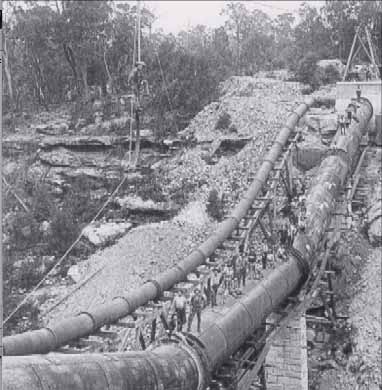
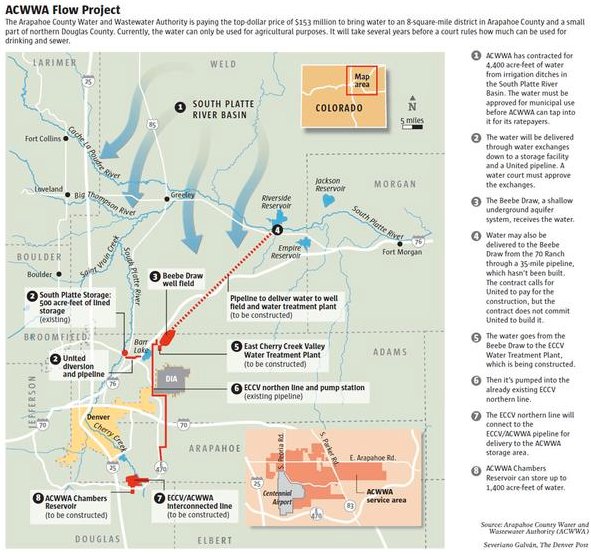
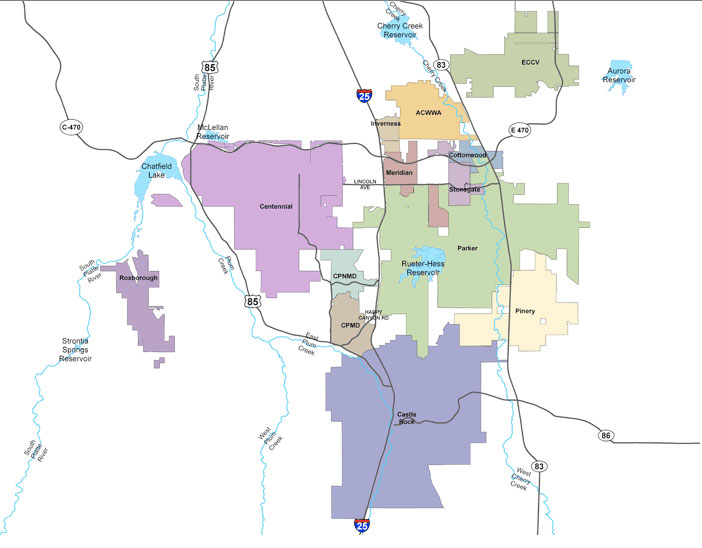
Southern Delivery System update: Denver companies are playing a large role in the construction of the pipeline

sdspreferredalternative.jpg

The Denver Business Journal (Cathy Proctor) is running profiles of 5 Denver area companies that are involved in the design and construction of the project. She lists Reynolds, Inc., Garney Construction Company, CH2M Hill, Northwest Pipe Company and MWH Global.

More Southern Delivery System coverage here and here.

Colorado Water Congress summer meeting: Deputy State Engineer Mike Sullivan — ‘The state engineer cannot curtail diversions from another state’

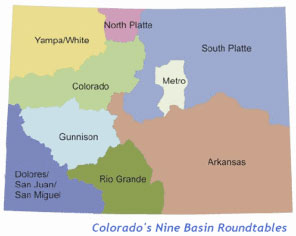
coloradoriverbasin.jpg

I’ve thought for a long time that Aaron Million’s proposal is akin to him driving a tanker truck across the Colorado/Wyoming border — not subject to Colorado water law — and that any water moved would count against the Upper Colorado River Compact. That’s the way the deputy state engineer sees it as well. Here’s a report from Chris Woodka writing for The Pueblo Chieftain. From the article:

“The state engineer cannot curtail diversions from another state,” Deputy State Engineer Mike Sullivan told the Legislature’s water resources review committee Tuesday. “We can’t go into Wyoming and padlock a headgate.” Sullivan and State Engineer Dick Wolfe told the committee they have concerns about proposals to take water from Flaming Gorge Reservoir and the Green River in Wyoming and send it through a pipeline to Colorado’s Front Range.

Wolfe explained that such plans could interfere with water rights administration in Colorado, particularly if lower basin states in the Colorado River Compact were to put a call on the river. Flaming Gorge Reservoir and the Green River are both part of the Colorado River basin, which supplies 80 percent of Colorado’s water. Under the compact, Colorado, New Mexico, Wyoming and Utah are required to deliver 75 million acre-feet of water over a 10-year period at Lake Powell. If they fail to do so, Arizona, California and Nevada could demand water, calling out junior rights in Colorado [ed. the compact has a 1922 priority, senior, for example, to the Colorado-Big Thompson Project]…

Fort Collins entrepreneur Aaron Million is claiming a Wyoming water right as the basis for his Flaming Gorge project, which would make enforcing it difficult under Colorado’s priority system. The Colorado-Wyoming coalition, led by Frank Jaeger of Parker Water and Sanitation, plans to work with the Bureau of Reclamation, and could claim the Flaming Gorge priority date. “There’s no authority in place for dealing with Flaming Gorge,” Wolfe told the committee.

Meanwhile, meeting attendees were treated to a discussion of population estimates yesterday. Here’s a report from Chris Woodka writing for The Pueblo Chieftain. From the article:

The state population grew to more than 5 million in 2010, from 4.3 million in 2000. Colorado grew at a 17 percent rate over the decade, compared with 9 percent for the nation as a whole…

[Elizabeth Garner, state demographer] gave a detailed analysis of counties, showing that the Eastern Plains and San Luis Valley were flat or lost population in the past decade, while the Front Range and Western Slope were the fastest growing parts of the state…

But the picture gets more complicated because baby boomers are getting older. Colorado’s population over age 65 is expected to grow by 150 percent in the next 20 years, which could also contribute to smaller household sizes, changes in water consumption patterns and the tax base. “We are becoming very different,” Garner said. “For the last decade, the largest part of our population has been the most productive . . . In the next 10 years, 1 million people will be leaving the labor force.”

More Colorado water coverage here.

Lamar Pipeline: Karl Nyquist — ‘Our entire focus is on El Paso and Elbert counties…There is enough demand in those two counties’

lamarpipeline.jpg

From The Pueblo Chieftain (Chris Woodka):

“Our project will continue to move forward, the service plan amendment would have allowed Elbert County to participate in the benefits,” said Karl Nyquist, a partner in GP Water. “The service plan amendment was certainly not necessary for the project as proposed and we will move forward as planned.”[…]

Bill Long, president of the Southeastern Colorado Water Conservancy District, doubts the cost figures that GP has shared so far, and said the pipeline would do little to meet the state’s municipal water gap. “I’m not at all surprised they pulled the Elbert County proposal,” Long said. “My hope is they could get behind a better long-term solution than one which has such a detrimental impact to one small area in a basin that is already water-short. In my mind, they aren’t even close to being a part of the solution.”[…]

The expansion of the authority of the Elbert County and Highway 86 Commercial District, which was formed by the GP partners to provide area water service, would have expedited both water plans and provided additional revenue to Elbert County, but Nyquist said there are other ways to pursue the project.

Hundreds who attended a Wednesday Elbert County commissioners meeting cheered when it was announced that the proposal to expand the district was withdrawn. GP Water hosted two public meetings in the county, but apparently did not convince enough people it was good for the county…

The pipeline would be designed to pump up to 12,000 acre-feet annually, but GP estimates its yield from water rights it owns would be an average of 8,000-10,000 acre-feet annually. Nyquist says treated water will sell for $6-$7 per 1,000 gallons, a competitive rate. Negotiations with several potential end users are under way, including the Cherokee Water District near Colorado Springs. Nyquist said other negotiations are confidential, but focus on El Paso County.

More Lamar pipeline coverage here.

Lamar pipeline: The Elbert and Highway 86 Commercial Metro District withdraws its request of the Elbert County Commissioners to approve operations across county lines, Karl Nyquist says they will be back

lamarpipeline.jpg

From The Denver Post (Karen Crummy):

The district’s retreat, which its director calls temporary, was met with loud cheers and whistles from about 1,000 people — the county has a population of about 22,000 — who showed up at the county commission meeting expecting a vote. Instead, a statement of withdrawal from the attorney representing Elbert and Highway 86 Commercial Metro District was read into the record…

Karl Nyquist, head of GP Water and the district director, said the pipeline is not on hold but didn’t provide any details about how he would proceed without authority to operate across county lines. “Our request to delay the vote on the district service plan amendment is simply to allow more time to educate the public and provide the facts about the project and its benefits,” he said in a news release. “The project will be moving forward in all respects despite this delay.”

The next time around, however, the district may face tougher challenges from county officials, who said they would make changes to the review process and who are facing intense public pressure. “We appoint you,” said Jim Eller, who teaches at Metropolitan State College of Denver, to commissioners Del Schwab and Kurt Schlegel. “You disappoint us, we dis-appoint you.”[…]

Elbert County, which does not have a renewable water source, relies on its aquifers, which are generally being depleted faster than they can be recharged. Many in the community fear that Nyquist will take too much water out or that his plan to store treated Arkansas River water in the aquifers will hurt their water quality. Additional concerns were raised after Nyquist failed to rule out using water for the oil and gas companies, which use millions of gallons for exploration.

More coverage from Barbara Preskorn writing for the Lamar Ledger. From the article:

Nyquist and his firm GP Resources, held a second stakeholder meeting at the Lamar Community Center, Tuesday, August 23 to share his business plan “Southeast Renewable Water Project Initiative: A new vision for Colorado’s water future.” Following the template offered by the Arkansas River Basin Roundtable, Nyquist’s firm is starting the process of obtaining comment from stakeholders about water issues. Several attorneys and water engineers in the firm’s employ were present as well as were representatives of the Lamar City Council, the Prowers County Commissioners and Prowers County Development, Inc. Colorado Springs water attorney David Shohet, retained by the City of Lamar, was also in the packed crowd.

“We are proposing a win-win sustainable business opportunity for Prowers County that will provide the region with a water treatment plant and with water storage in the gravel pit on land that I own. We have engineers studying the possibility of underground alluvial storage. One possibility for disposing of brine would be deep underground injection that is used successfully elsewhere.”

“Construction jobs and permanent operational jobs will be created, property tax will increase on the land where the treatment plant will be located because this is a private and not a government enterprise. We expect that school enrollments would go up as a result of these new jobs.” Nyquist stated…

When asked about how this project might be impacted by future extended extreme drought that this county is currently facing, water engineer consultant, Ken Knox stated that “Periods of extreme drought from the 1950s, 1977 and 2002 have been reviewed and that information is being considered in the GP Group’s plan. Few records exist from the 1930s, but indications are that the 1950’s actually were dryer.”

Jillane Hixson, Hixson Farms, stated that she was “under the impression that according to the Colorado-Kansas Compact agreement, river water could not be transferred from below the John Martin Reservoir.” Nyquist responded “This will be reviewed in water court when the application for change-of-use is filed. We will be able to show that no harm will be caused to downstream users, to wildlife or to the environment.”[…]

Roger Stagner, Mayor, City of Lamar, stated following the meeting “The Lamar City Council is watching this proposed business project very closely, but we do not have enough information yet to form an opinion as to whether this would be beneficial to the community or how much benefit it might bring to the region.”

Joe Marble echoed his statement “The Prowers County Commissioners are waiting to receive GP Resources 1041 permit application. We will then have enough information to review the proposal. We will probably need our own legal expertise to help us in this review process.”

More Lamar pipeline coverage here.

Reeves Brown: Why should agriculture, which is already short on water, be the reservoir for the state?

irrigatedagriculture.jpg

From The Pueblo Chieftain (Chris Woodka):

“Why should agriculture, which is already short on water, be the reservoir for the state?” Brown asked. “We need to go forward with a better analysis of the shortage and what is needed to support agriculture.” Brown also is a member of the Lower Arkansas Valley Water Conservancy District and Arkansas Basin Roundtable, and has often tried to keep the issue in front of those groups…

Earlier this month, the [Arkansas Basin] roundtable formed a committee to address Brown’s concerns. In the process, he hopes to guide the state to a new way of thinking about its water needs. At last week’s Lower Ark meeting, Brown expanded on the need for the committee, which is closely aligned with the district’s goals. “The agriculture industry deserves to be more than the stepchild for water supply in the future,” Brown said…

Water users in El Paso County — Fountain, Widefield, Woodmoor and Donala — have been buying farms and ranches for water in recent years. Large blocks of water have been purchased on the Fort Lyon and Bessemer canals for future municipal use. Half of the Amity Canal was sold to Tri-State Generation & Transmission Association for a future power plant. And there are agricultural operations that easily could turn into municipal supply projects throughout the valley, potentially catching the valley off-guard as GP’s plan did. Large blocks of agricultural water have been consolidated in Pueblo and Otero counties, causing public officials to worry about where the water could be headed…

The Lower Ark board is one of few water agencies in the state that firmly supports a Flaming Gorge pipeline. Last year, it supported Aaron Million’s idea for the 560-mile line from the Green River in Wyoming to Colorado’s Front Range because it would develop unused state entitlement in the Colorado River basin and take pressure off Arkansas Valley farms. Million has always insisted that some water from the pipeline be set aside for agricultural and environmental uses. The state’s roundtables have committed to investigating Million’s plan, along with a similar proposal by the Colorado-Wyoming Coalition, as a way of filling the water supply gap…

At a roundtable meeting earlier this month, Fremont County rancher Tom Young asked whether the state should seriously consider importing water from the Missouri River basin in South Dakota, rather than looking for more out of the Colorado River basin from Flaming Gorge Reservoir.

More Arkansas River basin coverage here.

The Pueblo Board of Water Works approves lease agreement for the Donala Water and Sanitiation District

http://coyotegulch.blog/wp-content/uploads/2010/02/denveraquifer.jpg.jpg

From The Pueblo Chieftain (Chris Woodka):

The 20-year lease agreement calls for either trading or selling up to 250 acre-feet of water annually to Donala, so the water district can meet terms of a proposed court settlement with the state of Colorado in a Water Court case. The Pueblo water board would receive a one-time payment of $7,500 and from $12,000 to $96,000 annually, depending on how much water is traded or sold. The rate also escalates over time, depending on general rate increases approved by the water board…

Under the agreement, the Pueblo water board would receive $50 per acre-foot, plus a 10 percent gain in the amount of water leased in a contract exchange of its water in Turquoise Lake for Donala water in Lake Pueblo. The 10 percent gain comes because there would be no transit loss in moving water in a paper trade. Alternately, the Pueblo water board would receive $385 per acre-foot if it sells water to Donala, according to the proposed agreement…

The ranch will provide part of the water supply for Donala’s 2,700 customers, who now rely primarily on dwindling groundwater reserves from the Denver basin aquifers. In a Water Court case in March, Pueblo District Judge Dennis Maes sided with the state engineer’s opinion that Donala would need to make winter releases to augment the Arkansas River, primarily to meet the in-stream flow requirements of Willow Creek under a decree held by the Colorado Water Conservation Board. Donala chose to seek augmentation water from Turquoise Lake, but had no way of getting an account in the reservoir, said Dana Duthie, Donala manager…

Several board members wanted to make sure the water would stay within the Arkansas River basin, since Donala has a small portion of undeveloped land in the South Platte River basin. “It’s in their contract with Colorado Springs and in the (Water Court) decree that they can’t use the water outside the Arkansas basin,” Executive Director Alan Hamel said.

More Pueblo Board of Water Works coverage here.

Energy policy — oil and gas: ‘Oil and Gas 101’ public meeting in El Paso County draws 300 to learn about the nexus between oil and gas exploration and production and groundwater

hooverdamspilling.jpg

From The Colorado Springs Gazette (John Schroyer):

El Paso County Commissioner Amy Lathen and state Rep. Marsha Looper, R-Calhan, convened the conference because oil in the near eastern plains is booming again, and Coloradans need to know how they can profit from it without endangering their water. State officials spent hours explaining how the oil and gas industry is regulated, how horizontal drilling and hydraulic fracturing operate, and what kind of rights are afforded to landowners trying to decide whether to lease their rights to oil companies.

The most vital message was that protecting Colorado’s groundwater should be the highest priority for both the state and landowners, said Dave Neslin, director of the Colorado Oil and Gas Conservation Commission. To that end, the state requires hydraulic fracturing (also known as “fracking”) pipes not only to be made of stainless steel, but also to be encased in concrete, said Neslin…The concrete casings are just one of dozens of requirements placed on the industry, Neslin told the crowd. Complaints can be filed by anyone at any time for any reason, and one of COGCC’s 15 inspectors around the state will respond within 24 hours, he said…

Looper called the conference the “beginning of an education,” and said there will be a lot of issues going forward. She said she doubts that a perfect balance will ever be struck between all the stakeholders. “The question is, how much water is in the ground? Is there enough for the energy companies and all of the 500,000-plus residents on the Front Range? I don’t think so,” said Looper.

niobrarashale.jpg

Meanwhile, Greeley oil company, Ranchers Exploration, held a public meeting Monday night to inform residents about their plans for the Niobrara shale play near Windsor. Here’s a report from Bobby Magill writing for the Fort Collins Coloradoan. From the article:

Ranchers Exploration intends to drill for oil 1½ miles directly beneath the neighborhoods [150 River West and Ridge West subdivision], which are in Larimer County along the Poudre River, using a drilling technique called directional drilling. That method allows drilling rigs to drill away from homes, preventing them from having to drill down into the oil from above. The specific drilling site hasn’t been determined yet, said the company’s chief operating officer Michael Ward. Each well also will be fracked, he said. Fracking companies use a granular substance and a cocktail of possibly carcinogenic chemicals to fracture an underground natural gas- or oil-saturated rock formation, helping to release the fuel into the well…

“Just reading this, I got the impression that if haste makes waste, we’re dealing with a cesspool of a company,” said resident and Colorado State University forest ecology professor Thomas Stohlgren, who received his lease in the mail Monday, after it was sent Saturday…

“This was a plan to keep us ill-informed,” he said. “We were not informed whatsoever about the chemicals used in the process, some of which may be carcinogenic. No list of chemicals came with the documents. We are not advised of whether a bond would be posted for any possible long-term environmental or health effects from fracking in a subdivision. “There are no peer reviewed studies that show no long-term effects of fracking. So, they are experimenting, and you are the guinea pigs. We are the guinea pigs.”[…]

Residents also said they are concerned about a practice called forced pooling, under which homeowners who decline to lease their minerals could be forced to by the COGCC. “If nobody signs the lease, do you still have the right to drill?” another woman asked Ward.

“Yes,” he responded. “But it’s not going to be fun.”

More coverage from T. M. Fasano writing for The Greeley Tribune. From the article:

Harold Smith owns 50 percent of the mineral rights and the homeowners own the other 50 percent. [Mike Ward, the chief operating officer for Ranchers Exploration Partners] said even if the homeowners do not sign a lease to turn over their mineral rights, which amounts to about $70 per year per property owner, the drilling will still go on because of Smith’s 50 percent ownership of mineral rights. “My job is to drill wells for people who want to access their mineral rights,” Ward said…

Ward, whose company is drilling four wells on open space farmland in Eaton, said there won’t be any drilling for at least six months, and the plan is to drill the first well on open space on the north side of River West. Ward said it’s the first time his company has drilled near a subdivision, and if the first well doesn’t produce oil or gas, the project will be stopped.

“The best hope we have to not get drilled on is if they hit a dry hole down below on River West,” [Donn Brubaker, the president of the Ridge West HOA board of directors,] said.

More oil and gas coverage here and here.

Flaming Gorge pipeline: Add Utah’s Uintah County to the list of critics of the proposed project

flaminggorgepipelinemillion.jpg

From the Deseret News (Amy Joi O’Donoghue):

“If this project moves forward, we’re afraid that whatever water rights we have left (on the Green River) will be a paper water right without any wet water,” said Uintah County Commissioner Mike McKee…

As planned, Million said the project would generate 70 megawatts of hydropower from in-line storage and another 500 to 1,000 megawatts from pumped storage — an energy source he says could shore up intermittent renewables such as wind and solar that are in demand to become a larger player in Colorado’s energy portfolio.

Million said he is framing the water-use requirements around a U.S. Bureau of Reclamation preliminary analysis that shows even when future Utah and Wyoming water depletions are factored in from the Green River, Flaming Gorge has an available surplus of 165,000 acre feet a year. Another 75,000 acre feet would be diverted per year from the Green River above Flaming Gorge…

Utah’s Uintah County joins another line of critics, who aside from other accusations, describe the proposal as an “if we build, it they will come” project because of questions about the financing and customer base.

Million says the viability of the project is backed by multiple water supply studies that show sharp contrasts between Colorado’s available water supply and demands in the decades to come. That is backed by letters of interest he says he has received that represent an annual need for 400,000 acre feet of water — nearly twice what the project would deliver.

More Flaming Gorge pipeline coverage here and here.

Energy policy — oil and gas: El Paso County Commission Chair Amy Lathen and State Representative Marsha Looper have scheduled two public meetings this week to discuss Niobrara shale exploration and production

niobrarashale.jpg

From the Colorado Springs Independent (Pam Zubeck):

Meeting information:

Tuesday, Aug. 16, 9:30 a.m. to 12:30 p.m.
Mountain View Electric Association, 11140 E. Woodmen Road
Falcon

Thursday, Aug. 18, 6 to 8 p.m.
El Paso County Public Services Facility
3255 Akers Drive
Colorado Springs

“I encourage residents to attend at least one and possibly both of these summits,” Lathen said in a press release.

More oil and gas coverage here and here.

Federal funding may become available for the south Metro suburbs, Aurora and Denver to use for the WISE project

prairiewaterstreatment.jpg

From The Denver Post (Bruce Finley):

Suburban water authorities said the project [Water Infrastructure Supply Efficiency or WISE], designed to reduce reliance on dwindling underground water, will cost about $558 million.

U.S. Bureau of Reclamation officials said “rural water supply” funds may be available for the project, if it survives a detailed feasibility review. Congress would need to authorize the federal funding, which could decrease the bill passed on to water customers. “What we’re looking at: Is this project capable of being completed? Is the cost-benefit going to work out? Is it going to be beneficial?” Bureau of Reclamation spokesman Peter Soeth said.

Meanwhile, a crucial wastewater purchase deal with Denver and Aurora has yet to be done. How much wastewater could be diverted, and how often, remains under negotiation. The suburbs told federal officials the WISE project would deliver 5,000 to 11,000 acre-feet a year for the first five years, then as much as 37,000 acre-feet a year…

The federal rural water-supply funds could be used because suburbs with populations under 50,000 are deemed “rural,” said Mark Shively, executive director of the Douglas County Water Resource Authority. “We have very aggressively pursued this opportunity,” Shively said. “We’re now about 20 percent into the feasibility study.”[…]

Beyond pipeline construction, the proposed project involves new storage of treated wastewater in surface reservoirs and by injecting it into depleted aquifers. “We have a couple reservoirs we’re looking at,” Shively said. “Between the Chatfield and Rueter Hess (reservoirs) we have a good amount of storage.”

Here’s the report from Reclamation.

More WISE project coverage here.

Energy policy — oil and gas: So far there is no evidence that hydraulic fracturing has contaminated water in Larimer or Weld counties

hydraulicfracturing.jpg

Bobby Magill has written a primer of sorts on the state of hydraulic fracturing and oil and gas exploration in northern Colorado for the Fort Collins Coloradoan. Click through and read the whole article. Here’s an excerpt:

Environmental groups and a federal advisory board, among many other residents in Colorado and across the country, are concerned about the impacts of fracking. The public outcry about fracking and the media attention it has received are the primary reason Gov. John Hickenlooper announced last week that state oil and gas regulators will develop by year’s end a rule requiring oil and gas companies to disclose the full contents of fracking fluid to the public…

Though some companies voluntarily report some of the contents of fracking fluid on the online chemical registry http://www.FracFocus.org, many of the ingredients in fracking fluid are proprietary, and the energy industry has been reluctant to divulge its contents…

…energy companies are using such chemicals to frack nearly all oil and gas wells these days, and there is not yet any evidence that fracking fluids have contaminated drinking water in Larimer County or heavily drilled Weld County, home to thousands of oil and gas wells, Colorado Oil and Gas Conservation Commission director Dave Neslin said. No water quality complaints tied to oil and gas development have been made in northern Weld or Larimer counties, he said.

Meanwhile, U.S. Senator Udall is OK with hydraulic fracturing. Here’s a report from John Colson writing for the Glenwood Springs Post Independent via the Summit Daily News. From the article:

“I believe it’s a safe technology,” said Udall. “It’s resulted in a lot of home-grown energy being produced.”

But the industry must be careful about maintaining the integrity of well-bore casings once the drilling and fracking has been completed and the gas begins to flow upward, he said. If a casing deteriorates or cracks, Udall said, the result is an increased possibility of contamination of underground water aquifers and wells. In Garfield County, locals believe that is exactly what happened when a local water well, owned by the Dietrich family, located south of Silt, was found to be contaminated by nearby drilling activities in 2004. The Colorado Oil and Gas Conservation Commission (COGCC) announced last year that, due to continued indications of contamination of area wells, it would renew investigations into the possible link between water well contamination and nearby gas drilling activity.

A separate instance of gas drilling activities polluting local waterways was the Divide Creek Seep case, also in 2004, when chemicals from the gas drilling process were found seeping into the creek. That case lead to a fine of $371,000 levied against the EnCana gas company by the COGCC, and the contamination was blamed on faulty cementing of the well-bore casing.

The New York Times reported on Aug. 3 about another case of alleged contamination of groundwater supplies by nearby fracking of gas wells. The case occurred in 1984 in West Virginia. A report on the case, according to the story, was published by the U.S. Environmental Protection Agency in 1987. “My office has contacted the EPA concerning this case and we are waiting to hear back from them,” said Udall when asked about the West Virginia case. “The bottom line is that drilling and fracking have to be done right for it to be safe.”

The Secretary of Energy Advisory Board Natural Gas Subcommittee released a draft report this week that recommends increases in regulation and greater disclosure. Here’s a report from Bob Berwyn writing for the Summit County Citizens Voice. From the article:

The report comes from the Secretary of Energy Advisory Board Natural Gas Subcommittee, which was directed by President Obama to identify any immediate steps that can improve the safety and environmental performance of shale gas drilling. One of the recommendations targets a key concern among environmental advocates by calling for full disclosure of the chemicals used in fracking.

Here’s what the report had to say about disclosure:

“The Subcommittee shares the prevailing view that the risk of fracturing fluid leakage into drinking water sources through fractures made in deep shale reservoirs is remote. Nevertheless the Subcommittee believes there is no economic or technical reason to prevent public disclosure of all chemicals in fracturing fluids, with an exception for genuinely proprietary information. While companies and regulators are moving in this direction, progress needs to be accelerated in light of public concern.”

The report acknowledges growing public concern about shale-gas impacts in this passage:

“There are serious environmental impacts underlying these concerns and these adverse environmental impacts need to be prevented, reduced and, where possible, eliminated as soon as possible. Absent effective control, public opposition will grow, thus putting continued production at risk. Moreover, with anticipated increase in U.S. hydraulically fractured wells, if effective environmental action is not taken today, the potential environmental consequences will grow to a point that the country will be faced a more serious problem. Effective action requires both strong regulation and a shale gas industry in which all participating companies are committed to continuous improvement.”

The report also calls for a reduction in the use of diesel fuel, explaining that there is no technical or economic reason to use diesel fuel in shale gas production, and that diesel engines for surface power should be replaced with natural gas engines or electricity where available.

Finally, the report was received with cautious optimism by Colorado U.S. Representatives Jared Polis and Diana DeGette, according to this report from David O. Williams writing for the Colorado Independent. From the article:

“The subcommittee’s recommendations and its acknowledgement that changes need to be made are certainly a step in the right direction,” said U.S. Rep. Jared Polis, D-Boulder. “However, until legal shortcomings are fixed and voluntary recommendations become actual requirements, communities will remain without real assurance that their air, water and health are adequately protected.”[…]

“I support their call to develop best practices for casing and cementing jobs in fracking operations,” U.S. Rep. Diana DeGette, D-Denver, said. “Last year’s BP spill in the Gulf has been largely attributed to faulty casing and cementing, and, as I have repeatedly warned, the consequences of a similar tragedy in an onshore well could be even more catastrophic.”

More oil and gas coverage here and here.

The Rio Grande Roundtable approves funding for the Flaming Gorge task force, members emphasize that they want a seat at the table

flaminggorgepipelinemillion.jpg

From The Pueblo Chieftain (Matt Hildner):

The move, which includes $5,000 roundtable members approved Tuesday, was done earlier this week with the idea of making sure the Rio Grande had a voice on the committee. Both Mike Gibson, the roundtable’s chairman, and Travis Smith, who represents the basin on the Colorado Water Conservation Board, told members that the funding did not represent an endorsement of the project…

Gibson said the Rio Grande had an interest in being at the table because of the potential impacts of Front Range water use on the San Luis Valley, which has the second-highest amount of irrigated ground in the state with 622,000 acres. The South Platte River basin is first with 831,000 irrigated acres. While the valley has not suffered from the water transfers that have sent Arkansas Valley water to cities like Aurora, the threat of a Front Range water grab is a not-too-distant memory. The region spent part of the 1980s and 1990s fighting off separate proposals from American Water Development and Stockman’s Water Company that would have piped the valley’s groundwater north.

More Flaming Gorge task force coverage here.

Energy policy — oil and gas: The Colorado Oil and Gas Conservation Commission is sampling groundwater to establish baselines

niobrarashale.jpg

From the Fort Collins Coloradoan (Bobby Magill):

Colorado oil and gas regulators are beginning a water testing program in Weld, Jackson, Elbert and Park counties to establish the current water quality in areas likely to see new energy development tapping the Niobrara formation…

Northern Weld County is booming with oil and gas activity, most of which was sparked by a well drilled into the Niobrara formation in 2009 near Grover that gushed oil and natural gas…

The water quality data will help regulators respond to complaints about groundwater contamination from oil and gas drilling, [Colorado Oil and Gas Conservation Commission Director Dave Neslin] said…

Widespread new development tapping the Niobrara formation is now expected throughout the Front Range…

“The Niobrara conservatively is 250,000 square miles,” [Larimer County spokesman John Dill] said. “It runs all the way east of Casper all the way east of Denver. It’s a huge, huge piece of land. We are just in the process of doing our exploration, trying to figure out where the best places to drill a well would be. I think it’s very early in the game to predict what the long-term looks like for any particular area, any particular county.”

More oil and gas coverage here and here.

Lamar pipeline: GP Water chief executive Ken Nyquist — ‘Private enterprise has got to pull the sled’

lamarpipeline.jpg

From The Pueblo Chieftain (Chris Woodka):

[The Lamar pipeline, a] $340 million proposal would divert the water 150 miles from where it was traditionally used, possibly out of the Arkansas River basin. “Private enterprise has got to pull the sled,” Karl Nyquist, GP Water chief executive, said. He touts both municipal and agricultural benefits of the project he is proposing. “But nothing is done in the private sector without an idea of making money.”[…]

Nyquist said the up-front costs of developing a large project can be too much for a growing community to afford. There is a competitive market for new sources of water as cities that rely on the Denver Basin aquifers slowly tap it out. GP Water quietly bought up shares of water in the Lower Arkansas Valley for nine years before deciding to make its move…

At a state Roundtable Summit in Denver last March, former State Engineer Jeris Danielson, who has worked as a consultant for both Boyce and Million, asked Gov. John Hickenlooper if there is a place for private development of state water projects. “We have to be careful bringing in private capital as part of the solution,” Hickenlooper answered. “I don’t have a problem with bringing private capital into the picture, but we need to make sure their goals line up with the state’s goals.”[…]

State officials are taking a wait-and-see approach to private projects, watching projects like Flaming Gorge and the newly announced GP plans cautiously. “I think the jury’s still out,” said Alan Hamel, a member of the Colorado Water Conservation Board and executive director of the Pueblo Board of Water Works. “In recent years, it has become harder to develop a large water project unless you’re a big water provider.”

Hamel said there could be a place for the private sector in filling state water needs, but like Hickenlooper he urges caution. “The unincorporated areas are struggling with coming up with a way to replace non-renewable groundwater assets,” Hamel said. “The Flaming Gorge Task Force is a way to flush out the issues. I think, before we’re done, there have to be some public-private partnerships.”

Be sure to click through. Mr. Woodka provides a lot of detail about water projects in Colorado in the article.

More coverage from Karen Crummy writing for The Denver Post. From the article:

Elbert County residents fear the group will take too much water out of the aquifers, some of which are being depleted faster than they can be recharged. County residents are also worried about an eventual plan to store treated Arkansas River water in their aquifers, fearing it will hurt their water quality. Meanwhile, Prowers County, where Lamar is located, is expected to lose irrigated farmland and seasonal farm-labor jobs as Arkansas River water is pumped north. “The big concern in our community is dried-up land. It’s extremely difficult to get things to grow after it dries up,” said Prowers County Commissioner Henry Schnabel. “I would rather the water was used in our area, preferably for agriculture. But we don’t know much about (the plan) right now.”

Karl Nyquist, head of GP, said the “net benefits” in both counties will outweigh the negative impacts. The pipeline from the Arkansas River means Elbert County will eventually get a renewable water source, which he said should help with economic opportunities. Prowers will enjoy a larger tax base and higher-paying jobs from the plant that will treat the river water to drinking standards. He also said GP intends to retain some farmland, using sprinkler irrigation. “We’re trying to create a win-win for every stakeholder,” said Nyquist, who has scheduled community meetings in Elbert, El Paso and Prowers counties this month to educate residents on the project…

After the public questioned the speed with which the proposal was being considered [by the Elbert County Commissioners] and the secrecy surrounding it, the commission delayed voting on the matter until Aug. 24. “This project popped up and caught a lot of people by surprise,” said John Stulp, special water adviser to Gov. John Hickenlooper and director of the Interbasin Compact Committee, a group created under a 2005 state law to promote cooperation on water- management issues and storage projects…

…through public records and an interview with Nyquist, The Denver Post was able to put together a basic picture of the project. Generally, the financing involves GP Water Group, which is made up of Nyquist and his two partners, David Pretzler and David Bechtel. Pretzler and Nyquist are also on the Highway 86 district board. Both men are also partners in C & A Holding Co., a real- estate management and development company. The Highway 86 district owns 180,000 acre-feet — roughly 58 billion gallons — of aquifer water. That water would be pumped through a 32.5- mile pipeline from southwestern Elbert County to Falcon, which is 15 miles northeast of Colorado Springs, for use while districts are waiting for Arkansas River water. Nyquist said the group is not focused on oil and gas exploration, which is set to begin in Elbert County and will need millions of gallons of water. But he also didn’t rule it out in the future. GP, which owns 39 percent of the Lamar Canal, will pull water from the Arkansas River near Lamar. Once GP, or one of its related companies, goes through the courts to change the use of the river water from agricultural to municipal, it will build a treatment facility near Lamar and the pipeline to Falcon. The group is already constructing a gravel pit in Lamar for water storage. Additional storage at the other end of the pipeline will be in aquifers…

The Arkansas River Compact Administration — made up of two Colorado members, two Kansas members and a federal representative appointed by the president — must give its seal of approval, said Steve Witte, an engineer for Colorado’s natural-resources division. It’s unclear how long that will take. “There isn’t a lot of precedent for this,” Witte said, noting that others have considered similar projects but haven’t followed through.

More Lamar pipeline coverage here.

Lamar pipeline: The CEO for GP Water Group estimates the pipeline will cost $340 million

lamarpipeline.jpg

From The Pueblo Chieftain (Chris Woodka):

Developers who want to build a 150-mile pipeline from Lamar to growing communities in El Paso and Elbert counties estimate it would cost about $340 million to construct. “We believe we can build it cheaper than government engineers would estimate,” said Karl Nyquist, CEO for the GP Water Group. “We’ve done a fair amount of this type of work, and there are a few similar projects we’ve watched.”

GP Water proposes to build a 24-inch diameter pipeline to deliver water from rights it owns on the Lamar Canal. Customers would include the Cherokee Water and Sanitation District near Colorado Springs, and potentially other users in Elbert or El Paso counties. It would deliver up to 12,000 acre-feet annually. The primary purpose of the project is to provide renewable water to growing communities that are now mining the Denver Basin aquifers as more wells are drilled…

GP’s engineering team estimates it would cost between $330 million and $340 million to build the proposed pipeline. The cost includes the water, pump stations, a treatment plant at Lamar and the pipeline…

There would also be costs associated with treatment and transmission. Water would have to be treated for high salinity and pumped at least 2,400 feet uphill…

In most court decrees for water transfers, only the consumptive use of water may be moved. The Lamar Canal water rights have already been changed to allow multiple uses, but GP would need a new decree to use the water in a new location. GP plans to be able to move the water within five years.

Here’s the schedule of GP Water Group’s planned public meetings:

Thursday: Elbert County issues, the old gym at Simla High School, 619 Pueblo Ave., Simla.

Aug. 16 and 23: Prowers County issues, Lamar Community Building, 610 S. Sixth St., Lamar.

Aug. 17: Elbert County issues, Legacy Academy Charter School, 1975 Legacy Circle, Elizabeth.

Aug. 22: El Paso County issues, Sand Creek High School, 7005 N. Carefree Circle, Colorado Springs.

More Lamar pipeline coverage here.

Flaming Gorge Pipeline hydroelectric generation project: Aaron Million says they are ‘double-checking’ things for the project’s FERC application

flaminggorgepipelinemillion.jpg

From the Fort Collins Coloradoan (Bobby Magill):

“We’re just double checking things,” Million said. “We’ve been making sure we had the application just the way we wanted it.”[…]

Million said he wants the Federal Energy Regulatory Commission to conduct the study because of the pipeline’s hydroelectric power generation potential and the agency’s ability to issue a permit in less time than the Army Corps.

Several Larimer County water districts and irrigators have expressed interest in the pipeline, which is vigorously opposed by about 20 Colorado environmental groups because of its possible impacts to Wyoming’s Flaming Gorge Reservoir and the Green River.

More Flaming Gorge pipeline coverage here and here.

Lamar pipeline: GP Water Group of Littleton has acquired about 40% of the land and water rights on the Lamar Canal

lamarpipeline

From The Pueblo Chieftain (Chris Woodka):

The GP Water Group of Littleton spent the past nine years quietly buying shares on the canal, which has one of the oldest water rights on the Arkansas River, with the intent of both farming and selling water to satisfy Front Range municipal water needs. While the company’s initial client, the Cherokee Water District near Colorado Springs, would receive Elbert County groundwater, the goal is to develop a renewable source from the Lower Arkansas Valley to serve communities that are essentially mining their groundwater reserves, said Karl Nyquist, CEO of GP Water. “Our goal is to create the most value for the water we already own, while having a net positive economic impact for Prowers County,” Nyquist said.

The 24-inch-diameter pipeline would be capable of delivering up to 12,000 acre-feet of water annually — equivalent to a little less than half of the potable water used in Pueblo each year. Nyquist said the water would be sold for $6-$6.80 per thousand gallons, which is a competitive rate for growing urban areas along the Front Range. The project would require a change case of water rights in Division 2 Water Court. If all goes according to schedule, the pipeline could be built and delivering water within five years…

The water would be destined to fill the gap in municipal supplies, particularly in northern El Paso and Elbert counties. Some of the Arkansas River might end up in the South Platte River basin, since both counties straddle the divide between the two basins. GP has had preliminary discussions with Castle Rock and other users in the South Platte basin as well…

The historical consumptive use of the water GP owns on the Lamar Ditch is about 8,000-10,000 acre-feet annually, which is the amount the company would move on its own. To continue farming, GP has purchased about 1,100 shares of well augmentation water through the Lower Arkansas Water Management Association…

Elbert County commissioners on Aug. 24 will consider a request to expand the district’s scope to statewide service. GP Water is planning five public meetings in Elbert, El Paso and Prowers counties over the next three weeks to explain its plan.

Here’s the release from the GP Water Group via The Prowers Journal:

GP Resources, LLC, a Colorado-based farming and natural resources firm, announced plans today to provide water to Front Range communities, Elbert County, and others as part of a new regional water project intended to serve as a model for how in-state water transfers can be done in a way that benefits all communities involved. The project involves limited amounts of ground water from Elbert County and a significant amount of agricultural surface water from the lower Arkansas River, both of which are privately owned by GP. It is anticipated that the project will create jobs and provide homeowners and businesses with access to much-needed renewable water supplies, helping them to solve the increasing problems associated with reliance on aquifer resources.

GP will hold a series of public information sessions to describe its plans in detail, take questions, and listen to community viewpoints in order to further increase the project’s benefits. Two meetings have already been scheduled in Lamar. These meetings will take place on August 16th and August 23rd from 7:00 to 9:00 p.m. in the multi-purpose room of the Lamar Community Building. Additional meeting times and locations in Elbert county and other venues will be announced soon. In an effort to make this project a model for how agricultural transfers should be done, GP will take guidance from the Water Transfer Template developed by the Arkansas River Roundtable as a framework for addressing the needs and concerns of all stakeholders. Significant groundwork has gone into project analysis, finance, and planning. Key components include: — Investments in equipment, systems, and practices to increase the efficiencies of current water consumption on GP’s farms based in Lamar.

Large portions of the farms will continue to operate after the project is completed and the remaining water will become available for municipal use after going through Colorado’s mandated water court process. The court process ensures that downstream agricultural and municipal users will not be adversely affected by the change in use. Furthermore, because this is an existing diversion, the project will not remove any water from the Arkansas basin that is not already being consumed and therefore should have minimal environmental impacts — Investments in GP’s water rights and systems in Elbert County, involving an upgrade of the capabilities of a local water District to allow transmission of GP’s privately owned and adjudicated water on an interim basis to a water district in the greater Colorado Springs area. This will include construction of a below-ground pipeline through or adjacent to an existing service easement for most of the alignment and will bring much-needed relief to the community, which has experienced problems with its current water sources.

Upon delivery of GP’s renewable water supply to this community, the same pipeline will be re-used to deliver additional renewable water to Elbert County and others. –Investments in water treatment, storage, and transmission facilities which will allow the efficient movement of GP’s excess Lamar water to Front Range communities and Elbert County, providing them with a stable, cost-effective, and renewable water supply. Additionally, jobs will be created in both counties through the construction, on-going maintenance and operation of the system. To implement these plans, GP is currently in discussions with several water districts to provide them with as efficient a solution to their water needs as possible. GP has also had preliminary consultations with relevant County authorities to ensure its project is responsive to local needs and provides a win-win for key stakeholders. GP plans to continue these efforts through immediate contact with all interested parties in the Arkansas Valley and along the Front Range.

More coverage from Chris Woodka writing for The Pueblo Chieftain. From the article:

Over the last nine years, GP quietly purchased 40 percent of the Lamar Canal, which already is used for municipal industrial, augmentation and wildlife in addition to agricultural purposes in the local area. Moving the water to growing communities could have grave consequences for Prowers County.

Nyquist would prefer that everyone benefit from his plan. In a benefit analysis, GP acknowledges that Prowers County would lose some irrigated farmland, export water out of the basin and lose seasonal farm jobs. On the plus side, the company plans to keep some of the farmland in production, improving it with sprinkler irrigation. It would increase the tax base with construction of a water treatment plant that would create jobs and diversify the local economy. Finally, it plans to develop aquifer storage in Prowers County, which would benefit all water users by reducing evaporation.

The most surprising thing about the company’s approach, however, is that it wants to subject the project to analysis under a water transfers template developed by the Arkansas Basin Roundtable. The template was the first attempt in the state to address third-party impacts from water projects — making up for the closed shops on Main Street, loss of tax base and other problems that come with the sale of water. While the template was widely hailed in water circles, it has never been put to practical use. “Our water attorney, Wayne Forman (of Brownstein Hyatt Farber Schreck), suggested we use it,” Nyquist said. “In all of our projects, if we can work with all of the stakeholders, we have a better chance to find a win-win solution.”

More Lamar pipeline coverage here.

Lamar-Elbert County Pipeline: Developers face the challenge of finding water rights for the project along with Arkansas River Compact constraints

arkbasinditchsystem.jpg

From The Pueblo Chieftain (Chris Woodka):

One of the biggest obstacles could be the Arkansas River Compact, which led to a 24-year U.S. Supreme Court lawsuit between Kansas and Colorado. The Arkansas River Compact Administration would have to approve any transfer of water from Water District 67 in Colorado, said Steve Witte, Division 2 Engineer and operations secretary for the compact…

Assuming the backers of the Lamar-Elbert County pipeline are willing to risk the expense, there would be the problem of finding enough water to make the venture profitable. GP, in a news release, says it plans to develop water rights it owns in the Lamar area, which apparently are on the Lamar Canal. The Lower Arkansas Well Management Association owns about one-third of the canal, and while the ditch has some senior water rights, the majority of its rights are fairly junior in the area’s priority system. So other water rights may have to come into play to make the project successful.

The owner of the largest collection of water rights in the Arkansas Valley says he is not involved in GP’s proposed pipeline. “I met with Karl (Nyquist) more than a year ago,” said Mark Harding, president of Pure Cycle. But he did not sign any agreements to participate. “If there was something tangible, we’d take a look. I didn’t think they had anything to offer.”[…]

“We are looking to develop our asset down there in a partnership with agriculture and municipal interests,” Harding said. “Non-participating water rights still need to be protected, and we are still interested in doing rotational fallowing.” Harding does not rule out a pipeline to the Front Range at some point, and said one is probably needed for the Super Ditch to realize its full value. “If we’re wildly successful, we’ll keep the water on 300,000 irrigated acres and bring in another source of income for farmers,” Harding said.

But, he said he thinks any pipeline proposal would have to move through the basin roundtable process set up in 2005 to resolve interbasin transfer issues. He sits on the Metro Roundtable. “I’m a firm believer in the cooperative framework we have set up,” Harding said.

More coverage from Chris Woodka writing for The Pueblo Chieftain. From the article:

[Public meetings in Lamar] are planned for 7 to 9 p.m. Aug. 16 and 23 at the Lamar Community Building, according to a news release from Karl Nyquist of GP Resources, a farming and natural resources firm. Additional meetings are planned in Elbert County…

GP plans to use the water transfers template developed by the Arkansas Basin Roundtable to address community concerns about the project, he said. In the news release, he outlined the approach GP plans to use to developing water:

– Investments to increase efficiencies of GP farms in Lamar, which would remain in production after the project is completed. The news release did not indicate how much farmland is owned, but Nyquist has water rights on the Lamar Canal. The water rights would have to be changed for municipal use in Water Court, but GP does not plan to change the point of diversion.

– Investments in GP’s water rights and systems in Elbert County, involving an upgrade of the capabilities of a local water district to allow transmission of GP’s privately owned and adjudicated water on an interim basis to an unspecified water district in the greater Colorado Springs area.

– Long-term investments in water storage, treatment and delivery systems to serve other Front Range communities.

More Lamar-Elbert County pipeline coverage here. More Pure Cycle coverage here and here.

Elbert County: Commissioners delay action on expanding Elbert and Highway 86 Commercial Metro District statewide and moving water from the Arkansas River near Lamar

pipeline.jpg

From The Pueblo Chieftain (Chris Woodka):

“It caught me by surprise,” said Henry Schnabel, chairman of the Prowers County commissioners. “I’m encouraged that the Elbert County commissioners aren’t jumping out and making a decision. I hope they are reasoning this issue on some level that can address the impact on the county where the water is being taken.”

Elbert County Commissioner Kurt Schlegel said his board is concerned with what happens in Elbert County. “We don’t have any say-so with water rights outside of the county,” Schlegel said.

While there is some speculation about whether the water would be used to support a burgeoning oil and gas development industry, Schlegel said the primary use for the water would remain residential and for commercial development in Elbert County based on public presentations.

The Elbert-86 metro district manager, Karl Nyquist, is traveling and could not be reached for comment. A spokeswoman said the district plans to share more details about its plans in the next month. “We’re looking forward to explaining the details of what we believe is a conscientious project that will benefit communities on both ends of the pipe,” said Michele Ames, district spokeswoman. “That’s why we’ll be holding public meetings soon in both Elbert and Prowers counties in hopes that community members will come, hear about the project and get their questions answered.

More coverage from Chris Woodka writing for The Pueblo Chieftain. From the article:

“Because of our free enterprise system, there’s nothing preventing anyone from doing a water project,” said John Stulp, who chairs the Interbasin Compact Committee. “Still, I think the people who have been involved in this project should have taken it to the roundtables.”[…]

The Colorado Water Conservation Board last year completed a study looking at various transbasin proposals. It found the costs of moving water from the Lower Arkansas Valley were high because of water quality and the pumping costs because of the increase in elevation. However, the CWCB has not studied this particular proposal.

“It was a surprise to me,” said Alan Hamel, CWCB member and executive director of the Pueblo Board of Water Works. “My personal hope, as a CWCB member from the Arkansas Basin, is that they will share the project with the roundtables, so issues can be identified and everyone better understands what’s being proposed.”[…]

The pipeline, rather than being advanced in secrecy, should be evaluated both for the potential benefits and harm, Hamel said. “The negative impacts of this project are entirely to our basin,” he said.

More Arkansas River basin coverage here.

Parker Water and Sanitation and Stonegate are in merger discussions

denverbasinwellsandpumping.jpg

From The Denver Post (Bruce Finley):

…utility managers propose to merge water systems to spread debt and increase efficiency. It’s the sort of consolidation that industry leaders anticipate, in Colorado and nationwide, as problems with water supply and aging pipes intensify. But the Parker-Stonegate deal has set off a political storm. On Wednesday night, more than 170 Stonegate residents attended the latest informational meeting, and a majority indicated in an informal vote that they opposed the merger. “Nobody in our neighborhood understands what is going on,” said Stonegate resident Lisa Nejedlow, whose residential water pressure recently decreased sharply. “I don’t want to go with Parker. I don’t trust them. I think they have too much debt ($214 million) and they are trying to go into other people’s pockets.”[…]

If Parker (population 45,000) and Stonegate (11,000) were to merge their water systems, it would be the first signficant consolidation in the south metro area. There are more than 25 water utilities on the Front Range. Suburban developers created most of these special-use districts. Some serve as few as 25 people…

Stonegate and Parker residents would face property-tax hikes as well as rising water bills whatever they do. But hooking up with Parker’s system could solve Stonegate’s problem of having to upgrade its sewage-treatment system — estimated to cost at least $10 million. That expense would add to Stonegate’s $30 million debt from sinking 13 super-deep municipal wells, building a pool and community center and other spending, said Stonegate metro district manager Mitch Chambers…

Stonegate board members are divided. “We need to explore other options,” said Mike Sjobakken, one of two board members who are opposed, noting that a former Parker utility-board member who resigned amid controversy has been hired to help Parker project who would pay what if the utilities merged. “It would make sense to consolidate,” but maybe with multiple entities, not just Parker, he said.

More South Platte River basin coverage here.

Conservation: Douglas County Water and the CWCB team up to install water efficient sprinklers

A picture named watersprinkler.jpg

From 9News.com (Lori Obert):

Nearly 700 homeowners in Douglas County signed up for a free sprinkler upgrade. They are water-efficient sprinkler heads that distribute less water over a longer period of time. That means less runoff which is a waste. And the roots get what they need.

Nine college students were hired to supervise crews of 36 high school students who were trained to do the retrofits as summer jobs…

A grant from the Colorado Water Conservation board paid for the sprinkler upgrades. Douglas County Water says the rotary nozzles are 30 percent more efficient than the old sprinkler heads. The hope is for this program to spread to other communities in Colorado.

More conservation coverage here.

Flaming Gorge pipeline update: Pikes Peak Water Authority to sponsor $190,000 study of the two alternatives on the table

A picture named flaminggorgepipelinemillion.jpg

From The Pueblo Chieftain (Chris Woodka):

The Pikes Peak Regional Water Authority will sponsor a $190,000 grant request to the Colorado Water Conservation Board to form a task force that water leaders from around the state decided was needed at a meeting in Silverthorne [ed. June 29]. The task force would be made up of members of the state’s nine basin roundtables, along with environmental and recreation interests. It also could include some of the state’s top water officials, and could have 20 to 23 members. The plan, however, still requires buy-in from the roundtables, which were formed by the Legislature in 2005 to sort out state water issues. The needs assessment committee of the Arkansas Basin Roundtable met Thursday and agreed to move the Flaming Gorge task force proposal to the full roundtable at its Aug. 10 meeting. All of the money would come from the water supply reserve account, a program funded by mineral severance taxes. The Arkansas Basin Roundtable would use $10,000 from its basin fund, along with $30,000 from the Metro roundtable. The rest of the grant would come through a statewide account.

“As a state, we need to move forward and identify new projects that bring water into the state,” said Alan Hamel, who represents the Arkansas River basin on the CWCB.

He also is a member of the roundtable’s needs assessment committee. “In order to protect agriculture, we’ve got to be able to move state projects forward,” he said…

The Pikes Peak group, which is managed by Gary Barber, chairman of the Arkansas Basin Roundtable, has an interest in new supply. Like the area served by the South Metro Water Supply Authority, the Pikes Peak region is largely dependent on the Denver Basin Aquifers, a groundwater formation that is being depleted…

The facilitators chosen for the project are Michael Hughes of the Keystone Center and Heather Bergman of Peak Facilitation. Bergman, while working for Keystone, facilitated the Fountain Creek Vision Task Force, which led to the formation of the Fountain Creek Watershed Flood Control and Greenway District by the Legislature in 2009…

“The task force will ask if (Flaming Gorge) is doable and determine how it fits in with the state water supply,” [Jim Broderick, another member of the needs assessment committee] said.

More Flaming Gorge Task Force coverage here.

Energy policy — nuclear: Powertech Uranium Corp fails to reach agreement on two parcels for their Centennial Project

A picture named uraniuminsitu.jpg

Here’s the release from Powertech Uranium Corp:

POWERTECH URANIUM CORP. (“Powertech” or the “Company”) announces the termination of an option agreement dated June 30, 2009 (the “Agreement”) with Howard and Donna Diehl and M.J. Diehl & Sons, Inc. (the “Optionors”) pursuant to which the Company was granted an option to acquire certain properties, together with associated mineral rights, related to the Company’s Centennial Project. The Company has determined not to exercise the option, which required the payment of US$6.16 million, and has been unable to renegotiate the terms of the Agreement on terms deemed favourable to both the Company and the Optionors. It remains the objective of both the Company and the Optionors to continue to explore a relationship or transaction to work together to develop the uranium resources held by the Optionors. As a result of the termination of the Agreement, the reported indicated and inferred resources at the Company’s Centennial Project will be reduced by approximately 1.1 million pounds.

The Company also announces the termination of an option agreement with Thomas Varra and Dianne Varra (collectively “Varra”) pursuant to which the Company was granted an option to purchase certain properties related to the Company’s Centennial Project from Varra. These properties contain no uranium resources and were determined to not be necessary for the development of the Centennial Project.

From the Fort Collins Coloradoan (Bobby Magill):

The British Columbia-based company announced Tuesday it has terminated an option agreement struck two years ago to purchase more than 3,500 acres of land from Howard and Donna Diehl of Carr and Thomas and Dianna Varra of Nunn. The land is in Weld County about 15 miles northeast of Fort Collins. “The company has determined not to exercise the option, which required the payment of $6.16 million, and has been unable to renegotiate the terms of the agreement on terms deemed favorable to both the company and the optioners (landowners),” the company announced in a statement…

“I’d rather not comment,” Powertech USA President Richard Clement said Wednesday, citing disapproval with previous Coloradoan news coverage about the Centennial Project…

The future of Powertech’s controversial aquifer pump test, which would help the company determine the viability of its proposed in situ leach uranium mining technique, is uncertain because the land on which the test is scheduled to be conducted is owned by the Diehls…

Powertech’s option agreement with the Diehls and the Varras included the 3,585 acres of land and the associated water and mineral interests, all of which would have cost Powertech $11.45 million. In June 2009, Powertech paid $197,000 for the exclusive rights to the property, and paid an additional $1.53 million in July 2009, with another $375,000 payment made last year, according to the Canadian securities filing.

More coverage from Joey Bunch writing for The Denver Post. From the article:

The change takes about 3,585 acres out of the original 9,615-acre Centennial Project near the town of Nunn. The change would reduce the expected haul of 12.7 million pounds of uranium by 1.1 million pounds. The Varra property didn’t have any uranium on it, and the Diehl property was stuck on a price of $6.16 million. Clement said negotiations could resume later, as the project advances, the economy improves and issues are resolved from the Japanese nuclear disaster.

Clement said the company has been focused on permitting and other issues at a site near Edgemont, S.D., which Clement hopes to have worked out by the end of 2012. “And then we’ll really focus on Colorado after that,” he said.

More Powertech coverage here and here.

Flaming Gorge Task Force: There are a lot of questions around Colorado’s role in building the project

A picture named flaminggorgepipelinemillion.jpg

From The Pueblo Chieftain (Chris Woodka):

On a 14-member committee that this week recommended forming a task force to look at a potential statewide project — a 570-mile pipeline from Flaming Gorge Reservoir in Wyoming to Colorado’s Front Range — half were members of the Interbasin Compact Committee. Still, the group favored a bottom-up approach to look at the problem, rather than a top-down method — acknowledging that a familiar cast of characters might ultimately be named to the task force…

The Arkansas Basin Roundtable became alarmed in 2009 when Eric Kuhn, general manager of the Colorado River District, pointed out that if things got tough, energy companies have better water rights than the Fryingpan-Arkansas Project and other transmountain diversions, Barber explained. That paints a big target on irrigated agriculture in the Arkansas Valley, [Gary Barber, chairman of the Arkansas Basin Roundtable] said…

In the last decade or so, Aurora completed its purchase of nearly all of the Rocky Ford Ditch, speculators bought one-fourth of the Fort Lyon Canal, the Pueblo Board of Water Works bought one-fourth of the Bessemer Ditch and Woodmoor Water and Sanitation is attempting to take water from several agricultural enterprises. “Our agriculture is on the chopping block,” Barber said. “It’s too easy to dry up the valley’s agriculture than to look at projects like (Flaming Gorge).”

Western Slope interests still are trying to steer the Front Range away from any trans-Continental Divide project, even if the water comes from Wyoming. Kai Turner, a Rio Blanco County Commissioner, reminded the group that Western Slope participants on a task force in no way meant an endorsement of the Flaming Gorge plan. “It feels like this is premature and there’s a big push to steamroll us,” Turner said. Later in the meeting, Turner asked the group to consider looking at a bigger project that would bring water into the state from the east, presumably a pipeline from the Missouri River or Mississippi River — far more expensive and politically complicated options that have yet to gain traction. “Any transmountain diversion is a short-term solution to a long-range problem,” Turner said. “We need a federal project that solves all the problems.”[…]

Aurora Water Director Mark Pifher, another familiar face at state water meetings and an IBCC member, summed up the process of forming a task force as another unavoidable battle in the water wars. “I’m not sure we’ll avoid people coming to this table without some baggage,” Pifher said.

More Flaming Gorge pipeline coverage from Chris Woodka writing for The Pueblo Chieftain. From the article:

Million is taking a new tack with the project, looking to permit it under the Federal Energy Regulatory Commission rather than the U.S. Army Corps of Engineers. The Corps process originally was to take 33 months, but that stretched into more than five years after a scoping process. Million estimates about $5 million has been spent on studies of the project so far, and $8 million to $12 million more could be needed to complete the Corps study of what would be a multibillion-dollar project…

There are still legal water rights issues, environmental objections and worries that other state allocations under the 1922 Colorado River Compact would be affected. Million’s position is complicated because a Colorado-Wyoming Coalition of water users also is studying its own version of a Flaming Gorge pipeline. The coalition is working the Bureau of Reclamation, which has recently modeled climate change in the Colorado River basin, to see how a pipeline would affect water levels in Flaming Gorge Reservoir…

“I have high hopes for a Flaming Gorge task force,” Million said. “We’ll share information. We’ve tried to look at everything we could over the last five years.”

More Flaming Gorge Task Force coverage here.

Energy policy — nuclear: Speakers at EPA hearing at the Nunn Community Center are mostly against Powertech’s proposed pump test

A picture named denveraquifer.jpg

From The Greeley Tribune (Chris Casey):

About 60 people attended the public hearing at the Nunn Community Center. It was the second time around for the test permit application, which the EPA, after hearing public comment and reviewing Powertech Uranium Corp.’s previous pump tests, approved late last year. But the agency withdrew the permit in February when it received a couple of petitions for the final permit to go before the EPA’s Environmental Appeals Board. The withdrawal allowed the agency to rewrite the permit as draft language, thereby addressing some petitioner concerns, such as the lack of language about zero pressure requirements — in other words, water will flow back into the well by gravity alone — in the previous permit. Those are pertinent because it makes clear that there’s no chance of the pump test breaching the confined area of the test, said Richard Mylott, EPA spokesman. Valois Shea, an EPA geologist, emphasized this permit would not allow any uranium to be extracted. Powertech, a Canadian company, would need to apply for a class III permit for in-situ leaching and go through a similar process of EPA review and public comment, she said…

Nearly every speaker — more than 15 spoke — expressed worries that the groundwater would be permanently tainted should uranium mining occur. Most also said in-situ leaching has a poor track record of safety worldwide, to the point it has been banned in some areas, including a couple of Canadian provinces.

Randy King said he is the manager of a drinking water treatment plant in a major northern Colorado community. “All of us understand the relevance and importance of source protection,” he said. “Don’t let it get polluted in the first place. Once it’s been polluted, people will never touch it again.”

Howard Williams of Carr said contamination is a certainty. “It’s like removing a brain tumor with a meat cleaver. The operation will be successful, but the host will die.” He said 30,000 people get water from the Fox Hill aquifer…

Williams said there are many unplugged wells from the 1970s and 1980s in the Centennial area that were not properly sealed. That allows for the possible migration of contaminants through vertical pathways. The EPA should require Powertech to ensure the integrity of the historic wells before issuance of any permit, he said, and the results of an investigation into the wells should be made public.

More nuclear coverage here and here.

Colorado Supremes uphold the Water Court Division One ruling in the FRICO case

A picture named barrlake.jpg

From The Denver Post (Bruce Finley):

In a 77-page decision, Justice Gregory J. Hobbs emphasized that “in order to prevent an unlawful enlargement” of agricultural water rights the suburban provider had purchased, those water rights had to be limited to the 200 cubic feet per second historically diverted from the South Platte River and used for irrigation above Barr Lake…

In this case, the high court backed up a water-court decree that “contains appropriate conditions to prevent injury to other water rights resulting from the change of water rights,” Hobbs wrote.

The case arose from a 2003 deal between the East Cherry Creek Valley Water and Sanitation District (ECCV), the Farmers Reservoir and Irrigation Co. (Frico), Burlington Ditch Land and Reservoir Co., Henrylyn Irrigation District, and the United Water and Sanitation District. Under the deal, United was to acquire agricultural water from Burlington and Frico and then petition the water court to convert it for municipal use by ECCV’s suburban clients…

The case consolidated several disputes and resolved an appeal that followed a 16-day trial in 2008. The state water court had sharply reduced the historical “consumptive use” — used to calculate the amount of previously agricultural water that municipalities can use.

“Old decrees were imprecise. Measurement was imprecise. As the value of water increases, the challenge of finding just how much a person’s or district’s water right might have been in the past is very difficult,” said [University of Colorado Law School dean David Getches], a water-law expert and former director of natural resources for the state. “So the court has to take its doctrine of historical use and apply it with this kind of modern scrutiny that peels back the imprecision of old decrees and understandings and measurement facilities,” he said.

More coverage from The Associated Press via TheDenverChannel.com (Wayne Harrison):

On Tuesday, the Colorado Supreme Court agreed with a water court ruling that limited what could be considered the irrigation companies’ historical consumptive use of their water, which helps determine how much water can be converted to municipal use. The water court had said it was trying to protect against harm to other water rights…

The cities of Denver, Thornton, Brighton, Aurora and Englewood were among those with interests in the case.

Here’s the opinion from Leagle.

More water law coverage here.

Flaming Gorge pipeline: A new report commissioned by The Arkansas and Metro roundtables recommends a task force to study the proposed project

A picture named flaminggorgepipelinemillion.jpg

From The Pueblo Chieftain (Chris Woodka):

The report recommends three possible ways to structure a Flaming Gorge task force:

– A stand-alone task force would build on the work of the CWCB and relate to work being done by the Interbasin Compact Committee, but remain independent to provide full attention to Flaming Gorge proposals.

– An IBCC-based task force would allow a wide selection of interests and experts to evaluate Flaming Gorge plans, as well as bring new perspectives into the discussion.

– A CWCB-based task force would focus more direct statewide attention on the project and provide more authority to conclusions reached during the discussions.

More coverage from Chris Woodka writing for The Pueblo Chieftain. From the article:

The scope of the task force was presented to the Arkansas Basin Roundtable at its meeting Wednesday by consultants Mike Hughes and Heather Bergman…

About 80 water leaders across the state were interviewed for the report, which was funded by the Colorado Water Conservation Board at the request of the Arkansas and Metro basin roundtables. Under the $40,000 grant, the consultants identified the need to form a task force. They also will organize the makeup of the task force and set the first meeting, probably in late June. The approach they are leaning toward is forming a free-standing committee, since the respondents disagreed over whether the CWCB or Interbasin Compact Committee should lead the discussion.

The committee would number 17 and be a mix of state officials and various interest groups from both sides of the Continental Divide. The committee probably won’t include the proponents of two versions of a Flaming Gorge pipeline, Fort Collins entrepreneur Aaron Million and Parker Water and Sanitation Manager Frank Jaeger, leader of the Colorado-Wyoming Coalition. It also would not have federal regulatory agencies as members. “Those people need to be in the room, but not at the table,” Bergman said…

“I think Frank Jaeger and Aaron Million need to be on the board,” said Jay Winner, general manager of the Lower Arkansas Valley Water Conservancy District, which has supported Million’s plan as a way to take pressure off farm water in the state. “You have three people building the same project.”

More Flaming Gorge pipeline coverage here and here.

CWCB: Alan Hamel — ‘To me, Flaming Gorge needs to be in the top two or three projects we consider’

A picture named dnrpipelineconcepts309

Chris Woodka sat down with CWCB member Alan Hamel (Pueblo Board of Water Works) to talk about the future for water supplies in Colorado. Here’s his report from The Pueblo Chieftain. From the article:

“To me, Flaming Gorge needs to be in the top two or three projects we consider,” Hamel said. “I do think Flaming Gorge could take pressure off agriculture in the South Platte and Arkansas basins. It could also eliminate some, but not all, of the West Slope consequences of water projects within Colorado.”

Through the roundtable process, Hamel has been working on a water bank concept with the Gunnison Basin Roundtable that would use Blue Mesa Reservoir as a backstop for junior water rights in the Colorado River basin, rather than piping water from it. Keeping a pool of water available for release during a potential downstream call would prevent the need to curtail transmountain water rights, under the roundtables’ proposal.

Flaming Gorge provides a different advantage by bringing a new source of water into the state, adding storage that could benefit the entire state as well. “With Flaming Gorge, or any new project, we need to prioritize. There are not enough resources to build all of them,” Hamel said.

Hamel, who formerly represented the Arkansas Basin Roundtable on the IBCC, sees a role for both state water agencies in moving a project forward. “To me, the CWCB is the policy side, and it has a talented staff and the expertise to evaluate a project,” Hamel said. “The IBCC can find common ground, communicate and resolve the concerns between the East Slope and the West Slope.”

More CWCB coverage . More IBCC — basin roundtables coverage here.

Douglas County water entities kick off ‘DC Water Smart’ effort to complete planning for a regional water project

A picture named denveraquifer.jpg

Here’s the release from the Douglas County Water Authority:

A group of area water entities has come together to complete regional water infrastructure planning efforts.

The pursuit will utilize the considerable work performed to date by members of the S. Metro Water Supply Authority to complete regional water infrastructure planning in the region, and move on to analysis of regional economics and financial considerations of water solutions in the Douglas County area.

The goal of the effort is to complete planning and then identify private, state, and federal options to fund construction of a regional water project. The process is scheduled to run through February 2012, and will include opportunities for public participation and comment.

The process began in April with a series of seven public listening sessions held at local libraries in the area.

More South Platte River basin coverage here.

Interbasin Compact Committee: Can the IBCC help the Front Range tap into the proposed Flaming Gorge Pipeline?

A picture named flaminggorgepipelinemillion.jpg

From The Pueblo Chieftain (Chris Woodka):

The Flaming Gorge pipeline project, a proposal by Fort Collins entrepreneur Aaron Million that also is being examined by a coalition of water providers in Colorado and Wyoming, may provide a test of the decision-making capabilities of the IBCC. “The whole IBCC process is about bringing people together,” Stulp said. “The IBCC helps people understand the larger picture.”

In the case of Flaming Gorge, the larger picture includes the South Metro Water Supply Authority, a consortium of 13 of the thirstiest water providers in the growing area who are looking for ways to supplement a dwindling supply of groundwater from the Denver Basin aquifers. The aquifers make up a closed system that is not replenished as fast as it is being pumped…

“Any project, whether it’s Flaming Gorge or something else, has to be good for the whole state,” Stulp said. “That doesn’t mean everyone has to be happy. I think the IBCC can look at it from that wide perspective.” The CWCB is looking at forming a Flaming Gorge task force, which would provide the same sort of away-from-the-table setting that led to the Denver Water-Colorado River agreement. The IBCC still would be a place where ideas could be exchanged and concerns brought to light, Stulp said. The unique aspect of Flaming Gorge, from Stulp’s perspective, is that it brings more water into the state that could not be used anywhere else because of how the Green River flows into and out of the state…

“It’s kind of like bringing in an outside company for economic development,” Stulp said. “You bring new water in without hurting what’s already here.” At the same time, Stulp does not rush into a position where Flaming Gorge would be the only solution. He approves of the IBCC’s approach to consider conservation, alternative agricultural transfers, improvement of yield from identified projects and potentially even other transmountain projects.

More Flaming Gorge pipeline coverage here and here.

Energy policy — nuclear: The Japanese disaster played a role in Powertech’s decision to put their Weld County ‘Centennial Project’ on hold

A picture named uraniuminsitu.jpg

From the Fort Collins Coloradoan (Bobby Magill):

The company plans to focus all its efforts on getting its Dewey-Burdock uranium mine permitted and producing uranium in South Dakota before moving ahead with the Centennial Project, Powertech USA President Richard Clement said…

Powertech plans to mine uranium there and at Dewey-Burdock using a process called in situ leaching, requiring the company to inject a baking soda-like solution into the ground, dissolve the uranium ore and pump it out as a liquid. “Dewey-Burdock is the most advanced project the company has, therefore, we’re concentrating our efforts on Dewey-Burdock to get permitted,” Clement said. “Especially in the post-tsunami financial environment, we need to concentrate our efforts as much as any other company.”

The March 11 Tohoku earthquake in Japan and nuclear meltdown at the Fukushima Dai-ichi nuclear power plant that followed sent uranium prices plummeting. Just before the earthquake, uranium prices had topped out around $75. By Tuesday, the price had dropped to $55.25, according to TradeTech, a Denver-based uranium market analysis firm. “This is about as bad a story as you can imagine for the U.S. nuclear power industry,” said Charles Mason, True Chair of energy economics in the economics and finance department at the University of Wyoming, who is writing a book about uranium exploration and its impacts. “It certainly is bad news.”[…]

Dewey-Burdock, planned for South Dakota’s Black Hills on the Wyoming border west of Wind Cave National Park, is in the middle of a complex U.S. Nuclear Regulatory Comm-ission permitting process. NRC spokesman David McIntyre said he expects the Dewey-Burdock permitting process to be complete by mid-2012 unless federal budget cuts affect the agency. The future of Centennial is “going to be dependent upon what the results are going to be and how fast we get operating at Dewey-Burdock,” Clement said. Uranium production at Dewey-Burdock will generate enough cash flow to help finance Centennial, he said…

Powertech’s report also says a new Colorado law requiring complete cleanup of the groundwater at Centennial could affect the project’s profitability. For now, Powertech will continue with Centennial’s state and federal permits already in process, but the company will wait to pursue any additional required permits, Clement said.

From the Associated Press via the The Greeley Tribune:

The Coloradoan in Fort Collins reports that Powertech Uranium Corp. plans to focus on getting permits for a mine in South Dakota before moving forward with the proposed mine near the town of Nunn. Powertech USA President Richard Clement said Wednesday that the company will concentrate on the Dewey Burdock project near Edgemont, S.D., because it is further along. Clement says Powertech will move forward in Colorado only when the mine in southwestern South Dakota starts producing.

From Windsor Now! (Bill Jackson):

The Canadian company announced earlier this week it was putting its plans to mine uranium in northern Weld on hold indefinitely and would focus its efforts on a mining project in South Dakota. The effects of the Japanese nuclear disaster played a part in that decision, company officials said…

Weld County Commissioner Dave Long, who represents that area of the county, said while the decision in the short term is good for residents in the area, “it still doesn’t resolve the cloud that remains over them on the long term” concerning their quality of water. Although the county was asked to take a stance one way or another on the proposal, Long said it could not because it would have to conduct the permitting process for the proposal and a resolution either way would have presented many legal problems.

Jay Davis, who lives about 8 miles northwest of Nunn, is a member of two groups that oppose the project. “There are a lot of people who are pretty excited right now,” Davis said. But he, too, is concerned about the future. “I think what this shows is the volatile market (for uranium) and that’s subject to change overnight,” he said. He noted that when the uranium market crashed in the 1980s, it stayed that way for nearly 30 years before rebounding and that could happen again.

More nuclear coverage here and here.

The southern metro Denver suburbs are looking to surface water to lessen dependence on the Denver Basin aquifer system

A picture named denverbasinwellsandpumping.jpg

A picture named coloradohydrologicalcycledenverpost.jpg

This is not news to many Coyote Gulch readers. Here’s a in-depth report from Bruce Finley writing for The Denver Post. From the article:

Today, nearly every glass of water drawn by residents in Castle Rock, Castle Pines and Parker originates deep underground, data from utility managers show.
Twenty-five utilities between Denver and Colorado Springs are together pumping 38,742 acre-feet of water from 449 municipal wells each year, according to data provided by the water suppliers. That works out to about 400 gallons per second being squeezed from the Denver Basin aquifer. It’s not that the water in the vast aquifer is expected to run dry anytime soon. The problem is that pumping water from as deep as 2,200 feet below the surface is getting more difficult — and expensive…

The water table and well-production data kept by some utilities show well levels falling by as much as 30 feet a year and that well flows in summer slow by as much as 20 percent…

When Two Forks was rejected, “the consensus was that groundwater was a very viable source that could be replenished,” said Jim Sherer, the Environmental Protection Agency’s regional administrator at the time, who favored the dam. “You could put water back in. What seemed to be easy answers 20 years ago is creating problems today.”

The prime alternative for some suburbs today involves diverting wastewater from Denver and Aurora and purifying it for use by others. Over the past year, 15 south metro suburbs have been been negotiating the Water Infrastructure and Supply Efficiency, or WISE, project. It would take advantage of Aurora’s new $660 million Peter D. Binney treatment plant, combined with the city’s 34-mile pipeline that diverts water from the South Platte River, downstream from Denver’s Metro Wastewater Reclamation facility…

But Denver’s participation depends on diverting more water from the west side of the Continental Divide, he said. The proposed Moffat Tunnel diversion project is under review. “The more water we bring over from the Western Slope, the more return flows (to the South Platte) we have,” Little said. “If we didn’t get the Moffat project, it could limit our ability to fully participate in the WISE project. I don’t think it would kill it.” Suburban leaders are counting on WISE. They anticipate receiving as much as 60,000 acre-feet of wastewater annually for reuse, said Pat Mulhern, who manages the Cottonwood, Inverness and Stonegate water districts. The cost has not been calculated.

More coverage from Bruce Finley writing for The Denver Post. From the article:

Their wells at the rim of the heavily subscribed Denver Basin aquifer first ran dry in 1997. Today some still run dry. The experience honed their survival skills. The southwest metro neighbors flush infrequently, redirect rainwater off roofs into gardens and redrill old wells. Most have buried 500-gallon cisterns near their homes…

When wells first went dry, about 150 homeowners formed the South Chatfield Water District. They bought rights to 69 acre-feet of surface water and arranged for Denver Water to deliver it through an extended pipeline. Below 10,000 gallons a month, each household pays $4 per 1,000 gallons. Above that, the fee increases to $60. Some have paid $1,000 a month trying to maintain lawns.

More Denver Basin aquifer system coverage here and here.

Colorado River basin: Flaming Gorge pipeline update — Million needs billions

A picture named flaminggorgepipelinemillion.jpg

From The Pueblo Chieftain (Chris Woodka):

Fort Collins entrepreneur Aaron Million announced plans to pursue the project five years ago, and the U.S. Army Corps of Engineers is evaluating his proposal in an environmental impact statement. Last year, the Corps said it could take until 2018 to reach a decision, although Million remains confident he can move the timetable up. About one year ago, the Colorado-Wyoming Coalition, led by Parker Water General Manager Frank Yeager, announced its own study of the feasibility of the project. Communities with a combined population of more than 500,000 are participating in that group.

Shortly after the announcement, Drew Peternell of Colorado Trout Unlimited, published an article claiming the cost of water from Million’s project was too much for anyone but growing urban areas to afford, and suggested sticking in the fork.

Not long after that, Gary Barber, chairman of the Arkansas Basin Roundtable floated the idea of a state task force on either Flaming Gorge idea, modeled after the Fountain Creek Vision Task Force. Within the next few months, the Colorado Water Conservation Board had approved a $40,000 grant to determine whether the task force should be formed. A report is expected in June…

Million was encouraged earlier this month when one of his consultants, former State Engineer Jeris Danielson, asked Gov. John Hickenlooper about the potential for private-public partnerships to develop water projects in the state. Hickenlooper, speaking at the first State Roundtable Summit, said all options need to be considered. “I think Governor Hickenlooper understands the private-public model of cooperation better than many in state government,” Million said. Million’s plan includes setting aside some of the water, whether directly or through return flows, to serve agriculture and fill environmental needs in Colorado. But even if every drop went to cities, he sees the project as beneficial because it relieves the pressure on other water rights in Colorado. “What’s the issue? Do we continue to let water flow down the Colorado River while we dry up farms in Eastern Colorado?” Million said.

More Flaming Gorge pipeline coverage here and here. More Colorado-Wyoming Cooperative Water Project coverage here.

Arapahoe County Water and Wastewater Authority deals are the subject of a Denver Post investigation

A picture named acwwaeccvdeal.jpg

From The Denver Post (Karen Crummy):

Arapahoe County Water and Wastewater Authority, known as ACWWA, proposes delivering its excess water to Castle Rock, even though the water isn’t yet approved for residential use. Castle Rock officials are wary. “We’re comparing projects. We’re not rushing into anything,” said Ron Redd, the town’s utilities director. “We need to make sure we partner up in a secure, long-term water deal. We can’t afford to make a mistake.”[…]

“Given ACWWA’s current surplus of treated and untreated water capacity and Castle Rock’s future water demands, a joint solution involving Castle Rock, ACWWA and United could be advantageous for all parties,” wrote Jim Dyer, ACWWA’s government-relations director, in a Feb. 11 letter to Redd…

Ten days ago, Redd gave the Town Council a memo that outlined the proposed project: South Platte River Basin water would be treated near Barr Lake and conveyed south through a pipeline to a delivery point near E-470 and Smoky Hill Road. Castle Rock would then have to build infrastructure to get the water to the Rueter-Hess Reservoir in Parker and then to the town service area. Redd’s memo points out his initial concerns, which include the town’s reliance on water that must be changed from agricultural use to municipal use…

Redd and his staff are analyzing the ACWWA/United proposal and another one from WISE — Water, Infrastructure and Supply Efficiency. WISE is a joint collaboration among Denver Water, Aurora Water and the South Metro Water Supply Authority (of which Castle Rock is a member and Redd is board president).

More South Platte River basin coverage here.

Arapahoe County Water and Wastewater Authority deals are the subject of a Denver Post investigation

A picture named acwwaeccvdeal.jpg

From The Denver Post (Karen Crummy):

[United Water], together with another district — the East Cherry Creek Valley Water & Sanitation District — offered what he called a “turnkey deal.” “The project at the end of the day was able to give us a delivered product at a guaranteed price through infrastructure that was already in place and constructed,” he said, pointing to a critical waterline already built by ECCV.

The authority, which serves about 25,000 customers, has paid or put into escrow $41.6 million for using the waterline but also to build more infrastructure, including a reservoir, a pipeline and a treatment plant. It’s also paid out $65 million for agricultural water rights so far — a price typically paid for water already adjudicated for municipal use — despite the fact that the change-of-use case will take several years and hundreds of thousands of dollars to litigate. And in December, the board amended its budget to pay for “higher than anticipated expenditures for water acquisition” and “unforeseen expenses” associated with the project, according to board minutes.

More South Platte River basin coverage here.

South Metro Water Authority supply strategies

A picture named southmetrowaterauthority.jpg

From the Highlands Ranch Herald (Chris Michlewicz):

Water providers that would once compete for water rights have joined sides to ensure the future vitality of the south metro area, said Ron Redd, utilities director for the Town of Castle Rock, who was recently appointed to lead the board of the South Metro Water Supply Authority. Its members — managers of water districts large and small — use their expertise and vision to strategically calculate what needs to be done today and in the future. They know that water pulled from underground aquifers is a finite resource. That’s why the group is hoping to finalize an agreement this summer that will enable it to purchase hundreds of thousands of acre-feet of treated water from Denver and Aurora. The SMWSA is also trying to secure permission from the U.S. Army Corps of Engineers to store the water in Rueter-Hess Reservoir, a 72,000-acre-foot reservoir southwest of Parker…

“It does not solve the long term water supply issue because it’s interruptible and depends on the hydrologic cycle, but it helps go a long way toward meeting our needs,” Redd said. Wise, which stands for Water, Infrastructure and Supply Efficiency, would in its first phase bring between 5,000 and 11,000 acre-feet of reclaimed water per year to the supply authority during the first five years. It would increase to 10,000 acre-feet per year on average during the second phase. The entities are still negotiating the terms of the contract…

The project is only a small part of the group’s overall goals. SMWSA leaders developed, phased and priced out a master plan that serves as a guide to future water procurement. The public can view the plan at www.southmetrowater.org.

More South Platte River basin coverage here.

Arkansas River basin: Woodmoor exchange case update

A picture named arkansasriverbasin.jpg

From The Pueblo Chieftain (Chris Woodka):

The exchange case was referred to Chief District Court Judge Dennis Maes on Monday, after the Pueblo Board of Water Works refused to settle the case in conferences with the water referee. The objections from the water board include the speculative nature of the exchange filing and concerns that water could be used outside the Arkansas River basin — Woodmoor, located in northern El Paso County, straddles the Palmer Divide.

Two other major El Paso County Water Court cases involving the transfer of water rights from the Upper Arkansas River basin are moving ahead as well.

A 2008 application seeking to change the use of water from the H2O Ranch in Custer County purchased for $3.5 million by Fountain and Widefield has been stayed pending the outcome of a 1996 Custer County water rights case that is being appealed to the state Supreme Court. Oral arguments in the case could either increase or decrease the yield of the water from the ranch, according to Curtis Mitchell, water conservation and supply manager for Fountain. The water rights were initially projected to yield 600 acre-feet of water or less annually, but that estimate was shelved until the other case is decided…

A 2009 application involves the change of water rights from the Mount Massive Ranch, purchased by the Donala Water and Sanitation District. While all but four of the 18 objectors in the Water Court case have settled, the Donala case is scheduled to move to trial Tuesday. Donala paid $4.7 million for the ranch and expects about 300 acre-feet annually from the water rights associated with the ranch. The district just north of Colorado Springs envisions a number of ways to use the water, including becoming a future partner in the Southern Delivery System.

More Arkansas River basin coverage here.

Energy policy — nuclear: The EPA to revise Powertech USA’s permit for a test well

A picture named uraniuminsituleaching.jpg

Here’s the release from the Environmental Protection Agency (Richard Mylott):

The U.S. Environmental Protection Agency (EPA) will revise and reissue a permit authorizing Powertech, USA, to re-inject water as part of an aquifer pump test at the proposed Centennial uranium recovery site in Weld County, Colo. The new draft Underground Injection Control (UIC) Class V permit will include a specific water pressure requirement for reinjection that was inadvertently not included in a permit EPA issued last December.

“EPA will remedy this oversight and clarify this permit with full transparency and public involvement,” said Steve Tuber, EPA’s assistant regional administrator in Denver. “We will issue a new draft permit that maintains specific and rigorous requirements to ensure the protection of groundwater.”

EPA issued a final Class V UIC permit to Powertech in December 2010 following a year-long public review and comment process. Since that time, EPA’s Environmental Appeals Board (EAB), an independent board that oversees EPA permitting actions, has received two petitions for review of the final permit. The EAB has asked EPA to file a response addressing the petitioners’ contentions.

After reviewing the petitions, EPA has decided to withdraw, revise and reissue the permit. This decision is based on a petitioner’s issue noting that the final permit did not specify that Powertech is required to not exceed zero pressure at the wellhead when re-injecting water from the pump test. While EPA has clearly stated its intent to require this condition, and Powertech has agreed to comply, this requirement was inadvertently not included in the final permit. The maintenance of zero pressure at the wellhead is important as it helps ensure that the re-injection activity will not cause movement of water between aquifers beyond that which is naturally occurring.

EPA intends to issue a new draft permit within the next several weeks that specifically requires that Powertech not exceed a Maximum Allowable Injection Pressure (MAIP) of zero at the wellhead. EPA will also clarify language in the permit to address additional concerns noted in the petitions. Upon issuing the new draft permit, EPA will initiate a public review and comment period.

This UIC Class V permit is limited to groundwater re-injection. Specifically, the permit will enable Powertech to re-inject water taken from a sandstone aquifer within the Fox Hills formation during an aquifer pump test in which groundwater will be placed in holding tanks and re-injected, unaltered, into the same aquifer. The test is designed to provide information about hydrogeology at the Centennial site and inform the feasibility of any future in-situ uranium extraction activities. Conditions of the aquifer pump test itself are subject to prior approval by the Colorado Division of Reclamation, Mining, and Safety.

This UIC permit does not allow for the removal or processing of uranium or the disposal of waste water at the project site. Such activities would be subject to additional EPA and State permit(s). Any future UIC permit applications will be subject to an extensive public review process, including access to technical information, public meetings and comment periods consistent with applicable laws and regulations.

The State of Colorado is an Agreement State under the Nuclear Regulatory Commission’s regulations for uranium in-situ leaching facilities and has authority for the licensing and operation of uranium extraction activities.

Related documents can be found at: http://www.epa.gov/region8/water/uic/

More coverage from The Denver Post (Joey Bunch). From the article:

…in taking that action, the Environmental Protection Agency’s Region 8 office in Denver said it intends to draft another permit within the next few weeks and open it up for public comment, according to paperwork filed with the Environmental Appeals Board in Washington.

The environmental group Coloradoans Against Resource Destruction, or CARD, and James Woodward, who lives near the proposed site near Nunn, had filed an appeal with the board in January, which temporarily stayed the permit. Their concerns included the EPA’s failure to review Power tech data from aquifer-pump tests in 2008 in the same geologic formation — one just 500 feet from the currently proposed injection well. They also claimed that the EPA failed to include a maximum well-injection-pressure requirement in the permit and that the agency did not evaluate the success in plugging other such sites. “The petitions raised substantial issues with the permit, warranting re-evaluation by EPA, and they were right to withdraw (the permit),” CARD co-founder Jay Davis said in a statement.

More coverage from the Colorado Independent (David O. Williams):

“Powertech wants to clarify that this really is not a revocation of a permit, which has a negative connotation, but simply a withdrawal of a permit that the EPA wants to go back and reconsider, and Powertech believes that the next issued approval will be even more airtight than this one was,” John Fognani, of Fognani and Fought, told The Colorado Independent…

The Powertech project is part of a growing effort to revive Colorado’s moribund uranium mining industry in order to capitalize on a push for more nuclear power in the United States as a much lower carbon alternative to coal- and gas-fired power plants. However, some environmental groups in Colorado are resistant to what they consider the “dirty front end” of uranium mining.

Fognani says technology has improved dramatically since the heyday of the state’s uranium mining boom in the 1950s and 60s and that nuclear power, fueled by Colorado uranium, needs to be a bigger part of the nation’s energy mix. The latest EPA decision, he said, is an example of the federal government making sure its permitting process is “airtight.”

“The fundamental feeling is that the EPA decision to grant the permit in the first instance was imminently defensible, but this is an EPA decision and the company will respect and abide by it and is comfortable with it,” Fognani said.

More coverage from the Fort Collins Coloradoan (Bobby Magill):

The permit would have allowed Powertech to take 43,000 gallons of water from an underground aquifer and re-inject it as part of a test of its uranium mining technique. No uranium would be mined in the test.

On Monday, the EPA announced it left out some details in Powertech’s permit, requiring the agency to withdraw the permit, revise it and then reissue it sometime in the next few weeks. “EPA will remedy this oversight and clarify this permit with full transparency and public in-volvement,” EPA Assistant Regional Administrator Steve Tuber said in a statement. “We will issue a new draft permit that maintains specific and rigorous requirements to ensure the protection of the groundwater.” The EPA received two petitions from the Western Mining Action Project and James B. Woodward of Wellington after the permit was issued asking the agency to review the permit, EPA spokesman Richard Mylott said.

The EPA intended to make Powertech adhere to a water pressure requirement during the test, but the EPA accidentally left the requirement out of the permit, Tuber’s statement said. The agency plans to require zero pressure at the injection well to prevent water from moving between aquifers during the test.

More nuclear coverage here and here.

Flaming Gorge pipeline update

A picture named flaminggorgepipelinemillion.jpg

From the Fort Collins Coloradoan (Bobby Magill):

The U.S. Army Corps of Engineers, the chief federal agency in charge of reviewing and approving the project, plans to issue a draft environmental impact statement on the project in 2016, with a final version and possible approval to follow in 2018.

Whether Million’s pipeline could actually produce as much hydropower as Million suggests and whether the energy needed to pump the water over the Continental Divide will cancel out the benefits of producing hydropower are two of a host of unknowns about the project that the public won’t be able to learn until the environmental review is released in five years, said Stacy Tellinghuisen, an energy and water policy analyst for Boulder-based Western Resource Advocates, a critic of the project…

Barry Wirth, spokesman for the Utah office of the Bureau of Reclamation, which oversees Flaming Gorge, said it’s unclear how the pipeline would affect hydropower at Flaming Gorge, and he did not know if the bureau had studied the matter.

More Flaming Gorge pipeline coverage here and here.

Energy policy — nuclear: Coloradoans Against Resource Destruction files petition with EPA over the agency’s decision to grant Powertech an aquifer pumping test permit

A picture named uraniuminsituleaching.jpg

From the Colorado Independent (David O. Williams):

Coloradoans Against Resource Destruction (C.A.R.D.) filed an appeal with the EPA alleging the regulatory agency didn’t look at Powertech pump tests from 2008 before issuing a permit to allow another pump test out of the Upper Fox Hills Formation to collect hydrogeologic information needed to ultimately approve the Centennial project. The proposed mine is about 15 miles northeast of Fort Collins. C.A.R.D. insists those tests will reveal the true integrity of the underground layers that separate the Upper Fox Hills Formation — which contains uranium, radium, antimony and iron exceeding federal water quality standards — from the overlying Laramie Formation, which doesn’t contain unsafe levels of minerals and is used as a source of drinking water. The in-situ leach mining process of extracting uranium uses large quantities of water, which then must be reclaimed. “While on the surface the permit appeared complete, a detailed review showed that critical information was lacking,” said Jay Davis, a C.A.R.D. co-founder whose Mustang Hollow Ranch is next to the proposed Centennial project. “As we’ve said from the beginning, we want the EPA to apply a high standard to protect our groundwater, and that includes reviewing all relevant information.”

It’s also hoped EPA review of Powertech’s 2008 tests before allowing more pump testing will reveal the extent to which thousands of uranium exploration bore holes drilled in the area in the late 1970s might have degraded the containment layers between the two water aquifers…

A Powertech attorney at the time [when Powertech filed their lawsuit against the new regulations spawned by H.B. 08-1161] told The Colorado Independent that the company’s legal challenge had nothing to do with higher costs. “If you want to narrow it down, it’s a resource issue in terms of utilizing more water resources to make sure that you meet the mandate and bring water quality back to background or better, which is what the rule states, and of course that’s what the legislation states,” said John Fognani of Fognani and Fought law firm. “At the end of the day it’s really the water resource issue.”

More Powertech coverage here and here. More nuclear coverage here and here.
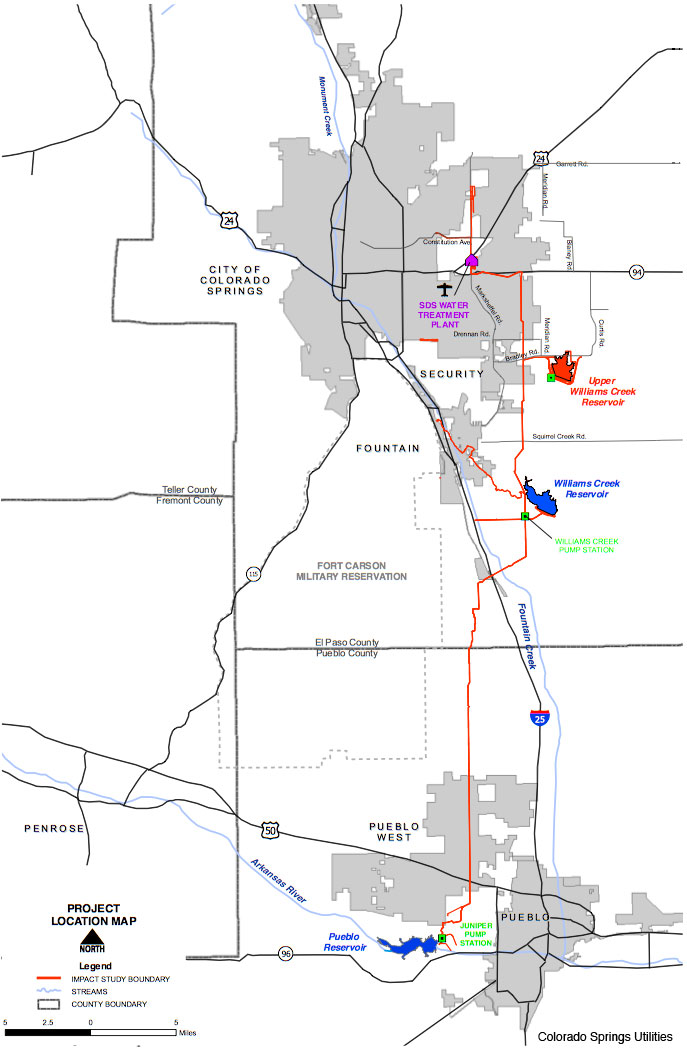
Energy policy — nuclear: Does the CPDHE license for the proposed Piñon Ridge mill signal that Colorado is open for business for uranium mining and processing?

A picture named uraniuminsitu.jpg

From the Fort Collins Coloradoan (Bobby Magill):

Critics of the [Powertech Centennial Project] said Thursday the Western Slope mill approval says little about how the state might approach its review of the Centennial Project…

Powertech’s uranium mining and processing method [in situ leach mining] would be different than the conventional hard-rock uranium mining and milling that may occur in Montrose County. At the Centennial Project, Powertech proposes to use a baking soda-like solution to dissolve the uranium underground, pump it to the surface and process it on site. “It’s up to us to lay out a responsible and clear guideline of what we’re going to be doing there so the agency can review it and determine a positive result,” Powertech USA President Richard Clement said Thursday. “The companies who understand the resources know there are clear guidelines they have to follow to get permits and licenses. As long as you follow those guidelines, then you will be successful.”[…]

Environmentalists said the approval doesn’t mean the state won’t scrutinize the Centennial Project carefully before permitting it. “I think it’s fair to say that the state is not opposed to uranium mining, so they’re going to make judgments on a case-by-case basis,” said Matt Garrington of Environment Colorado. He said the state’s approval of the mill might signal to other uranium mining companies that Colorado’s door is open for uranium extraction.

More nuclear coverage here and here.

Energy policy — nuclear: Coloradoans Against Resource Destruction files petition with EPA over the agency’s decision to grant Powertech an aquifer pumping test permit

A picture named uraniuminsitu.jpg

Here’s the release from Coloradoans Against Resource Destruction.

Coloradoans Against Resource Destruction (CARD) filed a Petition for Review with the Environmental Protection Agency’s Environmental Appeals Board in Washington, D.C. The petition appeals the December 3, 2010 decision by the EPA’s Region 8 office to issue a final Class V Underground Injection Control permit to Powertech (USA) Inc.

The permit is required for the reinjection of water that would first be pumped out of the Upper Fox Hills Formation during a proposed aquifer pump test. The purpose of the pump test is to collect data on the hydrogeologic characteristics of the aquifer including the integrity of confining layers that isolate the Fox Hills aquifer from the overlying Laramie Formation, which serves as an underground source of drinking water. The data would be used to prepare permit applications for the proposed Centennial in-situ leach uranium mining project.

The integrity of the confining layers is critical because the groundwater in the Upper Fox Hills Formation contains concentrations of uranium, radium, antimony and iron that exceed federal water quality standards. The groundwater in the overlying Laramie Formation does not exceed these water quality standards.

The Appeal alleges that EPA was required to request from Powertech and review existing relevant information from previous pump tests performed by Powertech. The previous pump tests were conducted as recent as 2008 in the same geologic formation, one as close as 500 feet from the currently proposed injection well. This prior pump test data could show the extent of the confinement of the aquifers, including the effect of the thousands of historic (late 1970’s) uranium exploration bore-holes drilled in the direct vicinity. As detailed in the appeal, some of these historic bore-holes have been documented as improperly sealed and abandoned, raising concerns of cross-contamination of the aquifers which could be exacerbated by the pump test and injection activities.

“While on the surface the permit appeared complete, a detailed review showed that critical information was lacking,” observed Jay Davis, whose Mustang Hollow Ranch is located adjacent to the proposed Centennial project area, and a co-founder of CARD. “As we’ve said from the beginning, we want the EPA to apply a high standard to protect our groundwater, and that includes reviewing all relevant information.”

Powertech filed its permit application with the EPA on April 30, 2009. Because the first draft permit, issued on June 15, 2009, contained errors, a second draft permit was issued on November 20, 2009. The public comment period for the second draft permit ran from November 20 through December 24, 2009.

After extensive public comments were submitted, EPA did not issue the final permit until December 3, 2010. The permit would have become effective as of January 3 if no appeal had been filed.

The Environmental Appeals Board, which is part of the EPA but is established to provide independent review of permitting and other decisions, will decide whether or not it will review C.A.R.D.’s appeal. In the meantime, the permit is stayed. The board has several options; it can deny review, it can send the permit back to Region 8 for modification, or it can overturn Region 8 and deny the permit. Board decisions are subject to judicial review in federal court.

“Powertech has failed to provide and EPA has failed to review necessary and available information regarding the condition of the confining layers in the aquifer and the condition of improperly abandoned historic drill holes in the immediate area” explains Jeff Parsons, senior attorney with the Western Mining Action Project who filed the appeal on behalf of C.A.R.D. “It is critical that all relevant information be incorporated into any permit that will allow groundwater injection of fluids with levels of radioactive uranium and radium, along with antimony and iron, in excess of water quality standards” notes Parsons.

“Powertech and the EPA committed to adhering to the highest standard in protecting groundwater quality and this permit falls short” stated Ken Tarbett, nearest neighboring resident and owner of the closest domestic well due west of the proposed aquifer pump test site. “Not unlike Powertech’s decision to sue over groundwater protections at the state level, it appears this company is unwilling or incapable of living up to their repeated promises to do everything necessary to protect local water supplies.”

“Groundwater supplies in Northern Colorado and Weld County serve as the economic lifeblood of our region and are far too precious to risk” contends Tarbett, “My family and livestock depend on our well for clean water and we’re depending on the Environmental Protection Agency and the Environmental Appeals Board to protect our water resources.

The appeal petition can be viewed and downloaded from the Environmental Appeals Board’s Active Dockets page.

More coverage from Monte Whaley writing for The Denver Post. From the article:

The petition appeals a Dec. 3 decision by the Environmental Protection Agency’s Region 8 office in Denver to issue an underground injection-control permit for the proposed in-situ operation near Nunn in Weld County. The filing of the appeal stays the permit and keeps Powertech Inc. — developer of the Centennial Project uranium mine — from reinjecting groundwater from an aquifer-pump test at the site, according to CARD…

The appeal claims the EPA failed to gather relevant information from pump tests performed by Powertech in 2008 in the same geologic formation, one as close as 500 feet from the currently proposed injection well. Some of those bore holes have been documented as improperly sealed, raising concerns of cross-contamination of the aquifers that could be exacerbated by the pump test and injection, CARD wrote.

More coverage from the Associated Press via Bloomberg. From the article:

This week, James Woodward and a group called Coloradoans Against Resource Destruction filed petitions challenging the EPA decision. CARD argues the EPA didn’t review all critical information. Meanwhile Woodward, who lives near the proposed mine site, says the permit’s conditions should be more specific so drinking water is protected.

More Powertech coverage here and here. More nuclear coverage here and here.
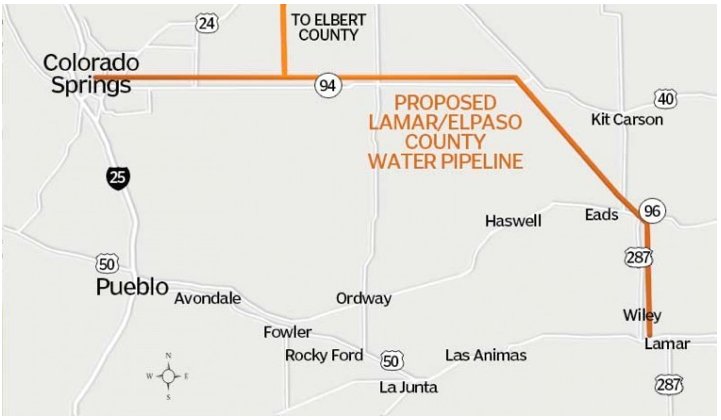
Highlands Ranch: ‘Insights on Front Range Water Issues’ forum January 20

A picture named denveraquifer.jpg

From the Highlands Ranch Herald:

Denver’s dry winter has done nothing if not underscore the tenuous nature of water supplies along the Front Range. Highlands Ranch Library invites the public to participate in a timely forum, “Insights on Front Range Water Issues,” at 7 p.m. Jan. 20.

The forum will be presented by Patty Limerick of the CU Center of the American West, and John Hendrick of the South Metro Water Supply Authority. Registration is free at 303-791-7323 or DouglasCountyLibraries.org.

Limerick and Hendrick will provide a brief history of Denver Water’s development and how it became the state’s largest municipal water supplier. They will also comment on water supplies in our region and how they will serve current and future demands in Colorado.

More education coverage here.

Woodmoor District’s exchange application headed to trial

A picture named arkbasinditchsystem.jpg

From The Pueblo Chieftain (Chris Woodka):

The application for an exchange by the Woodmoor Water and Sanitation District in El Paso County will be referred to Division 2 Water Court Judge Dennis Maes at the end of February, ending a process that allows lawyers to reach settlements prior to a court hearing. Since there was not unanimous agreement to extend the negotiation period, a referral to the water judge is necessary, explained Mardell DiDomenico, Division 2 water referee. She set the deadline for Feb. 28 in order to allow time for those who still wish to settle to work out agreements…

“From our standpoint, we wish to extend the process for another six months,” Woodmoor’s attorney Veronica Sperling said during Wednesday’s status conference. An objection was raised by Pueblo Board of Water Works attorney Beth Ann Parsons, however, that abruptly ended discussions about pushing back the deadline for further settlements. “The Board of Water Works objects and requests that the case be re-referred,” Parsons said during the conference phone call. At that point DiDomenico shut down discussion of future settlement conferences…

The Pueblo water board initially objected to Woodmoor’s application, filed in late 2009, in February 2010 because it was speculative, could injure other water rights and that there is not sufficient physical capacity in the Arkansas River to complete the exchanges.

More Arkansas River basin coverage here.

Donala Water and Sanitation water rates to rise January 1

A picture named waterfromtap.jpg

From The Tri-Lakes Tribune (Lisa Collacott):

Customers should expect to see a three percent increase if they use 1-10,000 gallons of water a month. That equals to about $3.40 per billing period. Customers that use 10,000-20,000 gallons of water a month will see a six percent increase or $4.55 per month. If customers use 20,000-30,000 gallons of water per month, they should expect an eight percent increase or $5.25. For 30,000-40,000 gallons of water used customers will see a nine percent increase or $6.60 per month.

There is a significant increase in rates for customers using over 40,000 gallons. They will see a 13 percent or $9.60 increase and for those using over 50,000 gallons of water or more there will be a 14 percent increase or an additional $11 tagged onto their monthly bill.

Donala is trying to get more people to conserve water, especially the high volume users. Duthie said Donala had 660 people go over that 40,000 gallon mark between June and September. “We are trying to get people to understand they need to cut back on water usage,” [Dana Duthie, general manager for Donala] added.

In addition, townhome irrigation rates will be the same as single family homes up to 40,000 gallons. If they go over the 40,000 gallon plateau it will be $8.50 a month and $7.50 for cooperative landscaping. The sewer rates will remain the same at $27 per month. And there is also a monthly minimum whether water is used or not and that is $13 per month. Golf course irrigation rates will be increased accordingly due to usage.

More infrastructure coverage here.

Energy policy — nuclear: Powertech gets the EPA go ahead for pump test

A picture named denveraquifer.jpg

From The Greeley Tribune:

“The permit places specific, rigorous conditions on the re-injection of groundwater that will be temporarily withdrawn from the Upper Fox Hills formation during an aquifer pump test,” said Steve Tuber, EPA’s assistant regional administrator in Denver, in the release. “The safeguards associated with this permit, some of which are the result of public comments, will ensure that groundwater in formations below the Centennial site is protected.”

More nuclear coverage here and here.

Energy policy — nuclear: Powertech lawsuit update

A picture named uraniuminsituleaching.jpg

From the North Forty News (Dan MacArthur):

In its lawsuit, Powertech seeks to overturn state rules that it contends are unreasonable and unconstitutional. It also asserts that legislators’ involvement in the rule-making process violated constitutionally mandated separation of powers. Fort Collins state Reps. John Kefalas and Randy Fischer were among those participating. The suit was filed Nov. 1 against the Colorado Mined Land Reclamation Board and Mike King, executive director of the Colorado Department of Natural Resources. The state must respond within 20 days after being served with the suit…

Powertech president Richard Clement said the company is proceeding with plans to apply for a mining permit sometime in 2011. Clement acknowledged his earlier statement that Powertech could live with the new state rules. But, he said, the Canada-based company was compelled to challenge the process because “there were a lot of inconsistencies in the way it was handled.”

The new rules principally apply to in situ leach mines such as the one proposed by Powertech. In situ mining involves pumping water underground to dissolve uranium. The solution then is pumped to the surface, the uranium extracted and the water returned underground. The rules require in situ leach operations to restore groundwater to its original quality or to standards set by the state. Applicants must also provide detailed baseline hydrology information and environmental protection plans and prove that the proposed mining technology has been used at five other locations without damaging groundwater quality.

More nuclear coverage here and here.

Energy policy — nuclear: Powertech gets the EPA go ahead for pump test

A picture named uraniuminsitu.jpg

From the Fort Collins Coloradoan (Bobby Magill):

On Friday, the EPA approved a different permit for Powertech, a “Class V” permit to re-inject 43,000 gallons of water into Fox Hills Aquifer underneath the Centennial Project as part of a “pump test” that will help the company gather data about its uranium mining technique. The pump test approval needed to occur before the EPA can go forth with investigating Powertech’s plans to inject radioactive waste into the ground. Though Powertech has a green light from the EPA to drill the pump test well, state mining officials must also approve the test before it begins.

“One of the purposes of the pump test is to collect information about the hydrogeology at the (Centennial Project) location to inform the feasibility of ore recovery activities,” said EPA spokesman Richard Mylott. “During the pump test, water will be pumped out of the aquifer, held for a time and reinjected into the same location in the aquifer. It will not be altered.”

More nuclear coverage here and here.

Interbasin Compact Committee meeting recap: Strategies to take the pressure off agricultural water

A picture named ibccroundtable.jpg

From The Pueblo Chieftain (Patrick Malone):

During its meeting at the Denver West Sheraton on Wednesday, the IBCC unveiled that progress in a draft strategy for sustaining the state’s future water supply. Its four-pronged tenets are a blend of water conservation, identified projects and processes (IPPs), agricultural transfers and developing new supplies.

While agricultural transfers are a staple in the strategy, delicate handling of them and a mindful perspective on their impact also are keys, and minimizing agricultural transfers is an objective of the IBCC’s strategy. “Large-scale dryup of irrigated agriculture has considerable adverse economic and environmental impacts,” the report said. “While some future portion of (municipal and industrial) water will come from agricultural sources, encouraging alternative agricultural transfers and new water supply development is essential to prevent the dryup of agricultural land. To the extent the conservation, IPPs and new water supply development is successful, less water will be transferred out of agriculture to meet the (municipal and industrial) gap.”

One mechanism proposed in the report to protect agricultural water is a legislative fix that makes long-term leasing of water rights more enticing to municipalities. [IBCC member Jay Winner of Pueblo] said that could be an effective step away from the “buy-and-dry” approach that can cripple agricultural areas and the economies they support.

Winner forecast that projects mirroring the Arkansas Valley Super Ditch that feed the urban thirst for water while halting buy-and-dry situations will be another alternative to selling the water that feeds Colorado farms. “It could be the model for the Western United States that keeps agriculture whole while saving municipalities,” Winner said…

The IBCC recommended proceeding with planned water projects such as the Super Ditch in order to be prepared for the population boom and to accommodate its water needs as it gradually arrives. Among the report’s more bold recommendations was state funding for those long-term projects, even if it costs $18 billion. That is a monumental sum at a time when the state is confronting a $1 billion budget deficit, and the general fund at the Colorado General Assembly’s disposal is about $7 billion annually…

Among the more radical ideas contained in the report were the means of conservation. They included adopting a statewide plumbing code for reduced flows and requiring retrofits of water-using fixtures (such as toilets and sinks) to meet certain use conservation standards before a building or house could be sold. Gov. Bill Ritter said he recognized the value of those recommendations, but warned the IBCC to expect a fight from cities and counties that presently enjoy local control over those matters…

Winner said the conservation efforts outlined in the plan aren’t folly, but will be absolutely necessary in order for the state’s water needs to be met a half-century from now. “If the people of Colorado want the state that they envision, they need to take a serious look at this now,” Winner said. Other strategies proposed in the plan include greater state support from permitting to completion of water projects and steep fees to areas that gain water by taking it from another part of the state…

Winner said the timeline is indefinite for the recommendations in the plan to progress from draft to implementation. Certain aspects could be the topic of legislation in the General Assembly when it reconvenes in January, but much of the report will next be vetted by basin roundtables throughout the state.

More coverage — Governor Ritter’s speech at the meeting — from Patrick Malone writing for The Pueblo Chieftain. From the article:

The only way to balance the competing water interests of municipalities and agriculture is to move forward with a strategy for sustained water availability that takes both into account, Ritter said. Likewise, other opposing water forces — energy and nonenergy users, and consumptive and nonconsumptive uses — also must be weighed on the scale of reason when crafting water strategies for the future, the governor said. “You have to reinvent this,” Ritter said, emphasizing that factious fighting between the competing interests in the water arena must join forces to assure that none is left without…

Along with funding for higher education, Ritter said he warned his successor, Gov.-elect John Hickenlooper, that water is a matter of paramount importance awaiting him when he takes office in January. Ritter interjected his belief that human-caused global warming could impact precipitation levels in the future and further limit the water available to the state in the future. He urged even those in the water community who doubt global-warming theories to take heed of the projected impact on precipitation as they plan for the future. “You can’t think about water without some of the forecasting that’s been done, because it’s dire,” Ritter said. “I don’t think it’s something you can dismiss or ignore in terms of planning the future of water availability in Colorado.”

More coverage from the Associated Press (Stephen K. Paulson) via CB Online. From the article:

The panel suggested the state should coordinate, support and endorse projects. One of their main conclusions was that the state needs more storage on the Western Slope. They also suggested that the governor issue an executive order to state agencies to implement a water use reduction and conservation plan. Suggestions included requiring people who sell their house to replace appliances with water efficient models and help utilities reduce water use. Until now, the state has left most water development projects to loca l communities and shied away from promoting water projects until the federal government gave its approval…

“We can’t get to a state with 10 million people without thinking about water. We have often prided ourselves on local control of these issues … but at the same time, we need the statewide vision. If we don’t have statewide vision, we will do the unthinkable, which is become less of an agricultural state and become a state where water usage is for residential and municipal use,” he told the panel…

Former state Agriculture Commissioner Don Ament, a farmer who attended the water basin meetings but has no official role, said the report does little to solve problems in conservation, loss of agricultural land and finding new water sources.

More IBCC — basin roundtables coverage here.

Energy policy — nuclear: Powertech’s lawsuit update

A picture named uraniuminsitu.jpg

From the Fort Collins Coloradoan (Bobby Magill):

Powertech USA President Richard Clement said the company is on track to file a permit application in 2011 for its Centennial Project uranium mine northeast of Fort Collins despite the lawsuit. “What we’re doing by filing (the lawsuit), there’s a number of issues there that we felt were inappropriately dealt with, but the rules themselves, we feel the rules are livable and we can work within the rules,” Clement said. Some provisions of the rules, he said, didn’t conform to the 2008 state law requiring Powertech to keep the groundwater clean…

Clement said earlier this year that the one provision in the rules, which requires companies to establish baseline groundwater purity before they even start looking for uranium underground, would be “fatal” to all future in situ mining operations statewide. “This is a suit on behalf of industry, not just Powertech,” he said Tuesday…

Jeff Parsons, senior attorney at the Western Mining Action Project, which represents local residents opposed to the mine, said it’s difficult to gauge the possible success of Powertech’s lawsuit, but it’s hard to imagine the company submitting its Centennial Project permit application to the state while the suit is making its way through the courts. “They previously said they plan to file their application for the Centennial Project by the end of the year, and now they’re suing,” Parsons said. “That raises the questions about what their timeline is for this project. This litigation can last years.” He said it would be awkward for Powertech to be legally challenging regulations they say they can comply with in their permit application.

More coverage from David O. Williams writing for the Colorado Independent. From the article:

Two uranium mining companies have filed lawsuits against the state this fall, challenging rules requiring cleanup of existing uranium mines and mandating water reclamation at a proposed mining site. Conservationists say the recent lawsuits filed by the Cotter Corp. and Powertech USA demonstrate the industry isn’t serious about a higher level of environmental protection in a new uranium mining boom…

An executive for Uranium One, a Canadian company with Denver offices, told the Colorado Independent (TCI) in October that his company is divesting itself of Colorado mine holdings in part because of the cost of increased environmental scrutiny and state regulation. But a Powertech attorney last week told TCI that his company’s lawsuit is less about money and more about reducing regulatory hurdles.

“No, it isn’t a fiscal issue at all,” said John Fognani of Fognani and Fought law firm. “If you want to narrow it down, it’s a resource issue in terms of utilizing more water resources to make sure that you meet the mandate and bring water quality back to background or better, which is what the rule states, and of course that’s what the legislation states. At the end of the day it’s really the water resource issue.”

More nuclear coverage here and here. More Powertech coverage here and here. More HB 08-1161 coverage here.