What Super #ElNiño Means for #Colorado — Peter Goble (Colorado #Climate Center) #ENSO

Click the link to read the article on the Colorado Climate Center website (Peter Goble):

September 3, 2026

You have likely heard news about El Niño recently. The National Weather Service reports that El Niño officially began in June. Observations from the International Research Institute show that it continues to strengthen. There is a greater than 90% chance of this becoming a “super” El Niño, and a greater than 50% chance of it becoming the strongest event since modern record-keeping began in 1950. Here is a look at what El Niño is and why it matters for Colorado.

El Niño refers to a climate pattern characterized by unusually warm sea surface temperatures in the eastern tropical Pacific Ocean (image 1). Normally, waters in the eastern Pacific (off the coast of South America) are much cooler than those in the western Pacific (near Indonesia and Papua New Guinea) (image 2). Earth’s rotation drives tropical trade winds from east to west, pushing warm surface water westward and pulling cool, deep ocean water to the surface along the coast of South America. During El Niño, these trade winds weaken, allowing warm water to spread east and suppressing the normal upwelling of cold water.
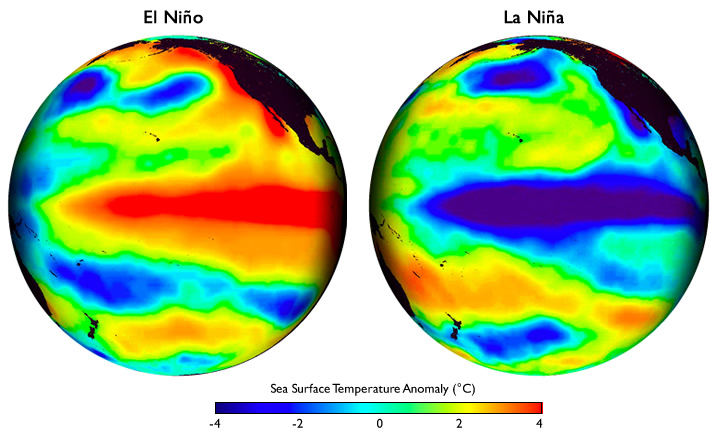
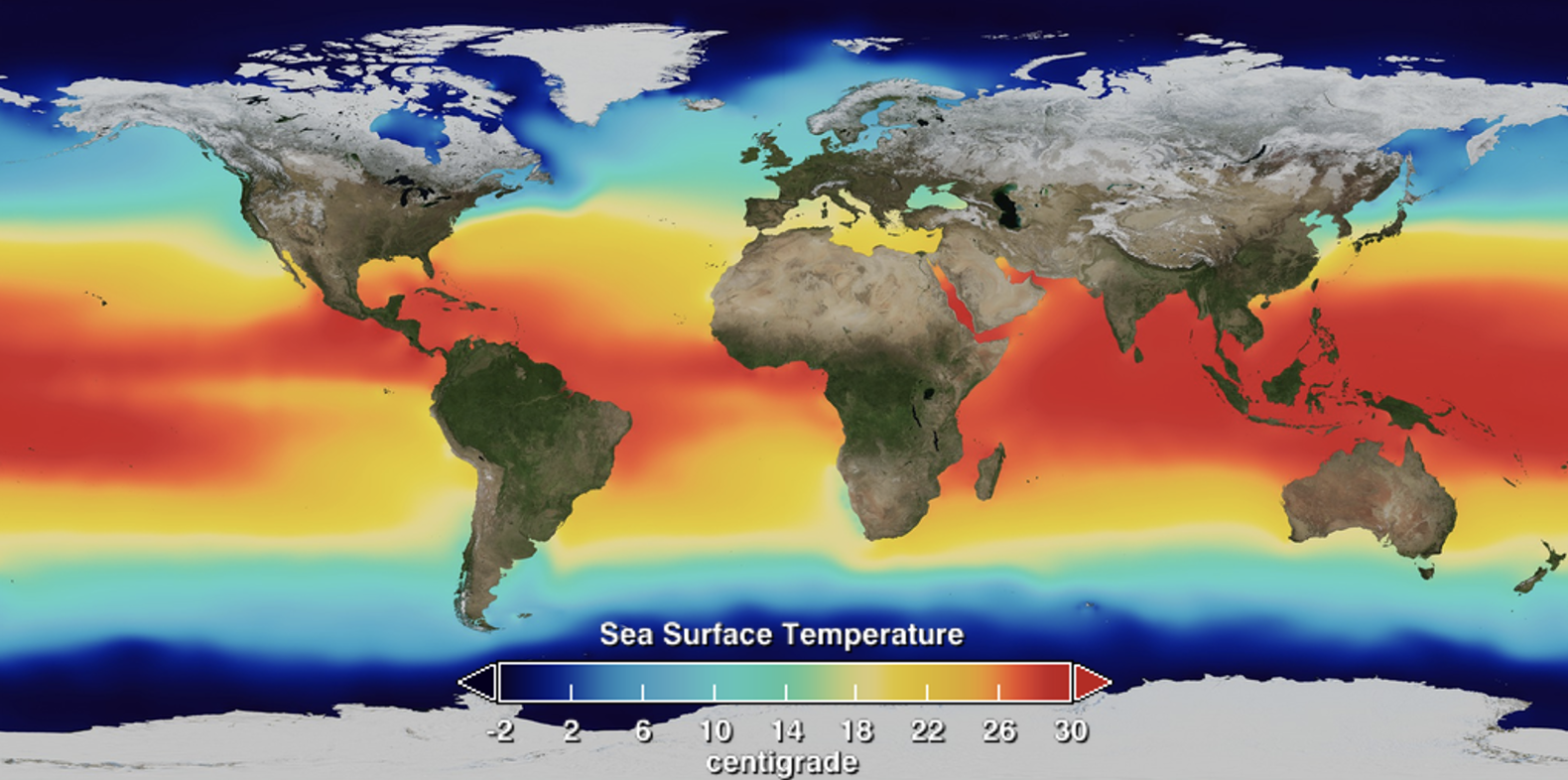
Image 1: Sample sea surface temperaure anomalies (Celsius) during El Niño (left) and La Niña (right). Source: climate.gov
Image 2: Average sea surface temperatures (Celsius). Source: nasa.gov

El Niño conditions typically peak during northern hemisphere winter. Peruvian fishermenoriginally named the phenomenon (Spanish for “little boy,” or “Christ child”) after noticing coastal waters warmed around Christmas. While this meant less productive fishing in South America, El Niño also alters global oceanic and atmospheric circulation. Its most predictable weather impacts include warmer, wetter weather in the eastern Pacific, drier conditions across the Amazon, and warm, dry weather in Indonesia (image 3). These circulation shifts ripple into natural and human systems—for instance, El Niño correlates with higher mosquito-borne mortality in South America.
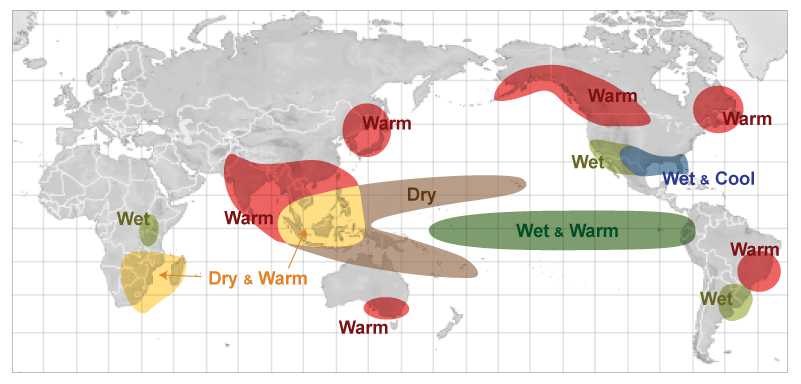
Image 3: Typical El Niño impacts to global weather. Source: noaa.gov

North America is impacted by El Niño as well. In response to weaker tropical trade winds, the northern hemisphere polar jet stream tends to weaken, and split with a more active southern flank. This raises the odds of cooler, wetter conditions across the U.S. Sunbelt, drier weather to the Ohio River Valley, and warmer conditions to the Pacific Northwest, north-central U.S., and a wide swath of Canada, and Alaska (image 4).

Here are the typical outcomes from both El Niño and La Niña for the US. Note each El Niño and La Niña can present differently, these are just the average impacts. Graphic credit: NWS Salt Lake City office

Historical correlation analysis shows El Niño is also linked to changes in Colorado weather, where conditions are generally wetter during El Niño years (image 5). This is especially true in fall and spring, when much of the state averages higher precipitation. Furthermore, the Front Range and Eastern Plains are more prone to large spring snowstorms and experience fewer dry and windy spring days (though such days remain frequent regardless). Unfortunately, the link between the El Niño–Southern Oscillation (ENSO) and peak seasonal snowpack levels in Colorado is weak. Southern river basins, such as the San Juan and Rio Grande, show a loose positive correlation between El Niño and snowpack (image 6).
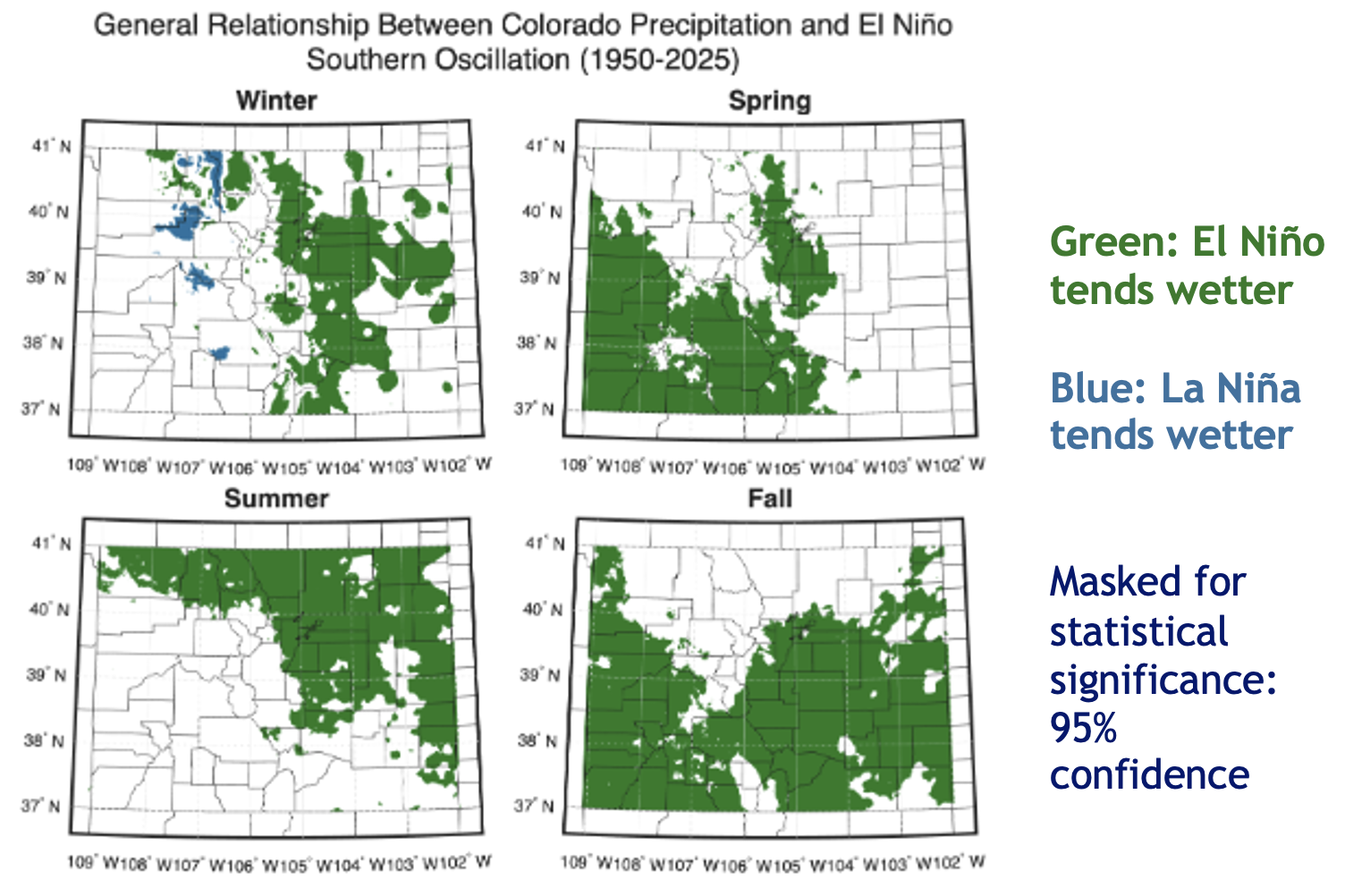
Image 5: Statistical relationship between El Niño Southern Oscillation (ENSO) and precipitation in Colorado. Green areas tend to be wetter during El Niño and blue areas tend to be wetter during La Niña.
mage 6: Linear correlation between ENSO RONI and peak season snowpack in major Colorado river basins. Blue = more snow on average during El Niño. Brown = more snow on average during La Niña.

Does a stronger El Niño guarantee more intense impacts? Not necessarily. Linear correlation models assume stronger events yield stronger outcomes, but real-world evidence is limited. Modern records include only three “super” El Niños (sea surface temperature anomalies of +2.0 °C or higher): 1982/83, 1997/98, and 2015/16. While 1982/83 delivered huge snowfall to Colorado, the latter two yielded roughly average conditions. Drawing firm conclusions from three events is unreliable, and our physical understanding of Earth’s climate system offers no clear threshold where impacts suddenly scale. On the positive side, dynamical seasonal climate models and the Climate Prediction Center both indicate elevated odds of above-normal precipitation across most of Colorado through spring.

Climate change complicates our understanding of what we can expect from a strong El Niño. Earth’s climate system has changed since the super El Niño and major snow year of 1982/83. Colorado is warming, and average precipitation is likely decreasing in western Colorado. The correlation analyses shown above do not account for these shifting baselines. A wet year is not guaranteed. Even if the storms do come, less of the precipitation may fall as snow than in a typical year, especially at lower elevations. Colorado continues to suffer from severe droughtlargely driven by snowpack deficits last winter and record warm temperatures. There is a strong appetite among people for moisture. The brewing super El Niño may offer some hope, but a wide array of outcomes are possible this winter. It is a bit like playing a game of poker with a few extra aces and kings in the deck. The deck may be stacked in our favor, but we could still draw a crummy hand.

#Nevada preached peace on the #ColoradoRiver. Now it’s suing to protect its water. The state’s lawsuit claims the federal government’s plan for the river could strip Las Vegas of two-thirds of its water supply — Austin Corona (Grist.org) #COriver #aridification

Las Vegas circa 1915

Click the link to read the article on the Grist website (Austin Corona):

August 28, 2026

Nevada officials have long presented themselves as a voice for compromise and conservation in debates over the Colorado River. The Las Vegas area, home to two-thirds of the state’s population and most of its economy, has become a model of urban water conservation. As the river has declined from overuse and a decades-long drought exacerbated by climate change, southern Nevada water planners built extensive water reuse facilities and implemented tight restrictions on new turf and fountains, dropping the region’s per capita water use by 58 percent in roughly 20 years. Meanwhile, in interstate negotiations over the management of the Colorado River, state representatives have positioned themselves as bridge-builders, sometimes referring to themselves as the “middle basin” between the river’s divided upper and lower basin states. 

When the federal government’s new management plan for the river was announced earlier this month, most observers thought Arizona, which stands to take the largest immediate cuts, would launch the first lawsuit over the plan’s implications for its water supplies. So it came as a surprise to many Colorado River experts when Nevada became the first to sue the federal government over the plan this week.

“I expected that there would be litigation, but it was surprising to me that Nevada fired the first shot,” said Anne Castle, former chair of the Upper Colorado River Commission.

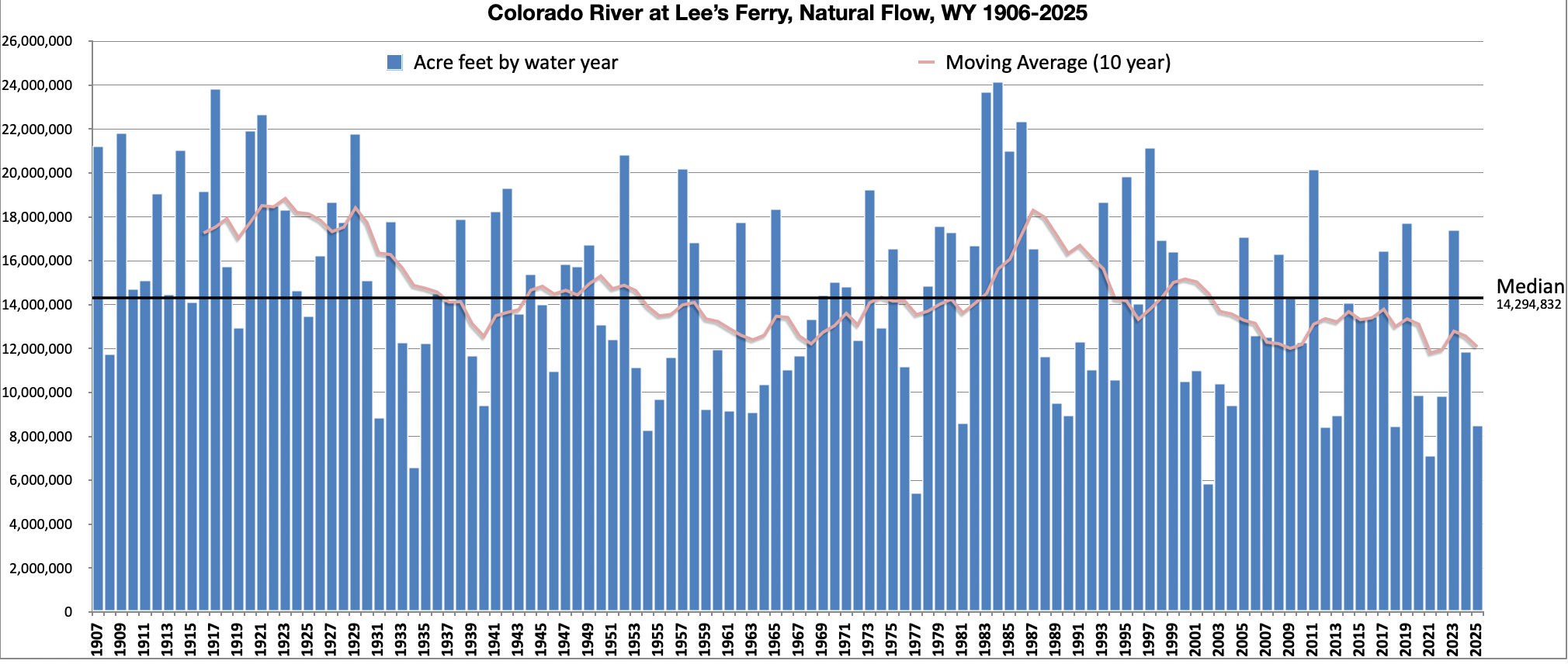
The natural flow flow at Lees Ferry, which is a calculation of what the Colorado River’s flow would be without any upstream dams, diversions, or human consumption. Land Desk graph using Bureau of Reclamation data.

Nevada’s lawsuit comes after more than two years of negotiations among the seven Colorado River states and the federal government over how to reduce water use on the declining river. The states failed to reach a long-term agreement before the river’s current management procedures expire in October, leaving the Interior Department to impose its own plan. The federal government’s plan largely relies on cuts to water use among the Lower Basin states — Arizona, Nevada, and California — to prop up water levels in the river’s largest reservoirs. Those reservoirs have been draining so quickly that the dwindling water depth could threaten hydropower and dam operations within months without intervention. 

Nevada argues that the federal government’s plan illegally forces it to take too much of those cuts. In a worst-case scenario, the plan could allow for a 71 percent cut to the Las Vegas area’s water supply, the state argued, calling it an unacceptable risk to the state’s largest population center and economic hub. Nevada believes this outcome results from a misreading of the law and also claims the government didn’t consider important alternatives to such drastic cuts.

This worst-case scenario, which experts say is an interpretation of the plan’s implications by Nevada, would become possible if reservoir levels continue to drop and if Nevada couldn’t reach an agreement with Arizona and California to help it absorb more of those cuts. Those three states already have such an agreement, which is incorporated into the federal plan and meant to last through 2028, at which point the plan allows the states to update the operations with a new agreement. Without an agreement, the federal government will implement cuts based on preexisting water rights and agreements, cutting the most from Arizona and leaning increasingly on Nevada and California as potential shortages increase. The plan was created through a decision-making process required under the National Environmental Policy Act, or NEPA, which mandates that federal agencies gather public input and consider environmental and socioeconomic impacts of major decisions.

Map of the Colorado River drainage basin, created using USGS data. By Shannon1 Creative Commons Attribution-Share Alike 4.0

#Denver announces $50 million cleanup plan at Sloan’s Lake to help prevent algae blooms and dead fish: Funding plan includes call for DURA to add the lake to nearby tax-increment financing district — The #Denver Post

Sunrise, Denver skyline, from Sloan’s Lake September 2, 2022.

Click the link to read the article on The Denver Post website (Elliott Wenzler). Here’s an excerpt:

September 2, 2026

On its surface, Sloan’s Lake is a beautiful oasis that offers a refuge from city life. Part of one of the largest parks in Denver, it features glistening water, mountain views and plenty of paved paths to walk a dog, catch up with a friend or train for a race. But just beneath its gentle waves is a murky, sometimes smelly truth. The [North] Denver lake is slowly filling in with stormwater sludge. The surprisingly shallow water is often quite warm, making it a difficult environment for fish to survive and an easy place for dangerous algae blooms to thrive. If the accumulating muck isn’t addressed soon, the lake is at risk of becoming fully stagnant and bereft of life. On Wednesday, Denver Mayor Mike Johnston stood alongside members of the City Council and advocates for the lake’s future to announce a plan to invest tens of millions of dollars to prevent that from happening.

“A lake that used to be 12 feet deep is in some places only 4 feet deep. It affects the lake’s health. It affects algae blooms. It affects our most beloved events,” Johnston said from the lake’s shore. “We think there’s nothing more important for the long-term health of this neighborhood than to support the long-term health of this lake.”

Dragon boat practice at Sloan’s Lake August 29, 2026.

To raise more money for the cleanup effort, Johnston’s administration will ask the Denver Urban Renewal Authority to add the lake to a nearby urban renewal district south of the park. That would allow it to benefit from money raised through an already-approved tax incentive in the area…The 177-acre lake, which plays host to the annual Colorado Dragon Boat Festival, is only 3 feet deep on average…Swaths of neighborhoods in Denver, Edgewater, Lakewood and Wheat Ridge drain into the lake, bringing sand, sediment and street crud. Over time, that has built up and begun filling in the bottom of the lake. The cleanup project will include dredging sediment out of the bottom of the lake and disposing of it. Crews will also work on ways to prevent more sediment from building up in the lake. Kurt Weaver, the executive director of the Sloan’s Lake Park Foundation, asked the community to keep advocating for the project throughout the entire construction process to ensure it’s completed.

“To be able to have an opportunity to write a new future for the lake is massive for us, the community around it and everyone who spends time here at the lake,” he said.

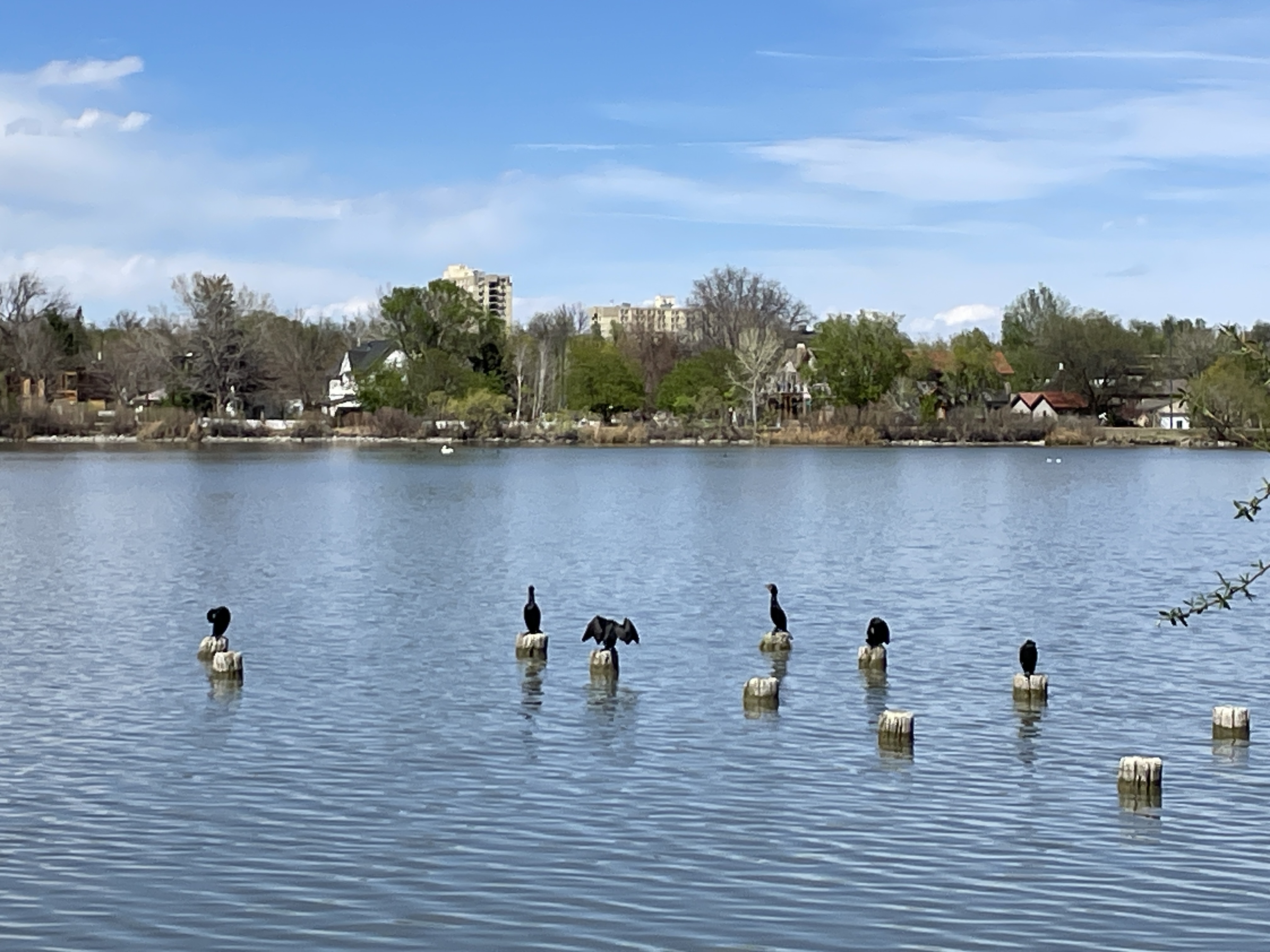
Cormorants on old pier pilings at Sloans Lake April 12, 2026.

#Colorado Water Congress: Watch the Recordings from the 2026 Summer Conference

From email from the Colorado Water Congress:

September 4, 2026

Thank you so much for attending the 2026 Summer Conference! We enjoyed hosting you, and we hope to see you at our Annual Convention in January. 

Recordings from the Conference are now available on our website! These recordings are only for conference attendees, so please do not share this information.

Recording Page: https://www.cowatercongress.org/2026-summer-conference-recordings/

Password: SC26Videos

If you have any questions about accessing the page or Summer 2026 content, reach out to blair@cowatercongress.org.

Colorado Rivers. Credit: Geology.com

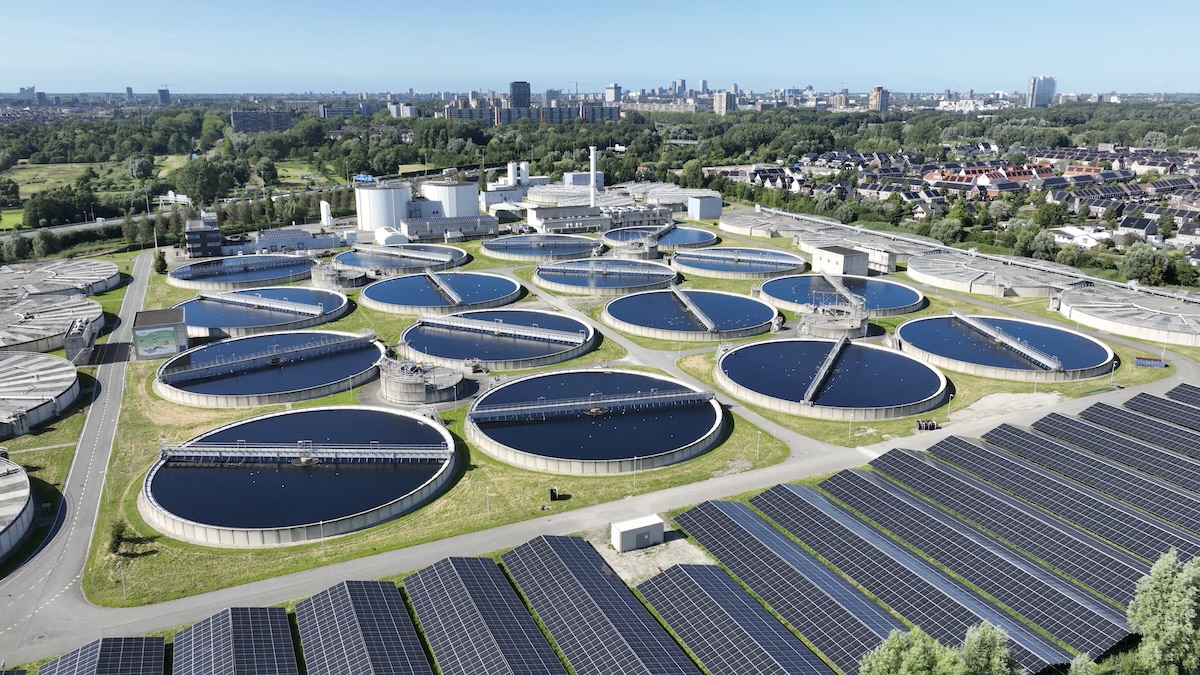
Municipal Water Recycling in Six Western Cities

Aerial photograph of a municipal waterwater plant, provided by Storyblocks.

by Robert Marcos

Cities in the Western United States are deploying advanced municipal water recycling technologies to combat chronic drought and to establish local, climate-resilient water supplies. By combining multi-barrier purification, natural filtration, and direct or indirect potable reuse, these municipalities are pioneering sustainable water management.

Los Angeles, California

Los Angeles relies on a multi-tiered water recycling system that treats municipal wastewater to fit-for-purpose standards. At a minimum, the city utilizes tertiary treatment involving screening, biological neutralization, chemical coagulation, and filtration. This water is distributed via an extensive network to over 400 commercial facilities for landscape irrigation and cooling towers. For its ambitious Pure Water Los Angeles and Groundwater Replenishment initiatives, LA applies advanced treatment—including micro-filtration, reverse osmosis, and ultraviolet light disinfection with hydrogen peroxide. This highly purified water is injected into local aquifers for groundwater recharge, creating a sustainable, drought-resilient local supply. 1

Phoenix, Arizona

Phoenix maximizes its treated wastewater through a combination of non-potable distribution and advanced purification planning. Currently, the city treats municipal wastewater to Class A+ standards, delivering it to regional partners for agricultural use, park irrigation, and tech sector demands like data center and industrial cooling towers. To secure long-term water sustainability, Phoenix is constructing dedicated advanced water purification facilities under the Pure Water Phoenix initiative. This system will subject pre-treated recycled water to multi-barrier technologies—specifically ozonation, membrane ultrafiltration, reverse osmosis, and ultraviolet advanced oxidation—safely transforming reclaimed wastewater into high-quality drinking water distributed directly to thousands of area homes. 2

San Diego, California

San Diego is in the process of implementing its multi-phase program to drastically reduce its heavy reliance on imported water. The city utilizes a rigorous five-step advanced purification process to clean municipal wastewater at its demonstration and upcoming production sites. Secondary effluent undergoes ozonation, biologically active carbon filtration, membrane filtration, reverse osmosis, and high-intensity ultraviolet disinfection. While Phase One routes this purified water into the Miramar Reservoir for an environmental buffer and further blending, Phase Two adapts to updated California regulations. This allows the San Diego Pure Water Project to utilize direct potable reuse, piping the ultra-pure water directly into the drinking water distribution system after remineralization. 3

Orange County, California

Orange County operates the Orange County GWRS, the world’s largest advanced water purification facility for indirect potable reuse. The system takes secondary-treated municipal wastewater that would otherwise be discharged into the Pacific Ocean and subjects it to a rigorous three-step purification process. This advanced flow includes microfiltration to remove solids, reverse osmosis to eliminate dissolved salts, pharmaceuticals, and viruses, and ultraviolet light combined with hydrogen peroxide advanced oxidation to destroy remaining trace organic compounds. The near-distilled quality water is then pumped to inland basins to naturally percolate into the groundwater basin, serving as a primary drinking source. 4

Aurora, Colorado

Aurora utilizes the innovative Aurora Prairie Waters project, a pioneering potable reuse system designed to maximize its fully consumable water rights. After municipal wastewater is treated and discharged into the South Platte River, Aurora recaptures the water downstream using a natural-technical hybrid method. First, riverbank filtration wells pull water through hundreds of feet of sand and gravel. Next, an aquifer recharge and recovery process allows the water to percolate through additional natural filters. Finally, the water is piped uphill to an advanced purification facility for state-of-the-art technical polishing before blending with mountain snowmelt for public consumption. 5

El Paso, Texas

El Paso is building the Pure Water Center, which will be the nation’s first direct-to-distribution water reuse facility that sends purified wastewater straight into the city’s drinking water system. Currently the city’s Fred Hervey plant treats municipal wastewater and injects it into the underground Hueco Bolson aquifer to recharge drinking supplies. The City’s Pure Water Center will take secondary effluent and subject it to multi-stage membrane filtration, advanced oxidation, and disinfection. Instead of utilizing an environmental buffer, this purified water will flow directly into the municipal drinking water system, after being blended with treated brackish groundwater. 6