A drought-tolerant grain could help #Colorado farmers save water. First, they need customers — Colorado Public Radio #SanLuisValley #groundwater

Photo credit: The Rye Resurgence Project

Click the link to read the article on the Colorado Public Radio website (Hayley Sanchez). Here’s an excerpt:

August 18, 2026

The San Luis Valley is searching for ways to use less water without shrinking agriculture. [The Rye Resurgence Project] effort believes rye could help. But turning the grain into part of the valley’s future will require more than convincing farmers to plant it.

“The situation is urgent, and we have to take action to reduce water use,” said Heather Dutton, manager of the San Luis Valley Water Conservancy District…

For years, groundwater has been pumped from the valley’s aquifer faster than nature can replenish it. If that continues, Dutton said, state regulators could eventually require irrigation wells to shut down. One option would be farming fewer acres. But Dutton said that would come at a steep cost.

“It wrecks our economy. It wrecks the fabric of our society of having people employed in agriculture and the heritage of this place,” she said. “That’s why it’s so important that we figure out other alternatives and ways that we can remain in farming, but use less water.”

[…]

The effort, launched by Dutton and Hooper farmer Sarah Jones, is exploring whether rye can help farmers reduce water use without taking more land out of production.

“This is a rye field that’s being used strictly for grazing and green manure,” project manager Morgan Neely said while walking along the perimeter of a lush green field in the San Luis Valley. Cows were cornered off to a section of the field.

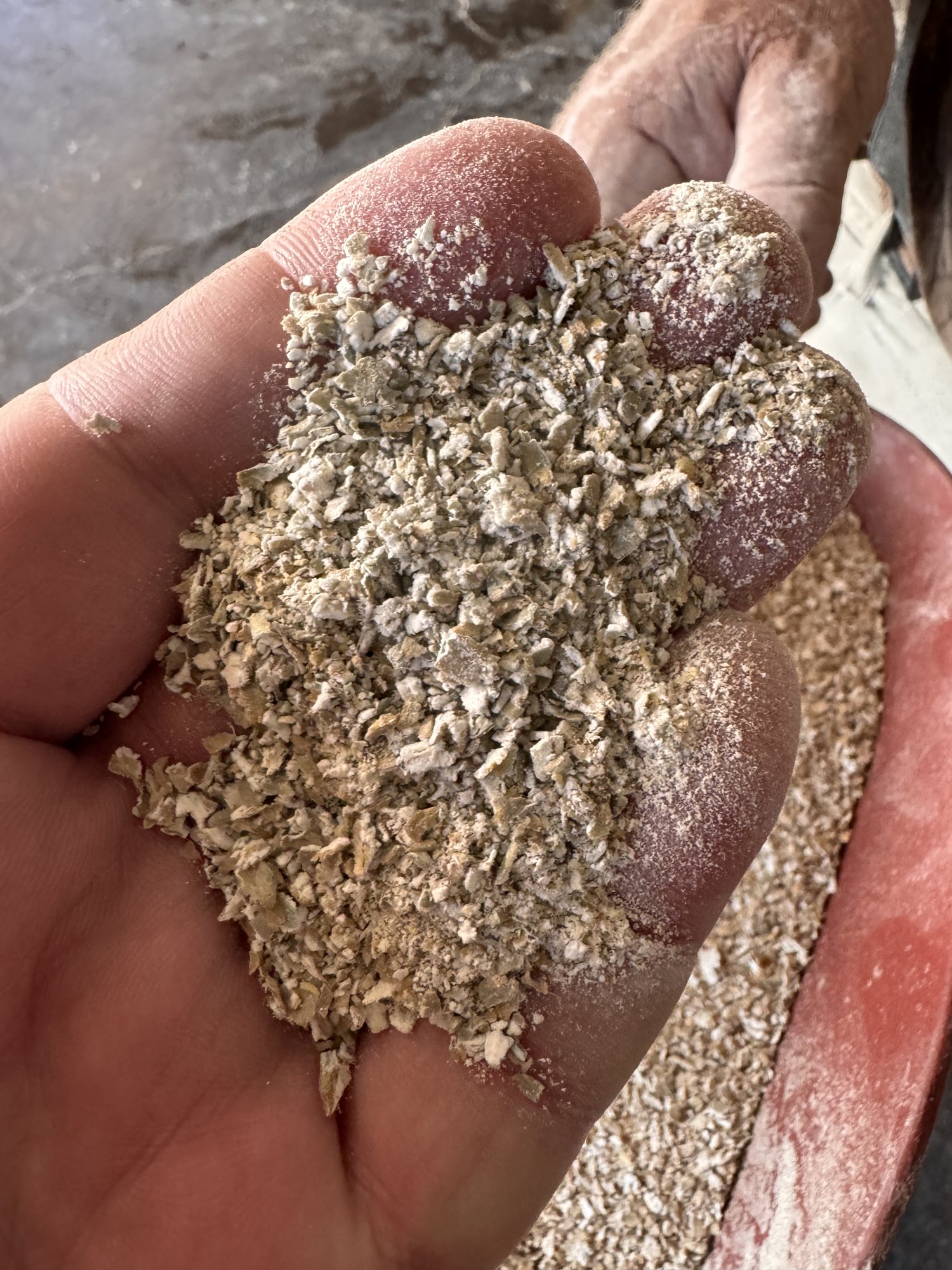
Rye requires less than 12 inches of water each year — roughly one-third to one-half as much as many traditional valley crops, Neely said. Its living roots help hold down topsoil during the valley’s powerful spring winds, and it can be grazed by cattle, incorporated into the soil or harvested for grain.

Photo credit: Rye Resurgence Project

#Climate ‘Overshoot’ Is Coming—Are We Ready?: If global warming remains above 1.5 degrees Celsius, a new U.N. report says “there are no good outcomes” — Bob Berwyn (InsideClimateNews.org)

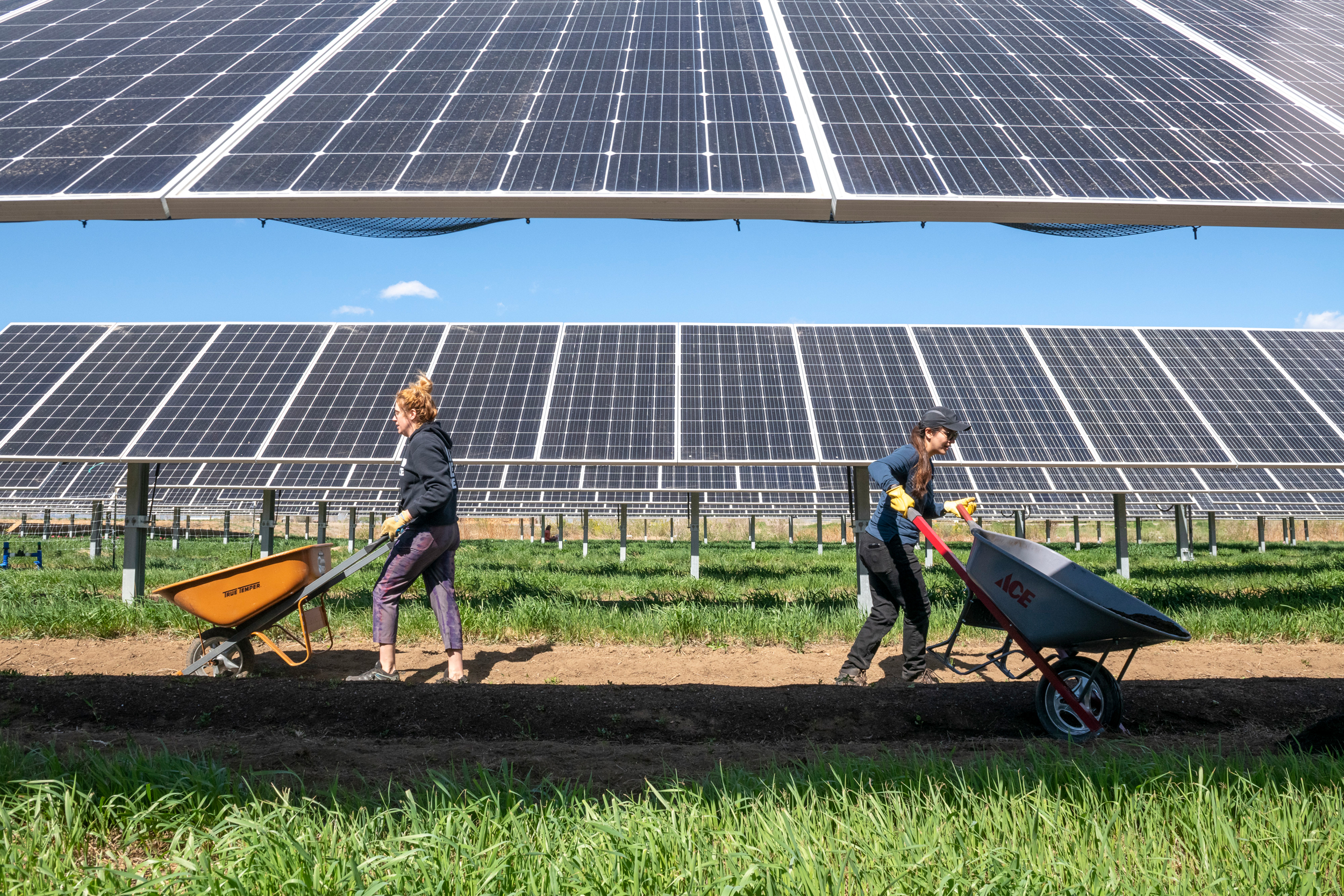
May 6, 2023 – Volunteers with the National Renewable Energy Laboratory’s (NREL’s) ESCAPES (Education, Stewardship, and Community Action for Promoting Environmental Sustainability) program. The report from the United Nations Environmental Programme identifies the need to accelerate the phaseout of fossil fuels and the transition to renewable energy. (Photo by Bryan Bechtold / NREL)

Click the link to read the article on the Inside Climate News website (Bob Berwyn):

September 2, 2026

Fossil fuel emissions are pushing Earth’s climate toward a dangerous new phase of climate “overshoot,” scientists warned Wednesday in a new report from the United Nations Environmental Programme.

The report, Limiting Overshoot, projects that global temperatures will exceed the 1.5-degree Celsius (2.7 degrees Fahrenheit) warming threshold identified in the Paris Agreement within a few years, intensifying deadly climate impacts. It says the best chance of restoring a safe climate is to begin cutting greenhouse gas emissions immediately, halve them by 2035, and figure out ways to remove billions of tons of carbon dioxide from the atmosphere before the end of the century.

The 1.5 degrees of warming identified in the report and the Paris pact refers to the increase in global temperatures since the preindustrial period of 1850 to 1900, before humans altered the atmosphere and climate with billions of tons of fossil fuel emissions and other industrial and agricultural pollution.

Under the 2015 agreement, more than 190 countries pledged to keep the global temperature below that level because they knew warming above that would mean even greater intensification of extreme weather events, ecosystem losses and the potential submersion of small island countries. 

Multiple scientific studies, including global assessments from the Intergovernmental Panel on Climate Change, project that warming of more than 1.5 degrees Celsius will cause severe damage to human health, food and water supplies, as well as infrastructure and economies. 

Scientists have calculated that at the current pace of emissions, warming could reach a catastrophic 2.7 to 3 degrees Celsius by 2100. If all the measures promised by governments under the Paris Agreement are implemented, warming could be limited to about 1.7 or 1.8 degrees Celsius, which would make it easier to return below the 1.5-degree Celsius threshold.

If Earth’s fever stays in the ‘overshoot’ zone too long, it could push ice sheets and key heat-carrying ocean currents past tipping points “that become difficult or impossible to reverse on human timescales,” the report concludes. 

“We must make the overshoot as small and short as possible, limiting how high

temperatures rise and how long they remain above 1.5 degrees Celsius,” said United Nations Secretary-General António Guterres

The new report, he added, identifies a triple play of climate action: accelerating the phaseout of fossil fuels and the transition to renewable energy, slashing methane pollution and protecting climate allies, such as lands, forests and oceans, that take heat-trapping carbon dioxide out of the atmosphere.

“We’ve failed to act on the options that were available 15 or 20 years ago to reduce emissions rapidly,” said report co-author Joeri Rogelj, a climate scientist at the International Institute for Applied Systems Analysis in Austria and a professor at Imperial College London. “The reality is that we have failed in that endeavor, and it needs to be acknowledged.”

The new report does just that, and it is alarming because the climate impacts projected for warming above 1.5 degrees Celsius are “unacceptable or unbearable for at least the poorest and the most vulnerable communities around the world,” he said. This summer, with heatwaves that killed thousands in Europe and burned parts of towns in North America, showed that developed countries in the Global North are not immune, he added.

“We need to face the consequences of this failure by dealing with the unavoidable impact,” he said. He added that there is a wide gap between doing nothing by allowing warming to continue for the rest of the century, and acting now to limit the peak temperature and the length of time the global temperatures remain above the threshold.

Co-author Carl-Friedrich Schleussner, another climate researcher at IIASA, said the report doesn’t just document the state of the global climate. Given the climate impacts happening at about 1.4 degrees Celsius warming, he said the report is “more about what it means for us here now, and what the response needs to look like.”

As warming heats the planet at the rate of half a degree Celsius every 20 years, he said “extreme events and climate-driven natural disasters are increasingly exceeding the capacities of ecosystems and of human systems.” 

This summer’s extremes show this happening now, not in the distant future, he said, with extreme heat in Europe hitting places where it’s been rare and overwhelming the adaptive capacity of hospitals, schools and retirement homes. Extreme heat contributed to about 15,000 heat-related deaths in Germany, one of the most developed countries in the world.

“We are seeing what it entails to adapt to climate change, and we are seeing that we have an enormous gap,” Schleussner said. “We are really lagging behind. We are not prepared for what’s coming.”

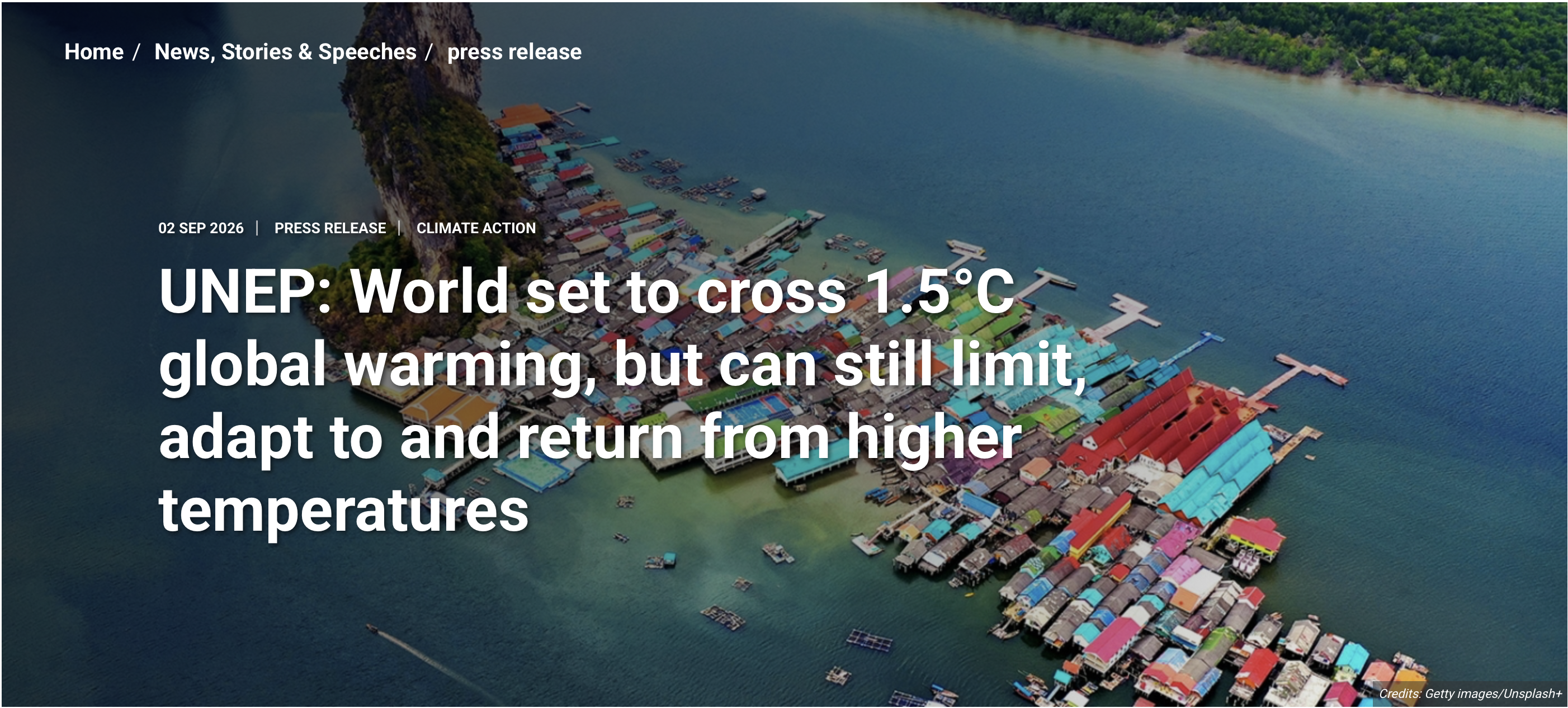
UN Environment Program: World set to cross 1.5°C global warming, but can still limit, adapt to and return from higher temperatures

Click the link to read the release on the UNEP website:

  • Report puts best-case scenario peak temperature rise at 1.8°C; others suggest over 2°C
  • Above 1.5°C, climate impacts and risks of tipping points intensify with every fraction of a degree
  • ‘Overshoot, peak and decline’ pathway best remaining option to help vulnerable nations and communities cope and return to below 1.5°C 

Nairobi, 2 September 2026 – Global temperature rise is set to cross 1.5°C, likely within the next few years, pushing climate risks and impacts to increasingly dangerous heights, but it is still possible to bring temperatures down and achieve global goals in the Paris Agreement, according to a new UN Environment Programme (UNEP) report. 

The report, Limiting Overshoot, identifies an ‘overshoot, peak, and decline’ pathway as the best remaining option to minimize the magnitude and duration of this overshoot and try to return to below 1.5°C as soon as possible. 

“This summer’s scorching heat, raging wildfires and deadly floods are a warning of what lies ahead. We must make the overshoot above 1.5 degrees as small and short as possible. That demands an overshoot of ambition” said UN Secretary-General Antőnio Guterres. 

This pathway would minimize peak temperature rise through immediate and sustained cuts to greenhouse gas emissions, including methane, on the road to net-zero, and bring down temperatures through long-term net-negative emissions, with carefully governed Carbon Dioxide Removal (CDR) – the process of removing carbon from the air and storing it through afforestation or other means – an essential part of the mix. 

At the same time, following this pathway would involve adaptation actions that reduce vulnerability to the current, expected and unexpected impacts of climate change on societies, communities and economies – although there will likely be limits to adaptation and irreversible impacts, especially if peak temperatures are not minimized. The report stresses such a pathway would reduce risks and impacts, make adaptation less difficult and expensive, and increase the chances of lowering temperatures. 

“There are no good outcomes if we remain above 1.5°C. Across the globe, extreme heatwaves are already proving that climate impacts will strike faster, hit harder, and last longer – costing more lives and causing deeper disruption,” said Inger Andersen, Executive Director of UNEP. “Now is the time we must double down on climate action. We can – and must – get on the right path. By cutting greenhouse gas emissions, strengthening resilience and adaptation, and ensuring exceedance of 1.5°C is as small and short as possible.”

Devastating impacts

The most optimistic scenario will see temperature rise peak at 1.8°C above pre-industrial levels, above the goal of limiting warming to 1.5°C set by the Paris Agreement. Most other scenarios predict higher peaks.

Above 1.5°C, risks and impacts will intensify with every extra fraction of a degree and every year. Anticipated impacts include intensified extreme weather, ecosystem loss, and submersion of Small Island Developing States and low-lying coastal cities. Severe damage to human health, food security, water supplies, nature, cities, infrastructure, and economies is expected.

The report warns that the likelihood of crossing irreversible tipping points increases with the magnitude and duration of higher temperatures. These include the destabilization of major ice sheets, degradation of the Amazon rainforest and disruption of the Atlantic Meridional Overturning Circulation (the system of currents that moves warm surface water north and cold deep water south, playing a key role in regulating the climate). Some impacts may emerge abruptly, while others will accumulate over time.

Considering the scale of the risks and the co-benefits of climate interventions such as a rapid transition away from fossil fuels to renewable energy – improving air quality and public health, lowering energy costs and increasing access to electricity – the report urges accelerated, collective and global action to get on an overshoot, peak and decline pathway. How quickly and strongly this action happens will define the shape and trajectory of the pathway.

Conditions for success

Strong political will and multilateralism, effective policies, inclusive governance, and finance are all important enabling conditions for action – and equity and justice must underpin all responses. Countries with greater responsibility for climate change should act the fastest with the greatest ambition.

The report also finds that mitigation and adaptation, which are mutually reinforcing, must advance together, while being responsive to emerging risks. Interventions that achieve both mitigation and adaptation goals – such as nature-based cooling – should be prioritized.

Adaptation set up now forms the foundation for efforts to come, but it must become transformational and responsive to evolving non-linear and abruptly arising risks – including those that will harm mitigation efforts.

The report emphasizes that net-zero is a milestone towards net-negative, with CDR needed in addition to, not instead of, sustained reductions in greenhouse gas emissions. However, CDR can only contribute credibly to a return below 1.5°C if peak warming remains well below 2°C and all residual emissions are reduced. Strong governance frameworks for CDR will be critical to allow responsible deployment and manage implications for environmental integrity, equity, scale.

Responding to a changed future

Years of inaction mean that even if a return to below 1.5°C is secured, irreversible losses and permanently changed conditions are certain. Many communities may be forced to relocate or change livelihoods, while societies will face the challenge of re-adjustment. This raises issues of justice, power, and political legitimacy, which will require new, inclusive governance arrangements to resolve difficult issues.

This report is a reminder that an overshoot, peak and decline pathway is a next generation climate frontier, but one which cannot be left unattended to for the next generation to tackle. Immediate action is required for such a pathway to remain possible.

Additional Quotes

“Every fraction of a degree of warming above 1.5 leads to increasing and increasingly severe climate impacts, with our Pacific family standing on the frontlines. While we know the challenge is growing, so too is momentum. The recent energy crisis has reminded the world of the need to reduce our dependence on fossil fuels, accelerate the transition to renewable energy and bolster climate cooperation. COP31 is an opportunity to turn our ambition into action — with Türkiye, Australia and the Pacific delivering a practical, solutions-focused COP.” – Chris Bowen, Australian Minister for Climate Change and Energy, and President of Negotiations for COP31.

“Every fraction of a degree matters, and every year spent in overshoot increases climate risks and the potential for irreversible losses. The Overshoot Report makes clear that exceeding 1.5°C should not be seen as a new destination, but as a pathway we must urgently work to minimize and reverse. This requires rapid and sustained emissions reductions, alongside ambitious adaptation to protect people, communities and ecosystems. 

COP31 must turn this urgency into concrete action. We need to accelerate global electrification, reduce methane emissions from waste, strengthen the climate resilience of cities, and enhance the resilience of marine and coastal ecosystems. At the same time, mitigation and adaptation should advance together. The choices we make today will determine how high temperatures peak, how long they remain there, and how safely we can return to 1.5°C.” – H.E. Murat Kurum, COP31 President-Designate

🔥 August 2026 not only beat the record for the warmest August on record, but it beat July 2023 for the warmest overall month on record for Planet Earth since 1940 – and likely the warmest during the entire Holocene. 😢

Climatologist49 (@climatologist49.bsky.social) 2026-09-02T10:03:46.418Z