#GunnisonRiver anglers question feds’ plan to reduce #BlueMesa Dam releases: Flows in Gunnison Gorge could drop as low as 200 cfs in effort to maintain #hydropower and rebuild storage — Heather Sackett (AspenJournalism.org)

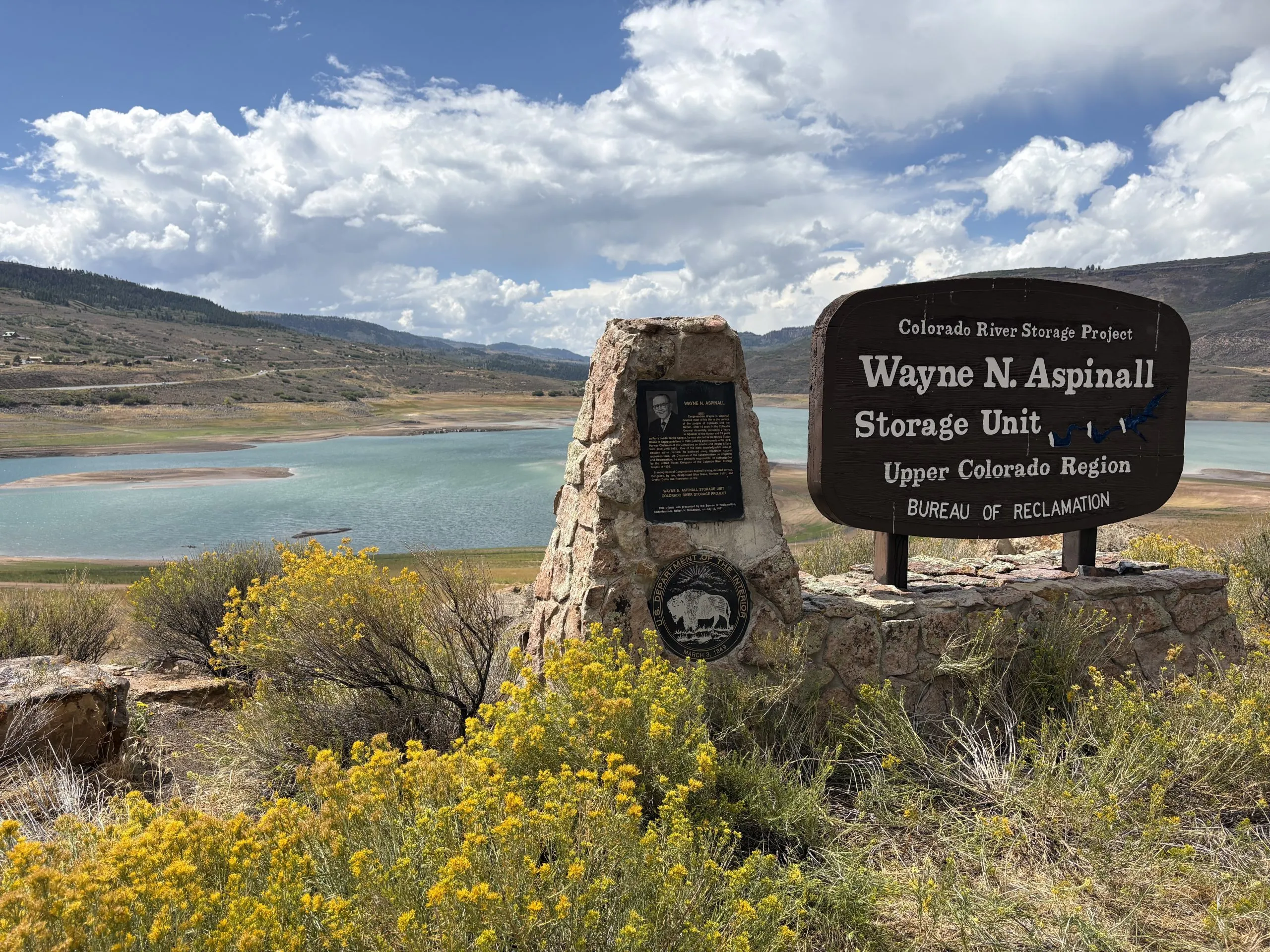
Blue Mesa Reservoir on the Gunnison River, seen Aug. 30, 2026 at about 21% full. Anglers and boaters say federal water management decisions are negatively impacting fish and recreation below the reservoir. CREDIT: HEATHER SACKETT/ASPEN JOURNALISM

Click the link to read the article on the Aspen Journalism website (Heather Sackett):

September 3, 2026

As this year’s historic drought drags on, conflicts over how to share and manage water are bubbling over. Gunnison River anglers and boaters say federal water-management decisions are causing increased water temperatures, prompting fishing closures, and creating serious economic impacts to outfitters and businesses.

An Aug. 26 letter from Drew Peternell, Colorado state director of Trout Unlimited, to U.S. Bureau of Reclamation Area Manager Bart Deming, asks the federal agency to change its approach to drought management. The river conservation nonprofit organization asked Reclamation to increase streamflows in the Black Canyon and Gunnison Gorge to alleviate damage to the fishery; to evaluate water use by downstream irrigators; and to better understand the drivers of storage depletion. 

“We acknowledge that the extraordinary drought conditions of the current water year present significant operational challenges,” the letter reads. “Nevertheless, the decision to reduce flows in the Gunnison River has exerted a toll on a vital and cherished natural resource.”

At a public Aug. 27 operations meeting in Grand Junction, Reclamation officials said they plan to reduce flows out of Blue Mesa Reservoir to as low as 200 cubic feet per second through February, in an effort to recover some storage in the reservoir, which is depleted after this year’s record-breaking drought and hot temperatures. Flows so far this month have hovered around 245 cfs.

Peternell said Trout Unlimited would like to see flows of at least 300 cfs in the Gunnison River, the minimum threshold for a healthy environment set by a federal reserve water right. The Black Canyon and Gunnison Gorge are home to a 27-mile-long Gold Medal trout fishery and are downstream of the federally operated Aspinall Unit, which is made up of Blue Mesa, Morrow Point and Crystal reservoirs.
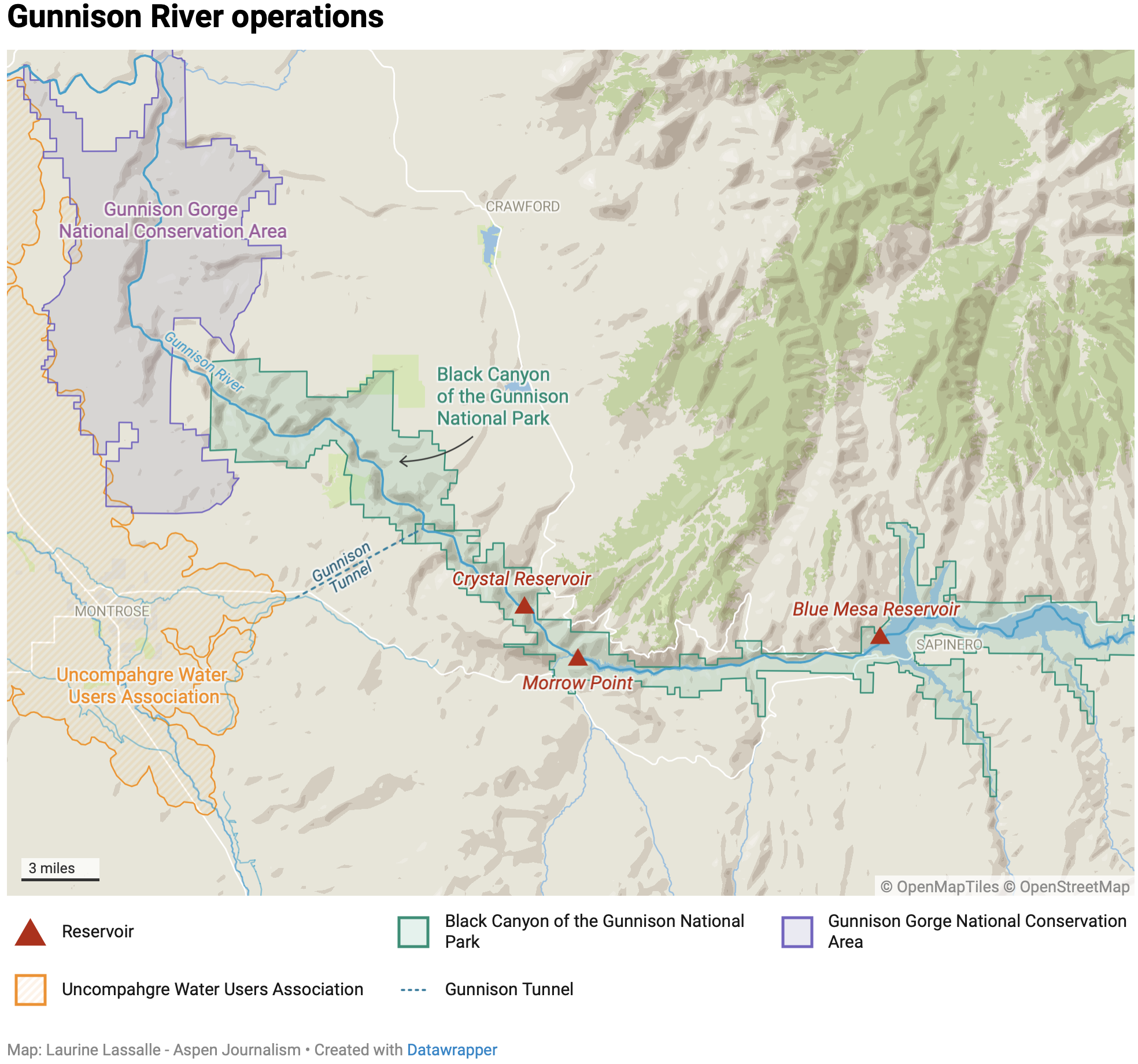
“It’s been a tough year for everyone and there’s not enough water to go around, unfortunately, so we appreciate that Reclamation is in a tough spot,” Peternell said in an interview with Aspen Journalism. “But 300 cfs is a minimum flow target for the Black Canyon and it’s the minimum amount of water the fishery really needs to survive down there, and we’re below that. We’re down to 250 or 240, and that’s hard on the fish, it’s hard on the people who make a living off that fishery.”

Federal water managers control how much water flows out of the Aspinall Unit in the highly engineered Gunnison River system, which is the largest tributary of the Colorado River in the state. Reclamation officials project storage in Colorado’s largest reservoir could fall to just 128,000 acre-feet, or 15% full, by the end of the year under the most probable scenario. 

At the Aug. 27 meeting, officials presented modeling that showed releasing water at a rate of 300 cfs could cause Blue Mesa to fall below the level needed to make hydropower, but 200 cfs will allow storage to build back up slightly over the winter. Reclamation officials presented modeling projections that showed if they don’t reduce releases now, the amount of water coming out of Blue Mesa may need to be dialed back to just 150 cfs this winter to preserve the ability to make hydropower.

“If we didn’t act, this slide right here is a plane going down and we pull up at the last second,” said Reece Carpenter, a Reclamation staffer with the Resources Management Division at the Western Area Office in Grand Junction. “So it’s very important for Reclamation and all of our partners to have that coordination to make some decisions.”

This management decision rests on a sentence in the Record of Decision for the Aspinall Unit’s environmental impact statement, designed to protect endangered fish, that says “the minimum downstream flow through the Black Canyon of the Gunnison National Park and Gunnison Gorge National Conservation Area is 300 cfs, except in severe drought when the flow may decrease.” And the Colorado River Basin is experiencing the most severe drought in recorded history.

Tim Patterson, owner of RIGS Fly Shop & Guide Service in Ridgway and who has been guiding for more than 30 years, said Gunnison Gorge trips represent more than half of his company’s guiding and outfitting business, and that flows of 200 cfs are a deal breaker. Low flows contribute to higher water temperatures, which can lead to fishing closures, and make navigating some rapids difficult, if not impossible.

Patterson would like more advance notice from federal water managers when flows will be dropping, and real-time temperature and flow monitoring. Patterson said he has already canceled a handful of trips this year and may have to cancel more if flows stay below about 250 cfs.

“The Gunnison Gorge National Conservation Area, as far as a guided fly-fishing trip, is a bucket-list trip known around the world and a must-do,” Patterson said. “So people have planned for over a year in advance for this experience, and it just puts us in a real tough spot.”
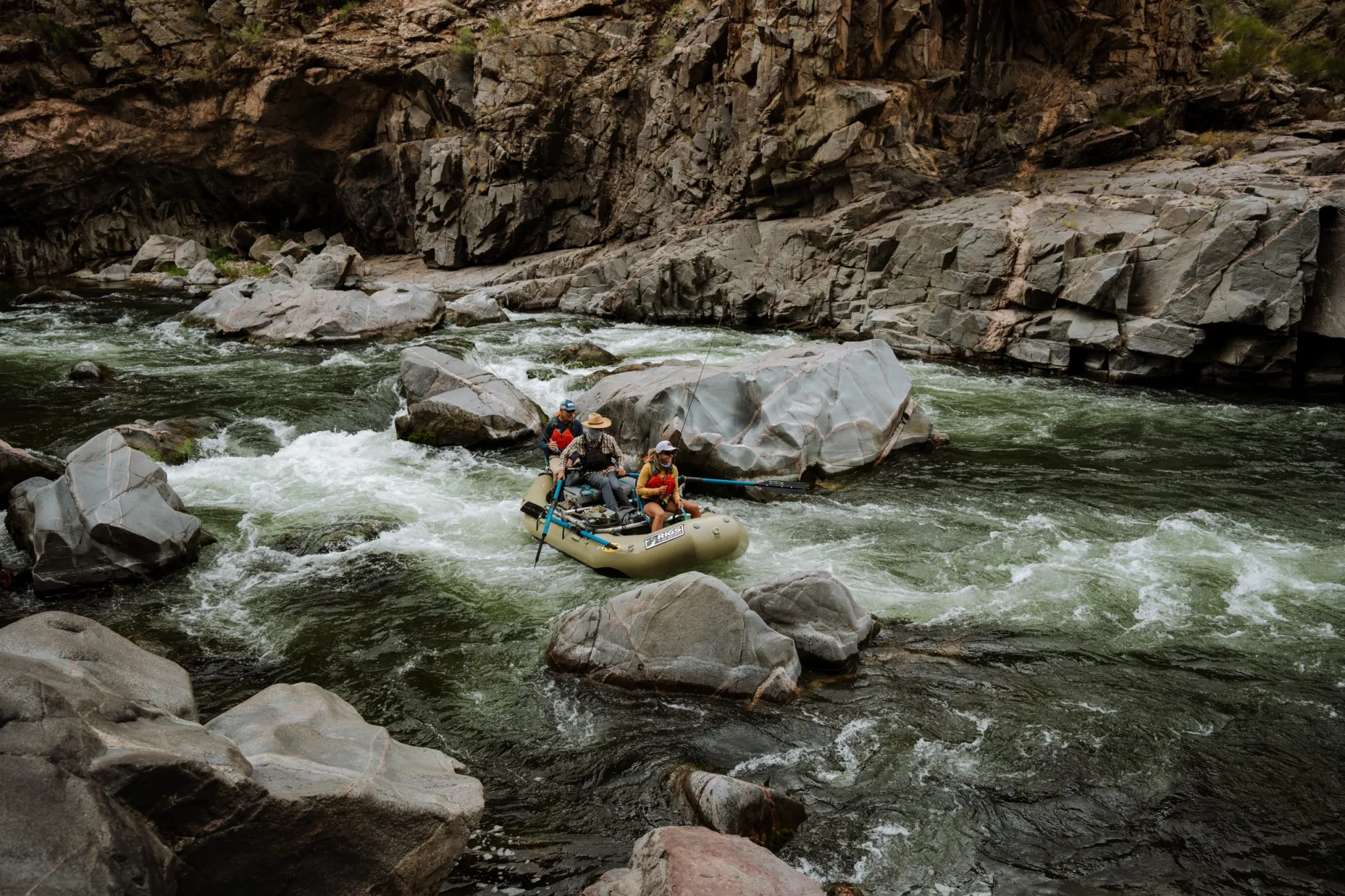
Boaters in the Gunnison Gorge National Conservation Area. A Ridgway outfitter said he has had to cancel trips this year because of low flows in the river. CREDIT: RIGS FLY SHOP & GUIDE SERVICE

Farmers facing ‘immeasurable hardship’

While flows in the river decline, downstream irrigators are still taking nearly their entire allocation of water. The Uncompahgre Valley Water Users Association is still diverting just more than 1,000 cfs through the Gunnison Tunnel. The association is a vast expanse of farmland that extends from just south of Montrose to Delta, and is the largest water user in the Upper Colorado River Basin. Water from the Gunnison River transforms the arid high desert into lush green fields of corn, pinto beans, onions and alfalfa. 

The association normally gets half of its water supply from the Uncompahgre River. But this basin saw some of the worst snowpack in the state at just 14% of median. That means farmers in this area are experiencing deep water cuts this year. And some growers made the tough decision to leave fields dry and unplanted this year. 

“I’ve got a senior water right, and I got 50% of my system that’s fallowed right now,” Uncompahgre Valley Water Users Association General Manager Steve Pope said at the Aug. 27 meeting. 
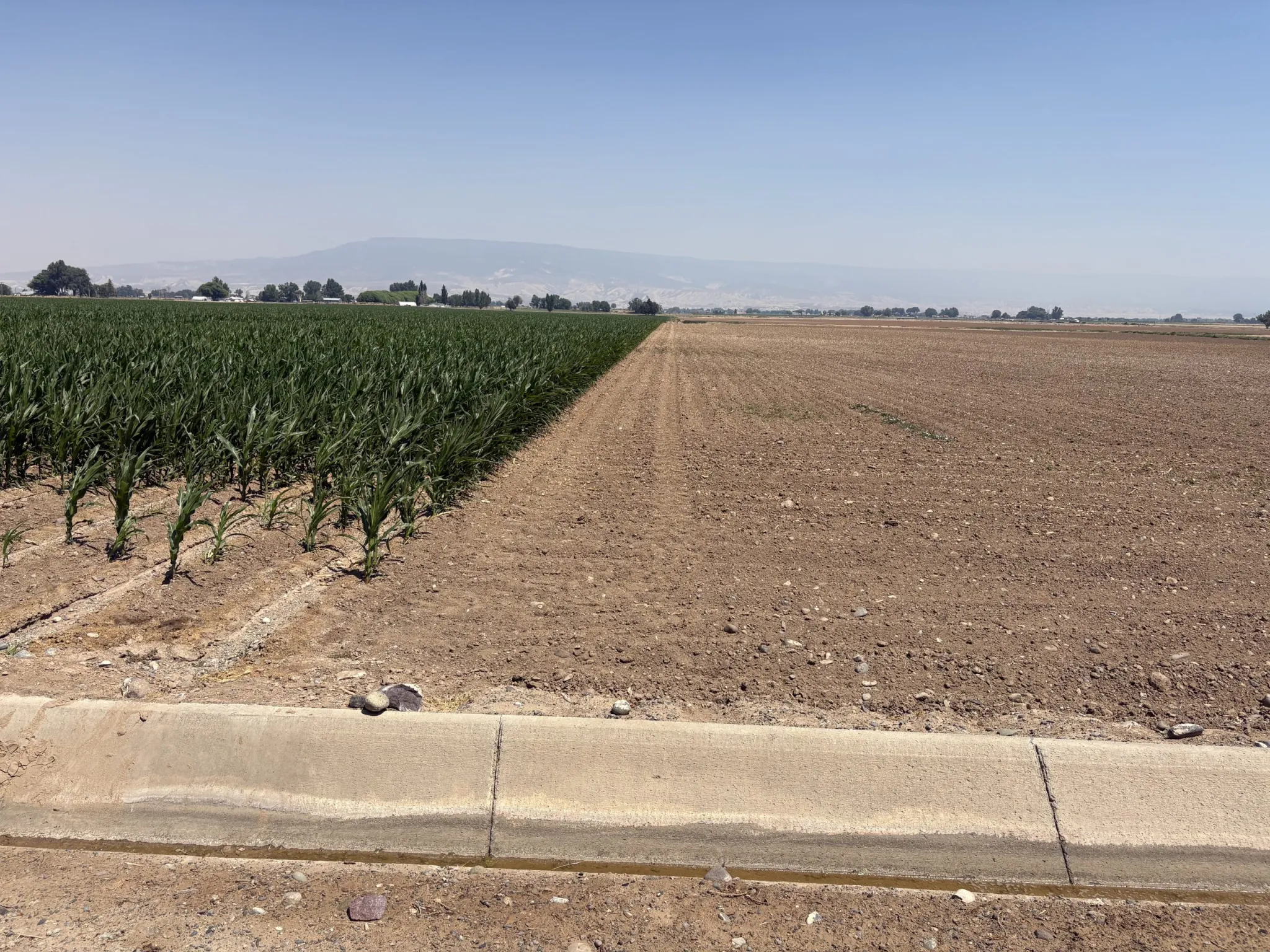
This field in the Uncompahgre Valley Water Users Association district has been fallowed this season due to a lack of water. The state of Colorado announced Wednesday that it will set up a conservation program using federal dollars, which means more fields on the Western Slope could soon look like this. CREDIT: HEATHER SACKETT/ASPEN JOURNALISM

This year’s conditions on the Gunnison River highlight how tensions are exacerbated among water-user groups — especially in times of extreme drought. Colorado’s prior appropriation system of water law says the oldest water rights have first use of the river, which almost always means agricultural water users get their water first. 

The state didn’t begin to grant water rights for the environment until the 1970s and for recreation until around the early 2000s. Although a large part of the Western Slope’s economy, culture and identity is now centered around outdoor recreation, keeping enough water in rivers for boating and fish is often the last priority.

The letter from Trout Unlimited asks Reclamation to evaluate power contracts with the Uncompahgre Water Users Association, which has several hydropower generating stations on its system of canals, and implement clear efficiency standards for water use. The letter lists reasons that suggest more water is being diverted from the Gunnison River than is necessary for irrigation.

Pope called their concerns “absolutely ridiculous.”

“These farmers have suffered immeasurable hardships this year, and for someone to say, ‘We think you should further reduce to maintain water temperatures and fish flows in the Black Canyon,’” Pope said. “They don’t bring a water right to the table; they don’t bring anything but a demand, and I don’t agree with it. Irrigation and agriculture is the senior priority, and it’s going to be used.”

Pope said he plans to dial back Gunnison River diversions to about 700 cfs by mid-September, but the river won’t see a bump in flows because of Reclamation’s plan to keep dam releases low to build back storage.
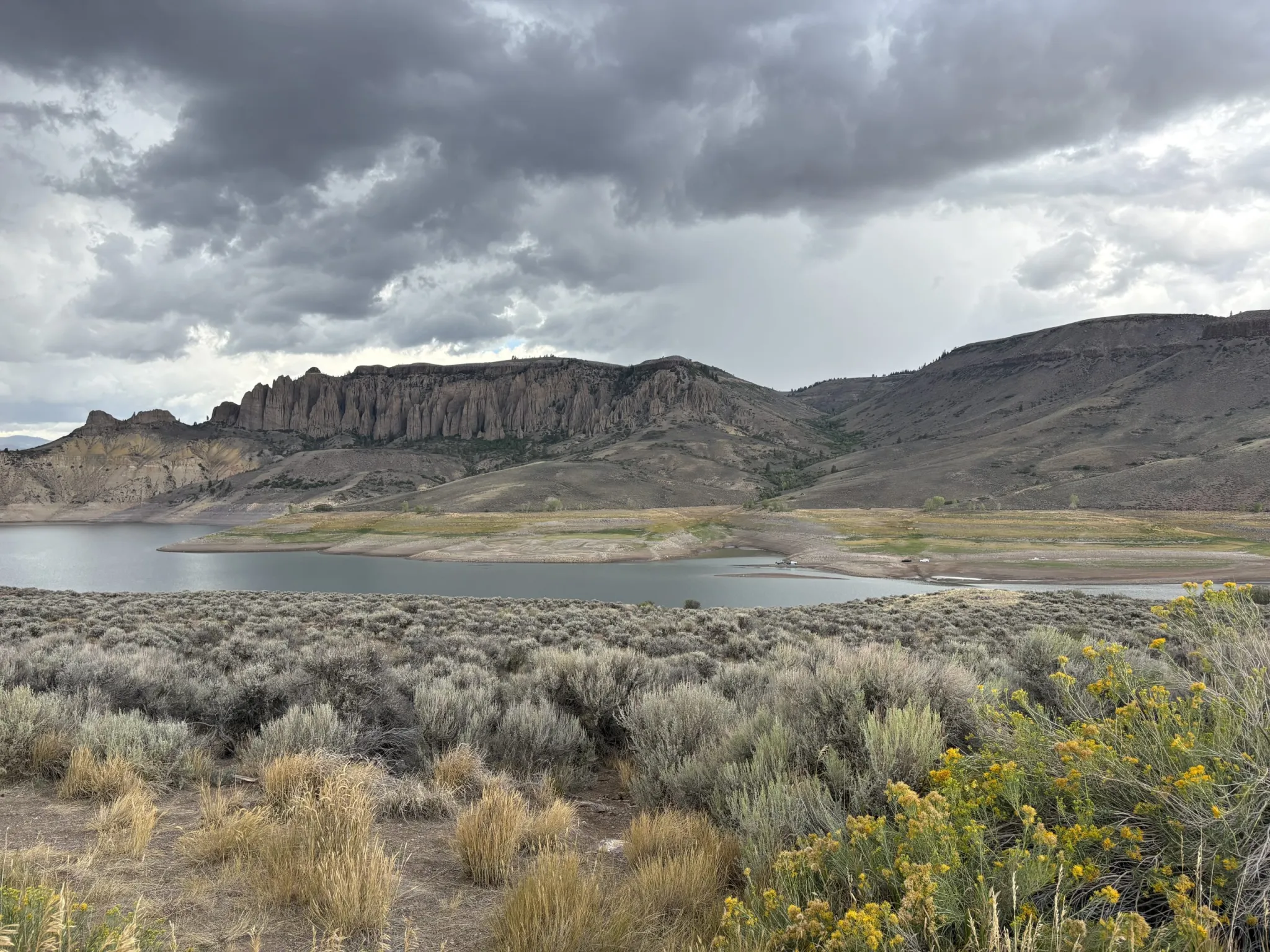
This rock formation known as the Dillon Pinnacles on the shores of Blue Mesa Reservoir on Aug. 30, 2026. Federal water managers say they will hold reservoir releases to between 200 and 300 cfs until February in an effort to recover storage in the reservoir. CREDIT: HEATHER SACKETT/ASPEN JOURNALISM

Patterson is hoping his business can get through September — which is the busiest month for multiday trips through the gorge — relatively unscathed. He would like to see more collaboration and communication between water managers and water users, and he wants anglers to have a seat at the table. 

Patterson framed the issue not as a fight among water users, but as an unevenly built safety net in times of shortage. For now, river recreation remains largely at the mercy of upstream decision-makers.

“We’re seeing it all over the Colorado drainage,” Patterson said. “You can’t demand water that isn’t there. But passing it through a special place like this and working with us on times of years to minimize water temperature issues and things like that is a great step. I think it starts with acknowledging that this place is special and important and deserves to be protected.”

Map of the Gunnison River drainage basin in Colorado, USA. Made using public domain USGS data. By Shannon1 – Own work, CC BY-SA 4.0, https://commons.wikimedia.org/w/index.php?curid=69257550

A first in the 110-plus-year history of this canal — Allen Best (BigPivots.com) #ColoradoRiver #COriver #aridification

The Government Highline Canal, courtesy of Wikipedia.

Click the link to read the article on the Big Pivots website (Allen Best):

September 3, 2026

Farmers served by the Government Highline Canal as of today will get no water, a result of last winter’s dismal snowpack and low levels in Green Mountain Reservoir

The Government Highline Canal has delivered water to farms in Colorado’s Grand Valley during irrigation season for more than 110 years.

Thursday will be a first in that long history. No water will be available in that canal to farmers, even though the growing season has not ended.

“This will be the first time since around 1914 the Government Highline Canal has been at undeliverable levels during the irrigation season, which usually runs until Nov. 1 (and sometimes later),” said Tina Bergonzini, general manager of the Grand Valley Water Users Association.

Water supplied by reservoirs upstream in the Colorado River headwaters has essentially run out.

The predicament on the Colorado River had become apparent by April. Record-breaking heat of March made it extremely likely that runoff would be anemic. It got a bit better in May, but not much.

This was clearly evident at Green Mountain Reservoir, between Silverthorne and Kremmling. The dam had been built between 1938 and 1943, as part of a quid pro quo. Farmers in northeastern Colorado, particularly in the Fort Collins-Longmont-Greeley triangle, wanted to divert water from the Colorado River headwaters.

Western Slope representatives objected. They worried that they would lose irrigation water they needed after spring runoff subsided in June and July. The federally financed dam was the answer. It can hold nearly 154,745 acre-feet of water. Of that, 66,000 is marked for delivery to downstream irrigators, most in the Grand Junction area.

Green Mountain was the quid for the quo of the Colorado Big-Thompson Project annual diversion of between 200,000 and 230,000 acre-feet through the Continental Divide.

It worked — until this year.

In April, the low levels in the reservoir made it clear that the farmers would not get the full amount of water they had come to expect. The Glenwood Springs-based Colorado River District created a plan to ease the shortage.

The district — which had been created to look out after Western Slope interests in the 1930s — looked into how it could tap various pools of water, getting a thimbleful here, a cupful there. Irrigators wouldn’t become whole, but they would get help, said Andy Mueller, the general manager of the River District at the board’s April meeting.

DeBeque Canyon has changed somewhat since this photo of the Roller Dam was taken in 1916. Most notably, now the canyon has an interstate highway. Photo/U.S. Bureau of Reclamation. For a more complete history, see the Palisade Historical Society page.

Water for the Grand Valley Canal is diverted from the Colorado River at what is called the Roller Dam on the Colorado River just east of Palisade. It continues 55 miles down the valley, mostly north of I-70, ending near Mack, 10 miles from the Utah border.

The canal is called the “government” for a good reason. It was built with federal money via the U.S. Bureau of Reclamation, an agency created in 1902 to help turn arid places like the Grand Valley into gardens and orchards. Accounts vary about when the water began flowing in the canal. Some say 1913, others 1914 or 1915. Regardless, the water has always flowed since before the United States entered World War I.

Until this year.

Early in the irrigation season, irrigators benefitting from the canal agreed to curtail their water use in exchange for getting water from reservoirs near the Colorado River headwaters later in the season.

That sounds simple enough. The mechanics are complicated. Crucial to understand is the seniority of the “Cameo call” at the Roller Dam, where water is diverted. Upstream users have to honor that very senior call.

The call is for 1,950 cubic feet per second. Grand Valley’s Bergonzini said her district lowered the target by 300 cfs and then another 200 cfs, or 1,450 cfs. That left a little more water in Green Mountain. Altogether, the reduced water diverted from the Colorado — combined with the two storms during May — brought the amount of water available in Green Mountain up to 50% of the allotment for the Grand Valley farmers.

This story has endless details. The essential story is that those with rights to water on the Colorado River within Colorado — including a transmountain diverter, Northern Water — have worked with the irrigation district to ensure the farmers in the Grand Valley had some water during the growing days of summer. Water officials stress what Bergonzini calls “teamwork and collaboration between entities.”

Upstream reservoirs tapped included Wolford and Wiliams Fork, both near Kremmling, and Ruedi, near Basalt. An additional 5,000 came from Granby Reservoir late in the season.

Helping out were appropriations of $450,000 from the River District in April and then, in May, $585,000 from the Colorado Water Conservation Board.

Still, farmers dependent upon the ditch only got 50% of the water they normally would from Green Mountain.

Some of the teamwork involves Orchard Mesa Irrigation District. The Grand Valley and Orchard Mesa districts have an agreement to share shortages.

A short distance east of Palisade, water from the Colorado River is pumped up to Orchard Mesa. Photo/Allen Best

Orchard Mesa pumps water uphill from near Palisade to the mesa, site of many of the peaches for which Palisade is famous. Farther down on the Government Highline Canal, other farms grow alfalfa, wheat, and usually corn. This year, however, little corn was grown, yielding to Sudan grass, triticale, and barley, as they are shorter season and can be grown with less water, said Grand Valley’s Bergonzini.

Both peach and grape orchards on Orchard Mesa have done quite well, said Rob Talbott, president of the irrigation district’s board of directors.

The fundamental story, he said, is that “everybody is doing whatever they can to share their water.”

The sharing continues. The peach orchards need water now if they will be productive next year.

“The peach trees (primarily on Orchard Mesa) need water right now to get ready for hibernation whereas my growers (served by Government Highline Canal) can wait for a bit to water in winter wheat and hay. They crop switched earlier this year to shorter season crops, so we have different needs,” explained Bergonzini.

The canal is designed for flows of 730 cfs, not for the 100 cfs now available. As such, she said, it’s better to let the peach trees have the water now.

“Then, IF THE RIVER HAS RISEN SOME,” said Bergonzini, using all-caps for emphasis in her e-mail, Grand Valley will take Orchard Mesa’s irrigation water and augment it with what is available in the river to get some crops watered along the 55-mile canal.

That could happen at the end of September.

“We are planning on running late — perhaps the middle of November if the weather allows without freezing, to assure our growers get good moisture on their fall crops,” she said.

As for Green Mountain Reservoir, according to the Bureau of Reclamation, yesterday it was 14.8% full.

Green Mountain Reservoir had plenty of beach on Aug. 17, and the reservoir has declined since then. Photo/Allen Best

#Monsoon madness and Mormon Marxism(?) — Jonathan P. Thompson (LandDesk.org)

Ute Mountain after autumn rain. Jonathan P. Thompson photo/illustration.

Click the link to read the article on The Land Desk website (Jonathan P. Thompson):

September 1, 2026

⛈️ Wacky Weather Watch⚡️

Wow. Just wow. Huge flash floods in the Grand Canyon this past weekend, with the biggest damage along Bright Angel Creek and Phantom Ranch. Bridges were washed away, dozens of people were evacuated, the Trans Canyon Waterline was destroyed (forcing the closure of rim hotels), and there was so much debris in the river that National Park Service officials had to shut down the river to rafting — though it is now reopened. As of Tuesday morning, two fatalities had been confirmed and one person were still missing.

The storm cells plowed across the Colorado Plateau during the waning days of August, and of meteorological summer, dumping large volumes of rain in short periods of time, leading to hot-chocolate-hued waterfalls cascading off of cliffs and down canyons. In some cases, wildfire burn scars from last year or earlier this summer exacerbated the impacts. In the Grand Canyon it’s likely that the Dragon Bravo Fire scar contributed to the severity of the flooding.

The storms tended to be isolated, pounding one area, while leaving others just miles away virtually dry, as can be seen in wildly varying streamflows.

  • Video from the Grand Canyon shows that the storm and its impacts were widespread, but certainly the most significant flooding was on Bright Angel Creek, which joins the river at Phantom Ranch. The normally clear and burbling brook was flowing at about 14 cubic feet per second at 11:20 on the morning of August 29; at 12:50 p.m. the gage showed a flow of 347 cfs; then the readings vanished as the gage was overwhelmed by a torrent, disabling the gage. Witness accounts and videos show a wall of water that sounded like a freight train slamming into the Phantom Ranch area.
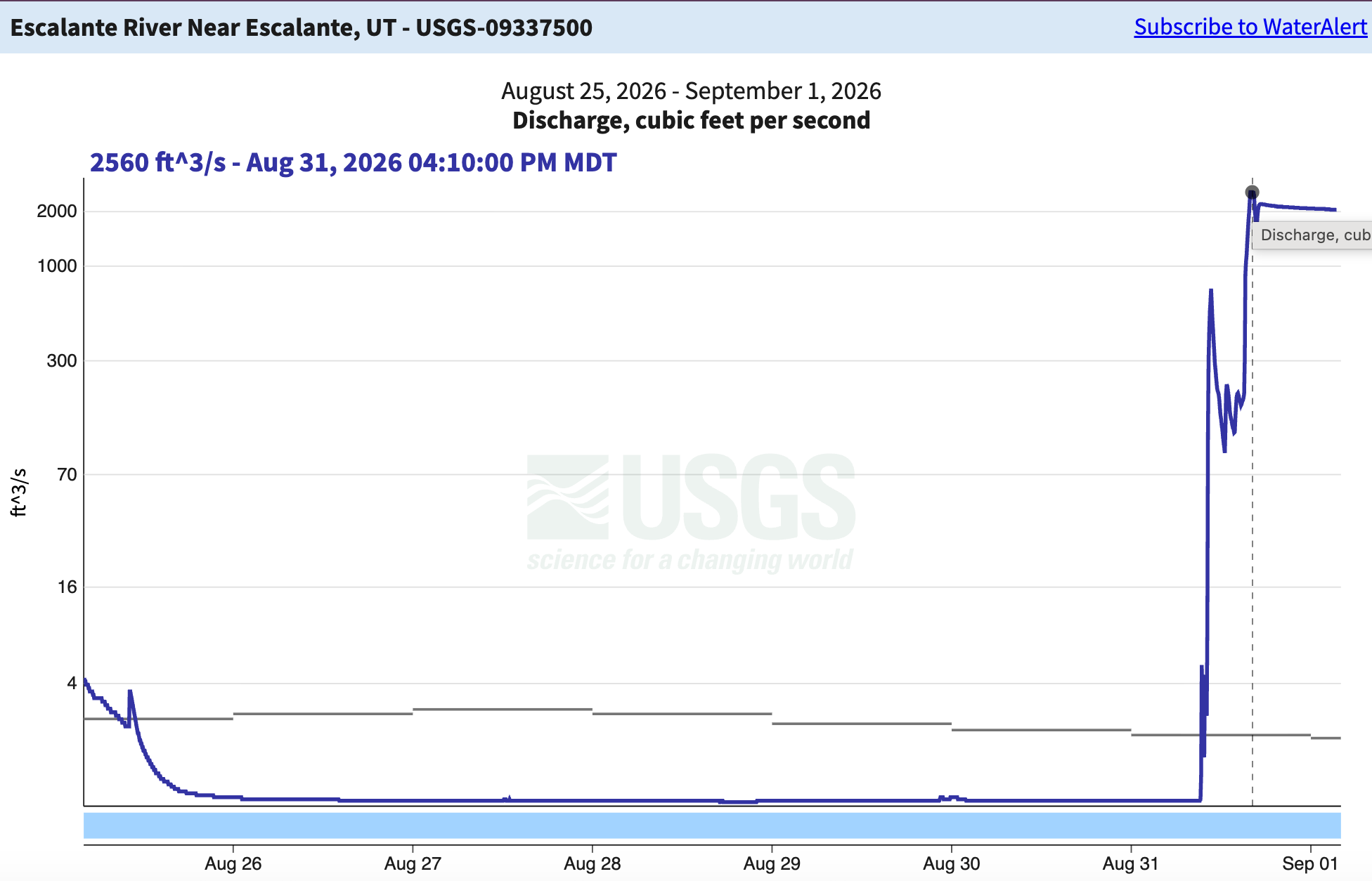
  • Always wanted to float one of those classic, usually un-runnable desert rivers but could never get big enough flows? Now’s the time to hit at least one of them, if you dare. The San Rafael River’s USGS gage near Green River was reading 800 cfs as of early Tuesday morning, which is runnable for the intrepid and skillful folks out there. But you’d better hurry: The forecast is calling for clear skies starting Wednesday. Meanwhile, flows on the Escalante River near Escalante, the Paria River near Kanab, and the Dirty Devil exceeded 2,000 cfs on Monday afternoon. But for these one’s it’s probably best just to sit on the canyon rim and watch the show, since American Whitewater recommends against running any of these rivers at these levels. But maybe this is just the dramatic ushering in of more gentle, widespread rains, and the flows will level out in the low-200s, making them quite floatable indeed.
  • The Big flows on three of the above mentioned rivers will give a bit of a boost to Lake Powell inflows, while the Paria will supplement the waters moving past Lee Ferry from the Colorado River’s Upper Basin to its Lower Basin. So far, however, the storms are too isolated and short-lived to significantly slow Lake Powell’s decline. The reservoir’s surface level is currently at about 3,517.6 feet.
  • Speaking of classic desert rivers, the sorrowful Lower Dolores River got a little bit of life back over the last few days as the storms moved into Western Colorado, pushing streamflows near its confluence with the Colorado above 600 cfs (after running below 30 cfs for the previous week). That’s good enough to float the lowest section of the river, which includes Stateline rapid, but the flows dropped back down below 100 cfs pretty quickly, which would leave anything but a SUP high and dry. What the rain gave to the river, it took from the roads: Highway 141 between Gateway and Whitewater was shut down Monday due to multiple debris flows; it had reopened as of Tuesday morning, according to the CDOT website. 
  • Zion National Park was hit by the same wave of storms, leading to flash flooding and big water in the Virgin River. Rockslides shut down the Zion Mount Carmel Highway.

Note: I wrote the following essay for the Utah Monthly, an insightful newsletter that provides an inside look at the sometimes maddening, always spectacular, and often confounding state. 

This historical piece jumps off from a feature story I wrote for High Country News back in 2012. The thesis behind that story was that even as Utah and the Mormon Church moved rightward politically with a full-throttle embrace of capitalism, they paradoxically held onto slivers of the collectivism espoused by Brigham Young. Since then, Utah has continued its rightward slide, and the Church of Jesus Christ of Latter Day Saints has continued to grow its corporate empire. 

Reporting from Bloomberg shows the Church and its real estate arms own some 2.4 million acres in the U.S. worth more than $20 billion, and that they are ramping up efforts to develop some of that land. Tributary is a planned community under development in Aurora, Colorado, south of Denver International Airport and adjacent to I-70. It covers about 960 acres of former farmland along a creek, and it is designed to eventually house some 12,000 people. 

Where will the water come from? Given that this will be in Aurora, I’m guessing it will be from Aurora water, which is currently under stage 1 drought restrictions. 

Anyway, on to a bit of Western history … 

Mormonism’s Collectivist Roots
And what remains of it in our era of financialized capitalism

The curiously named community of Orderville sits in a narrow valley in southern Utah on the banks of the East Fork of the Virgin River. It is propitiously placed along the highway between Bryce Canyon and Zion National Parks, yet it wasn’t until the last decade or so that businesses—a couple coffee shops, food trucks, and upscale glamping and vacation rentals—popped up to capitalize on the thousands of visitors passing through. But this isn’t just a modest farming community now taking up tourism. It was once the stronghold of the United Order communalist system, perhaps the most audacious economic experiment ever undertaken in the American West. Orderville, wrote historian Dean L. May, was for the Latter-day Saints a “near-successful effort to build the City of God on Earth.”

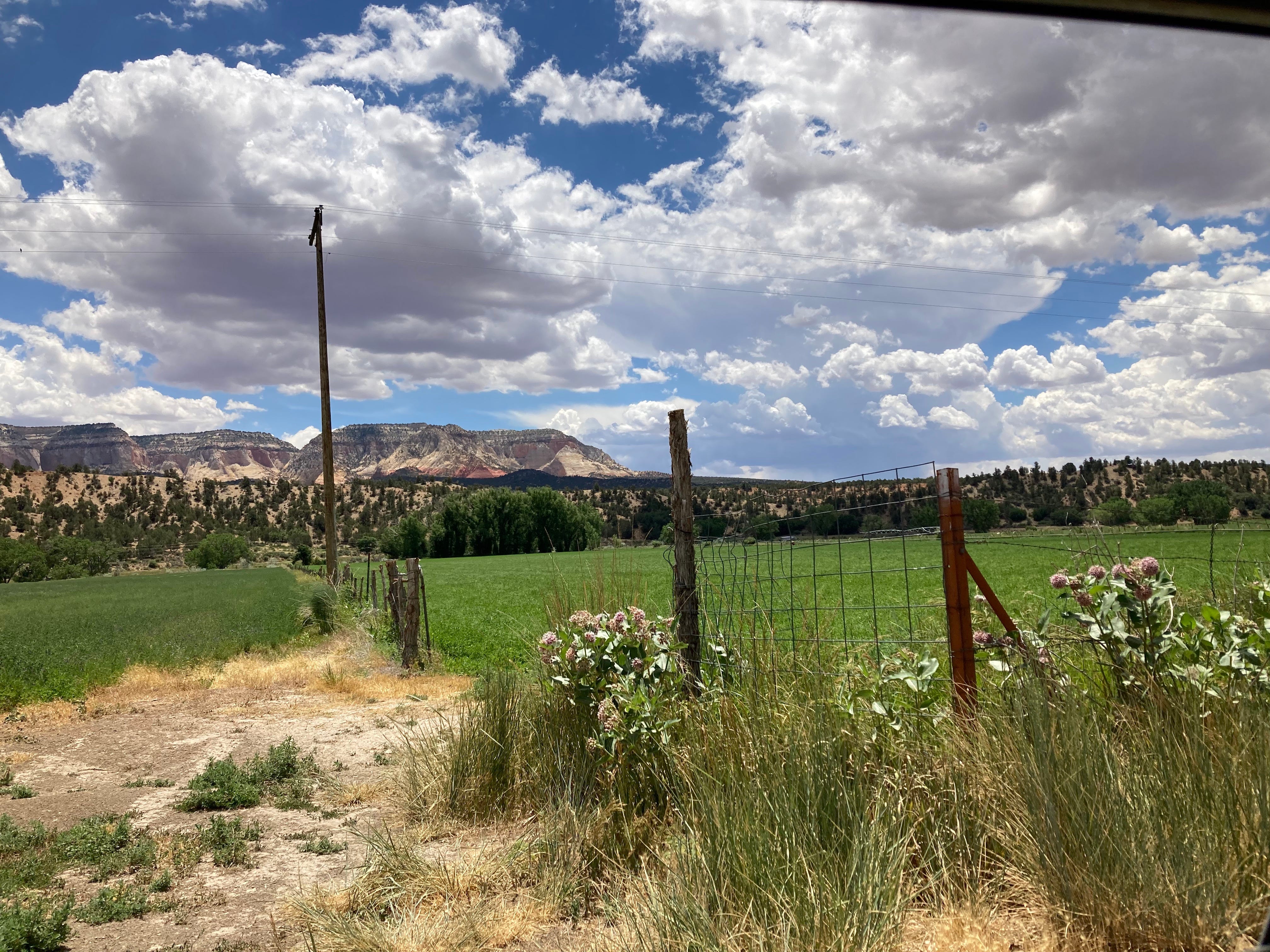
Hayfield just outside Orderville, Utah. Jonathan P. Thompson photo.

Over the last half-century, the Church of Jesus Christ of Latter-day Saints has wholeheartedly embraced free-market capitalism, and not only in ideological terms. The church is decidedly corporate, and owns Utah’s second-biggest newspaper, a book publisher, dozens of radio stations, financial companies, hotels, and restaurants. It spearheaded the $2 billion redevelopment of its land comprising a major portion of downtown Salt Lake City, and is one of the nation’s largest landowners, with about 2 million acres of agricultural, residential, and commercial properties across the United States. Up until McCarthyism and the Red Scare of the 1950s, however, the church leaned strongly in the opposite direction, favoring a communal, even socialist approach to economics.

When Brigham Young led his followers into present-day Utah in 1847 to build a homeland, he championed industriousness combined with cooperation and central planning over the frontier individualism commonly associated with the western frontier at the time. The Mormons began with a cooperative effort to build an irrigation system that belonged to everyone, and then laid out the towns. “The towns and villages were not established inadvertently or by individual initiative … they were a result of very definite plans,” wrote Hamilton Gardner in Cooperation Among the Mormons in 1917.

This relatively loose-knit system worked to build communities, but it wasn’t clear that it could protect them from the Gentiles pouring into the region in search of land and wealth. In the 1860s, as the transcontinental railroad approached Utah from both sides, bringing with it an orgy of capitalism and greed, financed with credit that the banks handed out like lollypops, Young buckled down in an effort to protect his holy land from the invaders.

He formed the School of Prophets, which, writes Leonard J. Arrington, the late LDS church historian, “countered an energetic and powerful laissez-faire capitalism with a vigorous, well-organized, socially minded and theocratically directed program of economic action.”

That program included creating an organization to build the section of railroad that came closest to the capital, to keep out the riffraff that might otherwise do the work. It funded the creation of cooperative furniture and wool manufacturing along with other businesses, to reduce reliance on eastern imports. The School created the Zion’s Cooperative Mercantile Institution and instituted uniform pricing controls to minimize competition among Mormon merchants.

The Utah Territory successfully resisted becoming a mineral colony for the eastern industrialists, and the School disbanded in 1872. But Young, whose collectivist leanings grew as he aged, wanted yet more.

A chance for radical change emerged in September of 1873, when the Jay Cooke & Co. bank—one of the big railroad backers—collapsed. Other banks toppled like dominoes, foreclosures were rampant, and the Panic of 1873 swept the nation and the world, leading to one of the worst depressions in history.

Utah’s mining towns were hit hard. But Brigham City, a settlement of about 1,500 people, actually thrived. It had organized a mercantile cooperative in the pre-railroad days, and, by the time the panic hit, it had expanded into a major manufacturing enterprise mostly owned by the worker/shareholders. It built houses for the poor and widows and provided labor for jobless drifters, and its leaders instituted central economic and land-use planning and zoning, dictating where houses and factories and public transit should be built. Novelist Edward Bellamy, who visited Brigham City after the panic, reportedly drew inspiration for Looking Backward, his 1888 utopian novel set in a socialist Boston in the year 2000, when greed and capitalism are no more.

Young didn’t need to wait another century for utopia to arrive. In the aftermath of the 1873 panic, he set about spreading the Brigham City model—combined with an element of Joseph Smith’s Order of Enoch wealth-redistribution plan—across Deseret. He started in St. George and worked his way northward, converting communities to the order as he went.

Each adopted the order in its own way, but the core principals were the same: communalism, cooperation, and equal distribution of wealth. That this occurred just after the Communist Manifesto, by Karl Marx and Friedrich Engles, had been published in America bears noting, if nothing else. The language in the St. George United Order Constitution gives a sense of what Young was trying to do, mentioning the struggle between capital and labor, bemoaning the “oppression of monied monopolies” and railing against “a growing … spirit for extravagant speculation and over-reaching the legitimate bounds of the credit system; resulting in financial panic and bankruptcies.”

“It was clear to all that the United Order,” writes Arrington, in Great Basin Kingdom, “was an attempt to retard, and, if possible, to prevent the development of a market-oriented economy dependent on extensive importation and exportation.” About 200 communities implemented the Order. Some, like Brigham City, took a moderate approach. Others were quite radical.

Orderville fits into the latter category. The community was founded in the spring of 1875 by twenty-five families who had broken off from the Mount Carmel community a few miles down valley. The Orderville citizens pitched in to build houses surrounding a central plaza and common dining hall. All property was turned over to the community corporation, including land, livestock, and machinery. Decision-making was centralized. The population grew to 600, with around 200 acres of communal fields. The citizens built a sawmill, cabinet shop, woolen mill, shoe shop and tannery. Wealth was distributed evenly. Everyone ate together and wore locally made uniforms.

Orderville thrived in its collective state even as other southern Utah communities abandoned all or parts of the United Order. The community gained population and was able to quadruple its communal assets over just several years’ time.

Orderville’s successes, however, only highlighted the failures of the predominant, free-market system in use everywhere else, drawing resentment from the outside world. The timing wasn’t so great, either: In 1882, in a direct affront to the Utah Territory and the church, Congress passed the Edmunds Act, banning polygamy. A few years later, the feds rounded up and jailed hundreds of suspected polygamists, including in Orderville, leaving many communities leaderless. Church leaders, looking to remove yet another source of negative outside attention, urged Orderville to abandon its communal ways. The town’s leaders eventually complied—the central dining hall had been wiped out by a flood a few years earlier anyway—but kept the industries under communal ownership for another couple of decades.

By the early 1900s, the United Order had died in practice. For its part, the church continued to start its own businesses and to invest in other firms—sometimes to its own detriment. The aim, for the most part, was not to turn a profit, but to provide resources for its members. Still, the communalist spirit lived on, permeating the politics and the economics of the church for years afterward.

One of the embodiments of this spirit came in the form of a Utah Mormon banker and conservative Republican named Marriner S. Eccles. Eccles had long believed that hard work and thrift were all one needed to be successful. His father, David Eccles, had built up an empire on those principles, most famously owning the Utah Construction Company, one of six firms that built Hoover Dam and the largest company of its kind in the nation. The senior Eccles died in 1912, leaving everything to his children from two wives, one in Logan, one in Ogden. Though Marriner was in the lesser-endowed Logan branch, he ended up in Ogden, rose to the top of the bunch with his business acumen, and became president of Utah Construction Company, First Security Corporation, and several other interests. Then the Depression hit. Though Eccles’s wealth insulated him and his businesses, he noticed all around him people who had toiled and saved their whole lives, and who were now ruined, unemployed, even homeless.

“It is a national disgrace that such suffering should be permitted in this, the wealthiest country in the world,” he said. “The present condition is not the fault of the unemployed, but that of our business, financial, and political leadership.”

In 1933, Eccles and forty-five other citizens addressed Congress on ways to stop or slow the downward economic spiral. Most witnesses suggested that extravagance, nature, or God had caused the crash, and that balancing the federal budget was the only solution. Not Eccles. He said the root cause was maldistribution of wealth. There was plenty of money out there, it had just all ended up in the hands of a small group of the ultra-rich—the 1 percent, if you will—leaving the other 99 percent broke. That left the bulk of Americans not only hungry, but also without any of the purchasing power necessary to fuel the economy, and that’s what led to the crash.

How to fix the problem? The federal government had to raise taxes on the rich, forget balancing the budget, and spend like crazy in order to redistribute the wealth. Eccles’s five-point plan included allocating $500 million for unemployment and poverty relief, increasing funding to state and local governments for public works and infrastructure projects, and refinancing farm mortgages.

The approach was both compassionate and coldly rational. It would feed the hungry with direct handouts. And it would push a little bit of the wealth back into the hands of the working class, restoring the purchasing power of the masses. That, in turn, would revive consumption and jump-start industry, creating more jobs and more wealth. For as Eccles often said, “Labor is our only source of wealth.” Meanwhile, it would bolster the infrastructure of the nation, providing a foundation for future economic growth.

Trickle-down economics simply wouldn’t work. “The orthodox capitalistic system of uncontrolled individualism … will no longer serve our purpose,” Eccles said, echoing Brigham Young and presaging John Maynard Keynes’s 1936 work, The General Theory of Employment, Interest and Money—the basis for one of the principal schools of modern economic thought. “We must think in terms of the scientific, technological, interdependent machine age, which can only survive and function under a modified capitalistic system controlled and regulated from the top by government.”

Eccles, who was not a church leader but whose family remains powerful in Utah, became the chairman of the Federal Reserve, and his theories provided the seeds of the New Deal. In 1936, around the same time that the federal government was launching its wealth redistribution effort, the church created its Welfare Program, which today spans the globe, providing food, shelter, medical help, and emergency aid to those in need.

The church adhered to the collectivist values of Smith, Young, and Young’s successor, John Taylor (also a strong proponent of wealth redistribution) for the next couple of decades. But when McCarthyism infected the nation in the 1950s, the Church’s communalist ways once again put them at odds with the nation’s mainstream. Then, maybe fearing more persecution, church leaders started an effort—perhaps concerted, perhaps not—to change their public image from borderline theocratic communists to full-on capitalists.

The ideological leader of this new, free-market, staunchly conservative Mormonism was Ezra Taft Benson, whom the church named to the Quorum of the Twelve Apostles in 1943. He served as President Dwight D. Eisenhower’s secretary of agriculture from 1953 until 1961, during which he became more and more rabidly anti-communist. In 1961, he told the church’s general conference: “No true Latter-day Saint and no true American can be a socialist or a communist or support programs leading in that direction.”

Benson was a contemporary, friend, and ideological twin of W. Cleon Skousen, the ultra-conservative political theorist whose teachings would influence the Sagebrush Rebellion of the 1970s, the Wise Use and Patriot movements of the 1990s, and the violent right-wing uprisings of the mid-2010s, including the armed occupation led by Ammon and Ryan Bundy of the Malheur National Wildlife Refuge in Oregon in 2016. Benson and Skousen both were strong supporters of the John Birch Society, which was considered extreme even by the likes of hardcore conservatives such as Barry Goldwater. The society’s founder, Robert Welch, derided Eisenhower as a communist and Benson concurred. And in 1963 Benson predicted that within the decade the United States would be ruled by a communist dictatorship, which would include military occupation, concentration camps, and the like.

Many church leaders considered Benson’s beliefs not only to be too radical, but also blatantly racist, and at times he was chided for being too political and too extreme—though his status as apostle was never threatened. Still, his beliefs trickled down into more tempered elements of the church. In 1966, Apostle Marion G. Romney, former Sen. Mitt Romney’s father’s cousin, felt compelled to use his entire speech to the annual LDS general conference to outline the differences between socialism and the United Order (distillation: the United Order has God, socialism doesn’t). And in 1999, Phillip J. Bryson, a professor at Brigham Young University, wrote a paper called “In Defense of Capitalism” to counter some LDS scholars’ anti-capitalist leanings.

These efforts served gradually to pull the church rightward politically, and in 1985, Benson was named the church’s thirteenth president, a position he held until his death in 1994.

Utah’s politics have long been dominated by the church—nearly 90% of the state’s legislature identify as practicing Mormons. As a result, the state’s politics tend to reflect the church’s. Prior to 1980, for example, the state’s voters were as likely to elect a Democratic governor or federal or state lawmaker as they were a Republican one. But during the Reagan era and, for that matter, the Ezra Taft Benson era, the state has become bright red, only electing Democrats to represent isolated liberal strongholds such as Salt Lake City.

During the same time-frame, the church shifted economically, as well. In 1960, a Canadian oil company executive named N. Eldon Tanner was appointed by then–church president David O. McKay as an assistant to the twelve; two years later he became an apostle. He introduced corporate financing to the church and pointed it to not only achieve solvency, but to become a full-on business empire within a few decades.

It’s the latter, capitalist version of Mormon history that the modern media has glommed onto. And it’s not inaccurate—under Young’s leadership, the church had its hands in a number of business enterprises, just like today—but it’s also not complete. There still is a faint undercurrent of the old United Order beliefs. The church’s welfare program and Deseret Industries continue to be a significant part of its larger workings, providing humanitarian assistance across the globe as well as food and clothing and jobs to people closer to home. And it’s safe to say that the church’s current capitalist successes are rooted in, and wouldn’t be possible without, Brigham Young’s collectivist, quasi-communist experiment from the late 1800s that played out in a tiny town called Orderville.

📸 Parting Shot 🎞️
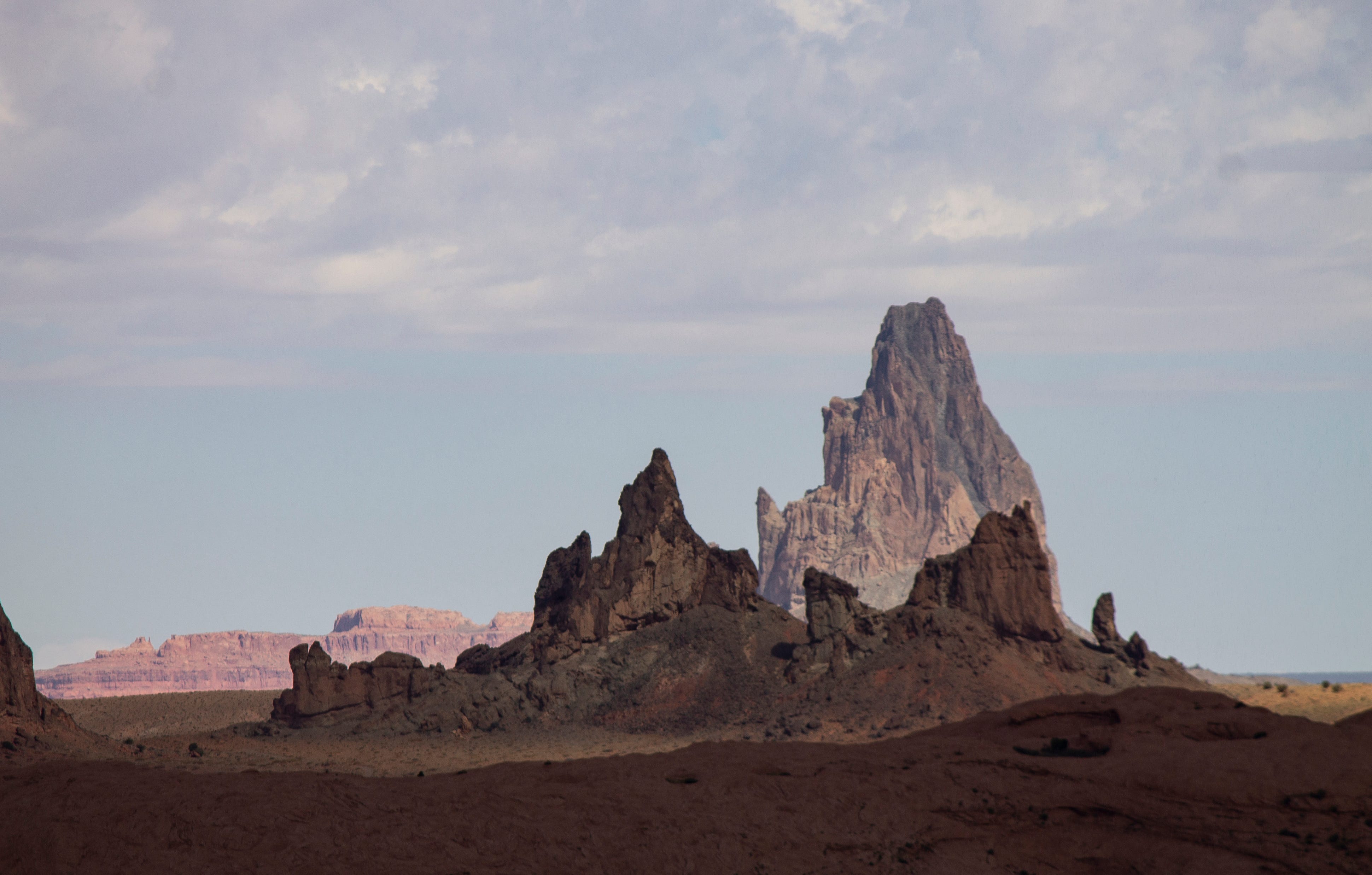
Agathla Peak near Kayenta, Arizona. Jonathan P. Thompson photo.