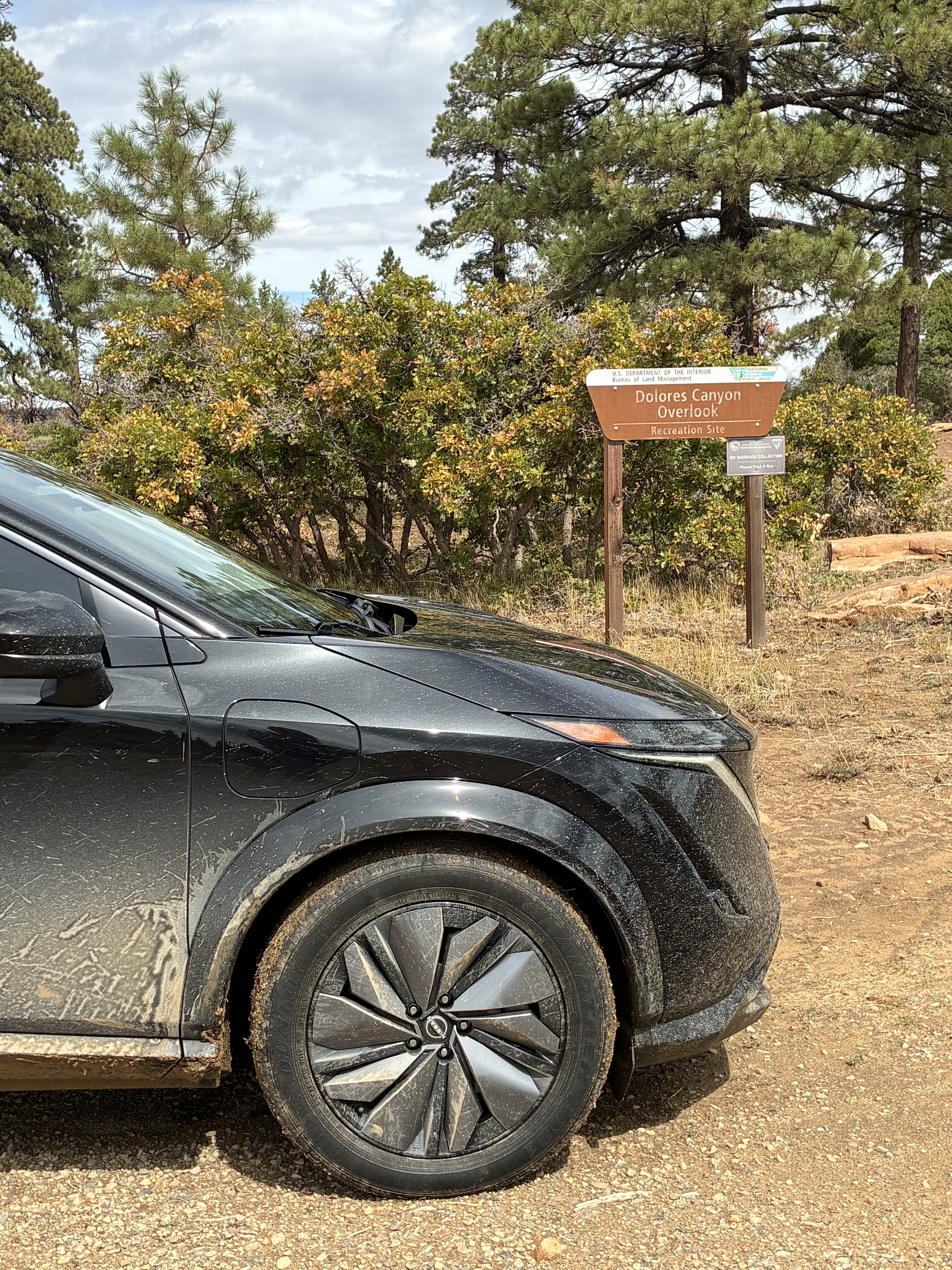
Coyote Gulch’s Ariya at the Dolores Canyon Overlook trailhead September 16, 2026.
Back in the early 2000s the Gulch’s bought a home between Dolores and Cortez in anticipation of retiring to Montezuma County. We rented out the home and 6 acres, carved out of an old apple and pear orchard, to offset the mortgage payment. We’d visit the renters frequently and spend time driving (and 4-wheeling) around the area and one of Mrs. Gulch’s favorite spots was the Dolores Canyon Overlook. For sentimental reasons the overlook was my driving goal on Wednesday.
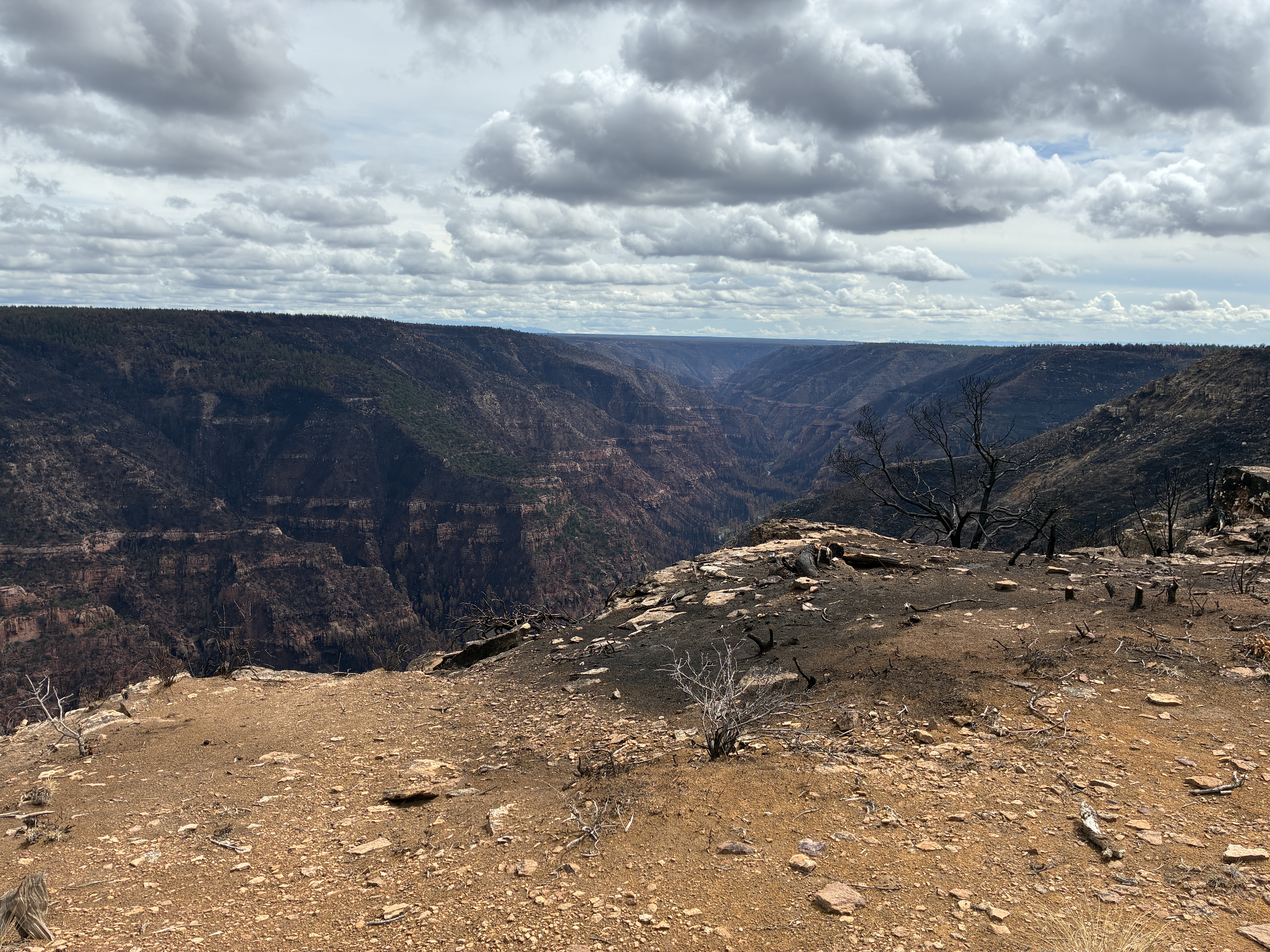
The Dolores River Canyon looking upstream September 2024 from the Dolores Canyon Overlook.
In July of this year the Ferris Fire impacted the area.
The Dolores River Canyon looking upstream September 2026.
You can see the clouds in the sky from the monsoonal moisture yesterday. Rain this week had soaked the area and the road to the overlook was very muddy in spots. I worried about getting stuck as soon as I turned off the gravel road onto the dirt road to the overlook. (Note: The Ariya is all-wheel drive and performed well.) I knew about how road conditions can turn muddy and slippery in the area having once encountered the worst of it, slipping and sliding, from the top of the Uncompahgre Plateau down to the San Miguel River near Uravan. We spent the night in the middle of the road because it was getting dark and I feared sliding off, not being able to see well.
Yesterday, as I was heading to the overlook, I passed a motorcyclist that had lost control in a very muddy section. I stopped to help, as we do out here in the West, and as it turned out, I made a new friend. Anna Odyssey was the motorcyclist, I learned, after helping her get the motorcycle upright on my return from the overlook. She is traveling all over on her motorcycle with no particular end point from day to day, camping most of the time, and stopping to learn about the country she is traveling through. (Click the Facebook link.)
I loved that when we got the Triumph motorcycle upright and ready to ride she asked if there were other difficult sections ahead. Of course there were more puddles and slick spots but I was sure, now that she knew what to look for, that keeping her motorcycle saddle up was possible and probable. She said, “I’m going to leave all my stuff here and go to the overlook, I won’t let this road beat me!”
Welcome to the first edition of the Land Desk’s Newswire, a human-curated summary (we are a non-AI shop, FYI) of some of the week’s biggest headlines that concern land, water, and other Western issues. I’m still working out the timing of this, and how it will meld with the week’s other dispatches, so expect some adjustments in coming weeks. Please give it a gander and, as always, I appreciate your feedback.
🚣🏽 WATER WATCH 🌊
New Mexico officials release about 2,000 acre-feet of water from Abiquiu Dam to provide a temporary un-drying of the Rio Grande’s desiccated riverbed through Albuquerque in an attempt to nourish stressed vegetation, recharge the aquifer, and to study the effects of such pulses. Audubon Southwest leased about 300 acre-feet of the water from various users, the Middle Rio Grande Conservation District contributed 300 acre-feet more, and the Albuquerque Bernalillo County Water Utility Authority provided the remaining 1,400 acre-feet from its share of river imported from the Colorado River Basin via the San Juan-Chama Project. (Inkstain, Laura Paskus, KUNM)
Aurora Water — a municipal utility on Colorado’s Front Range — looks to buy Lower Arkansas Valley farmers’ water rights to feed the city’s future growth, sparking concerns about negative impacts of “buy and dry” deals. But officials say it would be a “buy and (only partially) dry” deal that keeps some of the water in agriculture. (Colorado Sun)
🌵 PUBLIC LANDS 🌲
A new study finds federal land management agencies spent $1 billion less on vendors in Western states in 2025 compared to 2024, acutely affecting the small business sector. Some of the largest cuts were to wildland fire management investments, particularly on-the-ground suppression work as spending was shifted to aerial firefighting. (news release)
Conservation groups file a lawsuit challenging oil and gas leasing on hundreds of thousands of acres of public land in big-game migration corridors and wilderness quality lands in Wyoming and Colorado, saying the BLM violated federal law by skirting environmental protections. (news release)
The Bureau of Land Management seeks public input on 38 proposed oil and gas leases on 66,221 acres in northwestern Colorado that would be auctioned off in March 2027. The bulk of the parcels are under the jurisdiction of the BLM’s Kremmling and Little Snake River field offices, with one in the Royal Gorge office. (news release)
🦫 WILDLIFE WATCH 🦅
Colorado Parks and Wildlife officers euthanize a lethargic and unresponsive 300-pound male bear in Durango, finding that its stomach and intestines were completely blocked with trash. “We’ve all heard the oft-repeated phrase ‘garbage kills bears’ for years,” said Bryan Peterson of Bear Smart Durango. “And many have asked how in the world does trash get bears killed? Well, in many ways, but sometimes literally. Our community’s tepid approach to trash management got a bear killed. Thankfully, its pain and suffering was ended.” (news release)
Colorado Parks and Wildlife officers “lethally remove,” i.e. kill, two male yearling wolves from two separate packs after the animals were linked to attacks on sheep and cattle in Rio Blanco and Pitkin counties. (news release, Summit Daily)
🐮 GRAZING GAZETTE 🥩
A Wyoming advocate shows how the state’s agriculture industry’s resource footprint — in terms of water use for irrigation and land-use for livestock grazing — significantly dwarfs its statewide economic footprint, and that should be considered before giving ranchers outsized political influence. (WyoFile)
🛢️HYDROCARBON HOEDOWN📈
A pair of peer-reviewed studies link Permian Basin oil and gas operations to radioactive plumes and high ozone pollution in Loving, New Mexico, and other nearby communities, potentially increasing lung cancer and other health risks. (Capital & Main)
The Bureau of Land Management and Southern Ute Indian Tribe launch a planning process to guide and analyze oil and gas development on 110,000 acres of tribal trust land within the tribe’s land in southwestern Colorado. (news release)
⛈️ WACKY WEATHER WATCH⚡️
A massive sinkhole emerges in actor Nicolas Cage’s oceanfront house’s drivewayin Malibu, prompting city officials to declare and emergency, evacuate nearby homes, and shut off gas service in the gated community. Officials worry the situation could be worsened by forecasted high tides and rain and long-term weather disturbances resulting from the coming super El Niño. (Los Angeles Times)
🐓 REGULATORY CAPTURE CHRONICLES 🦊
Radical right-wing U.S. Rep. Paul Gosar (R-AZ) and fellow House Republicans launch an investigation of nineteen conservation groups, accusing the entities of profiting at the expense of taxpayers via statutory fee-shifting provisions, which can reimburse the organizations for legal costs when they win in court. (AFP,news release)
🤖 DATA CENTERS 👾
Pinal County, Arizona’s board of supervisors vote to reject Vermaland’s proposed data center complex following widespread local opposition, even though the developer scaled back the original proposal. The scaled-back proposed facility, spread across 3,300 acres, would have included 11 buildings and a gas-fired power plant. (AZ Family)
Tribal nations and Indigenous advocates push back on data center developmentin Arizona, Oklahoma, Nevada, and beyond. (Washington State Standard)
Oracle seeks proposals for the development of 2 gigawatts of new solar, wind, geothermal, or other renewable energy technologies to provide “carbon-free energy matching” for its Project Jupiter data center complex under development in southern New Mexico, which is expected to be powered by gas-fired fuel cells. The firm is also offering $1 million to support carbon capture and sequestration at the facility. (news release, KRQE)
Creekstone Energy, the developer of the massive Delta Gigasite data center in central Utah, looks to use untested technology to “create” more water than it uses by capturing condensation from natural gas combustion at the plant dedicated to powering the facility. (Salt Lake Tribune)
Arizona Gov. Katie Hobbs (D) opposes Attorney General Kris Mayes’ call for a pause on new data centers to get a better handle on their water and energy use, acknowledging the concerns are valid but saying a statewide moratorium is the wrong approach. (AZ Family)
A peer-reviewed study finds that data centers, which typically combine large capital investments with little local labor demand, can strain a community’s public infrastructure without generating widespread economic gains. (SSRN)
🔋ENERGY TRANSITION 🔌
Officials and residents of the Coalmine Canyon Chapter of the Navajo Nation push back against 750-megawatt solar-plus-storage installation in northern Arizona, saying the developers have been less than transparent and the power will not go to local homes, many of which are off the grid. (High Country News)
Accelergen Energy proposes a 125-megawatt solar-plus-storage installation on about 900 acres east of Cortez, Colorado. (Durango Herald)
A new study finds small-scale, front-of-the-meter solar-plus-battery installationscould serve about 32% of California’s largest utilities’ peak summer electricity demand; analysts say developing this asset would improve reliability and preserve affordability without significant transmission upgrades. (Utility Dive)
📈 DATAVIZ OF THE DAY 📊
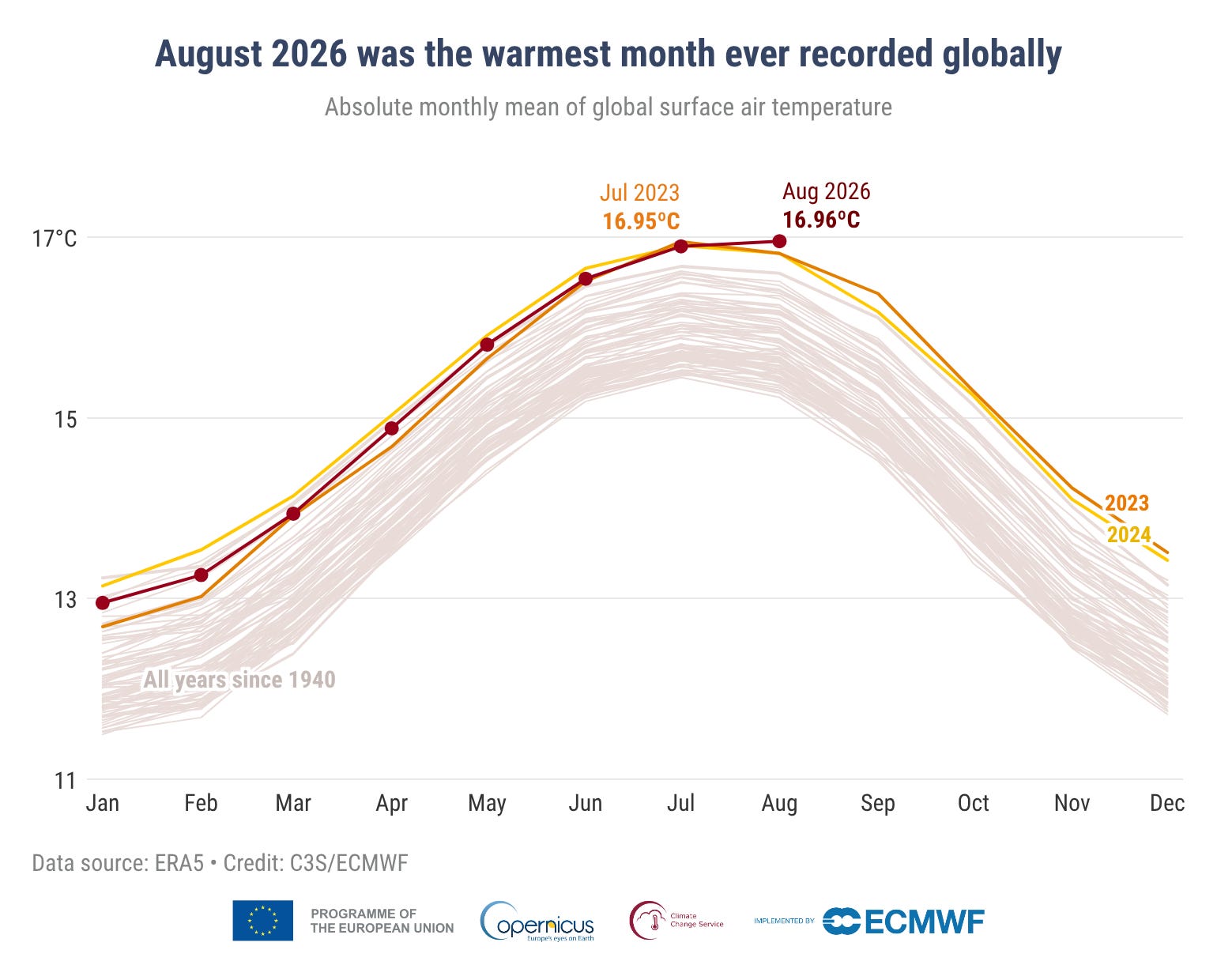
The stats for August are in and, well, it was a warm one. This August was the hottest August on record for the contiguous United States, as well as for many counties in the Southwest. It was also the hottest month on record globally, barely edging out July 2023 for the dubious honors.
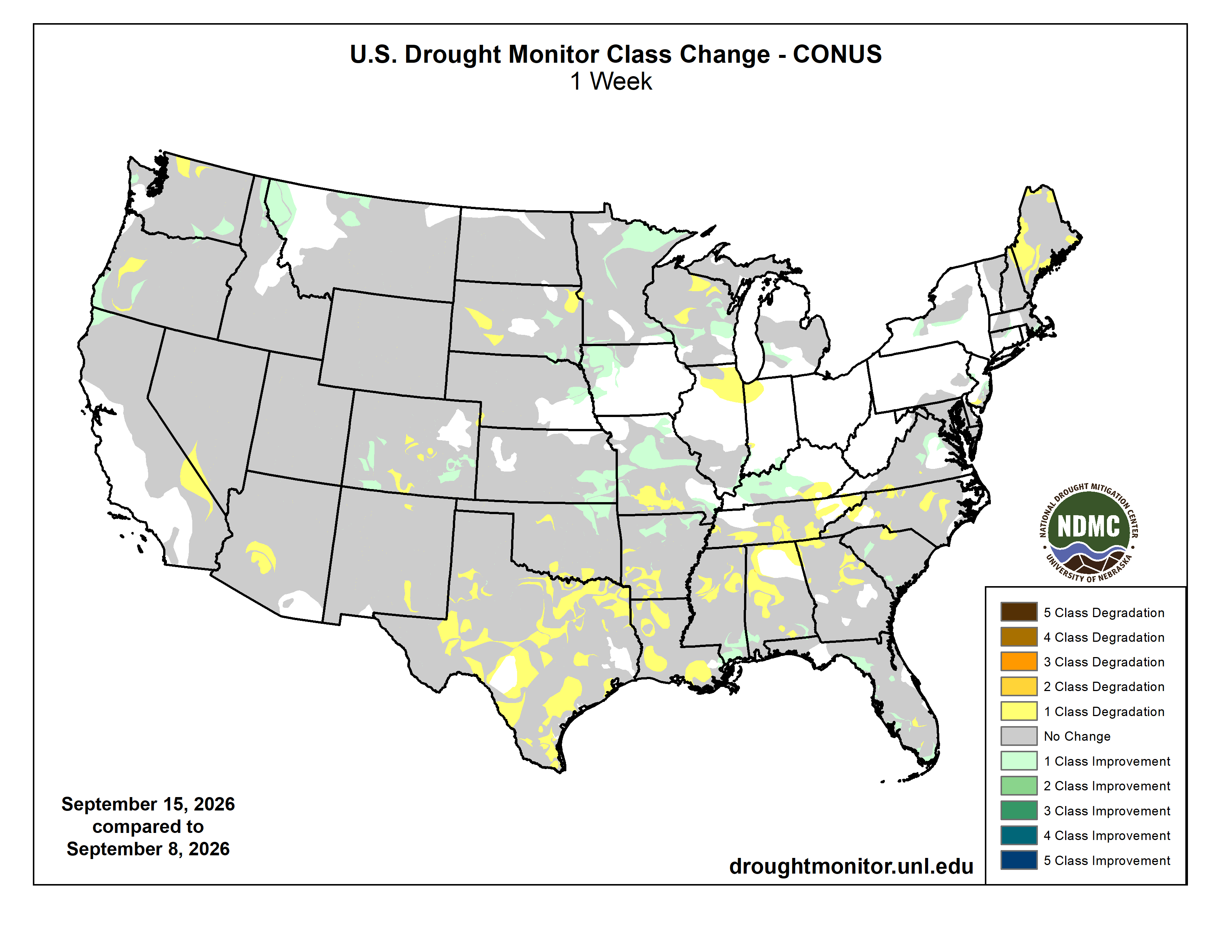
Last week, there were several areas that had significant rainfall amounts. One area was over Iowa, eastern Nebraska and Kansas, and northwest Missouri, where more than 4 inches fell in central Iowa and southeastern Kansas. Another area was centered over Ohio, West Virginia, and western Pennsylvania, where conditions were already wet. Much of Florida and the Gulf Coast received 2 to 4 inches of precipitation in the past week. Most of the southwest U.S. received little rain, with exceptions of scattered monsoonal precipitation along the New Mexico-Arizona border. Most of Texas and Oklahoma continued to be dry, as was the majority of the western Great Plains.
Temperatures in the southern Great Plains and lower Mississippi valley continued to be very warm, in some locations over 10F above normal. Most of the rest of the continental U.S. was also above normal. The only areas with below normal temperatures for the past week were in northern New England as well as most of the northwest states…
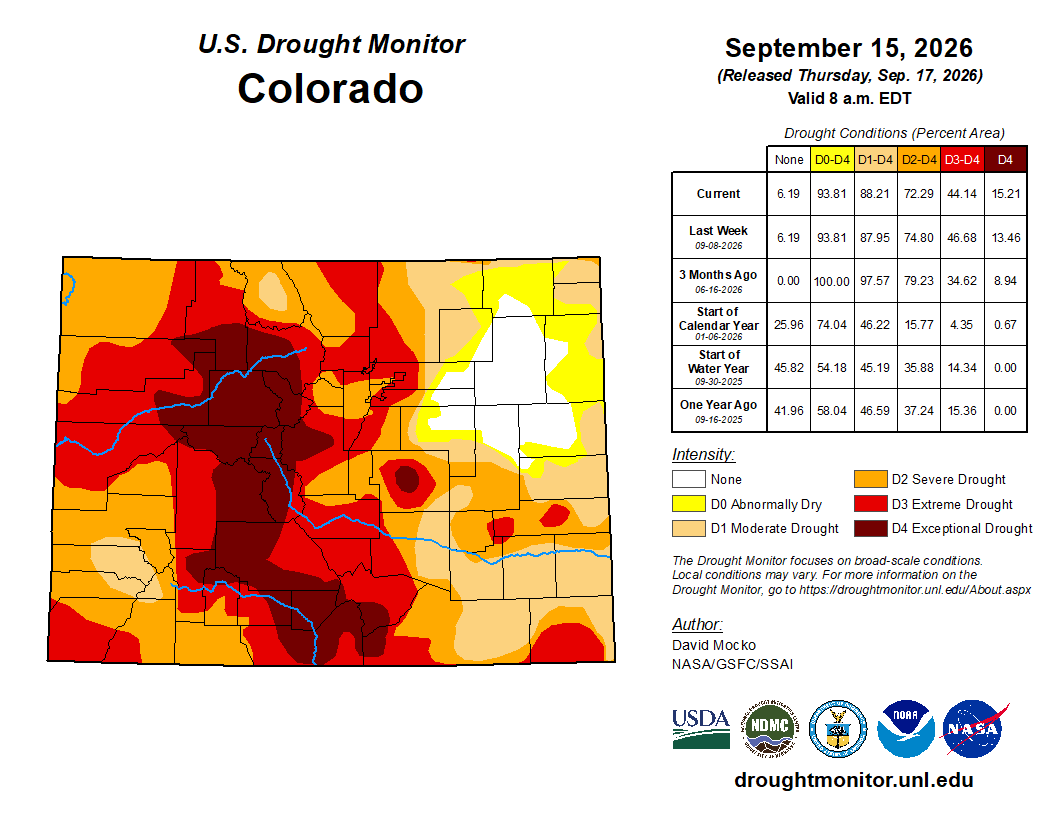
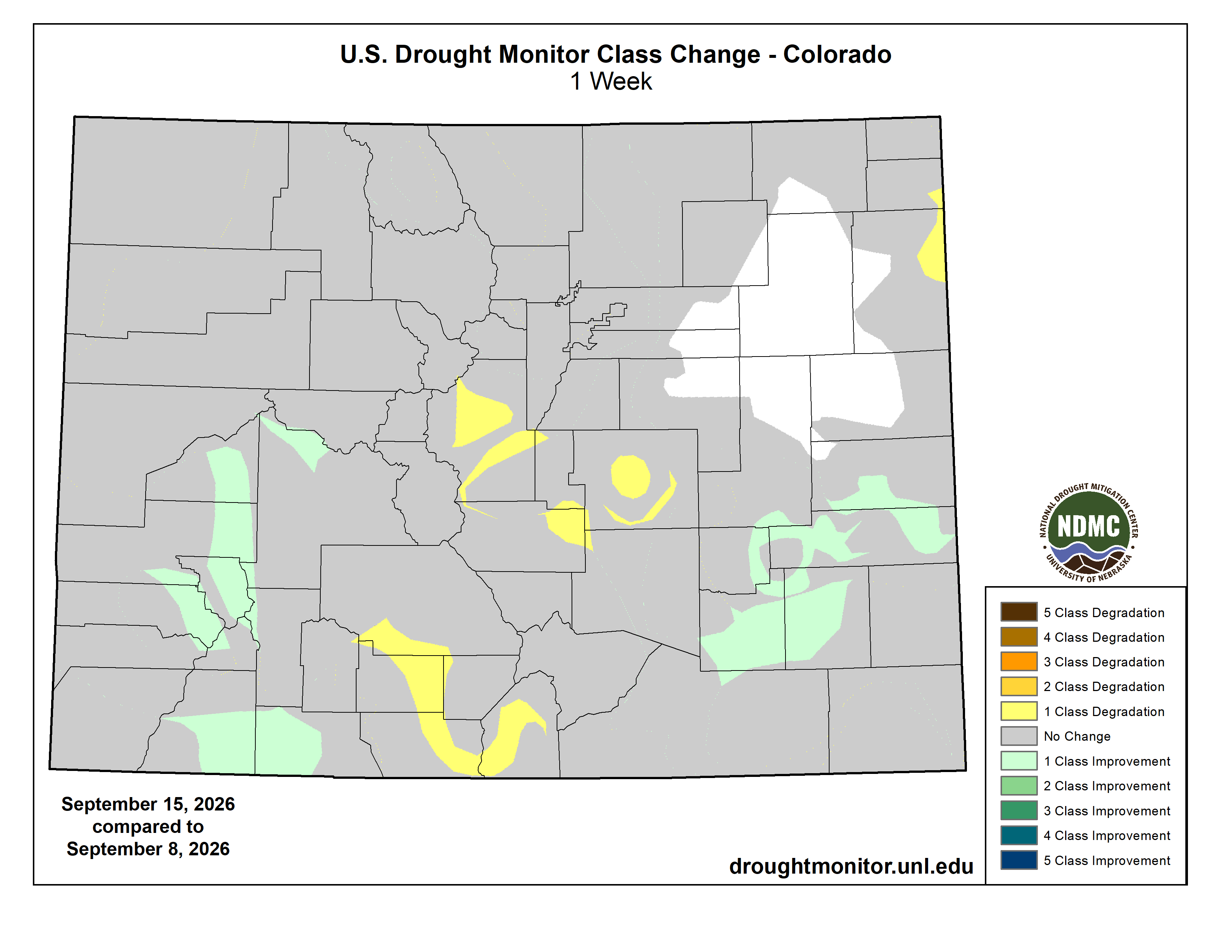
Eastern Kansas had above normal precipitation over the past week; this led to improvement in drought conditions in this area. Eastern Nebraska and eastern South Dakota also had decent rainfall and resulting improvement to drought. Other areas of South Dakota that missed out on the rain had drought degradation. Colorado had drought degradations in the center part of the state, with drought improvements in both the southwest and southeast parts. Extreme drought continues over much of Colorado and Wyoming, western Nebraska and the Dakotas, and in eastern North Dakota. Exceptional drought is observed over much of central Colorado as well as two localized areas in far western Nebraska…
Drought Monitor one week change map ending September 15, 2026.
An area from southwestern Oregon to central Washington into northern Idaho and Montana received some welcome rainfall during the week. The rain resulted in regional improvements in drought conditions. One location that just missed out was in northwest Washington on the Canadian border, resulting in a drought degradation, where continued low streamflows were observed. There were also areas on the California-Nevada border and central Arizona with drought degradation that also received little-to-no rainfall. Extreme drought is shown over much of central Oregon, central Utah, southern Idaho down into northern Nevada, and small areas in northern Washington and southern Arizona. Exceptional drought continues in southern Idaho, northern Nevada, and northeastern Oregon…
Extremely above normal temperatures continued in this region over the past week. Nearly all locations had drought deterioration, with the exceptions of northern Arkansas, northeastern Oklahoma, and coastal Mississippi. Much of Texas and into the Ark-La-Tex area experienced flash drought conditions. In addition to the heat, these areas received little rainfall in the week. Extreme to exceptional drought conditions are noted in far south Texas, most of northern Texas into western and southern Oklahoma, northwestern and northeastern Arkansas, and along the Arkansas-Mississippi border…
Looking Ahead
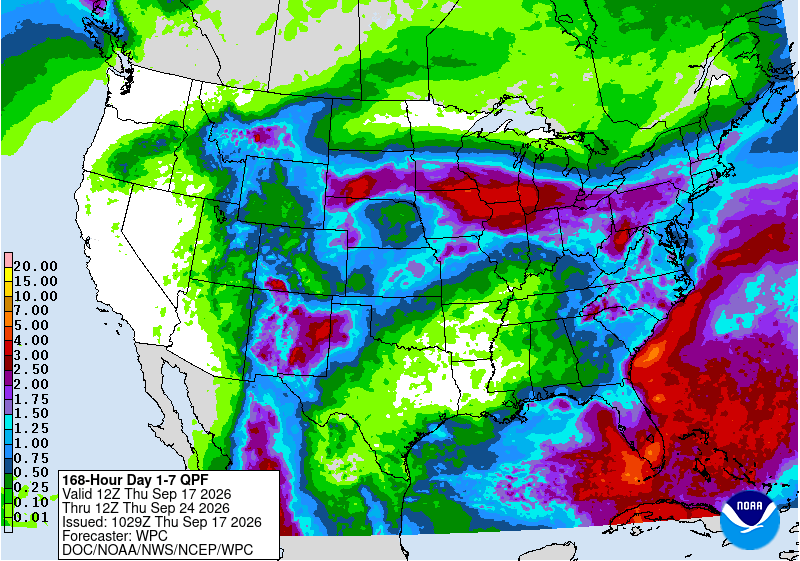
Over the next five days leading up to next Tuesday, above normal rainfall is forecast in south Florida as well as a large area in southern Wisconsin and Minnesota into eastern Iowa and northern Illinois. The latter area of forecasted rainfall continues to the east through central Michigan, the southern Great Lakes, Pennsylvania, New York, and much of central and southern New England. Other locations with rainfall in the forecast this week are in the Appalachian Mountains, the western Great Plains, and the Four Corners states. Unfortunately, most of Texas, Oklahoma, Arkansas, Louisiana, Mississippi, and Alabama are forecast to receive little rainfall. Dry conditions are also forecast in California, Nevada, and Washington. Much above normal temperatures are forecast to continue this week in the central and southern U.S.
The 6- to 10-day outlook (September 22-26, 2026) favors above normal temperatures continuing over nearly all of the continental United States. Areas most likely to be above normal are again the south into the southeast, plus the far north. Hawaii is also likely to be above normal. For precipitation, the Eastern Seaboard is likely to have above normal rainfall as is the Southwest. The central U.S. into the upper Midwest is likely to have below normal rainfall. Hawaii and Alaska are both likely to have above normal rain during this period.
US Drought Monitor one week change map ending September 15, 2026.