Anadarko announces expectations for Niobrara shale play: Results from eleven wells fuel 160 well drilling program for 2012

niobrarashale.jpg

From The Wall Street Journal (Russell Gold):

Echoing industry concerns, Mr. Hackett said he is worried that anti-drilling sentiment could prevent the projected expansion. The energy industry’s use of hydraulic fracturing, in particular, has prompted concerns about pollution; the federal government and several states are studying whether new regulations on water use and air emissions are needed…

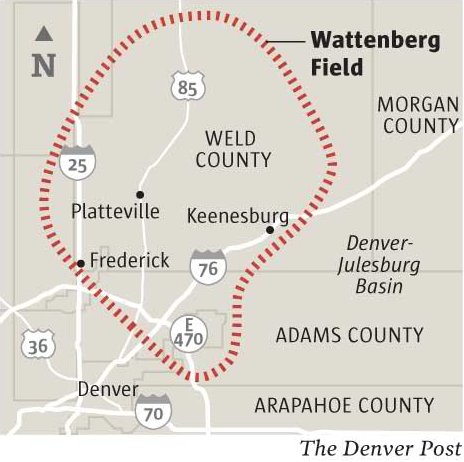
Anadarko on Monday said that results from 11 recent wells in the Wattenberg field have given it confidence that it can drill between 1,200 and 2,700 wells in northeast Colorado. It plans to drill about 160 wells next year. Based on its early results, it expects its wells will ultimately yield between 500 million and 1.5 billion barrels of oil, natural gas liquids, and natural gas. Finding a billion barrel field is extremely rare. Only a handful of billion barrel fields have ever been found in the U.S…

Recently, companies such as Anadarko and Carrizo Oil & Gas Inc. and Noble Energy Inc. have been applying horizontal wells and hydraulic fracturing in the Wattenberg, breathing new life into the field and leading to a reappraisal of its future oil and gas potential. Anadarko says it expects its production from the region to grow at a compound annual rate of 20% between 2010 and 2012. It produced about 72,400 barrels of oil equivalents there in the last quarter.

The company also said it plans to evaluate whether new technologies can be used to extend the discovery farther north into Wyoming where recent drilling results are more hit-and-miss. Some well results have been quite good, but others have not found enough oil or gas to be considered commercial successes.

Here’s a release from Governor Hickenlooper (Eric Brown/Megan Castle):

Gov. John Hickenlooper released this statement today after Anadarko Petroleum Corp. announced it plans to add more than 1,200 drilling locations in the Wattenberg field in northeastern Colorado:

“Anadarko’s announcement today shows once again that Colorado is a leader in the energy sector of our country’s economy. We are thrilled to see the company plan a significant investment in Colorado. This expected growth will create jobs and make more revenues available to local communities. We look forward to supporting Anadarko, its workforce of 1,000 people already here and the thousands of contractors it hires throughout the state.

“We also continue to work proactively to maintain the highest safety and environmental standards for oil and gas companies in Colorado, while also cutting permit times and making it easier and more predictable to develop natural gas and oil here. Anadarko’s future expansion in Colorado, on top of our effort last week to launch a multi-state initiative aimed at developing natural gas-fueled vehicles, is further evidence that Colorado is at the center of energy development in this country.”
wattenburgfieldoilplay.jpg

More coverage from Mark Jaffe writing for The Denver Post. From the article:

“This is going to have huge implications for the economy of Colorado,” said Pete Stark, vice president for industry relations at IHS, a Denver-based consulting firm. A reserve that size could generate 150,000 barrels a day and, assuming oil is $80 a barrel, provide more than $4 billion in annual revenues, Stark estimated. The total value of goods and services produced in the state in 2010 was $235.15 billion…

Anadarko’s wells had initial production averages of 800 barrels a day — with the best well producing 1,100 barrels a day. The wells were drilled in the Niobrara formation, which is more than 6,000 feet deep and runs from El Paso County to the Wyoming border…

Anadarko said it also found oil in the neighboring Codell formation…

The Anadarko estimate is just for the 100-square-mile Wattenberg Field, which includes Weld County and small parts of Adams, Broomfield, Boulder and Larimer counties. Anadarko is also doing exploratory drilling in Arapahoe County, and Chesapeake Energy has filed plans to drill in Elbert and Douglas counties. Ultra Petroleum is set to drill exploration wells in El Paso County.

More coverage from David O. Williams writing for the Colorado Independent. From the article:

Groups like Clean Water Action have been actively campaigning ahead of a new boom in the Niobrara formation, which stretches from Denver to Wyoming along the densely populated Front Range of Colorado. An official for the group on Monday called Anadarko’s announcement a “mixed bag” of economic benefit and potential pollution.

CWA’s biggest concern? Hydrayulic fracturing, or fracking, which injects millions of gallons of water mixed with sand and undisclosed chemicals under high pressure into natural gas and oil wells to break up tight geological formations and free up more oil and gas.

“What does fracking bring to communities where wells are drilled?” Clean Water Action asks on its website. “Fracking brings wells 200 feet away from the backyards and parks where our children play. It brings water and air pollution from wells and open chemical pits, wastewater laced with toxins, and soot from hundreds of construction vehicles. Fracking brings new gas and income to the communities, but at what cost?”[…]

There has been a growing debate over local control versus state authority versus federal oversight of the oil and gas industry. Cory Gardner, the Republican congressman who represents Colorado’s 4th Congressional District, including Weld County, has consistently tried to strip away the authority of the U.S. Environmental Protection Agency (EPA) since being elected last year. Anadarko has contributed to Gardner’s election campaigns.

More coverage from the Financial Times (Ed Crooks):

High quality global journalism requires investment. Please share this article with others using the link below, do not cut & paste the article. See our Ts&Cs and Copyright Policy for more detail. Email ftsales.support@ft.com to buy additional rights. http://www.ft.com/cms/s/0/cc4055bc-0f17-11e1-b585-00144feabdc0.html#ixzz1dnnG2FXq

Chuck Meloy, the company’s senior vice-president for worldwide operations, said the discovery was “located right in the heart of one of our existing core areas”. Anadarko and its predecessor companies have been operating in that part of Colorado for more than 30 years but until now had used only vertical wells. This year, it began using horizontal wells, which bend and extend laterally away from the rig. Coupled with hydraulic fracturing – pumping water, sand and chemicals into the well at high pressure to crack the source rock – horizontal drilling is enabling production at commercially viable rates from oil and gas reserves that were previously uneconomic…

High quality global journalism requires investment. Please share this article with others using the link below, do not cut & paste the article. See our Ts&Cs and Copyright Policy for more detail. Email ftsales.support@ft.com to buy additional rights. http://www.ft.com/cms/s/0/cc4055bc-0f17-11e1-b585-00144feabdc0.html#ixzz1dnnObQLd

Mr Meloy said Anadarko expected the field “to quickly become a self-funding, significant cash flow generator.” With US crude prices at about $98 per barrel and gas prices at less than $3.50 per million British thermal units – less than a quarter of the price of oil for the same energy content – liquids production is much more commercially attractive.

More coverage from Cathy Proctor writing for The Denver Business Journal. From the article:

“We’re very excited by what we see in the horizontal activity that we’ve had to date,” said John Christiansen, a spokesman for Anadarko (NYSE: APC), in an interview…

“Everything you could possibly want in a play — this has it. It’s great news for us and for Colorado because it’s going to generate a lot of activity and investment for a number of years,” Christiansen said.

More oil and gas coverage here and here.

The Rocky Mountain Farmers Union is hosting a discussion of oil, gas, and water issues November 15 in Elizabeth

marcellushydraulicfracturing.jpg

From email from the RMFU:

The Elbert/Lincoln Farmers Union and FUSA Insurance agents Teri Coulter, Kyle Bradley, and Ian Kean invite interested public to participate in a discussion of the effect of oil and gas development on water rights and quality.

The gathering will be on Tuesday, November 15, at the Creekside Community Church, 36100 County Road 13 in Elizabeth. The meeting is scheduled for 6:30-8:30 p.m. Special guests will be Colorado Representative Marsha Looper and Jill and Jim Duvall, coordinators of the Elbert Oil and Gas Interest Group.

The meeting is open to the public.

More oil and gas coverage here and here.

The Woodmoor Water and Sanitation District October 17 board meeting — lots of questions about the JV Ranch purchase

denveraquifer.jpg

Here’s the link to the Q&A session at the meeting. Here’s an excerpt:

Why did the Board decide on revenue bonds instead of voter-approved general obligation bonds?

Through several meetings with the JV Ranch sellers, the District and the Sellers negotiated the terms and conditions of the contract. Throughout that process the District determined that the Sellers would not enter into a contract with Woodmoor if the sale was contingent on a general obligation bond vote. Ultimately, the Board has the authority to issue revenue bonds and set rates to repay those bonds. The Board, when presented the merits and value of the JV Ranch, decided to proceed with revenue bonds in order to finalize the purchase of this unique asset for the District.

What is the timeline and current cost estimates for delivery of the JV Ranch water?

Phase I of Woodmoor’s Renewable Water Plan is to acquire the renewable water asset. Until the District is ready to embark upon construction of the delivery infrastructure, the JV Ranch will continue to operate as a cattle ranch. It is critical for Woodmoor to own and control its renewable water rights, and acquiring senior renewable water rights has always been the Board and staff’s first priority.
After the District closes on the JV Ranch water rights and completes the necessary water court processes, the water rights will be available for the District to use. The District will continue to refine all available options for the infrastructure portion of its Renewable Water Plan. These options include pump stations, pipeline and water-treatment facilities. This infrastructure can be viewed as Phase II of our plan.

The District staff anticipates updates to the Long Range Planning documents in 2012 that will continue to explore and evaluate all options and alternatives available for delivering the JV Ranch water to our customers. Some of the alternatives to be evaluated will include continued discussions with neighboring water districts and entities including Colorado Springs Utilities (CSU) to share in the cost of water delivery, storage, and treatment facilities or the potential to utilize CSU infrastructure for water delivery instead of Woodmoor constructing the necessary infrastructure on its own.

Cost estimates for water delivery have ranged from $30 million to over $100 million. At this point, it would be premature to assign any further cost estimates to Phase II. Every option that is evaluated during current and future planning processes will have specific costs, benefits, and drawbacks. The Woodmoor staff will perform the same level of diligence for this planning as it did on the JV Ranch water rights to ensure that District customers are provided with the most cost effective and reliable option for its renewable water infrastructure. Current estimates for when Phase II would be needed indicate sometime between the years 2020 and 2030.

What happens if the water court does not approve the transfer of water from agricultural use to municipal use?

Changes of water rights have been denied by the water courts only if the applicant does not have actual end users for the water or if the water rights proposed to be changed have not been historically used for their decreed purposes. The District has end users for the water – its customers – and the District’s due diligence has confirmed that the JV Ranch water rights have historically been used for their decreed agricultural purposes. In addition, the historical use of the majority of the JV Ranch water rights has already been quantified in previous water court proceedings. Under these circumstances, it is not likely that the water court would completely disapprove the transfer of the water rights from agricultural use to municipal use. However, if that were to occur, the District would take the steps needed to remedy any deficiencies noted by the water court and then file another application to change the water rights.

What is the reliability and quality of the water from JV Ranch?

The JV Ranch water is diverted from Fountain Creek, south of Colorado Springs. The District and its water quality consultants have reviewed the water quality along Fountain Creek and have determined that treatment technology is available to treat this water to meet all State and Federal drinking water regulations.

More Denver Basin aquifer system coverage here and here.

Colorado Geological Survey: Studies shed new light on Denver Basin groundwater

denveraquifer.jpg

Here’s the release from the Colorado Geological Survey (Vince Matthews):

The Colorado Geological Survey has released three significant new reports on ground water in the Denver Basin. The reports, representing more than a decade of research, provide the most detailed information yet on the varied distribution of groundwater in the Denver Basin and show the most productive aquifers are concentrated near the mountain front and diminish to the east.

All three publications document in different ways that the strata from which many of the people living along the southern Front Range obtain their groundwater, are highly variable. Together, they present a science-based perspective of the complex geometry of the freshwater-bearing strata which resulted from a dynamic geologic history. This new perspective shows a non-uniform distribution of strata with favorable aquifer characteristics across the basin. Because of the way the strata formed, the thickest and most productive sandstones concentrate near the mountain front and diminish to the east.

The reports will help regulators, modelers, consultants, policymakers, and planners better understand the variability of water productivity in the Denver Basin, a major source of water supply for populous regions south of Denver. One of the publications is the result of a collaborative effort with the Denver Museum of Nature & Science (DMNS).

The first report; Geology of Upper Cretaceous, Paleocene and Eocene Strata in the Southwestern Denver Basin, Colorado; is a compilation of more than 1000 square miles of surface mapping of the aquifers where they are exposed along the mountain front. The mapping was originally carried out at a scale of 1:24,000 and is compiled into a 1:50,000 map consisting of two plates. This compilation also presents a simplified naming classification for the geologic strata of the Denver Basin.

The second report; Bedrock Geology, Structure, and Isopach [thickness] Maps of the Upper Cretaceous to Paleogene Strata between Greeley and Colorado Springs, Colorado; takes what was learned by mapping at the surface and extends it into the subsurface using data from nearly 3,000 wells. This report was a collaborative effort with DMNS, whose personnel also spent more than a decade independently working on the strata in the Denver Basin. The report contains seven maps that illustrate the thickness, depth, and distribution of the various freshwater-bearing strata in the Denver Basin. It also contains a depth map to the Niobrara formation, and a thickness map of the Pierre shale that separates the Niobrara from the freshwater aquifers. An additional three maps of ancient landscapes illustrate why the sandstone aquifers are concentrated near the mountain front. Included with this report is an illustrative poster that explains the various environments within which the strata were deposited. The poster is also sold separately.

The third publication; Cross Sections of the Freshwater Bearing Strata of the Denver Basin between Greeley and Colorado Springs, Colorado; contains four north-south, and eleven east-west, detailed cross-sections of the strata in the Denver Basin. These cross- sections integrate surface geologic mapping with subsurface well data to graphically illustrate variability in the types of strata across the entire basin. This report is oriented toward the professional community, rather than the general public.

All three publications come in hard copy and include DVDs with detailed PDFs of the plates and GIS shapefiles containing metadata. The publications can be ordered from the Colorado Geological Survey at 303-866-2611 or in the online bookstore at http://geosurveystore.state.co.us/.

More coverage from Chris Woodka writing for The Pueblo Chieftain. From the article:

A new study by the Colorado Geological Survey and U.S. Geological Survey shows the Denver aquifers are thinner and less tributary than previously thought. At the same time, energy exploration is skyrocketing in the Niobrara formation, which runs through the geologic heart of Colorado. The fastest-growing areas of the state are located over the Denver Basin aquifers and their water supplies tap into what was thought to be a vast supply that would last 100 years into the future.

“This study is alarming because what we believed about aquifers for the last 20, 30, 40 years has been shattered,” state Rep. Marsha Looper, R-Calhan, told the Arkansas Basin Roundtable Wednesday. “The study of the geology showed the reservoirs are not as thick and deep as we thought.”[…]

Looper plans to introduce legislation to study how much water is available in the Denver Basin aquifers, rather than relying on past estimates that now may be inaccurate. “I want to take the Colorado Geological Survey study a step further and study how much water there actually is in the Denver Basin,” Looper said. “I plan to introduce a bill, but I want to work with the roundtable to take a bottoms-up approach to the issue.”

More coverage from Bob Berwyn writing for the Summit County Citizens Voice. From the article:

The reports compile more than a decade of research and provide the most detailed information to-date on the the distribution of groundwater, representing crucial information for water managers and land-use planners in the semi-arid region. Together, they present a science-based perspective of the complex geometry of the freshwater-bearing strata which resulted from a dynamic geologic history.

This new perspective shows a non-uniform distribution of strata with favorable aquifer characteristics across the basin. Because of the way the strata formed, the thickest and most productive sandstones concentrate near the mountain front and diminish to the east.

The reports will help regulators, modelers, consultants, policymakers, and planners better understand the variability of water productivity in the Denver Basin, a major source of water supply for populous regions south of Denver. One of the publications is the result of a collaborative effort with the Denver Museum of Nature & Science.

More Denver Basin Aquifer System coverage here and here.

Colorado Springs Utilities unveils $87 million budget increase, the Southern Delivery System causes 12% increase in water rates

southerndeliverysystemconstructioncelebration08192011.jpg

From The Colorado Springs Gazette (John Schroyer):

Utilities’ budget is projected to jump by 8.6 percent in 2012, an increase made possible by a 12 percent increase in water rates, a 5 percent increase in natural gas rates, and about a 1 percent increase in electricity rates.

Roughly three-quarters of the $87 million will be devoted to SDS work, and the remainder will go to other projects, such as the installation of new emissions-cleaning technology at Drake Power Plant, said Utilities Finance and Planning Chief Bill Cherrier.

The 187-page budget, which the Utilities Board is analyzing, also predicts that water, electricity and natural gas usage will remain flat throughout 2012. Hence the need for the rate increases. The budget likely will be approved by the board, comprised of City Council members, in December without any substantive changes…

Utilities plans to spend $333 million on coal and natural gas to power both Drake and other power plants, and will spend $310 million on capital projects, such as SDS. “That’s more than 60 percent of our budget,” Cherrier pointed out.

Water rates will continue to increase by 12 percent every year until SDS is completed, which is slated for 2016. After that, Cherrier said, rates should even out, and may even decrease. Utilities board and city council member Tim Leigh suggested Colorado Springs may even become a water broker for other Front Range municipalities once SDS is finished. “Not everyone has a pipeline to the Arkansas River,” Leigh said.

More Southern Delivery System coverage here and here.

Colorado River basin: More storage, more growth or a commitment to conservation and preservation?

coloradoriverbasin.jpg

The Pueblo Chieftain ran three columns in yesterday’s edition. First up is Chris Woodka’s musings about the river, preservation and growth in the West. Here’s an excerpt:

Back in 1974 [ed. during a rim to rim hike of the Grand Canyon], my young mind didn’t quite grasp that the pristine river I enjoyed so much was a product of timed releases between Lake Powell and Lake Mead. I did understand enough to know the beautiful canyon walls and mesas were the product of millions of years of relentless, unchecked erosion. Those kind of thoughts were running through my head the other evening as I sat in the Cornerstone Arts Center Celeste Theater in Colorado Springs listening to two legal experts tangle over the worthiness of the Colorado River Compact in a changing world…

The irony of talking about Colorado River issues in a city 80 percent dependent on Colorado River water brought over the Continental Divide did not escape me — you learn to think like this as a water reporter…

One of the speakers, Colorado Supreme Court Justice Gregory Hobbs, took the point of view that more storage is essential to continued enjoyment of the benefits of the Colorado River. Hobbs argued that building more projects along the Colorado River is not only probably, but necessary and desirable. “It’s high-risk water, but it’s going to be there in some years,” Hobbs said. “We can’t just pretend we don’t need more storage and risk drying up all the agricultural land.”

The other speaker, University of Wyoming legal professor Larry MacDonnell, argued that it’s time to start folding up the tents because the Colorado River basin is running out of water. Climate change is going to increase the pressure on the river’s resources. It’s foolish to try to develop any more, he argued. “Is this a sensible use of water?” MacDonnell asked, after listing several projects he considered folly. “In compromise, projects have been built that waste water.”[…]

The states along the Colorado River need to weigh how much more the river can deliver to avoid gobbling up more farm land in the support of growth. The preservation of its awesome beauty should be a major focal point. A frank discussion could lead to surprising conclusions about conservation, growth, land use and, ultimately, the storage of water that makes all that possible.

Meanwhile, Aaron Million’s column talks about developing the water left under the Colorado River Compact and Upper Colorado River Compact for the benefit of Colorado. Here’s his guest column from The Pueblo Chieftain. Here’s an excerpt:

The Upper Basin has over-delivered this region’s water supplies to the Lower Basin in every 10-year running average. Those waters are allocated to the Upper Basin. Why does it matter?

The Upper Basin has major natural resource concerns directly related to diminished water supplies and future increasing demands. Why not consider the Flaming Gorge Project? As a proponent of the project and the principal architect, I’m not afraid of an in-depth, critical environmental review…

…half the Upper Basin has moved forward to develop the supplies that the historic agreements gave to them. Both New Mexico, arguably up against that state’s compact allocation, and Utah, via the Lake Powell Project, have moved toward developing their respective water resources. Colorado and Wyoming need to do likewise. A new water supply would alleviate a myriad of environmental and socio-economic pressures throughout the region, allow aquifers to replenish, protect and enhance flows for use in agriculture, provide for the huge shortfall projected in municipal supplies and add huge new storage capacity with the addition of Flaming Gorge and other new reservoirs along the route. Preliminary scientific data indicates major water surpluses and supplies are available in the Green River-Flaming Gorge system to help alleviate pressures in water-short areas elsewhere, from Cheyenne to Pueblo. And the project, projected to move about 200,000 acre-feet, would take pressure off of western Colorado watersheds…

The build-out cost for this project is about $3 billion — one third of Western Resource Advocates’ estimate. How do we know its $3 billion and not $9 billion? Because we asked several nationally recognized pipeline and construction firms to give us estimates…

This state needs and deserves a straight-up evaluation of the Flaming Gorge project. The scare tactics of the environmental community are sophomoric, unnecessary and will not serve the interests of this region. Why not allow the project to be fully vetted? It’s currently in the federal environmental review process.

Finally, here’s Western Resource Advocates’ Karn Sheldon weighing in on the project from The Pueblo Chieftain. She writes:

Western Resource Advocates wants to see a water supply that sustains urban, agricultural and environmental needs. We want water that is affordable and reliable for all Coloradans. While The Pueblo Chieftain may disagree with our assessment that the Flaming Gorge Pipeline proposal is an implausible illusion (“Strange priorities,” 10/14/11), there are several important facts that should not be confused with opinion:

– The pipeline proposal would annually move 80 billion gallons of water 500 miles up and over the Continental Divide, from the Green River in southwestern Wyoming to Colorado’s Front Range. State agencies estimate the cost of the plan at $7 to $9 billion, which would make this the most expensive water in Colorado history. To put that into perspective, the most costly recent water project completed in Colorado is Aurora’s “Prairie Waters,” with a price tag of about $700 million.

– According to The Chieftain, “there is growing support for the pipeline in both Wyoming and Colorado.” But all available evidence indicates exactly the opposite. A statewide poll released in September by Trout Unlimited showed that 79 percent of Wyoming residents oppose the pipeline. “It makes perfect sense to me that so many people in Wyoming oppose this project,” said Wyoming Gov. Matt Mead, who has also said that the plan is “not well thought-out.” Sweetwater County Commission member John Kolb called it “a sham.”

– Million has tried to reclassify his pipeline plan as an energy project in order to find a federal agency that will agree to give him a permit. Million claims that the pipeline would generate 550 to 1,000 megawatts of hydroelectric power, but by first moving water over the Continental Divide, the pumping stations would consume more energy than they could generate.

More Flaming Gorge pipeline coverage here and here.

Woodmoor Water and Sanitation District rate-payers are worried about the district’s debt load

denveraquifer.jpg

From the Tri-Lakes Tribune (Lisa Collacott):

During the Oct. 17 meeting board members voted unanimously to purchase the ranch east of Fountain Creek. It is estimated that the cost of the ranch’s decreed water rights — 3,500 acre-feet annually — will range between $25 and $31 million. More than 100 residents attended the meeting and many were in opposition to the purchase of the ranch.

Woodmoor resident Bob Gountanis agrees that the water district needs to look at renewable water but is opposed to this particular decision. “I think the idea is OK, but the way they went about it is not,” he said. Gountanis said there is not a contract to convert the water from agricultural use to commercial use and there are no estimates on how much it will cost to deliver the water up to Woodmoor.

The water district hosted three public meeting — Sept. 27, 29 and Oct. 8 — to discuss the need for renewable water and the impact it will have on customer’s water bills. Jessie Shaffer, general manager for the water district, said the expected cost for the ranch is expected to be between $25 and $31 million but that is dependent on the water rights that are still to be determined in water court. The cost of delivery is estimated to be between $30 and $100 million.

The water district is looking at a 25-year revenue bond to pay for the purchase of the ranch. The average homeowner will see a $48.50 water investment fee beginning in January 2012 which comes out to an increase of $600 per year. Gountanis said an extra $600 a year may not seem like a lot to some people, however it is a lot for families who are having a tough time because of the economy.

More Denver Basin Aquifer System coverage here and here.

Flaming Gorge pipeline: FERC accepts the Million Resource Group’s application which opens a sixty day comment period

pumpedstoragehydroelectricschematic.jpg

From the Associated Press (Ben Neary) via The Columbus Republic:

The Federal Energy Regulatory Commission on Tuesday notified Fort Collins businessman Aaron Million that it had accepted his preliminary permit application — a decision that opens a 60-day public comment period…

If FERC issues Million a preliminary permit, it would allow him to apply to build the hydroelectric facilities for his project. FERC specified in its notice to Million that it only has jurisdiction over the proposed hydroelectric development elements of the pipeline project. It said construction of other substantial portions of the pipeline would require permits from other federal agencies…

One proposed “pump storage” project associated with the pipeline calls for building a new reservoir on the side of Sheep Mountain, west of Laramie. Million said Thursday that water could drain from the proposed reservoir on Sheep Mountain down to nearby Lake Hattie to generate power while possibly using wind power to pump the water back uphill.

The pipeline would have to move water over the Continental Divide on its way to Colorado. Although Million said the project couldn’t produce more energy than it uses, he said the hydropower could provide a valuable offset to its operating costs. “The hydropower has the potential to be a net benefit of the project. Not zeroing out the energy, that’s not realistic in any scenario,” Million said. But he said the hydropower would be consistent, and could provide a valuable addition to wind energy that’s increasingly under development in southeastern Wyoming…

Several environmental groups have come out against Million’s project. Wyoming Gov. Matt Mead also recently said he opposes it. “It makes perfect sense to me that so many people in Wyoming oppose this project,” Mead said in a written statement released by his office. “Water is the state’s most valuable natural resource and everyone wants to ensure it is used wisely. I generally oppose trans-basin diversion projects and in particular I believe Aaron Million’s project is not well thought out.”

More Flaming Gorge pipeline coverage here and here.

Centennial: The League of Women Voters of Araphoe County and the Arapahoe County Library are collaborating on a hydraulic fracturing public forum on November 2

niobrarashale.jpg

Here’s the release from the League of Women Voters via the Englewood Herald:

Explore the issues and find answers to your questions about the practice of fracking (hydraulic fracturing), a method used to release trapped gas and oil from the land, at a public forum Nov. 2 at 6:30 p.m. at Koelbel Public Library, 5955 S. Holly St., Centennial.

Sponsored by the League of Women Voters of Arapahoe County and the Arapahoe Library District, the forum will feature David Neslin, Director of the Colorado Oil and Gas Conservation Commission, Bryon Gale, Vice President, Environmental Health and Safety, Encana Oil & Gas (USA), and Charlie Montgomery, Energy Organizer, Colorado Environmental Coalition.
Topics will include:

What is fracking and where, when and why is it used in Colorado?

What are the potential problems and environmental consequences that may arise from fracking operations?

What operational and design safeguards are being used to avoid these problems?

What are the current rules regarding fracking and do we need regulations that are more stringent?

The program is free and open to the public, but registration is required. Call the Arapahoe Library District, 303-542-7279. For information about the forum call 303-798-2939.

More oil and gas coverage here and here.

Lamar pipeline: The Lower Ark Board listened politely (and critically) to GP Resources’ project preview yesterday

denverbasinwellsandpumping.jpg

From The Pueblo Chieftain (Chris Woodka):

The board had questions about the projected yield of the project, the problem of brine disposal from a proposed treatment plant and the idea of moving water out of the Arkansas Valley — which goes against the mission adopted by the district after voters formed it in 2002. “I compliment your approach, opposed as I am to any water leaving the valley,” said Reeves Brown, a Beulah rancher who sits on the Lower Ark board. “There’s a limit to what we think agriculture can give up in order to support growth in Colorado.”[…]

Upon questioning from the Lower Ark board, Nyquist said the only definite use for the water is in Elbert County. The Cherokee Metro District in Colorado Springs and Castle Rock in Douglas County have been approached, but decided on other options, at least in the short term, Nyquist said. “Right now, the pipeline ends at Falcon,” Nyquist said.

“It’s only a short distance to Reuter-Hess Reservoir (in Parker), which has 60,000 acre-feet of empty storage space,” said Jay Winner, general manager of the Lower Ark district…

GP is looking at either deep injection of brine or a solar heating system that would evaporate the water [ed. by-product of the proposed reverse osmosis water treatment plant]. The heating system, which could also generate steam to power turbines, has not been tested on a large scale, Nyquist said. It would also generate 16 truckloads of salt per week. “It could be used as sidewalk deicer,” Nyquist said. “As a private business, we will figure out another manufacturing opportunity for something that would just be waste.”[…]

[Karl Nyquist] said the assessed valuation of the ground on which the treatment plant is built would be greater than the value of the ground dried up. The combined wages from jobs at the treatment plant, reservoir and continued farm operations would more than make up for the temporary farm jobs that would be lost as a result of the dry-up, Nyquist said.

More Lamar pipeline coverage here.

The Castle Pines Metropolitan District nixes participation in the WISE project

denveraquifer.jpg

From the Aurora Sentinel (Sara Castellanos):

In a letter sent Oct. 12 from Paul Dannels, district manager of the Castle Pines Metropolitan District, to Rod Kuharich, executive director of the [South Metro Water Supply Augthority], Dannels said the board of directors decided not to proceed with the project. “Simply stated, the high cost of the Project and the uncertainty of water delivery do not make sense for the District at this time,” Dannels wrote in the letter. “We wish you great success with the Project which appears more feasible for larger users. They can deal better with both the uncertainty of water availability and the high Project costs than smaller users such as the District.”[…]

Greg Baker, spokesman for Aurora Water said the project, dubbed the Water Infrastructure and Supply Efficiency partnership, doesn’t require that all 15 entities of the SMWSA take deliveries for the project to be successful. Roxborough and the East Cherry Creek Valley Water and Sanitation District have already indicated that they had other resources they could develop and wouldn’t take water from the WISE partnership, Baker said. “Each member of the SMWSA must assess the value of participation in relation to their individual systems and needs,” Baker said. “SMWSA has indicated that the commitments from many of the other members have already met or exceeded the initial 10,000 acre-feet provided for by the proposed delivery agreement.”

More Water Infrastructure and Supply Efficiency partnership coverage here.

Castle Rock: The town council awards contract for new water treatment plant

plumcreeknearsedalia.jpg

Here’s the release from the Town of Castle Rock:

Town Council recently awarded a construction contract to Moltz Construction, Inc., Salida, Colo., who will begin construction of the Plum Creek Water Purification Facility next month.

Castle Rock Water owns water rights that date back to the 1860s. Part of the Town’s long-term water strategy is to start tapping into more of those rights to enhance the current water supply.

Plum Creek Water Purification Facility will enable the Town to collect and treat that water, which will provide a renewable and sustainable supply for the Town. Renewable water sources include water rights on East and West Plum Creek; reclaimable water discharged to East Plum Creek; lawn irrigation return flows; and future imported surface water.

When this facility begins operation in 2013, the Town will essentially transition from a mostly nonrenewable water supply to 35 to 40 percent renewable water.

The water purification facility will have an initial treatment capacity of four million gallons per day and will be expandable to 12 million gallons per day in the future. The average Castle Rock household uses an average of 400 gallons per day, which means this facility will produce enough water to supply 10,000 homes per day.

The project is being funded through existing certificates of participation. The Water Department budgeted $22.6 million for the entire project, including wells and pipelines.

This facility comprises just one component of the Town’s Legacy Water Projects – the goal of which is to transition the Town to 75 percent renewable water by the time it is built out. All of the Town’s water currently comes from nonrenewable wells.

There are two other major components to Legacy Waters:

•The purchase of water storage space in Rueter-Hess Reservoir, which will open next year near Parker
•A partnership with a long-term water provider to purchase future water resources

Construction of the Plum Creek Water Purification Facility is planned to be complete by March 2013. For more information, go to CRgov.com/pure.

The Castle Rock town council hears the pitch from the WISE partners touting the project as a long-term source to replace non-renewable groundwater

castlerock.jpg

From the Parker Chronicle (Rhonda Moore):

Aurora Mayor Ed Tauer made the opening remarks to introduce the team that presented the Water Infrastructure and Supply Efficiency proposal, the last of four bids submitted to the town of Castle Rock. The WISE proposal is a partnership between the Denver and Aurora water departments and the South Metro Water Supply Authority, a co-op of 15 Douglas and Arapahoe county metro districts and municipalities. The authority, which includes the towns of Castle Rock and Parker, has been working since 2008 with Denver and Aurora to draft the WISE proposal, touted as a financial boon for Aurora Water and a first-of-its kind regional water partnership for the Front Range…

The presentation was made before a joint meeting between the town’s utilities commission and Castle Rock town council, which will eventually make the decision on which provider reaps the benefits of an investment worth millions in the town’s long-term water future…

If Castle Rock opts to go with WISE, it will be a permanent agreement and water will be delivered to a master meter. The authority’s cooperating agencies will be responsible for delivery of water from the master meter to their respective customers. The estimated cost to Castle Rock residents to complete that cycle is expected to be upwards of $200 million, said Ron Redd, Castle Rock utilities director and executive director of the South Metro Water Supply Authority. The final estimate will be assessed when the town’s utilities department compares the bids on the table for council recommendation, he said, and it is possible the town could ask voters for a tax increase to finance the long-term water plan. The cost of water purchased in the WISE plan will vary from year to year, depending on rates determined by Denver and Aurora. Water rates will be based on a calculation that compares to that used to calculate cost to the providers’ existing customers, said Mark Pifher, director of Aurora Water…

“Both Denver and Aurora are longtime commitments. We’ll be here a long time,” Pifher said. “You’ll know where to find us 50 years from now if you have a problem under the contract. When you look at WISE, it’s the quintessential conservation project, it maximizes the efficient use of resources we already have.”[…]

Town councilmembers asked the utilities department to arrange public hearings to gauge input from the community before making its decision. Town staff plans to meet in the coming weeks to decide on the next steps and timelines for bringing the water provider information to residents, said Kim Mutchler, Castle Rock spokeswoman.

More coverage of the WISE project from Sara Castellanos writing for the Aurora Sentinel. From the article:

Aurora struck a tenative deal Oct. 4 that will grant water to 15 water providers in Douglas and Arapahoe counties in times when Aurora has excess, and that will likely be most of the time. Aurora Water Spokesman Greg Baker said the proposal is momentous. “What makes it historic is the fact that you had all these entities and they came to a consensus on how to solve an issue of this scale,” Baker said.

Aurora Water, Denver Water and the South Metro Water Supply Authority — which represents 15 water providers in Douglas and Arapahoe counties — formed a partnership that will provide the southern metro water authority with at least 5,000 acre-feet of water per year by June 2013 and at least 10,000 acre-feet per year by 2020. The amount of water delivered annually could eventually equal up to 60,000 acre-feet per year. Denver Water will also be able to access its unused water supplies in the South Platte River to make it available to water entities in the water authority or use the same infrastructure to use the water in Denver for emergency use. Denver Water can also provide 3,000 acre-feet of water currently allocated to DIA. The partnership is dubbed WISE, Water Infrastructure and Supply Efficiency.

The partnership is crucial for the authority, which has historically been mostly reliant on groundwater and deepwater nonrenewable aquifers. The aquifers, and wells, are hundreds of feet deep into the ground and extract water as old as the glacial period, Baker said. It takes decades and sometimes even centuries for the water to replenish, Baker said…

Aurora will receive a substantial revenue stream from the deal — equal to a net revenue of about $10 million per year after 2020. The water authority is paying for a $20-million expansion to Prairie Waters slated for completion by 2020, and they are leasing the water at a rate of $5.38 per thousand gallons, which is more than the $5.27 that Aurora residents pay for water rates. The deal will benefit Aurora residents in that their water rates will remain stable, Baker said.

More WISE project coverage here.

The Cherokee Metropolitan District is buying the Sundance Ranch in northern El Paso County for 1,000 acre-feet of non-renewable Denver Basin aquifer system water

denveraquifer.jpg

From The Pueblo Chieftain (Chris Woodka):

The Cherokee Metropolitan District on Tuesday chose to buy Denver Basin aquifers water rights from the Sundance Ranch in northern El Paso County from the Greenland Basin Pipeline Co. Cherokee will build the pipeline from the ranch, which is roughly 15 miles to the north. The water rights, pipeline and storage for the project will cost about $19.5 million for an annual yield of about 1,000 acre-feet…

A proposal by GP Water, which wants to build a 150-mile pipeline from Lamar to serve the Front Range with treated water, was put on hold but not totally rejected, said Sean Chambers, manager of the Cherokee district. GP Water, a Littleton company associated with C&A Holding Co., proposed a short-term water supply from wells near the Elizabeth area in Elbert County as a short-term solution for Cherokee. Water from the Lamar pipeline would be used to meet greater needs in the future.

“We need to know we wouldn’t be the only ones signing up,” Chambers said. “Forty years is a long term for encumbrance of debt, and we didn’t want to be the only ones at the table.”[…]

The purchase of the Sundance Ranch should tide Cherokee over for 10 years, the term of the bonds that will finance the project, he added. During that time, the district plans to look at its other options, which include the Southern Delivery System now being built by Colorado Springs, and the Lamar pipeline. There could be other possible sources of a new water supply as well — the district recently reviewed eight different proposals before deciding on the Sundance Ranch purchase…

Cherokee wants time to get a better idea of the dry-year yield of the Lamar ditch and sort out issues with the Arkansas River Compact associated with GP’s plan to build the Lamar pipeline, Chambers said. The compact between Colorado and Kansas has a provision against moving water out of the region unless it can be proved that it would cause no depletion in state-line flows.

More Cherokee Metropolitan District coverage here.

Aurora, Denver and the South Metro Water Supply Authority embark on the WISE project to share facilities and reuse wastewater treatment plant effluent

prairiewaterstreatment.jpg

Here’s the release from the partners.

More South Platte River basin coverage here.

Flaming Gorge pipeline: FERC asks the Million Resources Group for more information, warns that there may be a need to involve other federal agencies

flaminggorgepipelinemillion.jpg

From the Summit County Citizens Voice (Bob Berwyn):

The Regional Watershed Supply Project, first propossed in 2008 by a private water development entity known as Million Conservation Resource Group, would divert water from the Green River via Flaming Gorge Reservoir to the greater Denver area.

Proponent Aaron Million had at first submitted the project for review and approval to the U.S. Army Corps of Engineers, but earlier this year resubmitted it to FERC as a project that would generate hydropower.

The Corps terminated its review in late July. And last week, the FERC said Million must provide more specific information on proposed pump stations for the pipelines, as well as new reservoirs that would also be part of the diversion project. The federal agency also seeks more information on other permits that might be needed as part of the project.

More Flaming Gorge pipeline coverage here and here.

Cool photo of the week: Big trout, big smile

bigtroutcatch.jpg

Update (October 10, 5:20 a.m.): The Salt Lake Tribune deep link doesn’t work any longer. You can click here for my screen shot of the photo.

Click on the thumbnail graphic to the right to go to this column by Tom Wharton running in The Salt Lake Tribune. The photo is of a proud fisherman and his recent catch. Mr. Wharton also jabs the Flaming Gorge Pipeline:

…there was the news that the Colorado Water Conservation Board will spend $72,000 to fund an exploratory study to look at the feasibility of taking 81 billion gallons of water from Flaming Gorge Reservoir 560 miles in a pipeline to Colorado’s Front Range. The cost of such a project, opposed by 87 percent of Wyoming voters according to a recent Trout Unlimited poll, would be $7 to $9 billion.

If you fish on the Green River, boat and fish on Flaming Gorge or, for that matter, want to use water from Lake Powell for southwestern Utah via another pipeline, this pipeline should be frightening.

More Flaming Gorge pipeline coverage here and here.

Flaming Gorge pipeline: FERC asks the Million Resources Group for more information, warns that there may be a need to involve other federal agencies

flaminggorgepipelinemillion.jpg

Bump and update:

More coverage from Chris Woodka writing for The Pueblo Chieftain. From the article:

The Federal Energy Regulatory Commission issued the notice this week on Aaron Million’s preliminary permit application for hydroelectric power along a proposed 500-mile pipeline from the Green River and Flaming Gorge Reservoir in Wyoming to Colorado’s Front Range.

Western Resource Advocates seized upon the notice as an indication of reluctancy of federal agencies to take on a “hot potato” of a water project, saying the Bureau of Land Management or Bureau of Reclamation should be the lead agency in evaluating the proposal.

“This is yet another indication that the Flaming Gorge Pipeline is nothing more than an empty promise,” said Stacy Tellinghuisen, senior policy analyst for Western Resource Advocates. “We are over two years into the process of evaluating the project, yet fundamental questions are still unanswered.”[…]

“The notice has no impact, actually,” Million said. He characterized the notice as a standard request for more information about the project, a standard procedure in any federal process.

The notice cites two deficiencies in Million’s application:

Identifying owners of the reservoirs to be used in the project, which are the Bureau of Reclamation for Flaming Gorge and Lake Hattie in Wyoming.

Identifying the location of certain features of the project, including the Wild Horse Canyon pumped storage project, nine natural-gas powered pump stations, and four reservoirs that would be built as part of the project.

The notice also states Million would need additional permits from other federal agencies since FERC has jurisdiction over hydroelectric power generation only. FERC also asked for mapping details of elevation changes.

FERC also pointed out it could take up to five years to complete the process. Million was not fazed by any of the requests in the FERC notice, and said he thinks the Flaming Gorge pipeline will progress more quickly as an energy project. “FERC is the only federal agency with a maximum timeline,” Million said. “They get the information and then you move on.”

From the Associated Press (Catharine Tsai) via Forbes:

The Federal Energy Regulatory Commission requested more details Wednesday from a Colorado businessman on his permit application to build a 501-mile pipeline to divert water from Wyoming’s Flaming Gorge Reservoir to southeast Wyoming and Colorado.

The commission also told Aaron Million he may need permits from other agencies for his proposal, which involves hydropower and new reservoirs, because FERC has jurisdiction over only the hydroelectric component.

More coverage from the Colorado Independent (David O. Williams):

The Federal Regulatory Energy Commission (FERC) sent a letter to Fort Collins businessman Aaron Million requesting more information within a month, but FERC officials also appeared to have serious jurisdictional questions.

“Because the Commission would only have jurisdiction with regard to the proposed hydroelectric development, which is only one component of the proposed 501-mile-long water supply pipeline project, construction of substantial parts of the overall project may require permits from other federal agencies,” FERC officials wrote.

Million is on his second federal agency after having pulled his initial application to the U.S. Army Corps of Engineers and resubmitted to FERC after adding the hydroelectric component.

More Flaming Gorge pipeline coverage here and here.

Castle Rock is moving to secure long-term renewable water supplies, receives bid from the South Metro Water Supply Authority

denverbasinwellsandpumping.jpg

Castle Rock is on the hunt for a renewable supply and the South Metro Water Supply Authority wants to be the provider. Here’s a report from Rhonda Moore writing for the Castle Rock News Press. From the article:

Years after launching plans to invest in the South Metro Water Supply Authority, Denver and Aurora Water Infrastructure and Supply Efficiency project to meet its long-term water needs, the town opened the door for bids from providers vying for a chance at a piece of a pie valued at hundreds of millions of dollars.

The project will be the first investment to get Castle Rock to its goal of weaning itself from underground water and finding a source of long-term, renewable water. Town leaders aim to transform Castle Rock’s water consumption from 100 percent non-renewable, underground wells to getting 75 percent of its water from renewable sources, said Ron Redd, Castle Rock utilities director…

Castle Rock opened the process up for bids after hearing from other water providers interested in a chance to come before town council with a proposal. That process resulted in three bids presented Sept. 14 in a joint meeting with town council and the utilities commission. Each presenter was given 30 minutes at the podium as councilmembers heard from Renew Strategies, owned by a partnership that includes former Gov. Bill Owens, Stillwater Resources, which acts as a broker to match providers with municipalities like Castle Rock and United Water, which serves public water districts such as the East Cherry Creek Valley Water and Sanitation District and the South Adams County Water District.

The Denver, Aurora and South Metro Water Supply Authority WISE project could not meet the mid-September deadline because the draft proposal had yet to gain approval from city councils at Denver and Aurora. WISE will get its 30 minutes at another joint meeting between Castle Rock Town Council and the utility commission. The meeting is open to the public and will be at 6 p.m., Oct. 11, in council chambers at Town Hall, 100 N. Wilcox St.

Here’s a list of the Castle Rock’s potential suppliers from OurColoradoNews.com:

Providers who submitted bids include:

Renew Strategies, owned by a partnership that includes former Gov. Bill Owens.

Stillwater Resources, which acts as a broker to match providers with municipalities like Castle Rock.

United Water, which serves public water districts such as the East Cherry Creek Valley Water and Sanitation District and the South Adams County Water District.

The South Metro Water Supply Authority, a co-op of 15 south metro municipalities and metropolitan districts that includes the town of Castle Rock, Parker Water and Sanitation District, Castle Pines Metropolitan District, Castle Pines North Metropolitan District, Pinery Water and Wastewater District, Roxborough Water and Sanitation District and Stonegate Village Metropolitan District. The authority partnered with the Denver and Aurora water departments to draft the Water Infrastructure Supply Efficiency agreement.

More South Platte River basin coverage here.

Denver, Aurora and the South Metro Water Supply Authority make the WISE project official

denveraquifer.jpg

From The Pueblo Chieftain (Chris Woodka):

The Water Infrastructure and Supply Efficiency partnership between Denver, Aurora and the South Metro Water Supply Authority was announced Tuesday. The partnership could reduce pressure on agriculture in the South Platte and Arkansas river basins and the need for diversions from the Colorado River.

“I think it’s a step in the right direction,” [John Stulp, water adviser to Gov. John Hickenlooper and chair of the Interbasin Compact Committee] said. “I think it’s a unique way to share water and infrastructure. From what I understand, there is built-in drought protection. There are efficiencies and redundancies that can take pressure off ag communities.”[…]

The WISE partnership will improve South Metro water supplies while maximizing the water resources and infrastructure of Denver and Aurora. The agreement is in a 60-day review period and must be approved by all of the parties. South Metro represents 15 municipal water suppliers in Douglas and Arapahoe counties…

The backbone of the partnership is Aurora’s $659 million Prairie Waters project that allows return flows from treated wastewater in the South Platte River to be recaptured and treated. In Colorado, water from transbasin diversions and some water obtain through water rights transfers can be used to extinction. Aurora has built the first phase of Prairie Waters to treat up to 10,000 acre-feet of water per year, but it can expand to 50,000 acre-feet per year…

There would, however, always be seasonal capacity in the Prairie Waters project to provide additional water for users in the metro area, because the project is scaled to meet peak demands, [Mark Pifher, director of Aurora Water] said. The proposed agreement will sell treated water to South Metro for $5.38 per 1,000 gallons, with minimum guaranteed deliveries of 5,000 acre-feet per year beginning in June 2013. That works out to about $8.76 million annually. After 2020, the amount would increase to 10,000 acre-feet per year. Eventually, systemwide improvements could provide as much as 60,000 acre-feet to South Metro, Pifher said. Denver also would gain a new water supply through recycling its flows through Prairie Waters. In addition, South Metro water users would agree to fund improvements to Denver Water and Aurora infrastructure with $15.4 million over eight years, which is the equivalent to a tap fee. The money would go for interconnections between the Denver, Aurora and other systems. The agreement also includes a $412,000 connection between East Cherry Creek Village and Aurora.

More coverage from Bruce Finley writing for The Denver Post. From the article:

The deal, which would pay Denver and Aurora water utilities $17.4 million a year, is one of the first of its kind in the nation. It lets water agencies that often compete for resources share without merging, and sustain more people without diverting more water from over-subscribed Western Slope rivers. Environmentalists and state leaders swiftly praised the emerging arrangement.

“This type of water-sharing agreement is a critical step toward bolstering water supplies in the southern metro area while better utilizing water resources in Aurora and Denver,” Gov. John Hickenlooper said…

Denver and Aurora would funnel as much as 1.6 billion gallons of purified water a year to suburbs by 2013, increasing to as much as 3.2 billion gallons by 2020. Engineers say necessary new pipelines and hook-ups eventually could send as much as much as 19.5 billion gallons — 60,000 acre-feet a year — to the suburbs. Denver Water, Aurora Water and 13 participating suburbs would have to replumb before the first water could be delivered — which could bloat water bills for residents of Castle Rock, Parker and other communities. Those communities already need more than the maximum amount of water deliverable under the current 22-page contract, said Charles Krogh, past president of the South Metro Water Supply Authority, who represented suburbs through lengthy negotiations. “Our demands now are about 70,000 acre-feet annually,” Krogh said. “This proposal allows us to get in the game for renewable water supplies.”[…]

The replumbing would include a $412,000 hookup between Aurora pipes and an East Cherry Creek Valley pipeline and storage of water in Parker’s new Rueter-Hess Reservoir. To receive water, south metro suburbs would have to install additional pipelines “to connect ourselves all up,” at an estimated cost of $80 million, Krogh said…

South suburbs, if they approve the contract, would be obligated not to divert water from Colorado’s Western Slope.

More coverage from Sara Castellanos writing for The Aurora Sentinel. From the article:

Aurora Water, Denver Water and the South Metro Water Supply Authority have developed a water delivery agreement that, if approved, would provide SMWSA with up to 5,000 acre-feet of water per year by June 2013, increasing to 10,000 acre-feet per year by 2020 as additional pipeline and other infrastructure are built. SMWSA represents 15 water providers in Douglas and Arapahoe counties. The amount of water delivered annually could eventually expand to up to 60,000 acre-feet per year…

The new supply of fully treated water from Aurora’s state-of-the-art Binney Water Purification Facility will provide much welcomed relief to SMWSA and its members, who have been looking for ways to reduce their reliance on non-renewable underground aquifers, Baker said in a release. It also will reduce the need for the SMWSA members to pursue agricultural water rights in the South Platte River basin in the near term.

More WISE coverage here.

Flaming Gorge pipeline: Wyoming residents and water wonks may have the final say

flaminggorgepipelinemillion.jpg

From the North Forty News (Jeff Thomas):

State compacts dating from 1922 and 1948 entitle Colorado to water in the Flaming Gorge Reservoir, but “I don’t have the legal ability to go up there and administer those rights,” said Dick Wolfe, Colorado’s state engineer and director of the Colorado Division of Water.

While that ability may seem like just one of the many intricacies involved in a proposed 500-mile pipeline to bring water from southwestern Wyoming to a thirsty Colorado Front Range, it’s a key point that could be decided by Wyoming Gov. Matt Mead, who has already expressed opposition to the project. “He is opposed to the pipeline,” confirmed Renny MacKay, communication director for the governor’s office. MacKay said in a recent interview the governor said he opposes trans-basin diversions in general, and in particular, “I don’t think that Aaron Million’s project is well thought out.”[…]

For Wolfe, being able to administer such water rights is not a trivial matter. The whole project hinges upon Colorado’s ability to take more water out of the Colorado River, which it is entitled to do under an interstate compact with fellow headwater states, Wyoming and New Mexico, and downstream states, such as California and Nevada. As much as 250,000 acre feet of water could be brought to the Front Range by the project, about enough for 1 million new residents with current usage. However, the state engineer’s office also has to protect the rights of other users that draw water from the Colorado, such as the senior rights for the Colorado-Big Thompson project, which already supplies water to much of northeastern Colorado. “The point of diversion doesn’t have to be in the state of use,” Wolfe noted. “But then we have to deal with how to administer that right, and how that diversion gets counted under the compact.”[…]

At a minimum, Wolfe said, the state engineers from both Wyoming and Colorado need to put new rules in place that would allow him to shut down the headgate for the pipeline when it is not in priority — when there’s not enough water in the Colorado to comply with the compact. While both offices noted there is a high degree of cooperation between the headwater states regarding the compact, this is fairly new ground and legislative action may be required.

More Flaming Gorge pipeline coverage here and here.

The Woodmoor Water and Sanitation District is acquiring the JV Ranch for renewable sources

denveraquifer.jpg

From The Tri-Lakes Tribune (Lisa Collacott):

The water district has been working to acquire renewable water from the JV Ranch east of Fountain Creek and board members will decide at their Oct. 13 board meeting if they will finalize the purchase and the issuance of bonds to finance the purchase. If approved, the district expects to close on the purchase in late October or early November.

Jessie Shaffer, general manager for the water district, discussed the purchase and what impact it will have on water bills at two recent public meetings on Sept. 27 and 29. A third meeting is scheduled for Oct. 8.

The cost of the ranch’s decreed water rights, which is 3,500 acre-feet annually, is expected to cost between $25 and $31 million, dependent on the outcome of water court. Bonds will be used to finance the purchase of the ranch however that means an increase on customer’s water bills. They can expect to see a rate increase as early as January 2012…

Shaffer said the average residential customer pays $75.21 in the winter and $206.82 in the summer. In 2012 they can expect to pay $106.69 in the winter and $240.08 in the summer…

The next public meeting will take place at 8 a.m. Oct. 8 at the Mozaic Restaurant located at the Inn at Palmer Divide. The public is also welcome to attend the Woodmoor Water and Sanitation District’s board of directors meeting Oct. 13.

More Denver Basin aquifer system coverage here.

Douglas County Conservation District presents Rural Water Authority of Douglas County

douglascounty.jpg

Here’s the release from the Douglas County Conservation District via the Castle Rock News Press:

The Douglas County Conservation District invites you attend the celebration of over 50 years of service to the Douglas County residence at our Annual Meeting of Landowners. This year our meeting will be held on Oct. 12 at 6:30 p.m. at The Lowell Ranch south of Castle Rock located at 2330 E. Frontage Road.

The presentation will be given by the Rural Water Authority of Douglas County. The Rural Water Authority of Douglas County was created to serve the rural water users of Douglas County in providing an adequate, sustainable and reliable water supply. A brief business meeting will be conducted before the presentation.

The District will also be awarding a $500 college scholarship to Patrick Taggart to use toward his tuition to assist in pursuing a degree in Agriculture. Pine Cliff Ranch will also be recognized as the District’s Conservationists of the year for 2011.

Please join us for an enjoyable evening with complimentary finger foods, desserts, coffee, and apple cider, along with great information, awards recognitions and door prizes. It will begin at 6:30 p.m. at The Lowell Ranch located at 2330 E. Frontage Road south of Castle Rock. Please RSVP by October 11th at 303-688-3042 ext. 100 or by email at pam.brewster@co.nacdnet.net.

More Denver Basin aquifer system coverage here.

Castle Rock is pushing conservation on their website CRconserve.com, a resource for residents

waterefficenttoilet.jpg

From the Town of Castle Rock — Utilitiess via Castle Rock News Press:

Water conservation is something every resident needs to understand. It’s simple. It’s smart. Small, everyday decisions can add up to enormous water savings and allow our community to maintain its economic strength and quality of life.

Castle Rock is located in Colorado’s high-plains, semi-arid environment. The Town averages only 8 to 15 inches of precipitation a year. Because of this, every drop counts – whether it’s pumped fresh from a well and delivered to your home, or saved through reduced indoor and outdoor water use.

Helping residents learn tips and techniques of water conservation was a primary goal when Castle Rock Water created CRconserve.com, a website geared at helping residents maximize water conservation habits around their home.

Rick Schultz, water conservation specialist says, “A major component of the Town’s Water Conservation Master Plan is educational outreach. With the generous support of the Colorado Water Conservation Board, through this grant, this new website allows us another way to reach our customers. We can keep our residents updated with all the latest conservation tips, local xeric plants and upcoming classes.”

More conservation coverage here.

The Parker Water and Sanitation District may lower their mil levy 31%

rueter-hessplans.jpg

From the Parker Chronicle:

Said Mary Spencer, President of the [Parker Water and Sanitation District] Board, “The tap fee income PWSD has received from new development allows us to pay debt and reduce property taxes from 14.925 mills to 10.172 mills in 2012. This translates to a savings on property taxes. The reduction in the mil levy also includes a onetime reduction in the operating portion of the mill levy by 0.925 mills to payback property taxes plus interest that were collected in excess of limits allowed under TABOR. In addition, the Board is presenting to their customers, at the October 17, 2011 budget hearing, that there be no increase in the 2012 wastewater rates and only a 4% increase in water rates. The 4% increase for the average in house use of 6,000 gallons is $1.59 per month…

The Board will consider the proposed budget for approval at the October 17, 2011 Board meeting to be held at 7 PM at the District’s North Water Reclamation Plant located at 18100 E. Woodman Dr., Parker , CO 80134.

More Parker coverage here.

Ben Noreen: ‘A sustainable future costs money’

denveraquifer.jpg

From The Colorado Springs Gazette (Ben Noreen):

The [Woodmoor Water and Sanitation District] plans informational meetings during the next several days for its 3,300 ratepayers, but Manager Jesse Shaffer said information about the deal began to be mailed to customers months ago. As early as Oct. 16 the district’s board may decide to spend between $25 million and $31 million for the JV Ranch and the 3,500 acre feet of Fountain Creek water that go with it. Shaffer said the final purchase price will depend upon how much of that water can be converted to municipal use; it’s now used as agricultural water. A water court case would determine those numbers, but Woodmoor customers would see about $48 a month in additional charges to pay off revenue bonds sold by the district…

…a sustainable future costs money and the general notion of any water district reducing its dependence on disappearing groundwater in favor of annually renewable supplies is good for the entire Pikes Peak region. At some point, our nonrenewable water in the ground will be gone and long before that happens, cities towns and districts have to figure out how to avoid being left high and dry. “The JV Ranch purchase represents the greatest milestone in our district’s quest for renewable water,” Board President Barrie Town said…

Woodmoor customers can hear more details about the proposal at a meeting Thursday at 5:30 p.m. at Monument Town Hall, 645 Beacon Lite Road, or on Oct. 8 at 8 a.m. at The Mozaic Restaurant at the Inn at Palmer Divide, 443 S. Highway 105, Palmer Lake.

More Arkansas River basin coverage here. More Denver basin aquifer system coverage here.

‘What the Frack?’ event recap: More than 100 people attend event last Saturday in Fort Collins

niobrarashale.jpg

From the Fort Collins Coloradoan (Bobby Magill):

More than 100 people attended former EPA environmental engineer Weston Wilson’s Sierra Club-sponsored presentation about the environmental impacts of hydraulic fracturing, or fracking, Saturday at the Fort Collins Brewery…

Wilson, in a 2004 letter to Congress, said the conclusions of an EPA report about fracking were not supported by the evidence. The report claimed that injecting toxic material into the ground during a fracking job presented no risk to the environment. Wilson recently retired from the EPA…

“There’s really no place along the Front Range that’s unsuitable for drilling the Niobrara,” Wilson said. All those wells are going to be fracked, and that could be an issue with water quality and supplies, he said…

About 2 percent of fracked oil wells fail, possibly releasing contaminants into underground water supplies, he said. The challenge for regulators has been that nobody really knows much about those failures because those affected by them are legally bound to keep quiet, he said. “The industry buys out those they contaminate,” he said. “Well, we don’t learn anything from that. When they buy out the person with a nondisclosure agreement, there’s no public information.”

Wilson said he is advocating for making fracking cleaner, adding that fears about the impacts of fracking have encouraged several European countries to ban the practice in addition to New York City banning fracking within its watershed.

More oil and gas coverage here and here.

The Woodmoor Water and Sanitation District is finalizing purchase of El Paso County ranch to change the water rights to municipal uses

denveraquifer.jpg

From The Pueblo Chieftain (Chris Woodka):

The district’s board will look at finalizing the purchase of the JV Ranch near Fountain in Southern El Paso County at its Oct. 13 meeting, and has dropped contracts to purchase water rights on the High Line Canal and Excelsior Ditch. Woodmoor still has active contracts on the Holbrook Canal, as well as an application in Division 2 Water Court to exchange water from Holbrook up the Arkansas River and Fountain Creek. A trial in that case has been scheduled for June 2013. Woodmoor announced its intent to purchase the 3,500-acre JV Ranch, which has water rights of 2,500 to 3,500 acre-feet of water per year as well as a 70-acre reservoir. The purchase price will be $25 million to $35 million, depending on the historic average amount of water determined when a water rights change case is filed.

Woodmoor, which serves about 3,200 homes near Monument, has been hunting for water rights since 2009, to find renewable water supplies. It relies on 16 wells in the Denver Basin aquifers, which are being overtapped by new development…

If the JV Ranch can produce the full 3,500 acre-feet annually, it would provide nearly the full amount identified in the 2009 water plan, but [Woodmoor Manager Jessie Shaffer] said the district is looking to strengthen its water holdings…

The district has scheduled three meetings in the next two weeks to explain the JV Ranch purchase to its customers.

Here’s a Woodmoor Association letter to residents dated today:

In May, I updated you on the latest developments in the Woodmoor Water and Sanitation District’s ongoing efforts to acquire renewable water to transition the District away from dependence on the Denver Basin aquifers. That update included a Board decision to enter into a contract to purchase water rights from the JV Ranch, a parcel of land in southern El Paso County.

The Board at its October 13 meeting will consider finalizing the District’s purchase of the JV Ranch and the issuance of bonds to finance the purchase of this important asset. The cost for JV Ranch’s decreed water rights (approximately 3,500 acre-feet annually), land and reservoir will be between $25 million and $31 million, with the final cost dependent upon the outcome of Water Court processes that will change these agricultural water rights to be used in the District’s municipal system. The District is currently in the final stages of the purchase contract and is moving forward on the financing and closing of this purchase—currently scheduled for late October or early November 2011.

This purchase represents the greatest milestone in the District’s Renewable Water Plan. The JV Ranch will provide long-term water security and protect the value of properties in Woodmoor. As you know, acquiring renewable water to meet current and future needs is the District’s highest priority, and the Board and staff continually work to implement the District’s Renewable Water Plan.

Most likely, you are wondering how this purchase will impact your water bill. The Board and staff have been working diligently with the District’s financial and engineering consultants to finance this purchase while limiting the financial impact to customers. The purchase will be financed through revenue-anticipation bonds and repaid through a modest increase in water rates and the implementation of a monthly “Renewable Water Investment Fee.”

The implementation of the Renewable Water Investment Fee and water-rate change are anticipated to begin January 1, 2012. At the same time, property taxes in the District will actually decline as the WWSD mill levy expires on December 31. This mill levy allowed the District to develop water and wastewater infrastructure and fund the District’s portion of expanding the Tri-Lakes Wastewater Treatment Plant back in 1996.

[Click here for a brochure about the Renewable Water Plan, which includes a discussion of the January 1 changes in rates and an explanation of how the rates will be computed. Additionally, an interactive calculator for estimating the change in residential rates is available on the District’s web site at http://www.woodmoorwater.com/water/renewable-water-plan.html. For information on commercial rate impacts, please contact me at 719-488-2525 x14.

The District has scheduled three public meetings to discuss the JV Ranch purchase, financial impacts on customer water bills and a general update on the District’s Renewable Water Plan. Please join us at one of the following public presentations.

More Arkansas River basin coverage here. More Denver basin aquifer system coverage here.

Castle Rock may raise mil levy to pay for renewable water supplies and infrastructure

denveraquifer.jpg

From The Denver Post (Heather Sackett):

Castle Rock officials already have reviewed presentations from three water providers and expect at least one additional proposal. Renew Strategies LLC, headed by former Gov. Bill Owens, would supply Castle Rock with water from the Lost Creek Basin for $23,000 to $24,000 per acre-foot. Stillwater Resources and Investments Inc. would purchase Boxelder Farm water rights and would cost about $21,000 per acre-foot. United Water and Sanitation District would purchase water rights on the South Platte and would cost $23,800 per acre-foot. The infrastructure costs associated with getting the water to Castle Rock could run in the neighborhood of $200 million.

“It’s a big deal, mainly because of the cost to this community,” said Castle Rock Utilities Director Ron Redd. “We can’t roll all that into rates and fees. It’s just too much. Your bills would be too much.” Redd said the town would probably go for a mill levy of between eight and 12 mills. The earliest the town could hold a mill-levy election is April 2012.

More South Platte River basin coverage here.

The Arkansas Valley Super Ditch is ‘adding another crop to our rotation’

irrigation.jpg

From the Associated Press via the Houston Chronicle:

The three-year project would pay farmers to dry up some of their land on a rotating basis and let cities temporarily lease the unused water. “Water is the most valuable thing we have. It’s what I have to have to make a living,” said Lamar-area corn and hay producer Dale Mauch, vice president of the Lower Arkansas Valley Super Ditch Co., which is working on the project…

Proponents aim to sign contracts with about 10 farmers by October for the first year of the project. Each farmer would fallow about 33 acres in 2012 to divert a total 500 acre-feet of water — enough for about 1,000 households — to Pueblo Reservoir…

Project organizers expect to file a plan in December with the state engineer’s office to allow for the farmers’ water to be used by communities in El Paso and Douglas counties. By 2014, 30 to 50 farmers and perhaps six water providers could be signed on, said project consultant Heath Kuntz of Adaptive Resources Inc. A permanent lease-fallowing program would require a trip through water court to resolve issues over farm-to-city water transfers, or perhaps a change in state law…

Participating farmers would receive $500 per acre-foot from municipal water providers. That means that on average, a farmer would receive $945 per acre that is dry for a year, Kuntz estimated. “It’s just like selling another crop. We’re adding a crop to our rotation, and we still own the water. Now I have alfalfa, corn and water to sell,” said John Schweizer, who produces wheat and has about 200 cows in Rocky Ford.

More Arkansas Valley Super Ditch Company coverage here.

Donala Water and Sanitation is raising rates in January

fountainpavementdrawing.jpg

From The Tri-Lake Tribune (Lisa Collacott):

Donala customers are currently staring at a rate increase beginning in January if the Donala board of directors approves it at their Nov. 29 board meeting. Customers can expect to see a 40 percent increase for single family dwellings which comes to about $25, or a 29 percent increase for multi-family dwellings, at on average $18. Customers using 80,000 gallons of water per cycle will see a 60 percent increase. Following these bumps, customers will see smaller increases through 2025…

In November of 2008 Donala purchased the 711 acre Willow Creek Ranch near Leadville. Donala has already initiated conversions of the excess irrigation water which would flow through the Arkansas River. The ranch will be 20 percent of Donala’s total demand and has cost close to $6 million so far. The change of use permit that Donala was seeking, however, was denied by water court Judge Dennis Maes. Therefore Donala must continue negotiations with the state of Colorado. The water district is hoping to have up to 400 acre-feet of water per year. Duthie is confident that water will be flowing from the Willow Creek Ranch by the year’s end…

“We’ll still need more water,” Duthie said. The water district is putting together a reclaimed water project called the Donala Extended Water Supply Study that will look at streambed treatment, reservoir storage and construction of wetlands. Once that is complete and if the project moves forward Donala is looking at a cost of between $7-$19 million.

More infrastructure coverage here.

Centennial: Good planning has the city ready to meet short-term supply needs

mclellanreservoir.jpg

From the Highlands Ranch Herald (Chris Michlewicz):

Whether it was securing an agreement with the city of Englewood in 1980 to store 4,000 acre-feet of water in McLellan Reservoir or the recent discovery of a mutual benefit in loaning out some underused infrastructure to Castle Pines, the Centennial Water and Sanitation District has gradually tightened its grasp on what will only become a hotter commodity as the years pass…

Years of planning and a decision to shift from its reliance on groundwater from the Denver Basin, Denver-Arapahoe and Laramie-Fox Hills aquifers have put Centennial Water on a track that is much different than other providers in the region. But because the district is not openly touting its fortunate position, it is sometimes lumped in with other districts. Incorrect information and rumors have given some customers a wrong impression. Hendrick says it drives him nuts to hear that some believe Highlands Ranch is entirely on groundwater. “Nothing could be further from the truth,” said Sherry Eppers, community relations manager for the district.

Between McLellan and the South Platte Reservoir, there is 10,000 acre-feet of raw water storage capacity exclusively for Highlands Ranch users. Centennial Water also helped build a 400-acre-foot reservoir in Park County that has been in operation for two years. Surface water rights for Plum Creek came with the initial purchase of the ranch in 1979, but leaders have been actively seeking and developing other sources for several years…

Centennial Water continues to become involved in new endeavors, including the reallocation project that could nearly double the capacity at Chatfield Reservoir within a few years.
The district, which is part of the South Metro Water Supply Authority, is also a potential participant in the WISE program, which if approved will funnel 100,000 acre-feet of reclaimed water from Denver and Aurora to the south metro suburbs over a 10-year period…

Centennial Water wants to continue reducing its groundwater use; it takes 10 percent of the groundwater it’s entitled to, and has used only surface water over the last four years because of wetter seasons. It has even replenished some of the water it has removed from the aquifers over the years. “We’ve recharged 14,000 acre-feet over the last 20 years,” Hendrick said. “That has reduced the drain on the aquifers.”

More South Platte River basin coverage here.

The El Paso County Commissioners public work session about regulations is trying to find the sweet spot for county rules

niobrarashale.jpg

The sweet spot is somewhere between not regulating anything above what the state of Colorado does and enough regulation to protect local interests. Here’s a report from Debbie Kelley writing for The Colorado Springs Gazette. From the article:

“We can’t make somebody drill and we can’t keep them from drilling. I’m not wanting to run them through the wringer, but I think our regulations need to reflect the realities of the law and focus on the areas where the state is not regulating,” Commissioner Dennis Hisey said at Thursday’s work session.

But it will take months of additional public hearings, staff presentations and meetings with state officials before commissioners establish rules for natural resource exploration and extraction in the county.

Commissioners and some county staff will tour a working rig on Oct. 3; commissioners haven’t decided where yet. And at least two more work sessions will be held; the next is Sept. 29, following the board’s regular meeting at 27 E. Vermijo Ave.

That session will continue what county staff presented Thursday: an exhaustive analysis of 29 potential areas of regulation and how other Colorado cities and counties are addressing them…

Hisey said he doesn’t advocate “maximum extent” in every regulation, “but if the state’s not regulating to the best interests of our local interests and comfort level, we need to.” Commission chairwoman Amy Lathen said her priorities are to protect water supplies and quality and charge operators for road impacts.

More oil and gas coverage here and here.

Castle Rock: Three water providers show up at public meeting to pitch solutions to the city’s long-term supply needs

denveraquifer.jpg

From the Castle Rock News Press (Rhonda Moore):

Years after launching an effort to plan for a long-term source of renewable water, Castle Rock put out an invitation to hear from water providers that might be able to compete with the Water, Infrastructure and Supply Efficiency program, long touted as the solution to meet the needs of Castle Rock and several south-metro area municipalities.

Among the water providers that submitted bids were Renew Strategies, headed by former Gov. Bill Owens; Stillwater Resources, which acts as a broker to match providers with municipalities like Castle Rock; and United Water, which serves public water districts such as the East Cherry Creek Valley Water and Sanitation District and the South Adams County Water District.

WISE, a project from the South Metro Water Supply Authority, was not among the providers that responded to the request for proposal. WISE has long aimed to buy its water from Aurora and Denver and store it in the Rueter-Hess reservoir. The Army Core of Engineers earlier this year notified Rueter-Hess officials that the plan violates a provision of the reservoir’s federal permit, and town councils from Aurora and Denver have yet to approve a proposal for the WISE project.

The responses included a proposal from Renew Strategies to acquire underground water from the Lost Creek Basin for between $23,000 and $24,000 per acre foot, plus infrastructure costs of up to $75 million; Stillwater’s option to purchase 4,000 acre feet of Boxelder farm water rights for about $21,000 per acre foot; and United Water’s proposal to sell South Platte surface water to Castle Rock for $23,850 per acre foot, which includes about $9 million in infrastructure costs.

More Denver Basin aquifer system coverage here.

Flaming Gorge Pipeline: Some in Routt and Moffat counties are keeping a close eye on the project

flaminggorgepipelinemillion.jpg

From the Craig Daily Press (Tom Ross):

So, if the Green River only flows through Moffat County for about 35 miles or so, why should people in Routt County concern themselves with the pipeline proposal? The decision to fund the first part of the study of the plan comes at a time when energy development is making more demands on Western Slope water. We’re seeing the beginnings of what could be a boom-let of oil wells here. And if those wells use fracturing techniques to pry the hydrocarbons out of the Niobrara shale, they’ll require large amount of precious water…

Heather Hansen, of Red Lodge Clearing House Natural Resources Law Center at the University of Colorado Boulder, zoomed in on the essential point in a recent essay published in High Country News.

Hansen pointed out that the Green River plays a major role in the obligation Colorado, Utah, Wyoming and New Mexico have to deliver 7.5 million acre feet of water annually to the lower basin states of California, Nevada and Arizona under the 1922 Colorado River Compact.

The 250,000 acre-feet the Million proposal would subtract from the Green only puts more pressure on the Yampa, White, Eagle, Roaring Fork and Gunnison rivers to meet those obligations in a future that includes a growing Front Range of Colorado.

More Flaming Gorge Pipeline coverage here and here.

Flaming Gorge pipeline: Environmentalists are concerned that taxpayer dough is being spent frivolously on study

flaminggorgedrycoloradoestuary9billionbillboard.jpg

From the Grand Junction Free Press (Sharon Sullivan):

A coalition of environmental groups that include Western Resource Advocates, the Colorado Environmental Coalition and Save the Colorado, object to spending taxpayer money to study the feasibility of the trans-mountain diversion of water.

“Our concern is that it adds credibility to the project,” CEC water coordinator Becky Long said.

Ken Neubecker is director of Western Rivers Institute, past president of Trout Unlimited, and a member of the task force. The state legislature set aside money for projects like the task force study to look at what needs to be done regarding water supply and Colorado’s future, Neubecker said.

“Any significant reduction from the Green River could potentially affect all users in the basin,” said Hannah Holm, coordinator of the Water Center at Colorado Mesa University. The Water Center’s purpose is to “help communities in the upper Colorado River Basin understand how to be smart about water, do more with less to meet the needs going forward due to scarcity and tightened competition,” Holm said.

Additional water for projected shortages could come from purchase of agricultural rights, increased conservation, and alternative agricultural rights purchases — temporary arrangements with farmers so water could be obtained “without drying up the land forever,” Holm said.

The environmental coalition released a statement Wednesday protesting the vote: “While smaller, the proposal would still spend thousands of dollars in state funds to investigate a controversial and environmentally damaging project which thousands of Colorado citizens believe should not be funded at all.”

More coverage from Chris Woodka writing for The Pueblo Chieftain. From the article:

Board Chairman Eric Wilkinson castigated the environmental groups for trying to “sabotage” the study, and asked them to work with the state toward finding solutions. “The CWCB has the dirty, ugly discussions. That’s its responsibility. . . . I’m tired of all the disinformation about what the CWCB does,” Wilkinson said. “This board is trying to move the state forward, and, by golly, we’re going to turn this state around.”[…]

The CWCB approved a $72,000 grant — cut from the original $250,000 proposal — to identify statewide issues or interests from the proposed project. It would establish a task force of roundtable members from throughout the state as well as environmental representatives. The grant primarily covers the cost of 12 facilitated meetings during the process. Wilkinson asked the board to consider keeping the remainder of the money available if more discussion is warranted, but the board for now approved only the initial study. Part of the purpose of the task force would be to create a framework for studying future large projects.

The proposal was reworked Tuesday night after several environmental groups attempted to kill the project, said Jay Winner, general manager of the Lower Arkansas Valley Water Conservancy District, who represented the Arkansas Basin Roundtable at the meeting.

More Flaming Gorge pipeline coverage here and here.

Lamar pipeline: Former University of Colorado researcher urges in-depth analysis of the proposed project

lamarpipeline.jpg

From The Pueblo Chieftain (Chris Woodka):

“If an area is in economic decline, you want to slow the decline, you don’t want to make it worse,” said Ken Weber, an anthropologist who wrote numerous reports on economic changes in Crowley County and the Great Plains as a researcher at the University of Colorado from 1986-1996. Weber, 67, grew up in LaJunta in the 1950s, and returned to the area a few years ago to live in Pueblo after working for two federal agencies. Weber frequently attends area water meetings and had a hand in creating the Arkansas Basin Roundtable agriculture-urban transfers report and tipping-point study…

Crowley County already was in decline by the time Colorado Springs and Aurora purchased most of the remaining water rights on the Colorado Canal in the 1980s. Its population dropped to less than 3,000 in the 1980 Census, less than half of its peak in 1920. Prowers County is on a similar path. Its population peaked in 1950 at nearly 15,000. In 2010, the population dropped to its lowest point, 12,551. Irrigated agriculture in Prowers County has suffered through decades of economic turbulence, as witnessed by the sale of many farms on the Fort Lyon Canal to water developers and half of the farms on the Amity Canal to Tri-State Generation and Transmission…

Unlike past water grabs, the GP plan has included an incentive for Prowers County — a water treatment plant. Bill Grasmick, a longtime farmer whose family sold water rights to GP Water, called the plan “economic development” for Lamar. An economic analysis, prepared by GP as part of a water-service bid, says the equivalent of 41 full-time farm-labor jobs would be lost when the water is taken off 4,000 acres of ground. Those jobs would be replaced by 13 jobs in the water treatment plant and seven jobs at a gravel mining operation. The payroll would increase to $3.3 million a year with the new jobs from the existing $2 million paid annually from the present farming operation. Property taxes would go up to more than $600,000 from $15,000 on the land, with the water treatment plant and gravel operations, according to Peter Elzi, of THK Associates, a GP planning consultant…

“We can know the engineering and technical parts of a project, but not the economic and social part,” Weber said. “All of this operates in a social and historical context, and to the extent we ignore that context, our decisions are somewhat blind.”

More coverage from the Castle Rock News Press (Ashley Dieterle):

A 12-month moratorium on service plans and service-plan amendments related to water districts was passed by the Elbert Board of County Commissioners during the Sept. 14 board meeting. The moratorium also applies to water sanitation districts and metropolitan districts that provide water services. The moratorium stemmed from the application withdrawal of an amendment to the service plan for the Elbert and Highway 86 Commercial Metropolitan District during an Aug. 24 board meeting. The controversial petition, which would have allowed a 150-mile pipeline transporting water from Lamar to the county, was withdrawn when county residents were unhappy with the commissioners for allowing the petition to reach public hearing.

More Lamar Pipeline coverage here.

Colorado River District Annual Seminar recap: Water use has ‘caught up with the supply’

coloradoriverbasin.jpg

From KJCT8.com (Dann Cianca):

Mark Squillace, Director of the University of Colorado Law School’s Natural Resources Law Center gave a talk examining policy and river management. “We’re at a unique point in our history where the amount of water that we’re using has caught up with the supply,” Squillace said. Better-than-average precipitation this in 2011 kept river levels up on the Western Slope, but Squillace says, “what we’re really talking about is managing risk. Whether you believe in climate change or not, we know that there are risks associated with water supplies. There are droughts that occur.”[…]

“New supply is an essential part of that problem,” he says. “There are two choices for new supply: Drying up agriculture or transporting Colorado River basin water to the Front Range.” His point was to get local water managers thinking about plans that they could impose before Front Range managers came to them.

More coverage from NBC11News.com (Kelly Asmuth):

The River District says the state’s population is expected to double by 2050, with the majority of people living on the Front Range. The organization says transferring more water from the Western Slope needs to be discussed, even if it’s not a popular topic in the Grand Valley. “It’s something that truthfully a lot of people (on the Western Slope) wouldn’t want to hear, but unfortunately the reality is, we have to at least go in that direction and try and understand it,” says Colorado River District public information officer, Jim Pokrandt.

More Colorado River basin coverage here.

Flaming Gorge pipeline: Conservationists are not convinced that the proposed feasibility study is worth even $72,000

lowergreenriverlake.jpg

From the Colorado Independent (David O. Williams):

“We are encouraged that the state will waste less taxpayer money on this study, but we still think it’s a complete waste of time and money even in its watered-down form,” said Gary Wockner of Save the Colorado.

“The pipeline would irrevocably harm the Green and Colorado Rivers, cost up to $9 billion, and negatively impact the West Slope’s economy. The state should spend the public’s money elsewhere.”

Here’s a joint release from Save the Colorado (Gary Wockner), the Colorado Environmental Coalition (Elise Jones) and Western Resource Advocates (Peter Roesmann):

At its Wednesday, September 14, 2011 meeting, the Colorado Water Conservation Board passed a diluted proposal to fund an exploratory study for the Flaming Gorge Pipeline. The original proposal was for $240,000 and multi-year meetings; the final proposal approved by the board funds just over $72,000 with only a few months of meetings. The watered-down proposal passed despite opposition from thousands of members of the public, a large coalition of environmental groups, taxpayer representatives, and West Slope businesses. Board members expressed many concerns, only some of which were addressed in the water-down version.

Our organizations continue to have numerous concerns about the project even in a scaled back form. While smaller, the proposal would still spend thousands of dollars in state funds to investigate a controversial and environmentally damaging project which thousands of Colorado citizens believe should not be funded at all. This week members of the Joint Budget Committee expressed their concerns over the project notably that this process seems to duplicate an existing efforts of the Interbasin Compact Committee.

Ultimately, a Flaming Gorge pipeline project entails enormous costs and infeasibility. We will continue to work with the CWCB, project proponents, water utilities and other stakeholders to further the important and difficult dialog around meeting Colorado’s future water needs, in ways that—unlike the Flaming Gorge pipeline—are cost-effective, feasible, and do-able in a short time frame.

Finally, Trout Unlimited released results today from a survey of Wyoming reaction to the proposed pipeline. From their release:

Public Opinion Strategies recently completed a statewide survey of voters throughout Wyoming regarding their perceptions of water. The survey results show that Wyoming voters are soundly opposed to a proposal to pump water from the Green River near Flaming Gorge Reservoir to Colorado communities and farms, and to eastern Wyoming. In fact, a majority are strongly opposed to the proposal, and opposition remains high even after hearing arguments in support of the project. After all additional information was provided, an overwhelming 90% of Wyoming voters reject the proposed pipeline.

Respondents in the survey and those in focus groups conducted earlier in Cheyenne indicate their opposition is founded in a concern for allowing Wyoming water to leave their state and an uncertainty over the state’s future needs due to drought or other conditions.

More Flaming Gorge Task Force coverage here.

Lamar pipeline: Any potential GP Water change case faces close scrutiny from the Arkansas River Compact Administration

lamarpipeline.jpg

From The Pueblo Chieftain (Chris Woodka):

Formed in 1949, after Kansas and Colorado had ratified the 1948 Arkansas River Compact, the administration has proven to be an unwieldy body when it comes to moving water. No transfer of water ever has been approved from District 67, which covers the Arkansas River and its tributaries downstream from John Martin Reservoir. Both states are committed to abide by the compact under an act of Congress, and violations are serious. A U.S. Supreme Court case filed in 1985 was the latest round in a fight that has gone on for more than a century. While the massive water district touches corners of Elbert and El Paso counties, taking water to populated urban areas would require moving water outside District 67.

The compact has “bright red letter” language that prohibits that, said Steve Witte, Division 2 engineer for the State Division of Water Resources and ARCA operations secretary. The movement of water is covered in Article V, Section H of the compact, which prohibits transferring water into other districts or upstream of John Martin Dam unless it can be proved there are no adverse effects. “It’s pretty clear you can’t change water rights in Colorado to other districts unless you can prove there are no depletions,” Witte said…

Because the commission meets only once a year and it takes the agreement of both states to pass any resolution, change in the compact is glacially slow. Kansas can stop a discussion just by not addressing the issue. In recent years, the states have started talking again, but they proceed carefully. Under procedures developed during the court case, most matters are referred to an engineering committee, and it takes action by one of the state representatives to even get the administration to hear requests…

GP Water officials have portrayed the proposed pipeline project as one which moves only the consumptive use of the water, by drying up 4,000 acres of farm ground. No change would be made in the point of diversion and returned flows would be timed to meet historic conditions.

Colin Thompson, who represents District 67 on ARCA, said he is concerned about any plans to move water along the river — including the Arkansas Valley Super Ditch — because of the potential to diminish return flows and degrade water quality…

[Matt Heimerich, who represents upstream water users on ARCA] said the compact was adopted 63 years ago, and did not anticipate that large blocks of water could be moved from agricultural to urban use. He too sees problems with how [Lower Arkansas Water Management Association] shares figure into the GP plan…

Heimerich still farms on land in Crowley County that was left behind after much of the farm water was sold to Colorado Springs and Aurora. He can relate to concerns raised by other farmers in the Granada-Lamar area about the depletion of so much water on one canal. “It is really important to keep the people who are left whole,” Heimerich said.

More Lamar Pipeline coverage here.

The Colorado Water Conservation Board votes unanimously to fund Flaming Gorge pipeline study, now whittled down to $70,000 with more dough available if project looks feasible

flaminggorgedamusbr.jpg

I just got out of staff meeting at work and I was wondering about the outcome from the CWCB meeting in Grand Junction, so I opened up Twitter. You have to love the Internet.

Here’s a tweet from @beckylong who attended the meeting, “Statements from proponents & Board members on the #FlamingGorge proposal. Say they’ve invited us [ed. conservationists and environmentalists] to dinner. Feel a little like the turkey.”

From The Denver Post (Bruce Finley):

Members of the Colorado Water Conservation Board voted unanimously to spend $70,000 on a study exploring the idea for a 570-mile pipeline — and $170,000 more if the first study deems the diversion promising, according to participants at a CWCB meeting in Grand Junction…

This morning’s CWCB decision “shows the potential value of the project” for delivering “a new water resource for Colorado,” [Aaron Million] said. “We’ve been watching from the sidelines. The project needs to be studied. This is a move-forward decision.”

Some environmental groups objected to spending state money to explore the project, saying it would hurt the reservoir and the Green River ecosystems. Western Resource Advocates, a Boulder-based law and policy group, called state pursuit of the pipeline “a colossal waste of time and energy… All interested parties should instead spend time on more realistic means to meet future water demands.”

The CWCB is charged with protecting and developing water resources for the state.

More Flaming Gorge Task Force coverage here.

Flaming Gorge pipeline: The CWCB will discuss funding today for the Flaming Gorge Task Force

flaminggorgedrycoloradoestuary9billionbillboard.jpg

Click on the thumbnail graphic for the image of the billboards on display in Grand Junction this week. The Colorado Environmental Coalition, Save the Colorado [ed. be careful clicking on this link at work] and Western Resource Advocates are hoping to influence the vote. The photo is from Peter McBride and is of the dry Colorado River estuary in Mexico. The Colorado River is now an ephemeral stream at its terminus.

Here’s a report detailing the state of the battle over moving water from the Green River basin to slake the thirst of the Front Range, from Bob Berwyn writing for the Summit County Citizens Voice. From the article:

The Colorado Water Conservation Board is meeting Sept. 13 in Grand Junction to decide whether to spend $150,000 in taxpayer dollars on a special task force to further study the feasibility of the project, projected to cost as much as $9 billion to construct.

One big goal of the billboards is to raise public awareness. In the past, many major water projects received little public scrutiny in the early stages. By the time formal public comment periods are announced, the projects have already taken on a life of their own.

“At a time when government budgets are in deficit and we need to create jobs, it makes no sense to spend $9 billion on a pipeline that will hurt our economy,” said Bill Dvorak, owner of Dvorak Expeditions. “If we drain billions of gallons out of the Colorado River basin, fewer people will come out here to fish, boat and hike – businesses like mine will suffer and the West Slope will lose jobs.” Dvorak’s company leads boating expeditions on the Green River, which is a tributary of the Colorado River, and other rivers in the region.

Colorado Environmental Coalition, Save the Colorado and Western Resource Advocates joined forces to unveil the billboards, which display an image of a dried-up river bed with the message, “This will only cost you $9 billion.”

More coverage from NBC11News.com (Scott Aldridge):

…the chairman of the Colorado Wyoming Coalition, Frank Jaeger says he doesn’t know where they are coming up with those numbers, because their initial studies aren’t even done yet. “As far as numbers that others have thrown out there or published, I can’t speak to that…Right of way is going to be of immense concern, cost of pipeline, cost of pumping, electrical cost, all of these things are going to be reviewed in a study that we’re proposing to get those answers to…All of those issues have to be answered before you can put numbers on the table.”

Yet the Colorado Environmental Coalition is convinced the impacts would be devastating to Western Colorado. “Many aquatic habitats being devastated, all the great fishing on the green river would be hugely impacted.” Argues Wedemeyer.

“The Colorado River is the lifeblood of this community, we use it for our winery’s, we use it for tourism, for rafting, fishing, it’s the most important thing to our economy, and protecting water on the Western Slope is crucial to our livelihood.” Says Claudette Konola with Western Colorado Congress of Mesa County.

But Jaeger asks, how can critics cite these problems if the proposed study to find problems hasn’t even been done yet?

“Well it’s premature in that when we started this process two and a half years ago we went immediately to the Bureau of Reclamation first to find out if there’s adequate water. We are still waiting to determine that because the Bureau of Rec started a study to determine what the hydrologic amount of water would be on the reservoir, we don’t have that information yet…Until you’ve done a full investigation of a project how can you tout the pros and con’s if you don’t have the answers? I mean it’s kind of nonsensical to me for people to sit on the outside and say this is bad or that is bad, they don’t know what all the issues are.”

More coverage from KJCT8.com (Honora Swanson):

[Save the Colorado’s Gary Wockner] says the pipeline would cost between seven and nine billion dollars, making it the most expensive water in Colorado’s history. He says instead of a pipeline, the state should pursue conservation and recycled water.

More coverage from Alan Prendergast writing for Westword. He’s linking to Joel Warner’s in-depth piece from 2009 about the proposed pipeline. Here’s an excerpt Mr. Prendergast’s article:

The Colorado Water Conservation Board has pegged the cost of the pipeline at somewhere between $7 billion and $9 billion, up to triple the cost of Million’s own estimates. Despite that daunting figure, the CWCB is looking into spending $150,000 on a task force to study the project.

When board members arrived in Grand Junction to take part in that discussion, they were greeted by three billboards erected by a cadre of conservation groups, including Western Resource Advocates, Save the Colorado and the Colorado Environmental Coalition. The signs feature the dried-up, parched delta where the Colorado River supposedly (but only rarely) reaches the Sea of Cortez and refer viewers to an online petition at a website address — which, according to WRA spokesman Peter Roessmann, shut down at midnight last night after collecting 21,300 signatures protesting the plan.

More Flaming Gorge Task Force coverage here.

Castle Rock: Wednesday the Town Council and the Town Utilities Commission will hear from water providers who want to supply the long-term needs for the town

denveraquifer.jpg

From the Town of Castle Rock via the Castle Rock News Press:

Members of the public, along with Town Council and the Town Utilities Commission, will hear from the groups that wish to provide the Town with long-term water at a special meeting Sept. 14.

The meeting will begin at 6 p.m. in Council Chambers at Town Hall, 100 N. Wilcox St.

Three of the four groups that have been short-listed in the search for the Town’s long-term water provider – Renew Strategies, Stillwater Resources and United Water – will each make a half-hour presentation, followed by questions from Town officials and the public.

The fourth proposal – the WISE agreement between South Metro Water Supply Authority, Aurora Water and Denver Water – is being reviewed by the Aurora City Council prior to being released to the public.

All four proposals will be evaluated against the same criteria, which include the opportunity to succeed, cost, local partnership opportunities, existing infrastructure, experience and water rights.

Seven proposals in all were received in response to the Town’s June request for water supply proposals. All of those proposals were reviewed against the same criteria in placing the four remaining proposals on the short list. At [this] week’s special meeting, the three groups will introduce their projects and provide information on their concept, water supply characteristics and costs.

This effort to secure a long-term water source is just one component of the Town’s Legacy Water Projects – the goal of which is to transition the Town to 75 percent renewable water by the time it is built out. (All of the Town’s water currently comes from nonrenewable wells.)
There are two other major components to Legacy Waters:

• The purchase of water storage space in Rueter-Hess Reservoir, which will open next year near Parker
• The construction of a water purification facility in Castle Rock, which will provide for 35 percent of the Town’s renewable water needs by 2013

Additional funding will be needed to secure the water that is needed for the Town’s future. The Town may hold a property tax election in 2012 or 2013 in order to fund the Legacy Water Projects.

More Denver Basin aquifer system coverage here.

Lamar pipeline: Arkansas River basin roundtable members had many questions for Karl Nyquist yesterday

lamarpipeline.jpg

From The Pueblo Chieftain (Chris Woodka):

Questions about cost, economic impact, water quality and whether the project is speculative greeted Karl Nyquist, a partner in GP Water, which is proposing a 150-mile, $350 million pipeline from the Lamar Canal to northern El Paso County and other points along the Front Range. Up to 12,000 acre-feet of water annually could be delivered…

“You’ve said the water template [ed. ag water transfers template developed by the Arkansas basin roundtable] would be used as a guide, how does it get enforced?” asked Dave Taussig, an attorney from Lincoln County.

Nyquist responded that a change case in Water Court, when it is filed, would protect other water rights in the Arkansas Valley. The socioeconomic concerns identified in the roundtable report could be addressed in the Prowers County 1041 land-use process, he added…

Others wanted to know if GP Water was merely a water speculator. “We own the water and won’t go to court until we have end users in mind,” Nyquist said.

During his presentation, he said GP has bid for water service to Cherokee, Castle Rock, Bennett, the district it controls in Elbert County and others. Nyquist said the plan had come to light through media reports before it was fully formed…

The project includes a reservoir, underground storage and treatment plant near Lamar in Prowers County, which Nyquist said would more than offset the loss of agricultural jobs…

GP submitted a proposal to the Cherokee Metropolitan District in Colorado Springs to provide up to 4,000 acre-feet annually for $7 per 1,000 gallons. That works out to about $9 million per year for about one-third of the projected supply…

GP plans to reduce its storage costs by using underground reservoirs, which will cut down on water losses from evaporation. Water quality is better during high flows when GP would store the water, Nyquist explained…

About 40,000 acre-feet of underground storage is available under the ground GP owns. GP estimates its water rights would yield an average of 8,000-10,000 acre-feet annually to move from the Arkansas River basin.

Brine from the treatment plant — which Nyquist said would be about 3-5 percent of the total water supply — would be injected 4,000-8,000 feet underground into formations that are already watered, Nyquist added.

More Lamar pipeline coverage here.

Flaming Gorge pipeline: ‘A Water Pipeline No One Can Afford’ — Western Resource Advocates

flaminggorgepipelinemillion.jpg

The Colorado Water Conservation Board will take up the question of funding a Flaming Gorge Task Force at their next meeting but meanwhile, economist Geore Oamek, put a pencil to the project and determined that it will produce the most expensive water in Colorado history. Here’s the release from Western Resource Advocates (Stacy Tellinghuisen):

The most expensive water in the history of Colorado. That would be the dubious distinction of the proposed Flaming Gorge Pipeline. A new report written by economist George Oamek outlines the costs of the proposed pipeline to Front Range water users, impacts on the tourism and recreation economy on the Green River, and some of the financial risks that Westerners would bear.

The proposed Flaming Gorge Pipeline would move 81 billion gallons each year 560 miles from southwestern Wyoming to cities along Colorado’s Front Range. The concept is proposed by both a private developer, Aaron Million, and a group of municipalities in Douglas County.

The project – estimated by the Colorado Water Conservation Board to cost $7 to $9 billion – would provide water two to 10 times more expensive than water from other proposed or recently developed water projects. The report finds Flaming Gorge water would cost up to $4,700 per acre-foot per year, compared to several other proposed projects expected to cost less than $700 per acre-foot per year.

“Flaming Gorge pipeline costs would be completely out-of-whack with what Coloradans can afford and should have to pay, especially when there are cheaper alternatives.” said Stacy Tellinghuisen, a water and energy expert with Western Resource Advocates.

Other recent water projects in Colorado have had substantial impacts on ratepayers. Colorado Springs’ Southern Delivery System, which, at just under $1 billion is a relative bargain compared to the proposed Flaming Gorge project, has led to multi-year, double-digit rate increases for customers, long before construction began. The Flaming Gorge Pipeline would result in even greater rate impacts.

Water providers and project proponents in Douglas County would be unable to foot the bill. Neither federal nor state government agencies are poised to subsidize enormous new water projects. The State of Colorado faced a 715 million dollar budget shortfall in 2011, leaving no funds available to pay for a multi-billion dollar water project.

The cost of this pipeline project will not only be paid by those who use the water. The report finds that for the recreation-dependent economy in the rural region surrounding the Flaming Gorge Reservoir, the impact of losing nearly a quarter of the Green River’s flow would reduce the region’s recreation revenue by $58.5 million per year, roughly a 19% hit to this economic sector.

“Local businesses like mine depend on the same water that the Flaming Gorge pipeline wants to divert away,” said Zeke Hersh, the owner of Blue River Anglers. “The recreation industry supports a lot of working people in rural Colorado, and if visitors aren’t drawn out here for the fishing and rafting, they won’t be around to eat in local restaurants, shop in our stores , or stay in local hotels. Businesses here will take a hit.”

The Colorado Water Conservation Board, when it meets on September 13th in Grand Junction, is considering whether to spend $150,000 to fund a task force to study the Flaming Gorge Pipeline.
“The proposed task force would squander taxpayer dollars,” said Elise Jones, of the Colorado Environmental Coalition. “The State of Colorado should be looking at projects that are affordable, viable, and collaborative, not spending money on gold-plated pipedreams.”

More coverage from the Associated Press (Catharine Tsai) via NorthernColorado5.com. From the article:

In a study commissioned by Western Resource Advocates, economic consultant George Oamek said diversions could reduce opportunities for fishing, rafting and camping and in turn reduce business for hotels, restaurants, and commercial outfitters and guides. It estimates regional expenditures could fall by about $39 million annually, representing less than 1% of the regional economy.

More Flaming Gore pipeline coverage here and here.

Castle Pines and the Castle Pines North Metropolitan District have spent upwards of $500,000 since early 2010 over the potential dissolution of the district

castlepinesmap.jpg

From The Denver Post (Carlos Illescas):

The city says that by integrating the metro district into the city, it will be able to provide services at a cheaper rate and save taxpayers money. But the metro district doesn’t trust the city and thinks Castle Pines isn’t working with them to come up with the best solution…

The metro district provides services that include water, wastewater, storm draining, and parks and open space to about 3,200 customers. The district was formed in 1984 and has provided services for Castle Pines residents since then. After residents voted in 2007 to incorporate as a city, leaders envisioned consolidating the district into the city, but keeping related taxes to provide services or to fund other improvements. The metro district recently received an extension until February to come up with a dissolution plan. Should the judge approve it, the issue will be decided by voters…

Dwight Kemp, a Castle Pines North Metro District board member, said some of the animosity stems from the timing of the dissolution by the city. Both sides had been discussing how to proceed, he said, when the council suddenly moved to eliminate the metro district altogether…

More Denver Basin aquifer system coverage here and here.

Lamar pipeline: Developer of the proposed pipeline to brief the Arkansas Basin roundtable Wednesday

rockyfordditch.jpg

From The Pueblo Chieftain (Chris Woodka):

Karl Nyquist, a partner with GP Water, will discuss his proposal to build a reservoir and treatment plant at Lamar in order to move up to 12,000 acre-feet annually to growing Front Range communities. This will be the first presentation to the roundtable on the plan, which came to light in July when Nyquist and his partners asked the Elbert County commissioners to expand the Elbert and Highway 84 Commercial Metro District, which they control, as a way to expedite the project. The company has proposed using the roundtable’s report “Considerations for Agriculture to Urban Water Transfers” as a way to identify third-party impacts if water is moved from Prowers County, a rural area historically dependent on its farm economy, to growing cities on the Front Range…

GP Water proposes to pump water from Denver Basin aquifers in Elbert County to supply the Cherokee Metro District in Colorado Springs. In the long-term, GP proposes to pump treated water from Lamar to Cherokee and other users. Nyquist held five public meetings in Prowers, Elbert and El Paso counties during August to explain the plan to local communities that would be involved. About 1,000 people showed up to protest the expansion of the district at an Aug. 24 Elbert County commissioners meeting. The district withdrew its application in response to the public opposition, but Nyquist said the company will still work toward building the pipeline project…

The Lamar Canal is closely tied to the Granada Ditch, where some irrigators are fearful of what could happen to their water deliveries if the GP project is developed.

More Lamar pipeline coverage here.

Flaming Gorge Task Force: Colorado conservation organizations have collected 16,195 signatures opposing funding the task force (and the project) as of this morning

flaminggorgepipelinemillion.jpg

From The Pueblo Chieftain (Chris Woodka):

The groups plan to ask the Colorado Water Conservation Board not to fund a proposed task force that has been approved by basin roundtables throughout the state…

As of Thursday, more than 13,000 [ed. 16,195 as of 5:30 a.m. today) had signed the online petition at the Change.org website.

From the Change.org website:

As population increases along the Front Range of Colorado, from Pueblo to Fort Collins, some developers and water utilities have proposed projects to ship and sell more water to the region. One extreme proposal is to take 81 billion gallons of water every year out of the Green River at Flaming Gorge Reservoir in southwest Wyoming and pump it 560 miles across Wyoming, up and over the Continental Divide, and down to Colorado. This proposal – called the “Flaming Gorge Pipeline” – could cost up to $9 billion. If it were constructed, it would deliver water at a price that would be the most expensive in Colorado’s history.

The true cost only begins with the outrageous financial figures. The environmental damage would be severe. A world-class trout fishery, the ecosystem within Dinosaur National Monument, and other important habitat would be harmed by the project. This, in turn, would hurt the local tourism economy, and take away recreational opportunities that are the core of our Western way of life. This great river system and the people who depend upon it need your help to speak up for its protection!

On September 13, 2011, the Colorado Water Conservation Board – which is appointed by Colorado Governor John Hickenlooper – will consider a $150,000 grant request from a regional water authority pushing the Flaming Gorge Pipeline to create a special task force to study the proposed project. There are existing stakeholder forums, such as the Interbasin Compact Committee, that can, and are, evaluating this project and others, but the pipeline’s proponents want a special process with their rules and their participants. We are petitioning the Colorado Water Conservation Board to deny this grant request – taxpayer money should not used to study or support a project that would irrevocably damage Colorado’s rivers.

Please sign the petition. You do not have to live in Colorado to sign – anyone, anywhere who wants to protect the Green River and the Colorado River can sign on.

More Flaming Gorge pipeline coverage here.

Lamar pipeline: The Cherokee Metro District could become one of the GP Water’s customers

coloradodesignatedgroundwaterbasins.jpg

Colorado water law does not allow speculation so when the GP Water starts their change case in water court it will be important to have customers lined up. Municipalities are given wide latitude (Great and Growing Cities Doctrine) in planning because of the length of time it takes to plan, fund and build facilities but speculation findings bit Pagosa Springs and High Plains A&M in recent years.

The Cherokee Metropolitan District has supply woes after they were deemed to be pumping out of priority from the Upper Black Squirrel designated groundwater basin. They’ve been buying supplemental water supplies from Colorado Springs but they’re looking for a permanent supply. It looks like they’re in talks with GP. Here’s a report from Chris Woodka writing for The Pueblo Chieftain. From the article:

The pipeline, proposed by GP Water of Littleton, is one of two options that survived a review Wednesday by Cherokee’s board, said Sean Chambers, manager of the district. A contract with GP Water would move its proposal from the realm of speculation by identifying an end-user, a condition required under Colorado water law. GP has purchased 40 percent of the Lamar Canal, and plans to market it to Front Range communities, but has not filed an application in Water Court…

Cherokee is also looking at a proposal by the Greenland Basin Pipeline Co., which would provide water from Denver Basin aquifers in Northern El Paso County through a much shorter pipeline that the district would have the option of purchasing…

Currently the district buys about one-third of its water supply — 1,000 acre-feet a year — from Colorado Springs at the rate of $13.60 per 1,000 gallons. (Pueblo water customers pay $2.21 per 1,000 gallons.) The rate is tied to Colorado Springs’ rate increases of 12 percent each year expected through 2016 to pay for Southern Delivery System. That gets compounded, since Cherokee’s rate is 187 percent of the Colorado Springs base rate. The proposals Cherokee is looking at would cut the cost of water to $6-$7.50 per 1,000 gallons, Chambers said…

In June, GP Water also submitted a proposal to Castle Rock, and continues to negotiate with other water providers, [Karl] Nyquist said.

More Lamar pipeline coverage here.

Energy policy — oil and gas: Select Energy Services Acquires Salt Water Disposal Well in Weld County, Colorado

deepinjectionwell.jpg

Here’s the release from Select Energy Services via Business Wire:

Select Energy Services, LLC (“Select”), a water solutions, oilfield service and supply company headquartered in Houston, TX, announced today the acquisition of Lone Star, LLC (“Lone Star”), a salt water disposal facility in Weld County, Colorado.

Lone Star currently holds a 37-acre property and salt water disposal facility in Weld County, Colorado, in the heart of the DJ Basin and Niobrara Shale activity. Currently, there are 23 rigs running within a 20 mile radius of the Lone Star property and therefore the new facility should be advantageous for operators in the region due to the current shortage of disposal facilities in Weld County.

“The acquisition of Lone Star will provide Select with a valuable entrance point into salt water disposal services in the Rocky Mountain region and further compliment our current service offerings in the region,” said John Schmitz, CEO of Select. “We look forward to providing a cost effective solution to the region’s water solution and transportation needs.”

This transaction will augment Select’s current position in the Rockies and further bolster its regional water solutions division. The local demand for salt water disposal is robust and growing with the increased emphasis in the Niobrara Shale. Select’s entry into water solutions and transportation in Weld County marks a significant step forward in both Select’s presence and growth potential in the Rocky Mountain Region.

More oil and gas coverage here and here.