The Norris Family plans to build the reservoir at the site eyed by both the Flaming Gorge Pipeline and the Southern Delivery System

flaminggorgepipelineearthjustice.jpg

From The Pueblo Chieftain (Chris Woodka):

The Norris family, owners of T-Cross Ranches, has filed a plan for the Marlboro Metropolitan Water District with El Paso County. “I’m going to build the reservoir,” said Steve Norris…“There has been lots of interest throughout the region for creating a regional storage reservoir.” Norris said it would hold nearly 30,000 acre-feet of water and would be built on land owned by the family and the State Land Board southeast of Colorado Springs. The application was filed earlier this month. The dam would be just south of the site targeted for the second phase of the Southern Delivery System. Colorado Springs Utilities, Security, Fountain and Pueblo West are building the SDS pipeline from Pueblo Dam, along with three pumping stations and a treatment plant. It is expected to be complete in 2016.

The reservoir on Upper Williams Creek is contemplated several years after the first phase of SDS…

The reservoir is also identified as terminal storage in Aaron Million’s plan to build a pipeline from Flaming Gorge Reservoir and the Green River in Wyoming. Million and Norris are longtime friends.

More Arkansas River basin coverage here.

Flaming Gorge pipeline: Aaron Million files a reconsideration request with FERC in response to their denial of the preliminary application

flaminggorgedrycoloradoestuary9billionbillboard.jpg

From The Pueblo Chieftain (Chris Woodka):

Environmental groups promise to fight the project at every turn, while a state task force will hear about Flaming Gorge pipeline proposals next week in Glenwood Springs. Fort Collins entrepreneur Aaron Million on Friday filed for a rehearing with the Federal Energy Regulatory Commission for his proposed 500-mile water pipeline from the Green River and Flaming Gorge Reservoir in Wyoming to Colorado’s Front Range. FERC rejected the application from Million’s Wyco Power and Water Inc. on Feb. 23.

Million’s response states that FERC made errors in its determination that the application was filed prematurely. The basis was that the water pipeline associated with hydropower projects has not been constructed. “Wyco contends that sufficient information and maps associated with the pipeline alignment have been provided to the commission,” Million stated in an 11-page request for rehearing and clarification. “We’re asking for clarification of why the decision was made, other than political pressure. That shouldn’t be a factor,” he said.

Million contends FERC has granted preliminary permits to other power projects in their infancy, including the Lake Powell pipeline project in Utah. He said Wyco plans to build the pipeline. Wyco already has issued requests for proposals to manage the project.

On Tuesday, the Flaming Gorge task force, formed by the Colorado Water Conservation Board at the request of the Arkansas Basin and Metro roundtables, will hear presentations from Million and from Frank Jaeger, whose Colorado-Wyoming Coalition has proposed a similar, but competing project.

More coverage from Electa Draper writing for The Denver Post. From the article:

On Feb. 23, the Federal Energy Regulatory Commission dismissed Wyco Power and Water Inc.’s application for a preliminary permit on the basis it was premature. Officials said there was no purpose in issuing a hydropower permit without information on construction and operation of the pipeline, which Million couldn’t provide. Conservationists hailed the decision as a victory for the environment because, they said, Million’s project, which would divert water from the Upper Colorado River Basin to Front Range cities, would drastically lower the level of Flaming Gorge Reservoir, threaten four species of endangered fish, and further harm ecosystems, wildlife and recreation. “We hope that FERC will reject this appeal, and the project will die a much-deserved death,” wildlife biologist Erik Molvar said in a statement from the Biodiversity Conservation Alliance…

Million, in a telephone interview from Fort Collins, said FERC had asked for some additional information when Wyco filed the application in September. If there were additional deficiencies in the application, he said, FERC should have told him before accepting the application. However, Million said, Wyco doesn’t need the FERC preliminary permit to keep moving forward with other elements of the project. “We already hold the water filings in the river and for federal water rights,” Million said. “We already hold the priority filings. We’re going to move through the process, regardless.”

More coverage from Brandon Loomis writing for The Salt Lake Tribune. From the article:

Utah has used the same rationale in seeking approval for a Lake Powell pipeline to St. George, and Million’s new application questions whether FERC imposed the same requirements in advancing that project. “Wyco contends that it will be counterproductive and cost-prohibitive to secure all necessary permits and authorizations to construct the pipeline without confirming the locations of the associated hydroelectric facilities,” the company said in its filing…

“FERC certainly got it right the first time,” Earthjustice attorney Michael Hiatt said. “This project would clearly devastate the Green River.”

More coverage from Troy Hooper writing for the Colorado Independent. Here’s an excerpt:

Critics say the pipeline would drain 81 billion gallons of water each year from the Green River, a tributary of the already stressed Colorado River, and the state of Colorado projects the pipeline could cost as much as $9 billion to build. The Colorado River Water Conservation District, Wyoming Gov. Matt Mead, county and local governments in southwestern Wyoming and a multitude of conservation groups are opposing the potential pipeline that Million claims is needed for Colorado to meet its rising demand for water.

“FERC made the right decision in February,” said Matt Rice, director of the Denver-based chapter of American Rivers. “It is clear this is nothing more than a speculative project that if ever built would severely harm the recreational, economic, agricultural and natural values of the Green River. Mr. Million is grasping for straws. It is highly unlikely that FERC will reverse their decision.”

Gary Wockner of Save The Poudre added that “Mr. Million seems to think this process is like an Etch-A-Sketch, where he can just keep shaking and redrawing until he finally wears down the federal agencies and the opposition. The Flaming Gorge Pipeline is a fatally flawed concept that would devastate the Green and Colorado River ecosystems — we will fight it at every opportunity.”

More coverage from Amy Joi O’Donoghue writing for the Deseret News. Here’s an excerpt:

In a document filed Friday requesting a rehearing before the agency, Million argued that FERC should question if it erred by tossing his application for a permit in February on the basis that it was “premature” or incomplete…

Million said the agency needs to consider if it let the amount of comments and objections on record by multiple agencies unduly sway the commission. Opponents like the Wyoming Game and Fish Department, the U.S. Forest Service, Sweetwater County and Colorado Springs Utilities — as well as numerous conservation organizations — have asked the commission to legally recognize objections raised.

When the commission dismissed the preliminary permit application for Million’s Regional Watershed Supply Project, the agency said until the pipeline is built and authorizations are in place, it would be premature move the hydropower project forward. “The commission’s order implies that the final pipeline alignment, all authorizations to construct the pipeline and even the construction of the pipeline should be completed prior to filing an application for a preliminary permit” Million’s rehearing request said. Such a requirement, he added, is counterproductive and cost prohibitive absent knowing where the hydroelectric components would be sited…

“The developer’s application for a rehearing is a waste of taxpayer dollars,” said Michael Hiatt, an attorney with Earthjustice.

More coverage from Mark Wilcox writing for the Wyoming Business Report. From the article:

Aaron Million and his company Wyco, first proposed the water project to the Army Corps of Engineers. The Corps rejected the application in July of 2011 after two years’s consideration because they said Million failed to provide sufficient information. Million then proposed the Flaming Gorge pipeline to FERC as a power-generating project that would simultaneously quench the Front Range’s thirst in Colorado, and received an initial dismissal Feb. 23. The multi-billion dollar pipeline would transport water more than 500 miles to a reservoir at its final destination in Pueblo, Colo. “As presented in Wyco’s application, these hydropower projects are exclusively dependent on water from the proposed water supply pipeline,” the dismissal stated. “However, this pipeline does not currently exist, and Wyco’s application does not provide any information about the timeline for seeking and obtaining the necessary authorizations for the construction and operation of such a pipeline.”

Additionally, officials cited a lack of information on the route the pipeline would take through public and privately held lands. “Until…authorizations have been obtained for a specific route or the process to identify a specific route has been substantially completed, Wyco will be unable to prepare “[s]uch maps, plans, specifications, and estimates of cost as may be required for a full understanding of the proposed [hydropower] project,” the order read.

While the initial government dismissal was based on technicalities, many environmentalist groups are pushing for a more permanent dismissal. “Anyone who tries to divert Wyoming’s Green River over the Continental Divide doesn’t appreciate the value that it provides for native fish and wildlife, local economies and the western way of life,” said Earthjustice attorney Michael Hiatt in a statement. “The Flaming Gorge Pipeline—one of the biggest, most environmentally damaging water projects in the history of the western United States—would irreparably damage the Green and the Colorado River downstream.”[…]

Another group is now touring the region with a short film and presentation that reflect the damage the pipeline would do to Flaming Gorge and the Green River’s $118 million outdoor recreation economy. Studies indicate the lost water could raise salinity levels in the gorge and river to lethal levels for fish and other marine mammals. Opponents of the pipeline also indicate the potential downsides to mammals of building a 10-foot pipeline over the Continental Divide. “This thing is still on the rails,” said Walt Gasson, Trout Unlimited’s endorsed business director, “And still constitutes — to my way of thinking — to our way of thinking, a clear and present danger to wildlife conservation in Wyoming.”

More coverage from Steve Lynn writing for the Northern Colorado Business Report. From the article:

“[Wyco Power and Water Inc] respectfully requests that the commission grant re-hearing of the dismissal of preliminary permit application for the regional watershed supply project and to issue the preliminary permit for a term of 36 months,” the company stated in the document…

The pipeline would help meet the water needs of Colorado, which faces a water supply shortfall of between 500,000 and 700,000 acre feet in the next two decades, Wyco principal Aaron Million has said. He contends the federal government will take steps to protect river flows for recreation as well as enhance fisheries.

From the Denver Business Journal:

The Associated Press reports that Aaron Million of Fort Collins filed the request Friday with the Federal Energy Regulatory Commission…

FERC’s permission was needed for the pipeline’s water to be used to generate electricity.

More Flaming Gorge pipeline coverage here and here.

It turns out that Colorado Springs did need a stormwater enterprise after all — where is Douglas Bruce?

rueterhesswithwaterexample1

From The Colorado Springs Gazette (Daniel Chacón):

Melcher gave Mayor Steve Bach and the City Council five options, including making stormwater a responsibility of Colorado Springs Utilities and asking voters to pass a tax.

Melcher emphasized that Utilities should play a big role in the solution because he said the future of the $2.3 billion Southern Delivery System water pipeline is at stake. “Utilities right now has a shared interest with the city for a number of reasons, but particularly because their SDS project is contingent on a permit that requires the city, which includes Utilities, the entire city, to have a functioning stormwater system,” Melcher said during the monthly Mayor’s Counsel Meeting between Bach and council members. The 62-mile pipeline from the Pueblo Dam to Colorado Springs is under construction.

Colorado Springs is falling woefully behind on its stormwater needs.

The city should be spending $13 million to $15 million annually on stormwater, and the unfunded capital needs for stormwater are estimated at $500 million. The city is spending only about $1.2 million to pay for the federally mandated stormwater component of the National Pollutant Discharge Elimination System program.

At least two council members — Tim Leigh and Angela Dougan — said the city should try to find a way to pay for stormwater through Utilities’ budget of more than $1 billion.

More coverage from Chris Woodka writing for The Pueblo Chieftain. From the article:

Colorado Springs Council, in a meeting with Mayor Steve Bach this week, was told by City Attorney Tim Melcher that it should be spending $13 million-$15 million a year for stormwater projects, rather than the bare minimum it now spends, about $1.2 million a year, to satisfy federal requirements…

There is a $500 million backlog of stormwater projects dating back to the 1980s. Options to fund improvements include raising water rates, already expected to double to pay for the $2.3 billion cost of SDS; shifting Utilities’ payments to the city; finding more money somewhere in general fund; or asking citizens to vote on creating a stormwater enterprise. Colorado Springs had a stormwater enterprise from 2005-09, but eliminated it after a campaign led by tax activist Doug Bruce against a “rain tax.”[…]

The option to vote on the enterprise could conflict with the Fountain Creek Watershed Flood Control and Greenway District’s plans to ask voters in El Paso and Pueblo counties to approve a mill levy. The district, formed in 2009, will run out of money at the end of this year, and no other source of funding is in sight until SDS is completed in 2016. At that time, Colorado Springs Utilities will begin making five annual payments totalling $50 million.

The [Fountain Creek Watershed Flood Control and Greenway District] will hear a report at its April 27 meeting from Summit Economics on a regional stormwater solution. The study was commissioned by El Paso County communities to come up with a unified approach to stormwater management.

More coverage from J. Adrian Stanley writing for the Colorado Springs Independent Indy Blog. From the post:

Really, this was inevitable. Drainage problems aren’t going away. In fact, neglecting them too long will get the city in trouble with the feds, piss off [Colorado Springs Utilities], and probably lead to a few streets caving in.

According to City Attorney Chris Melcher, who spoke on the issue at today’s Mayor’s Counsel meeting, the city has a few options. City Council could simply write a law making Stormwater, or at least parts of Stormwater, the responsibility of Utilities. Alternately, Council could ask for a tax increase, or simply ignore the problem.

One thing’s for sure, the city general fund can’t pay for what needs to be done — about $15 million a year in work.

Both Council President Pro Tem Jan Martin and Councilor Brandy Williams responded by saying the city should cooperate with the Fountain Creek Watershed board, which is working on a regional solution to Stormwater. When that process wraps up, voters will likely be asked to approve a tax to cover project costs.

More stormwater coverage here and here.

Flaming Gorge Pipeline: The ‘Green with Envy’ tour hits Fort Collins March 22, Durango April 7

greenwithenvytrailerscreenshottroutunlimited.jpg

From Westword (Alan Prendergast):

Million’s plan, the subject of a 2009 feature by Joel Warner, calls for moving 81 billion gallons of water annually from the reservoir to municipalities in Colorado, including several in Douglas County. The costly project has hit a few snags, including a recent refusal by the Federal Energy Regulatory Commission to grant a preliminary permit. But the river’s defenders are keeping the pressure on with their own education campaign.

“The fight is far from over,” the promoters of the film claim in a press release. “Aaron Million, the wealthy entrepreneur behind the project, has already announced he will resubmit a stronger proposal in the near future.”

Green With Envy plays in Fort Collins on March 22 and in Durango on April 7. For more information, check out the It’s Our Dam Water website.

More Flaming Gorge pipeline coverage here and here.

Flaming Gorge pipeline: The ‘Green with Envy’ tour releases new trailer, you have to attend a tour session to see the whole film

greenwithenvytrailerscreenshottroutunlimited.jpg

Here’s the link to the Green with Envy webpage. Here’s the link to the trailer.

Here’s the current schedule:

Laramie, Wyoming
Monday, March 19, 7 p.m.
University of Wyoming
Education Auditorium
1000 E. University Ave.

Cheyenne, Wyoming
Tuesday, March 20, 7 p.m.
Cheyenne Depot Museum
121 W. 15th St.

Casper, Wyoming
Wednesday, March 21, 7 p.m.
Izaac Walton Building
4205 Fort Caspar Rd.

Fort Collins, Colorado
Thursday, March 22, 6 p.m.
Avogadros Number
605 South Mason St.

Park City, Utah
Thursday, April 5, 7 p.m.
Hotel Park City
2001 Park Ave.

Durango, Colorado
Saturday, April 7, 7 p.m.
Durango Art Center
802 E. 2nd Ave.

More Flaming Gorge Pipeline coverage here and here.

Flaming Gorge pipeline: ‘Green with Envy’ tour’s first stop was in Jackson, Wyoming

jacksonwy.jpg

From the Wyoming Business Report (Mark Wilcox):

Yesterday, a group formed to defend the Green River and Flaming Gorge from a proposed pipeline that would siphon roughly 81 billion gallons of water to Colorado’s Front Range held the first stop of a region-wide educational tour here at the Wort Hotel. The “Green with Envy” roadshow, which included presentations and a short film, will have six more stops in Colorado, Utah and Wyoming.

Presenter Walt Gasson, Trout Unlimited’s endorsed business director, briefly invoked Dr. Seuss’s Lorax in his impassioned plea to save the Green River. “This is not a problem for people in Colorado or Thneedville who just want to wash their car or water their lawn,” Gasson said. Instead, he said it is Wyoming and its $118 million local outdoor economy that will suffer the consequences of exporting 250,000 acre-feet of water annually. Of that water, 85,000 acre-feet would come from the Green River above Flaming Gorge while the rest would come from the reservoir itself.

Talking of Aaron Million, the entrepreneur who still hopes to build the pipeline despite one failed permitting attempt through the Federal Energy Regulatory Commission (FERC), Gasson said Wyoming gets the shallow end of the pool. “He gets the goldmine; we get the shed,” he said.

Here’s the rest of the tour schedule:

Laramie, Wyoming
Monday, March 19, 7 p.m.
University of Wyoming
Education Auditorium
1000 E. University Ave.

Cheyenne, Wyoming
Tuesday, March 20, 7 p.m.
Cheyenne Depot Museum
121 W. 15th St.

Casper, Wyoming
Wednesday, March 21, 7 p.m.
Izaac Walton Building
4205 Fort Caspar Rd.

Fort Collins, Colorado
Thursday, March 22, 6 p.m.
Avogadros Number
605 South Mason St.

Park City, Utah
Thursday, April 5, 7 p.m.
Hotel Park City
2001 Park Ave.

Durango, Colorado
Saturday, April 7, 7 p.m.
Durango Art Center
802 E. 2nd Ave.

More Flaming Gorge Pipeline coverage here and here.

Windsor: Sales of water for hydraulic fracturing operations is a growing source of revenue

marcellushydraulicfracturing.jpg

From the Fort Collins Coloradoan (Bobby Magill):

After years of selling small amounts of municipal water to construction firms, oil and gas well servicing companies started lining up in November at the [Windsor’s] fire hydrants, earning the community nearly $17,000 in millions of gallons of water sales as of March. 1…

Fracking is a thirsty process, with each Niobrara frack job using an average of 4.3 million gallons of water, or about 13 acre-feet, according to the Colorado Oil and Gas Association. Where that water comes from and where it goes is critical because many environmentalists are sounding alarms about the amount of water being used for drilling along the Front Range because they say it poses serious future water supply problems as the energy industry continues to boom here.

But the state begs to differ. Colorado energy regulators project that roughly 16,000 acre feet of water will be used this year for fracking statewide, most of which will stay far underground without being returned to a local stream or river. Compare that to the 13.9 million acre-feet of water used for farming in Colorado each year. Or the 1.2 million acre-feet of water all the state’s cities use each year. Those figures show that fracking represents only a fraction of the state’s overall water demand, said Thom Kerr, acting director of the Colorado Oil and Gas Conservation Commission…

The Coloradoan asked 32 municipalities in Larimer and Weld counties to report how much bulk municipal water they sold or rented to the energy industry in 2011, including oil and gas companies and their water haulers. Of the 26 that responded, seven were able to report selling water specifically to oil and gas companies and water haulers. The rest either did not sell water to the energy industry last year or do not track what kind of companies buy their water…

Greeley, in the heart of Northern Colorado’s oil and gas patch, is another big benefactor of the industry’s thirst for water. The city made $1.6 million in 1,507 acre-feet of bulk water sales in 2011, up from $951,000 in 2010, mostly to the oil and gas industry, said Jon Monson, director of Greeley Water and Sewer…

Also reaping big benefits from selling water to the energy industry is the city of Fort Lupton in southern Weld County, where officials are using the windfall of cash to pay down $20 million in debt the city racked up from replacing its water treatment plants in the 1990s, Fort Lupton city administrator Claud Hanes said…

“They don’t understand what the cumulative impact is going to be if we put in another 100,000 wells,” said environmentalist Phillip Doe of Littleton, a former environmental compliance officer for the U.S. Bureau of Reclamation. If all the wells that exist today were fracked multiple times, “it’s not hard to come up with calculations that come up with Denver’s annual water use. This stuff goes underground and never comes back.”

More oil and gas coverage here and here.

Aaron Million: ‘This project would divert less than 5 percent annually out of the massive Flaming Gorge Reservoir’

Conceptual route for the Flaming Gorge Pipeline — Graphic via Earth Justice

Here’s a guest column about the Flaming Gorge pipeline written by Aaron Million running in the Northern Colorado Business Report. Here’s an excerpt:

The argument that no further Upper Basin water projects be developed, which is a position some have taken, by default and in the simplest terms means California, Nevada and Arizona all benefit to the detriment of this region. Colorado faces a massive water supply shortfall, projected to be between 500,000 to 700,000 acre-feet over the next 20 years. New water and new storage, one of Gov. Hickenlooper’s keystone policy objectives and a long-standing objective for Colorado, can basically be accomplished with a pipe connection. This project would divert less than 5 percent annually out of the massive Flaming Gorge Reservoir, which is 25 times larger than Horsetooth Reservoir…

…the Flaming Gorge Project has several advantages for a new water supply. The Green River system itself, starting just south of Jackson Hole, has a different snowpack regime, which mitigates risk compared to relying on water from a single source or watershed. Also, global warming models predict the Green’s more northerly region to be wetter than average, while the Colorado River main-stem drainage, the historical focus of Front Range water needs, is predicted to be dryer than average. And the Green River is as large as the Colorado River main-stem, with comparatively little consumptive use and very few diversions.

Without question, the river has major environmental and recreational benefits that require protection…

So why does that matter for this region? It matters because an overall systems analysis on the Green River following implementation of the ROD indicates substantial surplus flows after meeting all the environmental needs of the river. Those surpluses, estimated at several hundred-thousand acre feet in a river system that flows over 1.5 million acre-feet annually, could be used to bring in a new water supply for the South Platte and Arkansas basins, generate new alternative energy, produce hundreds of millions of dollars in economic benefits, and provide re-use of waters for agriculture to keep the region strong and vibrant.

So the real question is this: If a large river system can be fully protected, and at the same time some of the potential surpluses from that same system alleviate major supply issues elsewhere, isn’t that an environmentally sound and reasonable water supply approach? The question remains unanswered until a rigorous and thorough environmental impact evaluation is completed…

I believe this we need to take this project through its paces. If it is environmentally sound, it should be permitted and built. If not, then stick a fork in it. The truth of a full scientific and environmental evaluation may be hard for some in the environmental community to swallow, but the consequences of not allowing that evaluation to occur remain: A continued bulls-eye on the Poudre, reverse-osmosis plants on the South Platte because of poor water quality, more future dry-up of the agricultural base in this state, and continued pressure on the western high country of our nearby mountain peaks.

The Flaming Gorge pipeline will be the topic of discussion March 14 at the Collegiate Peaks Anglers Chapter of Trout Unlimited. Here’s the release via The Chaffee County Times:

More Flaming Gorge pipeline coverage here and here.

Colorado Springs Utilities’ Steve Berry: ‘In looking at the numbers in this executive summary, it does not appear that many of our comments were considered’

transmountaindiversionscoloradostateengineer2011

Last week, the day before the Statewide Roundtable Summit, Western Resource Advocates, et. al., released a report titled, “Meeting Future Water Needs in the Arkansas Basin.” Colorado Springs and Pueblo are taking a hard look at the report, according to this article from Chris Woodka writing for The Pueblo Chieftain. Here’s an excerpt:

There may be a question whether water providers accept the figures used in the reports. “Colorado Springs Utilities was asked to peer review the draft version, and made extensive and substantial comments on it. In looking at the numbers in this executive summary, it does not appear that many of our comments were considered, and many of our suggested changes or corrections were not made,” said Steve Berry, spokesman for Utilities. The largest amounts of water, and presumably the largest conservation and reuse savings, come from Colorado Springs.

The Pueblo Board of Water Works is also reviewing the final report for accuracy, said Alan Ward, water resources manager…

The environmental groups say a combination of projects already on the books — conservation, reuse and temporary ag-urban transfers — could provide as much as 140,000 acre-feet, more than enough to meet the needs. Those numbers are being examined by urban water planners, who say the savings might not be attainable. “In general, we were unable to verify or recreate most of the numbers cited in their report, and their estimates for conservation and reuse are significantly greater than what our water conservation experts have calculated as realistic,” Berry said…

When asked how conservation savings would be applied to new supplies, a practice cities find risky, Jorge Figueroa, water policy analyst for Western Resource Advocates, said they could be put into “savings accounts” for future use. When asked where the water would be stored, he cited the T-Cross reservoir site on Williams Creek in El Paso County that is part of the Southern Delivery System plan…

Drew Peternell, director of Trout Unlimited’s Colorado Water Project, said the group supports [the Southern Delivery System]. Because the project already is under way, the groups look at SDS as a key way to fill the gap. The report also supports programs like Super Ditch as ways to temporarily transfer agricultural water to cities without permanently drying up farmland.

Meanwhile, here’s a look at a report from the Northwest Council of Governments, “Water and Its Relationship to the Economies of the Headwaters Counties,” from Bob Berwyn writing for the Summit County Citizens Voice. From the article:

The report, released in January at a Denver water conference, takes a fresh look at the critical importance to the economy of water in West Slope rivers, and why Colorado leaders may want to take careful thought before making future transmountain diversion policy decisions. Visit the NWCCOG website for the full 95-page report.

“This report makes an important contribution to the on-going dialogue about adverse economic impacts associated with losing water by focusing attention on Eagle, Grand, Gunnison, Pitkin, Routt and Summit counties,” said Jean Coley Townsend, the author of the report. “This has never been done before. The report provides an important counterbalance to earlier studies that show economic impacts of losing water from the Eastern Plains.”

Balancing the supply and demand of water could be the State’s most pressing issue. The report does not take issue with Front Range municipal or Eastern Plains agricultural water users — all parties have important and worthy concerns and points of view — but is meant as a thorough review of water as an economic driver of headwaters economic development.

The report provides a balance to the existing solid body of work that measures the potential economic effects of less water on the Front Range and the Eastern Plains and the loss of agriculture in those parts of the state.

“If we … are going to solve our Statewide water supply shortage challenges there must first be statewide mutual respect and true understanding of each other’s water supply challenges,” said Zach Margolis, Town of Silverthorne Utility Manager. “The report is a remarkable compilation of the West Slope’s water obligations and limitations as well as the statewide economic value of water in the headwater counties of Colorado.”

More transmountain/transbasin diversions coverage here.

Flaming Gorge pipeline: Should Front Range businesses more supportive of the project?

flaminggorgedrycoloradoestuary9billionbillboard.jpg

Bart Taylor (ColoradoBiz) is wondering why Front Range businesses are not clearly on board with Aaron Million’s plans for the Flaming Gorge pipeline. Here’s an excerpt:

There’s been little or no reaction from Front-Range business, the main beneficiary of the pipeline, though more than a dozen communities have committed to buy water if the pipeline is built. Jaeger’s group supports the Colorado Water Authority’s proposal, unaffiliated with Million’s and not affected by the FERC ruling. In a statement, South Metro remained committed to Flaming Gorge as one option to develop new supplies of “renewable surface water” for the region.

Million and Jaeger, famously at odds, are seemingly left to defend Flaming Gorge on their own. Jaeger, in the Post, doubted that the tool-kit proposed by opponents, including conservation, would be sufficient to address the state’s substantial long-term water needs. He’s consistently asserted that Colorado must think big to tackle the issue. So far, businesses here seem unconvinced…

Data may be tilting in favor of Million and Jaeger. One prominent study has show Colorado may be using less water than interstate agreements allow. More research is on the way. The Bureau of Reclamation will release a Basin-wide supply and demand study this summer. If it’s shown Colorado is entitled to more and is able to maneuver to use or store more water, Flaming Gorge will remain very much in play.

It might serve Colorado’s Front-Range business community to determine if its proponents are right.

More Flaming Gorge pipeline coverage here and here.

Statewide Roundtable Summit: Governor Hickenlooper touts the importance of understanding the water-food nexus, adios bluegrass?

ibccroundtable.jpg

From The Pueblo Chieftain (Chris Woodka):

The governor said bluegrass lawns in cities take water away from water needed for agriculture, and one of the easiest fixes is to get people to change their landscape habits. “We’re taking water from ag uses and applying it toward urban landscapes,” Hickenlooper said. “We don’t have an abundance of food. We’re going to need more water for food to make sure farmers don’t run short.”[…]

“Water is a public good, and the roundtables are bringing all of the interests in a river basin together to decide how to manage water in a basin,” he said. “The basin roundtables are on the cutting edge. They become a crucible to determine the needs of the state.”[…]

Citing Denver’s campaign that led to 20 percent water conservation, Hickenlooper outlined several statewide approaches that will increase public awareness of water stress and the need for farm water:

– The ongoing Colorado Water 2012 campaign.
– Incorporating water issues in the upcoming TBD (To Be Determined) Colorado roundtables.
– A “Pedal the Plains” event next fall, similar to “Ride the Rockies.”

The governor also mentioned “shuttle diplomacy” as a strategy to resolve lingering water conflicts. Last year, the state brokered talks between oil companies and environmentalists to rewrite rules on hydraulic fracturing that left both sides feeling like winners.

More IBCC — basin roundtables coverage here.

Aurora informally approves draft oil and gas ordinance

anadarkohydraulicfracturingapril2011

From the Aurora Sentinel (Sara Castellanos):

Council members at the meeting informally approved a draft ordinance regulating oil and gas development amidst growing tensions from the community about the environmental impacts of fracking. City staff members in the coming weeks are slated to meet with major oil and gas developers to discuss the proposed draft, and council members will have to formally vote on the draft at a later date. The draft ordinance puts stricter regulations on oil and gas developers than the city’s current ordinance, but concerned residents still say council should have done more…

Aurora’s proposed regulations include requiring oil and gas companies to obtain a conditional use permit if they are considering drilling within 1,000 feet from a residential subdivision. Aurora’s current ordinance allows drilling in all zone districts. “This is a recognition that as you get closer to residential (areas) there may be impacts,” said Jim Sayre, manager of zoning and development review for the city. “There may be light, glare, traffic, vibration, noise and things we do look at with industrial activity.”[…]

The city’s draft also requires the use of best industry practices for water quality monitoring, “green” fracturing fluids and closed-loop systems. Another tenet of the draft requires traffic impact studies and haul routes…

The draft regulations would also require an emergency response plan to deal with any hazardous spills, which current ordinances do not require.

Meanwhile, Commerce City has delayed their ordinance again. Here’s a report from Bruce Finley writing for The Denver Post. From the article:

The City Council on Monday temporarily shelved a six-month moratorium on all oil and gas drilling in the city — including the controversial practice of hydraulic fracturing, or “fracking” — to allow for more talks with oil and gas interests. The council unanimously voted Monday night to hold off on a moratorium for at least 60 days while city officials continued work on an agreement that could lead to fracking regulation. Council members say the negotiations could reap broader and more effective standards than a simple ban.

More oil and gas coverage here and here.

Flaming Gorge pipeline: Was last week’s FERC application dismissal a fatal blow to Aaron Million’s plans?

flaminggorgepipelineearthjustice.jpg

From The Salt Lake Tribune (Brandon Loomis):

Wyco Power and Water Inc. downplayed the denial as a glitch that it can address by submitting a better application to the Federal Energy Regulatory Commission (FERC), but opponents say it effectively kills the pipeline until the company gets environmental permits and secures the water — approvals they doubt are coming. “We think that’s going to be impossible,” said McCrystie Adams, an Earthjustice attorney who represented the Sierra Club, Utah Rivers Council and other groups that intervened to oppose the federal permit…

A FERC official ruled Thursday that the route was too uncertain and the application premature. Although Wyco’s application maps show only federal rights of way, FERC Office of Energy Projects Director Jeff Wright wrote in his decision, the pipeline would also have to cross state, county and private lands. “Until some certainty regarding the authorization of the pipeline is presented,” Wright wrote, “Wyco will not be able to gather and obtain the information required to prepare a license application for a proposed hydropower project.” He also noted that the hydropower stations on which the application is based require water from a pipeline that doesn’t exist, and the application provides no timeline for seeking other agencies’ authorizations to build it…

The proposal has drawn criticism from a number of sectors, including Wyoming’s governor, environmentalists opposing trans-basin diversions, Utahns fearing effects on their state’s water supply, advocates for the Green River’s endangered and sport fish, and those who question private control of 200,000 acre-feet of scarce Colorado River Basin water…

Million insisted Thursday’s decision just means he needs to fill in more details before resubmitting a FERC application. Gaining permission to cross lands on the map isn’t an issue, he said, given that water projects are entitled to condemnation rights…

Identifying an exact route means getting permission from other federal agencies more suited to studying water projects, said Adams, the Earthjustice attorney. The Bureau of Reclamation likely would not consent, she said, because there’s insufficient water at its Flaming Gorge Reservoir, and endangered fish would suffer downstream.

More coverage from The Salt Lake Tribune via Power Engineering. From the article:

Million has said the water is there and, if not, Utah’s plans for a Lake Powell pipeline likely are doomed. In fact, he said he modeled his proposal after Utah’s project, which also is before FERC because it includes hydropower production. FERC’s decision on the Flaming Gorge pipeline may indicate the agency learned a lesson after approving an initial permit for study of the Lake Powell pipeline, Harris said. Maybe the energy regulators will no longer take the lead on projects that are primarily about supply. A FERC spokeswoman did not respond to a question about whether the Powell project was more complete.

Zach Frankel, executive director of the Utah Rivers Council, said Utah’s proposal to supply water to St. George likely carries more weight with federal regulators than does Million’s “speculative” concept. Still, he was surprised FERC shot down the Flaming Gorge proposal before even granting a permit for further study. “They give those out like candy,” he said.

Gov. Gary Herbert has said he would not stand for the Green River project if it threatens Utah’s supply, but he did not intervene in the FERC application as Wyoming’s governor did.

More Flaming Gorge pipeline coverage here and here.

Outfitter Reed Dils: A voice for recreation and the environment on the committee evaluating the Flaming Gorge pipeline

raftingarkriver.jpg

From The Mountain Mail (Cailey McDermott):

Reed Dils of Salida is serving on the 20-member committee studying issues related to the proposed 578-mile pipeline to move water from Flaming Gorge Reservoir in Wyoming to the Colorado Front Range…

Dils said he has served on the Arkansas Basin Round Table as a recreational-environmental representative since its inception…

Dils said the committee’s task is to study all related issues, but “it’s not a process of determining whether the project is good or bad.” Effects to Western Slope water providers, environmental impacts to endangered fish in the Green River and the effects of water leaving the gorge are a few issues, he said.

So far, Dils has attended one meeting and said about four more are planned. He said anticipation is for study completion in the fall.

More Flaming Gorge Pipeline coverage here and here.

Commerce City: Council vote on oil and gas moratorium February 27

hydraulicfracturingrulisonhaliburtonap04152009

From YourHub (Joey Kirchmer) via The Denver Post:

The city will review an ordinance to place a six-month moratorium on oil and gas activities at its Feb. 27 meeting. The measure passed unanimously on first reading in December, but council has delayed the second reading to allow more time for dialogue.

The issue comes largely in response to public outcry over plans for an existing well at East 96th Avenue and Tower Road in Commerce City…

The oil and gas review committee, which is comprised of residents, industry, interest groups and council members, has been meeting for the past month and a half, but has not come to a consensus on any recommendations for City Council, she said.

More oil and gas coverage here and here.

Flaming Gorge pipeline: Aaron Million plans to try again for a FERC permit for the project

flaminggorgepipelinemillion.jpg

From the Associated Press via The Pueblo Chieftain:

…Million says he’ll resubmit the application in a couple of weeks. The commission said Million’s application was premature because there is no pipeline and no specifics about the proposed pipeline. Million says he sees FERC’s objections as relatively minor…

The idea has drawn strong opposition from the state of Wyoming, local governments and various conservation groups…

Million this week issued a request for proposals to permit and build the project. He said he plans to continue working to develop the project and resubmit the application with updated information.

More coverage from the Associated Press via The Columbus Republic:

Opponents of the proposal, which include the state of Wyoming, hope any subsequent applications meet the same demise. “FERC is still going to have to consider public comment, and I think maybe this guy’s not listening to what people are trying to tell him,” Green River Mayor Hank Castillon said.

The commission on Thursday issued an order through Jeff Wright, director of FERC’s office of energy projects, saying Million’s application was premature and lacked specifics about the proposed pipeline.

Opponents hailed the decision while Million downplayed its significance…

The state of Wyoming, local governments and various groups have opposed the plan, worrying it would draw down Flaming Gorge Reservoir, which is fed mainly by the Green River. They maintain recreation, the local economy and the environment would all be hurt. “This is a pipeline that’s going to devastate the Green River,” said McCrystie Adams, staff attorney for Earthjustice…

Steve Jones, watershed protection program attorney with the Wyoming Outdoor Council in Lander, said the “hydropower part of this project was more sort of a subterfuge than anything else” in order for Million to avoid going through the Army Corps of Engineers. Wyoming Gov. Matt Mead also questioned whether FERC was the proper agency to handle the permitting.

Thursday’s FERC order did not specifically say it was not the proper agency to review the project, but it noted that it could not properly consider Million’s application because no pipeline exists and there was no information from Million about seeking authorization for a pipeline.

More coverage from Bruce Finley writing for The Denver Post. From the article:

“The Flaming Gorge Pipeline is a zombie. It’s just staggering around looking for anything to latch onto to keep it alive,” said Stacy Tellinghuisen, a Western Resources Advocates energy policy analyst. But Aaron Million says he’s undaunted and soliciting bids after investing millions in planning the pipeline. He’ll submit new engineering and pipeline details within two weeks.

And Parker water manager Frank Jaeger is moving ahead with a rival project to divert water from Wyoming. Jaeger says he has 19 water utilities committed — mostly in southern suburbs dependent on depleted underground aquifers. State natural resources planners also are exploring possibilities for diverting unallocated water from Wyoming and have planned a forum featuring both Million and Jaeger…

[Population growth] control is one possibility, said Zeke Hersh, owner of Blue River Anglers in Frisco, part of a recreation-oriented business coalition opposed to a permit for Million’s project. “Growth’s great, but we need jobs. People come here for a reason and, if there’s no water in rivers, people aren’t going to be coming here.”[…]

Meanwhile Jaeger, manager of the Parker Water and Sanitation District, has enlisted 19 public water providers in Cheyenne, Castle Rock, Parker and elsewhere around south metro Denver who have committed to buy 105,000 acre-feet of diverted water. Jaeger said he’ll complete a full investigation before applying for permits. “Conservation is not the solution. Conservation is a management tool.”

A state task force, launched last year using funding from the Colorado Water Conservation Board, is exploring water diversions from Wyoming despite opposition from Wyoming’s governor. Task force leaders invited Million and Jaeger to discuss their ideas on March 27. “FERC’s action does not affect Colorado’s plans, which at this stage are simply to learn more about the project proposal as part of our ongoing conversation about addressing the challenge of meeting the state’s long-term water needs,” state natural resources spokesman Todd Hartman said.

More coverage from Troy Hooper writing for the Colorado Independent. From the article:

“Our region’s economy depends upon river flows that can support recreation and tourism,” said Arvin Ramgoolam, owner of Rumors Coffee and Townie Books in Crested Butte. “The state should be working to protect and promote jobs out here rather than pursuing dead end projects that will rob the resources on which our jobs depend,” Ramgoolam said.

The Colorado Water Conservation Board recently funded a “project exploration committee” that is considering the Flaming Gorge pipeline. The task force held its first meeting Jan. 12 in Silverthorne, and is scheduled to continue meeting to discuss the pipeline through the end of the year…

A Western Resource Advocates study said the pipeline would deprive the Green River of almost a quarter of its flow, and result in a $58.5 million annual loss to the region’s recreation economy. The same study said it would produce the most expensive water ever seen in Colorado.

Protect the Flows, a coalition of over 370 businesses who depend upon the Colorado River system, says it is rounding up resolutions opposing the pipeline from local governments. “This is a victory for Colorado’s economy, the West Slope’s Economy, water users and our communities. It’s time to get past this proposal once and for all,” Mesa County Commissioner Steve Acquafresca said.

More coverage from Bob Berwyn writing for the Summit County Citizens Voice. From the article:

After the proposal faltered and languished in the early review stages by the U.S. Army Corps of Engineers, Million suddenly tried to reinvent the pipeline as an energy project, switching the review process to the FERC.

The pipeline was controversial from day one, drawing opposition from the environmental community as well as from the Colorado River Water Conservation District, representing the Colorado Western Slope. The River District characterized the project as speculative and said there was no evidence that any of the projected users could pay for the pipeline. Environmental groups tabbed it as a boondoggle that would result in the most expensive water developement project ever in Colorado. The agency said it received more than 200 comments.

Proponent Aaron Million said his understanding is that FERC wanted more details on the exact route. He plans to resubmit his plans well within the 60-[day] rehearing period. “We’ll have something in within a couple of weeks. We’ve cowboyed through worse,” he said, describing the rejection as just another step in the permitting process.

More coverage from Bobby Magill writing for the Fort Collins Coloradoan. From the article:

Since Million’s company, Wyco Power and Water, submitted its application to FERC in September, the federal government’s chief hydropower regulator received hundreds of public comments from residents, city governments and a host of environmental groups in Wyoming and Colorado objecting to the pipeline partly because of the volume of water it would remove from the Green River and its possible impact on Fort Collins’ Soapstone Prairie Natural Area…

“These hydropower projects are exclusively dependent on water from the proposed water supply pipeline,” FERC Energy Projects Office Director Jeff Wright said in the agency’s dismissal letter Thursday. “However, this pipeline does not currently exist, and Wyco’s application does not provide any information about the timeline for seeking and obtaining the necessary authorizations for the construction and operation of such a pipeline.” Until the pipeline is built, permissions for its route obtained or the process to establish the pipeline’s route nearly completed, Million has no ability to provide the information necessary for FERC to issue him a permit, Wright said…

He said he’s so confident the project will move ahead that Wyco issued a request for proposals this week, “a $3 billion RFP for design-build-finance-operate.” “Our first call was out of Australia,” he said. “The big national and international engineering and construction firms have shown tremendous interest in this project. We’re getting calls from all over the world.”[…]

McCrystie Adams, an attorney for Earthjustice in Denver, called the pipeline a “water grab.” “This pipeline would have devastated the Green River – one of the West’s last great rivers – to enable unfettered development and sprawl. FERC made the right decision,” Adams said.

More coverage from Cathy Proctor writing for the Denver Business Journal. From the article:

FERC’s permission was needed for the pipeline’s water to be used to generate electricity. FERC isn’t the only federal agency to review the project. In May 2011, the U.S. Army Corps of Engineers halted its review of the pipeline proposal. At the time, Million told the Corps that he was shifting the pipeline’s focus from moving water to generating electricity and was shifting his focus from the Corps’ permitting process to FERC.

More coverage from MJ Clark writing for the Wyoming Business Report. From the article:

The $7 billion, 501-mile long pipeline, the brainchild of Fort Collins businessman Aaron Million, had initially applied for a permit from the Army Corps of Engineers. After working on the application for two years, the Corps cancelled his application on July 14, 2011. A number of claims about this pipeline proposal, such as the amount of power it could potentially generate and the water demand in Colorado necessitating such a project, are not backed by the facts on the ground and deserve further investigation, the corps said.

Million called reporters on July 15, 2011, announcing he would apply instead to the FERC, because of the potential hydro-power component of the project. At the time, he said the FERC application would shorten the time line “dramatically.”[…]

On Oct. 18, 2011 the FERC issued public notice of Wyco’s proposal. Motions to intervene were filed by conservationists, utility companies, outfitting associations, conservation districts and by Sweetwater County in Wyoming (home to both the Green River and most of Flaming Gorge). The pipeline was also opposed by the state of Wyoming. By January, more than 250 businesses from seven states had announced their opposition to the pipeline.

More coverage from Amy Joi O’Donoghue writing for the Deseret News. From the article:

[Aaron Million] added the agency seemed most uncertain over the location of the seven hydropower components in his proposal. “We thought we had addressed them, but obviously not well enough,” he said. “They left open the window to get the documentation that is needed.”

More coverage from Gary Harmon writing for The Grand Junction Daily Sentinel. From the article:

“This is kind of a non-issue,” Million said, saying he expected the rejection. It won’t be difficult to provide “finality” about the pipeline routing or to complete an environmental report over the next 18 months, he said.

Hailing the decision as “a victory for West Slope communities and water users,” [Mesa County Commissioner Steve Acquafresca] said the pipeline poses a threat to Colorado’s water future and wellbeing.

The rejection “amounted to a pretty dramatic statement for a federal agency,” said Chris Treese, spokesman for the Colorado River Water Conservation District. It was as if the agency looked at the project and decided: “How many resources should we be spending on this?” Treese said.[…]

Grand Junction, Fruita, the [Colorado] River District and several other agencies in western Colorado all opposed the project…

“It’s a natural evolution of the development of water in the western U.S.,” Million said. To make it work, “You need to be as tough as they are on the Utah desert.”

Here’s a release from Earth Justice (McCrystie/Taylor McKinnon)

Today, a scheme to build the proposed Flaming Gorge Pipeline—one of the biggest, most environmentally damaging water projects in the history of the western United States—was dismissed by a federal agency. The pipeline would have devastated the Green River, one of the West’s last great rivers and a sanctuary for native fish and wildlife, and severely harmed the Colorado River downstream. The dismissal of the preliminary permit application by the Federal Energy Regulatory Commission (FERC) is a significant setback for the plans of a private developer to turn water into profits.

“FERC made the right call,” said McCrystie Adams, Earthjustice staff attorney in Denver. “This proposal would have drained the Green River, placing local economies, recreation, fish and wildlife in jeopardy. We are confident that this project will never be approved. We will continue to oppose any project that threatens the West’s rivers and way of life like the Flaming Gorge proposal did.”

The applicant, Aaron Million, previously sought a permit for the pipeline from the U.S. Army Corps of Engineers (Corps). In July of 2011, the Corps terminated its review of the project because the applicant missed multiple deadlines and did not provide information requested by the Corps. A few months later, the applicant redesigned the project to include some incidental hydropower components and requested review through the Federal Energy Regulatory Commission (FERC). Despite the modifications, the project remained a huge energy hog—the proposal included at least nine air-polluting natural gas-fired pumping stations that would be required to pump the water uphill across Wyoming and over the Continental Divide. Million has acknowledged that pumping the water uphill would have used more energy than the project would have created through hydropower.

“It’s hard to imagine a worse idea, in this era of global warming, than burning fossil fuels to pump already-imperiled rivers hundreds of miles across mountains to fuel sprawl,” said Taylor McKinnon with the Center for Biological Diversity. “Today’s decision is a victory for rivers, endangered fish and people—a victory we hope proves fatal for the pipeline proposal.”

A coalition of 10 conservation groups from Colorado, Utah, Wyoming, and Arizona, the Colorado River Protection Coalition, intervened in the FERC review of the pipeline project. The coalition, represented by Earthjustice, called upon FERC to deny the permit on numerous grounds.

The coalition’s lead argument—and the one that FERC adopted in its decision—was that the pipeline was a water supply project requiring environmental review and approval of a massive pipeline and diversion, not merely a “hydropower project,” and thus FERC’s involvement in the process was premature. The Colorado River Protection Coalition argued that the pipeline was unlikely to gain necessary approvals due to the irrevocable harm to the Green and Colorado Rivers and other extreme environmental damage that would be associated with the pipeline’s construction and operation. Specifically, the proposed Flaming Gorge Pipeline would likely violate the Endangered Species Act, would adversely affect four national wildlife refuges, and would be located in a U.S. Forest Service roadless area, in addition to a number of other impacts.

Earthjustice is representing Sierra Club, Center for Biological Diversity, Biodiversity Conservation Alliance, Wyoming Outdoor Council, Save the Poudre: Poudre Waterkeeper, Living Rivers: Colorado Riverkeeper, Utah Rivers Council, Rocky Mountain Wild, Citizens for Dixie’s Future, and Glen Canyon Institute.

Here’s a short audio clip from Wyoming Governor Matt Mead commenting on the FERC action.

More Flaming Gorge Pipeline coverage here and here.

Flaming Gorge pipeline: Federal Energy Regulatory Commission dismisses preliminary permit application in surprising announcement

flaminggorgepipelineearthjustice.jpg

Download the FERC order here http://elibrary.ferc.gov/idmws/common/OpenNat.asp?fileID=12900017.

Here’s the release from Western Resource Advocates (Jason Bane):

The Federal Energy Regulatory Commission (FERC) has officially dismissed a preliminary permit application for the Flaming Gorge Pipeline in an order released this morning. This marks the second federal agency to dismiss an application from Aaron Million; in July 2011, the U.S. Army Corps of Engineers terminated its review of the pipeline proposal.

“The Flaming Gorge Pipeline is no closer to reality today than it was 10 years ago,” said Stacy Tellinghuisen, Water & Energy Policy Analyst at Western Resource Advocates. “This denial essentially says that the pipeline proposal is nowhere near being ready for even a preliminary permit. We have always argued that there is no reason to spend taxpayer resources studying such a flawed idea, and we are pleased to see today’s ruling.”

Aaron Million, President of Wyco Power and Water, Inc., was seeking a federal permit from FERC to review his ‘Flaming Gorge Pipeline’ (FGP) proposal to pump water more than five hundred (500) miles from the Green River in Wyoming to the Front Range of Colorado—at a projected cost of $7-9 billion dollars. Western Resource Advocates (WRA) filed objections representing itself, the National Parks Conservation Association and the Colorado Environmental Coalition.

For More Information on the Flaming Gorge Pipeline, go to:
http://www.westernresourceadvocates.org/water/pipeline/million.php.

To read the FERC denial in full, go to: http://elibrary.ferc.gov/idmws/common/OpenNat.asp?fileID=12900017

More Flaming Gorge pipeline coverage here and here.

Flaming Gorge pipeline: Wyco Water and Power’s request for proposal is drawing a lot of interest from around the world

flaminggorgepipelineearthjustice.jpg

From The Pueblo Chieftain (Chris Woodka):

There is international interest in a proposal to build a 578-mile water pipeline from the Green River and Flaming Gorge Reservoir in Wyoming to Colorado’s Front Range. “The first phone call we got this morning was from an Australian firm,” said Aaron Million, whose Wyco Water and Power Co. released a request for proposals on the pipeline project Monday…

The request for proposals will identify a contractor for the project, possibly by the end of April. A timeline in the document projects the FERC record of decision could be issued as soon as 2015, with construction of the first stage of the project by 2018…

The project has met opposition from conservation groups, the Colorado River District and communities in Wyoming. Some contend the price of building the pipeline would be three times greater than Million anticipates…

Million has not lined up specific customers for water from the pipeline, but says he’s willing to work with all who are interested. “I’m hoping the project would engender cooperation,” he said. “I think the scientific analysis of it will show that it is good for the environment.”

More Flaming Gorge pipeline coverage here and here.
Flaming Gorge pipeline opposition talking point: Outdoor recreation supports 52,000 jobs in Wyoming

flaminggorgepipelineearthjustice.jpg

From the Wyoming Business Report (Wyoma Groenenberg):

The group said it has gathered resolutions from West Slope governments opposing the pipeline, which is proposed to transport 80 billion gallons of water annually, which could negatively impact the region’s recreation industry. The coalition plans to lobby Colorado Gov. John Hickenlooper to drop the project…

Protect the Flows plans to spend the year reminding Hickenlooper and state officials that public resources would be better spent on more affordable solutions that support recreation industry jobs, such as improving water conservation efforts, water reuse and recycling, and better land-use planning and growth management.

Outdoor recreation supports 52,000 jobs in Wyoming, according to the January edition of the Wyoming Business Report. That means that about 1 in 11 Wyoming residents works in that industry. In Colorado, about 107,000 jobs are in outdoor recreation, according to a 2006 economic impact report from the Outdoor Industry Association.

More Flaming Gorge pipeline coverage here and here.

The Arkansas Valley Super Ditch engineering report forecasts the need for an additional 50,000 acre-feet in the valley by 2050

arkansasvalleywateruse2011

From The Pueblo Chieftain (Chris Woodka):

The conclusion is reached in an engineering report by Heath Kuntz prepared as part of the Super Ditch exchange case filed by the Lower Arkansas Valley Water Conservancy District in 2010.

The exchanges involve up to 58,000 acre-feet of water, 30,000 acres of ground, 82 exchange sites and seven ditch companies. So far, there has been no filing for a change of use of the water. Without a water leasing program like Super Ditch in place, there is the potential to permanently sell more farm water and take away flexibility to use the best farmland to grow crops, said Jay Winner, general manager of the Lower Ark district.

“Without the Super Ditch, I can see the day when the Ark Valley turns the clock back to the 1950s and we’re reduced to furrow irrigation,” Winner said. “In fact, I think the demand for water might be even higher than this report indicates.”

With the advent of surface-irrigation improvement rules in 2009, more replacement water will be needed as more systems in the valley are converted…

Well plans administered by three major groups now use about 24,500 acre-feet of leased water, and the engineering report projects that would increase to 30,500 acre-feet of water by 2050. In addition, the Arkansas Valley Conduit is expected to be constructed in the next decade, and its water demands will include 3,100 acre-feet from new sources to serve about 40 communities east of Pueblo. “The total projected demands associated with these operations are approximately 53,300 acre-feet per year in 2050,” Kuntz said in the report…

At its January meeting, the Lower Ark board heard from well associations that its lease of water from the Pueblo Board of Water Works, to help surface irrigators fill replacement needs, is raising the price others have to pay for augmentation water. The Pueblo water board typically sells water to bidders each year when the water is available. The price has been creeping up, as witnessed by the Fort Lyon Canal’s bid of $40 per acre-foot — twice its typical offer — in 2011. But the well groups argue that the $200 per acre-foot in the Lower Ark’s five-year contract takes water out of the pool available to them.

More Arkansas River basin coverage here.

2012 Colorado legislation: SB12-107 would regulate hydraulic fracturing near superfund sites and formations containing radioactive materials

coloradocapitolfront.jpg

From the Fort Collins Coloradoan (Bobby Magill):

State Sen. Morgan Carroll, D-Aurora, is sponsoring the “Water Rights Protection Act,” which, if passed, could affect future oil and gas drilling and hydraulic fracturing in eastern Larimer County where there are underground uranium deposits…

Carroll’s bill, sponsored in the House by Rep. Roger Wilson, D-Glenwood Springs, seeks to require the state to write new rules that would regulate fracking near federal Superfund sites and sites containing radioactive materials.

Energy companies would be required to report to the state how much water they plan to use to frack a specific well and submit water quality reports for all water wells within a half mile of a fracked oil well.

The bill would prohibit fracking within a half mile of any surface water unless the driller keeps all the fracking fluid contained within a “closed-loop” system, which would prevent the fluid from escaping into the environment.

Energy companies would also be held responsible for any water pollution that occurs within a half mile of a well and its bottom-hole if that pollution occurred within six months of drilling…

She said the bill, primarily written to address issues with fracking near unexploded munitions and places where depleted uranium was stored at the former Lowry Bombing and Gunnery Range in Aurora, would apply to areas with uranium deposits, possibly including Powertech’s Centennial Project site between Wellington and Nunn.

More oil and gas coverage here and here.

Longmont: Open house today to discuss the city’s options with respect to oil and gas exploration and production regulations

prideoftherockiesmilllongmontmuseum.jpg

From the Longmont Times-Call (Scott Rochat):

On Monday afternoon, city officials will hold an open house to discuss options for regulating the oil and gas industry, including the controversial practice of “fracking” or hydraulic fracturing, a drilling method which reaches deep deposits by creating minute fractures in the rock. After the open house, Longmont’s water board, parks board and Board of Environmental Affairs will meet jointly to give their advice. But there’s one tricky area. The regulations all those groups are advising on still don’t completely exist. A first draft of the new regulations won’t be done until at least Feb. 10, as Longmont’s staff feels its way past Colorado Supreme Court decisions, possible legislative action, and the limits set by the Colorado Oil and Gas Conservation Commission, the state’s regulating authority…

The open house will run from 4:30 p.m. to 6:30 p.m. Monday in the lobby of the City Council chambers, 350 Kimbark St. The joint board meeting, held in the council chambers, will start at 7 p.m.

More oil and gas coverage here and here.

The Northwest Colorado Council of Governments has released a report about the importance of water to Colorado’s headwaters counties

headwaterscountiesnwccog.jpg

From the Sky-Hi Daily News (Tonya Bina):

The Front Range benefits from spending associated with the fishing industry, for example, by as much as 57 percent, even though fishing takes place largely in the streams, rivers, lakes and reservoirs of the headwater counties.

The economic impact of fishing in the Colorado River Drainage headwaters counties — Routt, Grand, Eagle, Pitkin and Gunnison counties — equates to about 14 percent of the overall fishing expenditures. The remainder is attributed to other parts of Colorado.

And it’s important to note, the sport of fishing like other river recreation that attracts tourism to the state has minimal consumptive water use (water taken from rivers and never returned), the study emphasizes.

Snow-making for skiing, for example, has about 20 percent consumptive water use; transmountain water diversions are 100 percent consumptive.

“Colorado is continuing to look to the headwaters for growth; our message is you cannot dry up your headwater counties,” said Grand County Commissioner James Newberry, who is the chair of the Northwest Colorado Council of Governments Water Quality and Quantity Committee and the vice chair of the Colorado River Water Conservation District.

More transmountain/transbasin diversions coverage here.

The Colorado Geological Survey has developed an online tool to further understanding of the Niobrara shale play

denverbasincrosssectionniobrara.jpg

Here’s the link to the CGS page. Here’s the introduction:

The Niobrara strata in the Denver Basin are currently being developed for oil production using horizontal drilling and hydraulic fracturing. This development is moving into parts of the Denver Basin where many people depend on groundwater to meet their household needs. Citizens are concerned that this activity may adversely affect their water wells. This calculation tool was developed to help citizens or planners understand the geologic conditions that exist beneath their property.

The tool is designed to help people visualize the spatial relation of hydraulic fracturing in the Niobrara Formation to the important fresh-water aquifers. The tool will show the average depth to the Niobrara Formation at any selected point or address on the map. It will also show the minimum thickness of the shale barrier (Pierre Shale) that separates the Niobrara strata from fresh water aquifers. The tool also provides the depth of the deepest fresh water aquifer at any spot on the map.

The above cross section [ed. Click on the the thumbnail graphic above and to the right] represents what we would encounter if a giant, vertical slice were cut out of the Denver Basin so that we could observe the various layers of rock. Notice that the Niobrara strata are so deep that they are actually below sea level in some parts of the basin.The illustration shows how an oil company would drill a vertical well into the Niobrara strata and then turn the drill bit so that it would drill horizontally in the Niobrara limestone layers. After the horizontal part of the well is drilled (sometimes more than a mile in length), the company pumps liquid and sand out into the horizontal borehole. The pressure of this slurry fractures the limestone so that the oil flows into the well at much higher rates than it normally would without the artificial fracturing.

Controlling where fracturing occurs is important for two reasons. First, if fracturing were to extend into overlying freshwater aquifers it would create a potential pathway for contamination of water supplies. Second, oil production would decrease if fractures extended into non-oil bearing formations.

Fortunately, in the Denver Basin we have a stack of rocks (the Pierre Shale) that separates the Niobrara from shallower aquifers. The properties of the Pierre Shale are ideal for preventing upward migration of fractures or fluids. The Pierre Shale has extremely low permeability and it is very thick (varying from more than a half a mile thick to about a mile and a half thick). These two properties combine to make the possibility of fractures or fluids working their way up through it, essentially nil. The calculation tool will show you how thick this barrier is at any spot in the Denver Basin.

More coverage the Craig Daily Press:

Citizens around the state have been seeking a better understanding of how ground water supplies are protected amid energy development and the geologic conditions that separate ground water from the oil and natural gas deposits in the Niobrara.

The purpose of the tool is to answer the following questions: If a company were to hydraulically fracture the Niobrara formation under a house, how deep would this be occurring? How thick would the shale barrier be between the house’s water well and the Niobrara strata?

More oil and gas coverage here and here.

Frank Jaeger: ‘The CWCB, in the face of a high-profile, professionally orchestrated lobbying campaign, kept its promise to consider all options,’ with the Flaming Gorge pipeline

flaminggorgepipelineearthjustice.jpg

I caught up with Mr. Jaeger at this week’s Colorado Water Congress 2012 Annual Convention on Thursday. He told me that the Colorado-Wyoming Coalition has the customers signed up for the water so that there is little question that the group will meet the “can and will” provisions in the permitting process. He also says that the coalition’s estimates of costs for building the project are between two and three billion dollars. In addition they plan to use existing storage in southeastern Wyoming with their partners there.

I got to chat briefly with Aaron Million as well. He is positive that the project, now modeled after the Lake Powell Pipeline to the St. George, Utah area, is on track and will pass environmental muster.

Here’s a report Chris Woodka writing for The Pueblo Chieftain. Here’s an excerpt:

The Colorado- Wyoming Coalition this week wrote to state water officials confirming its interest in a Flaming Gorge pipeline. The group represents 550,000 people in five Colorado and three Wyoming cities or water districts…

“The CWCB, in the face of a high-profile, professionally orchestrated lobbying campaign, kept its promise to consider all options, including new projects that have some level of support and appear worth examining,” Frank Jaeger, manager of Parker Water and Sanitation District, wrote…

Jaeger said a pipeline project could help both Wyoming and Colorado develop what is left of each state’s allocation under the compact. “This project is a bi-state effort that provides an approach for two upper basin states to develop a portion of our compact entitlement in a collaborative manner,” Jaeger said.

More Colorado-Wyoming Coalition coverage here.

Flaming Gorge task force meeting recap

flaminggorgepipelinemillion.jpg

From The Pueblo Chieftain (Chris Woodka):

The task force met Thursday at Silverthorne to organize its work over the next six months. Members from the Arkansas River basin include Gary Barber, chairman of the roundtable; Betty Konarski, former mayor of Monument; and Reed Dils, who is representing environmental and recreation interests. Other members represent roundtables from throughout the state, as well as various water interests. “Today, we went through a lengthy discussion of protocols and got to know each other,” Barber said. “We decided which documents, reports and studies we need to look at.”

The group agreed to review preliminary findings with the roundtables before hosting larger public meetings, and to invite the project’s proponents and Wyoming water interests to address the task force.

More Flaming Gorge task force coverage here.

Southern Delivery System update: Construction of two Pueblo County sections of the pipeline are underway

sdspreferredalternative.jpg

From The Pueblo Chieftain (Chris Woodka):

A 6.4-mile pipeline section through Pueblo West and a 7.6-mile line through Walker Ranches are under way. Later this month, crews will begin construction on a 4.3-mile line from Pueblo Dam to Pueblo West. Construction on the entire 66-inch-diameter line through Pueblo County is expected to be complete by the end of this year. Pueblo City Council this week approved a $198,000 payment from Colorado Springs for an easement across the Honor Farm land. That will include about 27 acres of temporary easements, 16 acres of permanent easements and continuing access to the pipeline for maintenance and repairs. Work along the Pueblo West section has been going on for several weeks, although not all claims have been settled.

“They’ve already dug two big holes in my backyard,” said Dwain Maxwell, one of about seven property owners who are awaiting court action on how much they will be paid for SDS easements…

Construction has begun on Walker Ranches as well. Gary Walker has allowed access, and said he is working with contractors on construction details. But his lawyers are still negotiating the price of that access. Construction also has begun on the North Outlet Works connection at Pueblo Dam, 4.3 miles of raw pipeline in El Paso County and treated water pipelines in Colorado Springs. A contract for the Juniper Pumping Plant was recently awarded as well.

More Southern Delivery System coverage here and here.

Basin Roundtable Project Exploration Committee: Flaming Gorge process meeting Thursday in Silverthorne

flaminggorgepipelineearthjustice.jpg

From The Pueblo Chieftain (Chris Woodka):

The task force is scheduled to meet from 10 a.m. to 3 p.m. Thursday at the Silverthorne Town Pavilion to identify interests, existing studies and priorities as it works to complete a report to the state by June. The task force was formed last year at the request of the Arkansas Basin and Metro roundtables to evaluate proposals to build the 500-mile pipeline. First proposed by Fort Collins entrepreneur Aaron Million, the idea is also being studied by the Colorado-Wyoming Coalition…

[John Stulp, Gov. John Hickenlooper’s water policy adviser] explained that the task force will not endorse a Flaming Gorge project, but will identify the issues that are associated with any large-scale diversion from the Colorado River to the Front Range…

“It is important that the idea for the task force came from two roundtables that thought they needed more information,” Stulp said. “While this task force is looking specifically at Flaming Gorge, the information gathered will be applicable to other transfers out of the Colorado River, and will work toward answering the question of how much is left for Colorado to develop.”

Here’s the draft agenda for the meeting. Here’s the December 13 meeting summary.

More Basin Roundtable Project Exploration Committee: Flaming Gorge process coverage here. More Flaming Gorge pipeline coverage here and here.

Terry Scanga: ‘Lease-fallowing does a lot of good things and preserves ag water’

irrigatedagriculture.jpg

From The Pueblo Chieftain (Chris Woodka):

“There has to be better ways of using agricultural water,” said John Stulp, water policy adviser for Gov. John Hickenlooper, at a Super Ditch summit meeting Friday. “Rotational fallowing is one of the tools in the tool box,” he said…

The Lower Arkansas Valley Water Conservancy District, which supported and funded the startup of Super Ditch, plans to file a substitute water supply plan in February that would allow the program to be up and running by April. State Engineer Dick Wolfe said he believes the Super Ditch fits into the 2002 legislation that allows substitute water supply plans under certain conditions. The law initially was applied to the High Line Canal’s lease of water to Aurora in 2004-05. It allows for a three-year program with return flows accounted for over a five-year period…

If the leasing program continues, it would require a change of use decree in Division 2 water court, a process some have called “the mother of all change cases.” That would be an expensive proposition for both sponsors and objectors, so the Arkansas Basin Roundtable, part of the IBCC process, has discussed ways to develop a common platform to look at engineering as Super Ditch grows.

“Lease-fallowing does a lot of good things and preserves ag water. We might want to use it in the upper valley,” said Terry Scanga, general manager of the Upper Arkansas Valley Water Conservancy District, primary sponsors of a grant to develop an administrative tool for measurement during water transfers. “We need to know how to calculate water use. We are in this together.”

More coverage from Chris Woodka writing for The Pueblo Chieftain. From the article:

“We need to be working on new water projects, but that takes time,” said Alan Hamel, executive director of the Pueblo Board of Water Works. “We don’t want ag dry-up to be the main fallback.”

Hamel and fellow CWCB member Travis Smith addressed a water summit Friday on a proposed pilot program that would allow the Arkansas Valley Super Ditch to sell 500 acre-feet of water next year to El Paso County water providers. “Super Ditch is not without controversy, but is a local solution to determining our future,” Smith said…

Smith, superintendent of the San Luis Valley Irrigation District, hailed the state Supreme Court’s decision last month to approve a plan for subdistricts, which are needed to prevent overpumping of Rio Grande groundwater. “We’re going to fallow 80,000 acres, and the question is how do you do that and take care of the local economy,” Smith said. “In the San Luis Valley, we hurt ourselves with uncontrolled pumping up until 2002. We’re still recovering from the drought.”

Smith said the plan, like Super Ditch, was developed as farmers worked together to find ways out of a dilemma. “I’m optimistic that the ag community can work together and be successful,” Smith said.

More Arkansas Valley Super Ditch coverage here and here.

Two Rivers Water Company files exchange and storage change cases in water court

cucharasolandoreservoirstworivers.jpg

Here’s the release from the Two Rivers Water Company (John McKowen):

Two Rivers Water Company (http://www.2riverswater.com) announced today that it has filed two Colorado District Court, Water Division 2,Water Court applications in Pueblo, Colorado to irrigate farmland and for municipal, industrial, recreation, fire protection and other beneficial uses.

The first applicationwould allow Two Rivers to use water leased from Pueblo Board of Water Works to be stored in its reservoirs and used to irrigate farmlands in Huerfano and Pueblo County.

The second application would allow Two Rivers to use water diverted from the Huerfano River for irrigation to be stored in the Orlando Reservoir and other places upstream. In addition, itwould allow water to be used for municipal, domestic, industrial, agricultural, commercial, truck washing, stock watering, recreation, fish and wildlife, fire protection and other beneficial uses including augmentation, substitution and exchange. This application would permit Two Rivers to augment water supplies to the town of Gardner.

“The water court applications are another important step in the development of our business model, which is unique among publicly traded water companies,” stated John McKowen, Founder and Chief Executive Officer of Two Rivers.

“The exchange of water upstream to our reservoirs and ditch systems allow us to create jobs and economic growth in Huerfano and Pueblo counties at a more accelerated pace by putting water that otherwise would have to be released downstream to beneficial use first upstream for growing crops and augmenting municipal water supplies,” McKowen noted.“In particular, a water court application we filed for the Robert Rice ditch allows us to provide augmentation water to the town of Gardner, which could bein danger of losing its water supply,” he added.

McKowen noted that Two Rivers has a unique business model among publicly traded water companies in that it actively farms high-yield, irrigated farmland while also providingwholesale water for municipal, industrial and recreational use. Both farming and wholesale water are significantly demand driven in the current economic environment and provide excellent profit margins, McKowen said, adding thatone business benefits from the worldwide increase in the demand for food and the other benefits from the worldwide increase in the demand for water. In the western United States the two businesses are inextricably intertwined, McKowen noted.Two Rivers provides balance rather than the oftenseen,very intense competition for water between the agricultural and municipal communities, he said.

McKowen also pointed out that the symbiotic relationship between food and water allows Two Rivers to cover its overhead and generate profits from farming while its water business develops and establishes supply relationships.As a result, Two Rivers cansupport the development of its water business from irrigated farming and, in future years, provide support to water-short communities without permanently drying up prime farm land. Societally, McKowen noted, the Two Rivers business model provides a more holistic and sustainable solution to competing rural and urban interests.

Gary Barber, Two Rivers’ Chief Operating Officer and the architect of Two Rivers’ water strategy stated, “This is the first step of many whereby Two Rivers provides real solutions to water-short water districts along the southern portion of the Front Range of Colorado without buying and drying some of Colorado’s most productive farmland. As Chairman of the Arkansas Basin Roundtable, I have seen the tension build between smaller water districts trying to provide water to their communitiesandthose farming communities trying to sustainagriculture. Both need water.”

Barber noted, “Two Rivers’ water assets have a special character, most importantly 70,000 acre feet of storage which can be rehabilitated at 10% of the cost, and a small fraction of the time required to build new storage. We are ideally positioned to provide the ‘wet’ water solutions to both communities. It has been a problem we have been studying at the Roundtable for several years. “

In addition, Barber said, “When I was asked by Two Rivers to join its management team and saw how it had put together this unique “ag/muni” holistic business model with its unique assets, I saw it as a real opportunity to develop a public/private partnership that could genuinely serve the people of Colorado. Since joining Two Rivers in early 2010, I’ve been able to combine my water experience with the company’s entrepreneurial talent and build a unique enterprise that has many exciting opportunities ahead.”

More coverage from Chris Woodka writing for The Pueblo Chieftain. From the article:

Two Rivers’ plans call for creating about 38,000 acre-feet of storage in Cucharas and Orlando reservoirs. The company owns about 4,700 acres of land in ditch systems fed by the reservoirs, including the Huerfano-Cucharas Ditch. This year, about one-third of that will be planted as the company ramps up to full production, Barber said.

In a separate change-of-use application in water court, Two Rivers wants to dry up about 150 irrigated acres on the Robert Rice Ditch, but would change the use of the water only so it could be used in Huerfano County. Two Rivers purchased the ditch, which has a water right dating back to 1867, making it fairly senior.

Under the purchase agreement, as much as 130 acre-feet could be made available to serve future developments in Huerfano County. The water also could be used to augment existing wells in communities such as Gardner, Barber said.

“It’s not speculation, since we do have an agreement with the seller, but we did not file for the augmentation of any specific wells,” Barber said.

More Arkansas River basin coverage here.

2012 should see much increased exploration and production from the Niobrara shale play in eastern Colorado

niobrarashale.jpg

From the Fort Collins Coloradoan (Bobby Magill):

Companies exploring the shale are operating mostly in Weld County, but Niobrara activity is spreading across the entire northern tier of Colorado and down the Front Range toward Colorado Springs.

“New oil boom. The words stir the excitement in the hearts of landmen, landowners, geologists, engineers, regulators, environmentalists, tax collectors, the unemployed and charlatans. Although oil production from the Niobrara strata began early in the 20th century, the new oil wells in Colorado are causing a land rush and drilling boom in many parts of the state,” Colorado State Geologist Vince Matthews wrote in the issue of the Colorado Geological Survey’s quarterly newsletter “Rock Talk”featured on the Colorado Department of Natural Resources’ website.

New horizontal drilling technology allowing energy companies to tap the Niobrara and make a tidy profit doing it “has raised the hopes of thousands of Coloradans,” Matthews wrote.

The Niobrara shale spreads across northeast Colorado, but it’s only about 400 feet thick and thousands of feet underground. Because the shale is so thin, energy companies couldn’t drill it very efficiently before horizontal drilling technology was developed in recent years. The new technology allows a single oil well to tap an underground reservoir of oil up to 12 times larger than an older vertical well, according to the Colorado Geological Survey…

Matthews warned that some wells have gushed oil while others haven’t, showing that it’s too early in the rush to explore the Niobrara to know if it’s going to prove to be as profitable and lucrative as some energy companies hope. One thing is for sure, however: Oil and gas companies are going to invest billions in the Niobrara in Northern Colorado in 2012 and beyond. Anadarko announced, on Nov. 14, that it plans to drill up to 2,700 new oil wells into the Niobrara shale in the heavily drilled Wattenberg Field in Weld County. Noble Energy, already a big Niobrara player in northern Weld County, told the Denver Business Journal in November that it will invest about $8 billion in exploring the Niobrara and Codell formations in the Wattenberg Field in the coming years. Anadarko spokesman Brian Cain said that the company is “encouraged” by the potential for Niobrara exploration in Larimer County, where no new drilling permits have been issued since March.

From The Denver Post (Monte Whaley):

A special Ward II meeting to discuss hydraulic fracturing in [Commerce City] is scheduled for Tuesday, Jan. 10 at the Landmark Academy gym, 10550 Memphis St…

The Ward II meeting, hosted by city councilman Jim Benson, will feature panelists, including:

– Phillip D. Barber, an attorney with more than 30 years of oil and gas litigation experience.

– Charlie Montgomery, an energy organizers with the Colorado Environmental Coalition.

– Debbie Baldwin, environmental manager with the Colorado Oil & Gas Conservation Commission.

– Jim Jones, general manager, South Adams County Water and Sanitation District.

The meeting will from 6:30 — 8:30 p.m. For more information, contact Benson at jbenson@c3gov.com or 303-288-7011.

Finally, the Arapahoe County Board of Commissioners have decided to pass on the opportunity to set drilling guidelines, according to Carlos Illescas writing for The Denver Post. From the article:

Arapahoe County Commissioners today decided against passing rules for oil and gas exploration, deciding instead to focus on areas the state does not regulate. Those areas would be transportation and other types of infrastructure. The county’s planning and zoning commission had already passed a set of regulation for the commissioners to consider.

But at a public hearing today attended by about 75 people, the commissioners by a 3-2 voted denied an amendment to the county’s land development code to regulate oil and gas. Commissioners Rod Bockenfeld, Susan Beckman and Nancy Sharpe voted against the regulations, while Nancy Jackson and Frank Weddig were in favor of them. The commission also voted to work with state agencies on issues surrounding hydraulic fracturing, or fracking. A committee will also be created to help the county craft rules going forward.

More oil and gas coverage here and here.

Brad Johnson (Ultra Resources): ‘The [El Paso County] regulations in draft form are inefficient and burdensome and I would also add arbitrary in many instances’

oilgasevaporationpond.jpg

From The Colorado Springs Gazette (Daniel Chacón):

“The regulations in draft form are inefficient and burdensome and I would also add arbitrary in many instances,” Brad Johnson, vice president of reservoir engineering and development for Ultra Resources, told county commissioners during a 3 ½-hour work session on the proposed regulations.

“The requirements are vague with conflicting definitions that will lead to ad hoc – not legislative – rulemaking, and that will eventually lead down a path of precluding a mineral owner from developing its resources, which is in fact the taking of property rights,” he said. Johnson said industry regulations at the state level were sufficient. “Important issues such as wildlife, groundwater protection, visual mitigation, location setbacks, noise, air quality and waste management, among many others, are all effectively regulated by the state agencies,” he said.

Here’s a report about the proposed drilling regulations from Debbie Kelley writing for the Colorado Springs Independent. From the article:

At the fourth public work session on the issue, commissioners agreed to move toward adopting a final document. Next, the county’s planning commission will review the proposed regulations in a special meeting next Wednesday, Jan. 4, at 9 a.m. at Pikes Peak Regional Development Center, 2880 International Circle.

The planning commission will make a recommendation to county commissioners, who will vote on the final regulations Jan. 31. A four-month temporary suspension on drilling permits expires the end of January…

Ken Wonstolen, a Denver lawyer who represents the Colorado Oil and Gas Association, a trade group, as well as Ultra Resources, an energy developer that wants to drill in El Paso County, said both of his clients are “concerned about the vulcanization of problematic aspects we find with the proposed ordinance.”

He specifically cited what he called the time consuming nature of the local permitting process, which in the draft regulations require hearings before both the county planning commission and approval by the county commissioners.

“There really is a fundamental disconnect between land-use planning and oil and gas development,” Wonstolen said. “If you can’t say no and you can’t say where and you don’t have a lot to say about how it’s down what is it you’re trying to say with your regulations? You’re trying to squash a round peg into a square hole.”

More coverage from Debbie Kelley writing for the Colorado Springs Independent. From the article:

The county started researching the issue a year ago, after companies began leasing vast amounts of mineral rights in eastern El Paso County, in preparation for drilling. Reactions, at this point, fall to one extreme or the other, says Commissioner Dennis Hisey.

“When we first started this process, I heard things about, ‘How intrusive is it going to be?’ ‘What’s it going to look like?’ ‘What will happen to the roads?’ Now, it’s either, ‘Protect our water,’ or, ‘This will be good for our county — when are they going to start drilling?’ Nothing in between,” he says…

Potential water contamination from oil and gas development — a big fear for many — is “likely to come from surface activities associated with site development,” such as fuel spills and chemical storage, Sean Chambers, general manager of the Cherokee Metropolitan District, pointed out in his written comments to county officials…

To protect drinking water, the draft regulations include conditions such as prohibiting earthen pits for storing water that comes back out of the well after drilling, says Craig Dossey, a county planner and project manager. “We favor the closed-loop system, re-piping the fluid and putting it in tanks,” he adds.

Meanwhile, Fort Lupton Mayor, Tommy Holton, is on board with the recently issued hydraulic fracturing disclosure rules issued by the Colorado Oil and Gas Conservation Commission. Here’s a report from the Fort Lupton Press. Here’s an excerpt:

According to Fort Lupton Mayor Tommy Holton, who sits on the commission, the Colorado rules appear to be a good fit for the oft-opposing factions in the debate over fracking disclosures, reducing the amount of testimony by industry and environmental concerns. “It went really well. We took 11 hours of testimony at the last hearing date, which was Dec. 5,” Holton said. “The staff compiled all of the testimony and the rebuttals, then staff and the industry worked with the environmentalists, all three got together last week and put together a new version that everyone could agree on.”

The regulations went forward virtually as written, a testament to the staff that prepared the legislation behind the scenes, balancing a host of varied concerns. “We didn’t change a thing from the recommendations of staff and industry,” Holton said. “It worked out really well. The environmentalists were happy, and the industry was happy and staff was happy.

More oil and gas coverage here and here.

USGS: New Study Lends Insight to Decreasing Denver Basin Groundwater Availability

denverbasinaquifersandconfiningunitsandsprings.jpg

Here’s the release from the United States Geological Service (Heidi Koontz):

A newly released U.S. Geological Survey study of decreasing groundwater resources in the Denver Basin aquifer provides information on water movement within the system and how it responds to changes in climatic and human activities.

The 3-D computer model of groundwater flow in the Denver Basin aquifer system was constructed to quantify and offer a “big picture” view of the hydrologic system. It will serve as a useful tool for analyzing past and present groundwater conditions, predicting future aquifer response to continued development, and guiding hydrologic monitoring and assessment in the Front Range urban corridor of Colorado.

The Denver Basin aquifer system is an essential water resource for growing municipal, industrial, and domestic uses. Continued population growth along the Front Range and the resulting increase in pumping for additional water supplies has resulted in water-level declines and storage depletion in the aquifer system.

“The Denver Basin aquifers are a critical, but declining, drinking water resource for tens of thousands of residents along the Front Range in Colorado,” said Anne Castle, Assistant Secretary for Water and Science at the U.S. Department of the Interior. “This model and the associated data sets are essential tools for local governments and water suppliers to achieve sustainable water supplies in the future.”

Developed by scientists at the USGS, the groundwater flow model will provide a better understanding about the effects of continued pumping and climate variability on groundwater availability and storage depletion in the Denver Basin. A professional paper detailing the Denver Basin groundwater flow model and study results, “Groundwater Availability of the Denver basin aquifer system, Colorado,” is available online.

“Many communities rely on groundwater resources for municipal, industrial, and agricultural water supplies, and yet unlike the situation with streams and reservoirs, citizens cannot readily assess for themselves whether they are unsustainably depleting this valuable resource,” said USGS Director Marcia McNutt. “Studies such as this by the USGS provide important information on the current status of the groundwater aquifer and its future potential so that communities can plan for their long-term water needs.”

To develop the model, scientists compiled information on aquifer geometry, aquifer properties, land use, pumping history, and climate from 1880 through 2003. Among their findings:

For predevelopment (pre-1880) conditions, recharge, or water entering the aquifer, from precipitation and agricultural irrigation return flows was the primary source of water (94 percent of inflow) to the Denver Basin bedrock aquifers, and evapotranspiration was the primary component of groundwater discharge from the bedrock aquifers (72 percent of outflow). Flow between the bedrock aquifers, the alluvial aquifer, and streams accounted for the remaining components of the predevelopment water budget.

Changes in land and water use have altered the groundwater flow system compared to predevelopment conditions. The expansion of urban/suburban land use and/or irrigated agriculture since the 1950s has increased water use on the landscape, which has increased recharge, evapotranspiration, and streamflow in connection with shallow parts of the aquifer system.

Groundwater pumping was estimated for the period 1880-2003 on the basis of permitted wells using previously published methods. About 55,000 permitted pumping wells were included in the analysis, of which about 44,000 wells were completed in the bedrock aquifers and about 8,000 wells were completed in the alluvial aquifer.

Groundwater pumping from the bedrock aquifers has increased steadily since the 1950’s, primarily in response to increased municipal water-supply needs, which has reduced natural discharge from the aquifer, lowered water levels in the bedrock aquifers, and removed water from aquifer storage.

The model developed by this study is a necessary tool for evaluation of groundwater resources in the Denver Basin. The results provide quantitative estimates of system changes through time consistent with a conceptual model of limited groundwater resources. However, ongoing monitoring and updates to the model are considered necessary for continued assessment of groundwater availability

The report was funded by the USGS Groundwater Resources Program, and information derived from this and future studies of more than 30 regional aquifers will provide a collective assessment of U.S. groundwater availability.

Here’s the abstract from the report:

The Denver Basin aquifer system is a critical water resource for growing municipal, industrial, and domestic uses along the semiarid Front Range urban corridor of Colorado. The confined bedrock aquifer system is located along the eastern edge of the Rocky Mountain Front Range where the mountains meet the Great Plains physiographic province. Continued population growth and the resulting need for additional water supplies in the Denver Basin and throughout the western United States emphasize the need to continually monitor and reassess the availability of groundwater resources.

In 2004, the U.S. Geological Survey initiated large-scale regional studies to provide updated groundwater-availability assessments of important principal aquifers across the United States, including the Denver Basin. This study of the Denver Basin aquifer system evaluates the hydrologic effects of continued pumping and documents an updated groundwater flow model useful for appraisal of hydrologic conditions.

More Denver Basin Aquifer System coverage here and here.

Palmer Lake: 2012 budget includes a seven percent increase in water rates and includes a ten percent capital improvement fee

chemistryglassware.jpg

From the Tri-Lakes Tribune (Norma Engelberg):

The council’s water trustee Max Stafford explained that, starting Jan. 1, a 7 percent increase will be added to the base rate every water customer pays regardless of their amount of usage.
“We’re sorry that people didn’t know about the increase but it isn’t a secret process — it is part of the budget process we go through every year,” he said. “We (the water fund) barely broke even in 2011 and we have a lot of expensive testing coming up in 2012. We have to prove to the state that the new plant performs as it was engineered.”

Stafford said that water bills will also include a 10 percent capital improvement fee.

“The capital improvement fund is based on water-tap sales but the town is basically built out and the fund is dwindling every year,” he said. “We have pipes that were installed in the 1930s and our dam is 100 years old. … It makes more sense to fix things as we go instead of waiting until they break.”[…]

He assured residents that water money stays in the water plant. “The water fund is not a cash cow for the town,” he said.

Another worry that has to be planned for is a continuous drop in the local water table. “Think of it as an underground river that more and more people are tapping into,” he said. “Our city well is 1,000 feet deep, almost at bedrock at the edge of the aquifer. If the underground river dries up, we’re going to feel it first.”

More infrastructure coverage here.

Colorado River Basin: What are the reasonable water management options and strategies that will provide water for people, but also maintain a healthy river system?

coloradoriverbasin.jpg

Here’s a guest commentary written by Eric Kuhn, David Modeer and Fred Krupp running in The Denver Post. The trio are issuing a call to arms of sort, asking for input for the Colorado River Basin Study. Here’s an excerpt:

Management of the Colorado River is a complex balancing act between the diverse interests of United States and Mexico, tribes, the seven basin states, individual water users, stakeholders, and communities. The challenges posed by new growth and climate change may dwarf anything we faced in the past. Instead of staring into the abyss, the water users, agencies, and stakeholder groups that make managing the Colorado River responsibly their business are working together, using the best science available to define the problem, and looking for solutions.

We’re calling our inquiry the Colorado River Basin Study, and we want your help. As Colorado River management professionals, we have a lot of knowledge and ideas, but we know that we don’t have them all. We want ideas from the public, from you, but we need your input by February 1. You can submit your suggestions by completing the online form at: http://on.doi.gov/uvhkUi.

The big question we need to answer is: What are the reasonable water management options and strategies that will provide water for people, but also maintain a healthy river system? We don’t believe there’s a single silver bullet that will resolve all of our challenges. We want to continue to explore the benefits and costs of every possibility, from conservation to desalination to importing water from other regions.

The West was built on innovation and hard work, and that spirit is still strong. Our landscapes and communities are unparalleled in their beauty, resilience, and character. The economic well-being of our rural and urban communities in the Colorado River basin is inextricably linked to Colorado River and its environmental health.

That’s why we are asking for the public’s input to help us craft a study showing a path forward that supplies our communities with the water they need to thrive and protects the health of the Colorado River-and the ecosystems and economies it supports.

More Colorado River basin coverage here.

Jim Pokrandt: ‘The River District’s [motion to intervene] also cites the [Flaming Gorge pipeline] as speculative with relatively small demands’

coloradoriverbasinusgs.jpg

From email from the Colorado River District (Jim Pokrandt):

Update: Here’s the release from the Colorado River District website.

The Colorado River District is opposing a proposed Flaming Gorge Reservoir pipeline project through a motion to intervene with a federal regulatory agency that is reviewing the plan to pump water from the Wyoming reservoir to the Front Range of Colorado.

Fort Collins, Colo., businessman Aaron Million is proposing a 560-mile pipeline, the Regional Water Supply Project (RWSP), which would carry up to 250,000 acre feet of water. It is under review by the Federal Energy Regulatory Commission for its power-generating aspects. The River District’s motion to intervene says, “The volume of water at issue would adversely impact existing users of Colorado’s entitlement to the waters of the Colorado River, and could usurp the remainder of the state’s compact allocation.”

Although the water would be taken out of the Colorado River system from the Green River, a tributary with Wyoming headwaters, under the Colorado River Compact of 1922, the amount still counts against Colorado’s limited ability to use the river.

The River District’s motion also cites the RWSP as “speculative” with “relatively small demands – nowhere near the volume claimed by the RWSP. Moreover, none of the projected water users have demonstrated the ability to pay for the enormous cost of the project.” The RWSP also threatens the ability of the Colorado River District, the state of Colorado and other public entities to plan for the development of the state’s remaining entitlement to the Colorado River in a “responsibly conservative matter,” the motion states.

Other objections include:

– The need first for the Colorado Water Conservation Board to complete its Colorado River Water Availability Study;
– The need for the U.S. Bureau of Reclamation to complete is Colorado River Basin Water Supply and Demand Study;
– The need for Colorado’s West Slope to finalize its own consumptive and nonconsumptive studies; and
– The need for there to be interstate and intrastate agreements on how the water would be managed under the Prior Appropriation System.

More coverage from the Associated Press via The Billings Gazette. From the article:

Colorado River District officials are telling regulators the cost for the pipeline, which would stretch more than 500 miles, will be “enormous.” They also say the proposal could cause Colorado to use up its allocation of Colorado River system water under a multistate compact and hurt existing users of that water. Million contends there’s enough water available for his proposal. Federal and state studies on Colorado River water availability aren’t complete yet.

More coverage from Ken Green writing for the Denver Examiner. From the article:

The Center for Biological Diversity said that “online action alerts” issued by it and another environment advocacy group, Earthjustice, prompted the flood of public comments to the Regulatory Commission from members of the public who oppose construction of the 500-mile pipeline they claim would be “disastrous” to the ecosystem of the Green River, including the Colorado pikeminnow, the humpback chub and razorback sucker, as well as damage the communities whose economy is based on the river…

The current proposed project would require Wyco to construct natural-gas fired pumping stations (“at least nine”, said the Center) to pump the water over the Continental Divide. The Center claims that even Wyco officials acknowledge that the energy needed to pump the water over the divide would be greater than the project might create through hydropower

From the Summit County Citizens Voice (Bob Berwyn):

According to the River District’s motion, the project is speculative and, thus far, none of the projected users have shown an ability to pay for the expensive project…

“The volume of water at issue would adversely impact existing users of Colorado’s entitlement to the waters of the Colorado River, and could usurp the remainder of the state’s compact allocation,” the River District wrote in its motion to intervene. Although the water would be taken out of the Colorado River system from the Green River, a tributary with Wyoming headwaters, under the Colorado River Compact of 1922, the amount still counts against Colorado’s limited ability to use the river.

The River District also said the pipeline threatens the ability of the Colorado River District, the state of Colorado and other public entities to plan for the development of the state’s remaining entitlement to the Colorado River in a “responsibly conservative matter.”

More Flaming Gorge pipeline coverage here and here.

Taylor McKinnon: ‘Burning fossil fuels to pump river water across 500 miles to feed urban sprawl is a ludicrous idea — and that’s what the public told the Federal Energy Regulatory Commission this week’

flaminggorgedamusbr.jpg

Here’s a release from the Center for Biological Diversity (Taylor McKinnon/McCrystie Adams):

More than 5,000 public comments were sent to the Federal Energy Regulatory Commission this week opposing the proposed Flaming Gorge Pipeline, which would pump more than 250,000 acre-feet of water annually over 500 miles from Flaming Gorge Reservoir to Colorado’s Front Range. The project would suck massive amounts of water out of the Green and Colorado rivers in Utah, unleashing disastrous impacts on those river ecosystems, four species of endangered fish — the Colorado pikeminnow, humpback chub, razorback sucker and bonytail chub — and human communities dependent on those rivers. The commission is currently evaluating whether to grant a preliminary permit for the project.

“Burning fossil fuels to pump river water across 500 miles to feed urban sprawl is a ludicrous idea — and that’s what the public told the Federal Energy Regulatory Commission this week,” said Taylor McKinnon of the Center for Biological Diversity. “It’s hard to imagine a worse proposal for the already over-allocated Colorado River system that’s beset by a warming climate, declining flows and disappearing native fish populations.”

This week’s public comments come on the heels of formal intervention in the commission’s process filed last week by the Colorado River Protection Coalition — a coalition of 10 conservation groups, including the Center. The coalition asserts that the Flaming Gorge Pipeline is unlikely to be permitted because it would likely violate the Endangered Species Act and adversely affect four national wildlife refuges; part of the project would be located in a U.S. Forest Service roadless area. The coalition also argued that the permit should be denied because the applicant, Wyco, failed to meet several requirements during a previous attempt at permitting a nearly identical project with the U.S. Army Corps of Engineers.

The new batch of comments this week came from online action alerts created by the Center for Biological Diversity and Earthjustice.

“The opposition to this project is amazing,” said McCrystie Adams of Earthjustice. “The pipeline would devastate the Green River and severely harm the Colorado River downstream — the public is strongly speaking out against this pipeline scheme.”

Wyco previously sought a permit for the pipeline from the U.S. Army Corps of Engineers. In July 2011 the Corps terminated its review of the project because Wyco missed multiple deadlines and did not provide information requested by the Corps. A few months later, Wyco redesigned the project to include some incidental hydropower components and requested review through the Federal Energy Regulatory Commission. Despite the modifications, the project remains an energy hog — at least nine air-polluting, natural gas-fired pumping stations would be required to pump the water uphill across Wyoming and over the Continental Divide. Wyco’s president has acknowledged that pumping the water uphill would use more energy than the project would create through hydropower.

Since its inception, the Flaming Gorge Pipeline has met with opposition in Colorado, Wyoming and Utah. The water would go to the Front Range of Colorado, which is projected to double in population in the next 50 years. Colorado is already a parched state with severely depleted rivers, while the majority of the water in Colorado’s cities is used to keep lawns green for three months in the hot, dry summer across sprawling suburban landscapes.

The coalition’s intervention comments can be downloaded here.

More coverage from Kathy Gilbert writing for the Green River Start. From the article:

The coalition contends that the project cost could reach as much as $9 billion and that Million has failed to demonstrate a need for the water with customers committed to paying for it if it could be delivered.

They also say preventing that much water from flowing into the Green River would hurt wetlands, birds, fish and the recreation economies of surrounding communities.

The coalition believes the pipeline is extremely unlikely to be permitted because it would likely violate the Endangered Species Act, would adversely affect four national wildlife refuges and part of the project would be located in a U.S. Forest Service roadless area…

“The water in the Green River is essential for the operation of many of Sweetwater County’s major industries including four trona mines and the Jim Bridger Power Plant,” the county’s letter states. The power plant relies on a constant stream of water piped from the Green River for use in its four cooling towers.

The county asserts that the Regional Watershed Supply Project and the effects it would have on the water supply in the Green River, would “dramatically impact Sweetwater County’s industrial base.”

The county also states 38,769 or the county’s 43,806 population rely on the river to provide potable water and fire suppression supplies.

Finally, the county suggests its tourism industry would be impacted because the Flaming Gorge Reservoir is the basis of a multi-million dollar tourism industry…

In the Wyoming Game and Fish Department’s filing, they’re intervening with the purpose of ensuring its interests, including the protection of all Wyoming wildlife, is considered during the FERC process.

More Flaming Gorge pipeline coverage here and here.
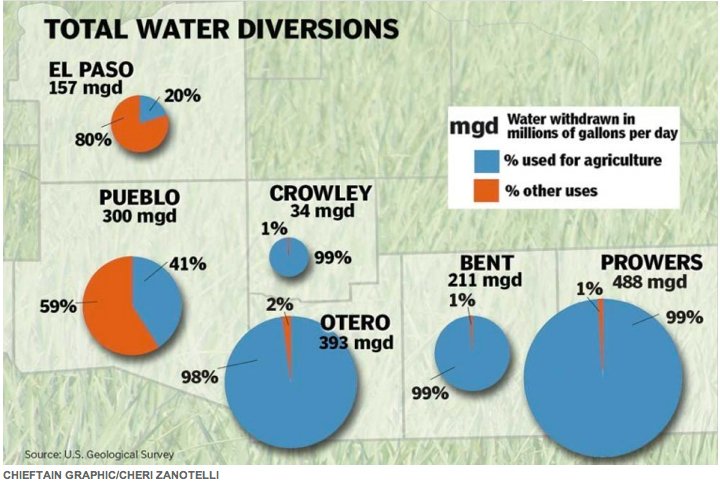
Deadline for Comments on Flaming Gorge Pipeline Closes with One Positive Note out of More Than 5,000 Objections

greenutriverbasin.jpg

Here’s the release from Western Resource Advocates (Jason Bane):

If official public support for the ‘Flaming Gorge Pipeline’ (FGP) is any indication of its future potential, the project to pump water from Wyoming to Colorado won’t become a reality any time soon. Public comments and objections regarding the FGP were due to the Federal Energy Regulatory Commission (FERC) by Monday, Dec. 19, and out of more than 5,000 submissions, only 1 (one) was supportive of the idea.

“The question here is obvious: If virtually nobody took the time to argue here that the pipeline is a good idea, why is any federal agency even considering a permit for this proposal?” said Western Resource Advocates Water Attorney Robert Harris. “Finding a supporter in the FERC filings is about as difficult as getting a perfect score on your SATs.”

Aaron Million, President of Wyco Power and Water, Inc., is seeking a federal permit from FERC to review his FGP proposal to pump water more than five hundred (500) miles from the Green River in Wyoming to the Front Range of Colorado. More than 5,000 comments from citizens, governments and non-profit organizations were formally submitted to FERC by Dec. 19, and only 1 comment – from a private citizen in Casper, WY – was supportive of the proposal. That comment represents roughly the same odds (.0002%) as an American high school student getting a perfect score on the SAT test.

Western Resource Advocates (WRA) submitted formal objections last week along with the Colorado Environmental Coalition and the National Parks Conservation Association. Wyoming Gov. Matt Mead formally objected to the proposal, saying: “This project would cut a vast swath across southern Wyoming, with the potential for huge impacts in many significant sectors of our economy and aspects of critical resources to Wyoming and Colorado.”

Additional objections included those from:

– City of Rock Springs, WY
– City of Green River, WY
– Sweetwater County, WY
– Wyoming Game and Fish Department
– Upper Yampa Water Conservancy District, CO
– City of Colorado Springs, CO
– City of Ft. Collins, CO
– Daggett County, UT
– Utah Rivers Council
– Colorado River District
– Colorado River Outfitters Association

Public comments and ‘Motions to Intervene’ can be found at: http://elibrary.ferc.gov (docket # P-14263).

BACKGROUND INFORMATION
On September 1, 2011, Mr. Aaron Million of Wyco Power and Water, Inc. applied to FERC for a permit application for the Regional Watershed Supply Project proposal (generally referred to as the Flaming Gorge Pipeline, or FGP). Two months earlier, the U.S. Army Corps of Engineers terminated its review of the project, citing Million’s failure to meet required deadlines to provide information. Wyco applied to FERC under the premise of reclassifying the FGP as a hydropower project, but because it is primarily a water-delivery system, FERC only has limited jurisdiction and cannot approve the entire project.

The FERC deadline for public comments and ‘Motions to Intervene’ is December 19, 2011. If FERC eventually decides to consider permitting for the FGP, it would begin a 3-year study period of the project. Before the FGP could begin to be constructed, Wyco would almost certainly need a permit from multiple additional federal agencies, such as the Forest Service and the Bureau of Land Management. At some point, Wyco would also likely need to resubmit an application to the U.S. Army Corps of Engineers.

For More Information on the Flaming Gorge Pipeline, go to:
http://www.westernresourceadvocates.org/water/pipeline/million.php

To access FERC Submissions/Filings directly, go to:
http://elibrary.ferc.gov/idmws/file_list.asp?accession_num=20111013-5035

A footnote from the release reads: “The Center for Biological Diversity submitted 3,388 individual public comments, and Earthjustice submitted 1,706 public comments”

More Flaming Gorge pipeline coverage here and here.

Flaming Gorge pipeline: Mesa County Commissioners vote to oppose the project, Wyoming Game and Fish files motion to intervene with FERC

flaminggorgepipelineearthjustice.jpg

From the Associated Press via The Columbus Republic:

Mesa County commissioners in Colorado have joined those opposing a proposal to build a pipeline to carry water from the Flaming Gorge Reservoir in Wyoming to Colorado…

Mesa County commissioners voted 2-0 Monday, with a third commissioner out sick, to oppose the idea. The Daily Sentinel reports commissioners said the idea is ill-conceived, expensive, and could cause Colorado to use more water than it has been allocated under a multistate compact divvying up water in the Colorado River system.

Meanwhile, here’s a release Wyoming Governor Matt Mead outlining his opposition to the pipeline. Thanks to Sagebrush Sam’s (@SagebrushSam) Twitter feed for the link:

Governor Matt Mead sent a letter to the Federal Energy Regulatory Commission (FERC) today. That letter expresses the Governor’s deep concern about the proposed water pipeline from the Green River in Wyoming to Colorado’s Front Range. Governor Mead’s comments are meant to protect Wyoming’s economy and resources and show the project is not feasible.

“This project would cut a vast swath across southern Wyoming, with the potential for huge impacts in many significant sectors of our economy and aspects of critical resources to Wyoming and Colorado,” Governor Mead wrote. He added, “The proponent has stated this project will cost $3 billion to construct but little is known about the future cost to consumers or others from such a massive project.”

FERC is considering a preliminary permit for this project, which is now billed as a hydroelectric endeavor. It had been before the U.S. Army Corps of Engineers until the Corps withdrew the application earlier this year. The project applicant then took it to FERC. Governor Mead expressed concern that FERC is not the correct entity to review this proposal, “The proponent has, by all appearances, shifted federal permitting venues to short-circuit the regulatory process and/or sidestep fundamental issues. I do not believe FERC should be the lead or initial permitting agency for this project.”

In terms of Wyoming’s water rights, Governor Mead wrote that the Upper Colorado River Basin Compact must be given full consideration because no project can disrupt Wyoming’s potential to develop its remaining appropriation under that Compact. While most of the water for this project would supposedly come from whatever Colorado’s unused portion of the compact is Governor Mead noted, “The applicant is proposing use of 25,000 acre feet of water per year from Wyoming’s undeveloped allocation under the Compact, and Wyoming has not agreed to this allocation.”

Governor Mead also raised concerns about the impact on recreation opportunities in the Flaming Gorge and the Green River as well as impacts on endangered species recovery programs in the Green and Colorado Rivers.

Wyoming Game and Fish Department has also filed a notice of intervention with FERC.

More coverage from Jake Nichols writing for the JH Weekly. From the article:

“Although in its proposal a hydroelectricity angle has been attempted, it is important to note that hydroelectric production is a minor purpose of the project,” Mead wrote. “The project first, foremost and always is a water supply project.”

Wyoming Game and Fish Department, along with a host of environmental groups including the Sierra Club, Earthjustice and Utah Rivers Council have joined Mead in urging that FERC deny Million’s application.

More coverage from Bobby Magill writing for the Fort Collins Coloradoan. From the article:

[John] Stokes, director of the Fort Collins Department of Natural Resources, said entrepreneur Aaron Million’s Regional Watershed Supply Project, also known as the Flaming Gorge Pipeline, would be “highly detrimental” to the 22,000-acre Soapstone Prairie and nearby 26,500-acre Meadow Spring Ranch. Both are located near the Wyoming border.

Million, however, believes his own proposal showing the pipeline threading through those lands is a mistake which will be corrected.

In a letter to the Federal Energy Regulatory Commission, or FERC, which is permitting the pipeline, Stokes wrote last week that Million’s company, Wyco Power and Water, plans to construct the pipeline, hydroelectric power facilities and major electric transmission lines across Soapstone Prairie and Meadow Spring Ranch…

…FERC received about 200 comments or motions to intervene in the pipeline permitting process.

Of those, few supported the project, and the most vehement objections came from cities along the pipeline corridor, environmentalists and federal and local government agencies warning that the pipeline would have a tremendous impact on the Colorado and Green rivers, endangered species, national forests and natural areas such as Soapstone Prairie.

“The magnitude of disturbance from installing an underground pipeline and transmission lines across several miles of SPNA and MSR would be great, both in the short term and longer term,” Stokes said…

On Monday, Million said the map in the proposal submitted to FERC showing the pipeline routed through Soapstone Prairie and Meadow Springs Ranch was an error. “That’s an artifact of GIS,” he said. “We have no intention of going through the natural area. John (Stokes) asked it to be moved, and I said I would.”[…]

Robert Stewart, an environmental officer for the U.S. Department of Interior, urged officials to determine if climate change will reduce the water flow in the Green River before the pipeline is built. He added that water diversions out of the Colorado River Basin, of which the Green River is a part, have altered the flow downstream, and water diversions for the Flaming Gorge Pipeline could further harm four endangered fish species in the Colorado River…

In his letter of opposition, Green River, Wyo., Mayor Hank Castillon joined a chorus of Wyoming counties and towns objecting to the project, because, he said, “the Regional Watershed Supply Project will profoundly and negatively affect every citizen and business in this community.”

Other major organizations objecting to the pipeline include the Glenwood Springs-based Colorado River Water Conservation District, the Upper Yampa Water Conservancy District of Steamboat Springs, the Colorado River Outfitters Association, the Wyoming-based Coalition of Local Governments, several counties in Utah and Wyoming and a host of environmental groups, including Trout Unlimited, Save the Poudre, the Sierra Club and others.

More Flaming Gorge pipeline coverage here and here.

Wyco Water and Power’s proposal to supply water for hydraulic fracturing is an insult to injury proposal for conservationists

flaminggorgepipelineearthjustice.jpg

Aaron Million has a history of trying to be all things to all people. At various times he’s said the Flaming Gorge pipeline will save agriculture in northeast Colorado, be environmentally friendly by using existing utility corridors, use natural gas for pumping instead of coal-generated power, etc. Last week he suggested that the project could supply the needed water for hydraulic fracturing. At least the oil companies could afford to pay the water haulers just about any price that he needs to charge to make a profit on his speculative venture. However, water providers in Weld County might object. The City of Greeley will sell about $1.4 million worth of water to oil companies this year, helping to keep rates down, according to their water manager, Jon Monson.

Last week ten conservation organizations filed the paperwork to intervene in the permit process now that the project has morphed into a hydroelectric generation project. Here’s a report from Deb Courson Smith writing for the Public News Service – Wyoming. From the article:

Duane Short, wild species program director with the Biodiversity Conservation Alliance, Laramie, is a spokesman for the coalition that has filed to intervene. “Probably the most local concern is the impact that this pipeline, which would consume some 81-billion gallons of water a year, would have on the Green River area water-sport and recreation industries.”

The list of objections is long, Short says. It includes violations of the Endangered Species Act, landscape destruction to build the pipeline, and downstream effects of removing so much water from the Green River, which connects to the Colorado River in Utah.

The company proposing the pipeline, Wyco Power and Water Inc., has touted its job-creation benefits and the fact that it includes hydropower construction plans. Short claims the hydropower was only added so FERC would look at the permit. He says the project will use much more power than it generates, because the water has to be pumped uphill across Wyoming and over the Continental Divide. The developer also recently announced that some of the water would be used for hydraulic fracturing (fracking). “With that type of history, and with all these other concerns that have been expressed in Wyoming, Colorado and even in Utah, to make this water available for fracking is sort of an ‘insult to injury’ type of proposal.”

More Flaming Gorge pipeline coverage here and here.

McCrystie Adams, ‘The Flaming Gorge Pipeline would be one of the biggest, most environmentally damaging water projects in the history of the western United States’

greenutriverbasin.jpg

As the Federal Energy Regulatory Commission’s Monday deadline for comments on the proposed project approaches conservationists have galvanized their opposition to Aaron Million and Wyco Power and Water and the 500 mile pipeline. Western Resource Advocates, on Thursday, labeled it a boondoggle. Here’s a report from Chris Woodka writing for The Pueblo Chieftain. From the article:

The Colorado River Protection Coalition, representing 10 environmental groups, also filed to intervene in the case.

“The Flaming Gorge Pipeline would be one of the biggest, most environmentally damaging water projects in the history of the western United States,” said McCrystie Adams of Earthjustice, the coalition’s lead attorney. “The pipeline would devastate the Green River, one of the West’s last great rivers and a sanctuary for native fish and wildlife, and severely harm the Colorado River downstream.”

Communities Protecting the Green River, which includes the cities of Green River and Rock Springs, Wyo. and Sweetwater County, Wyo., filed in opposition to the project earlier this week…

Million has said the pipeline is cost-competitive with other plans to import water and environmentally friendly because it would prevent worse impacts from occurring within Colorado.
The project also has attracted interest from Colorado and Wyoming municipalities, which have launched their own study of the project’s viability. They are awaiting revised water availability studies by the Bureau of Reclamation.

The Interbasin Compact Committee, formed by the Colorado Legislature in 2005 to sort out state water issues, at the request of member roundtables, has formed a task force to identify impacts of Flaming Gorge. The task force is being funded by the Colorado Water Conservation Board, over the objections of the environmental groups, as a model to develop a way to talk about statewide water projects.

Here’s the release from Earthjustice (McCrystie Adams/Gary Wockner/Steve Jones/Taylor McKinnon):

Today a coalition of 10 conservation groups from Colorado, Utah, Wyoming, and Arizona—the Colorado River Protection Coalition—moved to intervene in the Federal Energy Regulatory Commission (FERC) review of the Regional Watershed Supply Project, more commonly known as the Flaming Gorge Pipeline. FERC is currently evaluating a preliminary permit application for the Flaming Gorge Pipeline from Wyco Power and Water Inc. FERC allows members of the public with a stake in projects to intervene in preliminary permit proceedings, and the Colorado River Protection Coalition, represented by Earthjustice, has called upon FERC to deny the permit on numerous grounds.

“The Flaming Gorge Pipeline would be one of the biggest, most environmentally damaging water projects in the history of the western United States,” said McCrystie Adams of Earthjustice, the Coalition’s lead attorney. “The Pipeline would devastate the Green River, one of the West’s last great rivers and a sanctuary for native fish and wildlife, and severely harm the Colorado River downstream.”

In its intervention comments, the Colorado River Protection Coalition asserted that the Flaming Gorge Pipeline is extremely unlikely to be permitted because it would likely violate the Endangered Species Act, would adversely affect four national wildlife refuges, and part of the project would be located in a U.S. Forest Service roadless area. The Coalition also argued that the permit should be denied because the applicant failed to meet various requirements during a previous attempt at permitting a nearly identical project with the U.S. Army Corps of Engineers. Further, the Coalition asserted that the Pipeline is an extremely environmentally damaging water supply project that would irrevocably harm the Green and Colorado Rivers, not a “hydropower project,” and thus FERC is not the appropriate agency to lead federal review of the proposal.

“The Flaming Gorge Pipeline would severely harm the Wyoming landscape it crosses,” said Steve Jones of the Wyoming Outdoor Council. “Our state’s heritage, wildlife, and economy are dependent on protecting roadless and wilderness areas.”

“Four endangered fish—the Colorado pikeminnow, humpback chub, razorback sucker, and bonytail chub—are dependent on the water this pipeline proposes to drain out of the Green and Colorado Rivers,” said Taylor McKinnon of the Center for Biological Diversity in Flagstaff, Arizona. “The pipeline would spell disaster for those fish and the river ecosystems we and they depend on. It’s a foolish proposal in the face of global warming and projected declines in river flows.”

“The Green River flows through Utah’s largest roadless area, provides 40 percent of the water entering the Colorado River at Lake Powell each year, and supports a world-famous trout fishery averaging 6,000–8,000 fish per mile” said Zach Frankel, executive director of the Utah Rivers Council. “This catastrophic proposal would not only mar these treasures, it would forever alter life in Utah.”

The applicant previously sought a permit for the Pipeline from a different federal agency, the U.S. Army Corps of Engineers (Corps). In July of 2011, the Corps terminated its review of the project because the applicant missed multiple deadlines and did not provide information requested by the Corps. A few months later, the applicant redesigned the project to include some incidental hydropower components and requested review through FERC. Despite the modifications, the project remains a huge energy hog—at least nine air-polluting natural gas-fired pumping stations would be required to pump the water uphill across Wyoming and over the Continental Divide. Wyco’s president has acknowledged that pumping the water uphill would use more energy than the project would create through hydropower.

“We know this project would burn more energy than it produces,” said John Spahr of the Sierra Club. “Claiming it is a hydropower project is nothing more than a thinly veiled attempt to make an end-run around federal law.”

Since its inception, the extremely controversial Flaming Gorge Pipeline has met with great opposition in Colorado, Wyoming, and Utah. The water would go to the Front Range of Colorado which is projected to double in population in the next 50 years. Colorado is already a parched state with severely depleted rivers while the majority of the water in Colorado’s cities is used to keep lawns green for three months in the hot, dry summer across sprawling suburban landscapes.

Duane Short of Biodiversity Conservation Alliance noted, “The Coalition believes that Colorado and other western citizens are beginning to realize that unbridled consumption of water from our rivers and aquifers will leave our precious water resources depleted leading to even more severe water shortages for our children and grandchildren. We hope the public will work with us to prevent this shortsighted and irresponsible water grab.”

“The Flaming Gorge Pipeline would be a flaming disaster for Colorado,” said Gary Wockner of Save the Poudre: Poudre Waterkeeper. “The Pipeline would be a devastating step backwards for water supply policy and river protection in Colorado and the Southwest U.S.—our coalition will work as long and hard as it takes to stop this project.”

This Coalition’s intervention is one of several being filed by public interest groups and local communities. Over a hundred public comments urging FERC to deny the preliminary permit have already been filed before the deadline on Dec. 19th. Comments are posted on FERC’s website. (Search for Docket Number: P-14263.)

View a map of the pipeline’s proposed 550 mile route across Wyoming and down through Colorado.

Read the motion to intervene.

Meanwhile, Governor Matt Mead of Wyoming has submitted his comments on the pipeline. Here’s a report from Ben Neary writing for Associated Press via The Columbus Republic. From the article:

“This project would cut a vast swath across southern Wyoming, with the potential for huge impacts in many significant sectors of our economy and aspects of critical resources to Wyoming and Colorado,” Mead wrote…

“Although in its proposal a hydroelectricity angle has been attempted, it is important to note that hydroelectric production is a minor purpose of the project,” Mead wrote. “The project first, foremost and always is a water supply project.” Mead stated that it appears Million shifted federal agencies “to short-circuit the regulatory process and/or sidestep fundamental issues.”[…]

Mead stated that Million has not shown how much water Colorado is still entitled to under the Colorado River Compact. The U.S. Bureau of Reclamation, which operates Flaming Gorge Reservoir, is working on a study of how much water, if any, it believes could be available for withdrawal there…

Mead wrote that Wyoming has been involved in efforts to recover endangered fish species on the Upper Colorado River for decades. He said the agency’s review must consider the likely effect on the fish both of the pipeline project as well as Wyoming’s possible future use of its share of water from the Green River. The Wyoming Game and Fish Department filed a separate request with FERC to intervene in the permit application to track the issue…

[Aaron Million] said he agrees federal regulators need to consider water supply issues as well as his project’s likely effect on wildlife and recreation.

More coverage from Amy Joi O’Donoghue writing for the Deseret News. From the article:

Since its inception, the controversial Flaming Gorge Pipeline has met with opposition in Colorado, Wyoming, and Utah. The water would go to the Front Range of Colorado which is projected to double in population in the next 50 years. Although the project would be privately financed, critics say the end water would be so publicly expensive it wouldn’t be viable. It also smacks at tapping water that river watchers say is already over allocated.

Million has said that the water his project proposes to take from the Green River in Wyoming is sustainable, according to a review of water resources by federal water managers with oversight of Flaming Gorge.

According to a Tweet from Jennifer Petersen (@BCAWY): “Last night [December 14], Laramie Council voted unanimously to oppose the Million pipeline & send in a letter intervening in the FERC permitting process.”

More Flaming Gorge pipeline coverage here and here.

Woodmoor Water and Sanitation withdraws water court change case, cites purchase of JV Ranch as reason

denveraquifer.jpg

From The Pueblo Chieftain (Chris Woodka):

Woodmoor completed its purchase of the JV Ranch near Fountain in late November, and its board last week voted to pull a water court case that sought to deliver water by exchange from three ditch systems east of Pueblo. Woodmoor also has terminated all of the contracts on the Holbrook, High Line and Excelsior ditch systems…

The water court application had been moving toward trial after the Pueblo Board of Water Works refused to settle the case. The Pueblo water board objected to the plan partly because it could involve the removal of water from Pueblo County to another basin. Woodmoor straddles the Arkansas and South Platte basins…

The Lower Arkansas Valley Water Conservancy District also opposed the move, and took steps to help a farmer buy one of the farms Woodmoor was seeking on the High Line Canal, putting it in a conservation easement to ensure continued farming. “We ensured the water will run to the end of the High Line Canal forever,” said Jay Winner, general manager of the Lower Ark district…

After dropping its plans for Lower Ark water, Woodmoor opted to purchase the 3,500-acre JV Ranch, which has water rights of 2,500-3,500 acre-feet of water as well as a 70-acre reservoir. The purchase price will be $25 million to $35 million, depending on the historic average amount of water determined when a water rights change case is filed.

More Woodmoor Water and Sanitation District coverage here and here.
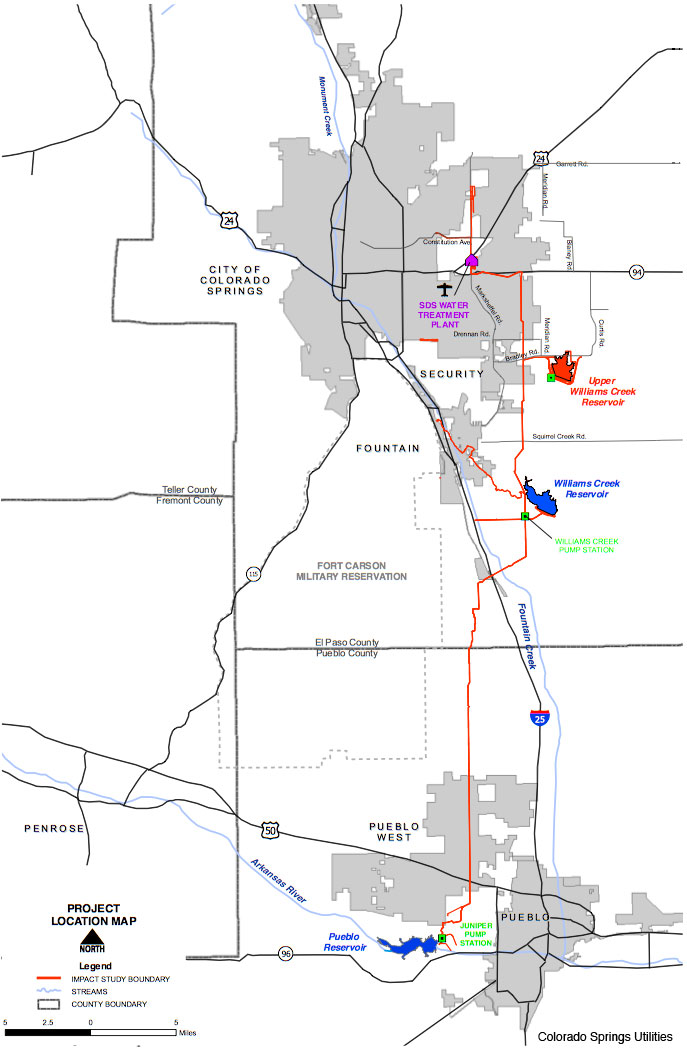
How much water will the Niobrara shale play under eastern Colorado Springs require and where will it come from?

niobrarashale.jpg

From the Colorado Springs Independent (Pam Zubeck):

Colorado Springs Utilities is required to serve Banning Lewis Ranch under the annexation agreement, in which the annexor relinquishes the land’s water rights to the city forever, except for 2,000 acre feet of groundwater on the south end. That water, about 652 million gallons, is to be split between the city and annexor.

But Utilities, still building the SDS pipeline, hasn’t heard a water request from Ultra, says spokesman Dave Grossman. He says the city doesn’t know how much is needed, because “fracking is new to our area, so we don’t have past data for planning purposes.” Ultra did not respond to a request for comment for this story, but Montgomery says 1 million to 5 million gallons is used per frack.

If the 326 million gallons to which Ultra would have access under the annexation agreement isn’t enough, and the company doesn’t want to buy water from Utilities, Cherokee Metropolitan District, which serves the 18,000-customer Cimarron Hills enclave east of Powers Boulevard, is open to the idea of selling water, manager Sean Chambers says. Five years ago, Cherokee lost its use of several wells in the Upper Black Squirrel Creek Ground Water Management District, east of its service area, after illegally exporting water from the basin to its customers.

Chambers now wonders if that water, which Cherokee still owns, could be sold to drillers.

“We would consider it, so long as we were assured certain protections and we could confirm our decrees are consistent with what’s allowable,” he says. “The state is a little unsure … They don’t want this oil bonanza to turn into a water problem.”[…]

[Charlie Montgomery, energy organizer of the Colorado Environmental Coalition] says the next battle will be over local control. The Pueblo Chieftain has reported that Rep. Marsha Looper, R-Calhan, wants to require a more comprehensive state accounting of oil and gas drilling’s water needs. Meanwhile, the Longmont Times-Call says that Rep. Matt Jones, D-Louisville, wants to give local governments more control over the industry, including fracking.

More oil and gas coverage here and here.

‘Communities Protecting the Green River’ file objections to Wyco Water and Power’s proposed Flaming Gorge pipeline

greenutriverbasin.jpg

From the Fort Collins Coloradoan (Bobby Magill):

Rock Springs, Wyo.-based Communities Protecting the Green River was the first to lodge objections to Fort Collins entrepreneur Aaron Million’s Regional Watershed Supply Project.

The group includes the cities of Green River and Rock Springs, Wyo. and Sweetwater County, Wyo.

“In reality, it is an investment scheme masquerading as a water supply project, which is masquerading as a pump-back hydropower project,” Don Hartley, the group’s vice-chairman, wrote in a letter to the Federal Energy Regulatory Commission on Dec. 9…

“This project is portrayed as a hydropower project, but pumping water over the Continental Divide will require more energy than can be generated from the fall of the water on the east side (of the divide),” Hartley wrote.

He added that consideration of such a massive water pipeline is premature because a federal study of the amount of water available to be consumed by growing communities in the Green River-Colorado River watershed is ongoing.

More coverage from the Associated Press via the Billings Gazette. Here’s an excerpt:

Many in western Wyoming say they’re concerned the project would draw down Flaming Gorge Reservoir. The city of Green River has joined the city of Rock Springs and Sweetwater County to fight Million’s proposal.

Green River Mayor Hank Castillon said Monday that residents are unified in opposition to the project. “They just don’t want to see Wyoming water going to Colorado,” Castillon said. “The main issues are recreational, and they feel that it’s going to affect their lifestyle as far as sporting events and water because we have the Flaming Gorge here also the fishing up and down the Green River, fish habitat.”[…]

Million filed an application with the Federal Energy Regulatory Commission this summer spelling out plans to construct a system of turbines and reservoirs along the pipeline to generate electricity. While he has said the project wouldn’t generate more electricity than pumping the water would consume, he said generation would help cover its pumping costs. He wants to construct a reservoir on the slopes of Sheep Mountain, west of Laramie, and generate electricity by pumping water into the reservoir and having it flow through turbines on its way downstream to another lake nearby, Lake Hattie…

Steve Jones, watershed protection program attorney with the Wyoming Outdoor Council in Lander, said his group is concerned with the prospect of such large-scale pumping out of the Green River. “It’s obvious to me that some years, there is not going to be any water available, and other years there might,” Jones said. “But to me, the idea that, that reservoir could supply that year in and year out, is just wrong, according to the statistics that I’ve looked at.”[…]

Duane Short, wild species program director with the Biodiversity Conservation Alliance in Laramie, said federal roadless policies would prohibit construction on Sheep Mountain…

Wyoming Gov. Matt Mead has expressed opposition to Million’s project. His office said this week that the state plans to file comments with FERC.

More Flaming Gorge pipeline coverage here and here.
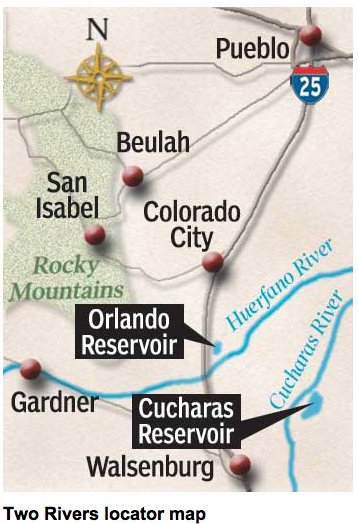
Castle Rock: The town council delays ballot question to fund a renewable water supply infrastructure

denveraquifer.jpg

From the Castle Rock News Press (Rhonda Moore):

Castle Rock Town Council will hold off on an election date for a ballot question to fund long-term water with a property tax increase and TABOR question.

Councilmembers on Dec. 6 opted against the town’s original plan to ask voters for a decision in the April 2012 election pending a recommendation from town staff on the preferred water provider.

Castle Rock is in the process of reviewing four proposals from water providers to secure a long-term renewable water supply that is expected to cost up to $200 million. The town’s original plan to invest in the WISE proposal, a coalition of south metro municipalities and metro districts to buy water from Denver and Aurora, was derailed earlier this year when other water providers decried the absence of a competitive bid process. The resulting public bid invitation netted four proposals to provide water to Castle Rock. Those proposals are under review by town staff, which is creating a comparative analysis to take to town council for consideration. Until that analysis is complete and town council has made its selection, the town cannot accurately tell voters what they would be paying for in an election question, said Ron Redd, Castle Rock director of utilities.

“It was always our intention to go to the voters with a complete project and have everything identified,” Redd said. “Voters like to see an actual project versus thoughts, ideas or studies. The perception would be the town would be given a blank check. Recent history shows that hasn’t been very successful at the voting booth.”[…]

While town staff favors a November 2012 ballot question, election strategists recommend against a property tax question in a general election, Redd said…

“If you want a tax to pass you’d better start getting the public involved in how that plan is going to come together,” said Ben Cox, a Castle Rock resident who spoke during the public comment portion of the meeting. “So they can see we’re not buying into something like Hess Reservoir, (which) looks to the public right now that we made a very big expenditure with no idea as to how we are going to fill it.”

More Denver Basin aquifer system coverage here.

Green River: The Sweetwater County Board of Commissioners unanimously adopt a resolution opposing the Flaming Gorge pipeline proposed by Wyco Power and Water

flaminggorgepipelinemillion.jpg

From the Green River Star (David Martin):

Wyco Power and Water Inc. filed a application for preliminary permit to the Federal Energy Regulatory Commission, and FERC is seeking public comment about the proposal. The proposal would include hydroelectric power generating developments north of Green River, however it would also pump approximately 250,000 acre feet of water per year from the Green River basin, through eastern Wyoming and into Colorado’s Front Range.

According to the document, an imbalance greater than 3.5 million acre feet of water could exist over the next 50 years due to potential changes in climate. The commission argues that if such imbalances are possible, the water demands of local and regional entities should be placed above transbasin needs.

The commissioners also said the population of the Colorado River basin is rapidly growing, creating an increasing demand for water. However because of the population increases, they claim water needs for the Colorado Basin are not fully understood and allowing the project to move forward could compromise the potential for growth through the basin.

The commission’s resolution claims the water added to the Colorado River Basin could impact programs aimed to mitigate endangered species by altering the temperature and water quality of the river.

Finally, the resolution claims a proposed pump reservoir on White Mountain could compromise at least four high-pressure gas lines, fiber optics cables and the water line to the Jim Bridger Power Plant.

More Flaming Gorge pipeline coverage here and here.

Mark Pifher (Aurora water): ‘We don’t plan to buy or lease any more water in Arkansas basin in the near future’

arkansasriverbasin.jpg

From The Pueblo Chieftain (Chris Woodka):

Aurora’s water rights include nearly all of the Rocky Ford Ditch in Otero County, about one-third of the Colorado Canal in Crowley County and water from 1,750 acres of ranches in Lake County. Those rights provide an average yield of 22,800 acre-feet per year — the equivalent of 80 percent of the potable water used by Pueblo each year.

– Aurora also uses the Homestake Project, Twin Lakes, Busk-Ivanhoe diversion and the Columbine Ditch to bring water from the Western Slope through the Arkansas River basin and into the South Platte basin. The average yield of those water rights is about 21,500 acre-feet annually.

– The city can reuse its Arkansas and Colorado basin water imports, and has built the $650 million Prairie Waters Project to directly recapture flows, rather than exchange them.

– Aurora’s South Platte water rights include wells, ranches, ditches and direct flow from the South Platte. They total about 46,000 acre-feet annually.

– Aurora has an agreement to trade 5,000 acre-feet of water a year with Pueblo West from Lake Pueblo to Twin Lakes beginning next year. It will replace a similar agreement with the Pueblo Board of Water Works that expires this year.

– The Pueblo water board sells Aurora 5,000 acre-feet of water each year.

– Aurora has a contract with the Bureau of Reclamation to store 10,000 acre-feet of water in Lake Pueblo and to move the same amount to Twin Lakes by paper trade.

– The water is moved from Twin Lakes to Spinney Mountain Reservoir through the Homestake pipeline system…

“We don’t have any current plans beyond what we’re already doing,” said Mark Pifher, director of Aurora water. “We don’t plan to buy or lease any more water in Arkansas basin in the near future.”

Instead, the city will continue developing Prairie Waters, a reuse project that pumps sewer return flows through a filtration and purification system, only at about 20 percent capacity so far. Aurora calculates that its average yield from its Arkansas River basin water rights is about 22,800 acre-feet annually. That’s roughly one-fourth of its total yield from its entire system, which includes South Platte and Colorado River basin rights. From a practical standpoint, Aurora does not move all of its water out of the Arkansas River basin each year.

More Aurora coverage here and here.

The strategy of switching federal agencies for the permitting of the Flaming Gorge pipeline project may not lead to a faster approval

flaminggorgepipelinemillion.jpg

From WyoFile (Allen Best):

“(Million) has been suggesting that he could get this project done in a significantly shorter amount of time (through FERC). My [Matt Rice, director of Colorado conservation for American Rivers] first reaction is this: He’s totally forgetting about the federal hydropower licensing requirements under the Federal Power Act. The process can be incredibly complex, especially for a project of this size, geographic scope and complexity.”

Based on his experience working on hydropower projects seeking permits in South Carolina and Alabama, Rice expects a process that lasts at least a decade. “I wouldn’t be surprised if this project took at least 10 years…and more like 12 to 15 years,” he says. “Augusta, Ga., just got a license for a small project, and that process took more than 30 years.”

And before a permit is awarded by FERC, it must also get review under the applicable environmental laws – possibly including the Clean Water Act, which is what had triggered the original review by the Army Corps.

Million needed a section 404 dredge-and-fill permit under the provisions of that law because of proposed use of fill at Flaming Gorge Reservoir for his proposed take-out structure and possibly at other wetlands locations along the pipeline route.

A spokeswoman for the Army Corps describes a process that was delayed because of Million’s foot-dragging. “It had to do with the many delays and the applicant continuing to ask for more extensions and more time,” says regulatory specialist Rena Brand. “Toward the end of July, his group explained that they were thinking about moving to energy production.” And that, she said, meant a new purpose and need.

More Flaming Gorge pipeline coverage here and here.

There are differing opinions to be found in eastern and western Wyoming counties with respect to the Flaming Gorge Pipeline

flaminggorgepipelinemillion.jpg

From WyoFile (Allen Best):

Yet the idea of a pipeline has a certain allure in Torrington, Cheyenne, and in Laramie County, each of which has chipped in $25,000 as members of the Colorado/Wyoming Coalition, a rival to Million’s plan.

“If someone is going to provide water through a pipeline near our water system, we are going to be interested,” says Tim Wilson, director of the Cheyenne Board of Public Utilities.

The Cheyenne urban area, with 70,000 people, has sufficient water to meet growth during the next 15 to 25 years, Wilson says. Most of the city’s water comes from snowmelt in streams west of the city, including some water from the Colorado River headwaters near the Colorado-Wyoming border, with water brought through a tunnel and then an exchange of rights.

Cheyenne’s Wilson says many unanswered questions remain about a possible new supply piped in from Flaming Gorge, including the costs and the water rights.

Laramie County has a similar position. “If, in fact, there is additional (Colorado River) Compact water, and it can be brought into Laramie County, we want to tap into that,” says Gary Kranse, planning director. Almost exclusively dependent on groundwater, the county wants more diversity of supplies as population growth continues.

Torrington, population 6,000, is also at the prospective pipeline table. City engineer Bob Juve says conservation and efficiency measures have dampened demand in Torrington 30 percent, with more savings possible. But with the city growing 1 percent annually, those savings will have been exhausted in a few decades. And the North Platte River, which flows through the town, is already spoken for. Nebraska and Wyoming in 2001 signed a legal settlement that reaffirmed the longstanding arrangement that majority of the water in the river goes to Nebraska. A current expansion of the Pathfinder reservoir west of Casper, however, will allow some future new water supplies from the river for Wyoming communities along the Platte, along with some water to sustain whooping cranes, least terns and other endangered species downstream in Nebraska.

Supporting a Flaming Gorge pipeline has not, Juve acknowledges, made him popular in Southwestern Wyoming. He’s OK with that. “I don’t mind fighting with anybody, but I first want to know what we’re fighting about,” he says. “We are not trying to be adversarial with people in Sweetwater County. Obviously, they have interests that they have not fully defined yet.”

More Flaming Gorge pipeline coverage here and here.

Noble joins Anadarko with exploration plans in the Wattenberg Field, they plan to pony up $1 to $1.5 billion

derrick.jpg

From The Denver Business Journal (Cathy Proctor):

Noble plans to invest $8 billion over the next five years in the Denver-Julesburg Basin, an area that includes northern Colorado and southern Wyoming, said Ted Brown, Noble’s Denver-based senior vice president in charge of its northern region operations, which includes Colorado.

In the Wattenberg area of the play, “it will be $1 billion to $1.5 billion a year,” Brown said in an interview Wednesday…

Noble said it think its can get 1.3 billion barrels of oil from its 840,000 net acres of mineral rights in the Wattenberg. The company said its wells in the area are currently producing oil and natural gas equivalent to 67,000 barrels of oil per day, and expects production to double by 2016.

More oil and gas coverage here and here.