The Arkansas Basin roundtable approves the Flaming Gorge task force, some members skeptical of project

flaminggorgepipelinemillion.jpg

From The Pueblo Chieftain (Chris Woodka):

Several members of the roundtable said they are against the project or skeptical that it will ever be built, but agreed the group needs to have input in case it develops…

The grant application, submitted by roundtable chairman Gary Barber on behalf of the Pikes Peak Regional Water Authority that he manages, does not propose supporting either proposal for a Flaming Gorge pipeline, but would identify impacts and concerns…

“This is not a good project for Colorado,” said Tom Young, a Fremont County rancher. He said a project from the Missouri River basin, just 50 miles further away in South Dakota, would truly bring more water into the state and not jeopardize Colorado’s entitlement under the Colorado River Compact…

[Alan Hamel, who now represents the basin on the CWCB] said there is still some water available to be developed under the 1922 Colorado River Compact. “It might not be available every year, but that’s the type of thing Colorado needs to look at,” Hamel said. “This is a public process, with all participants at the table.”

More Flaming Gorge task force coverage here.

Pipeline from the Mississippi: Pat Mulroy (Southern Nevada Water Authority) would drop the instate project from Nevada’s Snake Valley if the U.S. were to build a Missouri-Mississippi flood project

mississippibasin

From Vegas, Inc (Richard N. Velotta):

If innovative thinking is the key to solving Southern Nevada’s complex water puzzle, then Mulroy has a doozy of an idea. She suggests a massive public works project that not only could help relieve Colorado River Basin users but help solve the recurring problem of flooding in the Midwest.

“To me, it’s just counterintuitive,” she says. “One man’s flood-control project is another man’s water supply. You’ve got to remember that Hoover Dam was built as a flood-control project. That was its fundamental purpose: To prevent further flooding of the Imperial Valley down in Southern California.”

The idea is to build diversion dams for flood control and move the water to aquifers beneath the farmlands of Iowa, Nebraska, Kansas and Colorado. If Colorado farmers don’t have to use Colorado River Basin water for their crops, it makes more water available to downstream users, like us.

“It makes no difference to the corn and the alfalfa whether it gets Colorado River water or Mississippi water or Missouri water,” she says.

“You could improve the transportation and cargo transports on the Mississippi River, which have been severely impaired this year by flood conditions, and at the same time provide some security for those communities that have lost everything by pulling some of that water off and moving it. My friends in New Orleans say, ‘Take it tomorrow, please!’ Their wetlands are being destroyed. It’s more water than the system down there can handle. Let’s use it. Let’s recharge the Ogalala aquifer, let’s replace some Colorado River users. Let them use some of this and leave the other water in the Colorado River for those states that are west of the Colorado. Let’s start thinking about this the way we thought about our national highway system.”

If a Missouri-Mississippi flood control project were implemented, Mulroy says she’d stop pressing the Snake Valley project. After this year’s floods in North Dakota, she says, people are starting to talk about it again.

“Every flood makes people start thinking about it,” she says. “And from an economic standpoint… building the national highway network was an enormous economic boon to the country, post-Depression. You build this kind of network and you could effectuate a number of jobs in the short term and provide economic opportunities.

“The instate project wouldn’t be needed because at that point what you’ve done is securitize the Colorado River. You’ve made the Colorado River much more resilient and you’ve augmented the entire river system to the benefit of seven states and two countries.”

Here’s a short Q&A with Ms. Mulroy from Richard N. Velott writing for Vegas, Inc..

More pipeline from the Mississippi River coverage here and here.

Missouri River Basin: U.S. Army Corps of Engineers mainstem management public hearing recap

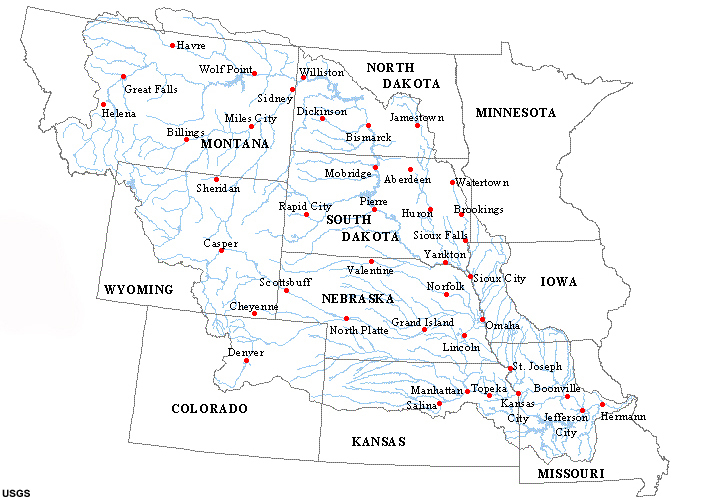
A picture named missouririverbasin

From the Associated Press via the KansasCity.com

More than a dozen people testified during a public hearing in Jefferson City hosted by the U.S. Army Corps of Engineers, which is responsible for managing the 2,000-mile-long river. Congress has authorized a five-year, $25 million study to determine if changes are needed to the management strategy outlined in a 1944 law.

Residents said the river was vital to Missouri’s economy, from providing drinking water to helping cool power plants, and flood control must be a priority. Some feared that the recreation interests of states upstream could take precedence and curtail barge traffic along the river. “The upper-states will never stop until they do away with navigation,” said Dan Kuenzel, 45, who raises hogs and grows corn and soybeans on river bottom land in Washington, Mo.

The Missouri River begins in Montana and flows into the Mississippi River just north of St. Louis. Upper basin states generally want water levels to rise or remain stable to help with fish reproduction and to keep reservoirs created by dams full for summer recreation. Lower basin states, including Missouri, want reliable flood control and a steady water flow for barges and drinking water or commercial water uses.

Many people at the hearing questioned why the Corps was studying river management priorities, citing another study completed in 2004. The current study focuses on a federal law approved in 1944 that makes the Corps responsible for managing the river for flood control, navigation, hydropower, irrigation, water supply, recreation, water quality, and fish and wildlife.

More Missouri River Basin coverage here.

The U.S. Army Corps of Engineers is taking a hard look at managing the Missouri mainstem — hearings start June 1 in Jefferson City, MO

A picture named missouririverbasin

Here’s the link to the website for the study. Here’s the pitch:

The Missouri River Authorized Purposes Study (MRAPS) is a broad-based, Congressionally authorized study to review the project purposes established by the Flood Control Act of 1944. The Study will analyze the eight authorized purposes in view of the current Basin values and priorities to determine if changes to the existing purposes and existing Federal water resource infrastructure may be warranted.

Thanks to missourinet.com for the heads up. From their article:

John Grothaus with the Kansas City District of the Corps says the first phase of the project is “public scoping” to get input from stakeholders and agencies, as well as members of the general public. “The first phase of the study, which is in some respects going to shape how we conduct our assessment of the existing conditions in the basin and how we shape the formulation of alternative plans. You know, what are people’s views what are their priorities?” Grothaus said.

The study will examine whether a 1944 federal law needs to be changed or revised from the eight set ‘purposes’ for the river, its dams and reservoirs.

“The fact that we’ve been granted this authority through Congress indicates that Congress feels like there’s some wisdom in looking at the purposes and seeing if any changes are needed or warranted,” Grothaus said.

Those eight purposes, outlined 65 years ago, are flood control, irrigation, hydropower, navigation, water supply, recreation, water quality, and fish and wildlife.

More Missouri River Basin coverage here.