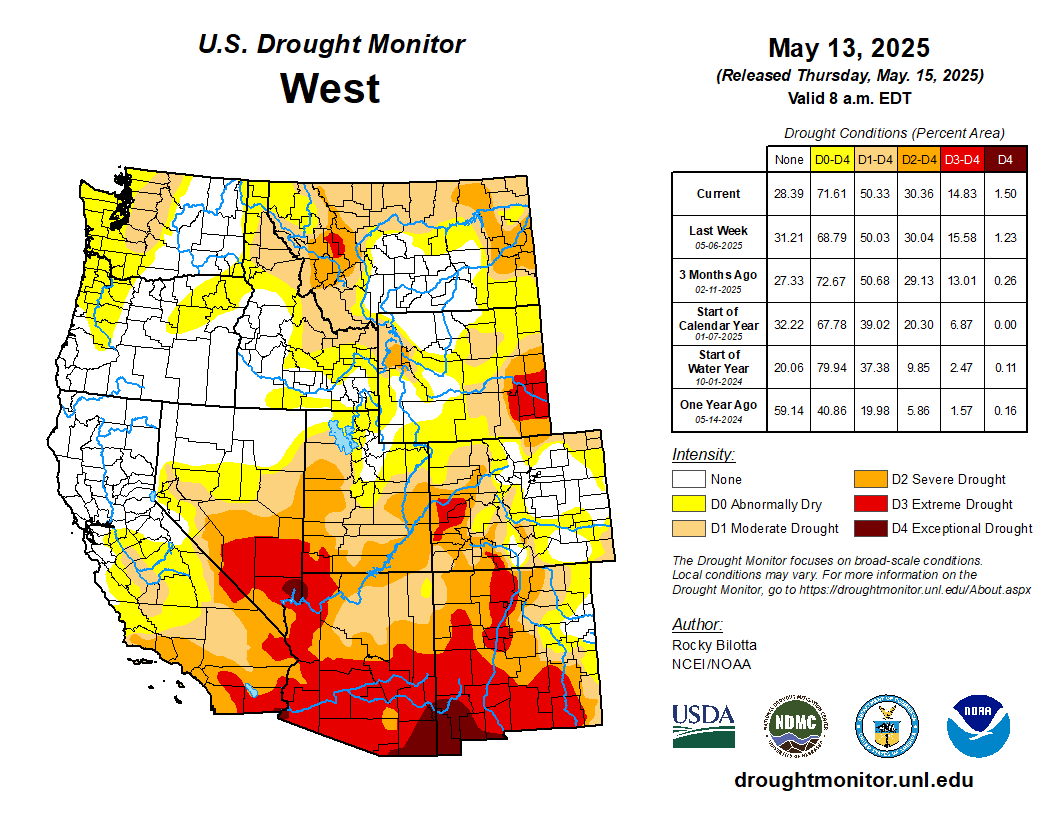
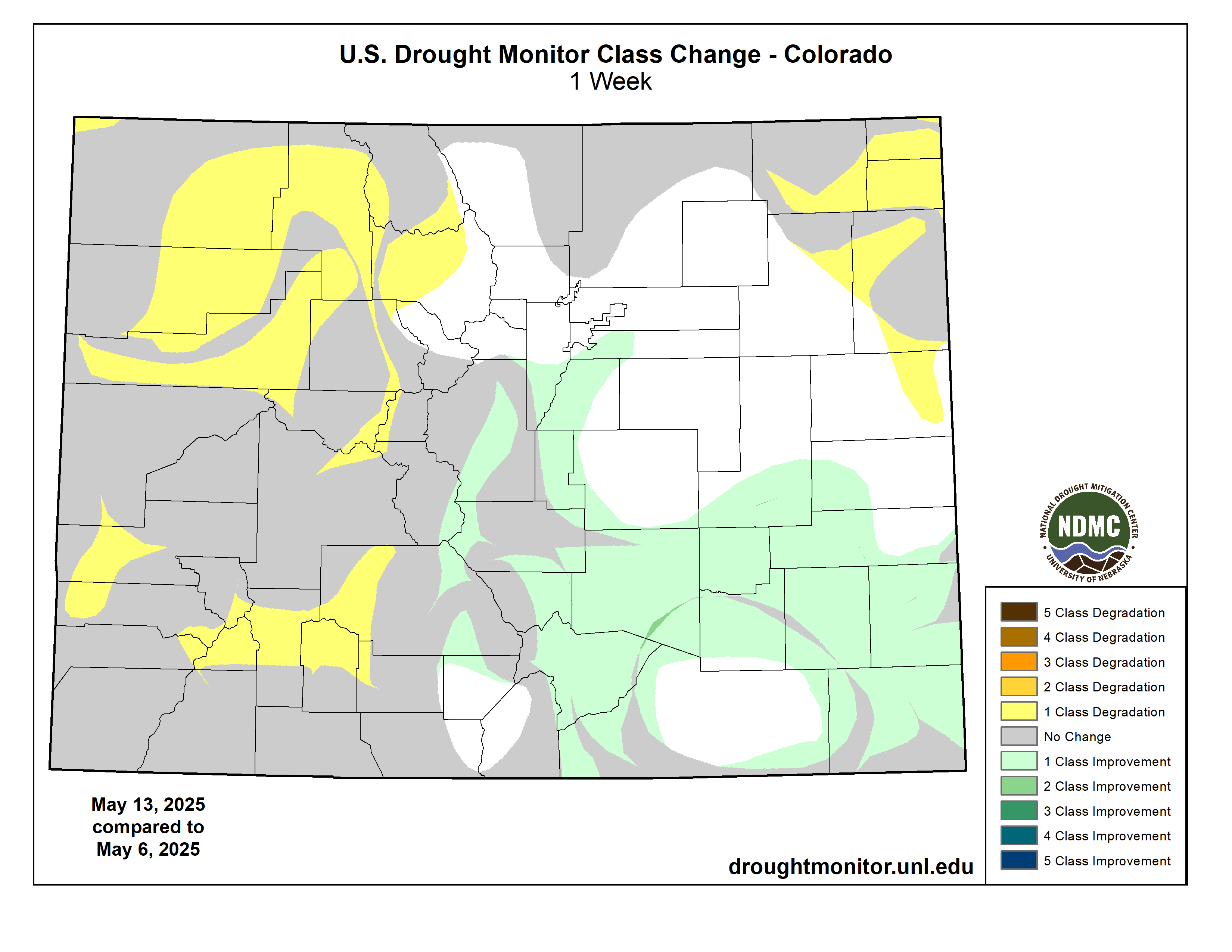
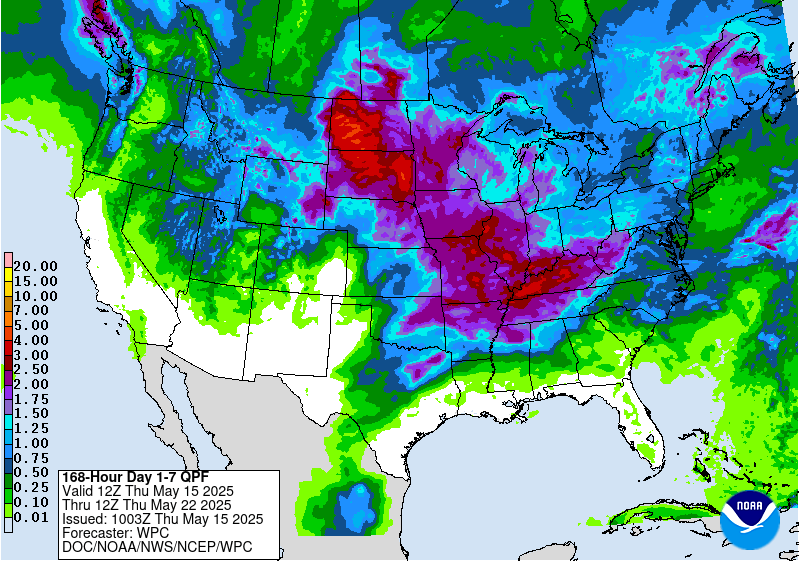
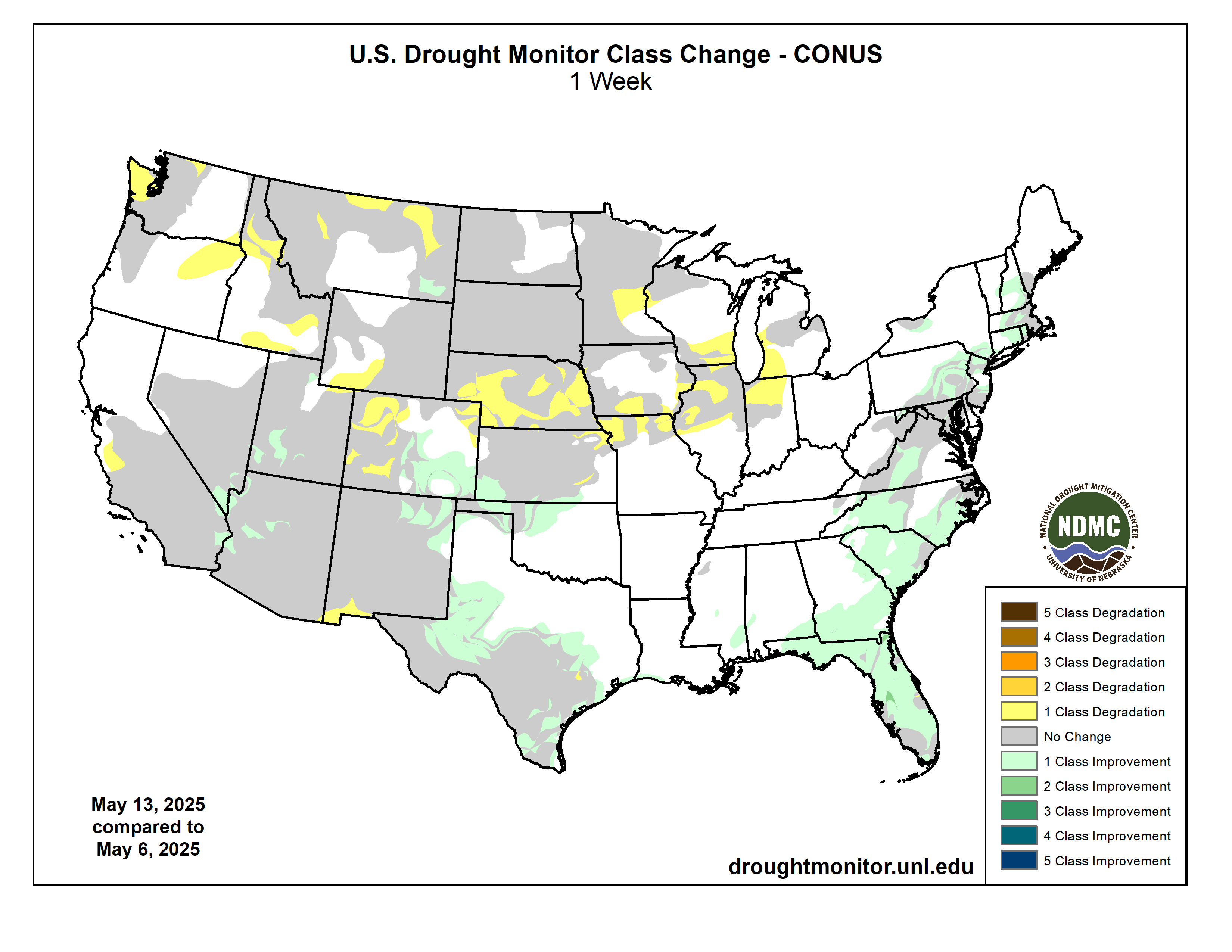
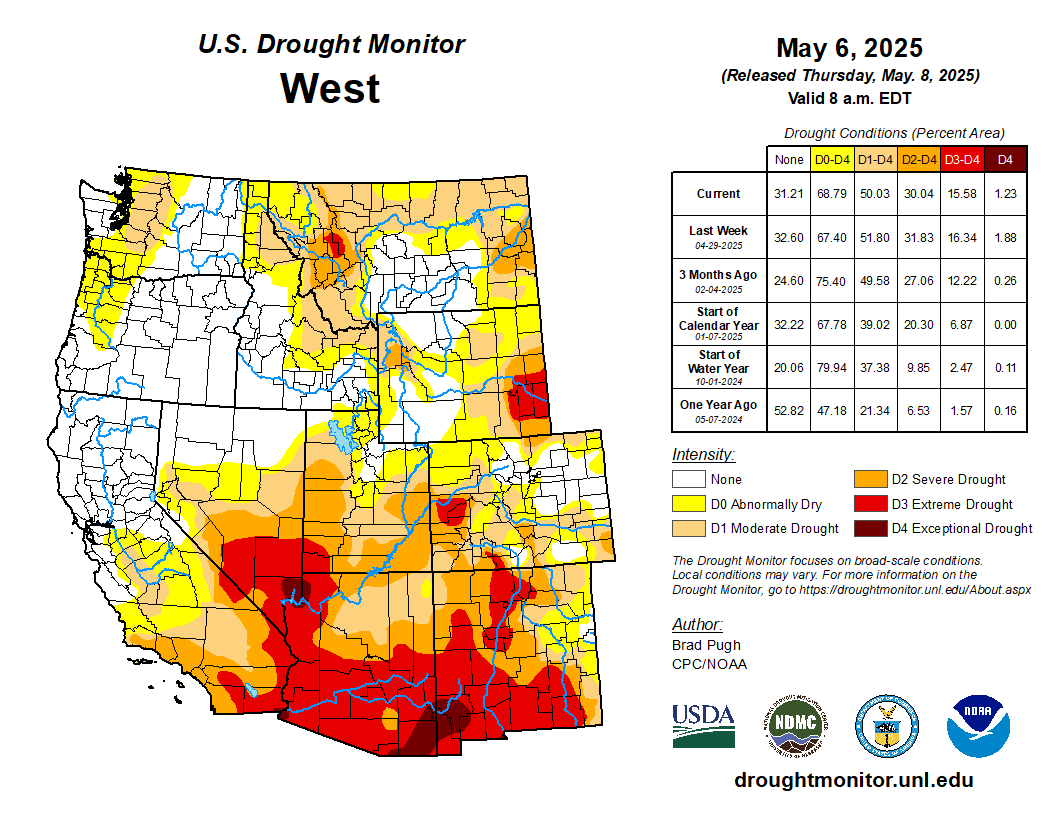
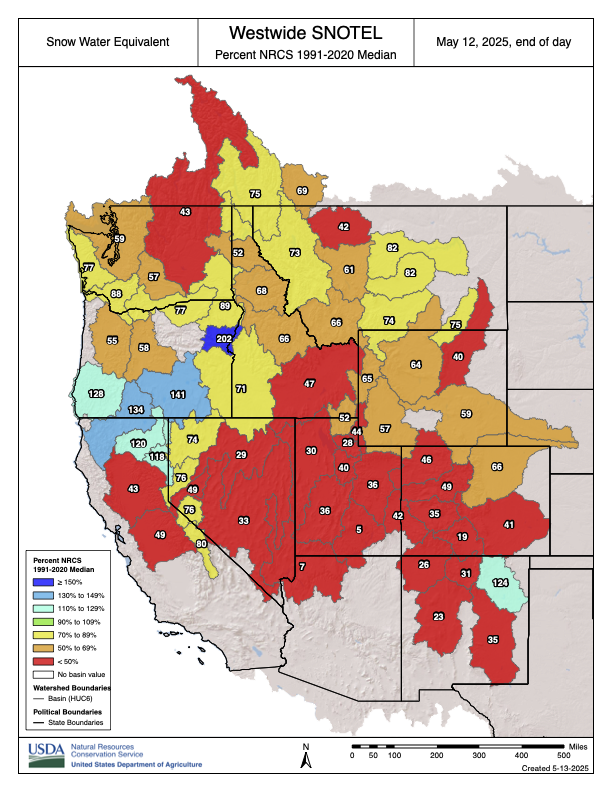
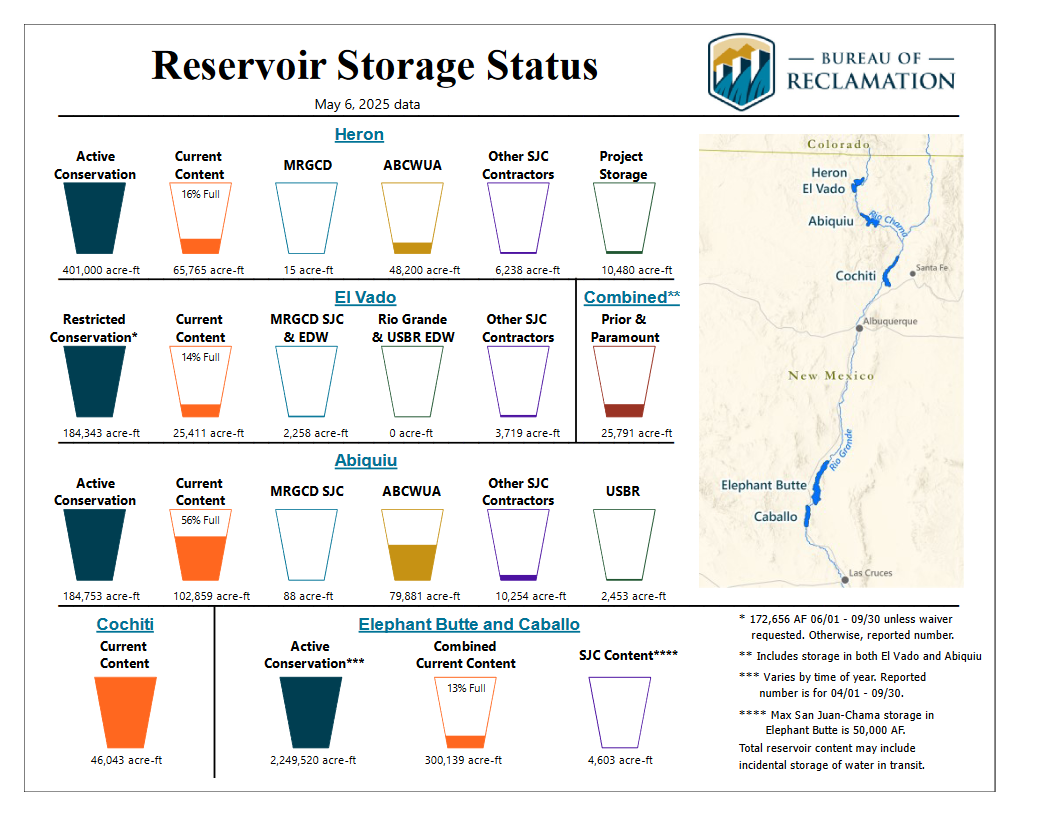
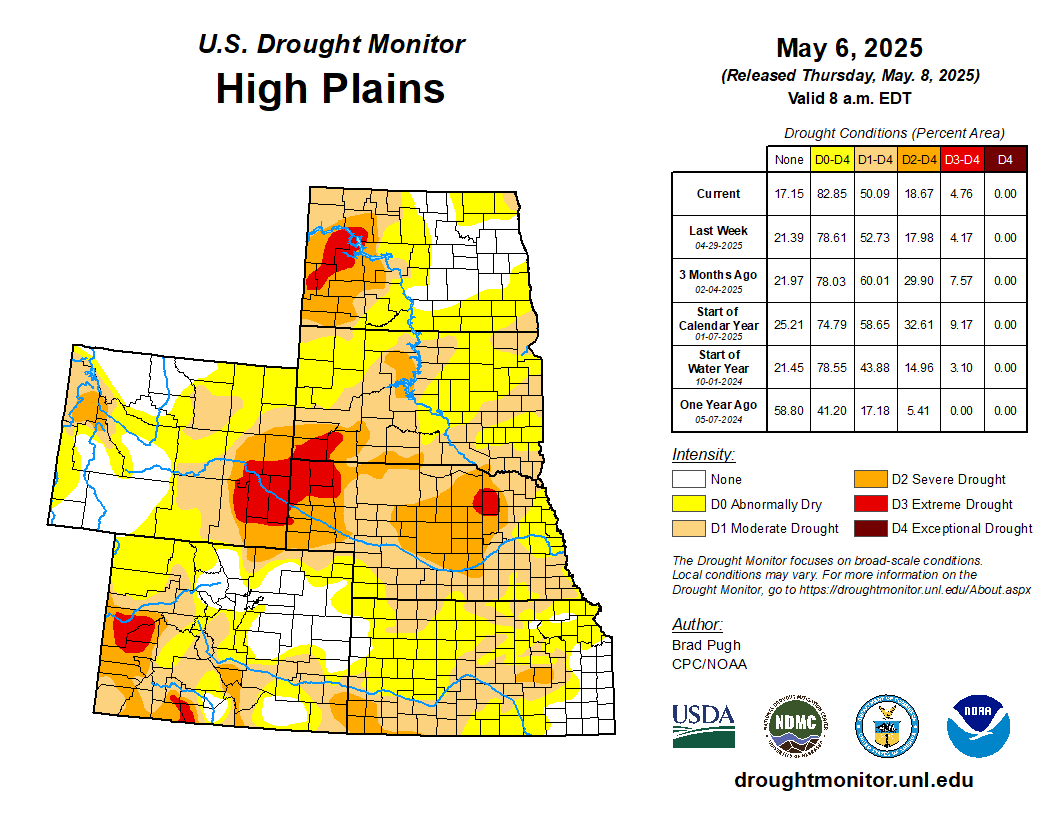
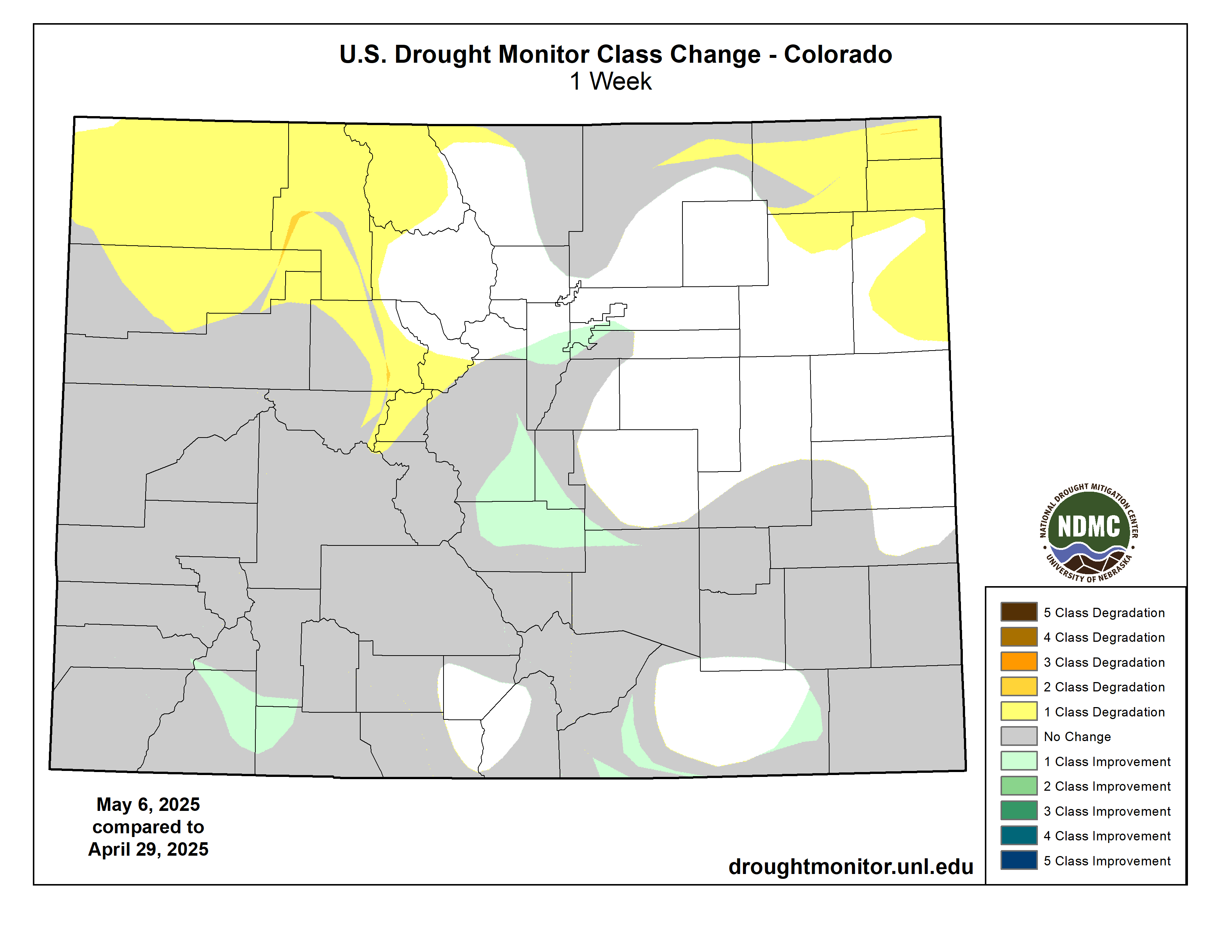
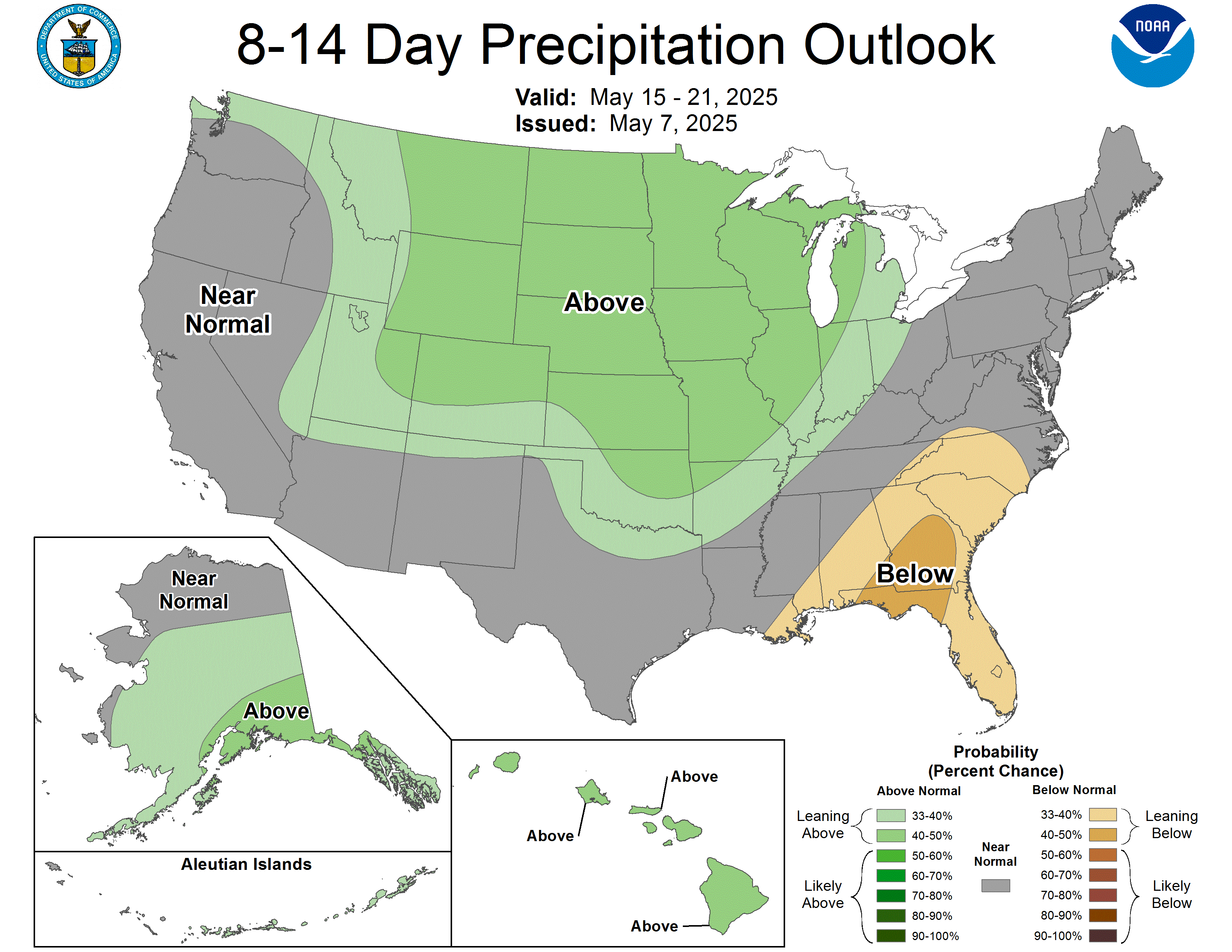
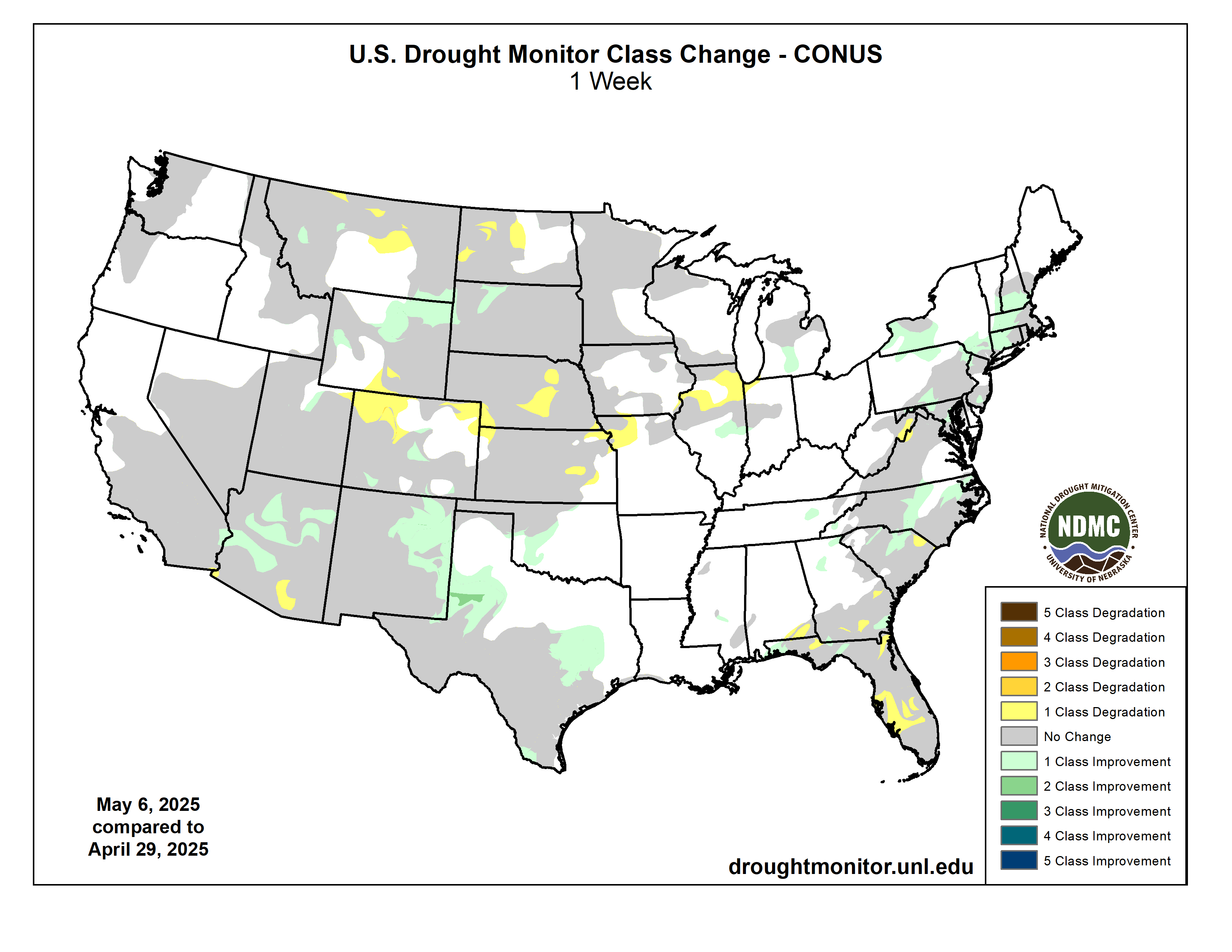
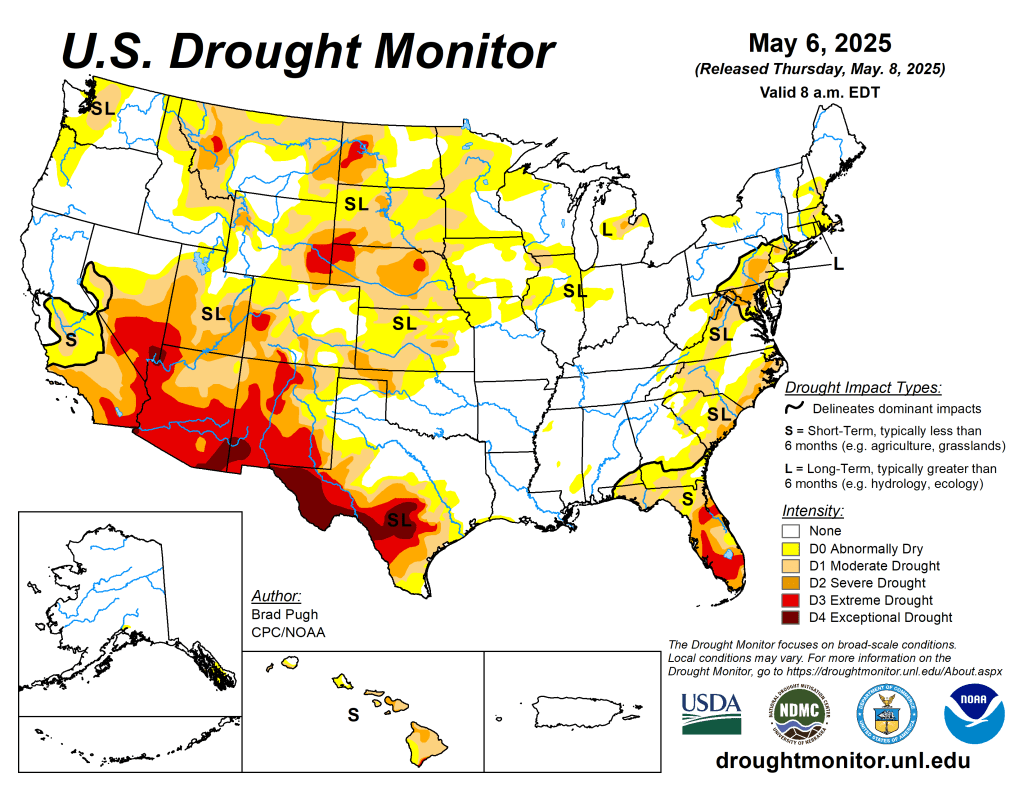
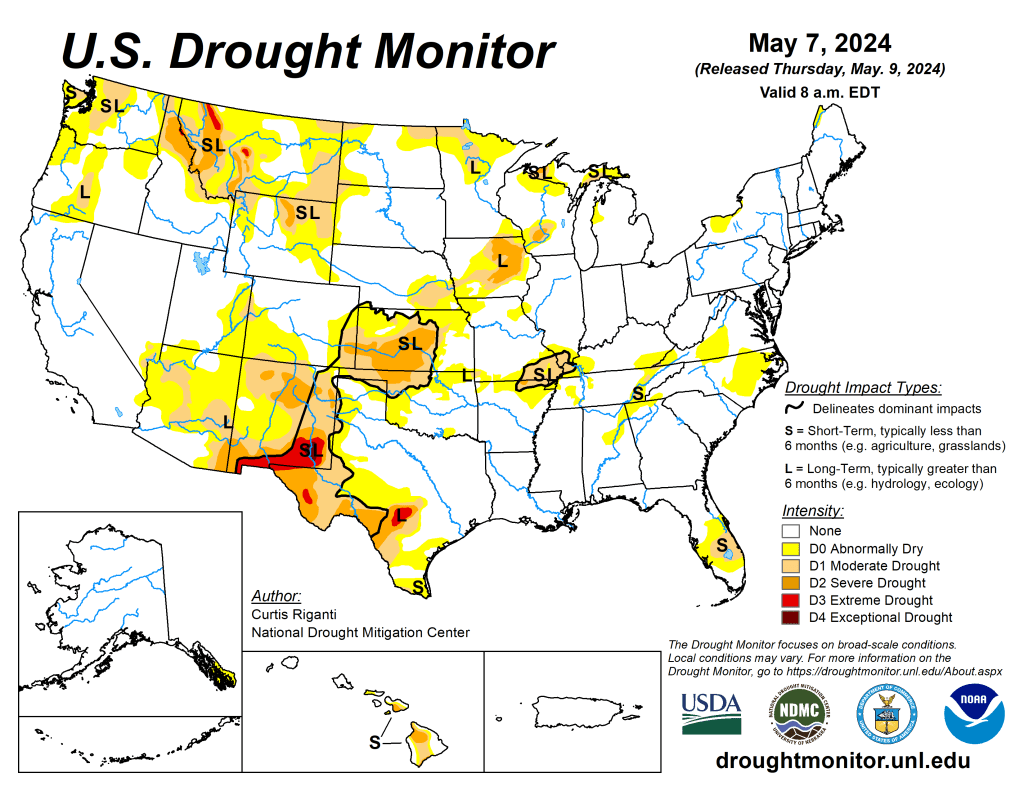
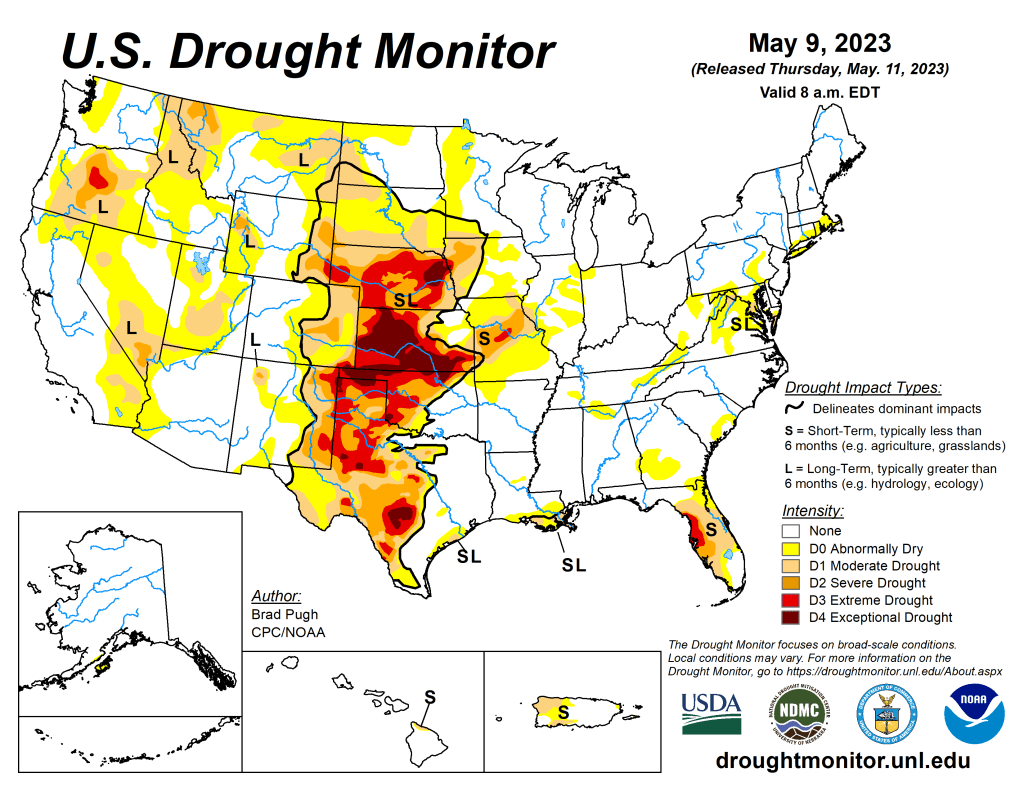
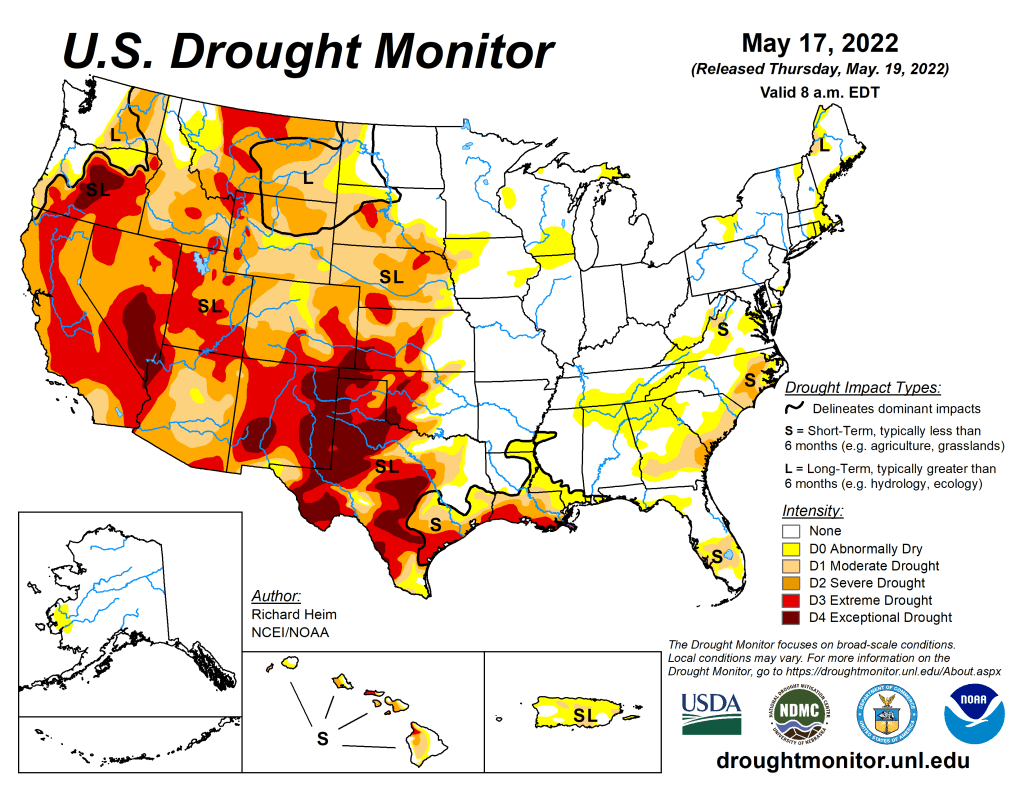
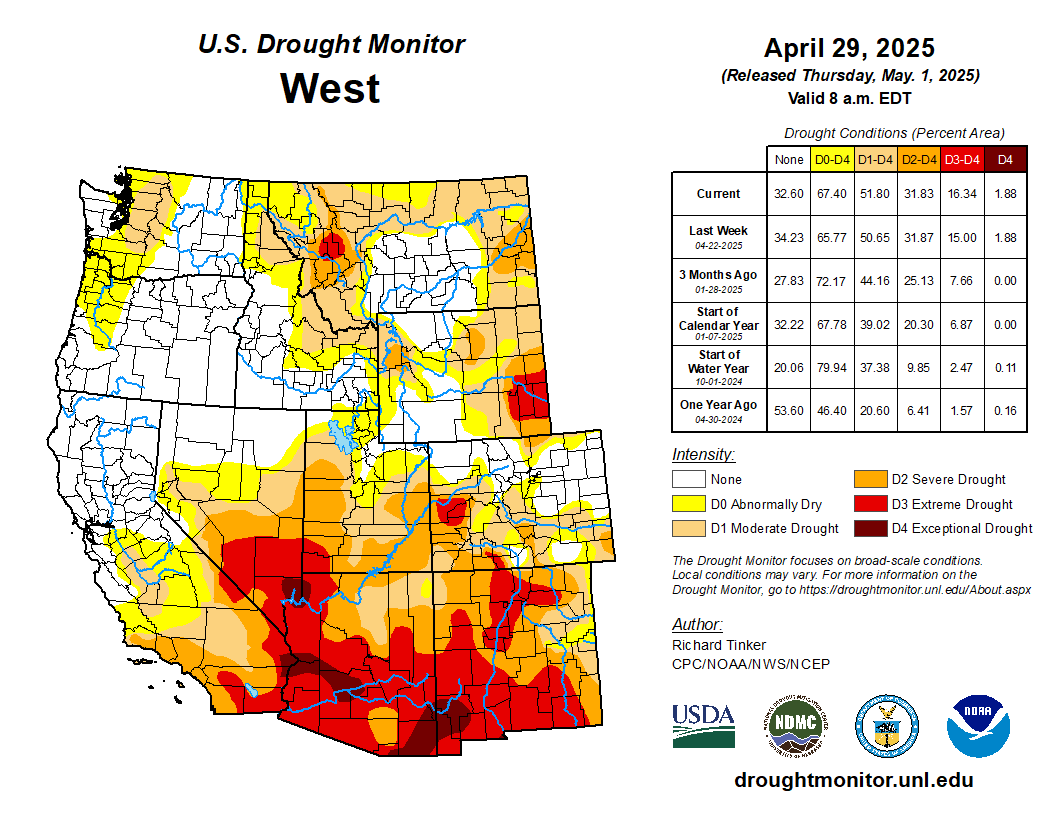
Click the link to read the update on the NIDIS website:
May 20, 2025
Record-Breaking Snowpack Melt Out Across the West
Key Points
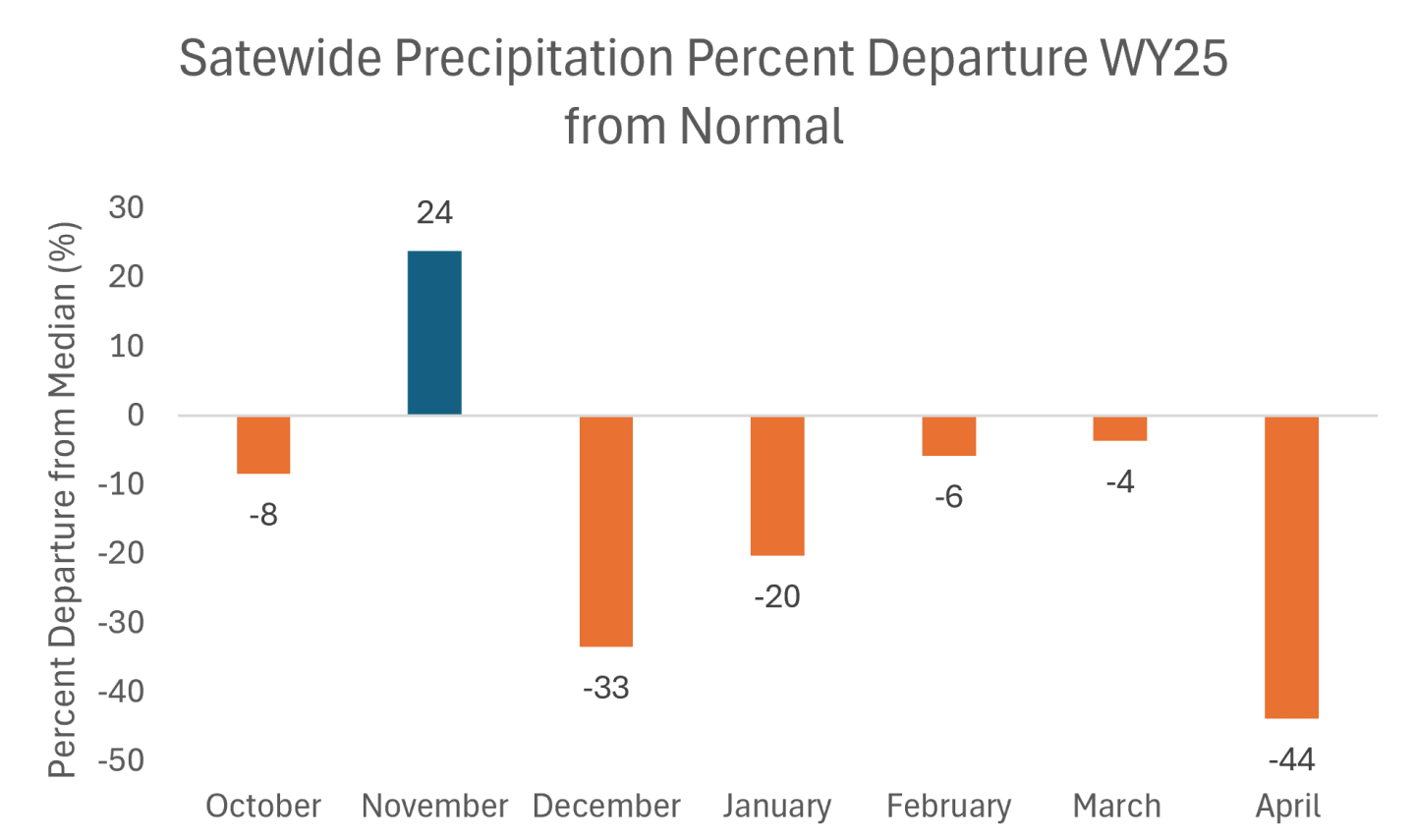
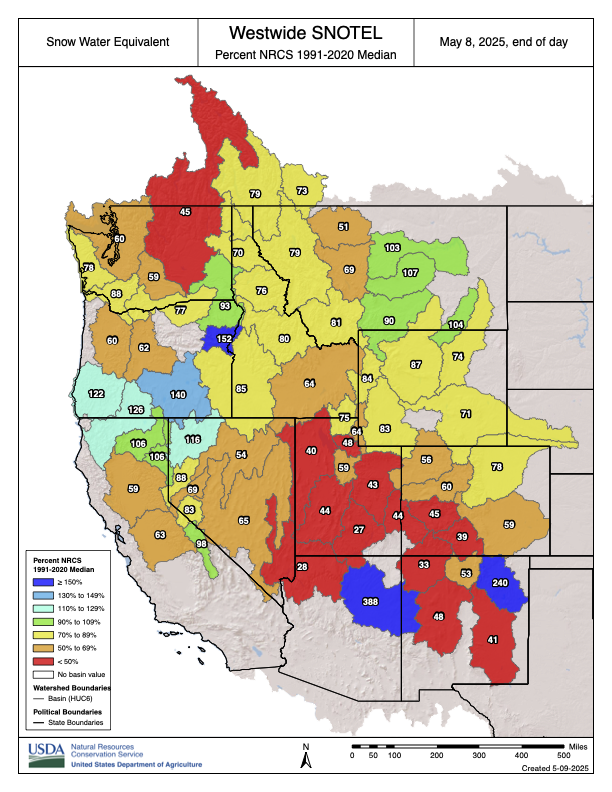
Above-normal temperatures and below-normal precipitation continued to rapidly melt western U.S. snowpack. Nearly all western basins are now in late season snow drought, despite many stations reaching near to above-average peak snow water equivalent (SWE) during the snow accumulation season. Some stations, including some in Nevada, Colorado, Utah, and New Mexico, saw record early melt out.
The rapid depletion of snow, coupled with increased evaporative demand (the “thirst” of the atmosphere), can rapidly dry soils and vegetation, which can lead to an early start to the fire season.
Snowmelt this time of year is common, but such rapid melt rates are not normal. In some instances, above-normal temperatures such as these can cause snow to sublimate (transition from a solid to a gas) and reduce runoff into streams and reservoirs.
Tracking snow drought during the snowmelt season is important, because the rate and disappearance of snow can cause flooding and impact water supply, soil moisture, ecosystems, recreation, and wildfire potential.
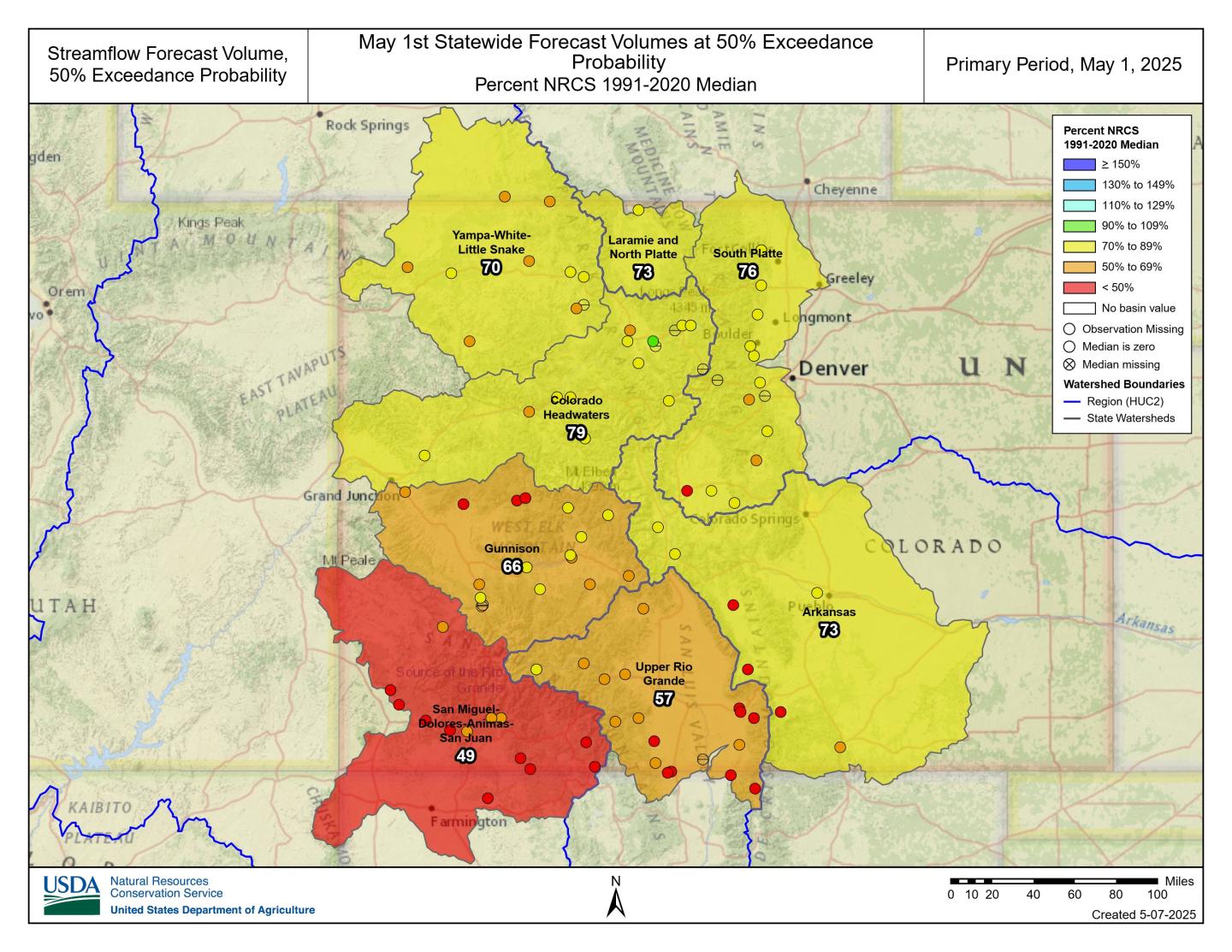
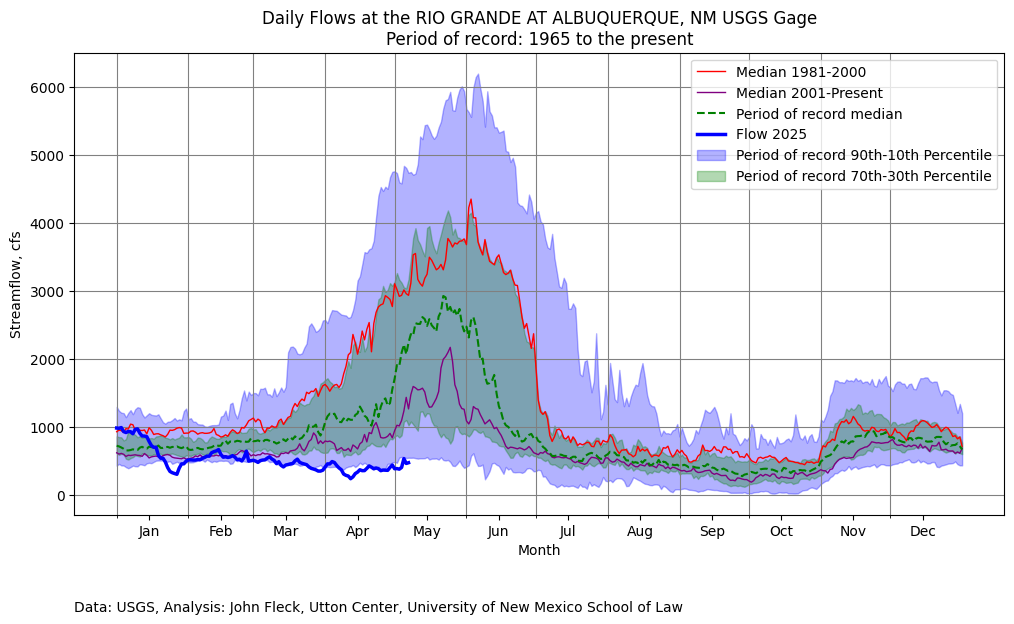
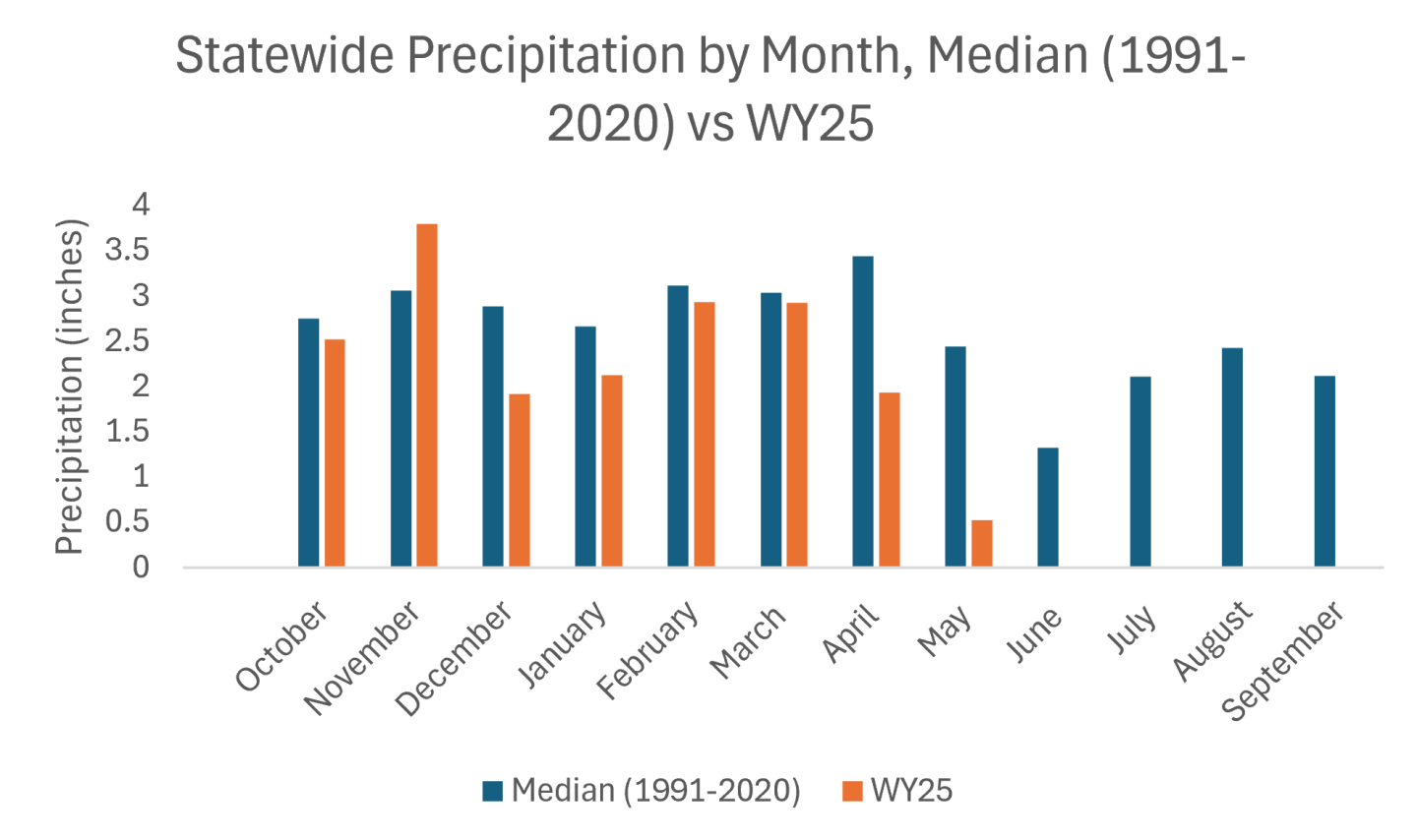
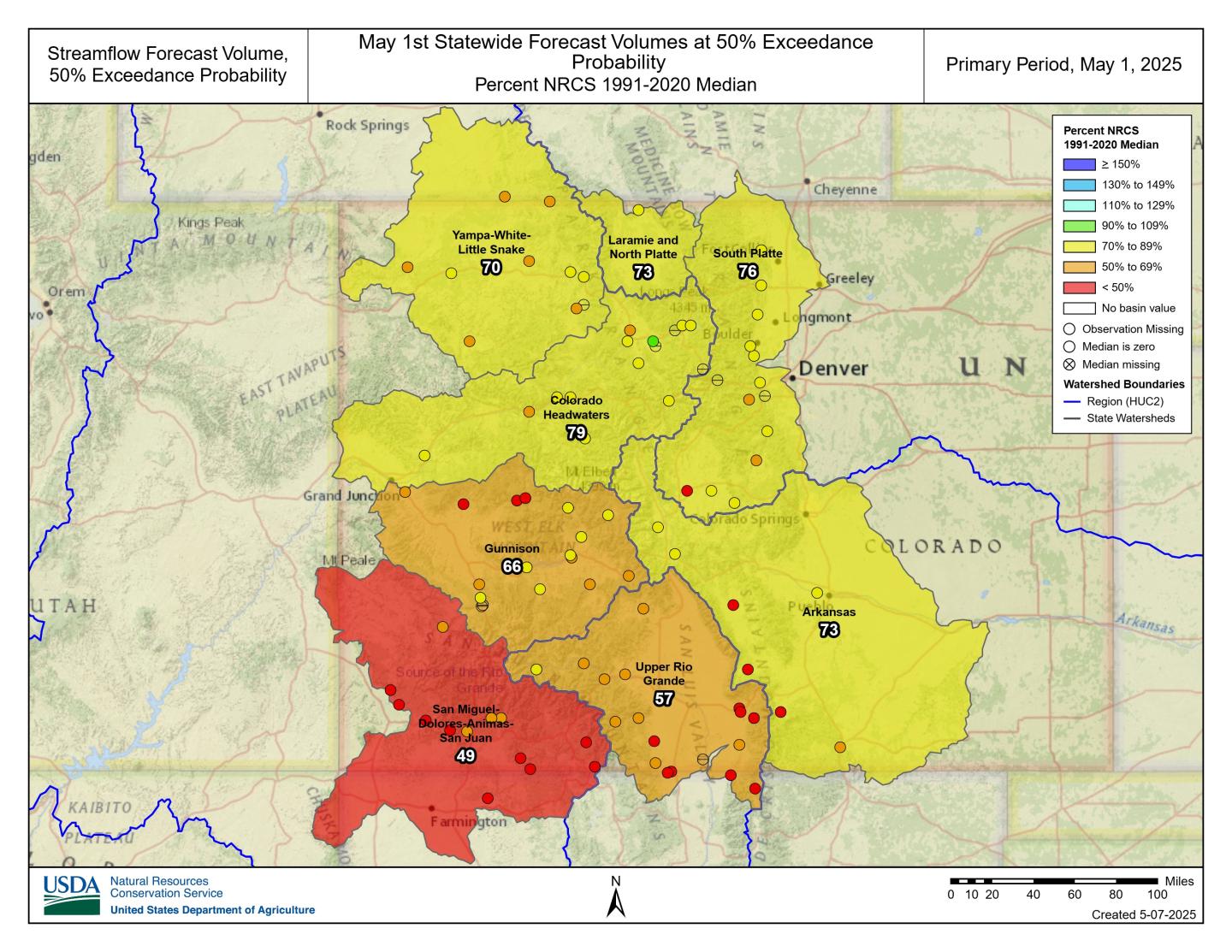
Water supply forecasts for the Colorado River Basin, Rio Grande Basin, and Columbia River Basin declined compared to April 1 forecasts due to well-below-average April precipitation.
This update is based on data available as of Thursday, May 15, 2025 at 12:00 a.m. PT. We acknowledge that conditions are evolving.
Current Conditions
Tracking snow drought during the snowmelt season is important because the rate and disappearance of snow can cause flooding and impact water supply, soil moisture, ecosystems, recreation, and wildfire potential.
Across many basins in the West, late season snow drought (snow water equivalent in the bottom 20% of historical conditions) developed amid above-normal temperatures and a very dry April and early May. Several significant melt out events impacted nearly every major mountain range. Some stations, including some in Nevada, Colorado, Utah, and New Mexico, saw record early melt out. Snowmelt this time of year is common, but such rapid melt rates are not normal. In some instances, above-normal temperatures such as these can cause snow to sublimate (transition from a solid to a gas) and reduce runoff into streams and reservoirs.
Median snowpack values are lower in late spring. As a result, even small precipitation events can cause large changes in percent of median values at this time of year without significantly increasing overall seasonal snowpack totals.
Columbia River Basin
In the Columbia River Basin, May-to-date precipitation has been below 50% of normal across large portions of the state. The Yakima River Basin and some other basins already had long-term precipitation deficits, and multiple years of drought prompted Washington to declare a drought emergency.
Earlier-than-normal snowmelt could deplete reservoir systems earlier in the season than is typical across Idaho. These lower reservoirs could lead to minimal water in storage for next year’s demands. Low reservoir levels could deepen Idaho’s reliance on ample snow next winter to meet water supply. The Middle Snake River Basin saw snow water equivalent (SWE) drop from the 70th percentile to the 30th percentile in a two-week period beginning late April.
Colorado River and Rio Grande Basins
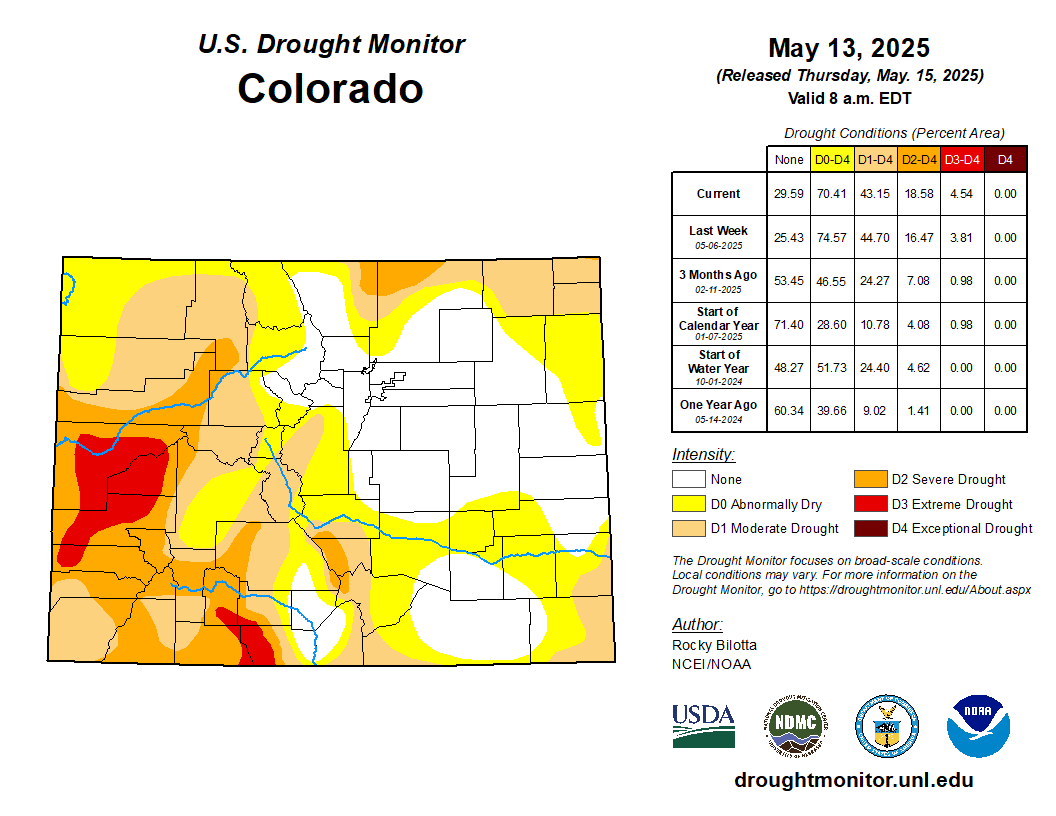
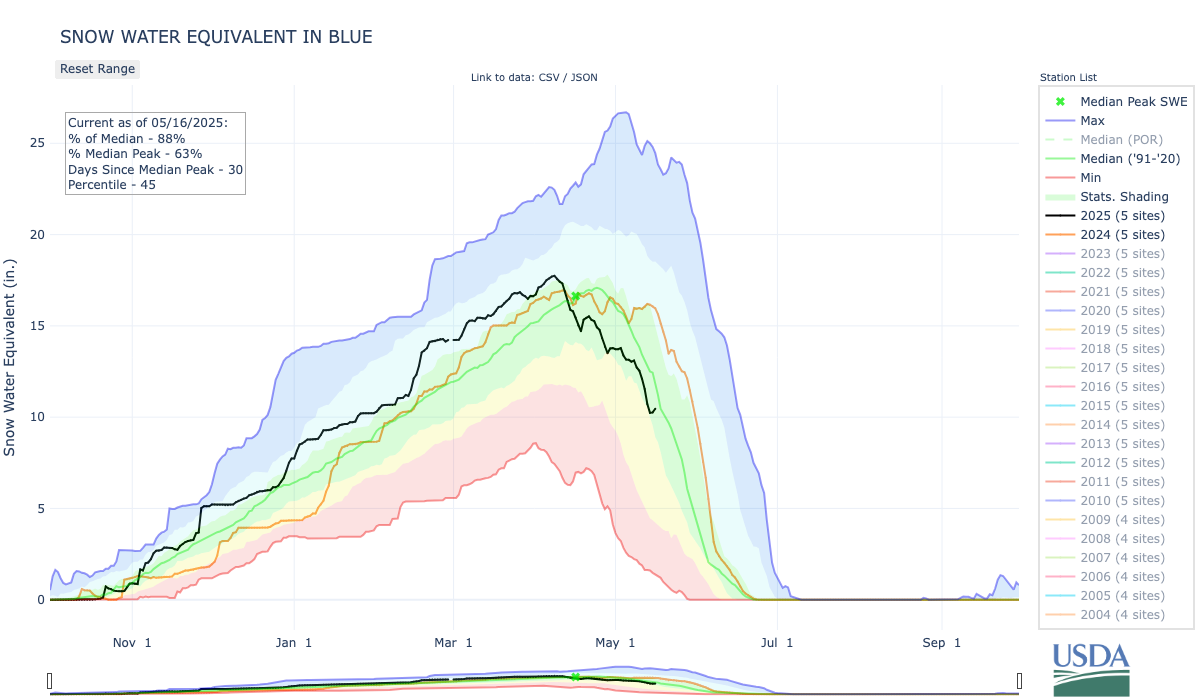
The Colorado River Basin and other portions of the central Rockies in Colorado and Utah that had above-median snowpack at the beginning of April rapidly melted later that month. Snow water equivalent (SWE) in the Colorado Headwaters Hydrologic Unit Code (HUC) 6 Basin dropped from the 30th percentile to the 10th percentile in a 7-day period in mid-April. On April 24, Utah declared a drought emergency in 17 southern Utah counties in response to low streamflow forecasts, increased water demand as temperatures rise, and drought.
As of May 4, parts of Wolf Creek Pass were snow-free, meaning they melted nearly 3-4 weeks early. The SNOTEL station at Wolf Creek Pass entered near-record low SWE totals for this time of year. The Baldy Mountain SNOTEL site in Arizona (9,210-foot elevation) remained mostly snow-free throughout the winter.
Looking Ahead
Low Water Supply Forecast
Water supply forecasts for the Colorado River Basin, Rio Grande Basin, and Columbia River Basin declined compared to April 1 forecasts due to well-below average April precipitation. The northern Rockies in the headwaters of the Missouri River Basin also experienced rapid melt out and early peak snow water equivalent (SWE). With 50% of the Missouri River Basin in drought, persistent dry conditions coupled with early peak SWE have reduced water supply forecasts.
Warm Temperatures, Near-Normal Precipitation Support Early Snowmelt
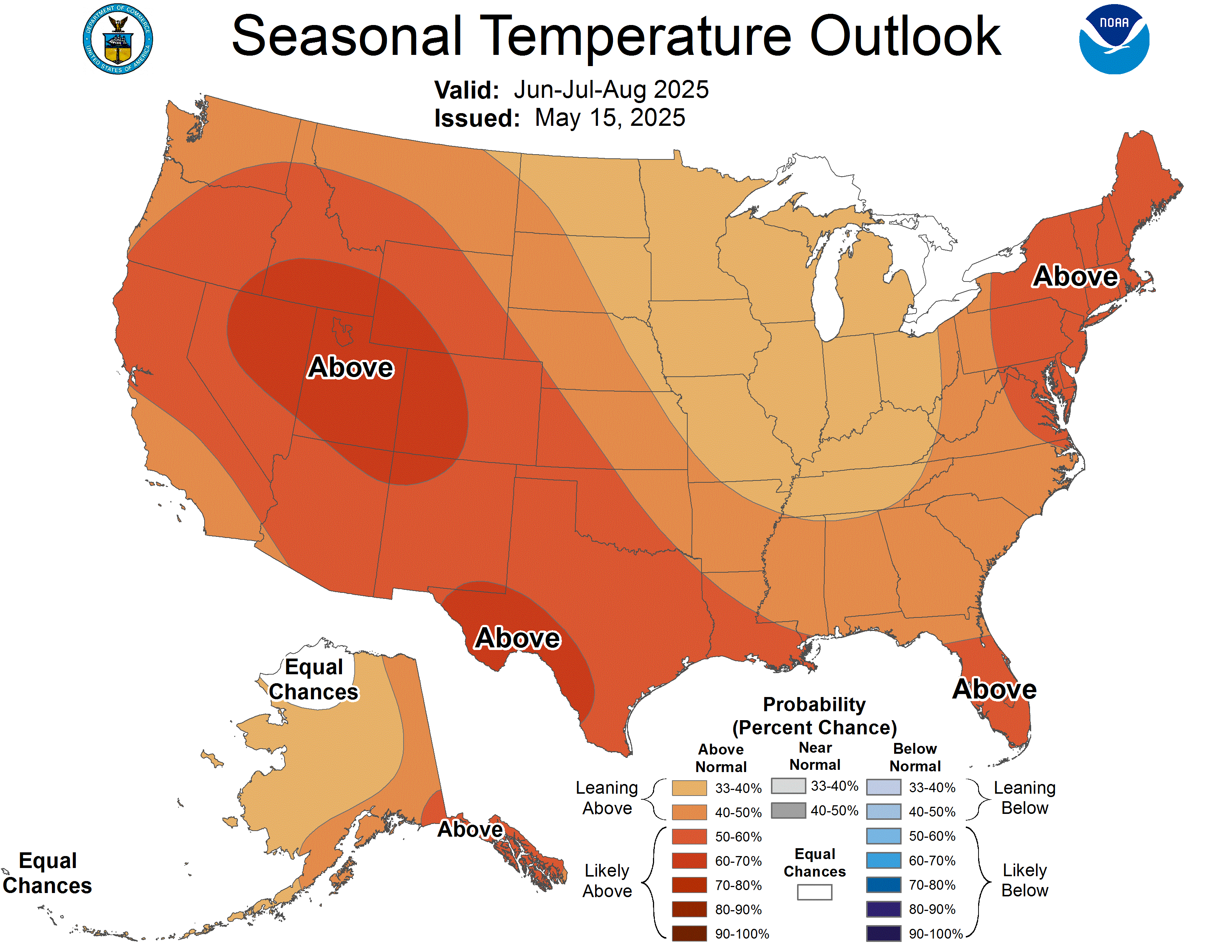
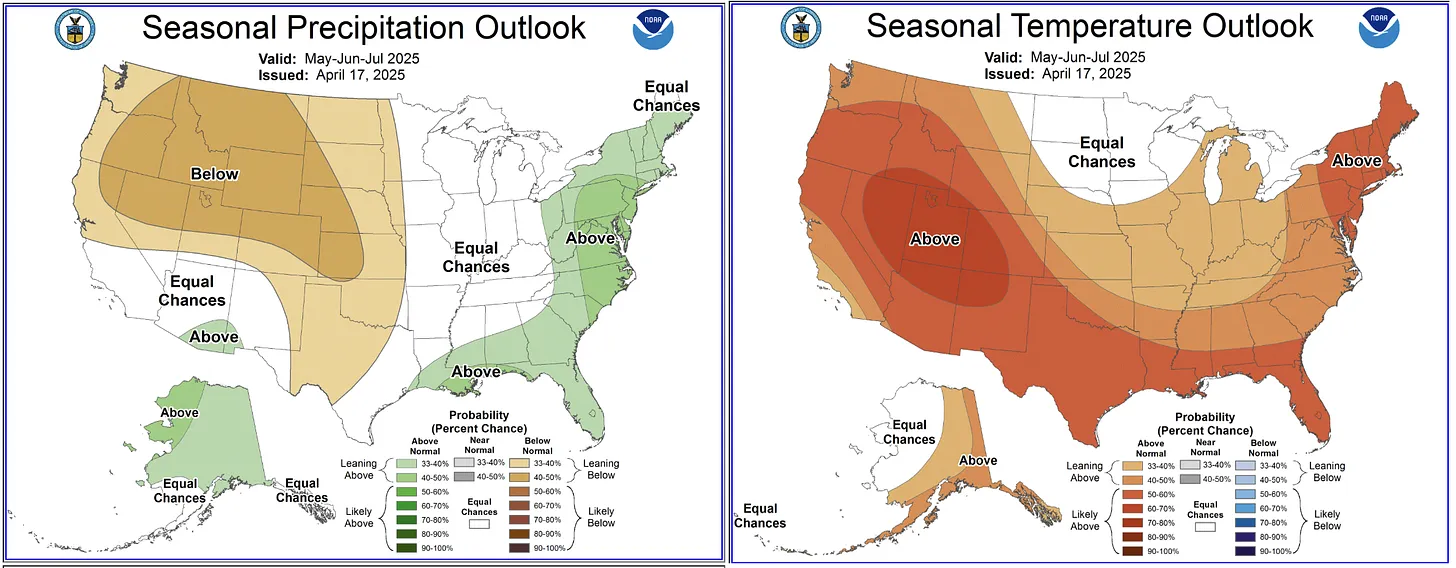
The NOAA Climate Prediction Center’s June outlook favors above-normal temperatures and below-normal precipitation across most of the West. California, Nevada, Arizona, and southwest Utah have equal chances of above-, below-, or near-normal precipitation. Conditions are favorable for earlier-than-normal snow meltout. Melt out is common this time of year. However, the rapid depletion of snow at higher elevations, coupled with increased evaporative demand, can rapidly dry soils and vegetation. This can lead to an early start to the fire season.
Drought Likely to Persist
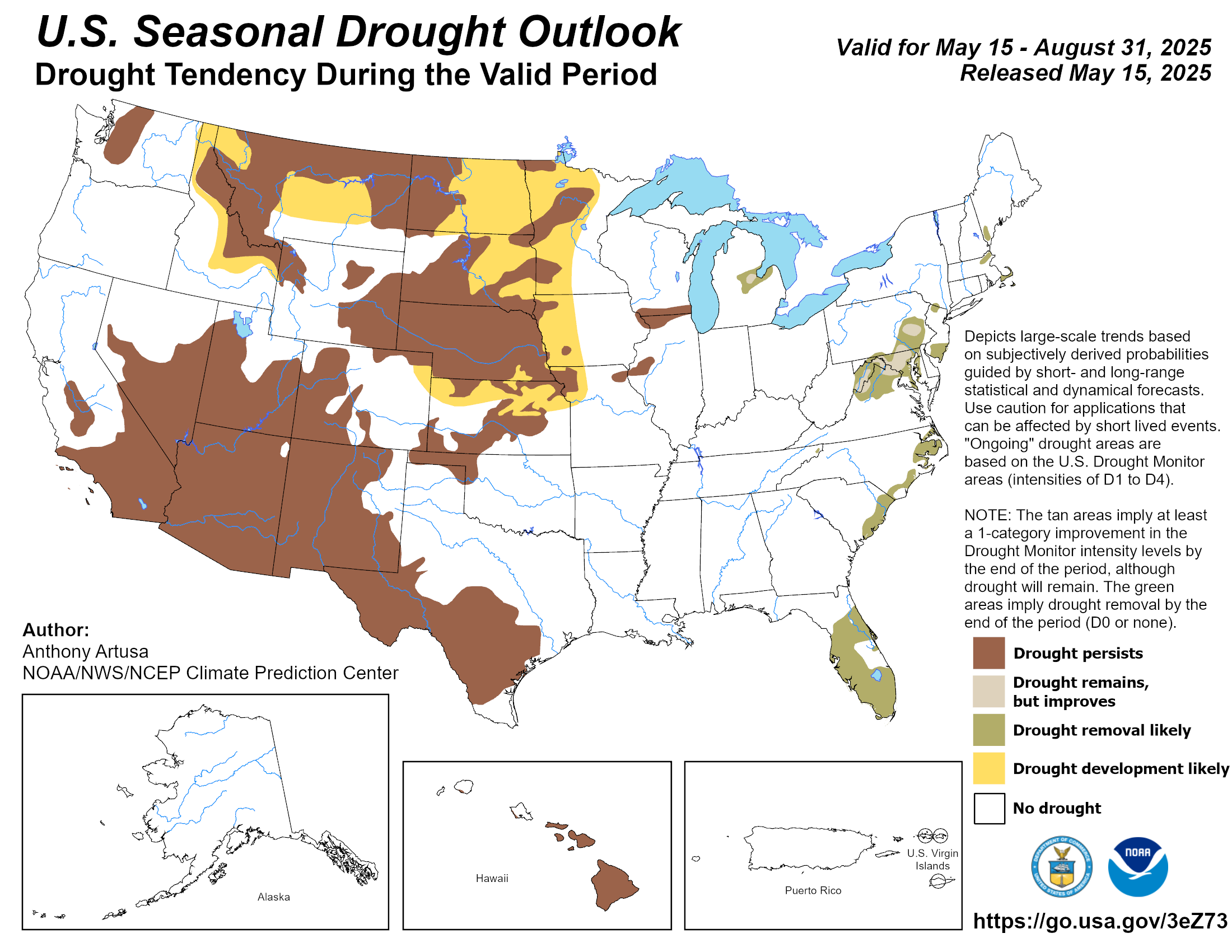
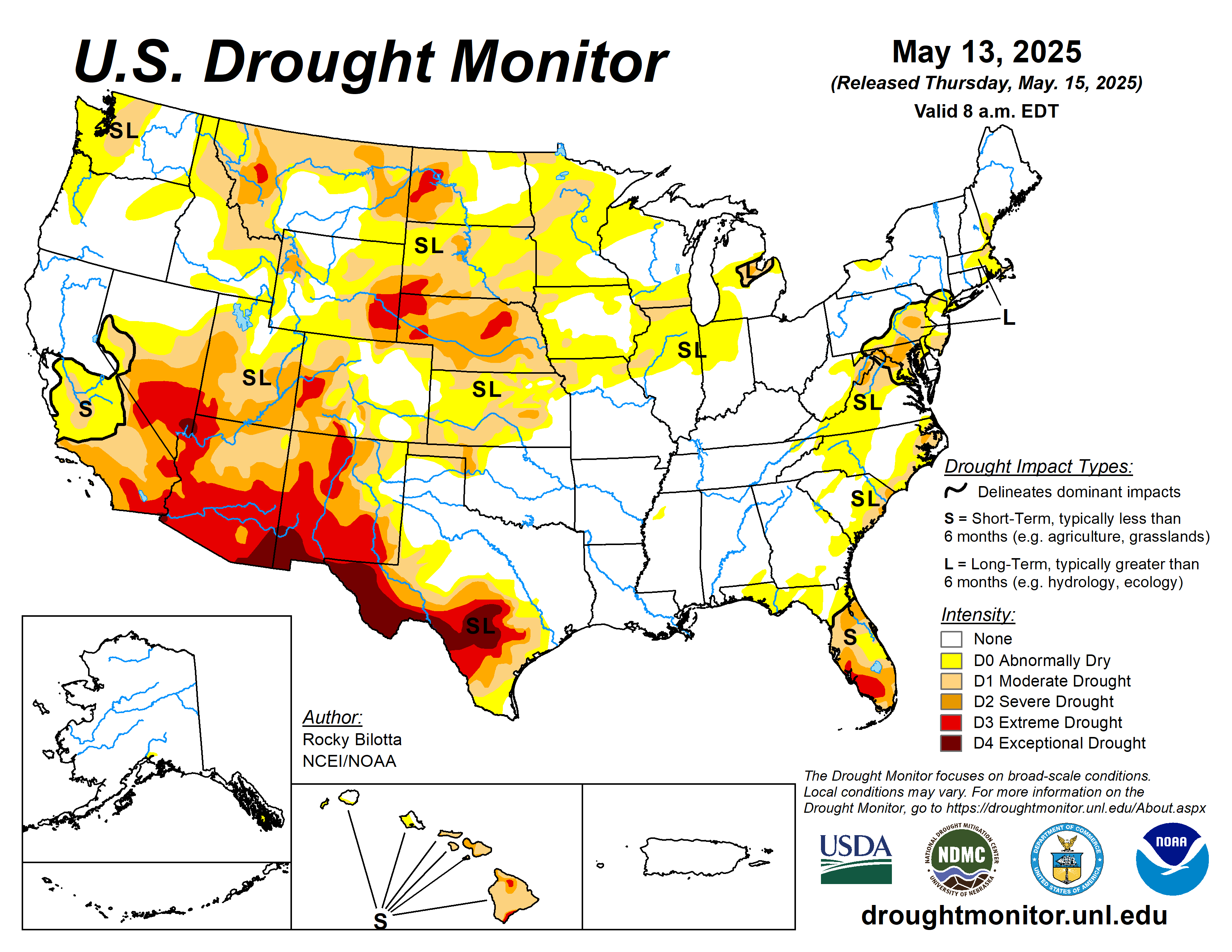
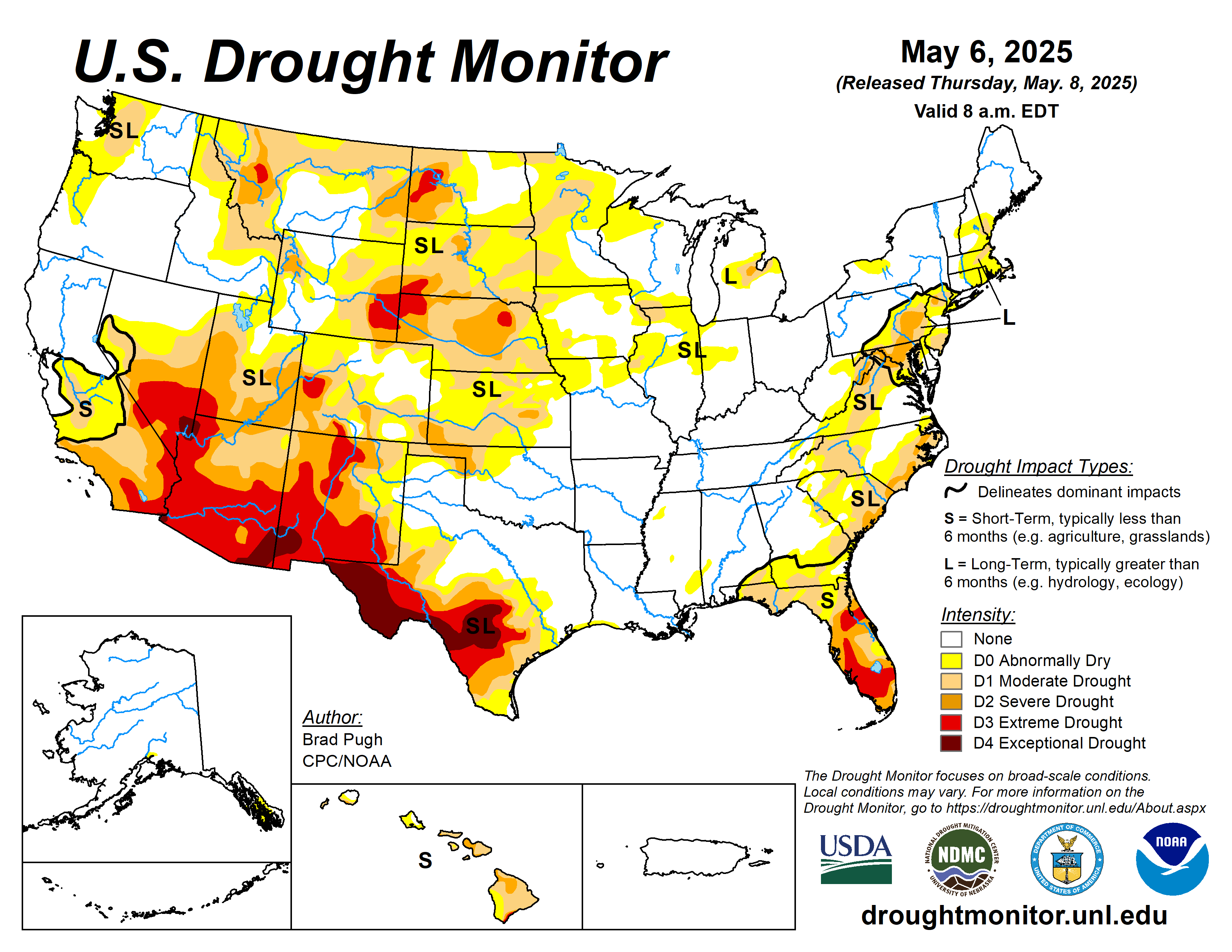
The seasonal drought outlook from the Climate Prediction Center favors drought development or expansion across the northern Rockies of Idaho and Montana, which includes some areas that received above-average snowpack earlier in the season but melted rapidly. The southern Rockies saw low snowpack throughout most of the season, and drought is expected to persist across these areas, including southern California, Nevada, Utah, and Colorado, along with Arizona, New Mexico, and a portion of Washington.
Heightened Fire Risk for Parts of the West
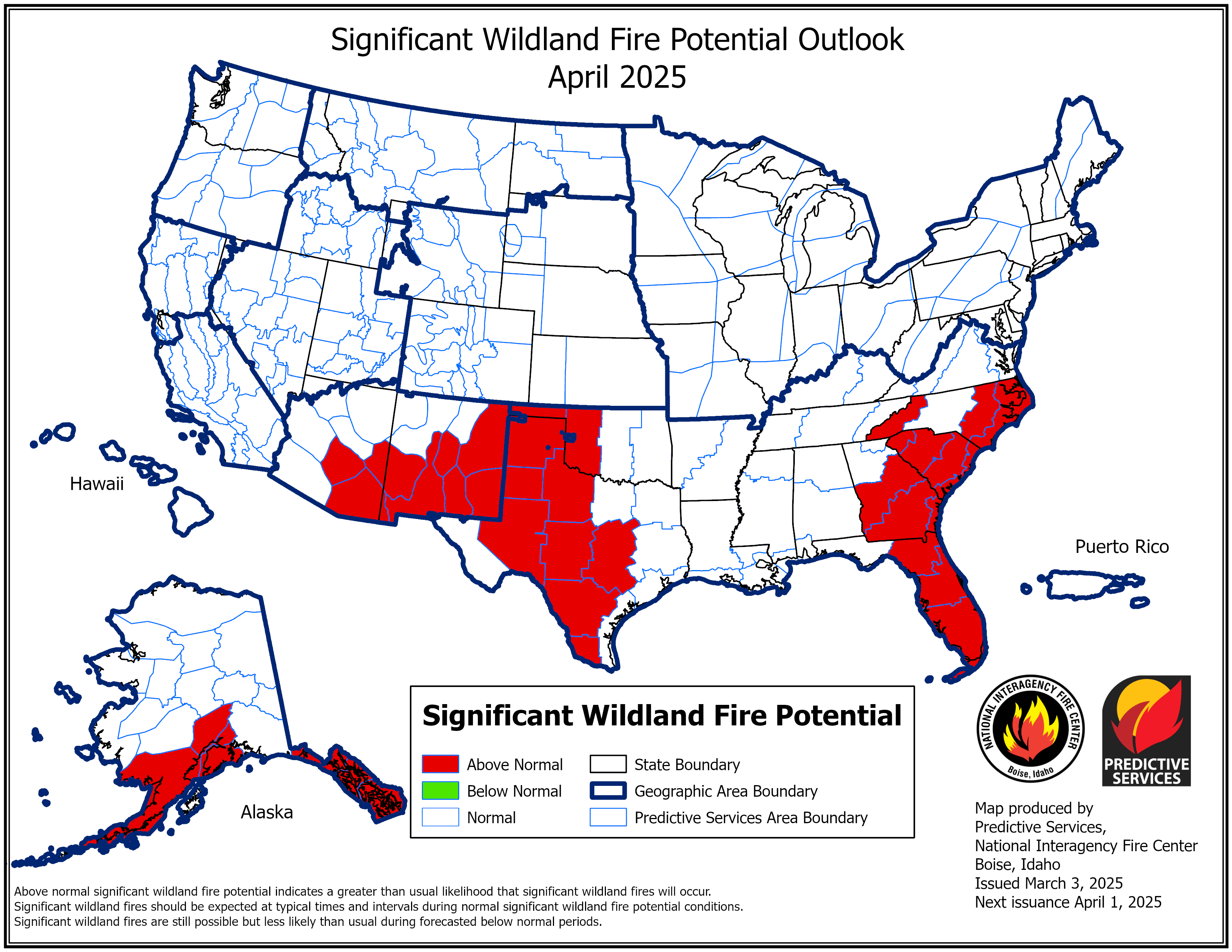
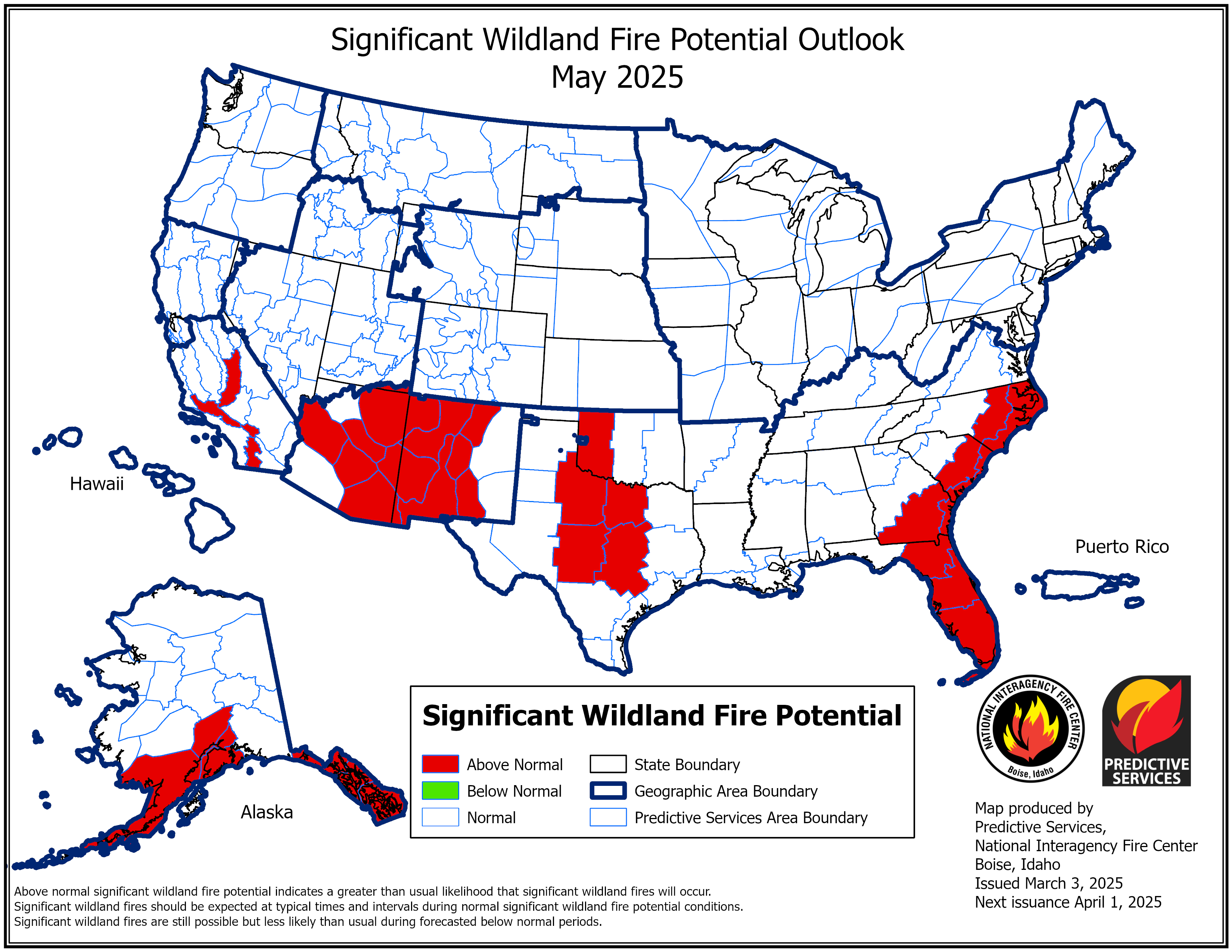
Late season snow drought from rapid snowmelt and early melt out, above-normal temperatures, and below-normal precipitation led to significant wildland fire potential. In Arizona and New Mexico, record low snowpack this winter and substantial long-term deficits favor above-normal wildland fire potential in May.
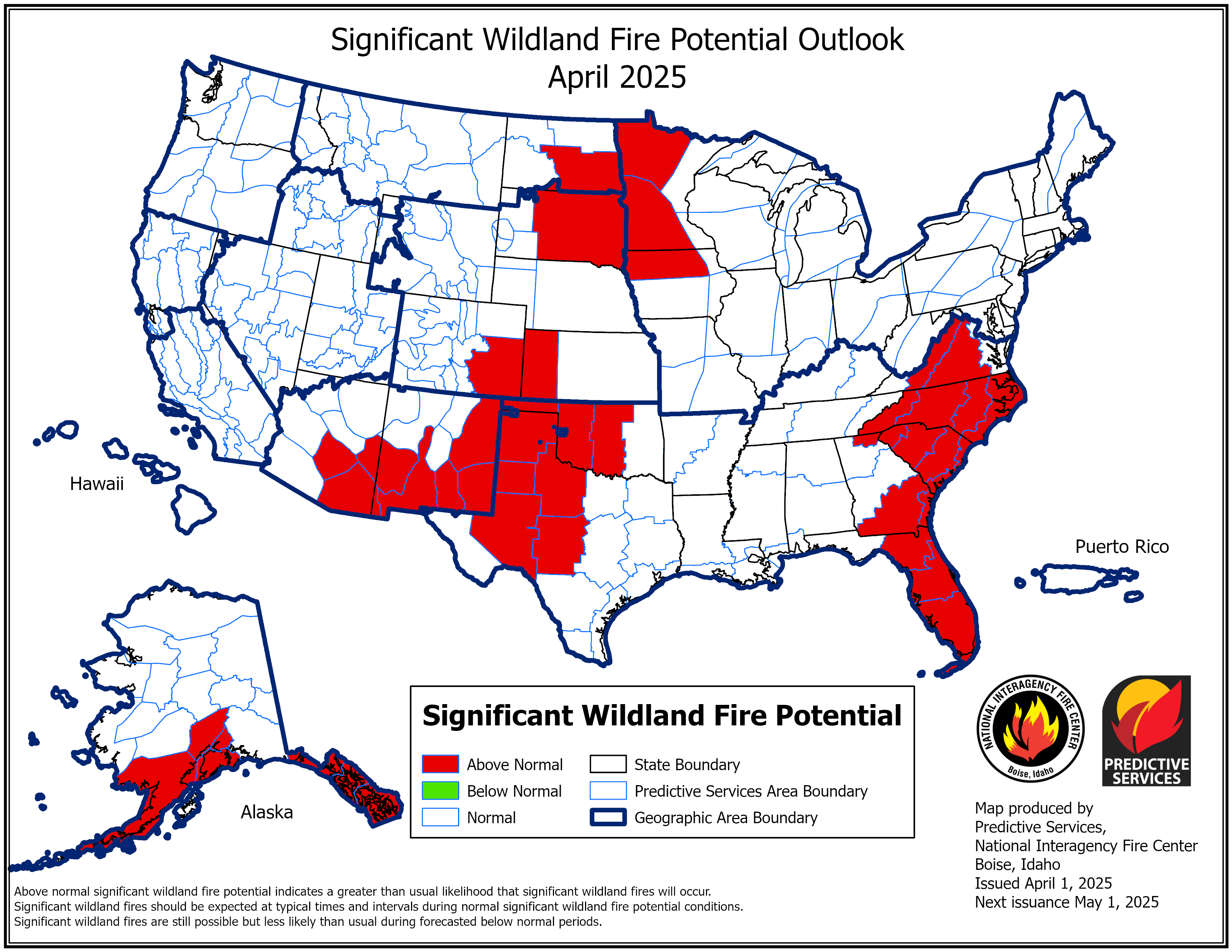
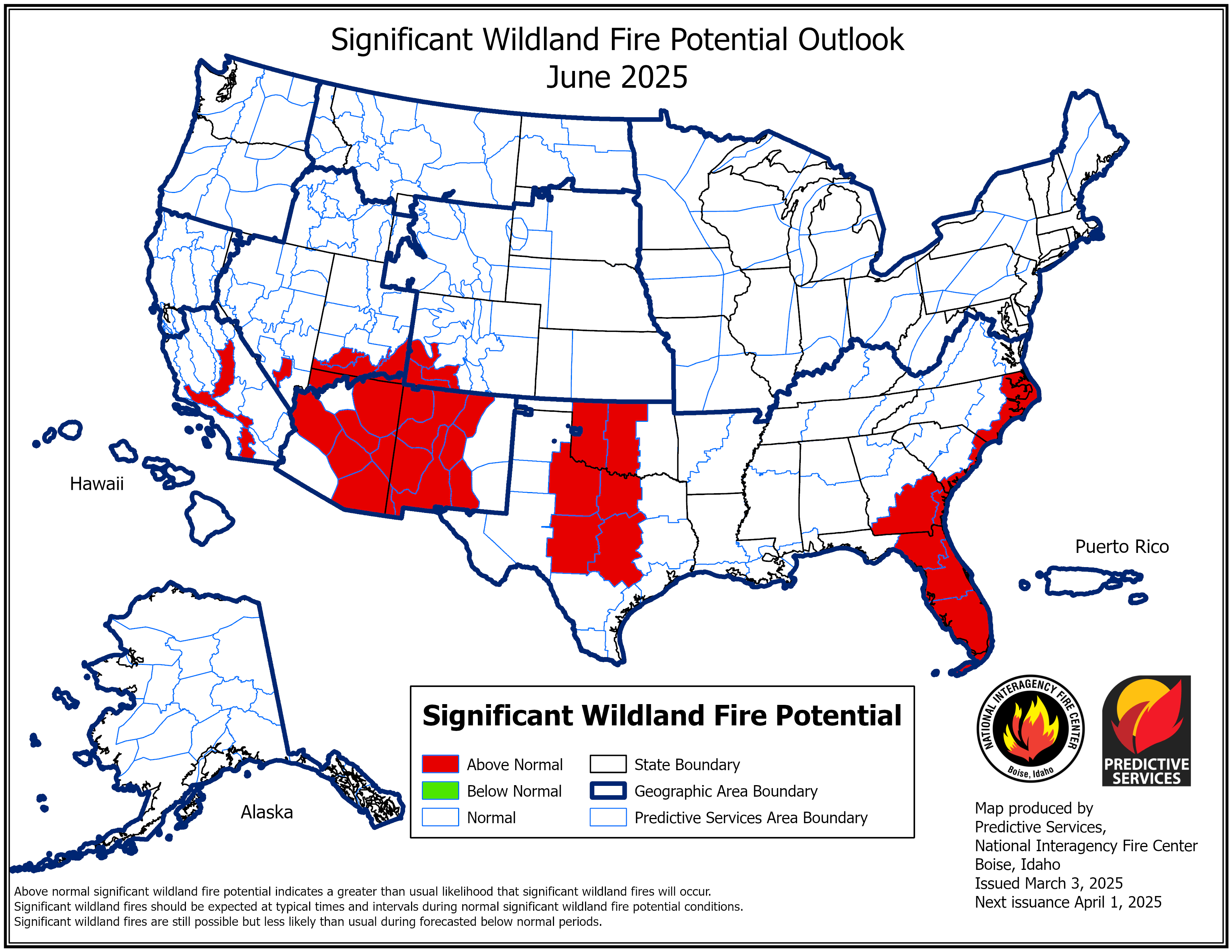
National Interagency Fire Center outlooks for Junefavor above-normal wildland fire potential in areas with significant snow drought, including Arizona and New Mexico. Increased fire potential extends into the southern portions of Nevada, Utah, and Colorado. June outlooks also favor above-normal fire potential in eastern Washington, northern Idaho, and the Sierra Nevada of California.
In July and August, significant wildland fire potential is favored across nearly all of Washington, Oregon, Montana, and Idaho. Significant portions of California, northern Nevada, and northeast Wyoming are also predicted to have increased fire potential.
Late Season Snow Drought Developed Across the West
Spring Heat Wave Rapidly Melts Snow
Rapid Snowmelt Led to Rapid SWE Losses in the Colorado Headwaters Basin
Rapid Snowmelt Led to Rapid SWE Losses in the Middle Snake-Boise Basin
* Quantifying snow drought values is an ongoing research effort. Here we have used the 20th percentile as a starting point based on partner expertise and research. Get more information on the current definition of snow drought. Note that reporting of SWE by Snow Telemetry (SNOTEL) stations may be unavailable or delayed due to technical, weather or other issues, which may affect snow drought depiction in this update.
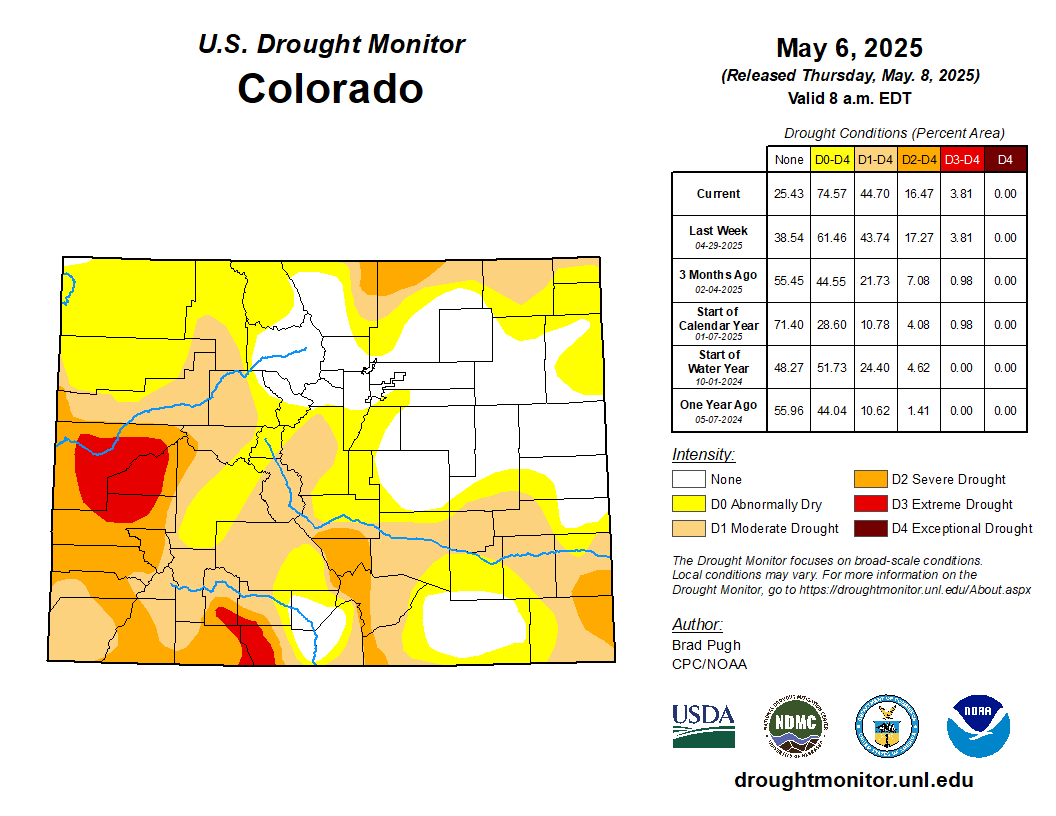
Grand County is home to numerous lakes, reservoirs and rivers. Currently, the county is sitting better than other areas in Colorado in terms of drought. But as a dry, hot summer is forecast, the Grand County Drought Preparedness Committee declared a drought watch. This is the lowest level of the four drought stages. According to the committee, the county has experienced its two driest decades in history. The drought committee includes stakeholders across the county who look at environmental indicators to determine droughts levels and give recommendations for water conservation…In a news release, the committee states the drought watch is spurred by significant snowmelt that’s occurred since early April. The Upper Colorado River Basin’s snowpack levels were at 67% of median on May 8, the release states…
Foulk said that the preparedness committee will reconvene on May 27 to review the county’s drought indicators. Based on precipitation levels and other factors, the county could move up to Stage 1 drought warning, or go back down from the current drought watch. For each drought stage, the preparedness committee recommends specific water reduction actions. Regardless of the current level of drought, residents are encouraged to conserve water as normal practice. Small steps in community members’ homes and yards can have big impact on the waters that flow through Grand County.
Click the link to read the article on the Summit Daily website. Here’s an excerpt:
May 15, 2025
The Colorado River District will hold one of its 11 “State of the River” events in Silverthorne on Thursday, May 22. The event, held in partnership with the Blue River Watershed Group, will be held at the Silverthorne Pavilion from 6 p.m. to 8 p.m., according to the Colorado River District’s website…
Presentations will cover topics including current river conditions and seasonal forecasts, updates on the Colorado River system, local water projects affecting the Blue River in Summit County, updates on the Shoshone River water rights efforts, conservation efforts in the region and updates on recent legislative efforts. Registration is required. To register for the “State of the River” event visit ColoradoRiverDistrict.org/state-of-the-river-meetings-2025
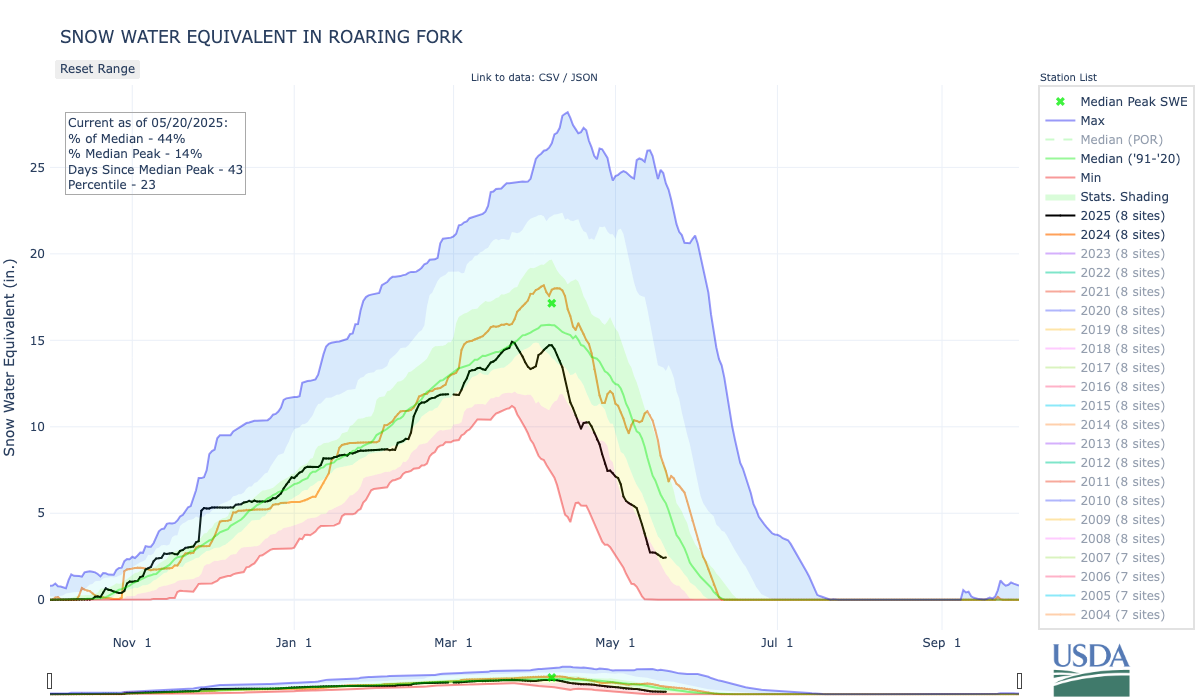
The central mountains of Colorado, including Aspen, are currently experiencing a snowpack that is only 42% of the seasonal average, a dramatic shortfall that is already producing consequences for river flows, drought conditions, and fire risk across the region. Meteorologist Kris Sanders with the National Weather Service in Grand Junction confirmed the snowpack is not only low, but melting rapidly.
“We peaked at pretty close to normal — around 80% — but normally we see the snowpack last a little longer,” he said. “It has been melting quicker.”
The zero snow water equivalent, a measurement of the amount of water contained in snowpack, is projected by the end of May, Sanders said. In other words, there soon won’t be any water content left in the central mountains’ snowpack…Sanders noted that recent precipitation will offer only short-term relief. He said the Roaring Fork Valley received up to less than one inch of rain, and four to eight inches of snow in the higher elevations, with close to a foot at the highest…He added that the central mountains are forecasted to remain abnormally dry, with moderate drought conditions likely persisting through the summer…[Matthew Anderson]pointed to current Roaring Fork River flows at Glenwood Springs, which are around 900 cubic feet per second (cfs) due to recent cold. The Colorado Basin River Forecast Center expects peak flows to reach 2,000 cfs within 10 days, a steep drop from the usual 6,000 cfs typically seen in early June.
The debate over selling off public land has become more serious, and consequential, than ever. While the urge to transfer public land out of the American public’s hands has flared up many times over the last century or so, never has the concept gained so much support among establishment politicians and pundits. Neither James Watt, the notoriously anti-conservationist Interior Secretary under Ronald Reagan, nor the fossil fuel-loving officials of the George W. Bush administration, nor even Trump I’s Interior Secretary, Ryan Zinke, called for wholesale public land transfers.
And yet, now we have not only Interior Secretary Doug Burgum advocating for selling land to states and real estate developers, but also members of Congress and even prominent newspaper columnists and editorial boards doing so. As this extremist threat becomes more real, public land lovers understandably react in extreme ways — including condemning every public land transfer, no matter how small.
I used to bristle at the mention of public land swaps, until the late Paul Beaber, a long-time US Forest Service surveyor, set me straight. He pointed out that not only does the current law allow federal land agencies to “dispose” of some parcels, but that in some cases exchanges and even sales can make sense and be beneficial to public land users. (And just to be clear, the current proposals by Republicans in Congress and the Trump administration do not make sense and will not benefit public land users).
The point was raised by Land Desk reader James Aldrich in response to last week’s piece on the public land sale amendment in Congress’ budget reconciliation bill. He wrote:
I have to take issue with James’ last sentence here: Saying that public land should be sold because it belongs to all of us is a logical fallacy, since once it is sold it will only belong to one of us! So that’s not the best justification for selling the land. However, he brings up some other good points.
First, there are hundreds if not thousands of this sort of parcel scattered around the West, these little squares of BLM islands in a sea of private land. The BLM is usually eager to get rid of those parcels, because they not only create a management headache, but also end up serving as something like exclusive parks for the private owner(s) that surround it. They are technically public, but practically private, since the public can’t access them without trespassing on private land.
And, as Luke Schafer put it in a response to Aldrich, the BLM does have a mechanism for “disposing” of those parcels.
I’ll get more into how that is typically done in a moment. But first, a bit of history to see how we ended up with these isolated squares of public land.
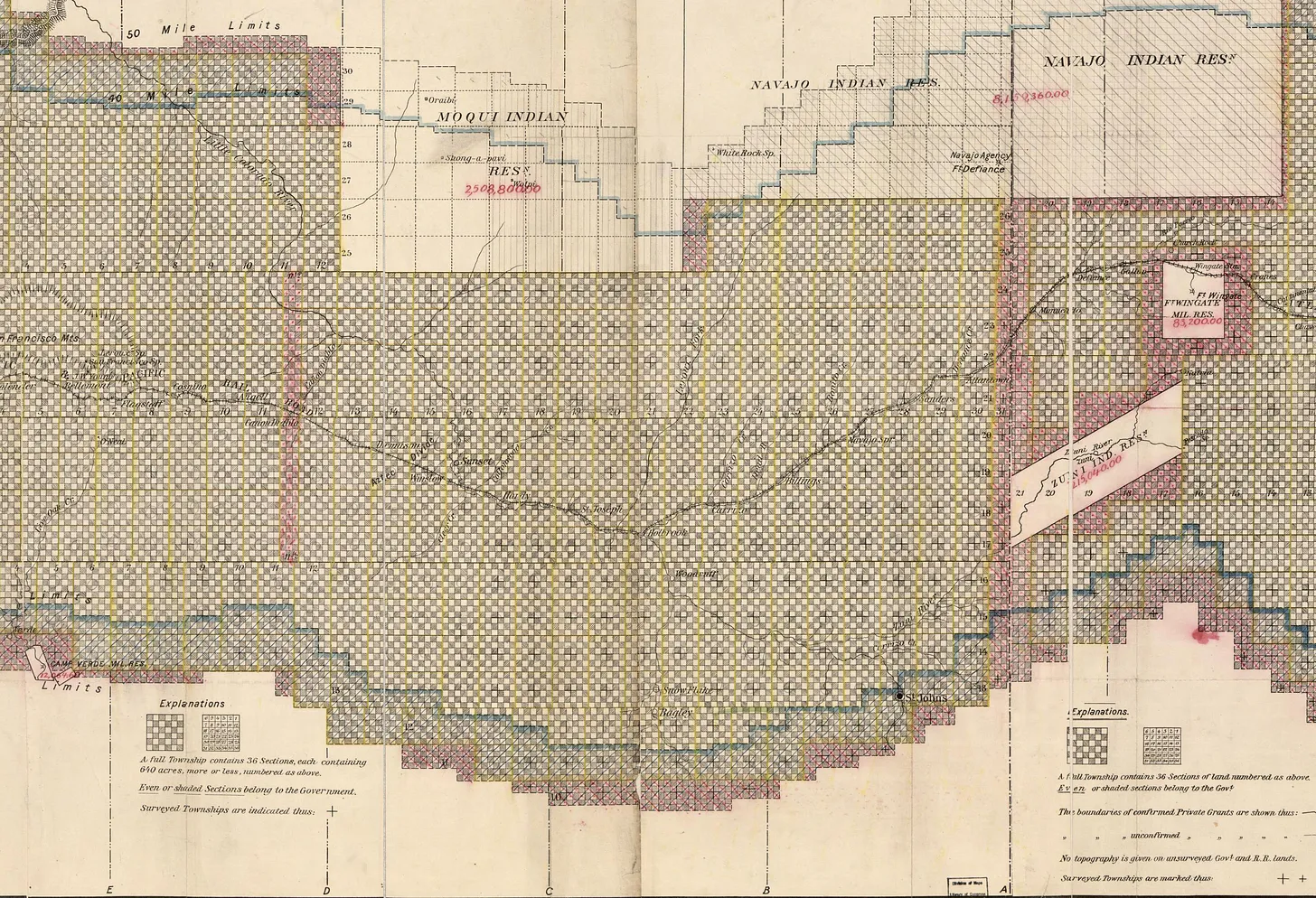
In 1785, the U.S. Congress of the Confederation passed the Land Ordinance, which in turn created the Public Land Survey System to be applied to the public domain west of the Appalachians (which, at the time, didn’t extend very far). The land was cordoned off into thirty-six-square-mile rectangular townships, which were then sliced into 640-acre sections — a big grid made up of thousands of squares — with zero consideration for topography, watersheds, cultural boundaries, eco-zones, or habitat.
This grid that overlays America is artifice, something seen only on maps, based on nothing real. Yet it has profoundly influenced the way Americans relate to the landscape and to one another, and is manifested physically on the American landscape in its state and county lines, its streets and avenues, its county roads and property lines, and in GPS coordinates. “The grid, not the eagle or the Stars and Stripes,” wrote John Brinckerhoff Jackson in his seminal A Sense of Place, A Sense of Time, “is our national symbol. It is imprinted in every child before birth.”
As the U.S. government continued to expand its empire westward, usually by stealing land from the Indigenous inhabitants, it added the land to the public domain and imposed the grid onto the landscape to create a system that allowed the government to dispose of — i.e. sell or give away — public land to settlers, would-be farmers, railroads, and miners in an orderly fashion.
[⚠️ Suspicious Content] The 1862 Homestead Act was created with subsistence farming in mind and allowed a prospective farmer to stake out a 40- to 640-acre claim on the public domain1. But the claim’s boundaries weren’t determined by the topography or richness of the soil, but rather by the PLSS; every homestead was a perfect square that the claimant could work for five years, and then patent it, or take title to the land. The government also gave railways every other square-mile of land in rail corridors to incentivize the rail corporations and to draw more homesteaders, and it allowed mining claimants to patent their claims too.
Every square of the public domain that was not homesteaded, given to the railway, staked with a mining claim and patented, or put into a forest reserve or park remained in the public domain. And land that was homesteaded or otherwise claimed, but not patented, also reverted back to the public domain. The result are numerous, chaotic land-ownership called “checkerboards” due to the square shape of each parcel, or geometrically-correct, jurisdictionally nightmarish hodgepodges of federal, tribal, state, private, and Indian allotment land.
Congress passed the Federal Land Policy Management Act, or FLPMA, in 1976, which ended the mass disposal of public lands. The Homestead Act was repealed, mining claims can still be staked (very easily), but there is a moratorium on new patents, and no one is giving public land to railroads any more — although some folks sure would like to give it to real estate developers. Still, the BLM does leave the door open for some land transfers, mainly to address islands of public land within a sea of private holdings. The BLM’s website describes the process like this:
The agency also works to clean up the checkerboard via land swaps, in which an isolated federal parcel is exchanged for a private one surrounded by public land. While these can be win-win situations, they can also look a bit like blackmail or a hostage situation. In the 1990s and early 2000s, for example, a real estate developer named Tom Chapman made a habit of acquiring private inholdings — often in wilderness areas — and threatening to develop them if the BLM or Forest Service didn’t exchange the inholdings for much more valuable parcels in or near ski resorts and so forth. The agencies usually had little choice but to comply.
But in many cases, the swaps can be beneficial. In the San Juan Mountains, for example, huge mining companies like ASARCO ended up with big blocks of mining claims in the high country, surrounded by public lands. The companies could sell the claims to private individuals, who could then potentially build on them, creating a nightmare for county land-use planners. Or they could turn them over to the feds in exchange for isolated but more developable public parcels elsewhere, allowing the BLM or Forest Service to consolidate its alpine holdings, while also disposing of private-land-locked parcels elsewhere.
Don’t get the wrong idea: The BLM can’t just sell or swap chunks of land at their whim. To sell parcels like those James referred to, the BLM first would have to identify them as “disposable,” if you will, during the Resource Management Planning process for that particular field office. That is a long process that includes extensive environmental reviews and ample opportunity for public input. Large exchanges, meanwhile, are subject to their own environmental analyses and public comment.
By contrast, the ideologues in Congress now pushing for public land transfers are looking to sell off or give away about a half-million acres. A small portion of the parcels could be considered “scattered, isolated tracts” that are hard to manage. But others are quite large and, if transferred, would create private inholdings surrounded by public land. This would not only take valuable public land out of the public’s hands, but also would further complicate management.
So, yes, there are cases in which selling or swapping public land isn’t the end of the world. But the fact is, there are fewer and fewer instances in which that is the case. And selling or swapping public land without public involvement? That’s always wrong.
📸 Parting Shot 🎞️
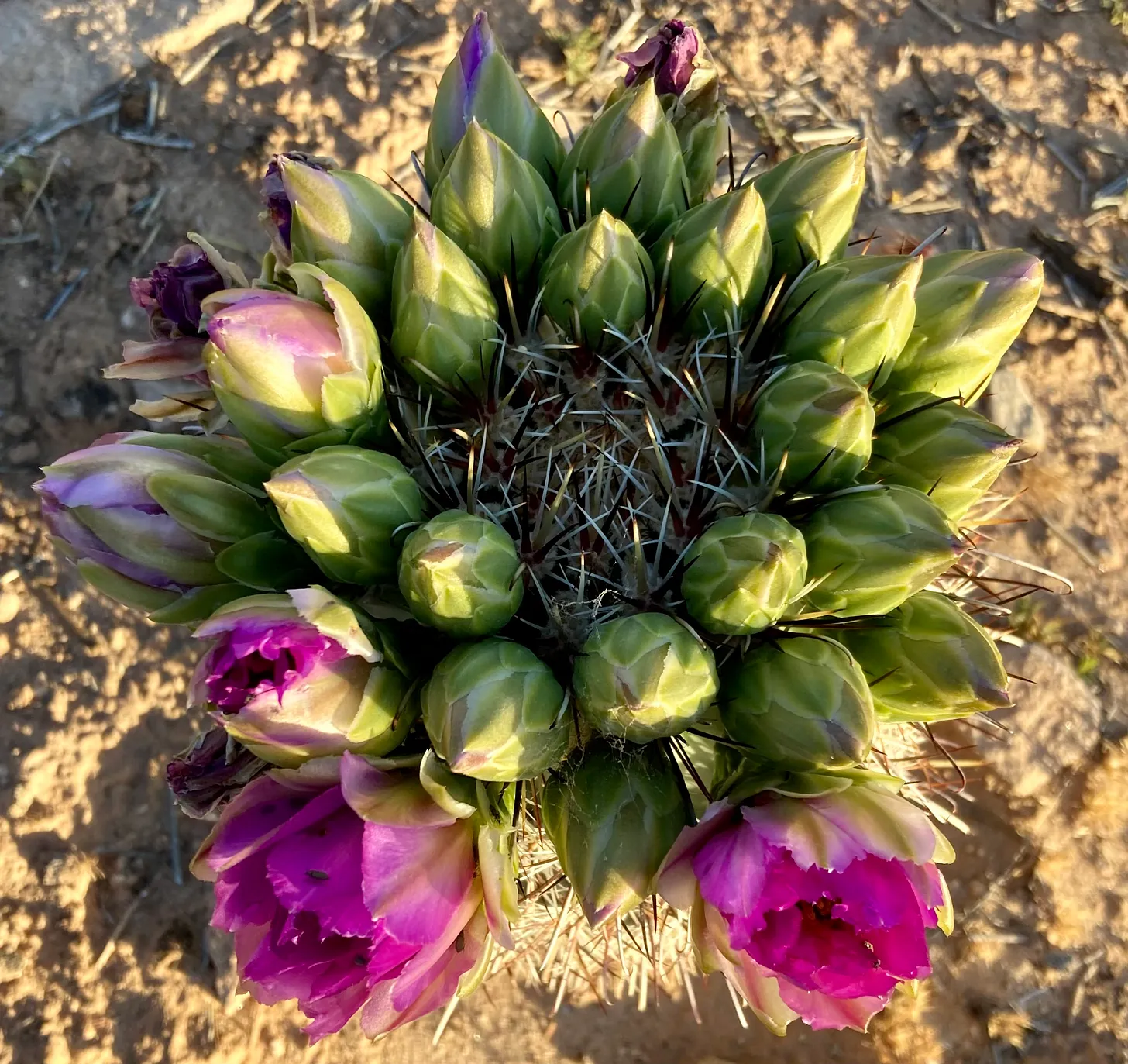
Barrel cactus blooming in southeastern Utah. Jonathan P. Thompson photo.
1 The Homestead Act allowed for claims of up to 160 acres, which was deemed insufficient for arid lands in the West, so in 1877 the Desert Land Act allowed for claims up to 640 acres, and in 1909 the Enlarged Homestead Act made provisions for 320-acre claims.
Governor Jared Polis signs HB-1115 in Dillon, CO. Photo: CWCB
From email from the Colorado Water Conservation Board (Katie Weeman):
May 15, 2025 –Yesterday, Governor Jared Polis signed two critical pieces of legislation that will enhance Colorado’s water management and conservation efforts.
“Water is the basis of life in Colorado. Securing our water future is important for our economy, environment and every Colorado family. With these new laws, we will have a better understanding of Colorado’s water resources, invest in efforts to secure our water, and plan for the future, ensuring Colorado’s access to clean water for generations to come,” said Governor Polis.
House Bill 25-1115: Advancing Water Supply Measurement & Forecasting: House Bill 25-1115 launches a new statewide effort to improve water supply measurement and forecasting across Colorado. The bill authorizes the Colorado Water Conservation Board (CWCB) to establish a comprehensive program to collect and share data on snowpack levels—providing essential information to navigate Colorado’s water future amid a changing climate.
The new effort includes a dedicated full-time employee to manage the program, which will focus on: Collecting and disseminating snowpack data, the primary indicator of Colorado’s annual water supply; investigating advanced technologies for snow measurement and water supply forecasting, including airborne and remote sensing tools; and gathering additional water supply data to help water managers, farmers and policymakers make more informed decisions.
Snowpack functions as Colorado’s largest natural reservoir, feeding streams, rivers and reservoirs throughout the year. And with snow levels becoming increasingly variable, better data and forecasting are essential for water planning that supports agriculture, environmental needs and a growing population.
“In Colorado’s challenging water landscape, we need all the tools in the toolkit,” said Lauren Ris, CWCB Director. “Using new technologies to get a clearer picture of our snowpack water supply is a critical step toward sustaining our water resources for future generations.”
The legislation follows years of collaboration between the CWCB and the Colorado Airborne Snow Measurement group, as well as feedback from water leaders across the state. Water managers have consistently voiced the need for a more coordinated, cost-effective approach to snowpack data collection that allows for more timely and reliable water forecasting.
Senate Bill 25-283: Securing Funding for Critical Water Projects: In addition to HB25-1115, Governor Polis also signed Senate Bill 25-283, the CWCB Projects Bill, which allocates approximately $67 million for water projects across Colorado. This annual legislation funds a wide range of initiatives aimed at enhancing water infrastructure and planning efforts statewide.
The 2025–26 funding includes $2 million for the innovative water forecasting initiatives mentioned above, as well as: $1.4 million for a statewide turf analysis; $29 million for Water Plan Grant funding; $6 million for South Fork focus zone irrigated acreage retirement; $5 million to continue Colorado watershed restoration and Wildfire Ready Watershed programs and more. These investments are designed to support the diverse water needs of Colorado’s communities, agriculture and environment, ensuring a resilient water future for all Coloradans.
“High-quality water data and strategic investment in water infrastructure are both essential to preparing for Colorado’s future,” said Dan Gibbs, Executive Director of the Department of Natural Resources. “Together, these bills represent a major step forward—modernizing how we forecast water supplies while also funding critical projects that strengthen our communities, support agriculture and protect our rivers and streams. We’re grateful for the broad bipartisan support that made these efforts possible.”
Snow Water Equivalent measurements as determined by ASO flights over the Upper Rio Grande (March 23), left, and Conejos River (April 28). Credit: Airborne Snow Observatory
There’s more snowmelt to come. At least from the eyes of ASO surveys and those measurements across the Upper Rio Grande Basin.
ASO flights – Airborne Snow Observatory – that were conducted in May show a higher level of snow runoff and corresponding water than earlier spring forecasts from the Natural Resources Conservation Service (NRCS) and National Weather Service. The surveys were conducted by Airborne Snow Observatories, Inc., and along with forecasts from NRCS and NWS, are used by the state to forecast a water season for local irrigators and to help Colorado determine the amount of water to deliver downstream for Rio Grande Compact purposes.
“This year it appears that between the pattern of snow accumulation and the early start to the melt season, the runoff forecasts reliant only on the SNOTEL observations have been lower than our snow and runoff estimates that incorporate the full-basin observations of the snowpack,” said Jeffrey Deems, co-founder and chief technology officer of Airborne Snow Observatories, in an email this week to Alamosa Citizen.
“There is of course plenty of runoff season left,” he said, “and always the potential for spring and summer rain (or snow), so how the season unfolds remains to be seen.”
The company was just completing its second flight over the Rio Grande at Del Norte the week of May 12 and had conducted two flights over the Conejos. Its turnaround time on measurements is about 72 hours, and Deems is confident the latest surveys will confirm earlier ones – that there’s more runoff in the high country than the SNOTEL sites could determine.
Gauging station near Mogote on the Conejos River. Credit: The Citizen
“In the Rio Grande basin, and especially in the Conejos watershed, the sparse SNOTEL network does not reflect the diversity of terrain and snow environments, and therefore can miss important changes in snowpack volume,” Deems said.
“This year it appears that between the pattern of snow accumulation and the early start to the melt season, the runoff forecasts reliant only on the SNOTEL observations have been lower than our snow and runoff estimates that incorporate the full-basin observations of the snowpack.”
State water division engineer Craig Cotten noted the differences in the ASO measurements compared to the NRCS and NWS when briefing members of the Rio Grande Basin Roundtable at their May meeting. The ASO flights were showing “significantly higher” levels of moisture than the other two sources and the state was “trying to figure out what’s going on with that and why their forecasts are so much higher.”
“We have been discussing our forecasts with the DNR and local water district folks in the Rio Grande and Conejos basins,” Deems said. “In contrast to the NRCS and NWS, our forecast model is informed by our airborne snow surveys which measure the snow water volume over the entire watershed(s), as opposed to only relying on the sparse network of SNOTEL stations that provide an index of snow conditions.”
Water managers through the years have complained of inaccurate readings of snow and there has been a push by the San Luis Valley Conservancy District and Rio Grande Water Conservation District to add more SNOTEL stations to fill in particular areas around Creede and Conejos County.
“Our forecasts start from an accurate snow water volume, and then forecast melt and runoff based on forecasts of future weather, “ Deems said of ASO data. “The NWS forecasts do something similar, but start from a simplified snowpack estimate derived from SNOTEL station measurements of precipitation. The NRCS forecasts use the SNOTEL snow measurements in comparison to a 30-year record as a statistical predictor of dry-season runoff volume.”
In a year when the month of February brought record high temperatures that caused an early melt to a light snow season, and then above-normal precipitation in April and snow in the high country and 1.5 inches of rain in early May, and the early spring predictions of a “dry year” look premature from the air.
“As it stands now, our forecasts are in line with the amount of snow water volume we have measured over our two flights in the Conejos,” Deems said. The next forecast updates from the ASO flight will be available in the coming week, data the state and local manager will be anxious to review.
Rio Grande and Pecos River basins. Map credit: By Kmusser – Own work, Elevation data from SRTM, drainage basin from GTOPO [1], U.S. stream from the National Atlas [2], all other features from Vector Map., CC BY-SA 3.0, https://commons.wikimedia.org/w/index.php?curid=11218868
dOak Flat, Arizona features groves of Emory oak trees, canyons, and springs. This is sacred land for the San Carlos Apache tribe. Resolution Copper (Rio Tinto subsidiary) lobbied politicians to deliver this National Forest land to the company with the intent to build a destructive copper mine. By SinaguaWiki – Own work, CC BY-SA 4.0, https://commons.wikimedia.org/w/index.php?curid=98967960
Click the link to read the article on the AZCentral website (Debra Utacia Krol). Here’s an excerpt:
May 15, 2025
Key Points
The San Carlos Apache Tribe wants a federal court to delay a land swap that would allow construction of a copper mine at Oak Flat.
A federal judge ordered a halt to the deal last week after hearing arguments by the grass roots group Apache Stronghold.
The San Carlos Apache Tribe has asked a federal court to block the Trump administration from finalizing a land exchange at Oak Flat Campground, following on the heels of a successful bid by grassroots group Apache Stronghold. The tribe sued to stop the exchange in 2021 after the U.S. Forest Service issued its final environmental impact statement. That opened a 60-day window during which the government could have finalized a deal with copper mining corporation Resolution Copper to take ownership of the site and begin construction on a huge copper mine that would eventually obliterate Oak Flat. San Carlos asked the U.S. District Court on May 14 to stop any progress on a plan that would allow Resolution to take ownership of Oak Flat and begin extracting copper on land considered sacred to Apache and other Native peoples. The tribe wants the order to stand until its own litigation was concluded…
“The Trump Administration is once again planning to violate federal laws and illegally transfer Oak Flat to the two largest foreign mining companies in the world,” said San Carlos Apache Tribe Chairman Terry Rambler. “Oak Flat sits above one of the largest copper deposits in the world. Resolution Copper intends to export the copper while destroying Apache sacred lands that the federal government has a Trust responsibility to protect. We will not allow this to happen.”
U.S. District Judge Steven V. Logan has already ordered a halt to the land swap in an order May 9 that ordered the Forest Service to hold off on issuing the document until one day after the Supreme Court had either refused to take the case of after it had decided in the government’s favor…The struggle over a small plot of land in the mountains is also at the heart of an ongoing national debate about the conflict between First Amendment religious rights, public lands oversight and a 150-year-old mining law’s relevance in the 21st century. [ed. emphasis mine]
In this detailed computer animation, we take a look into the future of Oak Flat, meticulously illustrating the development of subsidence as a result of the block cave mining process over an extensive period of 40 to 50 years. Crafted with transparency and precision, this video is grounded in the findings of multiple technical studies, aiming to provide as realistic a projection as possible of the landscape changes that Oak Flat will undergo. Block cave mining, a method known for its efficiency and low cost, has significant impacts on the terrain above the extraction zone. Through state-of-the-art animation, viewers will gain an understanding of how and why these changes occur, presenting a clear picture of the subsidence process from start to finish. Join us as we explore the intricacies of block cave mining and its effects on Oak Flat, guided by the latest in animation technology and scientific research. Whether you’re a student, a professional in the field, or simply interested in the future of our landscapes, this video is an invaluable resource for grasping the challenges and considerations of modern mining practices. By offering a visual journey through time, we aim to foster a comprehensive understanding of the complexities involved in mining operations and their environmental impacts. Learn more at http://www.resolutioncopper.com
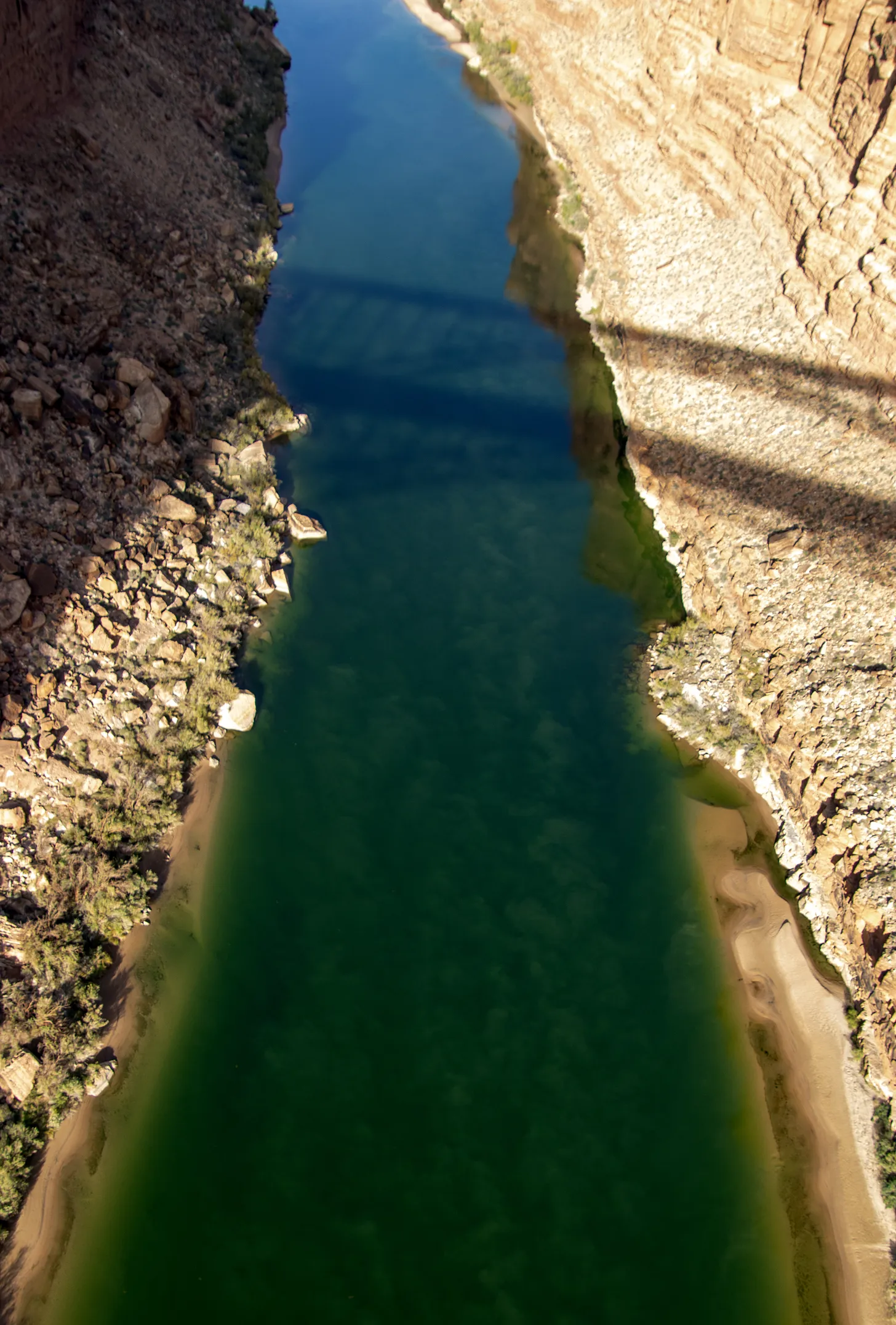
The Colorado River from the Navajo Bridge. Jonathan P. Thompson photo.
Click the link to read the article on the AZCentral.com website (Austin Corona). Here’s an excerpt:
May 15, 2025
Key Points
With no settlement yet on how to manage shortages on the Colorado River, the Trump administration is preparing to fill its last vacant Western water post, commissioner of the Bureau of Reclamation.
The seven states who draw water from the Colorado have struggled for years to agree on a plan to deal with shortfalls. The divisions remain among the states on the upper river and lower river.
Arizona’s top water negotiator says the Trump administration seems more willing to talk about different approaches to shortage sharing, but issues about who should take the largest cuts remain
The Trump administration is preparing to announce its pick to head the Bureau of Reclamation, a crucial position in deciding the future of the Colorado River, a White House spokesperson told The Arizona Republic. The move would effectively complete the new federal team overseeing strained negotiations over one of Arizona’s largest water sources. The new commissioner will take charge amid tense negotiations among the seven states that use the Colorado River, which has strained under multi-decade drought and high water demand…
Experts worry that this year’s poor river flows could trigger lawsuits over foundational river-management laws as soon as 2027. States only have months to reach a deal, and negotiators have not shown signs of progress.
Tom Buschatzke, director of the state Department of Water Resources and Arizona’s Colorado River negotiator, has said the Trump administration is already more “engaged in a much more meaningful way” on the Colorado River than former President Joe Biden’s team and has responded to some of Arizona’s long-unanswered requests in the negotiating process. Trump officials could give Arizona and the other Lower Basin states of California and Nevada a new opportunity to convince federal regulators that those states should not have to take all the cuts on the river. Biden negotiators would not call for cuts in the Upper Basin, while Buschatzke said the new administration may be more open to finding a “collaborative” solution. Even so, Upper Basin states — Colorado, Wyoming, Utah and New Mexico — have continued arguing that they cannot be forced to cut their water use if climate change and drought are the causes of low flows in the river, meaning any attempts to cut their use could lead to a lawsuit. A case could drag on for years, while water levels in the reservoirs continue to drop.
The Cache la Poudre River flows through Bellevue, Colorado on May 12, 2025. Water from the river will be used to fill the nearby Glade Reservoir once it’s built. The cost to build the new water storage project has grown from $400 million to $2.2 billion. Alex Hager/KUNC
Click the link to read the article on the KUNC website (Alex Hager):
May 15, 2025
This story is part of ongoing coverage of water in the West, produced by KUNC in Colorado and supported by the Walton Family Foundation. KUNC is solely responsible for its editorial coverage.
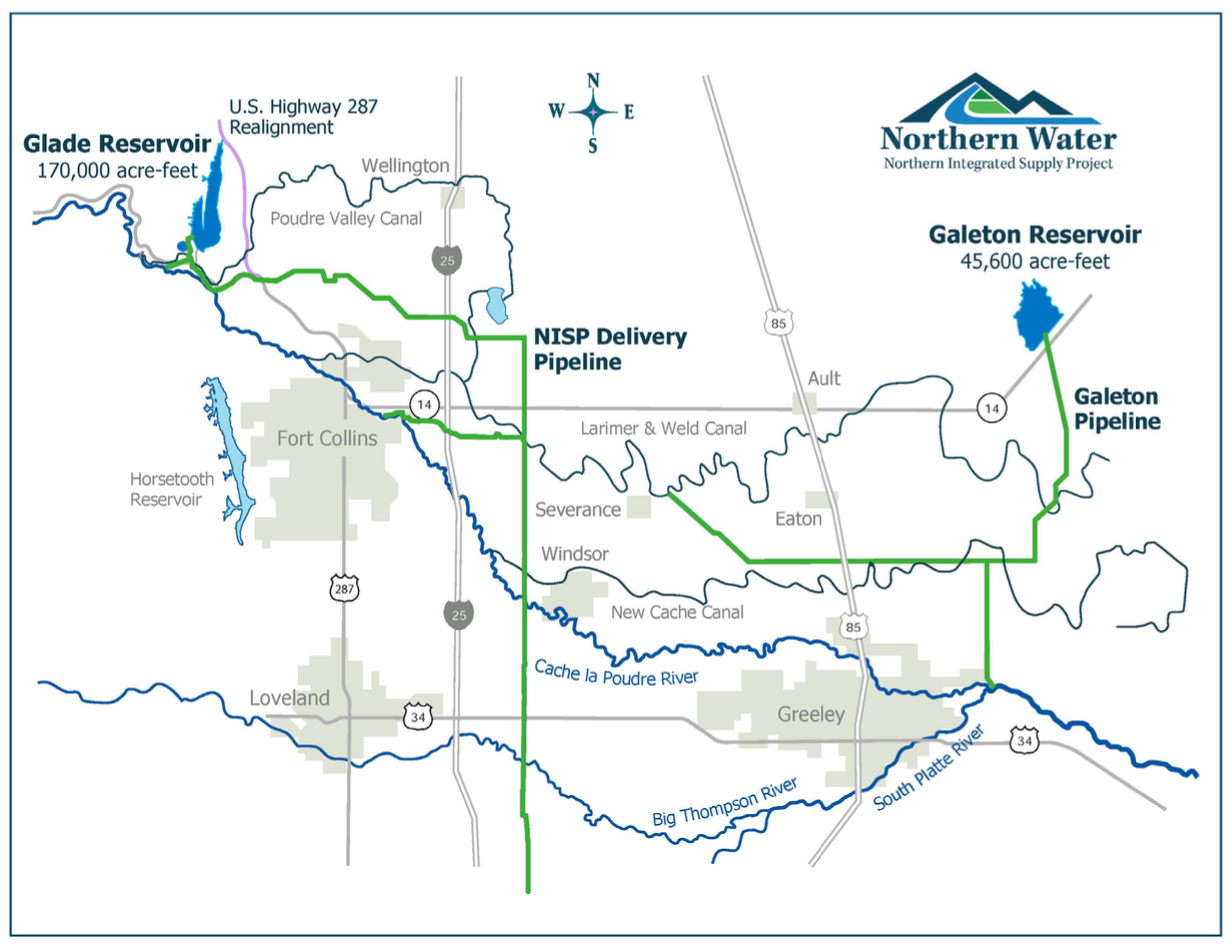
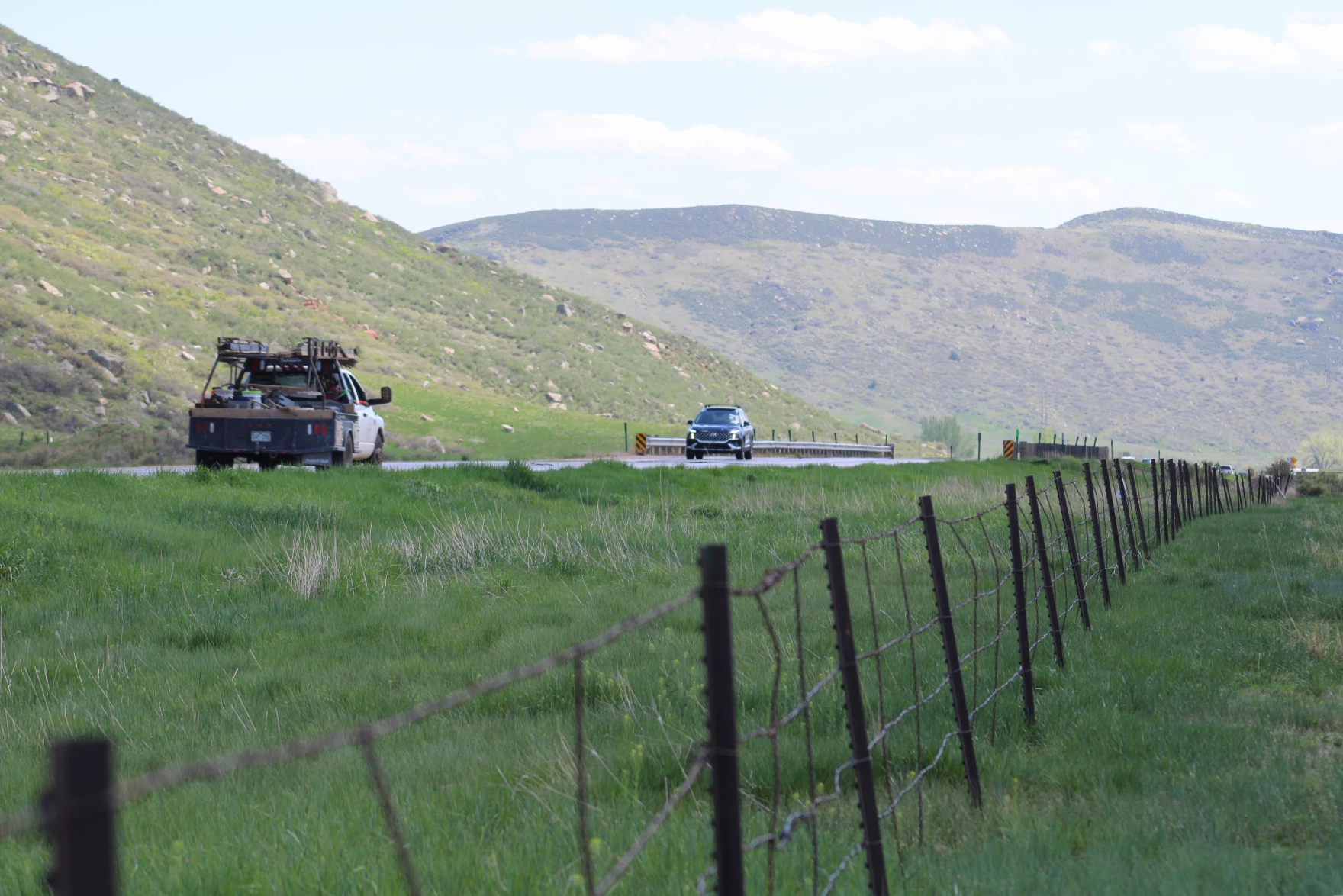
There’s a stretch of highway in Larimer County where prairie grasses sway with each passing vehicle. Cars, horse trailers and semi trucks zip through the valley on their way between Fort Collins and Laramie. Soon, it’ll be under more than 200 feet of water.
U.S. Highway 287 runs through the future site of Glade Reservoir. The Larimer county Board of County Commissioners approved the 1041 Land Use Permit for NISP in September, 2020. Photo credit: Northern Water
It’s the planned site of Glade Reservoir, the cornerstone of a massive new water storage system designed to meet the demands of fast-growing towns and cities in Northern Colorado. After more than two decades of permitting, planning and environmental lawsuits, it’s closer than ever to breaking ground.
But along the way, some things changed. Over the years, costs to build the reservoir system — and reroute seven miles of U.S. Highway 287 — have ballooned. Price estimates for the Northern Integrated Supply Project, often referred to as NISP, went from $400 million to $2.2 billion. Because of that, some of the towns that signed up to use its water are cutting back on their involvement before the reservoir system stores a single drop.
Northern Water, the agency building NISP, has projected confidence that it will still get built as planned. The long road from idea to construction, and the things that have changed along the way, can tell us a lot about how Northern Colorado uses water, and how much it costs to keep taps flowing.
The Northern Integrated Supply Project, currently estimated at $2 billion, would create two new reservoirs and a system of pipelines to capture more drinking water for 15 community water suppliers. (Northern Water project pages)
Rising costs
When it was first pitched, in the early 2000s, NISP garnered support as a way to make sure small towns with fast-growing populations could host new housing developments without going dry.
For a tiny town like Severance, that was an attractive proposition. Just 11 years ago, about midway through the NISP planning process, the town had a population of about 3,000. That’s when Nicholas Wharton took the job as town manager. Since then, he’s overseen the installation of the town’s first stoplight, the from-scratch development of its own police department and a homebuilding boom that has nearly quadrupled Severance’s population.
Signing on to NISP, he said, was a way to make sure Severance had enough water for all that growth.
“I think for smaller towns,” he said, “It was a great idea back when it was affordable to us.”
Wesley Lavanchy, the town administrator for Eaton, Colo., poses outside of his office on April 15, 2025. His town is one of four water agencies that reduced the amount of water it would store in NISP, and the amount it would pay to keep it there. Alex Hager/KUNC
Since then, Severance has cut back on the amount of water it will store in NISP, and the amount it will pay to be a part of the project. At one point, the town held 2,000 shares of the project. In 2024, it sold off 1,500 of those shares. Wharton said the town council might try to sell off even more.
And Severance isn’t alone.
Due West, in Eaton, town officials also got cold feet. They were one of four NISP shareholders to offload a portion of their involvement in the new reservoir project on the same day in July 2024.
For years, the water agencies that were part of NISP were mostly focused on paperwork — making sure the project had the permits it needed to get built. Then, there was a lawsuit from environmentalists standing in the way. But after NISP’s proponents were mostly seeing green lights on permits and decided to settle a major lawsuit, the focus shifted to money.
“I think the question for us now is, how do we afford this?,” said Wesley Lavanchy, Eaton’s town administrator. “Moving forward, how much can we afford? It’s like chocolate cake. You like it, it tastes great, but you can’t eat the whole thing.”
Ultimately, Eaton decided to sell off more than half of its NISP shares.
“I suspect that more entities would have been able to hold their commitment had the permitting process not drug on so long, the cost escalated, the litigation kind of wrapped things up,” Lavanchy said.
Cheaper alternatives
While the cost to build NISP has gone up, the cost of other water sources has gone down. Eaton and Severance said it’s getting easier to afford shares of the Colorado-Big Thompson project, which was a big motivator in their pullback from NISP.
That project, referred to as CBT, pipes water from the Colorado River across the continental divide. It flows underneath Rocky Mountain National Park and into major reservoirs along the Northern Front Range, such as Horsetooth Reservoir near Fort Collins and Carter Lake outside of Loveland.
Water from the Colorado-Big Thompson project is managed by Northern Water, the same agency building and operating NISP.
Boats cruise across Horsetooth Reservoir near Fort Collins, Colorado on May 12, 2025. The reservoir holds water from the Colorado-Big Thompson project, which has seen prices level off in recent years. Glade Reservoir is expected to be even larger than Horsetooth. Alex Hager/KUNC
For years, the CBT system was the main way for growing cities in Larimer and Weld Counties to get water for residential development. Typically, farms have sold their portion of CBT water to cities, towns, or developers. Occasionally, they are taken to auction, where cities bid against one another for water stored in those big reservoirs.
The cost of that water skyrocketed between 2010 and 2022. Estimated prices, adjusted for inflation, went from less than $20,000 per share, to around $100,000 per share, according to data from the consulting firm Westwater research. Since 2022, that soaring rise has leveled out.
“We believe that’s largely driven by a softening in the home construction sector,” said Adam Jokerst, a Fort Collins-based regional director for Westwater. “A lot of CBT purchases are by municipalities and developers who dedicate them to municipalities. And when new home construction slows, we see less demand for those shares.”
How did NISP get so expensive?
Northern Water said the price to build NISP has been climbing for about 15 years. Brad Wind, the agency’s general manager, cited inflation and rising interest rates as major drivers. He doesn’t, however, expect that to stop or significantly change the reservoir project.
“It’s an expensive project,” Wind said. “We and the participants advancing the project like it was envisioned.”
The lengthy process to get the project’s two reservoirs — Glade, and a smaller one called Galeton reservoir — from concept to construction gave time for the winds of economic change to shift direction. It’s not uncommon for a massive dam project like NISP to take more than fifteen years to attain a laundry list of environmental permits.
The project also faced opposition from local governments and nonprofits. At one point, Fort Collins voted to oppose the project. The most significant roadblock came from the environmental nonprofit Save the Poudre.
The group rallied local support and took legal action to try and stop NISP. At a 2015 event, Save the Poudre director Gary Wockner told a crowd of supporters that he would “fight to stop the project for as long as it takes.”
In late February, Wockner’s group settled for $100 million dollars. Northern Water will pay that sum into a trust over the course of the next two decades, and the money will be used to fund river improvement projects. In the intervening time, though, the price tag to build NISP likely grew significantly.
Wind said Northern plans to hire a contractor that could find ways to bring down the price by changing construction methods, but doesn’t expect “substantial reductions” to building costs, especially with rising prices of imported construction materials.
Over the years, the towns and water agencies that wanted to use NISP signed periodic agreements to stay part of the project. Now, time is ticking for those participants to sign a binding contract.
Eaton’s Lavanchy said that upcoming contract made his town take a harder look at their water needs, and whether those needs would be satisfied by NISP.
“We’re not dating anymore,” he said, “We’re getting married, and there’s no way out. Divorce is not an option. So it’s like, ‘Let’s be smart and think about, what are these obligations going to run us?’”
‘Demand continues to increase’
Even as some entities cut back on their financial ties to NISP, the project still has momentum.
For one, those towns and water agencies looking to sell their shares found a willing buyer. Eaton, Severance, Fort Lupton and the Left Hand Water District all sold their shares to the Fort Collins Loveland Water District.
Vehicles drive on U.S. Highway 287, near Bellevue, Colo. on May 12, 2025. The highway will be rerouted to make way for a massive new reservoir. Alex Hager/KUNC
The Fort Collins Loveland Water District, which serves an area roughly between Harmony Road and State Route 34, declined to be interviewed for this story.
Second, NISP has a total of 15 participants, and many of them are still on board for the same amount of water they signed up for years ago.
“No matter what,” Severance’s Wharton said, “In one way, you’ll see those 15 probably still continue to be a part of it no matter what, because everybody does realize how precious that water is and how this will be one of the last [big reservoirs.] I don’t think anybody’s discouraged.”
Even the towns that reduced the amount of water they’ll pay to use from NISP are keeping some. Severance and Eaton said they want to make sure they’re getting water from a diverse group of sources, especially with climate change and political bickering threatening their main source of water — the Colorado River via the CBT.
Ultimately, the fast-growing region served by Northern Water — from Boulder County to Fort Collins, and east to Fort Lupton — will keep needing water for a future that will likely see plenty of new home construction.
“It doesn’t appear that folks are shying away from moving to Northern Colorado,” Brad Wind said. “Either from within our state or from outside of our state, so the demand continues to increase for a high quality water supply, which NISP will produce.”
Regarding the Wolf Creek Reservoir on-going project, the district is still working to get an approval from the Army Corps of Engineers on their purpose and need statement to justify the project. Despite data from NRCS showing a drop of roughly 1/3 in water usage by area irrigators over the past 5 years, they have received funding to assess area water users need and or desire for additional water. The District will pursue a Recreation Survey as well.
The recently released Yampa River Scorecard Project grade of C-plus for the upper segment of the Yampa River shows a need for some improvements for overall river health in the stretch between Stillwater and Stagecoach reservoirs. Jenny Frithsen, environmental program manager at Friends of the Yampa, oversees the long-term river health monitoring and evaluation project. Frithsen said a major reason for the lower score is because that river segment is heavily utilized by agricultural water users but has less water coming in from smaller tributaries compared with downstream sections of the river.
“The first and foremost contributor to river health is water in the river, and the Upper Yampa and the Bear River are arguably the hardest-working and most heavily administered sections of river in the Yampa River system,” Frithsen said. “It probably is no surprise that the flow regime has lower scores for our ecological river health assessment. It is an altered flow regime.”
Frithsen presented a high-level overview of the 2024 river study segment during a South Routt Water Users meeting Monday evening at Soroco High School. The study looks at 45 indicators and nine characteristics of river health to determine and issue a score for combined flow and sediment regime, water quality, habitat and riverscape floodplain connectivity, riparian condition, river form, structural complexity and biotic community. On the positive side, the study team found the Upper Yampa stretch rated good in water quality, structural complexity, beaver activity, channel morphology and invasive weeds. The healthy beaver activity, especially on U.S. Forest Service land, showcases the natural engineering work of the large rodents to help mitigate the impacts of human water use and infrastructure. The beavers’ work maintains minimum flows in late summer and fall and provides a refuge for fish during low flows.
This year marks the 25th anniversary of the establishment of Canyons of the Ancients National Monument. Encompassing 178,000 acres of public land west of Cortez, the Monument was created on June 9, 2000 by President Bill Clinton using the authority of the Antiquities Act. Canyons of the Ancients was the brainchild of Interior Secretary Bruce Babbitt, who had great familiarity with the area owing to his Arizona roots. Canyons of the Ancients is widely renowned for what is often called the highest known density of archaeological sites in the United States, including more than 6,000 recorded sites and a total number of sites estimated as high as 30,000. As such, Canyons of the Ancients offers an unparalleled opportunity to observe, study and experience how cultures lived and adapted over time in the American Southwest.
As explorers and settlers colonized the western United States, the evidence of these ancestral cultures sparked enormous interest and curiosity. The famous western photographer, William Henry Jackson, recorded dramatic photographic images of prehistoric dwellings in the McElmo Valley in 1874. The General Land Office (the original precursor to the Bureau of Land Management) set aside Goodman Point in 1889 and made it off limits to homesteading for the protection of significant cultural resources. Eventually, in 1985, the BLM proposed protection for the larger landscape that today comprises Canyons of the Ancients, labeling it as an Area of Critical Environmental Concern. At the time, the BLM described the cultural resources as “individually and collectively unique and nationally important, representing a successful and challenging adaptation to marginal environments that lasted for 800 years.” A century’s worth of recognition and interest in preserving this cultural landscape set the stage for the presidential proclamation that established Canyons of the Ancients as a National Monument in 2000.
Click the link to read the article on the Summit Daily website (Kyle McCabe). Here’s an excerpt:
May 9, 2025
Snowpack in the Blue River Basin, which encompasses all of Summit County, stood at 90% of the 30-year median as of Friday. The figure shows that Summit is in a good position compared to the state as a whole, which sat at 58% of the median. Aldis Strautins, a service hydrologist with the National Weather Service in Boulder, said that 90% of the median is “within normal ranges.” He added that some lower elevation areas of Summit County, like the 9,350 foot-elevation snow telemetry monitoring site at Summit Ranch, have already melted out or gotten close.
“Some of the higher sites, like your Copper Mountain and Fremont Pass, those are still doing fairly well,” Strautins said. “Still have quite a bit of snowpack up there, which would make sense for this time of year.”
The Dillon Reservoir currently sits at 84% of its capacity, according to the Denver Water website.
The wetlands of the Prairie Pothole Region provide essential benefits to communities and are a premier waterfowl breeding ground. Explore how CASC science is informing the strategic restoration and management of the Prairie Pothole Region in the face of climate change. Photo credit: USGS
Click the link to read the article on the USGS website:
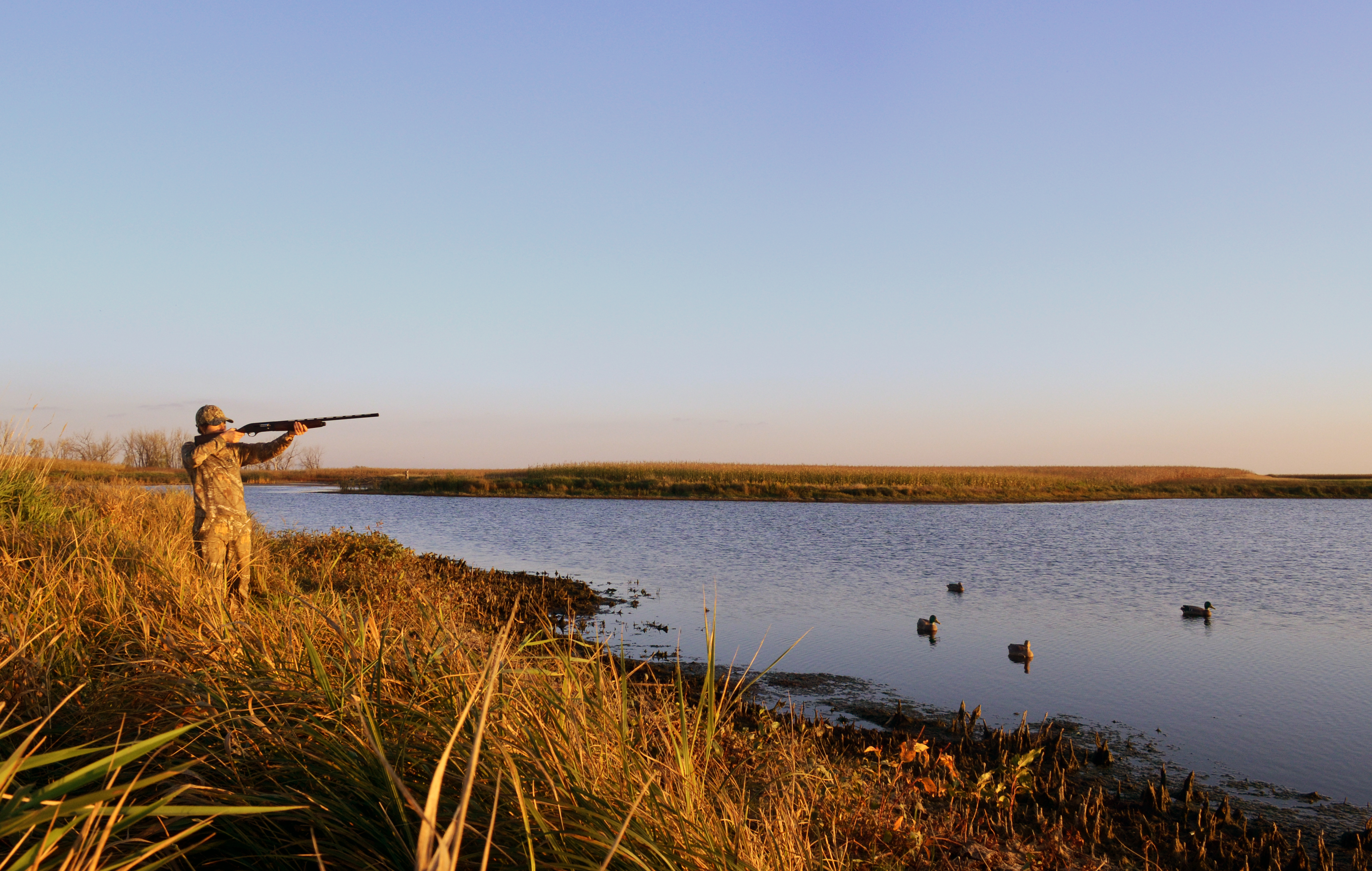
Waterfowl hunting. Credit: Chuck Traxler, USFWS
Climate Change and the Prairie Pothole Region
The Prairie Pothole Region’s economic and recreational significance is deeply rooted in its unique ecological characteristics. Extending across the northern Great Plains, the region’s rich, glaciated soils are a foundation for high-yield agriculture, contributing to the production of key commodities like wheat, soybeans, and corn. Across this landscape, depressional wetlands are interspersed with neighboring grasslands. These wetlands, commonly referred to as prairie potholes, provide essential benefits to communities like mitigating flood risks and regulating water flow, filtering pollutants, improving downstream water quality, storing significant amounts of carbon, and providing habitat for fish and wildlife.
The Prairie Pothole Region is a both a premier waterfowl breeding ground, attracting a large number of hunters, and major contributor to hunting opportunities across the continent. The region’s reputation as “North America’s Duck Factory” draws waterfowl hunters from within and outside the United States. Hunting and associated travel expenditures generate substantial revenue for local communities. An estimated 10,000 jobs and $760 million in labor income is generated in the region due to hunting and wildlife viewing. In recognition of these services provided by prairie pothole landscapes, conservation investment from federal programs like the Farm Bill and the North American Wetlands Conservation Act (NAWCA) provide significant funding for conservation initiatives. These investments support habitat restoration, land management, and research, creating jobs and stimulating economic activity in the conservation sector. Finally, national wildlife refuges and other public lands provide the public with additional access to these habitats so they can enjoy the many recreational opportunities.
Climate change is increasing temperatures and changing precipitation patterns, leading to pronounced shifts in this region. More frequent, high intensity storms over the last 25 years have been observed, causing a shift from snow-melt driven hydrology to summer and fall storm driven hydrology. At the same time, more frequent and severe droughts are causing changes in the diversity of wetland sizes, negatively impacting habitat quality of smaller-sized wetlands and landscape heterogeneity important to diverse waterfowl and wildlife populations. Land-use change, combined with these effects of climate change, are diminishing the region’s capacity to support viable populations of waterfowl and other wildlife populations. Climate adaptation scientists can provide the expertise and research needed to inform future adaptations important to maintaining the recreational and economic benefits of this region.
Supporting Prairie Pothole Management and Sustaining Recreational Opportunities
Since 2018, the USGS Climate Adaptation Science Centers has been documenting key impacts of climate change on this region. Results from multiple research efforts can inform strategic acquisition, restoration, and management in the Prairie Pothole Region to maintain its ecological, economic, and cultural importance to the United States.
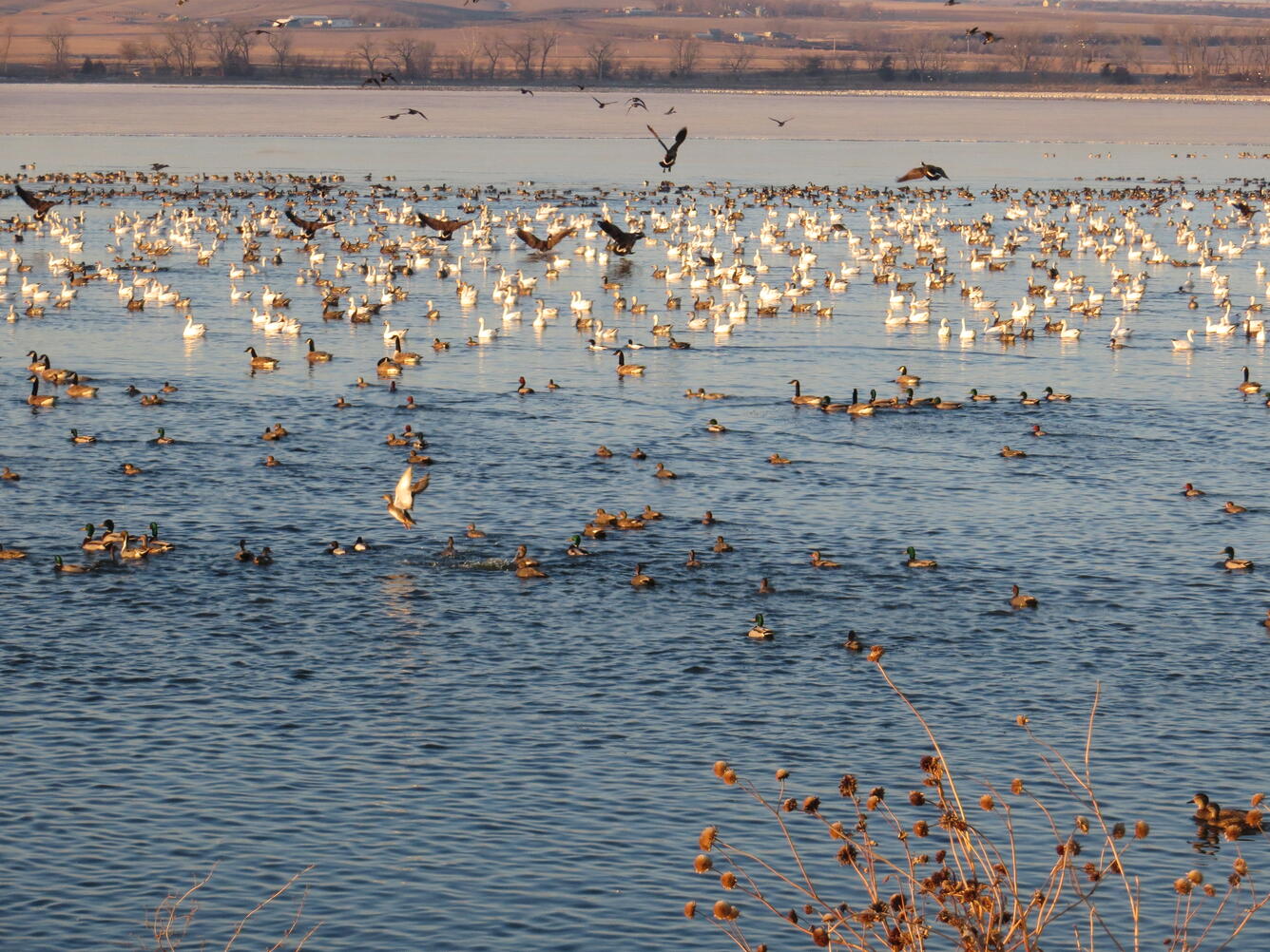
Waterfowl on Lake Andes; Lake Andes National Wildlife Refuge. Public domain
Impacts of Climate-Driven Shifts in Prairie Pothole Wetlands on Waterfowl
Recent science indicates that climate and land use change are affecting Prairie Pothole wetlands in unexpected ways, indicating that new areas may need to be targeted for restoration to maintain suitable waterfowl breeding habitat. Partnering with the U.S. Fish and Wildlife Service, CASC scientists used new models to simulate how these wetlands would change under different future climate change scenarios, and how those changes would impact the ability of the wetlands to support waterfowl breeding.
Results showed that areas that currently have the highest densities of intact wetlands and support large numbers of breeding ducks will also likely be the most successful in maintaining these habitats under future climate conditions. Additional follow up work used extensive datasets in collaboration with U.S. Fish and Wildlife Service scientists to generate actionable insights that can inform conservation strategies for grassland and wetland ecosystems in the Prairie Pothole Region.
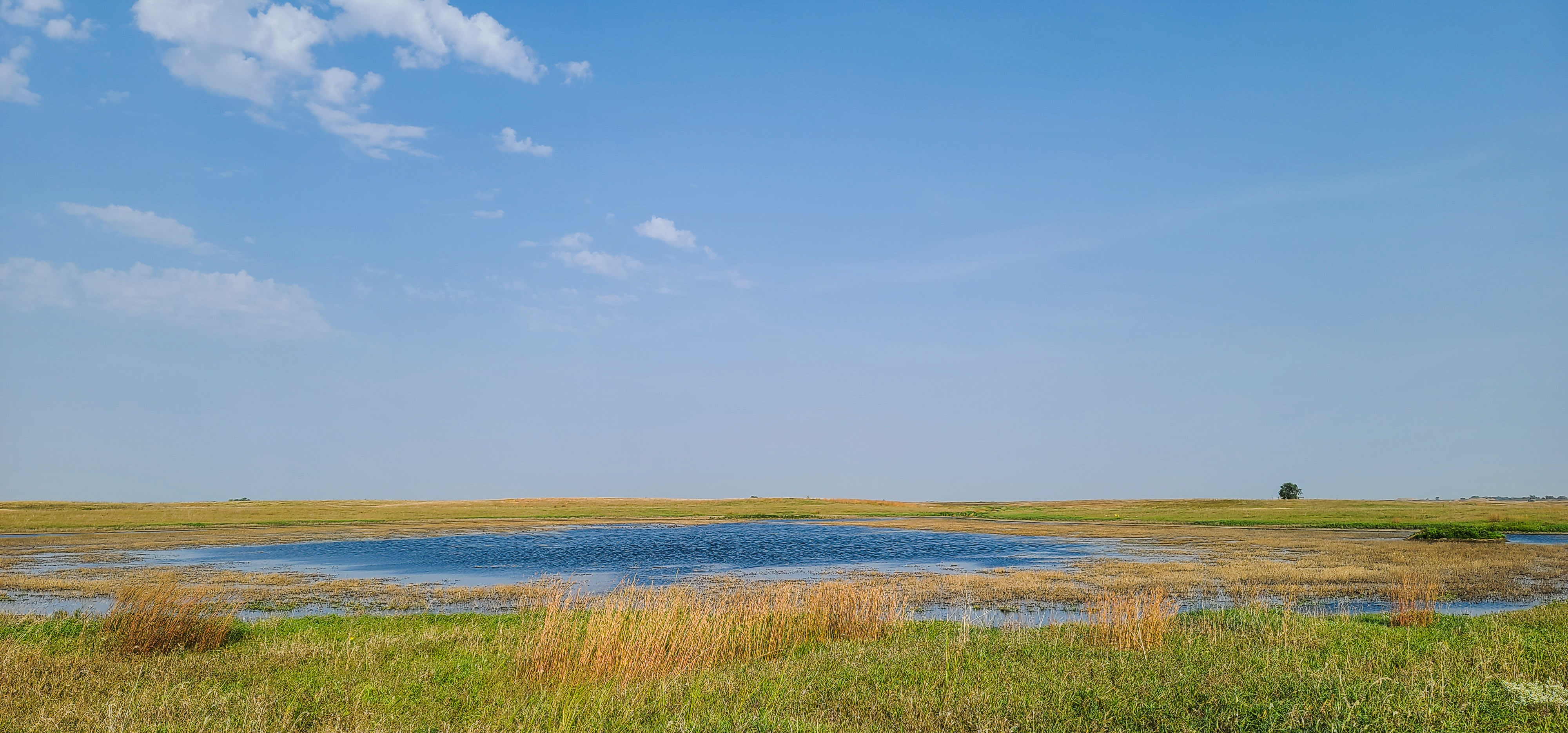
Prairie Pothole Landscape on Broken Arrow WPA Lake Andes Wetland Management District South Dakota. Sources/Usage Public Domain. Credits: Marcie Hebert, USFWS
How Climate Change is Linking Prairie Pothole Wetlands to River Wetlands
Wetlands in the Upper Mississippi River Basin help control floods, filter pollution, and provide critical habitat for migratory birds. However, high intensity rainfall events can cause these depressional wetlands to overflow and connect with Mississippi River tributaries. This reduces the ability of wetlands to process nutrients and mitigate nutrient pollution in the Mississippi River. These overflow events are expected to increase due to climate change and land management, as extreme precipitation events become more frequent and severe.
CASC scientists are working with managers to identify how wetlands along the Minnesota River, a large tributary of the Mississippi River, will respond to floods, and the resulting implications for water quality and migratory bird habitat. This information will feed into a tool that will allow management agencies to balance wildlife and water quality objectives in future conservation actions.
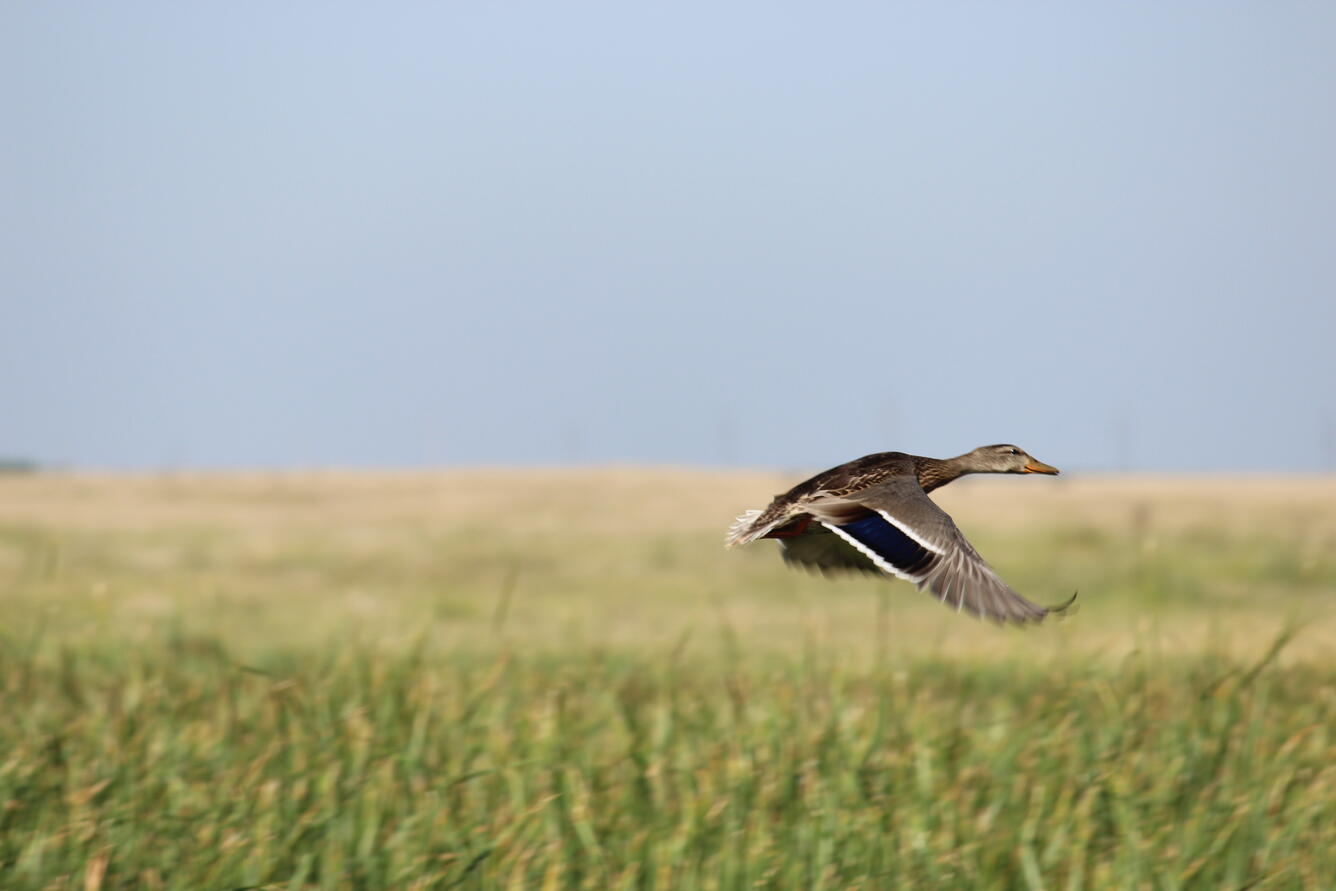
Mallard Hen in Flight over Lake Andes Wetland Management District South Dakota. Sources/Usage Public Domain.
How Weather Patterns and Land Use Influence Where Ducks are During the Fall and Winter
Ducks from the Prairie Pothole Region are important for both the economy and culture of the region. However, climate and land use change are altering their habitat are causing ducks to move to new areas during the hunting season. Partnering with the U.S. Fish and Wildlife Service and Ducks Unlimited, CASC scientists tracked these changes in duck distributions, using data from bird banding, hunting, and counts. They found that while many ducks are spending winters farther north, but it’s not a simple story. Different duck species are shifting their winter locations in different ways. Understanding these specific changes is key to figuring out what’s driving them and will inform decisions about managing habitats and harvest.
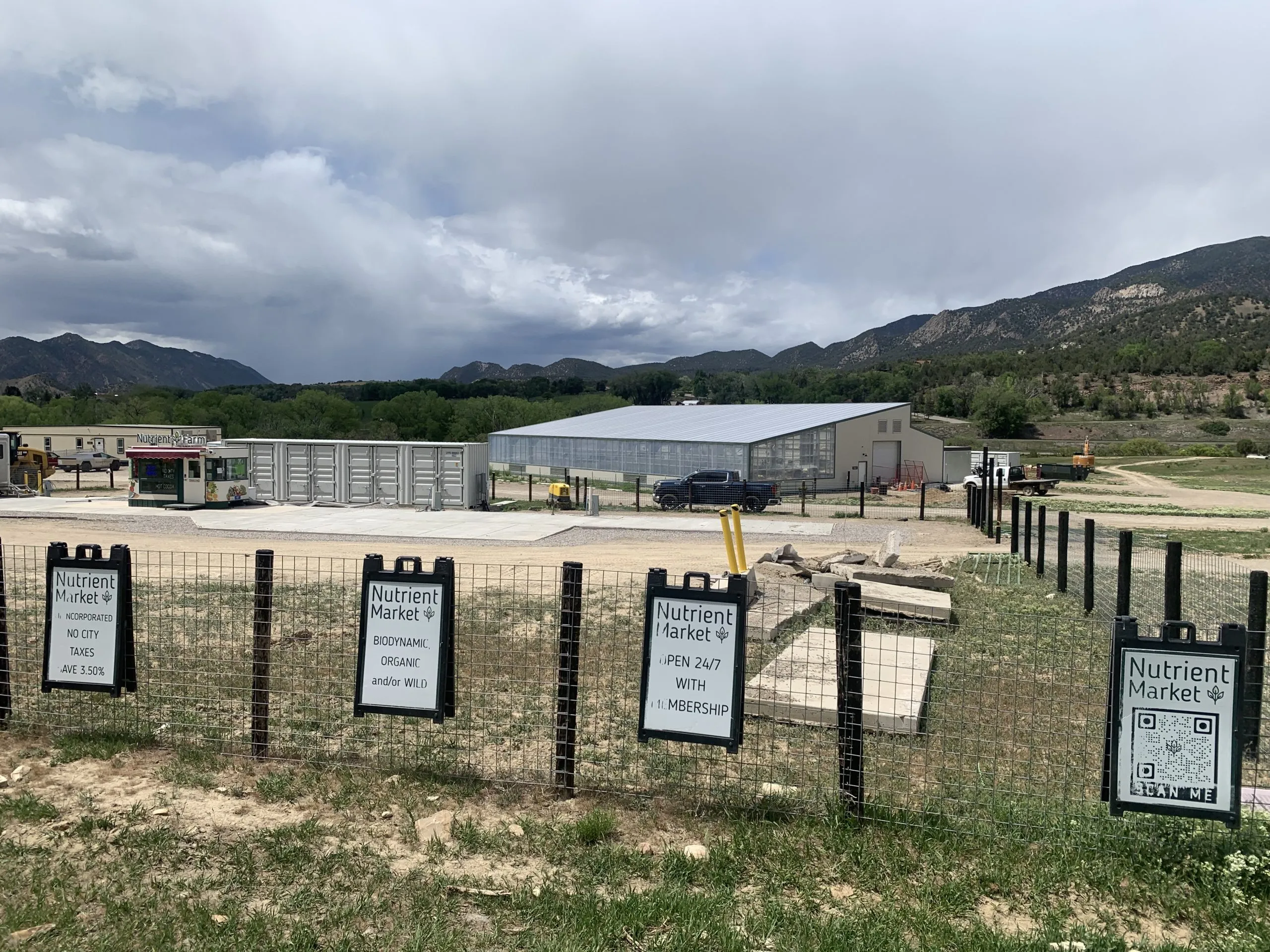
The Nutrient Farm store and greenhouse are located on Garfield County Road 335. Garfield County is considering a PUD application from Nutrient Farm to expand its operations into a restaurant, housing, lodging facilities, a music/entertainment area, campground, a health and wellness retreat, and other agricultural tourism-related operations. Credit: Heather Sackett/Aspen Journalism
The source of water — and whether there’s enough to go around — is at the heart of concerns about a proposed agritourism development for some local residents and Garfield County officials.
Nutrient Farm, an organic farm and ranch on the south side of the Colorado River between Glenwood Springs and New Castle, is seeking approval from Garfield County for a new planned unit development (PUD), which would include a restaurant, housing, lodging facilities, a music/entertainment area, campground, a health and wellness retreat, and other industrial and agricultural tourism-related operations on its 1,140 acres. Nutrient Farm would need water for its planned expansion of outdoor agricultural production including a “u-pick” orchard, nursery trees, pasture grass, hay, corn, vegetables, lawns and landscaping.
At the confluence of Canyon Creek and the Colorado River. Photo credit: Friends of Canyon Creek
Nutrient Farm is proposing that the main water supply would come from Canyon Creek, a tributary on the north side of the Colorado River. It would be taken out of the creek 1.5 miles upstream from its confluence with the Colorado River and conveyed across the river and Interstate 70 via the Vulcan Ditch.
According to Colorado Division of Water Resources records, the Nutrient Farm property has not used water from Canyon Creek or the Vulcan Ditch in more than two decades.
Water supply studies found that there may not be enough water in Canyon Creek for the Vulcan Ditch to take the full amount to which it is entitled during the late irrigation season in dry years, raising questions about the adequacy of the Canyon Creek water supply and the project’s impacts on the creek.
Concerned residents who live on Canyon Creek have formed Friends of Canyon Creek, a group dedicated to maintaining the ecological health of the stream. Six nearby property owners have hired a lawyer to oppose three water court cases related to Nutrient Farm’s water rights.
Sonia Linman lives along the creek and is an outspoken member of Friends of Canyon Creek. She is one of several residents who own property on the creek and don’t want to see the Vulcan Ditch reopened. Linman and others say the draw on the creek that Nutrient Farm is proposing could devastate wetlands, would harm the ecological values of properties that are protected by conservation easements between some landowners and the Aspen Valley Land Trust, and put the wildfire-prone valley at risk if the source of water to fight the frequent blazes is diminished.
“For me, I’d be losing a family member,” Linman said of the creek. “For most of us who believe nature is in an especially tenuous place right now, it would be reflective of a death of hope. We must do what’s right to protect something that is clearly, legally, morally, ethically deserving of that protection.”
Nutrient Farm’s proposal has been contentious, with the overwhelming majority of public comment and letters expressing concern about the project. Many took issue with impacts that the water use could have on Canyon Creek. After being continued twice — in January and March — the PUD application is scheduled to be revisited by the Garfield County Planning Commission on May 28.
AVLT has 12 conservation easements across eight properties in Canyon Creek, with the common goal to preserve and protect the ecological health of the creek and its habitat.
“Not only would [proposed water diversions] have a devastating impact on the ecology of Canyon Creek itself, it would also have extreme, irreversible and likely impermissible
impacts to the conservation values protected by AVLT’s conservation easements,” the letter reads.
But under Colorado water law, drawing a creek down to a trickle is not illegal, as long as the water is being put to beneficial use. And the state has no problem with someone using their water right — especially one that dates to before the 1922 Colorado River Compact — to the fullest extent possible.
Under Colorado’s arcane, century-old system of management, water usually belongs not to those who need it most, nor to the stream itself, but to the legacies of the European American settlers who got there first. Water is treated as both a natural resource that belongs to the public and a potentially valuable private property right. For some observers, Nutrient Farm’s plan highlights the system’s inherent imbalance and demonstrates how few options there are for protecting the health of streams in a warming and drying climate.
Canyon Creek water supply
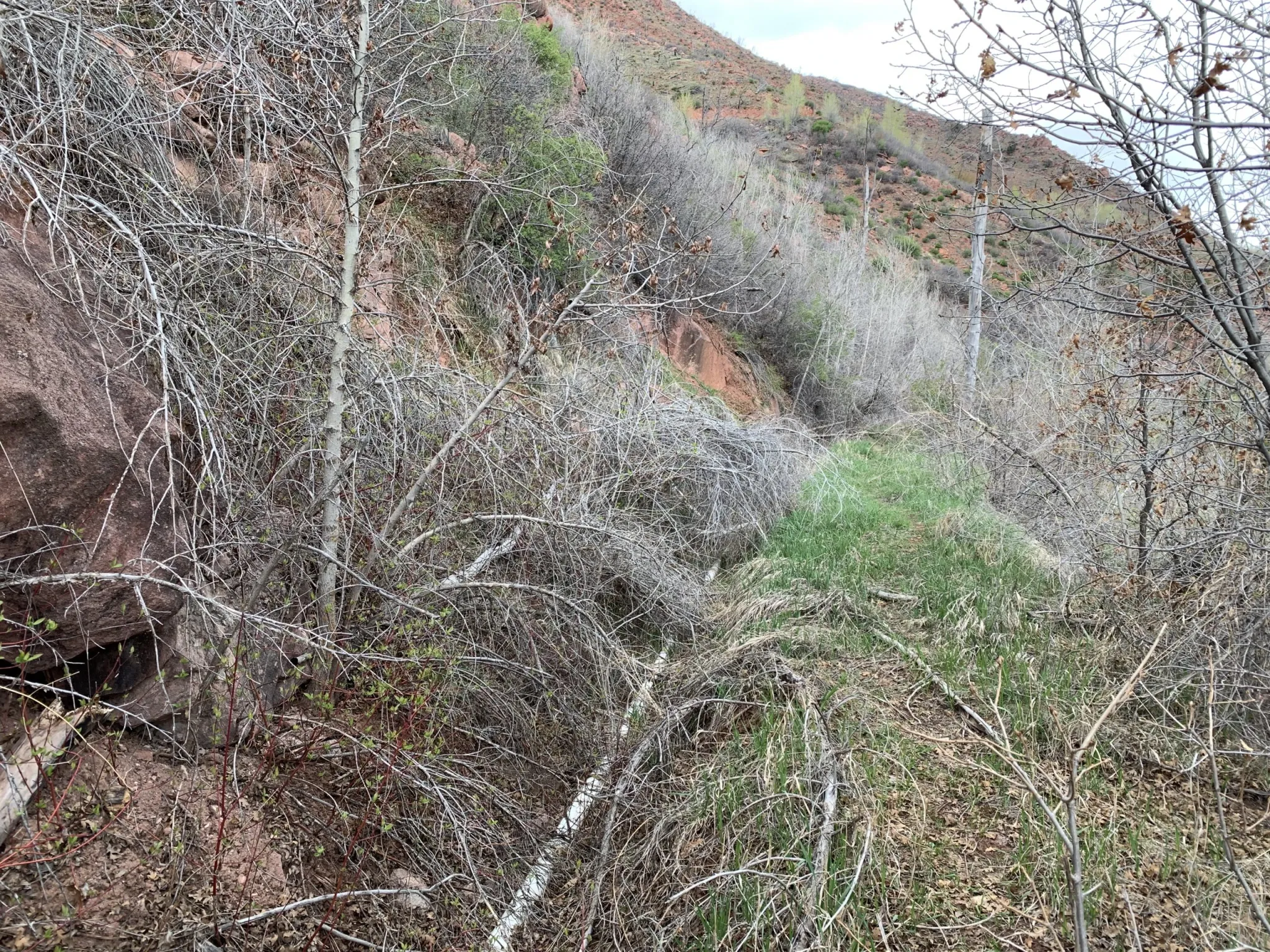
The Vulcan Ditch snakes across the hillside on the west side of Canyon Creek, roughly parallel to County Road 137. It is filled with downed trees, boulders, marmot holes, and an overgrown tangle of bushes and weeds. Nutrient Farm plans to reconstruct and realign the ditch, and install a 24-inch pipe, work that would require at least a 15-foot-wide — in some places, a 30-feet-wide — construction corridor, according to its PUD application. Water would have to be conveyed south across I-70 and the Colorado River to get to the Nutrient Farm property.
Dave Temple is the only other current water user on the ditch, which he maintains just enough in certain places to get his .13 cubic feet per second of water through a narrow, plastic pipe running along the bottom of the ditch to his property, located north of I-70 and the river. He walks parts of the Vulcan Ditch every other day during irrigation season.
“The ditch is a disaster,” Temple said. “I’ve always done it by myself, and it’s always taken me at least two weeks to get everything cleaned up enough to where I could turn the water in. … It’s in bad shape and even though [Nutrient Farm is] going to put it in pipes, it’s still going to devastate the whole hillside here.”
Nutrient Farm holds two water rights on Canyon Creek: a larger right, from 1908, and a smaller right, from 1952. According to a water supply adequacy report from Glenwood Springs-based engineering firm SGM, in dry years in the late irrigation season (August through October), the available streamflow may be limited to the senior 1908 water right.
A revised version of the SGM report, from this past March, clarified that although Nutrient Farm has the legal right to divert its full Vulcan Ditch right of 8.93 cfs, it will not — and cannot — divert continuously, year-round. The amount of water allowed to be used by crops (known as consumptive use) is capped at 393 acre-feet per year, which limits how much can be taken from the stream. At its maximum diversion rate of 8.93 cfs, Nutrient Farm would be able to divert only 34 days a year.
The report says the legal and physical water supply from Canyon Creek is sufficient.
“Whether diverting at higher rate for fewer hours, or diverting at a lower continuous rate, the proposed diversions are limited and are well within the supply available from Canyon Creek even in a dry year,” the report reads.
At the request of Canyon Creek property owners, Wright Water Engineers reviewed the original report from 2020 and submitted a memo to Garfield County. The Wright engineers agreed that there would be limited water available in Canyon Creek at the Vulcan Ditch headgate during the late irrigation season of dry years. Further, they concluded when using 1977, the driest year on record in the Colorado River Basin, as a benchmark, that the streamflow available at the Vulcan Ditch headgate would be below the property’s average demand at that time.
“Therefore, the Canyon Creek physical and legal supply is not sufficient to provide for Nutrient Farm’s demands during the late irrigation season in dry years,” the memo reads.
During late summer and early fall is when many streams in Colorado experience dry-ups as natural seasonal streamflows dwindle but irrigation continues. Many streams in Colorado are overappropriated, meaning there are more water rights on paper than there is water in rivers, depending on the season, and it’s not uncommon for irrigators to experience shortages during these times.
Nutrient Farm is owned by Andy Bruno, who bought the property in 2018. He did not answer a list of specific questions sent by Aspen Journalism, but he provided a statement about the project’s intended use of Canyon Creek.
“There is a long-standing adjudicated right for the entire Nutrient Farm water supply,” Bruno wrote in an email. “There is more than ample water available in the Canyon Creek to address all needs and Nutrient Farm remains subject to Division of Water Resources oversight. Nutrient Farm owns senior water rights, has a water management plan and will use this resource responsibly.”
Canyon Creek resident Dave Temple at the headgate of the Vulcan Ditch on Canyon Creek. Besides Nutrient Farm, Temple is the only other water user on the ditch, with a .13 cfs water right. Credit: Heather Sackett/Aspen Journalism
Water for fish
In a comment letter to the Garfield County Planning Commission, leaders of the Colorado chapter of Trout Unlimited said that if Nutrient Farm’s water right — in full or in part — was diverted during fall and winter low-flow periods, it could be devastating to spawning fish.
In 2021, Trout Unlimited completed a $250,000 project to upgrade the culvert system that conveys Canyon Creek under I-70 to improve access for spawning fish from the Colorado River. Trout Unlimited representatives said Nutrient Farm should permanently use water from the Colorado River, and that Canyon Creek should be protected from additional diversions.
“TU is primarily concerned about the detrimental impacts of additional diversion from Canyon Creek on brown trout spawning and subsequent egg incubation and fry emergence,” the letter reads. “In a drier, hotter climate, aquatic systems like Canyon Creek should be given special consideration.”
But historically, the health of aquatic ecosystems have been given very little consideration in the laws that govern water use in Colorado. And the section of lower Canyon Creek where the Vulcan Ditch headgate is located lacks one of the only protections available to rivers in Colorado: a minimum instream-flow water right.
These rights are held by the Colorado Water Conservation Board and are designed to preserve the natural environment to a reasonable degree. They date to the 1970s or later, and under the Western water management system of prior appropriation, where the oldest rights get first use of the creek, they aren’t always effective at keeping water in streams because they are so much younger than many big irrigation rights.
An upper reach of Canyon Creek between the confluence with Johnson Creek and the headgate of the Baxter Ditch has a series of minimum instream-flow water rights, but lower Canyon Creek lacks this protection.
Several other ditches besides the Vulcan Ditch take water from Canyon Creek, including the Williams Canal, the Mings-Chenoweth, Wolverton and Johnson ditches.
DWR does not have a problem with a water user taking so much water that it dries up the creek as long as they are not taking more than legally allowed or increasing their overall consumptive use to more than what is allowed in their water court decrees.
“That’s called tough luck,” said Aaron Clay, a retired water attorney, water court referee and expert who teaches community courses about the basics of water law across the Western Slope. “That’s the way the law works and DWR has no control over that. … Unfortunately, the prior appropriation system does not recognize environmental concerns on creeks.”
The Vulcan Ditch, which takes water from Canyon Creek, is overgrown and hasn’t been used in more than two decades. Nutrient Farm plans to pipe the ditch and begin using it for a farm and agritourism business. Credit: Heather Sackett/Aspen Journalism
Vulcan Ditch history
According to Nutrient Farm’s project narrative, “the Vulcan Ditch has historically provided irrigation water to the property from Canyon Creek and will continue to do so.” Nutrient Farm plans to use the Canyon Creek water for potable indoor use, irrigating crops, livestock, landscaping, grass fields, open space and recreational ponds.
But although the Vulcan Ditch may have brought water to what is now the Nutrient Farm property decades ago, state diversion records indicate that hasn’t happened in the past 24 years. The year 2000 was the last year that the ditch took a large quantity of water, about 1,500 acre-feet. Records are spotty for the next decade with either a very small amount of water diverted or no diversions at all, until 2010, when diversions resumed, but at a much lower level than in the 20th century. These numbers reflect the diversions of the only other water user on the ditch: Temple, who uses a small pipe to get water from the headgate to his property downstream.
Under Colorado water law, water rights holders must use the water if they want to keep their legal right to it. If they don’t, the water right could be abandoned. Abandonment is the legal term for one of Colorado’s best-known water adages: Use it or lose it. Abandonment means that the right to use the water is canceled. The principle came about to discourage hoarding of water rights that weren’t being used and to make sure that someone who used water long ago — but then stopped — couldn’t suddenly begin diverting water again and disrupt the flows of a river that more current water users have come to depend on.
Vulcan Ditch history
According to Nutrient Farm’s project narrative, “the Vulcan Ditch has historically provided irrigation water to the property from Canyon Creek and will continue to do so.” Nutrient Farm plans to use the Canyon Creek water for potable indoor use, irrigating crops, livestock, landscaping, grass fields, open space and recreational ponds.
But although the Vulcan Ditch may have brought water to what is now the Nutrient Farm property decades ago, state diversion records indicate that hasn’t happened in the past 24 years. The year 2000 was the last year that the ditch took a large quantity of water, about 1,500 acre-feet. Records are spotty for the next decade with either a very small amount of water diverted or no diversions at all, until 2010, when diversions resumed, but at a much lower level than in the 20th century. These numbers reflect the diversions of the only other water user on the ditch: Temple, who uses a small pipe to get water from the headgate to his property downstream.
Under Colorado water law, water rights holders must use the water if they want to keep their legal right to it. If they don’t, the water right could be abandoned. Abandonment is the legal term for one of Colorado’s best-known water adages: Use it or lose it. Abandonment means that the right to use the water is canceled. The principle came about to discourage hoarding of water rights that weren’t being used and to make sure that someone who used water long ago — but then stopped — couldn’t suddenly begin diverting water again and disrupt the flows of a river that more current water users have come to depend on.
“We’re afraid that this kind of precedent is dangerous,” Linman said. “When water has not been used and a ditch has not been maintained, to have the power to reopen a clearly abandoned structure puts residents at risk across the entire West.”
The reason that Nutrient Farm’s water rights on the Vulcan Ditch haven’t been formally abandoned, despite the ditch itself not being used in more than two decades, is because the farm has been taking water from the Colorado River using what’s known as an alternate point of diversion.
But those records are spotty. Diversion records indicate that a small amount of water was taken from the Colorado River to the Nutrient Farm property using a pump in five years between 2006 and 2023. Assistant Division Engineer for Division 5 Caleb Foy said his office must evaluate how to best use its resources in pursuing abandonment cases, which are subject to a determination of the court. For a water right to be abandoned, the water user must intend to abandon it in addition to not having used it in the previous 10 years.
“The water court has typically applied a relatively low standard for users to show they did not intend to abandon their rights,” Foy said in an email. “As such, within Division 5, partial abandonment of rights diverted at structures with a record indicating some water use were generally not a priority… .”
There may be another reason the Vulcan Ditch and associated water rights have not ended up on the state abandonment list: For the past 25 years, the state of Colorado has also given an extra layer of protection to pre-Colorado River Compact water rights. The state engineer’s office has had a policy of keeping them off the abandonment list for the past two cycles.
Nutrient Farm, an organic farm between New Castle and Glenwood Springs, is planning to use water from Canyon Creek for its proposed expansion of outdoor agricultural operations. It would involve reopening the Vulcan Ditch, which hasn’t been used in almost 25 years. Credit: Heather Sackett/Aspen Journalism
Data gaps
Garfield County planning staff has also expressed its concerns with Nutrient Farm’s water plan, which they outlined in two recommended conditions of approval. The county land-use code requires that applications for land-use change permits have an adequate, reliable, physical, long-term and legal water supply. To ensure this, the county wants Nutrient Farm to use water from the Colorado River instead of Canyon Creek and to complete an additional water supply plan analysis, which includes an assessment of impacts on stream flows in Canyon Creek.
However, counties typically don’t have jurisdiction over water rights issues in Colorado. Normally, that is the responsibility of departments of state government such as the water courts, DWR and the CWCB.
In a written response to the county, Nutrient Farm attorney Danny Teodoru said both these conditions are far outside the proper scope of zoning review in Colorado.
“Nutrient Farm, and frankly any water owner in the state of Colorado or the American West, can in no way agree to tie their legal use of legally decreed water rights to a discretionary zoning review,” Teodoru wrote. “Such a notion is absolutely untenable and again flies in the face of long-established Colorado law on incredibly valuable water rights.”
He added that Nutrient Farm would participate in a collaborative stream study if other Canyon Creek water rights holders do.
A stream management plan for Canyon Creek would go a long way to fill what Kate Collins, executive director of the Middle Colorado Watershed Council, called an area with a lot of data gaps. Canyon Creek was not included in the 2021 Middle Colorado Integrated Water Management Plan and was left out of the 2024 Wildfire Ready Action Plan. In addition to having no minimum instream flow for the lower portion of the creek, stream gauge data has been spotty over the years, without a long, consistent record.
“We believe finding out more science and data to make good decisions is always a good idea when it comes to the watershed,” Collins said.
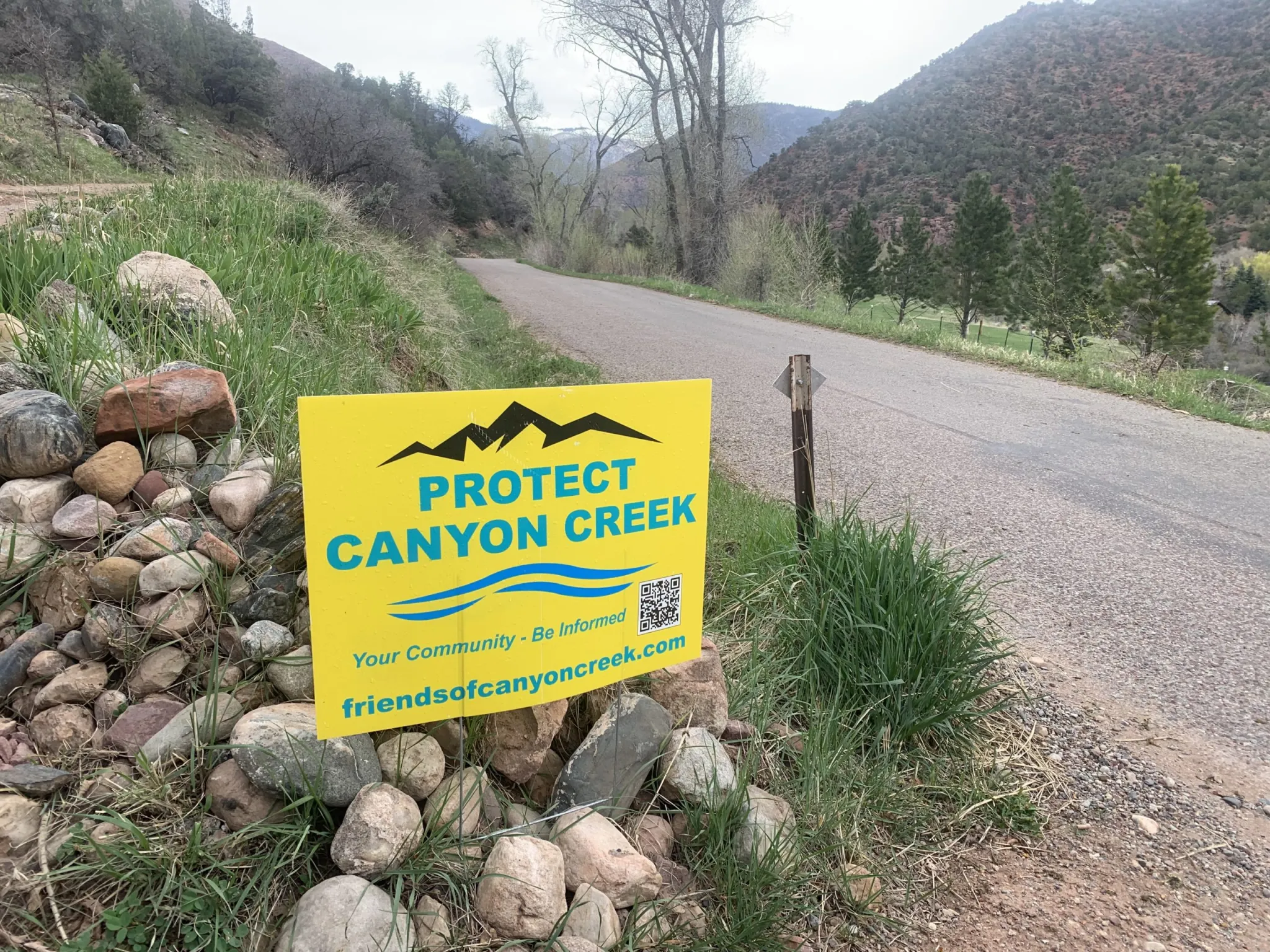
Signs have popped up in yards and along roads around New Castle and Glenwood Springs supporting Friends of Canyon Creek, a group dedicated to protecting the watershed. Nutrient Farm wants to resume using a ditch for its planned development that hasn’t been used in more than two decades. Credit: Heather Sackett/Aspen Journalism
Few options for protecting streams
The issue of who can use water on Canyon Creek gets at a central tension of Western water law: Is water a public resource or a private property right? The answer is both. There are other options for leaving water in streams during environmentally critical times of year, including nondiversion agreements or water leasing programs. But there’s no way to force it to happen without the willing participation of water users.
“It has to be a negotiated deal because it’s a property right and the property right says: ‘I have the right to dry up the stream,’” Clay said. “If the dispute is beyond the headgate, it’s no longer a water rights issue — it’s a private property issue. Those disputes are between private property owners, not DWR.”
The Friends of Canyon Creek have few options to protect their local stream. Linman said her group shouldn’t be responsible for funding an assessment of impacts when they want to leave the creek the way it is. Within the limited confines of the system, the water court process — which seeks to minimize harm to other water users — is the best opportunity to have a say in how Nutrient Farm uses water. Three cases related to Nutrient Farm’s water rights are still pending. However, none of the cases directly affects the project’s right to use water from the Vulcan Ditch.
“Our intention is to protect the creek and make sure that a new draw wouldn’t be pulled from an already threatened watershed that is significantly responsible for fire mitigation, ecological stability and community well-being,” Linman said.
Linman, Temple and others are frustrated by what they say is a lack of communication between them and Bruno and his representatives. Temple said he learned of Nutrient Farm’s plan to reopen and pipe the ditch when he talked with an employee of SGM who was surveying the Vulcan Ditch.
“I have not had any communication,” Temple said. “They have never ever come over here to talk to me. They should understand you can’t just be secretive; you have to communicate with your neighbors.”
Residents worry they will soon live next to a diminished stream, harming their quality of life and ability to fight wildfires. They are also concerned that the construction needed to clear the ditch of debris, repair the ditch and pipe the ditch will damage their property. They said they would be more likely to support Nutrient Farm’s development plan if it used water from the Colorado River, a much bigger water source than Canyon Creek and better able to handle the diversion.
According to SGM’s report, Canyon Creek should be the preferred source for Nutrient Farm’s water supply because it’s better quality than the notoriously silty Colorado. Last year, Nutrient Farm filed water court applications to renew water rights from 1983 that would allow the farm to take an additional 2 cfs from the Colorado River and for a 2,000 acre-foot reservoir in which to store this water.
Basalt attorney and JVAM partner Ryan Jarvis represents six property owners who are opposers in the three water court cases that Nutrient Farm filed last year related to its water use.
“Besides a decreed instream-flow water right, I don’t know of any other way, per se, to protect the flows in the creek for environmental concerns,” Jarvis said.
But residents are holding out hope that there is another potential way forward. They say Nutrient Farm could choose to be a good neighbor.
“There is an easy and achievable solution,” Jarvis said. “Take your water from the Colorado River and don’t unnecessarily harm Canyon Creek and its community. My clients are still here and willing to have conversations and find solutions.”
It appears that Republicans are actually serious about taking America’s public lands out of the public’s hands.
During a late night-early morning move this week, Republican Reps. Mark Amodei of Nevada and Celeste Maloy of Utah sneakily added an amendment to the House reconciliation bill that would open the door to selling off thousands of acres of Bureau of Land Management parcels (and some U.S. Forest Service land) in Utah and Nevada. Revenues would be used to help offset proposed tax cuts for the wealthy. The bill passed through committee, despite strong opposition from Democrats, but has not been voted on by the whole House yet.
The amendment will serve as an important test for Republicans who have condemned or remained ambivalent about public land transfers in the past. Rep. Ryan Zinke, the Montana Republican and Interior Secretary under Trump I, has said public land sales are his “red line” he refuses to cross, which makes sense since his constituents — and the general public — tend to be opposed to this sort of transfer1. We’ll see. The question is whether the GOP’s urge to pass a “big, beautiful bill” for Trump will erase that line for him and others. And if the amendment does pass, it may break the seal, so to speak, and open the door to much larger land transfers.
The whole deal has been wrapped in confusion, due to the rush of adding the amendment and lack of transparency around it, along with its vague language, which points to parcels on maps that are also a bit unclear. But it appears that it includes about 11,000 acres of BLM land in Utah and 200,000 acres or more in Nevada.
At least some of the land earmarked for “disposal” (bureaucratese for selling, giving away, or transferring public land) ostensibly would be used for housing. The amendment specifies that parcels in southern Nevada and in Washoe County be made “available at less than fair market value for affordable housing.” And parcels marked for disposal near Mesquite and Mormon Mesa in Nevada overlap with the American Enterprise Institute’s target areas for its Homesteading 2.0 and Freedom Cities initiatives. The Utah land is all in Washington and Beaver counties, the former of which is one of the nation’s fastest growing areas. The land is all on the urban fringe, meaning developing it would lead to more sprawl.
The Great Basin Water Network notes that some of the Washington County parcels also follow the path of the proposed $2 billion Lake Powell Pipeline, which would pull up to 28 billion gallons of water from the reservoir, use huge amounts of power to pump it across 141 miles of mesas and valleys to southwestern Utah, where it would water lawns and golf courses and irrigate alfalfa. Other parcels are long skinny segments that follow roads.
While some news reports and environmental groups have suggested that the proposed transfer is aimed at facilitating oil and gas drilling, it’s highly unlikely, as none of the parcels are in oil and gas-rich areas.
I did a mashup of the various maps for the Washington County, Utah, parcels, with the maroon and fuchsia indicating transfers requested by Washington County and St. George, and the dark blue by the water conservancy district. (To see a larger version click on it and go to the Land Desk website).
The fuchsia parcels were apparently requested by Washington County, and include the proposed path of the Lake Powell pipeline as well as what look to be parcels intended for housing or commercial development, including one on the border of Zion National Park.
The pink indicates BLM parcels that would be disposed of under the amendment and total about 65,000 acres. If the land were transferred, it would allow for a major expansion of Searchlight, a small former mining town, and Mesquite. It would provide enough acreage for a whole new sprawling city in the Moapa Valley.
🥵 Aridification Watch 🐫
There’s really no avoiding it now: This year’s spring runoff is going to be pretty piddly (in some cases this is in the past tense, since peak runoff has already come and gone). The winter started out pretty strong, and for some areas continued to be average into early spring, but then it all went to hell in a handbasket, despite early May storms.
Hopes for a continued recovery of Lake Powell levels this year are pretty much dashed. The Bureau of Reclamation’s latest 2025 water year unregulated inflow forecast for the reservoir is a meagre 6.78 million acre-feet, or 71% of normal. That would mean Lake Powell will continue to shrink over the next 12 months.
📸 Parting Shot 🎞️
I browse through old newspapers quite often to research the history of things. And lately, when I was looking into wolves in Colorado and Utah, I stumbled across a bunch of ads with a similar theme. And I couldn’t help but be reminded of some of the crazy spam that clogs up my email and social media feeds. These are from the late 1800s and early 1900s, and here merely for your amusement.
1 Let’s just be clear about something here: Zinke and others may express opposition to full-on land transfers, but they strongly support de facto land transfers, i.e. oil and gas and coal leases and mining claims. While they don’t transfer title of the land to the lessee or claimant, they do transfer the American public’s minerals and hydrocarbons to the corporations for little or no cost. And access can be cut off from the land while it’s being drilled or mined, and those activities can not only wreck the land, but also preclude future uses even after mining and drilling has ceased.
South of Hesperus August 2019 Sleeping Ute Mountain in the distance. Photo credit: Allen Best/The Mountain Town News
Click the link to read the article on the NOAA website:
May 12, 2025
April Highlights:
Temperatures were above normal across most land and ocean areas in April.
Preliminary data suggest that global average precipitation in April was record low.
Northern Hemisphere snow cover extent tied for lowest on record for the month.
Sea ice extent was below average around both poles.
Global tropical storm activity was near-normal with four named storms.
Map of global selected significant climate anomalies and events in April 2025.
Temperature
Temperatures were above normal across much of the globe in April. Asia and the Arctic stood out in this regard, though western Antarctica was also warmer than normal, and most of the ocean surface was much above average. A few areas were below normal, such as northern Australia, southern South America and eastern Antarctica, as well as the Norwegian, Greenland and Barents Seas.
For the globe as a whole, April 2025 was 2.20°F (1.22°C) above the 20th-century baseline. This is 0.13°F (0.07°C) below the record-warm April of 2024, thus ranking second in the 1850–2025 period. According to NCEI’s Global Annual Temperature Outlook, there is only a 3% chance that 2025 will rank as the warmest year on record.
Surface Temperature Departure from the 1991–2020 Average for April 2025 (°C). Red indicates warmer than average and blue indicates colder than average.
Precipitation
Large areas in central Asia and southern Africa received record-setting precipitation in April. Parts of northern Australia also experienced abnormally high precipitation. Heavy rainfall during the month caused floods and landslides in Brazil and Congo as well as flooding in western Somalia. Despite these extreme events, the globe as a whole was much drier than the long-term average. In fact, preliminary data indicate that April 2025 might have been the driest April in the historical record, which spans from 1979 to present.
Percent of Normal Precipitation from the 1961–1990 base period for April 2025. Brown indicates drier than average and green indicates wetter than average.
Snow Cover
The Northern Hemisphere snow cover extent in April was 820,000 square miles below average, tying with 2024 as the smallest April snow cover extent on record. Snow cover over North America and Greenland was below average (by 120,000 square miles), and Eurasia was also below average (by 710,000 square miles). A lack of snow cover was particularly obvious over the United States and central Eurasia.
Sea Ice
Global sea ice extent was 480,000 square miles below the 1991–2020 average, ranking in the lowest third of the historical record. Arctic sea ice extent was below average (by 160,000 square miles), with the Barents, Okhotsk, Bering and Labrador Seas having lower-than-normal ice extent. Antarctic extent was also below average (by 320,000 square miles), though extent was above normal in some areas (such as the Weddell and Amundsen Seas).
Map of the Arctic (left) and Antarctic (right) sea ice extent in April 2025.
Tropical Cyclones
Four named storms occurred across the globe in April, which matches the long-term average. Most notable among these was Severe Tropical Cyclone Courtney in the southwestern Indian Ocean. Two other storms occurred in the Australian region, along with one in the southwest Pacific.
Click the link to read the article on the Alamosa Citizen website:
May 14, 2025
OUTDOOR CONDITIONS
The early May rain delivered a recharge to the Upper Rio Grande Basin, and perhaps there’s more snowmelt coming from the higher elevations that forecasters haven’t yet figured out?
Craig Cotten of the Colorado Division of Water Resources, in speaking at this week’s May 13 meeting of the Rio Grande Basin Roundtable, said airborne snow forecasts are predicting “much higher” streamflows on the Rio Grande and Conejos than the other two sources the state relies on to make its predictions – U.S. Natural Resources Conservation Service (NRCS) and National Weather Service.
Cotten explained the state division of water resources uses all three sources to help it forecast the depths and the amount of water in the rivers. Colorado is forecasting 390,000 acre-feet this water year on the Rio Grande and 180,000 acre-feet on the Conejos – both measurements at around 60 percent of the long-term averages for the river system.
While NRCS and National Weather Service have been predicting low river flows from a light snow year, the Colorado Airborne Snow Measurement Program and its ASO Snow Survey has data that suggests “much higher” streamflows and is a source of information that the state is “trying to figure out what’s going on,” Cotten said.
“We still think it’s not going to be a great year on any of our stream systems,” he said.
Six of the seven state representatives who will shape the next chapter of Colorado River rules speak on a panel at the University of Colorado, Boulder on Jun. 6, 2024. The same group is opting not to speak at this year’s conference. Alex Hager/KUNC
Click the link to read the article on the KUNC website (Alex Hager):
May 11, 2025
This story is part of ongoing coverage of the Colorado River, produced by KUNC in Colorado and supported by the Walton Family Foundation. KUNC is solely responsible for its editorial coverage.
As tense negotiations about the future of the Colorado River are stuck at a standstill, the people in charge are retreating further into the shadows.
A group of negotiators – one from each of the seven states that use Colorado River water – will not be speaking at a major water law conference in June. Those representatives have appeared together on a panel at the conference for the last few years, and rarely appear together in public otherwise.
“The unwillingness to answer the public’s questions suggests that negotiations aren’t going well,” said John Fleck, who teaches water policy at the University of New Mexico. “I think it misses an important obligation in democratic governance of a river that serves 40 million people.”
The event, the Getches-Wilkinson Conference at the University of Colorado, Boulder, is typically one of two times each year that the negotiators appear together in public. In recent iterations of the same conference, they all spoke on one panel. Occasionally, a state representative has fallen ill or sent a deputy in their stead.
They seemed starkly divided at the other annual appearance, too. In December, they opted to split into two separate panels at the Colorado River Water Users Association conference in Las Vegas.
Water policymakers from (left to right) Utah, New Mexico, Colorado and Wyoming speak on a panel at the Colorado River Water Users Association conference in Las Vegas on December 5, 2024. The two rival factions of states chose to appear on two separate panels then, and have opted to avoid speaking entirely in June. Alex Hager/KUNC
People with knowledge of the situation confirmed to KUNC that state leaders told conference organizers they did not want to speak publicly. There is currently no seven-state panel on the published conference agenda.
JB Hamby, California’s top water negotiator, said he would attend the conference but not speak, and he was “100%” sure the other top officials wouldn’t be speaking. Representatives from Arizona, Colorado and New Mexico confirmed their states’ Colorado River negotiators would not be speaking.
Unlike many government processes, Colorado River policymakers work in a space that does not involve a mandate for public access. Their meetings are often held behind closed doors, are not listed publicly and do not yield minutes or records that can be viewed by the public.
“You need to listen to and have spaces to discuss with the people who are going to be impacted by your decisions,” Fleck said. “That’s not happening now, and that’s really disturbing.”
Those water policymakers are stuck in a standoff about how to use less water from the shrinking Colorado River. Negotiators seem to agree with the broad concept that the farms, businesses and 40 million people of the Colorado River basin need to cut back on water use as the river gets smaller due to climate change. They don’t, however, agree on who should cut back.
Talks so far have largely stayed divided along a decades-old fault line. On one side is the Upper Basin – which consists of Colorado, Utah, Wyoming and New Mexico. The other side, the Lower Basin, is made up of California, Arizona and Nevada.
The Lower Basin has volunteered relatively modest cuts in proposals for how to manage the river after the current rules expire in 2026. The Upper Basin has not volunteered any cuts, insisting that its states are already forced to use less water due to climate change and a longstanding legal requirement to send a fixed amount of water to those Lower Basin states.
“I am fully focused on the negotiations for post-2026 operations of Lake Powell and Lake Mead,” Becky Mitchell, Colorado’s top negotiator, wrote in an email to KUNC. “As the Getches-Wilkinson conference drew nearer, it was unclear where we would be in that process, and I wanted to be cognizant of the sensitivity of the work. Time is of the essence, and these critical negotiations have my full attention at this time.”
The states have dug their heels in on those positions for months now, and their willingness to talk about the status of their closed-door attempts to break the deadlock has only gone down over time.
Reporters’ requests to state water authorities that once yielded interviews with top policymakers are now often met with written statements that tend to be short on detail.
Glen Canyon Dam holds back the waters of Lake Powell near Page, Arizona on Sunday, Feb. 2, 2025. Lake Powell, has approached dangerously low levels in recent years as policymakers have struggled to come up with a long-term management plan for the water it stores. Photo credit: Spenser Heaps/Utah News Dispatch
“I have a lot of respect for the people who are doing these negotiations,” Fleck said. “They’re trying to solve really hard problems, and I respect the idea that they need some space to do that, but not showing up in public at all is granting them more space than I’m willing to grant them.”
Joanna Allhands, an opinion writer at the Arizona Republic who has written about the Colorado River’s “bankruptcy of leadership,” said more transparency from water policymakers “would be smart as a matter of self preservation.”
“Whatever the decision is made,” she said, “Whatever alternative gets chosen, if people feel like they’ve been left out, guess where we’re headed? We’re going to the Supreme Court.”
Colorado River negotiators have said that they want to avoid taking this issue to the Supreme Court, but have made little recent progress to steer talks away from that outcome.
Colorado River “Beginnings”. Photo: Brent Gardner-Smith/Aspen Journalism
This year’s predicted spring runoff into Lake Powell has decreased yet again as the impacts of a dry winter begin to show. Hydrologists at the Colorado Basin River Forecast Center said Wednesday that the amount of water flowing into Lake Powell between April and July this year is expected to be 55% of average. “Average,” in forecasting, refers to the average runoff between 1991 and 2020. That prediction follows a decline in forecasted flows since the start of winter…In terms of actual water, 55% of the average runoff translates to about 3.5 million acre-feet of water making it into Lake Powell…That’s lower than the runoff in 2022, which was a little over 3.7 million acre-feet, but better than 2021’s 1.85 million acre-feet. Spring runoff in 2023 and 2024 were well above what is forecasted this year. The snowpack above Lake Powell, which is the second-largest reservoir in the U.S., has already begun to melt. At the start of April, the snowpack was 89% of the 1991-2020 median. As of May 1, it has shrunk to 71% of the median.
Homestake Creek is a tributary of the Eagle River. CREDIT: BRENT GARDNER-SMITH/ASPEN JOURNALISM
Click the link to read the article on the Vail Daily website (Zoe Goldstein). Here’s an excerpt:
May 8, 2025
Every year brings different water conditions in Eagle County. With climate change, the promise of full rivers in the summer may become even less certain. To prepare for future drought years, the Eagle River Water and Sanitation District and Upper Eagle Regional Water Authority have a new water shortage response plan.
“The goal of this plan is to provide water security, to ensure that we can provide our core services,” said Justin Hildreth, the district’s water resources engineer, when presenting the plan to the district board for approval on April 10. Among the core services included in the list are safe drinking water and water for structure fire suppression…According to the plan, “a water shortage occurs when the (district/authority) lacks the physical or legal water supplies needed” to provide their services and maintain required streamflow levels. This can happen when there are extended calls from older water rights, (like the Shoshone water rights on the Colorado River), when stream flows are low for long periods and when local reservoirs (Eagle Park Reservoir and the Black Lakes) have low supply. The district and authority boards approved the plan during their April 10 meetings after learning about the plan during Feb. 27 work sessions…
One of the best early predictors of a drought scenario is if the snow water equivalent measure has not reached an average of 15 inches across the Vail, Fremont Pass and Copper SNOTEL stations by April 1. “That directly relates to Eagle Park Reservoir, that relates to the flows in Gore Creek and the flows in the Eagle River,” Hildreth said. This year, the average was just shy of 16 inches across the three stations on April 1.
Click the link to read the article on the Aspen Times website (Robert Tann). Here’s an excerpt:
Perched above the Dillon Reservoir on the side of a mountain road in Summit County, Gov. Jared Polis on Thursday signed into law three bills aimed at bolstering the state’s water infrastructure. The measures come amid the backdrop of chronic drought and increased water demand in the West which have made finding a path towards water sustainability more urgent. Speaking amid on-and-off snow flurries and bouts of sunshine, Polis said the bills signed on Thursday will help “build a sustainable, livable future” by “securing our water for the state of Colorado.”
State voters’ decision to approve a tax on sports betting in 2019 has provided a critical funding source for water projects, delivering as much as $30 million a year for infrastructure and conservation efforts. House Bill 1311 takes that a step further by eliminating a tax exemption for revenue generated from free sports bets…
A view of the popular Pumphouse campground, boat put-in and the upper Colorado River. Photo credit: Brent Gardner-Smith/Aspen Journalism
Finding solutions to funding woes
While taxes on sports betting have helped shore up state spending on water projects, its other key funding stream risks running dry…Under Senate Bill 40, the state will commission a nine-member task force within the Department of Natural Resources to study the future of severance tax revenue and come up with solutions to better fund the state’s water needs. The task force will be required to submit a final report to the legislature in July 2026, with lawmakers hoping to turn those ideas into policy.
Grays and Torreys, Dillon Reservoir May 2017. Photo credit Greg Hobbs.
Precipitation fell across much of the U.S. this week, with heavier amounts (> 1 inch) falling from portions of the central and southern Plains eastward to the East Coast, and also in parts of the West, Hawaii, and southern Alaska. Much of the Southeastern U.S., from eastern Texas to North Carolina, reported weekly rainfall totals between 2 to 10 inches, while similar amounts (2 to 6 inches) were reported in parts of the Northeast. Above-normal precipitation supported drought improvements across large portions of the South, Southeast and Northeast, and in parts of the Southwest and High Plains. Conversely, weekly precipitation totals were below normal across much of the West to the Midwest. Drought and abnormal dryness were expanded or intensified in northern portions of the West and Midwest, as well as parts of the Southwest and High Plains. Temperatures were above normal across much of the U.S. this week, with areas of the north-central U.S., from central Montana to Minnesota, reported temperatures 9 to 20 degrees above normal. Below-normal temperatures were observed from the southern Plains to parts of the eastern Midwest, where departures were up to 10 degrees F below normal, with the largest departures being reported in parts of Texas…
Warm temperature dominated the High Plains this week, with departures ranging up to 20 degrees F above normal, especially along the northern portions of the region, while cooler-than-normal temperatures were observed along the southern border. Precipitation fell across the western and southern portions of the region this week; however, in most areas, amounts were insufficient for significant improvement. Beneficial heavy precipitation (1 to 3 inches) in eastern Colorado and Kansas led to improvements in moderate to severe drought (D1-D2) and abnormal dryness (D0) in these areas. Conversely, dry conditions resulted in the introduction and expansion of drought. Extreme drought (D3) was introduced in western Nebraska, and moderate to extreme drought (D1-D3) expanded in western Colorado and eastern Nebraska. Abnormal dryness was also expanded in southern Wyoming this week…
Drought Monitor one week change map ending May 13, 2025.
Average temperatures were above normal across nearly the entire region this week, while below-normal temperatures were observed across much of New Mexico, and in parts of Arizona and along the coast of Washington, Oregon, and California, where temperatures were between 1 to 6 degrees F below normal. Conversely, Montana observed temperatures ranging between 3 to 15 degrees F above normal this week. Precipitation varied across the region this week, with beneficial amounts falling in parts of the Southwest and southern Montana. Exceptional drought (D4) was improved along the Nevada-Arizona border, while extreme drought (D3) was trimmed back in southern Utah, southern Nevada, eastern California, and western Arizona. Severe drought (D2) was improved in parts of Utah, Arizona, while moderate drought (D1) was reduced in Montana. Conversely, above-normal temperatures and below-normal precipitation resulted in the expansion of exceptional drought in southern New Mexico, severe drought in Montana, and moderate drought in northern portions of Washington, Idaho and Montana. Abnormal dryness (D0) was also expanded in western Washington, northeast Oregon, northern and southern Idaho, and in southern California this week…
Cooler temperatures dominated the South this week, with departures ranging up to 9 degrees F below normal. However, small areas of Texas, Oklahoma, Mississippi, and Tennessee observed temperatures slightly above normal this week, with temperatures between 1 to 3 degrees F above normal. Precipitation varied across the region this week, with heavier amounts (1 to 8 inches) falling across much of Louisiana and Mississippi, and in parts of Oklahoma, Texas, and southern Arkansas. Moderate to exceptional drought (D1-D4) was improved in parts of western, central, and southern Texas, while moderate to severe drought (D1-D2) was improved in western Oklahoma. Improvements to abnormal dryness (D0) were made in Oklahoma and Texas, and abnormal dryness was removed from southern Mississippi and southern Louisiana. Drought reduction and improvements were based on precipitation totals, short-term SPI/SPEI, NDMC short-term blends, and improvements to streamflow and soil moisture data…
Looking Ahead
During the next five days (May 13–17, 2025), the slow moving upper low across the Southeast U.S. will be weakening and evolving into an open trough by Thursday as it exits the East Coast. Another upper trough and closed low across the Northern Rockies mid-week will sustain a surface low crossing the Northern Plains and then into south-central Canada by the end of the week, with heavy rain for the Dakotas/Minnesota and late season mountain snow for the northern Rockies. Going into Thursday, the heavier rainfall reaches eastern North Dakota into northern Minnesota, with some of the guidance indicating the potential for 1-2 inch rainfall totals with some embedded convection. Very warm weather will continue across the Upper Midwest for the middle of the week, with highs reaching 85-90 degrees on Wednesday across the eastern Dakotas and much of Minnesota. The anomalous warmth then shifts eastward to the Great Lakes and Ohio Valley regions to close out the week, and much of the East Coast Friday into Saturday ahead of the cold front. Very hot conditions are expected across southern Texas for the entire forecast period with highs exceeding 100 degrees near the Rio Grande, and HeatRisk reaching the major category for these areas. In contrast, chilly conditions are likely for the Intermountain West and Northern Rockies with highs running 5-15 degrees below average with the upper level trough and increased cloud cover.
The Climate Prediction Center’s 6-10 day outlook (valid May 18–22, 2025) favors above-normal precipitation across most of the U.S., with below-normal precipitation favored in portions of the West Coast states and the Florida Peninsula. Increased probabilities for above-normal temperatures are forecast for Hawaii, from the southern Plains to the Southeast, and in parts of California, Nevada, and southern Alaska.
US Drought Monitor one week change map ending May 13, 2025.
Map of the Colorado River drainage basin, created using USGS data. By Shannon1 Creative Commons Attribution-Share Alike 4.0
Click the link to read the article on the AZCentral.com website (Branson Loomis). Here’s an excerpt:
May 13, 2025
Key Points
Arizona has “real skin in the game” as negotiations continue over shares of a smaller Colorado River, Gov. Katie Hobbs said. Now she wants other states to step up.
The seven Colorado River states are trying to reach a shortage-sharing agreement this year, but are also looking to the new Trump administration to see if there are alternatives.
Arizona officials say other parts of the state, such as Yuma, may have to take cuts. Tribes say they expect the state to honor settlements.
Arizona is doing its part and taking its hits to conserve the Colorado River, Gov. Katie Hobbs said, and it’s time for upstream states to do the same. The governor assembled a roundtable of water users and officials on May 13 to present what she called a unified front among the state’s interests in defending Arizona’s share of the Colorado River as time runs short for reaching a deal with other states that use the water. So far, states upstream from Arizona have not offered cutbacks beyond the limits that a paltry snowpack naturally extracts from their farmers.
“It’s been more than a little frustrating,” Hobbs said. “We’ve come to the table with real solutions, with real proposals. We have real skin in the game,” she said, including billions of dollars in water infrastructure upgrades and in conservation agreements that keep water in the river’s reservoirs. “The upper states need to be willing to take their share as well.”
[…]
So far, the Rocky Mountain states known collectively as the Upper Basin have declined to specify new cuts they might take, because they say they already suffer the consequences of a reduced snowpack that shortchanges their farmers every year. The federal government has paid some Lower Basin farmers and others to cut back on their demands from Lake Mead’s storage bank, and the four Upper Basin states of Colorado, New Mexico, Utah and Wyoming argue that their year-in, year-out hardship is unrewarded and largely invisible to water users in the Southwest.
Udall/Overpeck 4-panel Figure Colorado River temperature/precipitation/natural flows with trend. Lake Mead and Lake Powell storage. Updated through Water Year 2024. Credit: Brad Udall
Following a day of testimony on May 6, Denver Water has been asked by U.S. District Court Judge Christine Arguello to provide the court with the utility’s final summary highlighting its position following the witness testimony and exhibits. There isn’t a specific timetable set for this yet.
The focus of the hearing was for the judge to determine if construction can safely stop while Denver Water moves forward on an additional permitting review as the court ruled on April 3. Here is Denver Water’s statement on the risk presented by delaying construction:
Denver Water has already started the appeal process with the 10th Circuit Court of Appeals. As part of this, the project has been allowed to continue (under a temporary stay) while legal proceedings are underway.
Roller-compacted concrete will be placed on top of the existing dam to raise it to a new height of 471 feet. A total of 118 new steps will make up the new dam. Image credit: Denver Water.
The Ash Meadows National Wildlife Refuge in southwest Nevada harbors four endangered species, including the Amargosa pupfish, a tough little fish that has been around since the Pleistocene. The Wyoming toad, which makes its home in southeast Wyoming’s Mortenson Lake National Wildlife Refuge, is one of North America’s most endangered amphibians. And the Arctic National Wildlife Refuge protects one of the world’s largest onshore denning sites for polar bears.
All these bumpy, feathery, furry and increasingly rare species are part of the astonishing biodiversity in the United States that helps keep our planet alive and healthy. Now, every bit of that biodiversity — the fish and wildlife and the land and water that they all need to survive — face what conservation advocates call an existential crisis owing to draconian budget cuts proposed in the name of improving government efficiency.
An employee descends stairs to Devils Hole, home of Devils Hole pupfish, in a remote unit of Death Valley National Park near Ash Meadows National Wildlife Refuge, Nevada. Luna Anna Archey/High Country News
President Donald Trump’s recently released federal budget asks Congress to slash more than $900 million from the National Park System, $564 million from the U.S. Geological Survey’s science and research programs and almost $200 million from the Bureau of Land Management, along with $170 million in U.S. Fish and Wildlife Service conservation grants. And while the president’s budget is far from final — Congress ultimately controls the power of the purse — advocates say the past 100 days of Trump’s presidency have shown that the current Republican-led Congress is either unable or unwilling to stand up for public lands and wildlife protections. In fact, a House committee voted shortly before midnight Tuesday to begin selling off hundreds of thousands of acres of public land in Utah and Nevada.
If Trump’s current proposals become reality, advocates warn that the West as we know it will be permanently changed, home to neglected and shrinking public land with fewer national parks, diminished fish and wildlife, and increasingly out-of-control wildfires.
“This is short-term thinking at its absolute worst,” said Walt Gasson, a fourth-generation Wyoming hunter and outdoorsman. “We are standing by letting people make decisions for us that don’t reflect our own legacy, what we want to leave for our grandkids.”
“No more hiking, no more biking, no more grazing”
The proposed cuts to the National Park Service are some of the most alarming so far, and a shocking omen for anyone that goes outdoors.
Slashing $900 million from the agency budget is the equivalent of closing 350 national park sites, said Kristen Brengel, with the National Parks Conservation Association. And, in fact, Trump’s budget calls for “transferring smaller, lesser visited parks to state and tribal governments.”
The White House cannot unilaterally sell off parks, but it can cut staffing, and that is something that has Brengel seriously worried. This year alone, the Park Service has already lost at least 2,700 employees through buyouts and deferred resignations, and she expects more layoffs soon.
“They will make it impossible to open the parks to the public,” she said.
Interior Secretary Doug Burgum signed an executive order in early April saying that parks and historic sites would remain fully open, but Brengel noted that this contradicts the White House’s priorities, which include shuttering those sites and transferring control of them to the states. And while Burgum promised to fully staff parks for the coming summer, many remain critically short, some still lacking superintendents and maintenance chiefs.
The White House’s proposed cuts will hit more than the parks, though: They will impact all federally owned public lands, including wildlife refuges, said Christian Huntof Defenders of Wildlife. A leaked Department of Interior strategic plan called for national monuments to be “correctly sized” and “heritage lands and sites returned to states.”
A ranger-led sunset walk at White Sands National Park, New Mexico, in 2019. This year, the Park Service has already lost at least 2,700 employees through buyouts and deferred resignations. Luna Anna Archey/High Country News
Meanwhile, the House Natural Resources Committee voted late Tuesday night to sell public land in Nevada and Utah, at the same time requiring massive increases in timber production and coal, oil and gas extraction while deeply cutting the royalty rates companies pay to lease public lands. Estimates vary but the total acreage includes several hundred thousand acres across the two states.
“In the dead of night, 26 members of Congress, with no debate or explanation, voted to sell off public land that belongs to all Americans,” wrote Aaron Weiss with the Center for Western Priorities. “Once these lands are gone, they’re gone forever — that means no more hiking, no more biking, no more grazing, no more habitat for wildlife.”
All the changes to public lands and public-land agencies come on top of deep cuts to scientific research. The president’s proposed budget would also likely cancel out all cooperative fish and wildlife units and focus instead on “achieving dominance” in energy and critical minerals. And some worry those cuts will come even before Congress considers the president’s recommendations; sources tell High Country News that 1,000 employees in the USGS Ecosystem Services will be laid off soon.
The scientists whose jobs are on the chopping block identify and map big game migrations and figure out the best locations for constructing the wildlife over- and underpasses that save countless human and animal lives. They monitor grizzly bear numbers and perform annual migratory bird counts to set hunting limits, said Ed Arnett, CEO of The Wildlife Society. They are critical to maintaining healthy fish and wildlife populations.
Part of a plan
To Land Tawney, all this is part of a plan to “dismantle, defund and divest” federal public lands. It’s why the president’s budget calls for consolidating all wildland firefighting operations under the Interior Department, he said, which is currently being managed by DOGE operative Tyler Hassen.
“Chaotic is one word for this,” said Tawney, co-founder of American Hunters and Anglers, “but crisis is another.”
Regardless of political party, the general public does not, as a rule, support transferring national parks, historic sites or wildlife refuges to states or reducing permit oversight on oil, gas and mining development. But if public lands are mismanaged badly enough for long enough, Tawney said, selling them off may become inevitable. And selling places like national wildlife refuges will mean no more homes for fragile — and not so fragile — fish and wildlife populations, including the Wyoming toad and Nevada pupfish.
While Tawney said this is one of the darker periods in U.S. history, he hopes that all the federal staff firings, cuts to scientific research and other efforts to devalue and sell public lands will finally galvanize anyone who cares about the outdoors and conservation.
“I think we’re starting to coalesce around pushing back on these ill-fated ideas,” he said. “And collectively, not just the hunting and fishing community, but the entire outdoors community.”
The Palisades Fire, photographed here from Palisades Drive, ignited Jan. 7, 2025, in the Santa Monica Mountains of Los Angeles County. It spread rapidly because of hurricane-force Santa Ana winds, burning for 24 days, consuming more than 23,000 acres and destroying 6,837 structures. Photo credit: Ariam23, Wikimedia Commons, CC BY 4.0
One of the initial concerns during the series of tragic Los Angeles wildfires that burned in January 2025 was whether fire hydrants were ready to combat the inferno that left so much destruction in its wake.
To be clear, and as Denver7 highlighted in January, public water systems are designed to help firefighters battle urban fires.
For instance, Denver Water’s system includes built-in redundancies to ensure it can meet water demand, and the utility continually invests in the system to keep it that way.
Denver Water’s distribution system includes 31 treated water storage tanks across the metro area (many of which have been upgraded in recent years), more than 3,000 miles of pipe and 22,000 fire hydrants, along with dedicated mechanics who focus on maintaining those hydrants and keeping them in top condition.
During a fire in the Denver Water service area, its operators can analyze and adjust the operation of the distribution system so that firefighters have the water pressure they need to fight the blaze. The utility also will send experts to the scene to help maintain pressure.
The system of hydrants is not designed, however, to provide sufficient flows for a long enough period to effectively battle long-lasting, wind-driven, large-scale wildfires. Hydrants are pressurized and are crucial to fighting structure fires, but they can only do so much. And when many hydrants are in use in the same area at the same time, water pressure is going to weaken.
While Denver Water can store millions of gallons of drinking water in dozens of large water storage tanks around town to accommodate increases in demand, there are limits — like being able to provide enough water to fight a wildfire.
Fortunately, much of Denver Water’s service area is in a different environment compared to Los Angeles. But that doesn’t mean the area is immune, as there are portions that blend wildland environments with urban communities.
In fact, just last summer a string of wildfires ignited during the same week in the foothills along the Front Range. The fires required aggressive coordination from fire departments up and down the corridor, alongside state and federal agencies, to extinguish, with a focus on wildland firefighting. Wildland fire responders cleared fire lines and fought the fires from the air.
A plane pulls in water from Chatfield Reservoir to help fight the Quarry Fire, a wildfire that ignited in summer 2024 in Jefferson County, Colorado. The fire required a multi-jurisdictional effort to extinguish. Photo credit: Colorado Parks and Wildlife.
Urban fire hydrants were not the focus.
Ultimately, when a fire like the tragic blazes in Los Angeles occurs, it is always going to require a coordinated, multijurisdictional effort, often across city, state and even international lines.
So, what can be done?
Colorado Public Radio in January spoke with Colorado State Forest Service wildfire mitigation program specialist Chad Julian, who discussed the importance of focusing on the right topics when analyzing any fire.
“If we focus on increasing budgets, more water storage, more fire trucks, it’s not going to change the outcome of the next event. It would take the engagement of homeowners to really work on the resistance to ignition and hardening those buildings, the vegetation and the yards,” he said.
“Ninety-five percent of it was likely still caused by land use patterns, how we build, how we interact with the ecosystem, whether we adapt to it or not. And unfortunately, that’s not the focus at the moment,” he said.
But this was the focus in Colorado after the devastating Marshall Fire of 2021, leading to new legislation:
In Louisville, an ordinance took effect in December 2024 requiring implementation of wildfire-resistant measures in buildings. (Boulder is considering something similar.)
Many new construction sites in Denver include 5-foot vegetation barriers around new structures in their landscape planning.
The Wildfire Resilient Homes Grant Program, created by Colorado’s state legislature, encourages homeowners to make their properties more resistant to wildfire.
Julian says these are the types of changes that can make a real difference.
Denver Water has long focused on investing in the resiliency of its watersheds and system, and plans to invest about $1.8 billion over the next 10 years.
When customers pay their water bill, the money goes to building a reliable system, which includes regular infrastructure inspection and maintenance programs to ensure pipes, hydrants and storage tanks are ready to protect communities during urban fires.
Water bills also fund watershed resiliency projects that protect the lands and facilities that collect and store Denver’s drinking water.
The From Forests to Faucets partnership alone has committed more than $96 million to reduce wildfire risk in critical areas, from 2010 through planned work into 2027. Half of that money has come from Denver Water. The risk of wildfire in Denver Water’s watersheds remains the greatest risk to Denver’s water supply, making this investment crucial to the resilience of the system.
A Ponsse tree harvester works to thin a 40-acre section of forest in Breckenridge in August 2020, as part of the From Forests to Faucets partnership. Photo credit: Denver Water.
Denver Water’s 10-year investment plan also includes expanding Gross Reservoir in western Boulder County, which will improve water supplies on the north side of the metro area and make the system more balanced and resilient in the face of increasing impacts from climate change, drought and wildfire.
This improvement on the north side of the metro area will prove pivotal should wildfire inhibit resources that deliver water on the south side of the region, via the South Platte River, where wildfires have struck consistently over the past 20 years.
These are just a few examples of investments and partnerships already underway, but challenges lie ahead.
As Salazar noted in his column published in The Denver Post (which can also be found on Denver Water’s TAP news site), climate change continues to impact the environment and, as the wildland-urban interface continues to merge, even more investment and collaboration will be crucial.
As summer approaches, millions of Americans begin planning or taking trips to state and national parks, seeking to explore the wide range of outdoor recreational opportunities across the nation. A lot of them will head toward the nation’s wilderness areas – 110 million acres, mostly in the West, that are protected by the strictest federal conservation rules.
When Congress passed the Wilderness Act in 1964, it described wilderness areas as places that evoked mystery and wonder, “where the earth and its community of life are untrammeled by man, where man himself is a visitor who does not remain.” These are wild landscapes that present nature in its rawest form.
Regardless of whether Americans visit their public lands or know when they have crossed a wilderness boundary, as environmentalhistorians we believe that everyone still benefits from the existence and protection of these precious places.
This belief is an idea eloquently articulated and popularized 65 years ago by the noted Western writer Wallace Stegner. His eloquence helped launch the modern environmental movement and gave power to the idea that the nation’s public lands are a fundamental part of the United States’ national identity and a cornerstone of American freedom. https://public.tableau.com/views/Wilderness_17462162884870/CombinedMap?:language=en-US&:sid=&:redirect=auth&:display_count=n&:origin=viz_share_link&:showVizHome=no&:embed=true
One of the commission’s members was David E. Pesonen, who worked at the Wildland Research Center at the University of California at Berkeley. He was asked to examine wilderness and its relationship to outdoor recreation. Pesonen later became a notable environmental lawyer and leader of the Sierra Club. But at the time, Pesonen had no idea what to say about wilderness.
However, he knew someone who did. Pesonen had been impressed by the wild landscapes of the American West in Stegner’s 1954 history “Beyond the Hundredth Meridian: John Wesley Powell and the Second Opening of the West.” So he wrote to Stegner, who at the time was at Stanford University, asking for help in articulating the wilderness idea.
Stegner’s response, which he said later was written in a single afternoon, was an off-the-cuff riff on why he cared about preserving wildlands. This letter became known as the Wilderness Letter and marked a turning point in American political and conservation history.
Pesonen shared the letter with the rest of the commission, which also shared it with newly installed Secretary of the Interior Stewart Udall. Udall found its prose to be so profound, he read it at the seventh Wilderness Conference in 1961 in San Francisco, a speech broadcast by KCBS, the local FM radio station. The Sierra Club published the letter in the record of the conference’s proceedings later that year.
But it was not until its publication in The Washington Post on June 17, 1962, that the letter reached a national audience and captured the imagination of generations of Americans.
In the letter, Stegner connected the idea of wilderness to a fundamental part of American identity. He called wilderness “something that has helped form our character and that has certainly shaped our history as a people … the challenge against which our character as a people was formed … (and) the thing that has helped to make an American different from and, until we forget it in the roar of our industrial cities, more fortunate than other men.”
Without wild places, he argued, the U.S. would be just like every other overindustrialized place in the world.
In the letter, Stegner expressed little concern with how wilderness might support outdoor recreation on public lands. He didn’t care whether wilderness areas had once featured roads, trails, homesteads or even natural resource extraction. What he cared about was Americans’ freedom to protect and enjoy these places. Stegner recognized that the freedom to protect, to restrain ourselves from consuming, was just as important as the freedom to consume.
Perhaps most importantly, he wrote, wilderness was “an intangible and spiritual resource,” a place that gave the nation “our hope and our excitement,” landscapes that were “good for our spiritual health even if we never once in ten years set foot in it.”
Without it, Stegner lamented, “never again will Americans be free in their own country from the noise, the exhausts, the stinks of human and automotive waste.” To him, the nation’s natural cathedrals and the vaulted ceiling of the pure blue sky are Americans’ sacred spaces as much as the structures in which they worship on the weekends.
Stegner penned the letter during a national debate about the value of preserving wild places in the face of future development. “Something will have gone out of us as a people,” he wrote, “if we ever let the remaining wilderness be destroyed.” If not protected, Stegner believed these wildlands that had helped shape American identity would fall to what he viewed as the same exploitative forces of unrestrained capitalism that had industrialized the nation for the past century. Every generation since has an obligation to protect these wild places.
Stegner’s Wilderness Letter became a rallying cry to pass the Wilderness Act. The closing sentences of the letter are Stegner’s best: “We simply need that wild country available to us, even if we never do more than drive to its edge and look in. For it can be a means of reassuring ourselves of our sanity as creatures, a part of the geography of hope.”
This phrase, “the geography of hope,” is Stegner’s most famous line. It has become shorthand for what wilderness means: the wildlands that defined American character on the Western frontier, the wild spaces that Americans have had the freedom to protect, and the natural places that give Americans hope for the future of this planet.
Death Valley National Park in California contains one of the largest protected wilderness areas in the United States. National Park Service/E. Letterman
America’s ‘best idea’
Stegner returned to themes outlined in the Wilderness Letter again two decades later in his essay “The Best Idea We Ever Had: An Overview,” published in Wilderness magazine in spring 1983.
Writing in response to the Reagan administration’s efforts to reduce protection of the National Park System, Stegner declared that the parks were “Absolutely American, absolutely democratic.” He said they reflect us as a nation, at our best rather than our worst, and without them, millions of Americans’ lives, his included, would have been poorer.
Public lands are more than just wilderness or national parks. They are places for work and play. They provide natural resources, wildlife habitat, clean air, clean water and recreational opportunities to small towns and sprawling metro areas alike. They are, as Stegner said, cures for cynicism and places of shared hope.
Stegner’s words still resonate as Americans head for their public lands and enjoy the beauty of the wild places protected by wilderness legislation this summer. With visitor numbers increasing annually and agency budgets at historic lows, we believe it is useful to remember how precious these places are for all Americans. And we agree with Stegner that wilderness, public lands writ large, are more valuable to Americans’ collective identity and expression of freedom than they are as real estate that can be sold or commodities that can be extracted.
Russell and Andrea Shaffran, of Aspen, ready their boat for a float down the lower Roaring Fork River. Photo credit: Heather Sackett/Aspen Journalism
Click the link to read the article on The Denver Post website (John Meyer). Here’s an excerpt:
May 8, 2025
In the wake of a warm April, Colorado’s snowpack is going through early snowmelt with below-normal snowpack and low runoff, according to the monthly water supply outlook from the Natural Resources Conservation Service. The NRCS report, based on data as of May 1 and released on Thursday, wasn’t good news for rafting outfitters in the state.
“Thank goodness we received moisture this past week, and that the current reservoir levels are what they are,” said David Costlow, executive director of the Colorado River Outfitters Association. “The industry has seen this many times in the past decades, and we will plan for a full season in most places, as long as it doesn’t get too hot too quickly and the afternoon rains appear in July and August.“
West Drought Monitor map May 6, 2025.
Drought conditions worsened in areas of western Colorado and the eastern plains in April…A month ago outfitters were more optimistic. In last month’s report, the snowpack in the South Platte Basin stood at 98% of normal for the date. As of May 1, it was at 72%. The Colorado River Headwaters basin fell from 96% to 66%, and the Upper Arkansas headwaters fell from 91% to 59%.
Westwide SNOTEL basin-filled map May 12, 2025 via the NRCS.
(They do one of these every month, I always find them interesting, and I always forget to post them.)
26.5 miles are currently dry in the lower stretch of New Mexico’s Middle Rio Grande, in the stretch between Socorro and Elephant Butte Reservoir, though the Low Flow Conveyance Channel (a big canal next to the river’s main channel through this lower reach – it’s an engineered system, what counts as “river” is semantics at this point) is flowing, and water is still flowing through the Elephant Butte Narrows.
The river’s actually up right now through Albuquerque thanks to last week’s rain and the warmup melting off some last bits of snow. But this is likely the peak.
Rio Grande and Pecos River basins. Map credit: By Kmusser – Own work, Elevation data from SRTM, drainage basin from GTOPO [1], U.S. stream from the National Atlas [2], all other features from Vector Map., CC BY-SA 3.0, https://commons.wikimedia.org/w/index.php?curid=11218868
The Trump administration has sent its proposed fiscal year 2026 budget to Congress, and holy cow is it a doozy.
It would slash billions upon billions of dollars from environmental protection, public land management, foreign aid, health programs, science and research, housing, and education — usually because some of the money goes to “woke” or “DEI” programs or somehow funds “radical leftist ideology.” Yet it would increase Department of Homeland Defense spending by a whopping $44 billion, shovel an additional $113 billion into the military industrial complex, i.e. the Department of Defense, and spend more money to return to the moon and to put an American on Mars (seems like the perfect mission for Elon and Donny).
If it were implemented as proposed, the budget would tear apart the nation’s social safety net, set back science years, destroy America’s global standing, erode education, eviscerate the federal workforce, rob communities and low-income households of vital funding, gut dozens of federal agencies, generally weaken regulatory oversight, and even transfer some national park units to states.
Of course, a presidential budget is merely a wish list, a starting point for negotiations with Congress, which ultimately must sign off on it. And as we all know, the Republican-led Congress is independent and courageous and willing to stand up to Trump and put the kibosh on cuts and spending that are bad for the country, right?
Oh, what’s that? They are now the sycophant party? Oh… oh dear. We are in real trouble, aren’t we?
Okay, in all seriousness, the cuts in this budget are so deep, and would gut programs so important to many Republican congress members’ constituents, that it’s hard to imagine that no one from the majority party would stand up and try at least to mitigate the madness. Then again, so far the House hasn’t lifted a finger to block the destructive and inefficient actions of DOGE or Trump’s misguided economy-wrecking trade wars. In just the latest action, the National Renewable Energy Laboratory in Golden, Colorado, fired 114 employees; thus far not a peep out of GOP Rep. Jeff Hurd.
And, even as we speak, House Republicans are pushing a budget reconciliation bill that’s every bit as loony as Trump’s budget (and is more or less modeled on Trump’s requests).
Of particular interest to the Land Desk and many of its readers will be the House Natural Resources Committee’s portion of the bill, which amounts to an oil and gas and mining corporation wish list. Among other things it would:
Require quarterly oil and gas lease sales (already happening) and reinstate non-competitive oil and gas lease bidding (by reversing a Biden-era ban);
Reduce oil and gas drilling royalty rates;
Reissue Trump I-era oil and gas leases in the Arctic National Wildlife Refuge and roll back Biden-era regulations on drilling in the National Petroleum Reserve-Alaska;
Require Interior to hold coal lease sales and rescind former coal leasing moratoria and reduce some coal royalty rates;
Allow mining and drilling companies to pay a fee to expedite environmental reviews for developments on federal lands;
Charge anyone protesting an oil and gas lease or permit at least $150;
Block the BLM from implementing Biden-era Resource Management Plans for the:
Rock Springs Field Office in southwestern Wyoming, including the Red Desert;
Buffalo Field Office in Wyoming, which covers parts of the Powder River Basin;
Miles City Field Office in Wyoming;
North Dakota office;
Colorado River Valley and Grand Junction Field Offices in Colorado.
Encourage more timber production from Forest Service and BLM lands.
The point being that so far, it seems that the House Republicans and the Trump administration are on the same page, at least when it comes to their priorities for public lands. So finding enough Republicans to stand up to Trump and tell him his budget proposals are wacky, at best, may be challenging. We’ll see.
Now for some of the data from Trump’s FY 2026 budget. I’m saving the public lands stuff for last, and will just give a summary of other departments just to give you a sense of what they’re trying to do. The – in front of the number is a cut; the + is for a spending increase.
STATE DEPT
– $3.2 billion from international disaster assistance and humanitarian aid
– $2.5 billion from State and USAID operations to ensure that “foreign aid spending is efficient and consistent with U.S. foreign policy under the America First agenda”
– $1.2 billion from International Narcotics Control and Law Enforcement
– $1.6 billion from peacekeeping missions
– $6.2 billion from global health programs and family planning
– $1.6 billion from the Food for Peace program
DEPT of EDUCATION
+ $60 million for charter schools (to a total of $500 million)
– $4.5 billion from Title I and K-12 programs.
– $980 million from federal work study programs, saying it is a “handout to woke universities.” (I did work study in college, and it not only helped me pay tuition, but gave me valuable job skills.)
– $910 million from Supplemental Educational Opportunity grants because they have been “used to fund radical leftist ideology”
– $890 million from English language acquisition programs
– $64 million from Howard University
– $49 million from the Office for Civil Rights
HEALTH & HUMAN SERVICES
+ $500 million to Make America Healthy Again initiative.
– $4 billion from the Low Income Home Energy Assistance Program, which helps folks pay their utility bills, saying it “is unnecessary because states have policies preventing utility disconnection for low-income households” and it “benefits states like New York and California.” They want to eliminate this program “and instead support low-income individuals through energy dominance.”
– $770 million from Community Services Block Grant because they are “laden with equity-building and green energy initiatives” including using funds “to combine clean energy with affordable housing.” God forbid.
– $315 million from preschool development grants (eliminates the program) because it has been used to “push DEI policies on to toddlers.”
– $1.7 billion from the Health Resources and Services Administration
– $3.6 billion from Centers for Disease Control and Prevention programs
– $18 billion from National Institute of Health.
– $1.1 billion from Substance Abuse and Mental Health Services Administration
ENVIRONMENTAL PROTECTION AGENCY
+ $9 million for drinking water programs. Sounds great until you see what they cut.
+ $27 million for tribes for drinking water and wastewater infrastructure. Ditto.
– $2.5 billion from Clean and Drinking Water State Revolving Loan Funds because “when it comes to water infrastructure, the States should be responsible for funding their own water infrastructure projects.”
– $1 billion fROM categorical grants
– $254 million for Hazardous Substance Superfund
– $235 million from Office of Research and Development because it includes “radical environmental justice work, woke climate research”
– $100 million from Environmental Justice
– $90 million from Diesel Emissions Reduction Act grants
– $100 million from the Atmospheric Protection Program
DEPARTMENT OF HOMELAND SECURITY
+ $43.8 billion (total $175 billion) to “enable DHS to fully implement the President’s mass removal campaign, finish construction of the border wall … enhance secret service operations…”
– $646 million from Non-Disaster FEMA Grant Programs (falsely claiming that FEMA skipped over people who voted for Trump in the wake of Hurricane Helen. Oy.)
– $491 million for Cybersecurity and Infrastructure Security Agency
– $650 million for the Shelter and Services Program which “disburses grants used to facilitate mass illegal migration.”
– $247 million for TSA screening.
DEPARTMENT OF DEFENSE
+ $113 billion
DEPARTMENT OF ENERGY
– $15.2 billion and canceling the Infrastructure Investment and Jobs Act funding, including “Green New Scam” funds committed to “build unreliable renewable energy, removing carbon dioxide from the air, and other costly technologies.”
– $2.6 billion from Energy Efficiency and Renewable Energy programs.
– $1.1 billion from the Office of Science
– $389 million from the Environmental Management program which performs activities at 14 active cleanup sites (including the Atlas uranium mill cleanup in Moab) and operates WIPP. It would maintains the Hanford site’s funding at 2025 levels, but reduces funding for cleanup at other sites.
– $260 million from Advanced Research Project Agency
– $408 million from the Office of Nuclear Energy
– $270 million from the Office of Fossil Energy
DEPARTMENT OF COMMERCE
– $624 from Economic Development Administration and Minority Business Development Agency because they are “subsidies for idealogues (sic) who prioritize ‘racial equity’ and the radicalized climate agenda.”
– $1.3 billion from NOAA operations, research and grants.
– $209 million from NOAAs procurement of weather satellites and infrastructure
– $325 million from the National Institutes of Standards and Technology because they fund awards for curricula that “advance a radical climate agenda”
HOUSING AND URBAN DEVELOPMENT
– $26.7 billion from the state rental assistance block grant
– $3.3 billion, by eliminating the Community Development Block Grant program
– $1.3 billion to eliminate the HOME Investment Partnership Program
– $479 million from the Native American programs for housing
$532 million from Homeless Assistance Program consolidations
DEPARTMENT OF INTERIOR
– $609 million from the Bureau of Reclamation and the Central Utah Project, including reducing or eliminating funding for habitat restoration.
– $900 million from the National Park Service, saying that NPS includes sites that are “not ‘National Parks’ in the traditionally understood sense.” (wtf is that supposed to mean?)
-$158 million from the NPS Historic Preservation Fund
– $73 million from NPS construction “This reduction complements the Administration’s goals of federalism and transferring smaller, lesser visited parks to state and tribal governments.”
– $617 million from BIA programs the support tribal self-governance and tribal communities. Also terminates the Indian Land Consolidation Program. Reduces funding for programs that directly fund tribal operations in order to focus on “core priorities” such as law enforcement. And yet … they are also cutting …
– $107 million fROM BIA Public Safety and Justice, which includes law enforcement.
– $187 million from Bureau of Indian Education Construction account
– $564 million from USGS surveys, investigations and research programs
– $198 million from BLM conservation programs (Falsely claims that Biden and Obama-era national monument designations put areas off-limits to recreation, grazing, and hunting.)
$170 million US FWS conservation grant programs
USDA
+ $15 million for Food Safety Inspection Service
+ $74 million to rental assistance grants
– $602 million from National Institute of Food and Agriculture
– $159 million from Agricultural Research Service
– $754 million from Natural Resource Conservation Service operations
– $16 million NRCS watershed programs
– $721 million from USDA rural development programs
– $358 million from Farm Service Agency
– $392 million from National Forest system management, by reducing salaries and expenses by $342 million, and cutting another $50 million by eliminating the collaborative forest landscape restoration program
– $391 million from Forest Service operations, including salaries and facility leases. And “increasing State authority over land management within their borders.” (Which sounds kinda like a land transfer to me).
– $425 million from the Commodity Supplemental Food Program
NASA
+ $647 million for human space exploration
– $2.3 billion for space science
NATIONAL SCIENCE FOUNDATION
– $3.5 billion for general research and education
– $1.1 billion for NSF broadening participation programs
SMALL AGENCY ELIMINATIONS
– $3.6 billion
🗺️ Messing with Maps 🧭
This is Plate 16 from “A Notice of the Ancient Ruins in Arizona and Utah Lying about the Rio San Juan” by W.H. Jackson. It’s from the Bulletin of the Geological and Geographical Survey of the Territories, published in 1876.
Students in Sam Ng’s Field Observation of Severe Weather class hit the road every spring to observe storm structures, like this mesocyclone in Imperial, Nebraska. Photo by Sam Ng via Metropolitan State University of Denver
Click the link to access the article on the AMS Journals website (Daniel Whitesel, Rezaul Mahmood, Paul Flanagan, Chris Phillips, Roger A. Pielke Sr. , Udaysankar Nair, and Eric Rappin). Here’s the abstract:
April 25, 2025
Land-use land-cover change (LULCC) caused by irrigation impacts weather and climate. The Great Plains Irrigation Experiment (GRAINEX) aims to understand the impacts of irrigated and nonirrigated land uses on the convective environment. To the best of the authors’ knowledge, this paper is the first of this type of study that analyzed convective environments over irrigated and nonirrigated land uses during early and peak growing seasons under a variety of atmospheric conditions, using observed rawinsonde data from GRAINEX and convective diagnostic variables. These variables include CAPE, mixed-layer CAPE (MLCAPE), most unstable CAPE (MUCAPE), lifted index, total totals index, precipitable water (PWAT), 850-mb dewpoint depression (DD850mb; 1 mb = 1 hPa), and environmental lapse rates (ELRs). Rawinsonde observations were categorized by, for example, irrigated versus nonirrigated, morning versus afternoon, cloudy versus noncloudy day, and early [intensive observation period 1 (IOP1)] versus peak (IOP2) growing season (when irrigation also becomes widespread). Irrigated land use and irrigation impact many of these diagnostic variables. For example, it was found that CAPE and MUCAPE were higher over irrigated land use compared to nonirrigated land use for most categories. PWAT was found to be higher over irrigated land use, especially during clear days and peak growing season (IOP2) when irrigation is widespread. DD850mb was lower over irrigated areas and particularly during IOP2. We suggest that, regardless of background condition, LULCC driven by irrigation impacts convective environments and favors the development of convective storms.
Click the link to read the article on the NOAA website (Emily Becker):
May 8, 2025
The tropical Pacific is in ENSO-neutral conditions, and neutral is expected to continue through the Northern Hemisphere summer. Neutral is also the most likely outcome for the fall and winter, although chances of La Niña are a close second. Today, as your trusty representative of the ENSO forecast team, I’ll cover current conditions in the tropical Pacific, what we mean by neutral, and what it means for seasonal climate prediction… with a side of Macbeth (footnote 1).
The ENSO cauldron
First, let’s set the stage for why we care so much about El Niño and La Niña, the natural climate pattern collectively known as ENSO, the El Niño/Southern Oscillation. El Niño and La Niña change global atmospheric circulation and the jet streams in known ways, with impacts on extreme rain, drought, snow, heatwaves, the range of daily temperature, tornado and hurricane seasons, global crop yields and disease outbreaks, and many others. El Niño and La Niña can be predicted many months in advance, so they provide an early picture of potential climate conditions and allow for preparation and planning.
If it were done when ’tis done
Our primary yardstick for ENSO is how the temperature of the ocean surface in the Niño-3.4 region of the central tropical Pacific compares to the long-term average. (Long-term is currently 1991–2020). Warmer than average by 0.5 °Celsius (0.9 °F) or more is El Niño, while cooler than average by 0.5 C or more is La Niña. Between them—within 0.5 °C of average—is ENSO-neutral territory.
April 2025 sea surface temperature compared to the 1985-1993 average (details on climatology from Coral Reef Watch). The box indicates the location of the Niño-3.4 ENSO-monitoring region in the tropical Pacific. The surface of the east-central tropical Pacific is near average, while much of the global ocean remains warmer than average. NOAA Climate.gov image from Data Snapshots.
April 2025 sea surface temperature compared to the 1985-1993 average (details on climatology from Coral Reef Watch). The box indicates the location of the Niño-3.4 ENSO-monitoring region in the tropical Pacific. The surface of the east-central tropical Pacific is near average, while much of the global ocean remains warmer than average. NOAA Climate.gov image from Data Snapshots.
According to our most reliable long-term sea surface temperature dataset (see footnote), the Niño-3.4 region was just 0.16 °C (0.3 °F) cooler than the long-term average in April. This is solidly in ENSO-neutral territory for the second month in a row.
2-year history of sea surface temperatures in the Niño-3.4 region of the tropical Pacific for all La Nina events since 1950 (gray lines) and the recent (2024-25) event (purple line). The Niño-3.4 index has been near average for the past two months. Graph by Emily Becker based on monthly Niño-3.4 index data from CPC using ERSSTv5.
We ENSO forecasters also monitor the temperature of the water under the surface of the tropical Pacific because it can reinforce or change temperatures at the surface. Currently, the subsurface is also very close to the long-term average.
Turning to the atmospheric side of ENSO, some features are reminiscent of La Niña, but the brew this month has more ENSO-neutral flavors. We monitor many different aspects of the Walker circulation, the overturning atmospheric circulation in the tropical Pacific, to get a full picture of the strength of the circulation. During El Niño, the Walker circulation is weakened: weaker easterly (from the east) trade winds, a rainier central Pacific, and drier Indonesia. La Niña strengthens the circulation: stronger trade winds, a drier central Pacific, and a wetter Indonesia. When ENSO is neutral, winds, rainfall, and cloudiness are all near average.
Two ways of looking at the atmospheric conditions in the tropical Pacific: the Equatorial Southern Oscillation (left) and cloudiness in the central Pacific (right). The colored lines show 2024–25, while the gray lines are every La Niña on record since 1979. Both measurements provide evidence that the Walker circulation strength is near to average, after several months of being stronger than average. Climate.gov graph, based on data from Michelle L’Heureux.
Currently, we find that cloud cover over the central tropical Pacific is slightly reduced, easterly trade winds are modestly stronger than average near the Date Line, and the sea level pressure pattern across the Pacific (as measured by the Equatorial Southern Oscillation Index) is slightly positive. All these indicators are consistent with a stronger Walker circulation, so the tropical Pacific atmosphere is maintaining a slight La Niña-ish lean. However, these are the closest to average we’ve seen in some time, and these monthly measures of the tropical atmosphere bounce around a lot more than the ocean ones.
Nothing is but what is not
A question we often get here at the ENSO Blog is “what are the impacts of neutral?” That’s a great question! After all, I listed a whole bunch of effects from El Niño and La Niña in the second paragraph of this very post. However, neutral doesn’t have a signature pattern of weather effects. When El Niño or La Niña are in charge, they change atmospheric circulation and push the jet streams around in specific ways, leading to their typical impacts, and making the seasonal climate more predictable. In their absence—that is, neutral conditions—other, less predictable weather and climate patterns can be more important.
Concept by Tom Di Liberto and illustration by Emily Greenhalgh, NOAA Climate.gov.
Examples of other climate patterns include the North Atlantic Oscillation and the Madden-Julian Oscillation, both of which are known to influence temperature and rain/snow. However, they are largely only predictable a few weeks in advance, so they don’t give us the same kind of long-range prediction edge as El Niño or La Niña.
If you can look into the seeds of time and say which grain will grow and which will not
The current outlook for ENSO is very similar to last month’s, with a 74% chance of neutral through the summer. Neutral continues to be the most likely scenario through the winter, although La Niña is a close second. Odds of El Niño next winter are relatively small, at about 15%.
Out of the three climate possibilities—La Niña, El Niño, and neutral—forecasts say that ENSO-neutral conditions (gray bars) are most likely for the Northern Hemisphere spring and summer. Looking out to the fall, neutral is still the most likely, but chances for either La Niña (blue bars) or El Niño (red bars) are increasing. NOAA Climate Prediction Center image.
ENSO prediction in the spring is notoriously difficult, a time known as the “spring predictability barrier.” (Check here and here for more details on the spring predictability barrier.) In the coming months, we’ll emerge from this period, and as we draw closer to the winter, our forecasts should gradually become more confident.
A little peek behind the scenes: when Michelle was drafting this month’s ENSO Diagnostic Discussion, she messaged the team to say it was tough not just to repeat April’s discussion. This is another difficulty of ENSO-neutral conditions! It’s been a long time since we’ve had an extended stretch of neutral (you can check out our 75-year historical record of ENSO here). But that doesn’t mean we’re out of things to talk about here at the ENSO Blog, so watch this space!
Footnotes
1: All the section headings are quotes from Shakespeare’s Macbeth. Should I have used quotation marks? Maybe. But we all agreed that looked weird.
2: For official ENSO monitoring, we use the Extended Reconstructed Sea Surface Temperature data set, now on its 5th version. Details on what’s in the latest update are available from NOAA National Centers for Environmental Information.
Aerial view of Lake Estes and Olympus Dam looking west. Photo credit Northern Water.
From email from Northern Water (Jeff Stahla):
May 9, 2025
The Northern Water Board of Directors allocated 23,000 acre-feet of Regional Pool Program (RPP) water during its May 8, 2025, Board meeting. RPP water is available for lease by eligible Northern Colorado water users, with sealed bids due 2 p.m. May 22, 2025. Bid prices per-acre-foot must be greater than or equal to $33.80, a floor price the Board selected based on the 2025 agricultural assessment rate. Late bids will not be considered.
The allocation will be available to bidders from two subpools of 11,500 acre-feet each; one that delivers water from Horsetooth Reservoir, and a second that delivers to water users south of Horsetooth Reservoir, including the Big Thompson River, St Vrain Creek and Boulder Creek.
The following forms are required to submit a bid:
Pre-Approval Form – To confirm eligibility, interested bidders must email or mail the Pre-Approval Form to Northern Water. A new Pre-Approval Form is required each year.
Carrier Consent Form – If the RPP water will be delivered by a carrier, such as a ditch or reservoir company, bidders and their carriers must complete the Carrier Consent Form or provide a signed agreement stating that the carrier will deliver the RPP water to the bidder. This form must also be emailed or mailed to Northern Water.
Bid Form – Sealed bids will be accepted at Northern Water’s headquarters through a “self-serve” process. Bidders will sign in at a kiosk in the Building A lobby at Northern Water, 220 Water Ave., Berthoud, and print a bid label for their sealed bid envelope. The label will identify the bidder name, date and time stamp, and bid number. Bidders are then asked to secure the label to the bid envelope and place it in the drop box. Sealed bids may also be mailed to Northern Water, but bids must be received before the deadline.
Sealed bids are due by 2 p.m. Thursday, May 22, at Northern Water’s headquarters, 220 Water Ave., Berthoud, CO 80513. As described above, sealed bids can be mailed or hand delivered; email and fax bid forms will not be accepted. RPP leases within each subpool will be awarded based on highest bids per acre-foot. Sealed bids will be opened at 2:10 p.m. Thursday, May 22, in the Grand Lake Conference Room of Building A at Northern Water.
Questions regarding the Regional Pool Program and bid submittal can be emailed to regionalpool@northernwater.org or by calling Sarah Smith at 970-622-2295 or Water Scheduling at 970-292-2500.
Oak Flat, Arizona features groves of Emory oak trees, canyons, and springs. This is sacred land for the San Carlos Apache tribe. Resolution Copper (Rio Tinto subsidiary) lobbied politicians to deliver this National Forest land to the company with the intent to build a destructive copper mine. By SinaguaWiki – Own work, CC BY-SA 4.0, https://commons.wikimedia.org/w/index.php?curid=98967960
Click the link to read the article on the AZCentral.com website (Debra Utacia Krol). Here’s an excerpt:
May 9, 2024
Key Points
A federal judge temporarily blocked a procedural move that would allow a land exchange for a copper mine at Oak Flat, east of Phoenix.
The ruling was issued two days after lawyers for both sides argued the case in a Phoenix courtroom and will stand until the U.S. Supreme Court acts.
Judge Steven P. Logan issued the order May 9, two days after hearing the case in U.S. District Court in Phoenix. He ruled that the government cannot publish a final environmental review of a land swap between Resolution and the U.S. Forest Service, which manages a campground at the site 60 miles east of Phoenix. The order would remain in place until the day after the U.S. Supreme Court declines to take the case or, if it accepts it, rules against grassroots group Apache Stronghold, which filed a lawsuit to stop the exchange in 2021 and sought the temporary delay in the Phoenix court…
In his decision, Logan wrote that it was “abundantly clear that the balance of equities ‘tips sharply’ in Plaintiff’s favor, and that even in the short term, they have established a likelihood of irreparable harm should the transfer proceed.” If the government reissued the environmental impact statement, the land swap could occur within 60 days.
A new study finds that airborne dust deposited on snow in the Upper Colorado River Basin speeds up spring snowmelt. Regular readers of the Land Desk won’t be surprised by this conclusion, as there are regular mentions here regarding the effects of dust-on-snow in the San Juan Mountains. This study, however, is the first to quantify the effects across the entire Colorado River Basin.
When dust, lifted up from the lowlands by spring winds, falls on mountain snow, it decreases the snow’s albedo — the measure of a surface’s reflectivity — causing the snow to melt faster. That adds another variable into the water forecasting mix, since about 85% of the Colorado’s flow comes from snowmelt.
Dust events have been occurring for thousands of years on the Colorado Plateau and in the San Juan Mountains, but picked up significantly following the white settler-colonist influx of the mid-1800s, and peaking in the first few decades of the twentieth century, when volumes of dust were five times higher than they were prior to colonization.
The lowest dust-on-snow impacts occurred in the northern Uinta in Utah and the Wind River Range in Wyoming, while higher and more persistent effects were seen in the central and southern Rockies.
Dust impacts tend to be largest in the lower alpine elevations (8,000 – 10,000 feet).
The researchers observed greater dust effects in the first part of the observation period (2001 to 2014) and lesser after that, “producing a slight but statistically significant decreasing trend over the record.” And the patterns don’t necessarily align with drought intensity, “indicating that there is not a straightforward relationship between aridity and dust.”
The reason for the decreasing trend aren’t clear, but researchers hypothesize that it relates to a combination of increasing surface roughness (vegetation) and decreasing wind speeds related to climate variability.
The good news for the San Juans is that dust events have been relatively mild this spring, according to the Center for Snow and Avalanche Studies’ April 29 report, which has helped keep the meagre snowpack around a while longer. At least for now: A storm is forecast to move into the San Juans this weekend and early next week, likely bringing both dust and snow to the high country, which could throw off some of our Predict the Peak guesses, for sure.
***
Fire season has arrived in the Southwest. It feels early, but then, who the hell knows anymore? Maybe last year’s fire season is simply continuing on. The Stronghold Fire has scorched a little over 2,000 acres in the east edge of the Dragoon Mountains in southern Arizona, forcing evacuations in the rural sprawl. As of May 1, it was 62% contained and fire activity had ebbed. And the Otero Fire burned through 494 acres of the Rio Grande Bosque adjacent to Socorro, New Mexico.
The outlook is for a hot, dry, maybe smoky summer for a good swath of the West:
🏠 Random Real Estate Room 🤑
I stumbled upon an unexpected headline in the Las Vegas Review-Journal today: “Inventory flooding Las Vegas Valley’s home market with no buyers in sight: Zillow.” Say what? For I don’t know how long, we’ve been hearing that Las Vegas was suffering a severe housing shortage — i.e. demand was far outstripping supply — and that the only solution was to sacrifice surrounding public lands to housing developers.
Yet now Zillow is saying there are too many houses for sale? And what’s also interesting is that home prices continue to rise alongside inventory. That’s right: There are more homes available for sale, and yet the median sales price continues to increase, showing that the laws of supply and demand don’t always apply to housing (and showing that the push to bulldoze federal land for affordable housing is a sham).
I checked out Zillow for myself and found about 1,600 homes listed for less than $300,000 for sale in the greater Las Vegas area. I decided to look around the region a bit, too, and it actually seems like there are more sub-$300k homes/condos available now than during my previous scans over the past four years. Oh, and I found this tiny home in the sprawling metropolis of Ticaboo, Utah. A little overpriced, but the location? Heck yeah!
🤯 Trump Ticker 😱
Sigh. That guy is still president, and continues to do his darnedest to wreck everything that makes America great. Wes Siler’s Newsletter is reporting that the National Park Service plans to fire another 1,500 employees in coming days, bringing total Park Service staffing losses through resignations, firings, and layoffs to 5,000 under Trump. Meanwhile, year-to-date visitation at Zion National Park is at near-record levels. The combination of more visitors and fewer staff could get messy.
And all Interior Department employees (which includes the Park Service, BLM, and so forth), have been ordered to submit their resumes — i.e. reapply for their existing jobs — in preparation for significant job cuts and an expected complete overhaul of the department and its agencies.
Firing thousands of people from what seemed like secure jobs will not be good for the economy, which is already struggling mightily due to Trump’s policies. And on that note, if you’re interested in tariffs and how they might affect things, I’d urge you to read this smart take from Aaron Smith at his Ag Data News:
📈 Data Dump 📊
WildEarth Guardians just released their first quarter “Oil & Gas Waste Watch” report tallying up industry and regulatory failures in New Mexico. Findings include:
307/330 The number of oil and gas facility incidents/spills reported during the first three months of the year in New Mexico.
78,858 barrels Volume of liquid, including 22,927 barrels of wastewater in addition to crude oil, condensates, and other materials, spilled in those incidents. Some of the material was recovered.
118 Number of spills involving crude oil or condensates.
292/36 Number of spills in the Permian Basin/San Juan Basin, respectively.
The Pagosa Area Water and Sanitation District (PAWSD) customers are now under voluntary drought restrictions, signaling developing drought conditions in the area. PAWSD Manager Justin Ramsey announced the voluntary restrictions via press release on Monday evening, May 5. The press release explains that the PAWSD Board of Directors approved the 2018 Drought Management Plan on May 17, 2018, with that plan setting trigger points for voluntary drought procedures and four mandatory drought restriction stages from low through severe.
Click the link to read the article on the InkStain website (John Fleck):
May 8, 2025
A week of rain (I exaggerate, six days) has lifted our spirits after one of the driest starts to a calendar year on record in Albuquerque. The river was muddy yesterday on the family Wednesday lunch outing, and the cottonwoods looked so happy. The wild roses were blooming, we stuck our noses in them to smell.
And yet….
Lowest on this date since 1996.
Percentile ranking of yesterday’s flow: 7 (record goes back to 1965)
U.S. Rep. Jeff Hurd, shown here at a meeting with Pitkin County commissioners in February, said he has been fielding concerns about public lands management from local officials across his district. Hurd joined all of Colorado’s Democratic representatives in Congress in sending a letter to U.S. Agriculture Secretary Brooke Rollins asking her to reinstate Forest Service workers who are qualified to respond to wildfires. Credit: Jason Charme/Aspen Daily News File Photo
Months after the U.S. Forest Service cut thousands of positions nationwide, including 16 workers on the White River National Forest, Colorado’s congressional delegation is concerned that many of those lost played a critical role in preventing and fighting wildfires.
Rep. Jeff Hurd, a Republican from Grand Junction representing Colorado’s 3rd Congressional District, joined all of Colorado’s Democratic representatives in Congress in sending a letter dated April 29 to U.S. Agriculture Secretary Brooke Rollins asking her to reinstate Forest Service workers who are qualified to respond to wildfires. The three other Republicans representing Colorado congressional districts did not sign the letter.
The U.S. Department of Agriculture says wildland firefighting positions were exempt from hiring freezes and layoffs. Nonetheless, U.S. Sen. Michael Bennet, R-Colo., and the other signatories estimate that since January, the Forest Service has lost 3,000 staffers who hold the agency’s Incident Qualification Card, commonly called a red card.
“The layoff of red-card holding Forest Service employees has substantially weakened our nation’s firefighting workforce,” the letter reads. “Red-card-carrying Forest Service staff have the skills, training and qualifications to support wildfire response (and, indeed, fight wildfires), but hold other full-time jobs at the agency. Red-card holders are the backbone of federal firefighting efforts, proving critical support and added capacity when a wildfire breaks out.”
In addition to the layoffs that the Trump administration announced Feb. 14, there have been two opportunities for Forest Service employees to voluntarily leave the agency through the Deferred Resignation Program, in which participants resign and retain pay and benefits through Sept. 30. It’s not clear how many employees the White River National Forest has lost through this program, through other voluntary separation and through layoffs. Forest Service officials did not respond to a request for comment about this week’s letter or how many red-card carrying staff have been lost, and Aspen Journalism is awaiting reply on an inquiry through the Freedom of Information Act that was sent in early April concerning recent staffing, budgetary and communications changes.
Local nonprofits, retired Forest Service employees — including former White River National Forest Supervisor Scott Fitzwilliams — and the general public have expressed a growing concern about how a deeply reduced workforce will be able to manage the busy summer season on the White River National Forest, which was already facing deep budget cuts.
Hurd has been meeting with county commissioners across his sprawling congressional district — which includes much of the Western Slope, as well as Pueblo and the San Luis Valley — and said he has heard concerns about public lands management.
“We need more boots on the ground,” Hurd said in a phone interview Wednesday. “We need more individuals that are managing our forests, managing our public lands, reducing the fire load in our national forests, protecting watershed health, because, remember, forest health also means watershed health.”
Hurd said he has spoken with those in leadership roles at the White River National Forest and understands that recent cuts were to those working in the field.
“That’s something that we need to make sure we address as quickly as possible, particularly given the potential fire risk that we may have coming this summer,” he said.
The letter that Hurd signed is direct in its plea to Rollins and the USDA.
“The Forest Service is now entering peak fire season in a compromised position, placing an even greater fire danger on communities across Colorado,” it reads. “The loss of red-card holders threatens public safety, undercuts local economies and undermines years of local wildfire prevention efforts. We urge you to restore the Forest Service red-card holders without delay.”
Independence Pass Foundation Executive Director Karin Teague checks out the road and snow conditions on Highway 82 near the Lincoln Creek campground on April 25. Teague is spearheading efforts to protect the fragile high alpine ecosystems on Independence Pass as the White River National Forest faces budget cuts and staff shortages. Credit: Elizabeth Stewart-Severy/Aspen Journalism
Local organizations faced with picking up the slack, cleaning toilets
Amid the Trump administration’s layoffs, push to encourage resignations and talk of large-scale reorganization of the Forest Service, local organizations are deeply concerned about protecting the national forest and are working to avoid damage to the landscape.
“We know for a fact that there will be highly reduced Forest Service staff on [Independence Pass],” said Karin Teague, executive director for the Independence Pass Foundation.
Teague said the presence of Forest Service staffers in the field is critical — well before a wildfire incident occurs.
“If this summer we end up having drought conditions and wildfire restrictions are put in place, it’s critical to have boots on the ground, making sure that people are obeying fire restrictions, that they’re putting out campfires completely,” Teague said.
Teague and her summer field-ecology intern will increase their presence on the landscape this summer, she said, checking on campfires, educating the public and picking up garbage.
“We’re determined to make sure the landscape and the health of every living thing up there doesn’t suffer as a result of these cuts to budget and staff,” Teague said. “It’s a big hole to fill, and it’s not something we can do endlessly.”
Given the White River’s bare-bones budget, the Independence Pass Foundation will now foot a $18,000 to 20,000 bill for a contract to clean and stock toilets at the summit of Independence Pass, the Grottos day-use area and the Upper Lost Man trailhead. Such maintenance previously was overseen and funded by the Forest Service. Teague added that she is working with Aspen Chamber Resort Association and Pitkin County to help fund and support the contract.
“At the summit, you do not want to have restrooms closed,” Teague said. “Human waste and toilet paper on the tundra takes years to degrade, and there’s a reason restrooms were installed up there a couple decades ago. They’re a critical necessity.”
But the public will see a reduction in service; those toilets have been cleaned and stocked every day of the busy summer season. This year, the Independence Pass Foundation has stepped up to secure a contract with American Land and Leisure to clean and stock the bathrooms three days a week. Teague said volunteers will work to fill in the remaining four days a week.
Hurd said he is in favor of working to identify areas across the government, including the federal land management agencies, that can work more efficiently. But he emphasized that those cuts should not affect people working on the ground to protect resources.
“We’re doing everything we can to make sure that our public-lands agencies have the resources they need in the places that they need them and that when we’re making cuts, we’re making them in places that aren’t going to result in harm to our public forest, to our national forest and our public lands,” Hurd said.
Click the link to read the release on the NRCS website:
May 7, 2025
Snowpack across Colorado is well below normal following a warm, dry April. Statewide snowpack has begun its seasonal decline, with SWE at 57% of median. Despite a dry April, early May storms brought helpful precipitation to higher elevations.
As of May 1st, Colorado’s snowpack peaks and begins its seasonal decline. Statewide snow water equivalent (SWE) is at 57% of median, reflecting a sparse and well below average snowpack with drier conditions in central, southwest and southeast basins. In the Gunnison, combined San Miguel-Dolores-Animas-San Juan (SMDASJ), Upper Rio Grande (URG) and Arkansas snowpack is at 34% of median. Northern basins are at 73% of median with higher snowpacks in northeast mountains.
Statewide peak SWE occurs 11 days earlier than the historical median with 90% of sites observing earlier dates. April brings limited storm activity, making for a less eventful month and resulting in a -28% SWE departure of the 30-year median. That negative departure translates to a decline of 2.6 inches of SWE at 82% of sites over the past 30 days. Looking at the full accumulation season from late October through April, the cumulative SWE departure deepens to 5.5 inches.
May began with a strong storm system delivering over 3 inches of moisture at some sites in the Sangre de Cristos and San Juans, including the SMDASJ, URG and Arkansas River basins. The Front Range mountains are also benefitting from the early May storm, primarily east of the divide. Southwest basins typically receive around 7% of their annual precipitation in May, much of which falls as snow at higher elevations. During spring, however, this precipitation can fall as rain on snowpack unless temperatures cool significantly. “With this recent storm cooler temperatures prevailed, resulting in observed snowfall in many high elevation sites. While this early May storm did not benefit all regions equally, the widespread drop in temperatures will help reduce melt rates and slow runoff timing across the state,” notes Nagam Bell, NRCS hydrologist.
Water year to date (WYTD) precipitation is at 85% of median statewide, with basin values ranging from 74 to 95 percent. Northern basins lead the state with drier conditions found in the URG (74%) and SMDASJ (77%), while the Gunnison and Arkansas measure 82 and 86 percent of median, respectively. April finishes as the driest month for the primary accumulation period with statewide totals at 59% of median. Northern and central basins fall well below average: Yampa-White-Little Snake end at 43%, Colorado Headwaters at 47% and Gunnison at 49%. Southern basins fair slightly better over the last 30 days: SMDASJ reports 75% and the URG 70% for the month. Sixty day precipitation trends show a modest bump in some areas. Laramie-North Platte reaches 84% and the SMDASJ reports 88% of median.
On the lower end, the Arkansas and URG observe 66 and 73 percent, respectively. The 90 day averages highlight increased variation, spanning 64 to 98 percent. Northern basins remain the strongest performers while precipitation values taper farther southeast. The following charts highlight statewide totals (see Figure 1) and departures from median. November remains the only month with a notable surplus, while April records the steepest drop at 44% below normal (see Figure 2).
Figure 1. Statewide monthly precipitation totals comparing the 1991-2020 median with Water Year 2025. May totals reflect values through May 5th and are not yet complete. Credit: NRCS
Figure 2. Percent departure from median precipitation by month for Water Year 2025. November records a surplus and April has the largest negative departure. October, February and March observe closer to normal precipitation. Credit: NRCS
Statewide reservoir storage is at 93% of median and 61% of total capacity as of the end of April. Despite below average snowpack storage levels at most higher capacity reservoirs are holding near or above average volumes and include: Dillon, Lake Granby, Blue Mesa and Pueblo Reservoir. The exceptions are McPhee at 73% of median and 62% capacity and Navajo Reservoir at 74% of median and 61% capacity.
Streamflow forecasts continue to reflect widespread degradation heading into the remaining runoff period. The exception is a handful of points remaining closer to normal that are clustered northwest of the divide in the Colorado Headwaters. The lack of April moisture and precipitation deficits from primary accumulation months compounded by an early and accelerated snowmelt, particularly in southern basins, limits streamflow potential through the remainder of the forecast season based on conditions leading into the May 1 forecast.
As of early May, 24% of Colorado SNOTEL sites have reached melt out primarily in the southern basins. These sites melted out an average of 16 days earlier, with the median statewide melt out date on May 24th. “Lower snowpack volumes and increased temperatures drive early melt, which translates into earlier and likely lower peak streamflow. The potential result is a compressed runoff window and in many cases a muted response in flows,” notes Bell. Soil moisture data further supports these trends, with snowmelt signals registered throughout soil stacks across most basins.
Statewide, the 50% exceedance forecasts are at 71% of median with 86 forecast points averaging in the 19th percentile. Basins in the Upper Colorado Region that make up the Colorado western slope are at 72% of median forecasts. All 50% probabilities show a negative departure from median volumes with lowest outlooks in the southwest region ranging from 49% in the SMDASJ, 57% in the URG and 66% in the Gunnison. Streamflow’s in the Arkansas are at 73% of median with higher output points ranging from 71% of median at Pueblo Reservoir inflow to 85% of median at the Arkansas River at Salida. These suppressed forecasts reflect the combined effects of limited April precipitation, early and accelerated snowmelt, and low antecedent water year precipitation.
As the season progresses and fewer forecasts updates remain the range of forecasted outcomes narrows and uncertainty decreases as late season inputs come in. In general, most exceedance values remain low and can be compared for the entire forecast season at each point using the evolution forecast plots. In years like this the drier forecast range, including the 90% exceedance, can be especially informative. If dry conditions persist, these lower projections may prove most reflective of what materializes. It’s essential to consider the full range of forecast probabilities, not just the median, when planning around potential runoff outcomes.
Denver Water is helping ensure its future water security with the Gross Reservoir Expansion Project. When the project is complete, it will nearly triple the Boulder County reservoir’s capacity to 119,000 acre-feet. CREDIT: HEATHER SACKETT/ASPEN JOURNALISM
Adam engineer who designed a major expansion of Gross Reservoir Dam in Boulder County told a federal judge Tuesday that the raising of the dam, facing a potential halt due to an April federal court ruling, needs to proceed to protect public safety.
Mike Rogers, the civil engineer who designed the $531 million expansion of the dam, said bad weather could create flood conditions that would lead to a catastrophic failure similar to what occurred with the Oroville Dam failure in California in 2017.
But Stephen Rigbey, a Canadian dam safety expert testifying for Save The Colorado, said any issues with putting the construction project on hold, even in its partially-complete state, could be addressed, and that the risk of a catastrophic failure was “negligible.”
Workers from Denver Water and contractor Kiewit Barnard stand in front of Gross Dam in May 2024 to mark the start of the dam raise process. Photo credit: Denver Water.
Rogers’ and Rigbey’s testimony Tuesday came during a federal hearing in Denver, after which U.S. District Court Judge Christine Arguello will determine whether to allow construction to move forward on the Denver Water project or whether the construction will be paused until new federal reviews she has ordered are completed and legal questions are answered.
But at the end of Tuesday’s hearing, Arguello said the parties to the case had not provided enough information for her to make a decision and ordered them to submit more data later this month.
The massive construction project has raised fierce opposition in Boulder County and prompted several legal challenges from Save The Colorado, a group that advocates on behalf of rivers. Though its early lawsuits failed, in 2022 the river defenders won an appeal that put the legal battle back in play. Despite months of settlement talks, no agreement was reached.
Boulder County Commissioner Ashley Stolzmann was unmoved by Rogers’ testimony, saying she hopes the judge halts the work to prevent further environmental damage in Boulder County and to protect the Fraser River, a tributary to the Upper Colorado River. The Fraser has served as the source of water for Gross Reservoir since the 1950s, when it was built.
“It’s incredibly disappointing that Denver has chosen to move forward,” Stolzmann said. “With climate change, it really is a time for different entities to work together to repair the climate. I want to see Denver seek alternative solutions.”
Denver Water first moved to raise Gross Dam more than 20 years ago when the water provider began designing the expansion and seeking the necessary federal and state permits. Denver Water has said raising the dam and expanding the reservoir is necessary to ensure it has enough water throughout its delivery system and to help with future water supplies as climate change continues to reduce streamflows.
The Gross Reservoir Expansion Project involves raising the height of the existing dam by 131 feet. The dam will be built out and will have “steps” made of roller-compacted concrete to reach the new height. Image credit: Denver Water
After years of engineering, environmental studies and federal and state analyses, Denver received a permit from the U.S. Army Corps of Engineers and construction began in 2022. It has involved taking apart a portion of the original dam and raising its height by 131 feet to nearly triple the reservoir’s storage capacity to 119,000 acre-feet from 42,000 acre-feet.
The case took center stage again April 3, when Judge Arguello put a temporary halt to construction of the higher dam, at Save The Colorado’s request.
In that high-profile ruling, Arguello said, in part, that the Army Corps should have considered whether ongoing climate change and drought would leave the Colorado River and Western Slope waterways too depleted to safely allow transfer of Denver Water’s rights into a larger Gross Reservoir for Front Range water users.
At the same time, she ordered a permanent injunction prohibiting enlargement of the reservoir, including tree removal and water diversion, and impacts to wildlife.
Almost immediately, Denver Water filed for temporary relief from the order, saying, in part, that it would be unsafe to stop work as the incomplete concrete walls towered above Gross Reservoir.
Arguello granted that request, too, allowing Denver to continue work on the dam considered necessary for safety.
Denver Water has also filed an appeal with the U.S. 10th Circuit Court of appeals, seeking to permanently protect its right to continue building the dam. The appeals court is expected to wait for the lower court to rule, before considering Denver Water’s request.
Udall/Overpeck 4-panel Figure Colorado River temperature/precipitation/natural flows with trend. Lake Mead and Lake Powell storage. Updated through Water Year 2024. Credit: Brad Udall
Skiers descend Arapahoe Basin Ski Area in Colorado on May 4, 2025. Snowpack across the mountains that supply the Colorado River is far below normal for this time of year. Forecasts call for 55% of average runoff into Lake Powell, the nation’s second-largest reservoir. Alex Hager/KUNC
Click the link to read the article on the KUNC website (Alex Hager):
May 8, 2025
This story is part of ongoing coverage of the Colorado River, produced by KUNC and supported by the Walton Family Foundation. KUNC is solely responsible for its editorial coverage.
If you took a look at a map of Rocky Mountain snow right now you would see a lot of red.
The mountains that feed the Colorado River with snowmelt are strikingly dry, with many ranges holding less than 50% of their average snow for this time of year. The low totals could spell trouble for the nation’s largest reservoirs, but those dry conditions don’t seem to be ringing alarm bells for Colorado River policymakers.
Inflows to Lake Powell, the nation’s second largest reservoir, are expected to be 55% of average this year, according to federal data released this week. If forecasts hold true, 2025 would see the third-lowest amount of water added to Lake Powell in the past decade.
Westwide SNOTEL basin-filled map May 8, 2025 via the NRCS.
“It’s looking like a pretty poor water supply and spring runoff season,” said Cody Moser, a hydrologist with the Colorado River Basin Forecast Center.
If Lake Powell drops too low, the reservoir would lose the ability to generate hydropower for about five million people across seven states. Much lower, and it could lose the ability to pass enough water downstream, where tens of millions of people depend on it.
Eric Balken, who watches Lake Powell closely as director of the nonprofit Glen Canyon Institute, said this year’s snow data is concerning, but it isn’t driving the same level of concern from policymakers and media outlets that emerged in previous dry years.
Balken said that may be happening for two reasons.
First, it’s because negative outcomes might not be felt immediately. Lake Powell is unlikely to drop low enough to lose hydropower capabilities this summer, but the dry spring is making that more likely to happen in 2026.
Second, it’s because water managers simply have bigger fish to fry.
The federal offices that manage Western water are in disarray amid layoffs and restructuring since Donald Trump returned to the White House. The Bureau of Reclamation, the top federal agency for Colorado River dams and reservoirs, is without a permanent commissioner.
All the while, state and federal policymakers are spending most of their time and attention on drawing up new water-sharing rules. The current rules expire in 2026. Talks between states have reached a standstill, and negotiators say they’re working toward a compromise.
“That chaos within the agencies, the broader negotiations happening on the Colorado River, all of these other factors, I think, are sort of drowning out the severity of the drought situation right now,” said Balken.
Glen Canyon Dam creates water storage on the Colorado River in Lake Powell. Low water levels in Lake Powell could jeopardize the dam’s ability to produce hydropower or pass water downstream. Credit: U.S. Bureau of Reclamation
This year got off to a strong start for mountain snow, but took a dip during a dry spell that lasted from December through February. Snowmelt from Colorado accounts for about two-thirds of the water in Lake Powell. A portion of Western Colorado saw less than 15% of normal precipitation from December through April.
Scientists say these low snow years are the result of climate change, which is causing less snow to fall, and more of it to be soaked up by dry, thirsty soil before it has a chance to reach rivers and reservoirs. That has left the Colorado River in a dry trend going back more than two decades.
Balken said the climate reality is here to stay, and should spur the region’s leaders to rein in demand accordingly.
“Just because we’ve gotten used to it doesn’t mean that it’s not a problem,” he said. “We have to stay laser focused on what’s happening on the Colorado River, because there are some very big problems that need to be addressed.”
Layers of snowpack melted rapidly in Colorado in April, which could lead to less water supply in the summer and higher wildfire potential, according to data from the National Integrated Drought Information System. The federal data, released on May 1, indicate that “substantial and rapid” snowmelt occurred throughout broad swaths of Colorado between April 10-17. Several weather stations maintained by the U.S. Department of Agriculture logged record snowmelt during that week, compared to the same period in prior years. Snow disappeared up to 4 weeks early in parts of Colorado compared to previous years, federal data show…How quickly snow melts, and when it happens, can impact water availability during hot summer months and affect how likely wildfires are to occur in a region. An area that’s seen rapid snowmelt in early spring could have dried-out vegetation by summer, a potential fuel for blazes…
Westwide SNOTEL basin-filled map May 8, 2025 via the NRCS.
Spring heat waves in early April rapidly melted snow across Colorado’s Rocky Mountains, leading to large drops in the state’s median “snow water equivalent,” compared to past levels. Snow water equivalent (SWE) measures how much liquid water is stored in the snow, which will eventually melt and flow into the soil and bodies of water…
The federal data also show that water supply forecasts for the Upper Colorado River Basin – an area that stretches four states including Colorado – declined compared to rosier projections from early April.
A blocking weather pattern that is common during the spring, resulted in a couple of slow-moving low pressure systems from the end of April through the start of May. These low pressure systems brought heavy precipitation (more than 2 inches) and drought improvement to the Northeast, Mid-Atlantic, and Southern Great Plains. The heavy precipitation across Oklahoma, western Texas, and eastern New Mexico was accompanied by cooler-than-normal temperatures. Farther to the north, drought expanded and intensified across portions of the Central to Northern Great Plains. Another area that experienced worsening drought was the Florida Peninsula. For the West, drought improvements were made to parts of Arizona, Utah, and western Montana. No changes were made this week to Hawaii, while Alaska and Puerto Rico remain drought-free…
Mostly dry weather prevailed this past week (April 29 to May 5) across the Northern to Central Great Plains. Based on multiple soil moisture indicators including CPC, NLDAS, and NASA SPoRT along with the Vegetation Drought Response Index (VegDri), extreme drought (D3) was expanded to include more of western North Dakota. This D3 expansion coincides with recent wildfires and dust storms. Soil moisture (below the 10th percentile), VegDri, and 60 to 90-day SPEI supported an expansion of severe drought (D2) across central Nebraska. D3 was added to parts of northeastern Nebraska based on VegDRI soil moisture below the 5th percentile, and longer-term extreme drought signal. Farther to the west, a broad 1-category improvement was made to northeastern Wyoming and adjacent areas of western South Dakota due to recent wetness and a positive recovery among multiple drought indicators. Improvements were also warranted for the upper Green River basin of western Wyoming. However, a drier-than-normal April resulted in a 1-category degradation to parts of southern Wyoming…
Colorado Drought Monitor one week change map ending May 8, 2025.
Recent widespread, heavy precipitation along with consideration of multiple drought indicators such as SPI at various time scales, soil moisture, 28-day average streamflows, and the NDMC drought blends led to a 1-category improvement across eastern New Mexico. Improvements were also warranted for parts of Arizona due to April precipitation averaging at or above normal. Minor improvements were justified for parts of western and southeastern Montana, but abnormal dryness (D0) and moderate drought (D1) expanded across parts of north-central Montana that missed out on another week of spring precipitation. No changes were made this week to California or Nevada as those areas enter a drier time of year. For the Pacific Northwest, long-term drought is limited to the northern Cascades region of Washington…
Heavy precipitation (more than 2 inches) resulted in improvements to parts of Oklahoma and Texas. According to the Oklahoma Mesonet, 10 to 16 inches of precipitation was observed across central to southwestern Oklahoma during the past 30 days. A 2-category improvement was warranted to the north of Midland based on a favorable response among soil moisture indicators. Any precipitation that occurred after 8am EDT on Tuesday, May 9th, will be considered in the next U.S. Drought Monitor release. A very tight gradient from excessive wetness across much of Oklahoma to extreme and exceptional drought closer to the Upper and Middle Rio Grande Valley has become established this spring. Minor improvements were made to the small abnormal dryness areas depicted in parts of Mississippi and eastern Tennessee…
Looking Ahead
A cut-off low pressure system is forecast to bring widespread, heavy precipitation to the Southeast with the Weather Prediction Center depicting more than 3 inches of precipitation for southeastern Alabama, central to south Georgia, and the Florida Panhandle through May 12. Following a wet week, another round of precipitation (1 to 2 inches) is expected from northern New Jersey northward to New England on May 9 and 10. Elsewhere, mostly dry weather is forecast for the Corn Belt along with much of the Great Plains and West. The dry weather will be accompanied by unseasonably warm temperatures across the Northern Great Plains. By May 12, precipitation is forecast to overspread the Pacific Northwest as a low pressure system tracks inland from the northeastern Pacific.
The Climate Prediction Center’s 6-10 day outlook (valid May 13-17, 2025) favors above-normal precipitation for the Mid-Atlantic, Florida Peninsula, Upper Mississippi Valley, Northern to Central Great Plains, and much of the West. Elevated below-normal precipitation probabilities are limited to the Lower Mississippi Valley, western Gulf Coast, and Rio Grande Valley. Above-normal temperatures are likely for most of the eastern and central U.S. with the largest probabilities (more than 80 percent) forecast for the Great Lakes. Below-normal temperatures are favored throughout the West.
US Drought Monitor one week change map ending May 8, 2025.
Just for grins here is a slideshow of US Drought Monitor maps for the last few years.
The area around Yuma, Ariz., and California’s Imperial Valley provide roughly 95% of the vegetables available at grocery stores in the United States during winter months. February 2017 photo/Allen Best
From the sprawling alfalfa fields of the Imperial Valley to the lush, water-guzzling grass of cities like Phoenix, the definition of what the feds consider “beneficial use” along the Colorado River needs an update, according to a coalition of nonprofits. In a legal petition filed Tuesday, the Natural Resources Defense Council and a group of river advocates urged the federal Bureau of Reclamation to use its power to better dictate how water can be used in the Lower Basin states of Nevada, California and Arizona. Its authors acknowledge that’s a bold request…As states remain deadlocked on which ones should take cuts in how much water they can use, the agency emphasized in a statement its commitment to “long-term operational agreement for the river after 2026…The petition hinges on Part 417 of federal regulations — a section of code that gives the Bureau of Reclamation the authority over water deliveries to the Lower Basin states, with an obligation to ensure that water use is reasonable. Some worry that if the Bureau of Reclamation took the actions outlined in the petition, it could open the door to even more legal challenges from states and water users, kicking progress on conservation even further down the line when time is a luxury that water managers no longer have…
Gold’s petition specifically calls out the inefficiency of the agricultural sector, where more than half of the river’s water is used every year — far more than city use. The petition says exporting water-intensive crops is “akin to exporting water itself.” California’s Imperial Valley, where farming is a multibillion-dollar industry, receives more water than Los Angeles, Phoenix and Las Vegas combined to grow crops like alfalfa, carrots and lettuce. Gold hopes the feds will use better discretion in choosing which contractors are able to divert water from the river, prioritizing conservation. Some practices, like using flood agriculture to cover fields in water, are not practical, especially on days that break 100 degrees, he said.
Yampa River May 3, 2025. Yampa River on Saturday evening was flowing strongly through Steamboat Springs, but the snowpack in the the Yampa-White drainage area of northwest Colorado was still less than two-thirds of average. Photo credit: Allen Best
Click the link to read the article on the Big Pivots website (Allen Best):
May 6, 2025
Colorado’s southern mountains had another miserable snowpack. This is not good for the Colorado or Rio Grande rivers. It fits in with a theme.
Louis Meyer awoke on Monday morning at his farm about 10 miles north of Durango to see Engineer and Red mountains wearing fresh blankets of snow. The two mountains had been scantily clad for much of the winter.
The spring snow was welcome news, he said, but unlikely to change the story of southwest Colorado. Runoff will be abysmal.
A resident of southwest Colorado for about eight years, Meyer has conferred with others with deeper local knowledge. Right now, it appears that those farmers and ranchers who might normally expect to get three or four cuttings of hay will get no more than two. And in La Plata County, they will be lucky to get one cutting of hay.
Snow contributing water to the Animas, San Juan and other rivers of southwestern Colorado have only 28% of median of snow-water equivalent, according to maps released on Monday by the Natural Resources Conservation Service, a federal agency.
East of Wolf Creek Pass, in the upper Rio Grande drainage, numbers were worse yet, 21% of median. Last week, before the fresh snow, they had been even less.
Water managers in the San Luis Valley warned in a May 1 posting on Facebook that they expect early runoff, low rivers flows, and a short boating season. Heather Dutton, manager of the San Luis Valley Water Conservancy District, said there had been high hopes several times of 16- to 18-inch snow dumps, even 36 inches. “It just never materialized for us.”
Snowpack in Colorado’s southern mountains always has been uneven. Some years are better, other years worse. But a trend has emerged of earlier springs and less moisture in the San Juan Mountains and Sangre de Cristo Range of Colorado, and this year’s snowpack and weather fits in with it.
Russ Schumacher, the Colorado state climatologist, and associates at the Colorado Climate Center have analyzed data from the Snotel stations in Colorado going back to at least 1979. Their studies have focused on the volumes of peak snow-water equivalent in the snow and the dates of those readings.
Snotel stands for SNOwpack TELemetry, an automated system.
“In Colorado’s northern mountains, trends over the last 45 years are fairly modest overall, with some mixed signals,” he wrote in in an April 14 posting at Colorado Climate Center.
Many stations in the San Juans and Sangre de Cristo mountains showed levels below the 10th percentile of records, he said.
“But in the southern mountains, the data make a very clear statement: snowpack is declining, and the peak is happening earlier. At many of the stations in the San Juan and Sangre de Cristo mountains, the peak snow-water-equivalent has declined by 3% to 5% per decade, and the peak has shifted two to four weeks earlier.”
The 1980s were unusually wet, which makes the recent declines look even worse. Contributing to the declines have been dust-on-snow events and the rising temperatures.
During the 21st century, Colorado has had just one year of below-average annual temperatures when compared to the 1971-2000 average, according to a study commissioned by the state government. Seven of the top 10 hottest years on record have occurred since 2010.
Colorado’s northern mountains looked somewhat below average as of early April. But unseasonably warm temperatures caused the snowpack to sag as the month went on.
“It was clear by early April that it was going to be a bad year in southern Colorado,” Schumacher wrote to Big Pivots in an e -mail on April 29. “But with very little snow and a lot of sunshine in the last couple weeks, snowpack in the northern mountains has started declining early as well.”
The Natural Resources Conservation Service Snotel readings on Monday morning showed improvement after an overnight snowfall but remained far below average.
Snow was notably absent in Colorado’s southern mountains this winter. It started out OK, then got warm and dry. By late January, the odds were for a very poor runoff.
A Snotel station near Wolf Creek Pass had the second lowest peak snow-water equivalent since the station was established in 1979. The lowest reading was in 2002. This was even less than in 2018, a year plagued by wildfires in southern Colorado.
At his farm along the Animas River, Meyer first noticed a problem in February. The well that taps water for domestic purposes went dry. The water table had dropped 35 feet. He persuaded others on the ditch to begin diverting water from the Animas River through the ditch. This caused the groundwater level to rise. It worked, although he was out of water for a week to 10 days.
Meyer is relatively new to southwest Colorado but not to Colorado water issues. An engineer by training, he operated a Glenwood Springs-based water consulting business for 35 years before he retired. He then bought ranch property in southwest Colorado near the community of Mancos. After a drought in 2021, he resolved to get a property with better access to water.
The property north of Durango is where the San Juan Mountains begin to pinch the Animas River Valley. The farm he and his children tend has plentiful orchards: peaches, apples, and pears. They also grow cherries and plums along with raspberries, strawberries and blackberries.
Family members also like to raft, but on Sunday found too little water to do so.
At his office in Cortez, Ken Curtis, director of the Dolores Water Conservancy District, has been monitoring the snowpack numbers. In late April they suggested a runoff of 30% of average. Because his district owns more senior water rights, the farmers of alfalfa, pinto beans and other crops in his district will probably do better than that might suggest.
“It’s been a weird year,” he said. “We are definitely going to have a shortage.”
The good news he reported was the relative absence of dust-on-snow, a phenomenon that warms the snow more rapidly and causes faster melting.
This was the eighth or ninth year out of the last 15 that the runoff from the winter snowpack has been on the low side.
Cortez lies amid the remains of the Ancestral Pueblo, known colloquially as the Anasazi. Because of a multi-decade drought about 1200, they abandoned their cliff dwellings and took up homes along the Rio Grande to the east.
West Drought Monitor map April 29, 2025.
At least part of this drought is something different, the result of rising temperatures created by accumulating greenhouse gases. The process is called aridification, and scientists since about 2017 have conducted studies that convincingly demonstrate that it is responsible for roughly half of declined flows. Drought may go away, but human-caused aridification will not any time soon.
The Colorado River during the last 25 years has yielded significantly less water than the 20th century average — and even less than delegates from the seven basin states assumed when they drew up the Colorado River Compact in 1922.
The states, divided into the upper and lower basins, have been trying to come to grips with the new realities of the 21st century for most of the century. Results have been uneven.
First California and then Arizona gulped waters from the river with giant diversion projects. Colorado but especially other basin states were slower to put straws into the river and they have also been smaller straws.
Who should cut back given the clear evidence for need? At his farm near Durango, Meyer thinks that Colorado must recognize it needs to cut back somewhat in line with what Arizona and California have agreed to do.
Runoff into Lake Powell during March 2as 61% of average. The reservoir is 31.4% full, far better than in 2022, when capacity dipped to below 23% of capacity. Runoff in the last couple of years has been at least okay. This year’s runoff will be a stern reminder that new agreements must be hammered out.
On April 25, water journalist and author John Fleck and four collaborators – including Anne Castle and Eric Kuhn of Colorado – issued a short paper that outlined what they said are the seven essential pillars for post-2026 management of the Colorado River. The first calls for enforceable reductions in water use in both the Upper and Lower Basin.
The compact assumed far more water than occurred in the 20th century, but that faulty assumption was tolerable until the 1990s, when the Central Arizona Project withdrawals began. Then came the drought and aridification of the 21st century. The river that delivered 14.5 million acre-feet (unlike the 20 million acre-feet that was assumed) was in trouble.
Colorado, to a small extent, but Wyoming and Utah especially, had not been using the amount of water that was assumed by the compacts. California and Arizona had been – and then some.
In recent years, California and Arizona have cut back their use of the Colorado River dramatically. The argument made by Castle and Kuhn as well as the others is that there must be shared pain in reduced wager use. That runs counter to the official stance of Colorado and other basin states that it’s a lower-basin problem.
“Shared pain is also critical to inducing the various states not to litigate over the interpretation of the 1922 Compact,” they wrote. “Shared does not mean equal, either in amount, triggers or duration,” they added.
They also say that reductions in water use cannot be predicated on federal compensation, as was important in enabling Arizona and California to reduce their flows during the last few years.
Kuhn was the long-time general manager of the Colorado River Water Conservation District in Glenwood Springs, and Castle, an attorney who specialized in water, was undersecretary for Water and Science in the Interior Department during the Obama administration. She is now with the Getches-Wilkinson Center at the University of Colorado Law School.
Udall/Overpeck 4-panel Figure Colorado River temperature/precipitation/natural flows with trend. Lake Mead and Lake Powell storage. Updated through Water Year 2024. Credit: Brad Udall