
Click the link to access the letter on the AGU website (Guo Yu, Keith S. Jennings, Benjamin J. Hatchett, Anne W. Nolin, Nayoung Hur, Meghan Collins, Anne Heggli, Sonia Tonino, Monica M. Arienzo). Here’s the abstract:
December 23, 2024
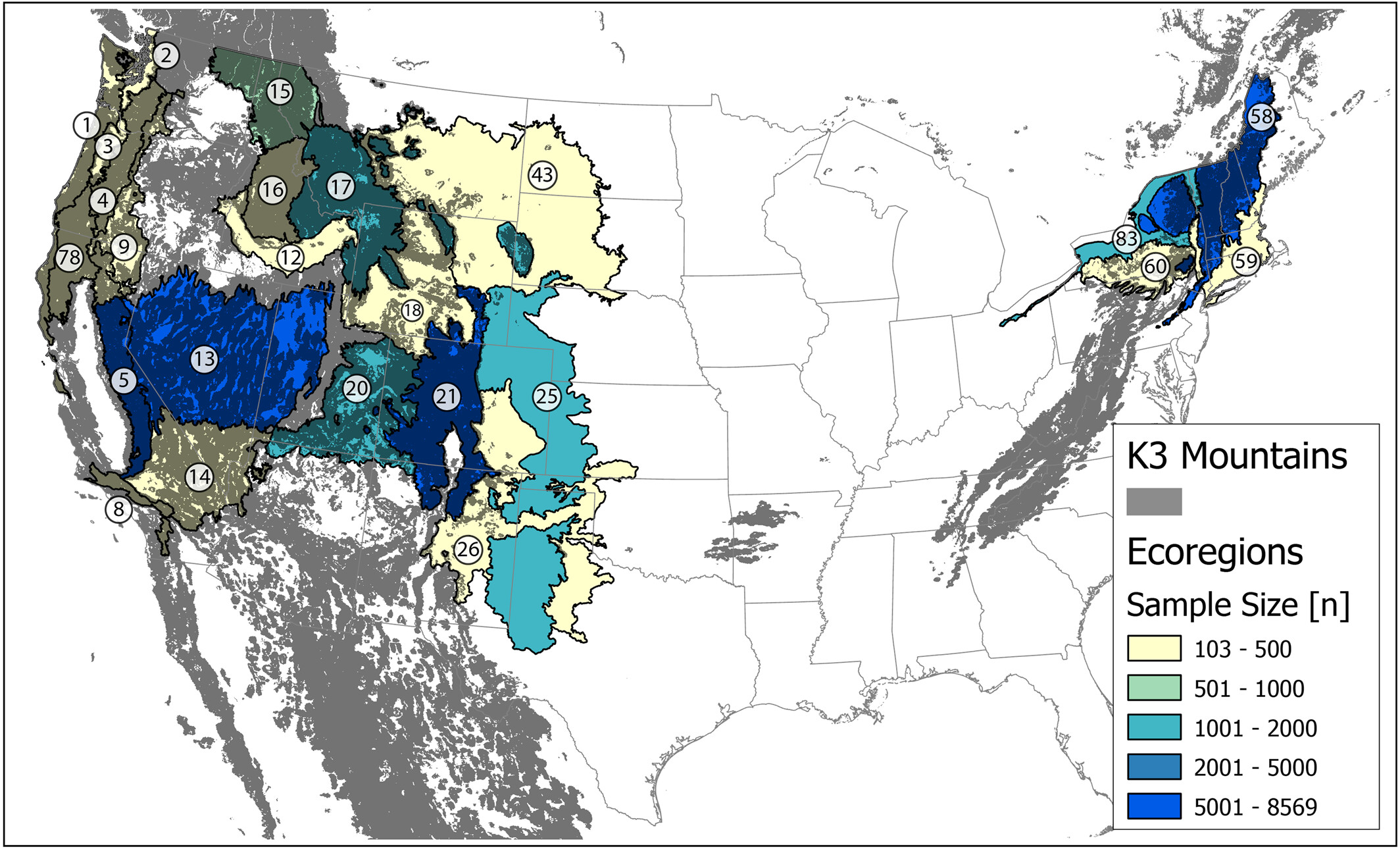
Reanalysis products support our understanding of how the precipitation phase influences hydrology across scales. However, a lack of validation data hinders the evaluation of a reanalysis-estimated precipitation phase. In this study, we used a novel dataset from the Mountain Rain or Snow (MRoS) citizen science project to compare 39,680 MRoS observations from January 2020 to July 2023 across the conterminous United States (CONUS) to assess three precipitation phase products. These products included the Global Precipitation Measurement (GPM) mission Integrated Multi-satellitE Retrievals for GPM (IMERG), the Modern-Era Retrospective Analysis for Research and Applications (MERRA-2), and the North American Land Data Assimilation System (NLDAS-2). The overall critical success indices for detecting rainfall (snowfall) for IMERG, MERRA-2, and NLDAS-2 were 0.51 (0.79), 0.49 (0.77), and 0.54 (0.53), respectively. These indices show that IMERG and MERRA-2 reasonably classify snowfall, whereas NLDAS-2 overestimates rainfall. All products performed poorly in detecting subfreezing rainfall and snowfall above 2°C. Therefore, crowdsourced data provides a unique validation source to improve the capabilities of reanalysis products.
Key Points
- The Mountain Rain or Snow citizen science project collected a novel dataset of 39,680 observations of precipitation phases across the US
- The precipitation reanalysis products performed poorly in detecting subfreezing rainfall and snowfall above 2°C
- The crowdsourced data provides a unique validation source to improve the capabilities of reanalysis products
Plain Language Summary
Distinguishing between rain and snow is challenging. This study used a unique crowdsourced dataset from the Mountain Rain or Snow (MRoS) project to allow researchers to better assess the accuracy of reanalysis products used to differentiate rain from snow. We compared the citizen science data with results from three reanalysis products. We found that these reanalysis products all performed poorly in detecting rainfall at subfreezing rainfall or snowfall at warmer air temperatures. Crowdsourced data could help enhance methods used to determine precipitation phases and improve real-time weather forecasts.