#Colorado to start regulating emission of 5 air toxics that make people sick: The new regulations will be rolled out in phases over the course of 2025 and into 2026 — The #Denver Post

Metro wastewater plant in Denver.

Click the link to read the article on The Denver Post website (Noelle Phillips). Here’s an excerpt:

January 13, 2025

Five new compounds soon will be listed as priority toxic air contaminants in Colorado and, over the next two years, the state’s Department of Public Health and Environment and Air Quality Control Commission will determine out how to regulate them. The state’s Air Pollution Control Division will recommend five compounds to be regulated to the commission during its two meetings that begin Thursday. The creation of the list of toxic air contaminants is the result of a years-long effort from environmentalists and public health advocates who want the state to do more to protect people from the pollution that can cause cancers, such as leukemia and lymphoma, and lung diseases, such as asthma, and can harm women’s reproductive health. For years, environmentalists have complained that air pollution permits issued by the federal and state governments allow companies to pollute with little attention given to how much of those contaminants are dangerous to human health…

The five toxic air contaminants being proposed for regulation are:

  • Acrolein, which is created when fossil fuels are burned by wood-burning, industrial boilers and reciprocating engines, and it is also used to make a polymer for paints, coatings and adhesives. Acute, short-term inhalation can cause eye and respiratory tract irritation. It is not considered a cancer risk.
  • Benzene, a carcinogen released when fossil fuels are burned, including in car exhaust and oil and gas extraction and production. It also is created by cement manufacturing, waste disposal and wood burning. Acute exposure may cause drowsiness, dizziness and headaches, as well as eye, skin and respiratory tract irritation, and unconsciousness at high levels. Chronic inhalation has caused cancer, various blood disorders and affects women’s reproductive organs, the Environmental Protection Agency has reported.
  • Ethylene oxide, which is used to make other products such as antifreeze, textiles, adhesives, plastics and detergents. It’s used to sterilize medical equipment, including at Terumo BTC in Lakewood to sanitize medical equipment. It causes cancers in humans, including lymphoma, myeloma, leukemia and breast cancer.
  • Hydrogen sulfide, highly toxic gas that smells like rotten eggs. It is released by wastewater treatment facilities, meat processing facilities, petroleum refining, manufacturing of asphalt and roofing material and places where large quantities of manure are stored. It can cause people to pass out due to high exposure. Low exposure can cause headaches, memory loss, balance problems and fatigue. It is not considered a carcinogen but data is limited on how it affects children’s health or women’s reproductive health, according to the EPA.
  • Hexavalent chromium is a by-product of industrial processes such as metal fabricating and by burning coal for electricity. It can leak into water systems and into the air. It can cause cancer and impact the respiratory system, kidneys, liver, skin and eyes, the EPA’s website says.


Meet the Navajo professor mapping the impact of climate change on Indigenous land — Boise State Public Radio

Michael Charles. Photo credit: Cornell University

Click the link to read the article on the Boise State Public Radio website (Daniel Spaulding). Here’s an excerpt:

January 13, 2025

Rising seas are forcing Indigenous communities to move. Higher temperatures are causing drought and loss of traditional foods. Michael Charles, a Navajo professor at Cornell University, is trying to quantify the impact of climate change on Indigenous life in North America. Our Living Lands producer Daniel Spaulding spoke to Charles about his work. Charles’ research includes a number of environmental issues impacting Indigenous communities, including air pollution, mining, and migration. To do this, Charles is focusing on Indigenous knowledge of traditional foods, land, and climate patterns.

“We’ll continue to see those knowledge systems evolving, but we’re also going to see continued disconnect on how well we can use our past knowledge systems,” Charles said. “So it’s going to be an interesting path forward to see how we adapt and evolve.”

Peggy Mott selected to lead Reclamation’s Dam Safety Program: Reclamation’s Dam Safety Program evaluates existing dams for safety concerns and implements proactive solutions when needed

Peggy Mott, P.E. Photo credit: Reclamation

Click the link to read the release on the Reclamation website:

January 13, 2025

DENVER — The Bureau of Reclamation selected Peggy Mott, P.E., as the chief of dam safety. Mott will oversee Reclamation’s Dam Safety Program and is responsible for Reclamation’s high hazard potential dams. If these dams were to fail or were improperly operated could result in loss of life or significant economic loss. This oversight ensures Reclamation’s dams do not present an unreasonable risk to people, property or the environment. 

Key for the success for Reclamation’s Dam Safety Program is leveraging relationships throughout Reclamation and with stakeholders. One close relationship the Dam Safety Office maintains is with the Asset Management Division, another office within the Dam Safety and Infrastructure Directorate. 

“The Dam Safety and Infrastructure Directorate provides reliable stewardship and oversight of Reclamation’s diverse infrastructure portfolio. We effectively manage risk and maximize the value of Reclamation’s assets for our stakeholders and American public,” said Dam Safety and Infrastructure Director Miguel Rocha. “Peggy’s experience across multiple domains will be valuable as she takes on this important role leading the program and working with our local, regional, and national partners.”  

Mott joined Reclamation 2019 in the Dam Safety Office as a program manager and supervisory civil engineer. Prior to joining Reclamation, Mott was a regional dam safety officer with the U.S. Fish and Wildlife Service. Prior to joining federal government, she worked with dams and dam safety with the Colorado Department of Natural Resources. She also served as the State Buildings Delegate for the capital construction and controlled maintenance program for the Colorado Department of Human Services. Mott began her career as a systems engineer for Lockheed-Martin. 

Mott earned a Bachelor of Science in Engineering Physics from the Colorado School of Mines and a Master of Science in Civil Engineering from the University of Colorado. She is a licensed professional engineer in the state of Colorado. 

Supreme Court rejects #Utah, #Wyoming claims on federal public lands — Angus M. Thuermer Jr. (WyoFile.com)

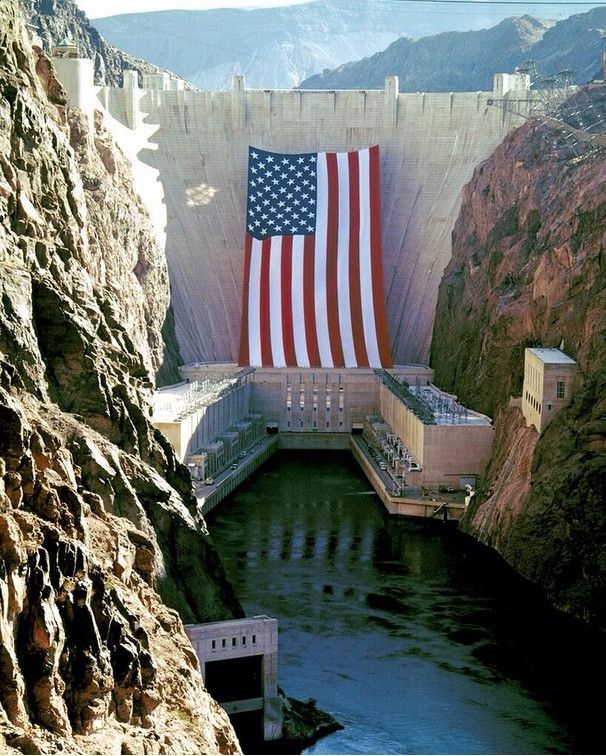
US Flag at Hoover Dam as the Olympic Torch passed over the dam in 1996

Click the link to read the article on the WyoFile.com website (Angus M. Thuermer Jr.):

January 14, 2025

It took the U.S. Supreme Court 12 words and one period to dismiss more than 300 pages of legal arguments in which Utah, Wyoming and other Western states sought to establish control and ownership of millions of acres of federally managed public land.

Utah, Wyoming’s lone U.S. Rep. Harriet Hageman, state legislators, Gov. Mark Gordon and many others sought an emergency hearing to argue that the federal government illegally owns property that rightfully belongs to Western states. Wyoming and other parties filed briefs of their own supporting the Beehive State’s assertion that federal ownership was detrimental to those commonwealths.

The filings appear to be unappreciated by the justices.

“The motion for leave to file a bill of complaint is denied,” the court said in an order filed Monday.

Utah’s petition generated another 424 pages of legal entreaties by its supporters and critics, a count that includes rebuttals by the United States and the Ute Tribe.

Utah claimed the federal government could not own and control “unappropriated lands,” which are those not specifically designated for use by an enumerated federal power. Utah targeted 18.5 million acres of Bureau of Land Management property belonging to all Americans.

Beehivers first said they wanted the court to “dispose” of the BLM property, then clarified that the state just wanted the court to say it is unconstitutional for the government to hold “unappropriated” acreage.

Hageman claimed that federal ownership is an occupation equivalent to a casus belli, a situation that justifies war or conflict between nations. “[T]he standard is whether the federal government’s actions would amount to an invasion and conquest of that land if—assuming a counterfactual—Utah were a separate sovereign nation,” Hageman’s filing states.

Twenty-six Wyoming lawmakers also saddled up for Utah, urging the court to take up the case and saying their support does not mean they will not seek other federal property for the Equality State. The perturbed posse said its claims could extend to “all former federal territorial lands … now held by the United States … [including] parks, monuments, wilderness, etc.”

Six of the sympathetic signatories — Sens. Tim French (R-Powell), Larry Hicks (R-Baggs), Bob Ide (R-Casper), John Kolb (R-Rock Springs), Dan Laursen (R-Powell) and Cheri Steinmetz (R- Lingle) — voted for a draft bill that would allocate $75 million for the Legislature, independent of the executive branch or other state entities, to litigate against the federal government. Senate File 41 “Federal acts-legal actions authorized” will be considered when the Legislature convenes today.

Gordon was more reserved in Wyoming’s official state plea, alleging “harms that federal ownership … uniquely imposes on western States on a daily basis” as a reason for the Supreme Court to immediately take up the case.

The next coordination meeting for the operation of the Navajo Unit is scheduled for Tuesday, January 21st 2025, at 1:00 pm

The outflow at the bottom of Navajo Dam in New Mexico. Photo: Brent Gardner-Smith/Aspen Journalism

From email from Reclamation (Susan Novak Behery):

January 13, 2025

This meeting is open to the public and will be held as a virtual-only meeting.

CLICK HERE TO JOIN AT THE MEETING TIME

This link should open in any smartphone, tablet, or computer browser, and does not require a Microsoft account.  You will be able to view and hear the presentation as it is presented.   

A copy of the presentation and meeting summary will be distributed to this email list and posted to our website following the meeting. If you are unable to connect to the video meeting, feel free to contact me (information below) following the meeting for any comments or questions.  

The meeting agenda will include a review of operations and hydrology since August, current soil and snowpack conditions, a discussion of hydrologic forecasts and planned operations for remainder of this water year, updates on maintenance activities, drought operations, and the Recovery Program on the San Juan River.    If you have any suggestions for the agenda or have questions about the meeting, please call Susan Behery at 970-385-6560, or email sbehery@usbr.gov.  Visit the Navajo Dam website at https://www.usbr.gov/uc/water/crsp/cs/nvd.html for operational updates.

The next coordination meeting for the operation of the Aspinall Unit is scheduled for Thursday, January 23rd 2025, at 1:00 pm #GunnisonRiver

Crystal Dam, part of the Colorado River Storage Project, Aspinall Unit. Credit Reclamation.

From email from Reclamtion (Erik Knight):

This meeting will be held at the Western Colorado Area Office in Grand Junction, CO. There will also be an option for virtual attendance via Microsoft Teams. A link to the Teams meeting is below. 

The meeting agenda will include updates on current snowpack, forecasts for spring runoff conditions and spring peak operations, the weather outlook, and planned operations for the remainder of the year. 

Handouts of the presentations will be emailed prior to the meeting.

Microsoft Teams Need help?

Join the meeting now

Meeting ID: 277 950 010 81

Passcode: nY7qX7sr