The December 2024 briefing is hot off the presses from Western Water Assessment

Click the link to read the briefing on the Western Water Assessment website:

January 10, 2025 – CO, UT, WY

Despite below average precipitation and warm temperatures during December, snow water equivalent (SWE) is near-normal for about half the region. Below average SWE conditions exist in northern Wyoming, southwestern Colorado and southern Utah, especially in the Escalante and Virgin River Basins where SWE is less than 45% of average. The first seasonal streamflow forecasts suggest near-average runoff in Colorado (90-100%), below average runoff in Utah (80-90%) and much below average runoff in Wyoming (50-80%). Drought conditions were relatively stable during December and cover 39% of the region. Previous forecasts of emerging La Niña conditions did not prove correct; Pacific Ocean temperatures remain near-average (ENSO-neutral) and are expected to remain so through spring. NOAA seasonal forecasts suggest the possibility of above average precipitation in northern Colorado, northern Utah and Wyoming during January and in Wyoming for January-March.

December precipitation in Colorado, Utah and Wyoming was below to much below average except for portions of northern Utah and western Wyoming that saw slightly above average precipitation. Large areas of southern Utah, southern Colorado and central to southeastern Wyoming received less than 50% of December precipitation. In eastern Colorado, many locations received record-low December precipitation. Central Colorado, central Utah and western Wyoming received slightly below average December precipitation.

Regional temperatures were at least 3 degrees above average across all locations. Large areas of Colorado and Utah experienced temperatures that were 6-9 degrees above average. In Wyoming, nearly all locations were 6-9 degrees above average during December and central Wyoming average temperatures were 9-12 degrees above average. Record hot December temperatures were recorded in northern Wyoming.

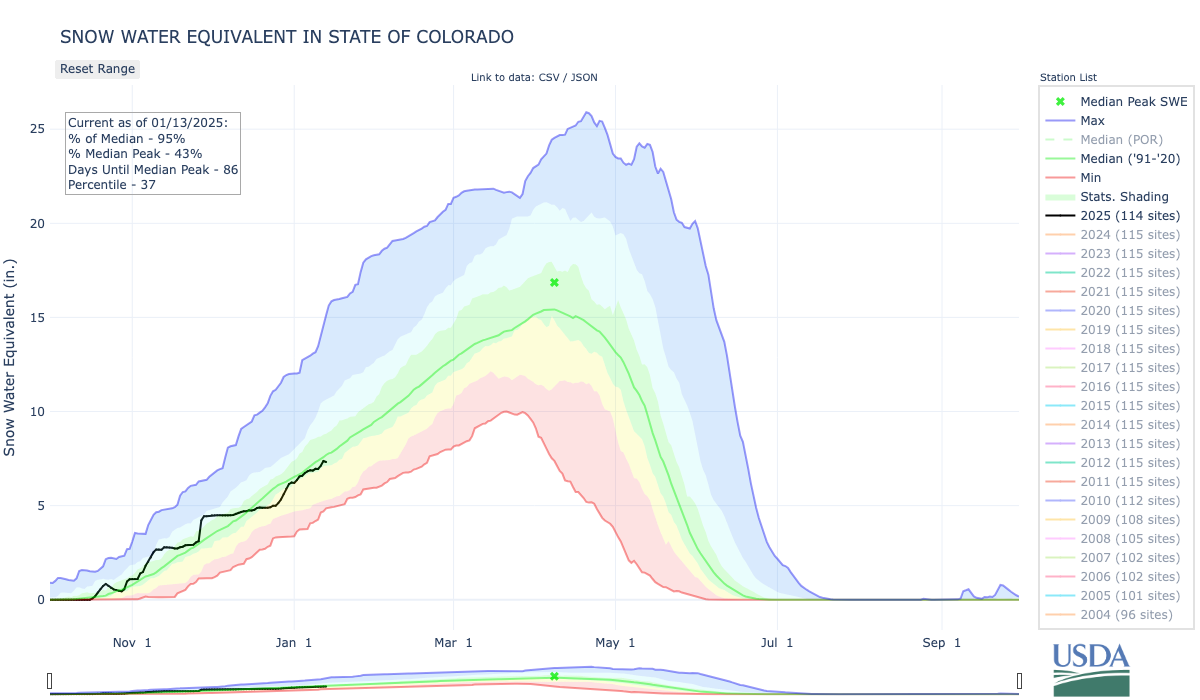
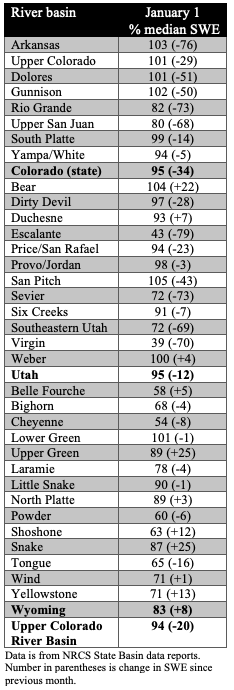
Snow water equivalent was near-normal (median) for about half of the region on January 1, including most of the Upper Colorado River and Great Basins. Below normal January 1st SWE conditions prevailed in southern Utah, southwestern Colorado and northern Wyoming. The majority of river basins in Colorado and Utah saw a significant decrease in SWE conditions relative to median during December. On a statewide basis, January 1st SWE conditions in Colorado and Utah were near normal (95%) and below normal in Wyoming (83%). Southern Utah is currently experiencing the worst snow drought conditions with the Virgin River Basin at 39% normal and the Escalante River Basin at 43% normal. Six snotel sites in southwestern Utah had no snow on January 1st which set or tied the lowest SWE totals on record. An additional 3 snotel sites in Wyoming had their lowest January 1st SWE conditions on record and an additional 4 sites in Wyoming had the second lowest January 1st SWE value.

The first seasonal streamflow forecasts of the 2025 water year suggest near-average runoff in Colorado river basins and below average runoff in all other regional river basins. In Colorado, seasonal streamflow forecasts suggest between 90-100% of average runoff for all river basins. Runoff in most Utah river basins is forecasted at 80-90% of average except for the Upper Bear (94%), Lower Bear (77%), Escalante (60%) and Virgin (50%). In Wyoming, the seasonal streamflow forecast for the Upper Green, North Platte, Snake and Yellowstone is 70-80% while streamflow forecasts for the Bighorn, Cheyenne, Powder and Tongue River Basins range from 50-60% of average. Except for Blue Mesa Reservoir, below average inflow is forecasted for all other major Upper Colorado River Reservoirs including Lake Powell (81%), Flaming Gorge (69%), McPhee (76%) and Navajo (78%).

Regional drought coverage continued a decreasing trend in December and now covers 39% of the region, compared to 42% of the region in early December. Wyoming remains the epicenter of regional drought with 88% of the state experiencing drought conditions and 26% of the state in extreme drought. The area of extreme drought in the Snake River basin expanded in December. In Colorado, abnormal dry (D0) conditions emerged in the San Juan Mountains and D1 drought conditions were removed near the headwaters of the Arkansas and Colorado Rivers. Drought conditions in Utah were relatively unchanged during December.

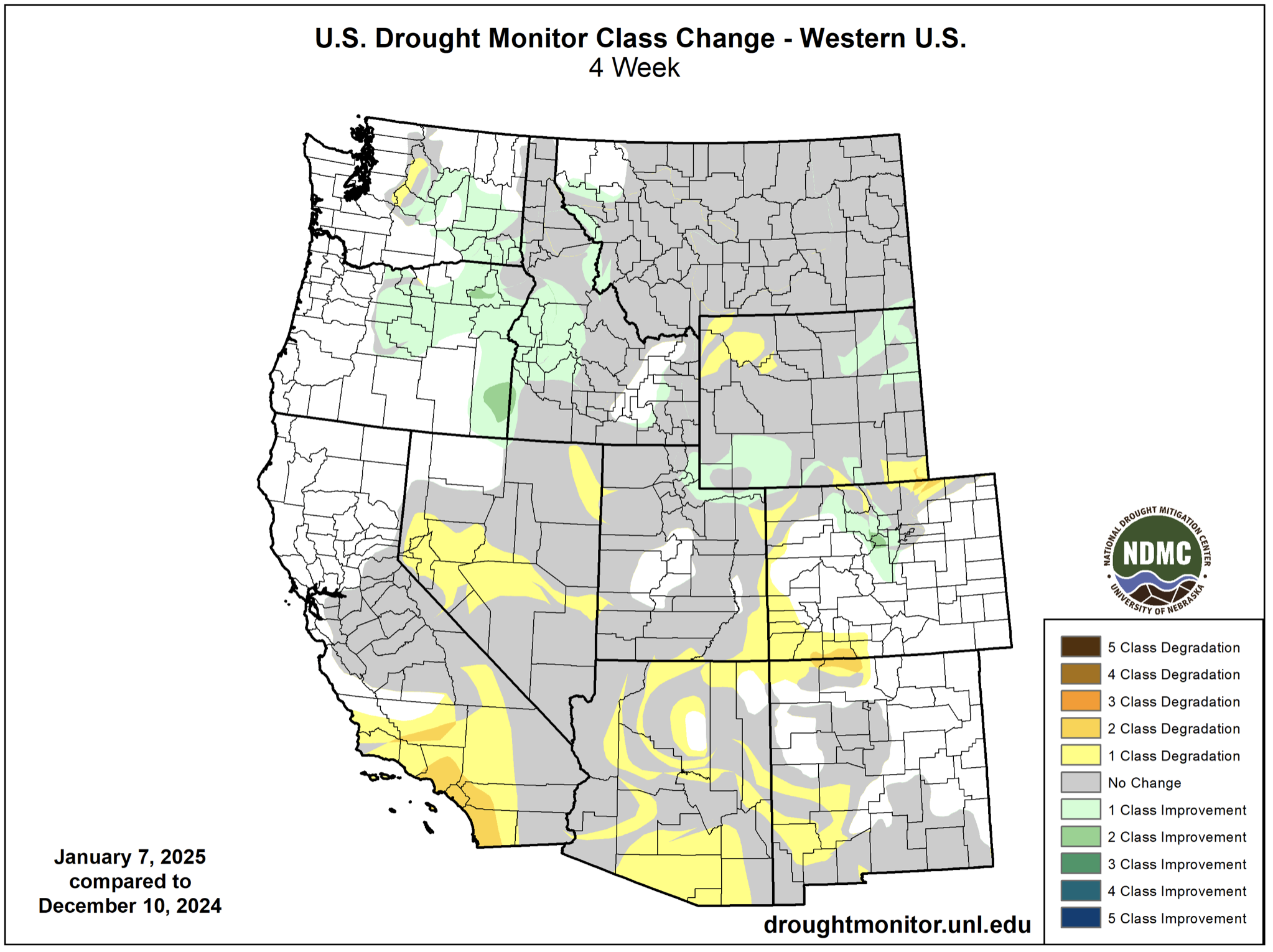
West Drought Monitor map January 7, 2025.

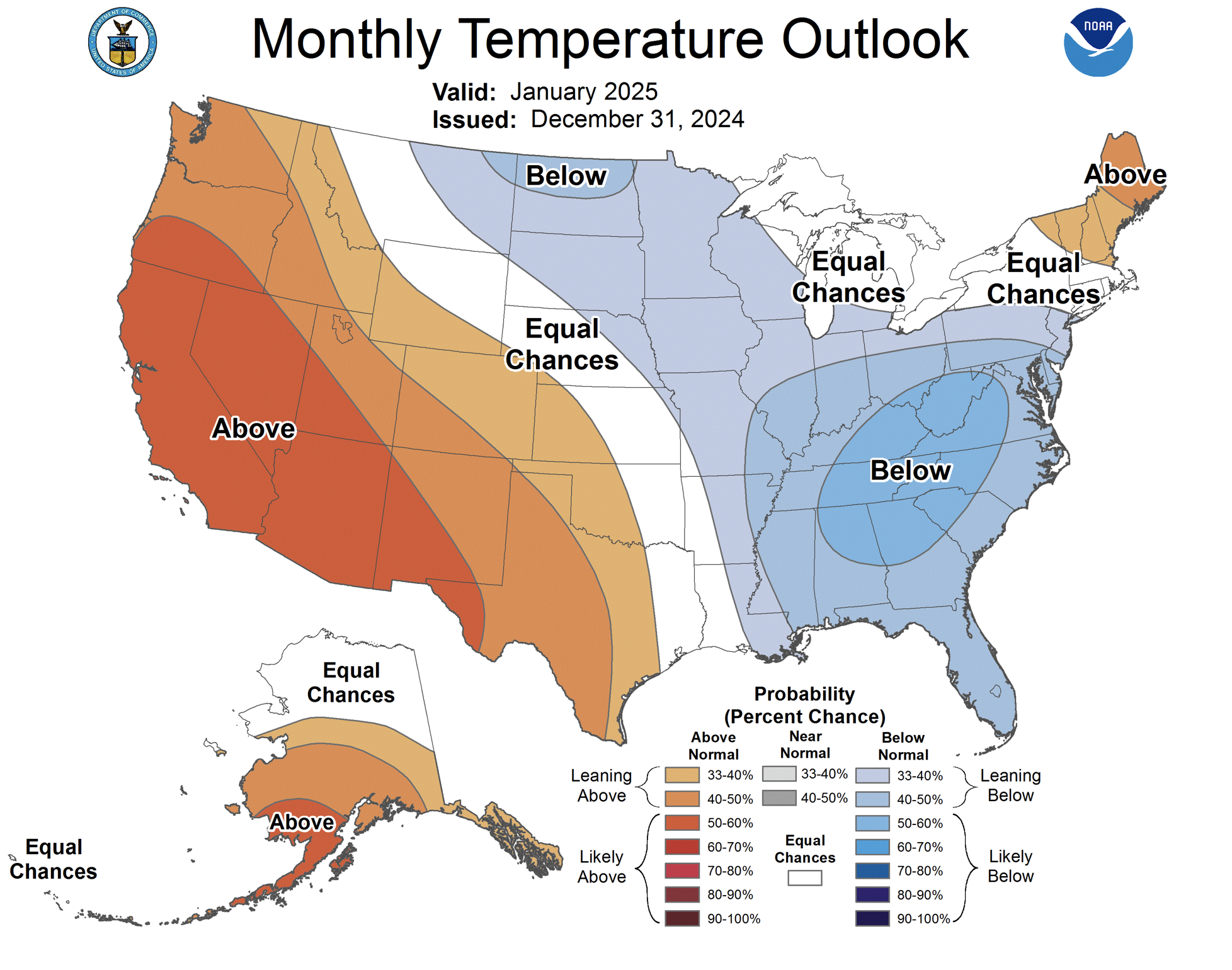
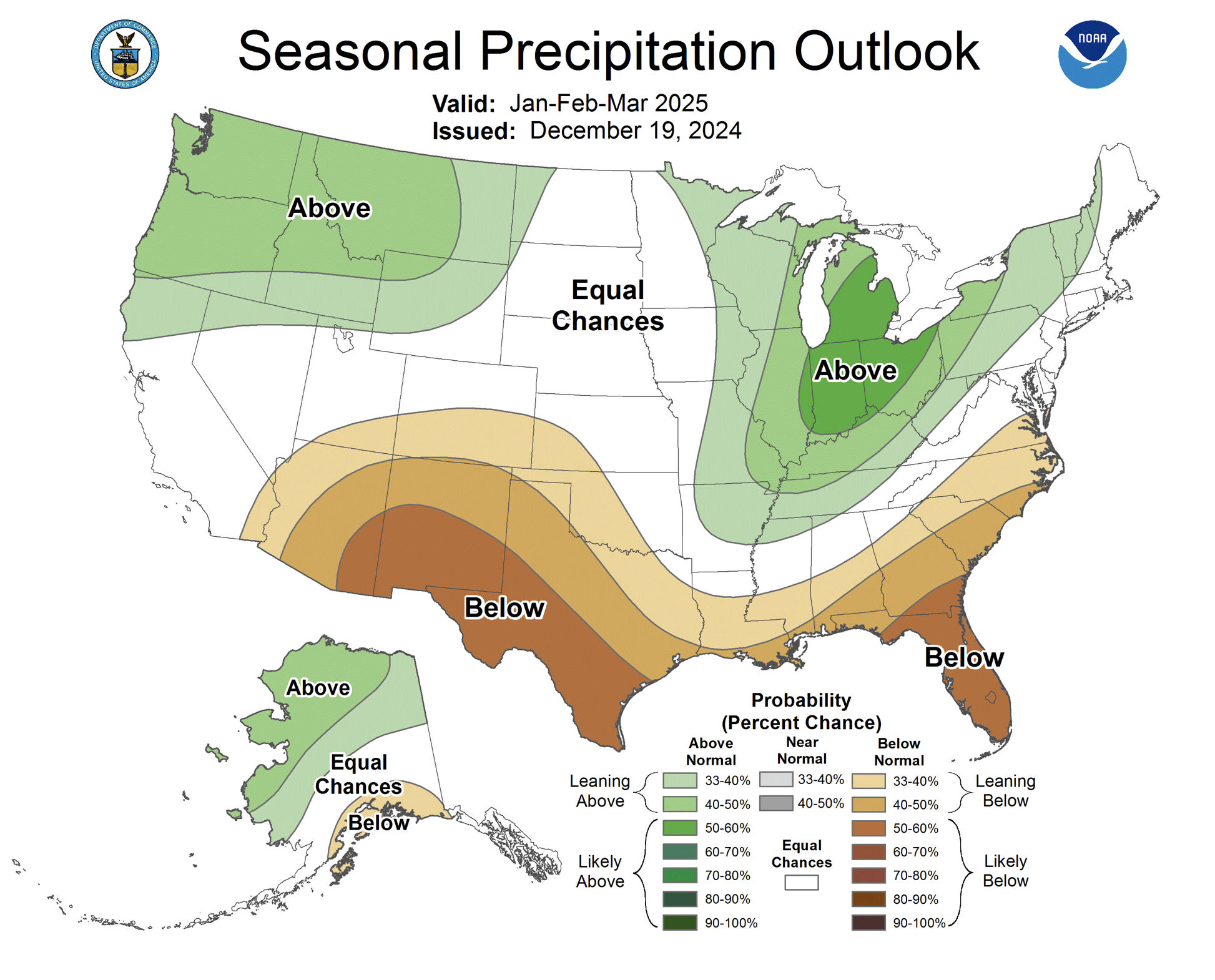
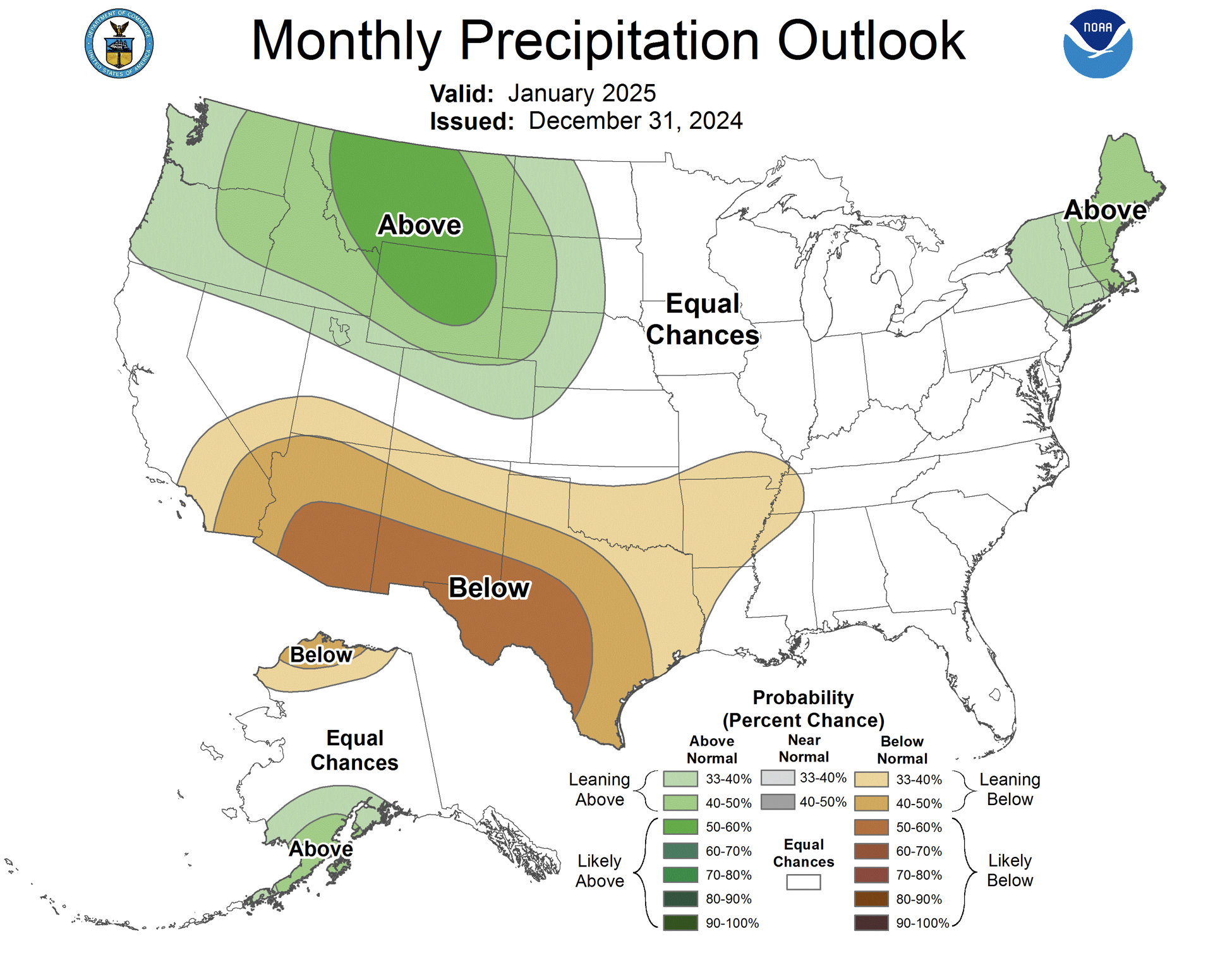
Despite previous forecasts indicating the formation of La Niña conditions in the Pacific Ocean, December Pacific Ocean sea-surface temperatures were consistent with ENSO-neutral conditions and there is a 60-80% probability of ENSO-neutral conditions persisting through spring 2025. NOAA monthly forecasts for January suggest an increased probability of above average precipitation for Wyoming, northern Colorado and northern Utah. There is an increased probability of below average precipitation for southern Utah and southwestern Colorado. NOAA forecasts also suggest an increased probability for above average temperatures for the entire region during January. On the three-month timescale, there is an increased probability of above average precipitation for Wyoming and below average precipitation for southern Utah and southern Colorado. The NOAA seasonal forecast for January-March indicates an increased probability of below average temperatures in Wyoming and above average temperatures for southern Utah and southern Colorado.

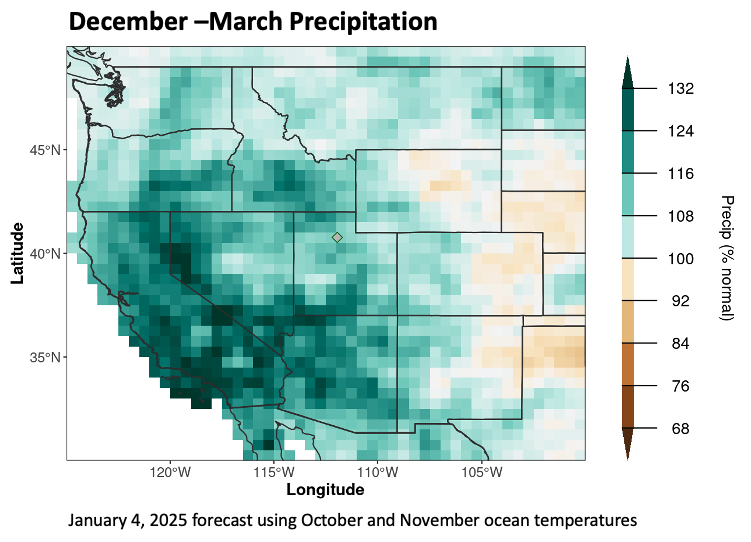
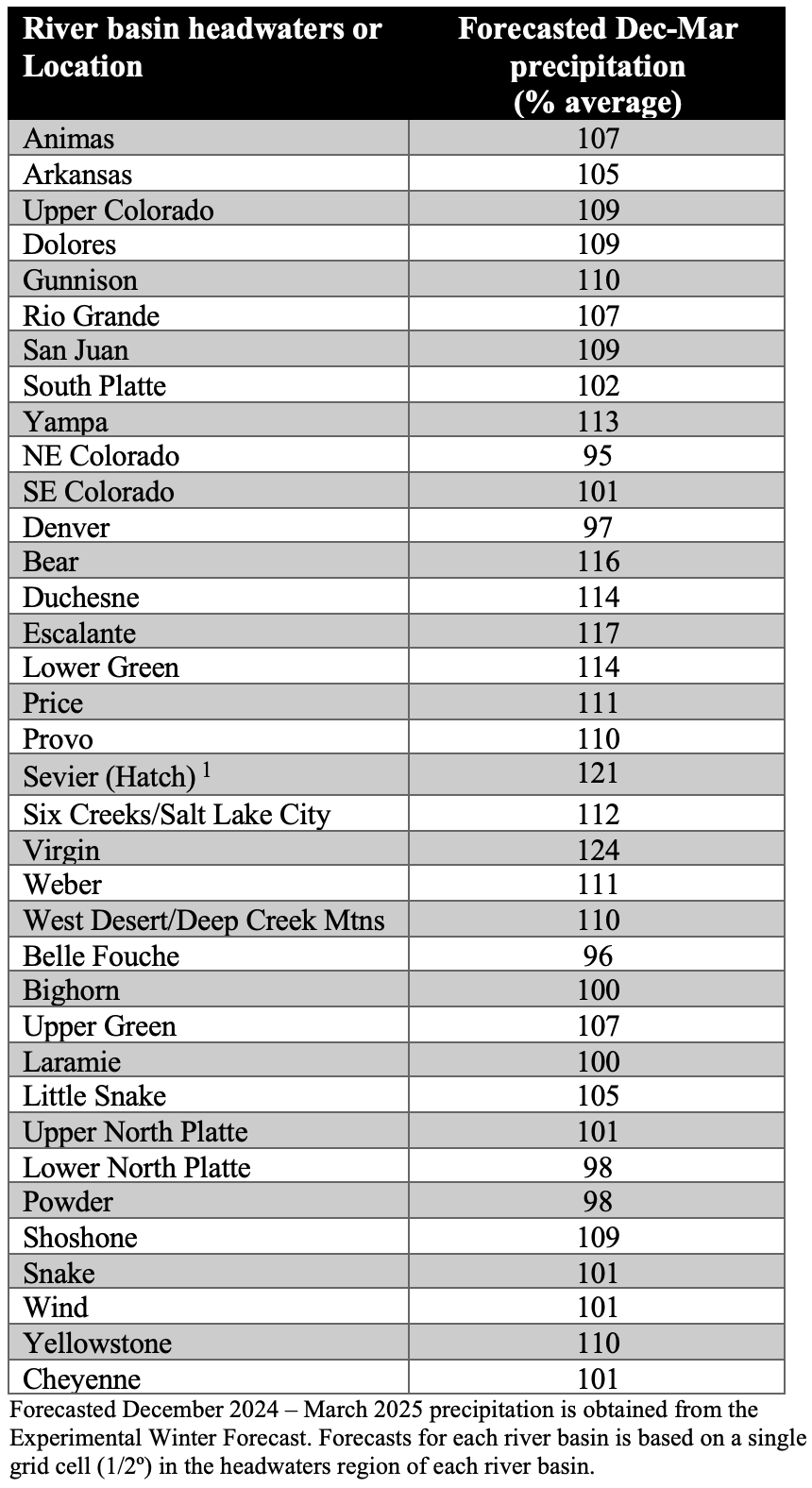
The New Experimental Winter Forecast is a tool that projects December-March precipitation in the western United States using Pacific and Atlantic Ocean temperatures. The most current forecast uses October – November ocean temperatures and indicates slightly above average winter precipitation for much of the region. The regional pattern of precipitation reflects average Pacific Ocean and warm Atlantic Ocean temperatures. Slightly above average winter precipitation is forecasted for most of the region with the highest precipitation relative to average in southern Utah and the lowest in central Wyoming and eastern Colorado.
December Climate Almanac. Much above average to record hot December temperatures in Wyoming are reflected in the temperature extremes. The highest daily maximum, the minimum maximum and minimum temperatures in the region were observed in Wyoming where temperatures are typically colder than Colorado and Utah.

AI has an environmental problem. Here’s what the world can do about that — United Nations Environment Programme #ActOnClimate

Click the link to read the article on the UN Environment Programme website:

September 21, 2024

There are high hopes that artificial intelligence (AI) can help tackle some of the world’s biggest environmental emergencies. Among other things, the technology is already being used to map the destructive dredging of sand and chart emissions of methane, a potent greenhouse gas.  

But when it comes to the environment, there is a negative side to the explosion of AI and its associated infrastructure, according to a growing body of research. The proliferating data centres that house AI servers produce electronic waste. They are large consumers of water, which is becoming scarce in many places. They rely on critical minerals and rare elements, which are often mined unsustainably. And they use massive amounts of electricity, spurring the emission of planet-warming greenhouse gases.  

“There is still much we don’t know about the environmental impact of AI but some of the data we do have is concerning,” said Golestan (Sally) Radwan, the Chief Digital Officer of the United Nations Environment Programme (UNEP). “We need to make sure the net effect of AI on the planet is positive before we deploy the technology at scale.”  

This week, UNEP released an issue note that explores AI’s environmental footprint and considers how the technology can be rolled out sustainably. It follows a major UNEP report, Navigating New Horizons, which also examined AI’s promise and perils. Here’s what those publications found. 

First of all, what is AI? 

AI is a catch-all term for a group of technologies that can process information and, at least superficially, mimic human thinking. Rudimentary forms of AI have been around since the 1950s. But the technology has evolved at a breakneck pace in recent years, in part because of advances in computing power and the explosion of data, which is crucial for training AI models. 

Why are people excited about the potential of AI when it comes to the environment? 

The big benefit of AI is that it can detect patterns in data, such as anomalies and similarities, and use historic knowledge to accurately predict future outcomes. That could make AI invaluable for monitoring the environment, and helping governments, businesses and individuals make more planet-friendly choices. It can also enhance efficiencies. UNEP, for example, uses AI to detect when oil and gas installations vent methane, a greenhouse gas that drives climate change.  

Advances like those are fostering hope that AI could help the world tackle at least some aspects of the triple planetary crisis of climate changenature and biodiversity loss, and pollution and waste

So how is AI problematic for the environment? 

Most large-scale AI deployments are housed in data centres, including those operated by cloud service providers. These data centres can take a heavy toll on the planet. The electronics they house rely on a staggering amount of grist: making a 2 kg computer requires 800 kg of raw materials. As well, the microchips that power AI need rare earth elements, which are often mined in environmentally destructive ways, noted Navigating New Horizons.  

The second problem is that data centres produce electronic waste, which often contains hazardous substances, like mercury and lead.  

Third, data centres use water during construction and, once operational, to cool electrical components. Globally, AI-related infrastructure may soon consume six times more water than Denmark, a country of 6 million, according to one estimate. That is a problem when a quarter of humanity already lacks access to clean water and sanitation.  

Finally, to power their complex electronics, data centres that host AI technology need a lot of energy, which in most places still comes from the burning of fossil fuels, producing planet-warming greenhouse gases. A request made through ChatGPT, an AI-based virtual assistant, consumes 10 times the electricity of a Google Search, reported the International Energy Agency. While global data is sparse, the agency estimates that in the tech hub of Ireland, the rise of AI could see data centres account for nearly 35 per cent of the country’s energy use by 2026.

Driven in part by the explosion of AI, the number of data centres has surged to 8 million from 500,000 in 2012, and experts expect the technology’s demands on the planet to keep growing. 

Some have said that when it comes to the environment, AI is a wildcard. Why is that?  

We have a decent handle on what the environmental impacts of data centres could be. But it’s impossible to predict how AI-based applications themselves will affect the planet. Some experts worry they may have unintended consequences. For example, the development of AI-powered self-driving cars could cause more people to drive instead of cycling or taking public transit, pushing up greenhouse gas emissions. Then there are what experts call higher-order effects. AI, for example, could be used to generate misinformation about climate change, downplaying the threat in the eyes of the public. 

Is anybody doing anything about the environmental impacts of AI? 

More than 190 countries have adopted a series of non-binding recommendations on the ethical use of AI, which covers the environment. As well, both the European Union and the United States of America have introduced legislation to temper the environmental impact of AI. But policies like those are few and far between, says Radwan. 

“Governments are racing to develop national AI strategies but rarely do they take the environment and sustainability into account. The lack of environmental guardrails is no less dangerous than the lack of other AI-related safeguards.” 

How can the world rein in the environmental fallout from AI? 

In the new issue note, UNEP recommends five main things. Firstly, countries can establish standardized procedures for measuring the environmental impact of AI; right now, there’s a dearth of reliable information on the subject. Secondly, with support from UNEP, governments can develop regulations that require companies to disclose the direct environmental consequences of AI-based products and services. Thirdly, tech companies can make AI algorithms more efficient, reducing their demand for energy, while recycling water and reusing components where feasible. Fourthly, countries can encourage companies to green their data centres, including by using renewable energy and offsetting their carbon emissions. Finally, countries can weave their AI-related policies into their broader environmental regulations.

UNEP is focused on helping the world better navigate the environmental challenges of tomorrow. To do that, we have ramped up our work on strategic foresight, scanning the horizon for emerging threats to the planet. This process culminated in the development of Navigating New Horizons – A Global Foresight Report on Planetary Health and Human Wellbeing, which was published earlier this year.  Produced in collaboration with the International Science Council, it examined eight global shifts accelerating the triple planetary crisis of climate change, nature and biodiversity loss, and pollution and waste. 

#Colorado #snowpack approaching normal levels — The #PagosaSprings Sun

Click the link to read the article on the Pagosa Springs Sun website (Garrett Fevinger). Here’s an excerpt:

January 9, 2025

As of Jan. 8, the statewide snowpack pack stood at 95 percent of the 30-year median, according to data from the Natural Resources Conservation Service (NRCS) — an improvement from weeks earlier when those levels tracked significant lower.

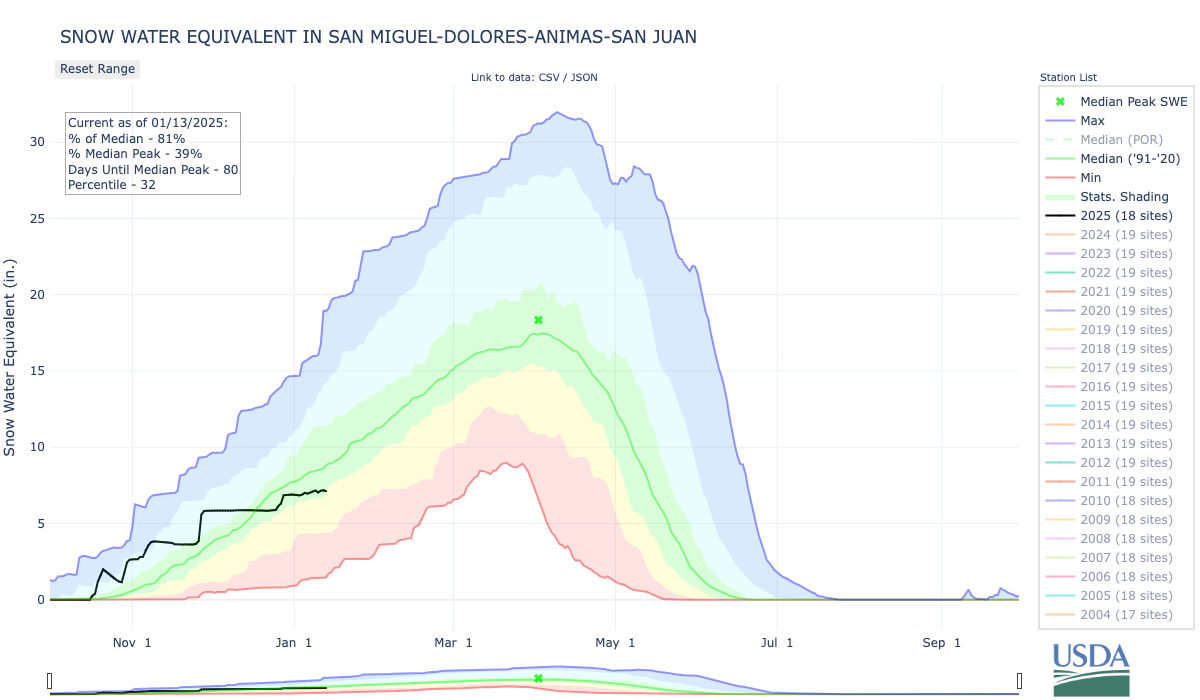
The San Miguel, Dolores, Animas, and San Juan basins measured to be at 84 percent of its 30-year median snowpack as Individual local levels were slightly lower, with the Upper San Juan area at 73 percent of its median snowpack, the Piedra area at 79 percent, and the Conejos area at 60 percent of its median. As of Jan. 8, 45 inches of snow were measured atop the Wolf Creek summit, which sits at 68 percent of its median snowpack, according to the NRCS.

River flows

The San Juan River was flowing at a rate of 42.9 cubic feet per second (cfs) through Pagosa Springs as of 9 a.m. Wednesday, according to the U.S. Geological Survey. Based on 89 years of water records, the median flow for the same date is 54 cfs, with a record high flow of 112 cfs in 1987. The lowest recorded flow for the date is 28 cfs in 1990.

Southern Ute Indian Tribe awarded more than $4 million in federal grants to prepare for #ClimateChange — #Colorado Public Radio #ActOnClimate

Much of the irrigation infrastructure and technology on the Southern Ute Reservation in Colorado is antiquated. The channel on the right looks much as it did in the 1950s photo on the left. Source: Tribal Water Study Basic projects, like expanding a water treatment plant or installing a new drinking water pipeline, can advance at a glacial pace, as tribes must deal with a variety of different federal agencies to get them approved. Even when funding is available, it can be difficult to launch projects as tribes often lack the resources to navigate the various regulations, fees and environmental reviews. Credit: Water Education Foundation

Click the link to read the article on the Colorado Public Radio website (Ishan Thakore). Here’s an excerpt:

Jan. 10, 2025

The federal government awarded $4.25 million to the Colorado-based Southern Ute Indian Tribe this week to defend tribal water resources from climate-related challenges. The Bureau of Indian Affairs Tribal Community Resilience branch distributed grants to 124 projects nationwide, with funding pooled from the Bipartisan Infrastructure Law, the Inflation Reduction Act and the 2024 federal budget…

Across the state, warming fueled by climate change is ratcheting up average temperatures, which can lead to drought conditions. Southcentral and southwestern Colorado –  where the Southern Ute Indian Reservation is located – have seen the largest temperature increases statewide, according to Colorado State University’s 2024 State of the Climate report.  Spring rain in southwest Colorado has also decreased by over 20 percent compared to 1951-2000, according to the report

The federal funding will support two projects to restore the ecology of waterways on the reservation and fortify irrigation systems.

A $250,000 grant will support the tribe’s environmental programs department to assess, and eventually restore, the Pine River watershed, which is facing impacts from drought and sediment pollution. The funding will allow the tribe to undertake a detailed assessment and devise a treatment plan for several waterways. Another $4 million grant to the tribe’s water resources division will shore up an irrigation system that delivers water to around 4,000 acres. The funding will allow the tribe to replace old infrastructure and construct new weirs — or low barriers built across waterways — on seven sites on the Pine River canal. The goal is to help the tribe maintain consistent water levels for irrigation, even as a lack of rain and increased evaporation dip into water supplies. 

Animas River. Photo credit: The Southern Ute Indian Tribe