Click the link to read the article on the NOAA website (Amy Butler and Laura Ciasto):
January 16, 2025
We’re briefly popping in because another surge of very cold air looks to drop down from the Arctic over a large region of the central US this weekend and into early next week. We know that the question will be asked: is the cold related to the polar vortex this time? So here we are to provide some answers.
There are two points we want to emphasize:
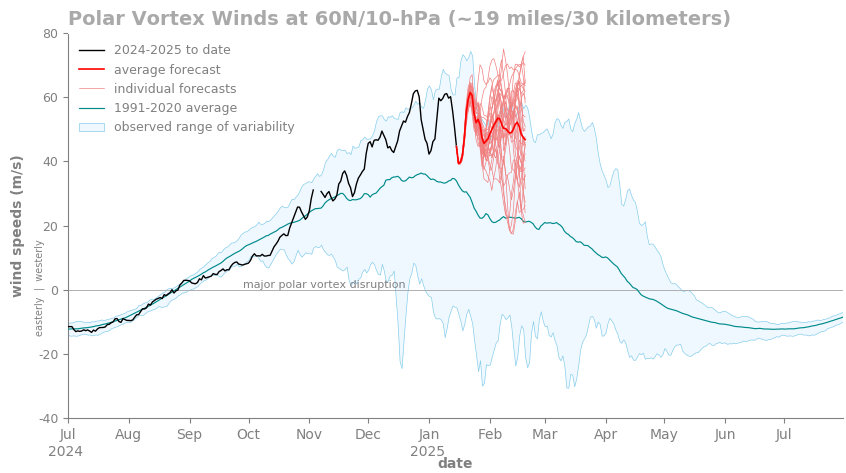
1. The polar vortex strength, as measured by the speed of the winds around the 60N latitude circle and 10 hPa pressure level, remains stronger than average, and is currently forecast by most models to return to near-record strong wind speeds into early February.
Observed and forecasted (NOAA GEFSv12) wind speed in the polar vortex compared to the natural range of variability (faint blue shading). Since mid-November, the winds at 60 degrees North (the mean location of the polar vortex) have been stronger than normal. According to the GEFSv12 forecast issued on January 15 2025, those winds are forecast to remain stronger than normal for at least the next few weeks (bold red line). NOAA Climate.gov image, adapted from original by Laura Ciasto.
Normally, if the polar vortex is communicating with the surface, which it finally has been in the last couple of days, a strong polar vortex would be associated with persistent warmth over much of Europe, Asia, and the eastern US. (A strong polar vortex is usually associated with a northward shifted jet stream that keeps the coldest air corralled over the pole.) Europe and Asia are indeed anticipating warmer than average conditions next week, but not the US. So something else is going on over the US that is overwhelming the “strong polar vortex” signal.
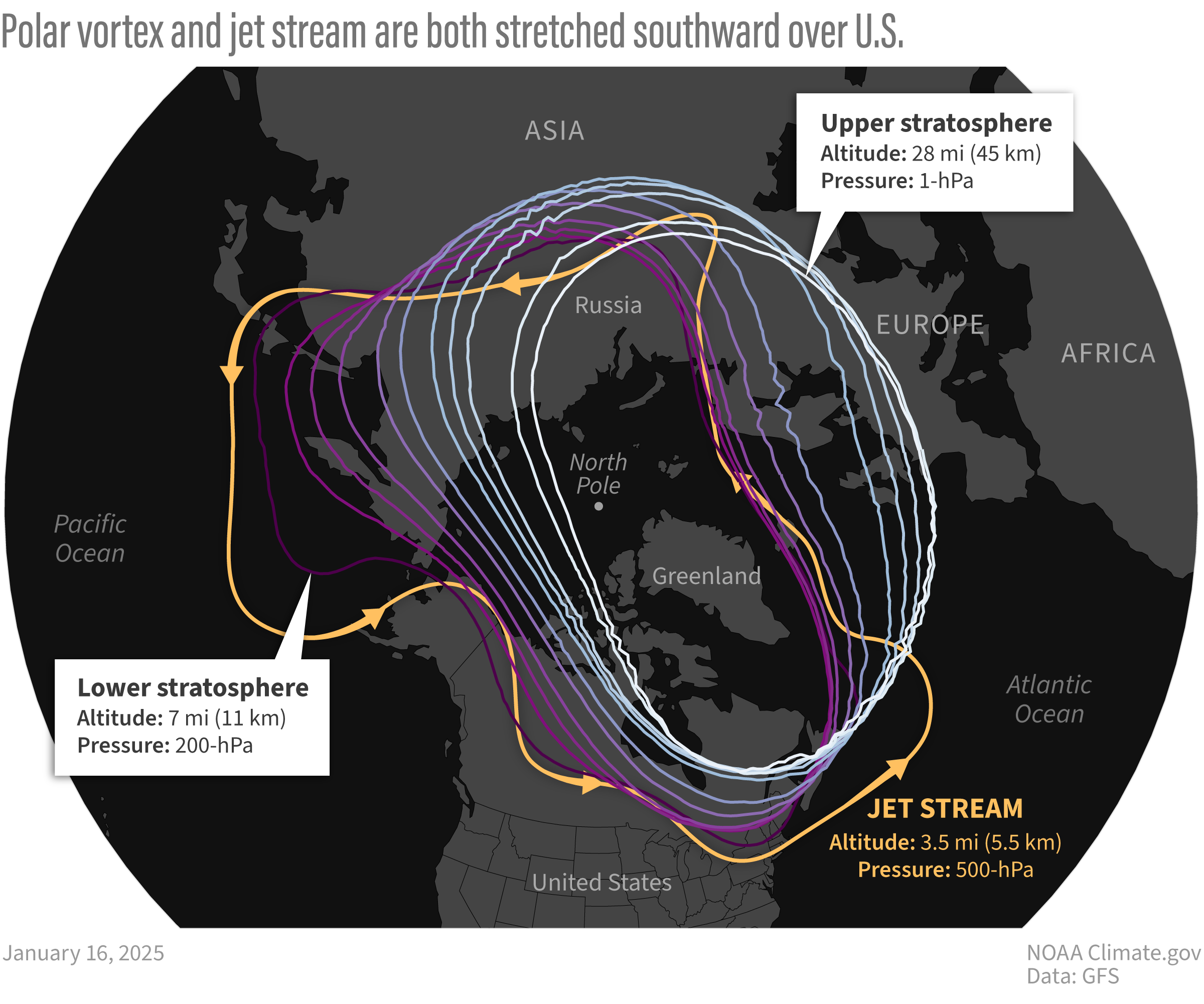
2. We discussed how we didn’t think the shape or stretching of the polar vortex contributed to the last cold air outbreak, because in the lower stratosphere the vortex was shifted towards Asia and not stretched over North America. However, in this case, the vortex is actually forecast to stretch throughout its entire depth (10-30 miles above the surface) over Canada and the Hudson Bay. So unlike last week, this time the stretched out polar vortex may be associated with the forecasted southward shift of the jet stream, which allows the troposphere’s cold Arctic air to spill into the continental US.
The forecasted structure of the tropospheric jet stream (yellow) and several levels of the stratospheric polar vortex from the lower stratosphere to the upper stratosphere in the NOAA GFS model for 17 January 2025 (initialized on 16 January 2025). The contours show how the stretched polar vortex corresponds to the southward shift of the jet stream over North America. NOAA Climate.gov image, adapted from original by Laura Ciasto.
However, we want to reemphasize that “associated with” still does not mean one thing caused another, and in this case, it’s still difficult to understand what is causing what. Additionally, a strong ridge of high pressure has been building up simultaneously near Alaska, which can also help force the jet stream to dive down south over the continental US and bring cold Arctic air with it, independent of the polar vortex.
Downstream of a “ridge” over Alaska, the jet stream (the winds at the 250-millibar pressure level) is forecasted to make a deep dip (known as a “trough” to meteorologists) into the United States over the weekend of January 18, 2025, according to NOAA’s Global Forecast System. NOAA Climate.gov animation based on a screen recording from the Earth Null School website.
To sum up: Unlike last time (Jan 5-7), the stretching of the polar vortex is extending through the entire column and is “in-sync” with the extension of the jet. But we don’t know the directionality (what caused what), and other tropospheric factors like the strong Alaskan ridging are definitely big players. And while things are more in-line this time, cold air outbreaks don’t only happen because of the polar vortex.
Click the link to read the article on the Big Pivots website (Allen Best):
January 11, 2025
It was another warm year in Colorado, part of a theme. Russ Schumacher, the state climatologist, reports 2024 was the 4th warmest on record, 3 degrees warmer than the 20th century average when temperatures across the state were averaged for the year.
Eight of the 10 warmest years in Colorado’s recorded history have been since 2012.
From his base in Akron, 115 miles northeast of Denver, Joel Schneekloth observed temperatures that fit in with this trend.
“We really had warm days but even warmer nights,” reported Schneekloth, who is a regional water specialist with the Colorado Water Institute. “But we didn’t have a string of 100 degree days like we had in 2012 and 2002. We had 100 just once or twice this year.”
To be clear, it can still get cold in Colorado. This is not quite up to Lake Wobegon standards, where all the children are above average. But all the action has been on the high side of the thermometer — or on the lack of cold.. That was particularly true in December.
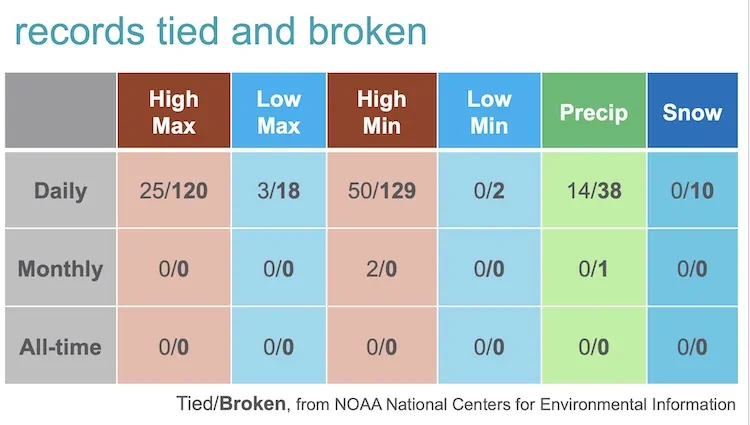
The Colorado Climate Center reported 120 new all-time high temperatures along with 25 tied records. Nights, as Schneekloth noted, were also warm. There were 129 records for the high minimum temperature.
On the flip side, it had two all-time cold temperatures.
Notable was the warmth of December. “It was very warm across Colorado, or perhaps more accurately, there was a distinct lack of cold,” Schumacher wrote.
“It really was the lack of any real cold in December that led to the record-breaking temperatures for the month,” he told Big Pivots.
“Highs in the low 70s aren’t especially remarkable in December, but many stations set records for the warmest low temperature for December. For example, at Sedgwick, the lowest temperature in December was 11F – the previous warmest low temperature for December was 9F. This is true at numerous stations in northeastern Colorado. Fort Collins only got down to 15 in December. The previous record was 12 Akron only got to 10; the previous record was 8.”
At many stations, the second or third warmest low for December was just the previous year (2023), a December with a similar lack of cold.
Precipitation, on the other hand, was above average statewide but not abnormally so, 35th wettest in records across the past 130 years. The story of rain and snow, however, was not uniform. The southern San Luis Valley had its wettest calendar year on record. Lands north of Fort Collins and Greeley, along the Wyoming border, much drier than average.
These hay bales stand ready to be collected on a ranch outside of Carbondale in July 2024. A program that pays irrigators in the Upper Colorado River Basin to cut back is facing uncertainty in 2025 because of Congressional delays. Credit: Heather Sackett/Aspen Journalism
A federally funded water conservation program in the Upper Colorado River Basin is facing uncertainty for 2025 after the bill to authorize funding for it stalled in Congress late last year.
On Friday, Upper Colorado River Commission Executive Director Chuck Cullom said the commission planned to communicate to participants in the 2024 System Conservation Pilot Program that the UCRC is not accepting applications at this time for a 2025 program. Officials will let people know later this month if and when the application process will open for 2025.
According to a post on the UCRC’s website, which has since been removed, applications were potentially going to be available Jan. 9, with a now-cancelled informational webinar scheduled for Jan. 10.
Officials are holding out hope that the program can still get federal authorization in time for water users — mostly farmers and ranchers — in Colorado, New Mexico, Utah and Wyoming to conserve water during the upcoming growing season.
“The commission recognizes that SCPP has been an important and useful tool for the Upper Basin to understand the opportunities and issues that conservation programs represent,” Cullom said. “We are hopeful we will have that tool available in 2025 and again in 2026.”
The System Conservation Pilot Program, which pays water users who volunteer to cut back, was restarted in 2023 as part of the Upper Basin’s 5-Point Plan, designed to protect critical infrastructure from plummeting reservoir levels. Over two years, the program spent about $45 million to save about 101,000 acre-feet of water. Funding for SCPP comes from $125 million allocated through the Inflation Reduction Act.
The U.S. Bureau of Reclamation’s authorization to spend this money expired in December and now must be renewed if the program is to continue.
Anthony Rivera-Rodriguez, a press secretary with the office of U.S. Sen. John Hickenlooper, D-Colo., said lawmakers plan to introduce a new bill for funding authorization in the next couple of weeks. He said funding for Western drought programs has not been controversial and has received bipartisan support. The authorization didn’t pass in December, he said, because lawmakers simply ran out of time before the end of the session. The Colorado Sun reported last month that the Senate passed the Colorado River Basin System Conservation Extension Act, but the House of Representatives “left it on the chopping block as lawmakers raced to pass legislation to avoid a government shutdown.”
“We are trying to get this authorized as soon as we possibly can,” Rivera-Rodriguez said.
SCPP has been dogged by controversy since it was rebooted in 2023. The program originally took place from 2015 to 2018.
SCPP has been criticized for a lack of transparency in the 2023 program, not measuring and tracking how much of the conserved water eventually makes it to Lake Powell, and for its potential negative impacts, in general, to the agricultural communities of the Western Slope and, in particular, to an irrigation company in the Grand Valley. In response to the second criticism, officials are working on how Upper Basin states could “get credit” for conserved water through a memorandum of understanding with the U.S. Bureau of Reclamation.
Delta County farmer Paul Kehmeier kneels by gated pipes in his family’s alfalfa field. Kehmeier participated in the 2024 System Conservation Pilot Program and said he would again in 2025 if funding is reauthorized by Congress. Credit: Natalie Keltner-McNeil/Aspen Journalism
Whether reauthorization will come quickly enough for Upper Basin agricultural producers to participate in the upcoming irrigation season remains to be seen. Short notice and a hasty rollout of SCPP for the 2023 growing season meant low participation numbers for that year, with just 66 water-saving projects and about 38,000 acre-feet conserved across the four Upper Basin states. The number of projects in 2024 jumped to 109, with about 64,000 acre-feet conserved.
A last-minute reprieve for the program wouldn’t be a problem for one Delta County rancher who participated in SCPP in 2024. Paul Kehmeier enrolled 58 acres of his ranch in the program last year and said he plans to participate again if the program is extended.
“There are two reasons that I’m planning to participate,” Kehmeier said. “One is that the money is very good, and second is that I don’t think we in the Upper Basin can stick our heads in the sand on all this big river stuff. … My irrigation season starts April 1, so anytime up until the last day of March, if I had a chance to participate, I would jump at the chance.”
The reauthorization of System Conservation comes at a pivotal moment for water users on the Colorado River. Negotiations between the Upper Basin states and the Lower Basin states (California, Arizona, Nevada) on how shortages will be shared after 2026 have ground to a halt. Lower Basin water managers say all seven states that use the Colorado River must share cuts under the driest conditions, while Upper Basin officials maintain they already take cuts in dry years because they are squeezed by climate change and can’t rely on the massive storage buckets of Lake Powell and Lake Mead for their water supply. Upper Basin leaders also maintain that they shouldn’t have to share additional cuts because their states have never used the entire 7.5 million-acre-foot apportionment given to them by the Colorado River Compact, while the Lower Basin regularly uses its full allotment.
But there has been a recognition in recent months by some Upper Basin officials that their states will have to participate in some kind of future conservation program — SCPP or otherwise — on a river whose flows have declined over the past two decades due to drought and climate change.
“As we get more familiar with this, maybe that can be ramped up to 100,000, 200,000 (acre-feet), I don’t know,” Esteban Lopez, the UCRC commissioner from New Mexico, told attendees at the December Colorado River Water Users Association Conference in Las Vegas. “Maybe we can get there, maybe we can’t. But the point is: We will conserve and we will commit to conserve what we can conserve when there’s water available and put it in an account in Lake Powell.”
Lafayette, CO — Today, House Assistant Minority Leader Joe Neguse, Co-Chair of the Colorado River Caucus, announced $2.4 million from the Bipartisan Infrastructure Law for two projects in Colorado’s 2nd District aimed at restoring and improving the ecological conditions of local waterways and aquatic habitat near the communities of Granby and Boulder. These investments were allocated by the Bureau of Reclamation’s WaterSMART Environmental Water Resources Projects program.
“Local communities are instrumental in protecting and restoring Colorado’s rivers and streams. This important funding will support locally driven projects that enhance watershed health and resiliency, restore ecological conditions, and embody the spirit of ecological stewardship,” said Assistant Leader Neguse.
“Colorado is focused on protecting our vital water sources so that there is plenty of clean water for our communities and environment. I applaud Rep. Neguse’s leadership in Congress to pass federal legislation that is delivering for Colorado, and thank our State agencies and Coloradans carrying out these important projects,” said Governor Jared Polis.
Projects in Colorado’s 2nd Congressional District include the Upper Colorado River Ecosystem Enhancement Project, managed by the Grand County Learning By Doing Cooperative Effort (LBD), and the Boulder Creek Headwaters Resiliency Project, led by the Boulder Watershed Collective. Additional information on both can be found HERE and below:
$1,425,859 for the Upper Colorado River Ecosystem Enhancement Project, to restore two stream reaches on the Fraser River and Willow Creek near the community of Granby.
$954,204 for the Boulder Creek Headwaters Resiliency Project, to restore and improve the ecological condition of 181 acres of degraded aquatic and riparian habitat, and 2.8 miles of wet meadow streams throughout the Boulder Creek Watershed near Boulder.
“This is just another great example of the successful collaboration taking place in Grand County across a wide range of stakeholders that is resulting in very tangible improvements in the ecological health of the Colorado River headwaters,” according to a statement from the Grand County Learning By Doing Management Committee.
“The projects selected are working through a collaborative process to achieve nature-based solutions for the health of our watersheds and river ecosystems to increase drought resiliency,” said Reclamation Commissioner Camille Calimlim Touton. “This historic investment from the Bipartisan Infrastructure Law gives Reclamation the opportunity to continue to collaborate with our stakeholders to leverage funds for these multi-benefit projects.”
“Denver Water is proud to support ongoing stream improvement projects like those to be funded in this latest round of federal funding. Congratulations to Grand County Learning by Doing on this award. We look forward to working with our partners on the upcoming restoration work to Willow Creek and the Fraser River to benefit the Colorado River Basin,” said Rick Marsicek, Chief of Water Resource Strategy at Denver Water.
As co-founder and Co-Chair of the Congressional Colorado River Caucus, Neguse has brought together a bipartisan mix of lawmakers each representing a state along the Colorado River Basin. The group is working to build consensus on critical issues plaguing the river and support the work of the Colorado River Basin states on how best to address the worsening levels of drought in the Colorado River Basin.
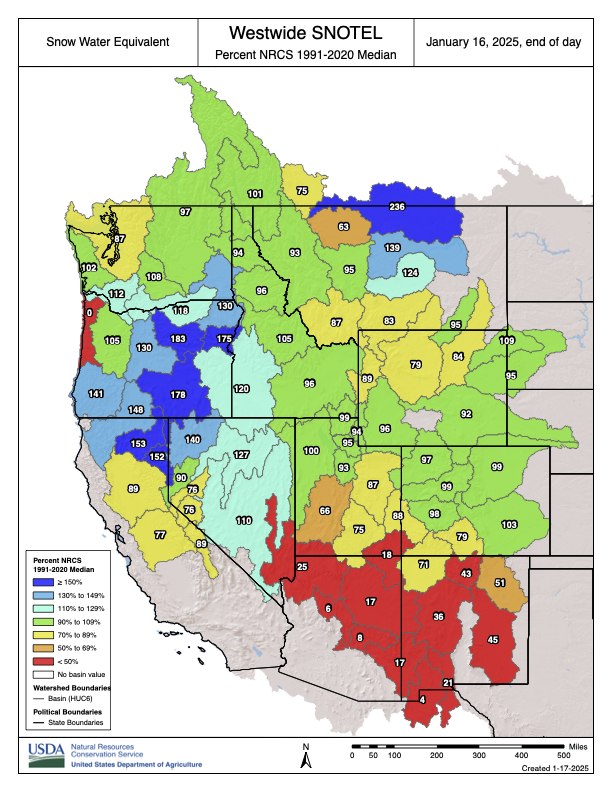
Snowpack levels across the Upper Colorado River Basin are close to average for this time of year, but forecasters say that might not translate to a comfortable year for the Colorado River…Moser reported that snow levels above Lake Powell, which straddles Utah’s shared state line with Arizona, are 94% of average as of Jan. 1. (“Average,” in forecasting, refers to the average precipitation between 1991 and 2020.) But forecasters currently predict that runoff into the reservoir between April and July will only be 81% of the thirty-year average. That’s a drop from the December forecast, which projected inflows of 92% of average…
Utah’s soil moisture is also below average and worse than it was this time last year. That could impact how much water reaches the Colorado River and Lake Powell, since dry soil absorbs melting snow, leaving less water to run off mountains and into reservoirs this spring. In terms of actual water, 81% of normal runoff into Lake Powell between April and July is 5.15 million acre-feet; the median runoff over the last thirty years has been 6.13 million acre-feet.
The Shoshone hydro plant in Glenwood Canyon. The River District has made a deal with Xcel Energy to buy the water rights associated with the plant to keep water flowing on the Western Slope. Credit: Heather Sackett/Aspen Journalism
The century-old water rights of the Shoshone Power Plant are essential to maintaining the flow and vitality of Colorado’s namesake river. The Colorado River District, alongside a diverse coalition of supporters, is working tirelessly to safeguard this critical resource, ensuring its benefits endure for ecosystems, communities, and future generations across Colorado’s Western Slope. Learn more at keepshoshoneflowing.org Learn more about the Colorado River District at ColoradoRiverDistrict.org