San Luis Valley: Groundwater sub-district #1 trial update: Use of closed basin water still a sticking point

artesianwellduttonranchalamosa1909.jpg

From the Valley Courier (Ruth Heide):

When the afternoon was concluded, objectors and supporters had agreed in concept to the 2012 annual replacement plan (ARP) for the sub-district and the underlying methodologies and technologies used to develop that plan. That made one of the remaining motions to strike expert witnesses and their reports a moot point because there is now no longer the need for a number of witnesses to present extensive testimony.

Proponents now plan to call only three witnesses, Rio Grande Water Conservation District Manager (RGWCD) Steve Vandiver, RGWCD engineer Allen Davey and Colorado Division of Water Resources State Engineer Dick Wolfe.

This first sub-district, which was designed to repair injurious depletions from well pumping to surface water rights and reduce the draw on the aquifer, operates under a management plan that is effectuated each year through an annual replacement plan. The annual plan spells out how depletions will be replaced…

The sponsoring water district approved the annual plan, as did the state engineer. Objectors challenged it and asked the judge to prohibit wells from pumping in the sub-district boundaries until those challenges were resolved this year. She denied that motion.

Objectors subsequently asked for their claims to be withdrawn and the October trial to be vacated. Judge Swift told objectors they could either withdraw their challenges to the 2012 replacement plan on the condition they could not bring those challenges back again or withdraw them with the opportunity to re-file them only if they paid the supporters’ costs for preparing for trial. They chose the first option, except for Schwiesow whose client the Costilla Ditch Company chose not to withdraw its claims.

One issue still remaining for trial is the use of Closed Basin Project water as one of the sources to replace depletions. Davey in particular will testify to that issue next week. He will also testify about augmentation wells, another issue still pending before the judge…

One of the controversial topics before the judge on Wednesday revolved around the possibility of challenging sub-district water plans in the future. Proponents said they would like some definitive rulings from the judge regarding the foundation of the water plan so they would not have to go through all the time and effort they did this year every year to defend the sub-district’s plan.

“We want the court to be in a position to be able to make factual determinations about the adequacy of the replacement plan because it was so broadly challenged,” [David Robbins, attorney for the Rio Grande Water Conservation District ] said.

[Attorney for the objectors Tim Buchanan] said the objectors raised broad issues “because we didn’t want to be foreclosed in the future from raising those issues.”

More San Luis Valley groundwater coverage here and here.

Rio Grande Water Conservation District board meeting recap: The impending water court trial and conservation issues dominated

riogranderiverstateengineersoffice.jpg

From the Valley Courier (Ruth Heide):

Now that the culmination is in sight for the Habitat Conservation Plan (HCP) the water district has spearheaded for about eight years, it looks like some of the San Luis Valley counties may not sign off on it, Robbins told the board on Tuesday. If they do not, the residents in their counties will not be covered by it.

The first of its kind in the U.S., the HCP was designed to permit the routine maintenance by farmers, ranchers, city and county crews in areas that might otherwise be up for critical habitat designation for endangered species such as the Southwestern Willow Flycatcher. Under the plan, farmers could still clear ditches and ranchers could still graze their cattle.

Without an HCP to provide mitigating habitat to allow the counties incidental take permits for those routine activities, individuals, cities and counties would have to apply for individual permits or stay out of the willows.

Robbins said this plan has been the subject of dozens of public meetings, but now some of the county officials or their legal counsel are raising questions that might mean some deal breakers with them signing off on the plan.

“It’s entirely possible one or more counties may decide they don’t want to take advantage of the benefits afforded by the habitat plan, which is unfortunate,” Robbins said.

He added, “We can’t make cities and counties participate if they do not want to. We will tell the Fish and Wildlife Service they are not covered by the HCP and Fish and Wildlife can determine critical habitat and take whatever actions it wishes.”

One of the issues being raised now, he said, was concern over federal jurisdiction, which is what the plan is attempting to avoid.

“It is absolutely beyond my comprehension why anyone would not want to take a very low cost way to avoid interactions with the Fish and Wildlife Service and why governments within the Valley would not want to avoid having to deal with that,” Robbins said.

Another issue is the multi-year clause in the HCP, Robbins explained. Some counties argue they cannot enter a contract encumbering county funds for more than one year at a time. The HCP is a 30-year agreement.

Robbins said all of the counties and their attorneys have had questions about the HCP. The county attorney for Conejos County wants to reserve the right to litigation. Robbins said governmental entities regularly enter into agreements in which they state they will not sue each other.

Robbins said the water district staff, board and legal counsel will do everything they can to get the HCP approved and implemented, especially given the time, effort and money involved in developing it, “but if it doesn’t work, there’s not much we can do about it.”

The HCP should be final in November or December.

More Rio Grande River Basin coverage here.

Rio Grande River Basin: The State Engineer is cracking down on over-pumping

slvdischargerecharge.jpg

From the Valley Courier (Ruth Heide):

This week [State Engineer Dick Wolfe] issued a draft policy concerning pumping limits for large-capacity wells in the Rio Grande Basin, Division 3 Engineer Craig Cotten announced to those attending the Rio Grande Water Conservation District board meeting yesterday in Alamosa.

The draft policy involves pumping limits for wells, specifically nonexempt large capacity wells, which have been required to meter usage for a few years now. Some of these wells have exceeded the pumping limits in their permits or decrees, Cotten explained, so they may be required to curtail or shut down pumping next year.

“We have actually started ensuring those limitations are complied with,” Cotten said on Tuesday, “but this policy sets it more in stone how we are going to do that and what steps we are going to take to ensure the wells are pumping within their limitations.”

He said this was something that needed to be handled, and this policy will set limits in black and white “so there’s no question.”

He described the bases that will be used to determine if a well has exceeded its limits. Some wells have maximum annual production they cannot exceed in any one year, such as 200-300 acre feet. On that basis, the water office has already ordered some wells to shut down, Cotten said.

“We do know there have been several that have exceeded their maximum annual production, and we have issued orders on those,” Cotten said…

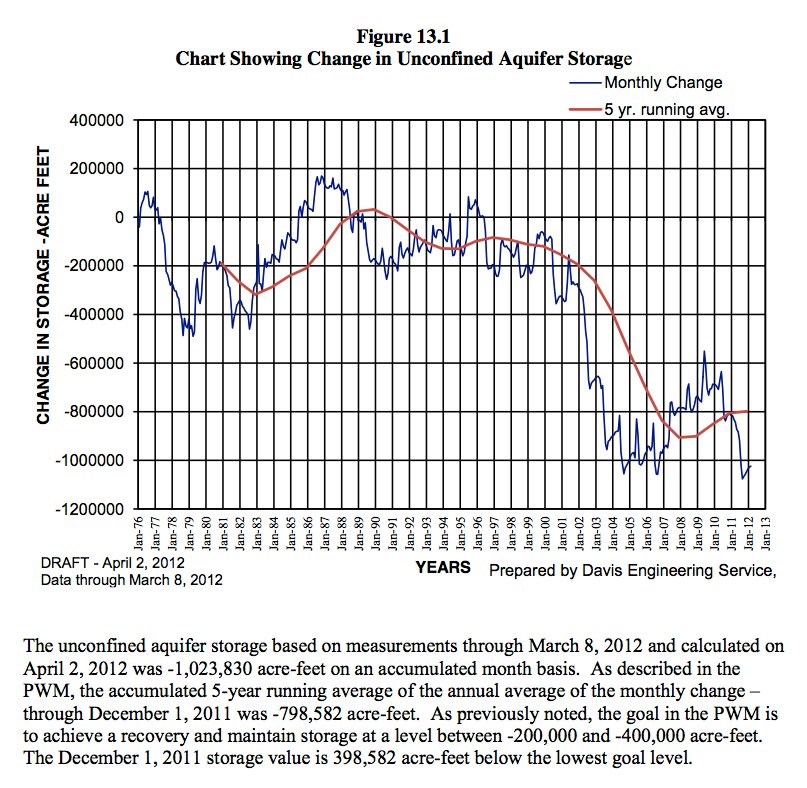
The “volumetric pumping limits of nonexempt wells in the Rio Grande Basin” draft policy refers to the extreme multi-year drought in the basin as one of the main reasons this policy is under consideration. It says the drought years have affected the recharge and storage in groundwater aquifers serving as the water supply for municipal, domestic, irrigation and other water users throughout the Valley. The policy states that during this summer alone, for example, water table elevations declined up to six feet in some areas, and the unconfined aquifer storage in the closed basin, which has been measured over a period of 30-plus years, decreased by about 166,000 acre feet.

More Rio Grande River Basin coverage here and here.

San Luis Valley: Groundwater Subdistrict No. 1 implementation plan trial scheduled for October 29

artesianwellduttonranchalamosa1909.jpg

From The Pueblo Chieftain (Matt Hildner):

One of the main groups objecting to how irrigators in part of the San Luis Valley mitigate the harm caused by groundwater pumping has chosen not to withdraw a number of its claims from court. The move by surface water users from the Conejos River basin and the northwestern corner of the valley, which came in a Tuesday filing to the water court for the Rio Grande basin, means a scheduled trial is still on for Oct. 29.

The objectors reaffirmed their claim against the use of water from the Closed Basin Project, which pumps groundwater from the east side of the valley and sends it down the Rio Grande River to assist Colorado in meeting the Rio Grande Compact.

Subdistrict No. 1, which includes just under 3,400 groundwater wells in the north-central part of the valley, had proposed using up to 2,500 acre-feet from the federal reclamation project to replace an estimated 4,700 acre-feet in depletions this year.

The subdistrict also has leased rights to roughly 5,500 acre-feet from reservoirs and trans-basin diversions near the Rio Grande’s headwaters to meet the depletions.

Judge Pattie Swift said last week the issue concerning the reclamation project could not be decided without a trial since there were issues of fact that were in dispute.

Swift also said the proposal from objectors to have a special master appointed likely would not be decided until after the trial.

More San Luis Valley groundwater coverage here and here.

San Luis Valley: Groundwater Subdistrict No. 1 implementation plan trial scheduled for October 29

slvdischargerecharge.jpg

From the Valley Courier (Ruth Heide):

Chief District Judge Pattie Swift on Thursday decided some of the pending motions in the water cases involving the San Luis Valley’s first water management sub-district operating plan and the state’s approval of it. She scheduled another hearing for October 24 to deal with more of the pending motions and is still planning to go forward with the scheduled October 29th trial to hear evidence and testimony.

This is the first year of operation for the Rio Grande Water Conservation District sponsored sub-district that involves hundreds of irrigators in the Valley’s closed basin area north of the Rio Grande. The sub-district was designed to repair injuries to senior surface water rights and replenish the Valley’s aquifers, and to that end the sub-district board developed an annual replacement plan for this year.

Objectors asked the court to invoke retained jurisdiction over the sub-district and deal with concerns they have over its first annual replacement plan. Judge Swift earlier this summer denied a motion from objectors that would have shut down wells in the sub-district until concerns over the operating plan were resolved.

Given that decision by the court, the objectors recently filed a motion to amend their invocation to retain jurisdiction and asked the judge to vacate the trial. Sub-district supporters and the state engineer’s office asked the judge to make an immediate decision on these motions and argued in favor of going forward with the trial.

Since the trial is scheduled for the end of this month, Judge Swift agreed to make a quick decision.

“The objectors seek to amend their claims, to remove them from consideration of the court and vacate the trial because they believe the primary issues remaining to be determined are contained within the amended motion before the court,” Judge Swift summed up the situation Thursday afternoon in court.

She said there are two motions for summary judgment: 1) concerning augmentation plan wells; and 2) concerning the Closed Basin Project.

Two other motions are also outstanding: 1) to strike expert witness designations and reports; and 2) to appoint a special master…

Also on Thursday, Judge Swift ruled on the objectors’ motion opposing the use of Closed Basin Project water for replacement water for the sub-district. She denied the objectors’ motion, “as I find there are disputed issues of material fact that must be determined to decide whether the Closed Basin Project water is adequate and suitable to prevent injuries to senior water rights under the district plan.”

The judge outlined objectors’ concerns with Closed Basin Project water being used to replace injurious depletions to senior water rights, with the objectors arguing that the 1963 Closed Basin Project itself represented a junior water right that in the priority system of water administration was causing injury to senior water rights so could not be used to replace injurious depletions in the sub-district…

Also on Thursday the judge asked attorneys from both sides to give her some guidance by Friday, Oct. 19 on how they believed the retained jurisdiction process should work. She said she saw the court’s primary functions in its retained jurisdiction over the sub-district as reviewing: 1) whether the plan of water management is operated in conformance with the terms of the court’s decree; and 2) whether injury is prevented in conformity with the court’s decree.

From The Pueblo Chieftain (Matt Hildner):

Water Court Judge Pattie Swift ruled Thursday that opponents of a groundwater plan could withdraw some of their claims if they were willing to pay the attorney costs for the supporters. The court has scheduled a five-day trial beginning Oct. 29 to examine the state’s approval of a plan that laid out how groundwater irrigators in the north-central part of the San Luis Valley would mitigate the harm their pumping caused to senior surface water rights owners during the current irrigation season. One group of objectors made up of surface water users in the southwestern and northwestern parts of the valley had asked the court to rule on their clams without trial in the name of saving time and expense.

But Swift pointed to one issue — the proposed use of groundwater from the federal Closed Basin Project as a source of replacement water for the plan— as one that could not be resolved without trial. “I can only decide that issue after hearing evidence,” she said.

Opponents have argued against the plan’s call to use up to 2,500 acre-feet of water from the project, which pumps groundwater on the east side of the valley and sends it to the Rio Grande to help the state comply with the downstream obligations to Texas and New Mexico.

The opponents have until Tuesday to inform the court of whether they will withdraw any of their claims.

More San Luis Valley groundwater coverage here and here.

USDA and Colorado Announce Rio Grande Basin Water Conservation Project Agreement

riogranderiverstateengineersoffice.jpg

Here’s the release from the U.S. Department of Agriculture:

Agriculture Secretary Tom Vilsack and Colorado Commissioner of Agriculture John Salazar today announced that Colorado and USDA have agreed to the terms of a new Conservation Reserve Enhancement Program (CREP) to help conserve irrigation water and reduce ground water withdrawal from the Rio Grande Basin. The project will enhance water quality, reduce erosion, improve wildlife habitat and conserve energy in portions of the Rio Grande watershed in Colorado. Vilsack and Salazar made the joint announcement at the 2012 Colorado Water Conservation Board Statewide Drought Conference.

“USDA is proud to work with the state of Colorado to enroll up to 40,000 acres of eligible irrigated cropland in an effort to address critical water conservation and other natural resource issues within portions of the Rio Grande watershed,” said Vilsack. “USDA’s Conservation Reserve Program continues to be one of our nation’s most successful voluntary efforts to conserve land, improve our soil, water, air and wildlife habitat resources—and now producers in Colorado have even greater incentives to enroll in efforts to protect the Rio Grande Basin.”

This agreement is for the establishment of permanent native grasses, permanent wildlife habitat, shallow areas for wildlife and wetland restoration on up to 40,000 acres of eligible irrigated cropland with a primary goal of reducing annual irrigation water use by approximately 60,000 acre-feet.

The sign-up date for this voluntary conservation program is expected to be announced soon after an agreement is formalized later this year. Farmers and ranchers in portions of Alamosa, Rio Grande and Saguache counties will then be able to apply for this program at their Farm Service Agency (FSA) service center. FSA will administer the Colorado Rio Grande CREP within these counties, working with USDA’s Natural Resources Conservation Service (NRCS), the state of Colorado’s Department of Natural Resources through the Division of Water Resources, Subdistrict Number 1 of the Rio Grande Water Conservation District, and other state and local CREP partners.

After the agreement is formalized, participants will (1) voluntarily enroll irrigated cropland into specialized 14-15 year Conservation Reserve Program (CRP) contracts, and (2) enter into water use agreements with Subdistrict Number 1 of the Rio Grande Water Conservation District. An additional perpetual irrigation water retirement agreement also will be an option for producers to help achieve long-term water savings.

The following national CRP conservation practices will be made available for eligible land focusing on water resource conservation:

– Establishment of Native Grasses and Forbs – CP2
– Establishment of Permanent Wildlife Habitat, Non-easement – CP4D
– Establishment of Shallow Water Areas for Wildlife – CP9
– Restoration of Wetland Habitat – CP23 and CP23A

CREP is an option under the Conservation Reserve Program (CRP) that agricultural producers may use to voluntarily establish conservation practices on their land. The project will provide land owners and operators financial and technical assistance. Under this CREP, participants will receive annual irrigated rental payments, cost share and incentive payments for voluntarily enrolling irrigated cropland into contracts and installing the approved conservation practices. USDA also will pay up to 50 percent of the cost of installing the conservation practices. Additional special incentives and cost share will be provided by the WAE for land enrolled within a designated focus area within the project area. Additional incentives will be provided by the subdistrict’s WAE to producers who elect to retire water permanently. Participants will establish permanent vegetative covers on enrolled land according to CRP conservation plans developed by NRCS.

To be eligible, cropland must meet CRP’s cropping history criteria, which includes cropping history provisions, one-year ownership requirement, and physical and legal cropping requirements. Marginal pastureland is also eligible for enrollment provided it is suitable for use as a needed and eligible riparian buffer. Producers who have an existing CRP contract are not eligible for CREP until that contract expires. Producers with expiring CRP contracts who are interested in CREP should submit offers for re-enrolling their land into CREP during the last year of their existing CRP contract.

In 2011, as a result of CRP, nitrogen and phosphorous losses from farm fields were reduced by 623 million pounds and 124 million pounds respectively. The CRP has restored more than two million acres of wetlands and associated buffers and reduces soil erosion by more than 300 million tons per year. CRP also provides $1.8 billion annually to landowners—dollars that make their way into local economies, supporting small businesses and creating jobs. In addition, CRP is the largest private lands carbon sequestration program in the country. By placing vulnerable cropland into conservation, CRP sequesters carbon in plants and soil, and reduces both fuel and fertilizer usage. In 2010, CRP resulted in carbon sequestration equal to taking almost 10 million cars off the road.

In 2011, USDA enrolled a record number of acres of private working lands in conservation programs, working with more than 500,000 farmers and ranchers to implement conservation practices that clean the air we breathe, filter the water we drink, and prevent soil erosion.

For more information about the Conservation Reserve Enhancement Program or CRP, contact the local FSA service center or search online at http://www.fsa.usda.gov/crp.

More Rio Grande River Basin coverage here and here.

Drought news: Rio Grande River Basin — Record drawdown of San Luis valley aquifer

riograndebasin.jpg

From The Pueblo Chieftain (Matt Hildner):

The irrigation season in the San Luis Valley is limping to a close with low stream flows and a record drop in the area’s most heavily used groundwater aquifer. Craig Cotten, the state’s division engineer for the valley, said Tuesday that stream flows on the two biggest rivers in the area have dropped to near 2002 levels. That was tempered by the fact that rivers ran much higher this spring. “We had significantly more stream runoff this year than we did in 2002,” Cotten told the Rio Grande Basin Roundtable.

San Luis Valley groundwater sub-district plan garners nearly a hundred pages of objections from surface water users

conejosriver.jpg

From The Pueblo Chieftain (Matt Hildner):

…opponents have said the plan fails to show the work leading to its conclusions.

The filings argue that it lacks data and used a faulty methodology in producing a groundwater pumping estimate of 308,000 acrefeet for the upcoming season. Nor does the plan detail recent adjustments to a state computer model designed to project groundwater use and depletions to surface water. Moreover, the objectors request an explanation of how the projected injury to surface water users was reduced from 5,016 acre-feet in a draft of the plan to 4,706 acre-feet in the final version.

Opponents of the subdistrict also argued in a Friday filing that the standard of review adopted by the court requires the implementation of the subdistrict’s plan be delayed until objections are resolved.

Also, without a plan in operation, the objectors argue that groundwater wells that injure the rights of senior surface users must be curtailed, a move that would break with nearly a century of unregulated groundwater use in the valley.

A status conference in the case has been set for Tuesday at 9:30 a.m.

More San Luis Valley groundwater coverage here and here.

Rio Grande River basin: The State Engineer has approved the groundwater Subdistrict No. 1 Annual Replacement Plan

riograndebasin.jpg

The State Engineer has approved the Rio Grande Water Conservation District’s annual replacement plan for groundwater Sub-district No. 1.

From email from the State Engineer’s office:

On May 1, 2012 State Engineer Dick Wolfe approved the Annual Replacement Plan for Subdistrict No. 1. This Approval was filed with the Division No. 3 Water Court.

All documents are located on DWR’s website at the following location:
http://water.state.co.us/DivisionsOffices/Div3RioGrandeRiverBasin/Pages/Division3EventsAndLinks.aspx

Note: these documents can also be downloaded from the DWR’s FTP site:
ftp://dwrftp.state.co.us/dwr/ARP_Subdistrict1/

More San Luis Valley groundwater coverage here and here.

Rio Grande River basin: Groundwater Sub-district No. 1 fallowed acreage at 9,100 acres for this season

slvdischargerecharge.jpg

From the Valley Courier (Ruth Heide):

Rio Grande Water Conservation District Manager Steve Vandiver told the water board during their meeting in Alamosa on Tuesday that some of the irrigators who were going to fallow their land in the first sub-district area this year opted to go with prevented planting instead because it would pay them more than the sub-district.

Vandiver said the sub-district ended up with about 9,100 acres under contract for fallowing this year.

“It was higher than that, and as insurance programs kicked in for prevented planting, people started withdrawing their contracts,” Vandiver told the board. “A number of people withdrew their offers to fallow.”

Farmers could receive $500-600 per acre under prevented planting, while the sub-district was only paying $200-300 per acre, Vandiver explained.

He said at least 18,000 acres would be fallowed to some extent under the prevented planting program, and although that would not entail 100 percent dry up, “there’s a considerable amount of ground that’s going to have a lot less growing on it this year than it has before.”

More San Luis Valley groundwater coverage here and here.

Rio Grande River basin: Subdistrict No. 1 public hearing April 19, come by and see the latest groundwater model run results

unconfinedaquiferstorageriogrand04022012.jpg

Click here for a copy of the letter from State Engineer Dick Wolf to the SLV Advisory Committee.

More coverage from Ruth Heide writing for the Valley Courier. From the article:

Groundwater users will begin to pay back surface water users for the harm they have caused them on May 1, at least in the closed basin area north of the Rio Grande where the San Luis Valley’s first water management sub-district was formed.

Before that happens, however, area residents will have an opportunity to comment on the sub-district’s annual replacement plan detailing how it will begin to replace depletions this year.

The state engineer’s office plans a formal public hearing on the replacement plan next Thursday, April 19, at 10 a.m. at the Ramada Inn (formerly Inn of the Rio Grande) in Alamosa.

Colorado Division of Water Resources Division Engineer for Division 3 Craig Cotten said the sub-district board at its meeting on April 3 took comments on its replacement plan and voted to send the plan on to the state engineer’s office with some minor modifications and additions. The sub-district has to have its final annual replacement plan to the state engineer by April 15.

The state engineer will then hold a formal public hearing on April 19. People may sign up that morning to speak, and comments will be recorded. State Engineer Dick Wolfe will likely make a decision soon afterward and must make a decision prior to May 1, when the replacements must begin.

Here’s the link for the Rio Grande Water Conservation District Annual Replacement Plan from the Division of Water Resources.

More San Luis Valley Groundwater coverage here and here.

The Rio Grande Water Conservation District has a little over 8,000 acre-feet in storage to meet augmentation requirements for groundwater Sub-district one

santamariareservoirfrombristolheadmountain.jpg

From The Pueblo Chieftain (Matt Hildner):

The annual [groundwater Sub-district 1] replacement plan, which still requires the approval of the State Engineer, will be the subject of a public meeting Tuesday. One of the main impacts from pumping has been to deplete stream flows and a court-approved computer model has determined the subdistrict will be responsible for paying back 5,016 acre-feet to the Rio Grande this year…

To meet that demand, the subdistrict has amassed 8,072 acre-feet in three reservoirs near the Rio Grande’s headwaters. The division engineer will determine when those releases will be made, starting May 1…

The subdistrict also has contracted with 39 growers to fallow 10,312 acres, a move the plan predicts will reduce consumptive use by roughly 12,700 acre-feet. The subdistrict’s goal is to add between 300,000 to 500,000 acre-feet back into the aquifer from its current level.

More San Luis Valley groundwater coverage here and here.

San Luis Valley: Fallowing of acreage irrigated by pumping to start this season, reduction of 5,000 acre-feet is the target

slvdischargerecharge.jpg

The Rio Grande Water Conservation District has been working diligently for several years to set up groundwater subdistricts to reduce pumping from the aquifer underlying the valley. The hope was to avoid having the State Engineer’s office come in a shut down wells as has happened in the South Platte and Republican River basins. The effort in the Valley has led to the creation of groundwater Subdistrict No. 1 which will start operations this season with a goal (set by the State Engineer’s office) of a 5,000 acre-foot reduction. Here’s a report from Matt Hildner writing for The Pueblo Chieftain Click through and read the whole article. Here’s an excerpt:

The unconfined aquifer, or shallower of the valley’s two major groundwater bodies, is recharged every spring when irrigation canals pull water from the Rio Grande River to fields in the district where it percolates down. Farmers pump it back up later in the growing season. But drought and largely unregulated use have seen the aquifer drop by 740,000 acre-feet, down to its lowest level since water managers began monitoring it in 1976. The subdistrict aims to reverse that trend by retiring up to 40,000 acres of farm ground over the next decade, a move they hope would return between 340,000 and 540,000 acre feet to the aquifer.

While the subdistrict doesn’t expect to finalize all of ifs fallowing contracts until April 1, up to 10,000 acres could be pulled from production this growing season, said Steve Vandiver, manager of the subdistrict’s parent organization, the Rio Grande Water Conservation District. “That will probably be 20,000 acre feet we’re not pumping,” he said. “That’s a big start.”[…]

The subdistrict’s other main task will be to replace the injury pumping of wells causes to surface water users. The valley’s aquifers and streams are connected to varying degrees depending on where one is in the area. And for more than four decades the valley’s surface users have had to bear the burden of the state’s compliance with the Rio Grande Compact as irrigation ditches were curtailed so water could be sent downstream. Groundwater wells faced no such burden. But that will change this season. State computer modeling has determined that the subdistrict will have to return 5,000 acre-feet to the river to make up for the injuries caused to surface water owners. While the subdistrict will have to formally submit its replacement plan to the Office of the State Engineer next month, Vandiver said the subdistrict could have between 6,500 acre-feet and 7,000 acre-feet at its disposal. Most of that water is stored in reservoirs on the Rio Grande upstream of the subdistrict.

More San Luis Valley groundwater coverage here and here.

State Engineer Dick Wolf tells San Luis Valley sub-district one irrigators that they need to deliver 5,000 acre-feet of replacement water this year

slvdischargerecharge.jpg

From the Valley Courier (Ruth Heide):

A few days ago the Valley reached another milestone in its sub-district journey with Wolfe’s expectation letter telling the sub-district and its sponsoring district the Rio Grande Water Conservation District how much replacement water must be delivered this year — 5,000 acre feet.

Rio Grande Water Users Engineer Jim Slattery clarified the 5,000 acre feet is the amount of depletions a groundwater model determined must be replaced this year, but it does not begin to replenish the Valley’s greatly reduced aquifer.

Wolfe said the first sub-district must submit a plan to the state by April 15 that includes the specified water replacement amount, and the state will hold a public hearing in April before acting on the plan. The sub-district’s plan must be updated and approved annually…

The groundwater model Slattery and other engineers and scientists have spent countless hours developing is designed to help sub-districts determine how much water they need to replace, and until recently the model was not calibrated to a point where that number could be specified.

Wolfe said now that the groundwater model is refined enough to provide specific data about the kind of water replacements required in the Rio Grande Basin, the first sub-district and several other sub-districts in various stages of formation can move forward more rapidly.

In addition, Wolfe and a large advisory group can begin moving forward again on groundwater rules and regulations for the Rio Grande Basin. The well rules advisory group has not met since last August but will resume its meetings soon, Wolfe said.

His goal is to submit well regulations to the water court before the end of the year. How long between his promulgation of the rules to their implementation will depend on how many objections there are to the rules and whether or not a trial becomes necessary, he said. Wolfe said in similar regulation promulgations in other basins in the state, the time frame was about a year between the time the rules were submitted to the court and implemented.

More San Luis Valley groundwater coverage here and here.

Colorado Water 2012: San Luis Valley groundwater sub-districts are designed to protect senior surface rights holders and take some irrigated cropland out of production

coloradowater2012

From the Valley Courier (Steve Vandiver):

In 2004, the Rio Grande Water Conservation District (RGWCD) supported legislation (SB04-222) that granted the State Engineer wide discretion to permit the continued use of underground water consistent with preventing material injury to senior surface water rights and ensuring sustainability of the unique aquifer systems in the San Luis Valley.

The district, as well as other water interests and well owners in the San Luis Valley, undertook this effort to try and reduce the severe negative economic impacts that have come about in other basins as the result of strict priority administration of groundwater by the state. The bill was signed into law in 2004, and codified as section 37-92-501. It prevents the State Engineer from curtailing groundwater withdrawals so long as those withdrawals are included in a groundwater management subdistrict and the withdrawals are made pursuant to the subdistricts’ properly adopted and approved groundwater management plan.

The district supports the development of subdistricts in the Valley as a flexible and innovative alternative to a strict priority administration by the state, as they can ensure protection to senior surface water rights, the viability of the aquifer systems and ensure the protection of the local economy that is dependent upon sophisticated agricultural practices. Water users developing subdistricts determined that subdistricts could be formed in communities of interest with relatively uniform hydrologic conditions that would reflect a local system, all the while protecting senior vested rights and sustaining the aquifer.

More Colorado Water 2012 coverage here.

Colorado Water 2012: Craig Cotten — ‘Approximately one-half million acre-feet per year are pumped from the [San Luis] Valley’s aquifers to support agricultural, livestock, commercial and residential needs’

slvdischargerecharge.jpg

Here’s the latest installment in the Valley Courier’s (Craig Cotten) Colorado Water 2012 series. From the article:

Early settlers to the Valley relied on both shallow and artesian flowing wells for household and livestock use and even today, more than 90 percent of the Valley’s domestic water supply comes from wells.

But all that groundwater use does not come without an impact to the stream systems and vested water rights within the Valley.

The State Engineer is currently working on developing rules and regulations for the administration of groundwater here in the San Luis Valley to mitigate injury caused by groundwater use. This development has been going on for several years, but the story of rules and regulations actually begins in 1969. That is the year in which the Colorado legislature passed the Water Rights Determination and Administration Act. This Act, for the first time ever, gave the State Engineer the legal authority to administer wells within the priority system, which is based upon the Doctrine of Prior Appropriation. Prior to the 1969 Act, the use of groundwater was not linked to surface water rights.

The State Engineer at that time, C.J. Kuiper, wasted no time in developing rules and regulations for various parts of the state. He first developed rules for wells within the South Platte Basin, then rules for wells within the Arkansas Basin, and then he moved on to the Rio Grande Basin.

In 1975, rules and regulations were developed for wells within the San Luis Valley. These rules mandated that all large capacity wells (greater than 50 gallons per minute) were to be shut down unless they had an augmentation plan to replace their depletions. Needless to say, the SLV well owners were less than thrilled with the new rules. Many individuals and groups objected to the rules, and so, those rules were the subject of years of debate, a 12-week trial, and finally a trip to the Colorado Supreme Court.

The Supreme Court ruled that the State Engineer did have the authority to establish rules and regulations, but that there might be some better options rather than shutting all of the wells completely off. They encouraged the State Engineer to look at alternatives, specifically mentioning the Closed Basin Project. At that time, there was a belief that the Project could produce enough water to cover all of the depletions from the wells.

More Colorado Water 2012 coverage here.

2012 Southern Rocky Mountain Agricultural Conference and Trade Fair recap: Groundwater subdistrict one was on everyone’s mind

slvdischargerecharge.jpg

From The Valley Courier (Lauren Krizansky):

The management plan’s purpose is to recharge the Valley’s aquifer, and one way to fill it back up is to stop taking water out. The RGWCD Subdistrict 1 is offering a tiered district fallowing program to persuade water users to do just that.

Water users qualify for the program if they have a three-year average of 50 percent reduced pumped groundwater. Contract prices for the 2012 irrigation begin at $300 an irrigated acre for zero groundwater use, $200 an irrigated acre for up to six inches of groundwater use and $100 an irrigated acre for up to 10 inches. The program is not offering incentives for more than 10 inches.

The deadline for fallow acreage bids is Wed., Feb. 15, but the board could extend the deadline if interest grows.

RGWCD Manager Mike Mitchell said that the program is calling for a significant irrigation reduction.

“Twenty-four inches is what is used on the common crops,” Mitchell said. “The whole focus of this is to see how much we can save.”

More San Luis Valley groundwater coverage here and here.

Southern Colorado Water Forum recap: Steve Vandiver — ‘We’ve issued too many well permits, and now we’re trying to unscramble the egg’

slvdischargerecharge.jpg

From The Pueblo Chieftain (Chris Woodka):

“We’ve issued too many well permits, and now we’re trying to unscramble the egg,” Steve Vandiver, manager of the Rio Grande Conservation District, told the Southern Colorado Water Forum Tuesday. More than 6,000 high-volume irrigation wells have been drilled in the Rio Grande basin in the rich farmlands around Alamosa, Center and Monte Vista over the past 50 years. “These wells have had an impact that was not recognized by anyone when they were drilled,” Vandiver said.

Part of the problem is that one-third of the water in the San Luis Valley has to be sent to New Mexico, in an arid region that gets only about 7 inches of precipitation annually. Since the 1940s, wells have improved and expanded agriculture in the Rio Grande basin.

The greater harm is to senior surface irrigation rights, which date back to the 1850s in the Rio Grande basin. The valley is economically dependent on agriculture, and the farmers themselves have taken up a solution which they hope to implement before the state imposes rules, Vandiver said. “Six subdistricts are being created as a market-driven approach,” Vandiver said.

More San Luis Valley groundwater coverage here and here.

The San Luis Valley unconfined aquifer depleted to lowest level since record keeping started in 1976

slvdischargerecharge.jpg

From The Pueblo Chieftain (Matt Hildner):

High commodity prices and a below-average snowpack prevented the normal recharge of the shallower of the valley’s two major groundwater bodies from bouncing back during runoff as it customarily does. “This last year has been pretty brutal,” Allen Davey, an engineer who monitors groundwater for the Rio Grande Water Conservation District, said at the district’s quarterly meeting Tuesday…

From January of last year pumping has reduced the aquifer by 200,000 acre-feet, according to the district’s monitoring wells that are clustered in the north-central part of the valley. It’s down 740,000 acre feet from when officials started charting the aquifer’s levels in 1976…

“I’ve talked to several users who have indicated they’re having trouble with their wells at this level, which is really no surprise,” Davey said.

More San Luis Valley groundwater coverage here and here.

San Luis Valley: First groundwater sub-district grappling with replacing surface water depletions this spring

slvdischargerecharge.jpg

From the Valley Courier (Ruth Heide):

The board of managers for Special Improvement District No. 1 of the Rio Grande Water Conservation District (RGWCD) held a special meeting on Monday to wade through some of the complicated issues facing the sub-district as it navigates the waters ahead. The Valley’s first sub-district affects 175,000 irrigated acres and 500 or more individual property owners in Alamosa, Rio Grande and Saguache Counties north of the Rio Grande. Its goals include replacing injurious depletions from well pumping to surface water users, restoring the Valley’s aquifer levels and ensuring compliance with the Rio Grande Compact. By court order, the sub-district must begin replacing depletions to surface water rights this spring…

Water district attorney David Robbins said the judge required any wells not originally in the sub-district to go to the peer review committee to make sure any depletions they were causing would be accounted for in the groundwater model and replaced by the sub-district…

The board on Monday decided to extend to February 15 the deadline for applications from those wishing to enter fallowing contracts with the sub-district this year. The initial deadline was January 31. The board said by extending the deadline into February they could give farmers one last push during the potato grain conference in early February.

In addition, the board is still working out rules that will govern fallowing contracts and plans to review a draft of those rules on Monday morning, Jan. 30, at 8:30 a.m. in the Bureau of Reclamation office just east of Alamosa. The sub-district board will meet again at 6 p.m. Wednesday, Feb. 8.

More Rio Grande River basin coverage here.

San Luis Valley: Area growers try to assess the potential impact of withdrawing acreage irrigated by groundwater pumping

slvdischargerecharge.jpg

From The Denver Post (Bruce Finley):

…the commercial agriculture that built up the valley is large-scale and competitive, and relies on center-pivot irrigation devices that pump heavily from underground aquifers. Commercial production of potatoes and hay — using 6,000 wells and 2,700 center-pivots to irrigate 120-acre crop circles — exploded after the 1950s. The pumping has depleted aquifers by more than 1 million acre-feet since 1976 and now is affecting surface streams…

By May, center-pivot farmers must activate a plan to reduce the water pulled from the aquifer by about 30,000 acre-feet a year. “They’ve got to start to restore it,” state engineer Dick Wolfe said. To avoid state shutdowns of wells — as happened in 2009 in northeastern Colorado — commercial farmers propose to pay to pump or purchase new surface-water rights and use these to offset pumping from aquifers…

“These communities, and no doubt other communities around the world, are coming to the realization that business as usual has to change,” said Mike Gibson, manager of the San Luis Valley Water Conservancy District and chairman of the Rio Grande roundtable that participates in statewide planning…

But the time has come for commercial farms “to pay for the impacts they are causing to the river,” said Steve Vandiver, manager of the Rio Grande Water Conservation District and the leader of efforts to find water to replace water pumped from wells.

More Rio Grande River basin coverage here.

San Luis Valley: Steve Vandiver — ‘The commodity markets are going to drive this (retiring acreage irrigated by groundwater)’

slvdischargerecharge.jpg

Farmers and the Rio Grande Water Conservation District have been working for a number of years now on rules for groundwater sub-districts that will incent farmers to remove land irrigated from the Valley’s aquifers. The Colorado Supreme Court recently blessed their work so all is well, right?

The short answer is nope. Senior surface irrigators are still claiming injury and now, it appears, high commodity prices are affecting farmers decision process when it comes to removing acreage from production.

Here’s a report from Brett Walton writing for Circle of Blue. Click through and read the whole article. Here’s an excerpt:

Simply put, the San Luis Valley no longer has enough water to support the abundant farm production that is becoming increasingly supercharged by rising prices for the crops grown here.

There may be a way out. Water officials in the region’s six counties are working with the federal government on a voluntary plan that would pay farmers to take land out of production. If things turn out as planned, up to 16,000 hectares (40,000 acres) of the valley’s roughly 240,000 irrigated hectares (600,000 acres) will not be farmed.

Though it is still being negotiated, the plan has a significant obstacle: the explosive rise in food prices, which are making the sums offered by the water-conservation program less enticing. Prices for the valley’s mainstay — potatoes — have increased 25 percent in the last five years. Wheat, alfalfa, and barley prices have done even better, more or less doubling over the same period.

“The commodity markets are going to drive this,” said Steve Vandiver, the general manager of the Rio Grande Water Conservation District, in an interview with Circle of Blue. “If prices stay high, it’s going to be harder to get farmers to sign up.”

If the voluntary program does not work, Vandiver went on to say, the result would be worst for farmers. The state, he said, would then step in — like it did in not long ago in the nearby South Platte Basin — and force well owners to shut down, without compensation. “We’re trying to keep that from happening here,” he said. “We’re trying to provide a soft landing.”[…]

Climate change plays a role in the new river patterns, Gibson told Circle of Blue. Wind storms from the deserts in Arizona and New Mexico are more frequent, and they drop dust on the mountain snowpack, which is the primary water source for the valley’s rivers. The warming effect of the dust, combined with higher temperatures, means that the spring melt has moved several weeks earlier in the year. With a longer dry period in the summer, more groundwater is required to balance the changes in the river.

New reservoirs to store the altered flows are prohibited under a compact between Colorado, New Mexico, and Texas, Gibson told Circle of Blue, but existing reservoirs are being renovated to maximize their storage capacity.

More San Luis Valley groundwater coverage here and here.

The Colorado Supreme Court affirms water court ruling for the first groundwater sub-district in the San Luis Valley

slvdischargerecharge.jpg

From The Pueblo Chieftain (Matt Hildner):

The ruling, written by Justice Greg Hobbs, declined to uphold any of the eight objections to the plan and cleared a path for the valley’s first groundwater subdistrict, which could be followed by as many as six others. “This truly is a historic moment in the San Luis Valley,” said Steve Vandiver who is manager of the Rio Grande Water Conservation District and also spent more than three decades in the valley working for the engineer’s office.

The efforts of Subdistrict No. 1 mark the first large-scale effort by groundwater users to compensate senior surface water rights owners who draw water from the valley’s streams, all of which are hydrologically connected, in varying degrees, to the valley’s two main aquifers. Subdistrict No. 1, whose management plan was modified then approved in two local water court decisions, takes in roughly 174,000 acres of irrigated farmland and roughly 3,000 groundwater irrigation wells.

Its plan imposes fees on its members to buy replacement water. It also calls for the retirement of up to 40,000 acres of farm ground with the help of the federal Conservation Reserve Enhancement Program as a means to restore the unconfined aquifer or shallower of the valley’s two big aquifers. Most of the valley’s farmers use some combination of surface water and groundwater, relying on the latter to finish off potato, barley and other crops late in the season.

Here’s the letter from State Engineer Dick Wolfe to the San Luis Valley Advisory Committee Members:

I hope this finds you and your families well in this holiday season. I wanted to give another update on the progress we are making in the rulemaking process. As always, my goal continues to be to advance the many earlier efforts in Division No. 3 water administration with the promulgation of the Rules Governing the Withdrawal of Ground Water in Water Division Three (“Rules”).

As you all know, one of the most important aspects of our rulemaking efforts centers on continuing to refine the data used in the RGDSS ground water model (“Model”), to ensure it is updated with the best and most accurate data available. We have spent a significant amount of work and effort in the past few months on evaluating and updating data inputs, which are pivotal to calculating depletions from ground water pumping in the San Luis Valley. The RGDSS Peer Review Team (PRT) has met 18 times since January 2011. At these meetings, the PRT has made headway in evaluating and refining various data sets including irrigated acreage assessments, water level and artesian pressure data from San Luis Valley wells, crop characteristics and coefficients, farming practices relying on subirrigation, winter diversions, sprinkler efficiencies, return flows, rim recharge, and the geology underlying the Valley.

These efforts have called for the input of many experts, such as agronomists, geologists, computer specialists, and farmers from the San Luis Valley with “boots on the ground” irrigation experience. Our experts want to assure that we include as much new and/or upgraded data as possible, so that the Model reflects ground water movement in the San Luis Valley as closely as possible. These refinements in the data that are uploaded to the Model give us more calibration data points, which in turn, give us more confidence in the accuracy of the predictive capacities of the model. The members of the RGDSS PRT continue to meet and work out the final details on the Model. Once these refinements are completed, our experts will re-run and calibrate the Model. Then we plan on making model pumping impact runs. Pursuant to the San Luis Valley Advisory Committee Member’s (“Committee”) stated desire, we plan to schedule our next meeting when the impact results are available for review. As with any project that combines the efforts of many people, we do not currently have an exact “end” date.

Our team has also been actively exploring the ideas of defining the metrics of a “sustainable” water supply. Currently we are looking at water levels and artesian pressures found in the wells across the San Luis Valley to establish sustainable water supply baselines. We are looking closely at well data logs and creating overlying maps for both the confined and unconfined aquifers to determine areas of correlation. This will assist us in creating “trigger points.” You may recall from previous Committee meetings that these are the points at which we consider the aquifer to be sustainable, less than sustainable, and not sustainable, triggering different degrees of administration. We are also considering the many good ideas on sustainability that have come from the Committee, by way of letter or other communication.

At our last meeting in May 2011, we asked for volunteers to help assist us in defining the important benchmarks, or tasks, which need to be accomplished for the creation of a subdistrict, an augmentation plan, and/or a substitute water supply plan. Examples of “benchmarks” include estimating the time it would take to circulate a petition to form a subdistrict, or the steps involved and the necessary time to nominate and form a Board of Managers for a new subdistrict. A small Benchmark Subcommittee was formed to assist us in this exercise. My staff identified all the statutory time requirements that are involved in these processes, and worked to determine the reasonable time it takes to accomplish each of these tasks. This information was presented to the Benchmark Subcommittee on September 8, 2011. At that meeting, the Benchmark Subcommittee provided insight and recommendations on “real life” steps that are not reflected in the statutes. This gave my staff a more accurate timeline for accomplishing the formation of one of these three methods, by which individuals can replace injurious depletions. Steve Vandiver from the RGWCD also provided insight into what Subdistrict No. 1’s experience has been in setting up the first groundwater management plan. Collectively, these meetings and benchmark exercises will help us craft the section of the rules that addresses the time necessary for a subdistrict to get up and running.

We are working very diligently to finalize the refinements to the Model and to present the results to the Committee. As always your input on these issues is essential, so any thoughts you have are welcome.

Thank you for your patience. I wish you and your family a happy holiday season.

More coverage from Ruth Heide writing for the Valley Courier. From the article:

“The General Assembly has adopted a series of statutes applicable to confined and unconfined aquifers within the San Luis Valley and Water Division No. 3, empowering the subdistrict to adopt and implement the plan. The plan as approved and decreed adequately addresses the replacement of well depletions that injure adjudicated senior surface water rights, along with restoring and maintaining sustainable aquifer levels in accordance with the applicable statutes,” the court stated in its Dec. 19 decision.

“The subdistrict bears the burden of going forward and the burden of proof to demonstrate that annual replacement plans prevent material injury to adjudicated senior surface water rights caused by ongoing and past well depletions that have future impact…

“Because the subdistrict must replace all injurious depletions, and bears the burden of proof of non-injury, we expect the subdistrict, in order to avoid needless controversy, will replace all predicted injurious depletions … If the subdistrict does not adhere to the plan, or the plan is not preventing material injury to senior surface water rights, the State Engineer must curtail groundwater withdrawal in the subdistrict as necessary to prevent material injury to senior surface water rights, even in the absence of rules and regulations.”

At the conclusion of its 70-page decision the Colorado Supreme Court acknowledged the work of the San Luis Valley residents, including objectors to the plan, who had a hand in shaping the final plan and the General Assembly that developed statutes specific to the Valley’s unique hydrology, “accomplishing a balancing of land and water resources.”

Sponsored by the Rio Grande Water Conservation District (RGWCD), the sub-district was set up to replace injurious depletions to surface water users by well pumping, ensure Rio Grande Compact obligations to downstream states and help restore the San Luis Valley’s aquifer…

With the court decision in place, one of the few remaining pieces of the sub-district puzzle now is the groundwater modeling efforts, which are still being finalized. The model will be crucial to determining how much water groundwater irrigators must pay back. Vandiver said a couple more peer review sessions will probably be held between now and the end of the year, and hopefully soon after the first of the year the model will be fully operational. The first sub-district’s board of managers meets the second week of January, and the sponsoring RGWCD board meets on January 17…

Those appealing the case to the higher court were: San Antonio, Los Pinos and Conejos River Acequia Preservation Association; Save Our Senior Water Rights, LLC.; Richard H. Ramstetter; and Peter D. Atkins. Objectors alleged trial court failures to abide by Colorado statutory and case law applicable to augmentation plans…

Referring to the late Ray Wright who as RGWCD board president spearheaded the sub-district efforts for years, Vandiver said, “he ought to be dancing on his grave this morning.”

More San Luis Valley groundwater coverage here and here.

The San Luis Valley’s first water management sub-district plan fees are being collected for the second year in a row and are being escrowed awaiting the Colorado Supreme Court

slvdischargerecharge.jpg

From the Valley Courier (Ruth Heide):

Since the plan is still pending in the courts, the fees collected this year have been held in escrow by the sponsoring district, the Rio Grande Water Conservation District (RGWCD), which continues to upfront the costs of its first sub-district as well as other pending sub-districts throughout the Valley. The purposes of these sub-districts include repairing the damage from well users to surface water rights, helping the state meet its Rio Grande Compact obligations to downstream states and replenishing the Valley’s underground aquifers…

The Valley’s first sub-district, affecting 175,000 irrigated acres and 500 or more individual property owners, lies north of the Rio Grande in what is known as the closed basin area of the San Luis Valley. The sub-district lies in three of the Valley’s six counties (Alamosa, Rio Grande and Saguache.) RGWCD Attorney David Robbins said the Colorado Supreme Court heard oral arguments in the sub-district plan of management case on September 28. He expected a ruling from the court in two to four months. Groups forming other water management sub-districts throughout the Valley are waiting for the court’s ruling before finalizing their sub-districts. Meanwhile, they are accumulating data required to form their sub-districts…

[Rio Grange Water Conservancy District Manager Steve Vandiver] reported during the water district board’s quarterly meeting this week that so far expenses for the first sub-district have totaled $1.37 million, with expenses on the other five sub-districts totaling about $350,000. One of the expenses for the first sub-district is water acquisition to replace injurious depletions to surface rights. The sub-district by court order must begin replacing those depletions in 2012. The sub-district is acquiring several options on water that can be used for replacement water in 2012 and is looking at several other possibilities, according to Vandiver. He said the sub-district has options on 3,500 acre feet for 2012 with another 1,500 acre feet being held for the sub-district if it is needed. Until the groundwater model runs are completed, the sub-district does not have a total for the amount of replacement water that will be required in 2012, he explained…

Well users who are not part of management sub-districts face the potential under pending state well regulations of having to shut down their wells or develop individual augmentation plans. Robbins said individual plans are no easier to develop than the sub-district plans, and some Valley residents have already begun that process. “If you are going to change water rights from irrigation to replacement, the same sort of responsibilities exist to surface streams,” [RGWCD Attorney David Robbins] said. “The same standards apply … the same obligation applies to make up projected depletions with the replacement supplies.”

More San Luis Valley groundwater coverage here and here.

Colorado Supreme Court to hear San Luis Valley groundwater sub-district rules appeal September 28

slvdischargerecharge.jpg

From The Pueblo Chieftain (Matt Hildner):

The valley’s local Water Court signed off on the plan of management for Subdistrict No. 1 in May 2010, but three parties made up largely of surface irrigators have appealed that ruling. They argue that the management plan does too little to protect the owners of senior surface water right from injury caused by the pumping of the subdistrict’s roughly 3,000 irrigation wells…

The appellants include two groups — The San Antonio, Los Pinos and Conejos River Acequia Preservation Association and Save Our Senior Water Rights which are represented by Arvada attorney Tim Buchanan. Richard Ramstetter and Peter Atkins have joined as individual appellants, who are represented by Alamosa attorney Stephane Atencio.

More San Luis Valley groundwater coverage here and here.

Rio Grande River basin: Valley water managers are considering applying for Conservation Reserve Enhancement Program funds to jumpstart the groundwater sub-district #1 process for retiring acreage

A picture named slvdischargerecharge.jpg

From The Pueblo Chieftain (Matt Hildner):

The Conservation Reserve Enhancement Program funds are being looked at by valley water managers to help retire up to 40,000 acres of irrigated land in the north-central part of the valley. “I think it’s something that would be in that priority class for us,” [U.S. Rep. Scott Tipton, R-Colo] said after a meeting with potato farmers Thursday. The first-term congressman had campaigned on cutting the federal budget, but he told the farmers that his spending preferences would be prioritized around energy, self-sufficiency and boosting America’s ability to feed itself…

Tim Davis, a Sterling-based consultant who has shepherded farmers in Nebraska and northeastern Colorado through applications to the program, said that so far there have been no rumblings on Capitol Hill about cutting the program…

Davis is helping Subdistrict No. 1 apply to the federal program, which pays a rental rate to farmers to retire ground…

The district’s assessments of its members would go to compensate for injury caused by pumping and it also would be coupled with the federal dollars to retire ground. But the local dollars likely would be used to sweeten the federal payments and increase the incentive for farmers to retire ground that would more helpful in reducing the pumping of groundwater, said Steve Vandiver, director of the Rio Grande Water Conservation District. Vandiver said the subdistrict had yet to decide how much money it would add, and it has not chosen the targeted acreage…

An appeal of a local court’s approval of the subdistrict’s management plan is before the Colorado Supreme Court. Vandiver said oral arguments in the case likely would come in the fall, with a decision possibly by next year. Two other pending subdistricts — one along the Rio Grande between Monte Vista and Alamosa and another that would take in the Carmel and Waverly areas — are also considering applying for the federal funds but have yet to write management plans while the court ruling is pending.

More San Luis Valley groundwater coverage here and here.

Rio Grande Water Conservation District quarterly meeting recap: Closed Basin Project operation questioned

A picture named slvdischargerecharge.jpg

From the Valley Courier (Ruth Heide):

Saying continued pumping of the project “is creating an enormous hardship on north Valley ranches,” [Moffat area rancher Peggy Godfrey] asked the water board to request of the Closed Basin operating committee and/or Department of the Interior Secretary Ken Salazar to modify the project. She referred to a section governing the project that allows it to be modified, curtailed or suspended to eliminate adverse effects.

The Rio Grande Water Conservation District (RGWCD) board indicated it would not grant her request. “We will continue to operate this project within its boundaries and within the constraints put on it,” said RGWCD Board President George Whitten who also sits on the Closed Basin Project operating committee. Whitten, who ranches in the northern part of the Valley, told Godfrey although he appreciated her comments, “I respectfully disagree with your findings.”

RGWCD District Engineer Allen Davey, who also sits on the Closed Basin Project operating committee, said, “There is no clear evidence that the Closed Basin Project is causing depletion of the aquifer in the Moffat area.” He said the project was developed to capture salvage water that was being lost. He said pumping has been reduced from project wells when evidence showed they were violating statutory criteria.

More Rio Grande River basin coverage here.

Rio Grande River basin: San Luis Valley’s first groundwater management sub-district update — accounting growing pains

A picture named riograndebasin.jpg

From the Valley Courier (Ruth Heide):

In its annual meeting this month, the sub-district board of managers struggled with some of those kinks, most of them surrounding water accounting issues. Although the sub-district itself has been approved, its plan of management is currently under appeal at the Colorado Supreme Court level. Because of the court appeal, fees collected for the sub-district for the first time this year must essentially be held in escrow. If/once they are freed up, funds can be used for such purposes as sub-district staff and water acquisition…

In addition, several potential water sellers have already approached the district and sub-district to sell replacement water, which the sub-district cannot buy until its funds are cleared, assuming the state court appeal goes in the sub-district’s favor. One of the main purposes for the sub-district, which lies in the Valley’s closed basin area, is to replenish well-pumping depletions to surface rights. Vandiver said a number of people have offered replacement water, including the San Luis Valley Conservancy District and a local real estate company with a ranch for sale on La Jara Creek. The ranch comes with senior water rights. Jim McCullough, who attended the sub-district board’s April 5 meeting, also offered for consideration shares he owns on the Excelsior Ditch. He said he would like to find a way to use that water to replace the depletions he owes within the sub-district. Vandiver said he had fielded several inquiries from people who wanted to use surface water that is not part of the sub-district as augmentation water…

Recharge credits are another area where the sub-district board is fine tuning the details. Board and audience members questioned how recharge would be credited to farmers who had recharge reservoirs, flood irrigated or in other means replaced water to the aquifer. For example, Monte Vista area farmer Dick McNitt said he felt like he was being penalized for his conservation efforts through reservoirs on his property. The board and audience also talked about reconsidering how surface water credits are calculated, and Sub-district Board Chairman Lynn McCullough appointed a committee to review that portion of the plan and develop recommendations. The committee includes board members and some of the audience members who requested to be a part of the discussion…

One issue that was easy to resolve during the board’s annual meeting was the election of officers. The board unanimously voted to keep the same slate of officers, with Lynn McCullough as chairman.

More San Luis Valley groundwater coverage here and here.

Colorado Commissioner of Agriculture John Salazar talks ag and the economy

A picture named grandvalleyirrigationditch.jpg

From The Pueblo Chieftain (Matt Hildner):

Salazar said he was not against the curtailing of wells as long as it followed the best available science and replaced depletions to surface water. While wells would not be subject to curtailment inside the subdistricts, should they go forward, there will be a reduction to the valley’s 622,000 irrigated acres, which ranks second among the state’s river basins behind the South Platte. After the 40,000 acres proposed for retirement by Subdistrict No. 1, the amount of acreage facing retirement won’t become clear until the other subdistricts come up with their management plans. But last year’s update of the Statewide Water Supply Initiative estimated that an additional 40,000 acres could be retired in the valley by 2050.

The changes could take place at a time when agricultural markets are poised to boom. Salazar noted that wheat growers are contracting for over $7 per bushel, while cattle prices could be up $2 in the coming year. Those circumstances could make agriculture the state’s top economic driver, but Salazar worries the state won’t realize what it has. “I always worry about agriculture in this state,” he said. “We need to continue the ability to produce food in this state.”

As for how the changes to the valley’s water policies will affect Salazar’s ranching and farming operations, the commissioner, like the rest of the valley’s water users, is waiting to see what the computer modeling says. Once he has that information he’ll see if joining a subdistrict in the Conejos River Basin is the right move.

More Rio Grande River basin coverage here.

2011 Colorado legislation: The State Engineer’s office decides against backing bill that was designed to allow the State Engineer to approve groundwater sub-district management plans as substitute water supply plans in the San Luis Valley

A picture named smithreservoir.jpg

From The Pueblo Chieftain (Matt Hildner):

The measure, which was never introduced at the Capitol, would have allowed groundwater users to apply for a substitute water supply plan, thereby avoiding shutdowns while they await court approval of groundwater subdistricts. A statement issued by the engineer’s office said moving forward with the measure would create undue controversy and possibly result in amendments that hindered the proposal and complicated rule-making efforts for Rio Grande basin well users…

…letting go of the temporary plans could leave some of the valley’s 6,000 groundwater wells vulnerable to being shut down. Wolfe has said the engineer’s new rules, which would require shutting down wells that do not have replacement water, are expected to be in place by 2012. The subdistricts would tax its members to help buy replacement water to make the senior surface users whole, but the first subdistrict remains under review by the Colorado Supreme Court. Other potential subdistricts are awaiting that ruling before they attempt to gain approval from the valley’s local water court. The engineer’s office hopes the issue can be resolved by an advisory committee Wolfe selected two years ago to assist in drafting groundwater rules in regulations

More San Luis Valley groundwater coverage here and here.

Rio Grande Water Conservation District quarterly board meeting recap

A picture named riograndereservoir.jpg

From the Valley Courier (Ruth Heide):

[The fees are hitting for] the Valley’s first sub-district, which encompasses about 175,000 irrigated acres owned by 500-plus individual property owners in an area north of the Rio Grande. It is the first of several water management sub-districts under the auspices of the sponsoring district, the Rio Grande Water Conservation District, that will eventually cover the San Luis Valley…

Last October the sub-district board of managers approved an administrative fee of $5 per irrigated acre (to generate about $875,000) and CREP (Conservation Reserve Enhancement Program) fee of $1 per irrigated acre to be assessed well users within the boundaries of the first sub-district this year. A variable fee of $45 per acre foot of groundwater pumped (less surface water credits), will not be collected until 2012 but will be based on 2011 pumping. This year’s fees will be held in escrow until the sub-district receives a decision from the Colorado Supreme Court regarding an appeal over the sub-district’s management plan…

[Cory Off] suggested the state should be bearing some of the cost of the sub-districts. He said he knew the state did not have any money, but neither did the Valley residents, and if the Valley water districts did not ask the state for help now, the Valley would not be considered for funding in the future when the state’s financial situation improved. He said although Valley farmers will benefit through the sub-districts by not having to pay for their own augmentation plans, the state will also benefit by not having to process thousands of augmentation plans in the Valley.

[RGWCD Attorney David Robbins] said he was not arguing that point, and if Off could get the state to help pay for the sub-districts, “God bless you and I will do whatever I can to help,” but the other river basins in the state had not had any luck getting the state to help with their costs. He said water users in the Republican River Basin are going to spend $80 million to acquire water and put in a pipeline.

RGWCD board member Lewis Entz, a former long-time state legislator, said the sub-district legislation was created as a way for the Valley to solve its own problems without the state’s interference. “It’s on us to solve our problem and not the state,” he said…

RGWCD Manager Steve Vandiver reported to the board on Tuesday the district’s costs associated with the first sub-district alone have totaled $1.13 million. This is a cumulative figure encompassing all of the expenses over the past several years. The district has also spent about $240,000 on the other sub-districts proposed throughout the Valley. Vandiver said those figures include court time, engineering time, legal time, administrative time, etc…

He and District Engineer Allen Davey said the efforts, and expenses, will not let up any time soon, either. “Obviously we are doing a lot of work on sub-districts, particularly Sub-district #1,” Davey said. “That’s been primarily our focus in the past year.”

More San Luis Valley groundwater coverage here.

Rio Grande Water Conservation District’s quarterly meeting recap

A picture named slvdischargerecharge.jpg

From the Valley Courier (Ruth Heide):

When the state pulls the trigger on groundwater rules and regulations, many Valley irrigators could be shut down. Colorado Division of Water Resources Division Engineer for Division 3 Craig Cotten reported during the Rio Grande Water Conservation District’s quarterly meeting on Tuesday that those rules are very close to being completed. State Engineer Dick Wolfe has been working with a large advisory group for the better part of two years to develop regulations that governing groundwater use in the Rio Grande Basin. Well irrigators who are not part of a water management sub-district or who have not completed individual augmentation plans may find themselves out of business when the rules go into effect and the state begins shutting down wells.

Currently, one water management sub-district of the sponsoring Rio Grande Water Conservation District is on appeal with the Colorado Supreme Court, while five or six other sub-districts throughout the Valley are in various stages of development. Because it appears the state’s rules could be in place before the sub-districts, the state engineer’s office asked legislators like State Senator Gail Schwartz and State Representative Ed Vigil to carry legislation adding language to existing legislation that would give folks within a pending sub-district some protection when the bullets start flying.

“We are going to have a situation, I think, where we will have rules and regulations in place. Those rules and regulations are in draft form right now and the rules and regulations will go into effect May 2012,” Cotten said. “If those rules and regulations go into effect we will have sub-districts that are in court but not through the process, so those people in those sub-districts will be stuck … They could be caught in a position where they are going to be shut down and they don’t have any ability to apply for a substitute supply plan.” He said without an augmentation plan, those folks would have to shut their wells off. Cotten explained that the state has had legislation for nearly a decade that provides for temporary or emergency substitute water supply plans to be approved while an official augmentation plan is pending with the courts. “It allows somebody to go forward and do what they are planning on doing, replace their water, as they wait on the court case to get done,” Cotten explained. He said the statute in place right now provides for several different situations but does not specifically mention sub-districts because it was enacted before the Valley began developing water management sub-districts.

More San Luis Valley groundwater coverage here and here.

2011 Colorado legislation: State Senator Gail Schwartz to sponsor bill that will allow the State Engineer to approve groundwater sub-district management plans as substitute water supply plans in the San Luis Valley

A picture named slvdischargerecharge.jpg

From the Valley Courier (Ruth Heide):

Steve Vandiver, manager for the Rio Grande Water Conservation District that is sponsoring the water management sub-districts in the Valley, explained the pending legislation to Rio Grande Roundtable members during their meeting on Tuesday…

He said the state engineer’s office and attorney general’s office requested the bill, which adds a phrase or two to existing legislation regarding substitute water supply plans. Vandiver said the current statute allows the state engineer to approve temporary operation of an augmentation plan or rotation crop management contract that has been filed with the water court, but the court has not yet issued a decree. The state engineer can approve the temporary operation of those plans until the decree is completed, Vandiver explained. The proposed legislation would add wording allowing the state engineer to do the same thing with sub-district water management plans. Under the proposed legislation, the state engineer could approve temporary operation of a groundwater management plan as a substitute water supply plan as long as the state engineer has approved the groundwater management plan application, judicial review of that approval has been filed with a water court and the court has not issued a decree…

Otherwise, [Vandiver] explained, the groundwater rules the state engineer is currently finalizing could become effective while water management plans are hung up in court, and all of the people who were relying on those plans to cover them might suddenly find their wells shut off.

Several proposed water management sub-districts, separated by Valley hydrology and geography, are in various stages of development. The sub-districts are designed to make up depletions to surface water rights and the aquifer as a whole, at least in part through reduction in irrigated acreage within the sub-district boundaries.

More San Luis Valley groundwater coverage here and here.

Rio Grande Basin: First groundwater sub-district assessments to start in 2011

A picture named slvdischargerecharge.jpg

From the Valley Courier (Ruth Heide):

On order of Chief District/Water Judge O. John Kuenhold, the board of managers for the San Luis Valley’s first water management sub-district of the Rio Grande Water Conservation District (RGWCD) this week established fees that will be assessed sub-district irrigators next year. The sub-district board plans a public meeting on Tuesday, Oct. 5, at 7:30 p.m., with the location to be announced, to review and possibly adjust the fees it set this week.

Although the sub-district’s management plan is still on appeal before the Colorado Supreme Court, fees for the Valley’s first water sub-district will go on the tax rolls next year.

More San Luis Valley groundwater coverage here and here.

Rio Grande Basin: The objectors to the groundwater management Sub-district No. 1 rules have filed an appeal of Judge O. John Kuenhold’s recent approval of the plan

A picture named slvdischargerecharge

From the Valley Courier (Ruth Heide):

The Rio Grande Water Conservation District, Rio Grande Water Users Association, Conejos Water Conservancy District, State Engineer, and Farming Technology Corporation filed Supporters’ Motion to Amend Decree on July 8. The following day, the senior water users filed notices of appeal to Colorado’s higher courts in two closely associated water and civil cases.

The senior water users’ attorneys contended in their appeals that the amended plan, and the judge’s conditions regarding its approval, still did not provide enough protections for senior water rights. They contended that injury would continue to occur to senior water rights as long as wells were allowed to pump within the sub-district area without state curtailment. They stated that such pumping constituted out of priority depletions. They also questioned whether the water management plan was complete, comprehensive and detailed enough and whether it complied with Senate Bill 04-222 and Colorado law…

Objectors also questioned whether the trial court erred in:

• determining that the plan of water management need not contain sufficient terms and conditions for the trial court to determine “no injury” to other water rights as a result;

• delegating to the sub-district and state and division engineers the authority to determine “annual replacement plans” to replace depletions from sub-district well pumping;

• deferring a finding regarding whether the plan of water management will result in injury to other water rights and instead relying on retained jurisdiction over the plan;

• approving the use of response function, a method for determining water injuries;

• determining that a plan of water management may use a reduction in the amount of water consumed by native vegetation to increase the quantity of water available to be pumped by sub-district wells;

• not requiring the sub-district to prove ownership or control over sufficient legally available replacement water to cover depletions from pumping sub-district wells;

• allowing the sub-district to utilize the water rights subject to the decrees referred to in Case Nos. 06CV64 and 07CW52 as the “recharge decrees” and in approving the quantification of fully consumable water in estimating ground water depletions;

• finding that the sub-district’s proposed use of Closed Basin Project water is not prohibited;

• allowing a 50 acre foot per year lower limit for the determination of injurious depletions and in allowing the replacement of injurious depletions in subsequent years;

• not adopting, rejecting, or referring back the plan of water management to the sub-district (the judge had referred the plan back to the sub-district board of managers once before);

• not affording objectors the opportunity to propose specific terms and conditions to the plan of water management;

• not requiring the sub-district to replace all injurious depletions, including ongoing depletions resulting from past pumping of sub-district wells, until the year 2012;

• approving Appendix 4 (budget and accounting plan) and Appendix 5 (operational timelines) of the plan of water management;

• determining the sub-district may contract with the owners of any non- sub-district wells.

• finding that individual plans of augmentation in Water Division 3 are not presently possible and cannot be completed with any engineering validity;

• finding that the calculation of the Surface Water Credit in Appendix 2 of the plan of water management is reasonable and supported by the record;

• finding that the amended plan of water management’s change in timing for removing land from irrigation to effectuate further recovery of the unconfined aquifer to a sustainable condition is lawful.

San Luis Valley groundwater coverage here and here.

Rio Grande Basin: The objectors to the groundwater management subdistrict #1 rules have filed an appeal of Judge O. John Kuenhold’s recent approval of the plan

A picture named slvdischargerecharge

From The Pueblo Chieftain (Matt Hildner):

The subdistrict water management plan approved by Judge O. John Kuenhold calls for subdistrict members to tax themselves to pay for injuries to senior surface rights owners and fallow up to 40,000 acres of farmland.

The subdistrict includes roughly 174,000 acres of irrigated farmland and 3,000 wells.

Objectors want the Supreme Court to determine whether the trial court erred in relegating authority to the subdistrict and the State Engineer’s office to devise annual replacement plans to compensate surface rights owners for injury.

The appeal questioned if the trial court erred by deferring any finding of injury and instead retaining jurisdiction over the plan to make such a determination.

A series of points in the appeal also question the sources of potential replacement water.

More San Luis Valley groundwater coverage here and here.

San Luis Valley: With the plan for Subdistrict No. 1 approved the next step is submitting the rules to water court

A picture named slvdischargerecharge

From The Pueblo Chieftain (Matt Hildner):

The rules would help govern how the Engineer’s Office regulates the subdistrict, which is made up of groundwater users in the north-central part of the valley who will tax themselves to buy replacement water for pumping that injures senior surface water rights and to fallow ground in an effort to restore aquifer levels. The rules would also apply to groundwater irrigators who are not part of a subdistrict…

The effective date of the rules also will be pushed back to 2012.

The other pending hurdle for the draft rules will come when the advisory committee gets a look at the response functions of the Rio Grande Decision Support System, a computer program designed to model the flow of the valley’s groundwater. That system may be used to help the Engineer’s Office determine where injuries from pumping will occur and from which wells, but the draft rules allow the office to use other means when it’s determined that reliance on the computer model would be inappropriate.

More San Luis Valley groundwater coverage here and here.

San Luis Valley: Water court approves rules for groundwater Subdistrict No. 1

A picture named slvdischargerecharge

It’s been a long time coming but the rules designed to protect senior rights holders in the San Luis Valley from groundwater pumping (along with idling 40,000 acres of irrigated farmland) received Judge O. John Kuenhold’s blessing in a ruling released yesterday. The plan is an alternative to state imposed regulations. Here’s a report from Matt Hildner writing for The Pueblo Chieftain. From the article:

Should it make it through an anticipated appeal to the state Supreme Court, the plan for Subdistrict No. 1 would take in roughly 174,000 acres of irrigated farmland and 3,000 irrigation wells. The plan would institute a tax on its members to pay for replacement water to compensate senior surface water users harmed by depletions exceeding 50 acre-feet per year. It also would use those proceeds to retire at least 40,000 acres over a 10-year period to restore the unconfined aquifer, a move the ruling called, “an important and courageous milestone in water development in this state.” The unconfined aquifer is the shallower of the valley’s two main bodies of groundwater and the court has found that both are connected in some degree to the area’s surface streams.

David Robbins, the lead attorney for Subdistrict No. 1, was heartened by the ruling. He pointed specifically to the judge’s decision that replacements wouldn’t go into effect until 2012. The extra year will give the subdistrict time to collect sufficient funds to meet its water replacement obligations…

The objectors gained some consolation when the judge ruled that the subdistrict must replace past depletions from well pumping, which can have an effect on surface streams for up to 20 years after the pumping has taken place. Evidence at the trial pegged the amount of injury from past depletions to amount to 48,993 acre feet through 2028. The court rejected proposals from supporters that compensation for past depletions go back only to 2005, noting that senior surface water users have gone four decades without having their rights fully and fairly protected. “This is not the time for a half-step that would be viewed by many as simply another delay tactic,” the ruling stated…

The plan would rely on the Rio Grande Decision Support System, a computer modeling system, to determine both future and past impacts from pumping. Should water users object to any components of the plan from year to year or of the Engineer Office’s handling of the plan, the court would retain jurisdiction to hear their complaints.

More San Luis Valley groundwater coverage here and here.

State Engineer to sign San Luis Valley groundwater irrigation rules setting the timing to coincide with surface irrigation

A picture named irrigation.jpg

From the Valley Courier (Ruth Heide):

When the state shuts off the water to ditch and stream irrigators this fall, groundwater irrigators will have to stop pumping as well. Colorado Division of Water Resources State Engineer Dick Wolfe said he plans to sign an irrigation season policy in a week or two. “All water use for irrigation in the basin will be subject to that irrigation season policy – surface and wells,” he said, “which is something that has not occurred in the past.”

The presumptive irrigation season for the Rio Grande Basin (the San Luis Valley) will be April 1 to November 1, Wolfe explained. He added that the irrigation season policy would outline specific criteria that could be considered to vary from that presumptive season. For example, last fall the water division permitted water diversions past the normal irrigation season for recharge purposes. Wolfe said the irrigation season policy he will sign in the next week or two will solely apply to Division III, the Valley. “We don’t have a specific policy like it anywhere else in the state,” he said. This could become a model for other areas, he added.

He said the policy is required under legislation specific to this basin and will be incorporated into the groundwater rules he is developing with the assistance of a 55-member advisory committee. A sub-committee of the larger group worked specifically on the irrigation season policy. The well rules advisory committee meets again April 28, and Wolfe anticipates one more meeting in May before submitting a final draft of the rules to the water court. “The process has been good,” Wolfe said. “I have been amazed we have sustained 50-plus members at every one of these meetings. That’s remarkable. That just shows the dedication of the people of this Valley.”[…]

Wolfe explained that the goals of the groundwater rules include: develop plans of water management to address sustainability of the aquifers; set an irrigation season; address the impacts to senior surface water users within the basin; and protect the state’s ability to meet its Rio Grande Compact obligation to downstream states.

More San Luis Valley groundwater coverage here.

Conflict in the San Luis Valley over groundwater pumping

A picture named slvdischargerecharge.jpg

Here’s a recap of a recent meeting of the Rio Grande Water Conservation District board, from Ruth Heide writing for the Valley Courier. From the article:

In response to several letters to the editor from Perry Alspaugh, the water district board asked Alspaugh and other members of the senior surface water group Save Our Senior Water Rights (SOS) to meet with the board during its quarterly meeting in Alamosa.

More San Luis Valley groundwater coverage here and here.

Rio Grande Basin: New groundwater pumping rules update

A picture named slvdischargerecharge.jpg

Here’s an update on the proposed new rules for pumping in the San Luis Valley, from Ruth Heide writing for the Valley Courier. From the article:

The stated purpose of the rules is to optimize the use of water in the Rio Grande Basin (the San Luis Valley) while preserving the priority water rights system and protecting Colorado’s ability to meet its obligations to downstream states through the Rio Grande Compact.

The rules are also designed to regulate the confined and unconfined aquifers to maintain a sustainable water supply.

The proposed rules state that they do not relieve wells from their obligation to replace injurious stream depletions and do not allow illegal water uses or expansions.

The proposed rules are specific to the Rio Grande Basin in recognition that this basin is unique. For example, the Rio Grande Basin has an aquifer system that includes a shallow or unconfined aquifer above a deeper confined aquifer that consists of multiple layers and formations.

The rules will utilize a groundwater model to help evaluate how withdrawals from the underground aquifers are affecting stream systems and other aquifers.

The rules recognize, as the water court has also recognized in the Valley, that the basin is over appropriated and groundwater withdrawals that are injuring the streams must be remedied. These rules allow the state engineer to administer and regulate groundwater and to curtail injurious groundwater diversions that are not replaced through an augmentation plan, sub-district management plan or substitute water supply plan.

Once finalized, the rules will head to water court for ratification. Wolfe said he brought in as many people as he could, from as many sectors as he could, to help draft the rules so there would be less contention over them later on.

The committee has drafted rules that are becoming more refined with each monthly meeting. The committee met again this week to review the 19-page document. Sub-committees of the larger advisory group are also meeting to discuss vital portions of the draft rules, such as the irrigation season that will be defined in the rules.

More San Luis Valley groundwater coverage here and here.

San Luis Valley: Final arguments heard in trial over first groundwater sub-district

A picture named slvdischargerecharge.jpg

From The Pueblo Chieftain (Matt Hildner):

Attorneys argued for four hours in a packed courtroom over which sources of water the subdistrict could use to replace injuries to senior surface users, how proposed computer modeling could accurately monitor them and to what extent past injury to seniors should be compensated. Attorney William Paddock, who represents the Rio Grande Water Users Association, argued that compensating for past depletions from the Rio Grande that project to cause injury into the future would be unfair to well users who were operating legally in the past. Judge O. John Kuenhold, who questioned each of the six attorneys who presented arguments, asked if not doing so would be fair to the senior surface water users, who’ve born the demands of delivering water downstream under the Rio Grande Compact since the 1960s while wells went unregulated. “Is it fair to wait 40 years for something?” he asked, while clarifying later in the proceedings that attorneys should not take his questioning as an indication of how he would rule.

The plan, which would take in roughly 174,000 acres of irrigated land and 3,000 irrigation wells, are an alternative to the rules and regulations currently being formulated by the Office of the State Engineer. Either of those two plans, should they go in effect, would represent the first regulation of the valley’s wells.

Tim Buchanan, an attorney representing 11 objectors, criticized the computer model that would be used to project depletions, noting that there were more than 200,000 acre-feet in groundwater depletions that resulted in only a 3-percent depletion to the Rio Grande. “Is it math or is it voodoo,” he asked. Buchanan and Erich Schwiesow, an attorney for one other objector, also questioned the subdistrict’s plans to attribute the recharge decrees of ditch companies in the subdistrict toward replacement water. Buchanan argued that the subdistrict didn’t have the authority to utilize the property rights of ditch shareholders in that manner. Paddock countered, noting that the decrees for two of the larger ditches in question, allowed water to be reallocated should they come under new regulation from the state.

Meanwhile, not content to wait for Judge Kuenhold’s ruling, the Rio Grande Water Conservation District board voted this week to move ahead with implementing assessments for the management of the groundwater sub-district. Here’s a report from Ruth Heide writing for the Valley Courier. From the article:

Well owners within the geographic area of the sub-district will pay fees to operate and manage the sub-district. The Rio Grande Water Conservation District (RGWCD) has been footing the bills for developing its sub-district to this point. The water management sub-district is designed to reduce well pumping in order to alleviate injuries to senior surface water rights, replenish the underground aquifer and ensure the basin complies with the Rio Grande Compact. The water court approved the sub-district, but the sub-district’s management plan is currently under dispute and judicial review…

RGWCD District Engineer Allen Davey asked the board on Tuesday if Sub-district #1 should prepare to submit the administrative fee documentation to the Rio Grande County treasurer. He said the process of preparing the documentation will cost some money, and the district would be risking the loss of those funds if the sub-district plan is denied by the courts. RGWCD Board President Ray Wright said the illness at the conclusion of the trial delayed closing arguments to the end of October, and the judge would undoubtedly take time to render a thorough decision after that time. He said it is a judgment call at this point whether the judge’s ruling will be made in time to begin assessments in 2010. Davey added that even if the judge makes a favorable ruling, an appeal could be filed that could last another year or more.

RGWCD Attorney Ingrid Barrier said, “I am fairly confident if we get such a ruling, we will have an appeal to the Colorado Supreme Court.” She said Kuenhold is well aware of the district’s time constraints regarding the fee collections, but there is also no question the judge will be determined to fashion a comprehensive decision taking into account the proposals of all the parties involved. “I think it is wise for us to move forward as if we are able to collect this fee … because if we do not do that, that’s another year off.” She said the administrative fees could be placed in an escrow account so in the event the Supreme Court denied the sub-district plan, the fees could be given back. Barrier said that completing the process to begin collecting fees would make it easier in the future to repeat the process. Several other sub-districts are in the works throughout the San Luis Valley…

Barrier also reviewed the major arguments from the principal attorney for the opponents, Tim Buchanan who represents a group of senior surface water owners. Barrier said the opposing arguments include: sub-district not entitled to use any water from the Closed Basin Project to replenish depletions; likewise with recharge water; the plan is not specific enough in how it will protect senior water rights; the plan is invalid because no rules/regulations are in place regarding contracts with well users outside the sub-district area; and the time period to begin replacing injurious depletions is in dispute. The sub-district board proposes to replace depletions in January of the year following the plan’s approval, while opponents believe the depletions should be retroactive.

More San Luis Valley groundwater coverage here and here.

San Luis Valley: First groundwater management sub-district trial update

A picture named slvdischargerecharge.jpg

Here’s a recap of the first week of the current trial, from Ruth Heide writing for the Valley Courier. From the article:

The district and the state water division, represented by the attorney general’s office, are defending their approval of the sub-district board’s management plan while attorneys representing senior water users are contesting the plan as it is currently written.

By reducing well pumping in the closed basin area of the Valley north of the Rio Grande, the sub-district intends to provide protection and mitigation of injurious depletions to senior water rights; balance the aquifer; and ensure compliance with the Rio Grande Compact, an interstate agreement with downstream states.

The water district is presenting its witnesses first. Robbins said at the conclusion of testimony on Friday that the proponents still have four witnesses to call before the opponents begin their slate of witnesses.

Kuenhold told the attorneys on Friday that he would like to hear closing arguments in the case on the Friday of the third week, October 16, if at all possible He added he would try to render a decision in about 30 days following the trial but would not promise he could meet that ambitious of a deadline. He said he has asked visiting judges to help fill in for him so he could concentrate on the water decision…

When senior water rights attorney Tim Buchanan asked [Dr. Willem Schreüder, an expert on the Rio Grande Decision Support System computer model] if the model still had limitations, Schreüder responded, “I believe that’s true of every model.”[…]

Previously on the stand was the water district’s engineer Allen Davey who remained on the stand two days. Other witnesses this week have been the water district’s general manager Steve Vandiver and sub-district board member Carla Worley.

From The Pueblo Chieftain (Matt Hildner):

In February, District Judge O. John Kuenhold sent the plan back to the board of managers for Subdistrict No. 1 of the Rio Grande Water Conservation District. Kuenhold called for the inclusion of a time frame and detailed methodology for determining the depletions well pumping caused to the Rio Grande. The subdistrict’s boundaries would include 174,000 acres of irrigated land and roughly 3,000 groundwater irrigation wells. The valley could see up to five other subdistricts move forward with management plans if the court approves this one.

Attorney Tim Buchanan, who represents 11 objectors, said the revised plan left too much discretion to the state engineer and did not clearly lay out the steps the subdistrict would take. “We need implementing language,” he said. Buchanan also argued that the revised plan had backed away from previous testimony that past groundwater depletions would be replaced. Both he and Stephane Atencio, an attorney for two other objectors, took note that 40,000 acre-feet from past pumping will deplete the river over the next 20 years…

The subdistrict’s attorney, David Robbins, said the subdistrict board had felt replacing past depletions would punish those well users who voluntarily took part in the subdistrict. He added that the valley’s well users were operating within the law when those depletions were made. “There’s no logical basis to punish those who’ve acted affirmatively to solve the problem,” he said. Robbins also reiterated the plan was an attempt by users to find a workable solution instead of being subject to the groundwater rules and regulations currently being worked on by the engineer’s office. “It’s an effort to claim a right of self-governance,” he said.

More San Luis Valley groundwater coverage here and here.

San Luis Valley: Second round in court for first groundwater sub-district

A picture named slvdischargerecharge.jpg

From the Valley Courier (Ruth Heide):

Attorneys for proponents on Monday told the judge they had complied with his February order and revised the management plan. The state engineer’s office and sponsoring water district approved the amended plan this summer.

Opponents said they still had concerns with the plan, primarily regarding provisions to protect senior water rights, and argued that the amended plan did not comply with the judge’s February order. Three attorneys, Atencio, Erich Schwiesow and Tim Buchanan, represent the senior water users who still oppose the management plan.

Kuenhold has set aside the better part of three weeks for the trial, but RGWCD Attorney David Robbins told the judge on Monday he hoped to finish it in two weeks. He said he plans to call six or seven witnesses, and the state attorney general’s office plans to call two, State Engineer Dick Wolfe and Deputy State Engineer Michael Sullivan. Robbins said many of those involved in the water management effort, including one of his potential witnesses, were still involved in harvest.

The opening arguments consumed the morning of the first day, and the trial progressed no further than the first witness by the end of the day. Vandiver remains on the stand for cross-examination this morning as the trial enters its second day.

Vandiver testified about the process and progression of the revised management plan.

In his opening argument, Robbins said the sub-district water management plan is the culmination of seven years of efforts on the part of numerous volunteers who are trying to solve the Valley’s water problems in an innovative way, self-regulation. “The board of managers wasn’t thrilled to have had to do this, but they believe it’s the right thing to do. They believe it has to be done.”

More San Luis Valley groundwater coverage here.

Great Sand Dunes National Park: Public input sought for installation of groundwater monitoring wells

A picture named greatsanddunesnp.jpg

From The Pueblo Chieftain (Matt Hildner):

The installation of the wells was a condition for the non-consumptive water right approved by state water court in August 2008. The monitoring wells would be installed along the south, north and west park boundaries to collect baseline water data and monitor any potential change in water levels. The monitoring wells would extend to the bottom of the unconfined aquifer – the shallower of the two groundwater formations that sit beneath much of the San Luis Valley. No water would be pumped from the wells, which will consist of a 2.5-inch pipe, protective housing built from a metal culvert and a metal pole with a solar panel and transmission antennae. Internal study by the National Park Service on the wells’ impacts on geology, soils, vegetation, wildlife and other resources found them to be minor.

Comments are due by Tuesday and can be mailed to Superintendent, Great Sand Dunes National Park and Preserve, 11500 Highway 150, Mosca, CO 81146. Comments can also be sent by e-mail to Fred_Bunch@nps.gov or telephone at 719-378-6361.

More Coyote Gulch groundwater coverage here and here.

San Luis Valley: Groundwater sub-districts sprouting across the valley

A picture named slvdischargerecharge.jpg

Here’s an update for the formation of groundwater sub-districts in the San Luis Valley, from Ruth Heide writing for the Valley Courier. From the article:

About six sub-districts of the sponsoring Rio Grande Water Conservation District (RGWCD) are in various stages of formation at this time. The primary goal of these water management sub-districts is to reduce groundwater use in order to sustain the Valley’s aquifers, protect senior surface water rights and maintain delivery obligations to downstream states through the Rio Grande Compact.

The first sub-district, located in the closed basin area north of the Rio Grande, has been approved, but its management plan is currently being litigated in water court. A late September trial is scheduled before Water Judge O. John Kuenhold.

Other sub-districts include: alluvial sub-district south of the Rio Grande, working on list of landowners within its boundaries; Conejos, collecting petitions again; Alamosa/La Jara, working on landowner information but comfortable with sub-district boundaries; Saguache Creek, trying to work out kinks in groundwater model; and San Luis Creek, progressing and has set boundaries…

RGWCD Attorney David Robbins added, “The more we know, the better the modeling will work and the more fairly we can make decisions what should be done to keep the system in balance and protect the senior water rights.” Robbins added he is willing to provide as much information as possible to objectors of the sub-districts in attempts to resolve contested issues short of trial. “I have to do everything I can to try to find areas where we don’t have to spend our time in court and we can reach some agreement,” he said.

However, he said he was certain the September 28 trial would still go forward and could last several weeks. Robbins said attorneys for Sub-District 1 on Monday filed a response brief to one filed by the senior water rights group that had challenged the way recharge decrees in Sub-District 1 were used in the model. “They were arguing the recharge decrees could not be taken into account when looking at impacts of well pumping. The recharge decrees are set up in part to replace the impacts of well pumping.”

In addition, Robbins said the senior water rights group last week filed a motion challenging any reliance on the Closed Basin Project production for replacement water alleging the project is an injurious activity that has to be augmented. He said organizers of the sub-districts in the San Luis and Saguache Creeks have also expressed concerns about the Closed Basin Project…

Robbins said in theory the Closed Basin Project is diverting salvage water. “If the terms and conditions of the decree are correct, that’s what it is doing.” Robbins added that the courts in the past have upheld the Closed Basin Project decree and associated agreements when they have been challenged but he would not presume to guess what the judge would decide in this present legal challenge. “Judge Kuenhold will decide based on what’s before him,” he said.

More Coyote Gulch San Luis Valley groundwater coverage here and here.

San Luis Valley: Well owner education forums start tonight

A picture named typicalwaterwell.jpg

From The Pueblo Chieftain (Matt Hildner):

A series of educational forums for domestic well owners and users in the San Luis Valley will kick off tonight at the Sangre de Cristo Parish Hall. The forums will provide information on how to collect water for testing, how to shock chlorinate a well to kill bacteria and how to interpret well-testing results…

The meetings are sponsored by the SLV Leap High project, a collaborative group of local nonprofits, businesses, government and educational entities. All meetings begin at 6:30 p.m. For more information, call the San Luis Valley Ecosystem Council at 1-719-589-1518. The schedule for the forums is: today, Sangre de Cristo Parish Hall, San Luis; Thursday, Blanca/Fort Garland Community Center; June 9, Moffat School Round Room; June 11, Kiwanis Building, Center; June 16, Hospice del Valle, Alamosa; and June 18, Mosca Community Building.

San Luis Valley: State engineer approves amendments to groundwater sub-district #1 management rules

A picture named slvdischargerecharge.jpg

The state engineer has approved proposed changes to the management rules for the San Luis Valley’s groundwater sub-district #1. Here’s a report from Matt Hildner writing for the Pueblo Chieftain. From the article:

The revisions, posted (pdf) on the conservation district’s Web site Tuesday, include a revised plan of water management and appendices for an annual replacement plan, surface water credit calculation, an index of the subdistrict’s wells, budget plan and operational timelines. The replacement plan also includes provisions for the subdistrict to deliver water downstream when senior surface water users are curtailed under the Rio Grande Compact at a rate equal to or greater than the injurious depletions caused by pumping.

During a Tuesday hearing on the course of management for the September trial, Kuenhold ordered additional information be included on how the subdistrict plans to use the Rio Grande Decision Support System, a computer modeling program, to calculate depletions. He also agreed with the plan’s supporters to limit the issues that any new interveners in the case might raise, avoiding the risk of re-trying matters the court previously covered.

More Coyote Gulch coverage here and here.

San Luis Valley: Trial for first groundwater sub-district moved to September 28

A picture named slvdischargerecharge.jpg

From the Pueblo Chieftain (Matt Hildner):

District Judge O. John Kuenhold scrapped an Aug. 3 trial date Tuesday so that objectors in the case would have sufficient time to analyze forthcoming changes to the proposed management plan and the court could give sufficient public notice. Attorneys for 16 objectors in the case also had argued that more time was needed to evaluate the Rio Grande Decision Support System, a computer model which the court ordered should serve as the basis for calculating the depletions caused by groundwater pumping.

The new time frame puts the squeeze on the plan’s supporters. Should the court approve the plan, the plan’s backers would have to get the subdistrict’s tax information to Alamosa, Rio Grande and Saguache county assessors by Dec. 1. Failure to do so would mean the subdistrict would be without local tax revenue in 2010. The subdistrict, which would take in nearly 3,000 irrigation wells and 174,000 acres of irrigated farmland, hopes to use a combination of local assessments and federal conservation funding to pay farmers to fallow up to 40,000 acres and thereby reduce groundwater pumping.

More Coyote Gulch coverage here and here.

San Luis Valley: First groundwater sub-district plan review gets extension from Judge Kuenhold

A picture named slvdischargerecharge.jpg

Judge O. John Kuenhold has given the people working on the rules for the Valley’s first groundwater management sub-district another week to come up with a solution for protecting senior rights holders and other items specified in his ruling earlier this year. Here’s a report from Ruth Heide writing for the Valley Courier. From the article:

The modified plan went out to objectors on Friday afternoon. The attorneys said they had not had time between Friday afternoon and Monday afternoon’s status conference to review the changes in the plan, so Judge Kuenhold gave them another week, until Monday, May 4. In the meantime he asked the parties to discuss among themselves whether they could agree or disagree on the changes to the plan. Kuenhold has scheduled an August trial in the event the parties do not agree. Attorney Ingrid Barrier who has been working with the sub-district board to modify its plan told the judge she sent out draft changes on Friday including copies of appendixes addressing annual replacements, the well data base and sub-district efforts to document how it will calculate credits. She encouraged other attorneys to contact her with any questions or concerns. She added that the sub-district board is on a short time schedule to get its plan adopted and finalized by the June deadline set by the court. “We are galloping toward that,” she said.

More Coyote Gulch coverage here and here.