Green Mountain Reservoir operations update: 370 cfs in the Blue River below the dam

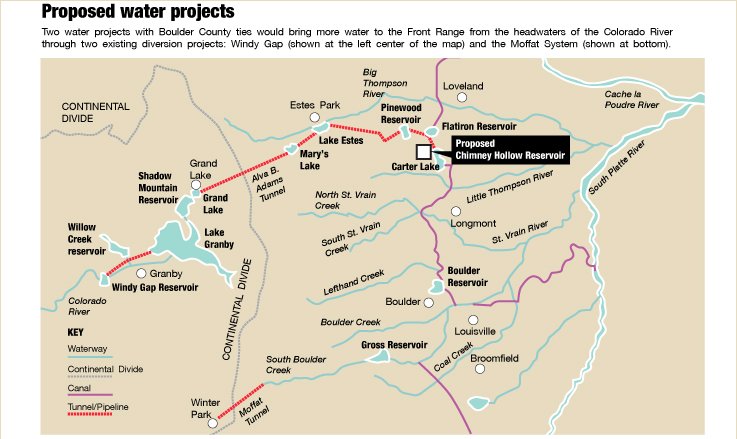
coloradobigthompsonmap.jpg

From email from Reclamation (Kara Lamb):

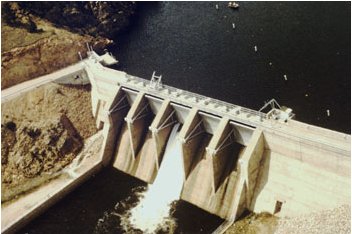
We continue to make adjustments to our releases based on the cooperative efforts of the larger water operators’ community on the Upper Colorado River. Currently, we are releasing about 370 cfs from Green Mountain Dam to the Lower Blue River. There could be additional changes over the weekend.

Boulder County approves and sets conditions for the 1041 permit for Northern Water’s Southern Water Supply Pipeline Project II

southernwatersupplyprojectnorthernwater.jpg

From the Boulder Daily Camera (John Fryar):

Boulder County commissioners on Thursday approved a proposed pipeline that will deliver water from Carter Lake in Larimer County to the city of Boulder, the Left Hand Water District, the Longs Peak Water District and the Town of Frederick.

But the Northern Colorado Water Conservancy District, which is heading up what’s called the Southern Water Supply Pipeline Project II on behalf of the entities that will be getting the water, will have to comply with nearly three dozen conditions that Boulder County is attaching to its approval. The project’s representatives expressed particular concerns about two of those conditions.

One, as recommended by Boulder County Land Use staff, will require the applicants to pay for a county-retained “project overseer” who’d monitor and inspect the work while it’s under way and would have the authority “to alter, direct and/or stop any activity that will result in adverse environmental or safety conditions” or violations of various county permits or “accepted construction standards.” Project proponents indicated discomfort over giving someone the ability to stop all work over issues they said could be resolved without bringing everything to a halt. County commissioners agreed to add language that the overseer couldn’t act arbitrarily. But they said some situations might require emergency work stoppages, rather than awaiting dispute resolution.

Pipeline project applicants also objected to a condition that they pay for the county Parks and Open Space Department to hire someone representing the county, as a landowner, during the project’s construction and reclamation work on county open space lands…

Northern Water’s Carl Brouwer, the project manager, said participants will now meet to work out a timetable for the phased construction of the pipeline, whose advocates have said is needed to improve the quality of the water being delivered, provide a year-round water supply and meet projected increases in demand. Brouwer said it’s been estimated that the work will about $35 million or more once it’s completed. At least some of the new underground pipeline will replace Northern Water’s and water recipients’ reliance of the portion of the current delivery system that channels water through exposed open-air canals that are closed in the winter and that can be polluted by storm runoffs and other surface sources. The new pipeline would run roughly in parallel to the old canal system between Carter Lake and a point near Longmont’s Vance Brand Municipal Airport. From there, it would run southwest to Boulder Reservoir. An eastern spur from the main pipeline would run from a point north of Longmont and go east to Frederick.

More infrastructure coverage here.

Colorado-Big Thompson Project operations update: Pinewood Reservoir water level to rise over the weekend

pinewoodreservoirberthoudrecorder.jpg

From email from Reclamation (Kara Lamb):

We have recently completed some regular maintenance on the east slope of the C-BT. This means that Pinewood Reservoir water levels will once again be on the rise.

Pinewood is expected to start rising late tonight, June 15. By Saturday morning, the reservoir should be only a few feet down from full.

We are also planning to restart the pump up to Carter Lake tomorrow. While this will not bump up the reservoir water elevation level, it will help keep it static, possibly through the weekend. Carter Lake is just over 70% full with a water level elevation of 5729 feet.

Horsetooth Reservoir will continue to see the slow draw down that has been going on throughout June. This is very typical for this time of year. Currently, the reservoir elevation is at 5415 feet. Interestingly, this is one foot higher than Horsetooth’s annual average water elevation line for the beginning of the summer season.

Lake Estes is also looking good for the weekend. Operations at the reservoir and Olympus Dam continue as normal.

For recreation information, please visit Larimer County Division of Natural Resources and the Estes Valley Recreation and Park District.

More Colorado-Big Thompson Project coverage here.

Colorado-Big Thompson Project operations update: Inspection and maintenance work complete, releases dropping from Olympus Dam

olympusdam.jpg

From email from Reclamation (Kara Lamb):

As we continue to make adjustments to the Colorado-Big Thompson project system, there have been some changes to the release from Olympus Dam to the Big Thompson River. Late last night, we dropped the release from 325 cfs to roughly 250 cfs. Tonight, shortly after midnight, we will drop it again to around 125 cfs. The reason for the drop in release amounts is primarily because we have completed the inspections and related maintenance work scheduled for this week.

More Colorado-Big Thompson Project coverage here.

Colorado-Big Thompson Project update: 365 CFS in the Big Thompson River below Olympus Dam

coloradobigthompsonprojecteastslopesystemncwcd.jpg

From email from Reclamation (Kara Lamb):

Just an update on Colorado-Big Thompson Project operations for the Big Thompson River and Pinewood Reservoir:

Tonight, June 11, after midnight, we will bump releases from Olympus Dam on Lake Estes up to 365 cubic feet per second. The increase will be made in several steps of 100 cfs each. As a result, by Tuesday morning, June 12, flows in the river at the top of the canyon should be around 365 cfs. We have had some downstream demands come on and folks need their C-BT water.

Meanwhile, we will also be closing the tunnel that takes water from Lake Estes into the southern power arm of the C-BT project. They will be conducting an inspection. With the tunnel down, Pinewood Reservoir will not have inflow. It will drop, probably about 10 or 12 feet, to a water level elevation around 6565 by Friday morning. It is currently at an elevation of about 6577–three feet from full.

Work should wrap up and the water level start rising again by the weekend.

More Colorado-Big Thompson coverage here.

‘Oil shale development would involve intensive use of water’ — Alan Hamel

oilshaledepositscowyutblmostseis.jpg

From The Pueblo Chieftain (Chris Woodka):

“We have to protect the water we have, as well as provide water for endangered species,” said Alan Hamel, executive director of the Pueblo Board of Water Works and a member of the Colorado Water Conservation Board. “Oil shale development would involve intensive use of water, particularly for use in power generation.” Last month, the Pueblo water board and other members of the Front Range Water Council weighed in on the Bureau of Reclamation’s environmental impact statement for oil shale and tar sands…

The Front Range Water Council includes the major organizations that import water from the Colorado River: Denver Water, the Northern and Southeastern Colorado water conservancy districts, Aurora Water, Colorado Springs Utilities, Twin Lakes Reservoir and Canal Co. and the Pueblo water board. Collectively, they provide water to 4 million people, 82 percent of the population in Colorado.

More Front Range Water Council coverage here and here.

Carter Lake: The Northern Colorado Water Conservancy District dedicates their new hydroelectric generation facility

robertrouthydroelectricplantcarterlake05312012.jpg

From the Loveland Reporter-Herald (Pamela Dickman):

A hydroelectric plant is now up and running at Carter Lake west of Loveland and pumping energy into the Poudre Valley Rural Electric Association grid Dignitaries from Northern Water, which built the plant, the REA, Tri State Generation and even the United States Department of Interior on Thursday dedicated the Robert V. Trout Hydropower Plant not far from the south shore of the lake…

Already, the Colorado-Big Thompson Water that funnels through the Adams Tunnel from the Western Slope to Northern Colorado feed six Bureau of Reclamation hydroelectric power plants and has fed 37 billion kilowatt hours of electric energy into the grid. The new plant, owned and operated by Northern Water, will add 2.6 megawatts of power, or enough to feed 1,000 homes…

The water district named the plant after Trout, a lawyer who has represented the water district for 35 years and whose innovative and tireless efforts helped bring the hydroelectric plant to life.

Here’s the release from the Northern Colorado Water Conservancy District (Brian Werner):

Northern Water dedicated their first hydropower plant today at Carter Lake southwest of Loveland. About 100 people attended the ceremony, which featured Anne Castle, assistant secretary for water and science for the U.S. Department of the Interior, and speakers from several organizations involved in the project.

The project, which started generating power in mid-May, harnesses pressure created by existing releases from the outlet tower at the south end of Carter Lake, a Colorado-Big Thompson Project reservoir. The facility includes two 1,300-kilowatt turbines and connections to the Carter Lake outlet and the St. Vrain Supply Canal. It is expected to produce 7 to 10 million kilowatt-hours of clean energy a year – enough to power about 1,000 homes – sold by the Poudre Valley Rural Electric Association.

“Although the industry classifies this hydro project as small, it’s a really big step for Northern Water. We’re taking energy in the form of pressure that was already there and turning it into marketable power that expands Poudre Valley REA’s green energy portfolio,” said Carl Brouwer, project manager for Northern Water.

Northern Water’s Board of Directors approved a resolution earlier this month to name the facility the Robert V. Trout Hydropower Plant after attorney Bob Trout, Northern Water legal counsel for more than 35 years. Just as he was for countless other initiatives, Trout was instrumental in the development of the hydro project.

The $6 million project received a $2 million low-interest loan through the Colorado Water Resources and Power Development Authority, and Northern Water’s new hydropower enterprise fund is managing a loan for the rest. The project’s projected revenue, which will repay construction costs and cover future upgrades, is about $600,000 a year.

More hydroelectric coverage here and here.

Colorado-Big Thompson Project update: 125 cfs in the Big Thompson River below Olympus Dam

olympusdamrelease062011.jpg

From email from Reclamation (Kara Lamb):

As everyone has likely heard by now, we didn’t have much snow pack this year. As a result, I haven’t had much run-off information to share over the last several weeks. But, now that we are on the brink of summer, I thought a Memorial Weekend update on Colorado-Big Thompson Project reservoirs and operations might be helpful.

Over on the west side of the Continental Divide, we’ve seen a steady release from Green Mountain Reservoir to the Lower Blue River of about 75 cfs. That does not appear likely to change in the near future. The reservoir is currently at a water level elevation of about 7920 feet, that’s about 64% full. That is actually slightly above what we might normally see in late May. This is because run-off in the Blue River Basin started early this year and we began filling at Green Mountain on April 1.

Similarly, storage levels at Granby, Willow Creek and Shadow Mountain reservoirs–where we collect the water that will be diverted to the East Slope–are also slightly higher than is typical for this time of year. Like Green Mountain, that is because we saw run-off start and peak early on the upper reaches of the Colorado River. Currently, Granby has a water level elevation of about 8263 feet, around 79% full, and is releasing about 53 cfs to the Colorado River at the Y gage. In a more normal snow pack year, we’d be releasing 75 cfs at the Y gage.

Willow Creek Reservoir, whose water is pumped up to Granby is about 82% full and Shadow Mountain Reservoir is around 96% full–it usually is.

Following the project over to the East Slope, we have seen fairly typical water elevations in Lake Estes for most of the spring. Releases from the reservoir through Olympus Dam to the Big Thompson River have not fluctuated much, averaging around 120 cfs for the past several weeks. Currently, releases to the Big T are closer to 125 cfs.

Pinewood and Flatiron water levels fluctuate fairly often. Water elevations rise and fall daily, depending on power generation at the Flatiron Power Plant. Over the last couple of weeks, Pinewood’s elevation declined, but we are steadily bringing it back up again. Next week, visitors to both reservoirs might notice some surveying going on. Reclamation employees will be out at the reservoirs looking at sediment.

The pump is on to Carter Lake and its water level elevation continues to rise. It’s currently at an elevation of 5735 feet, about 77% full. While it will go up in elevation a little more, how high it gets now depends on downstream demands. Demands will come up with hot and dry weather.

Horsetooth is in a similar situation. The reservoir saw its highest water level elevation (about 5424) for the summer season at the end of April/early May. It has been slowly dropping this month and is currently around 5419 feet–that’s roughly 87% full. Like Carter, summer water levels at Horsetooth depend largely on downstream demands, which depend largely on weather. We’ll see how hot and dry it gets.

If you plan to visit one of our reservoirs over the holiday weekend, check out its current operations via our Colorado Lakes and Reservoir website. We have up-to-date information posted there.

More Colorado-Big Thompson Project coverage here.

Northern Water ups the Colorado-Big Thompson quota to 100%, lets hear it for storage

coloradobigthompsonprojecteastslopesystemncwcd.jpg

Here’s the release from the Northern Colorado Water Conservancy District (Brian Werner):

A 100 percent quota for Colorado-Big Thompson Project water was approved today by the Northern Water Board of Directors. Their decision bolsters this year’s C-BT water supplies by 31,000 acre feet with a 10 percent increase from the quota set in April.

Despite paltry snowpack and dismal streamflow forecasts, recent abundant water years replenished C-BT reservoirs enough to give directors the option to increase the quota for a second time this year, demonstrating the value of reservoir storage.

Directors based their decision on the agricultural community’s needs for more water as they plan for the crop-growing season. The board concluded that this is the type of year when a 100 percent quota is needed, based on record-low snowpack readings and streamflow forecasts similar to the drought of 2002.

“The smaller agricultural producers need this water this year,” said Don Magnuson, director from Weld County. “We have an obligation to take care of the little guys.”

The C-BT quota sets the percentage of an acre foot that a C-BT allottee will receive during the current water year for every unit of C-BT water the allottee owns. The 100 percent quota means that each unit will yield one acre foot. This is the tenth time the water year’s total quota has reached 100 percent in the C-BT Project’s 55-year history of full water deliveries.

From the Associated Press via CBSDenver.com:

On Friday, the district’s board of directors approved a 100 percent quota so that project allottees can collect a full acre-foot of water for every unit of project water that they own…District directors say they decided to boost the quota from 90 percent in April because they’re concerned about farmers who will need more water after a dry, mild winter.

More Colorado-Big Thompson Project coverage here.

Colorado TU Gives Conservation Award to Grand County

grandlake.jpg

Here’s the release from Colorado Trout Unlimited (Randy Scholfield):

Colorado Trout Unlimited today announced that Grand County government – led by County Commissioners Gary Bumgarner, James Newberry, and Nancy Stuart – is the recipient of TU’s 2012 Trout Conservation Award for its work protecting the Upper Colorado River watershed in the face of Front Range water diversions and other threats.

The award is presented each year to recognize outstanding achievements in conserving Colorado rivers and trout habitat.

“I have never seen a local government place the level of attention, resources, and overall emphasis on river conservation as has been the case with Grand County over the past five years,” said David Nickum, executive director of Colorado Trout Unlimited. “Commissioners Bumgarner, Newberry and Stuart, and County Manager Lurline Curran, have worked tirelessly to preserve healthy river flows along with the wildlife, local communities, and quality of life that depend on them. They have been true champions for the Colorado headwaters.”

“As a resident of Grand County for 40 years, and as a father who wants his children and their children to experience the same natural wonders that I’ve enjoyed here over the years, I am deeply appreciative of the unified effort from our commissioners and staff in their fight to save our rivers and lakes,” said Kirk Klancke, president of the Colorado River Headwaters Chapter of TU. “I am proud of my county for having courageous leaders like these, who are an example to all of the Davids that are facing Goliaths.”

Nickum called Grand County “a longstanding and valued partner” with Trout Unlimited in working to protect and restore the Upper Colorado River watershed. He noted that Grand County officials have invested more than $3 million into assessing and addressing the needs of its rivers, and spent thousands of hours negotiating with Front Range water users and advocating to federal permitting agencies for better protections for the Upper Colorado River watershed.

Among other accomplishments in the past year, Grand County (along with other west slope governments and Denver Water) unveiled a historic “cooperative agreement” that includes many important benefits for the Colorado River and its tributaries, including millions of dollars for river restoration and environmental enhancement; 1,000 acre-feet of water to help with low flows in the Fraser River watershed; guarantees that the vital Shoshone call continues to operate in the future to keep water in the Colorado River year-round; and an agreement that any future transbasin projects will only be pursued with the consent of the West Slope. The agreement is also important in establishing a stakeholder partnership called “Learning by Doing” to provide ongoing monitoring of river health to ensure adequate protection measures.

Grand County has also worked with the Northern Colorado Water Conservancy District to use Windy Gap pumping capabilities to re-manage some “excess” water for the benefit of flows in the Colorado River and has filed for a Recreational In Channel Diversion to help support a new in-river water right on the Colorado mainstem.

Moreover, Grand County leaders are negotiating with Northern for enhanced funding for river restoration projects—including a needed bypass around Windy Gap Reservoir to improve Colorado River habitat—and additional water for use in Grand County to boost flows and river health. Grand County is also promoting an agreement to release water for endangered fish in the downstream Colorado River out of Granby Reservoir – thereby benefiting the Colorado through miles of key trout habitat – instead of releases solely from Ruedi Reservoir, as has been done in the past.

For all the progress in recent years, the health of the Upper Colorado River ecosystem will continue to decline unless further protections are put in place to address looming impacts from two new Front Range diversion projects, Denver’s Moffat Tunnel expansion and Northern’s Windy Gap Firming Project. Nickum noted that EPA recently issued recommendations that supported Grand County and TU’s case for stronger mitigation on the Windy Gap Firming Project.

“Grand County officials understand that the Colorado headwaters are the lifeblood of their communities and of our state’s tourism economy and outdoor quality of life,” said Nickum. “They have set an example for our public leaders of what strong river stewardship looks like.”

More Colorado River basin coverage here.

Green Mountain Reservoir operations update: 75 cfs in the Lower Blue River below the dam

greenmountainreservoir.jpg

From email from Reclamation (Kara Lamb):

This morning, we had a slight change in releases from Green Mountain Dam to the Lower Blue River. To meet a call for water, we bumped releases up by 15 cfs. That means there is now approximately 75 cfs in the Lower Blue below the dam.

Meanwhile, the road across Green Mountain Dam is still closed as we upgrade the bridge. Access below the dam and to the Town of Heeney is open by driving around the reservoir from the south.

More Green Mountain Reservoir coverage here and here.

Colorado-Big Thompson Project update: 124 CFS in the river below Olympus dam

olympusdamrelease062011.jpg

From email from Reclamation (Kara Lamb):

The continuing heat is generating some early season run-off. With highs in the low 80s, we are anticipating some run-off tonight down the Big Thompson River and into Lake Estes. We will bypass that increase through the dam, on down the Big Thompson Canyon. Around midnight tonight, April 23, we anticipate bumping releases up to about 150 cfs.

Earlier this month, I e-mailed that we were increasing releases from Olympus Dam to the lower Big Thompson River for similar reasons. Since that time, releases from Olympus Dam have averaged about 127 cfs. They’ve gotten as high as 159 cfs and dropped down to about 112 cfs. Currently, we are releasing about 124 cfs.

It is likely these types of fluctuations will carry on into May.

Please keep in mind that we typically make our adjustments late at night; so, the river might look different in the morning than it did the night before.

More Colorado-Big Thompson Project coverage here.

Loveland: The Spring Waterway Cleanup attracts 350 people, ‘It’s amazing how dirty it gets’ — Lynn Adame

lovelandspringwaterwaycleanup04212012reporterherald.jpg

From the Loveland Reporter-Herald (Shelley Widhalm):

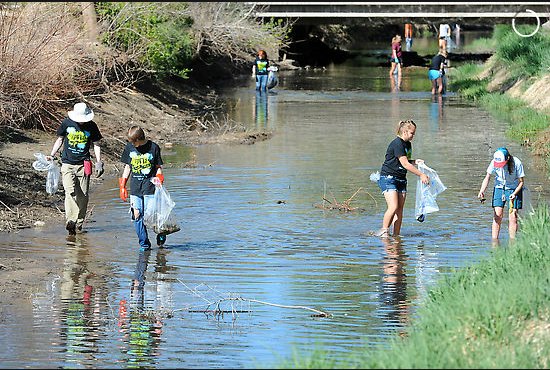
“I love to be out here by the river,” said Waneka, a member of National Honor Society like his peers who came out that day. “Everybody sweeping in, getting every bit of trash, it makes a world of difference. It looks like nature and less like a river in the middle of the city.”

An estimated 350-plus people met at five cleanup stations throughout Loveland, coming alone, with friends and family, or as part of civic, school or community groups to help protect and improve the local waterways.

“It’s amazing how dirty it gets. We clean it every year, and every year, we find more stuff,” said Lynn Adame, a city employee helping out at the Loveland Civic Center station.

For three hours, the volunteers removed trash from the Thompson River, Jayhawker Ponds and other lakes, creeks and ditches in Loveland. They found a few large items, including shopping carts, a toilet, a vacuum cleaner and car tires, along with bottles, cups and cans, pieces of plastic, metal objects, barbed wire, tarps and trash bags…

Eight-year-old Travis Hallmark’s finds included cans and plastic.

“I love the Earth, and I don’t want it to go to waste,” the second-grader said. “I want to clean the river so animals don’t die from the garbage.”

Joe Chaplin, storm water quality specialist for the city, said the volunteers collected fewer large items than they did in past years, though the number of volunteers is comparable — he won’t have a final number of volunteers and the volume they collected until early next week, he said.

More Big Thompson River watershed coverage here and here.

Loveland: Annual waterway cleanup Saturday

lakeloveland.jpg

From the Loveland Reporter-Herald (Jessica Benes):

Volunteers will clean up areas of the Big Thompson River, Dry Creek, Big Barnes Ditch and many more ditches…

Last year, 381 volunteers removed about 93 cubic yards of trash and debris. The stormwater division counts on about 400 volunteers and hopes to reach that number this week, which is when a lot of volunteers sign up.

As part of the stormwater permit through the Colorado Department of Public Health and Environment, the division creates a number of programs like the waterway cleanup to provide for public participation and education.

More Big Thompson River watershed coverage here.

Northern Water’s new Carter Lake hydroelectric plant is scheduled to be online June 1

carterlakehydroelecricinstallation042012reporterherald.jpg

From the Loveland Reporter-Herald (Pamela Dickman):

By June, it will be up and running, adding as much as 2.6 megawatts of power to the Poudre Valley Rural Electric Association grid, or enough to power 1,000 homes.

The water from Carter Lake drops 120 feet to a feeder canal that distributes it to cities and farmers east of Loveland. The kinetic energy unleashed in that drop will now be harnessed and turned into electric power for the grid, all by a simple detour through two turbines built and imported from Gilkes, a company based in Kendal, England.

The twin turbines weigh 10 tons apiece and are connected to generators that tip the scale at 15 tons — equipment held into place by bolts as large and heavy as dumbbells, shipped to Houston by boat then trucked to Colorado along highways. The special equipment arrived Thursday, and a team from Northern Water, Gilkes and Berthoud-based Aslan Construction have been working every day since to get the equipment in place — within a thousandth of an inch. The team is carefully balancing and placing the equipment to work as efficiently a possible.

More hydroelectric coverage here and here.

The Northern Water board sets a 90% water quota, let’s hear it for a good water year last year, and for storage

coloradobigthompsonprojecteastslopesystemncwcd.jpg

From The Fort Morgan Times:

Their decision, which they based on low snowpack and precipitation conditions, bolsters this year’s supplemental water supplies with a 40 percent increase from the initial quota set earlier this water year.

The C-BT quota sets the percentage of an acre foot that a C-BT allottee will receive during the current water year for every unit of C-BT water the allottee owns. The 90 percent quota means that each unit will yield nine-tenths of an acre foot. This is the first year since 1977 that the board set an April quota of 90 percent or above.

Every year the directors base their April quota decision on updated snowpack, precipitation and reservoir storage information while striving to balance the overall needs within Northern Water’s district boundaries.

As of today, snowpack in watersheds integral to C-BT is significantly below average for this time of year, at 34 percent of average in the Upper Colorado River Basin and 53 percent in the South Platte River Basin. To add to that, the year’s precipitation within district boundaries is sitting at 59 percent of the historical average.

Northern Water is also forecasting below-average streamflows this season.

More coverage from the North Forty News (Kate Hawthorne):

The quota will make 279,000 acre feet of C-BT water available to agricultural, municipal and industrial users in the district — a 40 percent increase in supplemental supplies over the initial quota for the 2012 water year. This is the first time since 1977 that the April quota has been 90 percent or above…

“This is one of those years why we have the C-BT,” said Director Kenton Brunner from Weld County in a prepared statement announcing the April quota. “Farmers need to get their crops in and they need the water.” The board can make additional water available anytime through October if they see the need, according to the district.

More coverage from the Loveland Reporter-Herald:

It is the highest amount of water allowed to be released from reservoirs such as Carter Lake and Horsetooth Reservoir in several years…“This will allow the project to do what it is intended to do: Get us through the dry years,” said Director John Rusch, who represents Morgan and Washington counties, in a release from the agency.

More Northern Colorado Water Conservancy District coverage here and here.

Colorado Water 2012: The Northern Colorado Water Conservancy District turns 75 this year

coloradowater2012

Here’s the latest installment of the Valley Courier’s Colorado Water 2012 series written by Brian Werner. From the article:

The rich water development history of the South Platte Basin goes back another 75 years before Northern Water’s creation. In fact the earliest water rights in the basin date to 1861 when the first farmers began diverting water from the Poudre River near Fort Collins.

A little more than a decade later, in 1874, a confrontation between the downstream Greeley residents and the upstream Fort Collins residents led to the codification of the doctrine of prior appropriation and eventually as part of the State Constitution in 1876.

As ditch, reservoir and irrigation companies were developed and canals built during the remainder of the 19th century the region flourished and developed a robust agricultural economy. Beginning in the 1890s and continuing for 20 years, hundreds of storage reservoirs were built to store water for late summer irrigation or for future dry years.

When Northern Water was created in the 1930s as a direct result of the ongoing drought and depression, there were more than 120 ditch, reservoir and irrigation companies in existence within the boundaries of what was to become the Northern Colorado Water Conservancy District.

Northern Water was established under the Water Conservancy Act of Colorado in September 1937. Its first order of business was to work with the Federal government – the Bureau of Reclamation which had been established in 1902 – to build what was to become the largest transmountain diversion project in the state. The project, the Colorado-Big Thompson, was a direct result of the 1930s drought and depression and was viewed as a life saver for the economy of northeastern Colorado…

Today, Northern Water is working through the environmental permitting on two water storage projects – the <a href="Today, Northern Water is working through the environmental permitting on two water storage projects – the Windy Gap Firming and the Northern Integrated Supply projects. When built these will provide an additional 70,000 acre feet of new supply to the region and lessen the pressure on agriculture to supply those needs.”>Windy Gap Firming and the Northern Integrated Supply projects. When built these will provide an additional 70,000 acre feet of new supply to the region and lessen the pressure on agriculture to supply those needs.

More Colorado Water 2012 coverage here.</p

Colorado-Big Thompson Project update: Oil patch water haulers were part of the crowd bidding for regional pool water

hydraulicfracturingrulisonhaliburtonap04152009

From The Denver Post (Bruce Finley):

The Northern Water Conservancy District runs the auction, offering excess water diverted from the Colorado River Basin — 25,000 acre-feet so far this year — and conveyed through a 13-mile tunnel under the Continental Divide. A growing portion of that water now will be pumped thousands of feet underground at well sites to coax out oil and gas.

State officials charged with promoting and regulating the energy industry estimated that fracking required about 13,900 acre-feet in 2010. That’s a small share of the total water consumed in Colorado, about 0.08 percent. However, this fast-growing share already exceeds the amount that the ski industry draws from mountain rivers for making artificial snow. Each oil or gas well drilled requires 500,000 to 5 million gallons of water. A Colorado Oil and Gas Conservation Commission report projected water needs for fracking will increase to 18,700 acre-feet a year by 2015…

Riding his tractor this week, Colorado hay producer Lar Voss, who bid for water at the recent auction, accepted this approach. Voss bid for 100 acre-feet “to be sure I’ve got enough for the crops,” he said. Selling water to those who can pay the most “is what ought to happen.”[…]

At the recent auction, Fort Lupton-based A & W Water Service Inc. bid successfully for 1,500 acre-feet of water, paying about $35 per acre- foot. That’s slightly higher than the market price that irrigators pay for leasing water along the Front Range. The average price paid for water at NWCD’s auctions has increased from around $22 an acre-foot in 2010 to $28 this year.
A & W also leases water from Longmont, Loveland, Greeley and other cities — and hauls it to drilling sites.

More Colorado-Big Thompson Project coverage here.

Colorado-Big Thompson Project update: Northern’s sale of pool water nets $644,142, reservoir combined storage = 75% of capacity

coloradobigthompsonmap.jpg

From the Loveland Reporter-Herald (Pamela Dickman):

The regional water provider, which distributes all Colorado-Big Thompson Water, sold 25,000 acre-feet of water — roughly enough for 50,000 urban households — on Friday because reservoir levels were high enough. The sealed bids brought in $644,142 for the cities and districts that had excess water beyond what they can carry over. The price paid for the water differs among bidders, but the weighted average is $25.77 per acre-foot with the lowest bid at $11.13 per acre-foot and the highest $40…

Even with the sale, there will be plenty of water stored to handle farmers’, cities’ and districts’ needs this spring and summer, said Brian Werner, spokesman for Northern Water.

“We’ve got a good savings account going with storage,” he said.

All the reservoirs that store Colorado Big-Thompson water, including Carter Lake and Horsetooth Reservoir, are sitting at a combined 75 percent of capacity, which is 125 percent of the average amount of water in storage, according to Werner.

More Colorado-Big Thompson coverage here.

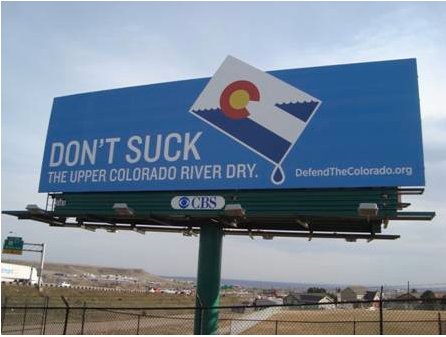
Don’t suck the Colorado River dry billboard part of grassroots campaign to protect the Upper Colorado River

dontsuckthecoloradoriverdry.jpg

Here’s the release from Colorado Trout Unlimited (Randy Schofield):

A coalition of river advocates has unveiled a billboard on I-70 that highlights the threat to the upper Colorado River from massive water diversions to the Front Range—diversions that are sucking the life out of the upper Colorado and degrading irreplaceable mountain areas where many Coloradans love to fish, hunt, and recreate.

The billboard is part of a larger grassroots campaign that is rallying Coloradans to help protect this popular western slope recreation destination.

The billboard, in the foothills of Golden near the 470 exit, shows a state flag image being drained of water and warns, “Don’t Suck the Upper Colorado River Dry.” The message will reach an estimated 180,000 people each day who travel this major east-west corridor.

“Coloradans need to know that the health of the upper Colorado and Fraser rivers is jeopardized by these water diversions,” said Sinjin Eberle, president of Colorado Trout Unlimited. “We’re asking our state leaders to step up and finish the job of protecting these special places.”

For years, large-scale water diversions to Denver and the Front Range have severely depleted and at times nearly sucked dry entire stretches of the upper Colorado River and its tributaries, including the Fraser River. The low flows and higher temperatures have caused dramatic declines in fish and other benchmarks of aquatic health. Low flows have also contributed to the spread of smothering silt and choking algae.

River advocates warn that the proposed expansions of the Moffat Tunnel and Windy Gap diversion projects could push the upper Colorado ecosystem to the brink of collapse unless environmental mitigation plans for the projects contain stronger flow protections for the rivers. Those proposals are currently in the final stages of permitting and under review by federal regulators.

The billboard is aimed at the tens of thousands of Front Range residents who travel up I-70 each week to hike, ski, fish, raft and play on the West Slope. Outdoor recreation is a $10 billion a year business in the state, supporting 107,000 jobs and generating nearly $500 million in state tax revenues. Many towns in the Fraser and upper Colorado River valleys depend heavily on outdoor tourism for their economic health.

“It’s important that Front Range residents understand the seriousness of these diversion impacts and show their support for healthy rivers,” said Drew Peternell, director of Trout Unlimited’s Colorado Water Project. “We can meet our water needs while preserving our rivers, but that will only happen with stronger protections for the Upper Colorado.”

Gov. Hickenlooper and other state leaders have a responsibility to protect these rivers and the state recreation economy that depends on them, said Peternell.
A 2011 state study that showed stronger measures were needed to keep the upper Colorado system healthy. Moreover, in a recent letter citing that study, the EPA called for a “more robust monitoring and mitigation plan” for the Windy Gap proposal.

The groups are calling on state and federal officials to support stronger protection measures for the upper Colorado, including higher spring flushing flows and a monitoring plan for the river.

“We’re asking Gov. Hickenlooper to speak up for the Colorado River,” said Peternell. “He has an opportunity to be a hero for the river.”

In response to the campaign, thousands of Coloradans have raised their voices for river protection. The Defend the Colorado website features a “Voices of the River” gallery profiling Fraser Valley residents and visitors who speak eloquently about their concern for the river. Moreover, thousands of Coloradans and more than 400 businesses have signed petitions asking state leaders to protect the rivers and state tourism.

“These are special places,” said Jon Kahn, owner of Confluence Kayaks in Denver. “Many Coloradans live here because of our state’s magnificent rivers and recreation opportunities. That quality of life is at risk unless our leaders act.”

To learn more about diversion impacts on the river and how you can raise your voice to help, go to www.defendthecolorado.org

More coverage from Bob Berwyn writing for the Summit County Citizens Voice. From the article:

From all the feel-good language about a global solution and Front Range-West Slope collaboration, you’d never know that there’s a bitter war being waged over what’s left of the Colorado River. A coalition of river advocates hopes to cast a spotlight on the fight with a new billboard going up along I-70, where mountain-bound travelers will see the bold message, “Don’t Suck the Upper Colorado River Dry.”[…]

At issue is a pair of planned new diversions, based on existing water rights, by Denver Water and the Northern Colorado Water Conservancy District that would further deplete the Colorado River’s native flows.

Northern’s Windy Gap firming project would divert water through the Colorado-Big Thompson system to a proposed new reservoir on the northern Front Range, southwest of Loveland.

Denver Water’s Moffat Collection System Project would produce 18,000 acre-feet of new supply by expanding Gross Reservoir, near Boulder.

Both projects are under review, and Colorado has developed mitigation plans that address at least some of the potential impacts. The state’s water establishment claims the mitigation plans will not only protect the Colorado River from new impacts, but actually improve existing conditions. Environmental advocates are skeptical, and are asking for additional specific mitigation and monitoring, and recently got some backing from the EPA, which pointed out weaknesses in the proposed mitigation plans…

River advocates warn that the proposed expansions of the Moffat Tunnel and Windy Gap diversion projects could push the upper Colorado ecosystem to the brink of collapse unless environmental mitigation plans for the projects contain stronger flow protections for the rivers. Those proposals are currently in the final stages of permitting and under review by federal regulators.

More Colorado River basin coverage here.

Windsor: Sales of water for hydraulic fracturing operations is a growing source of revenue

marcellushydraulicfracturing.jpg

From the Fort Collins Coloradoan (Bobby Magill):

After years of selling small amounts of municipal water to construction firms, oil and gas well servicing companies started lining up in November at the [Windsor’s] fire hydrants, earning the community nearly $17,000 in millions of gallons of water sales as of March. 1…

Fracking is a thirsty process, with each Niobrara frack job using an average of 4.3 million gallons of water, or about 13 acre-feet, according to the Colorado Oil and Gas Association. Where that water comes from and where it goes is critical because many environmentalists are sounding alarms about the amount of water being used for drilling along the Front Range because they say it poses serious future water supply problems as the energy industry continues to boom here.

But the state begs to differ. Colorado energy regulators project that roughly 16,000 acre feet of water will be used this year for fracking statewide, most of which will stay far underground without being returned to a local stream or river. Compare that to the 13.9 million acre-feet of water used for farming in Colorado each year. Or the 1.2 million acre-feet of water all the state’s cities use each year. Those figures show that fracking represents only a fraction of the state’s overall water demand, said Thom Kerr, acting director of the Colorado Oil and Gas Conservation Commission…

The Coloradoan asked 32 municipalities in Larimer and Weld counties to report how much bulk municipal water they sold or rented to the energy industry in 2011, including oil and gas companies and their water haulers. Of the 26 that responded, seven were able to report selling water specifically to oil and gas companies and water haulers. The rest either did not sell water to the energy industry last year or do not track what kind of companies buy their water…

Greeley, in the heart of Northern Colorado’s oil and gas patch, is another big benefactor of the industry’s thirst for water. The city made $1.6 million in 1,507 acre-feet of bulk water sales in 2011, up from $951,000 in 2010, mostly to the oil and gas industry, said Jon Monson, director of Greeley Water and Sewer…

Also reaping big benefits from selling water to the energy industry is the city of Fort Lupton in southern Weld County, where officials are using the windfall of cash to pay down $20 million in debt the city racked up from replacing its water treatment plants in the 1990s, Fort Lupton city administrator Claud Hanes said…

“They don’t understand what the cumulative impact is going to be if we put in another 100,000 wells,” said environmentalist Phillip Doe of Littleton, a former environmental compliance officer for the U.S. Bureau of Reclamation. If all the wells that exist today were fracked multiple times, “it’s not hard to come up with calculations that come up with Denver’s annual water use. This stuff goes underground and never comes back.”

More oil and gas coverage here and here.

Colorado-Big Thompson Project update: Reclamation is moving water to Carter Lake

coloradobigthompsonprojecteastslopesystemncwcd.jpg

From email from Reclamation (Kara Lamb):

A busy maintenance season that has continued from late fall well into the New Year is starting to wrap up. As a result, we have started pumping water up to Carter Lake again. Also, the water elevation at Horsetooth Reservoir is higher than is typical for this time of year.

More Colorado-Big Thompson Project coverage here.

Today: ‘Rally for the River II’ — Conservationists hope to get Governor Hickenlooper’s ear regarding the Windy Gap Firming Project

windygapmoffatfirmingboulderviewpoint.jpg

From The Denver Post (Scott Willoughby):

Building on the boisterous success of last month’s Rally for the Upper Colorado River at the Environmental Protection Agency building in Denver, a coalition of conservationists hoping to derail a pair of transmountain water diversion projects is taking its message to Gov. John Hickenlooper’s doorstep today. Sportsmen, boaters, wildlife enthusiasts and others concerned about the collapsing upper Colorado River are being encouraged to meet outside the Capitol at 11 a.m. for Round 2.

The EPA, apparently having heard Defend the Colorado’s message, recently issued a letter to federal permitting authorities at the Bureau of Reclamation and U.S. Army Corps of Engineers raising concerns of “critical adverse impacts” resulting from the Northern Water Conservancy District’s Windy Gap Firming Project. The agency determined the proposal to divert up to 67 percent of the upper Colorado River’s natural flows into a tunnel across the Continental Divide may cause “significant degradation” to the struggling river and recommended “a more robust monitoring and mitigation plan” to protect it. Now it’s the governor’s turn.

As reported last week by Bruce Finley of The Denver Post, state officials stand behind Hickenlooper’s contention that Northern Water’s current plan to pull an extra 21,296 acre-feet of water a year from the Colorado River near Granby “comprehensively addresses impacts to Colorado’s fish and wildlife.”[…]

To their credit, Northern and Denver Water both bolstered mitigation efforts while seeking approval of their respective projects by the Colorado Wildlife Commission last summer. Northern has committed $250,000 to study a possible bypass around the Windy Gap Reservoir, a collection pond that pumps water back uphill.

With the federal permit decision looming, the governor can expect to be asked to help broker an agreement making the bypass a reality. He might also be asked to explain his April comment: “This state has to realize, people in the metropolitan Denver have to realize, that their self-interest is served by treating water as a precious commodity and that its value on the Western Slope is just as relevant as its value in the metro area.”

More coverage from Alan Prendergast writing for Westword. From the article:

…environmentalists say the further depletion of the river will alter the temperature, kill fish and insects that a healthy river needs, increase sediment — and generally trash the tourism business for folks in places like Fraser and Granby. A state study found a dramatic drop-off in aquatic insect species over the past two decades from previous diversions, and a recent EPA report is calling for more study and better monitoring of the project.

Opponents say the Upper Colorado can survive additional Front Range incursions, but only by developing further mitigation measures, including periodic water releases to flush out sediment gathering in the depleted riverway. Hoping to bend Hickenlooper’s ear a bit, speakers at tomorrow’s rally, which starts at 11 a.m., include Drew Peternell of Trout Unlimited and Field and Stream columnist Kirk Deeter.

More coverage from Tonya Bina writing for the Sky-Hi Daily News. From the article:

In a letter to the Army Corps of Engineers and the Bureau of Reclamation, both dated Feb. 6, the agency outlined its concerns with the proposed Windy Gap Firming Project, saying more mitigation needs to be tied to an upcoming record of decision.

Among recommendations, the agency would like to see a bypass channel constructed around Windy Gap Dam for times when the Northern Colorado Water Conservancy District and municipal subdistrict are out of priority.

The bypass channel was identified in a 2011 report by researchers of division of the Colorado Parks and Wildlife. The report spells out ongoing problems in the Upper Colorado River basin that have been worsening over the past half-century, primarily chronic sedimentation, high temperatures and a lack of high flushing flows that have already caused the disappearance of the mottled sculpin, a native fish.

“Two things must be done if there is to truly be any hope of enhancement of aquatic ecosystem in the upper Colorado River in the future,” the 2011 Nehring Parks and Wildlife study reads. “A bypass channel around Windy Gap Dam and a major investment in stream channel reconfiguration for the Colorado River below Windy Gap Dam are both equally important and the only way true enhancement has any possibility of success. Either one without the other will have virtually no chance of succeeding.”

More Windy Gap coverage here and here.

The EPA recommends more protection of the Upper Colorado River in light of the proposed Windy Gap Firming Project

windygapreservoirnorthernwater.jpg

From The Denver Post (Bruce Finley):

An Environmental Protection Agency review of data used in planning the project found mathematical errors and a downplaying of “critical adverse impacts” from the $270 million project, which Colorado leaders consider crucial for millions of residents. EPA reviewers cited a separate 2011 state study that documented the disappearance of all native sculpin fish and 38 percent of aquatic insect species over 20 years as a result of existing water diversions.

An EPA document, sent to federal permitting authorities last week, recommends further analysis of the Northern Water Conservancy District’s Windy Gap Firming Project to prevent new violations of state water-quality standards and “a more robust monitoring and mitigation plan” to protect the river. “The EPA has not recommended delaying this project,” EPA regional administrator Jim Martin said. “Our recommendations are intended to provide a path forward that also protects the Colorado River…

Conservation groups say the EPA review backs what they have been saying for years. They are hoping the report will bolster their push for a bypass around Windy Gap Reservoir, which has broken the flow of the river. They also want to make sure at least 2,400 acre-feet of water — or 1,200 cubic feet per second — is released every other year to clear sediment. The state’s own study found such flushing flows are essential. But the Northern Water Conservancy District has agreed to devote only about half that much water to ensure ecosystem health.

“This project could be done in a way where the Front Range gets its water and the river is protected. But to do that, we need more mitigation and monitoring. You have to make sure you have enough high flows,” said Trout Unlimited attorney Mely Whiting. “Our hope is to have folks see the light on this and come to an agreement. Litigation is an option.”

More Windy Gap coverage here and here.

Northern Water nixes use of Colorado-Big Thompson Project water for hydraulic fracturing outside of project boundaries

coloradobigthompsonin2007

From KUNC (Nathan Heffel):

Northern Water is cracking down on oil and gas companies using its water for hydraulic fracturing. The agency says its water cannot be used for fracking operations outside of the district boundaries. Brian Werner, with Northern Water says they have no knowledge of this happening but, “With all the trucks out there hauling water in Weld County and elsewhere that it is apt to.”

More oil and gas coverage here and here.

Rocky Mountain National Park: Lily Lake Dam in need of repairs

lilylakermnp.jpg

Here’s the release from Rocky Mountain National Park (Kyle Patterson):

The Lily Lake Dam, located in Rocky Mountain National Park, has been rated a high-hazard dam by the U.S. Bureau of Reclamation. Failure of the dam is not imminent, and park staff are evaluating long term solutions; considering two options to reduce the risk, either repairing or removing the dam. Until a long term solution is implemented, the dam will be regularly inspected and monitored, and a pump has been purchased to lower the lake level in the event of a significant weather event.

The Lily Lake Dam is situated at the headwaters of Fish Creek, which flows into Lake Estes in Estes Park. Fish Creek is about 5 miles in length and the elevation difference between Lily Lake and Lake Estes is about 1,500 feet. If the dam were to fail, the ensuing floodwaters could result in the loss of life and property along Fish Creek. Repairs are needed to the dam to reduce the hazard, or the dam could be removed and the area restored to natural conditions.

Lily Lake, located along Highway 7, has become a popular recreational area in Rocky Mountain National Park. The lake sits in a beautiful mountain setting, surrounded by an accessible trail. The lake is a popular fishing spot and is stocked with greenback cutthroat trout, a federally listed threatened species.

Park staff are seeking the public’s input on two long term alternatives. Both repairing and removing the dam would involve several steps. The estimated cost of repairing the dam is approximately $1.4 million, with additional annual costs to maintain and monitor the dam. The estimated cost of removing the dam would be approximately $150,000. If the dam is removed, the resulting lake would be about 14 acres in surface area and would contain about 39 acre feet of water. If the dam remains in place, the lake would be about 17 acres in surface area and contain about 75 acre feet of water.

To learn more about Lily Lake, the dam and possible consequences for both actions, please go to: www.nps.gov/romo/parkmgmt/lily_lake_dam.htm

If you have Internet access, the preferred method for submitting comments is to use the National Park Service Planning, Environment and Public Comment (PEPC) website: http://parkplanning.nps.gov/romo.

From this site, select the Lily Lake Dam Project. Your comments can be submitted online.

You can also submit your comments in the following ways:

By email:e-mail us

By Mail: Superintendent, Rocky Mountain National Park, Estes Park, Colorado 80517

By Fax: (970) 586 -1397

By Express Delivery: Superintendent, Rocky Mountain National Park, 1000 Highway 36, Estes Park, Colorado 80517

Hand Delivery: Rocky Mountain National Park Headquarters, 1000 Highway 36, Estes Park, Colorado or to Kawuneeche Visitor Center, Rocky Mountain National Park, 16018 Highway 34, Grand Lake, Colorado

Some possible questions to consider when conveying your comments:

1. Which alternative do you favor? Repair the dam or remove it?

2. Why did you choose the alternative that you favor?

3. What are the reasons why you did not choose the other alternative?

4. Do you have any concerns about the alternative you favor?

5. Have we overlooked something important that we should be aware of?

6. Are there any other ideas or observations you would like to share about this project?

If you do not have internet access and would like a copy of the detailed information that is posted on the park’s website, please call the park’s Information Office at (970) 586-1206. Please note that comments should be received in writing by close of business on February 29, 2012.

More coverage from the Associated Press via The Denver Post. From the article:

Park engineers say failure of the dam is not imminent, but a long-term solution is needed. Options include repairing or removing the dam. In the meantime, the dam will be regularly inspected. The dam is located at the headwaters of Fish Creek, which flows into Lake Estes in Estes Park.

More infrastructure coverage here.

Northern Water’s new hydroelectric facility at Carter Lake should be online this summer

carterlakenorthernwater.jpg

From the Loveland Reporter-Herald (Pamela Dickman):

Northern Water, which distributes all the Colorado-Big Thompson water, is building a $6 million hydroelectric plant at Carter Lake. The district invested $4 million and borrowed $2 million from the Colorado Water Resource and Power Development Authority — a loan that will be paid back with profits from the sale of the power. The building to house the equipment that will transform the pressure from the water into electricity is nearly complete. And the actual generation turbines are on order from a company in England. They are expected to arrive in Colorado by March, and crews will install them in the new building. By June, the plant should begin adding electricity to the grid for Poudre Valley Rural Electric Association, which signed a 20-year contract to buy the water power. The plant could produce up to 2.6 megawatts of power — enough to serve 1,000 homes.

More Colorado-Big Thompson Project coverage here.

Colorado-Big Thompson Project update: Reclamation plans to start filling Mary’s Lake on December 26

maryslakepowerplantncwcd.jpg

From email from Reclamation (Kara Lamb):

As we near the Holidays, we near the wrap up of annual maintenance on the Colorado-Big Thompson Project. Immediately following Christmas, we will begin bringing water back through the east slope of the C-BT system.

Marys Lake, which has been drawn down for annual maintenance at the power plant, will begin to fill again starting December 26.

Operations at Lake Estes, which has maintained average water level elevations through most of December, will be unchanged.

Next week, the Pole Hill Canal, which helps bring water from Lake Estes to the C-BT’s southern power arm, will start to water up again, in stages. Our contractor on that project has finished work early and we will be testing the canal the last week of the year. Check out the news release announcing the project’s completion.

As Pole Hill Canal waters up, the water level at Pinewood Reservoir will slowly start to rise.

The water elevation at Carter Lake has continued to slowly drop as we have run Unit #3 in reverse to generate hydro-electric power and also send water down the canal towards Horsetooth. Next week, Unit #3 will be on and off as a power generating unit. On December 30, however, we have scheduled to switch back to pump mode and water will once again pump up to Carter Lake.

A little bit of water will continue going to Horsetooth Reservoir via the Charles Hansen Feeder Canal. Horsetooth is still high in water elevation for this time of year. It is currently at an elevation of about 5408 and did not drop below 5400 in 2011. That is unusual.

Northern Water is seeking to make sure that Colorado-Big Thompson Project water is not used outside the project boundaries

coloradobigthompsonin2007

From the Northern Colorado Business Report (Steve Porter):

The rule, proposed by the district’s board of directors, is intended to keep cities and towns and others with C-BT water rights from selling the water for use outside the district. In this case, that means selling it to oil-and-gas companies or water haulers who intend to use it on hydraulic fracturing – or fracking – operations in the region. Federal and state laws prohibit the use of C-BT water outside the district, but oil-and-gas companies and the water haulers who serve them have been eagerly buying water from any source available to them.

Brian Werner, Northern spokesman, said the rule was proposed because the district has been contacted by some of the 33 communities it serves about whether selling C-BT and Windy Gap Project water is allowed under their contracts. “My guess is the vast majority of them have been approached by water haulers,” he said…

Northern’s proposed rules explicitly target the use of C-BT and Windy Gap water: “The use of C-BT Project water and the first use of Windy Gap Project water as well development water cannot and shall not be made for any oil or gas well located outside the boundaries of Northern Water or the Subdistrict.” The proposed rule also calls for the water supplier – city, town or other possessor of C-BT or Windy Gap water – to keep strict accounting records to assure that the water is being beneficially used within district boundaries. Penalties for violating the rules would include the water supplier being fined $500 per acre-foot of C-BT and Windy Gap water illegally delivered to a water hauler. Other possible corrective actions include requiring water suppliers to provide a replacement water supply to Northern Water or the subdistrict…

Werner said Northern’s board will take the matter up again at its Jan. 13 meeting. He said written comments can be submitted through Jan. 3…

While the city of Greeley has become one of the region’s biggest suppliers of water to the oil and gas industry, Longmont, Loveland, Fort Lupton, Frederick and Firestone are also reportedly selling water.

Jon Monson, Greeley’s water and sewer director, said the city has been selling surplus water to the oil-and-gas industry for the last five years, an amount that held relatively steady through 2010 but which jumped by 50 percent this year. “This extra revenue can lower the bond costs and the amount of bonds we need to issue,” he said. “This lowers the cost of the bonds to the ratepayers and will cut down future water bills.”

Here’s the announcement (including to proposed rule) from Northern Water.

Final EIS for Windy Gap Firming Available to Public

chimneyhollowreservoir.jpg

From the Sky-Hi Daily News:

The project’s key feature, construction of Chimney Hollow Reservoir southwest of Loveland, would increase the reliability of the existing Windy Gap Project, which started delivering water to Front Range municipalities in 1985.

The Windy Gap Firming Project is a regional collaboration among 13 growing Northeastern Colorado water providers (Platte River Power Authority, Broomfield, Erie, Greeley, Longmont, Louisville, Loveland, Superior, Central Weld County Water District, Evans, Little Thompson, Louisville, Loveland, Superior, Central Weld County Water District, Evans, Little Thompson Water District, Lafayette and Fort Lupton) who in 2050 face a population totaling more than double what it was in 2005, according to Northern.

Water demand projections for the participants show a storage of 64,000 acre feet in 2030 and 110,000 acre-feet by 2050. Northern Water’s Municipal Subdistrict is coordinating the review on behalf of the providers, who will pay for the estimated $270 million project.

Chimney Hollow would be just west of and slightly smaller than Carter Lake and would be part of Larimer County’s Open Lands Program, with non-motorized boating, fishing and trails.

“We put a lot of time and effort into developing these plans, and we’re proud to say that they will make conditions on the Colorado River better in the future than they are today,” said Jeff Drager, project manager of Northern Colorado Water Conservancy District, in statements released this week.

More Windy Gap coverage here and here.

Windy Gap firming project update: More water for Boulder County

windygapmoffatfirmingboulderviewpoint.jpg

From the Boulder Daily Camera (Laura Snider):

“It’s been a long haul for us, but we see a light at the end of the tunnel,” said Dana Strongin, spokeswoman for Northern Water, which is spearheading the project that will serve a number of local towns, including Louisville, Lafayette, Longmont, Broomfield, Erie and Superior. “We entered into this process in 2003. It takes a lot of work to take this water planning and put it into action.”

The goal of the Windy Gap Firming Project is to make the supply of water from the original Windy Gap project, which was finished in 1985, more reliable. The original Windy Gap project was never able to deliver all the water promised to towns on the Front Range because it has to piggyback on some parts of the Colorado-Big Thompson diversion system to make it across the mountains.

That’s a problem because in wet years — when there’s more water to divert from the river — the Colorado-Big Thompson system doesn’t have room to store the Windy Gap water in its already-full reservoir. During dry years, there’s room to store Windy Gap water, but the project’s water rights are so junior that it can’t draw water from the river.

The key feature of the $270 million firming project, if approved, would be the construction of a new reservoir in Larimer County to solve the storage problem. The proposed Chimney Hollow Reservoir would sit just west of Carter Lake and have a capacity of 90,000 acre-feet. The water to fill the reservoir would largely be pumped through existing pipes and canals.

Environmentalists have been concerned about the effects the Windy Gap project could have on the upper reaches of the Colorado River, which already has been severely depleted. In particular, they worry that taking more water from the headwaters of the Colorado will cause an increase in water temperature, which can be lethal for fish, and a decrease in “flushing flows,” which are critical for cleaning out the sediment that can armor the bottom of riverbeds, smothering aquatic insects.

When the Draft Environmental Impact Statement for the Windy Gap Firming Project was released in 2008, Trout Unlimited was one of the groups that said the document was inadequate. Now, the nonprofit organization says the final version of the document is an improvement over the draft, though still not good enough.

More Windy Gap coverage here and here.

Denver: Hydraulic fracturing disclosure rulemaking moved to Tuesday, December 13

cityparksunrise.jpg

Here’s the release from the Colorado Oil and Gas Conservation Commission (Todd Hartman):

The Parties to the Colorado Oil and Gas Conservation Commission’s hydraulic fracturing disclosure rulemaking are engaged in discussions to attempt to resolve the remaining rulemaking issues. To allow these discussions to continue, the continuation of the Rulemaking Hearing will move from 8:00 a.m. Monday at the COGCC hearing room, to 8:00 a.m. Tuesday at the COGCC hearing room. The COGCC hearing room is on the 8th floor of the Chancery building at 1120 Lincoln St. in Denver.

The Commission’s regular December hearing will still commence at 1:00 p.m. in Greeley, on Monday Dec. 12, as previously scheduled. The Greeley meeting will be held at the Weld County Administration Building, 1150 O Street.

More coverage from The Wall Street Journal (Stephanie Simon And Daniel Gilbert). From the article:

The proposed Colorado regulations also would allow companies to withhold some chemical names from public disclosure, since trade secrets are protected by both federal and state law. But at an emotional 11-hour hearing last week, environmental activists pleaded with state officials to limit that privilege. The activists renewed that call on Friday, in light of the EPA’s findings in Wyoming. “That should be a gut check for the state,” said Mike Chiropolos of Western Resource Advocates, an environmental group in Boulder, Colo…

Industry executives in Colorado say they do support some mandatory disclosure. But they have resisted some of the specific proposals pushed by environmentalists, such as a requirement that they publicly disclose the concentration of each chemical in their fracking fluid. They say that would in effect give a recipe book to rivals looking to copy their technique.

The state’s regulatory body, the nine-member Oil and Gas Conservation Commission, will debate the issue on Tuesday. Also up for debate: whether private citizens should be able to challenge drilling companies over their use of the trade-secret privilege to withhold chemical names.

More coverage from Alan Prendergast writing for Westword. From the article:

The EPA draft report comes after three years of resident complaints about fouled drinking water around the town of Pavilion in west-central Wyoming, where the gas giant Encana operates 169 production wells. Monitoring wells detected numerous chemical compounds used in the fluids energy companies inject into the ground to force out pockets of oil and gas, including benzene and toluene. “Given the area’s complex geology and the proximity of drinking water wells to groundwater contamination, EPA is concerned about the movement of contaminants within the aquifer and the safety of drinking water wells over time,” the agency noted in a statement on the report.

Environmental activists contend that the Pavilion results show that the industry’s claims about the safety of the process are overblown. While supporters of fracking say the chemicals are injected thousands of feet below aquifers and can’t possibly reach them, the Wyoming wells were fracked at a shallow level, around a thousand feet below the surface, and the casing that’s supposed to protect the groundwater went down less than 400 feet.

But at least Wyoming officials know what toxic chemicals the company was using. The Cowboy State passed a law last year requiring the companies to disclose their fracking recipes, while Colorado is still mulling over such a measure.

More coverage from David O. Williams writing for the Colorado Independent. From the article:

Colorado’s conservation community wants to make sure oil and gas regulators get it right the first time Tuesday when they decide on a new hydraulic fracturing chemical disclosure rule. Otherwise, they say state officials should keep working on the new rule.

And getting it right means taking into consideration new U.S. Environmental Protection Agency (EPA) findings in Pavillion, Wyo., showing chemicals used in fracking present in groundwater testing wells near where residents have been warned not to drink their tainted well water.

Getting it right also means pre-disclosure of chemicals before fracking (which is required in Wyoming and Montana), full disclosure of any toxic chemicals (no trade secret exemptions) and full public access (requiring immediate website access so the public can sort by type of chemical, date and location of a frack job). In its draft rule, the Colorado Oil and Gas Conservation Commission (COGCC) may not require full sorting on http://www.fracfocus.org until 2013.

Most of all, says former oil and gas commissioner Trési Houpt, the COGCC should not adopt an inadequate rule on Tuesday in hopes that it can later revisit and correct deficiencies.

More coverage from Joe Moylan writing for the Craig Daily Press. From the article:

“The Environmental Protection Agency and the COGCC are both on public record stating there has never been a case of fracking polluting a water source. I think there is some public misconception that there is this great risk and I think there is a middle ground between the extreme environmental viewpoint and common sense.” — Tom Gray, Moffat County Commissioner[…]

Gov. John Hickenlooper has said oil and natural gas companies need to be up front with state residents about the potential danger hydraulic fracturing poses to ground water reserves. Currently, oil and natural gas companies can voluntarily disclose the fluids used in fracking at http://www.fracfocus.com. The governor wants to make reporting mandatory…

However, the Colorado Environmental Coalition believes the draft rule includes a loophole that would allow oil and natural gas companies to hide certain chemicals from the public by listing them as trade secrets. “We understand the need for trade secrets,” CEC energy organizer Charlie Montgomery said. “Every business needs trade secrets, but we are looking for some type of approval process. The way the rule is currently drafted allows companies to simply ask for the exemption and they’ll get it.”

David Ludlam, executive director of The West Slope Colorado Oil & Gas Association, believes the rule is appropriate in its drafted form. “Stakeholders operating in good faith recognize that all Colorado businesses have reasonable legal protections of research and inventions,” Ludlam said. “Stakeholders not operating in good faith might be tempted to ignore the fact that citizens will have a very clear pathway to challenge trade secrets they believe are not valid…

The CEC, Earthworks Oil and Gas Accountability Project, National Wildlife Federation, San Juan Citizens Alliance and High Country Citizens Alliance pressed the COGCC to close the trade secret loophole through its collective legal representative Earth Justice during Monday’s meeting.

More coverage from the Dallas Business Journal (Matt Joyce). From the article:

Encana Corp. takes exception to an Environmental Protection Agency report that suggests a link between hydraulic fracturing and contaminated groundwater in Pavillion, Wyo., and says the town’s poor water quality has been known since before natural gas development took place there…

Encana has used hydraulic fracturing – the same drilling technique used to develop natural gas in the Barnett Shale of north Texas – to drill natural gas wells in the Pavillion area. Encana sold its Barnett Shale assets in November.

Meanwhile the Northern Colorado Water Conservancy District is laying out new rules for selling water for hydraulic fracturing operations, according to Kirk Siegler writing for KUNC. From the article:

New regulations proposed by Northern Water would ensure that its water is only being leased to fracking companies for use within the agency’s strict boundaries in the South Platte River basin. Much of Northern’s jurisdiction also lies within Weld County where state regulators have permitted some 500 new wells this year alone. “What we’re trying to do is just be proactive,” said Eric Wilkenson, general manager for Northern. “We’ve got a new situation developing that is going to result in an increased water demand, so to address that in a proactive way, we want to put rules and regulations and procedures in place so that we can handle that.”[…]

But oil industry representatives and officials from area cities including Greeley told Wilkenson and the rest of his board Friday that the new regulations are so punitive they could halt the leasing of water for fracking, and curtail economic growth. “This remarkable technology that could help supply domestic energy for many many years to come could be at risk if reliable water supplies are not available to do that,” said Kent Holsinger of the Colorado Oil and Gas Association.

More oil and gas coverage here.

Windy Gap Firming: Recently released final EIS acknowledges potential declines in streamflow in the Upper Colorado River basin

windygapmoffatfirmingboulderviewpoint.jpg

From the Summit County Citizens Voice (Bob Berwyn):

Even more worrisome to conservation advocates are the projected declines in summer flows. Below Windy Gap Reservoir, July flows could drip by as much as 20 percent, according to the Bureau’s study, which also acknowledged that extensive mitigation measures will be needed to protect West Slope aquatic ecoystems…

But the proposed mitigation falls short of what’s needed to protect the Upper Colorado, according to Trout Unlimited, a cold-water fisheries conservation group.

Here’s the release from Colorado Trout Unlimited (Randy Scholfield):

A new federal report on the environmental impacts of a plan to expand the Windy Gap water diversion project in Colorado falls short of recommending what’s needed to protect the fragile Upper Colorado River, according to Trout Unlimited.

The Final Environmental Impact Statement, released by the U.S. Bureau of Reclamation on Nov. 30, outlines the anticipated effects of the proposed project and recommends needed mitigation.

“This new document is an improvement over the previous version in that it acknowledges the Windy Gap project will worsen conditions in the Upper Colorado River and Grand Lake unless measures are taken,” said Drew Peternell, executive director of Trout Unlimited’s Colorado Water Project. However, the mitigation proposed by the bureau falls far short of what is needed and critical problems continue to be ignored. We urge the Bureau to require additional protective measures to preserve this irreplaceable natural resource.”

“Trout Unlimited’s concerns with the Environmental Impact Statement are echoed by the Upper Colorado River Alliance, a nonprofit group that is also seeking to require more mitigation to protect the river,” said Boulder attorney Steven J. Bushong, a representative of the Alliance.

The report comes out as Trout Unlimited is launching a petition campaign to protect the Upper Colorado River and its tributary, the Fraser River, and the mountain communities, businesses, people and wildlife that depend on them. The petition campaign, based online at DefendTheColorado.org, is being spearheaded by Trout Unlimited to engage advocates for the iconic but threatened rivers. The website allows advocates to sign on to a petition that will be delivered to decision makers before the bureau makes a final decision on the Windy Gap project. That decision is expected in early January.

“The good news is that the Bureau of Reclamation’s Environmental Impact Statement says additional mitigation measures may be added before the agency makes a final decision. That highlights the importance of taking action to stand up for the river now,” Peternell said.

Already 60 percent of the Upper Colorado is diverted to supply Front Range water users. The Windy Gap proposal, along with a separate Moffat Tunnel water project, could divert as much as 80 percent of the Upper Colorado’s natural flows. According to Trout Unlimited, steps must be taken to protect the rivers including:

· Managing the water supply to keep the rivers cool, clear and healthy.
· Funding to deepen river channels and create streamside shade.
· Monitoring of the rivers’ health and a commitment to take action if needed to protect them.
· Bypassing the Windy Gap dam to reconnect Colorado River and restore river quality.

“The Final Environmental Impact Statement continues to ignore existing problems that will be made much worse by the Windy Gap project,” said Sinjin Eberle, president of Colorado Trout Unlimited. “A study released by the Colorado Division of Parks and Wildlife earlier this year shows that entire populations of native fish and the insects they feed on have all but disappeared from the Colorado River below the Windy Gap Reservoir. The state study blames the reservoir and the lack of spring flows that clean sediments from the stream beds and warns that expansion of the Windy Gap project poses additional threats to the health of the river and the aquatic life in it.” See http://www.cdphe.state.co.us/op/wqcc/Hearings/Rulemaking/93/Responsive/93rphsTUexG.pdf

The Windy Gap project also impacts the health of Grand Lake. “Grand Lake – once a pristine lake of dramatic clarity and scenic beauty – has become cloudy, weedy and silty because of diversion water pumped into the lake from Shadow Mountain reservoir,” said John Stahl of the Greater Grand Lake Shoreline Association. “Nothing in the FEIS mitigation plan is helpful in addressing the existing problems–at best it maintains the status quo while more likely creating even bigger problems.”

The Environmental Impact Statement indicates that the Bureau of Reclamation will monitor to ensure that mitigation is adequate and will impose additional measures if necessary. “That’s helpful but needs to be more clearly articulated. Another critical addition is the construction of a bypass around the Windy Gap dam,” Eberle added.

The DefendTheColorado.org campaign highlights the people who depend on the rivers.

“The Colorado and Fraser rivers aren’t just bodies of water, they are the lifeblood for wildlife, local communities and the state’s recreation economy,” Eberle said. “But many Coloradans are unaware that these rivers are on the brink of collapse because of diversions. DefendTheColorado.org’s purpose is twofold – to raise awareness about the threats facing the Colorado and Fraser and to give people a way to stand up for our rivers.”

Eberle added, “We can’t afford to let these rivers literally go down the drain.”

A new feature of the website called “Voices of the Fraser” profiles local Fraser Valley residents and visitors who speak eloquently about their connection to the Fraser River and the need to preserve healthy flows. Among the individuals profiled are Olympic skier Liz McIntyre, logger Hoppe Southway and landscape artist Karen Vance.

“It would be a shame to see any of these tributaries dry up just for the sake of developing the Front Range,” said Southway in his profile. “It’s the water my children and grandchildren are going to want to see someday, and I hope it’s protected for future generations.”

Visitors to the site also have added their voices about why the river is important to them.

“I have fished and hiked the Fraser and Upper Colorado river regions for over 30 years and am deeply saddened by the degradation of these great watersheds,” a Golden, Colo., resident wrote.

A Bonita Springs, Florida, resident wrote: “I LOVE fishing that stretch of water and find such a simple peace of being in that area. Please don’t mess with such a special place.”

“As a visitor and fisherman to Colorado on a regular basis, my tourist dollars help the local communities,” noted a resident of Blue Springs, Missouri.

More Windy Gap Firming Project coverage here and here.

Conservationists worry that impacts to the Upper Colorado River basin have not been adequately addressed in the final EIS for the Windy Gap Firming Project

coloradorivergranby.jpg

From The Denver Post (Monte Whaley):

…watchdog groups aren’t satisfied that the impact of the water-storage project on fish and wildlife habitat on the Western Slope has been adequately addressed. The report details how Chimney Hollow will increase diversions and reduce flows in the Colorado River below the Windy Gap reservoir, decrease some fish habitat and affect vegetation, wetlands and wildlife. “We have very serious concerns about this project and its intersection with projects and participants in the Poudre River watershed as well as its potential negative impacts on the Colorado River and Grand Lake,” said Save the Poudre executive director Gary Wockner…

Northern Water — the agency coordinating the project on behalf of 13 Front Range cities and water utilities — says it is working with other groups and agencies to mitigate the impact of the project. “In our minds, we have addressed the impacts, and we have gone through a long public process … to develop measures to protect fish and wildlife,” said project manager Jeff Drager.

More coverage from the Northern Colorado Business Report. From the article:

The FEIS states that the best course of action, according to the Bureau of Reclamation, is to construct Chimney Hollow Reservoir, a proposed 90,000 acre-foot reservoir southwest of Loveland. The construction of Chimney Hollow Reservoir is the project’s key feature and would increase the reliability of the existing Windy Gap project, which started delivering water to Front Range municipalities in 1985…

The FEIS was the last document in the Windy Gap project’s National Environmental Policy Act review. The project is now awaiting an official decision from the U.S. Bureau of Reclamation, which is expected in early 2012.

Participants in the project include: Platte River Power Authority, Broomfield, Erie, Greeley, Longmont, Louisville, Loveland, Evans, Superior, Lafayette and Fort Lupton, Weld County Water District and Little Thompson Water District.

More Windy Gap coverage here and here.

Final EIS for Windy Gap Firming Available to Public

chimneyhollowreservoir.jpg

Here’s the release from Reclamation (Kara Lamb):

The Bureau of Reclamation announces the availability of the Final Environmental Impact Statement on the proposed Windy Gap Firming Project.

To access the Final EIS, Executive Summary, and supporting technical reports please visit www.usbr.gov/gp/ecao. A list of libraries where the Final EIS is available is also included on the website.

To receive a copy of the Final EIS on compact disk, please submit a written request to the attention of Lucy Maldonado through regular mail or e-mail:
Bureau of Reclamation
11056 W. County Rd. 18E
Loveland, Colorado 80537
lmaldonado@usbr.gov

The Windy Gap Firming Project was proposed to Reclamation by the Municipal Subdistrict of the Northern Colorado Water Conservancy District. Reclamation prepared the Final EIS in compliance with the National Environmental Policy Act of 1969.

The Final EIS discloses and summarizes the anticipated effects of the proposed project and four alternatives, including a No Action Alternative. It also recommends a preferred alternative and outlines environmental commitments and mitigations.

More coverage from Tom Hacker writing for the Loveland Reporter-Herald. From the article:

Chimney Hollow, just west of and slightly smaller than Carter Lake, is the key feature of the Windy Gap Firming Project and would store 30,000 acre feet of water. Thirteen municipalities and utilities, including Loveland, share ownership of the project…

The project, like its Colorado-Big Thompson predecessor, would divert Western Slope water from the upper Colorado River Basin to the east slope, where it would be stored at Chimney Hollow and delivered to Front Range water users.

More Windy Gap coverage here and here.

Reflections on the Colorado-Big Thompson Project — W.D. Farr

wdfarrcoloradobigthompsonprojectgreeleywater.jpg

Here’s a video with W.D. Farr explaining the origins of the Colorado-Big Thompson Project. Thanks to Greeley Water for posting the video.

Next year is the 75th anniversary of the 1937 act that established the water conservancy districts and the Colorado Water Conservation Board.

Farr explains that Congressman Taylor would not support the project unless Green Mountain Reservoir — for west slope supplies — was built first.

“The biggest cloud of dust I ever saw came out of that tunnel [Adams Tunnel],” Farr says, “I never saw men so happy in my life.”

More Colorado-Big Thompson Project coverage here.

Colorado-Big Thompson Project update: Winter refill for Carter Lake should start up in December

coloradobigthompsonprojecteastslopesystemncwcd.jpg

From email from Reclamation (Kara Lamb) that was buried in my inbox since last Friday:

As we move into the weekend, we have several operational changes taking place across the Colorado-Big Thompson Project on the east slope.

Visitors to and residents of Estes Park will likely notice that Marys Lake and Lake Estes are gradually going down in water elevation. By the end of next week, Marys Lake will be dropped down for maintenance and inspections. It is anticipated that its water level will begin to rise again by mid-to-late December.

At Lake Estes, the drop in water level is to accommodate some annual maintenance and inspection at Olympus Dam. The reservoir is expected to drop about 12 vertical feet by Monday morning, November 21. It will begin to rise again by late Monday afternoon.

As the water level at Lake Estes drops, the release from Olympus Dam to the Big Thompson River through the canyon will also slowly decline. Today, it dropped approximately 30 cfs from 300 to about 270 cfs. Releases will continue to drop through the weekend and into the top of next week. By Monday night, November 21, releases to the Big Thompson River should be back to normal flows for this time of year, which are approximately 25 cfs.

Diversion from Olympus Dam to the southern power arm of the C-BT is currently off-line while other project maintenance is underway. The contractor continues to work on the replacement of the open-faced Pole Hill Canal, installing closed box culverts. This work is split into two phases, the first of which is being completed this fall and is scheduled to wrap up in mid-December. Attached you will find a photo of the work currently underway along the Pole Hill Canal.

With Pole Hill off-line, no water has been flowing into Pinewood Reservoir, which has maintained a high water elevation through October and well into November. This will change starting Monday, November 21. On Monday, we will begin to draw Pinewood’s water elevation down to accommodate a maintenance project on the Bald Mountain Pressure Tunnel, which carries water from the reservoir to the Flatiron Penstocks. Residents of and visitors to Pinewood will see the water elevation decline through the week, hitting a low of about 6550 by the the following Monday, November 28. It will remain at the low level well into December, until the work on the Pressure Tunnel is complete. We have been in close contact with the Newell-Warnock Water Association at Pinewood so they are aware of these changes to the maintenance schedule.

We are anticipating that the southern power arm of the C-BT will start to “water up” by mid-to-late December.

Meanwhile, water elevations at Horsetooth are still climbing slightly, but will level off as these changes across the project go into effect.

Water levels at Carter Lake are likely to continue dropping, as is typical for this time of year. We anticipate the start of refill for Carter to begin in mid-to-late December, as normal.

From email from Reclamation (Kara Lamb, November 16):

In order to accommodate on-going maintenance at the Shoshone plant, we will reduce our releases from Green Mountain Dam to the Lower Blue River from 300 to 200 cfs. The reduction will be made in two steps of 50 cfs each. This afternoon, we dropped releases to around 250 cfs. Tomorrow morning around 8 a.m. we’ll drop releases to about 200 cfs. We will keep 200 cfs in the Lower Blue through Thanksgiving.

More Colorado-Big Thompson Project coverage here.

DefendTheColorado.org website launches to build awareness of upper Colorado River basin streamflow issues

denverwatercollectionsystemmap.jpg

Say hello to DefendTheColorado.org, a new website designed to connect interested people and raise awareness of the issues around transbasin diversions from the Upper Colorado River here in Colorado. Here’s a report from Tonya Bina writing for the Sky-Hi Daily News. From the article:

For the Trout Unlimted Project, [Editorial Photographer and Videographer Ted Wood of Story Group, Boulder] brought in Boulder colleagues Beth Wald, a photojournalist who of late has been covering environmental and cultural stories in Afghanistan, and Mark Conlin, a seasoned underwater photographer.

“We launched the project as a way to get more visibility of the stream-flow issues on the Fraser and Upper Colorado,” said Trout Unlimited’s Randy Schoefield. “What we’re trying to portray is the community’s deep connection to the river.”

The Story Group plans to add more portraits to the website in coming days and weeks. Eventually, Trout Unlimited hopes to host public events that display the portraits as well as work by other photographers, granting a full sense of the river’s significance in Grand County and the consequences of further transbasin diversions.

Click on the thumbnail graphic above and to the right for a map of Denver Water’s collection system. More Colorado River basin coverage here.

Green Mountain Reservoir operations update: Reclamation is cutting back releases to 600 cfs in the Lower Blue River by Saturday night

greenmountainreservoir.jpg

From email from Reclamation (Kara Lamb):

This morning (October 28), we began curtailing releases from Green Mountain Dam to the Lower Blue River. We are stepping releases down in 50 cfs increments. At 8 a.m., we dropped from 800 to 750 cfs. This evening around 8 p.m., we will drop another 50 from 750 to 700 cfs. We will follow a similar pattern on Saturday. By Saturday evening, releases from Green Mountain Dam will be around 600 cfs. It is likely the reductions could continue to drop during the first week of November. I will keep you posted of future changes.

More Colorado-Big Thompson Project coverage here.

Colorado-Big Thompson Project update: 313 cfs in the Big Thompson below Olympus Dam through the weekend

olympusdam.jpg

From email from Reclamation (Kara Lamb):

This is an update to our fall operations of the Colorado-Big Thompson Project. Tonight, Thursday, October 27, we begin making some changes around the project for our annual maintenance program.

This evening, the pump to Carter Lake will be turned off.

Also tonight, we will begin increasing the releases from Olympus Dam to the Big Thompson Canyon. Changes will be made over a series of intervals beginning at 11 p.m. and ending around 2 a.m. Friday morning. The release below the dam will go from 54 cfs to about 313 cfs. It will stay around 313 cfs through the weekend.

Over the weekend, we will curtail the inflow to Horsetooth Reservoir slightly during some maintenance work. However, inflow to Horsetooth is scheduled to go back up on Monday afternoon, October 31. The reservoir elevation will continue slowly dropping through the weekend and begin rising again on Monday when inflow goes back up.

Water levels at Lake Estes are expected to fluctuate as is normal for this time of year.

More Colorado-Big Thompson coverage here.

Colorado-Big Thompson Project update: Reclamation is gearing up for fall maintenance

coloradobigthompsonmap.jpg

From email from Reclamation (Kara Lamb):

Now that it is fall, we are into our annual maintenance schedule on the east slope of the Colorado-Big Thompson Project. That means there will be some changes across our reservoirs and canals.

The first update is actually a schedule change at Pinewood Reservoir. Previously, I had let you all know that Pinewood was going to be drawn down considerably in November. That is no longer the case. With the changes in place, Pinewood will now be full by October 28 and stay relatively high until the week of Thanksgiving. During that week, testing at the Flatiron power plant below will begin and the water level at Pinewood will slowly drop for about three weeks. At this time, we are anticipating the water level at Pinewood will start going back up in the middle of December.

While the test is going on at Flatiron, the contractor will be busy on the Pole Hill Canal box culvert project. With Pole Hill, Pinewood, and Flatiron under maintenance, it is very likely we will wind up running some water down the Big Thompson Canyon, releasing from Olympus Dam on Lake Estes. After October 28, flows in the canyon could be as high as 350 cfs. They could stay at that level into November.

Meanwhile, pumping to Carter Lake is scheduled to end on October 28. Currently the reservoir water level is slowly rising at a rate of about a tenth of a foot a day.

When pumping to Carter stops, delivery of water to Horsetooth will come back on. Water released from Lake Estes and sent down the Big Thompson Canyon will be recaptured at the Dille Diversion (just upstream of the Dam Store) and sent north to Horsetooth. That means that Horsetooth Reservoir’s water elevation will likely stay above 5400 feet–a very unusual situation. All boat ramps will be in the water all year.

We will likely keep water going to Horsetooth until mid-November.

The second update has to do with C-BT facilities in Estes Park. Annual maintenance at the Marys Lake Power Plant, dikes and related system will draw Marys Lake down to dead storage in the middle of November. While Marys is down, the water level at Lake Estes will fluctuate very little. Marys Lake will start going up again the middle of December, once maintenance work concludes.

More Colorado-Big Thompson Project coverage here.

Colorado-Big Thompson Project update: 200 cfs in the river below Olympus dam

coloradobigthompsonprojecteastslopesystemncwcd.jpg

From email from Reclamation (Kara Lamb):

As we move into fall, we’re seeing some of our late season demands come on downstream of the Big Thompson River. As a result, we’ve been moving some water down from Pinewood, Flatiron and Lake Estes. Each reservoir has seen a slight drop in water elevation.

We have also increased releases from Lake Estes through Oly Dam. Monday night, we bumped releases up 75 cfs. Last night, we bumped up another 50 cfs. Consequently, this morning the Big Thompson through the canyon is flowing at about 200 cfs.

It is possible we could go up another 25 cfs late tonight. But, it is also likely flows will drop back down to below 100 cfs by Saturday morning when it is anticipated delivery of water down the Big T will drop off.

Also from Reclamation (Kara Lamb):

Flows on the Colorado River continue to drop. That means, calls for water along the 15 Mile Reach of critical habitat for the endangered fish are up slightly. As a result we have increased our release from Green Mountain to the Lower Blue. Yesterday around 5 p.m. we released another 50 cfs. That means the Lower Blue is currently around 650 cfs.

More Colorado-Big Thompson Project coverage here.

Colorado-Big Thompson Project update: Pumping resumed September 7 from Shadow Mountain Reservoir into Grand Lake for deliveries to the South Platte Basin

secchidiskprocedure1.jpg

From the Sky-Hi Daily News (Tonya Bina):

In the shallow, “crystal clear” connecting channel of Grand Lake and Shadow Mountain Reservoir, “The day after they started pumping, you couldn’t see the bottom,” said Watershed Program Manager Ben Carver, of the Grand County Water Information Network. Secchi disc measurements back up observances…The Water Information Network’s paid field technician has been sampling clarity at 14 sites of Grand Lake three times per week this summer. In mid-July, the measurements averaged around 20 feet (6.25 meters). On Sept. 10, three days after pumping resumed, the clarity on Grand Lake had been cut nearly in half to an average 11 feet (3.25 meters). The channel became “a bottleneck for all the algae coming into Grand Lake” from shallow Shadow Mountain Reservoir, Carver said.

More Colorado-Big Thompson Project coverage here.

Colorado-Big Thompson Project update: Carter Lake elevation about average, Horsetooth Reservoir a little above average elevation

coloradobigthompsonprojecteastslopesystemncwcd.jpg

From email from Reclamation (Kara Lamb):

There are a few changes coming up for Carter and Horsetooth reservoirs this week. This is just a quick update on what to expect.

Carter Lake is sitting at a fairly average water elevation for this time of year. Full is around 5759 feet above sea level. Currently, the reservoir is at about 5717 feet. This is largely because we have been delivering water from Carter Lake via both the St. Vrain Supply Canal out of Carter Lake Dam #1 and through Unit #3–the reversible pump unit at Flatiron Power Plant.

Normally, Unit 3 is used to pump water up to Carter, filling it, but it can be used in reverse to generate hydro-electricity and deliver water down the Charles Hansen Feeder Canal, which runs all the way to Horsetooth. For the past month, we have been using Unit 3 to meet some water demands downstream of the canal.

That will end tomorrow. On Wednesday, September 14, Unit 3 will go back into pump mode and the water elevation at Carter Lake will likely start rising again.

Meanwhile, Horsetooth is at a water level elevation that is actually higher than average for this time of year. The reservoir is at an elevation of about 5407. All ramps are still in the water–and that is not usually the case after Labor Day.

When the pump to Carter goes on tomorrow, we will be taking a section of the canal which feeds Horsetooth down for annual maintenance. With little water coming into the reservoir, it is likely its rate of drop will increase. The rate of drop will depend on water demands, which are driven largely by the weather. Visitors to and residents around Horsetooth should anticipate that its water level will continue to go down through September and October, as is typical.

More Colorado-Big Thompson Project coverage here.

Colorado-Big Thompson Project update: Horsetooth Reservoir is as full as it has been since 1999

horsetoothreservoir.jpg

From the Loveland Connection (Bobby Magill):

The surface elevation of Horsetooth Reservoir, which stores water from the Colorado River on the Western Slope, is at 5,419 feet, about 11 feet below full pool of 5,430 feet.

The Colorado-Big Thompson Project, of which Horsetooth Reservoir is a part, set an all-time record for in-flows from the Colorado River, he said. Lake Granby, Shadow Mountain Lake and Grand Lake all received 430,000 acre-feet of water from the Colorado River, more than 75,000 acre-feet more than the previous record of 355,000 acre-feet, he said…

Horsetooth and other area reservoirs are full enough to put water managers in a good position to deliver plenty of water to irrigators next year regardless of how snowy the winter is, [Northern Colorado Water Conservancy District spokesperson Brian Werner] said. We’re in good shape,” he said. “We can get by with average or below average winter snows this year and be fine next year.”

More Colorado-Big Thompson Project coverage here.

Green Mountain Reservoir operations update: 750 cfs in the Lower Blue River below the dam

greenmountainreservoir.jpg

From email from Reclamation (Kara Lamb):

Today [August 10], we’re dropping releases from Green Mountain Dam to the lower Blue by another 200 cfs. By late this afternoon, flows in the lower Blue should be around 750 cfs. Inflows to Green Mountain Reservoir are dropping off. As we continue to match outflow with inflow, the reservoir water surface elevation is remaining fairly steady at about 2 feet down from full.

More Colorado-Big Thompson Project coverage here.

Colorado-Big Thompson Project update: Reclamation is moving water from Grand Lake to Shadow Mountain Reservoir to test the effects on Grand Lake clarity

coloradobigthompsonmap.jpg

From email from Reclamation (Kara Lamb):

Even though we finally have the snow melt run-off behind us, we are still releasing water from Granby Dam to the Colorado River. Currently, we are releasing about 500 cubic feet per second. The reservoir is still pretty full, dropping slowly. Today, it is at a water level elevation of 8278 feet above sea level–about two feet below full.

The current release of 500 cfs will continue most likely through September and possibly into October.

The reason for the longer-than-most-years release is two-fold. First, we just have a lot of water this year. The heavy snow pack is still melting out from the highest mountain elevations, albeit much more slowly than in June and July.

Second, and most significantly, with all the snow melt and then the rain we had this summer, there just is not a lot of demand for water from the east slope. Plus, east slope storage is close to full. Without a call for or a place to store C-BT water, we cannot import it from the west to the east slope.

Additionally, this is the time of year we adjust how we run the C-BT west slope system as part of our on-going work to improve clarity in Grand Lake. For the past four years we have experimented with different operations. This year, we are attempting to maintain a steady flow from Grand Lake to Shadow Mountain Reservoir. Usually, the flow is in the opposite direction because we are diverting more water to the east slope.

I have received several questions over the past few days regarding the west slope collection system. Please feel free to contact me directly with any additional questions. More C-BT information is also available by visiting Northern Water on-line, or by visiting Reclamation’s website.

From email from Reclamation (Kara Lamb):

Most of you have probably noticed that Pinewood has not gotten as high this summer as it has in previous years. I’ve had a couple inquiries so I thought it was a good time to send out an e-mail update.

The reason for Pinewood’s elevation fluctuation is because it is a forebay for the Flatiron hydro-electric power plant ; it’s the water storage above a power plant. Water is stored in the reservoir to build up “head,” or energy, then run downhill to produce that energy at the plant below . Because we are only generating with one of the two units and because we have had so much water move through the system this year, Pinewood’s fluctuations this summer have been slightly different than in other summers: it isn’t getting as high as most are used to seeing.

We’re going to try and get the water elevation at Pinewood back up for this weekend, however. Right now, Pinewood’s water surface elevation is on the decline. Its current elevation is about 6567 feet–about 13 feet below full–and it will probably go down another three feet or so. The good news is the decline will stop later today and the reservoir will begin to rise again. The elevation climb will continue well into the coming weekend…

If you’d like more information on the Colorado-Big Thompson Project of which Pinewood is a part, please visit us on-line.

From email from Reclamation (Kara Lamb):

As snow melt run-off has declined in the Blue River basin, we’ve been cutting back our releases from Green Mountain Dam to the lower Blue River. Releases have dropping over the last week.

The most recent change was this morning, calling for another reduction. By early evening, releases from the dam should be around 950 cfs. Additional changes will depend on weather and water demands.

The reservoir elevation has remained very close to full. It is currently at about 7948 feet, two feet down from full.

More Colorado-Big Thompson Project coverage here.

More Grand Lake clarity coverage here. Check out this article from November, 2007 written by Tonya Bina for the Sky-Hi Daily News. I think it’s cool that the deep link still works.

Colorado-Big Thompson Project update: Granby is releasing about 420 cfs

coloradobigthompsonmap.jpg

Just a quick note to update you all on our facilities across the Colorado-Big Thompson Project. I’ve also updated our webpages. Once on our main page, be sure to check out the menu on the left hand side to see information on our other facilities.

Meanwhile, Granby is releasing about 420 cfs.

Willow Creek is releasing about 77 cfs.

Olympus Dam on Lake Estes is releasing about 125 cfs.

All reservoirs are basically full, with the exception of Lake Estes, Pinewood and Flatiron. These three fluctuate often due to hydro-power generation. Pinewood and Flatiron, in particular, might drop significantly over the course of one day, then rise back up again.

More Colorado-Big Thompson Project coverage here.

Northern Colorado Water Conservancy District tour attracts nearly 100 taxpayers, city officials, water district employees and students

coloradobigthompsonmap.jpg

From the Carbon Valley Miner and Farmer (Gene Sears):

Nearly 100 participants attended the tour, a mix of taxpayers, city officials, water district employees and students, split between two buses hired by the district for the trip. Starting at NCWCD headquarters in Berthoud, the tour headed northeast up Big Thompson Canyon, through Estes Park and onto Trail Ridge Road in Rocky Mountain National Park, headwaters for much of the district’s supply…

Built at a cost of $162 million, the project began full water deliveries in 1957. As it stands now, the Colorado-Big Thompson system consists of 12 reservoirs, 35 miles of tunnels, 95 miles of canals and 700 miles of power transmission lines. Spanning 150 miles east to west and 65 miles north to south, C-BT provides water to almost 700, 000 irrigated acres and more than 750,000 people in the South Platte River Basin.

More Northern Colorado Water Conservancy District coverage here.

Green Mountain Reservoir operations update: 2,550 cfs in the Blue River below the dam

greenmountainreservoir.jpg

From email from Reclamation (Kara Lamb):

The releases out of Green Mountain dam to the lower Blue River will be lowered to 2,550 CFS after 4 PM today [July 18].

More Colorado-Big Thompson Project coverage here.