Romancing the River We Have – sort of…. — George Sibley (SibleysRivers.com) #ColoradoRiver #COriver #aridification

Click the link to read the article on the Sibley’s Rivers website (George Sibley):

July 30, 2025

We left the Colorado River a couple months ago to explore the Trumpsters’ effort to use the public lands in the river basin to ‘unleash American energy’ and return us to the glorious age of cheap petroleum – and why it’s not happening. At that time, the seven states in the river’s basin were in a stalemate over a management plan to replace the cobbled together ‘interim’ management guidelines that expire next year. The Trumpsters’ have not interceded noticeably in this situation, since it appears to require complex and sustained thought.

Unfortunately, the stalemate is still the basic situation. As a couple water mavens put it, we’re all still waiting for the black smoke coming out of the chimney to turn white. The Basin’s state representatives are meeting together regularly though, with input from the First People, and reports from the meetings suggest that the participants have all agreed to ‘work with the river we have, not the river we wish we (still) had’ (if we ever actually did have it) – the Colorado River Compact’s river. So a little review here today, to remind us where this puts us….

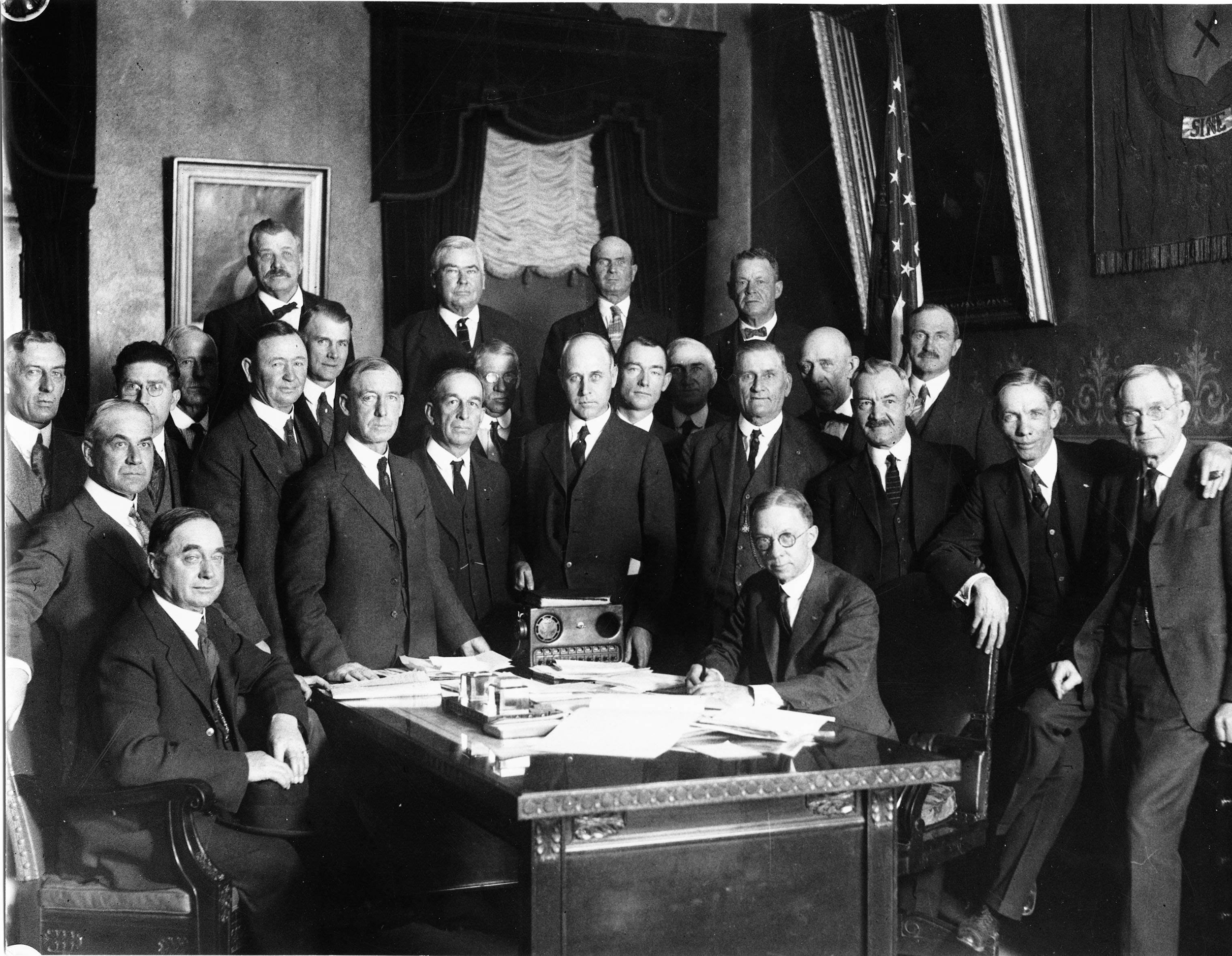
Members of the Colorado River Commission, in Santa Fe in 1922, after signing the Colorado River Compact. From left, W. S. Norviel (Arizona), Delph E. Carpenter (Colorado), Herbert Hoover (Secretary of Commerce and Chairman of Commission), R. E. Caldwell (Utah), Clarence C. Stetson (Executive Secretary of Commission), Stephen B. Davis, Jr. (New Mexico), Frank C. Emerson (Wyoming), W. F. McClure (California), and James G. Scrugham (Nevada) CREDIT: COLORADO STATE UNIVERSITY WATER RESOURCES ARCHIVE via Aspen Journalism

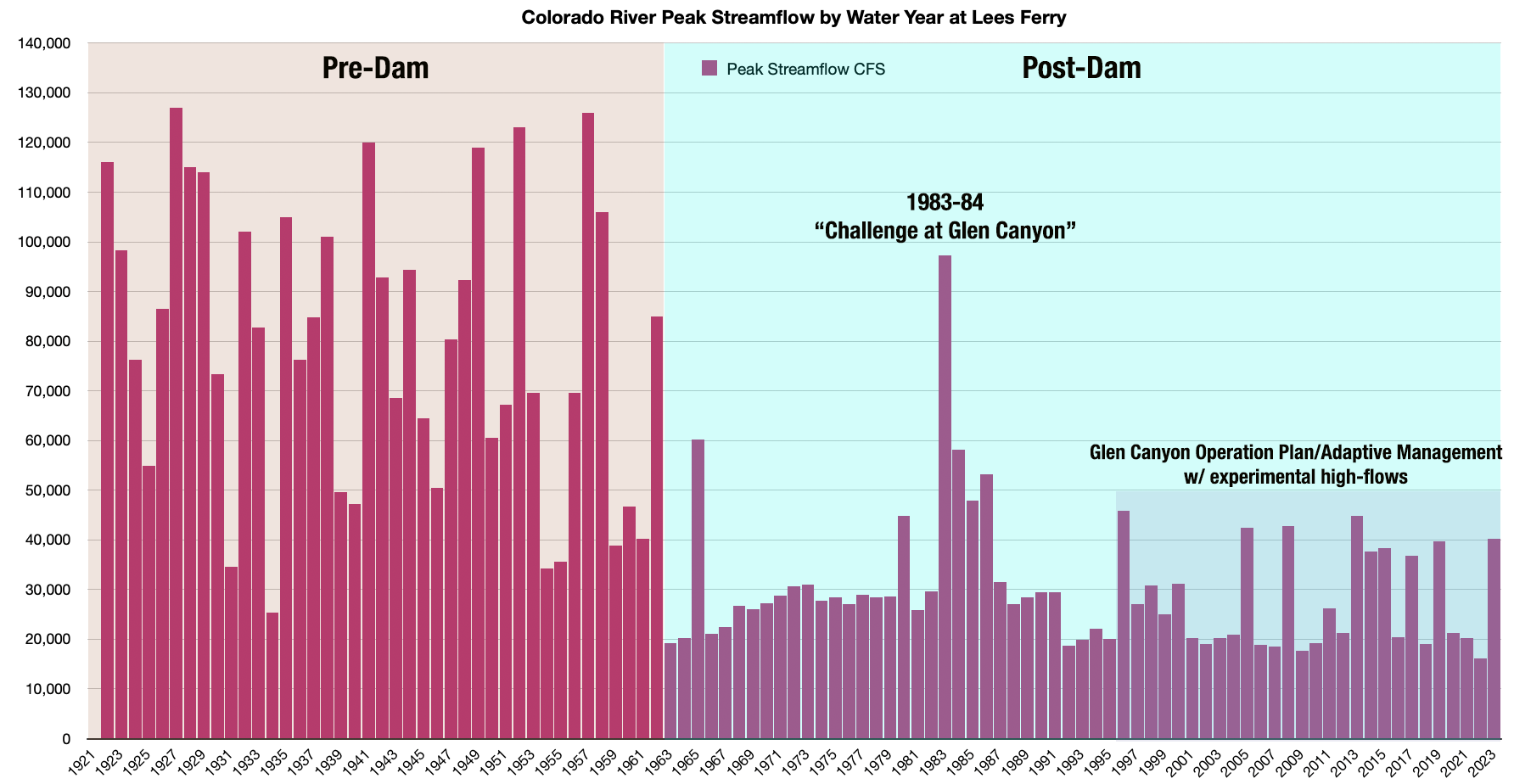
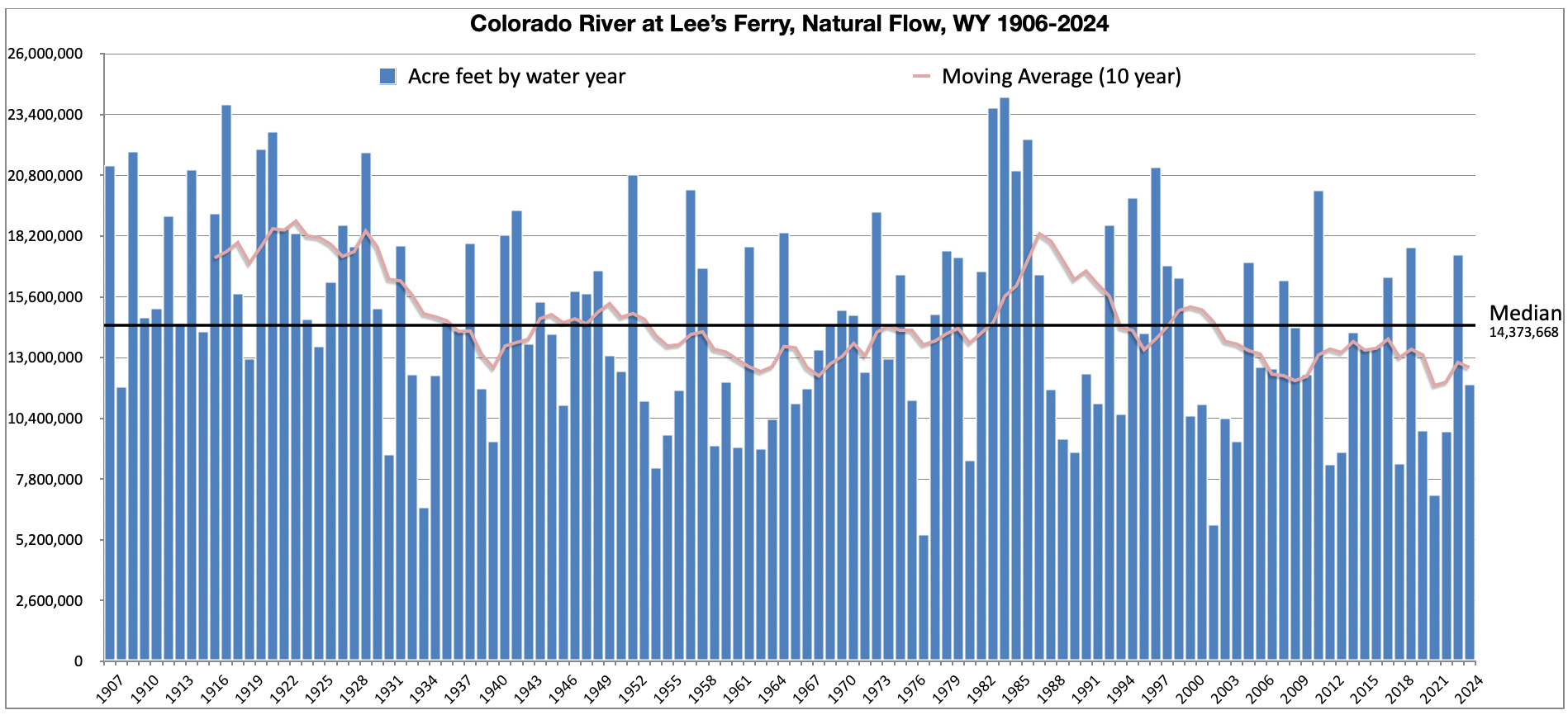
The Colorado River Compact was created in 1922 for a river that had been, for a couple decades, running flows guesstimated to average 18 million acre-feet (maf) annually. The compact commissioners thought they were being conservative in only dividing 15 maf among themselves, and assumed that ‘those men who may come after us, possessed of a far greater fund of information’ would be dividing up even more water after resolving a share for Mexico and resolution of the Indian rights.

The river then played desert trickster and stopped running those big flows, shortly after Congress passed the Boulder Canyon Act to reconstruct the Colorado River through the subtropical deserts below the canyons. By the end of the 1930s drought that followed, the states’ water leaders knew the numbers in the Compact division might have been for a river that no longer existed, if it ever really had. But they persisted with the Compact, in the spirit of the unnamed quasi-mythical G.W. Bush administration official: ‘We are an empire now, and when we act, we create our own reality.’ The next half century was invested in creating our own imperial reality for the Colorado River – until we began to run into more ‘natural’ realities than we’d anticipated….

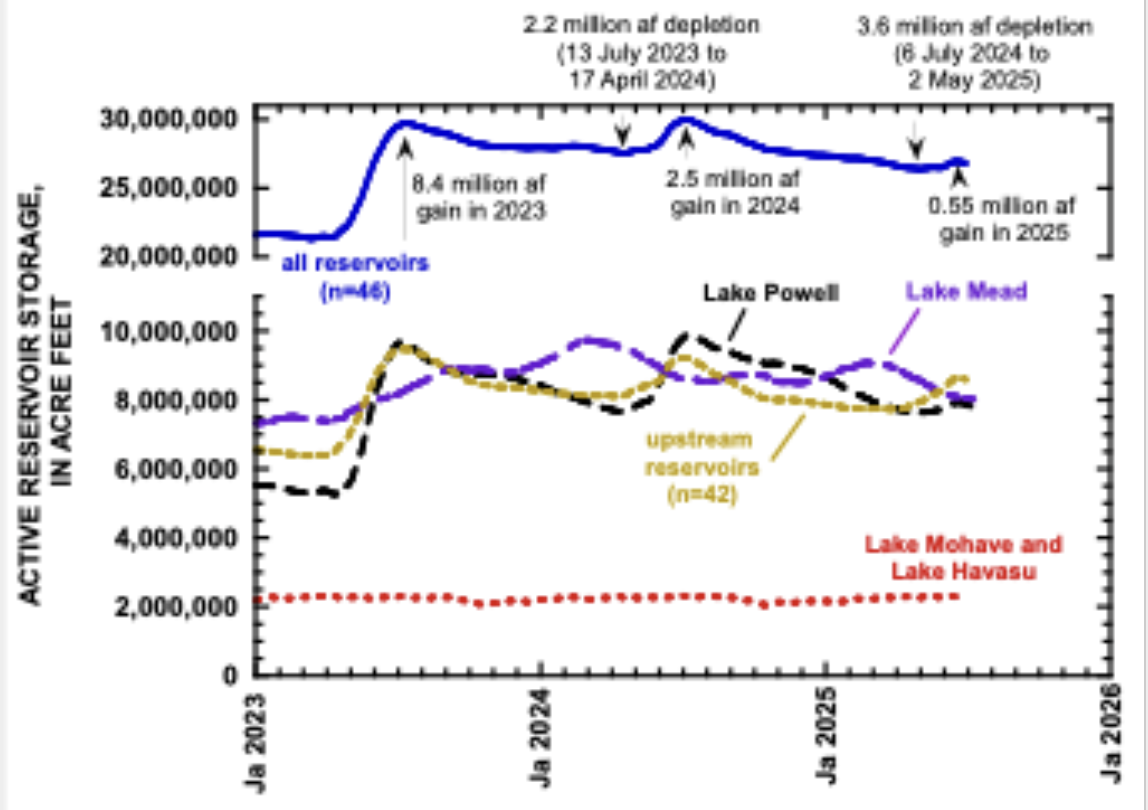
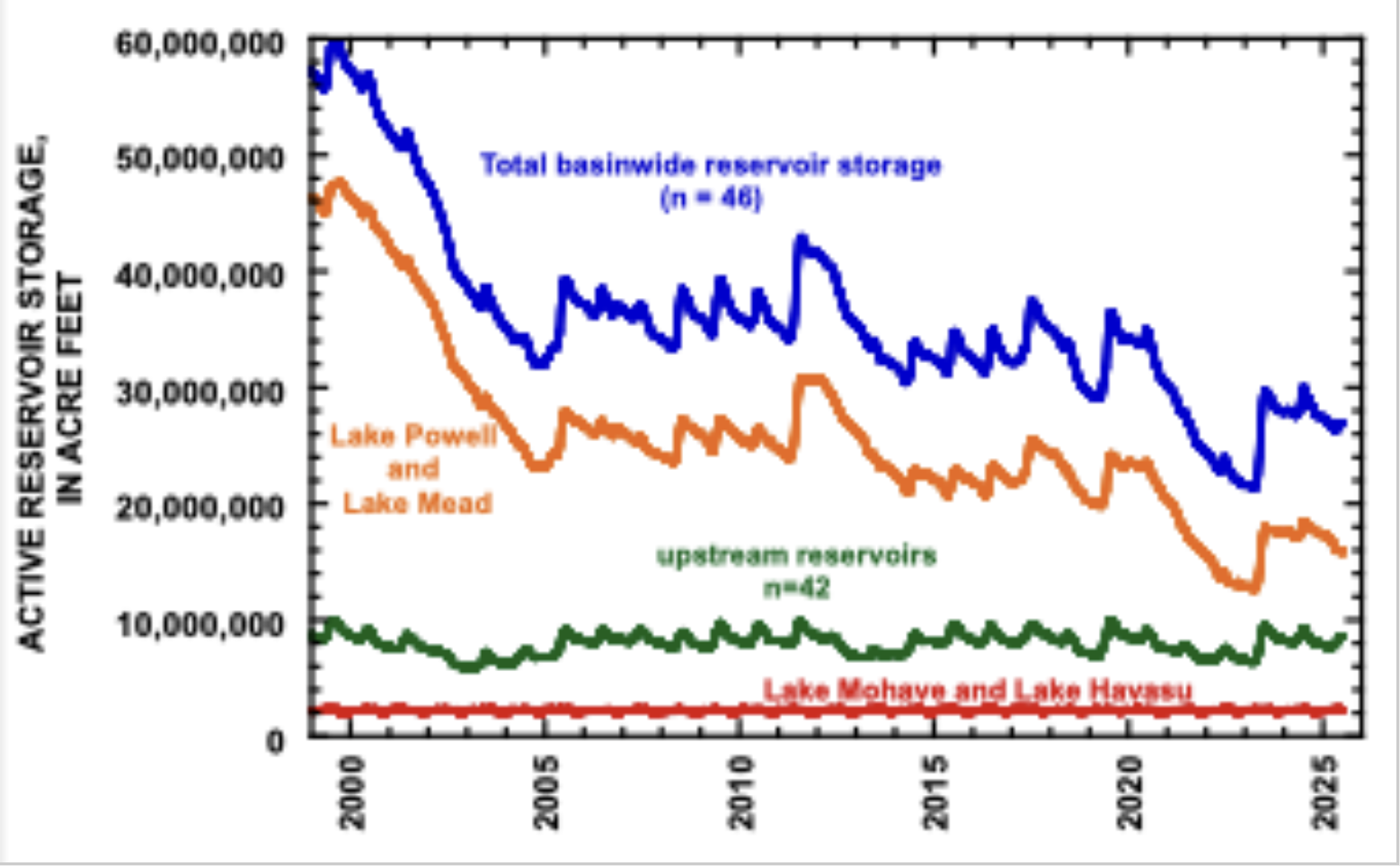
Udall/Overpeck 4-panel Figure Colorado River temperature/precipitation/natural flows with trend. Lake Mead and Lake Powell storage. Updated through Water Year 2024. Credit: Brad Udall

The unimperial reality today is a river whose annual flow since the turn of the century has dropped to an average around 12.5 million acre-feet (maf), two-thirds the size of the Compact’s river. That is ‘the river we have’ – and we are aware of the extent to which our superimposed imperial reality on the Colorado River region (and on the whole planet) has caused a lot of this unanticipated loss of water.

Exactly what it means when the basin-wide negotiators say they are working with that ‘river we have’ has not been revealed. One bad sign, however, viewing it from ‘outside the box,’ is their persistence in thinking of the river as divided into a four-state Upper Basin and a three-state Lower Basin, a construct destined by a competitive appropriation culture to devolve into chronic conflict – which it has.

Much of the conflict has revolved around the foggily written Article III(d) of the Compact, stating that the Upper Basin ‘will not cause the flow of the river at Lee Ferry to be depleted below an aggregate of 75,000,000 acre-feet for any period of ten consecutive years.’ This could be most rationally interpreted as a warning to the Upper Basin to just be careful to not develop to the point of using more than their 7.5 maf/year (which the four states have not even come close to doing) and cutting into the Lower Basin’s 7.5 maf in dry periods. Or it could be irrationally interpreted as a delivery obligation that the Upper Basin had to deliver regardless of the natural state of the river, even if an extended drought forced the upper states to short themselves in order to deliver the required 7.5 maf.
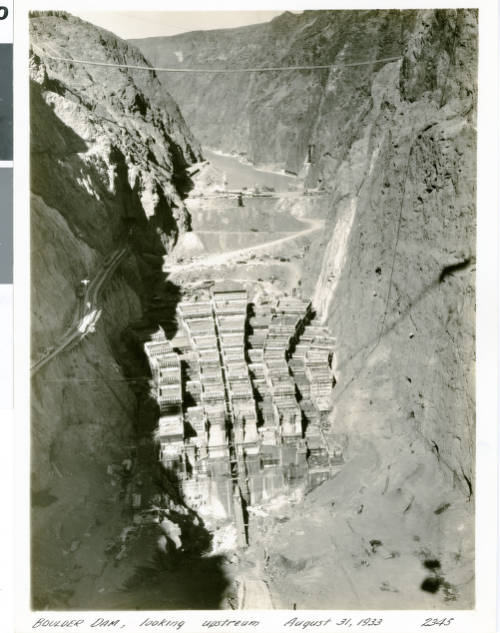
Looking upstream at the Boulder Dam (now called Hoover Dam) under construction. “Boulder Dam, looking upstream August 31, 1933 2345” is written at the bottom of the photo. Via UNLV

Given a history of tension among the states based on how fast California was growing, the obvious choice between those interpretations was to believe the worst. Their intent in convening the compact commission had been to prevent a ‘seven-state horse race’ to appropriate water for their futures; they wanted a seven-state division of the use of the river’s water that would override interstate appropriative competition. But they didn’t know enough about either the river or their own fantasy-infused futures to do that desired division. The two-basin division has come to be regarded as a stroke of genius, good for all time, when in fact it was just an expedient measure – one wouldn’t be wrong to call it a ‘desperate measure’ – to cobble together something that would persuade Congress that the states were enough on the same page so Congress could put up the money for a big control structure (Hoover Dam).

But in their haste in pasting together the two-basin compact, they appeared, through Article III(d), to make one basin ‘junior’ to the other, subject to a ‘compact call’ in an extended drought  – or at least that is how everyone chose to interpret it. The 2007 ‘Interim Guidelines’ began to address that (perceived) inequity by imposing cuts on the Lower Basin states when Mead and Powell Reservoirs dropped to dangerous levels, but on not the Upper Basin (leaving their shortages up to the erratic river). But interstate ‘seniority’ played a big role in the size of cuts for each Lower Basin state, belying the notion that the Compact would protect states from interstate appropriative competition.

So what could today’s negotiators be doing instead? There is actually a constructive and useful way to divide a desert river into two ‘basins,’ based on the nature of the desert river. All rivers are surface water that is leaving – maybe reluctantly – the land it flows through; it is leaving the land because the land and its life were not able to put the water to use in support of life or to hold it as groundwater in an aquifer. Even much of the groundwater that doesn’t get used by the plants does not escape leaving the land with the river; isotopic analysis indicates that over the course of a year more than half of all the water in surface streams is groundwater trickling back in.

Ephemeral streams are streams that do not always flow. They are above the groundwater reservoir and appear after precipitation in the area. Via Socratic.org

This is not to say that a river is nothing but a drainage ditch – an earlier Army Corps of Engineers perspective that messed up a lot of rivers, trying to make the drainage more efficient by straightening channels. All rivers have a much more complex relationship with the land they are flowing through than just ‘drainage.’ Most rivers have their origins in highlands – mountains or other significant uplands – where steep slopes or fast snowmelts produce too much water to sink into whatever soil there might be; this generates surface flows that become small streams confluing to form larger streams and rivers. Through hyporheic exchange, surface streams either gain groundwater from the land they flow through when that land has a higher water table than the stream level (a gaining stream), or they lose water to the riparian areas along the river when the water table there is lower than the stream level (a losing stream – although, since the water it loses nurtures life in the riparian area, I think hydrologists should consider calling it a ‘giving stream’).

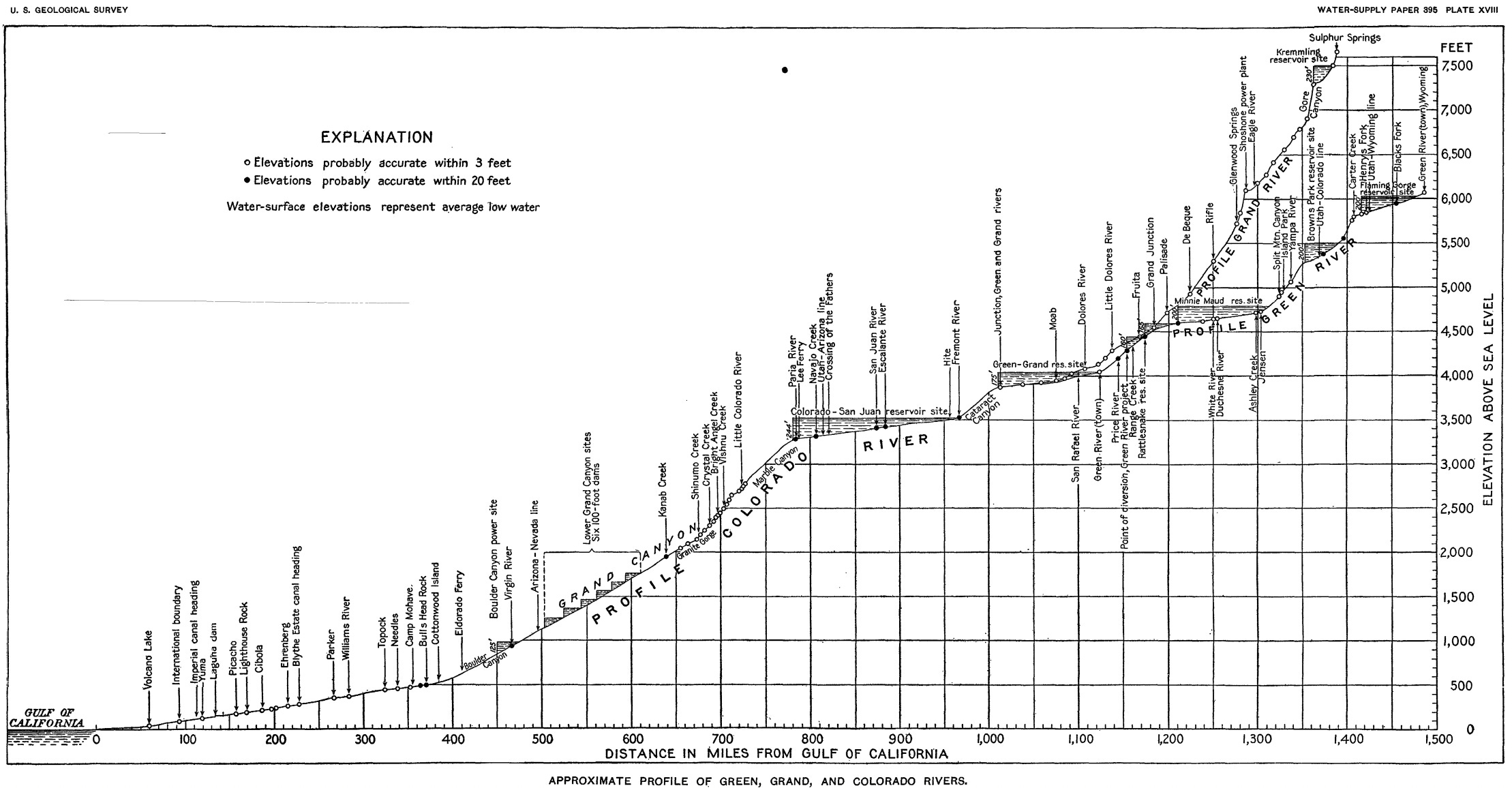
For rivers in humid regions, there is adequate precipitation throughout the river’s basin so the rivers will usually gain more from the land they pass through than they will lose (or ‘give’); they are gaining streams that grow from both surface and ground water until they discharge it all into the seas. But a desert river like the Colorado, on the other hand, is a dependable gaining stream only in its highland headwaters, where the Colorado River accumulates 85-90 percent of its entire water supply from the Southern Rockies, Wind River and Wasatch Mountains above ~8,000 feet elevation. This water-producing region is less than 15 percent of the whole basin. (That ‘division contour’ is more accurately an ‘ecotone,’ a blurry edge zone, in the 7,500-8,500 feet range.)

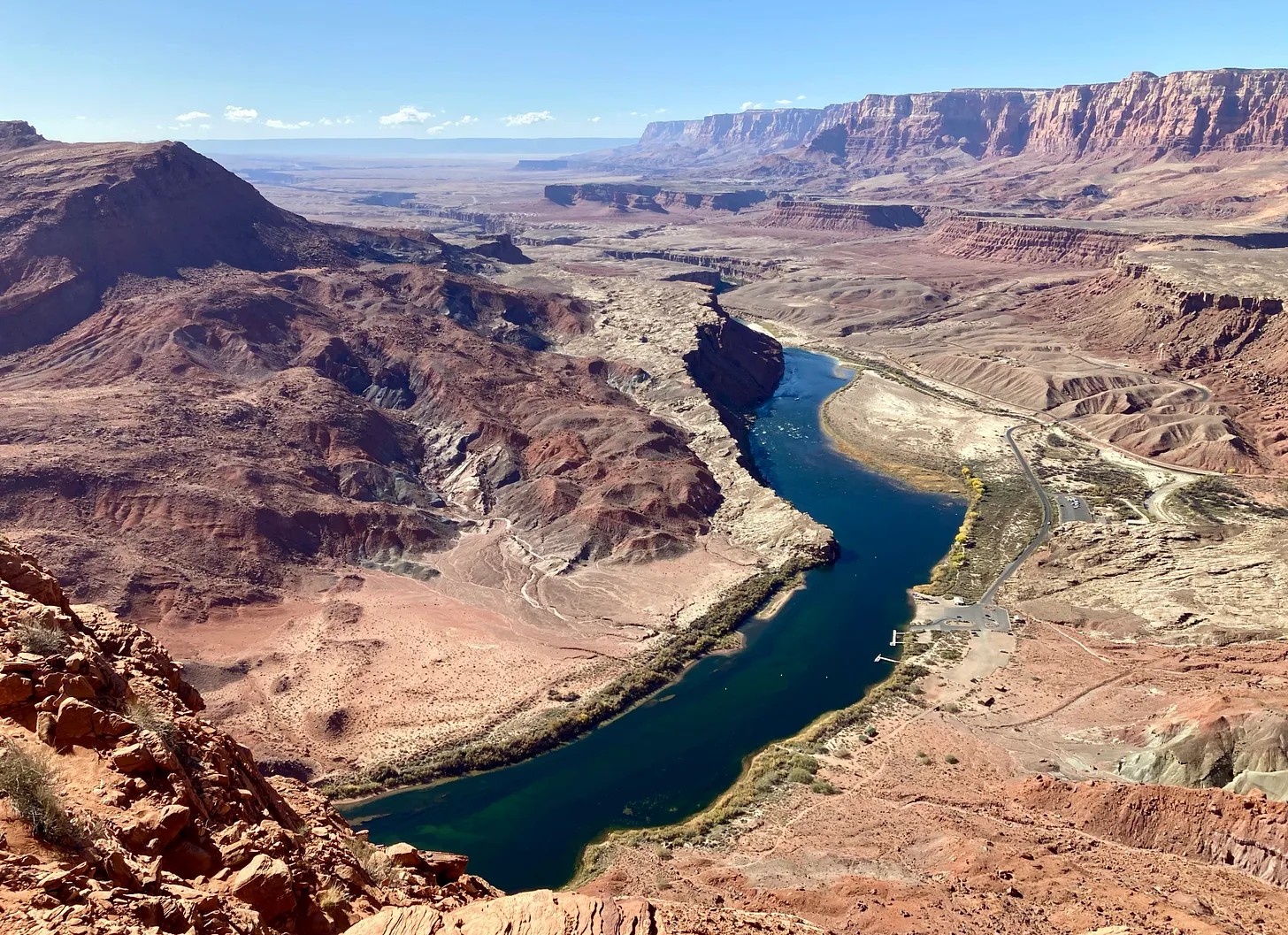
Below the ~8,000 foot elevation, the river’s tributaries flow first into the high orographic ‘cold deserts’ (steppes) of western Colorado, southwestern Wyoming and eastern Utah. Most of its tributaries have been ‘stepping down’ through the mountain region in a series of canyons alternating with floodplains, all of it the water’s work – and all of it the beautiful erosion and deposition that draws and holds us here. As they drop into the high desert, they get into a serious canyon-cutting project through the Colorado Plateau, up to a mile deep – a mystery story in itself that I’ve written about before. After more than five hundred miles of canyons winding through the Plateau, the river flows out into the subtropical Mojave and Sonora ‘hot deserts,’ and thence – only occasionally now – emptying what’s left into the Gulf of California.

Super Bloom along UT-128 during the last road trip with Mrs. Gulch May 2023.

But once they drop out of its headwaters highlands, desert streams and rivers like the Colorado and its tributaries become losing (giving) streams; they get little new precipitation below the ~8,000 foot contour. The occasional exception is the desert cloudburst that manages to penetrate the desert’s heat shield, dumping a huge rain that mostly runs off the desert land in a quick, destructive flood, filling dry arroyos and stream beds for a few dangerous hours. Or a rare winter snowfall that melts and sinks in, activating flora and small fauna that have lain inactive for long periods, instigating pilgrimages from hundreds of miles away just to see the desert in bloom.

The ‘natural’ Colorado River (the river before the 20th century CE) became a ‘big river’ for two or three months a year, in the May-July period when its mountain snowpack released the majority of the river’s water into its tributaries and ground storage. But once the snowpack was gone, the natural river became an increasingly modest flow, fed largely by groundwater, and as it wandered through the desert regions, it gave what water it had to riparian life (a process that intensified as humans began ‘broadening’ its riparian areas through irrigation systems), or into desert aquifers – and a lot of it just evaporated or transpired back into the atmosphere (losses that increased as humans spread more of it out in reservoirs and fields).

There were probably years (like our current water year) in which the last of the natural river’s water never made it through its lush delta to the sea in the autumn. It is not unusual for a desert stream to completely disappear in its desert; some 40 surface streams and rivers flow into the Great Basin, and most of them just disappear after spreading their limited beneficence en route.

The natural and logical ‘two-basin’ division for a desert river like the Colorado, then, would be into a ‘water production region’ and a ‘water consumption region.’ With the exception of mountain mining or resort towns, and the mountain flora and fauna, nearly all the users of Colorado River water live below that ~8,000 foot division. They are all in the same boat, trying to figure out how best to share a ‘losing river’ when its flows drop into the desert regions where they live.

Map of the Colorado River drainage basin, created using USGS data. By Shannon1 Creative Commons Attribution-Share Alike 4.0

The Colorado River Compact ignores this natural division of the river. The clumsy division into the four-state Upper Basin and three-state Lower Basin is done according to state boundaries, which have no geographic or hydrographic relevance to the Colorado River Basin.  The state boundaries also include a lot of heavily developed land outside the natural river basin that can lay claim to Colorado River water as part of the state – and they have population and wealth concentrations that enable them to move that water out of the basin through tunnels. ‘We are an empire, and when we act’ et cetera et cetera.

The Compact division is especially problematic for the Upper Basin. A quarter to a third of the Upper Basin area is the river’s major water production area, scattered among the mountains of the four states above the ~8,000-foot contour, and the rest of the Compact’s Upper Basin is part of the river’s water consumption region. The Compact makes no such distinction, and all the water above the Upper-Lower division point near Lee’s Ferry is presumed to be the Upper Basin’s – minus the annual ‘delivery obligations’ of 7.5 maf for the Lower Basin and half of the 1.5 maf for Mexico. Given that the river’s annual flows vary between 5 and 20 maf, this makes the Upper Basin’s Compact allotment of 7.5 maf annually a fantasy.

Acknowledging the desert nature of the Colorado River suggests a rather radical, but common sense two-basin management strategy for the Colorado River, addressing two main challenges: first, to work out an equitable division among all users for the use of the water that flows into the ‘water consumption region’; and second, for all water consumption region users to collaborate on optimizing (not ‘maximizing’) the flow out of the ‘water production region’ and into the deserts.

And a third challenge (which should be first) would be to transcend (abandon) the Compact’s two-basin division, the artificiality of which just gets in the way of desert-river reality at best, and at worst fosters a competitive rather than collaborative attitude between the two basins.

And that’s enough for today. We will look more closely at those challenges next time – unless the negotiators have come up with a brilliant breakthrough to parse out. Don’t hold your breath….

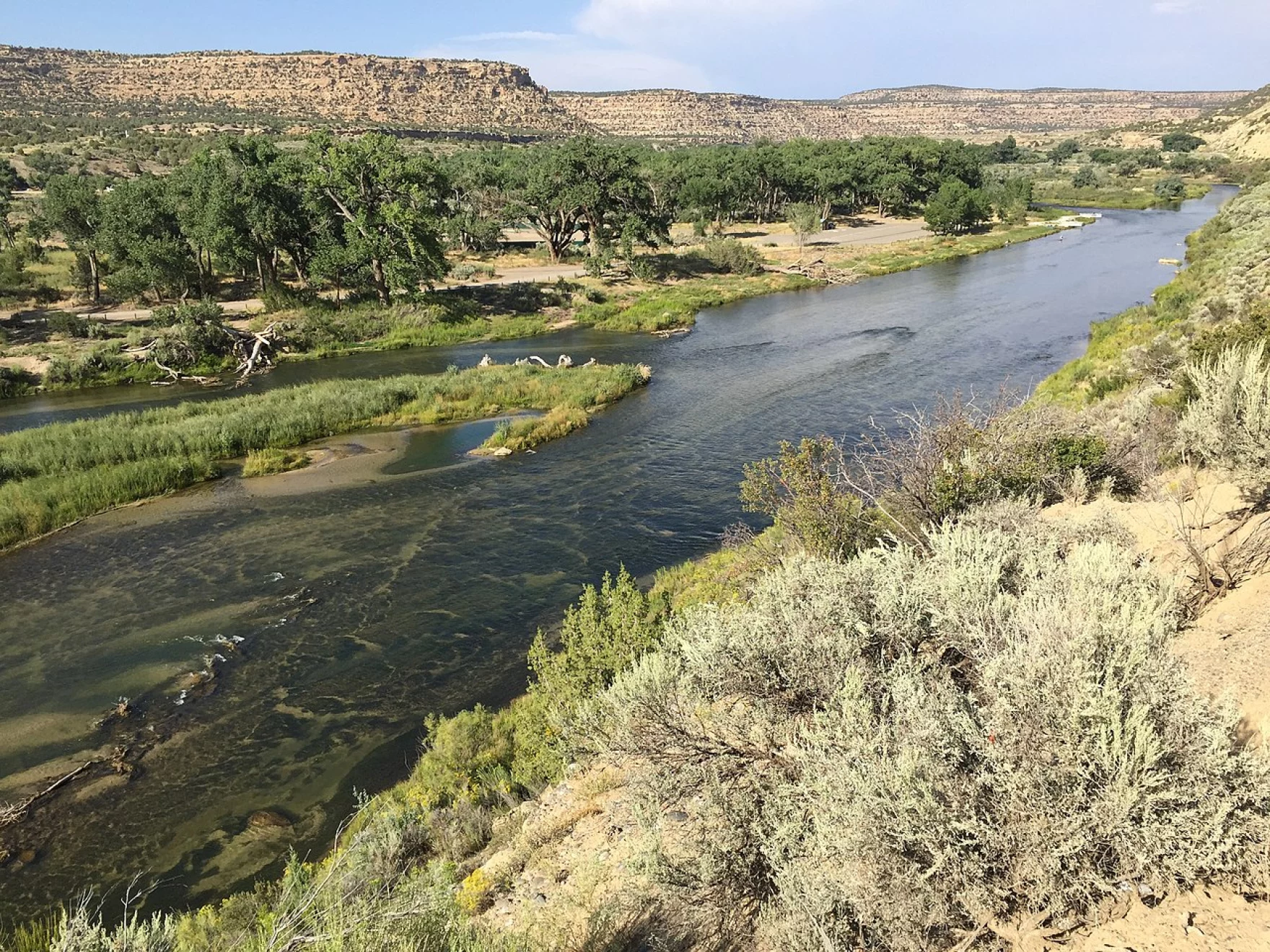
Colorado River “Beginnings”. Photo: Brent Gardner-Smith/Aspen Journalism

No, there is not plenty of water for data centers: And, yes, we should worry about it, along with the facilities’ power use — Jonathan P. Thompson (LandDesk.org) #ColoradoRiver #COriver #RioGrande #aridification

A satellite view of Mesa, Arizona, showing a handful of the 91 energy- and water-intensive data centers in the greater Phoenix metro area. Source: Google Earth.

Click the link to read the article on The Land Desk website (Jonathan P. Thompson):

July 29, 2025

📈 Data CENTER Dump 📊

When I first read a recent headline in Matthew Yglesias’s Slow Boring newsletter, I assumed it was a sort of joke to rope me into reading. “There’s plenty of water for data centers,” it said, reassuringly. “Probably the last worry you should have about either water or AI.”

Unfortunately, he wasn’t joking. But he opened his piece with a line that should have warned his readers to take everything else he said with a grain of salt:

Before I continue with my rant, I’d just like to encourage Yglesias to do a little more thinking about water scarcity before writing about it. Oh, and also, maybe consider spending a little bit of time in the water-starved West before committing punditry about it. (This is the same guy who tweeted that Sen. Mike Lee’s proposal to sell off public land was “pretty reasonable” and an “okay idea on the merits”).

Yglesias acknowledges that data centers use water, and that more data centers will lead to more water consumption. But it’s okay, he says, because “We’re not living on Arrakis, and rich countries are not, in general, abstemious in their water usage.”

No, we are not on Arrakis, but have you seen the lower reaches of the Colorado River or even the mid-reaches of the Rio Grande lately? It’s looking pretty Dune-like if you ask me.

Well, sure, Yglesias argues, but even in those places, people are doing frivolous things with water, like filling up their Super Soakers or using it to make ice cubes for their cocktails. Yes, he used those actual examples. Never mind that the potable water used each day by a single Microsoft data center in Goodyear, Arizona, could yield more than 35 million ice cubes or fill about 223,000 Super Soakers. That would be one big, drunken water fight.

Yglesias also notes that agriculture, especially growing alfalfa and other feed crops for cattle, is an even larger water consumer than Big Tech. True, for now. And he writes:

His logic appears to be: People are currently using a lot of water for all sorts of things — frivolous or otherwise. So, it should be fine to use a lot more water for data centers in perpetuity, since water is “sufficiently plentiful.” This is the sort of thinking that got the Colorado River Basin into its current mess, in which there actually may not be enough water to drink very soon if its collective users don’t change their ways. Adding a fleet of water-guzzling hyperscale data centers to places like Phoenix, Las Vegas, and Tucson, where water is anything but “sufficiently plentiful,” will only exacerbate the crisis.


A Dog Day Diatribe on AI, cryptocurrency, energy consumption, and capitalism — Jonathan P. Thompson


Researchers have tried various methods to determine how much water a single ChatGPT query or AI-assisted Google search uses as compared to, say, streaming a Netflix video or writing a standard e-mail. So far the estimates diverge wildly. An early calculation came up with a whopping 500 ml for each AI query, but the estimates have since gone down. The difficulty is due in part to the fact that water use data isn’t always publicly available, and also because data centers’ water use can vary depending on location, as do their carbon footprints.

What is clear is this: Data centers use large quantities of both energy and water, no matter where they are. The massive server banks churning away in warehouse-like buildings on the fringes of Phoenix and Las Vegas, and even in rural Washington and Wyoming, each gobble as much electricity as a small city to process AI queries, cryptocurrency extraction, and other aspects of our increasingly cloud-based society. The harder they work, the hotter they get, and the more power and water they need to cool off to the optimum operating temperature of between 70° to 80° F.

Evaporative or adiabatic cooling, where air is cooled by blowing it through moistened pads (i.e. high-tech swamp coolers), works well in arid areas like Phoenix, Tucson, or Las Vegas. They use less energy than refrigerated cooling, but also use far more water.

Data centers can also indirectly consume water through their energy use, depending on the power source. Thermal coal, nuclear, or natural gas plants need water for cooling and steam-production (some of this water may be returned to the source after use, except with zero-discharge facilities); natural gas extraction uses water for hydraulic fracturing; and solar installations can require large amounts of water for dust-suppression and cleaning. This explains how Google’s data centers withdrew 8.65 billion gallons of water globally in 2023 1.


Energy-Water Nexus Data Dump 1: Fracking — Jonathan P. Thompson


A 2023 study found that a single Chat GPT-3 request processed at an Arizona data center uses about 30 milliliters of water, compared to 12 ml per request in Wyoming. That doesn’t seem like much (it’s less than a shot-glass) until you consider that there are at least 1 billion ChatGPT queries worldwide per day and growing, using a total of some 8 million gallons of water daily, worldwide. And, training the AI at an Arizona data center would use about 9.6 million liters — or 2.5 million gallons — of additional water.

Another estimate finds the average data center uses between 1 million and 5 million gallons of water per day, onsite, which would be far more than the aforementioned Goodyear center (56 million gallons/year), but in line with a planned Google data center in Mesa, Arizona. When Google was first planning the facility back in 2019, the city of Mesa guaranteed delivery of nearly 1 million gallons of water per day. If they reach certain milestones they can use up to 4 million gallons daily, or about 4,480 acre-feet per year.

Now multiply those numbers by the more than 90 data centers of various sizes and water and energy intensity in the Phoenix area, alone, which would amount to somewhere between 14 million to 450 million gallons per day. No matter how you add it up, they collectively are sucking up a huge amount of water and power, and enough to strain even Yglesias’s purported “sufficiently plentiful” supplies (which do not exist in Arizona, by the way).

The average Phoenix-area household uses about 338 gallons of water per day, or almost 123,000 gallons per year. One of these big data centers, then, could guzzle as much water as some 10,000 homes. And yet housing developments in groundwater-dependent areas on Phoenix’s fringe must obtain 100-year assured water supply certification before they can begin building. The same is not the case for data centers.

According to Open ET maps, a 75-acre alfalfa field in Buckeye (western Phoenix metro area), uses about 156 acre-feet — or 50.8 million gallons — per year. That’s far less than the 28-acre Apple Data Center in Mesa consumes. Of course, there are the equivalent of about 3,470 alfalfa fields of that same size in Arizona (260,000 acres), meaning the total water consumption of hay and alfalfa is still greater than that of data centers. But it shows that while replacing an alfalfa field with houses would result in a net decrease in water consumption, replacing those same fields with data centers would substantially increase consumption.

And don’t forget that the 75-acre alfalfa field produces about 690 tons of alfalfa per year, which could feed quite a few dairy cows, which in turn would produce a bunch of milk for making cheese and ice cream. Just saying. Maybe it’s time to update the old saying: “I’d rather see a cow than a data center.”


Western water: Where values, math, and the “Law of the River” collide, Part I — Jonathan P. Thompson


Data centers aren’t going away. After all, they are the hearts and brains of the Internet Age. Many of us may wish that AI (not to mention cryptocurrency), which are more water- and energy-intensive than other applications, would just up and vanish. But that’s probably too much to ask for. Besides, AI, at least, does have real value. 

So what can be done to keep the data center boom from devouring the West’s water and driving its power grid to the snapping point? Here’s where Yglesias had a good point: Policymakers and utilities should adjust water and power pricing for large industrial users, i.e. data centers, to discourage waste, incentivize efficiency and recycling, and push tech firms to develop their own clean energy sources to power their facilities.

It’s imperative that utilities force data centers to pay their fair share for infrastructure upgrades made necessary by added water or power demand, rather than shifting those costs to other ratepayers, as is usually the case. Arizona should make data centers prove out their water supply, just like they do with housing developments. Plus, states should stop trying to lure data centers with big tax breaks, which ultimately are paid for by the other taxpayers. And local governments and planners should subject proposed data centers to the highest level of scrutiny, and not give in to promises of jobs and economic development if it means sacrificing the community’s water supply or the reliability of the power grid.

Proper policy isn’t a cure all, by any means. But it could mitigate the impacts of the imminent data center boom. Meanwhile, Mr. Yglesias, I will reiterate that the West, at least, does not have plenty of water for data centers, and I will continue to worry about them guzzling up what little water remains.


📖 Reading Room 🧐

  • The Land Desk is reading all of y’all’s great responses to last week’s open thread about forms of resistance. Check it out and weigh in if you haven’t already.
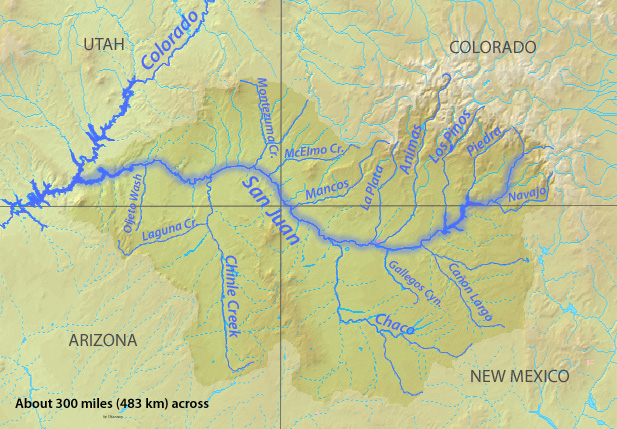
  • Len Necefer has had some really strong pieces on his All At Once by Dr. Lennewsletter recently, including this one musing about the opportunities for the Navajo Nation to build a recreation economy on the San Juan River (great idea!). He writes about how strange it is that he, a Navajo Nation citizen, must get a permit from the BLM to raft the river, when it borders his homeland (and is at the heart of Diné Bikeyah). I also like that he sees boating/recreational opportunities along the entirety of the river, not just from Sand Island to Clay Hills Crossing. I’ve always thought it would be super cool to boat the reaches between Farmington and Bluff (actually, I’ve always wanted to boat from Durango to Farmington to Bluff). 
  • Another Substack that’s been getting my attention is Time Zero, a podcast and Substack on “the nuclearized world.” The Wastelanding series is about the legacy of uranium mining and milling on the Colorado Plateau, the Navajo Nation, and on Pueblo lands. Very powerful stuff. 
  • The Colorado Sun’s Shannon Mullane has a good story about the Southern Ute Tribe finally getting some of its Animas-La Plata water, which was the whole reason the last big Western water project, as it’s known, was finally built.

Cisco Resort and other water buffalo oddities — Jonathan P. Thompson


1 This is not the same as consumption, which is the amount of water withdrawn minus the amount returned to the source.

Udall/Overpeck 4-panel Figure Colorado River temperature/precipitation/natural flows with trend. Lake Mead and Lake Powell storage. Updated through Water Year 2024. Credit: Brad Udall

Water treatment plant set for 2025 groundbreaking — Gunnison Country Times #GunnisonRiver

The water treatment process

Click the link to read the article on the Gunnison Country Times website (Alex McCrindle). Here’s an excerpt:

July 23, 2025

On July 22, after months of uncertainty about the impact of federal funding cuts and tariffs, Gunnison City Council received an update on the future of the water treatment plan project. Gunnison Public Works Director Pete Rice addressed the council with a report on funding, design and construction of the proposed plant on the Van Tuyl Ranch. The water treatment plant, estimated to cost $50 million and be one of the largest infrastructure developments in city history, is divided into three projects. The first project covers the construction of a raw water intake and three separate wells at the VanTuyl Ranch. The second and third projects focus on the water delivery system and water treatment facility. With the first project nearing approval from the Environmental Protection Agency (EPA), the city is expected to finalize its design this fall and begin construction before the end of 2025. The treatment plant initiative stems from the 2021 water master plan and a potable water evaluation. Gunnison currently relies on nine wells to source its drinking water. The system is outdated and no longer permitted by the state. Because all of the wells pull water from the same aquifer, drinking water is vulnerable to contamination and extended drought conditions. The proposed plant will allow Gunnison to pull water from the Gunnison River, in addition to the aquifer…

The first project includes the construction of a raw water intake and three separate wells. The proposed intake will be 18-feet deep alongside the Gunnison River, and cylindrical intakes will extend halfway into the river. The first project is expected to be approved by the EPA in the next four weeks, and begin construction this year with well drilling extending into 2026. The project is projected to cost $4 million, with $900,000 covering design, and $3 million going toward construction. The entire construction cost is funded by $1.75 million in congressionally directed spending, and $1.5 million from a Colorado Water Conservation Board grant. Four additional grants covered roughly $850,000 in design costs. The City of Gunnison will pay the remaining $25,000. Once complete, the water intake will have little impact on outdoor recreation, including boating and fishing, Rice said. However, construction will likely disrupt those activities for an estimated two to three months. It is currently unknown if construction can take place in the winter to minimize impact on summer recreation. Project two focuses on a complex network of pipes that will connect the raw water intake and wells, and deliver water directly to the water treatment plan. The third project is the construction of the water treatment plant itself. Rice said the second and third project design is estimated to be completed between winter 2025 and spring 2026, with construction lasting into 2029. The two projects will cost $2.7 million for design, and $40 million for construction. The majority of design costs are already funded by six grants, while the construction costs are set to be discussed at upcoming council meetings.

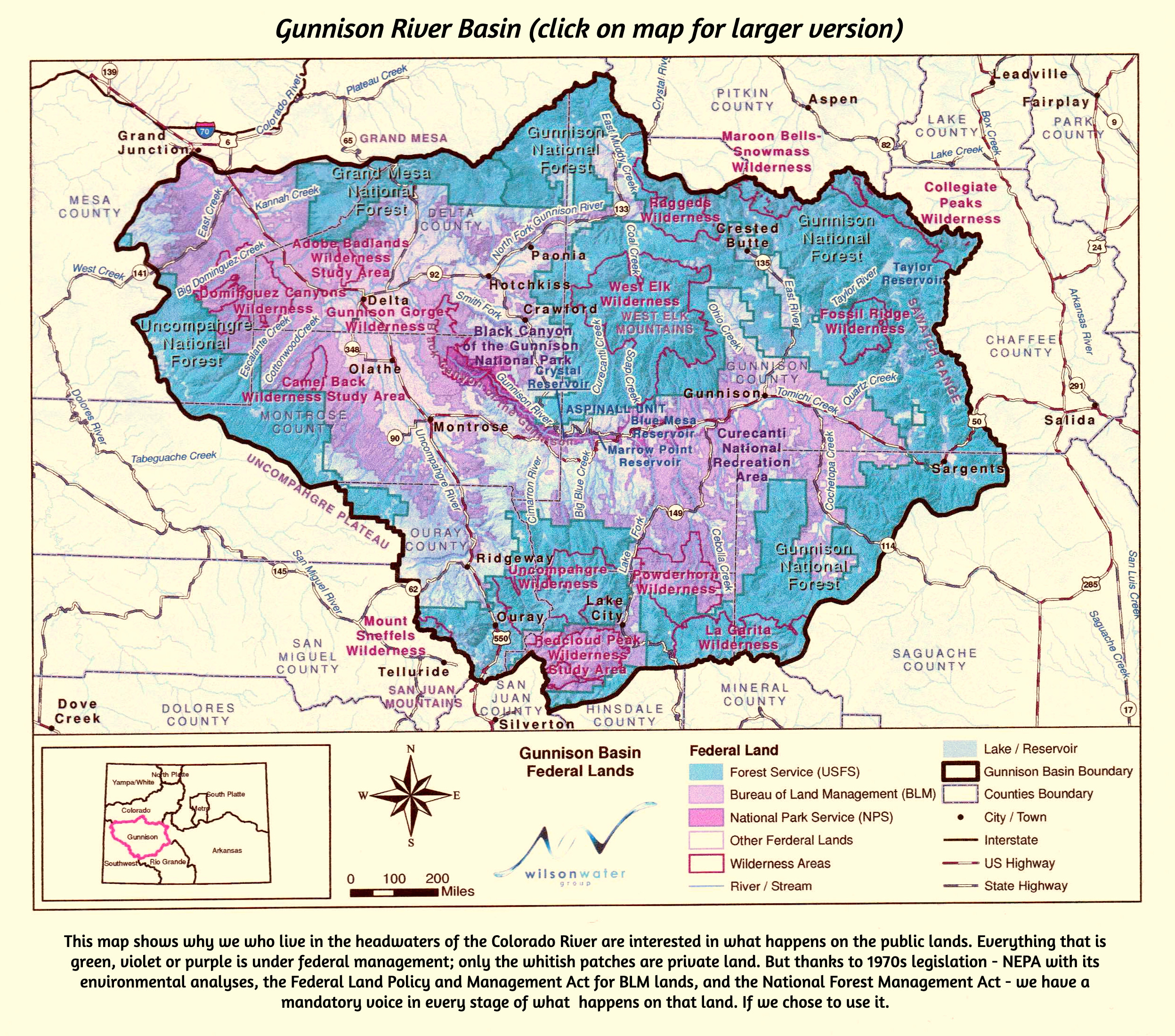
Map of the Gunnison River drainage basin in Colorado, USA. Made using public domain USGS data. By Shannon1 – Own work, CC BY-SA 4.0, https://commons.wikimedia.org/w/index.php?curid=69257550

#ColoradoRiver District offers proposal on Western Slope water deal — Heather Sackett (AspenJournalism.org) #CORiver #aridification

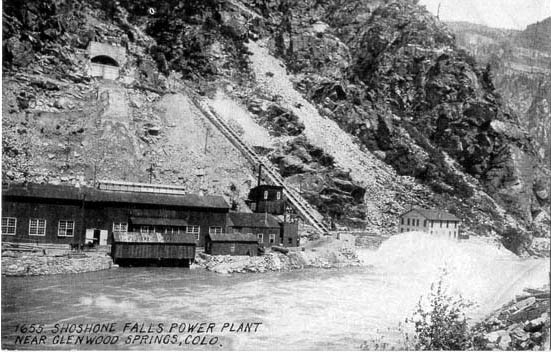
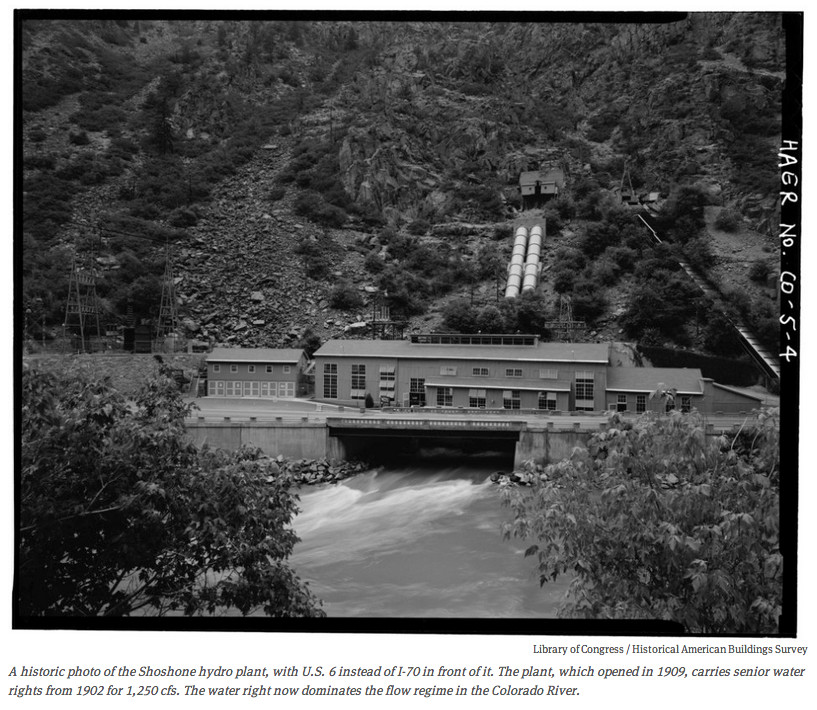
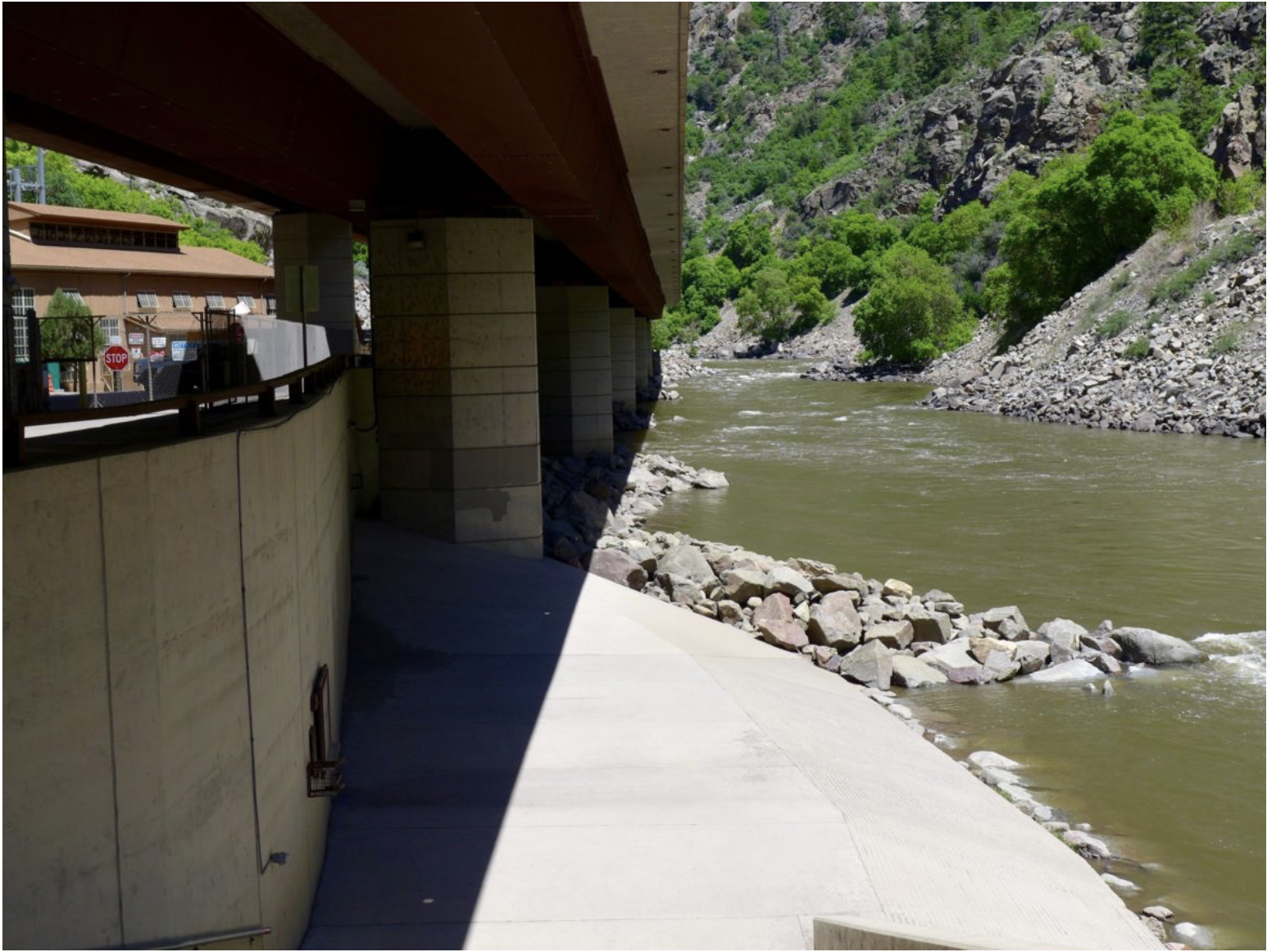
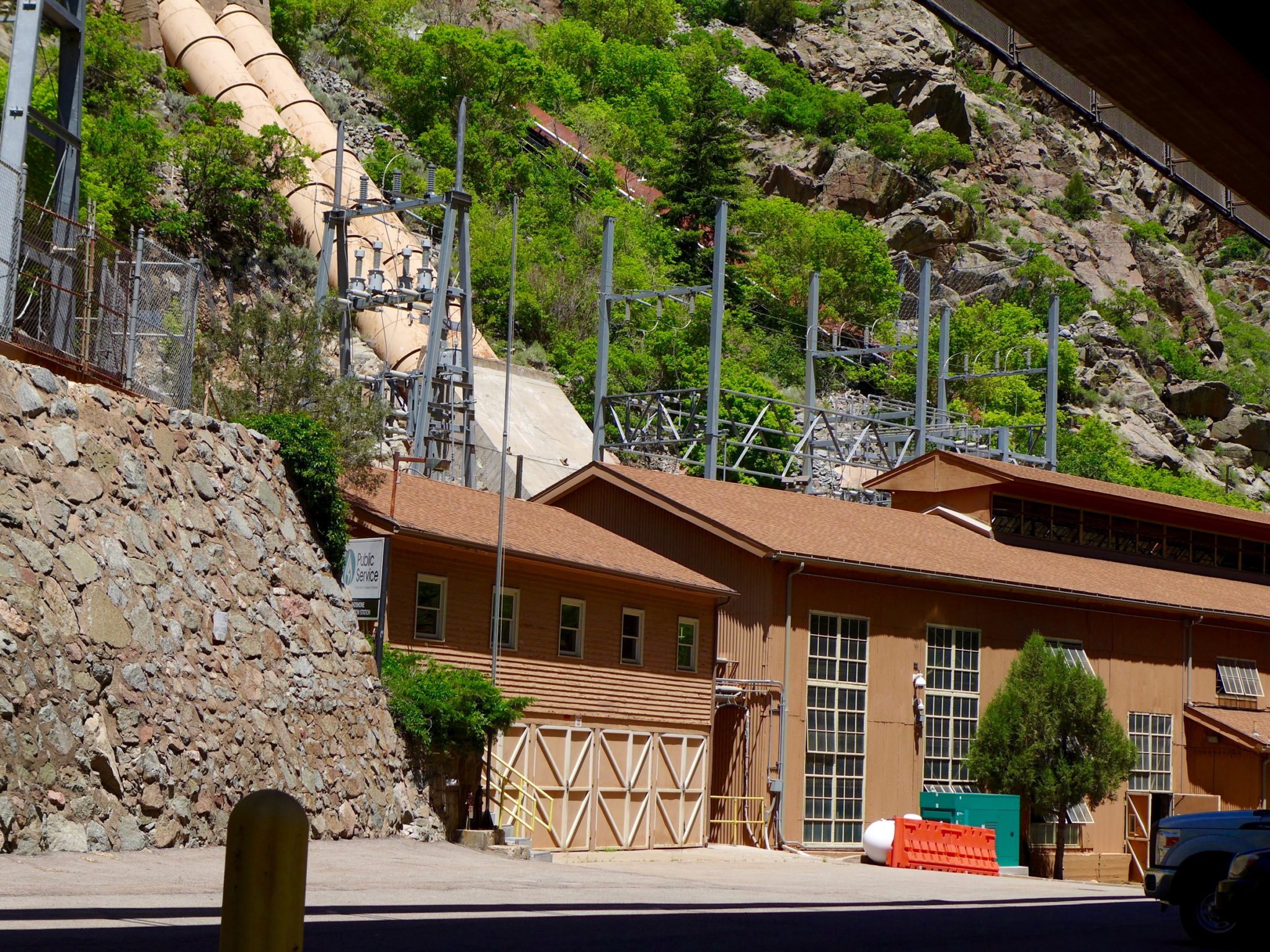
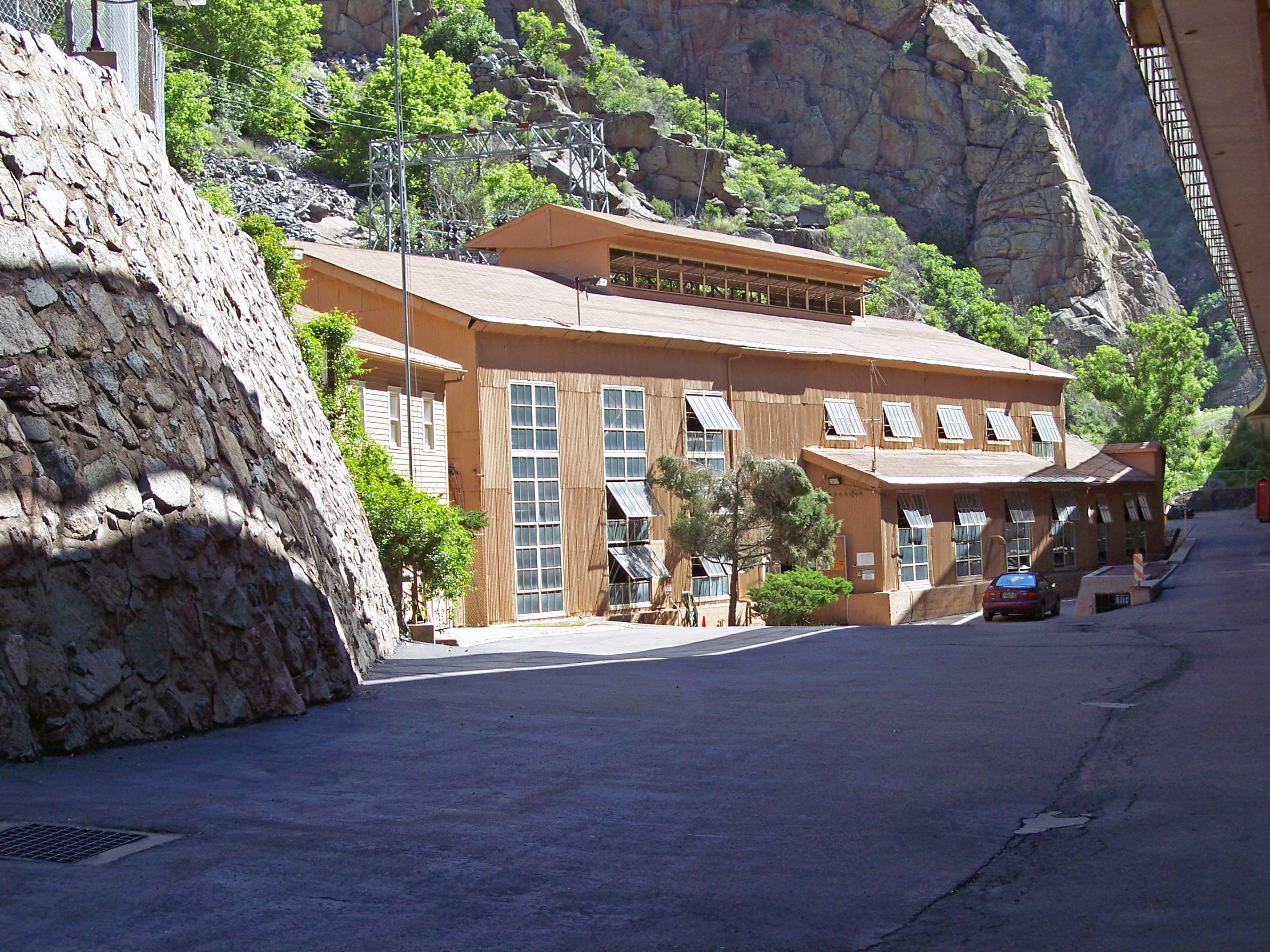
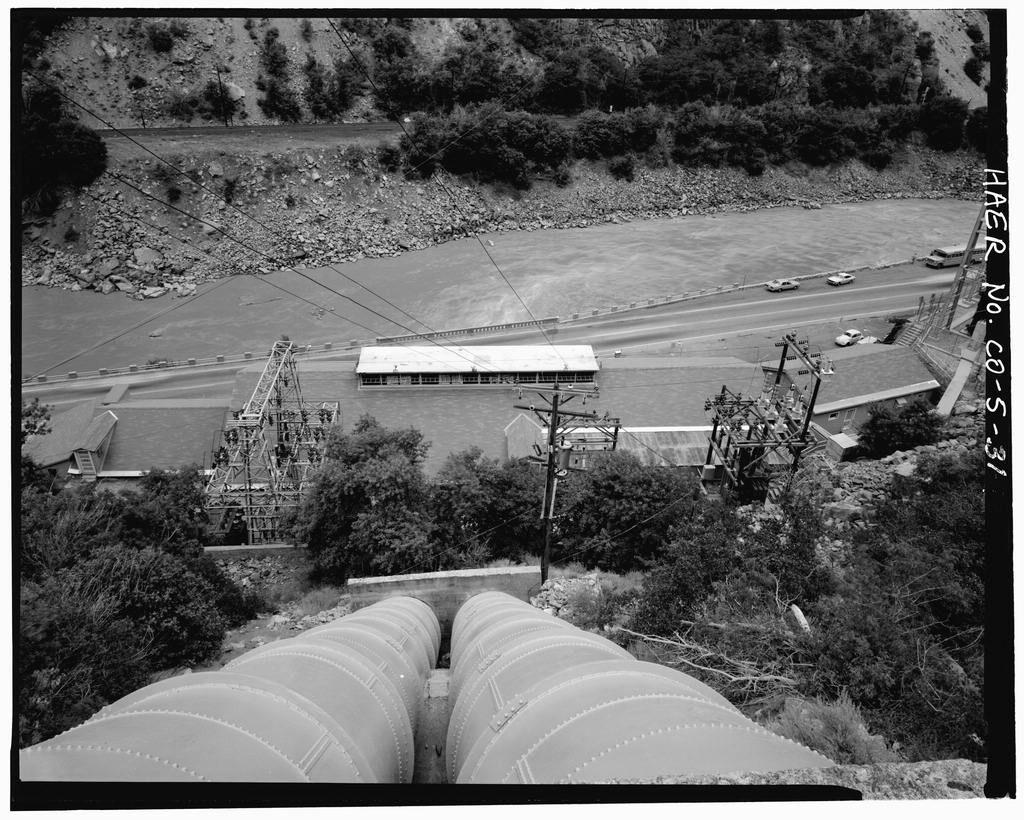
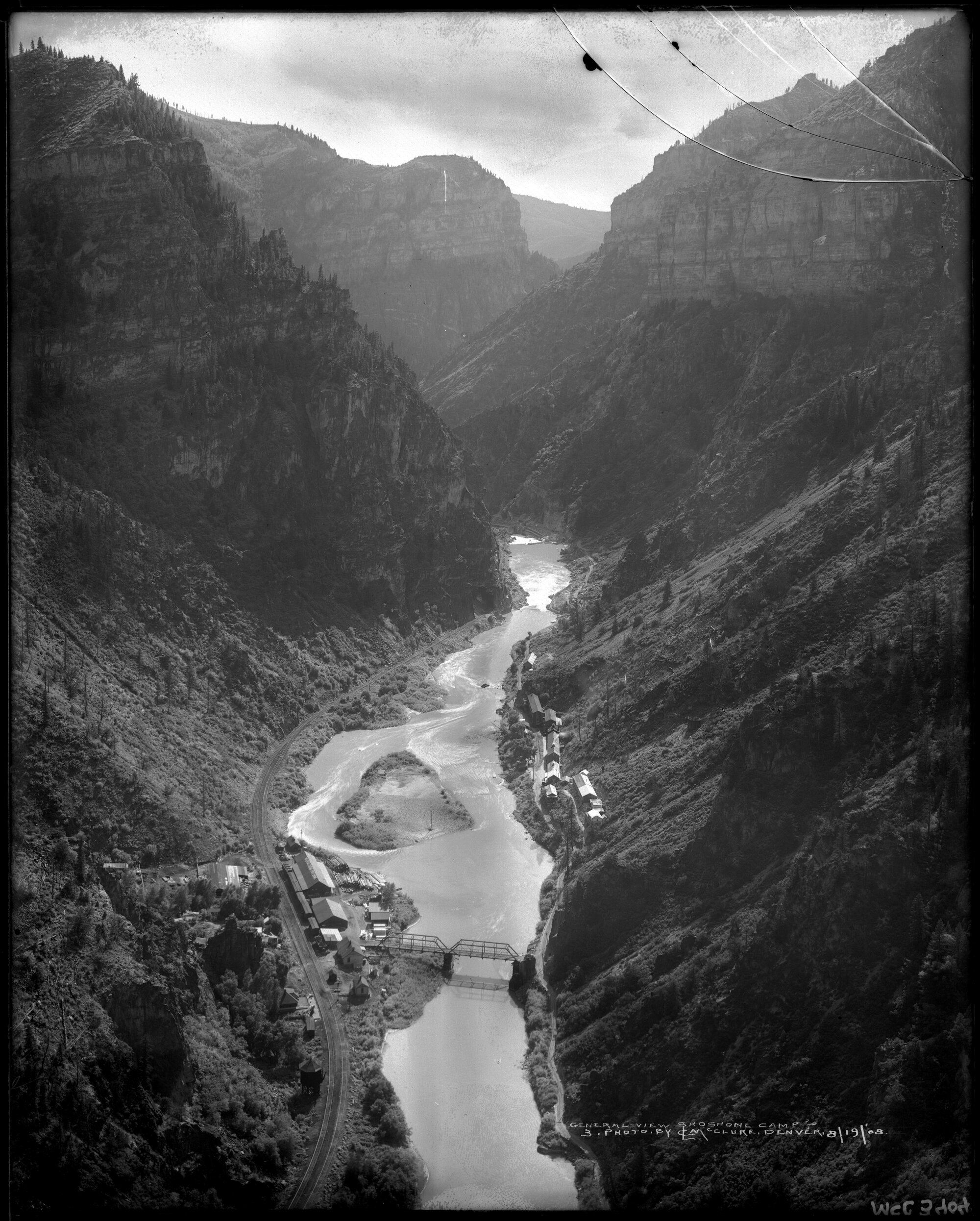
The Shoshone hydro plant in Glenwood Canyon. The Shoshone hydropower plant in Glenwood Canyon. The CWCB will hold a hearing on the water rights associated with the plant in September. Credit: Heather Sackett/Aspen Journalism

Click the link to read the article on the Aspen Journalism website (Heather Sackett):

July 25, 2025

Front Range asked for Colorado Water Conservation Board neutrality on historic use of Shoshone water rights

In an effort to head off concerns about the state’s role in a major Western Slope water deal, a Western Slope water district has offered up a compromise proposal to Front Range water providers. 

In order to defuse what Colorado River Water Conservation District General Manager Andy Mueller called “an ugly contested hearing before the CWCB,” the River District is proposing that the state water board take a neutral position on the exact amount of water tied to the Shoshone hydropower plant water rights and let a water court determine a final number. 

“Although we believe this would be an unusual process, the River District believes it would address the primary concern (i.e., avoiding the state agency’s formal endorsement of the River District’s preliminary historical use analysis) that we heard expressed by your representatives at the May 21, 2025 CWCB meeting regarding the Shoshone instream flow proposal,” Mueller wrote in an email to officials from the Front Range Water Council.

The River District worked with CWCB staff to draft the proposal, but it may not go far enough to address Front Range concerns.

The River District, which represents 15 counties on the Western Slope, is planning to purchase some of the oldest and largest non-consumptive water rights on the Colorado River from Xcel Energy for nearly $100 million. The water rights, which are tied to the Shoshone hydropower plant in Glenwood Canyon, are essential for downstream ecosystems, cities, endangered fish, and agricultural and recreational water users. As part of the deal, the River District is seeking to add an instream flow water right to benefit the environment to the hydropower water rights.

The effort has seen broad support across the Western Slope. The River District has raised $57 million toward the purchase from at least 26 local and regional partners. The project was awarded a $40 million Inflation Reduction Act grant in the waning days of the Biden administration, but those funds have been frozen by the Trump administration. 

“These water rights are foundational to the Colorado River,” said Amy Moyer, chief of strategy at the River District. “It’s the number one project for the Western Slope. It’s the top priority to move forward.”

Critically, because its water rights are senior to many other water users — they date to 1902 — Shoshone can force upstream water users to cut back. The Shoshone call has the ability to command the flows of the Colorado River and its tributaries upstream all the way to the headwaters.

The twin turbines of Xcel Energy’s Shoshone hydroelectric power plant in Glenwood Canyon can generate 15 megawatts. The River District is proposing that the CWCB remain neutral on the issue of the plant’s historic water use. Credit: Heather Sackett/Aspen Journalism

Putting a precise amount on how much water the plant has historically used is a main point of contention between the River District and the Front Range Water Council, a group that includes some of Colorado’s biggest municipal water providers: Denver Water, Colorado Springs Utilities, Aurora Water and Northern Water. These entities take water that would normally flow west, and bring it to farms and cities on the east side of the Continental Divide through what are called transmountain diversions. About 500,000 acre-feet of water annually is taken from the headwaters of the Colorado River and its tributaries to the Front Range.

Estimates by the River District put the Shoshone hydro plant’s average annual use at 844,644 acre-feet using the period between 1975 and 2003 — before natural hazards in the narrow canyon began knocking the plant offline regularly in recent years.

But Front Range Water Council members say this estimate is flawed and could be an expansion of the historical use of the water right. They have requested a hearing at the September CWCB meeting to hash out their concerns.

“The preliminary analysis that has been presented appears to expand historic use and creates potential injury,” Abby Ortega, general manager of infrastructure and resource planning at Colorado Springs Utilities told the CWCB at its May meeting.

Determining past use of the Shoshone water rights is important because it will help set a limit for future use. While changing the use of a water right is allowed by going through the water court process, enlarging it is not. The amount pulled from and returned to the river must stay the same as it historically has been.

As part of the River District’s deal to buy the water rights, the CWCB — which is the only entity in the state allowed to hold an instream flow water right — must officially accept the water right and then sign on as a co-applicant in the water court change case. 

But Front Range water providers said that doing so would amount to an endorsement of the River District’s historical use estimate, which would mean taking a side in the Front Range versus Western Slope disagreement.

“If you agree to accept the right and as I understand it, the instream flow agreement, you’re agreeing to be a co-applicant, which risks you accepting their analysis,” said Alexandra Davis, an assistant general manager with Aurora Water, at the CWCB’s May meeting.

Some members of the Front Range Water Council have asked that the CWCB remain neutral during the water court change case. In May 9 and June 9 letters to the CWCB from Marshall Brown, general manager of Aurora Water, he said the CWCB shouldrefrain from endorsing any specific methodology or volume of water.

“… [T]he CWCB should remain neutral in the water court proceedings and defer to the court’s determination of the appropriate methodology and volumetric quantification,” the May 9 letter reads. 

The River District’s offer does just that: It proposes that the CWCB should not take a position regarding the determination of historical use of the Shoshone water rights. 

“We heard the issues that are most front and center from these entities,” Moyer said. “And so we are trying to find a path forward that works for everyone.”

But even if Front Range Water Council members are in favor of the proposal, it is unlikely to result in a cancellation of the hearing. CWCB Executive Director Lauren Ris said in an email that under the board’s rules, they are required to hold a hearing. And Jeff Stahla, public information officer at Northern Water, said they will still be asking for the hearing to proceed. 

Spokespeople from Colorado Springs Utilities, Aurora Water and Denver Water all declined to comment on the River District’s proposal because it was marked as confidential. 

Some members of the Front Range Water Council have concerns beyond CWCB neutrality that could be addressed at the September hearing. 

In a May 14 letter to the CWCB, Denver Water’s CEO Alan Salazar said the water provider also wants to carry over some provisions from existing agreements like the Shoshone Outage Protocol. This agreement has an exception in cases of extreme drought that allows Denver Water to keep taking water if its reservoirs fall below certain levels and streamflows are low. Denver Water added that by omitting the last two decades of Shoshone water use, the River District’s study period is skewed, and that using an upstream stream gauge to measure historical use is improper.  

The hearing is scheduled for the next CWCB board meeting Sept. 16-18. The board can approve or disapprove the acquisition of the water rights, or make changes to the proposal and adopt the amended proposal. The board is required to take action at the September hearing unless the River District approves an extension. Pre-hearing statements are due by Aug. 4.

CWCB board members Brad Wind, who is general manager of Northern Water, and Greg Johnson, manager of resource planning at Denver Water, recused themselves from the July 17 CWCB board meeting discussion of the Shoshone water rights and plan to recuse themselves from future Shoshone discussions and decisions. 

Map of the Colorado River drainage basin, created using USGS data. By Shannon1 Creative Commons Attribution-Share Alike 4.0

Why warring #ColoradoRiver states could be headed for ‘divorce’ — The Las Vegas Review-Jounal #COriver #aridification

The potential path forward.

Click the link to read the article on The Las Vegas Review-Journal website (Alan Halaly). Here’s an excerpt:

June 27, 2025

Deadlocked for months in tense, closed-door meetings, Colorado River states may be one step closer to an agreement. Representatives from each of the seven Western states have agreed to discuss a new path forward — one that could more firmly ground Colorado River policy in hydrological reality as snowpack fails to deliver, reservoirs decline and fears mount…The proposal, presented for the first time publicly at a meeting in Arizona on June 17, would base the release of water from Lake Powell on a three-year average of the “natural flows” of the river. Water released from Lake Powell ends up in Lake Mead, the source of roughly 90 percent of Southern Nevada’s supply…The natural-flow proposal, while details remain sparse, would be a stunning departure from guidelines minted in 2007, which some argue don’t take into account declining water availability.

Community revives iconic #Colorado mountain pond, restoring water flow that was diverted by developer — The #Denver Post

Barn Pond before developer caused draining in 2024. Photo credit: SaveTwinLakesBarnPond.com

Click the link to read the article on The Denver Post website (Elise Schmelzer). Here’s an excerpt:

June 26, 2025

For decades, the pond in the hamlet of Twin Lakes served as a peaceful lunch spot for travelers, as a wildlife viewing area for locals and as one of the most photographed spots in Colorado. When filled, the pond reflected an old barn and the snowcapped peaks of the Sawatch Range — an image that adorns postcards and tourism websites…But the pond dried up last year after a developer altered the path of the stream water that filled it…On Sunday [June 22, 2025], residents gathered to celebrate the restoration of the pond after their collective efforts brought back the water flow. Twenty people — and four dogs — gathered near a new sign marking the creek before touring the water infrastructure put in place to restore the pond.

#LakePowell forecasts show hydropower generation is at risk next year as water levels drop — Shannon Mullane (Water Education Colorado) #ColoradoRiver #COriver #aridification

This 2023 diagram shows the tubes through which Lake Powell’s fish can pass through to the section of the Colorado River that flows through the Grand Canyon. Credit: USGS and Reclamation 2023

Click the link to read the article on the Water Education Colorado website (Shannon Mullane):

July 17, 2025

Federal officials reported Tuesday that the water level in Lake Powell, one of the main water storage reservoirs for the Colorado River Basin, could fall low enough to stop hydropower generation at the reservoir by December 2026.

The reservoir’s water levels have fallen as the Colorado River Basin, the water supply for 40 million people, has been overstressed by rising temperatures, prolonged drought and relentless demand. Upper Basin officials sounded the alarm in June, saying this year’s conditions echo the extreme conditions of 2021 and 2022, when Lake Powell and its sister reservoir, Lake Mead, dropped to historic lows.

The basin needs a different management approach, specifically one that is more closely tied to the actual water supply each year, the Upper Colorado River Commission’s statement said.

The seven basin states, including Colorado, are in high-stakes negotiations over how to manage the basin’s water after 2026. One of the biggest impasses has been how to cut water use in the basin’s driest years.

“You can’t reduce what doesn’t come down the stream. And that’s the reality we’re faced with,” Commissioner Gene Shawcroft of Utah said in the statement. “The only way we’re going to achieve a successful outcome is if we’re willing to work together — and not just protect our own interests.”

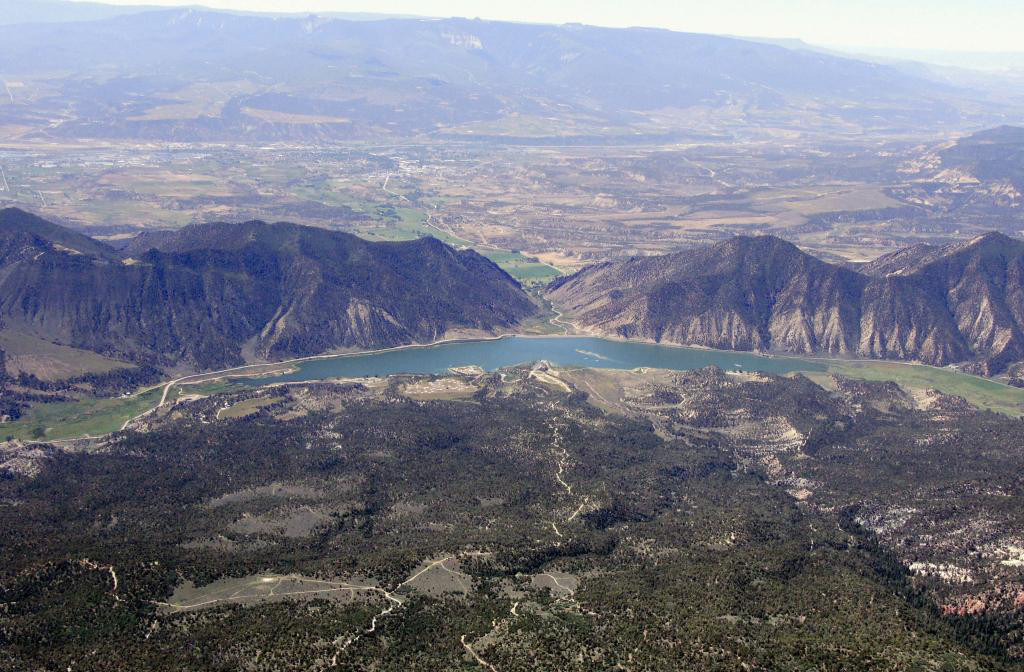
Lake Powell is seen in a November 2019 aerial photo from the nonprofit EcoFlight. The Upper Basin states are proposing two pools of stored water in Lake Powell: A Lake Powell protection account and a Lake Powell conservation account. Credit: EcoFlight

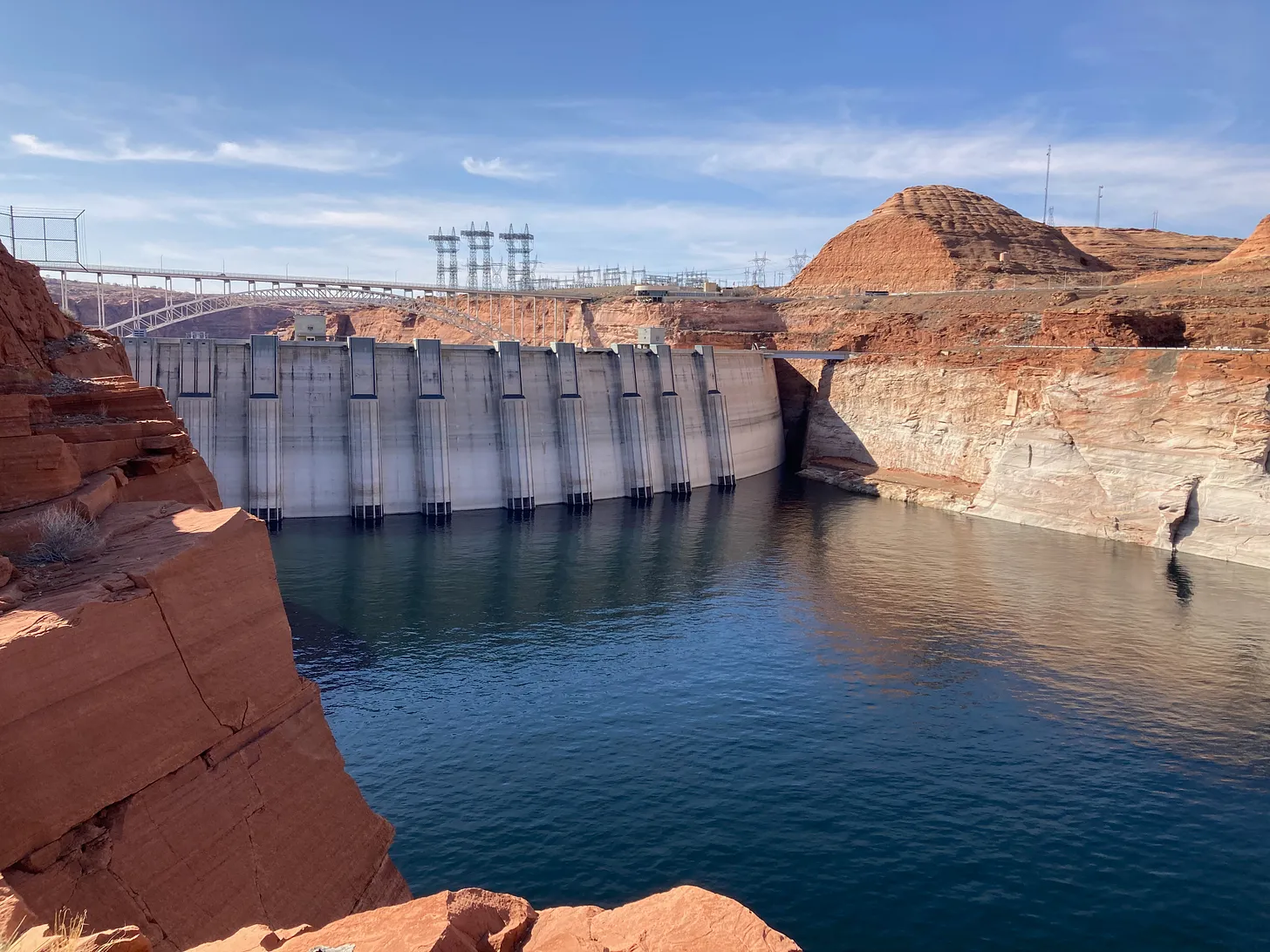
Lake Powell, located on the Utah-Arizona border, collects water from Colorado, New Mexico, Utah, Wyoming, part of Arizona and tribal reservations in the Colorado River’s Upper Basin. Glen Canyon Dam releases the reservoir’s water downstream to Lake Mead, Native American tribes, Mexico, and Lower Basin states, including Arizona, California and Nevada.

Lake Powell and Lake Mead make up about 92% of the reservoir storage capacity in the entire Colorado River Basin.

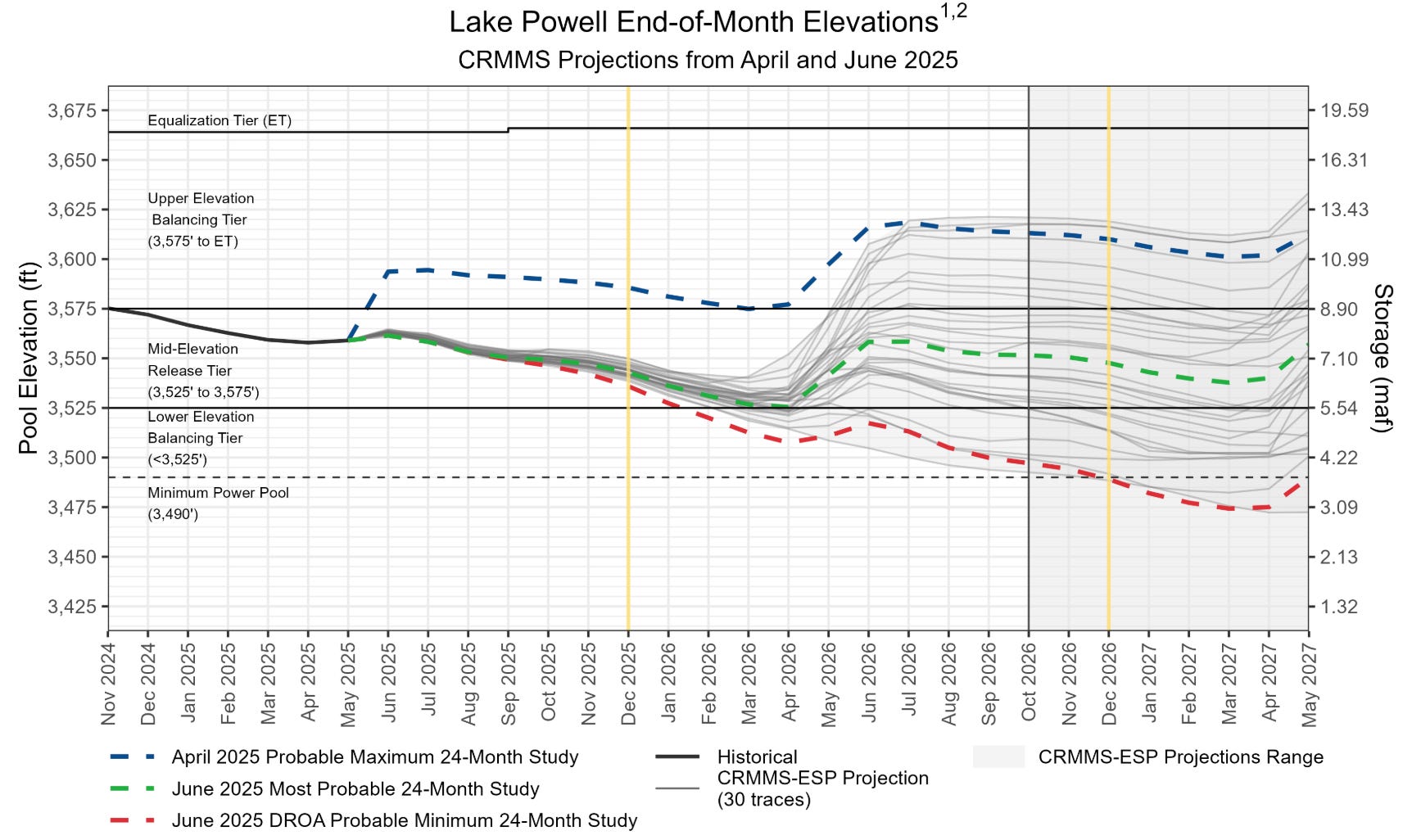
The U.S. Bureau of Reclamation’s July report, called a 24-month study, shows the potential for Lake Powell to decline below two critical elevations: 3,525 feet and 3,490 feet.

It could drop below 3,525 feet in April 2026, which would prompt emergency drought response actions. That’s in the most probable scenario, but the federal agency also considers drier and wetter forecast scenarios. The dry forecast shows that the reservoir’s water levels would fall below this elevation as soon as January.

Lake Powell would have to fall below 3,490 feet in order to halt power generation.

Planning for emergency water releases

In 2021 and 2022, officials leapt into crisis management mode and released water from upstream reservoirs — including Blue Mesa, Colorado’s largest reservoir — to stabilize Lake Powell’s water levels.

The emergency releases prompted some concerns about recreation at Blue Mesa.

The July 24-month study triggered planning for potential emergency releases, called drought response operations, at Lake Powell, and Flaming Gorge, Blue Mesa and Navajo reservoirs, said Chuck Cullom, executive director of the Upper Colorado River Commission.

“The Upper Division States and Reclamation have been monitoring the risks to Lake Powell since January 2025 due to the declining snowpack and runoff, and are prepared to take appropriate actions as conditions evolve through 2025 and spring of 2026,” he said in an email to The Colorado Sun.

The back of Glen Canyon Dam circa 1964, not long after the reservoir had begun filling up. Here the water level is above dead pool, meaning water can be released via the river outlets, but it is below minimum power pool, so water cannot yet enter the penstocks to generate electricity. Bureau of Reclamation photo. Annotations: Jonathan P. Thompson

At-risk hydropower

Hydroelectric power generation takes a hit with lower water levels at Lake Powell and Lake Mead.

Reclamation’s dry conditions forecast says Lake Powell could fall below 3,490 feet by December 2026, and Lake Mead’s water level could fall below a key elevation, 1,035 feet, by May 2027. At that point, Hoover Dam would have to turn off several turbines and its power production would be significantly reduced, said Eric Kuhn, a Colorado water expert.

In more typical or unusually wet forecasts, neither reservoir would fall below these critical elevations in the next two years, according to the report.

Lake Powell and other federal reservoirs provide a cheap and consistent source of renewable energy. Without that, electricity providers would have to look to other, more expensive sources of energy or nonrenewable supplies. Some of those costs can get handed down to customers in their monthly utility bills.

Output capacity of the dam’s turbines decreases in direct proportion to the reservoir’s surface elevation. As Lake Powell Shrinks, the dam generates less power. Source: Argonne National Laboratory.

Glen Canyon’s hydropower is normally pooled with other power sources to serve customers in Wyoming, Colorado, Arizona, New Mexico, Nevada, Texas and Utah. Its power generation has already been impacted: Fourteen of the lowest generation years at the dam have occurred since 2000.

A strong monsoon season this summer could help elevate the water levels in the major reservoirs, as could a heavy winter snowpack in the mountains this coming winter.

“If next year is below average, then we’re setting ourselves up for some very difficult decisions in the basin,” said Kuhn, former general manager of the Colorado River District and author of “Science Be Dammed,” a book about the perils of ignoring science in Western water management.

Arizona power house at Hoover Dam December 2019. Each of the 17 hydroelectric generators at Hoover Dam can produced electricity sufficient for 1,000 houses. Photo credit: Allen Best/The Mountain Town News

Kuhn has also been tracking the releases from Lake Powell with big, interstate legal questions in mind.

If the river’s flow falls below a 10-year total of about 82.5 million acre-feet, it could trigger a legal mire. In that scenario, the Lower Basin could argue that the Upper Basin would be required to send more water downstream in compliance with the foundational agreement, the 1922 Colorado River Compact.

Some Upper Basin lawyers disagree about the terms of when states, like Colorado, would be required to send more water downstream. That’s a big concern for water users, including farmers and ranchers, who say they already don’t have enough water in dry years.

From 2017 to 2026, the 10-year cumulative flow is expected to be about 83 million acre-feet, Kuhn said.

“We’re OK through 2026,” Kuhn said. “But under the most probable and minimum probable [forecasts], it’s almost a certainty that the flow will drop below 82.5.”

Lake Powell’s ecosystems feel the strain

Bridget Deemer, a research ecologist for the U.S. Geological Survey, keeps her eye on how lower water levels impact ecosystems in Lake Powell.

In a recent study, she found that low dissolved oxygen zones grow larger as water levels fall and more sediment gets backed up in the reservoir over time. This sediment can spur more decomposition, which uses up oxygen in the water.

The zones can cut down on fish habitat. Fish don’t want to be in the warm surface waters of the lake, but as they search for their preferred temperature and food source, they can end up in an area with low oxygen, Deemer said.

The effect is greatest right below Glen Canyon Dam. In 2023, there were 116 days when the oxygen was below 5 milligrams per liter, which is the threshold for trout. At 2 to 3 milligrams per liter, the fish can die.

Deemer also studies how these zones are impacted by algae blooms.

Lake Powell researchers noted toxic algae blooms around the Fourth of July and last fall. They don’t know definitively what caused either bloom event, but research does show that warming water temperatures and increased nutrients are two leading causes of harmful algae blooms.

These blooms can impact fish, people, pets or anything that ingests the algae.

“In general, Lake Powell is doing well,” she said. “Its waters are really clear without a lot of nutrients and algal growth. These blooms are smaller scale and localized.”

More by Shannon Mullane

Map credit: AGU

Part III: 20th century expansions and 21st century realities in the #SanLuisValley: The solutions seem fairly obvious. Executing them is another matter — Allen Best (BigPivots.com) #RioGrande

Center pivot in the San Luis Valley. Photo credit: Allen Best/Big Pivots

Click the link to read the article on the Big Pivots website (Allen Best):

July 20, 2025

Center, as its name implies, lies at the center of the San Luis Valley. The valley is among the nation’s two most prominent places for growing potatoes. Among the growers is a fourth-generation family operation, Aspen Produce LLC.

Jake Burris married into the family. In addition to spuds, the family grows barley and alfalfa on 3,500 acres. Some neighboring farmers also grow canola. Burris is president of the board of managers of one of six subdistricts in the San Luis Valley’s Rio Grande Water Conservation District. His subdistrict — called Subdistrict No. 1 — was formed in 2006 in response to a declining water table. What’s known as the unconfined aquifer supports this area, the most agriculturally productive in the San Luis Valley. With just seven inches of annual precipitation, irrigation in the San Luis Valley is everything. And in Subdistrict 1, much of that water comes from 3,617 wells..

Alfalfa grown is quite thirsty, but potatoes get grown on much larger areas of the Rio Grande Water Conservancy District. Photo credit: Allen Best/Big Pivots

Alfalfa is the thirstiest crop, using 24 to 36 inches of water to get three cuttings. The strong sunshine and cooler temperatures found above elevations of 7,000 feet produce a high-quality hay that draws orders from dairies as far as California. Alfalfa is grown on 21,100 acres in the district. Potatoes cover 51,100 acres. Barley is grown on 28,000 acres. Some have replaced barley with rye. Several thousand acres have together been devoted to canola, lettuce, and other crops. A recent census found about 25,000 acres had been fallowed.

The San Luis Valley has two primary aquifers. Lower in the ground, separated by relatively impermeable beds of clay from what lies above, is the confined aquifer. The first well into the confined aquifer was bored in 1887. Because of the pressures underground, it was an artesian well. No pumping was needed to bring water to the surface. Louis Carpenter, a professor at the Colorado Agriculture College (now Colorado State University), estimated the valley had 2,000 artesian wells when he visited in 1891.

The unconfined aquifer lies above the confined aquifer. The unconfined aquifer existed prior to major water development in the valley but water volumes rose greatly when farms began using Rio Grande water in the 1880s. Four ditches deliver Rio Grande water to the farms and hence to the aquifer. Introduction of high-capacity pumps in the 1950s and center-pivot sprinklers in the 1970s accelerated groundwater extraction. In 1972, the state engineer imposed a moratorium on new wells from the confined aquifer, followed in 1981 by a moratorium on new wells in the unconfined aquifer. These moratoria acknowledge that groundwater drafting had to be limited.

Then came 2002, hot and dry, escalating the challenge. Impact to the unconfined aquifer was drastic with rising temperatures causing growing water demand even as snowpack declined.

The unconfined aquifer “has been dropping overall since about 2002,” says Craig Cotten, the Colorado Division of Water Resources engineer for Division 3, which encompasses the San Luis Valley. “We just have not had a real good series of years as far as the surface water.”

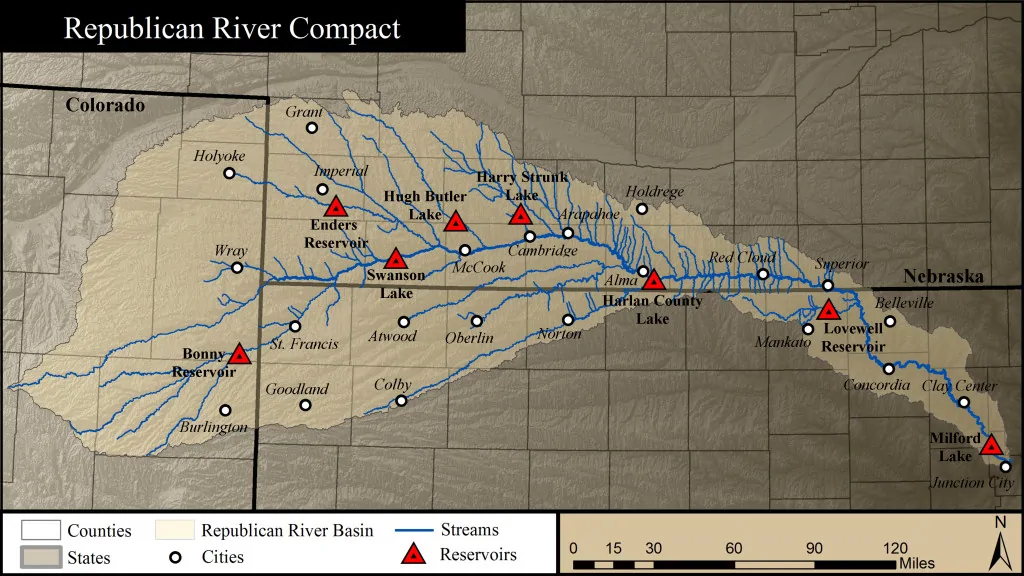
In 2004, state legislators passed a law that sets the San Luis Valley’s aquifers apart from those of the Republican River and Denver Basin groundwater stories. That law, SB04-222, explicitly orders both the confined and unconfined aquifers in the San Luis Valley be managed for sustainability. The Colorado law governing the Denver Basin aquifers requires a “slow sip” but does not imagine sustainability. In the Republican River Basin, no law speaks to sustainability. There, only the interstate compact insists upon limits.

San Luis Valley Groundwater

Here’s another difference. Water from aquifers create the Republican River and its tributaries. In the south-metro area, surface streams cause little recharge to the Denver Basin aquifers. In the San Luis Valley, the Rio Grande as well as some surface streams coming off the San Juans contribute water to both the unconfined and confined aquifers. The hydrogeology is more complex.

This 2004 law also encouraged the formation of groundwater subdistricts within the Rio Grande Water Conservation District. The thinking was that very local groups of farmers could work together to figure out how to keep their portions of the aquifers sustainable. They could also be more effective in this pursuit by working together than doing so individually.

Six subdistricts have been created in the Rio Grande Water Conservation District and one in the Trinchera Water Conservancy District. Subdistrict No. 1 began operations in 2012 after the state approved its operating plan.

All these groundwater districts have the goal of reducing water consumption as necessary to replenish the aquifers or by introducing water into the aquifer from the Rio Grande or other sources.

Agriculture constitutes nearly the entire economy of the San Luis Valley. Photo credit: Allen Best/Big Pivots

Exactly how much restoration of the aquifers is needed? The state law specified a return to volumes that approximate those of 1976 to 2001 in the confined aquifer. But there’s some guesswork about how much water the confined aquifer had then. Detailed records on Subdistrict No. 1 were not kept until 1976.

In August 2024 the unconfined aquifer in Subdistrict 1 was estimated to have averaged almost 1.2 million acre-feet less water during the five preceding years than it had in 1976. The rules approved by the Colorado Supreme Court in 2011 in a document called the Plan for Water Management call for the unconfined aquifer recovery within 200,000 to 400,000 acre-feet of where it was in 1976. That would be deemed sustainable, as ordered by the 2004 law.

To achieve this, the state engineer said that Subdistrict No. 1 would need to recover 170,000 acre-feet each year between now and 2031. Initially, Subdistrict No. 1 aimed to take 40,000 acres out of irrigation per year, or about 80,000 acre-feet of annual groundwater pumping, to allow the unconfined aquifer to recover. That goal is unattainable, say water officials, and hence a rethink is needed. Success has occurred, though. In 2024, for example, roughly 176,000 acre-feet were pumped from the confined and unconfined aquifers in Subdistrict No. 1, the fewest since groundwater metering began in 2009. That’s about a 30% reduction.

More sustained success will be necessary. “You don’t recover that unconfined aquifer through single years of good runoff,” says Ullmann, the state engineer. “There are difficult decisions that have to be made in order to recover and restore the aquifers, but that’s what these subdistricts are trying to do.”

Unlike the Republican River Basin, the unconfined aquifer in the San Luis Valley is fed water diverted from the Rio Grande, seen here at Monte Vista, and into irrigation canals. Photo credit: Allen Best/Big Pivots

This success is at least partly due to efforts to modify irrigation practices and taking land out of production. Amber Pacheco, deputy general manager of the Rio Grande Water Conservation District, explains that it’s difficult to quantify the reductions.

“Some farmers, for example, have simply reduced the number of alfalfa cuttings (and hence the irrigation required), for example. Or they only irrigate when they need to do so. Others have changed the cover crops planted after a potato harvest to reduce the amount of water needed.”

As in the Republican River District, local efforts to take land out of production use the foundation of federal programs, particularly CREP, or Conservation Reserve Enhancement Program. The subdistrict provides 20% of funds and the federal government 80%.

As did the Republican district in 2022, the Rio Grande district got an additional $30 million allocation of federal money funneled through the state. That money allows $3,000 in payment per acre-foot of curtailed groundwater use.

More must be done to recover the aquifer. The current proposal assembled by Burris and other directors of Subdistrict No. 1, their fourth iteration, would require aquifer recharge as a condition of pumping on a one-to-one basis. Water for recharge would come from water secured from the Rio Grande or native flows into the unconfined aquifer. This new plan allows subdistrict members with surface water credits to pump from the aquifer, because they are resupplying it.

The pumping allowed under the plan would be cut drastically. The Rio Grande district does not have authority to shut down wells, but it does have authority to assess fees for over-pumping. That fee stands at $150 per acre-foot. The plan would elevate that to $500. And, if aquifer recovery is not achieved, it would rise to $1,000.

Ultimately, the state engineer has authority to curtail wells that do not provide replacement water pursuant to an approved groundwater management plan or some other augmentation plan.

Some farmers in the subdistrict disagree with this plan. Opponents banded together as the Sustainable Water Augmentation Group, or SWAG, and filed a lawsuit to block implementation of the plan. A five-week trial has been scheduled for early 2026. Nobody expects that court’s decision to be the end of it. Whoever loses might well appeal the decision to the Colorado Supreme Court, a process likely to continue into 2028.

Might the problem of the depleted unconfined aquifer be resolved by diverting more water from the Rio Grande? The river has long been over-appropriated. This year, for example, rights junior to 1880 were being curtailed in May. As with the Republican River, water must be allowed to flow downstream as required by the Rio Grande Compact.

For the unconfined aquifer to recover quickly, Mother Nature would need to quickly step up. “It would take multiple years of above-average flows [in the Rio Grande] to recover to the level that we need,” says Pacheco. In fact, 19 of the last 20 years have been sub-average as compared to 1970 to 2000. This year’s runoff in mid-May was forecast to be 61% of the average from 1890 through 2024.

Part IV: “It’s like the clock is ticking when it comes to sustainability,” said Rod Lenz, chair of the Republican River Water Conservation District, at a recent board meeting. This and other parting thoughts about the three groundwater basins examined in this story. Also, a study is underway to provide a better estimate of the groundwater remaining in Baca County.  You can also download the entire story here in a magazine format.

Colorado Rivers. Credit: Geology.com

Dismantling of EPA’s Scientific Research Arm Fulfills Key Chemical Industry Goal — Marianne Lavelle (InsideClimateNews.com)

EPA-estimated cancer risk in the region (Cancer Alley). By MiseDominic – Own work, CC0, https://commons.wikimedia.org/w/index.php?curid=147151609

Click the link to read the article on the Inside Climate News website (Marianne Lavelle):

July 21, 2025

Companies feared rules and lawsuits based on the Office of Research and Development’s assessments of the dangers of formaldehyde, ethylene oxide and other substances.

Soon after President Donald Trump took office in January, a wide array of petrochemical, mining and farm industry coalitions ramped up what has been a long campaign to limit use of the Environmental Protection Agency’s assessments of the health risks of chemicals.

That effort scored a significant victory Friday when EPA Administrator Lee Zeldin announced his decision to dismantle the agency’s Office of Research and Development (ORD).

The industry lobbyists didn’t ask for hundreds of ORD staff members to be laid off or reassigned. But the elimination of the agency’s scientific research arm goes a long way toward achieving the goal they sought. 

In a January 27 letter to Zeldin organized by the American Chemistry Council, more than 80 industry groups—including leading oil, refining and mining associations—asked him to end regulators’ reliance on ORD assessments of the risks that chemicals pose for human health. The future of that research, conducted under EPA’s Integrated Risk Information System program, or IRIS, is now uncertain.

“EPA’s IRIS program within ORD has a troubling history of being out of step with the best available science and methods, lacking transparency, and being unresponsive to peer review and stakeholder recommendations,” said an American Chemistry Council spokesperson in an email when asked about the decision to eliminate ORD. “This results in IRIS assessments that jeopardize access to critical chemistries, undercut national priorities, and harm American competitiveness.”

The spokesperson said the organization supports EPA evaluating its resources to ensure tax dollars are being used efficiently and effectively.

H. Christopher Frey, an associate dean at North Carolina State University who served as EPA assistant administrator in charge of ORD during the Biden administration, defended the quality of the science done by the office, which he said is “the poster case study of what it means to do science that’s subject to intense scrutiny.”

“There’s industry with a tremendous vested interest in the policy decisions that might occur later on,” based on the assessments made by ORD. “What the industry does is try to engage in a proxy war over the policy by attacking the science.”

Among the IRIS assessments that stirred the most industry concern were those outlining the dangers of formaldehyde, ethylene oxide, arsenic and hexavalent chromium. Regulatory actions had begun or were looming on all during the Biden administration.

The Biden administration also launched a lawsuit against a LaPlace, Louisiana, plant that had been the only U.S. manufacturer of neoprene, Denka Performance Elastomer, based in part on the IRIS assessment of one of its air pollutants, chloroprene, as a likely human carcinogen. Denka, a spinoff of DuPont, announced it was ceasing production in May because of the cost of pollution controls.

Public health advocates charge that eliminating the IRIS program, or shifting its functions to other offices in the agency, will rob the EPA of the independent expertise to inform its mission of protection.

“They’ve been trying for years to shut down IRIS,” said Darya Minovi, a senior analyst with the Union of Concerned Scientists and lead author of a new study on Trump administration actions that the group says undermine science. “The reason why is because when IRIS conducts its independent scientific assessments using a great amount of rigor … you get stronger regulations, and that is not in the best interest of the big business polluters and those who have a financial stake in the EPA’s demise.”

The UCS report tallied more than 400 firings, funding cuts and other attacks on science in the first six months of the Trump administration, resulting in 54 percent fewer grants for research on topics including cancer, infectious disease and environmental health.

EPA’s press office did not respond to a query on whether the IRIS controversy helped inform Zeldin’s decision to eliminate ORD, which had been anticipated since staff were informed of the potential plan at a meeting in March. In the agency’s official announcement Friday afternoon, Zeldin said the elimination of the office was part of “organizational improvements” that would deliver $748.8 million in savings to taxpayers. The reduction in force, combined with previous departures and layoffs, have reduced the agency’s workforce by 23 percent, to 12,448, the EPA said.

With the cuts, the EPA’s workforce will be at its lowest level since fiscal year 1986.

“Under President Trump’s leadership, EPA has taken a close look at our operations to ensure the agency is better equipped than ever to deliver on our core mission of protecting human health and the environment while Powering the Great American Comeback,” Zeldin said in the prepared statement. “This reduction in force will ensure we can better fulfill that mission while being responsible stewards of your hard-earned tax dollars.”

The agency will be creating a new Office of Applied Science and Environmental Solutions; a report by E&E News said an internal memo indicated the new office would be much smaller than ORD, and would focus on coastal areas, drinking water safety and methodologies for assessing environmental contamination.

Zeldin’s announcement also said that scientific expertise and research efforts will be moved to “program offices”—for example, those concerned with air pollution, water pollution or waste—to tackle “statutory obligations and mission essential functions.” That phrase has a particular meaning: The chemical industry has long complained that Congress never passed a law creating IRIS. Congress did, however, pass many laws requiring that the agency carry out its actions based on the best available science, and the IRIS program, established during President Ronald Reagan’s administration, was how the agency has carried out the task of assessing the science on chemicals since 1985.

Justin Chen, president of the American Federation of Government Employees Council 238, the union representing 8,000 EPA workers nationwide, said the organizational structure of ORD put barriers between the agency’s researchers and the agency’s political decision-making, enforcement and regulatory teams—even though they all used ORD’s work.

“For them to function properly, they have to have a fair amount of distance away from political interference, in order to let the science guide and develop the kind of things that they do,” Chen said. 

“They’re a particular bugbear for a lot of the industries which are heavy donors to the Trump administration and to the right wing,” Chen said. “They’re the ones, I believe, who do all the testing that actually factors into the calculation of risk.”

ORD also was responsible for regularly doing assessments that the Clean Air Act requires on pollutants like ozone and particulate matter, which result from the combustion of fossil fuels. 

Frey said a tremendous amount of ORD work has gone into ozone, which is the result of complex interactions of precursor pollutants in the atmosphere. The open source computer modeling on ozone transport, developed by ORD researchers, helps inform decision-makers grappling with how to address smog around the country. The Biden administration finalized stricter standards for particulate matter in its final year based on ORD’s risk assessment, and the Trump administration is now undoing those rules.

Aidan Hughes contributed to this report.

Federal Water Tap, July 21, 2025: Draft House Budget Would Cut Key Water Infrastructure Funds — Brett Walton (circleofblue.org)

December 22, 2008 Kingston Fossil Plant coal ash retention pond failure via the Environmental Protection Agency and the Tennessee Valley Authority

Click the link to read the article on the Circle of Blue website (Brett Walton):

The Rundown

  • The House budget, though not as severe as the White House’s, proposes a 25 percent cut to the main source of federal funding for local water systems.
  • Senate approves Trump’s $9.4 billion in cuts to public broadcasting and foreign aid.
  • Other water bills in Congress include tribal water infrastructure funding, sinkhole monitoring, microplastics, and Great Lakes fisheries.
  • Bureau of Reclamation announces $200 million for water recycling projects in two western states.
  • EPA delays requirements to monitor groundwater at coal ash dumps.
  • Before taking summer break, Congress will hold hearings this week on fossil fuel pipeline safety, rising electricity demand, FEMA improvement, and NEPA reviews.

And lastly, Congress’s watchdog finds NRCS could improve its dam safety approach.

“While requests greatly exceeded the funding available for projects, we did our best to provide some funding for all eligible projects given the impact these dollars will have in communities across the country.” Rep. Mike Simpson (R-ID), speaking about water infrastructure earmarks in his committee’s 2026 budget proposal.

By the Numbers

$200 Million: Bureau of Reclamation funding announced for two water reuse projects in the western states. Phoenix will receive $179 million for its North Gateway project, which will produce 8 million gallons of recycled water a day. Washington County Water Conservancy District, which encompasses high-growth St. George in southwest Utah, will see more than $20 million for its regional recycled water system. The final cost for that system is expected at more than $1 billion.

News Briefs

House Proposes Water Cuts
In its draft fiscal year 2026 budget, a House Appropriations subcommittee proposes a 25 percent combined cut to the state revolving funds, the main source of federal funding for local water systems.

The Drinking Water State Revolving Fund would be funded at $895 million, down from $1.1 billion. The Clean Water State Revolving Fund, which is for sewer and stormwater projects, would be funded at $1.2 billion, compared to $1.6 billion in 2025.

Though not as deep as President Trump’s proposal of a 90 percent cut, the budget proposal still drew criticism from water utility groups, who would prefer federal assistance be maintained or increased.

Combined, half of the appropriated funds would be redirected as earmarks to specific projects. This action pulls money out of circulation in the revolving funds, which grow as utilities repay interest. Water groups worry that if Congress continues down this path of carving out earmarks from the revolving funds the viability of the funds will be at risk.

In context: Will Congress Defy Trump on Water Infrastructure Spending?

Delaying Coal Ash Compliance
The EPA granted states and utilities more time to meet federal rules for cleaning up waste pits at coal-fired power plants that pollute groundwater and rivers.

Groundwater monitoring requirements will not be mandatory until August 2029, according to the new timeline. It is a 15-month extension.

In context: President Trump Wants Coal Ash in State Hands

Senate Approves Foreign Aid, Public Broadcasting Cuts
Joining the House, the Senate endorsed the president’s desire to cut $9.4 billion in already approved spending on public broadcasting and foreign aid.

Reuters details the on-the-ground fallout from U.S. foreign aid cuts, documenting 21 water projects that were abandoned before completion.

Other Water Bills in Congress
Besides the budget, members introduced bills on microplastics, tribal water access, and sinkholes.

  • Representatives from Florida and Oregon introduced a bipartisan bill in both chambers that would require a federal study on the damage to human health from microplastics in food and water.
  • The House Natural Resources Committee approved a bill to reauthorize a federal research program for Great Lakes fisheries.
  • The House passed a bill to establish within the U.S. Geological Survey a sinkhole mapping and risk assessment program.
  • Democrats in the House and Senate introduced the Tribal Access to Clean Water Act, a bill that would increase funding authorizations for a number of federal programs that invest in water infrastructure and technical assistance on tribal lands. The largest chunk would be directed to the Indian Health Service, authorized at $500 million annually through 2030 for sanitation facilities. Even if the bill were to pass, Congress would still need to appropriate the money.

Studies and Reports

Dam Safety
The Government Accountability Office reviewed the Natural Resources Conservation Service’s approach to dam safety.

The report found that NRCS could improve in several areas. For one, the agency does not monitor completion of dam inspections with its local project sponsors.

Also, the agency is missing data on the condition of the dams, even those that are rated high-hazard and threaten lives and property downstream if they fail.

NRCS helped to plan, design, and construct nearly 12,000 dams.

On the Radar

Congressional Hearings
A few hearings on tap this week before the representatives take summer break.

On July 22, the House Natural Resources Committee will hold a hearing on NEPA reviews, which agencies are beginning to shorten.

That same day, a House Energy and Commerce subcommittee will hold a hearing on fossil fuel pipeline safety. This week marks the 15th anniversary of one of the nation’s largest inland oil spills. In July 2010, an Enbridge pipeline ruptured near Marshall, Michigan, spilling more than 843,000 gallons of oil into local waterways.

Also on July 22, the House Appropriations Committee will vote on the fiscal year 2026 budget bill for EPA and Interior.

On July 23, the Senate Energy and Natural Resources Committee will discuss challenges to meeting rising electricity demand. Data center growth is causing energy demand to soar.

Also on July 23, a House Transportation and Infrastructure subcommittee will discuss ways to improve FEMA’s disaster response.

Cybersecurity Webinar for Water Utilities
The EPA and the federal government’s cybersecurity agency will hold a free webinar for water utilities on cybersecurity vulnerabilities.

The webinar is July 24 at 2:00 p.m. Eastern. Register here.

Federal Water Tap is a weekly digest spotting trends in U.S. government water policy. To get more water news, follow Circle of Blue on Twitter and sign up for our newsletter.

Part II: South Metro #Denver cities starting to diversify water sources: #CastleRock and #Parker 25 years ago were almost entirely dependent upon #groundwater. They are diversifying, and one plan is to import water from far down the #SouthPlatteRiver Valley — Allen Best (BigPivots.com)

Castle Rock. Photo credit: Allen Best

Click the link to read the series on the Water Education Colorado website. Click the link to read the article on the Big Pivots website (Allen Best):

July 20, 2025

This is Part II of a four-part series about groundwater basins in Colorado. The story was commissioned by Water Education Colorado and appears in a variant form in the summer 2025 issue of Headwaters magazine. Photos by Allen Best unless otherwise noted.

Unlike the sparsely populated Republican River Basin, the south metro area of the Denver Basin has large and still-growing cities. Most of the south metro area lies within Douglas County, whose population ballooned between 1980 and 2025 from 25,200 to nearly 400,000.

Castle Rock, the county’s largest city, has 87,000 residents. Based on approved development, the city expects to grow to a population of 120,000 to 140,000. Parker, the second largest city, has 68,000 residents and has zoning for 80,000. Utilities serving these two cities in 2005 were almost 100% dependent upon extractions from the underlying Dawson, Denver, Arapahoe and Laramie-Fox Hills aquifers. Both cities as well as other jurisdictions have lessened their dependence, but they have much work to do.

How much water remains? That’s not an easy answer to deliver, as a consultant told the Castle Rock City Council in 2005. A council member asked him: “Just how much water remains?” Perhaps leery of trying to offer easy answers that required a half-hour explanation, he simply smiled and said: “It’s dark down there.”

That absence of total certainty was at the heart of a Colorado Supreme Court decision handed down in late 2024. Parker Water and Sanitation District, Castle Rock Water and others had squared off in water court beginning in 2021 with the Colorado Division of Water Resources. Parker Water has 33 wells that are 515 to 2,745 feet deep. State-issued permits for the newest five wells limit the volumes to what could be withdrawn during 100 years at a rate of 1% a year. Parker Water and several other south-metro jurisdictions disputed the state’s authority to attach this stipulation.

The stipulation was premised on a 1973 law in which state legislators ordered a “slow sip” of Denver Basin aquifers. Later legislation and rulemaking clarified that withdrawals were not to exceed 1% of total recoverable water in that portion underlying the land of the permittee’s well in any given year.

Castle Rock believes it has underlying water in the Denver Basin aquifers to satisfy its needs for 300 years but is also making efforts to reduce per-capita use while also diversifying sources. It has 87,000 residents now but expects to grow to between 120,000 and 140,000. Photo credit: Allen Best/Big Pivots

This dispute is about the future. When the cities reach those 100-year limits and the total volumetric limits associated with their wells, will they be able to continue pumping. Must they cease pumping even if water remains in the aquifer?

Aurora, which lies within a half-mile of Parker Water wells, argued its water rights could be harmed if Parker pumped more than the total volume of water found to be available for its wells.

It’s crucial to understand that water underground knows no property lines, no signs saying “Welcome to Parker.” Water could, in theory, flow from below Aurora’s land to Parker’s wells. Underground, there are no fences.

Colorado Supreme Court justices, in their November 2024 majority opinion, warned of a “race to the bottom of the aquifer, with earlier permittees receiving a significant head start.” What would happen if Parker Water, Castle Rock Water and others had their druthers? “Absent a total volumetric limit, a permittee who continues to pump at the maximum permitted rate for more than 100 years would end up pulling water to its well that would not otherwise be underlying its land,” said the justices in their majority opinion.

In his dissent, Justice Brian Boatright came to the opposite conclusion, siding with the south-metro jurisdictions.

A study by the U.S. Geological Survey published in 2011 used a model that found 1% to 2% of precipitation becomes water in the bedrock aquifers and 7% in the alluvial aquifer. For urban irrigation, such as at the Watercolor subdivision in Castle Rock, 2.5 inches of water makes it back to underlying aquifers each year. Photo credit: Allen Best/Big Pivots

Some south-metro entities may seek state legislation that reflects what they believe is the best policy. As it stands now, a permit-holder that has withdrawn the total volumetric amount identified on a well permit must cease pumping, says Jason Ullmann, the state engineer and director of the Colorado Division of Water Resources. He has authority to notify users in writing of their violations. Could he shut down wells? They would be given “time as may reasonably be necessary to correct deficiencies,” he says. But yes, they would be “subject to enforcement.”

Just how much water remains in the Denver Basin aquifers? The Division of Water Resources issues well permits, and in doing so, estimates the potential volume of water underlying the applicant’s parcel. But the state agency does not track changes in volume over time, nor does it track the amount of water that wells pump. It requires well owners to maintain pumping records.

When asked how much water remains in Castle Rock’s wells, Mark Marlowe, director of the city’s water utility, suggested consultation of a hydrogeologist, perhaps from the U.S. Geological Survey. Pressed further, he said Castle Rock’s groundwater supply will last more than 300 years “from a legal standpoint” based on current rates of use.

The practical effect of the Supreme Court ruling on Castle Rock? Very little in the short term, Marlowe says. In 2005, Castle Rock set out to create a pathway to dramatically lessen groundwater dependence. “We’ve been headed down this road for a long time,” he says. So why participate in Parker’s lawsuit? Because, he replied, the city wants to make long-term use of its investment in groundwater extraction. And as a practical matter, the city commonly extracts less than the 1% allowed annually.

Marlowe’s answer is not totally satisfying, but the work done by Castle Rock since 2005 must be acknowledged. It was 100% dependent on groundwater extraction then. It is adding new impoundments to store surface water, pumping water upstream from Chatfield Reservoir, and doubling the daily capacity for treating wastewater. Castle Rock already has lessened its dependence on groundwater to less than 69% over the last four years and Marlowe says he’s confident that by 2050 it will lessen to 25%.

Several of Castle Rock’s successes have involved working with other south-metro jurisdictions, including the Parker Water and Sanitation District. In 2013, when Ron Redd was hired by Parker Water as general manager, the utility was still 90% groundwater reliant. He was given a mission: transition to renewable sources.

A key project has been water reuse. Water introduced into the South Platte River from other basins or from groundwater can be reused. Aurora Water set out to do so in 2003. The $680 million Prairie Waters Project pumps water from the river-side aquifer near Fort Lupton to a reservoir in the southeast metropolitan area. From there, in 2010, Parker Water, Castle Rock and eight other south-metro communities joined Denver Water and Aurora Water in a partnership called WISE (Water Infrastructure and Supply Efficiency) to further manage infrastructure cooperatively and deliver the reclaimed water to their members.

Making this possible was a new 75,000-acre-foot impoundment called Rueter-Hess Reservoir. Completed in 2012, it is a core asset for Parker Water and three other utilities who share its use.

Jim Yahn, left, manager of the Prewitt Reservoir, which might become part of the Platte Valley Water Partnership, speaks with Ron Red, manager of Parker Water and Sanitation District, and Joe Frank, general manager of the Lower South Platte Water Conservancy District, which is part of the proect. There is still hope that Prewitt would be part of the plan,” says Yahn. “The decree that Parker and Lower South Platte are seeking still has Prewitt Reservoir as a component of the plan.” Photo credit: Allen Best/Big Pivots

The Platte Valley Water Partnership is even more ambitious. Parker Water and Castle Rock Water have joined with the Lower South Platte Water Conservancy District.

They plan to detain South Platte River water that currently flows downstream into Nebraska during winter and spring runoff. The South Platte River Compact allows the use of this water. Little excess exists in many years, but when there is, such as in 2023, no place exists to store that water. The project plans to use Prewitt Reservoir and a new reservoir northwest of Akron in the capture and storage of those flows before pumping some of that water 125 miles to Rueter-Hess Reservoir.

Farmers will also have access to a cut of this “new” water — with agricultural users receiving 50% of the captured water and municipalities receiving 50%. Construction is set to begin around 2035, at an anticipated cost of $780 million.

As of mid-July, it’s not clear how the Nebraska lawsuit against Colorado involving water for Nebraska’s proposed Perkins Canal might affect this project.

A final important component of the path forward for the water utilities who mine Denver Basin aquifers lies in conservation, particularly for outdoor landscaping. The prevailing theme at one time was use as much as you want — but pay for it. That thinking has shifted to limits and goals of reduced use.

Parker has reduced groundwater dependence to 60% and has goals to reduce it to 25%. Might that be achieved in tapping the aquifers of the San Luis Valley? The idea has provoked outrage for more than 30 years.

“Thanks, but no thanks,” is how Redd describes Parker’s response to the idea of a lengthy straw sucking water from two river basins away.

“We have our project, and financially it makes a lot more sense to go that route.”

For that matter, the San Luis Valley aquifers have their own problems.

Part III: Declines in flows of the Rio Grande parallel those of the Colorado River during the 21st century. There were problems anyway for the potato and other growers around in the eponymously named San Luis Valley farm community of Center. Simply put, less water must be pumped from underground. Easier said than done.  You can also download the entire story here in a magazine format.

Colorado Rivers. Credit: Geology.com

Western states step up to save their wetlands: The West’s vital wetlands are in trouble — but states are working to safeguard them — Natalia Mesa (@HighCountryNews)

Hannah Agosta/High Country News

Click the link to read the article on the High Country News website (Natalia Mesa):

July 1, 2025

The U.S. Supreme Court’s 2023 decision on Sackett v. Environmental Protection Agency dramatically weakened protections for millions of acres of the West’s essential wetlands and streams. Under the ruling, only bodies of water with a “continuous surface connection” to a “relatively permanent” traditional, navigable water body can be legally considered part of the waters of the United States (WOTUS) and therefore covered by the Clean Water Act.

The court’s definition excludes wetlands with belowground connections to bodies of water as well as those fed by ephemeral or intermittent streams. In effect, an estimated 60% of wetlands have lost federal protection, according to a National Resources Defense Council report. The language in the decision was ambiguous — exactly how wet a wetland has to be to fall under WOTUS and qualify protections was left up to federal agencies.

Wetlands are critical to both human and ecosystem health as well as for climate change mitigation. But they are also prime targets for dredging, filling and other disruptions because of their proximity to water and rich, fertile soil.

Under President Biden, the EPA broadly interpreted Sackett, focusing on protecting wetlands adjacent to bodies of water, with no explicit threshold for how often they had to be flooded. In March, however, Donald Trump’s EPA released a memoindicating that it plans to restrict all WOTUS, although it’s not yet clear by how much. 

“The current EPA seems to be using Sackett as a springboard to find any perceived ambiguities and narrow the definition of WOTUS further,” said Julian Gonzalez, senior legislative counsel at Earthjustice.

In the absence of federal regulations, state dredge-and-fill permitting programs can protect wetlands, and California, Oregon and Washington all have broad protections for non-WOTUS wetlands and streams. And since the Sackett decision, Colorado and New Mexico have passed laws restoring clean water protections for waters excluded from WOTUS. “It’s a dereliction of duty on the federal government’s part by not appropriately protecting the waters of the U.S. and that leaves it up to the states to fill in those protections,” said Rachel Conn, deputy director of Amigos Bravos, a New Mexico conservation organization.

The result is a patchwork of laws protecting the nation’s wetlands. But if more Western states were to emulate their neighbors’ efforts and take action, millions of acres of wetlands could be saved, even in the absence of strong federal protections. 

National Resources Defense Council estimates are based on scenarios in which the federal government adopts two interpretations of Sackett that are supported by industry and some states: one, excluding wetlands adjacent to intermittent or ephemeral streams (bottom of range), and another, excluding wetlands that are not wet or flooded most of the year (top of range). According to legal experts, the EPA’s current guidance suggests that the administration will limit WOTUS significantly, excluding most wetlands. Alaska is excluded from this graph due to lack of data. Credit: Hannah Agosta/High Country News

Arizona

Wetland oversight is primarily conducted through the Surface Water Protection Program (SWPP), administered by the Arizona Department of Environmental Quality. House Bill 2691, passed in 2021 before Sackett, established the SWPP, which allows the state to protect some waters not covered under the Clean Water Act. 

Wyoming 

While Wyoming lacks a permitting program, it does bar the discharge of any pollution or wastes into its waters without a clean water permit. In addition, Wyoming established a Wetland Banking Fund before Sackett to encourage individuals and companies to preserve wetlands. It enables entities to bank wetland credits earned from wetland conservation projects and use them later to offset a development’s impacts on wetlands, with the goal of achieving “no net loss of wetland function and value in the state.”

Colorado

Wetland protections are primarily governed by House Bill 24-1379, a law passed in 2024 that aims to restore Clean Water Act protections to state wetlands that lost them owing to Sackett. It establishes a state permitting program.

New Mexico

The Pollutant Discharge Elimination System Act (SB 21), which was signed into law on April 8, gives the state authority to regulate surface waters. It creates a statewide permitting program and addresses polluted groundwater that falls outside federal programs.


How wetlands work

Approximately 40% of species, including half of all federally listed species, rely on wetlands, which act like sponges for excess water, offering billions of gallons of flood protection and storing this water for later use. Their plants, roots and microbes filter pollution from drinking water and also store 20%-30% of the world’s total soil carbon. But Western states have lost 50% of their wetlands since colonization, and roughly half of the region’s remaining ones are degraded.  

Illustrations by Hannah Agosta/High Country News

SOURCES: From Gold, 2024 in Science/Environmental Defense Fund, National Resources Defense Council, U.S. Fish and Wildlife National Wetlands Inventory, Wetlands International. 

This article appeared in the July 2025 print edition of the magazine with the headline “In defense of wetness.”

Blanca Wetlands, Colorado BLM-managed ACEC Blanca Wetlands is a network of lakes, ponds, marshes and wet meadows designated for its recreation and wetland values. The BLM Colorado and its partners have made strides in preserving, restoring and managing the area to provide rich and diverse habitats for wildlife and the public. To visit or get more information, see: http://www.blm.gov/co/st/en/fo/slvfo/blanca_wetlands.html. By Bureau of Land Management – Blanca Wetlands Area of Critical Environmental Concern, Colorado, Public Domain, https://commons.wikimedia.org/w/index.php?curid=42089248

#Arizona’s Declining #Groundwater — NASA #ColoradoRiver #COriver #aridification

Click the link to read the article on the NASA Earth Observatory website (Adam Voland):

By measuring the gravitational pull of water for more than two decades, NASA satellites have peered beneath the surface and measured changes in the groundwater supplies of the Colorado River Basin for years 2002 to 2024. Credit NASA
By measuring the gravitational pull of water for more than two decades, NASA satellites have peered beneath the surface and measured changes in the groundwater supplies of the Colorado River Basin for years 2015 to 2024. Credit: NASA

By measuring the gravitational pull of water for more than two decades, NASA satellites have peered beneath the surface and measured changes in the groundwater supplies of the Colorado River Basin. In a recent analysis of the satellite data, Arizona State University researchers reported rapid and accelerating losses of groundwater in the basin’s underground aquifers between 2002 and 2024. Some 40 million people rely on water from the aquifers, which include parts of Arizona, California, Colorado, Nevada, New Mexico, Utah, and Wyoming.

The basin lost about 27.8 million acre-feet of groundwater during the study period. “That’s an amount roughly equal to the storage capacity of Lake Mead,” said Karem Abdelmohsen, an associate research scientist at Arizona State University who authored the study.

About 68 percent of the losses occurred in the lower part of the basin, which lies mostly in Arizona. The research is based on data collected by the GRACE (Gravity Recovery and Climate Experiment) and GRACE-FO (GRACE Follow-On) missions. The data were integrated with output from land surface models, such as NASA’s North American Land Data Assimilation System, and in-situ precipitation data to calculate groundwater losses.

The conclusions were similar to those arrived at by Arizona State University Global Futures Professor Jay Famiglietti in an analysis of the Colorado River Basin published in 2014, when his team was at the University of California, Irvine. “If left unmanaged for another decade, groundwater levels will continue to drop, putting Arizona’s water security and food production at far greater risk than is being acknowledged,” said Famiglietti, previously a senior water scientist at NASA’s Jet Propulsion Laboratory and the principal investigator of both studies.

The maps above underscore the accelerating rate of groundwater loss detected by the GRACE missions. In the first decade of the analysis, between 2002 and 2014, parts of the basin in western Arizona in La Paz and Mohave counties and in southeastern Arizona in Cochise County lost groundwater at a rate of about 5 millimeters (0.2 inches) per year. Between 2015 and 2024, the rate of groundwater loss more than doubled to 12 millimeters (0.5 inches) per year. [ed. emphasis mine]

1950 – 2023

Two key factors likely explain the acceleration, the researchers said. First, there was a global transition from one of the strongest El Niños on record in 2014-2016 to a period when La Niña reasserted control, including the arrival of a “triple-dip” La Niña between 2020 and 2023. La Niña typically shifts winter precipitation patterns in a way that reduces rainfall over the Southwest and slows the replenishment of aquifers.

Second, there was an increase in the amount of groundwater being used for agriculture. “2014 was about the time that industrial agriculture took off in Arizona,” Famiglietti said, noting that large alfalfa farms arrived in La Paz and other parts of southern Arizona around that time. Dairies and orchards in southeastern Arizona likely impacted groundwater supplies as well, he added. Other “thirsty” crops grown widely in the state include cotton, corn, and pecans. Data from the U.S. Department of Agriculture’s Cropland Data Layer(CDL) shows that these crops are common in several parts of southern Arizona, including MaricopaPinal, and Cochise counties.

Irrigated agriculture consumes about 72 percent of Arizona’s available water supply; cities and industry account for 22 percent and 6 percent, respectively, according to Arizona Department of Water Resources data. Many farms use what Famiglietti described as “vast” amounts of groundwater in part because they use a water-intensive type of irrigation known as flood irrigation (or sometimes furrow irrigation), a technique where water is released into trenches that run through crop fields. The long-standing practice is typically the cheapest option and is widely used for alfalfa and cotton, but it can lead to more water loss and evaporation than other irrigation techniques, such as overhead sprinklers or dripping water from plastic tubing.

Captured by the OLI (Operational Land Imager) on Landsat 8, shows desert agriculture in La Paz and Maricopa counties on July 12, 2025. CDL data from the U.S. Department of Agriculture indicates that most of the rectangular fields around Vicksburg and Wenden are used to grow alfalfa, while the fields around Aguila are typically used for fruits and vegetables, such as melons, broccoli, and leafy greens. Some of the alfalfa fields in Butler Valley (upper part of the image) have gone fallow in recent years following the termination of leases due to concerns from the Arizona State Land Department about groundwater pumping.

The satellite image above, captured by the OLI (Operational Land Imager) on Landsat 8, shows desert agriculture in La Paz and Maricopa counties on July 12, 2025. CDL data from the U.S. Department of Agriculture indicates that most of the rectangular fields around Vicksburg and Wenden are used to grow alfalfa, while the fields around Aguila are typically used for fruits and vegetables, such as melons, broccoli, and leafy greens. Some of the alfalfa fields in Butler Valley (upper part of the image) have gone fallow in recent years following the termination of leases due to concerns from the Arizona State Land Department about groundwater pumping.

The new analysis found some evidence that managing groundwater can help keep Arizona aquifers healthier. For instance, the active management areas and irrigation non-expansion areas established as part of the Arizona Groundwater Management Act of 1980 lessened water losses in some areas. The designation of a new active management area in the Willcox Basin in 2025 will likely further slow groundwater losses. “Still, the bottom line is that the losses to groundwater were huge,” Abdelmohsen said. “Lots of attention has gone to low water levels in reservoirs over the years, but the depletion of groundwater far outpaces the surface water losses. This is a big warning flag.”

NASA supports several missions, tools, and datasets relevant to water resource management. Among them is OpenET, a web-based platform that uses satellite data to measure how much water plants and soils release into the atmosphere. The tool can help farmers tailor irrigation schedules to actual water use by plants, optimizing “crop per drop” and reducing waste.

NASA Earth Observatory images by Wanmei Liang, using data from Abdelmohsen, K., et al. (2025), boundary data from Colorado River Basin GIS Open Data Portal, and Landsat data from the U.S. Geological Survey. Oceanic Niño Index chart based on data from the Climate Prediction Center at NOAA. Story by Adam Voiland.

Map of the Colorado River drainage basin, created using USGS data. By Shannon1 Creative Commons Attribution-Share Alike 4.0

Part I: Hard questions about #groundwater mining in #Colorado: Varying degrees of difficulty in the Republican, Denver Basin and San Luis Valley aquifers — Allen Best (BigPivots.com)

Photo credit: Allen Best/Big Pivots

This is the first part of the series from the summer issue of Headwaters Magazine. Click the link to read the series on the Water Education Colorado website. Click the link to read the article on the Big Pivots website (Allen Best):

July 20, 2025

To understand the predicament in the Republican River Basin of eastern Colorado, you need to appreciate the volume of water being hoisted from the underlying High Plains Aquifer. The most important component is the Ogallala.

Farmers and the few small towns in the Republican River Basin average 720,000 acre-feet of withdrawals annually. In one hot and dry year, 2012, they pumped 940,000 acre-feet. As a point of reference, Blue Mesa Reservoir, the largest water body in the state, can hold 947,435 acre-feet.

Groundwater mining cannot be sustained far into the future in many areas of the Republican River Basin. Wells in some areas have not declined while wells in other areas have declined 13 feet during the last decade. Pumping at existing rates cannot be maintained. Within 25 years, about a third of land that’s now irrigated will have no water. In other places, pumps already sputter.

“Sustainable” and “pumping” do not belong in the same sentence in this basin. The water of the Republican River Basin in the High Plains Aquifer accumulated from 18 to 4 million years ago.

Far from the snowmelt of the Rocky Mountains, it is recharged by minimal surface water. Based on studies, the Republican River Compact of Colorado, Nebraska and Kansas assumes that 17% of the water on the surface trickles down through the ground to the aquifers. So, only very slowly is the aquifer recharged. It’s mostly an ancient bank account with now small, almost tiny deposits and fast-and-furious withdrawals.

The Republican River Basin and several other regions of the state rely largely on groundwater. In a 2024 decision, Colorado Supreme Court justices pointed out that it would be difficult to overstate the importance of groundwater given the state’s population and arid climate. The 285,000 wells poked into the earth across the state deliver 18% of Colorado’s water.

The Republican River Basin, the San Luis Valley, and the south metro area of the Denver Basin are all, to varying degrees, rethinking water — both its sources and uses. All three have historically relied heavily on groundwater, and all have made at least limited progress in shifting toward more sustainable groundwater use in the last 20 years. The cities have adopted policies that foster smaller, less water-intensive lawns. They have diversified their sources. Two south-metro water utilities that 20 years ago pulled nearly all their water from wells, today have lessened that dependency to 60% to 65%.

Farmers in the Republican River Basin and San Luis Valley have somewhat different challenges. They have taken action to use less water and to save their communities, but whether those actions match the scale of the challenges they face is another matter. Changes can best be achieved before emergency sirens wail. In the Republican River Basin, some already see a swirl of red lights warning of catastrophe ahead.

Irrigation pipe and corn crop near Holyoke. Photo credit: Allen Best/Big Pivots

It’s going fast! What needs to be done in the Republican River Basin?

The Republican River Basin consists of 7,000 square miles, an area slightly smaller than New Jersey. It is largely located within a triangle between Julesburg, Limon and Cheyenne Wells. A few businesses cater to travelers but agriculture constitutes nearly all of the basin’s economic foundation.

An average 17 inches of precipitation falls per year across the basin, less in some areas. High-dollar agriculture depends almost entirely upon water drawn from the Ogallala. A 2010 state report found that of the basin’s 600,000 acres then under irrigation, only 1,000 were supplied by surface water. Locals suggest the true number is far, far less.

Dryland farming prevailed until the arrival of high-capacity pumps and rural electrification in the late 1940s. Farmers in the 1950s began converting dryland areas to irrigation, dramatically expanding crop yields. Other farmers arrived to plow hitherto virgin turf. Twice in the 1970s, groundwater extraction exceeded a million acre-feet per year.

Drafting of groundwater via 5,000 wells today produces a bounty of herbaceous crops. Most end up in the bellies of livestock. Two feedlots near Yuma alone can each hold more than 150,000 cattle and several others can accommodate 75,000. The basin also has three hog farms, several dairies, and an ethanol plant.

Republican River Basin map. Credit: Republican River Compact Administration

In 1942, Colorado, Nebraska and Kansas allocated the waters of the Republican River and its tributaries in an interstate compact. The state engineer in 1973 ordered a moratorium on new wells. The most powerful limitation did not come until 1990. Rules were changed, reducing the allowed rate of depletion, effectively precluding new well permits.

Existing wells, however, were drawing down the aquifers in the Republican River Basin. Kansas in the 1990s complained that it was getting shorted by Nebraska. Nebraska in turn blamed Colorado. A 2002 settlement stipulation among the three states represented a new line in the sand. By whatever means, Colorado had to figure out how to deliver water to the downriver states.

Colorado responded by forming the Republican River Water Conservation District. In effect, the state gave farmers and others in the eight-county district responsibility for figuring out how to comply with the compact. To help achieve compliance, legislators gave the district authority to levy fees on irrigators. The fee, originally $5 per acre, has been boosted twice and is now $30 per acre annually.

The Ogallala is plumbed by many wells in the Republican River Basin within Colorado.

This $15 million in annual revenue is used in several ways. An early project was a pipeline to boost the amount of water flowing into Nebraska. The pipeline carries water from eight wells previously used for irrigation. They had been drilled amid hills with sugar-like sand between Wray and Holyoke in the deepest part of the aquifer. The water from these wells flows 12.6 miles through the pipeline and into the North Fork near the Nebraska border. The wells are pumped from October to April, ensuring minimal loss to evaporation or riverine trees or grasses.

This pipeline, since its completion in 2012, has allowed Colorado to meet its compact delivery requirements. The cost of the wells, pipeline, and water rights was $72 million. Faced with declining production from these wells, the district in 2025 is planning four more wells and 9.5 miles of pipe at an estimated cost of $14 million to deliver what the compact pledges to Nebraska.

With members and staff of the Republican River Water Conservation District looking on, Colorado Gov. Jared Polis signed a bill in May 2023 that allocated $30 million to be used to retire irrigated acreage as necessary to meet a 2029 deadline. Photo/Office of Jared Polis

In another move toward compact compliance, Bonny Reservoir, a 165,238 acre-foot impoundment on the South Fork of the Republican, was drained. Prior to the 2011 draining, Bonny had delighted boaters and anglers but lost too much water to evaporation and seepage. Water now flows more efficiently downstream.

More actions were needed to ensure Nebraska and Kansas received their apportioned water. Beginning in 2006, Colorado removed 30,000 to 35,000 acres from irrigation. A multi-state agreement in 2016 specified that Colorado would remove an additional 25,000 acres in the South Fork drainage by 2029. Dick Wolfe, then Colorado’s state engineer, was asked at the time how this was to be done. He paused a moment, then likened it to getting a haircut: a snip here, a snip there.

This snipping of irrigated acreage has been encouraged with financial incentives assembled from pots of local, state and federal funds. The money is delivered via two federal programs: the Conservation Reserve Enhancement Program (CREP), and the Environmental Quality Incentives Program (EQIP). The latter allows farmers to use the land for dryland farming or grazing.

By early 2025, the Republican River Water Conservation District had retired 17,120 of the 25,000 acres as required by the 2016 settlement. It was a milestone, a time for momentary celebration. The harder work lies ahead. Nearly 8,000 additional acres must be retired to meet the December 2029 deadline. If the goal is not met, the state engineer has authority to shut down wells. Nobody wants that, least of all the state engineer. To help sweeten the incentives in 2025, state legislators appropriated $6 million. This adds $750 to the $4,500 per acre paid to farmers participating in CREP and $750 to the $3,500 per acre in EQIP.

By June 2025, Bonny Reservoir had a forest of trees, but the water that had drawn boaters and anglers was drained in 2011. Photo credit: Allen Best/Big Pivots

Using less water is the paramount challenge. This has been accomplished almost exclusively by taking land out of irrigation. There are other ways, too. Today, corn is king, responsible for about 85% of irrigated acres in the basin. It commonly receives 20 to 22 inches of supplemental water. A growing realization of late has been that less can be more. Planting fewer seeds — say 18,000 per acre instead of 30,000 — will save money and require less fertilizer. Fewer seeds will then require only 12 to 14 inches of supplemental water, meaning less pumping and shaving electricity bills. Lower crop yields can counterintuitively produce better profit margins.

Conversations are also underway about water-conserving crop alternatives: milo, millet and wheat, kidney and pinto beans, even black-eyed peas. It’s partly a matter of developing markets. Deb Daniel, the general manager of the district since 2011, has been toying with how to emphasize productivity strategies with the phrase “crop per drop.”

None of this adds up to the scale of the challenge, though.

Above: Most of the water in the Republican River comes from the aquifers, and by Wray, there’s little in the river. Photo credit: Allen Best/Big Pivots
Republican River in Colorado January 2023 near the Nebraska border. During winter, water is pumped from wells north of Wray for delivery into the North Fork of the Republican at the Nebraska state line. Photo credit: Allen Best/Big Pivots

Kenny Helling, a fourth-generation farmer from the Idalia area of Yuma County, believes more is needed than financial incentives to take land out of production. “Continuing to throw money at the problem won’t fix the problem,” he says. Ways must be found to keep land in irrigation, because irrigated land pays more in property taxes. Those taxes are crucial for operating fire departments, schools and other community purposes. “It’s a very big concern to me.”

The answers? Helling sees value in permits specifying reduced volume of pumped water. He would like to see more crop rotation.

Helling was a member of the Republican River Water Conservation District Board of Directors for nine years. He says the district needs other tools. The true authority for limiting pumping belongs to the eight groundwater subdistricts within the basin. They do not use it. Why?

“Everybody on those groundwater management districts are generally irrigators,” says Helling. “Most of them are neighbors. A lot of them go to church together. A lot of them might have kids and grandkids in school together. Nobody wants to make anybody mad. And so, unfortunately, the groundwater management districts do not use all the authority they could to restrict the amount of water used.”

Colorado legislators, he says, need to give the Republican River Water Conservation District more authority. It needs sticks, not just carrots. “We need to use less water.”

Tim Pautler told members of the Colorado Groundwater Commission something similar in May 2025. A dryland farmer from the Stratton area, he has served on the Republican River Water Conservation District’s Board of Directors for 21 years. He says that the board has accomplished almost no basin-wide conservation. It hasn’t figured out how to substantially reduce water use.

Most landowners who have taken advantage of the incentives have been irrigators who have less groundwater available in their wells. Nearly all in the southwestern portion of the basin, where many wells were already sputtering. He says if reduced water use is the goal, the fees charged to farmers must be based on acre-feet of water pumped and not just on irrigated acres.

There’s no pretense of sustainability in the Republican River Basin. The water deposited over millions of years is now being mined. The task is to maximize value of the remaining water, to prolong the availability of the High Plains Aquifer. Few have yet been willing to talk about the gravity of the challenge.

“I hope enough water remains in the hole to sustain society,” says Pautler. “I hope we don’t go completely dry.”

Part II: Entering the 20th century, the Denver metro communities of Castle Rock and Parker were growing fast — and almost entirely reliant upon Denver Basin aquifers. They still are, but they have started diversifying their sources while encouraging conservation of water. You can also download the entire story here in a magazine format.

Colorado Rivers. Credit: Geology.com

Southwestern #Drought Likely to Continue Through 2100, Research Finds — Wyatt Myskow (InsideClimateNews.org)

Lake Mead and the big “bathtub ring” as seen from next to Hoover Dam. Jonathan P. Thompson photo.

Click the link to read the article on the Inside Climate News website (Wyatt Myskow):

July 18, 2025

Climate change is warming the North Pacific Ocean, leading weather patterns that drive drought in the U.S. Southwest to persist decades longer than they have in the recent past.

The drought in the Southwestern U.S. is likely to last for the rest of the 21st century and potentially beyond as global warming shifts the distribution of heat in the Pacific Ocean, according to a study published last week led by researchers at the University of Texas at Austin.

Using sediment cores collected in the Rocky Mountains, paleoclimatology records and climate models, the researchers found warming driven by greenhouse gas emissions can alter patterns of atmospheric and marine heat in the North Pacific Ocean in a way resembling what’s known as the negative phase of the Pacific Decadal Oscillation (PDO), fluctuations in sea surface temperatures that result in decreased winter precipitation in the American Southwest. But in this case, the phenomenon can last far longer than the usual 30-year cycle of the PDO.

“If the sea surface temperature patterns in the North Pacific were just the result of processes related to stochastic [random] variability in the past decade or two, we would have just been extremely unlucky, like a really bad roll of the dice,” said Victoria Todd, the lead author of the study and a Ph.D student in geosciences at UT Austin. “But if, as we hypothesize, this is a forced change in the sea surface temperatures in the North Pacific, this will be sustained into the future, and we need to start looking at this as a shift, instead of just the result of bad luck.”

Currently, the Southwestern U.S. is experiencing a megadrought resulting in the aridification of the landscape, a decades-long drying of the region brought on by climate change and the overconsumption of the region’s water. That’s led to major rivers and their basins, such as the Colorado and Rio Grande rivers, seeing reduced flows and a decline of the water stored in underground aquifers, which is forcing states and communities to reckon with a sharply reduced water supply. Farmers have cut back on the amount of water they use. Cities are searching for new water supplies. And states, tribes and federal agencies are engaging in tense negotiations over how to manage declining resources like the Colorado River going forward. 

“Planners need to consider that this drought, these reductions in winter precipitation, are likely to continue, and plan for that,” said Tim Shanahan, an associate professor at UT Austin’s Jackson School of Geosciences and co-author of the study. 

The research began with decades-old sample cores taken from lakes in the Rocky Mountains. Using modern geochemical techniques, Todd was able analyze drought conditions during the mid-Holocene period 6,000 years ago, a period in Earth’s history when the Northern Pacific warmed and the Southwestern U.S. experienced hundreds of years of drought. 

But the sample cores suggest the drought was much worse than previously thought by scientists. Through a series of climate models, the researchers found vegetation change in the tropics darkened the Earth’s surface so that it absorbed more of the sun’s heat. That led to a warming of the North Pacific that was similar to the PDO that drives drought in the Southwest, but in this case, the drying lasted for centuries. “As soon as we saw that, you know, we started thinking about what’s happening today,” Todd said.

For the past 30 years, the PDO has been in its negative phase, which leads to drought in the Southwest by reducing winter precipitation and the runoff from mountain snowpack that fills many of the region’s rivers and recharges groundwater aquifers. 

Using an ensemble of historical and future climate models forecasting climate and precipitation patterns until 2100, they found the PDO-like negative phase continues through this century. But unlike the mid-Holocene period’s warming, which was brought on by vegetation change, today’s is driven by greenhouse gas emissions. Certain models revealed that the change in the ocean pattern was less about vegetation absorbing solar radiation, Todd said, and more about warming in general. 

The study also revealed that current climate models are underestimating drought conditions, Todd and Shanahan said, and they hope to find better ways to approximate aridity going forward.

Drought that continued until the end of the century would have major implications for water resources in the Southwest and how they are managed. The region currently sustains some of the country’s biggest cities and most productive agricultural areas. 

Brian Richter, president of the water research and education group Sustainable Waters and a water researcher not involved in the study, said the research further proves the drought in the Southwest is more intense than previously thought and is not going away any time soon.

“Doesn’t it suck that every time the science improves, the outlook for the climate and water looks worse?” he said. 

In many ways, Richter said, what people are seeing on the ground is outpacing science. Five years ago, he said, farmers would say they’ve been through droughts before, and this one would soon pass. Now, he said, their tone has changed to “This is a different kind of a drought.”

Udall/Overpeck 4-panel Figure Colorado River temperature/precipitation/natural flows with trend. Lake Mead and Lake Powell storage. Updated through Water Year 2024. Credit: Brad Udall

Indigenous youths finish historic journey down #KlamathRiver with help of #Aspen-based nonprofit after dams removed: Largest dam removal in history is an inflection point for tribes and the natural world — Eleanor Bennett (AspenJournalism.org)

Indigenous youths with Ríos to Rivers’ Paddle Tribal Waters program head toward the shore where the Klamath River meets the Pacific Ocean in Northern California on July 11. The young kayakers were joined by a flotilla with dozens of tribe and community members on the final days of their monthlong, 310-mile journey. CREDIT: ERIK BOOMER / COURTESY OF RÍOS TO RIVERS

Click the link to read the article on the Aspen Journalism website (Eleanor Bennett):

July 19, 2025

Click through to listen to an audio version of this story, produced for Aspen Public Radio.

In a thick forest along the remote northern California coast earlier this month, a group of mostly young Indigenous kayakers pushed off into the clear-emerald waters of the recently undammed Klamath River. 

The 13- to 20-year-olds from more than six tribes in the Klamath Basin, along with several instructors, had been paddling for a month, covering over 300 miles. 

In just a few hours, they would reach the Pacific Ocean, making the group among the first in over a century to descend the river from its headwaters in southern Oregon to its mouth in northern California. The expedition began in early June after the largest dam-removal project in history was completed last fall to restore salmon populations, improve water quality and support tribe-managed lands. 

In the group was 15-year-old Hoopa Valley tribe member Carmen Ferris, who comes from a long line of fishing people along California’s Trinity River. 

“The Trinity is the biggest tributary to the Klamath,” she said. “So I feel like I have a deep connection and ancestry with both of the waters.”

Carmen and about 40 other Indigenous kayakers had spent years training for the expedition with the help of Ríos to Rivers. Founded by Aspen resident Weston Boyles, 38, the nonprofit organization works with Indigenous youths around the world to protect rivers through advocacy, education and exchange programs. 

Thirteen-year-old Scarlett Schroeder, left, and Coley Miller, 14, who belong to tribes on the Upper Klamath, stand with their paddles on the banks of the Klamath River. The Paddle Tribal Waters group of 13- to 20-year-olds from more than six tribes in the Klamath Basin, along with several instructors, were among the first in a century to paddle the free-flowing river after several major hydropower dams were removed last year. CREDIT: ERIK BOOMER / COURTESY OF RÍOS TO RIVERS

Historic paddle

In anticipation of the removal of four of the Klamath’s six dams, Boyles teamed up with local Indigenous youths and kayak instructors to launch the Paddle Tribal Waters program, with the goal of supporting young tribal members aiming to be the first to paddle the mostly free-flowing river since the first dam was built in 1918. 

Although Carmen had heard about the dams growing up, it wasn’t until joining the program that she learned the full history of the decades-long effort by tribes and environmentalists, including her own Hoopa Valley people, to remove the dams from the Klamath and restore the salmon that local tribes once depended on. 

“I was like, ‘Oh, my God, that is happening, and it’s nearby,’” she said. “I was in shock, and I learned about the history and what my ancestors and people before me have gone through for these dams to finally come out.” 

Eighteen-year-old Ruby Rain Williams, of the Karuk tribe, and several other kayakers with Paddle Tribal Waters, navigate a section of whitewater on the Klamath River along the California-Oregon border. The group of local Indigenous youths trained for several years with the support of Aspen-based nonprofit Ríos to Rivers to be among the first in a century to paddle the recently undammed river. CREDIT: ERIK BOOMER / COURTESY OF RÍOS TO RIVERS

Carmen spent two years in the Paddle Tribal Waters program — taking tribe-led classes on river ecosystems, advocacy and cultural knowledge, as well as learning to whitewater kayak both in her own backyard and on exchange trips to Chile. 

“I built a love for kayaking,” she said. “And then I was like, I’m definitely doing the descent, like I can’t stop kayaking now.” 

The journey from the river’s headwaters to the Pacific Ocean wasn’t easy, from camping in a remote, rugged wilderness to tackling a number of Class 4 rapids on the upper Klamath, including one called “Big Ikes.”

“I got battered into this hole for a little bit, and if I didn’t know how to roll, I’d probably swim that day, which wouldn’t have been fun, because there were a lot of rocks,” she said. “I ended up being OK, but everyone was like, ‘Carmen, what happened?’”

Ruby Rain Williams of the Karuk tribe, who turned 18 on the trip, said the paddle group faced other challenges beyond navigating technical and dangerous rapids. 

“There were definitely some hard parts, like getting up every morning around 6:30, and also the flat-water days on the lake with the headwind were quite treacherous,” Ruby said. 

They also learned some valuable river-trip lessons, including the importance of sun protection. 

“I remember the first couple days, we’re all like, ‘Oh, we don’t need sunscreen. We never wear sunscreen,’” Ruby said. “You know, we’re swimming in the river all day and I put pink Zinc on my face just to look cool and I had polka dots burned all over my cheeks and my ears were burnt, and even my eyes because I didn’t wear sunglasses. It was just gnarly.” 

A map of the Klamath River Basin shows the four hydroelectric dams that were removed last year: Iron Gate, Copco 1, Copco 2, and J.C. Boyle. The two remaining dams in the upper river basin (located west and northwest of J.C. Boyle Dam and depicted as gray dots) are mostly used for farming irrigation.

The recently undammed Klamath River runs through the site of the former Copco Lake reservoir, named for the Copco 1 dam, in Northern California. Restoration efforts have begun at the former reservoir site, but signs of the former reservoir still remain on the landscape. CREDIT: ELEANOR BENNETT / ASPEN JOURNALISM & ASPEN PUBLIC RADIO

Reshaped landscape 

Along the river, the young kayakers saw how the dam- removal and restoration effort had started reshaping landscapes and communities as they paddled through former reservoirs and dam sites, including Northern California’s Kikacéki Canyon, where for decades the water had been diverted to a power station, leaving a dry stretch of riverbed. 

The four recently removed hydropower dams, which were built between 1918 and the mid-1960s, were still producing relatively low amounts of electricity. According to PacifiCorp, which operated the dams and is owned by Warren Buffett’s company Berkshire Hathaway, the sites were producing less than 2% of the operator’s total power generation — enough to power about 70,000 homes when they were running at full capacity.

In addition to losing a relatively low amount of power generation, there were other concerns about removing the dams. These included potential impacts of drained reservoirs such as exposed sacred burial sites that had been previously submerged, increased fire risk, loss of tax revenues for nearby counties, and decreased property values for former lakeside homes. 

Still, scientists and advocates for dam removal maintained that the dams and their reservoirs worsened water quality in the river and that removing them would reduce the likelihood of sediment buildup, toxic algae blooms and diseases that thrive in warmer, stagnant waters and are harmful to salmon. They also maintained that the dams blocked salmon from returning to their upstream habitat where fish lay eggs and babies grow before migrating to the ocean. 

Eventually, local tribes and other dam-removal advocates came to an agreement with PacifiCorp and federal regulators, and in 2022, the four dams on the lower Klamath were approved for removal. 

In order to alleviate some of the community concerns, the Klamath River Renewal Corporation (KRRC), which helped broker the dam-removal deal, and Resource Environmental Solutions (RES) are now overseeing restoration efforts. These include working with fire officials concerned about the loss of a wildfire-fighting resource once the reservoirs were drained to set up dry-hydrant systems that allow crews to pull water directly from the river. 

They also worked with the Shasta Indian Nation to mitigate the risk of damage to newly exposed cultural sites. Last year, the state of California also transferred some of the land near one of the former reservoirs back to the group. 

Other restoration projects include excavating sediment that had built up behind the dams and planting billions of native seeds along the riverbanks and former reservoir sites. 

The two dams that remain in the upper section of the river in southern Oregon are primarily used to divert water for irrigation and farming. During their monthlong river trip, which began in Chiloquin, Oregon, the Paddle Tribal Waters group carried their kayaks on land and portaged around these remaining dams.

Tribal Paddle Waters youths kayak below the Keno dam, one of the two remaining dams on the upper Klamath. The expedition group carried their kayaks on land and portaged around both of the remaining dams. CREDIT: ERIK BOOMER / COURTESY OF RÍOS TO RIVERS

Salmon returning

Brook Thompson, a scientist and Yurok and Karuk tribe member, researches salmon life cycles and water quality, and joined the paddlers for the last few days on the river. 

Despite an unexpected salmon die-off after the first of four dams came down last year, Thompson said hundreds of miles of fish habitat on the Klamath and its tributaries have now opened up and dwindling salmon populations are already returning to spawn in greater numbers.

Chinook salmon on the Klamath River, Oct. 16, 2024. Photo: Oregon Department of Fish & Wildlife

“We really did not know what was going to happen with the salmon and if they would return right away, or if it would take years,” Thompson said. “So the fact that they immediately started going past where the dam sites were is so exciting for me as a tribal member.”

Researchers have also found lower rates of disease-carrying parasites and toxic algae since the dams were removed last year, according to Thompson. 

Thompson decided to study environmental engineering, water infrastructure and ecosystems after tens of thousands of dead salmon clogged the lower reaches of the river during a major drought in 2002, after a decision by the Bush administration that reversed environmental protections and allowed upper Klamath farmers to divert much of the remaining water.

“Witnessing thousands of fish die on the river firsthand as a 7-year-old really devastated me, personally, because these salmon are not just a food source for my family, they weren’t just our income — I paid for all my school clothes and supplies through selling fish as a kid — but they’re also a connection to family, they’re my connection to my ancestors and they’re really the lifeblood of the tribes here,” Thompson said.

Now that the dams are out, Thompson hopes reconnecting with the river, including through salmon fishing and recreation opportunities, can help address a rise in health concerns such as cardiovascular disease and diabetes, as well as mental health challenges faced by tribes in the region, including addiction and suicide.

“When you lose out on that culture, you’re having all these issues health-wise, and you’re having people die because of it,” Thompson said. “I know for me, if I’m not by the river, and I don’t get a chance to fish and pray and be thankful for this food that feeds my body, that connects me to my ancestors, then I don’t feel as well mentally either.”

Although the Klamath was once the third-largest salmon-producing river on the West Coast, young people such as Ruby, the Karuk tribe member, had only heard stories about those days. 

“My grandma and my dad always told me how there used to be so many salmon in the river, you used to be able to walk across their backs and almost make it across,” Ruby said. “There was such an abundance of them that my grandpa would go spearfishing and be able to see them swimming through the river, because it was so clean and healthy.” 

During a fall scouting trip before their monthlong journey, Ruby and another young kayaker were some of the first to witness the salmon migrate past one of the former dam sites in Kikacéki Canyon. 

“We looked down, and then there’s these salmon just flying up the river, and you could see their heads at the top of the river’s edge,” Ruby said. “I’ve never seen that before. And to be able to say that I saw some of the first set of salmon make it up above where the dams used to be was incredible.”

Ma-Kaych McConnell, right, and several of his fellow Paddle Tribal Waters kayakers get ready to push off into the Klamath River on July 10, the day before reaching the Pacific Ocean. About 15 of the young paddlers finished the full, 310-mile descent of the river, and about 30 more met up with the group for the second half of the journey. CREDIT: ELEANOR BENNETT / ASPEN JOURNALISM & ASPEN PUBLIC RADIO
Carmen Ferris, in the red kayak, of the Hoopa Valley tribe, and Ruby Rain Williams, in the blue kayak, of the Karuk tribe, float on a peaceful stretch of the Klamath River the day before reaching the Pacific Ocean. The two young paddlers grew up hearing stories from their elders about a time when the undammed river was plentiful with salmon. CREDIT: ELEANOR BENNETT / ASPEN JOURNALISM & ASPEN PUBLIC RADIO

‘Only the beginning’

John Acuna, a Hoopa Valley tribe member and Ríos to Rivers kayak instructor, helped lead the group of young people on the Klamath just a few years after being introduced to the sport. 

Despite nearing the end of a long expedition with only a day left on the river, Acuna sees the monthlong descent as the beginning of something bigger. 

“This is the biggest dam removal in history, and kind of the question is ‘What do we do next?’” Acuna said. “The hope is that this sets a precedent for other dam-impacted rivers and dam-threatened rivers, and I think our work has kind of just begun.” 

Ríos to Rivers board member and river guide Jaren Roberson, who grew up in Arizona, agrees — and he hopes the recent dam-removal can be a model for how his own Diné (Navajo) and Hopi tribes can have a greater say in how water is allocated in the Colorado River basin. 

“Indigenous people should be figures in these resource management areas because they’re the ones who have been taking care of them and have been living in these places for generations and generations and generations,” Roberson said. 

During the last few days of the trip, Boyles, Ríos to Rivers’ founder, invited Indigenous groups from Bolivia, Chile and New Zealand to join a flotilla with dozens of local tribe and community members, which accompanied the long-distance paddlers as they neared the end of their journey. 

Afterward, the visitors were invited to share their experiences with dams in their own communities during a two-day symposium on the Yurok Reservation, near the California towns of Requa and Klamath, where the river meets the ocean. 

“In other basins, the mistakes of building dams, of destroying habitat, destroying culture, can be avoided if we learn from the past,” Boyles said, addressing the symposium crowd July 12. “And that’s a goal and a vision of ours, is to make sure that folks in river basins that have yet to be impacted or could avoid having the big impacts of dams, can come here to the Klamath and other parts of the world and learn from all of your lived experiences.”

Paddle Tribal Waters youths run to touch the ocean at the mouth of the Klamath River after finishing their monthlong journey July 11. Some of the young paddlers have already started their own kayak clubs in their communities to help other Indigenous youth reclaim their rivers. CREDIT: ELEANOR BENNETT / ASPEN JOURNALISM & ASPEN PUBLIC RADIO
Young kayakers with Paddle Tribal Waters embrace a loved one on the beach July 11 after completing a 310-mile journey to the Pacific Ocean. Community members welcomed the paddlers home with a traditional prayer ceremony on the beach. CREDIT: ELEANOR BENNETT / ASPEN JOURNALISM & ASPEN PUBLIC RADIO

Reaching the ocean 

On July 11, the final day of the monthlong paddle, dozens of community members lined the beach and cheered as the flotilla, with the young kayakers leading the way, emerged from the mist and paddled toward the Pacific Ocean. 

Clarence Hostler, of the Hoopa Valley, Yurok and Karuk tribes, and two younger men brought traditional drums to welcome the paddlers. 

He grew up swimming on the river as a kid in the 1950s, but he had to stop after he got a rash from the toxic algae. 

Clarence Hostler, of the Hoopa Valley, Yurok and Karuk tribes, waits on the shore at the mouth of the Klamath River to greet the young Indigenous paddlers as they reach the ocean. Having grown up on the river in the 1950s, Hostler witnessed decades of violence, protests and legal battles over fishing and water rights before the dams were removed last fall. CREDIT: ELEANOR BENNETT / ASPEN JOURNALISM & ASPEN PUBLIC RADIO

“So I hadn’t been on the water on the Klamath since 1965, and just a couple of days ago, I joined the paddle group and it was a stretch of river that I’d never been on because I didn’t want to get that rash again,” Hostler said. “And then being with the group, it settled with me that this was a triumph of a spirit coming back to the river, that we get to live with the river again after so many of us had to stay away from the river because of the contamination.” 

Seeing the young kayakers paddle the river, after experiencing decades of violenceprotests and legal battles over fishing and water rights on the Klamath, brought him to tears. 

“A lot of the early warriors had to do the difficult work, and there are some of us, older ones, who carry the knowledge of old ways,” Hostler said. “But now, some real work starts with these young people who are activists on the water because there’s more contaminated water yet that needs to be worked on.”

As Carmen and her fellow kayakers reached the ocean and splashed in the waves, she felt the weight of that history. 

“We shouldn’t be having to do this — like, there shouldn’t have been dams in the first place — but we fought a lot for nearly a century, for decades and decades, and now dams are finally out,” Carmen said. 

Even with feelings of sadness and frustration over what her people endured, Carmen is proud of what she and her peers accomplished. 

“We’re making history,” she said. “This is something I never thought I’d ever do, but I’m doing it today.”

Now that the dams are out, Carmen and several of the other young kayakers who have already started their own kayak clubs, are looking forward to returning to their communities to help the next generation of young paddlers reclaim their rivers and their ancestry.  

This story was produced by Aspen Journalism and Aspen Public Radio, in partnership with The Water Desk at the University of Colorado Boulder’s Center for Environmental Journalism.

This story was produced through a social justice reporting collaboration between Aspen Journalism and Aspen Public Radio.

Klamath river California Image from Public domain images website, http://www.public-domain-image.com/full-image/nature-landscapes-public-domain-images-pictures/river-public-domain-images-pictures/klamath-river-california.jpg.html. By Blake, Tupper Ansel, U.S. Fish and Wildlife Service – http://www.public-domain-image.com/public-domain-images-pictures-free-stock-photos/nature-landscapes-public-domain-images-pictures/river-public-domain-images-pictures/klamath-river-california.jpg, Public Domain, https://commons.wikimedia.org/w/index.php?curid=24916463

Would a #ColoradoRiver deal spell disaster for the #GrandCanyon? — Jonathan P. Thompson (LandDesk.org) #COriver #aridifcaton

Glen Canyon Dam. Photo credit: Jonathan P. Thompson/The Land Desk

Click the link to read the article on The Land Desk website (Jonathan P. Thompson):

July 18, 2025

In response to last week’s dispatch on a potential new Colorado River sharing deal, Save The World’s Rivers! tweeted this compelling — but, for some, potentially opaque — tweet:

I say “opaque” because at first glance it might seem strange that a 50/50 split of the river’s waters between the Upper Basin and the Lower Basin would lead to ecological disaster. But it could, if, during a period of extremely low flow years, the 50% sent downstream was so low that it reduced daily flows through the Grand Canyon to a level that could not support fish or the ecology.

I’ve written about the faulty math of the Colorado River Compact many times here. Yet the assumptions of the river’s flow and the math are hardly the only, or largest, problems with the document. Most egregious was the exclusion of tribal nations from the original negotiations and the compact, itself, even though they collectively are entitled to a significant portion of the river’s waters. Under the compact, the tribal nations’ water rights must come out of the respective states’ allotments — that reduces tribes to subdivisions of the states, which they are not. They are sovereign nations and their water rights are negotiated with the federal government.

The other very big problem is that the compact never once considers the river, or the ecology that depends upon it. Instead, it apportions all of the water in the river and then some to “beneficial use,” which does not include environmental or even recreational uses. The compact also states that “the use of its waters for purposes of navigation shall be subservient to the uses of such waters for domestic, agricultural, and power purposes.” If we consider river-running and Lake Powell boating to be navigation, then the compact also deprioritizes those uses, i.e. recreation. 

Because all of the Lower Basin’s water must flow through the Grand Canyon, the Lower Basin’s water rights serve as sort of de facto instream water rights through the canyon. In other words, the more water the Imperial Irrigation District and other Lower Basin users demand for irrigating alfalfa, the more water there is for fish and other critters in the Grand Canyon (including river runners). So, if the states were to strike a deal that might allow the Upper Basin to send only a trickle to the Lower Basin, it would also result in a mere trickle flowing through the Grand Canyon.

The thing is, the fish and even the river runners don’t really care much about the annual volume of water in the river, they care more about the daily streamflow. And that is currently regulated by a separate set of rules aside from the Colorado River Compact that were implemented in the 1990s.

But first, let’s go back in time to the years before there was a Glen Canyon Dam. Back then, the Colorado River through Glen Canyon, Marble Gorge, and the Grand Canyon was truly wild. Seasonal streamflow fluctuations were extreme, swinging from as low as 3,000 cubic feet per second in late summer, fall, and winter, to 80,000 cfs or more during spring runoff and late summer monsoonal floods. The water was often laden with orange-red sediment, and in the summer its temperature might reach 80° F or higher, giving it a viscous, dirty-bathwater feel. It may not have been great for swimming in, but the native fish reveled in it.

The completion of Glen Canyon Dam in 1963 changed all of that. Annual flows were evened out to build up storage in Lake Powell while also meeting Colorado River Compact obligations. Seasonal fluctuations were also no more, and the silt-free, murky green water emanating from the dam was a near-constant 46° F. Daily fluctuations of streamflow, however, could be erratic and downright manic, depending on the power grid’s need for more juice.

Before there was a Glen Canyon Dam, the Colorado River ran wild and free, often topping out at Lees Ferry at or above 100,000 cubic feet per second, which is ginormous. After the dam was completed, managers withheld flows to fill up the reservoir. Then, in 1983, they withheld too much water, and a massive spring runoff threatened the dam itself, forcing managers to release nearly 100,000 cfs once again and providing a wild ride for Grand Canyon river runners. After the 1996 operations plan was implemented, occasional high-flow releases occurred to help move sediment through the Grand Canyon in an effort to benefit the riparian ecology and build new beaches. But they still pale in comparison with pre-dam high flows. Data source: USGS.

During the first few decades after the dam was completed, the hydropower plant operators had ample leeway to “follow the load” by modulating the flow of water through the turbines. This occasionally caused huge fluctuations in the flow of water through the Grand Canyon. On one July day in 1989, for example, about 3,471 cfs was running through the dam at 5 a.m., a meagre flow by the Colorado’s standards. By 3 p.m., it had jumped to 29,000 cfs—the maximum flow through the turbines—to generate juice to the burgeoning number of air-conditioners on the Southwest power grid. This must have wreaked havoc on river runners in the Grand Canyon, who might have tied up their boats during high flow, only to find them beached out several hours later (or vice versa, depending on how far downriver they were). It probably wasn’t so good for the fish, either.

In the early ‘80s, dam operators wanted to maximize the potential for following the load by also installing turbines in the river outlets so they could generate even more power by releasing more water, which likely would have exacerbated daily fluctuations. The proposal was shot down following intense opposition, and sparked an effort to develop a more river-friendly plan for managing the dam. 

Congress passed the Grand Canyon Protection Act in 1992, and in 1996 Interior Secretary Bruce Babbitt signed off on the Glen Canyon Dam Operations plan, selecting the “Modified Low Fluctuating Flow” alternative — a compromise between environmental and power-generating interests — and creating an adaptive management working group. The annual releases would remain the same (8.2 million acre-feet), but it imposed minimum and maximum release rates and maximum fluctuation rates, along with adding in occasional high-flow events meant to simulate pre-dam seasonal fluctuations. This limited Glen Canyon Dam’s flexibility as a hydroelectric plant, but it was far better for the downstream river and its users.

A profile of the Colorado River with potential future dam and reservoir sites. From the 1916 USGS paper “Colorado River and its utilization,” by E.C. La Rue.

Yet in the ensuing three decades, power-generation has often taken precedent over downstream ecological health, and the Grand Canyon’s riparian environment remains imperiled. (As long as we’re talking about ironies: A portion of revenues from Glen Canyon Dam’s power sales fund endangered fish recovery efforts.) 

Whether a new deal to share the Colorado River becomes an ecological disaster would seem to depend less on the annual volume released from Glen Canyon Dam than it does on the daily and seasonal operations of the dam. And I would add this to the above tweet: It would be the second ecological disaster for the Grand Canyon; the first was the construction of Glen Canyon Dam, itself.


Challenge at Glen Canyon — Jonathan P. Thompson

The back of Glen Canyon Dam circa 1964, not long after the reservoir had begun filling up. Here the water level is above dead pool, meaning water can be released via the river outlets, but it is below minimum power pool, so water cannot yet enter the penstocks to generate electricity. Bureau of Reclamation photo.

As long as we’re talking streamflows … here’s a hydrograph of the Animas River in Durango for the last year (July 17, 2024-July 17, 2025) and for the same time period during the previous year. You can see that spring runoff this year was lower, and less drawn-out than in 2024, and that the current streamflow is about 25% lower than it was on this date last year. Hopefully the monsoon will arrive soon and boost flows, at least for a bit.


🤯 Trump Ticker 😱

While everyone is going bananas over the Trump/Jeff Epstein brouhaha, the Trump administration is putting its fossil fuel fetish on garish display. This includes:

  • Yesterday the Interior Department said it would subject proposed solar and wind developments on public lands to elevated scrutiny in an effort to end “preferential treatment for unreliable, subsidy-dependent wind and solar energy.” Meanwhile these guys have been eliminating environmental reviews for and public input on oil and gas and mining projects. So who’s getting preferential treatment now? 
  • Meanwhile, the Environmental Protection Agency is trying to block the state of Colorado from pushing dirty coal plants to close as part of its effort to reduce air pollution and, well, comply with EPA air quality regulations. CPR’s Sam Brasch has the story, and reports that Colorado’s not about to take this one lying down. 
  • And, the EPA continues to defy its name by extending the deadline for compliance with regulations for managing coal combustion waste, or CCW. Coal combustion waste is the solid stuff left over from coal burning, like ash, clinkers, and scrubber sludge, and it contains copious quantities of nasty stuff like mercury, arsenic, boron, cobalt, radium, and selenium. This is an enormous waste stream, and is piled up outside coal plants and in coal mines all over the West. Check out this map from Earthjustice to see where the coal waste depositories are near you! 
  • And finally, U.S. Energy Secretary Chris Wright, in an Economist column, wrote that climate change is “not an existential crisis,” merely a pesky little “by-product of progress.” He said he was willing to take the “modest negative trade-off” of climate change—along, presumably, with the heat waves, wildfires, and devastating floods—”for this legacy of human advancement.” It’s almost as if they like pollution! It would be funny if it weren’t so tragic.
😀 Good News Corner 😎

Colorado has new wolf pups! Yes, Colorado Parks and Wildlife has confirmed three new wolf families have joined the Copper Creek Pack with new pups, though they have not released the number of pups in each family. This is good news, indeed. 

“Like so many Coloradans, I’m thrilled to hear of new wolf families and puppy paws on the ground,” said Alli Henderson, southern Rockies director at the Center for Biological Diversity, in a written statement. “The howl of wolves rising once more in this iconic landscape signals real progress toward restoring balance in Colorado’s wild places.”

For more background and history on wolves, check out my essay from a little while back on wolves, wildness, and hope. But you’ll have to sign up as a paid subscriber to read it, since the archives are behind the paywall!


Longread: On wolves, wildness, and hope in trying times — Jonathan P. Thompson


La Plata Electric Association secures 10-year deal for local #hydropower from Vallecito Dam

Vallecito Lake via Vallecito Chamber

Click the link to read the release on the La Plata Electric Association website:

July 14, 2025

La Plata Electric Association (LPEA) has signed a new 10-year power purchase agreement (PPA) with Ptarmigan Resources and Energy Inc. for locally generated hydropower from the Vallecito Dam, reinforcing the cooperative’s commitment to clean, reliable, and community-focused energy. 

Effective April 1, 2026, through March 31, 2036, the agreement will provide approximately 5.8 megawatts of renewable capacity onto LPEA’s system – enough to power around 2,500 homes per year. It’s the first time LPEA has been able to purchase power directly from Vallecito, thanks to new flexibility under its evolving power supply strategy. 

“This is a win for our members and our mission,” said LPEA CEO Chris Hansen. “For the first time, we’re contracting directly with a local hydropower provider right in our backyard.” 

The hydropower facility at Vallecito Dam, located northeast of Bayfield, has long provided clean energy to the regional grid. However, LPEA’s previous long-term wholesale power contract limited its ability to work with independent producers like Ptarmigan. 

“This project is exactly what we envision for the future of energy for our members: affordable, responsibly generated power produced right here in our community,” said Nicole Pitcher, LPEA Board President. “It’s meaningful that the same water sustaining our ranches and farms and bringing joy to recreationists will also be generating clean energy for homes across our service territory.” 

“Selling power locally is a win-win,” said Sam Perry, CEO of HydroWest (contracted by Ptarmigan to oversee plant operations). “With this new partnership, Vallecito can provide consistent, renewable energy and grid stability to LPEA.” 

This PPA follows LPEA’s launch of a competitive Request for Proposals (RFP) earlier this year, seeking additional long-term energy resources to serve its load after 2028. 

San Juan River Basin. Graphic credit Wikipedia.

#ColoradoRiver users come to their senses?: A supply-driven plan is on the table, but many sticky details remain up in the air — Jonathan P. Thompson (LandDesk.org) #COriver #aridification 

Looking down at the Colorado River, Lees Ferry, and the Paria River. Jonathan P. Thompson photo.

Click the link to read the article on The Land Desk website (Jonathan P. Thompson):

July 15, 2025

I’m a little slow getting to this one, thanks mostly to being consumed by the whole public land sale brouhaha, but better late than never.

After years of bickering, wrangling, fighting, and digging in their heels, representatives of the seven Colorado River Basin states may have finally agreed on a “revolutionary” way to split up the river’s waters: They’re going to base it on how much water is actually in the river at any given time.

So, apparently, in this world, “revolutionary” is a synonym for the most common sense, obvious, and, really, necessary way to do things.

More specifically, the Upper Basin would release a percentage of the rolling three-year average of the“natural flow”* at Lee Ferry from Glen Canyon Dam, making it available to the Lower Basin. That’s opposed to the current model, where the Upper Basin is required to release at least 75 million acre-feet every ten years (or 7.5 MAF per year on average)**

Let’s pause for a moment and use an analogy to reflect on how short-sighted and dumb that original approach was. [ed. emphasis mine] Say someone has a potato farm and they die, leaving the farm to their two children, Upper and Lower, who must determine how to divide the farm and its yield between them. They look back at their parent’s ledgers, and determine that the farm has produced at least 15 tons of potatoes annually during the previous few years.

So they agree to divide it in half, with 7.5 tons going to each of them each year. But Upper will actually live on the farm, and has the keys to the lock on the gate, so they add into their Potato Farm Compact a clause that requires Upper to not prevent Lower from taking 75 tons of potatoes from the farm during every 10 year period.

This works out fine as long as the farm produces 15 tons per year. But what happens if you signed the Compact during an abnormally productive period, and the long-term average yield was far lower than 15 tons? Or what happens as the soil becomes less fertile and the irrigation water becomes more scarce and production drops far below 15 tons per year? Under the agreement, Upper still has to allow Lower to take 7.5 tons annually, leaving Upper with far less, maybe even nothing during a string of bad years.
Obviously, this is untenable. And, just as obviously, it would have made far more sense for Upper and Lower to simply divide each year’s harvest in half and each take 50% of whatever the total might be. Just as obviously, that would have been the smartest way to divide up the Colorado River in the first place.
Of course, a river is not a potato crop.

To determine how much potatoes you have, you just put them on a scale. Determining the “natural flow” of the Colorado River is far more difficult, and requires inputting:

  • data from 29 upstream streamflow gauges/gages;
  • historic outflow and pool elevations from 12 main-stem and 12 off-stream reservoirs;
  • upstream consumptive uses and losses.

While that doesn’t sound so complicated, gathering all of these inputs — reservoir evaporation, for example, or the exact amount consumed by agriculture — can require separate calculations and guesswork of their own.

Note that the would-be signatory’s of this deal haven’t agreed on what the “fixed percentage” would be, and that there still would be an unspecified “lower limit” to the annual release from Lake Powell. Those could both be sticking points in finalizing this plan. Source: Arizona Reconsultation Committee June meeting.

But the states wouldn’t be coming up with this from scratch. The Bureau of Reclamation already calculates the river’s natural flow at Lees Ferry along with Lake Powell’s unregulated inflow. As you can see from the graph below, the river has not consistently delivered 15 million acre-feet per year, forcing the Upper Basin to deplete their savings account (Lake Powell) in order to meet its Colorado River Compact obligations.

This shows the estimated natural flow of the river — or what it would deliver without any upstream dams, diversions, or human-related consumptive use — at Lees Ferry, several miles downstream from Glen Canyon Dam. The natural flow is calculated using upstream streamflow gages, consumptive use, and calculated reservoir evaporation. Source: Bureau of Reclamation.

If the supply driven concept is implemented, it will base Glen Canyon Dam releases on a fixed percentage of the previous three-year moving average. For example, the average of water years 2022, 2023, and 2024 was 13 million acre-feet. If the Upper Basin and Lower Basin were to each take 50%, then the Glen Canyon release this year would be 6.5 million acre-feet (plus something for Mexico, presumably, although this isn’t clear. I highly doubt the Lower Basin will settle for just 50%, given that it has far more people, more agriculture, and is just thirstier, overall, but let’s go with that figure since it’s what’s in the Colorado River Compact, sort of.

The Lower Basin states use far less water now than they did a decade or so ago, thanks in part to forced cuts and in part to general conservation measures. The increase between 2023 and 2024 is probably due to the fact that 2023 was an unusually wet year in most of the Colorado River Basin, meaning farmers and other irrigators needed less water. Source: Colorado River Accounting and Water Usage Report, Lower Basin, Bureau of Reclamation.

That would actually work: The Lower Basin states’ consumptive use last calendar year was about 5.8 million acre-feet, so they’d have enough to use, and a little on top for evaporation from reservoirs (which is not included in the Lower Basin’s accounting). It would leave the Upper Basin enough for consumption and some extra for reservoir storage. 

But if you go with the previous three years (‘20,’21,’22), you end up with an average of just 9 million acre-feet, 50% of which would be a measly 4.5 million acre-feet, forcing downstream users — namely the Central Arizona Project, since their rights are junior to California’s — to take deep cuts. And it would leave the Upper Basin just enough to meet their needs, meaning they’d have to draw down Lake Powell or other reservoirs to fulfill their obligations. 

Another tricky scenario would be if three decent water years were followed by an extremely dry year. Releases from Lake Powell could significantly exceed inflows, which might deplete the reservoir enough to bring it down to minimum power pool, which is no bueno. 

While this may be the closest the states have come to reaching some sort of consensus on how to run the River beyond 2026, it seems as if there is still many sticky details to work out. How are they going to agree on a fixed percentage? What will the minimum release be? And how will that fly with the Upper Basin during years such as 2002, when the natural flow at Lees Ferry was a mere 5.8 million acre-feet? Time’s running out. 

Now for some more data for your pondering pleasure:

The Upper Basin states use far less water than the Lower Basin, but the Lower Basin has generally been reducing overall use, while the Upper Basin has remained steady or even increased consumption, with Colorado overtaking Arizona in 2023. Note: The Arizona figure only includes the Lower Basin. Arizona also consumes about 13,000 acre-feet of Upper Basin water each year, down significantly from pre-2019, when up to 40,000 acre-feet was withdrawn from Lake Powell for steam generation and cooling at the now shuttered Navajo Generating Station. Source: Bureau of Reclamation.
The Imperial Irrigation District in southern California remains the River’s largest single water user, and one of the most senior water rights holders, using most of the water for alfalfa and various food crops. However, it has cut its consumption considerably over the years, in part thanks to state and federal programs that pay farmers not to irrigate. It’s not clear how long these programs and the payments can last, however. Nevada is included on this list because nearly all of the state’s Colorado River allocation is drawn from Lake Mead and goes to the greater Las Vegas area. Also note that it is only number 8 on this list. Source: Bureau of Reclamation.
Agriculture has been and remains the biggest single user of Colorado River water, by far. Of that amount, alfalfa and other hay crops take up the lion’s share.

This passage, from David Starr Jordan’s Fish Commission Bulletin 1889: Report of Explorations in Colorado and Utah During the Summer of 1889, remains relevant today:


Uggh. Fire season is getting ugly. The Dragon Bravo Fire blew up and burned the historic Grand Canyon Lodge on the North Rim. The Deer Creek Fire, burning near Old La Sal, Utah, just west of the Colorado state line, has grown to almost 12,000 acres and exhibited some erratic behavior (see video above). Just northeast of there, the Wright Draw and Turner Gulch fires have forced the closure of Hwy. 141 and numerous evacuations in the Unaweep Canyon area outside Gateway (the community of Gateway is not yet threatened). The South Rim Fire at the Black Canyon of the Gunnison is now at 4,000 acres. The Laguna Fire west of Abiquiu Reservoir in New Mexico has reached 15,200 acres. And the air in the West is basically full of smoke. 

Here’s hoping for rain and lots of it, sans lightning, please.


📸 Parting Shot 🎞️

This one’s from “A notice of the ancient ruins of southwestern Colorado, examined during the summer of 1875,” by W.H. Holmes. The text is the beginning of the description of the sketch.

Return of the Deadpool Diaries: The #ColoradoRiver news keeps getting worse — John Fleck (InkStain.net) #COriver #aridification

Lake Mead shipwreck. “That boat is totally fixable.” – Greg. Photo credit: John Fleck

Click the link to read the article on the InkStain.net website (John Fleck):

July 17, 2025

With the latest Bureau of Reclamation model runs highlighting the serious risks posed by the declining reservoir levels that Utah State’s Jack Schmidt has been warning about, there are signs that the closed-room discussions among the seven basin states, after brief glimmers of hope last month, are once again not going well.

The Reservoirs

The latest Bureau of Reclamation 24-month studies show a clear risk of Lake Powell dropping below minimum power pool in late 2026, with Lake Mead dropping to elevation 1,025 by the summer of 2027. This should be hair on fire stuff.

The “clear risk” here is based on Reclamation’s monthly “minimum probable” model runs – what happens if we have bad snowpacks next year, and the year after? These are probabilistic estimates, not predictions. But the whole point of Reclamation doing this is so that we can be prepared. We need a robust public discussion about what our plan is if we end up on this fork in the hydrologic road.

The warning signs are clearly there in Jack’s analyses. Frustrated by the delay in the traditional metrics we use for measuring and monitoring the Colorado River, Jack’s been doing routine updates on reservoir storage contents. The traditional metrics we use – the Upper Basin Consumptive Uses and Losses Reports, the Lower Basin Decree Accounting Reports, the Natural Flow Database – have significant lags. The reservoir data is there in real time, integrating how much the climate system provides and how much humans use. The data here are all public. Jack’s value add is to sum them up and slice and dice the resulting data structures.

The somewhat arcane but incredibly useful framework he’s been using his his recent analyses is the period of accumulation, when reservoirs rise as river flows exceed human uses above them and extractions below them, following by the period of decline, when we’re drawing down the reservoirs. This is a tool, or a way of thinking, that we could use in real time to adjust our behavior, noting bad reservoir conditions and reducing our use. This is not something our water allocation framework is well suited to do.

The Negotiations

For more than a year, those involved in the delicate interstate negotiations over future Colorado River water allocation rules have repeatedly asked that we give them space to have the hard conversations they need to have in private. The results, or lack thereof, have done nothing to earn our trust.

The potential path forward.

When Arizona’s Tom Buschatzke moved the up-until-then super secret “supply driven” allocation concept into public view a month ago, it seemed like a good sign along two dimensions. First, the idea of basing the amount of water delivered from Upper Basin to Lower Basin past Lee Ferry on actual hydrology, on a percentage of how much water the climate is actually providing, seemed like an eminently reasonable approach. Second, Buschatzke was talking about this in public.

Folks from the Upper Basin followed suit, and a round of positive press followed.

Talking to Alex Hager, I called it “a glimmer of hope.

But as this shifts from the brief sunshine of public statements back to the closed door negotiations, any glimmer appears dim indeed.

The problems were already visible in that brief, glorious bit of sunshine of public discussion last month.

There are two critical questions that need to be settled to make this work. The obvious one is the number – what percentage of the three year natural flow are we talking about shepherding down past Lee Ferry? The second is more subtle: What happens if the Lee Ferry flow falls short of that number?

Speaking to the Arizona Reconsultation Committee, Buschatzke was clear that whatever percentage number they settled on would be an Upper Basin “delivery obligation” at Lee Ferry. Becky Mitchell, speaking on behalf of Colorado, (but effectively as the de-facto Upper Basin voice, the role the other Upper Basin states seem to have for all practical purposes ceded to her) said (per Heather Sackett’s excellent reporting) it was in no way to be considered a delivery obligation.

When I suggested in a blog post that Upper Basin states might need to curtail water users in order to ensure the agreed-upon-percentage (whatever that is) is met, I got an angry call informing me that the Upper Basin was considering no such thing.

What this makes clear is that the same disagreement over the irreducibly ambiguous legal question in Article III of the Colorado River Compact – does the Upper Basin have a Lee Ferry delivery obligation or not? – is simply being shifted to a new modeling framework.

Never mind the equally intractable question of what the Lee Ferry don’t-call-it-a-delivery-obligation percentage might be. I don’t know anything more than gossip, but the gossip suggests the attempt to settle on a number, or even a range of numbers that Reclamation might model as part of its NEPA analysis, also is not going well.

If I was talking to Alex Hager today, I would no longer describe a glimmer of hope.

The Failure Mode

One of the most useful questions I learned to ask as a reporter covering water involved drilling down to the question of what happens when scarcity finally bites. What is the failure mode? Who actually doesn’t get water? How does that work? [ed. emphasis mine]

The combination of Jack’s analysis and Reclamation’s latest 24-month study suggests that we need to be asking that question in the near term. When Powell approaches minimum power pool, and Mead drops below 1030, whose water use will be curtailed to protect the system? If your answer involves a defense of why your own water supply should not be reduced, you’re doing this wrong. Everyone needs to be realistic about their risk of a legal outcome different from their agency lawyer’s position. But we also need to recognize moral obligations here, to find ways to share in this shrinking river. How are we going to come together, as a community, to respond?

The longer term argument also needs to begin to take this form.

Let us imagine going to the Supreme Court to settle the question of whether the Upper Basin does or does not have a legal delivery obligation under Article III of the Colorado River Compact to deliver 75 million or 82.5 million acre feet per year past Lee Ferry. If you lose that litigation, what is the failure mode? Who actually doesn’t get water? If your groupthink has convinced you that this is not a meaningful question, that you’re sure to win, and the other basin is the one that needs to be thinking about failure modes, you need a second opinion, to get out of your groupthink bubble.

Whatever “bring it on” enthusiasm for litigation you’re hearing from your groupthinkers needs to be tempered by an honest discussion about what happens to your communities’ water supplies if you lose.

I’ll also make a modest pitch here for a need to recognize moral obligations, to find ways to share this shrinking river.

Map of the Colorado River drainage basin, created using USGS data. By Shannon1 Creative Commons Attribution-Share Alike 4.0

#Nebraska sues #Colorado over construction to pull water from #SouthPlatteRiver — Parker Yamasaki and Olivia Prentzel (WaterEducationColorado.org)

The confluence of the Big Thompson and South Platte rivers near Greeley. Credit: Westervelt Ecological Services

Click the link to read the article on the Water Education Colorado website (Parker Yamasaki and Olivia Prentzel):

July 16, 2025

against the state of Colorado to clear the way for construction of the Perkins County Canal, a contentious proposal to divert water from the South Platte River in Sedgwick County to a storage facility on the Nebraska side of the state line.

The lawsuit was filed in the U.S. Supreme Court on Wednesday and claims Colorado is threatening Nebraska’s water supply through “unlawful water diversions” that have deprived Nebraska’s farmers of water.

Nebraska’s Western Irrigation District, a beneficiary of the compact, was recently forced to shut off the majority of its surface water irrigation due to lack of supply from the South Platte River, according to the lawsuit.

“These breaches have harmed Nebraska and pose a significant, ongoing threat to Nebraska, from its agricultural economy to the water security of its major population centers,” the lawsuit said.

Perkins County Canal Project Area. Credit: Nebraska Department of Natural Resources

The complaint also alleges Colorado is obstructing Nebraska’s efforts to build the Perkins County Canal.

In February, landowners in Sedgwick County, where the river leaves Colorado and flows into Nebraska, received notices of condemnation, giving them 90 days to accept a buyout from the state of Nebraska or face eminent domain.

The letters escalated what was until then a simmering disputebetween the states over enforcement of the South Platte River Compact, an agreement ratified by the governors of Colorado and Nebraska in 1923.

The compact guarantees Nebraska a flow of 120 cubic feet per second from April 1 to Oct. 15 where the South Platte leaves Colorado just northeast of Julesburg. For the other half of the year, the compact allows Nebraska 500 cubic feet per second through a canal that would pull from the river near Ovid. Without a canal, Colorado gets first dibs on the South Platte’s winter flow.

Historically Colorado has sent significant winter water across the state line, but the state’s rapid development in recent years spooked officials in Nebraska.

The century-old compact permits Nebraska to use eminent domain to build the canal, but is unclear about whether eminent domain can be used in another state.

The lawsuit said the states are at an impasse about key terms in the compact.

Earlier this year, Attorney General Phil Weiser called the move onto Colorado soil “novel” and said that he was willing to challenge the move by Nebraska in court.

It appears he will get his chance.

In an emailed statement Wednesday, Weiser said that the lawsuit is “unfortunate and predictable given the misguided effort driving the proposed canal.”

“Nebraska has now set in motion what is likely to be decades of litigation. And if, after decades of litigation, the court allows Nebraska to move forward with its wasteful project, Nebraska’s actions will force Colorado water users to build additional new projects to lessen the impact of the proposed Perkins County Canal,” Weiser wrote.

Nebraska has been inching toward building the canal since April 2022, when the state legislature approved the $500 million project, citing fears about Colorado’s increased water use.

At that point, Weiser started making trips to the northeastern corner of Colorado to brief people about the project, under the impression that it was unlikely to move forward based on the cost, the cross-border dealings and evaluations by a state water engineer.

“I also said I think this feels more like a political stunt. It doesn’t make sense,” Weiser told The Colorado Sun in February.

Nebraska hopes to complete the Perkins County Canal by 2032.

More by Parker Yamasaki and Olivia Prentzel

The Platte River is formed in western Nebraska east of the city of North Platte, Nebraska by the confluence of the North Platte and the South Platte Rivers, which both arise from snowmelt in the eastern Rockies east of the Continental Divide. Map via Wikimedia.

#Nebraska state leaders filed a lawsuit against #Colorado on Wednesday seeking to have the U.S. Supreme Court assert Nebraska’s century-old water rights to the #SouthPlatteRiver that crosses state lines — Zach Wendling (ColoradoNewsline.com)

Nebraska Attorney General Mike Hilgers, at center, and Gov. Jim Pillen, at right, announce a lawsuit against Colorado before the U.S. Supreme Court seeking to assert Nebraska’s water rights to the South Platte River that crosses state lines. At left is Jesse Bradley, director of the Nebraska Department of Water, Energy and Environment. July 16, 2025. (Zach Wendling/Nebraska Examiner)

Click the link to read the article on the Colorado Newsline website (Zach Wendling):

July 16, 2025

This story was originally published by the Nebraska Examiner.

LINCOLN, Nebraska — Nebraska state leaders filed a lawsuit against Colorado on Wednesday seeking to have the U.S. Supreme Court assert the Cornhusker State’s century-old water rights to the South Platte River that crosses state lines.

Nebraska Gov. Jim Pillen, announcing the legal action at a news conference with Nebraska Attorney General Mike Hilgers and other state and local officials, said, “Every drop of water matters.”

Pillen and Hilgers accused Colorado officials of siphoning off more and more water every day, even as Nebraska had been “nice” with Colorado, which has seen increases in housing, agricultural and business development along the waterway.

“We’re here to put our gloves on,” Pillen said, to defend what he called a “multi-generation investment” afforded under the South Platte River Compact that took effect in 1926.

“We’re going to fight like heck. We’re going to get every drop of water,” Pillen continued Wednesday. “We’ve been losing to Colorado on this issue for too long. It’s time we win.”

Colorado Attorney General Phil Weiser called Wednesday’s lawsuit “unfortunate” and said Pillen and Hilgers “put politics above farming communities and the regional agricultural economy.”

“The failure to look for reasonable solutions and to turn to litigation is both unfortunate and predictable given the misguided effort driving the proposed canal,” Weiser said in a statement.

‘They want everything’

Hilgers said his team had exercised all options in communications with Weiser’s office before filing the 55-page complaint before the U.S. Supreme Court.

Governor Clarence J. Morley signing Colorado River compact and South Platte River compact bills, Delph Carpenter standing center. Unidentified photographer. Date 1925. Print from Denver Post. From the CSU Water Archives

The complaint accuses Colorado of violating the interstate compact between Colorado and Nebraska, which was ratified in the states in 1923 and enacted federally in 1926. Under the agreement, Nebraska is entitled to at least 120 cubic feet of water per second each day of the summer, during irrigation season.

State Sens. Kathleen Kauth, Carolyn Bosn, Jana Hughes, John Fredrickson and Dave Murman tour part of what could be part of the proposed Perkins County Canal in western Nebraska on Monday, May 1, 2023. (Courtesy of State Sen. Carolyn Bosn)

Hilgers said it’s hard to say precisely how long more water than allowed has been taken and that it’s getting worse, an assertion Colorado officials denied in 2022. So far this summer, Hilgers said, Nebraska has gotten its mandated water flows about half the time, averaging 75 cubic feet per second of water daily.

Nebraska’s Western Irrigation District was also recently forced to shut off the majority of its surface water irrigation due to a lack of water from the South Platte River, despite the compact, according to the lawsuit.

Pillen said Colorado is storing more water for its “upstream economy,” which he said comes at the expense of Colorado and Nebraska farmers, with Nebraska’s western neighbors having “no interest in anything being fair and just.”

“They want absolutely everything, they’re even stealing the water from their own farmers, for crying out loud,” Pillen told reporters.

‘All-front war’

The interstate compact also allows Nebraska to construct the “Perkins County Canal,” a major water project through Keith County and into Colorado that would allow Nebraska to divert at least 500 cubic feet of water per second in the winter, during non-irrigation season.

Nebraska is also afforded “eminent domain” over some Colorado land to build the canal, meaning the state could seize private land if needed.

Work on the Perkins County Canal near Ovid, Colorado, began in 1894, but the project halted after running out of money. (Courtesy of the Perkins County Historical Society)

State lawmakers, to the tune of more than $600 million, have approved funding to build a canal up to 1,000 cubic feet of water per second to capture more water flow in above-average water years. Nebraska officials say newly captured water would flow statewide and is not just focused on western Nebraska.

According to the court filing, Nebraska officials in January tried to purchase land from landowners in Sedgwick County, Colorado, at 115% of fair market value, deals that ultimately fell through. Nebraska pledged to take land “only if the parties failed to reach amicable terms.”

Hilgers said the situation escalated to an “all-front war” in the past year, with Hilgers and Pillen accusing Colorado officials of stepping up opposition, including through local Colorado landowners.

Nebraska-Colorado ‘impasse’ reached

Hilgers said he and his team have had many conversations with their Colorado counterparts but are at an “impasse,” largely over the project’s scope, including canal size, location and Nebraska’s eminent domain rights, a provision Weiser has said he is ready to challenge Nebraska on.

The eminent domain provisions are believed to be one of a kind among any interstate compacts in the nation’s history, according to Hilgers.

“There is no alternative forum capable of fully resolving the claims Nebraska asserts against Colorado, which are of such seriousness and dignity as to justify the exercise of the court’s jurisdiction,” the complaint to the Supreme Court states.

Weiser said that if the Supreme Court does greenlight the “wasteful project,” it will force Colorado water users to build additional projects to lessen the impact of the canal. He encouraged “collaboration and collaboration, rather than litigation,” which could lead to a “durable and thoughtful solution” that increases regional resiliency and agricultural strength.

In 2022, a spokesperson for Colorado Gov. Jared Polis called the project a “canal to nowhere” and a “boondoggle.”

Polis on Wednesday called the lawsuit “meritless” and said the state had continued to meet with Nebraska in “good faith” despite its efforts to intimidate some Colorado landowners. He reasserted that his state has always complied with the South Platte River Compact.

“This escalation by Nebraska is needless, and Colorado will take all steps necessary to aggressively defend Colorado water users, landowners, and our rural economy,” Polis said in a statement.

Pillen, asked whether he had talked to Polis about the canal or lawsuit, said plainly: “No.”

“The bottom line: He and I do not agree one iota. And there’s no sense in further conversations,” Pillen said. “I’m not playing goober politics on this. We’re going to fight for Nebraska.”

Then-Gov. Pete Ricketts joined other state officials in an unannounced visit in September 2022 to the area of the proposed Perkins County Canal. (Courtesy of Nebraska Governor’s Office)

Former Gov. Pete Ricketts, now a Republican U.S. senator for Nebraska, unearthed and reinvigorated the compact in 2022 with Hilgers, the then-speaker of the Legislature.

Hilgers said it was probably always “inevitable” that the U.S. Supreme Court would decide the issue. He acknowledged that while a minority of state senators have tried to claw back funding for the Perkins County Canal, he anticipated that future efforts to do so would continue to fail.

‘The future of Nebraska’

Jesse Bradley, director of the newly merged Nebraska Department of Water, Energy and Environment as of July 1, said his team would continue to move forward with the project, parallel to the litigation, estimating that permitting and design would finish by 2028 for construction to begin.

The hope is that water will flow through the new canal no later than 2032.

“This is critical to the future of Nebraska,” Bradley said. “We will continue to push forward aggressively.”

Also joining Wednesday’s news conference were representatives of the Nebraska Public Power District, Central Platte Natural Resources District, Central Nebraska Power and Irrigation District, Twin Platte Natural Resources District, the Nebraska Western Irrigation District, the South Platte Natural Resources District and the state’s chief water officer, Matt Manning.

Hilgers estimated the state lawsuit could cost a couple of million dollars, including hiring outside experts or legal counsel, and take three to five years before the Supreme Court decides.

Pillen said Nebraska would not “save pennies” on the project and would have the “A Team 100% of the time” to win, “not a shadow of a doubt.”

Weiser estimated that “when the dust finally settles,” more than a billion dollars would be spent over a possible decade of litigation, and “no one in Nebraska or Colorado will be better off.”

Hilgers said he’s thankful the U.S. Supreme Court will decide the issue.

“We could maybe not get everything we want in front of the Supreme Court. But if we don’t file, we will lose. Period, full stop,” Hilgers said. “And what we will lose will so far outstrip the cost of this particular project that will really be a ‘shame on us’ moment if we don’t actually follow through.”

Nebraska Examiner is part of States Newsroom, a nonprofit news network supported by grants and a coalition of donors as a 501c(3) public charity. Nebraska Examiner maintains editorial independence. Contact Editor Aaron Sanderford for questions: info@nebraskaexaminer.com.

The South Platte River Basin is shaded in yellow. Source: Tom Cech, One World One Water Center, Metropolitan State University of Denver.

Summer Update on the #ColoradoRiver Water Supply — Jack Schmidt (InkStain.net) #COriver #aridification

Click the link to read the article on the InkStain website (Jack Schmidt Center for Colorado River Studies, Utah State University):

July 14, 2025

Water stored in the reservoirs of the Colorado River represents the account balance from which we draw water for use. The amount in the account is especially important during dry times when the demand by water users throughout the Basin exceeds income to the account, primarily snowmelt runoff, and is met by account withdrawals.

The annual cycle of reservoir hydrology includes two seasons – a relatively short season when reservoir storage increases and a relatively long season when storage decreases. In wet years, the season when storage increases typically begins in March or early April and may last until late July. In dry years, this season might not begin until May and end in mid-June. During the rest of the year, the Basin’s reservoirs are progressively depleted.

Snowmelt in 2025 was low, similar to what it was in 2012 and 2013; in early June, the Colorado Basin River Forecast Center predicted that this year’s unregulated snowmelt inflow to Lake Powell will end up being 54% of the recent 30-yr average. In the 21st century, only 2002, 2018, and 2021 had lower inflows to Powell. Not surprisingly, the amount of water that accumulated in the Basin’s reservoirs during the 2025 snowmelt season was also unusually low.  There are a few ways to consider the Basin’s reservoirs. We can consider every reservoir for which data are readily available[1]; we can consider the major reservoirs actively managed by Reclamation[2]; or, we can consider just Lake Powell and Lake Mead (hereafter, Powell+Mead). Considering only Lake Powell or only Lake Mead doesn’t tell us much, because all of the Rocky Mountain snowmelt is first stored in Lake Powell and subsequently transferred to Lake Mead. In 2025, the 46 Basin reservoirs gained only 0.55 million af (acre feet) of water, of which only 0.28 million af accumulated in the 12 federal reservoirs and only 0.11 million af accumulated in Powell+Mead. That is a very small amount, especially compared to 2023 and 2024 (Fig. 1). That accumulation is being quickly consumed. By 1 July 2025, all of the 2025 accumulation in Powell+Mead had been released downstream or evaporated.

Figure 1. Graph showing reservoir storage in different parts of the Colorado River Basin since 1 January 2023. Total storage in March 2023 was the lowest in the 21st century. Storage significantly increased due to 2023 snowmelt, but the accumulation from the 2024 snowmelt was entirely lost. This will also happen in the coming months. On 30 June 2025, active storage in 42 reservoirs upstream from Lake Powell was 8.58 million af, active storage in Lake Mead was 8.05 million af, and storage in Lake Powell was 7.88 million af.

In contrast to previous dry years, however, today’s account balance is unusually low, about the same as in late July 2021 (Fig. 2). Depending on how you think about the reservoir system, today’s contents are between 34 and 45% full in relation to their condition at the beginning of the 21st century (Table 1).

Figure 2. Graph showing reservoir storage in different parts of the Colorado River Basin since 1 January 1999. On 30 June 2025, total basin storage was comparable to what it was in late July 2021

Table 1. Present storage contents of reservoirs in the Colorado River Basin in relation to past conditions.

Storage contents, in million acre feet
on 30 June 2025Last time storage was as lowPresent storage as a percentage of storage in late July 1999
entire Basin (n=46)26.825-Jul-2145%
federal reservoirs (n=12)23.644-Sep-2142%
Powell + Mead15.9320-Nov-2134%

The implications for Lake Powell depend on whether Reclamation decides to emphasize water storage in Lake Powell or in Lake Mead, and whether water presently in Flaming Gorge reservoir will be released to supplement storage in Lake Powell.  As of June 30, 32% of the reservoir storage in the Basin was in 42 reservoirs upstream from Powell, 30% was in Mead, and 29% was in Powell (Fig. 1). if past management practices prevail, storage upstream from Powell will be quickly reduced, and storage in Powell and Mead will be reduced more slowly. If Reclamation emphasizes storage in Lake Powell by reducing releases to Lake Mead through the Grand Canyon, hydropower production at Glen Canyon Dam will be maintained and the risk of entrainment of smallmouth bass through the turbines will be reduced. But this management approach will cause Lake Mead to fall more quickl, thereby reducing hydropower production at Hoover Dam and perhaps the quality of water withdrawn to southern Nevada. Water storage can’t be maximized in both reservoirs at the same time. Indeed, we are living in dry times!

[1] There are 46,  https://www.usbr.gov/uc/water/hydrodata/reservoir_data/site_map.html.

[2] There are 12 included in Reclamation’s monthly 12-month study reports (Taylor Park, Blue Mesa, Morrow Point, Crystal, Fontenelle, Flaming Gorge, Navajo, Vallecito, Lake Powell, Lake Mead, Lake Mohave, and Lake Havasu).

#RioGrande Compact settlement is ‘on track…this is an extraordinary moment unlike any in history’ — Colorado State Attorney General Phil Weiser (AlamosaCitizen.com)

Click the link to read the article and listen to the Valley Pod on the Alamosa Citizen website:

July 9, 2025

A draft agreement settling the long-running Rio Grande Compact lawsuit dealing with New Mexico’s delivery of water to the Texas border is on the one-yard line and should be pushed across the goal line come fall, says Colorado Attorney General Phil Weiser.

Weiser was on a two-day tour of the San Luis Valley this week when he gave an update on the lawsuit to members of the Rio Grande Basin Roundtable. All three compact states – Colorado, New Mexico and Texas will be party to the settlement. 

Earlier this week, Special Master D. Brooks Smith scheduled a hearing for the week of Sept. 29 on the parties motions toward a settlement. 

The states had worked out a previous agreement to the 2013 case, only to have the federal government object when the proposed settlement was presented to the U.S. Supreme Court. This time, said Weiser, the federal government’s role has been addressed.

“We’re on track,” Weiser said during a recording of The Valley Pod. “We have a settlement that properly has the federal government in its place and resolves the concerns which were mostly between New Mexico and Texas.”


Listen here to the full Valley Pod episode with AG Phil Weiser.


Colorado has nine interstate water compact agreements, including the Colorado River Compact which dominates the headlines. At the Rio Grande Basin Roundtable meeting, Conejos Water Conservancy District Manager Nathan Coombs asked Weiser how the state and local water users could collaborate on more “creative ways” in administering the river compacts.

“We all agree with keeping our compacts whole. But I would ask what are some of the processes we could go through to make them more vehicles for the water users within the state as we see this drying?” Coombs said.

On The Valley Pod, Weiser addressed the Valley’s efforts to recover the Upper Rio Grande Basin’s confined and unconfined aquifers.

“We will have to continue looking at this situation of groundwater and have to keep asking ‘How do we best manage this precious resource?’ I don’t have any immediate views on what to do in the face of the challenging hydrology. I do believe we have to keep thinking hard about a series of strategies that include ‘How are we most smartly storing water, how are we re-using water, and how are we conserving water?’”

Weiser, a two-term attorney general, is a candidate for governor, seeking the Democratic Party nomination in 2026. In The Valley Pod episode he talks more about his candidacy as well as the 27 different lawsuits Colorado has been party to in the past six months in challenging the Trump Administration.

“This is an extraordinary moment unlike any in history,” Weiser said.

Rio Grande and Pecos River basins. Map credit: By Kmusser – Own work, Elevation data from SRTM, drainage basin from GTOPO [1], U.S. stream from the National Atlas [2], all other features from Vector Map., CC BY-SA 3.0, https://commons.wikimedia.org/w/index.php?curid=11218868

R.I.P. John Stulp

John Salazar, Governor Hickenlooper, and John Stulp at the 2012 DNR Drought Conference

From email from the Colorado Water Congress (Christine Arbogast):

The Colorado water family has lost a giant and a gentleman.  To be able to stand by John’s side was an honor, as he exhibited such knowledge, integrity and humility in all he did.

Obituary from Peacock Funeral Home:

A memorial service is pending for longtime Lamar resident John R. Stulp, Jr.

John was born on December 27, 1948 at Yuma, CO to John and Nina (Dunafon) Stulp Sr. and passed away on July 7, 2025 at the age of 76 at the Prowers Medical Center in Lamar with his family by his side.

John is survived by his wife Jane Stulp of the family home in Lamar; children John (Lyndsey) Stulp, III of Fort Collins, CO; Janea (Sunit) Bhalla of Fort Collins, CO; Jason (Megan) Stulp of Fruit Heights, UT; Jeremy (Christi) Stulp of Granada, CO; and Jensen (Annessa) Stulp of Lamar, CO; grandchildren Jackson, Cooper, and Eli Stulp; Brady, Kaitlyn, and Tyson Bhalla; Ethan, Nathan, and Addison Stulp; Mark and Brynn Stulp; and Zeke, Trenton, and Anneston Stulp.

He is also survived by his sisters, Clydette (Charles) DeGroot of Cabris, France and Patty Stulp of Denver, CO; his aunt Leta Smith of Joes, CO; his brothers-in-law Bill Ragsdale of Santa Clarita, CA; John Ragsdale of Santa Clarita, CA; and David Ragsdale of Fort Collins, CO; his sisters-in-law Cindy Stulp of Yuma, CO; Renel Ragsdale of Santa Clarita, CA; Judy (Gary) Barham of Halfway, MO; and Jean Ragsdale of Bolivar, MO; as well as many cherished nieces, nephews, cousins, and a host of friends.

He is preceded in death by his parents, his brothers D.V. Stulp and Tim Stulp, his parents-in-law Howard and Mary Ragsdale, and his brother-in-law Bob Ragsdale.

More Coyote Gulch posts mentioning John Stulp.

Job Opportunity: #Colorado Division of Water Resources – Assistant Division Engineer (PE II) (Division 5, #GlenwoodSprings)

Click the link to view the job posting on the State of Colorado Job Opportunities website.

As the #ColoradoRiver shrinks, desert towns grow: Kanab gets a bunch of new development, Imperial Irrigation District scoffs at farmland #solar — Jonathan P. Thompson (LandDesk.org) #COriver #aridification

A houseboat docks on the mudflats near Wahweap Marina during the summer of 2021, when reservoir levels dropped perilously low. Jonathan P. Thompson photo

Click the link to read the article on The Land Desk website (Jonathan P. Thompson):

July 8, 2025

🥵 Aridification Watch 🐫

If Lake Powell is like a big thermometer gauging the hydrologic health of the Upper Colorado River Basin, then it’s running a high fever.

In one case, the fever analogy is a bit too literal: The National Park Service has detected high concentrations of cyanotoxins in the reservoir around the mouth of Antelope Canyon, and is warning folks to limit their exposure to the water. Warm water is one of the drivers of cyanotoxin growth.

The surface level peaked out on June 19 at 3,562 feet above sea level, with about 7.8 million acre-feet of storage (or about one-third of its capacity). That means the big, white “bathtub” ring on the sandstone cliffs has grown by about 27 feet in the past year, re-revealing some landforms and rendering some boat ramps unusable. Levels will continue to drop throughout the summer.

This is because more water is leaving the reservoir via downstream releases and evaporation than is flowing into it. Reservoir inflows during June were a mere 883,000 acre feet, or about 41% of the median inflows. That’s far lower than the last two years and is only marginally higher than in 2002, 2018, and 2021, some of the worst years on record. And with the water year three-fourths of the way done, only 4.2 million acre-feet has flowed from the Colorado River and its upstream tributaries into the reservoir, setting the stage for a water year total of just about 5.5 million acre-feet — or 2 million acre-feet less than the minimum release from Glen Canyon Dam.

The only good news is that temperatures at the reservoir mostly have been in the 80s or 90s for the past several weeks, which is about normal for this time of year. Oh, and another sorta-kinda silver lining: As the reservoir levels drop, the surface area decreases, reducing the rate of evaporation. Yay?

Inflow volumes at Lake Powell have been pretty skimpy this water year, with June of 2025 delivering just 41% of the median flows for that month. 1983 was the biggest water year on record since Glen Canyon Dam was completed in 1963, and 2002 was the lowest inflows.

Meanwhile, many of the Colorado River’s users continue under the illusion that the Colorado River Compact and the Law of the River will trump nature and the reality of diminishing flows.

Take the Imperial Valley in southern California. The Imperial Irrigation District is the single largest water user on the river, consuming some 2.3 million acre-feet during the 2024 calendar year to grow various food crops and a lot of alfalfa. That’s about seven times more Colorado River water than all of southern Nevada’s casinos, hotels, golf courses, and homes consume.

Bales of alfalfa in the Imperial Irrigation District of southern Calfornia, grown with Colorado River water. Photo by Brian Richter

But it’s also about 200,000 acre-feet less than the irrigation district consumed in 2013. That’s in part because some farmers are being paid to not irrigate or to irrigate less, often meaning they must fallow their fields, at least temporarily. And some of those farmers have chosen to lease their land — about 13,000 acres — to solar companies for utility-scale energy installations, allowing them to continue to make money off the land without further depleting the Colorado River.

Thanks to Dustin Mulvaney for tipping us off to this resolution on Bluesky.

That irks the Imperial Irrigation District’s board, which recently passed a resolution“opposing the continued expansion of utility-scale solar projects on active or historically farmed agricultural land” in the district. “Our identity and economy in the Imperial Valley are rooted in agriculture,” said IID Board Chairwoman Gina Dockstader, in a written statement. “Solar energy has a role in our region’s future, but it cannot come at the cost of our farmland, food supply, or the families who depend on agriculture. This resolution is about protecting our way of life.”

The resolution doesn’t carry any legal weight, but the IID has a lot of influence, and could easily push the county to ban or heavily restrict solar installations on farmland as dozens of other counties across the nation have done.


Meditations on solar, Joshua trees, and the movement to kill clean energy — Jonathan P. Thompson


Granted, taking land out of agriculture and irrigation has consequences. It can become a weed-choked, dust-spawning expanse. In the Imperial Valley, irrigation runoff feeds the Salton Sea. And, of course, you lose food production and farmworker jobs.

Nevertheless, the resolution seems somewhat short-sighted. It is based on the assumption that the IID will be able to flex its senior water rights in perpetuity, and never have to give up significant amounts of irrigation. It robs farmers of their private property rights, their ability to diversify their income sources, and an opportunity to conserve increasingly scarce water.

And, if the solar installations aren’t built there, they are likely to end up on public land in desert tortoise and other wildlife habitat that could require the removal of hundreds or even thousands of Joshua trees. Worse, it might result in new natural gas or even coal plants to meet the burgeoning demand for power driven by the proliferation of energy- and water-intensive data centers.


A Dog Day Diatribe on AI, cryptocurrency, energy consumption, and capitalism — Jonathan P. Thompson


🏠 Random Real Estate Room 🤑

And on that note, there’s Kanab, in south central Utah. I’ve driven through Kanab many a time, but usually I just roll on through, finding more of interest in Ordervilleor Fredonia or even Colorado City and Hildale. I mean, Orderville does have “Ho-Made Pies,” or so the sign declares, and was founded as a bastion of the United Order, the tenets of which were communalism, cooperation, and equal distribution of wealth.

Kanab, meanwhile, was notable to me only as the home of former Utah state representative Mike Noel, who was a Wise Use/Sagebrush Rebel leader of the early 2000s, and I wasn’t going to stop in for a cup of coffee — er, a soda — with the guy. So I failed to notice that the little community was not only growing, but sprawling into the surrounding red-rock desert in the form of upscale resorts and housing communities and even a brand new town. A friend sent me this video, which enthusiastically offers details:

  • There is, for example, Catori Canyon “a premium housing development & luxury gated community” that “redefines modern indoor-outdoor living.” Prices start at $450,000 — for a bare lot. It also predictably has a pickleball court, which is what I think they mean when they say it “isn’t just home — it’s a lifestyle.” I call that real estate propaganda.
  • And Ventana Resort, which is on state trust lands and is described by the Utah Trust Lands Administration as an “ambitious project that includes townhomes, affordable housing, nightly rentals, single-family homes, and even a hotel.” The Kane County Water Conservancy District, headed by the aforementioned Mike Noel, had hoped to build a golf course on the land, but pickleball — yes, the development has courts — and four swimming pools won out, apparently. The townhomes are expected to begin at $650,000, according to the Southern Utah News.
  • The new town? It was originally just a huge subdivision called Willow Preserve Estates, which received county approval (after the county had denied its proposed public infrastructure district). But apparently the developers weren’t content with the limits of the subdivision approval, so they petitioned the state to incorporate their own municipality called Willow, which would allow them to approve their own PID with higher housing density. Kane County commissioners are miffed. If the state approves the municipality, it will include 1,200 to 1,400 home sites along with commercial areas on a big parcel of land east of Kanab and just south of Hwy 89.

That’s a lot of homes; Kanab has about 2,000 households, and that doesn’t count Catori Canyon or Ventana Resorts, let alone Willow. And, if you’re like me, you’re wondering where these folks — along with the other developments with their swimming pools and lawns — are going to get their water.

It appears the answer is: wells. Kanab currently supplies its 5,000 residents with several groundwater wells and springs. Willow will likely get its water from Kane County Water Conservancy District’s Johnson Canyon system, which is also fed primarily by groundwater. Which is to say, they aren’t taking it directly out of the Colorado River system, but they are taking it indirectly from the system, since groundwater and surface water is all connected. Plus, aquifers all over the Colorado River Basin are being depleted by over-pumping. Pulling more out of them is not sustainable.

But that’s not all. Kanab is also about to be home to two new ultra-exclusive resorts in a similar vein as Amangiri, the posh place frequented by the Kardashians and located just outside the (past and possibly present) polygamist community of Big Water, Arizona. 

Canyon Country, my friends, is rapidly being gentrified. 

Kaia, by Outdoor Citizen, bills itself as a “new ultra-luxury RURAL EB-5 investment opportunity.” That is, if you’d like to migrate to America, just fork out a million or so bucks for one of the 40 planned residences in Johnson Canyon outside Kanab and, voila!, you have permanent U.S. residency. In Europe they call that a “golden passport.” The project’s developer is FirstPathway Partners, whose sole purpose is to facilitate these EB-5 visas.

Kaia, by Outdoor Citizen, bills itself as a “new ultra-luxury RURAL EB-5 investment opportunity.” That is, if you’d like to migrate to America, just fork out a million or so bucks for one of the 40 planned residences in Johnson Canyon outside Kanab and, voila!, you have permanent U.S. residency. In Europe they call that a “golden passport.” The project’s developer is FirstPathway Partners, whose sole purpose is to facilitate these EB-5 visas. 

Kaia’s website says the development …

Yeah, the BLM land might be protected for now. But a warning to the rich folks that might want to invest: Utah politicians are leading the charge to turn that lovely “Greenbelt” of public land over to housing developers. So instead of those fetching red rocks, you might one day have a view of a subdivision out your giant front window. And if Sen. Mike Lee and his ilk can’t sell the public land straight out, the Trump administration might just fast-track a uranium or coal mine, AI-crunching data center, or oil and gas development in that greenbelt just a few hundred meters from your luxury home.


Late light on Glen Canyon rock formations. Jonathan P. Thompson photo.

The upset apple cart of the #ColoradoRiver — Allen Best (BigPivots.com) #COriver #aridification

Mapping the Grand Canyon. In this photo we have Claude Birdseye (right) – expedition leader and Chief Topographic Engineer of the USGS, and Roland Burchard (left) – expedition topographer. Photo credit: USGS

Click the link to read the article on the Big Pivots website (Allen Best):

June 30, 2025

Becky Mitchell and Doug Kenney had much to say at Crested Butte. Just as important may have been what they did not say.

The apple cart of the Colorado River has been upset for 25 years, and Doug Kenney and Becky Michell were on stage June 24 at the Crested Butte Public Policy Forum to talk about the bruised apples.

There’s broad understanding that what worked in the past won’t work in the future. As to what will work — ah, well, that has yet to be resolved. “So far, we haven’t really been able to pull the demands down as quickly as supplies have been going down,” said Mitchell.

Adding tension to the conversation is another so-so or worse spring runoff in the river. Despite a decent snow year in northern Colorado, yet another early, warm and mostly drier-than-usual spring has produced an anemic projected runoff of a little over 9 million acre-feet. Average runoff into Lake Powell has been 12 million in recent years. The compact governing the river between the three lower-basin states and the four upper basin states assumed at least 20.

Douglas Kenney. Photo credit: University of Colorado Boulder

Kenney directs the Western Water Policy Program at the University of Colorado Boulder’s Getches-Wilkinson Center. The program puts on a conference each June that is considered one of several must-attend events for those drawn to the unceasing drama about Colorado’s namesake river.

The river and its tributaries provide water for farms almost to Kansas and Nebraska and, on the west side, to 23 million people crowded along the Pacific Ocean in southern California.

In Crested Butte, Kenney said that unlike other people in Colorado River discussions, whether they represent environmental or agriculture organizations, he enjoys a rare freedom. “I tell people sometimes, I don’t have a dog in the fight, and by that, I just mean I don’t have to represent an interest.”

Then he added: “That’s not entirely true.” He went on to confess that when he sees the Colorado River “sometimes it gives me goosebumps. And I’m not a goosebumps sort of guy.”

Colorado’s Becky Mitchell had a hearty laugh at the 2024 Getches-Wilkinson Center’s Colorado River conference. Photo/Getches-Wilkinson Center

Mitchell shared that she was a “solid B student” who had grown up in Hawaii before arriving in Colorado to pick up two degrees at the Colorado School of Mines. She worked primarily as a consulting engineer before becoming the director of the Colorado Water Conservation Board. In 2024, Gov. Jared Polis named her to a new position in Colorado government: the state’s negotiator on Colorado River issues.  Unlike others in such roles, she’s not a lawyer.

“Often I think of everything as a math problem,” she said. “And a lot of what you see with the Colorado River is a math problem. It’s kind of simple math, almost like just addition and subtraction, not even algebra or multiplication.”

The two provided a high-level, yet sometimes detailed overview of the Colorado River during their hour on stage. However, students of the Colorado River, especially about the dramas, might have wanted another hour and the opportunity to ask additional questions.

For example, what do they make of the so-called “natural flow proposal” that was first formally discussed at a public meeting earlier that day in Arizona. As reported by the Las Vegas Review-Journal, this would base the release of water from Lake Powell on a three-year average of the “natural flows” of the river.

In their comments at Crested Butte, Mitchell and Kenney both broadly identified the need for the river to be shared in ways aligned with what Mother Nature is delivering, not a century-old compact.

Later, at a different meeting, Mitchell had this to say: “What we know today is that for any approach to work, it must be supply driven, perform well under both dry and varying hydrologies, and adapt to uncertain future conditions fundamental to this ‘divorce,’ or how we call it in Colorado, the conscious uncoupling.’”

Others might have asked Mitchell about the tensions behind the closed-door sessions — and the things that Kenney mentioned she could not really talk about in a public forum.

Or about the amount of water used to grow hay, including alfalfa, and other fodder crops for livestock. A 2020 study published in Nature Sustainability found that 55% of the water in the Colorado River Basin altogether goes to crops to feed primarily cattle. In the upper basin, it’s much higher.

Mitchell and Kenney did talk about Mead and Powell, the two big reservoirs in the basin, as all Colorado River conversations must.

“Those are the two biggest reservoirs in the United States, and they happen to fall on a river that’s not even one of the top 20 biggest rivers in the U.S. in terms of volume,” observed Kenney. The reservoirs were close to full 25 years ago. Now, they’re two thirds empty. “Optimists would say one-third full,” he said.

If you have more water going out than you have coming in, he explained, you have a mass balance problem. “That’s happening 8 out of 10 years. More water leaves than is coming into the reservoirs under guidelines adopted in 2007. Those interim guidelines govern operations, including how much water is released from the reservoirs and when.

“When we talk about Big River issues right now, the Big River issue is getting the system into balance and bringing back the sustainability of the system,” Kenney explained.

Management of the reservoirs was premised on meeting demand. To be more precise, demands of the lower-basin states. Until relatively recently, the lower-basin states were taking an average 10 million acre-feet even if the river delivered only 5 to 10 million acre-feet for the entire basin. Having two big reservoirs upstream allowed them to ignore the winters of scant snow in the headwaters and the rising spring temperatures that spiked evaporation and transpiration.

The first big shock was in 2002, when the river delivered only 3.8 million acre-feet. That was bad, very bad. But the reservoirs still had a lot of water. And there had been bad snow years before. In 1934, for example, the river delivered only 3.9 million acre-feet. And in 1977, a cold but uncommonly snowless winter, it had delivered 4.8 million acre-feet.

By May 2022, Lake Powell had dropped to the lowest levels since the 1960s, when it began filling after construction of Glen Canyon Dam. Photo/Allen Best

A big snow year did not soon follow 2002, so the states, guided by the Bureau of Reclamation, came up with a sort-of short-term set of solutions called the 2007 Interim Guidelines. Those guidelines remain in effect but are to be replaced with new guidelines. That’s a way of saying how the river is to be managed and, more precisely, who gets what and when. They’re called the post-2026 guidelines.

As were the 2007 guidelines, these will be interim, because the hydrology of the Colorado River Basin is not static. It is changing, with some concern that the river, already slimmed down from its 20th century average, will continue to shrink. The Colorado River Compact that was devised in 1922 to apportion the river’s waters assumed somewhere around 20 million acre-feet. This century the average has been 12.5 million acre-feet.

“The math problem is becoming worse,” said Kenney.

It will likely worsen. Some scientists have projected a further decline in decades ahead, conceivably to an average 10 million acre-feet or less.

How to shrink demands to correspond with the shrinking river?

Mitchell offered some thin optimism. Demands have ceased to rise. They have actually declined. The lower-basin states have reduced their take from the river to 7.5 million acre-feet.

That’s what the compact apportioned. But again, the compact from 1922 was flawed. It assumed more water than the river has delivered. Because of the two big reservoirs in the deserts of Utah and Arizona, the lower-basin states have been able to get their 7.5 million acre-feet (and more, until relatively recently). Arizona and California take way more than half of the river’s harvest. And because the upper-basin states were not taking their full allocation, they could get away with it without causing harm.

The 21st century combined with the aridification caused by rising temperatures have forced the issue. Even so, the reckoning has come slowly. The lower basin states did not reduce demand to stay within the compact until forced to by a declared shortage in August 2021.

While the decision was not a surprise to veteran Colorado River watchers, it vaulted the Colorado River troubles high into the national consciousness. The story ran on the front page of the New York Times: “In a First, U.S. Declares Shortage on the Colorado River, Forcing Water Cuts.” Arizona farms took the brunt of this declaration, but as the Times noted, wider reductions loomed as climate change continues to affect flows into the river.

The upper-basin states have been averaging 4.4 to 4.5 million acre-feet, far less than the 7.5 million acre-feet apportionment in the compact. How much they take depends upon how much it snows and rains.

“We have highs and lows because of hydrology. That can shift a lot. A really good example is from 2021 to 2022. Our use was 4.9 (million acre-feet), and then it went down to 3.9 the following year. That wasn’t because we’re amazing people.”

It was, Mitchell explained at Crested Butte, as she does in all of her talks, because the upper basin is limited by what Mother Nature actually delivers. The upper basin has no big dams upstream to serve as an aqua bank account. It has to moderate demand based on what kind of snow — and rain — year occurs.

Some 92% of all the water in the Colorado River originates in the upper basin states, including the Yampa River, seen here emerging from Cross Mountain Canyon in northwest Colorado. Photo/Allen Best

When there’s insufficient water, the state engineer in Colorado and his district engineers cut off water users, mostly ranchers irrigating grasses.

The compact struck among the four-upper basin states in 1948 used a more common-sense approach for how to allocate the 7.5 million acre-feet in the 1922 compact. It allocated the water among the four states based on proportions. Colorado gets a little more than half — and uses most of it. Wyoming has never come close to developing its share. Regardless, the rule of percentages makes sense for an uncertain hydrology.

“We realized real quickly that Mother Nature reigned supreme,” said Mitchell. I would be in big trouble if I said the lower basin should do the same. I think they should, but they’re not there yet.”

Mitchell used an analogy to describe the difficult transition for the lower basin. It is much harder to take candy from a baby after they have it,” she said.

“It’s going to be hard for them, and my heart goes out to them. But we have an example up here of how it works. Seniors work with juniors,” she explained, using the shorthand for senior and junior water uses under the prior appropriation system governing water use in Colorado and most Western states. Ag works with environment interests, utilities with agriculture, and so on. They cut deals in advance of water-short years.

“We have examples of how to make it work. You have a budget. You have to work within it. That’s the deal. And sometimes that budget might fluctuate.”

“We’ve not lost all of our junior water-right holders in Colorado because of one bad year or two bad years or three bad years, in a row, because we figure out how to make it work. And what we are saying to the lower basin is figure out where the deals are to be made.

And she drew upon her childhood for another dynamic.

“What my mom always said is, you can have anything you want, but you can’t have everything you want.”

Translated to the lower basins, that means “you can’t have chip factories and the largest agriculture in the world and golf courses and pools and Scottsdale and whatever.  You can have the capability to have a strong economy, a sustainable system. You just can’t have it all.”

The federal government, through the Bureau of Reclamation, an agency housed within the Department of Interior, built the dams. Reclamation manages the dams. As Mitchell said, they turn the spigots. The onus is on the states to create a solution, an agreement of how to share the shrinking river, but the federal government could step in, if forced to. Mitchell said the feds don’t want to.

“They really want a consensus deal with the seven states,” she said. That’s a hard thing, because there’s no way to do this without change. The math is the math. The facts are the facts. There’s not the 50 million acre-feet in these reservoirs that there were when these (2007) guidelines started. And so the consensus is harder.”

Mitchell said she wouldn’t disparage those who created the now obviously flawed 2007 guidelines. Climatologists had suggested only a 3% probability of the runoff that has happened since then would come to pass.

“What we’re trying to create through this federal process is something that can handle all the hydrologies. How do we all suffer when the river is suffering? How do we all benefit when the river is flush? And what does benefit look like? That’s different in the upper basin than in the lower basin.”

The federal government in this case has been nudging the states toward agreement.

“They’re trying to say, ‘You know, you might be able to open up different project funding if you guys can get to a deal.’ We know we need a deal. I’m not going to promise you that we’re going to get there, but it is a goal. And (the federal agencies) are part of that goal. They don’t want to make the hard decisions of cutting people off. They are the water masters in the lower basin. They can turn the valves, and that’s their role.”

Added Kenney: “Typically the states are happiest when the federal government is silent, (but) sometimes it’s helpful to have a federal government that is throwing out some ultimatums and some deadlines and some threats.”

In the last six months, the federal involvement in the negotiations has grown, and it might grow yet. But a big part of the process — as Mitchell had said — is that the states need to be coming up with their wish list for Congress for consideration next spring.

“So there is a federal role,” Kenney summarized. “It evolves based on how the states are doing. But the tradition is you want the feds to stay away until it’s time for someone to write the check.”

MItchell had the last word. She again pointed to the meager runoff from this year’s upper-basin rivers, source of 92% of the river’s water. Runoff is projected at a little more than 5 million acre-feet into Powell, which is to release 7.48 million acre-feet to the lower basin.

Again, it’s a match problem. And it could get worse.

“If next year looks anything like this year, or even as a 12 million acre-foot river, actions absolutely have to be taken., and those actions are going to be greater than anybody has put on the table voluntary.”

Udall/Overpeck 4-panel Figure Colorado River temperature/precipitation/natural flows with trend. Lake Mead and Lake Powell storage. Updated through Water Year 2024. Credit: Brad Udall

Judge’s ruling keeps #Thornton water pipeline project moving forward — The #FortCollins Coloradan #PoudreRiver #SouthPlatteRiver

Thornton Water Project preferred pipeline alignment November 16, 2023 via ThorntonWaterProject.com

Click the link to read the article on the Fort Collins Coloradoan website (Rebecca Powell). Here’s an excerpt:

July 7, 2025

Key Points

  • A Larimer County judge ruled in favor of Larimer County commissioners, upholding their approval of a permit for Thornton’s 10-mile pipeline project.
  • Save The Poudre, an environmental group, sued the county, arguing the commissioners didn’t properly consider the ‘Poudre River option.’
  • Save The Poudre is considering an appeal, while Thornton says it continues to focus on providing water to its residents.

The city of Thornton is the true winner in a recent court ruling focused on the pipeline it’s planning to build in Larimer County to bring more water to its residents. The lawsuit was filed a year ago by Save The Poudre, an environmental advocacy group. Its target was the Larimer County commissioners, who had approved a permit for construction of the pipeline.

On July 3, Larimer County District Court Judge Michelle Brinegar ruled that commissioners were justified in their decision to approve the application for 10 miles of pipeline through the county…In its lawsuit, Save The Poudre asked the judge to vacate the board’s decision to approve the pipeline. The nonprofit alleged that commissioners didn’t adequately follow the county’s standards for these kinds of applications. Specifically, Save The Poudre contends that commissioners should have required Thornton to present a plan for the so-called Poudre River option, which would have conveyed the water through the Poudre River downstream of Thornton’s current diversion point…But commissioners concluded that while they could encourage the Poudre River option, they couldn’t require it. Brinegar sided with commissioners, saying they can’t compel Thornton to present all possible alternatives, only those that are reasonable.

‘We stand on the brink of system failure’: Feds up pressure for states to reach deal on the future of the #ColoradoRiver — The Salt Lake Tribune #COriver #aridification

Click the link to read the article on The Salt Lake Tribune website (Leia Larsen). Here’s an excerpt:

June 26, 2025

The clock is ticking for seven states to figure out how they’ll share dwindling water in the Colorado River for the foreseeable future. In a meeting at the Utah State Capitol Thursday [June 26. 2025], the river’s four Upper Basin state commissioners further embraced the idea of a “divorce” with their Lower Basin neighbors — an idea also floated at a meeting in eastern Utah last week, as reported by Fox 13.

“Today we stand on the brink of system failure,” said Becky Mitchell, the commissioner for Colorado. “We also stand on the precipice of a major decision point.”

…negotiations between the four Upper Basin states, which includes Utah, Colorado, Wyoming and New Mexico, have been in a standstill with the remaining three Lower Basin states for more than a year. The Interior Department’s acting assistant secretary for water and science, Scott Cameron, has met with leadership in the seven states that use Colorado River water since April, working to broker a deal.

Udall/Overpeck 4-panel Figure Colorado River temperature/precipitation/natural flows with trend. Lake Mead and Lake Powell storage. Updated through Water Year 2024. Credit: Brad Udall

“We all have to live in the physical world as it is,” he said, “not as we might hope it will be.”

On Thursday, Cameron presented water managers with a deadline. The Interior Department plans to release a draft environmental impact statement evaluating different alternatives for the river’s future in December, which will then open to public comment. The department will make its final decision on how to proceed by June of 2026.

“The goal is to essentially parachute in a seven-state deal as the preferred alternative,” Cameron said.

For that to work, the states will need to reach an agreement by Nov. 11. By Feb. 14, they’ll need to hand over the details of their plan. Whatever the states decide on, Cameron reminded commissioners, will likely take an act of Congress and new policy adopted by most of the affected states’ legislatures…

The idea of framing the future relationship of the river users as a “divorce” was first pitched by the Lower Basin states, Mitchell said. Under that proposal, the Upper Basin states would release water from Lake Powell based on the average natural flow measured at Lee’s Ferry, a point just downstream of the reservoir and upstream of both Grand Canyon National Park and Lake Mead.

“If done correctly,” Mitchell said, “it should provide the opportunity for the Upper and Lower basins to manage themselves, with the only real point of agreement being the Powell release.”

Getches-Wilkinson Center Well Represented at #CrestedButte Public Policy Forum — Douglas Kenney #ColoradoRiver #COriver #aridification

Mount Emmons

Click the link to read the release on the Getches-Wilkinson Center website (Douglas Kenney):

July 2, 2025

On the evening of June 24, the GWC’s Doug Kenney joined Becky Mitchell, Colorado’s lead negotiator on Colorado River matters, at the Crested Butte Public Policy Forum for a conversation about current and future Colorado River issues.  Well over 100 people packed the Center for the Arts for the public event that in previous years has featured speakers as varied as Ted Turner, Sandra Day O’Connor, and the GWC’s Senior Fellow Anne Castle.

The primary focus of discussion was how “big river” issues—that is, the changing rules determining how Colorado River supplies are shared amongst the seven states—impact the availability of water on Colorado’s West Slope.   This required a review of the three numbers in the basin that increasingly are out of step: the amount of water entering the system each year through snowmelt and rain; the amount of water consumed by water users throughout the basin; and the amount of consumptive use that has been promised to water users in the Colorado River Compact and other laws. This mismatch of supplies, demands and allocations is not a new problem, but is of particular urgency now as Lakes Powell and Mead are two-thirds empty, the EIS process for new determining new reservoir operations is well underway, and the current year runoff is shaping up as one of the worst in decades.

The conversation was led by Julie Nania, an icon in Crested Butte for her work with High Country Conservation Advocates in protecting Mt. Emmons—the so-called “Red Lady”—from development into a molybdenum mine, as well as her service on the Board of Directors of the Upper Gunnison Water Conservancy District and as Executive Director and Faculty Chair of the Coldharbour Institute based at Western Colorado University.  Julie began her career at Colorado Law (class of 2011), which included a post-graduate fellowship with the GWC from 2013-2014 working on tribal water rights. Julie stands as a great example of the GWC’s ongoing influence in protecting the resources and places that we all value.  

Udall/Overpeck 4-panel Figure Colorado River temperature/precipitation/natural flows with trend. Lake Mead and Lake Powell storage. Updated through Water Year 2024. Credit: Brad Udall

Data Dump: Abandoned oil and gas wells in #NewMexico: Also: Public lands continue to take a beating, despite one small victory — Jonathan P. Thompson (LandDesk.org)

A serious mess, also known as the NE Hogback #53 well and associated infrastructure. Chuza, the most recent owner of the site in the Horseshoe Gallup oil field in northwestern New Mexico, went bankrupt. That left New Mexico and federal taxpayers holding the cleanup bill. The site has been partially reclaimed, but only partially. Jonathan P. Thompson photo.

Click the link to read the article on The Land Desk website (Jonathan P. Thompson):

July 2, 2025

🛢️ Hydrocarbon Hoedown 📈 Data Dump 📊

A new report on New Mexico’s abandoned and orphaned oil and gas wells presents an alarming and expensive scenario for the state. It reveals that while the industry generates a lot of revenue for the state, cleaning up its mess is also poised to cost state and federal taxpayers hundreds of millions of dollars. No, this report was not put out by an environmental or progressive advocates, but by the state’s legislative finance committee.

New Mexico has been an oil and gas hotspot for more than a century, during which drillers have sunk at least 121,000 wells, mostly in the San Juan and Permian basins in the northwest and southeast portions of the state. Newly drilled wells typically kick out a large volume of oil and/or gas during the first months after drilling, generating a lot of cash for their operators and for state coffers, and helping to push production numbers for the state through the roof.

Decline curve generated by decline curve analysis software, utilized in petroleum economics to indicate the depletion of oil & gas in a petroleum reservoir. By Richard Banks – Sent to me personally, GFDL, https://commons.wikimedia.org/w/index.php?curid=33914059

But the wells are soon afflicted with what’s known as the decline curve, meaning that the longer they pump, the less they pump. You know, it’s kind of like aging in people. Eventually, aging will render all oil and gas wells into low-producing stripper wells (I’m not sure how this analogy extends to the human realm, but hey …) that kick out less than 10 barrels of oil per day. Thousands of New Mexico wells are extreme strippers, producing one barrel or less daily. Yet they continue to spew methane, hydrogen sulfide, and volatile organic compounds at the same as or an even higher rate than their younger, more vital counterparts.


A trip through a sacrifice zone: The Horseshoe Gallup oilfield — Jonathan P. Thompson


This is problematic for a number of reasons. For one, the operators of stripper wells are likely to be smaller, less financially secure companies, and it’s easier and cheaper for them to keep the wells in a nearly inactive state — during which the wells continue to ooze pollutants into the air and groundwater — than to decommission, plug, and reclaim them. It may make economic sense to abandon these wells, or for the companies to cease to exist and “orphan” the wells, leaving them to the state or federal taxpayers to clean up, since reclamation bonds are woefully inadequate. And, finally, these wells generate almost nothing in production taxes, meaning that they aren’t contributing much to the state’s conservation fund, a portion of which is used to clean up abandoned and orphaned wells.


Saga of an Oil Well (The Horseshoe Gallup Field Sacrifice Zone Part II) — Jonathan P. Thompson


The near constant drone of drilling for over a century has resulted in a near-constant addition of low- to non-producing wells to New Mexico’s rosters. While responsible and financially solvent companies plug and reclaim their own wells, many smaller operators simply walk away.

New Mexico’s Oil Conservation Division is currently responsible for plugging close to 1,000 abandoned and orphaned wells, including 700 on state or private land, and for remediation and reclamation of an additional 500 well sites and 18 infrastructure sites (such as leaky tank batteries).

Detail of interactive map showing orphaned, inactive, and low-producing wells on state and private land in the San Juan Basin (this leaves out hundreds of additional such wells on federal lands).

At recent rates, plugging them will take close to a decade, not including remediation/reclamation. OCD is also responsible for remediation and reclamation of an additional 500 well sites and 18 infrastructure sties. In total, plugging, remediation, and reclamation of all currently orphaned wells and infrastructure on state and private land is estimated to cost a minimum of $208 million, and likely more. And that’s just for now.

The report goes on to say: “… in addition to wells the state already has legal authority to plug, thousands of inactive and low-producing wells are at risk of being orphaned, potentially increasing the state’s liability by many orders of magnitude.” There are about 1,400 inactive at high risk of being orphaned on state and private land, according to the OCD. And there are thousands more that are extremely low-producing wells — putting out less than one barrel of oil equivalent per day — for which the “expected cost of cleanup far exceeds predicted future revenues, increasing their risk of being orphaned.”

And the kicker: “Altogether, the state’s current and near-future liability for well plugging and site remediation is estimated to be between $700 million and $1.6 billion.”

More data from the report:

  • 38,817 Number of stripper wells, meaning they produce less than 10 barrels of oil-equivalent daily, in New Mexico, making up about 64% of the state’s active wells. This number will continue to increase.
  • $100,000 Average cost to plug single oil and gas well.
  • 450% Percent the average state-contracted cost to plug an oil and gas well in New Mexico has increased since 2019.
  • $250,000 Maximum amount of financial assurance an operator in New Mexico must post to cover the costs of plugging and reclaiming its wells. This cap applies whether the operator has five wells or 500 wells, meaning it actually provides almost no financial assurance whatsoever.
  • $46.4 million Amount spent by the New Mexico Oil Conservation Division to plug and reclaim 360 wells and associated infrastructure between 2019 and 2024.
  • 9% Percent by which the cost of plugging a gas well exceeds that of an oil well. Most of the wells in the San Juan Basin are gas wells.
  • $208 million Estimated cost to New Mexico to plug, remediate, and reclaim all existing orphaned and abandoned wells and infrastructure on state and private land.
  • $5.6 million Amount in financial assurance associated with orphaned wells or their operators, meaning most of the costs will be shouldered by the taxpayers — either via the state reclamation fund or federal grants.
  • $66.7 million April 2025 balance of New Mexico’s oil and gas reclamation fund (which is funded by a portion of conservation tax revenues).
  • $6 million Tax revenue New Mexico’s 3,024 wells producing less than 1BOE/day would generate with the West Texas Intermediate oil price at $70/barrel (it’s currently lower than that). Plugging and reclaiming those same wells would cost an estimated $531 million to $885 million. “The vast majority of the wells—87%—are owned by private companies whose financial health is difficult for regulators to assess.”
  • $1.6 million Amount New Mexico paid in 2024 to plug six of Ridgeway Arizona’s wells under a 2023 settlement agreement with the company. Under the agreement, the state pays to plug 299 of the company’s wells, and the company reimburses the state $2 for each barrel of oil it sells, with a minimum payment of $30k per month. But at current rates, the total cost to plug the remaining wells could be $60 million or more, meaning it would take the company as long as 170 years to pay it off.

🌵 Public Lands 🌲

By now you’ve probably heard that Sen. Mike Lee pulled his public land sell-off provision from the budget reconciliation bill that the Senate just passed following intense backlash. And perhaps you’re planning on celebrating the salvation of America’s public lands on July 4.

There’s so much BS in Lee’s statement. How, for example, does selling public land to developers keep it from being ruined for the next generation? It doesn’t, it just locks up that land for every generation except those that can afford to buy a house in the new subdivision that would go there. Public land is not “locked away from the people who live there.” But it would be locked away if it was privatized. And while there is no property tax on public lands, there are federal payments in lieu of taxes, or PILT, which a county can use to fund schools and search and rescue operations. Plus, public lands generate billions in revenue for gateway communities through public land users’ sales and lodgers taxes and local spending.

Well, I hate to be Mr. Buzzkill, but while this victory may be sweet, it does little to offset the bitterness brought by continuing attacks on public lands, along with democracy, morality, decency, and, well, America, itself, this Independence Day week.

The “Big, Beautiful Bill” perpetuates and amplifies the massive transfer of wealth from low- and middle-income and working-class Americans to the richest 10%. It will slash Medicaid and other vital programs Americans have paid into and rely upon, while also dismantling tribal sovereignty. And yet, it will also drive up the deficit by trillions of dollars due to additional spending on the military industrial complex, which is reaching its tentacles further into immigration enforcement, wildlife blocking border walls, deportations, and $450-million-per-year concentration camps. With Trump threatening to revoke citizenship from U.S.-born citizens whom he considers threats (e.g. Zohran Mamdani and Elon Musk), those camps may end up housing his political opponents. I really hate to make this comparison, but that is some severe Nazi-esque nastiness.

The Senate’s bill gives more handouts to the oil and gas and coal industries, while revoking tax credits for wind and solar power, which could kill those industries when they are needed most.

And yes, some of you may cheer a weaker renewable-energy industry, since it will mean fewer utility-scale installations blanketing the desert. I get that. But it will also hurt rooftop solar and larger installations on big box stores, over parking lots, or in fallow agricultural land, brownfields or other appropriate sites. A western Colorado farmer’s plan to install solar panels to generate electricity and shade his crops, for example, is imperiled by the GOP’s plans.

This at a time when strain on the power grid is exponentially increasing due to the outsized demand of more and more AI-powering, hyperscale data centers. That power will come from somewhere, and if it’s not solar or wind or batteries, then it’s likely to be from pollution-intensive coal and natural gas (mined and drilled from public lands), fish-killing hydropower, or new nuclear reactors (that will require uranium mined from public lands).

And keep in mind, oil and gas leasing and mining claims represent a sort of quasi-privatization of public lands. Sure, the government retains title to the land, but the corporations get access to the minerals within, can rip the land apart to get to them, and can cut off public access with the necessary permits. With its accelerated 14-day “energy emergency” permitting process, the Trump administration is making it a heck of a lot easier for corporations to mine, drill, and otherwise develop public lands, sans public input. The latest beneficiaries include:

I’m not suggesting that these are horrible projects that shouldn’t have been approved. Geothermal holds a lot of potential as a relatively clean, round-the-clock baseline power source, and these are merely upgrades and exploration, not full on developments. Still, geothermal development and even exploration have impacts and can affect groundwater aquifers, springs, and wetlands. Land agencies should have as much time as it takes to adequately analyze potential effects, and tribal nations should be consulted and have time to do their own analysis. And if it’s happening on public lands, then the public deserves to know about it and have an opportunity to weigh in. None of that is possible under this 14-day permitting process.

So, yeah, happy Fourth of July, y’all and welcome to the Divided States of Project 2025. And on that note, the Land Desk will be taking the rest of the week off.


📸 Parting Shot 🎞️

Just getting into the ol’ July Fourth spirit with this picture of Raymond “Squeek” Hunt’s signs near his mutton meat slaughterhouse and shop in Waterflow, New Mexico. I mean, it does have an American flag in it, after all.

The Colorado Water Conservation Board grants hearing over Shoshone Power Plant water rights deal — Shannon Mullane (Fresh Water News) #ColoradoRiver #COriver #aridification

Water runs down a spillway at the Shoshone hydro plant in Glenwood Canyon. Rockfalls, fires and mudslides in recent years have caused frequent shutdowns of plant operations. Credit: Heather Sackett/Aspen Journalism

Click the link to read the article on the Water Education Colorado website (Shannon Mullane):

July 3, 2025

{The Colorado Water Conservation Board] unanimously agreed Tuesday to hear out Front Range water operators’ concerns about a Western Slope plan to purchase historic Colorado River water rights.

The Colorado River Water Conservation District, which represents 15 Western Slope counties, negotiated a $99 million deal to purchase water rights tied to the century-old Shoshone Power Plant, owned by a subsidiary of Xcel Energy.

The River District and the Front Range groups — Aurora Water, Denver Water, Colorado Springs Utilities and Northern Water — all want to maintain the historical flows past Shoshone to provide predictable water supplies long into the future. They mainly disagree about the amount of water involved. Front Range providers say, if the number is too high, it could hamper their ability to provide water to millions of people.

In June, the Front Range water managers asked the Colorado Water Conservation Board to hold a hearing to air concerns. That hearing will be held during the board’s meeting, Sept. 16-18.

“We look forward to the hearing, and we appreciate the effort and the time that you and the staff have put into this effort,” Andy Mueller, the River District’s general manager, said during the board meeting Tuesday. “[We] look forward to finishing this in September.”

The decision Tuesday also opened up a seven-day period, ending July 9, for others to ask to join the September hearing. The board will share updates with the public on its website.

The hearing is part of a larger [CWCB Instream and water court] process to decide whether Shoshone Power Plant’s water rights can become an environmental water right, called an instream flow right. These rights aim to keep water in rivers to help aquatic ecosystems.

Photo: 1950 “Public Service Dam” (Shoshone Dam) in Colorado River near Glenwood Springs Colorado.

In this case, the environmental water right would focus on a 2.4-mile stretch between Shoshone’s intake dam, which takes water out of the Colorado River, and the end of its penstocks, which return all of Shoshone’s water to the river. The power plant is tucked into Glenwood Canyon along Interstate 70 a few miles east of Glenwood Springs.

At times, the power plant sucks nearly all of the Colorado River’s flow — depending on the amount of water in the river above the dam — through its turbines before returning it to the river channel. When this happens, the 2.4-mile stretch immediately below the dam is reduced to a narrow channel of water.

The environmental flow right would allow water managers to keep more water in that stretch of the river to help fish and other aquatic species. If approved, it would be the largest, most influential instream flow right in the state’s portfolio. The Colorado water board has until Sept. 18 to make its decision.

The Colorado River District wants to purchase the water rights as part of a larger plan to permanently shore up water supplies for Western Slope communities, which have long worried that Shoshone’s flows could change if Xcel decided to shut down the power plant or sell the water rights.

The district has a purchase agreement with Xcel Energy to buy the rights and lease the water back to Xcel to generate electricity. One of the terms of the deal is getting the instream flow use approved by the state.

The Front Range water providers and water managers want to prevent any changes to Shoshone’s water rights from harming their water supplies.

Shoshone’s water rights are like the bottom blocks in a game of Jenga: change to the rights could cause ripple effects statewide, in part, because of their age, location and amount of water.

Shoshone’s oldest water right can impact up to 10,600 other upstream water rights because of the plant’s geographic location, according to the Colorado Division of Water Resources. Those junior water users include Front Range water managers, like Denver Water and Northern Water, that send water to millions of people.

Colorado transmountain diversions via the State Engineer’s office

They are also tied to numerous, carefully negotiated agreements that dictate how water flows across both western and eastern Colorado.

The Front Range water operators want to resolve their concerns about the historical flows through Shoshone during the instream flow approval process this summer.

The Colorado River District says their questions can be resolved during the subsequent water court proceedings, where opposing parties will have another opportunity to voice their concerns and make sure their water supplies aren’t negatively impacted.

“We are deeply concerned that the Front Range entities requesting this contested hearing are asking the CWCB to encroach on the jurisdiction of water court,” the district said in a prepared statement Tuesday.

More by Shannon Mullane

Map credit: AGU

More Coyote Gulch Shoshone water right coverage here.

Riparian restoration on Rifle ranch marks 10 years: John Powers hopes #RifleCreek project can be living lab for improving habitat — Heather Sackett (AspenJournalism.org)

Rifle ranch owners John Powers, left, and plant ecologist Lisa Tasker talk about the Rifle Creek restoration project at a tour of the property on June 3. The project has replaced invasive species with native plants. CREDIT: HEATHER SACKETT/ASPEN JOURNALISM

Click the link to read the article on the Aspen Journalism website (Heather Sackett):

June 18, 2025

The banks of a previously degraded 1-mile stretch of Rifle Creek are now thick with willows and cottonwoods, and have signs that deer, elk and beavers are once again frequent visitors. 

This summer marks 10 years since an ambitious, multiphase riparian restoration project began on John Powers’ ranch, located north of Rifle and off Colorado 325. Since 2016, the property has been a worksite of the Colorado Natural Heritage Program, which has cataloged species; replaced invasive Russian olive, thistles and weeds with native trees, flowers, shrubs and grasses; and trained the next generation of scientists and conservationists on how to restore the health of a stream. 

On June 3, Powers, who is a self-described lover of the outdoors, along with friend and associate Janna Six, as well as interns from CNHP, hosted a public-outreach day with conservation professionals who worked on the project, including representatives from local governments, agencies and nonprofit organizations, for a tour of the project. Powers called it a living lab for education and hopes it can serve as a demonstration project for other ranches in the area that want to control erosion. 

A decade ago, the banks of the creek were severely eroded — bare of vegetation in places and steep. Part of the reason for these conditions is the upstream Rifle Gap Reservoir, which was completed in 1967. Sediment collects behind the dam, meaning the water released downstream is clean and erosive, cutting into the streambanks. The three-phase project sought to remedy that.

“Rifle Creek used to be shallow, allowing horse-drawn hay wagons to cross it,” Powers said in a written response to questions from Aspen Journalism. “After the Rifle Gap Reservoir was built, severe erosion occurred downstream, making creek banks vertical and 12-15 feet deep.”

Powers said the goals of the project are to improve the habitat for songbirds, pollinators and wildlife; increase carbon sequestration, including cultivating healthy soil and minimizing erosion; and maintain the economic benefits of a working ranch while enhancing the ecological condition of the riparian area.

Small cottonwoods and other native trees have fencing to protect them from wildlife and livestock until they get established. The riparian restoration project on the Powers Ranch near Rifle planted thousands of native trees, shrubs and grasses. CREDIT: HEATHER SACKETT/ASPEN JOURNALISM

The thousands of native plants were put in over a three-year intensive effort by volunteers and interns, led by plant ecologist Lisa Tasker. Some are protected by fencing from wildlife and livestock until they become established, and are watered with a drip irrigation system. 

“My hope is that I live long enough that I won’t be able to see one side of the creek from the other side of the creek,” Powers told tour participants.

David Anderson, director and chief scientist at CNHP, said conditions on the ranch have changed dramatically for the better over the past decade due to the restoration work.

“We’re seeing a lot more birds now that there’s some woody structure,” he said. “There’s just a whole different suite of wildlife that can utilize the riparian area there now.”

Anderson added that with the new vegetation providing shade to cool the stream, conditions for native fish will improve.

Sprinklers have replaced flood irrigation on part of the Powers Ranch property near Rifle. This summer marks the 10th year since the beginning of a creek restoration project on the ranch. CREDIT: HEATHER SACKETT/ASPEN JOURNALISM

Restoration tactics take time

Rivers and wetland habitats comprise a small amount of Colorado’s land area, but they are of outsize importance to wildlife. Improving the health of Rifle Creek is a focus of the Middle Colorado Watershed Council, a nonprofit organization that works to protect and improve watershed health. Between 2015 and 2019, the creek was the subject of a watershed assessment, which looked primarily at water quality. 

The council has also been implementing the goals of its Riparian Restoration Implementation Plan, which spans the entire Colorado River watershed from Glenwood Springs to DeBeque. But the stretch of Rifle Creek from below Rifle Gap Reservoir to its confluence with the Colorado River is a main concern. 

“We won’t be able to restore the whole thing right away,” said Kate Collins, executive director of the council, referring to plans to conduct additional restoration work along Rifle Creek beyond the Powers ranch. “But what we want to do is identify certain projects that are either the most urgent or perhaps they are the most low-hanging fruit — in other words, there’s the best opportunity for restoration.” 

The health of many streams across the Western Slope is impacted by erosion, invasive species and agriculture. Collins said the tactics for fixing them are often low-tech, such as replacing invasives with native plants. 

“Some of these techniques are being widely used, and this Rifle Creek project could be a model for others,” she said, referring to the Powers ranch restoration project.

Rifle Creek in 2015 before the riparian restoration project. The banks of the creek were severely eroded. CREDIT: JOHN POWERS

Future plans for the ranch include another bio blitz in 2026 in which CNHP interns will document as many species of plants and animals on the ranch as possible over a 24-hour period and compare the results to their bio blitzes in 2016 and 2017. 

Powers and Anderson are also interested in potentially building what are called beaver dam analogs (BDAs), which are human-made structures that mimic beaver dams, helping to slow streamflow and keep water on the landscape. These temporary wood structures usually consist of posts driven into the streambed with willows and other soft materials weaved across the channel between the posts. Environmental groups and local governments are using BDAs to improve stream health and wildlife habitat.

“We’re really interested in doing some of those,” Anderson said. “I hope that maybe next year or in another subsequent year that we’ll work with the interns to build some of those structures right in Rifle Creek.”

For Powers, the Rifle Creek restoration on his ranch has been a passion project that keeps a riparian area thriving, as well as adapting to climate change and a future with less water. Collins sees the project as a step toward reconnecting the community to its local waterway.

“(Rifle Creek) is a vital part of what runs through that town and that community, and it’ll be exciting to see what positive ecological changes those bring about to virtually everything else,” Collins said…

This story ran in the June 23 edition of the Grand Junction Daily Sentinel.

Rifle Gap Reservoir via the Applegate Group

Front Range concerns over purchase of Colorado River rights on Western Slope to get hearing: #ColoradoRiver District wants to buy Shoshone Power Plant rights to protect water flows — The #Denver Post #COriver #aridification

Shoshone Falls hydroelectric generation station via USGenWeb

Click the link to read the article on The Denver Post website. (Elise Schmelzer). Here’s an excerpt:

July 2, 2025

Four major Front Range water providers — Denver Water, Aurora Water, Colorado Springs Utilities and Northern Water — will present their concerns about the purchase of the Shoshone Power Plant water rights by the Colorado River District during a hearing in September before the Colorado Water Conservation Board. The board during a special meeting Tuesday decided to hold the hearing to hash out the urban utilities’ concerns about how much water should be allocated to the right. The board must decide by September whether to approve the new use of the water right proposed by the district…The Colorado River District, a taxpayer-funded agency that works to protect Western Slope water, in 2023 announced a $99 million deal to buy the water rights from Xcel Energy, which owns the power plant. The purchase — a decades-long effort by the district — will ensure that water will continue to flow west past the plant tucked into Glenwood Canyon and downstream to the towns, farms and others who rely on the Colorado River even if the century-old power plant were decommissioned.

Each of the Front Range utilities have said they do not oppose the purchase itself. They do, however, question the river district’s calculations of how much water has been used historically under the rights. Under Colorado water law, that number will determine how much water must flow through the plant in the future. The district’s calculations are too high, the four utilities argue, and would leave them with less water from the Colorado River for their own uses. The river district has repeatedly said it plans to maintain the status quo and will not use more water than has been used in the past. Disputes about the amount of water historically used under a water right should be settled in water court, the district’s general manager Andy Mueller said Tuesday in a statement.

“We are deeply concerned that the Front Range entities requesting this contested hearing are asking the CWCB to encroach on the jurisdiction of water court,” Mueller said. “… We believe maintaining public trust relies on following the right path and avoiding political intrusion.”

Colorado transmountain diversions via the State Engineer’s office

More Coyote Gulch coverage of the Shoshone plant.

Western public land sale axed from Senate budget bill: #Utah U.S. Senator Mike Lee withdraws a plan that could have auctioned more than a million acres — Angus M. Thuermer Jr. (WyoFile.com)

This map shows land owned by different federal government agencies. By National Atlas of the United States – http://nationalatlas.gov/printable/fedlands.html, “All Federal and Indian Lands”, Public Domain, https://commons.wikimedia.org/w/index.php?curid=32180954

Click the link to read the article on the WyoFile website (Angus M. Thuermer Jr.):

June 28, 2025

Utah Sen. Mike Lee withdrew his land-sale provision from the Senate reconciliation budget bill Saturday evening.

“I was unable to secure clear, enforceable safeguards to guarantee that these lands would be sold only to American families – not to China, not to Blackrock, and not to any foreign interest,” Lee posted on X. “For that reason, I’ve made the decision to withdraw the federal land sales provision from the bill.”

The Republican had sought to require the sale of Bureau of Land Management property — owned by all Americans — to help Western communities resolve affordable housing worries. Critics said existing laws allow such sales and that the measure violated a core western value — public access to public land.

More than one million acres of public land were at stake. The provision required the government to auction the property rapidly and with curtailed public involvement.

Conservationists, hunters and anglers and outdoor recreation businesses erupted in virtual applause after Lee conceded. Opposition across the West stirred thousands to rally in support of continued ownership of and access to their publicly owned property.

“Public lands are the cornerstone of our conservation legacy,” Chris Wood, president and CEO of Trout Unlimited said in a statement heralding the provision’s demise.

Others were less reserved.

“Total faceplant,” wrote Land Tawney, co-chair of American Hunters & Anglers.

“He rewrote his scheme multiple times,” Tawney said of Lee. “And tonight? He yanked his own language from the bill,” Tawney wrote in a statement.

Southern Utes to tap #LakeNighthorse water: Tribe holds rights to 38,108 acre-feet annually — The #Durango Herald #AnimasRiver

Lake Nighthorse and Durango March 2016 photo via Greg Hobbs.

Click the link to read the article on The Durango Herald website (Christian Burney). Here’s an excerpt:

June 10, 2025

The Southern Ute Indian Tribe plans to begin drawing water from Lake Nighthorse this summer, becoming the first entity to use the reservoir for non-testing purposes since the reservoir’s completion in 2009. The Southern Ute Tribal Council approved the annual use of a portion of its Animas-La Plata Project water in Lake Nighthorse for “future industrial uses,” including energy development, in February 2024, according to the tribal newspaper, The Southern Ute Drum.

“This is a historic and exciting moment for the Southern Ute Indian Tribe – the Tribe is finally utilizing some of its ALP water rights that it has fought for over a long period,” the Drum reported. “The Tribe plans to continue developing its water resources for the benefit of the Tribe and its members in the future.”

[…]

Lake Nighthorse stores 123,541 acre-feet of water. The tribe holds a 44,662 acre-foot annual allocation from the A-LP, with 38,108 acre-feet stored in Lake Nighthorse, according to a U.S. Bureau of Reclamation spokesperson. The tribe’s claim represents about 35% of the water stored in the reservoir, according to the Drum…The tribe currently uses 6,553 acre-feet annually from its Animas River allocation under the A-LP, according to the Bureau of Reclamation.

Can fracking #wastewater be reused?: #NewMexico’s legislators are eager to repurpose “produced water,” but environmental organizations say that there is no safe way to do that — Shi En Kim (High Country News)

A DEQ worker collects samples from Alkali Creek below where produced water from the Moneta Divide Field is discharged. (Wyoming DEQ)

Click the link to read the article on the High County News website (Shi En Kim):

June 9, 2025

On Oct. 2, 2024, a geyser erupted in Toyah, a town in west Texas 50 miles from the New Mexico border. This was not a case of water miraculously appearing in the desert, a deliverance from the area’s long-standing drought. Rather, it was an environmental disaster: a blowout from an orphaned oil and gas well.

What gushed from the ground wasn’t actually water, but rather a vile brine of heavy metals, radioactive substances, chemical additives and noxious organics — the by-product of fracking. 

The Toyah incident is the latest of at least eight leaks over the preceding 12 months in the Permian Basin, a fracking hub across west Texas and southeastern New Mexico. It highlights the increasingly urgent challenge of what to do with fracking’s wastewater — what fossil fuel companies euphemistically call “produced water.” But some New Mexico legislators have a solution in mind: For the last few years, they’ve proposed reusing the wastewater off the oil field for industrial purposes, such as data center cooling and hydrogen production.

Part of their argument is that New Mexico desperately needs water. More than 90% of its residents live in areas facing drought. In the next 50 years, the already-arid state will see its ground- and fresh water sources shrink by 25%.

Political pressure is mounting on New Mexico’s lawmakers to tap into fracking wastewater as a new resource. Environmental groups, however, strongly oppose the idea, arguing that there is still no way to make the wastewater safe for off-field use. Year after year, the New Mexico Legislature finds itself at a crossroads.

“We are, as a state, very beholden to oil and gas,” said Carlos Matutes, the New Mexico director at the advocacy group GreenLatinos that’s part of the coalition opposing produced water reuse. Any bill that sanctions produced water, he said, “is almost guaranteed to come back.”

PRODUCED WATER is an existential dilemma for the oil and gas industry. Fracking involves blasting underground rock with water to free up trapped oil and gas, but when that water returns to the surface, it is laden with contaminants it picks up from the earth. Every barrel of hydrocarbons reaped also generates up to 10 barrels of contaminated water. In 2021 alone, New Mexico was spewing 147 million gallons of toxic wastewater daily.

Drilling companies usually dispose of wastewater in dedicated injection wells. Water, however, does what water always does: It flows where it wishes, heedless of human-drawn boundaries. And it can travel for miles underground, then burst forth from improperly sealed oil wells, as it did with Toyah. (So far, no company has claimed ownership of the well, though its use dates back to 1961.) Even wastewater that stays underground finds ways to revolt — by triggering earthquakes. As fracking operations have ramped up over the last decade, so too has the tally of tremors. In the past year alone, New Mexico experienced over 2,500 quakes, most of them concentrated in the southeastern corner of the state, where fracking is most flagrant. In comparison, only 45 tremors rumbled the state in 2017.

Currently, most of New Mexico’s produced water is either injected underground or transported across state lines for disposal elsewhere. By contrast, neighboring Texas permits repurposing treated wastewater for other uses or discharging it into the environment.

Produced water. Graphic credit: U.S. Department of Energy

In late 2023, New Mexico Gov. Michelle Lujan Grisham floated a strategic water supply proposal to follow in the footsteps of its neighbor. Initially, she proposed investing $500 million of state funds in treating produced water. But that measure dried up in legislative budget negotiations. In subsequent revisions, Lujan Grisham has watered down the funding allocation, from $250 million in 2024 to $75 millionin 2025. Each time, pushback from environmental groups helped flush produced water treatment from the proposals altogether.

Even if the plan had sailed through, though, it would not have recouped a significant amount of water, said Rachel Conn, the deputy director of the water conservation organization Amigos Bravos. Removing contaminants from fracking wastewater requires copious energy to boil off and squeeze fresh water from dissolved toxins. Her team estimates that it costs at least $2 to treat a barrel, twice as much as it costs to send it down an injection well. The total amount could easily top $1 billion a year. (In Texas, oil companies pay more, as much as $10 per barrel for treatment.) Given the high costs, Conn said that the amount of water the strategic water supply could afford to treat would meet no more than 1% of New Mexico’s water needs — a literal drop in the bucket.

Additionally, environmental organizations like Amigos Bravos have raised concerns about the safety of fracking wastewater, whether it’s treated or untreated. Radioactivity levels around several injection wells in Ohio and West Virginiaexceed the federal safety limit by several hundred-fold; and in one Pennsylvanian river, radium still persists among mussels even five years after the last discharge of produced water.

The complex cocktail of chemicals found in produced water makes it hard to characterize, said Bonnie McDevitt, a research physical scientist at the U.S. Geological Survey. Companies usually guard the chemical additives in their fracking fluid as a trade secret. Toxicity requirements cannot cover every contaminant present, essentially leaving some questionable compounds completely unregulated. That means that even if the treated wastewater technically meets drinking water standards, it may not necessarily be safe to drink. Environmental advocates are calling for testing limits on 600 compounds potentially found in fracking wastewater before it can be used off fracking fields.

But the fossil fuel industry insists that the treatment technology is ready; Ryan Hall, the director of technical operations at NGL Energy Partners, said, “We can treat to any spec.” As one of the nation’s largest handlers of the industry’s wastewater, his company manages 2.5 million barrels from the Permian Basin, mainly by disposing of it in injection wells. NGL Energy has also explored wastewater treatment in some states, and Hall said it is eager to start in New Mexico once authorities give the legislative greenlight.

The New Mexico Produced Water Research Consortium, which is partially funded by oil and gas companies, is currently leading the effort to develop purportedly safe and affordable treatment methods. The institute’s recent projects include advancing various separation technologies and studying the health impacts of produced water on indicator species, like aquatic microbes and plants. “I’m with the environmental groups,” said Pei Xu, the institute’s research director and an environmental engineer at New Mexico State University. “We also want this water to be very safe. I think we have made a lot of very good progress.”

THE BATTLE BETWEEN industry and environmental groups is heating up. In April, New Mexico’s Water Quality Control Commission announced that it would allow pilot treatment projects to discharge up to 84,000 gallons of wastewater into groundwater daily. Environmental groups filed court briefs and staged a protest outside the Capitol, and 27 state legislators wrote a letter to the commission urging it to reconsider. In a follow-up hearing on May 13, the commission rescinded its April decision and reinstituted the ban.

What environmental groups want, ideally, is to end fracking altogether. But that’s unlikely to happen anytime soon: New Mexico is economically dependent on oil and gas, ranking second in the nation’s top fossil fuel-producing states. Industry has a solid grip on politics here — roughly 60% of Lujan Grisham’s 2017-2022 campaign contributions came from the state’s largest oil corporations.

At the very least, environmental groups say, taxpayer dollars shouldn’t be used to solve a problem of the industry’s own making. “It should be the industry’s responsibility to clean up that produced water,” Conn said. Her suggestion: Reuse the wastewater for future fracking. About 60% of wastewater is recycled on oil fields; Conn says bumping the rate to 90% could save 4 billion gallons of fresh water — more than all the produced water that the strategic water supply proposal would treat.

Active Permian Basin pumpjack east of Andrews, Texas. By Zorin09 – Own work, CC BY 3.0, https://commons.wikimedia.org/w/index.php?curid=14607474

Meanwhile, drilling shows no signs of slowing down. Across the Permian playa, pumpjacks rise like giant birds pecking at the ground. Strewn alongside these steel flocks are miles-deep injection wells, each designated by a comparatively squat wellhead that often comes in the shape of a cross — a headstone for an otherwise unmarked grave for the vast refuse that refuses to go quietly.

Environmental groups protest outside New Mexico’s Capitol after the state announced it would allow pilot treatment projects to discharge up to 84,000 gallons of wastewater into groundwater daily. Courtesy of New Energy Economy

Front Range water providers request state hearing to air concerns about Western Slope water rights deal — Shannon Mullane (Fresh Water News) #ColoradoRiver #COriver #aridification

Shoshone Hydroelectric Plant back in the days before I-70 via Aspen Journalism

Click the link to read the article on the Water Education website (Shannon Mullane):

July 26, 2025

Four major Front Range water agencies have requested a state hearing to fully air their objections to a Western Slope plan to purchase historic, coveted Colorado River water rights.

The Colorado River Water Conservation District, which represents 15 Western Slope counties, is leading the effort to purchase the $99 million water rights tied to the century-old Shoshone Power Plant, owned by a subsidiary of Xcel Energy. The district wants to buy the rights to protect historical water resources for Western Slope communities long into the future.

Aurora Water, Denver Water, Colorado Springs Utilities and Northern Water  also want to maintain the historical flows past Shoshone which provides stability for their water supplies. They just disagree over the numbers, namely how much water is included in the deal. If the number is too high, it could throw a wrench in their water systems.

The state’s water board, the Colorado Water Conservation Board, will decide during a special meeting Tuesday whether to grant the hearing requests.

“If, as the River District asserts, the status quo will be maintained, this acquisition can be a win-win for both the Front Range and the West Slope,” wrote Marshall Brown, general manager of Aurora Water in a letter on June 9. “However … we have significant concerns.”

The Colorado River District already has passed a few hurdles in its years long effort to purchase the powerful water rights for Shoshone, located just east of Glenwood Springs.

It has a purchase agreement with Xcel Energy. A diverse array of Western Slope cities, agricultural groups, the Colorado legislature and others have promised millions of dollars toward the asking price.

The federal government awarded $40 million, but that funding remains tied up in President Donald Trump’s policy to cut spending from big Biden-era funding packages.

Democratic and Republican Congressional representatives from Colorado have spoken in support of the purchase. U.S. Rep. Jeff Hurd, a Republican from Grand Junction, asked Secretary of the Interior Doug Burgum to release the funds in a committee meeting this month.

120 days to decide

The district is moving on with its next step: working with the state to use the water rights to help protect the environment. This is where the concerns over historical flows come in.

The River District wants Shoshone’s rights to be used to keep water in the Colorado River near the power plant in Glenwood Canyon to benefit aquatic ecosystems when the power plant isn’t generating electricity.

The additional environmental use would secure the flow of water past the power plant, even if the plant goes out of commission — maintaining the status quo flows permanently. That water could otherwise be used further upstream.

The Colorado Water Conservation Board, faces a September deadline to decide whether to approve this new environmental use, called an instream flow right.

If approved, the instream flow right would be one of the largest, most influential environmental water rights in state history in large part because of their seniority in the state’s water system.

The board launched its 120-day decision-making process May 21, triggering a 20-day window for people to submit notices that they planned to contest the proceedings and request a hearing.

Front Range outlines concerns

The four Front Range water managers were the only entities to submit notices within that 20-day window.

They want to recalculate how much water has been used at Shoshone in past decades before the matter goes to water court, where opposing parties will have another opportunity to voice their concerns and make sure their water supplies aren’t negatively impacted.

Collectively, the four agencies help deliver water to over 3 million people along the Front Range cities and northeastern plains.

In its letter, Aurora Water said the river district’s estimate could overstate historic use by up to 300,000 acre-feet. One acre-foot roughly equals the annual water use of two to three households. The utility did not respond in time for publication.

Northern Water is concerned about its ability to fill Green Mountain Reservoir in Summit County, which depends in part on downstream water rights, like Shoshone’s. The reservoir delivers water to the Western Slope, including to a 15-mile stretch of the Colorado River that provides vital habitat for endangered and threatened fish.

Colorado Springs Utilities’ letter said a too-high estimate could cut into the amount of water the provider can divert from the Blue River and the Homestake Water Project, which directs water from the Western Slope to the Eastern Slope.

Denver Water cited similar concerns, saying the proposal, as is, will change the “status quo” in ways that would harm the utility’s ability to provide water to over 1.5 million people during severe or prolonged drought.

Colorado Springs and Denver Water declined to comment further, referring to their written letters.

If the Colorado Water Conservation Board approves the hearing request, people will have until July 9 to ask to join the hearing process, said Rob Viehl, chief of the Stream and Lake Protection Section at the Colorado Water Conservation Board. The board will share updates with the public on its website and decide the date of the hearing during its meeting Tuesday.

More by Shannon Mullane

#Utah U.S. Senator Mike Lee pulls his public land sell-off bill after serious backlash — Jonathan P. Thompson (BlueSky)

Sen. Mike Lee pulls his public land sell-off bill after serious backlash. That's what happens when you try to hand Americans' land to developers.

Jonathan Thompson at the Land Desk (@landdesk.bsky.social) 2025-06-29T04:23:31.940Z

Tribal leaders rally support for Chaco Canyon, citing threats from President Trump’s energy policies — AZCentral.com

An image of the ruins of Chetro Ketl in Chaco Canyon (New Mexico, United States); shown is the complex’s great kiva. By National Park Service (United States) – Chaco Canyon National Historical Park: Photo Gallery, Public Domain, https://commons.wikimedia.org/w/index.php?curid=1536637

Click the link to read the article on the AZCentral website (Arlyssa D. Becenti). Here’s an excerpt:

June 25, 2025

Key Points

  • The National Congress of American Indians passed a resolution seeking new protections for Chaco Canyon in New Mexico.
  • The group says the Trump administration wants to rescind an administrative order that created a 10-mile buffer around Chaco Canyon, barring oil and gas drilling for 20 years.
  • The resolution has renewed a rift between other tribes and the Navajo Nation, which says the 10-mile buffer could cost local residents royalties from gas and mineral extraction.

The oldest and largest organization representing tribal governments is urging action to protect Chaco Canyon from oil and gas leasing, amid what its leaders say are growing threats from the Trump administration’s energy policies. The National Congress of American Indians passed a resolution urging action to restart efforts to protect Chaco Canyon and the public lands surrounding it, and to pass the Chaco Cultural Heritage Area Protection Act, which would create a permanent 10-mile buffer zone around the site restricting oil, gas and mineral extraction. Trump has ordered federal agencies to prioritize energy and mineral extraction on public lands. Supporters of the buffer say that a shift in policy risks damage to Chaco Canyon, but residents with land allotments in the region argue that the buffer could deprive them of an income. With the resolution, the NCAI joins other tribes, elected officials and environmental organizations opposing a proposal to revoke Public Land Order 7923, which withdraws approximately 336,404 acres of federal land from new oil and gas leasing within a 10-mile area around Chaco Canyon for 20 years…

On June 6, New Mexico’s senators and congressional delegation sent a letter to Interior Secretary Doug Burgum expressing support for the 10-mile buffer zone around Chaco Canyon. Sens. Martin Heinrich and Ben Ray Luján, along with Reps. Melanie Stansbury, Teresa Leger Fernández, and Gabe Vasquez, all Democrats, signed the letter, which voiced concern over the Interior Department’s move to begin revoking the public lands order…The letter said Interior has yet to adequately consult tribal nations on Chaco Canyon protections. A May 9 letter from the Bureau of Land Management, an Interior agency, announced a general tribal consultation for May 28, 2025, which gave less than 30 days’ notice and was short of the department’s own consultation standards. The letter also claimed that many affected Pueblos were not directly notified, and that BLM’s informal virtual presentation lacked the detail and structure needed for meaningful dialogue or informed tribal input According to the bureau’s own estimates, the 10-mile withdrawal area protects approximately 4,730 documented archaeological sites while oil and gas operators forgo development of only a few dozen wells, stated the letter.

The Navajo Nation is embroiled in a lawsuit against Haaland and the Interior Department, filed in a New Mexico federal court three days before President Donald Trump took office. The suit argues that Interior’s plan to withdraw land from new oil and gas leasing violated the law and could cost land allottees millions of dollars in royalties.

The official National Park Service map for Chaco Culture National Historic Park. By United States National Park Service – http://www.nps.gov/chcu/index.htm, Public Domain, https://commons.wikimedia.org/w/index.php?curid=111458973

BREAKING: #Utah Senator Mike MAGA Lee changes public land sell off bill — Jonathan P. Thompson (LandDesk.org) #ColoradoRiver #COriver #aridification

Condors perched on steel girders some 450 feet above the Colorado River. Jonathan P. Thompson photo.

Click the link to read the article on The Land Desk website (Jonathan P. Thompson):

June 24, 2025

🌵 Public Lands 🌲

Sen. Mike Lee, the Utah Republican and Trump sycophant, has slightly backed off on his proposal to sell-off public lands, but only slightly. 

Lee posted the following on X/Twitter at 5:42 a.m. today:

Big sigh of relief? Nope. Sure, it’s great he’s removing Forest Service land from the pool of land eligible for “disposal.” This means the Hidden Valley/Falls Creek areanear Durango is out of danger, as are parcels near Flagstaff and Boise and Santa Fe that could have ended up on the auction block under the original provision. The 5-mile limit from population centers will also take some remote BLM parcels out of consideration — parcels that wouldn’t have been prioritized, anyway. 

The change reduces the size of the pool of available land, and presumably also reduces the amount of land that would be sold to between 1.25 million and 1.9 million acres. That’s still a crap-ton of public lands that will be privatized, cluttered up with houses and roads and cul-de-sacs and power lines and so forth, and to which the public will lose access. If this goes forward, you can plan on houses popping up on some of your favorite hiking, trail-running, or biking areas. 

And it still includes places like:

  • Animas Mountain and upper Horse Gulch near Durango; 
  • swaths of BLM land near Naturita and Nucla, Colorado; 
  • BLM land, including wilderness study areas, near Moab (wilderness study areas and areas of critical environmental concern are not exempted from the sell off);
  • parcels that abut Zion National Park’s boundaries (within five miles of Springdale and Rockville);
  • the lower slopes of Jumbo Mountain near Paonia; 
  • parcels on Las Vegas’s fringe, along with tracts around Mesquite and Moapa that the Freedom Cities folks have their eyes on; 
  • other Freedom City-proposed parcels near Fruita and Grand Junction;
  • the list goes on and on. (To get an idea just check out the Wilderness Society map, ignore the green areas, and look for “population centers” around the brass-colored areas to see what might be eligible).

Freedom Cities are back! — Jonathan P. Thompson

Lee says he will protect ranchers, which may or may not mean his provision would again leave out land that is in active grazing allotments. He doesn’t explain what the hell he means by “FREEDOM ZONES,” except to imply that he wouldn’t let any foreigners buy the land(?). Lee once again doesn’t mention a damned thing about affordable housing, meaning he’s just fine with public lands being used for luxury developments or even multi-million dollar mansions. 

Oh, and then there’s that little aside about the Byrd Rule. Yeah, that might get in Lee’s way. See, the Senate parliamentarian ruled that the public land sell off provision, along with several other sections relating to energy development on public lands, were subject to a 60-vote threshold. This means they would likely be dropped from the reconciliation bill altogether, since leaving it in could sink the entire “Big Beautiful” whatever. Still, the GOP has a thing about ignoring the parliamentarian and the usual rules, and Lee indicated he would push on with this concept in one form or another. So now is not the time to back down. 


The public lands sell-off provision has generated a huge amount of outrage and public push back, which is clearly working (after all, why else would Lee make those changes?). But it’s not the only or even the worst thing the MAGA folks are inflicting on the American public’s lands. 

For example, yesterday Agriculture Secretary Brooke announced that the U.S. Forest Service plans to repeal the Clinton-era Roadless Rule, which blocks roadbuilding and other development on about 58 million acres of Forest Service land. If the rollback survives inevitable legal challenges, it will open up a lot of forest to logging.


Glen Canyon Dam, January 2022. Jonathan P. Thompson photo.
🥵 Aridification Watch 🐫

To be a Colorado River watcher is to ride a slow-motion emotional roller coaster. We reached extreme highs during the late 1980s and into the 1990s, fell into a two-decade depression beginning in 2002 — with ebullient spikes in 2005, 2008, 2011, 2019 — and then the bountiful winter of 2023 came along and was followed up by a not-so-sad 2024.

It was enough to convince us we were recovering, and we could quit therapy, cut back on the meds, and stop worrying (all figuratively, of course). During this period of relative abundance, all of the studies about climate heating diminishing snowpacks and threatening the West’s lifeline seemed a bit abstract: Scary, sure, but we still had years and years before it manifested itself.

Yeah, no. It turns out that 2023 was just another manic and anomalous episode that falsely lulled us into complacency. And now that it has past, we’ve been sent spiraling back down into a deep aridification-sparked depression (somewhat figuratively speaking).

The snowpack-meagre 2025 winter delivered the first buzzkill to the Upper Colorado River Basin, followed by a warm and dry and dismal spring. Now, Lake Powell’s surface level is flatlining just as it should be shooting upward, an indicator that the river is back to its new normal. That is to say it is once again shrinking, and the gap between how much water has been allocated to the river’s users and what’s actually in there continues to grow. Which is to say, we’re still f&$#ed, and getting even more so with each passing year.

In fact, the U.S. Bureau of Reclamation’s latest projection has Lake Powell possibly dropping below the minimum power pool, or the level at which hydropower production shuts down, as soon as the end of 2026. Mind you, that’s their worst case scenario, but these forecasts often lean towards optimism. Most notable is how dramatically the forecast has changed since April, a difference that is visible in the graph below.

Romancing the River: The Empire Strikes the Public Lands, Part 2 — George Sibley (SibleysRivers.com)

Click the link to read the article on the Sibley’s Rivers website (George Sibley):

June 10, 2025

Get used to it: I’m probably going to be using that quote at the head of every post here for the near future at least; nothing so perfectly summarizes the history not just of the past several months, but of the past century, beginning – so I would argue – in the 1920s with the first crash of over-financialized hog-trough capitalism,  resolved with the construction of Hoover Dam, and the birth of a growing government partnership with the private sector in financing and building what we came to accept as 20thcentury reality.

Since the 1990s and the creation of the internet and virtual reality, we have seen the process of imperial reality creation speed up – now to a literally unbelievable speed with leadership standing firmly athwart the line between the merely incredible and the absolutely ridiculous.

Science has been puffing and panting along behind the juggernaut of industrial civilization for that whole century, trying to point out the’ real realities’ we have to ultimately confront and learn to live with, real realities whose consequences for what we have been doing are measurable, documentable – and increasingly alarming. So alarming that the Trumpty-Mumpty masters of the universe are telling us we can ignore, deny them. No, not can, but will deny and ignore them, because in their new reality such things as ‘climate crisis,’ ‘social inequity,’ ‘resource depletion’ (including potable water) either do not exist, or are deported, or are otherwise under control.

A Big Beautiful Joke: How many Republicans does it take to change a light bulb? Answer: None; Trump just says I’ve fixed it, and the Republicans sit in the dark and applaud….

Okay – moving on. I’ll begin with a couple of corrections to the last post, about the Trumpish assault on the public lands, specifically the lands managed by the Bureau of Land Management (BLM). First, the correct name of the law mandating the BLM Resource Management Plans that the MAGAs don’t like, is the Federal Land Policy and Management Act (FLPMA). And second, the Gunnison Sage Grouse is not a subspecies of Sage Grouse; it has been recognized as a distinct species. My apologies, and thanks to Arden Anderson, a retired BLM agent living in Gunnsion.
But now – well, I’m confused.

In my last post here, I got about halfway through some historical perspective on a bill proposed by my occasional congressional representative, Jeff Hurd, a lawyer from Grand Junction. (By ‘occasional representative,’ I mean I occasionally feel represented by Congressman Hurd, a definite improvement over the Repugnican Lauren Boebert whom he replaced.) But – now he’s got me almost as confused as Trump gets us all on tariffs.

Hurd’s bill to the House is for a ‘Productive Public Lands Act’ (‘PPL Act’). In Hurd’s own words: ‘This bill would force the Bureau of Land Management to reissue nine Biden-era Resource Management Plans (RMPs) which locked up access to viable lands throughout Colorado and the West. A reissue of these RMPs will put us on a path to energy dominance allowing for a more secure and prosperous United States.’ This is a direct legislative response supporting Trump’s trumped-up ‘national energy emergency,’ announced his first day in office with an executive order titled ‘Unleashing American Energy.’ One ‘First Day’ promise he did keep. We will look at more closely at the ‘national energy emergency’ in the next post (if it is still part of official reality).

Meanwhile, however, at about the time my post about Hurd’s PPL Act was appearing in your inbox, Hurd announced that he was introducing in the House, as a bipartisan legislation proposal, the bill that Colorado Democrat Senator [Michael Bennet] had just introduced in the Senate, for a ‘Gunnison Outdoor Resources Protection Act’ (‘GORP Act’).

The GORP Act, if passed, according to Senator [Bennet’s] website description, ‘will protect over 730,000 acres of public lands in Western Colorado, safeguarding the region’s local economy, world-class recreation, ranching heritage, wildlife habitat, and clean air and water.’ It’s a true mulitple-use bill, in the spirit of the FLPMA, that includes:

  • Enlargement of existing wilderness areas into undeveloped land around their edges;
  • ‘Protection Areas’ designated to protect the natural and undeveloped character of public lands;
  • ‘Recreation Management Areas’ to provide for sustainable management of both motorized and unmotorized recreation;
  • ‘Special Management Areas’ set aside for ‘broadly conserving, protecting, and enhancing the natural, scenic, scientific, cultural, watershed, recreation and wildlife resources’;
  • A ‘Rocky Mountain Scientific Research and Education Area’ in the upper East River valley, above and below the Rocky Mountain Biological Lab in Gothic;
  • ‘Wildlife Conservation Areas’ to conserve and restore wildlife and wildlife habitat (including the Gunnison Sage Grouse);
  • Existing mineral claims or oil and gas leases can be developed, but there will be no further withdrawals for minerals or oil and gas on the public lands covered by GORP, and the oil and gas rights under some of the land can only be developed with no surface disturbance (by horizontal drilling or tunneling).

If the GORP bill were to pass, it would require new Resource Management Plans that would, in Repugnican terminology, be ‘locking up’ a large quantity of public land for a diversity of uses valued in the local economy and culture – with no accommodation for the ‘national energy emergency.’ The GORP bill includes practically everything the ‘Productive Public Lands’ bill wants to undo in nine existing BLM Resource Management Plans.

It is not, in short, a bill anyone would expect from even a Republican, let alone a Repugnican – and certainly not from the congressman who put the ‘Productive Public Lands’ bill before the House. I’ve submitted a question to Congressman Hurd asking for his rationale, in submitting one bill that essentially contradicts another bill he had submitted. I’ve received no answer yet, but will pass it along when I do.

The simplest explanation – maybe just simplistic, fitting the Trumpty-Mumpty era – is that Rep, Hurd knows that the ‘Productive Public Lands’ bill will probably be passed by the Republican-majority House (the usual one or two vote ‘landslide’), while the GORP Act has practically no chance of passing. But proposing it will make him some friends among the conservationists and environmentalists that continue to be a growing part of his district, grasping at any straw in these times. Or maybe, I’ve heard it suggested locally, his work session with the Gunnison County Commissioners, between his presentation of the two bill, was a low voltage version of the biblical bolt that struck Saul/Paul on the road to Damascus. The commissioners did make a well-informed and passionate defense of the grassroots input on and support for the amended Gunnison Sage Grouse RMP that Rep. Hurd’s PPL Act would throw out.

And the amended Sage Grouse Resource Management Plan deserves a defense, in what’s left of our democratic system of governance. Rep. Hurd and other Repugnican supporters blame these RMPs on President Biden, but all President Biden did was what other presidents this century, excepting Trump, have done: they have stood back and let the 1970 National Environmental Policy Act, and the two 1976 Acts, the Federal Land Policy and Management Act and the National Forest Management Act, work as Congress intended, back in the way-too-short 1970s ‘enviro-populist’ era.

That legislation happened before the Supreme Court turned our elections over to the plutocrats who only want to get richer. From the mid-1960s through the 1970s, the people elected a series of Congresses that actually performed the will of the people, who saw the forests dying from acid rain, rivers too polluted to even swim in let alone drink from, air sometimes unbreathable, and who wanted to protect and restore what was still salvagable on the planet after a century of pedal-to-the-metal, balls-to-the-wall industrial capitalism. That, in at least my mind, is one of the times when America was great. And needs to be great again in that way, even greater as the challenges escalate – but that won’t happen during the Trumpty-Mumpty hog-trough administration.

The GORP bill is a synthesis of portions of the plans evolving since the turn of the century to keep the Gunnison Sage Grouse viable as a species, and also of a ‘Gunnison Public Lands Initiative’ that has been evolving since 2014. The ‘GPLI’ is a collaboration involving ranchers, motorized and non-motorized recreational users, whitewater and flatwater interests, and other stakeholders whose joint purpose is to strike a balance between conservation (in culture as well as nature), preservation, and tourism on the 2.5 million acres of public lands in Gunnison County – four-fifths of the County. Sage Grouse concerns spread the GORP bill into counties beyond Gunnison County where the bird is found in small populations.

The national public land agencies – mainly the BLM and Forest Service – accept the need for public participation in resource management planning, and respect the level of knowledge that most stakeholders bring to the table; but they also have top-down management priorities to work into the mix, and are a little reluctant about ‘citizen initiatives’ with a more local economic and ecological focus. Senator Bennett used the Gunnison Public Lands Initiative as a foundation document for his GORP bill, but the U.S. Forest Service mostly ignored it in the recent Grand Mesa, Uncompahgre and Gunnison National Forest planning process for the next decade.

They prefer citizen response to alternatives established (with citizen participation) through the NEPA environmental analysis procedure; various alternative management action plans are outlined and analyzed according to the exhaustive (and often exhausting to read) environmental analysis that had been assembled. There is always a ‘no action, continue current management’ alternative; there is usually a ‘heavy industrial’ alternative that the environmental and recreational users don’t like, a ‘heavy recreation and preservation’ alternative that the loggers and miners don’t like, and gradations between leading to a ‘preferred alternative’ that tries to balance the various multiple uses in a way that everyone can live with.

So that is where we stand now: Senator [Bennet] and Representative Hurd are presenting the grassroots, multiple-use ‘Gunnison Outdoor Resource Planning Act’ bill (GORP Act) in the two houses of Congress, with thirty West Slope participating organizations signed on, including eleven County Boards of Commissioners. And Representative Hurd is presenting in the House of Representatives the ‘Productive Public Lands Act bill (PPL Act). The GORP bill, if passed, would require Resource Management Plans of exactly the type that the PPL bill, if passed, would seek to rescind, in favor of a top-down, single-use bill to ‘Unleash American Energy.’

Next time, we will take a deeper look at the unleashing of American energy on our public lands. (And after that, I promise, it’s back to the river – the beautiful, the beautiful and also useful river.

Map of the Gunnison River drainage basin in Colorado, USA. Made using public domain USGS data. By Shannon1 – Own work, CC BY-SA 4.0, https://commons.wikimedia.org/w/index.php?curid=69257550

‘A glimmer of hope’ emerges from long-stuck #ColoradoRiver negotiations — Alex Hager (KUNC.org) #COriver #aridification

The potential path forward.

Click the link to read the article on the KUNC website (Alex Hager):

June 23, 2025

This story is part of ongoing coverage of the Colorado River, produced by KUNC and supported by the Walton Family Foundation.

There’s a break in the clouds that have hovered over Colorado River negotiations for more than a year. State water leaders appear to be coalescing behind a new proposal for sharing the river after talks were stuck in a deadlock for more than a year.

The river is used by nearly 40 million people across seven states and Mexico, but it’s shrinking due to climate change. As a result, state leaders need to rein in demand. For months, they were mired in a standoff about how to interpret a century-old legal agreement. The new proposal is completely different.

Instead of those states leaning on old rules that don’t account for climate change, they’re proposing a new system that divides the river based on how much water is in it today.

“We finally have an approach that at least allows a glimmer of hope that the laying down of arms is possible,” said John Fleck, a writer and water policy researcher at the University of New Mexico.

The long, tense negotiations have mostly been stuck on one issue: How much water should the Upper Basin states — Colorado, Utah, Wyoming, and New Mexico — send downstream from their largest reservoir, Lake Powell? 

The new plan says the amount should be based on a three-year rolling average of the “natural flows” in the river — basically, how much water would flow through it if human dams and diversion weren’t in the way.

States would still have to negotiate the exact percentage of those “natural flows” that would go downstream to the Lower Basin states of California, Arizona and Nevada. Picking that number will likely be difficult, but the fact that states are willing to base it on current climate conditions represents a major philosophical shift in how the river is divided.

“This new approach gets beyond the obsessively arcane discussions about various interpretations of laws written 100 years ago, with people hoping that their lawyers’ arguments can mean they get more water,” Fleck said. “It says, ‘Look, we all have to share this river. We have to do some math about how much water it really has.’”

Nevada’s John Entsminger, Arizona’s Tom Buschatzke, and California’s JB Hamby sit on a panel of state water leaders at the Colorado River Water Users Association annual conference in Las Vegas on December 5, 2024. Arizona’s Tom Buschatzke (center) brought details of a Colorado River plan to the public, and said it “allows for a fair division of what Mother Nature provides to us. Alex Hager/KUNC

Details of the plan first emerged in a meeting of the Arizona Reconsultation Committee, where the state’s water leaders gather to discuss Arizona’s position in multistate talks. Tom Buschatzke, director of the Arizona Department of Water Resources, described the plan as “innovative.”

“I was very pessimistic that we were on a path towards litigation,” he said. “I’m more optimistic now that we can avoid that path if we can make this work.”

Buschatzke emphasized that the proposal is in its early stages. The concept is now heading to the Bureau of Reclamation, the federal water agency which manages dams and reservoirs in the West. Employees there will run models to figure out exactly how much water would flow between the two basins.

State and federal leaders are in a crunch to finalize new water sharing rules before a 2026 deadline, when the current rules expire.

“It is still just a concept,” Buschatzke said. “We haven’t agreed to anything at this point, but we agreed to test it.”

Colorado, which often speaks on behalf of all four Upper Basin states, appears cautiously supportive of the plan.

“Colorado remains committed to developing supply-driven, sustainable operations of Lake Powell and Lake Mead,” Becky Mitchell, Colorado’s top water negotiator, wrote to KUNC in a statement. “The natural flow approach is one way to achieve this, if it is done right.”

Colorado and its allies initially dug in their heels on a very specific interpretation of the 1922 Colorado River compact, arguing that they shouldn’t have to take new cutbacks to their water supplies since they feel the impacts of climate change-fueled shortages more than their downstream neighbors.

“There is no doubt that Arizona views things differently than the Upper Division States, and a successful framework will set aside our differing views and focus instead on the health and sustainability of the Colorado River System for all who depend upon it,” Mitchell wrote.

Map credit: AGU

Trump appointee, a Jackson Hole consultant, ID’d pitfalls of #Wyoming managing its federal land: Tapped for Bureau of Land Management post, Brenda Younkin will report directly to agency’s acting director, Jon Raby — Mike Koshmrl (WyoFile.com)

Brenda Younkin was tapped for a Bureau of Land Management post in the Trump administration. (photo illustration by Tennessee Watson/WyoFile)

Click the link to read the article on the WyoFile website (Mike Koshmrl):

June 20, 2025

Not unlike the current moment, roughly a decade ago a political push to do away with large swaths of federal lands in the West was gaining steam. 

Utah Republican U.S. Rep. Jason Chaffetz ran a bill at the time that would have transferred 3.3 million acres of the federal estate to state ownership. The bill was later pulled, and the representative resigned his congressional seat after the proposal whipped hunters and anglers into a fury

The movement crossed state lines into Wyoming. During state lawmakers’ 2015 general session in Cheyenne, a legislative committee drafted a bill that demanded the transfer of vast tracts of federal lands to Wyoming. Later, the measure was amended to require a study of Wyoming managing federal lands, not owning them.

The Wyoming Office of State Lands and Investments was ultimately given $75,000 for the study, and it picked Jackson-based Y2 Consultants to complete the analysis. When the 357-page study was completed the following fall, state land managers and lawmakers were warned that they lacked staff and resources to take over control of 25 million acres of Bureau of Land Management, U.S. Forest Service and Bureau of Reclamation property that fell within state boundaries.

A two-track road cuts through Bureau of Land Management property west of Pinedale in April 2024. Such tracts of public land could be on the chopping block because of federal budget reconciliation text that seeks to sell between 2-3 million acres of the federal estate. (Mike Koshmrl/WyoFile)

“Ultimately, without significant changes to federal law, the greatest challenge would be that the state would be inheriting the same bureaucratic maze of overlapping, entwined, often conflicting federal mandates established in the labyrinth of laws and directives laid out by Congress,” the 2016 Y2 Consultants report stated. “The land management trials, conundrums, and conflicts encountered would largely be the same for the state that exist under present [federal] management.”

The first author listed on the report, a slot that typically denotes the lead, was Brenda Younkin, a natural resource specialist who co-founded Y2 Consultants with her husband, Zia Yasrobi. 

On Wednesday, Politico’s E&E News publicized that Younkin had been appointed by the Trump administration and had started working in a senior advisor post at the Bureau of Land Management, where she’d report to its acting director, Jon Raby. Trump’s first pick to lead the BLM, Colorado oil and gas advocate Kathleen Sgamma, withdrew her bid after it was revealed that she’d written a memo expressing “disgust” for “President Trump’s role in spreading misinformation that incited” the Jan. 6, 2021 riot at the U.S. Capitol. 

WyoFile was unable to reach Younkin for an interview Friday, but an auto-response from her Y2 Consultants email address confirmed a “leave of absence” because of a new gig with the U.S. Department of the Interior, the BLM’s government parent.

The Bureau of Land Management’s 245 million surface acres, depicted in yellow in this map, account for about 10% of the United States’ landmass. (Library of Congress)

According to her biography and past interviews, Younkin has worked in the public lands and ranching sphere her entire career. 

In statements made to the Cowboy State Daily, U.S. Sens. Cynthia Lummis and John Barrasso both lauded Younkin’s appointment. 

“The more Wyoming voices we can have in the room, the better off we will all be,” Barrasso told the outlet. 

Younkin joins a handful of other Wyoming residents who’ve gone to work for the Trump administration’s Interior Department via political appointments, or who have been nominated for positions. 

Wyoming Game and Fish Director Brian Nesvik speaks at a Game and Fish Commission meeting in Douglas in September 2024. (Mike Koshmrl/WyoFile)

In early February, former Wyoming Game and Fish Department Director Brian Nesvik was nominated to directthe U.S. Fish and Wildlife Service, though four months later his appointment has still not cleared the Senate’s confirmation process. Cyrus Western, a former Republican statehouse representative, was picked to helm the U.S. Environmental Protection Agency’s Region 8 office, based in Denver. Cheyenne attorney Karen Budd-Falen was also selected as the acting deputy secretary under Interior Secretary Doug Burgum. 

Last, southwestern Wyoming big game hunting advocate Josh Coursey was appointed to a Fish and Wildlife Service post, pulling him away from the Muley Fanatic Foundation, which he co-founded. That group has since gone on record opposing a provision expected to be yoked into the so-called “One Big Beautiful Bill Act” that would mandate the sale of an estimated 2-3 million acres of federal land in 11 western states. 

“Public lands need to stay in public hands and the Muley Fanatic Foundation opposes anything or anyone that threatens our lands that we hold dear for personal use,” President and CEO Joey Faigle told WyoFile in a written statement. “The public land sales being included in the reconciliation needs to stop now.”

If the public land sale mandates don’t stop, the amount of land that Younkin, the Jackson Hole consultant, will be tasked with overseeing at the Bureau of Land Management will shrink. 

The disposal language in the Senate Committee on Energy and Natural Resources legislative text demands selling between 0.5% and 0.75% of the BLM and U.S. Forest Service’s 438 million surface acres within the next five years. Although just a fraction of the agencies’ overall holdings, it’d translate to doing away with public lands that collectively add up to an area no smaller than Yellowstone National Park.

Navajo Dam operations update June 24, 2025

The San Juan River near Navajo Dam, New Mexico, Aug. 23, 2015. Photo credit: Phil Slattery Wikimedia Commons

From email from Reclamation (Conor Felletter):

June 23, 2025

The Bureau of Reclamation has scheduled an increase in the release from Navajo Dam from 350 cubic feet per second (cfs) to 450 cfs for Tuesday, June 24th, at 4:00 AM. 

Releases are made for the authorized purposes of the Navajo Unit, and to attempt to maintain a target base flow through the endangered fish critical habitat reach of the San Juan River (Farmington to Lake Powell).  The San Juan River Basin Recovery Implementation Program recommends a target base flow of between 500 cfs and 1,000 cfs through the critical habitat area.  The target base flow is calculated as the weekly average of gaged flows throughout the critical habitat area from Farmington to Lake Powell.  

This scheduled release change is subject to changes in river flows and weather conditions.  If you have any questions, please reply to this message, call 970-385-6500, or visit Reclamation’s Navajo Dam website at https://www.usbr.gov/uc/water/crsp/cs/nvd.html

Aspinall Unit operations update June 23, 2025: 700 cfs in the Black Canyon

Crystal dam spilling May 2009

From email from Reclamation (Conor Felletter):

June 23, 2025

Today, Monday, June 23rd at noon MT, the releases from Crystal Dam will increase to 1,650 cfs. On Tuesday, June 24th at 9am MT, the scheduled releases from Crystal Dam will increase to 1,750 cfs. Releases are currently at 1,550 cfs. This release change is intended to meet the baseflow target in light of rapidly declining tributary flows. Reclamation will evaluate the need for further release increases in the coming days based on updated forecasts.

Gunnison River flows in the Black Canyon/Gunnison Gorge are currently ~500 cfs and are anticipated to increase to approximately 700 cfs. Gunnison Tunnel diversions remain at 1025 cfs.

Releases are made for the authorized purposes of the Aspinall Unit, and to attempt to maintain a target base flow through the endangered fish critical habitat reach of the Gunnison. Future release changes will be determined based on changes in tributary flows and weather

New #ColoradoRiver plan spreads the pain, shares water based on reality of shrinking flows — AZCentral.com #COriver #aridification

The potential path forward.

Click the link to read the article on the AZCentral website (Brandon Loomis). Here’s an excerpt:

June 18, 2025

Key Points

  • Arizona officials present details of a new proposal to share future shortages on the Colorado River.
  • The “supply-driven” solution would base allocations on the river’s actual flows, not on storage in the reservoirs.
  • Upper Basin states say the plan has problems, but Gov. Katie Hobbs insisted Arizona will defend its river allocation and demand other states take cuts.

Negotiators for the seven states arguing over diminished Colorado River water are discussing an option they hope will end their deadlock, one that Arizona officials say would focus less on who gets what and more on what the river can realistically provide. They’re calling it the “supply-driven” solution, Arizona Water Resources Director Tom Buschatzke said, and it links the required water deliveries out of Glen Canyon Dam to what might naturally be flowing downstream at Lees Ferry if the dam weren’t there. The Rocky Mountain states upstream from there would have to let that amount pass, and the Southwestern states would have to live within its limits. It’s intended as a fair way of adapting — and shrinking — the region’s use of a river whose flow was once thought to exceed 15 million acre-feet of water a year but, in the last 25 years, has averaged 12.4 million…

Jennifer Pitt and Brad Udall at the Getches-Wilkinson Center/Water and Tribes Initiative conference June 5, 2025. Photo credit: Allen Best/Big Pivots

A Colorado State University climate scientist recently projected that the region’s warming trajectory could drop the flow to 10 million by the end of this century — a plunge of about a third of the water that the first state negotiators agreed to divvy up with the 1922 Colorado River Compact…

Udall/Overpeck 4-panel Figure Colorado River temperature/precipitation/natural flows with trend. Lake Mead and Lake Powell storage. Updated through Water Year 2024. Credit: Brad Udall

So far, agreement about what’s fair has appeared distant. The Lower Basin states of Arizona, California and Nevada have the bulk of the region’s population and farm production, and have fully developed and then started to cut back on the half of the river’s flow that the compact awarded them. The Upper Basin states of Colorado, New Mexico, Utah and Wyoming have not fully developed their share of the water — a share that no longer fully exists. They have balked at cutting their existing uses to meet the compact’s requirement that they send at least half of the river’s flow of a century ago now that a changing climate has exposed the folly of the compact’s numbers. The supply-driven model would generally mandate a flow past Lees Ferry to the Southwestern states equal to a rolling three-year average of the natural flow that the mountain snowmelt provides, Buschatzke said. There would be upper and lower bounds on that number, to account for needs such as protecting reservoir levels that are safe for Glen Canyon and Hoover dam operations. Those bounds are as yet unidentified.

Map of the Colorado River drainage basin, created using USGS data. By Shannon1 Creative Commons Attribution-Share Alike 4.0

Once a Showcase of American Optimism and Engineering, Hoover Dam Faces New Power Generation Declines: #LakeMead is shrinking, threatening a big drop in electricity from the #ColoradoRiver basin’s biggest dam — Brett Walton (circleofblue.org) #COriver #aridification

Water level of Lake Mead behind the Hoover Dam July 2023. Photo credit: Reclamation

Click the link to read the article on the Circle of Blue website (Brett Walton):

June 23, 2025

The long-term drying of the American Southwest poses a gathering and measurable threat to hydropower generation in the Colorado River basin.

Should Lake Mead, the reservoir formed by Hoover Dam, continue to shrink, a substantial drop in the dam’s hydropower output is on the horizon.

The diminished state of the lake and the potential severe drop in electricity supply illustrate the consequences of a warming climate for the region. Built in the throes of the Great Depression, Hoover was the signature project of a country displaying its grit and engineering prowess to tame the West’s mightiest rivers to irrigate farmland and build cities. Today the dam is an aging asset buffeted by hydrological change and generating half the power that it did just a generation ago.

According to the Bureau of Reclamation, the federal agency that manages the basin’s large dams, if Lake Mead falls another 20 feet, Hoover Dam’s capacity to generate electricity would be slashed by 70 percent from its current level.

If there is a reason not to be especially alarmed it’s this: Hoover is just a small piece of the region’s electric power infrastructure. Federal dams along the Colorado River account for just over 4 percent of Arizona’s generating capacity, for instance.

Still, the cheap electricity is a lifeline for tribes and small rural electric providers. And the dam’s ability to be quickly turned on and off helps regulate the peaks and troughs of electricity demand. Curtailing this source of inexpensive electricity would raise the cost of power in the region while also challenging the integration of renewable energy into the electric grid.

A hydropower shortfall will be “bad news for us,” said Ed Gerak, executive director of the Irrigation and Electrical Districts Association of Arizona, which represents power providers that receive federal hydropower from Colorado River dams.

Lake Mead now sits at an elevation of 1,055 feet. The break point for hydropower is 1,035 feet. At that level, 12 older turbines at Hoover that are not designed for low reservoir levels would be shut down, Reclamation said. Five newer turbines installed a decade ago would continue to generate power.

The threat is real, especially as this year’s runoff forecast for the basin continues to worsen. Every month, Reclamation updates its projection of reservoir levels over the next two years. The June update shows a 10 percent chance that Lake Mead breaches 1,035 feet in spring 2027.

In a worst-case scenario, the breach would happen at the end of 2026, just when current operating rules for Lake Mead and Lake Powell expire. The modeling indicates a similar chance that Lake Powell drops low enough in 2027 that Glen Canyon Dam, another key hydropower asset in the basin, stops producing electricity.

The probability that Lake Mead drops that far is small and laden with uncertainties about weather and water use. But it is large enough that Hoover’s power customers are signaling their concern.

Reclamation, for its part, acknowledges the problem at Hoover and is evaluating its options. The agency estimates that replacing the 12 turbines would cost $156 million.

“Reclamation is assessing the cost-benefit analysis of replacing some of the older style turbines and the timeline for installation,” the agency wrote in a statement to Circle of Blue. “Ordering new turbines is a lengthy process as they have to be designed, model tested, built and ultimately installed.”

The dozen older turbines are not designed to operate at low reservoir levels. Dams like Hoover, which was completed in 1936, function based on the principle of hydraulic head, which is the difference in elevation between the top of the reservoir and the intake pipes for the dam’s powerhouse. When the hydraulic head drops, so does the water pressure. That can trigger the formation of air bubbles in the water, which can gouge and damage the turbines in a process called cavitation.

The five turbines that would not be shut down are low-head units that can accommodate lower reservoir levels. Installed a decade ago at a cost of $42 million in response to a previous rapid decline in Lake Mead, they can operate down to 950 feet. (One of those five turbines is currently offline, and Reclamation does not have an estimate for when it will resume operating.)

Hoover Dam, at the center of the photo, forms Lake Mead, which is currently just 31 percent full. Photo © J. Carl Ganter/Circle of Blue

Hoover is already hobbled by low water. Power generation in 2023 was roughly half the output of 2000, the last year that Lake Mead was effectively full.

When Lake Mead is full, Hoover has a generating capacity of 2,080 megawatts, equivalent to a large coal-fired or nuclear power plant. Today its capacity is 1,304 MW. If the dozen older turbines go offline, it will drop again, to 382 MW.

These declines in hydropower generation have been felt by the customers who buy Hoover Dam’s electricity, Gerak said. In a shortfall, they have to buy market-rate electricity. Depending on the season and power demand, market rates can be considerably more expensive.

Eric Witkoski is the executive director of the Colorado River Commission of Nevada, which manages the state’s allocation of Hoover’s power. Witkoski said that rural electric companies in his state have a higher share of their electricity coming from the dams and would be most affected by a shortfall.

The value of Hoover’s electricity is measured not just in raw megawatts and dollars. It is a flexible power source that can be ramped up and down to match the region’s daily and seasonal rhythms. Energy use rises in summer afternoons when air conditioning units are blasting and electricity-consuming household chores are at hand. It falls at night when cooler air prevails and washing machines are silent.

“The beauty of hydropower is that it’s great for helping to stabilize and regulate the grid,” Gerak said.

IEDA and other interest groups are pursuing a number of fixes. They are encouraging Reclamation and its parent agency the Interior Department to use federal infrastructure funds to install new low-head turbines or to request appropriations from Congress.

They are writing their congressional representatives in support of the Help Hoover Dam Act, a bill that would unlock some $50 million in ratepayer funds that had been set aside for pension benefits for federal employees. The trade groups claim that Congress funds the pension benefits through other means and that the funds could be spent on dam upgrades if Reclamation was given the authority to do so.

They also want to set up an organization modeled after the National Parks Foundation that can accept donations for dam operations and maintenance, including the visitor center, which is supported by power sales.

These fixes will take time. But as Lake Mead declines, the urgency to achieve them will intensify.

Coyote Gulch at Hoover Dam

Ted Cooke tapped to run Bureau of Reclamation amid pivotal #ColoradoRiver talks — Alex Hager (KUNC.org) #COriver #aridification

The Central Arizona Project canal carries water through Phoenix in 2019. The project’s former general manager, Ted Cooke, was recently nominated to run the top federal agency for the Colorado River. Those who have worked with Cooke described him as a qualified expert. Ted Wood/The Water Desk

Click the link to read the article on the KUNC website (Alex Hager):

June 17, 2025

This story is part of ongoing coverage of the Colorado River, produced by KUNC and supported by the Walton Family Foundation.

President Donald Trump has tapped longtime water manager Ted Cooke to be the next commissioner of the U.S. Bureau of Reclamation. The nomination, submitted Mondayto the Senate Committee on Energy and Natural Resources, attempts to fill a pivotal role at the top federal agency for Western rivers, reservoirs and dams.

If confirmed, Cooke will become the main federal official overseeing Colorado River matters. His nomination comes at a tense time for the river. The seven states that use its water appear deadlocked in closed-door negotiations about sharing the shrinking water supply in the future.

Cooke will likely try to push those state negotiators toward agreement about who should feel the pain of water cutbacks and when. If they can’t reach a deal ahead of a 2026 deadline, the federal government can step in and make those decisions itself.

Cooke has spent most of his lengthy career with the Central Arizona Project, which brings Colorado River water to the Phoenix area. He first joined the agency in 2003, according to his LinkedIn page. He climbed the ranks and served as CAP’s general manager from 2015 to 2023.

Ted Cooke and Tom Buschatzke: Photo credit: Arizona Department of Water Resources

Water experts across the Colorado River basin, including some who have worked with him in the past, told KUNC they regard Cooke as a qualified technical expert. Sharon Megdal, whose tenure on CAP’s board of directors overlapped with Cooke’s time as general manager, said she had “great admiration” for Cooke.

“He’s thorough, he’s deliberative, he looks for solutions, and boy, we need to find solutions right now,” said Megdal, who now directs the Water Resources Research Center at the University of Arizona. “My observation of seeing him in action in tough situations shows that he’ll keep working until a resolution is reached or a solution is achieved, and I think that’s what we need now.”

John Entsminger, Nevada’s top water negotiator, called Cooke’s appointment a “great choice,” and cited his work in shaping the 2019 Drought Contingency Plan. If confirmed, Cooke will likely be in the same negotiating rooms as Entsminger.

“There are times when [the Bureau of Reclamation Commissioner] has to level pretty realistic threats at everybody,” Entsminger said. There’s also times when they have to be the mediator… I think Ted has both of those skills. I’ve seen him be pretty pointed, and I’ve seen him drive compromise.”

The seven states working on the next set of rules for managing the Colorado River are currently split into two caucuses – the Upper Basin states of Colorado, Wyoming, Utah and New Mexico and the Lower Basin states of California, Arizona and Nevada.

The appointment of Cooke, a longtime Arizonan, could upset some on the other side of that divide. The Central Arizona Project, his former employer, is generally among the first entities to lose water under any plan for cutbacks.

Eric Kuhn is the former general manager of the Colorado River District. The taxpayer-funded agency was founded to keep water flowing to the cities and farms of Western Colorado. He said Cooke is qualified, but added “the nomination of someone from Arizona is interesting at a time when the Lower Division and the Upper Division states are far off.”

“I assume that he would recuse himself from decisions that could affect the CAP – which is just about any decision in the basin,” Kuhn wrote to KUNC. “None the less, his nomination is a plus for Arizona and the Lower Division States.”

Negotiators from Colorado and New Mexico declined to comment, and negotiators from Wyoming and Utah did not get back to KUNC in time for publication. Chuck Cullom, executive director of the Upper Colorado River Commission and a former colleague of Cooke’s, also declined to comment.

Map credit: AGU