Take your children out into these landscapes” — Kevin Fedarko

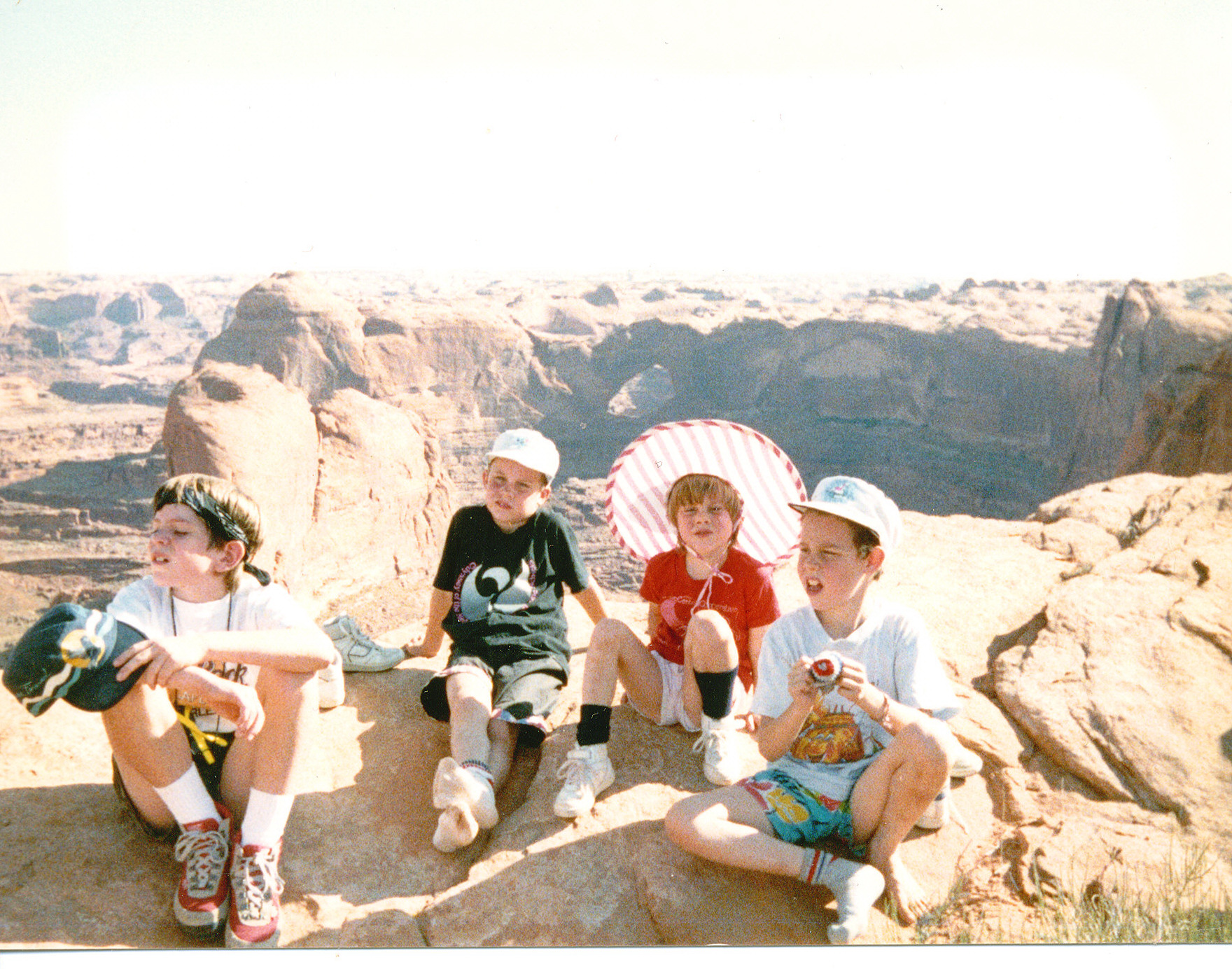
My friend Joe’s son and the Orr kids at the top of the Crack in the Wall trail to Coyote Gulch with Stevens Arch in the Background. Photo credit: Joe Ruffert

Kevin Fedarko was the keynote speaker at the symposium and he is as inspirational a speaker as you could ask for. It doesn’t hurt that the landscape that he spoke about is the Grand Canyon. He urged the attendees to, “Take your children out into these landscapes so that they can learn to love them.” He is advocating for the protection of the Grand Canyon in particular but really he is advocating for the protection all public lands.

Kevin Fedarko and Coyote Gulch at the Rio Grande State of the Basin Symposium hosted by the Salazar Rio Grande del Norte Center at Adams State University in Alamosa March 29, 2024.

What an inspirational talk from Kevin. I know what he is saying when he speaks about the time after dinner on the trail where the sunset lights up the canyon in different hues and where, he and Pete McBride, his partner on the Grand Canyon through hike, could hear the Colorado River hundreds of feet below them, continuing its work cutting and molding the rocks, because the silence in that landscape is so complete. He and I share the allure of the Colorado Plateau. Kevin was introduced to it through Collin Flectcher’s book The Man Who Walked Through Time, after he received a dog-eared copy from his father. They lived in Pittsburgh in a landscape that was industrialized but the book enabled Kevin to imagine places that were unspoiled.

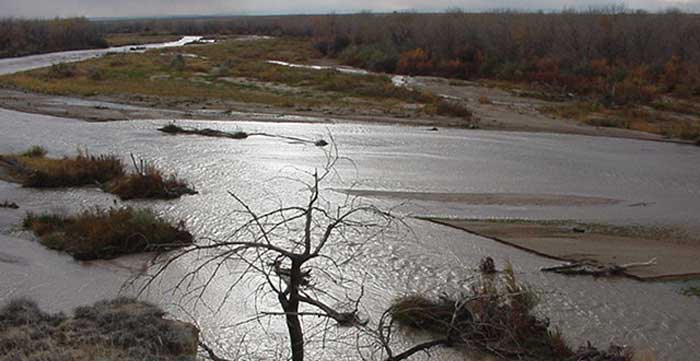
My introduction to the Colorado Plateau came from an article in Outside magazine that included a panoramic photo of the Escalante River taken from the ledges above the river. Readers in the know can put 2 and 2 together from the name of this blog — Coyote Gulch — my homage to the canyons tributary to Glen Canyon and Lake Foul.

Stevens Arch viewed from Coyote Gulch. Photo via Joe Ruffert

Kevin’s keynote came at the end of the day on March 29th after a jam-packed schedule.

Early in the day Ken Salazar spoke about the future of the San Luis Valley saying, “Where is the sustainability of the valley going to come from.” Without agriculture this place would wither and die.” He is right, American Rivers and other organizations introduced a paper, The Economic Value of Water Resources in the San Luis Valley which was a response to yet another plan to export water out of the valley to the Front Range. (Currently on hold as Renewable Water Resources does not have a willing buyer. Thank you Colorado water law.)
Claire Sheridan informed attendees that their report sought to quantify all the economic benefits from each drop of water in the valley. “When you buy a bottle of water you know exactly what it costs. But what is the value of having the Sandhill cranes come here every year?”

Sandhill Cranes Dancing. Photo by: Arrow Myers courtesy Monte Vista Crane Festival

Russ Schumacher detailed the current state of the climate (snowpack at 63%) and folks from the Division of Water Resources expounded on the current state of aquifer recovery and obligations under the Rio Grande Compact.

The session about the Colorado Airborne Snow Measurement Program was fascinating. Nathan Coombs talked about the combination of SNOTEL, manual snow courses, Lidar, radar, and machine learning used to articulate a more complete picture of snowpack. “You can’t have enough tools in your toolbox,” he said.

Coombs detailed the difficulty of meeting the obligations under the Rio Grande Compact with insufficient knowledge of snowpack and therefore runoff volumes. Inaccurate information can lead to operational decisions that overestimate those volumes and then require severe curtailments in July and August just when farmers are finishing their crops. “When you make an error the correction is what kills you,” he said.

If you are going to learn about agriculture in the valley it is informative to understand the advances in soil health knowledge and the current state of adoption. That was the theme of the session “Building Healthy Soils”. John Rizza’s enthusiasm for the subject was obvious and had me thinking about what I can do for my city landscape.

Amber Pacheco described how the Rio Grande Basin Roundtable and other organizations reach out to as many folks in the valley as possible. Inclusivity is the engine driving collaboration.

Many thanks to Salazar Rio Grande del Norte Center director Paul Formisano for reaching out to me about the symposium. I loved the program. You can scroll through my posts on BlueSky here

Orr kids, Escalante River June 2007

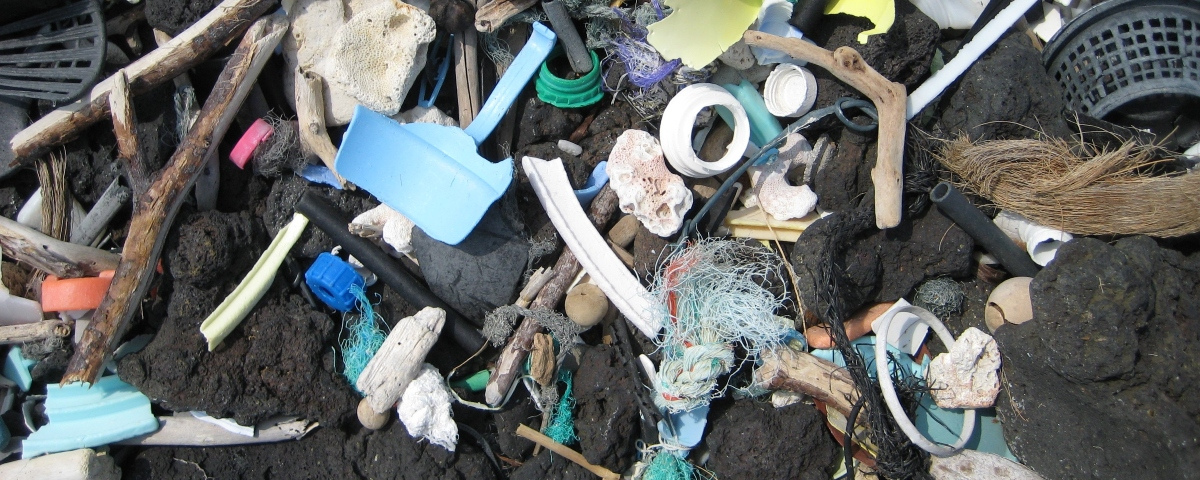
Microplastics might be worse than you think. Hereโ€™s why — Karen Garvey (MSUDenver.edu)

Click the link to read the article on the Metropolitan State University of Denver website (Karen Garvey):

February 11, 2025

Antibiotic-resistant bacteria that thrive in deteriorating plastics could cause the next pandemic, an environmental researcher says.

Just when it seemed the news about microplasticsโ€™ potential for harm couldnโ€™t get worse, an environmental researcher at Metropolitan State University of Denver has found a new cause for concern: Microplastics are contributing to the global problem of antibiotic resistance.

In research published in the Journal of Environmental Chemical Engineering, Sung Hee Joo, Ph.D., director of MSU Denverโ€™s Environmental Engineering program, and colleagues describe how plastic waste, particularly in fresh water, creates a habitat that allows antibiotic-resistant bacteria and genes that promote antibiotic resistance to thrive, which could lead to another pandemic.

โ€œThatโ€™s a significant concern, not just in the U.S. but globally,โ€ Joo said. โ€œWe already have microplastics detected in tap water, and water-treatment methods donโ€™t remove them all โ€” yet there is no regulation on microplastics in drinking water. So Iโ€™m very concerned about another pandemic because of plastic waste and the genetic changes we see in bacteria as a result.โ€

As plastics age and degrade, their chemical makeup changes, which creates an environment where antibiotic-resistant microorganisms can survive and reproduce, Joo and her colleagues wrote in the study. The World Health Organization has called the growing problem of antibiotic resistance one of the worldโ€™s most critical health threats.

Sung Hee Joo, Ph.D., director of MSU Denverโ€™s Environmental Engineering program, is surrounded by different types of plastic, including her polyester hat made from polyethylene terephthalate (PET). Photo by Amanda Schwengel via MSU Denver

Joo and her colleagues intend to conduct further research into the threat posed by microplastics. But her efforts on behalf of the environment donโ€™t stop there. Thanks to a $1 million grant from the U.S. Department of Energy, Joo and one of her research colleagues, Katrina Knauer of the National Renewal Energy Laboratory, are set to lead a project to put some of those thrown-away plastics to new use.

โ€œIncreased regulation and education are essential to addressing the problem,โ€ Joo said. โ€œOne thing we can do is focus on upcycling, which converts plastic waste into resources. Thatโ€™s why weโ€™re so excited for this collaboration with NREL.โ€


RELATED:ย Partnership expands pathway to careers in renewable energy


As part of the project, Joo will lead an education program, a cooperative between MSU Denver and NREL, that will examine ways to put postconsumer recycled plastics to use in new products, such as an asphalt replacement. Beginning this summer, the project will create internships for MSU Denver Environmental Engineering students and will include a community component. Interns will educate residents in low-income areas of Pueblo about the importance and benefits of recycling.

โ€œWe need to educate the public because many people donโ€™t realize how important proper recycling is,โ€ Joo said.

Joo teaches the Environmental Assessment of Plastic Particles class at MSU Denver. Photo by Amanda Schwengel via MSU Denver

If successful, the project would reduce greenhouse-gas emissions by up to 60% by developing an asphalt replacement that incorporates plastic waste while integrating bio-based additives. Using microplastics this way not only provides a new way to pave streets but reduces microplastic waste and decreases temperatures needed to create asphalt.

Joo, whose research over more than two decades has earned her numerous awards, including the Environmental Protection Agencyโ€™s Scientific and Technological Achievement Award, said finding new uses for plastic waste is one important way to combat the potentially deadly spread of antibiotic-resistant bacteria.

โ€œThe human body carries plastics, and tiny plastic particles are found in every organ, including the brain, especially in the blood-brain barrier,โ€ Joo said. โ€œStill, itโ€™s not too late to act now to protect our environment and public health.โ€

A Sagebrush Rebel returns to Interior: Karen Budd-Falen has spent her career fighting the agency; Mining Monitor; “Avalanche” comes out from behind the paywall — Jonathan P. Thompson (LandDesk.org)

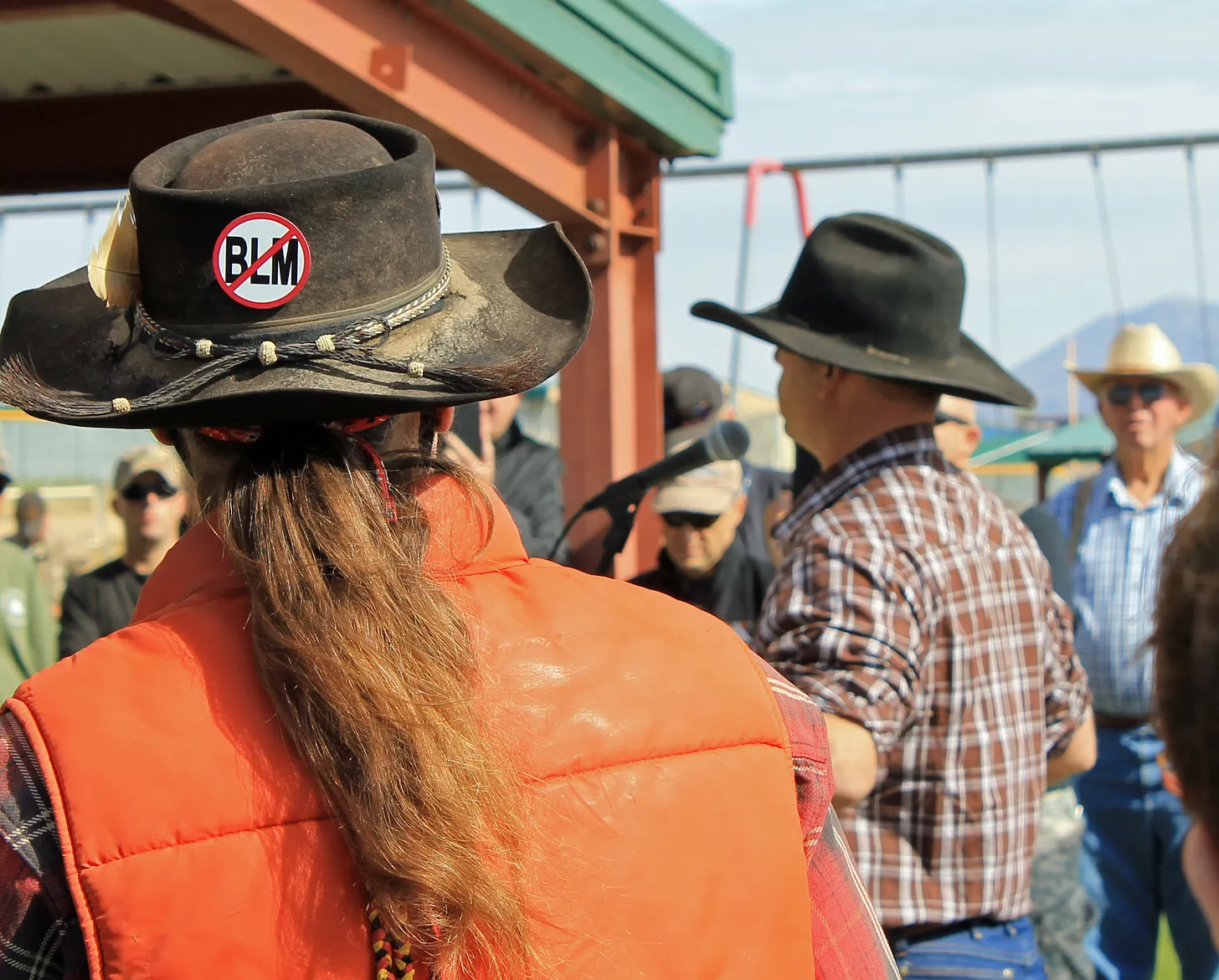
Ryan Bundy speaks at the 2014 Recapture rally to protest federal land management, which took place just days after armed insurrectionists threatened federal officers who had tried to detain Cliven Bundyโ€™s cattle, which had long been grazing on public lands illegally. Karen Budd-Falen โ€” reportedly appointed to be the number three at Interior โ€” represented Bundy years before the standoff, but later condemned his response. Nevertheless, her writings and court cases provided an ideological underpinning for the Bundys and their fellow insurrectionists. Jonathan P. Thompson photo.

Click the link to read the article on The Land Desk website (Jonathan P. Thompson):

March 7, 2025

Interior Secretary Doug Burgum has given another indication of how he plans to oversee public lands with the reported appointment of Karen Budd-Falen, a Wyoming property rights lawyer and rancher, as associate deputy Interior secretary, the departmentโ€™s third in command. This will be Budd-Falenโ€™s third stint at Interior: She worked under James Watt, Ronald Reaganโ€™s notorious Interior secretary, and served as deputy Interior solicitor for wildlife and parks under the first Trump administration. Budd-Falen revealed the appointment to Cowboy State Daily this week, though the administration has yet to announce it.

Budd-Falen has spent much of her five-decade-long career fighting against federal oversight and environmental protections โ€” she has been called an โ€œarchitect of the modern Sagebrush Rebellionโ€ โ€” and is a private property rights extremist (except when they get in the way of public lands grazing).

In 2011, Budd-Falen divulged her core philosophy โ€” and her distorted view of the U.S. Constitution โ€” in a keynote speech to a meeting of Oregon and California county sheriffs, many of who adhered to the โ€œconstitutional sheriffโ€ creed. She told them that โ€œthe foundation for every single right in this country, our freedom of speech, our freedom to vote, our freedom to petition, is all based on the right of ownership of private property.โ€

While this is obviously a messed up interpretation, it is an honest reflection of her worldview, and she has often stuck with it even if it meant going after extractive interests. In the 1990s, for example, Budd-Falen represented the legendary, stalwart Republican-turned-anti-oil-and-gas activist Tweeti Blancett in her attempt to get the Bureau of Land Management to clean up the mess its industry-friendly ways had facilitated on and around her northwest New Mexico ranch. And Budd-Falenโ€™s law firm often worked with landowners to get the best possible deal from energy companies that developed their property.

But more often than not, Budd-Falenโ€™s vision of private property rights extends beyond a landownerโ€™s property lines and onto the public lands and resources โ€” at the expense of the land itself, the wildlife that live there, and the people who rely upon it for other uses.

In a telling article in the Idaho Law Review in 1993, Budd-Falen and her husband, Frank Falen, argued that grazing livestock on public lands was actually a โ€œprivate property rightโ€ protected by the Constitution. If you were to extend this flawed logic to oil and gas and other energy leases and unpatented mining claims, then corporations and individuals would have private property rights on hundreds of millions of acres of public lands. This may sound alarmist, but the fact is, the federal land management agencies often adhere to this belief. Once an oil and gas lease is issued, for example, a BLM field office is unlikely to deny a drilling permit for the lease, since doing so would be violating the companyโ€™s private property rights. Who needs public land transfers when this sort of de facto privatization is commonplace?

Many of Budd-Falenโ€™s cases relied on a similar argument: That private property rights can apply to public resources. She defended Andrew VanDenBerg, for example, who bulldozed a road across the Whitehead Gulch Wilderness Study Area in Coloradoโ€™s San Juan Mountains to access his mining claim โ€” just one of many times she wielded RS-2477, the 160-year-old statute, to try to keep roads across public lands open to motorized travel and bulldozers. She represented big landowners who felt that they had the right to kill more big game โ€” a public resource โ€” than the law allowed, because they owned more acreage.

Budd-Falen was instrumental in crafting a slew of ordinances for Catron County, New Mexico, declaring county authority over federally managed lands and, specifically, grazing allotments. While the ordinances and resolutions focused on land use, they also contained language influenced by the teachings of W. Cleon Skousen, an extreme right-wing author, Mormon theologian, and founder of the National Center for Constitutional Studies, nรฉe the Freeman Institute, known for its bestselling pocket-size versions of the US Constitution.

The ordinances were โ€œabout the legal authority of county governments and the legal rights of local citizens as regards the use of federal and state lands.โ€ They were intended to preserve the โ€œcustoms and cultureโ€ of the rural West, which apparently included livestock operations, mining, logging, and riding motorized vehicles across public lands. And the Catron County commissioners were ready to turn to violence and even civil war to stop, in the words of the ordinance, โ€œfederal and state agentsโ€ that โ€œthreaten the life, liberty, and happiness of the people of Catron County โ€ฆ and present danger to the land and livelihood of every man, woman, and child.โ€ The National Federal Lands Conference, a Utah-based organization launched in the late 1980s by Sagebrush Rebel Bert Smith, a contemporary and philosophical collaborator of Skousenโ€™s, peddled similar ordinances to other counties around the West.

Budd-Falen has been especially antagonistic toward the Endangered Species Act, often representing clients hoping to reduce the lawโ€™s scope or to water down its enforcement or applicability. In 2013, for instance, she filed an amicus brief in support of People for the Ethical Treatment of Property Ownersโ€™ claim that the ESA should not apply to Utah prairie dogs because the speciesโ€™ range was confined to one state. The property owners lost and the U.S. Supreme Court declined to hear the case.

Occasionally Budd-Falen has veered away from defending property rights, however, if it means keeping cows on public lands. After Bill Clinton designated Grand Staircase-Escalante National Monument in 1996, the Grand Canyon Trust bought out grazing allotments in the monument from willing sellers with the intention of retiring the permits for good. It was a win-win situation, one that allowed ranchers to bring in a pile of cash and maybe retire or move operations to a more cattle-appropriate area, and it protected sensitive areas from the ravages of grazing.

Nevertheless, Kane and Garfield County commissioners didnโ€™t like the deal, mostly because they didnโ€™t like the monument. So they sued to block the permit retirements, in an attempt to undercut the transactions, and Budd-Falen stepped in to represent them. She said she was trying to ensure the survival of the โ€œcowboyโ€™s Western way of life,โ€ apparently even if it was against the cowboysโ€™ own wishes. โ€œI think itโ€™s important to keep ranchers on the land,โ€ she told the Deseret News. She definitely will not do anything to reform public lands grazing during her tenure, but then thatโ€™s no different from any other administration so far, Republican or Democrat.

In the early 1990s Budd-Falen represented a number of southern Nevada ranchers โ€”including Cliven Bundy โ€” in their beef with the feds over grazing in endangered desert tortoise habitat. Budd-Falen was quick to condemn the Bundysโ€™ armed insurrection against the federal government when BLM rangers tried to remove their cows from public lands, where they had been grazing illegally for years. And she also spoke out against the Bundy-led armed takeover of the Malheur National Wildlife Refuge.

Still, one canโ€™t deny that her work and words โ€” often hostile and aimed at environmentalists and federal land agencies โ€” provide an intellectual underpinning for the Bundy worldview. She is an alumni of the Mountain West Legal Foundation, the breeding ground for the Sagebrush Rebellion and Wise Use movement that helped launch the careers of Watt and Gale Norton, the Interior secretary under W. Bush. And in 2007 Budd-Falen told High Country Newsโ€™s Ray Ring that her most important case was when she used RICO, and anti-racketeering law, to go after BLM agents who had cited her client for violating grazing regulations.

Her rhetoric outside the courtroom not only inflames, but also provides justification for those who may be inclined to take up arms against their purported oppressors. She has referred to federal land management agencies as โ€œa dictatorshipโ€ wielding its โ€œbureaucratic power โ€ฆ to take private property and private property rights.โ€ She once made the spurious claim that โ€œthe federal government pays environmental groups to sue the federal government to stop your use of your property.โ€

Seems pretty crazy to put someone like that near the top of a federal land management agency, but then, thatโ€™s par for the course for Trump and company.

The tally at Interior now includes, in addition to Budd-Falen:

  • Interior Secretary Doug Burgum, whoย has close ties to oil tycoon Harold Hamm, and whoย suggestedย using โ€œinhospitable or unoccupiedโ€ public lands to pay down the federal debt.
  • BLM director Kathleen Sgamma,ย an oil and gas industry lobbyistย who has sued the agency she is now tapped to lead.
  • Deputy Interior Secretary Katharine McGregor, who served the same position during the final year of Trumpโ€™s first term, and was most recently the VP of Environmental Services at NextEra Energy in Florida.

โ›๏ธMining Monitor โ›๏ธ

It appears that Trumpโ€™s executive orders are beginning to change the way regional public lands offices operate. Patrick Lohmann with Source NM reports, for example, that Cibola National Forest Service employees โ€” at least the ones that werenโ€™t fired by DOGE โ€” were ordered to prioritize โ€œmission criticalโ€ activities, including reviews of proposed uranium mines, to comply with Trumpโ€™s energy orders.

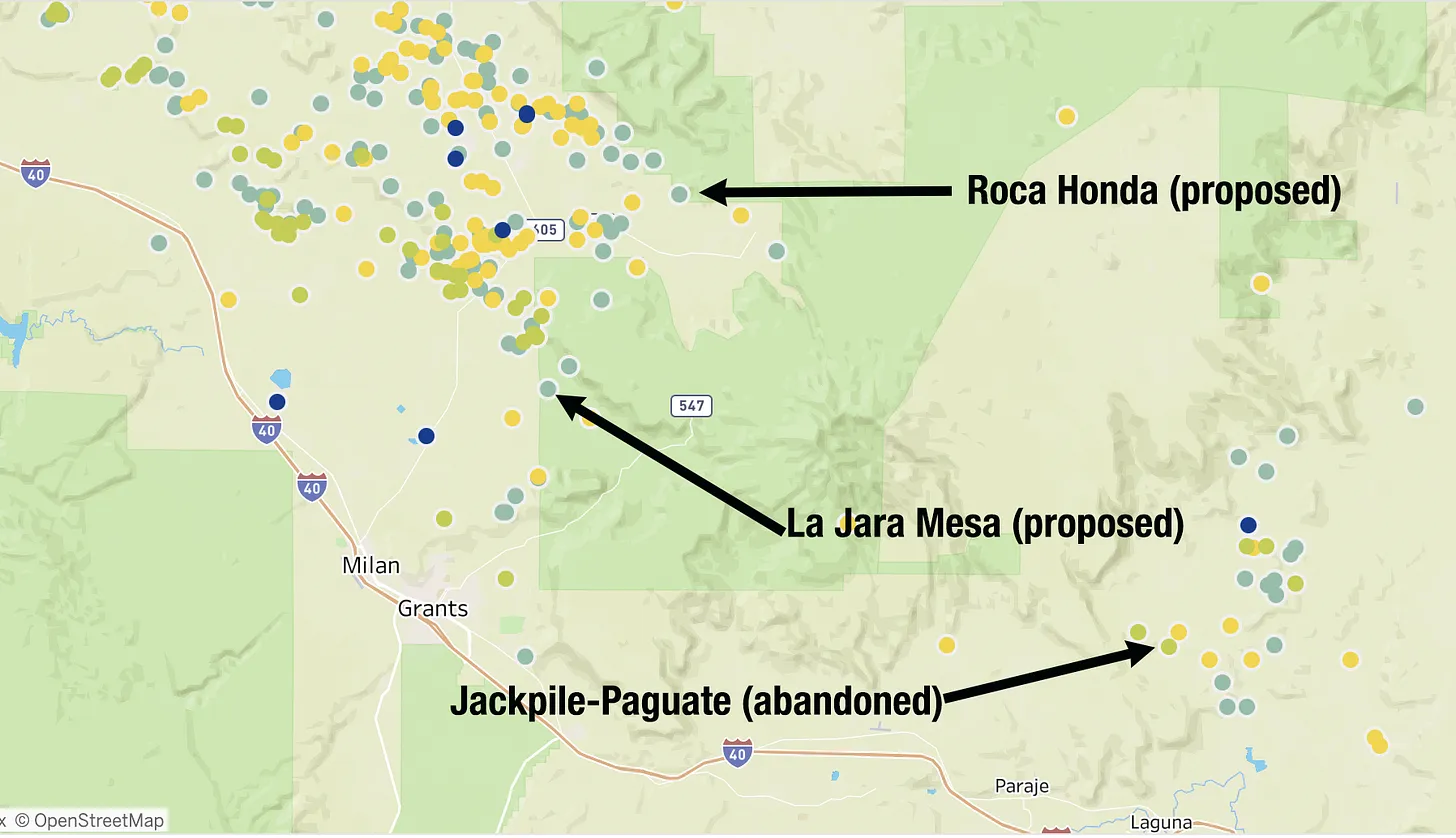
There are currently two proposed uranium mines on the forest, which includes Mount Taylor and surrounding areas near Grants, New Mexico. Energy Fuels โ€” the owner of the Pinyon Plain uranium mine and the White Mesa uranium mill โ€” is looking to develop the Roca Honda mine on about 183 acres. And Laramide Resources wants to build the La Jara Mesa mine. Both projects would be underground, not surface mines, and were originally proposed over a decade ago, but stalled out when uranium prices crashed. Now that prices have increased, the firms have expressed renewed interest.

The dots show abandoned uranium mining and milling sites.

The Grants and Mount Taylor area was ravaged by Cold War-era uranium mining and the wounds from the previous boom continue to fester. That include the remnants of Anaconda Minerals Companyโ€™s Jackpile-Paguate Mine on Laguna Pueblo land, which was once the worldโ€™s largest open-pit uranium mine, producing some 24 million tons of ore.

Miners were exposed to radioactive and toxic heavy metals daily, even spending their lunch breaks sitting on piles of uranium ore. Blasting sent tremors through the puebloโ€™s adobe homes, and a cloud of poisonous dust drifted into the village of Paguate, just 2,000 feet from the mine, coating fruit trees, gardens, corn, and meat that was set out to dry. A toxic plume continued to spread through groundwater aquifers, and the Rio Paguate, a Rio Grande tributary, remains contaminated more than a decade after the facility became a Superfund site, despite millions of dollars in cleanup work. Laguna residents and former mine workers still suffer lingering health problems โ€” cancer, respiratory illnesses and kidney disease โ€” from the mine and its pollution.

Now the feds are saying approving new uranium mines in the same area is โ€œmission critical.โ€

***

In December, the Biden administration began the process of halting new mining claims and mineral leasing for the next 20 years on 165,000 acres in the upper Pecos River watershed west of Santa Fe, New Mexico. This included holding meetings to gather public input on the plan. But the BLM canceled the first such meeting, scheduled for late February, and has not announced a new date, sparking fears that the new administration may be withdrawing plans for a mineral withdrawal.

Rio Grande and Pecos River basins. Map credit: By Kmusser – Own work, Elevation data from SRTM, drainage basin from GTOPO [1], U.S. stream from the National Atlas [2], all other features from Vector Map., CC BY-SA 3.0, https://commons.wikimedia.org/w/index.php?curid=11218868

Included within the acreage are more than 200 active mining claims held by Comexico LLC, a subsidiary of Australia-based New World Resources. For the past several years, Comexico has been working its way through the permitting process to do exploratory drilling at what it calls its Tererro mining project. It has met with stiff resistance from locals and regional advocacy groups, partly because mining has a dark history in the Pecos River watershed. In 1991, a big spring runoff washed contaminated mine and mill waste from a long-defunct mine into the upper Pecos River, killing as many as 100,000 trout. That prompted a multi-year cleanup of various mining sites.

***

๐Ÿ“ธ Parting Shot ๐ŸŽž๏ธ

And now for a special treat, or maybe torture, but either way it might help take your mind off the dismantling of Democracy for a few moments. Itโ€™s my blow-by-blow analysis of the 1978 movie Avalanche, starring Rock Hudson and Mia Farrow. Normally this would be behind a paywall, like all of the other Land Desk archives. But Iโ€™m opening up to everyone for a limited time only in honor of the snowslide-triggering storm that is pounding the San Juans as I write. Enjoy. And, while youโ€™re at it, check out our interactive map of long-lost ski hills in southwest Colorado.

AVALANCHE: A blow-by-blow analysis of the 1978 disaster flick — Jonathan P. Thompson, February 9, 2022

I was drawn in by the close-up winter aerial shots of ridges and peaks of the San Juan Mountainsโ€”Look, thereโ€™s Vestal! I yelled to my non-existent viewing companions as Rock Hudsonโ€™s name flashed on the screen. And Arrow! And Mount Garfield! I kept watching the lost-to-obscurity 1978 disaster film,

Read full story

Messing with Maps: Pipeline edition — Jonathan P. Thompson (LandDesk.org)

Click the link to read the article on the Land Desk website (Jonathan P. Thompson):

February 11, 2025

๐Ÿ—บ๏ธ Messing with Maps ๐Ÿงญ

Detail of a 1931 New Mexico oil and gas map showing part of the San Juan Basin, where commercial drilling began in earnest in the early 1920s. Note that there were already pipelines running from Bloomfield to Albuquerque, from the Ute Dome to Durango and from the Rattlesnake Dome to Gallup.

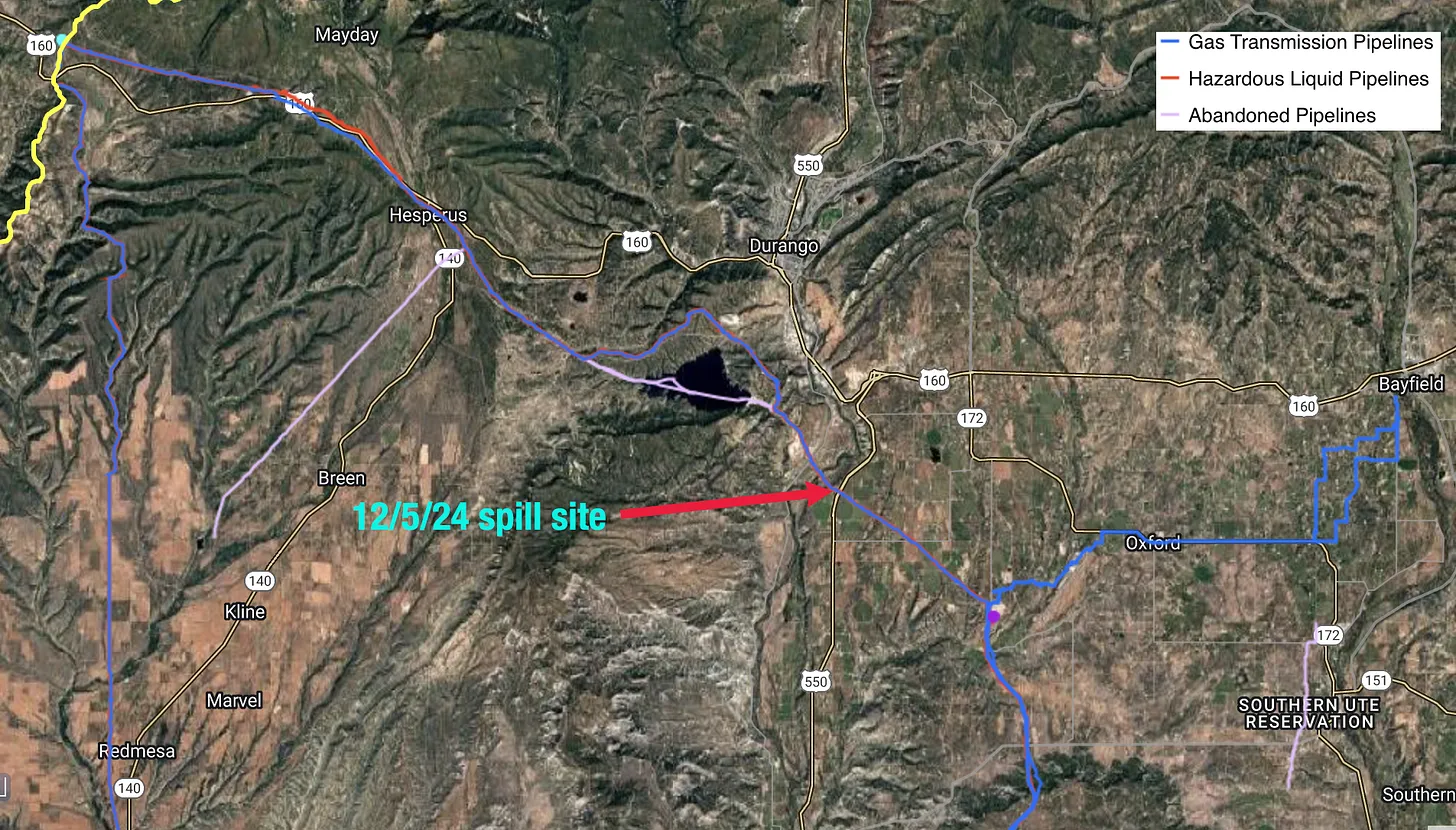
On the afternoon of December 5, 2024 at least seven homes were evacuated in rural La Plata County, Colorado, after a major pipeline ruptured and spilled some 23,000 gallons of gasoline 1.ย Two months later, lingering fumes and contamination kept at least one of the evacuated households from returning home,ย according to the Durango Herald.

The spill tainted nine domestic wells with benzene concentrations of up to 300 parts per billion; the carcinogenโ€™s maximum allowable level is 5 parts per billion. And the nearby Rainbow Springs trout farm suffered an 80,000 fingerling die-off in the days following the spill, according to theย Herald, though a conclusive link between the two has yet to be made.

Graphic credit: The Land Desk

That a bunch of hydrocarbons broke free from their confines in that part of the country didnโ€™t shock me: La Plata County is in the San Juan Basin, where oodles of natural gas has been pumped from the ground over the last century or so, and leaks, breaches, and spills have been frequent โ€” sometimes with deleterious results. But I was a bit taken aback to read that the material that spilled was gasoline that came from a major, interstate pipeline.

In fact, several Facebook commenters expressed their doubts, saying it must have been drip condensates or liquid natural gas, instead, coming from one of the lines associated with the gas fields or the processing plant nearby. But the Herald reporter got his info directly from the pipeline operator (and they should know). And I double-checked the Pipeline and Hazardous Materials Safety Administration incident report, which said Enerprise Productsโ€™ Four Corners Lateral Loop pipeline, which was installed in 1980, had spilled 544 barrels (or 22,848 gallons) of non-ethanol gasoline.

Curiously, both Energy Information Administration and PHMSA records show that only natural gas-carrying lines pass through the county. But apparently the line now carries auto fuel from Texas to New Mexico, Colorado, and Wyoming, where it helps keep pump prices affordable, or so the pipeline operator told the Herald.

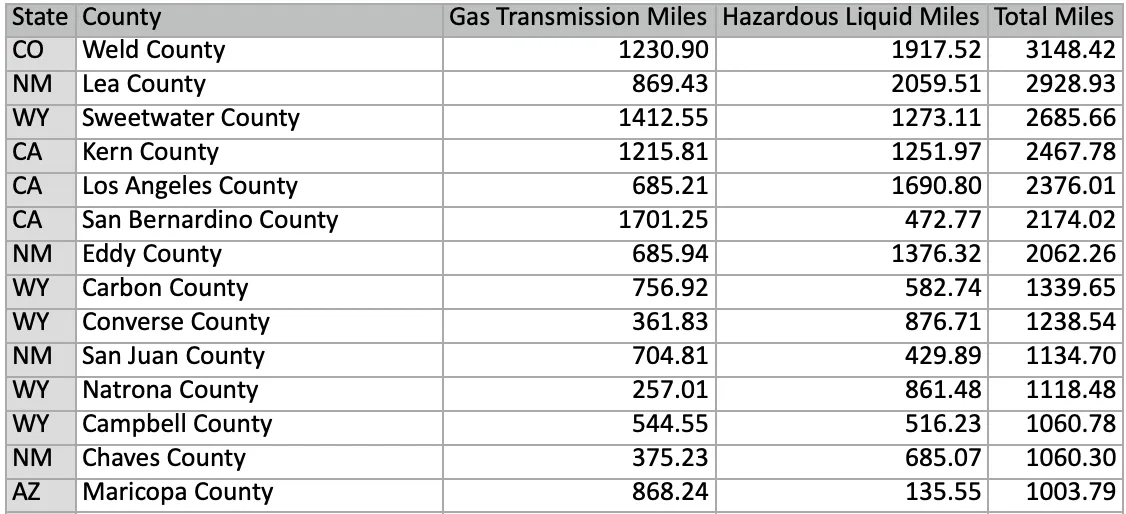
Itโ€™s one of seven natural gas, carbon dioxide, or hazardous liquids pipelines โ€” totaling 225 miles โ€” that cross La Plata County. The Western states contain about 93,024 miles of these long-distance methane and petroleum carrying lines (this does not include local gathering systems that web their way through the oil and gas fields or natural gas distribution lines that run through towns and cities).

The top 15 counties in the Western U.S. in terms of gas transmission and hazardous liquid pipeline mileage. Source: PHMSA.

Thatโ€™s one of those things about pipelines. You might be subtly aware they exist, thanks to the strips of land that have been cleared of vegetation and the signs warning you not to dig there. But the fact that there are large quantities of flammable, sometimes explosive, climate-altering substances rushing beneath your feet on their way to distant destinations is not something that is often at the top of oneโ€™s mind. At least not until they leak, rupture, or explode.

Graphic credit: The Land Desk

And they do, more often than most of us would hope. Usually the cause is corrosion, a failed weld, or some other type of equipment or material failure, though excavation-caused ruptures are also up there. Cars and trucks run into pipelines and break them, floods or seismic activity can tear them apart, and sometimes lightning strikes them.

Natural gas is composed mostly of methane, a potent greenhouse gas with about 86 times the atmospheric warming potential than carbon dioxide. So every release is contributing to climate change. A major breach or a slow leak that goes undetected can emit massive amounts of methane; in April, a construction worker breached a pipeline that released 118,000 MCF (thousand cubic feet) of natural gas before it was shut off 2. Plus, when the stuff builds up it can explode, which makes gas line leaks especially dangerous. Crude oil and gasoline spills, meanwhile, can harm wildlife, waterways, and people, and evenย carbon dioxide pipeline rupturesย can be fatal.

So itโ€™s good to have strong regulations around pipelines, as well as a well-staffed agency to enforce those regulations. Itโ€™s also nice to know where the major pipelines are around you. And for now, at least, you can find out by consulting the PHMSAโ€™s National Pipeline Mapping System. Just enter your state and county and you get a map of the big hazardous liquid and natural gas transmission lines. You can also do an accident query and see where there have been accidents near you. One drawback is that the system limits how far you can zoom in on the map, apparently because theyโ€™re worried about saboteurs using it to locate targets. Hereโ€™s what the zoomed in map looks like. This is about the same view as the opening image from 1931.

Graphic credit: The Land Desk

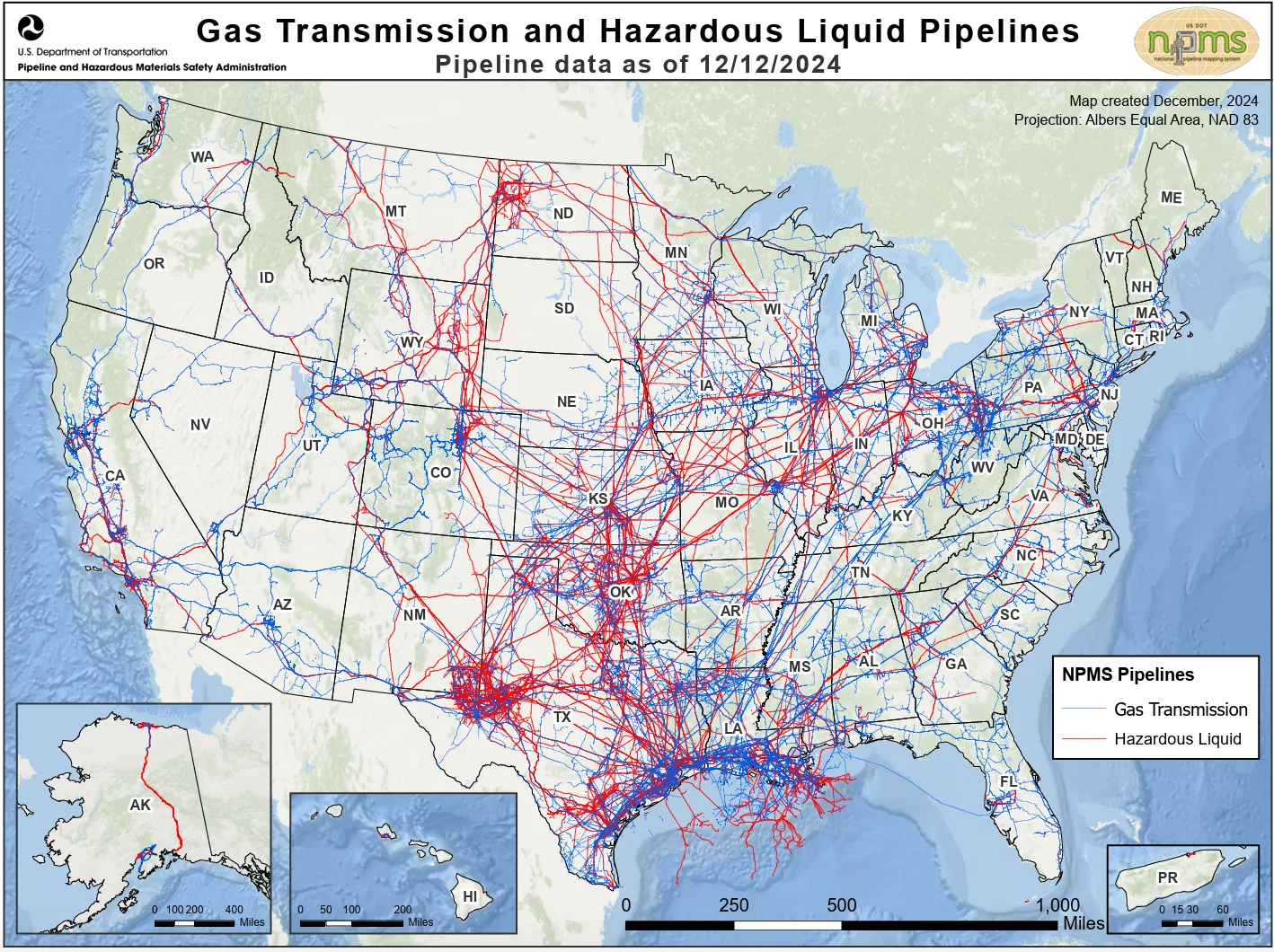
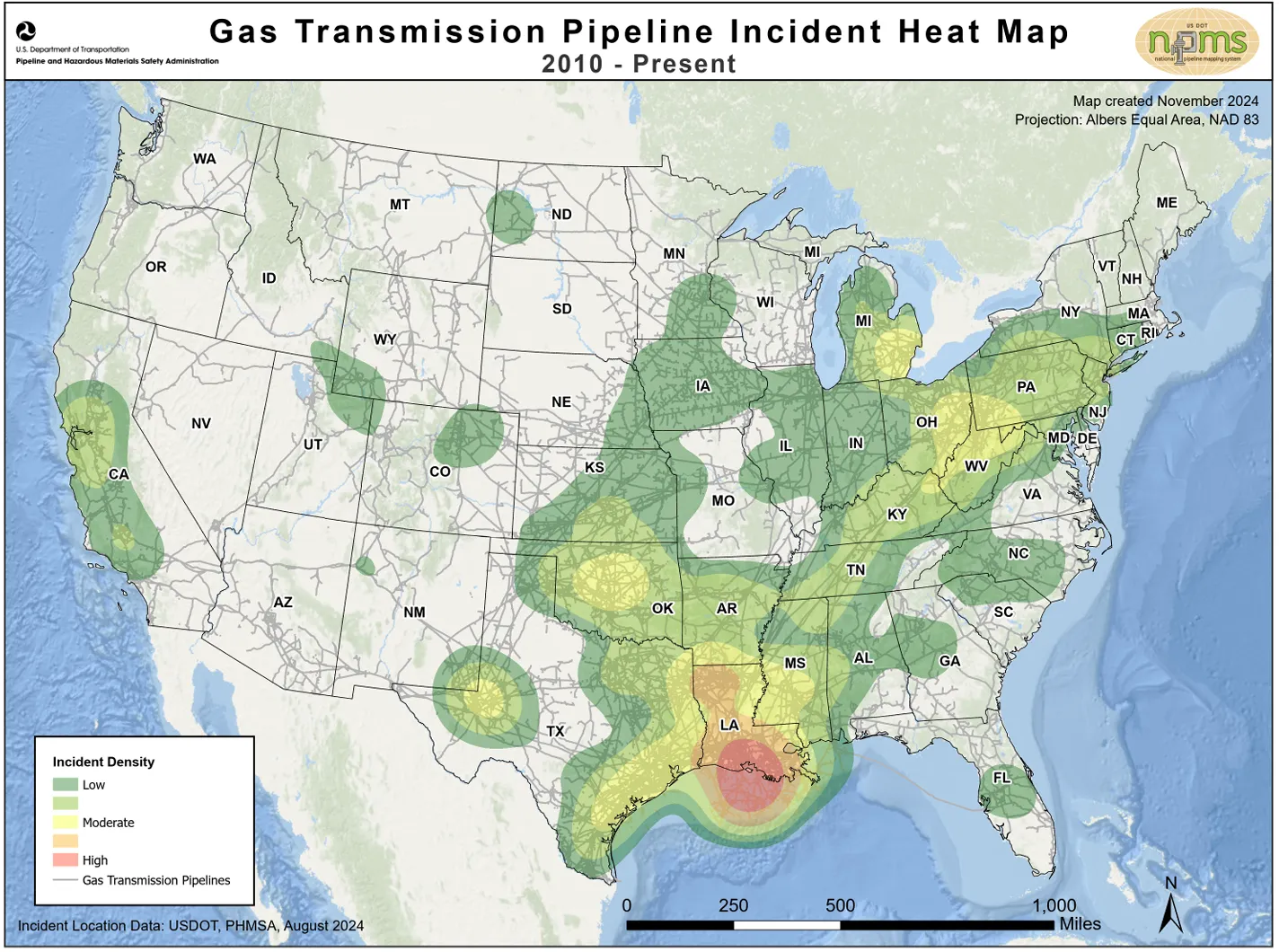
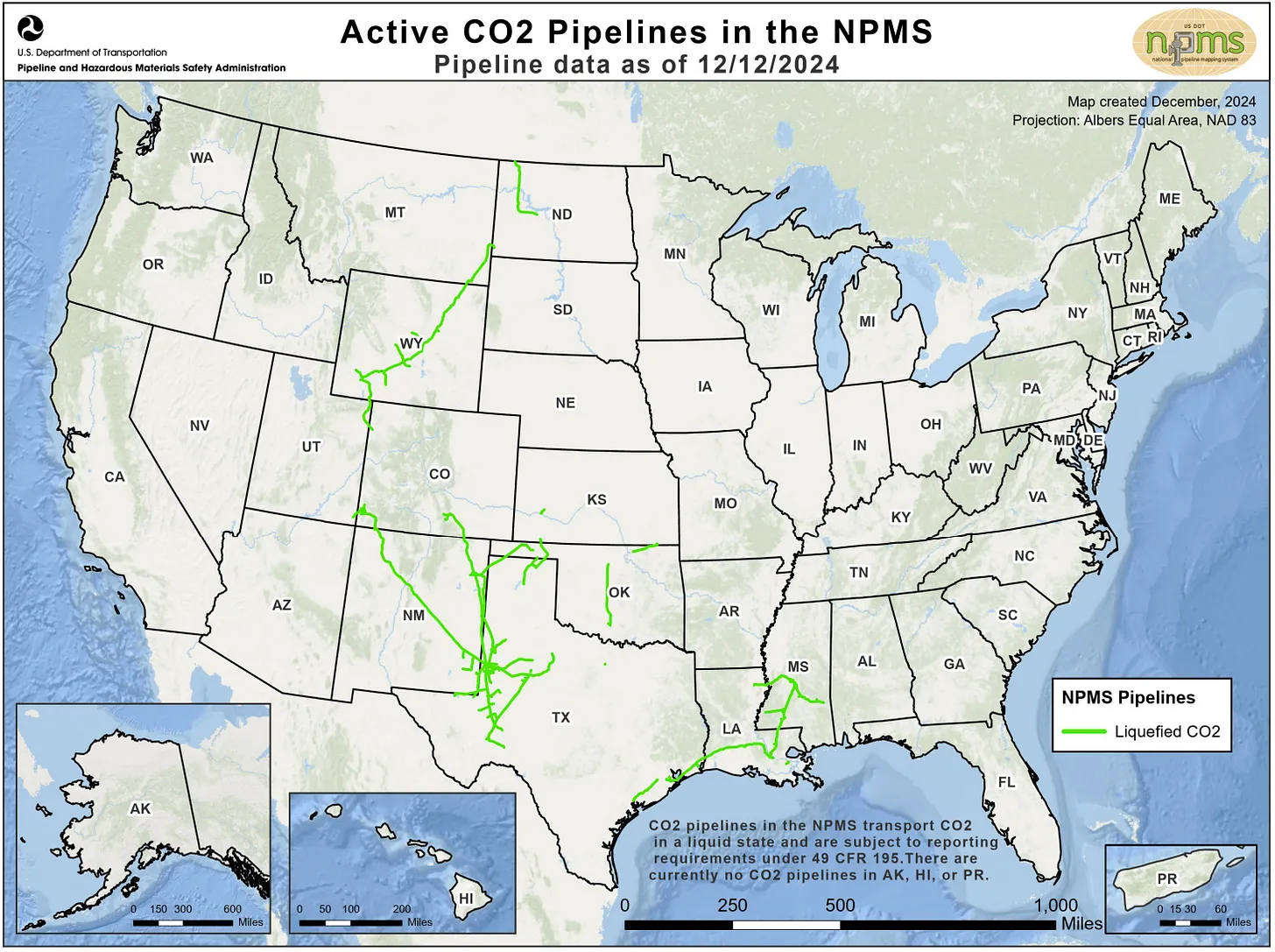
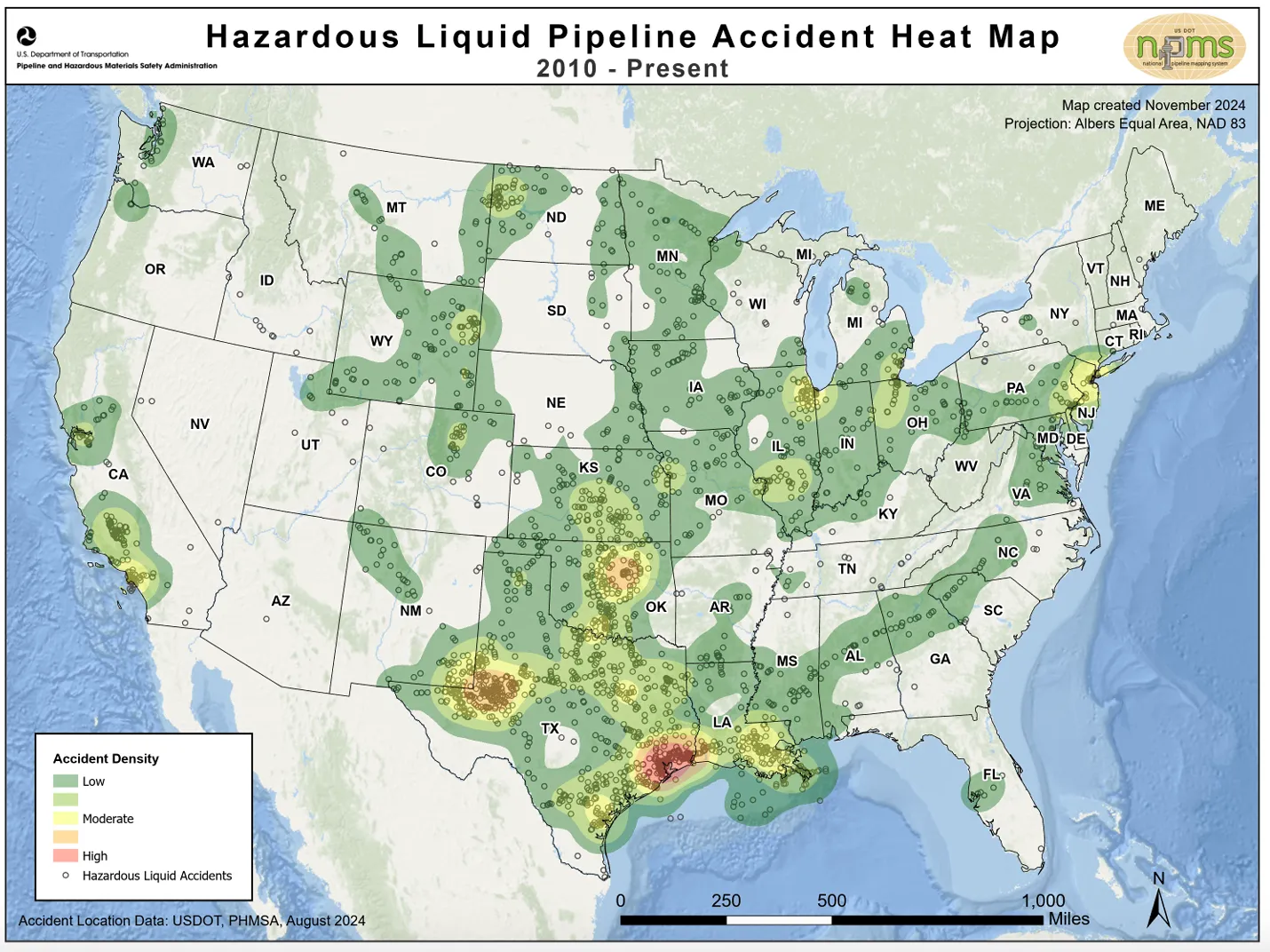
Here are some zoomed out maps to give you a sense of where the pipelines are concentrated, with the highest densities in the Permian Basin and Louisiana.

Graphic credit: The Land Desk

DATA DUMP:

  • 122ย Number of U.S. interstate natural gas transmission system incidents, accidents, and spills in 2024, resulting in 7 injuries.
  • 1.82 millionย MCF Volume of natural gas released during those incidents.
  • Corrosionย The leading cause of natural gas transmission pipeline incidents.
  • 13, 28ย Number of fatalities and injuries, respectively, resulting from natural gas distribution system incidents nationwide in 2024.
  • 309,560 MCFย Volume of natural gas released during distribution system incidents.
  • $549,000ย Total damages, as of early February, resulting from the Enterprise pipeline spill in La Plata County in December.
  • 192ย Number of incidents reported on Enterprise Products Operating pipelines between 2017 and 2025.
  • 294ย Number of incidents in interstate hazardous liquid pipelines nationwide in 2024.
  • 80ย Number of hazardous liquids incidents in 2024 that occurred in pipelines that were installed prior to 1985. Ten of the damaged lines were installed prior to 1940.
  • 16,708ย Barrels of crude oil spilled in 2024 pipeline incidents.
  • 3,333ย Barrels of refined petroleum products spilled or lost in 2024 pipeline incidents.
  • $70 millionย Total damages resulting from hazardous liquid (crude oil, gasoline, and other products) pipeline incidents in 2024.

Parting Poem

Now for something completely different, Iโ€™d like to leave you with this lovely poem by Richard Shelton. Itโ€™s from his Selected Poems, 1969-1981, which is easily my most read book, as I come back to it time after time. No one captures the essence of the desert like Shelton.

1 Which is about enough gasoline to fuel the olโ€™ Silver Bullet (the Land Deskโ€™s official mascot) for another 800,000 miles or so.

2 The average U.S. residence uses about 65 MCF of natural gas per year.

The #SaltonSeaโ€™s weirdness is whatโ€™s appealing — Dennis Hinkamp (WriterOnTheRange.org) #ColoradoRiver #COriver #aridification

Bales of straw along the banks of the Salton Sea, Hinkamp photo

Click the link to read the article on the Writers on the Range website (Dennis Hinkamp):

February 3, 2025

Fascinating and fetid, the Salton Sea in southern California lures me back, every year.

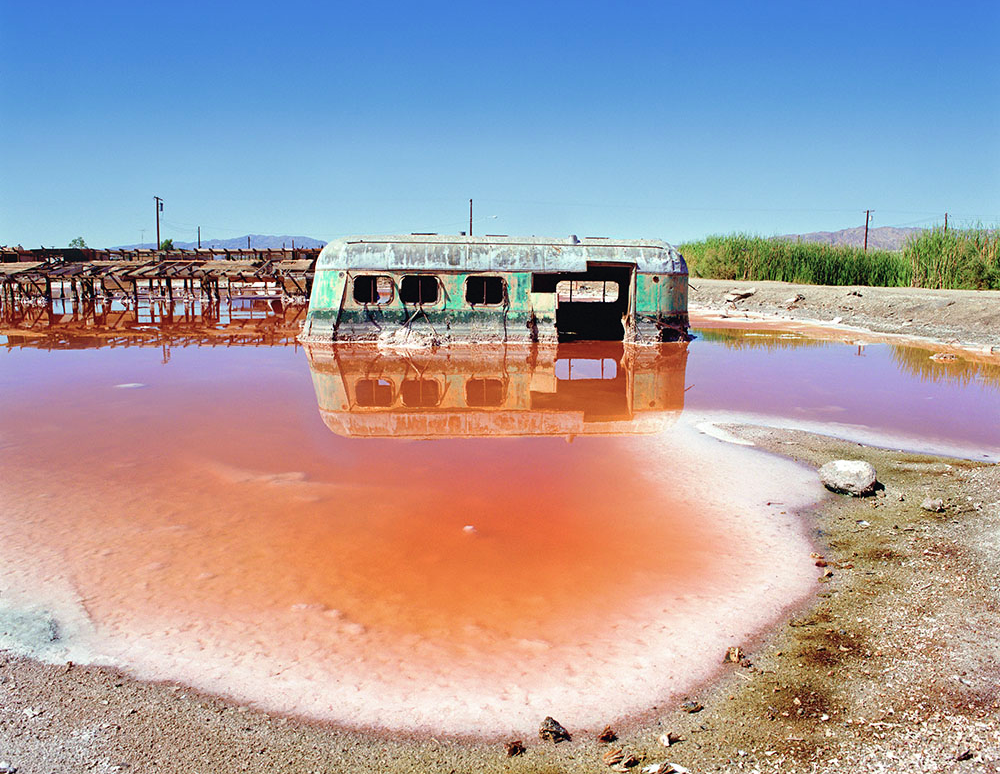
Driving south from Utah, I take bits of historic Highway 66 and then skirt Joshua Tree National Park to cruise through little known Box Canyon to Mecca, California. When the landscape opens up, I see the beautiful wreck of the Salton Sea, created by the collision of geology and bad luck.

Southern Pacific passenger train crosses to Salton Sea, August 1906. Photo via USBR.

The sea occupies a much smaller footprint of what used to be Lake Cahuilla, which disappeared in the late 1500s. Then, in a wild spring runoff in 1905, the Colorado River blew out a diversion dam and for three years, and the mighty Colorado drained into the Salton Sink. Agriculture runoff replenished the shallow lake over the following decades, though recently lined canals, courtesy of San Diego, in the Imperial Valley resulted in diminished flows. Its run as a bombing range ended in the 1970s.

If the lake were to completely dry up there would be a horror to behold. While at shrinking Lake Mead a few gangster cadavers showed up in the mud, the Salton Sea contains crashed planes and practice bombs, the targets simulations during the 1940s for the real atomic bombs dropped on Japan.

The lake is bracketed by opulent Palm Springs to the north and the arty squalor of Slab City to the south, home to about 150 full-time residents but temporary home to as many as 4,000 in the winter. In between there are hot springs RV resorts, date palm groves, geothermal energy plants and the town of Bombay Beach sitting atop the San Andreas fault.

Is the diminished sea worth saving? Itโ€™s too late to ask the question because, like the great Salt Lake, the cost of not saving it is likely higher than the rescue. Like many invasive species around the West, there is no easy way to get rid of it. Yet most of its fish are already dead and migrating birds have little to eat.

Dust is the issue, and most conservation programs attempt to mitigate dust.

The 1950s and 60s brought out the excesses of post-war revelers to the Salton Sea. You can see the salt-encrusted remains of former resorts and second homes of the Los Angeles fancy people. You can imagine the ghosts of boat races and cocktails.

Those folks even named the local wildlife refuge after swinging Sony Bono, but what came next was toxic salinity and decay as less water came in and the water that remained increased in salinity.

Still, the sea persists. Its salt-encrusted shores circle about 340 square miles of sea. A silo-full of conspiracy theories features the Salton Sea: The military may have accidently dropped a real bomb that did not explode, and the bomb might even be under the water along with hundreds of other dummy bombs and fallen planes. Bodies may still sit in the planes. We know for certain that Slab City is whatโ€™s left of a decommissioned military base built about 70 years ago.

Most of the people I meet around the lake seem happy. The place brings pleasure to pre-apocalyptic people like me and those creating outsider art on the actual beach near Bombay Beach. Thousands of Canadians migrate there each winter because the highest temperatures rarely top 80 degrees.

I look forward to my week at the hopefully named Fountain of Youth Spa RV Resort. I joke that I have been coming there since 1906 so it must be working.

It attracts so many Canadians that the resort hosts U.S. vs. Canada Games featuring geezer sports of pickleball, horseshoes, bocce and karaoke. Poutine and box wine flow freely, and people sometimes stay up into the double-digit hours of the evening.

Dennis Hinkamp. Photo credit: Writers on the Range

The Salton Sea will likely remain a curiosity and hiding place for the weird until some real monster beneath the sea emerges, which could be a rush to start mining lithium made by the sea.

On the other hand, the San Andreas fault might just swallow the whole thing in one glorious gulp. Meanwhile, itโ€™s my refuge, my winter solace away from anxious headlines, and just strange enough to be hospitable.  

Dennis Hinkamp is a contributor to Writers on the Range, writersontherange.org, the independent nonprofit dedicated to spurring lively conversation about the West. He writes in Utah.

Map of the Salton Sea drainage area. By Shannon – Background and river course data from http://www2.demis.nl/mapserver/mapper.asp and some topography from http://seamless.usgs.gov/website/seamless/viewer.htm, CC BY-SA 4.0, https://commons.wikimedia.org/w/index.php?curid=9707481

The #ColoradoRiver is salty. But where does salinity come from, and whatโ€™s being done about it?: Among river disputes, salinity is an issue that all seven basin states agree is worth solving together — The Summit Daily #COriver #aridification

Colorado River. For over 50 years, stakeholders throughout the Colorado River basin have worked to address challenges caused by salinity. Photo credit: Abby Burk via Audubon Rockies

Click the link to read the article on the Summit Daily website (Ali Longwell). Here’s an excerpt:

February 6, 2024

Since 1974, the seven Colorado River basin states โ€” Arizona, California, Colorado, Nevada, New Mexico, Utah and Wyoming โ€” have coordinated efforts to implement salinity control in the waterway as part of theย Colorado River Basin Salinity Control Forum. The forum was created by the U.S. Congress, flowing funding through the Bureau of Reclamation to reduce the salt load in the river and research the issue…While salinity is naturally occurring, there are a few reasons that states and river stakeholders have long kept an eye on it.A baseline amount of salinity is OK. Too much salinity can have adverse effects on drinking water, water infrastructure and treatment, appliance wear, aquatic life, the productivity of certain agricultural crops (including wine grapes, peaches and other salt-sensitive products) and more.ย The U.S. Bureau of Reclamationย estimatesย that salinity causes between $500 and $750 million annually in damages and could exceed $1.5 billion per year if future increases are not controlled…

Much of the Upper Basin geology โ€” specifically Mancus and Mesa Verde shale formations โ€” was created when it was covered by an inland sea, [David] Robbins added. Therefore, they contain salt deposits that through natural erosion and runoff, make their way to the rivers and downstream.ย In Colorado, natural salinity sources include the geothermal hot springs in Glenwood Springs; shale cliffs and evaporating salt deposits in the Eagle and Roaring Fork valleys; and the salt domes in Paradox Valley in Montrose County along the Dolores River.ย Human activity can also exacerbate challenges by accelerating the release of compounds from these natural geologic materials and increasing the salt load in the river and tributaries, according to the 2009 U.S. Geological Survey report. This includes activities like mining, farming, petroleum exploration and urban development.ย  For example, with some agricultural irrigation practices, by adding more water to the soil that naturally contains salts, โ€œincreases the rate of dissolution above the natural signal,โ€ [Dave] Kanzer said.ย  The use of road salts โ€” solid and liquid โ€” to clear snow and ice can also lead to increased salt loads as the salt dissolves and makes its way into snowmelt and streams.ย 

Photo credit: Glass of Bubbly

Coloradoโ€™s Stream & Wetlands Protection Bill Becomes a Law: Representing the environment as a stakeholder in Coloradoโ€™s HB24-1379 rulemaking — Nathan Boyer-Rechlin (Rockies.Audubon.org)

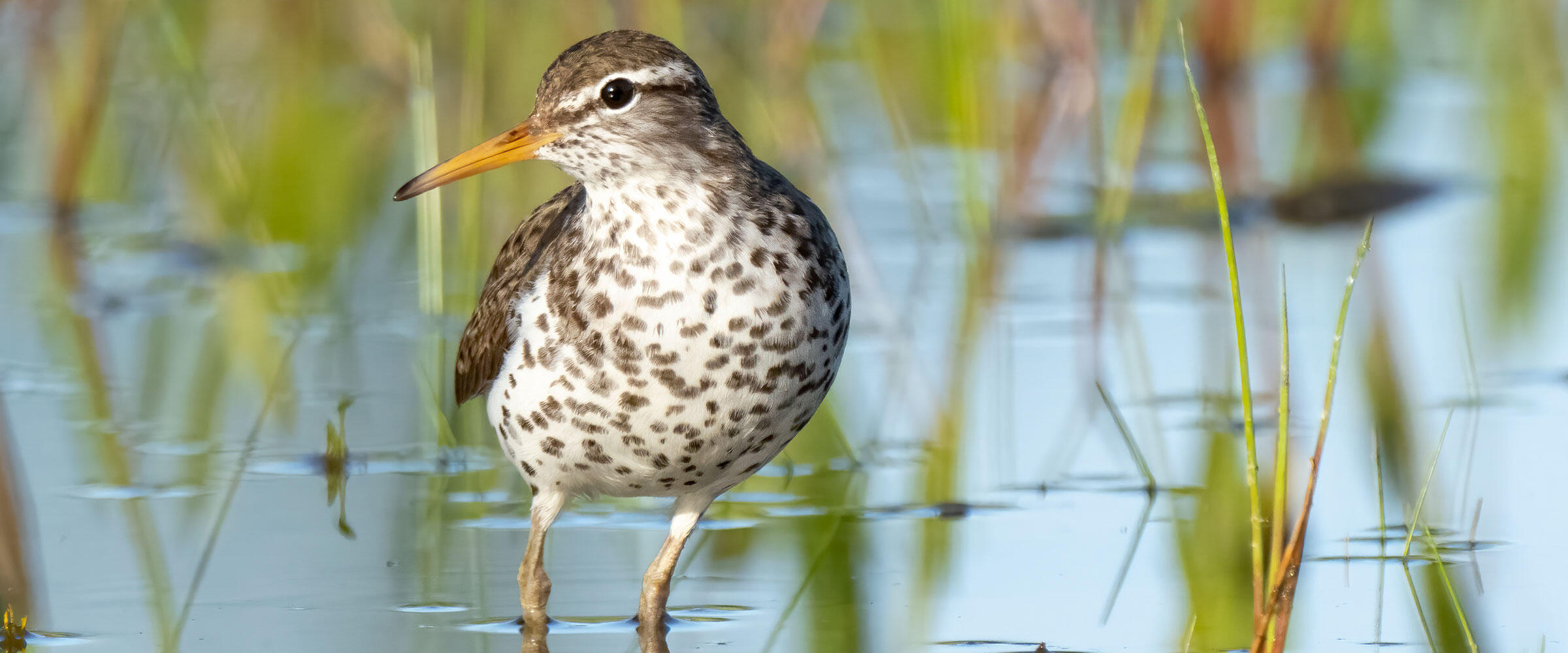
Spotted Sandpiper. Photo: Mick Thompson/Audubon Rockies

Click the link to read the article on the Audubon Rockies website (Nathan Boyer-Rechlin):

January 28, 2025

Colorado is in the midst of a nation-leading rulemaking for its state-waters protection program, established by HB24-1379: Regulate Dredge & Fill Activities in State Waters (HB1379) which Governor Polis signed into law on May 29th. This bill establishes a state regulatory program to permit dredge and fill activities that impact state waters not covered by the Clean Water Act (CWA). This encompasses removal, filling, or other alteration of wetlands and ephemeral streams from activities such as mining and infrastructure development. Audubon Rockies told the story of why Colorado needed new legislation following the Supreme Courtโ€™s Sackett Decisionโ€”which removed crucial wetland protectionsโ€”and how the bill passed with bi-partisan support in our June 2024 blog post, โ€œA Colorado Program the Colorado Way.โ€

Ephemeral streams are streams that do not always flow. They are above the groundwater reservoir and appear after precipitation in the area. Via Socratic.org

The core of this programโ€™s regulatory jurisdiction are ephemeral streams and isolated wetlands. Existing federal and state-managed regulatory programs tend to undervalue these types of streams and wetlands, and inadequately mitigate for loss of these habitats and their ecological functions. HB1379 has given Colorado the opportunity to lead the nation in developing a regulatory program that not only fills the gap left by Sackett, but effectively addresses impacts to these key habitats that birds, and humans, rely on. Although the bill set a strong framework for the regulatory program, the gains made during the legislative session could be minimized if the next step isnโ€™t done well. That next step, the rulemaking process, is currently underway.

Anatomy of a Rulemaking

Most of us who grew up with the American public school system likely remember Bill, that โ€œsad little scrap of paperโ€ who only ever dreamed of becoming a law (revisit that Schoolhouse Rock clip for a trip down memory lane). However, what our schoolhouse rock education left out was the long road ahead once poor Bill finally achieves his dream. Sadly for him, it’s not over yet. In most cases, a bill that passes through the state or federal legislature is a sketch or outline which sets the structure and parameters for how a law will function. The rulemaking process fills in the color and detail. 

In our billโ€™s case, HB24-1379 outlines key requirements and structure for a state program to regulate dredge and fill impacts to state waters which are not covered under the Supreme Courtโ€™s current interpretation of the Clean Water Act. The bill directs Coloradoโ€™s Department of Public Health and Environmentโ€™s (CDPHE) Water Quality Control Commission (WQCC) to develop and promulgate rules detailing how the program will be administered by December 31, 2025. These rules will determine regulatory requirements for stream restoration projects; determine how permits are evaluated, including standards avoiding and minimizing impacts to state waters; and establish a compensatory mitigation program to ensure that all lost stream and wetland functions due to permitted activities are replaced. How these rules are written will determine how effectively the state program meets the billโ€™s objectives.

CDPHE began convening stakeholders, including Audubon and our partners, in September 2024.  They then released the first draft of new regulations on December 6th. CDPHE is holding monthly stakeholder meetings through November 2025 to build consensus on priorities and draft additional language. WQCC will begin the formal rulemaking process in August 2025, which will include a public comment period for the proposed rules and the rulemaking hearing will be held on December 8, 2025.

Whatโ€™s at Stake?

The United States Geological Surveyโ€™s National Hydrography Dataset estimates that 24 percent of Coloradoโ€™s streams are ephemeral and 45 percent are intermittent. These streams provide key habitat for more than 400 bird species throughout Colorado and are vital for mitigating climate and drought impacts, protecting water quality in downstream riverways by capturing sediment and other pollutants, and regulating late season flows and stream temperatures.

Colorado Rivers. Credit: Geology.com

One of the most critical components of a dredge and fill permitting program is compensatory mitigation. In the federal dredge and fill permitting program ((ยง) 404 of the CWA), which Colorado is modeling its program after, permittees must first avoid and minimize all impacts to regulated waters and then compensate for all unavoidable impacts. Wetland compensatory mitigation most commonly takes place through mitigation banks, where permittees purchase credits from a mitigation bank that has previously constructed wetlands. Mitigation can also be done through an in-lieu fee program or onsite, where the impacts are taking place, by the permittee.

Sunrise Over Wetland by NPS/Patrick Myers

While wetland mitigation has been a well-established practice for decades, stream mitigation has only become common in the last 20 years. Due to challenges unique to streams, and particularly ephemeral streams which are more challenging to create or replace through mitigation banks, stream mitigation has been largely ineffective at replacing the functions lost through dredge or fill impacts. One review of the efficacy of stream mitigation programs found that โ€œexisting methods often devalued partially degraded, small, and non-perennial streams and thus discouraged protection and restoration of these stream types.โ€ Developing a compensatory mitigation program that effectively replaces the functions of ephemeral streams that are lost through unavoidable impacts is a key challenge this rulemaking will address.

HB24-1379 included three key provisions to ensure the program adequately protects ephemeral streams and isolated wetlands:

  1. The rules must focus on avoidance and minimization of all adverse impacts [of permitted projects] and describe avoidance and minimization standards.
  2. The rules must implement a compensatory mitigation program for all unavoidable impacts [of permitted projects]. Compensatory mitigationย mustย compensate for all โ€œfunctions of state waters that will be lost as a result of the authorized activityโ€
  3. The rules must include an exemption [from permitting] for stream restoration projects in ephemeral streams that are designed solely for ecological lift. Ecological life refers to improvement in the biological and/or hydraulic health of the stream.

While the first draft regulation has been released, many of the sections of the rules that will address these issues are still under development.

Better Together โ€“ Working Collaboratively for the Environment

Audubon and our partners have been actively engaged with CDPHE through their stakeholder engagement processes to advocate for strong rules in these three areas. In November, Audubon along with 10 other conservation organizations contributed and signed on to a letter to CDPHE detailing our priorities. This coalition, Protect Coloradoโ€™s Waters, also submitted specific feedback on the draft regulations in early January and are continuing to be engaged in advocating for strong rules that ensure avoidance and minimization of wetlands impacts and effective mitigation when needed. Our priorities also include ensuring that qualified stream restoration projects, designed for ecological lift, can continue without undue regulatory burden.

While Audubon and our partners secured a major victory for birds and people with the passing of HB24-1379, our billโ€™s journey is not done yet. If CDPHE can develop and promulgate rules for this program that ensure that permitted projects are the least damaging available alternative, ensure any lost functions are replaced through mitigation, and streamline permitting for voluntary stream restoration projects, then Coloradoโ€™s program will be the first of its kind to effectively protect these vital habitats. To stay engaged and attend future stakeholder meetings, visit CDPHEโ€™s dredge and fill engagement website.

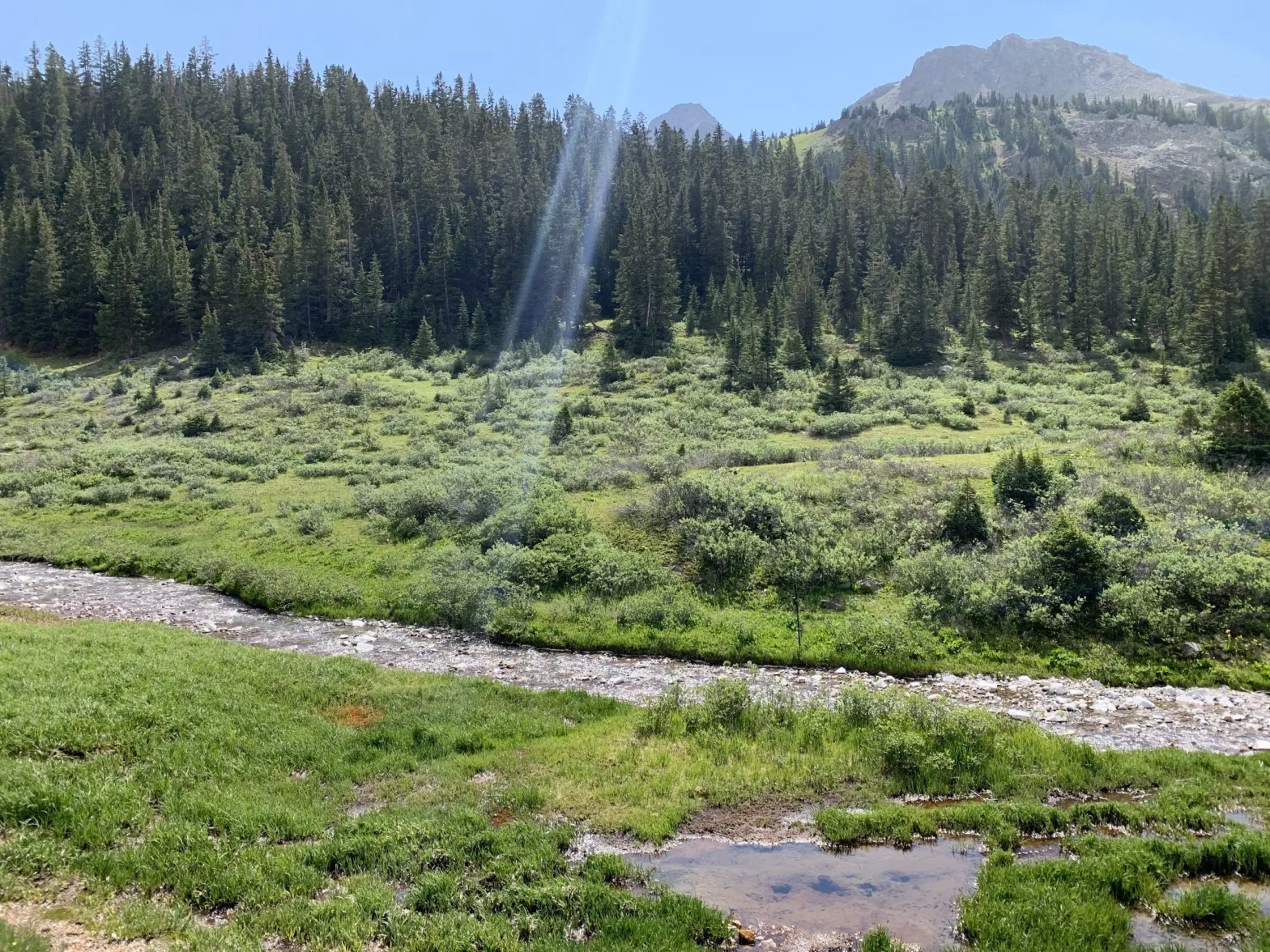
Colorado River headwaters tributary in Rocky Mountain National Park photo via Greg Hobbs.

Rare earth elements found in #LincolnCreek raise new questions: Mineralized tributary and Ruby mine also source of rare earth elements in Lincoln Creek — Heather Sackett (AspenJournalism.org)

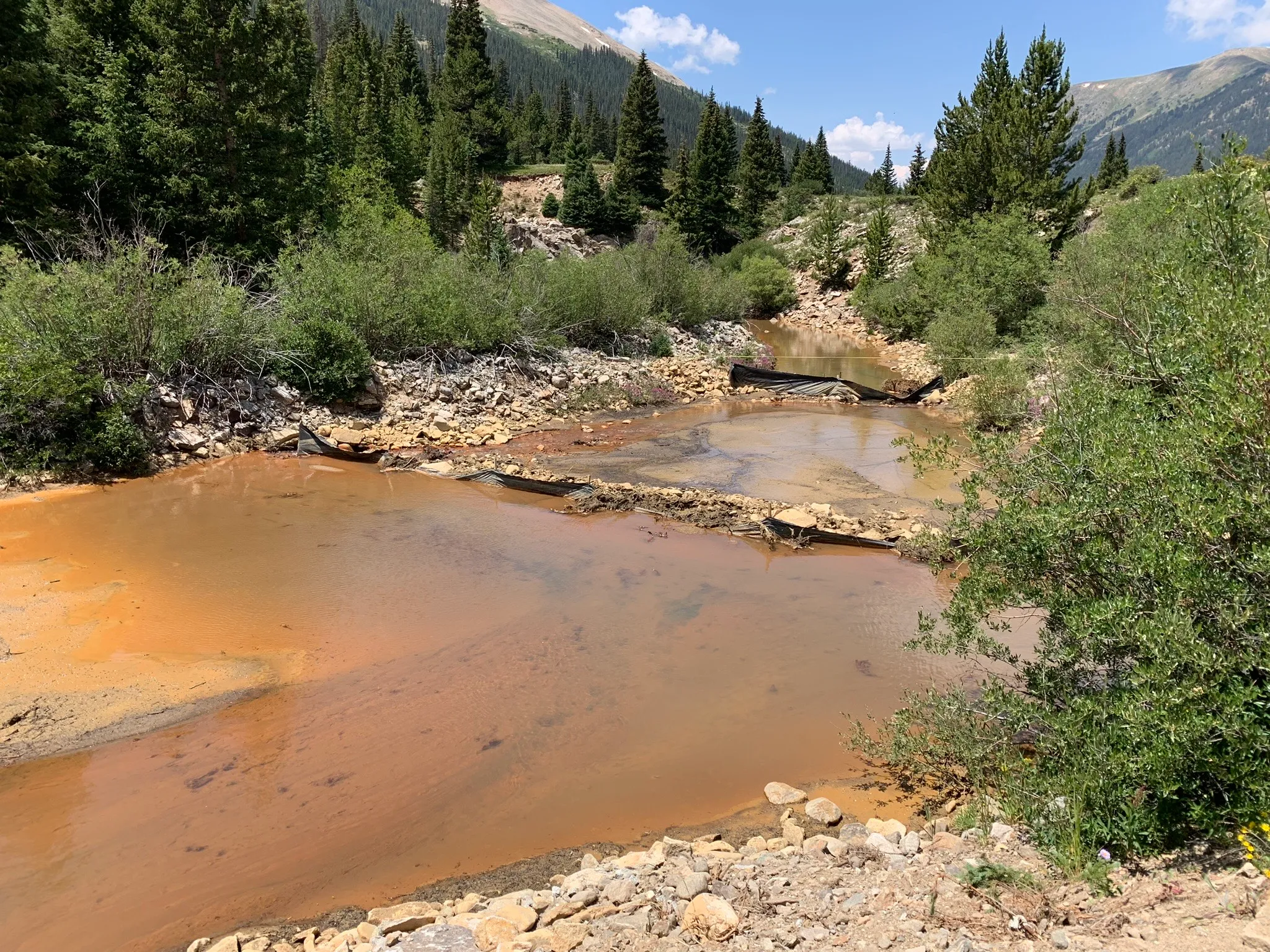
Lincoln Creek was orange just downstream of the mineralized tributary in July 2024. A team of scientists from the University of Colorado Boulder found that a mineralized tributary is also contributing rare earth elements to Lincoln Creek, in addition to other metals like aluminum. Credit: HEATHER SACKETT/Aspen Journalis

Click the link to read the article on the Aspen Journalism website (Heather Sackett):

January 25, 2025

Recent sampling shows that a high-alpine tributary of the Roaring Fork River, in addition to having high concentrations of certain metals, also contains rare earth elements. But what that means for human and aquatic health is unclear.

Scientists from the University of Colorado Boulder presented the preliminary results from water-quality sampling on Lincoln Creek over last summer at a public meeting hosted by the Roaring Fork Conservancy at the Basalt Regional Library on Thursday. 

Occupying a lesser-known corner of the periodic table, rare earth elements (which, despite their name, are commonly occurring in Earthโ€™s crust) are a set of 17 heavy metals that are used in making products such as cellphones, fiber-optic cables and computer monitors. With names such as yttrium, lanthanum and neodymium, they often turn up at sites in Colorado where there is acid rock drainage, such as upper Lincoln Creek.

โ€œYou get a phoneโ€™s worth of neodymium coming down the mineralized tributary about every 5ยฝ minutes,โ€ said Adam Odorisio, a graduate student and researcher at CUโ€™s environmental engineering department. โ€œThis translates to 96,000 phones per year. And what I think is the most striking fact in this is that this is for one tributary. You multiply this across hundreds of acid mine sites in Colorado and potentially thousands across the Western U.S. and itโ€™s very exciting for resource extraction.โ€ 

CU scientists are also monitoring other high alpine acid rock and mine drainage sites in Colorado, including the Snake River. Odorisio said the concentrations of rare earth elements in a mineralized tributary that feeds Lincoln Creek was in the middle of the pack when compared to other sites around the state.

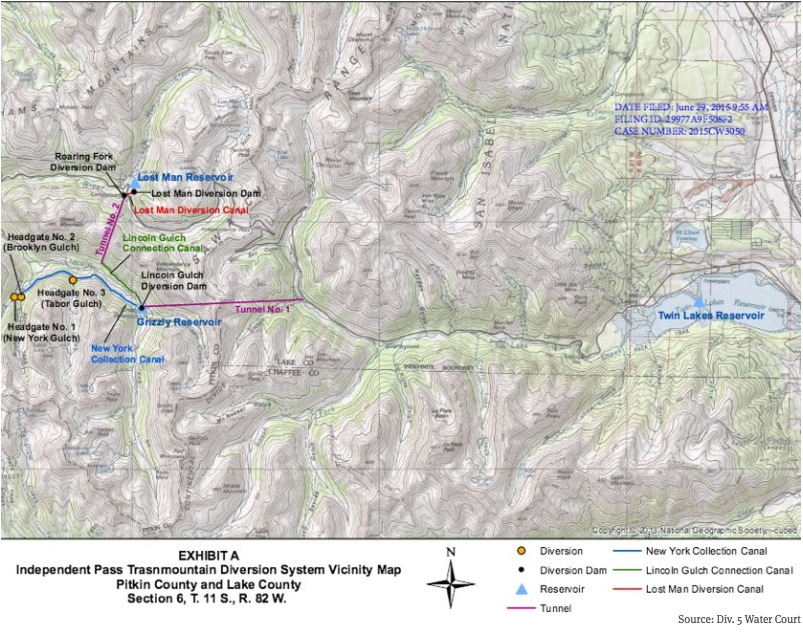
Twin Lakes collection system

In addition to the potential for mining valuable rare earth metals, scientists are eager to learn more about their impacts to human health and aquatic environments. There are no state or federal water quality standards for rare earth elements. Lincoln Creek is a source of drinking water for Front Range cities, including Colorado Springs. 

โ€œThis is just wide open as an unknown area,โ€ said Diane McKnight, a professor at CUโ€™s Institute of Arctic and Alpine Research. โ€œItโ€™s not clear that itโ€™s something to worry about here. The water from (Lincoln Creek) that goes into the Twin Lakes system is highly diluted.โ€ 

Over nine days from June through October, the CU team collected 79 water samples from eight sites, took sediment core samples from the Grizzly Reservoir lakebed, and collected rock scrapings and bugs from the waterway. Early results also confirmed what the Environmental Protection Agency found in previous water-quality tests: The water is highly acidic, and concentrations of metals including zinc, copper and aluminum exceed standards for aquatic life. Scientists found that a groundwater source could also be adding metals to Lincoln Creek. They are still analyzing the data and plan to present more results at a spring meeting.

โ€œFor the greater scientific community, the fate of rare earth elements in aquatic systems is not well understood,โ€ Odorisio said. โ€œWe are hoping to change that.โ€

The headwaters of Lincoln Creek upstream from the Ruby Mine and mineralized tributary. Recent water sampling by scientists from the University of Colorado Boulder found rare earth elements in the creek downstream, but implications for human health and aquatic impacts are unclear. Credit: HEATHER SACKETT/Aspen Journalism

The results may be of use to the Lincoln Creek workgroup, an ad hoc group โ€“ composed of officials from Pitkin County, Colorado Parks and Wildlife, the U.S. Forest Service, Colorado Department of Public Health and Environment, Independence Pass Foundation, Roaring Fork Conservancy and others โ€“ that is trying to understand how contaminants are impacting Lincoln Creek and the Roaring Fork River. The group has hired consultants LRE Water to compile water-quality data collected by several different agencies last summer and propose options to clean up the waterways. 

โ€œThe rare earth metals is a group we havenโ€™t really thought through,โ€ said Kurt Dahl, Pitkin Countyโ€™s environmental health manager. โ€œThatโ€™s one of the things that we are talking through with the contractor, LRE Water.โ€ 

The water quality of Lincoln Creek has been under increased scrutiny in recent years as fish kills and discoloration of the water downstream of Grizzly Reservoir have become more frequent. In July, reservoir owner and operator Twin Lakes Reservoir & Canal Co. drained the reservoir for a planned dam-rehabilitation project, releasing an orange slug of sediment-laden water from the bottom of the reservoir downstream. Testing showed that the water had high levels of iron and aluminum, but not copper, which is toxic to fish.

An EPA report in 2023 determined that a โ€œmineralized tributary,โ€ which feeds into Lincoln Creek above the reservoir near the ghost town of Ruby, is the main source of the high concentrations of metals downstream. 

Prior to mining, snowmelt and rain seep into natural cracks and fractures, eventually emerging as a freshwater spring (usually). Graphic credit: Jonathan Thompson

The process that causes metals leaching into streams can be both naturally occurring and caused by mining activities. In both cases, sulfide minerals in rock come into contact with oxygen and water, producing sulfuric acid. The acid can then leach the metals out of the rock and into a stream, a process known as acid rock drainage. The contamination from acid rock drainage seems to be increasing at other locations around Colorado and may be exacerbated by climate change as temperatures rise. 

The recent water-quality-testing effort on Lincoln Creek is probably just the beginning of a long-term data-collection and monitoring program, Dahl said. 

โ€œI think thereโ€™s still a lot of energy around this,โ€ Dahl said. โ€œPeople are really invested in this, and itโ€™s going to take a couple of years to get it characterized.โ€

Aspen Journalism, which is solely responsible for its editorial content, is supported by a grant from the Pitkin County Healthy Community Fund.

This story ran in the Jan. 27 edition of The Aspen Times.

Map of the Roaring Fork River drainage basin in western Colorado, USA. Made using USGS data. By Shannon1 – Own work, CC BY-SA 4.0, https://commons.wikimedia.org/w/index.php?curid=69290878

Gen Z Fears Clean Water Shortages, Displacement Due to #ClimateChange — Walton Family Foundation

Click the link to read the release on the Walton Family Foundation website (Mark Shields):

January 28, 2025

74% of Gen Zers say climate change threatens the clean water supply in the U.S.

WASHINGTON, D.C. โ€” Jan. 28, 2025 โ€” The Walton Family Foundation and Gallup released a new report today examining Gen Zโ€™s experiences with climate change and water issues, shedding light on their concerns about climate events and the potential impact on their generationโ€™s future. The research finds water issues top the list of Gen Zโ€™s climate worries, with individual perspectives shaped by diverse experiences and beliefs.

Of 12 climate-related issues measured in the study, majorities of Gen Zers express โ€œsomeโ€ or โ€œa great dealโ€ of worry about nine, including five related to water. This is true regardless of location, with water pollution and the health of fish and oceans ranking among the top three concerns in every U.S. Census region. While a majority of Gen Zers nationwide (61%) have reported experiencing a water-related climate issue in the past two years, water-related problems are more commonly reported by those in the Central and Western U.S.

When considering how these issues may affect their future, Gen Zers report concern about the availability of clean water and the potential need to relocate. Those who have experienced climate-related events at a higher rate are more likely to worry about these impacts . T here are notable differences across demographic groups. Hispanic (36%) and Black (34%) Gen Zers are more likely than their White (27%) peers to have experienced unsafe tap water . They are also more likely to believe there will not be enough clean water for their generation to live in the future (41% of Hispanic and 34% of Black Gen Zers, compared with 24% of W hite Gen Zers). Adult Gen Zers are significantly more likely to worry about needing to move due to climate change compared with their 12- to 17-year-old counterparts (40% vs. 27%, respectively).

Denver School Strike for Climate, September 20, 2019.

There is large-scale unity among young people on the importance of protecting water quality. Seventy-four percent of Gen Zers say it is โ€œvery importantโ€ to protect oceans, lakes and rivers from pollution, with another 19% saying it is โ€œsomewhat important.โ€ Gen Z acknowledges the adverse effects of climate change on water resources: 74% of Gen Zers say climate change impacts the amount of clean water available in the U.S. โ€œsomewhatโ€ (47%) or โ€œa great dealโ€ (27%). There is solid bipartisan agreement on the inadequacy of current water protection efforts: M ajorities of both Democratic (88%) and Republican (63%) Gen Z adults say the U.S. is โ€œprobablyโ€ or โ€œdefinitelyโ€ not doing enough to protect water.

โ€œGen Z is united in their deep concern for water protection and availability, recognizing it as a critical issue that touches us all โ€” regardless of where we live or who we are,โ€ said Moira Mcdonald, Environment Program Director at the Walton Family Foundation. โ€œAs we look to the future, there’s a growing sense of urgency. Young people fear inheriting a world where clean water is scarce and climate change continues to worsen. We need to work on solutions to ensure clean, safe water remains accessible for generations to come.โ€

Looking ahead, Gen Zers are pessimistic about the trajectory of climate change โ€” 67% believe climate change will worsen in their lifetime. And rates of pessimism are about 10 percentage points higher among those who have recently experienced a climate-related issue such as flooding, drought or unsafe tap water. Among voting-age Gen Zers, majorities of both Democrats and Republicans believe it is very or somewhat unlikely that climate change will be stopped.

Methodology

Results are based on a Gallup Panelโ„ข web survey conducted Aug. 6-14, 2024, with a sample of 2,832 12- to 27-year-olds from across the U.S. The Gallup Panel is a probability-based panel of U.S. adults. Data were weighted to match demographic targets of age, gender, education, race, Hispanic ethnicity and Census region for 12- to 27-year-olds, using the most recent five-year population estimates from the American Community Survey.

Twelve- to 17-year-old children, as well as some 18-year-olds, were reached through adult members of the Gallup Panel who indicated they had at least one child aged 18 or younger living in their household. The remaining 18- to 27-year-old respondents are members of the Gallup Panel.

For the total sample of 2,832 respondents, the margin of sampling error is +/-2.9 percentage points at the 95% confidence level. Margins of error for subgroups are higher; selected subgroups are reported below. All margins of error reported are adjusted to account for the design effect.

El Paso County to consider forever chemicals testing agreement with Air Force — #Colorado Politics #PFAS

Fountain Creek photo via the Fountain Creek Watershed Flood Control and Greenway District

Click the link to read the article on the Colorado Politics website (Savannah Eller). Here’s an excerpt:

January 22, 2025

The El Paso County Board of County Commissioners will soon have an option on the table to formalize a forever chemicals testing agreement with the Air Force over wells at Fountain Creek Regional Park. Todd Marts, El Paso County director of community services, said in an informal meeting with commissioners on Tuesday that the U.S. Air Force has been regularly testing wells for two forever chemical types in “surrounding areas” including the park. The agreement would formalize continued access for the military…

Widefield aquifer via the Colorado Water Institute.

Residents in and around Fountain and Security-Widefield were previously exposed to elevated levels of forever chemicals from firefighting foams used on Peterson Space Force Base. The communities have since put in systems to treat groundwater…The county did not have immediate plans to mitigate forever chemicals in park water, with Melvin pointing out that the chemicals lived up to their name. El Paso County’s parks department is considering the addition of a third well to serve the Fountain Creek Nature Center, will would also be subject to testing under the access agreement with the Air Force. The contract will allow military access for testing for one year, with the option to renew for nine years. The El Paso County commissioners will vote on the agreement as an item at an upcoming public meeting.ย 

How do President Trumpโ€™s Executive Orders Impact Your Clean Water? — Leda Hua (AmericanRivers.org)

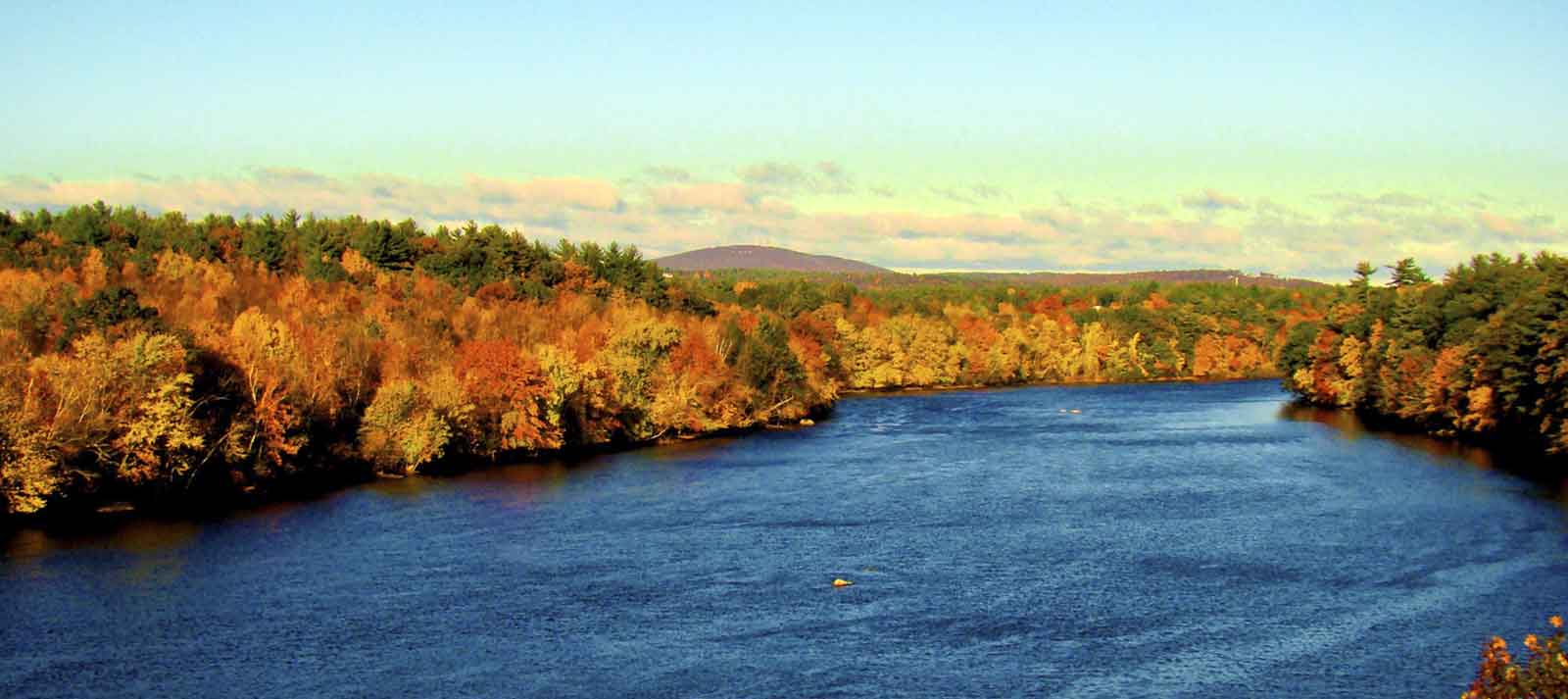
Merrimack River, New Hampshire | Merrimack River Watershed Council

Click the link to read the article on the American Rivers website (Leda Hua):

January 22, 2025

Following his inauguration, President Trump issued a number of executive orders focused on climate and energyโ€”actions that could have major impacts on the rivers and clean water that all Americans depend on. President Trump has said he wants our country to have โ€œthe cleanest water,โ€ which is why we must prevent any actions that harm our rivers and drinking water sources.   

Thatโ€™s why we need a responsible national energy strategy that is considerate of our water resources. Responsible energy development means meeting the needs of people without damaging the environment that our health and water wealth depend on.  

No matter who you are or where you live, we all need clean, safe, reliable drinking water. Most of our countryโ€™s water comes from rivers. Public opinion research shows that Republican, Democrat, and Independent voters of all ages and races overwhelmingly support protections for clean water.  Clean water is a basic need, a human right, and a nonpartisan issue we can all agree on. 

The details and implementation of these executive orders will matter as we pursue the dual goals of energy and water security. 

We cannot return to days where polluters were allowed to devastate rural and urban communities and their natural resources. But these executive orders eliminate efforts to safeguard communities from environmental harm, putting their drinking water at risk.  

In addition to protecting Americans from pollution, we also need to help families and businesses prepare for increasingly extreme weather. As Asheville, North Carolina and other communities in the Southeast continue to recover from Hurricane Helene, and thousands in Los Angeles are without homes following recent catastrophic fires, we should be bolstering policies to fight climate change and working to strengthen communities in the face of severe floods, droughts, and fires.  

Created by Imgur user Fejetlenfej , a geographer and GIS analyst with a โ€˜lifelong passion for beautiful maps.โ€™ It highlights the massive expanse of river basins across the country โ€“ in particular, those which feed the Mississippi River, in pink.

Announcement: Public water systems grant availability for emerging contaminants: Grant application deadline is March 21 — #Colorado Department of Public Heakth & Environment

Firefighting foam containing PFAS chemicals is responsible for contamination in Fountain Valley. Photo via USAF Air Combat Command

From email from CDPHE:

January 24, 2025

The Water Quality Control Division (division) is pleased to announce the Request for Applications (RFA) for the Emerging Contaminants in Small or Disadvantaged Communities Grant Program. This RFA is open as of January 24, 2025. 

This program helps non-transient, non-community or community public water systems in small or disadvantaged communities. The funds can help with planning, design, and infrastructure to reduce public health risks from emerging contaminants, including PFAS (per-and polyfluoroalkyl substances), manganese, and others. 

The details of this RFA are located on the divisionโ€™s website. Written questions and inquiries regarding the RFA are due on February 7, 2025, by 2:00 p.m. MDT.

The application deadline is March 21, 2025, at 11:59 p.m. MDT.
Lenguaje y accesibilidad
Si necesita ayuda en espaรฑol o en otro idioma, pรณngase en contacto con la divisiรณn escribiendo a cdphe.commentswqcd@state.co.us.

The American Oil Industryโ€™s Playbook, Illustrated: How Drillers Offload Costly Cleanup Onto the Public — Mark Olalde, illustrations by Peter Arkle (ProPublica.org) #ActOnClimate

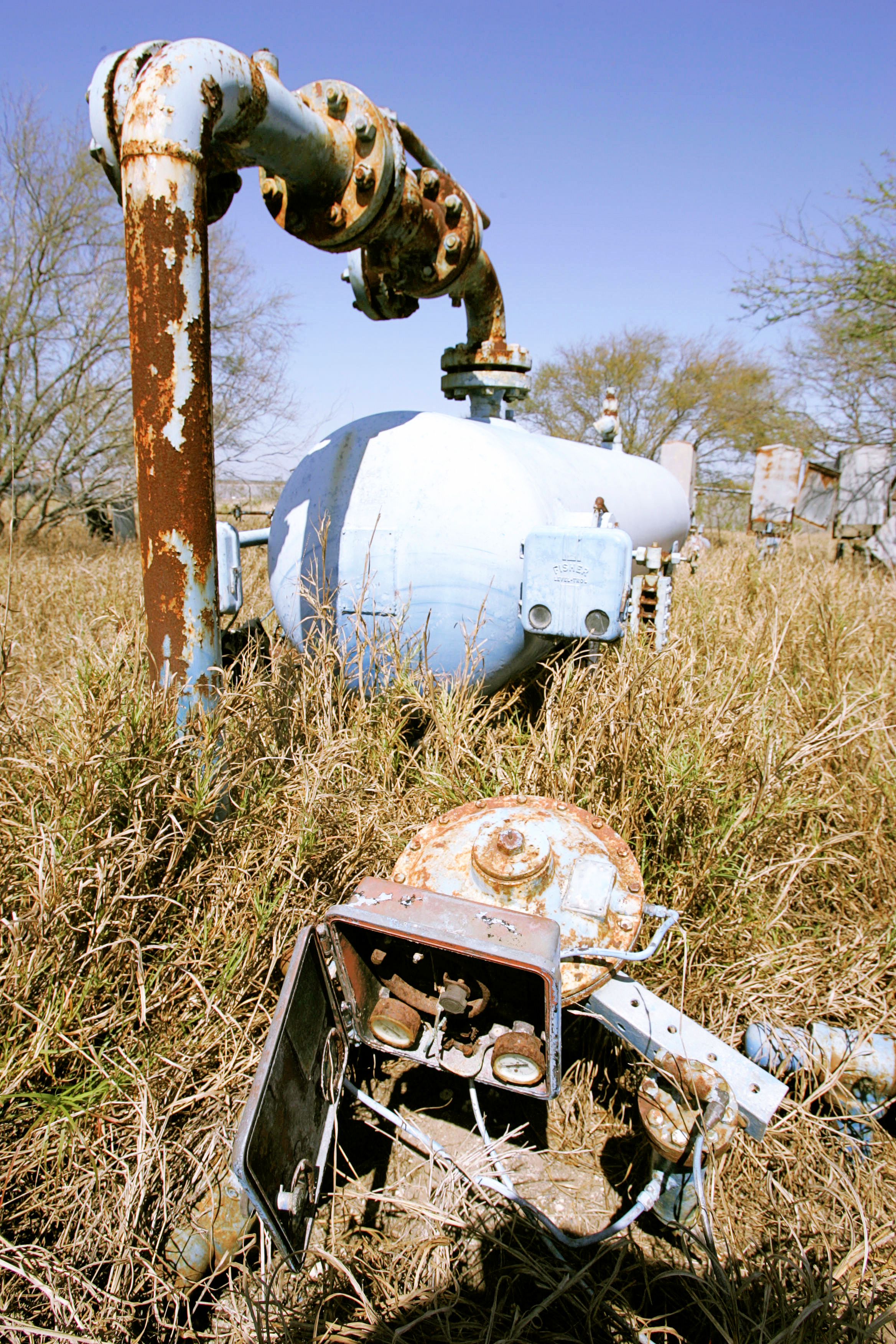
Abandoned gas well located in Lower Rio Grande Valley National Wildlife Refuge. By Hillebrand, Steve, USFWS – https://digitalmedia.fws.gov/digital/collection/natdiglib/id/13540/rec/9, Public Domain, https://commons.wikimedia.org/w/index.php?curid=113189594

Click the link to read the article on the ProPublica website:

by Mark Olalde, illustrations by Peter Arkle, special to ProPublica

December 30, 2024

ProPublica is a Pulitzer Prize-winning investigative newsroom. Sign up for The Big Story newsletter to receive stories like this one in your inbox.

Series: Unplugged:Will Taxpayers Foot the Oil Industryโ€™s Cleanup Bill?

More in this series

In December 1990, officials in the federal agency tasked with regulating offshore oil and gas drilling received a memo with a dire warning: America faced a ticking time bomb of environmental liability from unplugged oil and gas wells, wrote the agencyโ€™s chief of staff. Those wells and their costly cleanup obligations were being concentrated in the hands of cash-strapped drillers at the same time as production was shrinking. (The document, unearthed by public interest watchdog organization Documented, was shared with ProPublica and Capital & Main.)

More than three decades later, little action has been taken to heed that warning, and the time bomb is threatening to explode.

More than 2 million oil and gas wells sit unplugged across the country. Many leak contaminants like brine, methane and benzene into waterways, farmland and neighborhoods. The industry has already left hundreds of thousands of old wells as orphans, meaning companies walked away, leaving taxpayers, government agencies or other drillers on the hook for cleanup.

Americaโ€™s oil fields are increasingly split between a small number of wells producing record profits and everything else. Researchers estimate roughly 90% of wells are already dead or barely producing.

Consider the Permian Basin, the worldโ€™s most productive oil field, stretching from West Texas across southeastern New Mexico.

โ€œThe Permian is the oil patchโ€™s Alamo โ€” thatโ€™s where itโ€™s retreating to,โ€ Regan Boychuk, a Canadian oil cleanup researcher, said of the oil industry. โ€œThatโ€™s their last stand.โ€

Even here, many wells sit idle and in disrepair. Itโ€™s time to plug them, according to a growing chorus of researchers, environmentalists and industry representatives.

The question of who pays for cleanup remains unanswered. Time and again, oil companies have offloaded their oldest wells. Their tactics are not written down in one place or peddled by a single law firm โ€” but companies follow an unmistakable pattern. The strategy, which is legal if followed properly, has become such a tried-and-true endeavor that researchers and environmentalists dubbed it โ€œthe playbook.โ€

Clark Williams-Derry, an analyst with clean-energy-focused think tank the Institute for Energy Economics and Financial Analysis, studies fossil fuel companiesโ€™ cleanup costs. โ€œThereโ€™s almost a cheerleading squad for shedding your liabilities, like a snake sheds its skin and just slithers away,โ€ he said.

Should you want to become an oil executive and try this strategy yourself, hereโ€™s how it works โ€ฆ

As you launch your business, begin by collecting subsidies, tax breaks and other incentives from the government to guarantee you can pump oil and gas profitably. Globally, fossil fuel subsidies total in the trillions each year, according to organizations such as the International Monetary Fund.

Next, start pumping and profiting.

As you set up your business, create layers of shell companies. Down the road, theyโ€™ll provide a firewall between you and your liabilities โ€” key among them, cleanup costs.

Once oil and gas production slows, sell low-producing wells. Smaller drillers operating on thinner margins, known in the business as โ€œscavenger companies,โ€ will be happy to take them off your hands.

Rinse and repeat by selling wells as their profits slow to a trickle. Theyโ€™ll be sold again to ever-smaller companies that teeter on the edge of insolvency. Maintenance and environmental stewardship will usually fall by the wayside as companies eke out a profit. Studies show that the number of environmental violations rises as wells pass to less-capitalized drillers. But these wells arenโ€™t your problem any longer.

Pull any remaining profits before regulators hit you with violations and fines for your remaining wells that arenโ€™t pumping and may be leaking.

Then, idle the wells โ€” pausing production, but not plugging them or cleaning up โ€” and walk away. Regulators are typically tasked with ensuring that as much oil as possible is pumped out of the ground, so rules allow wells to sit idle, instead of being plugged, in case prices surge and it becomes profitable to restart them. However, a study in California found that, after wells are inactive for only 10 months, thereโ€™s a 50-50 chance they will never produce again.

Regulators will likely grow tired of asking you to clean up your wells, but you can make the case for leaving them unplugged for now. Pitch grand plans, as other drillers have โ€” maybe repurposing the wells for bitcoin mining, carbon sequestration or the synthesis of hydrogen fuel โ€” that require the wells to remain open.

When regulatorsโ€™ patience has reached its limit, remind them what will happen if they come down hard on you. Fines or other extra costs could force your business into bankruptcy, leaving your unplugged wells as orphans and taxpayers on the hook. Ask them if they want to be responsible for that catastrophe.

โ€œThe root of the problem is thereโ€™s no regulator of the oil industry across North America,โ€ Boychuk said, adding that โ€œthe rule of law has never applied to oil and gas.โ€

When regulators finally act, declare bankruptcy. The Bankruptcy Code is meant to protect businesspeople like you who took risks. More than 250 oil and gas operators in the U.S. filed for bankruptcy protection between 2015 and 2021, according to law firm Haynes Boone. (Industry groups estimate there are several thousand oil companies in the country.)

Regulators only require oil and gas companies to set aside tiny bonds that act like a security deposit on an apartment. Because you didnโ€™t clean up your wells, youโ€™ll lose that money, but itโ€™s a fraction of the profits youโ€™ve banked or the cost of the cleanup work. ProPublica and Capital & Main found that bonds typically equal less than 2% of actual cleanup costs.

And as you finalize your exit, the labyrinth of shell corporations you set up should act as corporate law intends, protecting you from future responsibility. Such companies, little more than stacks of paper, will be responsible for your liabilities, not you. Even if regulators know who is behind a company, it becomes increasingly difficult to penetrate each layer of a business to go after individual executives.

โ€œItโ€™s the essence of corporate law,โ€ Williams-Derry said.

Now that youโ€™ve offloaded your wells, youโ€™re free to start fresh โ€” launch a new oil company and buy some of your old wells for pennies on the dollar, a proven option. Maybe you leave oil entirely โ€” thatโ€™s also tried-and-true. Or become a vintner and open a winery just down the road from the wells you left as orphans โ€” you wouldnโ€™t be the first.

For its part, the oil industry downplays the so-called playbook and the countryโ€™s orphan well epidemic. โ€œThereโ€™s a general trend, which is there are very few orphan wells,โ€ said Kathleen Sgamma, who has been among oil companiesโ€™ most vocal proponents as president of the Western Energy Alliance, an industry trade group. Plus, she said, companiesโ€™ bonds and statesโ€™ orphan well funds help pay for plugging.

But those tasked with addressing the reality of the countryโ€™s orphan wells disagree. โ€œWe have a welfare system for oil and gas. I hope you understand that,โ€ said New Mexico Commissioner of Public Lands Stephanie Garcia Richard, who oversees the stateโ€™s public lands. New Mexico has already documented more than 1,700 orphan wells across the state. โ€œWe have oil and gas welfare queens.โ€

In New Mexico, Garcia Richard is trying to hold accountable one of the myriad drillers that have followed key steps in the playbook, the oil company known as Siana.

Siana is made up of two related entities โ€” Siana Oil and Gas Co. LLC and Siana Operating LLC โ€” based in Midland and Conroe, Texas. The company operated 11 wells in southeastern New Mexico in the heart of the Permian Basin.

In reality, Siana is the corporate shield for a man named Tom Ragsdale. After he aggregated his few wells, he generated cash through a trickle of oil and gas production and set up a business injecting other companiesโ€™ wastewater into his wells to dispose of it. But the state worried that Ragsdaleโ€™s operations were polluting the environment and that he was refusing to pay royalties and rental fees he owed the state, according to State Land Office staff.

Ragsdale did not respond to repeated requests for comment from ProPublica and Capital & Main. He also did not appear for a pretrial conference after the state brought legal action against Siana, court records show, and a state court judge ruled against his companies.

Siana was responsible for at least 16 spills, according to New Mexico Oil Conservation Division data, mainly spilling whatโ€™s called produced water, a briny wastewater that comes to the surface alongside oil and gas. โ€œCorrosionโ€ and โ€œEquipment Failureโ€ were among the causes.

The State Land Office hired an engineering firm to study the damage. The firm produced a damning 201-page report in 2018, finding oil and salt contamination exceeding state limits at Sianaโ€™s most polluted site. At high enough levels, these substances can kill plants, harm wildlife and impact human health.

The State Land Office estimated that cleaning up that site alone would cost about $1 million.

In 2020, New Mexico won a judgment against Ragsdaleโ€™s companies that, with interest, is now worth more than $3.5 million. But it wonโ€™t cover the cleanup cost. Between a small bond and the judgment, the state has been able to recover a mere $50,000 or so from Siana and related entities.

When the state tried to collect the rest, Ragsdale placed Siana Oil and Gas in bankruptcy protection in June 2023. Although he listed the company as having millions in assets at the time of the bankruptcy, the company had only $20,500 in a bank account. Court records show Siana is responsible for between $1 million and $10 million in liabilities, including money owed to the state of New Mexico, other oil companies, various counties and others.

Stickers plastered around Sianaโ€™s drill sites โ€” on which the companyโ€™s name is misspelled โ€” provide phone numbers to call in case of leaks or other emergencies. None went to Ragsdale or Siana employees. A man named William Dean answered one number. He owned a local oil field services company called Deanโ€™s Pumping that was contracted to work on Sianaโ€™s wells, but Ragsdale stopped paying its bills, ultimately owing his company tens of thousands of dollars, Dean said.

โ€œHe was trying to half-ass things,โ€ Dean said of Ragsdale. โ€œI donโ€™t know what happened to Tom.โ€

Sianaโ€™s bankruptcy case is ongoing, but Ragsdale has been largely unresponsive even in those proceedings.

Siana is, Garcia Richard said, โ€œan exemplar of how our system has failed.โ€ Although he was very nearly free of his old wells, Ragsdale flouted the playbook and ignored the bankruptcy judgeโ€™s demands that he participate in the case. In an unusual move, the judge in late September issued a warrant for Ragsdaleโ€™s arrest to compel him to hand over certain data. The U.S. Marshals Service was investigating Ragsdaleโ€™s whereabouts but had not taken him into custody as of mid-December, according to an agency representative.

The day after the judge issued the arrest warrant, the bankruptcy trustee filed a complaint alleging Ragsdale had committed fraud, siphoning about $2.4 million from Siana to purchase real estate in Houston.

That money could have gone toward cleaning up the mess left to New Mexico taxpayers.

ProPublica and Capital & Main visited Sianaโ€™s 11 wells in late 2023. At one drill site, methane leaked from a wellhead that had also stained the surrounding land black from spilled oil. The air was sour with the smell of toxic hydrogen sulfide. A nearby tank that held oil for processing was rusted through. Another had leaked an unidentified liquid. There appeared to be hoofprints where cattle had tracked through the polluted mud.

ProPublica and Capital & Main found oil spills at multiple Siana wells. At others, the idle pump jacks stood silent โ€” corroded skeletons at the end of the line, the detritus of another run through the playbook.

Efforts to reform the system that has shielded oil companies from liability have been haphazard. When the federal government rewrote its rule setting bond levels on federal public land earlier this year, a simple math error meant the government would ask oil companies to set aside around $400 million less in bonds than it wouldโ€™ve otherwise. And when states have tried to pass reforms, theyโ€™ve been stymied by state legislatorsโ€™ and regulatorsโ€™ chummy relationships with the industry.

As an ever-greater share of wells go offline and the economy transitions to cleaner forms of energy, policymakers face a choice: Do they focus attention on propping up or cleaning up the industry?

Sgamma of the Western Energy Alliance gives voice to one path forward. โ€œAny time a well goes into an orphan status, itโ€™s not a good thing,โ€ Sgamma said, yet her group has been instrumental in killing efforts to address the orphan well epidemic and the oil industryโ€™s contributions to climate change. Her organization is suing to halt the federal rule that sought to bring bonding levels closer to true plugging costs.

Sgamma co-authored the energy section of Project 2025, the conservative policy paper with deep ties to the first Trump administration that lays out policy priorities for a conservative White House. The plan would โ€œStop the war on oil and natural gas,โ€ reopen undeveloped habitat from Alaska to Colorado for drilling, increase the number of sales for oil leases on public lands and shrink federal environmental agencies. President-elect Donald Trump has repeatedly indicated this closely aligns with his vision for pumping Americaโ€™s โ€œliquid gold.โ€ He has begun staffing his administration with pro-oil and gas figures.

The future for which Sgamma is fighting sees a resilient American oil and gas industry, able to โ€œtake a lot of punchesโ€ while continuing to grow unabated.

Or thereโ€™s the future Garcia Richard, who oversees New Mexicoโ€™s public land, envisions. She has paused the leasing of public land to drillers until the Legislature forces oil companies to pay state taxpayers higher royalties that reflect fair market rates. She directed her staff to aggressively pursue companies like Siana. And her office is preparing to raise required bonding levels. As she talked about this work, she held up the literal rubber stamp that imparts the State Land Officeโ€™s seal on documents, suggesting thatโ€™s not how business is done anymore. She also held up a small notebook where she tracks the numerous companies her office is pursuing for polluting the stateโ€™s land and water.

In her future, Garcia Richard said, oil drillers wouldnโ€™t behave like Siana and Ragsdale. โ€œA good-acting company is a company that understands thereโ€™s a cost of doing business that shouldnโ€™t be borne by the landowner, shouldnโ€™t be borne by the taxpayers,โ€ she said. But in the modern American oil industry, she added, the playbook and the still-burning fuse of the cleanup time bomb represent little more than โ€œWild West behavior.โ€

EPA takes unprecedented step to remove uranium waste from the Navajo Nation: The decision opens the door for new ways to manage uranium pollution on tribal land — Natalia Mesa (High Country News)

Red Water Pond Road Community leader, Larry King, addresses plans to relocate the Quivera Mine Waste Pile that is located about 1,000 feet from the closest residence. Shayla Blatchford

Click the link to read the article on the High Country News website (Natalia Mesa):

January 17, 2025

As a child, herding her grandmotherโ€™s sheep, Teracita Keyanna unknowingly wandered onto land contaminated with radioactive waste from three abandoned uranium mine and mill waste sites located near her home on the Navajo Nation. 

Keyanna and other Dinรฉ citizens have been living with the consequences of uranium mining near the Red Water Pond Road community since the 1960s. But now, uranium waste rock that has sat for decades at a Superfund site will finally be moved to a landfill off tribal land.

โ€œThis is a seismic shift in policy for Indigenous communities,โ€ said Eric Jantz, an attorney for the New Mexico Environmental Law Center. 

On Jan. 5, in a first-of-its-kind move, the Environmental Protection Agency signed an action memo to transport 1 million cubic yards of low-grade radioactive waste from the Quivira Mining Co. Church Rock Mine to a disposal site at the Red Rock Regional Landfill. The Northwest New Mexico Regional Solid Waste Authority owns and operates the landfill, which is located about 6 miles east of Thoreau, New Mexico. 

โ€œI feel like our community has finally had a win,โ€ Keyanna said. She is a member of the Red Water Pond Road Community Association, a grassroots organization made up of Dinรฉ families that have been advocating for the waste removal for almost two decades. โ€œItโ€™ll help the community heal.โ€

Companies extracted an estimated 30 million tons of uranium ore on or near the Navajo Nation from 1944 to 1986, largely to fuel the federal governmentโ€™s enormous nuclear arsenal. When the mines were abandoned in the 1980s, the toxic waste remained. Today, there are hundreds of abandoned mines in plain sight on the Navajo Nation, contaminating the water, air and soil. Altogether, there are an estimated 15,000 uranium mines across the West โ€” 1,200 of them on the Navajo Nation alone โ€” with the majority located in the Four Corners region. 

The impact of all this mining on Dinรฉ communities has been devastating. A 2008 study found uranium contamination in 29 water sources across the Navajo Nation, while other studies show that people living near waste sites face a high risk of kidney failure and various cancers. 

At Quivira, the cleanup is set to begin in early 2025 and will continue for six to eight years, according to an EPA news release. The permitting process, which will provide opportunity for public comment, will be overseen by the New Mexico authority that manages the proposed waste site and is responsible for its long-term safety monitoring.  

Mine Waste Area with Limited Vegetation. Photo credit: EPA

The EPA had considered multiple options for waste remediation. But for years, Red Water Pond Road advocates and other local organizations continually pushed it to simply remove the waste, a course of action that the EPA has never taken before, even though the Navajo Nation has repeatedly called for the federal government to move all uranium waste from Dinรฉ tribal land. 

Throughout the Navajo Nation, said Jantz, โ€œprior to this decision, EPAโ€™s primary choice in terms of remediation of mine was to bury the piles under some dirt and plant some grass seeds on top, called cap in place.โ€ But studies have shown that this approach is not effective at containing radioactive waste in the long term, he said. 

The agency took a similar approach when addressing the other uranium waste in the Church Rock area. In 2013, the EPA and the Nuclear Regulatory Commission, which oversees uranium mine-waste cleanup, dumped 1 million cubic yards of waste from the Northeast Church Rock Mine โ€” a different waste site, roughly 3 miles from the Quivira Mine โ€” on top of existing tailings located half a mile from the Red Water Pond Road communities. 

But the EPA plans to handle the Quivira Mineโ€™s waste differently, placing it in geoengineered disposal cells with a groundwater leak protection system after it is moved off-site, an approach that Jantz called โ€œstate-of-the-art.โ€

The Quivira Mine cleanup is part of the 2014 Tronox settlement, which provided $5.15 billion to clean up contaminated sites across the United States. The settlement allocated $1 billion of those funds to clean up 50 uranium mines across the Navajo Nation. 

There is a lot more to be done, said Susan Gordon, coordinator for the Multicultural Alliance for a Safe Environment, a grassroots organization led by uranium-impacted communities. Hundreds of abandoned mines pepper the Navajo Nation, and the EPA has not formulated a broader plan to clean up the majority of them. Funding is also an issue, she added. 

What the EPAโ€™s decision means for the future of uranium mine waste remediation is unclear. Under other circumstances, Jantz said that the decision would signal a sea change for the EPAโ€™s policy of removing waste from the Navajo Nation. But the incoming Trump administration has not indicated its policy on hazardous waste disposal.

As Jantz put it, โ€œAll bets are off.โ€

Graphic credit: Environmental Protection Agency

#Colorado to start regulating emission of 5 air toxics that make people sick: The new regulations will be rolled out in phases over the course of 2025 and into 2026 — The #Denver Post

Metro wastewater plant in Denver.

Click the link to read the article on The Denver Post website (Noelle Phillips). Here’s an excerpt:

January 13, 2025

Five new compounds soon will be listed as priority toxic air contaminants in Colorado and, over the next two years, the stateโ€™sย Department of Public Health and Environmentย andย Air Quality Control Commissionย will determine out how to regulate them. The stateโ€™sย Air Pollution Control Divisionย will recommend five compounds to be regulated to the commission during its two meetings that begin Thursday. The creation of the list of toxic air contaminants is the result of a years-long effort from environmentalists and public health advocates who want the state to do more to protect people from the pollution that can cause cancers, such as leukemia and lymphoma, and lung diseases, such as asthma, and can harm womenโ€™s reproductive health. For years, environmentalists have complained that air pollution permits issued by the federal and state governments allow companies to pollute with little attention given to how much of those contaminants are dangerous to human health…

The five toxic air contaminants beingย proposed for regulationย are:

  • Acrolein, which is created when fossil fuels are burned by wood-burning, industrial boilers and reciprocating engines, and it is also used to make a polymer for paints, coatings and adhesives. Acute, short-term inhalation can cause eye and respiratory tract irritation. It is not considered a cancer risk.
  • Benzene, a carcinogen released when fossil fuels are burned, including in car exhaust and oil and gas extraction and production. It also is created by cement manufacturing, waste disposal and wood burning. Acute exposure may cause drowsiness, dizziness and headaches, as well as eye, skin and respiratory tract irritation, and unconsciousness at high levels. Chronic inhalation has caused cancer, various blood disorders and affects womenโ€™s reproductive organs, the Environmental Protection Agency has reported.
  • Ethylene oxide, which is used to make other products such as antifreeze, textiles, adhesives, plastics and detergents. Itโ€™s used to sterilize medical equipment, including atย Terumo BTC in Lakewood to sanitize medical equipment. It causes cancers in humans, including lymphoma, myeloma, leukemia and breast cancer.
  • Hydrogen sulfide, highly toxic gas that smells like rotten eggs. It is released by wastewater treatment facilities, meat processing facilities, petroleum refining, manufacturing of asphalt and roofing material and places where large quantities of manure are stored. It can cause people to pass out due to high exposure. Low exposure can cause headaches, memory loss, balance problems and fatigue. It is not considered a carcinogen but data is limited on how it affects childrenโ€™s health or womenโ€™s reproductive health, according to the EPA.
  • Hexavalent chromiumย is a by-product of industrial processes such as metal fabricating and by burning coal for electricity. It can leak into water systems and into the air. It can cause cancer and impact the respiratory system, kidneys, liver, skin and eyes, the EPAโ€™s website says.

Cleanup of abandoned uranium mines set to start after Navajo Nation, EPA reach agreement — AZCentral.com

Graphic credit: Environmental Protection Agency

Click the link to read the article on the AZCentral.com website (Arlyssa D. Becenti). Here’s an excerpt:

January 8, 2025

After years of demanding the cleanup of uranium waste at the Kerr-McGee Quivira Mines on the Navajo Nation community advocates got the news this week that the Environmental Protection Agency will remove waste rock from three areas of the site and move it to a new off-site repository. The removal of over 1 million cubic yards of radioactive waste from the sites about 20 miles northeast of Gallup will begin in early 2025, the EPA said. The waste will be taken to a new off-site repository at Red Rocks Landfill east of Thoreau, N.M. The process, including permitting, construction, operation and closure of the repository, is expected to take 6-8 years.

โ€œI feel as though our community finally has something of a win,โ€ said Teracita Keyanna, a member of the executive committee for Red Water Pond Road Community Association. โ€œRemoving the mine waste from our community will protect our health and finally put us back on a positive track to Hรณzhวซ.โ€

Commercial exploration, development, and mining of uranium at Quivira Mines began in the late 1960s by the Kerr-McGee Corporation and later its subsidiary. The mine sites are the former Church Rock 1 (CR-1) mining area; the former Church Rock 1 East (CR-1E) mining area; and the Kerr-McGee Ponds area. The mines were in operation from 1974 to the mid-1980s and had produced about 1.2 million tons of ore, making them among the 10 highest producing mines on the Navajo Nation…From World War II until 1971, the U.S. government was the sole purchaser of uranium ore, driving extensive mining operations primarily in the southwestern United States. These efforts employed many Native Americans and others in mines and mills. Between 1944 and 1986, nearly 30 million tons of uranium ore were extracted from Navajo lands under leases with the Navajo Nation. With over 500 abandoned uranium mines โ€” many say the total could be in the thousands โ€” clean up of mines has always been a battle.

Arkansas Valley Conduit awarded an additional $250 million — Chris Woodka (Southeastern #Colorado Water Conservancy District) #ArkansasRiver

Reclamation Commissioner Camille Calimlim Touton greets several members of the Southeastern District Board, from left, Bill Long, Kevin Karney, Howard โ€œBubโ€ Miller, Andy Colosimo and Justin DiSanti. Photo credit: Southeastern Colorado Water Conservancy District

January 8, 2025

Camille Calimlim Touton, Commissioner of the U.S. Bureau of Reclamation, traveled to Pueblo on Wednesday, January 8, to announce an additional $250 million for construction of the Arkansas Valley Conduit.

โ€œWe are proud to see the work underway because of President Bidenโ€™s Investing in America agenda,โ€ Commissioner Touton said. โ€œBut thereโ€™s much more work to be done and we are again investing in this important project to bring safe drinking water to an estimated 50,000 people in 39 rural communities along the Arkansas River.โ€

The $250 million is funded through the Bipartisan Infrastructure Law and is part of a $514 package of water infrastructure investments throughout the western United States under the BIL.

The additional funding brings the total federal investment in the AVC to almost $590 million since 2020, along with state funding guarantees of $90 million in loans and $30 million in grants.

โ€œAfter 25 years, I still almost canโ€™t believe itโ€™s happening, but I drive by and can see it with my own eyes,โ€ Southeastern Water Conservancy District President Bill Long told Commissioner Touton. โ€œThere are so many people who have worked so hard who would be so proud to see it being built. This money will get us to the area that has seen the most problems.โ€

The Southeastern District is the sponsor for the AVC, which is part of the 1962 Fryingpan-Arkansas Project Act. The 130-mile pipeline to Lamar will bring water to 50,000 people being served by 39 water systems when complete.

Several Southeastern Board members attended Wednesdayโ€™s announcement.

โ€œYou and your team are the ones who have gotten this off the ground,โ€ said Kevin Karney, a La Junta rancher, and at-large Board member.

โ€œPeople said it would never get built, but now weโ€™re getting it done,โ€ said Howard โ€œBubโ€ Miller, who represents Otero County on the Board.

The AVC will help 18 water systems that face enforcement action for naturally occurring radionuclides in their groundwater supplies, as well as communities struggling to meet drinking water and wastewater discharge standards.

Construction of the AVC began in 2023, and three major construction contracts have been awarded.

โ€œThis money really gets us further down the valley. It is very much appreciated,โ€ Long said.

Here is a link to the Bureau of Reclamation News Release: https://www.usbr.gov/newsroom/news-release/5074.

Below is a news release from Coloradoโ€™s Senators: https://www.bennet.senate.gov/2025/01/08/bennet-hickenlooper-welcome-additional-250-million-from-bipartisan-infrastructure-law-for-arkansas-valley-conduit/

Hickenlooper, Bennet Welcome Additional $250 Million for Ark Valley Conduit

Funding awarded from the senatorsโ€™ Bipartisan Infrastructure Law

In total, Hickenlooper and Bennet have helped secure $500 million in funding for the project

WASHINGTON โ€“ Today, Colorado U.S. Senators John Hickenlooper and Michael Bennet welcomed the Bureau of Reclamation (BOR)โ€™s announcement of $250 million in new funding from the Bipartisan Infrastructure Law for continued construction of the Arkansas Valley Conduit (AVC).

โ€œWe passed the Bipartisan Infrastructure Law to finally deliver on promises to rural communities,โ€ said Hickenlooper. โ€œIn Colorado that means finishing the long-awaited Ark Valley Conduit and bringing clean, reliable drinking water to 50,000 people.โ€

โ€œFor decades, Iโ€™ve worked to secure investments and pass legislation to ensure the federal government keeps its word and finishes the Arkansas Valley Conduit,โ€ said Bennet. โ€œThis major Bipartisan Infrastructure Law investment will be critical to get this project across the finish line to provide safe, clean water to tens of thousands of Coloradans along the Arkansas River.โ€

John F. Kennedy at Commemoration of Fryingpan Arkansas Project in Pueblo, circa 1962.

The AVC is a planned 130-mile water-delivery system from the Pueblo Reservoir to communities throughout the Arkansas River Valley in Southeast Colorado. This funding will continue ongoing construction. The AVC is the final phase of the Fryingpan-Arkansas Project, which Congress authorized in 1962.

Hickenlooper and Bennet have consistently and successfully advocated for increased funding for the AVC. Last year, Hickenlooper and Bennet wrote to President Biden to urge him to prioritize funding for the AVC in his fiscal year 2025 budget. The senators also called on Senate Appropriations leaders to provide more funding for the project. In January 2023, Hickenlooper and Bennet urged BOR to allocate additional resources through annual appropriations and Bipartisan Infrastructure Law funding.

As a result of their efforts, the senators have helped deliver $500 million from the Bipartisan Infrastructure Law for the AVC, including $90 million in 2024, $100 million in 2023, and $60 million in 2022. They also secured an additional $10.1 million in fiscal year 2024 and $10.1 million in fiscal year 2023 through the annual government funding bills.

More information on the funding is available HERE.

Arkansas Valley Conduit map via the Southeastern Colorado Water Conservancy District (Chris Woodka) June 2021.

Safe Drinking Water Act Turns 50: Landmark law encounters new problems, enduring challenges — Brett Walton (@circleofblue)

A water tower in Sacaton, the central town of the Gila River Indian Community. Photo ยฉ J. Carl Ganter / Circle of Blue

Click the link to read the article on the Circle of Blue website (Brett Walton):

December 16, 2024

The American public, newly conditioned to the health dangers of a polluted environment, was worried.

Media reports documented carcinogens in the lower Mississippi River. The federal government, empowered by recent legislation, sued Reserve Mining Company for dumping asbestos-like fibers into Lake Superior, thereby jeopardizing the water supply for Duluth, Minnesota, and at least four other communities. Congress had just approved groundbreaking laws for cleaner air and ecosystems. What about tap water?

Those were the circumstances in 1974 as a receptive Congress and a supportive-but-cost-conscious Ford administration debated first-ever national drinking water standards.

In the previous four years, lawmakers had passed the Clean Air Act and the Clean Water Act. โ€œNothing is more essential to the life of every single American than clean air, pure food, and safe water,โ€ Russell Train, then-administrator of the Environmental Protection Agency, wrote to President Gerald Ford. โ€œThe time is overdue for a Safe Drinking Water Act.โ€

Fifty years ago, on December 16, 1974, Ford clinched a public health victory when he signed a bill that joined the pantheon of federal environmental protection laws enacted that decade.

Today, the country still reaps the benefits. Most Americans are provided high-quality water from their taps.

โ€œAt a time when the American public is skeptical of the governmentโ€™s ability to take positive action and improve their lives, the Safe Drinking Water Act is an example of the essential work that our government can and must do to stand up for our well-being,โ€ Radhika Fox, assistant administrator for water at the U.S. Environmental Protection Agency from 2021 to 2024 told a Senate committee last month. โ€œItโ€™s a demonstration of the most basic mission of our government: to safeguard the rights and interests of its people.โ€

As the Safe Drinking Water Act begins its next half century, it is clear that the law is an essential piece of the countryโ€™s project to assure every American access to safe, reliable, affordable water. But there is still much room for improvement. By one estimate, some two million people in the country do not have running water or indoor plumbing at home. Black and Hispanic communities, especially if they are poor, are more likely to have low quality drinking water. The struggles of small water systems that serve dozens or hundreds of people remain problems.

The act was weakened in 2005, following secret meetings between the oil industry and the Bush administration, that advanced oil and gas development by exempting chemical fluids used in fracking from federal oversight.

There are also elements of drinking water provision that the act does not explicitly address. Aging infrastructure, a changing climate, decaying plumbing within buildings, and limited funding for repairs are major impediments. Private well water is not regulated.

Health and environmental groups, seeing the proliferation of chemicals in commerce and their links to cancer, kidney disease, and other chronic ailments, encourage the U.S. Environmental Protection Agency (EPA) to regulate more of these contaminants.

The agency appears to be paying attention. It decided earlier this year to set national standards for six PFAS โ€“ the persistent and toxic โ€œforeverโ€ chemicals used in non-stick, water-repellent goods and firefighting foams. They were the first additions to the roster of regulated contaminants in decades. Perchlorate, used in explosives and a concern for fetal brain development, is next on the EPA agenda, due to a court order.

A counter argument โ€“ offered most passionately by public policy experts and utility leaders โ€“ is that the EPA is focusing on the wrong risks. This line of thinking suggests that regulators are targeting new chemical contaminants when they should be more concerned about the reliability of the pipes through which water flows. Utilities and municipalities have limited funds, the argument goes, so the biggest health risks should be addressed first.

Pipe breaks โ€“ which occur by the hundreds every day in this country โ€“ can pull pathogens into water systems and do immediate harm. Plumbing systems inside buildings, which are not regulated by the Safe Drinking Water Act, can harbor Legionella bacteria, which causes Legionnairesโ€™ disease, a respiratory illness that is the countryโ€™s deadliest waterborne disease. It kills about one in 10 people it infects. A Legionnairesโ€™ outbreak in Grand Rapids, Minnesota, that began in 2023 sent 11 people to the hospital.

Chad Seidel, president of Corona Environmental Consulting, worries that the failure to invest in basic infrastructure will result in less reliable water systems that are prone to malfunctioning and spreading disease. Backsliding on infrastructure quality would be detrimental, he said.

โ€œI believe the health risks of regressing are higher than the risk of unregulated contaminants,โ€ Seidel said.

The data show that certain water providers have higher risks of failure. In 1970, the EPAโ€™s drinking water division assessed the quality of water from 969 systems. Most failing systems were small.

So it is today. Small water systems, a half century later, are more likely to violate health standards and monitoring requirements.

The country counts about 50,000 public water systems, most of them small. Many lack the financial strength or managerial know-how to successfully operate. There is a growing consensus that small systems will need to be absorbed into larger neighbors, or form regional entities that take advantage of scale to provide better service.

Amendments to the act in 1996 established a revolving loan fund that is the federal governmentโ€™s primary vehicle for financing local drinking water improvements. Despite tens of billions of dollars added to the fund in the last three decades, state and local governments still account for about 95 percent of water infrastructure spending. Utility leaders fret that Congress is starting to erode the revolving fund by extracting earmarks from its annual appropriation. In time, this will result in less money available to lend.

โ€œYou canโ€™t talk about the future of safe drinking water without talking about how to pay for it,โ€ said Rob Greer, who studies public administration at Texas A&M University.

Water utilities are lobbying for a federal program to assist low-income people with their water bills, as the government does for energy bills. During the pandemic, Congress approved a short-term water bill assistance program but it has expired. A federal program would allow utilities to raise rates to pay for needed repairs, while not burdening their poorest customers with large bills.

Even if adequate funding is secured, there are social and cultural headwinds buffeting utilities. An unknown but rising number of people do not drink their tap water. They do not trust it.

Mistrust is highest among Black and Hispanic communities who are also most likely to have tap water that exceeds federal standards or looks and tastes gross. Notorious tap water failures in Flint, Michigan, and Jackson, Mississippi, in the last decade highlight the ease by which trust can be lost.

Mistrust is illustrated by soaring sales of bottled water and the growing presence of commercial water kiosks, a trend documented by Samantha Zuhlke of the University of Iowa and Manny Teodoro of the University of Wisconsin-Madison. Both bottled water and kiosk water have less regulatory scrutiny than tap water.

Water is an intimate relationship between individuals and their government because water is the โ€œonly government service you ingest,โ€ Teodoro said.

The water treatment process

#Coloradoโ€™s environmental efforts could be in grave peril: 2024 is likely to be hottest year on record. Itโ€™s no time for science deniers to be in charge of countryโ€™s future — Pete Kolbenschlag (Colorado Newsline) #ActOnClimate

An aerial view of Assignation Ridge in the Thompson Divide area of Colorado. (Courtesy of EcoFlight)

Click the link to read the commentary on the Colorado Newsline website (Pete Kolbenschlag):

December 31, 2024

Some people say that the movement toward renewable energy cannot be stopped by a single regressive administration. But Colorado could be badly harmed if its efforts to transition to clean energy are put on hold. Millions of dollars in investments for rural co-ops, community-based solar, and grid hardening could be in jeopardy, striking a heavy blow to our more resilient future. Worse still, thatโ€™s only one piece of what could be coming under a new federal regime.

Coloradoโ€™s public lands and water supplies are also in grave peril under the incoming Congress and president. This is despite decades of hard, locally-driven work to secure protections for vital headwaters, hunting lands, forests and habitat, many from a century-long history of extraction. And itโ€™s regardless of rapid warming, persistent drought and an imperiled Colorado River system with no good solutions in sight.

Healthy natural systems guard against ecological collapse. But now various environmental tipping points, that moment in a system where it moves into a new norm and change becomes irreversible, appear at their most precarious moments. During 2024 humans pumped out more climate-choking pollution than ever before. Thatโ€™s almost 10 years after the acclaimed Paris Agreement, which our president-elect and his cabinet have vowed to abandon.

Global warming presents a clear and present danger to all our livelihoods and well-being. And the United States is already the No. 1 oil and gas producer in the world and a top polluter behind only China. 2024 is likely to be the hottest year ever recorded. Without the sufficient response we careen toward calamity. To meet this moment, the incoming administration and Congress have pledged to pollute more and care less.

That is bad news not only for our lands and water supplies, but for the economic future, too. Our ledgers will already never be free of climate risk. Which is why the debate at the global climate summits is now about who ends up with the bill for loss and damages done and coming. That matters here, too: A recent study correlates rising insurance costs with climate vulnerability and puts much of Colorado in the dark red hazard zone.

In a state where housing is increasingly unaffordable, putting science deniers in charge of our future is just a bad idea. Moving federal agency offices or installing Colorado-based cabinet-members wonโ€™t matter if the new administration is just rearranging deck chairs to ensure its patrons have the best seats to watch this escalating disaster.

In fact, fossil fuel โ€œdominanceโ€ could make a mess of Colorado, as it does most places it asserts itself. This puts at risk our lands and communities with oil trains, backdoor schemes to subsidize legacy polluters, policies that favor extraction over conservation, and more pipelines for more fracked gas exports. The alternative to slamming head on into a worst future is to stop the harm now and to make systems more resilient to coming disruptions. That means less fossil energy and more conservation of natural places. [ed. emphasis mine]

Milkweed, sweet peas, and a plethora of other flora billow from Farmerโ€™s Ditch in the North Fork Valley of western Colorado. Jonathan P. Thompson photo.

Standing up for Coloradoโ€™s liveable future means fighting the expansion of fossil fuel infrastructure and defending places Coloradans have fought for decades to protect โ€“ such as Thompson Divide, the Dolores River canyons, or the forests and public lands surrounding critical watersheds and farmlands in places like the North Fork Valley.

That will best limit the extent of further harm and will better secure our natural capital as a hedge against future disruption. By investing in ecological systems through resilient watersheds and healthy lands we guard against uncertainty. By defending these cherished places, we will keep intact critical sources of sustenance and enjoyment for the future and return dividends to those who live, work, and visit here today.

The Dolores River, below Slickrock, and above Bedrock. The Dolores River Canyon is included in a proposed National Conservation Area. Photo: Brent Gardner-Smith/Aspen Journalism.

Critical water quality permits designed to protect streams remain backlogged, but numbers are improving — Jerd Smith (Fresh Water News)

Metropolitan Wastewater Reclamation District Hite plant outfall via South Platte Coalition for Urban River Evaluation

Click the link to read the article on the Water Education Colorado website (Jerd Smith):

January 2, 2024

Colorado health officials say a massive permit backlog that has left hundreds of water systems in administrative limbo has shrunk in the past year, though more work remains.

Last year, 75% of wastewater discharge permits had expired. This year that figure has dropped to 50%, according to the Colorado Department of Public Health and Environment (CDPHE), with 1,384 permits classified as expired. The permits regulate and set standards for removing pollutants from wastewater before it is discharged to streams.

The stateโ€™s Water Quality Control Division has wrestled with the problem for several years. In the past two years the state has provided several million dollars to help eliminate the backlog. Major dischargers, such as the City of Aurora and Metro Water Recovery, are among those that have been impacted by the problem.

Under the federal Clean Water Act, entities that discharge fluids into streams, including wastewater treatment plants and factories, must get approval from water quality regulators to ensure what theyโ€™re putting into the waterways does not harm them.

Though holders of expired permits are legally allowed to continue discharging, the expiration means dischargers face major uncertainty about what future requirements may be and how much it will cost to meet them, according to the CDPHE.

Protecting streams from pollutants is a tough problem and is getting more difficult as populations grow and climate change reduces the amount of water flowing in rivers, intensifying contamination. Emerging toxins, such as PFAS, also now require treatment. PFAS make up a large class of chemicals used in everything from firefighting foam to Teflon. They are known as โ€œforever chemicalsโ€ because they last decades in the environment and the human body. The EPA has just begun setting regulatory standards for them.

The agency has hired a consultant to help it examine new ways of managing the permitting process. It expects to have recommendations for new procedures by midyear 2025, CDPHE spokesperson John Michael said.

โ€œWe are committed to finding solutions to address more of the backlog,โ€ he said via email.

The agency is under the gun to do so, in part, because its performance lags the standards set by the EPA, which state that 75% of all discharge permits under the National Pollutant Discharge Elimination System, or NPDES, should be current.

โ€œTimely issuance and reissuance of NPDES permits are important because they can provide greater certainty to the business community and ensure that permits improve environmental protection by reflecting the most recent scientific information,โ€ said Marisa Lubeck, a spokesperson for EPAโ€™s Region 8, which includes Colorado.

โ€œThe EPA has encouraged and continues to encourage CDPHE to decrease its NPDES permit backlog, and we are aware the state has acquired additional resources to help with this effort,โ€ Lubeck said via email.

States across the country have wrestled with monitoring and renewing the discharge permits. According to a 2024 EPA analysis, Colorado had the largest permit backlog nationwide, with 81% expired. The average nationwide is 22%. The EPAโ€™s estimate is higher because the stateโ€™s method for classifying permits differs from the federal governmentโ€™s, according to the EPA.

With the new funding, the CDPHE has hired additional staff to address the problem and to shore up long-term finances for the regulatory work by increasing fees the state can charge for the permits.

Colorado State Sen. Barbara Kirkmeyer, a Republican from Brighton and a member of the legislatureโ€™s Joint Budget Committee, said she remains concerned that the health department hasnโ€™t fully resolved the problems.

โ€œThe bottom line is that there are still a lot of permits in that backlog,โ€ Kirkmeyer said.

And she said cities and wastewater utilities continue to complain about the permitting process, calling it cumbersome and time-consuming.

The Colorado Wastewater Utility Council, which represents municipalities and wastewater treatment providers, did not respond to a request for comment.

More by Jerd Smith

Wastewater Treatment Process

Congress passes mining cleanup bill, at last — Jonathan P. Thompson (LandDesk.org)

The Gold King Mineโ€™s level 7 adit and waste rock dump, boarding house, and other associated structures, circa 1906. Via the Land Desk

Click the link to read the article on the Land Desk website (Jonathan P. Thompson):

December 13, 2024

โ›๏ธMining Monitor โ›๏ธ

The News: After decades of trying, Congress finally passed a โ€œgood samaritanโ€ mine remediation bill that could help nonprofits and other non-governmental organizations clean up abandoned mining sites.

The Context: In 1994, the state of Colorado, with the help of Bill Simon and other volunteers, launched the Animas River Stakeholders Group to study and address abandoned mines in the upper Animas River watershed. It would be a collaborative approach โ€” without heavy-handed regulations or the dreaded Superfund designation. โ€œWe figured we could empower the people in the community to do the job without top-down management,โ€ Simon told me back in 2016. โ€œGiving the power to the people develops stewardship for the resource, and thatโ€™s particularly useful in this day and age.โ€

Their task was a monumental one: The US Geological Survey has catalogued some 5,400 mine shafts, adits, tunnels, and prospects in the upper Animas watershed. Nearly 400 of them were found to have some impact on water quality, about 60 of which were major polluters, contributing about 90% of the mining-related heavy metal loading in streams. Dozens of abandoned mine adits collectively oozed more than 436,000 pounds of aluminum, cadmium, copper, iron, and zinc into the watershed each year, with waste rock and tailings piles contributing another 80,000 pounds annually.1

The upper Animas isnโ€™t unusual in this respect. A 2020 Government Accountability Office report estimated that there are more than 500,000 abandoned mining-related sites and features across the Western United States. While most of those are hardly noticeable and have little effect on the environment, at least 100,000 of them were found to pose physical or environmental hazards.

Those hazards range from open mine shafts (that can swallow up an unsuspecting human or animal), to contaminated tailings or waste rock piles, to the big one: mine adits discharging heavy metal-laden acid mine drainage into streams. Federal and state programs exist to address some of these hazards. But the sheer number of problematic sites, and the fact that many are on private lands, makes it impossible for these agencies to remediate every abandoned mining site.

So, for the last few decades, nonprofits and collaborative working groups like the Animas River Stakeholders have taken up some of the slack. With funding from federal and state grants and mining companies, the Stakeholders removed and capped mine waste dumps, diverted runoff around dumps (and in some cases around mines), used passive water treatment methods on acidic streams, and revegetated mining-impacted areas.

This image was taken during the peak outflow from the Gold King Mine spill at 10:57 a.m. Aug. 5, 2015. The waste-rock dump can be seen eroding on the right. Federal investigators placed blame for the blowout squarely on engineering errors made by the Environmental Protection Agencyโ€™s-contracted company in a 132-page report released Thursday [October 22, 2015]

But the most pernicious polluters โ€” the draining adits โ€” were off limits. The volunteer groups couldnโ€™t touch them, because to do so would require a water discharge permit under the Clean Water Act, and that would make the Stakeholders liable for any water that continues to drain from the mine, and if anything went wrong. In other words, if some volunteers were trying to remediate the drainage from a mine, and it blew out Gold King-style, the volunteers would be responsible for the damage it inflicted โ€” which could run into the hundreds of millions of dollars.

For the last 25 years, the Animas River Stakeholders2, Trout Unlimited, other advocacy groups, and Western lawmakers have pushed for โ€œgood samaritanโ€ legislation that would allow third parties to address draining mines without taking on all of the liability. Despite bipartisan support, however, the bills struggled and ultimately perished.

Thatโ€™s in part due to concerns that bad actors might use the exemptions to shirk liability for mining a historic site. Or that industry-friendly EPA administrators might consider mining companies to be good samaritans. And back in 2015 Earthworks pointed out that good samaritan legislation wouldnโ€™t address the big problem: A lack of funding to pay the estimated $50 billion cleanup bill. So if a volunteer group did trigger a Gold King-like disaster, the taxpayers would likely end up footing the bill.

But last year, Sen. Martin Heinrich, a New Mexico Democrat, and 39 co-sponsors from both parties introduced the Good Samaritan Remediation of Abandoned Hardrock Mines Act, tightened up to alleviate most concerns. It passed the Senate in July of this year, and was sent to the House, where it also received support from Republicans and Democrats alike.

Assuming President Biden signs it into law, the new act will open the door to more cleanups โ€” but in a limited way. To begin with, the bill only authorizes 15 pilot projects nationwide, which will be determined via an application process. The proponents will receive special good samaritan cleanup permits and must follow a rigorous set of criteria. No mining activities will be allowed to occur in concert with a good samaritan cleanup. However, reprocessing of historic waste rock or tailings may be allowed, but only in sites on federal land, and only if all of the proceeds are used to defray remediation costs or are added to a good samaritan fund established by the act.

Rep. Frank Pallone, a New Jersey Democrat, opposed the bill nonetheless, saying it compromises federal environmental law and โ€œopens the floodgates for bad actors to take advantage of Superfund liability shields and loopholes.โ€ He added that it would give the incoming Trump administration โ€œunilateral power to decide which entities are good samaritans and which are not.โ€

This isnโ€™t, however, a blanket loophole, it only applies to 15 projects โ€” at least for now. While that limits the damage that could be done by bad actors abusing the liability shields, it also limits the benefits: Fifteen projects isnโ€™t going to go very far in addressing the 100,000 or so hazardous mine sites. The Animas River watershed may not benefit at all, since the 48 sites in the Bonita Peak Mining District Superfund site are not eligible for good samaritan remediation.

Still, the law will open the door for a handful of projects that could improve water quality in some watersheds. The challenge now is figuring out how to address draining mines in an economically feasible fashion. Simply plugging, or bulkheading, the mine adits often isnโ€™t effective, because the contaminated water ends up coming out somewhere else. And treating the draining water is an expensive, and never-ending, process.

The good news is that some funding was made available via the Infrastructure and Inflation Reduction laws passed during the last four years, and just this week the Biden administration gave mining cleanup a boost this week by offering states $3.7 million in grants to inventory, assess, and remediate abandoned hardrock mines.

The bad news is that the legislation thatโ€™s really needed โ€” genuine and substantial mining law reform โ€” probably is on hold for at least the next four years.

Primer: Acid Mine Drainage Jonathan P. Thompson

Dec 13, 2024

Bonita Mine acid mine drainage. Photo via the Animas River Stakeholders Group.

Acid mine drainage may be the perfect poison. It kills fish. It kills bugs. It kills the birds that eat the bugs that live in streams tainted by the drainage. It lasts forever. And to create it, one needs no factory, lab, or added chemicals. One merely needs to dig a hole in the earth. Read full story

Prior to mining, snowmelt and rain seep into natural cracks and fractures, eventually emerging as a freshwater spring (usually). Graphic credit: Jonathan Thompson

***

In other mining news, the Biden administration this week halted new mining claims and mineral leasing for the next two years on 165,000 acres in the upper Pecos River watershed west of Santa Fe, New Mexico. The โ€œsegregation,โ€ as the action is called, is designed to allow the Interior Department to determine whether to ban mining and drilling in the area for the next 20 years.

Included within the acreage are more than 200 active mining claims held by Comexico LLC, a subsidiary of Australia-based New World Resources. For the past several years, Comexico has been working its way through the permitting process to do exploratory drilling at what it calls its Tererro mining project. It has met with stiff resistance from locals and regional advocacy groups, partly because mining has a dark history in the Pecos River watershed. In 1991, a big spring runoff washed contaminated mine and mill waste from a long-defunct mine into the upper Pecos River, killing as many as 100,000 trout. That prompted a multi-year cleanup of various mining sites.

But the withdrawal wonโ€™t stop the project outright, because it doesnโ€™t affect existing, active, valid claims. Yet it can keep the company from staking more claims and may make it harder to develop the existing ones (especially if they havenโ€™t established validity).


๐Ÿ—บ๏ธ Messing with Maps ๐Ÿงญ

The federal government has started quantifying the economic contributions of outdoor recreation. It should come as no surprise that it is a big one in many Western states, as this map shows:

What was a bit more of a surprise to me is how it broke down into categories.


๐Ÿ“ธ (Not Quite) Parting Shot ๐ŸŽž๏ธ

The old Buick at Cow Canyon Trading Post and Cafe in Bluff, Utah, my favorite place to stop and get caffeinated and breakfast burritoโ€™d in Canyon Country. Jonathan P. Thompson photo.

1 These figures did not include the recently closed Sunnyside Mine/American Tunnel or the Gold King, since both were permitted mines at the time, meaning they werenโ€™t abandoned.

2 The ARSG disbanded after much of the watershed was designated a Superfund site.

Survey: 23 #Colorado cities need to replace at least 20,000 lead pipes that could taint drinking water — Jerd Smith (Fresh Water News)

Denver Water crews replacing a lead service line at 1657 Vine Street. Jan. 12, 2021. Credit: Jerd Smith

Click the link to read the article on the Water Education Colorado website (Jerd Smith):

December 22, 2024

A  new statewide survey shows that 23 Colorado cities have aging lead water delivery pipes, roughly 20,000 of them, that could potentially taint drinking water.

Under federal rules, those cities must identify all contaminated pipes and replace them by 2037, according to the Colorado Department of Public Health and Environment.

But the initial survey, completed in October, also found that 170,000 additional water lines still need to be examined. Cities that have untested water delivery pipes are notifying customers of the risk and have through November of next year to finish the identification process, according to Seth Clayton, executive director of Pueblo Water.

โ€œIt took a significant effort to get the initial inventory completed,โ€ Clayton said, โ€œand then we sent out 22,000 letters to customers saying their service line type is unknown and could be lead. That sparks a bit of panic because of the misinformation out there. But call volumes and our customer service time is starting to decrease.โ€

The City of Lafayette banned lead pipes in 1959, according to Melanie Asquith, the cityโ€™s principal utility engineer. As part of the new survey, it has identified just one partial pipe that contains lead. Still, the city is notifying 770 customers who have unknown line types and plans to begin testing them early next year.

The communities on the list are: Sterling, Denver Water, Manitou Springs, Steamboat Springs, Georgetown, Grand Junction, Golden, Ft. Morgan, Englewood, Loveland, Aurora, Yampa, Flager, Lafayette, Limon, Bristol Water and Sanitation District, Pueblo Water,  Eckley, Parkville Water District, Silver Plume, Greeley, Morgan County Quality Water District, Lost Valley Ranch Corp.

Lead water lines were commonly used up until the 1980s, when they were banned by the EPA. Though water entering the pipes may be clean, erosion of the aging lines causes lead to seep into the water. No levels of lead are considered safe for children and can cause serious health problems in adults, according to the Colorado Department of Public Health and Environment.

To help finance the testing and replacement work, this year the EPA awarded the state $32.8 million. It is part of a $2.6 billion national replacement initiative funded through the federal Bipartisan Infrastructure Law.

Even before the new mandate to replace all lead lines, the EPA ordered cities such as Denver to begin replacement programs because some lead had been detected in water delivered to homes, violating federal standards at the time. Denver Water has removed 30,000 lines, with another 30,000 to go, according to agency spokesman Todd Hartman.

Other cities that have never had lead levels that exceed federal standards began replacing lead lines years ago as part of routine maintenance and leak repair programs, according to Mark Ritterbush, Grand Junctionโ€™s water services manager.

โ€œWeโ€™ve been chipping away at it over time because we knew the EPA was going to do this. Thereโ€™ve been rumblings for at least a decade,โ€ Ritterbush said.

Still, he said, the city has spent $1 million to comply with the lead pipe rules and meet the survey deadline. โ€œWe had a good foundation. But because weโ€™re on the clock, itโ€™s a lot to handle.โ€

More by Jerd Smith

Roman lead pipe — Photo via the Science Museum

Photocatalytic Cโ€“F bond activation in small molecules and polyfluoroalkyl substances — Nature

A whistleblower and watchdog advocacy group used an EPA database of locations that may have handled PFAS materials or products to map the potential impact of PFAS throughout Colorado. They found about 21,000 Colorado locations in the EPA listings, which were uncovered through a freedom of information lawsuit. Locations are listed by industry category. (Source: Public Employees for Environmental Responsibility analysis of EPA database)

Click the link to access the article on the Nature website (Xin Liu,ย Arindam Sau,ย Alexander R. Green,ย Mihai V. Popescu,ย Nicholas F. Pompetti,ย Yingzi Li,ย Yucheng Zhao,ย Robert S. Paton,ย Niels H. Damrauerย &ย Garret M. Miyake). Here’s the abstract:

November 20, 2024

Organic halides are highly useful compounds in chemical synthesis, where the halide serves as a versatile functional group for elimination, substitution, and cross-coupling reactions with transition metals or photocatalysis1-3. However, the activation of carbon-fluorine bonds, the most commercially abundant organohalide and found in PFAS, or โ€œforever chemicalsโ€, are much rarer. Current approaches based on photoredox chemistry for activation of small molecule carbon-fluorine (Cโ€“F) bonds are limited by the substrates and transition-metal catalysts needed4. A general method for the direct activation of organofluorines would have significant value in organic and environmental chemistry. Here, we report an organic photoredox catalyst system that can efficiently reduce Cโ€“F bonds to generate carbon-centered radicals, which can then be intercepted for hydrodefluorination (swapping F for H) and cross-coupling reactions. This system enables the general use of organofluorines as synthons under mild reaction conditions. We extend this method to the defluorination of polyfluoroalkyl substances (PFAS) and fluorinated polymers, a critical challenge in the breakdown of persistent and environmentally damaging forever chemicals.

Cleanup of abandoned mines could be getting easier in the West — KUNC

Prior to mining, snowmelt and rain seep into natural cracks and fractures, eventually emerging as a freshwater spring (usually). Graphic credit: Jonathan Thompson

Click the link to read the article on the KUNC website (Rachel Cohen). Here’s an excerpt:

December 12, 2024

More than 140,000 abandoned hardrock mines scatter federal lands in the Western U.S. Their cleanup could be getting easier, thanks to a bill that cleared its final hurdle in Congress this week…Finally, this week, the U.S. House of Representatives passed a bipartisan bill called theย Good Samaritan Remediation of Abandoned Hardrock Mines Act, which the Senate had already passed this summer. It creates a pilot program under the Environmental Protection Agency that allows nonprofits, governments or landowners to clean up old mines without taking on the risk…

โ€œHistorically, the fear of litigation and liability that might trail a would-be โ€˜good Samaritanโ€™ has kept us from doing a lot of that clean-up work,โ€ said Chris Wood, the president and CEO of Trout Unlimited, which works to remediate mine tailings to improve water quality. Wood said the organization faces obstacles to do as much cleanup as it would like because of the liability concerns. Heโ€™s been working to remove these hurdles for two decades.

Global Atlas Expands Reach of NOAA Microplastics Database

Virtually indestructible plastic on a black rock beach in Hawaii. Photo credit: Eric Johnson/NOAA

Click the link to read the release on the NOAA website:

November 19, 2024

Marine microplastics are an urgent issue. Much of the world population consumes seafood as a source of protein, andย microplasticsย can threaten this sustainable food source.ย 

With further research, scientists can gauge how microplastics impact human health, fishing industries, and our marine ecosystems. 

Understanding the existing distributions and quantities of microplastics in the global ocean is a vital first step towards combating microplastic pollution. This requires scientists, researchers, and decision-makers to have access to large-scale, long-term comprehensive microplastics data.

Atlas of Ocean Microplastics

Debuting in 2024, the Atlas of Ocean Microplastics (AOMI) is a database of ocean surface microplastics data created by Japanโ€™s Ministry of the Environment, AMOI is created in collaboration with researchers, research institutions, and governments around the world. Data from the NCEI Marine Microplastics Product are available through AMOI, which is in keeping with NCEIโ€™s commitment to data findability, accessibility, interoperability, and reuse of digital assets (FAIR Principles). AOMI is also sharing microplastics data with NCEIโ€™s Marine Microplastic database, making both databases more complete to best serve users. 

Since the data are from many different publicly-available sources, AOMI quality controls the data and adds a comparability grade to each data according to the Guidelines for Harmonizing Ocean Surface Microplastic Monitoring Methods. AOMI also visualizes where the data was collected and thus the distribution of ocean surface microplastics around the globe on an interactive map

AOMI is available to the public. Users can view and download all data for free, and filter the data according to their own purposes and uses. 

Marine Microplastics Unraveled

Microplastics, including those found in the marine environment, are pieces of plastic or fibers less than 5 mmโ€”smaller than a sesame seed. Any plastic product, including single-use plastics like bottles and plastic bags, along with plastics in items like cosmetics, can eventually become marine pollution.

There are many different types of microplastics, including beads, fragments, pellets, film, foam, and fibers. 

Some microplastics are made to be small for a specific purpose. These primary microplastics can be plastic pellets that are melted and used to create larger plastic items, or the microbeads that may be found in personal care products, such as toothpaste, face washes, and cosmetics. 

Secondary microplastics come from larger pieces of plastics, such as beverage bottles, bags, and toys. Sun, heat, wind, and waves can cause these plastics to become brittle and break into smaller and smaller pieces that may never fully go away. Microplastics are also created when pieces of plastic break off during use. For example, particles of synthetic tires can break off during regular use and through wear and tear. 

Similarly, our clothing, furniture, and fishing nets and lines may produce plastic microfibers, another type of secondary microplastics. These fibers are extremely common on shorelines across the United States, and are made of synthetic materials, such as polyester or nylon. Through general wear or washing and drying, these tiny fibers break off and shed from larger items.

No matter where we live on the globe, we all have a role to play inย taking actionย in reducing plastic waste through more responsible behaviors to help keep our environment clean. Products like the AOMI and the NCEI Marine Microplastics Product give everyone access to microplastic concentration data that can guide future work and help visualize our progress.ย 

#Aspen to impose stricter requirements for lead in drinking water — The Aspen Times

Aspen

Click the link to read the article on the Aspen Times website (Westley Crouch). Here’s an excerpt:

Aspen City Council unanimously passed a first reading of an ordinance aimed at updating the cityโ€™s water service line requirements. Called Ordinance 19, it sets out to be in compliance with new federal and state lead and copper regulations…The primary goal of the ordinance is to align Aspenโ€™s water system with the U.S. Environmental Protection Agencyโ€™s Lead and Copper Rule Revisions and Lead and Copper Rule Improvements, which were finalized in December 2021…These rules, which Aspen utilities staff had to meet by Oct. 16, impose stricter requirements for lead in drinking water, including mandatory service line inventories and replacement plans for all public water systems. In that inventory, Aspenโ€™s Water Department showed that 98% of the cityโ€™s 4,121 accounts are free of lead, with the majority of pipes being copper or plastic.ย 

Investing $1.8 billion into our water supply: How @DenverWater is building a strong, resilient water system for the future — News on Tap

Click the link to read the article on the Denver Water website (Cathy Proctor and Jay Adams):

October 23, 2024

Preparing a water system to meet future challenges means investing in a flexible, resilient operation thatโ€™s ready for just about anything โ€” such as a warming climate, pandemics, population growth, periodic droughts, competition for water resources, security threats and changing regulatory environments.

From meeting day-to-day challenges to addressing long-range issues, Denver Water is building and maintaining just such a system, one that stretches from the mountains to homes and businesses across the Denver metro area.

The goal: Ensuring a clean, safe, reliable water supply for 1.5 million people, about 25% of Coloradoโ€™s population, now and in the future.

To continue meeting that goal, Denver Water expects to invest about $1.8 billion into its water system during the next 10 years, from large projects to regular inspection and maintenance programs designed to ensure the system is flexible, resilient and efficient.


Read how Denver Water customers are investing in their water system.


In addition to rates paid by customers, funding for Denver Waterโ€™s infrastructure projects, day-to-day operations and emergency expenses, like water main breaks, comes from bond sales, cash reserves, hydropower sales, grants, federal funding and fees paid when new homes and buildings are connected to the system. The utility does not make a profit or receive tax dollars. 

In addition, major credit rating agencies recently confirmed Denver Waterโ€™s triple-A credit rating, the highest possible, citing the utilityโ€™s track record of strong financial management.

Hereโ€™s an overview of some of Denver Waterโ€™s recently completed and ongoing work: 

Northwater Treatment Plant

Denver Water in 2024 celebrated the completion of the new, state-of-the-art Northwater Treatment Plant next to Ralston Reservoir north of Golden. The new treatment plant was completed on schedule and under budget.

The treatment plant can clean up to 75 million gallons of water per day and the plantโ€™s design left room for the plant to be expanded to clean up to 150 million gallons of water per day in the future as needed.

A major feature of the site visible from Highway 93 is the round, concrete tops of two giant water storage tanks. Most of the two tanks are buried underground; each tank is capable of holding 10 million gallons of clean, safe drinking water. 

The plant is a major part of Denver Waterโ€™s North System Renewal Project, a multi-year initiative that included building a new, 8.5-mile pipeline between the Northwater Treatment Plant and the Moffat Treatment Plant. The new pipe, completed in 2022, replaced one that dated from the 1930s. 

The Moffat Treatment Plant, which also started operations in the 1930s, is still used a few months during the year and will eventually transition to a water storage facility. 

Lead Reduction Program

The water Denver Water delivers to customers is lead-free, but lead can get into drinking water as the water passes through old lead service lines that carry water from the water main in the street into the home.

The Lead Reduction Program, which launched in January 2020, is the biggest public health campaign in the utilityโ€™s history and considered a leader in the effort to remove lead pipes from the nationโ€™s drinking water infrastructure. 

Denver Water crews dug up old lead service lines from customersโ€™ homes for years of study that led to the utilityโ€™s Lead Reduction Program. Denver Water has replaced more than 28,000 old, customer-owned lead service lines at no direct cost to the customer. Photo credit: Denver Water. Photo credit: Denver Water.

The program reduces the risk of lead getting into drinking water by raising the pH of the water delivered and replacing the estimated 60,000 to 64,000 old, customer-owned lead service lines at no direct cost to the customer. Households enrolled in the program are communicated with regularly and provided with water pitchers and filters certified to remove lead to use for cooking, drinking and preparing infant formula until six months after their lead service line is replaced.

To date, Denver Water has replaced more than 28,000 customer-owned lead service lines at no direct cost to the customers. The program received $76 million in federal funding in 2022 to help accelerate the pace of replacement work in underserved communities, resulting in thousands of additional lines being replaced during 2023 and 2024. 

Water storage

Work on the Gross Reservoir Expansion Project, the subject of more than 20 years of planning, got underway in April 2022. Expected to be complete in 2027, the project will raise the height of the existing dam by 131 feet. 

The higher dam will nearly triple the amount of water that can be stored in Gross Reservoir, providing Denver Water with more flexibility to manage its water supply in the face of increasingly variable weather and snowpack patterns. 

The additional storage capacity also will provide a greater balance between Denver Waterโ€™s separate north and south water collection areas. (Read Denver Waterโ€™s statement on a recent court ruling here.)

Check out the work done on Gross Dam during summer 2024: 

After two years of preparation and foundation work, Gross Damโ€™s new look began to take shape in 2024 when workers began placing new, roller-compacted concrete at the base of the Boulder County dam in early May. 

Raising the dam involves building 118 steps on the downstream side of the dam. Each step is 4 feet tall with a 2-foot setback.

At the height of construction, there will be as many as 400 workers on-site, and when complete the dam will be the tallest in Colorado. 

Ongoing investments for the future

As the metro area grows and changes, itโ€™s often an opportunity for Denver Water to upgrade older elements of its system. 

Denver Water is continuing its investment in replacing about 80,000 feet of water mains under streets every year while also installing new water delivery pipe where needed. The utility has more than 3,000 miles of pipe in its system, enough to stretch from Seattle to Orlando.

In early 2025, Denver Water will wrap up a major project: replacing 5 miles of 130-year-old water pipe under East Colfax Avenue, from Broadway to Yosemite Street. The pipe replacement work was done in advance of the East Colfax Bus Rapid Transit project. That effort, led by the Denver Department of Transportation and Infrastructure, broke ground in early October.

In addition to replacing the water mains under Colfax, Denver Water crews are replacing any lead service lines they encounter during the project. 

Changing our landscapes

In recognition of the drought in the Colorado River Basin, Denver Water and several large water providers across the basin in 2022 committed to substantially expanding existing efforts to conserve water. 

Among the goals outlined in the agreement is the replacement of 30% of the nonfunctional, water-intensive Kentucky bluegrass in our communities โ€” like the decorative expanses of turf grass in traffic medians โ€” with more natural ColoradoScapes that include water-wise plants and cooling shade trees that offer more benefits for our climate, wildlife and the environment.

Denver Water supported a new state law passed in 2024 designed to halt the expansion of nonfunctional, water-thirsty grass by prohibiting the planting or installation of high-water-using turf in commercial, institutional, or industrial property or a transportation corridor. The bill takes effect Jan. 1, 2026. The new law doesnโ€™t affect residential properties. 

To help customers remodel their landscapes to create diverse, climate-resilient ColoradoScapes, Denver Water offered two workshops this year and is planning additional workshops in 2025. Photo credit: Denver Water.

Denver Water also is working with partners โ€” including local governments, fellow water providers and experts in water use and landscapes โ€” to develop programs that will help transform our landscapes and expand our indoor and outdoor conservation efforts. 

The utility in 2024 held water-wise gardening workshops and offered a limited number of customer discounts on Resource Centralโ€™s popular Garden In A Box water-wise garden kits and turf removal services. 


Get tips and information about rebates available for conserving water indoors and out at denverwater.org/Conserve.


The utility also has started work transforming its own landscapes, including about 12,000 square feet around its Einfeldt pump station near the University of Denver. Itโ€™s Youth Education program has helped Denver-area students remodel landscapes at their schools. 

And itโ€™s supporting partners, such as Denverโ€™s Parks and Recreation Department, which is replacing 10 acres of water-intensive Kentucky bluegrass covering the traffic medians on Quebec Street south of Interstate 70. The project is replacing the homogenous expanse of turf with a closely managed, water-wise Colorado prairie meadow filled with grasses and wildflowers that provide habitat to pollinators.

These projects are examples of how Denver Water is planning for a warmer, drier future by partnering with our community. Together, we can build a system and a landscape that supports our customers and creates a thriving, vibrant community now and in the future. 

Denver Water’s collection system via the USACE EIS

Algae under scrutiny in #YampaRiver โ€” A rising concern for watershed groups — #Craig Press

Environmental Program Manager Jenny Frithsen with nonprofit Friends of the Yampa conducts water quality sampling in fall 2023 on a tributary to the Yampa River. Friends of the Yampa/Courtesy photo

Click the link to read the article on the Craig Press website (Suzie Romig). Here’s an excerpt:

October 5, 2024

In early fall with lower and warmer water levels, river users commonly see algae coating rocks or floating in the Yampa River, in coves and edges of area reservoirs and especially in stagnant ponds of water left over from higher flows. However, this fall watershed study groups and some citizens are raising algae alarm bells and asking questions about what appears to a strong presence of algae in the watershed. Some residents are asking water experts if the toxic level spike from a blue-green algae bloom in early September at Stagecoach Reservoir, which led the state to issue a brief red warning level closure at Morrison Cove, may be a foreshadowing of greater, growing concerns systemwide in the Yampa River watershed…

โ€œAs there are warmer temperatures and less water, this is the risk that we are going to face in the future, and a healthy watershed is more important than ever,โ€ said Jenny Frithsen, environmental program manager at nonprofit Friends of the Yampa, during an Upper Yampa River Watershed Group meeting on Wednesday.

For the first time since the state algae monitoring program was formalized in 2018, an algae bloom caution warning occurred at Elkhead Reservoir in September, said Water Quality Monitoring and Assessment Specialist Ashley Rust with Colorado Parks and Wildlife…COepht.colorado.gov/toxic-algaeย shows that of the 10 waterbodies listed at a yellow caution level for algae, three are in Routt County including Elkhead, Stagecoach and Steamboat reservoirs. In August 2020, a red warning level was issued briefly for a toxic spike from an algae bloom at Steamboat Lake…Supervisory Hydrologic Technician Patricia Solberg with the U.S. Geological Survey said algae was present at very noticeable levels in the river through Steamboat this year during the August sampling. Solberg said the USGS has been testing once annually since 2019 in late summer or early fall for the aquatic indicator chlorophyll-A as well as algae biomass at three sites, including upstream of Stagecoach, in Steamboat and in Milner.

Yampa River Basin via Wikimedia.

More states ban #PFAS, or โ€˜forever chemicals,โ€™ in more products: In total this year, at least 16 states adopted 22 PFAS-related measures — Stateline

Products that contain PFAS. Graphic credit: Riverside (CA) Public Utilities

Click the link to read the article on the Stateline website (Shalina Chatlani and Alex Brown):

October 22, 2024

Legislative momentum against PFAS has surged this year, as at least 11 states enacted laws to restrict the use of โ€œforever chemicalsโ€ in everyday consumer products or professional firefighting foam.

The legislation includes bans on PFAS in apparel, cleaning products, cookware, and cosmetic and menstrual products. Meanwhile, lawmakers in some states also passed measures that require industries to pay for testing or cleanup; order companies to disclose the use of PFAS in their products; and mandate or encourage the development of PFAS alternatives, according to Safer States, an alliance of environmental health groups focused on toxic chemicals.

In total this year, at least 16 states adopted 22 PFAS-related measures, according to the group. Since 2007, 30 states have approved 155 PFAS policies, the vast majority of them in the past five years.

The thousands of chemicals categorized as perfluoroalkyl and polyfluoroalkyl substances, or PFAS, do not naturally break down and are found in the blood of 97% of Americans. Some PFAS compounds can harm the immune system, increase cancer risks and decrease fertility.

Earlier this year, the U.S. Environmental Protection Agency released new standards limiting PFAS in drinking water. Water systems have five years to comply with the rules. Even before the EPA action, 11 states had set their own limits on PFAS in drinking water, starting with New Jersey in 2018.

Water utilities and chemical manufacturers are challenging the new EPA standards. But states also are heading to the courthouse: So far, 30 states have sued PFAS manufacturers or key users for contaminating water supplies and other natural resources, according to Safer States.

โ€œOver the past two decades, the knowledge of PFAS health effects has really exploded,โ€ Jamie DeWitt, a professor of environmental molecular toxicology at Oregon State University, told Stateline.

โ€œWe now know that theyโ€™re linked with different types of cancer, suppression of the vaccine antibody response, liver damage, elevated cholesterol and developmental effects,โ€ said DeWitt, who is also director of the universityโ€™s Environmental Health Sciences Center.

But the chemical industry and some companies that use PFAS in their products argue that states are going too far. PFAS compounds have properties that make them nonstick, stain-repellent, waterproof or fire-resistant. In addition to being used in everyday consumer goods, they are critical to renewable energy, health care and electronics, defenders say.

โ€œPFAS are a diverse universe of chemistries. They have differing health and environmental profiles. It is not scientifically accurate or appropriate to treat all PFAS the same,โ€ Tom Flanagin, a spokesperson from the American Chemistry Council, told Stateline in an email.

โ€œConsumers should also know that PFAS chemistries in commerce today have been reviewed by regulators before introduction, are subject to ongoing review, and are supported by a robust body of health and safety data.โ€

In California, which has enacted 19 PFAS-related laws since 2007, the state Chamber of Commerce โ€œopposes any blanket ban on all commercial products containing PFAS,โ€ according to Adam Regele, vice president of advocacy and strategic partnerships. There are more than 15,000 chemicals in the PFAS category, Regele said, and there arenโ€™t viable alternatives for all of them.

Scott Whitaker, president and CEO of AdvaMed, a trade association representing medical technology companies, told a congressional committee last year that โ€œit is hard to imagine the medical industry without the many important products that contain fluoropolymers,โ€ a type of PFAS. Whitaker noted that CPAP machines, prosthetics, IV bags, surgical instruments and many other medical products contain PFAS.

The semiconductor industry also has expressed concern about far-reaching bans on PFAS, which it uses to manufacture computer chips. It wants exceptions to the new rules as well as time to develop alternatives.

But Sarah Doll, national director of Safer States, said one reason states have been so successful in enacting PFAS limits is that more companies are willing to stop using the chemicals.

โ€œWhen California restricted PFAS in textiles, all of a sudden you saw companies like REI saying, โ€˜We can, weโ€™re going to do that. Weโ€™re going to move to alternatives,โ€™โ€ Doll said.

In Vermont, state lawmakers in April unanimously approved a measure banning the manufacture and sale of PFAS in cosmetics, menstrual products, incontinence products, artificial turf, textiles and cookware.

โ€œThe same as everyone else, like Democrats, we want to make sure that we remove PFAS and get it out of products as soon as we can,โ€ said Vermont Republican state Rep. Michael Marcotte, who said his district includes cosmetics manufacturer Rozelle Cosmetics, in Westfield.

Democratic state Sen. Virginia Lyons, the chief sponsor of the Vermont bill, said it is particularly important to get PFAS out of products that are essential to consumers.

โ€œThere are some consumer products where you can say, โ€˜I donโ€™t need to buy that, because I donโ€™t want PFAS,โ€™โ€ Lyons said. โ€œBut itโ€™s really tough to say that [about] a menstrual product.โ€

Californiaโ€™s latest PFAS measure, which Democratic Gov. Gavin Newsom signed last month, specifically bans the use of PFAS in menstrual products. Democratic Assemblymember Diane Papan, the author of the bill, said it was particularly strong because it covers both intentional and unintentional uses of PFAS, so โ€œmanufacturers will have to really be careful about what comes in their supply chain.โ€

While more states enact laws focused on specific products, Maine is preparing to implement the worldโ€™s first PFAS ban covering all consumer goods. The Maine law, which is scheduled to take effect in 2030, will include exceptions for โ€œessentialโ€ products for which PFAS-free alternatives do not exist. Washington state has also taken a sweeping approach by giving regulators strict timelines to ban PFAS in many product categories.

Eagle County, environmental groups file Supreme Court briefs opposing Utah oil train project: Uinta Basin Railwayโ€™s approval was overturned by a lower court — #Colorado Newsline #ActOnClimate

Freight trains sit idle in rail yards in Grand Junction on May 16, 2023. (Chase Woodruff/Colorado Newsline)

Click the link to read the article on the Colorado Newsline website (Chase Woodruff):

October 21, 2024

Coloradoโ€™s Eagle County and a coalition of environmental groups are urging the U.S. Supreme Court to reject what they called an attempt to โ€œdramatically remakeโ€ federal environmental law by the backers of a controversial oil-by-rail project in eastern Utah.

First proposed in 2019, the 88-mile Uinta Basin Railway would connect Utahโ€™s largest oil field to the national rail network, allowing drillers there to ship large volumes of the basinโ€™s โ€œwaxyโ€ crude oil to Gulf Coast refineries โ€” with the vast majority of the traffic routed through Colorado.

Eagle County and five environmental groups sued to overturn the railwayโ€™s 2021 approval by federal regulators, and in a decision last year the U.S. Court of Appeals for the D.C. Circuit sided with the plaintiffs, finding โ€œnumerousโ€ and โ€œsignificantโ€ violations of the National Environmental Policy Act in regulatorsโ€™ analysis of the projectโ€™s risks. The Seven County Infrastructure Coalition, a group of Utah county governments backing the project, appealed that ruling to the Supreme Court, which agreed to hear the case this year.

In separate briefs filed Friday, attorneys for both Eagle County and the environmental groups urged the court, where conservatives hold a 6-3 majority, to affirm the Court of Appeals decision.

โ€œPetitioners are asking this Court to impose limits on NEPA that have no basis in its text whatsoever,โ€ Eagle Countyโ€™s attorneys wrote in their filing. โ€œThey ask this Court to give agencies broad permission not to study the consequences of their actions.โ€

The Court of Appealsโ€™ August 2023 ruling found that Surface Transportation Board regulators had violated NEPA by failing to analyze a wide range of โ€œreasonably foreseeable upstream and downstream impactsโ€ of the railwayโ€™s construction, including increased air pollution and the โ€œdownlineโ€ risk of train derailments and wildfires in Colorado and elsewhere. If the lower courtโ€™s decision is ultimately upheld, the project would be remanded back to the STB for a more thorough environmental review.

โ€œItโ€™s disgraceful that the railroadโ€™s backers want federal agencies to turn a blind eye to those harms,โ€ said Wendy Park, a senior attorney at the Center for Biological Diversity, one of the groups that sued to block the project, in a press release Friday. โ€œA robust environmental review that takes a hard look at all the trainโ€™s threats is crucial for protecting communities near and far from this railway.โ€

At an estimated capacity of up to 350,000 barrels exported per day, the Uinta Basin Railway would rank among the largest sustained efforts to transport oil by rail ever undertaken in the U.S., singlehandedly more than doubling the nationwide total in 2022, and causing a tenfold increase in hazmat rail traffic through environmentally sensitive and densely populated areas in Colorado.

In their petition for Supreme Court review, the railwayโ€™s backers argued that federal agencies conducting NEPA reviews must be limited to considering โ€œproximate effects of the action over which the agency has regulatory authority.โ€

โ€œThere is simply no role under NEPAโ€™s text and this Courtโ€™s precedents for stymying development projects based on environmental effects that are so wildly remote in geography and time,โ€ attorneys for the Seven County Infrastructure Coalition wrote in an Aug. 28 brief.

A long list of conservative advocacy organizations and fossil fuel industry groups have filed amicus briefs in support of the Seven County Infrastructure Coalitionโ€™s argument. Among them is a filing by Anschutz Exploration Corporation, the oil and gas company owned by conservative Colorado billionaire Phil Anschutz, whose ties to Supreme Court Justice Neil Gorsuch have repeatedly come under scrutiny.

In their response brief, Eagle Countyโ€™s attorneys argued that adopting the petitionersโ€™ view of NEPAโ€™s requirements would โ€œchange it beyond recognition.โ€

โ€œNEPA makes clear that agencies must study the โ€˜reasonably foreseeableโ€™ environmental consequences of their actions,โ€ they wrote. โ€œAnd the environmental consequences of, for example, a derailment of an oil-laden train next to the river are eminently foreseeable.โ€

Oral arguments in the case, Seven County Infrastructure Coalition v. Eagle County, are scheduled to be heard on Dec. 10.

A timy critter that has a lot to say about our rivers — @AmericanRivers

West Branch of the Saco River, Bartlett, New Hampshire | Andy Fisk

Click the link to read the article on the American Rivers website (Andrew Fisk):

July 9, 2024

While many are familiar with the fish and wildlife that define our landscapes there are other lesser-known critters that play a role in creating and maintaining a healthy ecosystem. This little guy isnโ€™t flashy with brilliant plumage, a thrilling call, or a remarkable migration story. It is very difficult to see by the naked eye, doesnโ€™t have a dramatic migration story, and isnโ€™t tasty to eat. But you can always know where to find it โ€ฆ in clean clear healthy waters.

So what is this new river friend of ours?

Cymbella cistula photomicrograph. Via: American Rivers

Cymbella cistula shown here is one of the many members of the genera and among the many thousands of varieties of diatoms, or what are commonly called algae. Diatoms are microscopic cells with an outer body shaped in a dramatic and diverse array of wondrous forms. These individual diatoms can exist as individuals or group together in visible colonies (such colonies can be mistaken for a vascular plant, e.g., a plant that has circuitry like blood vessels for transporting water and nutrients through their stems โ€ฆ as a simpler form of life, diatoms have none of this circuitry).

Diatoms generate oxygen through photosynthesis โ€“ the process where sunlight and carbon dioxide are converted to oxygen, energy, and water. They are often referred to as planktonic (from the Greek for โ€œwanderingโ€) because despite some having the ability to swim about, they spend their time moving with the currents. The companion group of critters to the plant-like diatoms, or phytoplankton, are the zooplankton, the first consumer in the ocean that eats phytoplankton, also small or early life stage animals that swim or float about.

These two types of planktonic organisms are critical to freshwater and marine food webs and make up a tremendous amount of the living biomass, or organic matter, in our rivers and streams.

Algae? Phytoplankton? You may be envisioning a lake or stream covered in green, making recreation discouraging or even hazardous with certain types of algae blooming in the heat of summer. Too many nutrients from treated wastewater and lawn or farm chemicals allow many species of diatoms to excessively thrive. Impoundments behind dams are often subject to algae blooms due to the decreased flow of water and higher water temperatures. And while abundant amounts of algae generate oxygen from their photosynthesis, inevitably an excessive amount of algae biomass will crash and decay. And decay then consumes all that oxygen. What was a naturally clear and clean waterbody turns a murky green with little oxygen. And some species of diatoms generate toxins that are harmful to humans and animals, making an impoundment or lake not just unappealing to swim, but hazardous to your health. But what about our new friend Cymbella cistula? Not all diatoms are alike! And many species are quite sensitive to an abundance of nutrients and do not thrive in enriched and warmer waters. Cymbella diatoms are one of the diatoms that can really only flourish in low nutrient (โ€œoligotropicโ€) conditions, waterbodies that run clear and clean. Here is where this tiny organism has an out-sized role in our work to protect and restore our waters.

To chart a course away from polluted and degraded rivers, streams, lakes, and wetlands we need to set a destination. One destination is a waterbody that has little or no impact from humans, or what scientists and regulators call a baseline condition. Because different types of waterbodies โ€“ wetlands, estuaries, lakes, streams, and rivers โ€“ all have different chemical, biological, and physical characteristics no two types of baseline conditions are exactly the same. Pristine rivers and streams in the northeast are generally those that run clear and cold and flow through forests and areas of little human disturbance. While you may know a pristine stream when you see it, in order to make decisions about how to restore an unloved reach of river, scientists and regulators need precise and measurable indicators of what a pristine baseline condition means.

Macro Invertebrates via Little Pend Oreille Wildlife Refuge Water Quality Research

For many years those indicators were chemical measures of water cleanliness โ€“ dissolved oxygen, suspended solids, or temperature. But these indicators only describe a condition at a point in time when the measurement was taken and donโ€™t integrate conditions over longer periods. And they can miss other problems that may be present. So these chemical measures alone are not the best for ensuring we make it to our destination of healthy water. To get the get fullest and most robust picture of the health of a river or stream we need to listen to the critters!

To make a better roadmap (rivermap?) to our destination scientists have for years been exploring what types of fish, insects, and diatoms live in the different types of waterbodies. This work over the last 30 years has created biological definitions of a waterbodyโ€™s health to complement the more simplistic chemical measures. One of those biological definitions is based on the description of the types and amounts of diatoms present different environmental conditions. In many parts of the country including here in New England scientists have now collected enough diatom data across enough waterbody types and conditions to create statistical models that show us what diatoms should be living in what types of water conditions. These data and models allow environmental professionals to design clean-up plans or demonstrate how a high-quality water body can remain in good health. In our work to ensure our rivers can be as clean and healthy as possible we rely on the most robust tools, regulations, and policies that help guide science-based decision making. Biological indicators of river health are one of those important tools. The Cymbella diatoms whose presence in these models provides a scientifically robust measure of what constitutes high-quality water are ones we need to listen and pay attention to. So the next time you are paddling down or wandering along that clear and cold stream give a nod to that other โ€œwandererโ€ helping guide us on our journey to clean and healthy water for all!

Microplastics: Meant to last, just not forever and not in our bodies — #Colorado State University

Photo credit: Colorado State University

Click the link to read the release on the Colorado State University website (Mark Gokavi):

September 2024

Megan Hill is an assistant professor of chemistry and leader of the Hill Lab in Colorado State Universityโ€™s College of Natural Sciences. Her research leverages organic chemistry to design advanced polymeric materials for applications in sustainability, catalysis and soft materials. She recently sat down with SOURCE to answer some common questions.

What are microplastics?

Given their name, they are micro-sized bits of plastic. There are even smaller nanoplastics that are below that (.5 mm in diameter) threshold (about the size of a grain of rice). They are pieces of plastic that have broken down but never fully degraded.

How long has synthetic, mass-produced plastic been around?

Letโ€™s say about 100 years. Chemists spent a lot of time and effort optimizing polymerization techniques, eventually making catalysts that enabled extremely fast, cheap and easy production of plastic materials. Once the industry realized how useful these lightweight, durable and cheap materials were, then it just kind of exploded. Itโ€™s much more complex than that because there was government assistance in making these types of products more affordable. Within the last 10 to 20 years, people started to realize, โ€œWow, this stuff is still around, and it doesnโ€™t seem like itโ€™s going away anytime soon.โ€

Dr. Megan Hill at Colorado State University where she teaches. โ€œThere’s not a future that is without plastic, but there should be a future with much less and better plastic.โ€ Photo credit: Colorado State University

Have we had better living through chemistry, i.e. plastics, in the past century?

You absolutely have to take that into account. Plastics make cars and airplanes lighter, reducing the amount of fuel that is needed. Wind turbines are made from epoxy resins, crosslinked polymer networks. Polyethylene is used in hip replacements, and Kevlar is something that saves peopleโ€™s lives. These are all plastic materials.

What are the unintended consequences?

Weโ€™ve never had to deal with materials that have such a long lifetime. Every material that weโ€™ve worked with in the past has been environmentally degradable over at least long periods of time. People didnโ€™t realize how long it would actually take these materials to degrade. But now we are facing the fact that nearly every piece of plastic that has ever been made still exists, except for a small percentage that has been incinerated. 

Is it bad that microplastics are found in virtually every part of human bodies?

We still have a lot to learn about how microplastics affect our health. Initially, it was thought that it wouldnโ€™t be that big of an issue because particles have to be really small to pass through your esophagus or digestive tract, so we assumed microplastics would not persist in the body. But as these particles have become smaller and smaller, now theyโ€™re accumulating in tissues and throughout our bodies. We are still not sure what this means to our health. Plastics are designed to be inert, so the chemical structures are not likely interacting with anything in our body, but they are foreign objects that your body will likely react to. Thereโ€™s still a lot unknown about the severity or what might actually happen as these particles accumulate more in animals and then humans as it goes up the food chain.

Dr. Megan Hill in the chemistry lab at Colorado State University where she teaches. Photo credit: Colorado State University

Whatโ€™s an example of your labโ€™s research in polymers?

One area of research our lab focuses on is integrating reversible or degradable bonds into polymer networks and backbones. By making some of the bonds reversible, we can improve the ability for the materials to be broken and reformed, without compromising their material properties โ€” a big problem plastic recycling is currently facing. Another CSU group has pioneered polymer materials that can be chemically recycled, a route that enables polymers to be broken down to their starting materials so they can be remade into the high-quality materials that are needed in industry.  

What does it mean for a polymer to be sustainable?

It means finding starting materials that arenโ€™t derived from oil. [ed. emphasis mine] It means using processes that are less energy intensive. It means thinking about the end-of-life of the materials we are making. We still arenโ€™t exactly sure how long itโ€™s OK for something to persist in the environment, and the answer will certainly depend on several different circumstances, but it needs to be addressed. Something I find hopeful and inspiring is how the whole polymer community, and chemistry community, has refocused our attention on these issues. I wouldnโ€™t say that anyoneโ€™s doing research now without thinking about the end fate of the materials they are making, which is something that people just didnโ€™t consider before.

What are some positive developments?

Scientists have teamed up and come up with some really promising solutions. They have developed new recycling methods, they have engineered enzymes that are more efficient at breaking down plastics, they have developed catalysts that can convert plastics into useful chemicals, etc. There is also funding for researchers to develop sustainable materials, figure out creative methods to tackle the abundance of plastic waste, and for people to start companies. So I see a very bright future in this. It would help if the government would make plastic a little more expensive or have some sort of incentives to get companies to stop using it. Itโ€™s incredibly difficult for individual consumers to avoid all the plastic that is cheap and easy.

What can people do to help?

Every little action helps. Support companies that try to steer away from plastics, vote for politicians who support research, and if you can, spend or give a little extra money to show itโ€™s something you care about.

Top 10 sources of plastic pollution in our oceans.

#Coloradoโ€™s Water Resources and Agriculture Review Committee advances bill to clean up legacy mines and improve water quality: Proposed legislation to establish new permit process, potentially speeding up local initiatives — The #Telluride Daily Planet

Prior to mining, snowmelt and rain seep into natural cracks and fractures, eventually emerging as a freshwater spring (usually). Graphic credit: Jonathan Thompson

Click the link to read the article on the Telluride Daily Planet website (Sophie Stuber). Here’s an excerpt:

September 24, 2024

Across the state, Colorado has 23,000 abandoned mines awaiting cleanup. Untreated, these mines spread acid mine drainage into an estimated 1,800 streams. Many of these legacy mines โ€” inoperational areas with historic mining activity โ€” leach heavy metals into watersheds, harming aquatic ecosystems. Cleaning up mines could help improve water quality and contribute to healthier watersheds. Coloradoโ€™s Water Resources and Agriculture Review Committee recently advanced a bill to help remove dangerous mining waste. Bill 4 would establish a new permit process through the Division of Reclamation, Mining, and Safety in the Department of Natural Resources (DNR) to facilitate the removal of mining waste. The permits are intended for projects that would improve water quality by cleaning up mines that are no longer operational. Currently, Colorado laws make some cleanup efforts challenging due to strict regulations that are intended to protect the ecosystem from mining operations โ€” not reclamation of legacy mines. The new permit type would focus on areas that are โ€œsources of discharge,โ€ leaking acid mine drainage or heavy metals into the watershed. Permit applicants would still be required to comply with any applicable surface or groundwater water quality conditions. If approved, the bill would help expedite โ€œreclamation-onlyโ€ permits issued starting in July 2025…

The โ€œBonita Peak Mining Districtโ€ superfund site. Map via the Environmental Protection Agency

Locally, the regionโ€™s history of mining still affects water quality today. Critical headwaters in the San Juans are surrounded by old mining areas. On Red Mountain Pass between Ouray and Silverton, Red Mountain Creek runs orange. Both natural minerals and ceased mining operations contribute to the creekโ€™s hue. Heaps of mine tailings also funnel the river in a straight line into the Uncompahgre River and down into Ridgway. Bill 4 is intended to incentivize clean up of some of these 23,000 abandoned mines across the state, while improving water quality.

Thousands of abandoned mines in #Colorado are leaking toxic water, but Congress finally has a solution in sight — The #Denver Post

Bonita Mine acid mine drainage. Photo via the Animas River Stakeholders Group.

Click the link to read the article on The Denver Post website (Elise Schmelzer). Here’s an excerpt:

September 24, 2024

Organizations and local governments that want to fix the acidic drainage from a mine outside of Alma โ€” and the hundreds of thousands of other abandoned mines across the West โ€” are hopeful aboutย new legislation under consideration in Congress. By removing liability burdens,ย the bill would finally give them more leeway to stop the pollution seeping into the streams relied upon for drinking water, recreation, and fish and animal habitat.

โ€œThis is a problem that is generally unseen to the general public,โ€ said Ty Churchwell, a mining coordinator with Trout Unlimited who has worked for more than two decades to create better policy for abandoned mine cleanup. โ€œAs long as they can walk over to their tap and turn it on and clean water comes out, too often people donโ€™t think about whatโ€™s happening at the top of the watersheds. โ€œBut itโ€™s a horribly pervasive problem, especially in the West. Itโ€™s hurting fisheries, tourism and recreation, domestic water โ€” itโ€™s a problem that needs to be solved.โ€

Acidic drainage pollutes at least 1,800 miles of Coloradoโ€™s streams,ย according to a 2017 report from state agencies. About 40% of headwater streams across the West are contaminated by historical mining activity, according to the Environmental Protection Agency…But nonprofits, local governments and other third parties interested in fixing the problem are deterred by stringent liability policies baked into two of the countryโ€™s landmark environmental protection laws: Superfund and the Clean Water Act. Anyone attempting to clean up sources of pollution at a mine could end up with permanent liability for the site and its water quality…State officials, nonprofit leaders and lawmakers for decades have worked to find a solution that allows outsiders โ€” called โ€œgood Samaritansโ€ โ€” to mitigate the pollution infiltrating thousands of miles of streams. That work may finally bear fruit as Congress considers a solution that advocates believe has a good chance of passing. Federalย legislation to address the problemย cleared the Senate with unanimous support, and on Wednesday it passed out of the House Transportation and Infrastructure Committee โ€” the farthest any good Samaritan mine cleanup bill has proceeded.

The Animas River running orange through Durango after the Gold King Mine spill August 2015. Photo credit: Jonathan P. Thompson/The Land Desk

Albuquerque Bernalillo County Water Utility Authority unimpressed by Air Force cleanup plan: โ€˜Not includedโ€™ in plan for mitigating 20th-century leak — City Desk Albuquerque Journal

Monitoring wells being drilled near KAFB (Roberto E. Rosales / The Paper.)

Click the link to read the article on the City Desk Albuquerque Journal website (Rodd Cayton):

September 9, 2024

The U.S. Air Force has a plan for cleaning up a decades-old jet fuel spill from a base near Albuquerque.

However, the local water authority said last week that the plan is inadequate, in part because it scales back current remediation efforts and doesnโ€™t mention how the Air Force will address sudden issues.

In 1999, officials discovered a fuel leak, assumed to be more than 24 million gallons, in the jet fuel loading facility at Kirtland Air Force. The leak could be twice the size of the infamous Exxon Valdez oil spill of 1989, according to the Global Atlas of Environmental Justice.

Itโ€™s unclear when the leak โ€“ the largest underground toxic spill in U.S. history โ€“ first occurred, but it had been spilling fuel into the ground for decades by the time it was discovered, according to Kelsey Bicknell, environmental manager at the Albuquerque Bernalillo County Water Utility Authority.

An Air Force report says existing measures have prevented further migration of the fuel contaminants and that officials are regularly taking groundwater samples to ensure that drinking water remains safe both on and off-base.

Bicknell said there are concerns with the way the Air Force plans to go forward, including a lack of forward-looking analysis and the absence of a โ€œtrigger action planโ€ that identifies possible changes and prescribes a response to those changes.

She told the water authorityโ€™s Technical Customer Advisory Committee that the fuel soaked its way through almost 500 feet of soil, and ultimately reached the water table, where rock wouldnโ€™t permit it to drop further. Then, she said, it began to pool underground.

Bicknell said the fuel not only contaminated the groundwater but also released volatile vapor into the nearby atmosphere.

She said the Air Force used a vapor extraction system to clean up more than a half-million gallons of fuel.

โ€œThis was a really successful system,โ€ Bicknell said, adding that the program was shuttered after about a decade.

Bicknell said the Air Force is now using a groundwater pump-and-treat system that targets the dissolved fuel components that have moved away from the source of the leak and area. There are also four extraction wells, brought online between 2015 and 2018; they draw out and treat groundwater.

Bicknell said the Air Force has announced plans to turn off two of the wells. But that was done without input from the water authority and without including the agency in decision-making.

Air Force representatives did not immediately respond to phone and email requests for comment.  

Bicknell said the goal now is to try to get the Air Force to reverse its decision before the wells are shut down. State and federal regulators have jurisdiction over the cleanup plan, she said, but the water authority cannot veto what the Air Force wants to do.

โ€œUltimately, weโ€™re the water carrier, the ones that are impacted,โ€ Bicknell said. โ€œIf the Air Force messes up, it is our source water thatโ€™s impacted, and itโ€™s us that lose out on access to a supply source, so including us in the room and in project discussions and decision-making is something that is paramount.โ€

How a California county got #PFAS out of its drinking water — National Public Radio

On April 16, 2024, the Yorba Linda Water District (YLWD/District) Board of Directors rededicated its state-of-the art PFAS Water Treatment Plant in honor of former YLWD Board President Dr. J. Wayne Miller. The J. Wayne Miller, Ph.D. Water Treatment Plant โ€“ capable of treating up to 25 million gallons of water per day โ€“ provides clean drinking water for the 80,000 customers the Yorba Linda Water District serves. Credit: Yorba Linda Water District

Click the link to read the article on the National Public Radio website (Pien Huang). Here’s an excerpt:

September 12, 2024

…in the past few years, Yorba Linda has picked up another distinction: Itโ€™s home toย the nationโ€™s largestย per- and polyfluoroalkyl (PFAS) water treatment plant of its kind, according to the city.

โ€œThis December will be [three] years we’ve been running, and weโ€™re the largest PFAS treatment plant using resin,โ€ saysย J. Wayne Miller, former board president at the Yorba Linda Water District, for whom the plant is named.

The Yorba Linda PFAS treatment plant took over a long, narrow strip of the water districtโ€™s parking lot, not quite the length of a football field. A series of giant tanks sit atop a concrete platform. โ€œHonestly, they look like large propane cylinders,โ€ says Todd Colvin, chief water system operator for the district. Each tank looms about 10 feet tall and can hold around 4,500 gallons. There are 22 of them, arranged in a double row, painted pristine ivory white. The tanks are packed half-full with a kind of resin โ€“ special polymer beads โ€“ that pull PFAS out of the water. Every gallon of water pumped from the districtโ€™s wells now passes through a few of these tanks for treatment, before going to the homes and businesses of 80,000 people.

The Yorba Linda Water District built the largest PFAS water treatment plant of its kind because it had a big PFAS problem. In February 2020, the water district had to take all of its wells offline because they were drawing groundwater contaminated with PFAS…But where is all this PFAS coming from? In Orange County, one of the primary culprits appears to be the Santa Ana River Almost a hundred miles long, the Santa Ana River flows through mountains and canyons, the cities and suburbs of San Bernardino and Riverside. Along the way, it picks up PFAS. โ€œWe find it in some of just the natural runoff that goes into the river during the winter, during storms,โ€ saysย Jason Dadakis, executive director of water quality and technical resources at the Orange County Water District. โ€We also detect some PFAS coming out of the sewage treatment plants upstream.โ€ Thereโ€™s also the legacy of factories and military bases in the area.

Youโ€™ve probably never heard of this โ€˜forever chemical.โ€™ Scientists say itโ€™s everywhere — E&E News #PFAS

Click the link to read the article on the E&E News website (Miranda Willson). Here’s an excerpt:

September 12, 2024

โ€œItโ€™s absolutely everywhere,โ€ said Sarah Hale, an environmental researcher who manages ZeroPM, a project funded by the European Union. โ€œTrifluoroacetic acid (TFA) will be the next discussion in America, I can guarantee it. It will be about how should we treat it and what should we do.โ€

The attention on TFA underscores the game of whack-a-mole that scientists and communities face with forever chemicals. With thousands of identified versions of the substances, the chemicals are practically ubiquitous in the global economy, and researchers are still determining the exact health risks associated with many of them. But TFA could pose a particularly difficult problem down the line, due to how much it would cost to take it out of drinking water, experts say. The substance is extremely small, mobile and water soluble. As a result, it cannot be removed from water using the filtration systems that many communities are installing now for large, widely studied forever chemicals, said Rainer Lohmann, a professor of oceanography at the University of Rhode Island.

Click the link to access the article “Assessing the environmental occurrence of the anthropogenic contaminant trifluoroacetic acid (TFA)” on the Science Direct website. Here’s the abstract:

Abstract

Trifluoroacetic acid (TFA) is a very persistent contaminant that has gained attention due to its multitude of anthropogenic sources, widespread occurrence in the environment, and expected accumulation in (semi-)closed drinking water cycles. Here, we summarize and assess the current knowledge on the anthropogenic sources of TFA to better understand the human-induced environmental TFA burden and highlight future research needs. Formation of TFA from the degradation of volatile precursors leads to diffuse and ubiquitous contamination of the environment. The analyses of ice core and archived leaf records have undoubtedly demonstrated that atmospheric depositions of TFA have increased considerably over the last decades in the Northern Hemisphere. Moreover, many point sources of TFA have been identified, which can lead to contamination hotspots posing a potential threat to human and environmental health. Also, unintentional formation of TFA during per- and polyfluoroalkyl substance (PFAS) remediation might become a major secondary source of TFA.

#Colorado gets $225,000 from Centers for Disease Control to measure lead, #PFAS exposure: State is working with #Arizona, #NewMexico and #Utah — The #Denver Post

A whistleblower and watchdog advocacy group used an EPA database of locations that may have handled PFAS materials or products to map the potential impact of PFAS throughout Colorado. They found about 21,000 Colorado locations in the EPA listings, which were uncovered through a freedom of information lawsuit. Locations are listed by industry category. (Source: Public Employees for Environmental Responsibility analysis of EPA database)

Click the link to read the article on The Denver Post website (Meg Wingerter). Here’s an excerpt:

Colorado will receive $225,000 each of the next three years to monitor exposure to lead in rural residents and to โ€œforever chemicalsโ€ in people who encounter them at work. The Centers for Disease Control and Prevention made grants to Colorado, Arizona, New Mexico and Utah for โ€œbiomonitoring,โ€ which refers to testing blood or other bodily fluids for chemical contamination. The grants willย allow them to test the amount of lead and other heavy metals in rural residentsโ€™ blood, while testing for per- and polyfluoroalkyl (PFAS) will focus on firefighters and other people in jobs where they frequently use the chemicals.

#LincolnCreek sediment release had high levels of aluminum, iron — Heather Sackett (@AspenJournalism)

These sediment traps of hay bales and tarps, seen on July 21, were placed in Lincoln Creek below Grizzly Reservoir. Pitkin County officials say that a July 16 release from Grizzly Reservoir that turned Lincoln Creek and the Roaring Fork River orange had minimal biological effects on fish and other aquatic life. Credit: Heather Sackett/Aspen Journalism

Click the link to read the article on the Aspen Journalism website (Heather Sackett):

August 30, 2024

Pitkin County officials say that a July release from Grizzly Reservoir that turned Lincoln Creek and the Roaring Fork River orange had minimal biological effects on fish and other aquatic life. 

Water quality testing results from the day of the sediment release, July 16, show high levels of iron and aluminum, but they do not show levels of copper high enough to be toxic to fish. 

Members of the Lincoln Creek workgroup, which is comprised of officials from Pitkin County, Colorado Parks & Wildlife, Colorado Department of Public Health and Environment, Independence Pass Foundation and others, met remotely on Wednesday to debrief the July 16 incident. The water quality samples were collected by staff from the Roaring Fork Conservancy and the results are available on River Watch, a statewide volunteer water quality monitoring program operated by CPW.

The released sediment was in particulate form and less able to be readily taken up by aquatic life, according to a press release from Pitkin County. There were no fish kills reported to CPW and the event is not expected to have a significant long-term impact on aquatic ecosystems. 

โ€œMost of this indicates that although visually the impact of the event was, you know, scary to look at, it does seem that at least from a copper and biological perspective that there was less of a copper biological risk to fish,โ€ said Megan McConville, CPW River Watch program manager. โ€œThe copper has a more toxic effect on aquatic life than the aluminum or the iron.โ€

Twin Lakes Reservoir & Canal Co., which operates Grizzly Reservoir, drained the reservoir this summer so it could make repairs to the dam and outlet works. On July 16, a pulse of sediment-laden water from the bottom of the reservoir was released down Lincoln Creek, turning it and the Roaring Fork River orange and alarming Aspen residents and visitors. 

A July 1 news release from Pitkin County had warned of the potential for temporary discoloration of the river as the reservoir was drawn down, but the severity of the event shocked many people. The U.S. Army Corps of Engineers is investigating whether the sediment release needed a permit under the Clean Water Act. 

Officials say the release is unlikely to pose any ongoing risk to people recreating in local waterways.

Local officials, residents and environmental groups have long been concerned about water quality on Lincoln Creek and the July 16 release came at a time of increased scrutiny. Officials have determined that a โ€œmineralized tributary,โ€ which feeds into Lincoln Creek above the reservoir near the ghost town of Ruby, is the source of the high concentrations of metals downstream. The contamination seems to have been increasing in recent years and may be exacerbated by climate change as temperatures rise. 

High levels of aluminum, iron at testing sites

Water quality samples were taken by Roaring Fork Conservancy staff at six locations on Lincoln Creek and the Roaring Fork on three dates: June 4, June 25 and July 16. The locations were the Grizzly Reservoir inlet, below Grizzly Dam, the Lincoln Gulch Campground on the creek just above the confluence with the the Roaring Fork, the Grottos day-use area and Difficult Campground. Control samples were also taken from the Roaring Fork just above the Lincoln Creek confluence. An additional location, below the sediment traps on Lincoln Creek about 50 yards below Grizzly Dam, was tested only on July 16. 

That data show sharply increasing concentrations of aluminum and iron on July 16, particularly just below the dam. On June 25, there were 258 micrograms (parts per billion) of aluminum in the water below Grizzly Dam, which is still exceeds the chronic water quality standard for aquatic life (on all but one date and location, the amount of aluminum exceeded either the CPW acute or chronic water quality standards for aquatic life). During the release on July 16, that jumped to 1.7 million micrograms. Testing at the second location below the dam, below the sediment traps placed by Twin Lakes, that number was down to 726,600. 

โ€œThere was a pretty significant drop from what was coming directly out of the dam,โ€ said Chad Rudow, water quality program manager with the Roaring Fork Conservancy. โ€œIt kind of shows the sediment traps were doing their job and helping to sequester some of that stuff.โ€

Map of the Roaring Fork River drainage basin in western Colorado, USA. Made using USGS data. By Shannon1 – Own work, CC BY-SA 4.0, https://commons.wikimedia.org/w/index.php?curid=69290878

By the time the release had made it downstream to the confluence of the Roaring Fork, the total iron levels had decreased by 97%, and total aluminum decreased by 98%.

Because there were additional elements in the water, the aluminum was not as toxic to fish as it could have been, McConville said. 

โ€œThe more carbon you have in the water, the less toxic it makes the aluminum,โ€ she said. โ€œBecause weโ€™ve got bottom lake sediments coming down, they were probably pretty high in carbon. โ€ฆ My guess is that a big slug of carbon came down along with the iron and aluminum and for aluminum in particular, it probably provided some protection for those aquatic organisms.โ€

The iron levels also exceeded state chronic water quality standards for aquatic life in eight of the 19 sites and days tested, but iron is a 30-day standard and the release was a roughly 36-hour event. 

โ€œIf that event had gone on for 30 days or a longer duration, then that standard would have been applicable,โ€ McConville said. โ€œBut because it was such a short-term event, that sort of clogging, smothering effect that we would expect from that precipitated iron just really didnโ€™t have a chance to occur.โ€

The reason copper levels below the reservoir were so low is probably because the entirety of Lincoln Creek above the reservoir โ€” the source of copper contamination โ€” is being diverted to the Arkansas River basin through the Twin Lakes Tunnel. 

A map of the Independence Pass Transmountain Diversion System, as submitted to Div. 5 Water Court by Twin Lakes Reservoir and Canal Co.

Lincoln Creek and Grizzly Reservoir are part of a highly engineered system that takes about 40% of the water from the headwaters of the Roaring Fork to cities and farms on the east side of the Continental Divide. Water is sent from the reservoir through Twin Lakes Tunnel into Lake Creek, which is then collected in Twin Lakes Reservoir.

Four municipalities own 95% of the shares of water from the Twin Lakes system: Colorado Springs Utilities owns 55%; the Board of Water Works of Pueblo has 23%; Pueblo West Metropolitan District owns 12% and the city of Aurora has 5%.

Officials said at Wednesdayโ€™s meeting that this is just the initial attempt at understanding the water quality testing data around one reservoir release event and there is still a lot of data that needs to be analyzed from other testing agencies. 

In addition to the Roaring Fork Conservancy, four other entities are conducting water quality sampling this summer: Pitkin County Environmental Health; the U.S. Forest Service; Colorado Parks and Wildlife; and the Institute of Arctic and Alpine Research at the University of Colorado Boulder. The workgroup has hired consultant LRE Water to review the data and an EPA report, make a site visit and comment on the sampling plans of the five different entities. 

โ€œThe initial plan was to have all of the data come to us at one time, the beginning of next year, but there became this ask for the data around this event; there was a concern around toxicity,โ€ said Kurt Dahl, Pitkin County environmental health director. โ€œThereโ€™s still a lot of data that we have out there. โ€ฆ The context of the entire year is going to have to wait until our intended timeframe of early next year to talk about how this looks in comparison to the various other times weโ€™re out there sampling.โ€ 

Prior to mining, snowmelt and rain seep into natural cracks and fractures, eventually emerging as a freshwater spring (usually). Graphic credit: Jonathan Thompson

2024 #COleg: #Colorado Water Quality Control Commission to kick off high-stakes wetlands regulatory process Sept. 4 — Jerd Smith (Fresh Water News)

Blanca Wetlands, Colorado BLM-managed ACEC Blanca Wetlands is a network of lakes, ponds, marshes and wet meadows designated for its recreation and wetland values. The BLM Colorado and its partners have made strides in preserving, restoring and managing the area to provide rich and diverse habitats for wildlife and the public. To visit or get more information, see: http://www.blm.gov/co/st/en/fo/slvfo/blanca_wetlands.html. By Bureau of Land Management – Blanca Wetlands Area of Critical Environmental Concern, Colorado, Public Domain, https://commons.wikimedia.org/w/index.php?curid=42089248

Click the link to read the article on the Water Education Colorado website (Jerd Smith):

August 28, 2024

Dozens of environmentalists, homebuilders, farmers and road builders, along with Colorado water quality regulators, will buckle down next week to begin work on a complex new set of rules designed to protect thousands of acres of wetlands for years to come.

And, yes, they want your help.

Coloradoโ€™s Water Quality Control Commission plans a series of public meetings in the coming months, with a kickoff meeting Sept. 4, followed by workshops Sept. 13 and Oct. 4. Meetings will be held virtually and workshops will be held virtually and in person, according to state health officials.

Colorado is the first state to address a major gap created last year when the U.S. Supreme Court, in its Sackett v. EPA decision, wiped out a critical set of environmental safeguards contained in the Clean Water Act. 

Healthy mountain meadows and wetlands are characteristic of healthy headwater systems and provide a variety of ecosystem services, or benefits that humans, wildlife, rivers and surrounding ecosystems rely on. The complex of wetlands and connected floodplains found in intact headwater systems can slow runoff and attenuate flood flows, creating better downstream conditions, trapping sediment to improve downstream water quality, and allowing groundwater recharge. These systems can also serve as a fire break and refuge during wildfire, can sequester carbon in the floodplain, and provide essential habitat for wildlife. Graphic by Restoration Design Group, courtesy of American Rivers

House Bill 1379, approved by Colorado lawmakers in May, identifies which streams and wetlands must be protected, and where exceptions and exclusions for such things as homebuilding, farming and road building will apply. During the next 16 months, the rules spelling out how the law will be enforced must be crafted and approved by the Colorado Water Quality Control Commission.

Lawmakers have given the regulators and participants until December 2025 to finish the rules and launch the oversight program.

โ€œFor 50 years we all depended on the Clean Water Act to protect our watersheds,โ€ said Stu Gillespie, an attorney with EarthJustice who helped negotiate House Bill 1379. โ€œBut that was taken away by the Supreme Court. Now we all need to be involved because we all rely on these watersheds. I hope people will keep tabs and engage from the outset so we donโ€™t lose any more wetlands and streams.โ€

Ephemeral streams are streams that do not always flow. They are above the groundwater reservoir and appear after precipitation in the area. Via Socratic.org

The Sackett case had major impacts in Colorado and the West, where vast numbers of streams are temporary, or ephemeral, flowing only after major rainstorms and during spring runoff season, when the mountain snow melts. The Sackett decision said, in part, that only streams that flow year-round are subject to oversight. It also said that only wetlands that had a surface connection to continually flowing water bodies qualified for protection. Many wetlands in Colorado have a subsurface connection to streams, rather than one that can be observed above ground.

House Bill 1379 corrected those problems.

But lawmakers and others remain worried that the Colorado Department of Public Health and Environmentโ€™s Water Quality Control Division, already facing a major backlog on issuing permits for one of its programs, will have difficulty keeping up with the permitting demands of the new wetlands program.

Sen. Barbara Kirkmeyer, a Republican from Brighton, said she is hopeful that new requirements calling for frequent reporting to the stateโ€™s Joint Budget Committee, or JBC, and lawmakers will keep the program on track and help fill the funding gaps that have plagued the health department in recent years.

Lawmakers have provided nearly $750,000 this year for the initial work and OKโ€™d four new full-time positions for the program as well as part-time legal support, according to the final fiscal note on House Bill 1379.

โ€œWeโ€™ve always understood that we needed a permitting process in place,โ€ Kirkmeyer said Aug. 20 at a meeting of the Colorado Water Congress. โ€œBut we also need safeguards to ensure there is oversight at the JBC so we can ensure permits are being processed in a timely manner.โ€

More by Jerd Smith

Wetlands, which are havens of biodiversity, offer priceless ecological benefits. (Photo Credit: John Fielder via Writers on the Range)

More than half a million dollars from the state is flowing into a demonstration #wastewater treatment project in Southern #Colorado — KRCC

Wastewater Treatment Process

Click the link to read the article on the Colorado Public Radio website (Shanna Lewis). Here’s an excerpt:

August 22, 2024

A pilot wastewater treatment project in the Wet Mountain Valley west of Pueblo just got a boost from a state grant. The project isย designed to address challengesย some small communities are having in meeting increasing federal environmental standards combined with the demands created by a growing population. The system calls for upgraded wastewater lagoons stocked with specialized microbes, as well as a technology known as electrocoagulation to help clean sewage from water. Dave Schneider manages the Round Mountain Water and Sanitation District in Westcliffe and Silver Cliff. He said theyโ€™ve run small scale tests that show their concept works. The next step is to run a larger scale test on the upgraded lagoon system. Theyโ€™ll also do separate assessments of the electrocoagulation component to determine whether it is necessary.ย 

โ€œWhat are the challenges we have (on a) big scale?โ€ he said. โ€œWe might have to do one or two different tweaks that we might not have initially planned, but we’re going to find a methodology in this that will work.โ€

The state Department of Local Affairs awarded a $546,750 grant to the district to help fund the $800,000 pilot project…Schneider said they hope to submit the plans for the demonstration project to the state health department for approval this fall and get the upgrades started next spring.

#Colorado regulators approve oil and gas drilling plan on state land east of #Aurora — Colorado Newsline

The entrance to the Colorado State Land Boardโ€™s Lowry Ranch property in Arapahoe County is pictured on May 16, 2024. (Chase Woodruff/Colorado Newsline)

Click the link to read the article on the Colorado Newsline website (Chase Woodruff):

August 7, 2024

Colorado regulators on Wednesday gave the go-ahead to a sweeping oil and gas drilling plan on a large tract of state-owned land east of Aurora, with several conditions aimed at addressing concerns from nearby residents opposed to the project.

On a 3-1 vote, members of the Colorado Energy and Carbon Management Commission approved the 32,000-acre โ€œcomprehensive area planโ€ proposed by Denver-based Civitas Resources, which aims to streamline permitting for 156 new oil and gas wells at seven drilling locations in Arapahoe County. But they moved to require that Civitas use emissions-reducing electric drilling equipment, and left the door open to denying permits for proposed well pads nearest to several southeast Aurora subdivisions.

โ€œI do see concerns with the CAP, and I do think thereโ€™s additional work that could have and probably should have been done,โ€ said ECMC Commissioner Mike Cross. โ€œBut I still do think that it does meet our rules, and is approvable.โ€

Most of the area in Civitasโ€™ CAP proposal consists of the sprawling Lowry Ranch property, a former U.S. Air Force missile launch site and gunnery range acquired by the Colorado State Land Board in the 1960s. Limited drilling has taken place on the property since the Land Board first issued a lease for oil and gas development in 2012, but the CAPโ€™s approval could fast-track drilling in the area for the next six years.

Save the Aurora Reservoir, a community activist group formed to oppose the project, made their case against its approval in a two-day hearing last week, citing concerns about increased noise, truck traffic, air pollution and wildfire risk. They also worry about the proximity of the Lowry Landfill Superfund Site, on the northwest corner of the project area. Civitas agreed not to drill under the Superfund site at the Environmental Protection Agencyโ€™s request.

โ€œWe are devastated by the Commissionโ€™s decision,โ€ Marsha Goldsmith Kamin, STARโ€™s president, said in a press release. โ€œThis is without doubt the wrong decision for the health, safety, and environment of our community.โ€

The approval also drew condemnations from state and national environmental groups, including the Sierra Club, which called the plan โ€œreckless.โ€

โ€œThe grassroots efforts in Aurora have been powerful, passionate and persistent,โ€ Ben Jealous, the Sierra Clubโ€™s executive director, said in a statement. โ€œMembers of this community deserve access to healthy air and clean water, and shouldnโ€™t have to live in fear of fracked gas operations beneath their homes and schools.โ€

The 26,500-acre Lowry Ranch, a former U.S. Air Force missile site and bombing range, was acquired by the Colorado State Land Board in the 1960s. (Colorado Newsline illustration/State Land Board map)

Two-year process

Civitas first submitted its CAP application in 2022. Jamie Jost, an attorney representing Civitas, told commissioners Wednesday that the companyโ€™s proposal had โ€œevolved for the betterโ€ over the course of two years of community outreach and feedback, โ€œincluding input and influence from STAR.โ€

โ€œItโ€™s a comprehensive area plan thatโ€™s the result of thousands of hours of consultation, cooperation and collaboration with multiple federal, state and local governmental stakeholders, oil and gas operators, mineral owners, community groups and citizens,โ€ Jost said of the proposal.

But Jost also criticized the testimony from STAR and its expert witnesses during last weekโ€™s hearings, accusing the group of spreading โ€œmisinformation intended to incite fear.โ€ Civitas was particularly adamant throughout the proceedings that STARโ€™s fears about induced seismic activity โ€” a phenomenon that has been documented elsewhere but is considered a low risk in the geological formations drilled in northeast Colorado โ€” are unfounded.

In a statement, Kait Schwarz, director of the Colorado branch of the American Petroleum Institute, called it โ€œdisappointing and revelatoryโ€ that environmental groups continue to offer โ€œsignificant resistanceโ€ to drilling proposals following the passage of stricter laws and regulations in recent years.

โ€œOur operators are proud to produce in Colorado, yet it is disheartening to encounter such opposition even when the regulations and requirements are strictly adhered to,โ€ Schwartz said. โ€œThis application and decision should serve as a model for addressing future projects.โ€

None of the drilling sites proposed in the Lowry Ranch CAP would be closer than 3,000 feet from the nearest subdivision โ€” satisfying the 2,000-foot setback requirement adopted by the ECMC in 2020 โ€” but the planโ€™s opponents say itโ€™s still far too close to neighborhoods, schools, recreation areas like the Aurora Reservoir and environmentally hazardous sites like the Lowry Landfill.

The Lowry Landfill superfund site east of Aurora in Arapahoe County is pictured on May 16, 2024. (Chase Woodruff/Colorado Newsline)

Commissioner John Messner was the lone vote against the planโ€™s approval. Trisha Oeth, the commissionโ€™s newest member, did not take part in the proceedings because they began prior to her appointment to the panel by Gov. Jared Polis in June.

Messner objected to the โ€œvague and noncommittal effortsโ€ made in the proposal to minimize the projectโ€™s cumulative impacts on public health and the environment.

โ€œThe CAP application as a whole, as presented, does not meet the intent and requirements of our rules, and has not shown that it is protective,โ€ Messner said.

ECMC staff recommended the Lowry Ranch planโ€™s approval earlier this year. Itโ€™s the fourth CAP considered by the commission since its 2020 rules overhaul, and Wednesdayโ€™s vote marks the fourth consecutive approval. But Commissioner Brett Ackerman said prior to the vote that โ€œthis one felt close.โ€ Commissioners debated whether to delay a decision on the plan, but ultimately moved forward with an approval with the attached conditions.

โ€œLike Commissioner Cross, I do not believe itโ€™s perfect,โ€ Ackerman said. โ€œLike Commissioner Messner, I do have some concerns that it can more closely comply with the intent and specificity of our regulations with a little more work.โ€

Civitas will still be required to seek ECMC approval for each proposed drilling location in the plan through a process known as an โ€œoil and gas development plan,โ€ or OGDP. That process could include revisions to the proposed sites as a result of a required โ€œalternative locations analysis,โ€ commissioners said Wednesday.

โ€œIn order of the things that cause me the most concern, first and foremost would be the proximity of the primary line of well pads to the line of residential developments,โ€ said Ackerman. โ€œThey feel a little deaf to some of the concerns of the nearby residents, as opposed to promoting maybe a couple of opportunities for working together with those residents to minimize impacts.โ€

Radioactive tailings near the #ColoradoRiver close to full removal: Nearly 14.8 million tons removed in more than decade-long effort — The Deseret News #COriver

Moab tailings site with Spanish Valley to the south

Click the link to read the article on The Deseret News website (Amy Joi O’Donoghue). Here’s an excerpt:

August 6, 2024

Sixteen million tons of radioactive uranium tailings once sat near the banks of the Colorado River, putting the waterway in peril of contamination on the outskirts of Moab. Removal began in 2009 and was halted for a time due to lack of funding for the U.S. Department of Energy cleanup project, but work is continuing at a steady clip โ€” with nearly 15 million tons shipped by rail to a disposal cell about 30 miles away at Crescent Junction. At this rate, the tailings removal may be completed by next year, but much work remains to be done afterward for full remediation of the area in which the uranium mill operated for nearly three decades…

Mary McGann, a Grand County commissioner who heads up the steering committee involved in the project, said she envisions something similar toย Las Colonias Park in Grand Junction, Colorado.ย It, too, was a remediation site for tailings removal and it, too, is adjacent to the Colorado River…

Contamination from what the locals call โ€œThe Pileโ€ has been a problem for the Colorado River in Grand County โ€” before the establishment of the Moab Uranium Mill Tailings Remedial Action, or UMTRA, Project. But the project established groundwater wells to prevent the leaching and to serve other useful purposes.

During the reporting period, which ran in mid-July of 2023 to mid-July this year, officials noted there were over 1,036,719 tons of uranium mill tailings shipped by rail four times a week. To date, the project has shipped more than 14.8 million tons, or about 92% of the total estimated 16 million tons in the tailings pile to be moved. During that same reporting period, more than 151,162 tons of debris was placed in the disposal cell โ€” also shipped by rail. That includes the successful removal of 14 autoclaves โ€” each weighing 16,000 pounds, according to project spokeswoman Barbara Michel.

US air force avoids #PFAS water cleanup, citing supreme courtโ€™s #Chevron ruling: EPA says Tucsonโ€™s drinking water is contaminated but air force claims agency lacks authority to order cleanup — The Guardian

Petersen Air Force Base. Photo credit: Peterson Air and Space Museum

Click the link to read the article on The Guardian website (Tom Perkins). Here’s an excerpt:

August 12, 2024

The US air force is refusing to comply with an order to clean drinking water it polluted in Tucson,ย Arizona, claiming federal regulators lack authority after the conservative-dominatedย US supreme courtย overturned the โ€œChevron doctrineโ€. Air force bases contaminated the water with toxicย PFAS โ€œforever chemicalsโ€ย and other dangerous compounds. Though former USย Environmental Protection Agencyย (EPA) officials and legal experts who reviewed the air forceโ€™s claim say the Chevron doctrine ruling probably would not apply to the order, theย militaryโ€™sย claim that it would represents an early indication of how polluters will wield the controversial court decision to evade responsibility. It appears the air force is essentially attempting to expand the scope of the courtโ€™s ruling to thwart regulatory orders not covered by the decision, said Deborah Ann Sivas, director of the Stanford University Environmental Law Clinic…

The supreme court in late Juneย overturned the 40-year-old Chevron doctrine, one of its most important precedents. The decision sharply cut regulatorsโ€™ power by giving judges the final say in interpreting ambiguous areas of the law during rule-making. Judges previously gave deference to regulatory agency experts on such questions. The ruling is expected to have a profound impact on the EPAโ€™s ability to protect the public from pollution, and the Tucson dispute highlights the high stakes in such scenarios โ€“ clean drinking water and the health of hundreds of thousands of people hangs in the balance…

Several air force bases are largely responsible for trichloroethylene (TCE) โ€“ volatile organic compounds โ€“ andย PFASย contaminating drinking water sources in Tucson. A 10-sq-mile (26 sq km) area around the facilities and Tucson international airport were in the 1980s designated as a Superfund site, an action reserved for the nationโ€™s most polluted areas. The EPA in late Mayย issued an emergency orderย under the Safe Drinking Water Act requiring the air force to develop a plan within 60 days to address PFAS contamination in the drinking water.

Special Report: Big city water buys in #Coloradoโ€™s Lower #ArkansasRiver Valley raise alarms — Fresh Water News

Flood irrigation in the Arkansas Valley via Greg Hobbs

Click the link to read the article on the Water Education Colorado website (Jerd Smith and Michael Booth):

August 8, 2024

From satellite view, the land north of the Arkansas River is a seemingly random checkerboard of vital green and desperate brown, quickly fading from a few thriving farm acres to the broad, water-drained desolation of northern Crowley County.

From the cab of Matt Heimerichโ€™s pickup, each alternating square of emerald corn or desiccated knapweed is a decision by a distant big city โ€” to either share Colorado resources responsibly or toss rural Arkansas River counties to the fate of the hot summer winds.

That square was reseeded with native grass after Aurora bought the water in the 1970s, Heimerich says. That plot, Colorado Springs dried up and itโ€™s all weeds. That farm, Aurora wants to dry it up soon, but the water court referee wants a better reseeding plan.

Heimerichโ€™s family is one of the few farmers remaining in the 790 square miles of Crowley County after city water buy-ups shrank the countyโ€™s irrigated acres from more than 50,000 in the 1970s to just a few thousand this year. He jumps down from the pickup to clear invasive kochia weeds from a pipe opening gushing cool canal water down a 1,500-foot corn row.

Straight line diagram of the Lower Arkansas Valley ditches via Headwaters Magazine

Two miles away is downtown Olney Springs, population 310. Crowley County as a whole has only 5,600 residents, and more than a third of those are inmates at two prisons. The only retail operation left in Olney Springs is a soda vending machine against the wall of town hall.

As Heimerich clears his irrigation pipe, he pauses to jab a thumb over his shoulder 150 miles to the north at Aurora, where the population increased by more than 100,000 over 20 years. โ€œWhen you build a new development, at the end of the day, youโ€™re drying up a farm,โ€ Heimerich said. โ€œWhere else is it going to come from?โ€

โ€œCrowley is just the worst example of what can happen when nobody cares, and nobody pays attention,โ€ he said. The tiny community serves as an enduring reminder of the cultural and economic ruin that occurs when big cities in Colorado and elsewhere purchase farms, dry up the land and move the water to urban areas. It gave rise to the term โ€œbuy and dry,โ€ a practice now widely condemned.

The practice was supposed to end in the Lower Arkansas Valley in 2003 with a hard-fought federal court battle and settlement. Since then, state lawmakers and top water and farm agencies have changed laws and spent millions of dollars testing new protective methods for sharing water temporarily between rural and urban areas. They have also spent heavily to improve water quality for thousands of people living near the river who still donโ€™t have clean water to drink.

The big cities insist they have learned their lessons from the Crowley County disaster.

โ€œThe results of what happened in Crowley County are unacceptable and widely recognized as a travesty,โ€ said Colorado Springs Utilities spokesperson Jennifer Jordan. โ€œWeโ€™ve taken those lessons to heart.โ€

Arkansas River Basin — Graphic via the Colorado Geological Survey

But outraged Lower Arkansas growers and water districts say new efforts to protect their farm water arenโ€™t working. At the same time, the big cities say new laws making it easier to share farm water donโ€™t provide enough reliable water to grow their communities.

The cities also say big changes in the future water picture, climate-driven reductions in stream flows and threats to their Colorado River supplies leave them little choice but to draw more farm water.

This year they did that, inking deals in the Lower Arkansas worth more than $100 million to buy and lease land and water, raising alarms among local growers and generating big questions about whether the state is doing enough to protect rural farm communities and the water that keeps them going.

Buy and dry light

The cities say a lot has changed in the past 20 years and that these new deals represent innovations in water sharing. But critics in the Lower Arkansas Valley say these same deals signal that no one is doing enough to prevent โ€œbuy and dryโ€ or the latest tool in the water acquisition quiver, โ€œlease and dry,โ€ in which water is pulled from farmland periodically.

Aurora, for instance, spent $80 million in April to buy nearly 5,000 acres of farms in Otero County and the more than 6,500 acre-feet of water associated with that land. An acre-foot equals nearly 326,000 gallons of water, enough to irrigate half an acre of corn, or supply at least two urban homes for one year.

Aurora plans to use the water itself in three out of 10 years, leaving it on the farms the rest of the time. Some 4,000 acres of land will be dried up intermittently when Aurora is using the water, according to Karl Nyquist, a developer and grower who negotiated the deal with Aurora and who is operating the farms for Aurora under the lease agreement.

Colorado Springs has a different arrangement just downriver in Bent County, where it will permanently purchase up to 15,000 acre-feet of water from local farmers. Colorado Springs will also help pay local farmers to install modern center pivot irrigation systems that use less water, allowing the city to keep the saved water for its use.

In Crowley County. Photo: Brent Gardner-Smith/Aspen Journalism

In this deal, Colorado Springs and the farmers will be responsible for revegetating any dried-up land. It will use the water in five out of 10 years, and it has agreed to make a one-time, upfront payment of $2.5 million to Bent County plus payments each year based on how much water is taken off the fields. The money is in addition to payments to farmers.

โ€œWe wanted to make sure Bent County was kept whole,โ€ said Scott Lorenz, a senior water projects manager with Colorado Springs Utilities.

Bessemer Ditch circa 1890 via WaterArchives.org

And in Pueblo County, perhaps the least controversial of the three deals, Pueblo Water agreed to purchase nearly one-third of the shares in the local historic Bessemer Ditch system for $56.2 million. Pueblo continues to lease the water back to the farmers for now. At the same time, the Palmer Land Conservancy has developed a sophisticated new framework that measures farm productivity on land watered by the Bessemer Ditch and will eventually help direct water to the most productive farms as Pueblo takes its water. The hope is that the new system will increase overall farm productivity on the ditch system and help make up for anything lost when the less productive lands are dried up, according to Dillon Oโ€™Hare, Palmerโ€™s senior conservation manager.

Palmer is also working to analyze the impact of the deals on water quality downstream and how to prevent further damage, Oโ€™Hare said.

Irrigated farmland is evaporating

The three projects come as new data shows Coloradoโ€™s irrigated farmlands are shrinking. Since 1997, the state has lost 32% of these lands, with areas in the Lower Arkansas Valley seeing losses higher than that, according to an analysis of federal agricultural data by Fresh Water News.

Crowley County has lost 90% of its irrigated lands in that period. Pueblo has lost 60.2%, and Bent and Otero have lost 37.6% and 35.2%, respectively.

State agriculture and water officials are worried about the decline, but say they have few tools to prevent it because farmers are free to sell their water rights to whomever they want.

โ€œAm I concerned? Definitely,โ€ said Robert Sakata, a long-time vegetable grower near Brighton, and former member of the Colorado Water Conservation Board who now serves as the director of water policy for the Colorado Department of Agriculture. โ€œWe all talk about water being a limited resource, but prime farmland is also limited and itโ€™s important to take that into consideration.โ€

Not all these losses are due to big city water prospecting. Climate change, market challenges and legal obligations to deliver water to downstream states are also fallowing Colorado farmlands.

Everyone is sympathetic. No one is in charge.

Still, more than 20 years after the intergovernmental peace accords, it wasnโ€™t supposed to be this way.

The Lower Arkansas Valley region is part of the sprawling Arkansas River Basin. The river has its headwaters near Leadville and flows through Buena Vista, Salida, Caรฑon City, into Pueblo Reservoir and on over the state line east of Lamar.

Its counties were once a sweet spot in the basinโ€™s agriculture economy. The river fed a bountiful chain of tomato, sugar beet and onion fields, as well as acres of luscious Rocky Ford melons, and chiles, corn and alfalfa.

Cities say these latest deals, which they call โ€œwater sharingโ€ agreements, will bolster the agricultural economies and keep remaining water on farm fields forever. But the term โ€œsharingโ€ doesnโ€™t sit well with some local farmers and water officials who have a deep distrust of the cities they blame for the regionโ€™s decline.

โ€œI call it a charade,โ€ said Mike Bartolo, a retired Colorado State University Extension research scientist who farms in Otero County near Rocky Ford. โ€œYou dry up an acre, youโ€™re drying up land that was formerly irrigated. Thatโ€™s buy and dry.โ€

While the stateโ€™s highly touted Water Plan cheers for the concept of cities helping rural areas thrive after water losses, there is no mechanism or state law or bureaucracy to watchdog new sales.

After the 2003 agreement in the Lower Arkansas Valley, state and local water leaders began testing new ways for cities and farmers to temporarily share water, something that had been almost impossible under older water law.

But Aurora and Colorado Springs say the early experimental programs didnโ€™t provide enough water at reasonable prices to fulfill their fast-growing community needs permanently.

Lorenz, the Colorado Springs Utilities manager, said the city does lease some water in the valley, but it hasnโ€™t been enough to ensure the stability of its long-term water supply.

โ€œThe major concern is that we would lease from a particular farmer, and then a different city would come out and buy those water rights and the farmer wouldnโ€™t lease to us anymore,โ€ he said.

And in fact that is what just happened in April, when Aurora purchased the Otero County farms, which had formerly leased water to Colorado Springs.

Colorado Springs Utilities formally opposes the latest Aurora water deal, as do the Southeastern Colorado Water Conservancy District based in Pueblo, and the Lower Arkansas Valley Water Conservancy District in Rocky Ford.

But their anger has so far been expressed by passing resolutions, not filing lawsuits.

How Aurora Water and other cities have treated Arkansas River counties like Crowley after past buy-ups leaves nothing but suspicion about newly announced deals, local leaders say.

Though Aurora says it is not attempting any more permanent dry-ups of local land, โ€œI donโ€™t think any of us believe them,โ€ said Heimerich, Crowley Countyโ€™s representative on the Southeastern Conservancy board. Heimerich also is a member of the board of Water Education Colorado, which is a sponsor of Fresh Water News. โ€œTheyโ€™ll do whatever they need to do and apologize later.โ€

Thornton, Larimer and Weld counties conducted a similar debate publicly โ€” from the 1990s to this year โ€” as Thornton bought up 17,000 acres of northern Colorado farms and their water rights and began drying up the land. County commissioners and other local officials brought their legal weight and bully pulpits to bear in demanding extensive concessions from Thornton. The Adams County city has been reseeding dried up land with native grass and backfilling lost property taxes, but gets mixed reviews from locals.

The latest Lower Arkansas water deals are also pitting Coloradoโ€™s big cities directly against each other in conflicts not seen for decades. When the board of Colorado Springs Utilities passed a resolution earlier this year condemning Auroraโ€™s Otero County deal, it was a direct shot from leadership of a city of nearly 500,000 โ€” the Colorado Springs City Council is the utility board.

โ€œThe idea is that thereโ€™s Denver, thereโ€™s a Denver metro complex and theyโ€™re going to just do whatever they want to do and the rest of the state has to go along with it,โ€ City Councilman Brian Risley said.

But Alex Davis, a top Aurora Water official, said Colorado Springsโ€™ ire is unwarranted.

โ€œAurora has worked in close partnership with Colorado Springs for decades and that will continue,โ€ she said. โ€œThis is a case where we disagree.โ€

Peter Nichols, general counsel for the Lower Arkansas Water Conservancy District in La Junta, said he is deeply concerned by what cities are proposing now.

โ€œWe thought we were through with all of this. We thought we had it under control,โ€ he said of the Aurora and Colorado Springs purchases.

Nichols is among those who have spent much of the past 20 years creating a system, now known as the super ditch, that allows seven local irrigation companies to negotiate leases with cities.

A map of the Fry-Ark system. Aspen, and Hunter Creek, are shown in the lower left. Fryingpan-Arkansas Project western and upper eastern slope facilities.

Importantly, it also won the legal right to move leased water stored in Pueblo Reservoir out of the valley, via the federal Fryingpan-Arkansas Project and the Otero Pipeline, removing what had been a key barrier to leasing.

Nichols said local growers and water districts have worked hard to find ways to share water so that it doesnโ€™t permanently leave the valley. That the cities are now jumping the line with these new deals isnโ€™t OK with him.

A farmerโ€™s โ€” and a countyโ€™s โ€” greatest asset

Colorado Springs and the other thirsty Front Range cities want farmers like the young Caleb Wertz to be the new face of urban water agreements. On a recent 95-degree summer afternoon, Wertz high-tailed it across Bent County driving an ambulance to take an injured neighbor to the hospital. He had planned to be on his farm, but thatโ€™s life in the Lower Arkansas Valley.

The population is shrinking, and everyone has too many jobs to count. The local farmer is also a first responder. Your primary care provider is a farmerโ€™s wife.

Arriving back at the farm just after 5 p.m., Wertz talks about what is perhaps the most controversial decision he has ever made: Selling a portion of his agricultural water to fuel housing growth in Colorado Springs.

The deal will pay him enough so that he can install modern irrigation systems, drying up portions of the fields, known as corners, that wonโ€™t be reached by the new, center pivot sprinklers, and allow Colorado Springs to buy the saved water.

He is also planting cotton alongside his traditional corn, and he believes he is the first in the state to do so. A new modern variety is supposed to use half the water, just one acre-foot per acre, rather than the two acre-feet of water that older types, such as those grown in Arizona, use.

For Wertz, the agreement will give him enough money to keep farming and enough new technology to make his remaining agricultural water go farther. He will become a rarity in the area: A young farmer with enough land and water to continue the business his family started in 1919 and to expand it.

โ€œThe water purchase makes it a lot more doable because we can farm those acres so much more with pivots,โ€ Wertz said. โ€œThatโ€™s the case even though weโ€™re drying up the corners. โ€ฆ That has a bad connotation to it. But Colorado Springs is reimbursing the farmers to turn those corners into pasture land or to revegetate. โ€ฆ Even if it is not producing corn, itโ€™s not just becoming wasteland.โ€

But to some of his neighbors in the valley, Wertz has entered a hostile no-manโ€™s land, facilitating yet another dry-up of farmland in a region that has already lost too much water and land to urban thirst.

โ€œI know people donโ€™t like it and people are entitled to their opinions, but a lot of those are the older generation who donโ€™t like seeing it because of what happened years before I was even born,โ€ said Wertz, who is 23. โ€œI was glad to see the Springs come in and ask questions about working with us.

โ€œWe were quite leery at first. But they have proved it to us. It is extending the water use for them and us, and allowing my brother and I to start taking over some of these acres that havenโ€™t been farmed for a while because there isnโ€™t enough manpower.โ€

But can the land come back after fallowing?

Another worry for Lower Arkansas growers is whether new methods that allow cities to take the water off the fields for one or more years and then return it at a later time, do more harm than good. Theyโ€™re not sure farmland in the region is resilient enough to bounce back from cycles of city-caused drought.

Perry Cabot, a research scientist and specialist in farming practices and farm economies, has spent years studying the issue. He says that there is hope for fallowing, after years of experiments and tests, but only with crops such as alfalfa and other grasses and sometimes corn.

โ€œThe programs we have done saw alfalfa return almost with a vengeance,โ€ Cabot said. โ€œGrass hay is the second-best candidate.โ€

Nyquist, the developer and grower who is leasing back and farming the land he recently sold to Aurora, agreed, saying fallowing programs do work, but they are not good for small growers who donโ€™t have the cash to buy the necessary new equipment and nutrients that are needed to help fully restore the crops once water returns.

Still, Jack Goble, general manager of the Lower Arkansas Valley Water Conservancy District in Rocky Ford is wary of plans that take water from parts of farm fields over long periods of time.

โ€œAnd I havenโ€™t found a farmer yet that believes that thatโ€™s a viable farming situation, โ€ he said. โ€œItโ€™s tough to bring that land back.โ€

Dan Hobbs irrigating from the Bessemer Ditch. Credit: Greg Hobbs

For years, valley water hasnโ€™t been drinkable

Anger aimed west and north from Lower Arkansas Valley towns extends to water quality issues, not just water volume.

For many decades, groundwater wells and the river have been contaminated by farm runoff, mining operations and some naturally occurring pollutants.

The same federal Fryingpan-Arkansas Project that in 1962 created Pueblo Reservoir was also supposed to solve the drinking water problem for 40 communities downriver by building the 130-mile Arkansas Valley Conduit to move clean water from Pueblo Reservoir. But it wasnโ€™t until 2023 that final funding for the $610 million pipeline arrived.

Some downstream leaders are galled that Aurora can start taking more fresh water out of the Arkansas before serious pipeline construction has begun to serve the 50,000 people in long-suffering downstream towns.

โ€œMy whole life has been under drinking water restrictions, not being able to attain safe drinking water except to go buy it or to go through extraordinary measures to treat it,โ€ said Dallas May, whose family ranches 15,000 acres north of Lamar. May also is on the Southeastern Colorado Water Conservancy District board.

The Colorado Department of Public Health and Environmentโ€™s Water Quality Division, which tests Lower Arkansas water a few times a year, classifies most of the river below Pueblo Reservoir as not supporting drinking water or โ€œaquatic life use.โ€ The classification calls the Lower Arkansas suitable for โ€œwarm-water aquatic lifeโ€ and recreation.

The state did not respond to requests for more detailed assessments of Lower Arkansas water health. Asked if state efforts were improving water quality on the Arkansas, a spokesperson said in an email, โ€œTrend studies require extensive data over a significant period of time. The water quality in watersheds is influenced by a wide variety of factors, including precipitation and weather trends that can highly influence the water quality from year to year.โ€

Some Lower Arkansas farmers and officials are tired of waiting. They see the problem getting worse as, for instance, Aurora takes more water out of Otero County, โ€œWhat happens is all of the bad things are concentrated into what is left,โ€ May said, โ€œand that is a huge problem.โ€

Silence at the state level?

The Colorado Water Conservation Board spent years writing the statewide Water Plan, convening forums and task forces, and conducting listening sessions on the tensions between city water needs and the survival of agricultural communities. They say they are concerned about new city water buys, but add they have no authority to influence any deals because water rights are private property rights and can be bought and sold at will.

The board declined an interview request about Auroraโ€™s water purchase or the broader water use questions.

โ€œThe Colorado Water Plan sets a vision for meeting the stateโ€™s future water needs and was broadly supported by local communities,โ€ Russ Sands, the boardโ€™s water supply planning chief, said in email responses to questions. โ€œBut the decisions that happen in local communities regarding their water purchases and planning are largely outside of the stateโ€™s control. Accountability for staying true to the vision of the Water Plan is a collective responsibility.โ€

The loss of irrigated farmland isnโ€™t expected to slow anytime soon as climate change dries up streams and population growth drives cities to buy more. The Colorado Water Planโ€™s forecast shows the population of the Arkansas River Basin, which includes Colorado Springs and Pueblo, surging more than 60% by 2050, increasing the pressure to tap farm water.

Sakata, the state water policy advisor, who farms near Brighton, said protecting the stateโ€™s irrigated farmland will take more work. โ€œWe canโ€™t just say lease the water for three out of 10 years. We need to have agreements so that water sharing will be really available.โ€

As an onion grower, Sakata canโ€™t do interruptible water supply agreements because he has long-standing yearly agreements with suppliers that require him to deliver vegetables. If he fallows his land for a year, the money he would likely be paid wouldnโ€™t be enough to compensate him for the loss of onion sales and the need to support his employees during the break.

Farm research scientist Cabot would like to see the state begin buying irrigated farms, using conservation easements to protect them from development or purchase, and then leasing that land and its water to young growers.

What else state leaders can do to preserve whatโ€™s left of Coloradoโ€™s irrigated land isnโ€™t clear yet, but Alan Ward, a Pueblo native who is also director of water resources for the Pueblo Water, said the state needs to reexamine its policies and goals.

โ€œThere is only so much water available, and I donโ€™t think itโ€™s realistic for the state to continue to think that we can control our urban areas and grow them fast without impacting agriculture.โ€ Clarifying that he was speaking as a private individual, rather than a water official, he said, โ€œIโ€™d rather have the farms continue and not have the urban growth, but I am probably in the minority on that.โ€

Where does the battle flow next?

Water veterans such as Cabot said the state is likely doing everything it can right now to protect irrigated ag lands. But like Sakata, he says more work needs to be done to shore up farm markets and to create easier, more lucrative water sharing arrangements.

โ€œI donโ€™t want to oversimplify this,โ€ Cabot said, โ€œbut the simplest way for cities to get this water is to go to farmers and say โ€˜How much did you make last year?โ€™ and then offer them 10% more. โ€ฆ These are not just fields. They are farm enterprises.โ€

Kate Greenberg, Coloradoโ€™s agriculture commissioner, is overseeing multimillion-dollar efforts to protect farmlands by improving soil health, solving market challenges and making farm water use more efficient. She says the people of Colorado are on board with her agencyโ€™s efforts.

โ€œWe did a study last year that showed over 98% of Coloradans believe agriculture is an integral part of our state. If weโ€™re taking water out of agriculture, where are we putting it to beneficial use?

โ€œAre we conserving it to grow urban developments and do we want to see that over preserving agriculture and biodiversity. We need to answer that question as a state.โ€

Bartolo, the retired CSU researcher, hopes the answer comes soon, before any more of the valley water is siphoned off for urban use.

As news of the deals spreads, Bartoloโ€™s sense of deja vu is growing and his fears for the future of the valleyโ€™s irrigated ag lands is growing too. No one knows yet what will happen when Auroraโ€™s contract to use the Fryingpan-Ark to deliver water expires in 2047.

โ€œHaving lived through it in my lifetime, I have seen the drastic changes,โ€ Bartolo said.

What worries him, and other growers too, is โ€œwhat happens if they come back after 2047? What happens then?โ€

More by Jerd Smith, Michael Booth

#Colorado Attorney General Phil Weiser weighs formal role as U.S. Supreme Court reviews oil-train case — Colorado Newsline #ActOnClimate #COriver #ColoradoRiver

The Colorado River flows through Ruby and Horsethief canyons area near Mack, June 9, 2023. (William Woody for Colorado Newsline)

Click the link to read the article on the Colorado Newsline website (David O. Williams):

August 6, 2024

Proposed Uinta Basin rail project in #Utah could result in surge of hazardous shipments along Colorado River

Coloradoโ€™s attorney general recently left open the possibility he will take a formal role in a case before the U.S. Supreme Court to help block a proposal that would send a massive surge of oil trains along the Colorado River.

Attorney General Phil Weiser last week expressed disappointment that the court in June agreed to review Eagle Countyโ€™s 2023 appellate court win, which derailed the proposed Uinta Basin Railway project in Utah. The project would likely result in a dramatic increase in hazardous oil shipments traveling through the Colorado mountains and Denver toward Gulf Coast refineries.

โ€œThe proposed plan to run two-mile-long trains filled with hundreds of thousands of barrels of waxy crude oil along the Colorado River daily poses an extreme risk to this critical water source and the communities, industries, and farmers that rely on it,โ€ Weiser wrote in an email statement to Colorado Newsline. โ€œThis proposal was rightfully tossed out by an appellate court. I am presently considering all options to protect the Colorado River โ€” that includes weighing in with the U.S. Supreme Court as it reviews the case.โ€

The U.S. Court of Appeals for the D.C. Circuit last year ruled the U.S. Surface Transportation Board, which is the primary federal regulatory agency overseeing U.S. rail projects, erred under the National Environmental Policy Act and ordered the agency to fix significant problems with the proposed 88-mile rail spurโ€™s environmental impact statement.

The appeals court found the STB failed to properly weigh both the upstream and downstream impacts of oil production, including accident data, downline fire risks and the impact to endangered fish from predicted oil spills in the Colorado River. 

The seven Utah counties surrounding the Uinta Basin oil fields, which formed the Seven County Infrastructure Coalition, petitioned the Supreme Court to hear the case in March. The Seven County Infrastructure Coalition v. Eagle County case will be heard during the high courtโ€™s next session, which begins in October.

Weiser โ€” a former Supreme Court clerk to justices Byron White and Ruth Bader Ginsburg, former dean of the University of Colorado law school, and former U.S. Justice Department attorney in the anti-trust division โ€” has been one of the top state officials critical of the Uinta Basin Railway project.

โ€œI am disappointed the Supreme Court heard (the Uinta Basin) case. We won an important decision,โ€ Weiser said in a phone interview last week. โ€œI have been a vocal critic of the idea of taking what seems to me a high-risk move through a fragile ecosystem by allowing there to be the shipping of oil in railway cars that could lead to the sort of ecological harms weโ€™ve seen happen elsewhere.โ€

Weiser points to the environmental devastation of Norfolk Southern railroadโ€™s East Palestine, Ohio, chemical train derailment last year.

โ€œIt doesnโ€™t take much for a single incident to create extraordinary and lasting damage, and that, too, is a good basis for prohibiting (the Uinta Basin) project for going forward, so weโ€™ll continue to make that case,โ€ Weiser said. โ€œI worry that a Supreme Court that is not interested in protecting our land, air and water could be less sympathetic to this point. We did see that lack of sympathy in the case involving the Clean Water Act.โ€

In last yearโ€™s Sackett v. the Environmental Protection agency case, decades of federal wetlands protections under the Clean Water Act were stripped away by the court, forcing Colorado to stand up its own regulations after a compromise with Republicans in the state Legislature.

Weiser said the only silver lining in that case was that conservative Justice Brett Kavanaugh sided with the liberal minority, joining Justices Sonia Sotomayor, Elena Kagan and Ketanji Brown Jackson in dissenting against the ruling.

โ€œWe were successful in that case with Justice Kavanaugh, but obviously we were still a vote short,โ€ Weiser said. โ€œIโ€™m worried about all of our environmental statutes if the mindset is, โ€˜How do we gut any environmental protections?โ€™ We as a society are going pay a price for that, whether thatโ€™s coming from the Supreme Court or a second Trump administration.โ€

From an antitrust standpoint, Weiser says consolidation in the railroad industry has opened up new risks of harm, because less competition leads companies to be less committed to reliable, safe service and adequate staffing. While federal legislation is stalled, Colorado lawmakers took up the issue last session and set up a new state rail safety office.

โ€œPart of the challenge from a competition standpoint is the Surface Transportation Board I believe has had the sole authority to evaluate mergers in rail, and theyโ€™ve been willing to approve mergers in rail that really highly concentrated that industry,โ€ Weiser said, specifically referring to the U.S. Justice Department objecting to the Union Pacific merger with Southern Pacific in 1996.

โ€œI think the system of oversight that does not allow the Justice Department to stop anti-competitive mergers is problematic, and itโ€™s problematic that the Surface Transportation Board took action in this case and did not take the Department of Justice competition concerns more seriously,โ€ Weiser added. Now Union Pacific controls most east-west freight through Colorado and is currently negotiating with the state for a new lease at the state-owned Moffat Tunnel.

Eagle County officials have said they hope the state will take a more active role in the Uinta Basin Railway battle going forward, citing $450,000 in legal fees.

Democratic Colorado Gov. Jared Polis, in a rare statement on the Utah oil-train project, which has united the stateโ€™s Democratic lawmakers in opposition, said that if the Supreme Court greenlights the Uinta Basin Railway this fall, it will have โ€œprofound implications across the West.โ€

โ€œItโ€™s a legal case that weโ€™re following, of course,โ€ Polis said recently in Vail, as quoted in the Colorado Times Recorder. โ€œWeโ€™re actively monitoring it. It would have a major impact on our state for sure, in terms of transportation. I donโ€™t have any say over it. Itโ€™s not up to the governor. Itโ€™s a pending court case, so weโ€™re aggressively monitoring it, and it would have profound implications across the West.โ€

Map of the Colorado River drainage basin, created using USGS data. By Shannon1 – Own work, CC BY-SA 4.0, https://commons.wikimedia.org/w/index.php?curid=65868008

On Superfund and the #GoldKingMine, 9 years later — Jonathan P. Thompson #AnimasRiver #SanJuanRiver

The Animas River running orange through Durango after the Gold King Mine spill August 2015. Photo credit: Jonathan P. Thompson/The Land Desk

Click the link to read the article on The Land Desk website (Jonathan P. Thompson):

August 6, 2024

โ›๏ธMining Monitor โ›๏ธ

It was nine years ago yesterday, while I was sitting in our Durango home, when a tweet from La Plata County popped up on my screen warning residents of an upstream spill of some sort. โ€œI gotta see this,โ€ I said to myself, running out to the old Silver Bullet and driving it to the 32nd Street Bridge. When I found the water to be its usual placid green, brimming with SUPers and boaters and scantily-clad tubers, I continued north into the broad, flat-bottomed Animas Valley, where the generous monsoon had left pastures green and cottonwoods lush. 

I turned onto Trimble Lane, passed the golf course and rows of McMansions to a little turnout by the bridge and was transfixed by the river: Turbid, electric-orange water, utterly opaque, sprawled out between the sandy banks, as iron hydroxide particles thickened within the current like psychedelic smoke.

This image was taken during the peak outflow from the Gold King Mine spill at 10:57 a.m. Aug. 5, 2015. The waste-rock dump can be seen eroding on the right. Federal investigators placed blame for the blowout squarely on engineering errors made by the Environmental Protection Agencyโ€™s-contracted company in a 132-page report released Thursday [October 22, 2015]

The crazy color was the result, of course, of the Gold King Mine spill, when contractors for the EPA inadvertently breached an earthen plug in the portal of the Gold King Mine, releasing some 3 million gallons of TANG-hued, acidic, metal-tainted water into a tributary of the Animas River, turning the waterways various shades of yellow and orange for a good 100 miles downstream. The incident drew global attention, shut down the river, and affected recreation, commerce, and agriculture, as well as inflicting trauma on the collective psyches of the riverside communities โ€” some of which still lingers today.

It really seemed, at the time, to be a turning point. After years of lurking under the public radar, abandoned mines and the ways they harm the environment, impair water quality, and sometimes harm human health were finally getting attention. There were congressional hearings on the problem, dozens of stories in the national media, and Gold King downstreamers demanded that the Upper Animas River watershed be declared a Superfund site in order to fix the problem, once and for all. 

The โ€œBonita Peak Mining Districtโ€ superfund site. Map via the Environmental Protection Agency

Nine years have passed, a Superfund site โ€” the Bonita Peak Mining District โ€” was established, numerous lawsuits have played out, and as much as $160 million has been spent responding to the initial disaster and on Superfund-related activities in the years since. And yet, no meaningful federal policy regarding abandoned mines has been passed by Congress or implemented by the White House. And while Gold King Mine discharges are being treated, keeping some harmful metals out of the streams, very little additional progress has been made on solving the larger problem of abandoned mines in the Upper Animas watershed and their effect on water quality.

It is all a bit discouraging, to say the least. Though none of it is all that surprising. 

On the federal policy part, the Biden administration issued a report last summer calling for major reforms to the 1872 General Mining Law. The proposed changes would increase protections on mining claim/lease and permitting end, so as to avoid future Gold King events. And they would establish a reclamation fee and royalties on federal hardrock minerals to help fund a restoration industry tasked with cleaning up abandoned mines. 

It all sounds great, but so far has yielded very little actual policy. Yes, the Biden administration increased mining claim fees from $165 to $200. And the Infrastructure Investment and Jobs Act and the Inflation Reduction Act did earmark billions of dollars for abandoned mine โ€” and oil and gas well โ€” cleanup. As for Congress, the closest theyโ€™ve gotten to a viable mining law reform bill is one clearing the way for corporations to use public lands as waste dumps. 

The problem is that the mining industry wields a great deal of power, especially in Nevada, Arizona, and Utah. And that means that even Democratic, otherwise green-leaning politicians tend to bow down to industry (see Sens. Jacky Rosen and Catherine Cortez Masto, both of Nevada). The Biden administration, meanwhile, has developed a case of carbon tunnel vision, and is looking to streamline and encourage mining for so called โ€œgreen metalsโ€ such as lithium, manganese, cobalt, and copper. And it has also signed on to efforts to bolster the domestic uranium mining industry to support a growing advanced nuclear reactor sector. Implementing the administration’s own recommended reforms could slow those efforts. 

Prior to mining, snowmelt and rain seep into natural cracks and fractures, eventually emerging as a freshwater spring (usually). Graphic credit: Jonathan Thompson

As for a lack of progress in the Upper Animas? Thatโ€™s a more complicated situation. In fact, itโ€™s the complicated nature that makes it so challenging. 

Superfund โ€” or CERCLA โ€” seems to work well as a blunt instrument for cleaning up old factories, waste dumps, or other contained industrial sites, and for holding the responsible parties to account. It has a good track record on some mining sites, as well, including several in the West. Even then, however, the cleanup can last for decades, and in the case of draining mines, may require water treatment in perpetuity. 

But thereโ€™s nothing straightforward or simple about the environmental legacy of mining in the Upper Animas watershed and the 48 sites within the Bonita Peak Mining District Superfund site. The mountainsโ€™ innards resemble Swiss cheese, with miles and miles of drifts and shafts in addition to natural fractures and faults that blur hydrological understanding. Indeed, mysteries remain around the exact source and pathways of the water that blew out of the Gold King in 2015. (For what is likely the most exhaustive, and exhausting, chronological dive into the Gold King/Sunnyside/American Tunnel connections, check out this old Land Desk wonkfest. But remember, only paid subscribers have access to the archives!) 

Further complicating issues is a fair amount of natural acidity and metal loading that can never be cleaned up, along with the still unanswered question of which stretches of stream may have been able to support fish before mining commenced, and which ones may feasibly be able to support fisheries in the future. In other words, what is the end goal of the project? What would โ€œfixingโ€ the problem, as downstreamers demanded in 2015, look like in terms of specific water quality improvements in specific stretches of streams? And are those desired fixes feasible? Nine years later and those questions linger. 

The saddest part of it all, perhaps, is the fact that those questions were being asked and answered, and solutions were being implemented, prior to the Gold King spill. The Animas River Stakeholders Group moved maddeningly slow at times, but they were thorough, realistic in what could be achieved, and effective. They were also efficient: Since their funding was limited, they had to prioritize projects that would give them the biggest water quality bang for their buck. They were also somewhat limited in what they could do thanks to liability issues. While moving or capping a waste pile is fairly low risk, if a โ€œgood samaritanโ€ like ARSG tries to fix a draining, abandoned mine, it could become responsible for future problems โ€” like the Gold King blowout, for example. So, ARSG relied on industry partners for draining adits, or called in the EPA. 

A lot of folks, myself included, hoped that the Superfund cleanup would incorporate ARSG as an active partner and build upon their efforts. Just imagine what the group, which was formed in 1994 and included a vast storehouse of water quality data and analysis and human expertise, could have done with EPA funding and liability protection? Instead, the EPA started virtually from scratch. The ARSG ultimately disbanded and was replaced by the citizens advisory group, or CAG. Former ARSG Coordinator Peter Butler was brought on as CAGโ€™s chair. 

Iโ€™d run into Butler on occasion while running or hiking the trails around Durango, and he always seemed a bit frustrated about the lack of progress at the Superfund site and the EPAโ€™s lack of receptiveness to the advisory groupโ€™s advice and data collection. 

Shortly after the Gold King spill, the EPA had spent many millions of dollars setting up a water treatment facility in the former mining town of Gladstone, at the mouth of the bulkheaded and defunct American Tunnel (which accessed the Sunnyside, the last operating mine in the region, which was shuttered in 1991). But it only treats drainage from the Gold King, letting acid mine drainage from other nearby adits flow unmitigated into Cement Creek, which ultimately joins up with the Animas River. Other than that, the EPA had done very little in the way of substantive remediation, and downstream water quality has remained poorer than it was in the early 2000s, when the Sunnysideโ€™s treatment plant was still up and running. (Itโ€™s a very long story, but to sum it up: Legal issues, a lack of funding, and an eviction shut treatment down in 2004, causing water quality and downstream fish populations to deteriorate).

Still, I was a bit shocked when Butler announced his resignation from the CAG late last year, and sent a letter detailing his reasons for moving on. He cited the lack of CAG influence on decision-making, the high turnover among local EPA administrators, and the EPAโ€™s failure to honor promises made to the local community prior to Superfund designation. And, he wrote:ย 

(The EPA later responded, as reported by the Durango Heraldโ€™s Reuben M. Schafir)

It was damning criticism and the EPA lost an important advisor when Butler stepped down. And while the CAG continues its work with a capable group of local advisors, Butlerโ€™s exit also seemed to signal the end of the Animas River Stakeholders Group era, in which environmentalists, bureaucrats, scientists, and industry collaborated to find working solutions to complex problems. 

It has taken me a while to write about this, in part because I do find it somewhat heartbreaking. It also worries me. Earlier this year Navajo Nation advocates and residents celebrated when the EPA finally designated the Lukachukai Mountains Mining District Superfund site after years of lobbying for it. They saw it as a guarantee that dozens of abandoned, Cold War-era uranium mines would finally be cleaned up and would stop oozing toxic material into the water and homes. And maybe it is, but how long will it take? 

The sad reality is that no one โ€” not the EPA, not the Stakeholders group, not industry โ€” will ever totally fix the problem of polluting abandoned mines in the Upper Animas watershed. All they can really do is manage it and, in an ideal world, learn from the experience and develop better and more innovative ways to carry out that management. I suppose in EPA-time, nine years isnโ€™t all that long. Thereโ€™s still time to right the ship so that the project can benefit the water and the local community. 

Wonkfest: Sunnyside Gold King Settlement, explained Jonathan P. Thompson January 24, 2022

Last weekโ€™s $90 millionย settlementย relating to the 2015 Gold King Mine Blowoutย that turned the Animas and San Juan Rivers TANG-orange for over 100 miles downstream did not bring an end to the legal saga that has dragged on for more than six years (lawsuits against the federal government are still pending). But when the agreement is finalized, Sunnyside Gold Corpโ€”the owner of the nearby, now-shuttered Sunnyside Mineโ€”will finally be free of the mess. Extricating themselves from any further liabilities has cost them about $67.6 million: $40.5 million to the feds;ย $6.1 millionย to the State of Colorado;ย $11 millionย to the State of New Mexico; and $10 million to the Navajo Nation, not to mention the tens of millions theyโ€™d already spent cleaning up a centuryโ€™s worth of mining mess.


๐Ÿฅต Aridification Watch ๐Ÿซ

Glen Canyon Dam. Photo credit: Jonathan P. Thompson/The Land Desk

Iโ€™ve seen a bunch of headlines lately to the effect of: โ€œLake Powell water hits highest level in three years.โ€ Itโ€™s accurate and itโ€™s certainly good news for everyone who relies on water from the Colorado River, but it doesnโ€™t really tell the whole story. Yes, deadpool has been delayed for another year or so, boaters have better access to the reservoir, hydropower output should be a bit better, and the ferry between Halls Crossing and Bullfrog Marinas is operating once again. 

That said, the headline is a bit of a glass half-full sort of thing. Yet in this case, it wasnโ€™t even half full, at its seasonal peak in early July it was only about 41% of capacity โ€” or 59% empty for all the pessimists. Now water levels are dropping again and likely will continue to do so until next spring, as releases exceed inflows. 

In some ways you could say that Lake Powellโ€™s levels are a microcosm of the Southwestโ€™s climate as a whole. Weโ€™ve had a few decent to downright-abundant water years, which have eased the drought in most places and helped reservoir levels recover. But the wet years have not ended the Southwest megadrought, now going on its 25th year, which is the most severe dry spell of the last 1,200 years, according to new research out of UCLA. Nor has the above-average snowpack brought Lakes Powell or Mead back to their 1980s glory days. It will take several more consecutive wet years to make that happen. 

The increase may not be enough to quell concerns about future water supplies, but the ferryโ€™s up and running again, which is a good sign. I’ve only taken it once: My dad and brother and I took the Lowrider, a 1967 Pontiac Catalina, across Lake Powell many years ago, before taking some hairball, oil-pan-busting Henry Mountain route for which the car was not appropriate. The ferry ride only lasts a few minutes, but itโ€™s kind of cool, and it allows you to see a lot more country with less driving. It only runs when the water level is above 3,575 feet, though, which means you probably only have a month or two to try it out.

Figure 4. Graph showing the distribution of reservoir storage in different parts of the Colorado River basin between 1 January 2021 and 15 July 2024. Credit: Jack Schmidt/Center for Colorado River Studies

Opinion: ETA grant brings hope to Indigenous farmers — The Santa Fe New Mexican

The orange plume flows through the Animas across the Colorado/New Mexico state line the afternoon of Aug. 7, 2015. (Photo by Melissa May, San Juan Soil and Conservation District)

Click the link to read the article on The Santa Fe New Mexican website (Anita Hayes). Here’s an excerpt:

Jul 6, 2024

As the CEO of Northern New Mexico Indigenous Farmers, I see firsthand the struggles our farmers face every day. Our community, inherently connected to our land and rich in agricultural traditions, has been hit hard by an unreliable water system that makes it tough to keep our crops healthy and our livelihoods secure. The Hogback pump station, which should be a dependable source of water, often breaks down, causing us to lose crops and hope. Today, I want to share why securing Energy Transition Act funding for a new pump station is so crucial and how this project will bring much-needed hope to our community.

This image was taken during the peak outflow from the Gold King Mine spill at 10:57 a.m. Aug. 5, 2015. The waste-rock dump can be seen eroding on the right. Federal investigators placed blame for the blowout squarely on engineering errors made by the Environmental Protection Agencyโ€™s-contracted company in a 132-page report released Thursday [October 22, 2015]

Our organization was born out of the Gold King Mine spill, a disaster that laid bare the lack of support for our farmers. The spill made our existing problems worse, showing that without quick action, our farming future was at risk. One of the biggest issues we face is our broken-down irrigation system, specifically the Hogback pump station. Its frequent failures leave us with no reliable water supply for our crops, creating a constant state of anxiety for our farmers and resulting in fallow land. This situation canโ€™t go on if we want our community to thrive. Thatโ€™s why we applied for the ETA grant from New Mexicoโ€™s Economic Development Department, and Iโ€™m thrilled to announce we were awarded $3.6 million in funding to replace our failing pump station. This isnโ€™t just a fix for our water problems; itโ€™s a lifeline for our entire community. The new pump station, complete with its own solar power, will make sure our farms get a steady and reliable supply of water, leading to healthier crops and more stable incomes for our farmers. But the benefits of this project go beyond water. A reliable pump station will help us rebuild our agricultural sector, providing jobs and boosting local businesses that rely on farming. It will also help us keep our cultural traditions alive, as farming is more than just work for us โ€” itโ€™s a way of life that connects us to our heritage and our land. This project will also bring our community together. Alongside the new pump station, we plan to offer training for our farmers on modern irrigation techniques and sustainable land management. This training will give our farmers the tools they need to use water more efficiently and improve their yields. By learning and growing together, our community will become stronger and more united.

The #EagleRiver Water & Sanitation District and Upper Eagle Regional Water Authority decline to participate in another #PFAS settlement — The #Vail Daily

Eagle River Basin

Click the link to read the article on the Vail Daily website (Zoe Goldstein). Here’s an excerpt:

July 28, 2024

Little is known about the full impact of so-called ‘forever chemicals,’ and settlement would prevent participants from suing in the future

In the fall, the district and authorityย declined to participateย in two PFAS-related settlements. Last month, district staff received information about a new settlement the district and authority could elect to participate in, with similar terms to those in the fall, and lower compensation. During their regular meetings on Thursday, July 25, the district and authority boards reviewed and declined the new settlement proposal, and authorized district staff to make decisions about similar settlements going forward…

The district and authority have conducted three studies to sample the water they provide for PFAS over the last five years. Data from the most recent study,ย conducted in 2023, shows that PFAS have been detected in five out of 11 of the two water providersโ€™ sources, with four detections within the authority, and one in the district. All five detections were below the maximum contaminant level of four parts per trillion. For reference, one part per trillion is the equivalent of one drop of water in 20 Olympic-sized swimming pools…

Part of the challenge of sampling for PFAS is that technology has not caught up to the chemicals โ€”ย though there are thousands of PFAS chemicals, only 29 can currently be detected. At the moment, not all labs in the United States can test for PFAS, and the testing is very expensive. The district and authority will next sample for PFAS in 2025.

Report: Sacket v. EPA The State of Our Waters One Year Later — ProtectCleanWater.org

Click the link to access the report on the ProtectCleanWater.org website. Here’s an excerpt:

July 2024

Introduction

One year ago, the Supreme Court issued its sweeping decision in the case Sackett v. EPA, which invalidated federal Clean Water Act protections for most streams and wetlands in the United States. Since then, the fight for clean water protections has been at the state level. This report outlines the state of clean water protections one year out from the Sackett decision and why federal protections for our critical waters is vital in the face of worsening climate change and other threats.

In the year since the Supreme Court ruling, two states passed or introduced legislation to create new permitting programs to fill the gap in federal protections and eight states passed or introduced stronger laws and policies to strengthen state protections. Two states passed legislation weakening state-level protections, while efforts to weaken state protections failed in four other states.

The Importance of Wetlands and Streams

Wetlands and streams are the livers and heart of our ecosystems. These critical waters prevent flooding, filter pollution, store carbon, and provide critical habitat for wildlife. According to the Environmental Protection Agency (EPA), โ€Wetlands are among the most productive ecosystems in the world, comparable to rain forests and coral reefs.โ€

Similarly, streams that flow only part of the year play a critical role in maintaining the quality and supply of our drinking water and aid water conservation.

Our lakes and rivers depend on these critical waters, which in turn depend on the Clean Water Act (CWA or the Act) for protections to keep them healthy for fishing and swimming, agriculture and other business uses, and as a source for drinking water. In many cultures, particularly Indigenous cultures, water has a deep religious and spiritual element, and water is seen as life โ€” waters are considered sacred places to cherish and protect. To limit their protection under the CWA could degrade the quality of water in waterways that people and wildlife depend on.

Healthy mountain meadows and wetlands are characteristic of healthy headwater systems and provide a variety of ecosystem services, or benefits that humans, wildlife, rivers and surrounding ecosystems rely on. The complex of wetlands and connected floodplains found in intact headwater systems can slow runoff and attenuate flood flows, creating better downstream conditions, trapping sediment to improve downstream water quality, and allowing groundwater recharge. These systems can also serve as a fire break and refuge during wildfire, can sequester carbon in the floodplain, and provide essential habitat for wildlife. Graphic by Restoration Design Group, courtesy of American Rivers