Energy policy — oil shale: Dan Whitney of Shell Exploration and Production Co says rewrite of oil shale programmatic environmental impact statement by the BLM is, ‘a waste of taxpayer money’

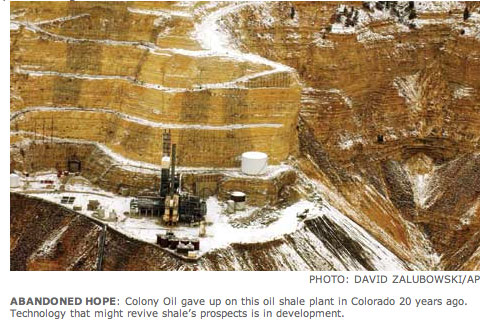
colonyoilshaleproject.jpg

From The Grand Junction Daily Sentinel (Gary Harmon):

Whitney spoke during a congressional oversight field hearing conducted by two Colorado representatives, Scott Tipton and Doug Lamborn, both Republicans serving on the House Natural Resources subcommittee on energy and mineral resources…

The new study is holding back applications for three new leases, limiting the kind of innovation and variety of experimentation that will make oil shale a commercial resource, Whitney said…

Another witness, former Grand Junction Mayor Jim Spehar, called on the committee to support the establishment of an oil shale trust fund or similar mechanism to help communities prepare for and deal with the effects of growth if an oil shale industry is to take shape. A relatively small, 500,000-barrel-per-day oil shale industry could add 50,000 new people to northwest Colorado, Spehar said. “That’s why I’m concerned about getting a head start” on development if and when oil shale development does take place, he said. “Current taxpayers shouldn’t have to pay for it.”[…]

Anu K. Mittal of the Government Accountability Office said a study of the potential use of water over the life of an oil shale project can range from one to 12 barrels of water per barrel of the equivalent of oil for an in-situ project, to two to four barrels for an above-ground, retort project. Another analysis offered by the University of Utah’s Institute for Clean and Secure Energy, suggested an average water consumption rate of 2.5 barrels for each barrel of oil from shale, according to Jennifer Spinti, research associate professor at the university.

More oil shale coverage here and here.

Energy policy — oil shale: Congressmen Scott Tipton and Doug Lamborn hold a Committee on Natural Resources subcommittee field hearing in Grand Junction

oilshaledepositsutwyco.jpg

From the Grand Junction Free Press (Sharon Sullivan):

At Wednesday hearing in Grand Junction, Congressmen Scott Tipton (R-CO) and Doug Lamborn (R-CO) repeatedly criticized the Obama administration, claiming the administration is hindering the domestic development of oil shale…

The few non-industry witnesses allowed to testify at the hearing mentioned other factors hampering oil shale development: Technological challenges, low oil prices discouraging investment, and concerns about environmental impacts…

“Oil shale has relatively low energy content and companies have yet to demonstrate net gains in energy production. In essence, commercial oil shale production could use more energy than it would produce,” Frank Smith, of Western Colorado Congress, said.

[Anu Mittal director of Natural Resources and Environment Division at the U.S. Government Accountability Office presented a] report [that] focused on impacts of potential oil shale development on water resources. “Oil shale will require large amounts of water — a resource that is already in scarce supply in the arid West where an expanding population is placing additional demands on water,” Mittal said.

Some analysts project that large scale oil shale development in Colorado would divert water away from agricultural and urban development. Companies have acquired significant water rights within the Colorado and White River Basins of Colorado, and may apply for additional water rights in the future.

Another panelist attending the hearing, Jennifer Spinti, a research associate professor at the University of Utah’s Department of Chemical Engineering and Institute for Clean and Secure Energy, mentioned that the public also needs to be aware of “ancillary water use” of oil shale development. Construction and operation of a nearby power plant to provide energy for an oil shale project would consume significant amounts of water, as well as would water needed to control dust, she said. Potential water contamination is also a concern, Spinti said…

Tipton questioned Helen Hankins, Colorado State Director of the BLM, about the need for another PEIS.

Hankins replied: “The industry is in its infancy. Water, sage grouse, and plants are potentially threatened. There was litigation in 2009 challenging the PEIS — that’s why the (Interior) Secretary is taking a fresh look. It does not affect the six existing (research and development) leases.”

Tipton repeated “regulatory uncertainty is a factor in delaying oil shale research.”

Hankins responded again that a new PEIS will not affect companies’ research and development on private lands, or on the existing leases. “We’re yet many years away from environmental approval and commercially viable oil shale development,” Hankins said. “It gives us time to review the rules.”[…]

“Energy development is one of the key priorities of Secretary Salazar,” Hankins said. “Oil shale is one component of energy development. When it is commercially viable, and environmentally proven, it will be a source.

“However, the BLM’s mission is ‘multiple use.’ Land use plans consider a variety of factors — watershed health, wildlife habitat, as well as energy.”

More coverage from Meghan Gordon writing for Platts. From the article:

Representatives Doug Lamborn and Scott Tipton, both Colorado Republicans, criticized the Department of Interior’s February decision to take a new look at a November 2008 federal rule for commercial development of oil shale. At a field hearing of the House Energy and Minerals Resources Subcommittee in Grand Junction, Colorado, the pair couched the oil shale policy in the same terms House Republicans have approached other energy issues this session, saying federal regulations should not stand in the way of industry creating jobs, reducing oil imports and increasing national security…

“The road to viability for the oil shale industry is reliant on a predictable regulatory structure and an environment in which companies can invest in research and development and create jobs,” Tipton said. “The proper implementation of our environmental and safety regulations already on the books is a far better strategy than adding additional layers of bureaucracy to the process.”[…]

Dan Whitney, Shell’s upstream manager for heavy oil development in the Americas, said the producer understands the importance of water to western states and is committed to using it responsibly. He said the company would address the issue by maintaining a diversity of water rights to give operations the flexibility of multiple sources, developing extraction and processing technologies that need less water and to honing water-management practices such as recycling and storage.

Shell holds three “research, development and demonstration” leases for oil shale development in Colorado.

More coverage from the Associated Press (Catharine Tsai) via The Denver Post. From the article:

Dan Whitney of Shell Exploration and Production Co. said his industry needs a stable regulatory environment and one in which numerous companies can lease public land for research projects.

Researchers noted their need for funding and suggested a specific program focused on Western oil shale.

And Anu Mittal of the GAO said the U.S. Interior Department should be responsible for gathering data on water conditions now, so any potential effects of oil-shale activity can be detected years in the future. Her agency in October had recommended collecting baseline data.

They were among 10 speakers at the Grand Junction field hearing of the House Energy and Mineral Resources Subcommittee. Rep. Scott Tipton and subcommittee chairman Doug Lamborn, both Colorado Republicans, conducted the hearing.

More oil shale coverage here and here.

The DeBeque phacelia and the Parachute penstemon both will be protected under the Endangered Species Act

debequephaceliacenterfornativeecosystems.jpgpagosaskyrocketsteveokanecenterfornativeecosystems.jpg

parachutepenstemonsteveokanecenterfornativeecosystems.jpg

Here’s the release from the Center for Native Ecosystems (Josh Pollock):

Today the U.S. Fish and Wildlife Service announced that two Colorado wildflowers found only on and around the Roan Plateau and South Shale Ridge area are now protected as Threatened species under the Endangered Species Act and have been proposed for critical habitat protections that will be finalized next year. The federal agency identified the primary threat to both species as current and proposed oil and natural gas drilling operations on public lands.

Parachute penstemon, which occurs in only 6 populations on or near the base of the Roan Plateau, and DeBeque phacelia, which is found only in the vicinity of the growing town of DeBeque and South Shale Ridge, were both found by the Fish and Wildlife Service to be at risk of extinction from a variety of threats associated with oil and gas development including new roads pipelines as well as off-road dirt bike and ATV riding.

“Endangered Species Act protection for these two rare and unique wildflowers will help us balance our need for domestic energy production with preserving our natural heritage,’ said Josh Pollock, Conservation Director at Rocky Mountain Wild. “When we work to keep the parts of the natural world that we cannot, including these plants specially adapted to the rugged beauty of Colorado’s West Slope, we leave a legacy for our children that we can be proud of.”

The announcement of protections for these two species is part of a trio of Endangered Species Act listings for wildflowers in Colorado. As part of the same final listing rule, the Fish and Wildlife Service also designated the Pagosa skyrocket as endangered. The Pagosa Skyrocket occurs in only 2 populations near the town of Pagosa Springs and is highly vulnerable to disturbance from residential and commercial development on the private lands where it is primarily found.

“Today three unique facets of Colorado’s stunning and diverse mountain and canyon country got the protection they so desperately needed,” said Pollock. “All three of these listings are necessary and sensible, given how vulnerable each one of these wildflowers is to the ways that we are using and converting the open lands around us here in the West.”

In a separate announcement in the Federal Register, the Fish and Wildlife Service also proposed critical habitat designation for all three species. The proposed habitat designation includes over 19,000 acres for Parachute penstemon and almost 25,000 acres for the more widely distributed DeBeque phacelia. In the case of Parachute penstemon, the proposed designation acknowledged that the current populations alone would be insufficient to ensure the long-term survival and recovery of the species and therefore included a strip of potential recovery habitat at the north end of the Roan Plateau. The Service determined that this area has the same habitat characteristics as the occupied habitat, including exposed slopes of oil shale. For all three species, the Fish and Wildlife Service also took into account the possible effects of climate change on such plants that are so narrowly dependent on particular soil types and expanded their proposed boundaries for the proposed habitat units beyond the edges of the current populations. The agency also identified these buffers around the currently occupied habitat as necessary to protect the base of pollinators—primarily ground nesting bees and wasps—upon which both species depend.

“The critical habitat proposal that comes along with today’s listing is a model of how the Fish and Wildlife Service should consider habitat protections for rare plants with limited ranges in the face of climate change and continued oil and gas drilling on public land,” said Pollock. “The agency appropriately limited their proposal to places that are not already developed, concentrated on federal public lands, and took into account the need for additional habitat for recovery. While we can’t know everything climate change will do to an individual species, we must begin to acknowledge that it will change habitat for many at-risk species and do what we can to protect additional places with that in mind.”

Both species have been official candidates for Endangered Species Act protection for at least twenty years. In the case of DeBeque phacelia, the Colorado species has been on the official waiting list for 31 years. Center for Native Ecosystems (which has now merged to form Rocky Mountain Wild), the Colorado Native Plant Society, and Dr. Steve O’Kane petitioned to move the two species off the candidate list and finalize their protection under the ESA in 2004 and 2005.

“To say that these protections are overdue would be an extreme understatement,” said Pollock, “but the most important thing is that they are in place now. We hope it is in time to secure a future for these three parts of our web of life in Western Colorado along with the dozens of other rare species that carve out a life in the same difficult habitat.”

There will be a 60 day period for public comment on the proposed critical habitat designation for all three species.

Parachute Penstemon

Parachute penstemon, also known as Parachute beardtongue, is a beautiful perennial with lavender-and-white, funnel-shaped flowers. It occurs in only six populations on and around the Roan Plateau. Only three of those populations are considered large enough to be stable, but two of them are on land owned by Occidental Petroleum. Two of the remaining populations are on top of the Roan Plateau in locations recently leased for oil and gas development. Conservation organizations are challenging the leasing on top of the Roan Plateau in court.

Center for Native Ecosystems, the Colorado Native Plant Society, and Dr. Steve O’Kane (one of the botanists who discovered the species in the 1980s) petitioned in 2004 for the parachute penstemon to be moved from the Fish and Wildlife Service’s candidate list and given the protection under the Act it deserved.

A high resolution photograph of Parachute penstemon is available for download (with credit to Steve O’Kane) at http://nativeecosystems.org/wp-content/uploads/Parachute-penstemon_Steve-OKane.jpg

DeBeque Phacelia

DeBeque phacelia is also found near the Roan Plateau. It occurs only on slopes of clay soil around the growing town of DeBeque, west of Rifle, Colorado. All DeBeque phacelia habitat is found within the larger Piceance Basin region that is Colorado’s third largest natural gas producing area, according the Colorado Oil and Gas Conservation Commission. More than ¾ of all DeBeque phacelia habitat had been leased for oil and gas drilling.

DeBeque phacelia is a low-growing annual plant with small yellowish flowers. It relies on a bank of seeds within the soil to continue coming up year after year, and therefore disturbance of the slopes where it is found or even the soil below such slopes can destroy its seeds. The Fish and Wildlife Service found that threats to the wildflower’s seed bank and habitat included natural gas exploration and pipelines, expansion of roads and other oil and gas facilities, and even proposed reservoir projects that would be used to support oil shale development experiments in the area north of DeBeque.

Center for Native Ecosystems, the Colorado Native Plant Society, and Dr. Steve O’Kane petitioned in 2005 for DeBeque phacelia to be moved from the Fish and Wildlife Service’s candidate list and given the protection under the Act it deserved.

A high resolution photograph of DeBeque phacelia is available for download (with credit to Rocky Mountain Wild) at http://nativeecosystems.org/wp-content/uploads/phacelia.jpg

From the Summit County Citizens Voice (Bob Berwyn):

The U.S. Fish and Wildlife Service announced July 27 that the DeBeque phacelia and the Parachute penstemon both will be protected and proposed for critical habitat designations based on threats from current and proposed oil and natural gas drilling operations on public lands…

Parachute penstemon grows in only 6 populations on or near the base of the Roan Plateau, and DeBeque phacelia is found only in the vicinity of the growing town of DeBeque and South Shale Ridge. The proposed habitat designation includes more than 19,000 acres for Parachute penstemon and almost 25,000 acres for the more widely distributed DeBeque phacelia.

In the case of Parachute penstemon, the proposed designation acknowledged that the current populations alone would be insufficient to ensure the long-term survival and recovery of the species and therefore included a strip of potential recovery habitat at the north end of the Roan Plateau. The Service determined that this area has the same habitat characteristics as the occupied habitat, including exposed slopes of oil shale…

As part of the same final listing rule, the Fish and Wildlife Service also designated the Pagosa skyrocket as endangered. The Pagosa Skyrocket occurs in only 2 populations near the town of Pagosa Springs and is highly vulnerable to disturbance from residential and commercial development on the private lands where it is primarily found.

More endangered/threatened species coverage here.

Yampa River Flow Survey closes April 6

A picture named yampariverbasin.jpg

Here’s the post from American Whitewater. From the article:

To take the survey, CLICK HERE.

We have developed this survey so individuals can help American Whitewater represent recreational interests in deciding what the future of the Yampa and White Rivers will look like. Our goal is to utilize information from the survey to help us quantify flow preferences for whitewater boating, which will identify the range of flows necessary to provide whitewater recreation experiences, from technical low water to challenging high water trips. The information will provide us with the data necessary to describe flow-dependant recreation experiences and to protect and manage flows for river-based recreational opportunities.

American Whitewater is working to identify the range of flows that support the full range of boating opportunities for the main stem and tributaries of the Yampa and White Rivers. As part of our Yampa River Project, we are working with the Colorado Water Conservation Board and the Yampa-White roundtable to identify and define flows needed for whitewater boating throughout the basin. Results of our assessment will inform future negotiations over water supply planning, and resouce management actions.

More Yampa River basin coverage here. More White River basin coverage here.

The Colorado Basin Roundtable and the Yampa/White Basin Roundtable release energy consumptive use assessment

A picture named yampariverbasin.jpg

Here’s the report, Energy Development Water Needs Assessment, from the Colorado River District website. From the introduction:

The Joint Energy Development Water Needs Committee reported that total demands can be seen in Table 13 of the Final Scenarios report. Maximum water demands are about 120,000 acre-feet per year, a substantial decrease from the 400,000 acre-feet per year in the Phase I study. The reduction stems from 3 primary factors:

1. It was assumed a portion of an in-situ oil shale industry would use some form of down-hole combustion process instead of electrical heaters, which results in reduced electrical generation requirements. We know that from Phase I, water for electrical generation for oil shale actually exceeded the water directly needed for oil shale production.

2. It was assumed combined cycle natural gas fired turbines would be used for electrical generation. These require approximately a third less water. If coal-fired generation was used to meet electrical demand, we believe the generating capacity would occur out of the basin.

3. With extensive input from industry, the committee fine-tuned the unit water demands for oil shale. It believes these revisions are a more realistic estimate of how water might be used in oil shale production. For example, the unit demand estimates reflect information from industry that the in-situ conversion process results in the molecular production of water from the organic compounds in the oil shale.

More Colorado River Basin coverage here. More Yampa River basin coverage here. More White River basin coverage here.

Flaming Gorge pipeline update

A picture named flaminggorgepipelinemillion.jpg

From the Fort Collins Coloradoan (Bobby Magill):

The U.S. Army Corps of Engineers, the chief federal agency in charge of reviewing and approving the project, plans to issue a draft environmental impact statement on the project in 2016, with a final version and possible approval to follow in 2018.

Whether Million’s pipeline could actually produce as much hydropower as Million suggests and whether the energy needed to pump the water over the Continental Divide will cancel out the benefits of producing hydropower are two of a host of unknowns about the project that the public won’t be able to learn until the environmental review is released in five years, said Stacy Tellinghuisen, an energy and water policy analyst for Boulder-based Western Resource Advocates, a critic of the project…

Barry Wirth, spokesman for the Utah office of the Bureau of Reclamation, which oversees Flaming Gorge, said it’s unclear how the pipeline would affect hydropower at Flaming Gorge, and he did not know if the bureau had studied the matter.

More Flaming Gorge pipeline coverage here and here.

The Colorado River District is kicking off a grant program for water resources projects

A picture named coloradorivergjwik.jpg

From email from the Colorado River Water Conservation District (Martha Moore):

The Colorado River District is accepting grant applications for projects that protect, enhance or develop water resources within the 15-county area covered by the District. This includes all watersheds in north- and central- western Colorado, except the San Juan River basin.

Eligible projects must achieve one or more of the following:

– develop a new water supply

– improve an existing system

– improve instream water quality

– increase water use efficiency

– reduce sediment loading

– implement watershed management actions

– control tamarisk

– protect pre-1922 Colorado River Compact water rights

Past projects have included the construction of new water storage, the enlargement of existing water storage or diversion facilities, rehabilitation of non-functioning or restricted water resource structures and implementation of water efficiency measures and other watershed improvements. Such projects that utilize pre-1922 water rights will be given additional ranking priority over similar projects that do not. Each project will be ranked based upon its own merits in accordance with published ranking criteria.

Eligible applicants can receive up to a maximum of $150,000 ((or approximately 25% of the total project cost whichever is less, in the case of smaller projects this percentage may be slightly higher) for their project. The total grant pool for 2011 is $250,000. Application deadline is Jan. 31, 2011.

More Colorado River basin coverage here.

Flaming Gorge pipeline: Opposition to the transmountain diversion project grows

Say hello to the temporary home for OurDamWater.org. They’re online to spread the word against the Million Resources Group’s plans to build a pipeline from the Green River in Southwest Wyoming to Colorado’s Front Range and points south. Thanks to CBS4Denver.com for the link.

More Flaming Gorge pipeline coverage here and here.

Yampa River and White River basins: Colorado Trout Unlimited hires a new project coordinator

A picture named yamparivereofmaybell.jpg

Here’s the release from Colorado Trout Unlimited (Randy Scholfield):

Trout Unlimited’s Colorado Water Project today announced the hiring of Brian Hodge as project coordinator for the Yampa and White River basins in northwest Colorado. Hodge will be located in Steamboat Springs.
Hodge will plan and implement habitat improvement projects on key stream reaches in the Yampa and White river basins, with the goal of protecting, reconnecting and restoring trout populations, particularly native Colorado River cutthroat trout. Among other duties, he will work closely with water users, private land owners and agency staff to identify opportunities to improve streams and implement cooperative agreements with irrigators that benefit agricultural operations and fish habitat simultaneously.

Prior to joining TU, Hodge worked as a research assistant with the California Cooperative Fish and Wildlife Research Unit, leading a multi-year fishery resource study of steelhead/rainbow trout in the lower Klamath River basin. He has also served as the fisheries crew leader for the Carson Ranger District, where he evaluated aquatic habitat and fish passage potential on approximately 150 miles of stream. In his work, he has worked extensively with private landowners and irrigators to create positive working relationships.

“We are pleased to have Brian Hodge’s skills and experience on the ground in the Yampa basin,” said Drew Peternell, director of TU’s Colorado Water Project, which works to improve stream flows and coldwater fisheries in the state. “Brian is a gifted biologist and pragmatic problem-solver who has a strong commitment to finding water solutions that benefit both private landowners and fisheries.”

The Yampa and White Rivers are among the last largely undammed river systems in Colorado, but many of their tributaries are fragmented by diversion dams and other barriers and disconnected from the mainstem rivers. Trout Unlimited, a grassroots sportsmen’s conservation organization, is expanding its trout restoration work in several river basins within Colorado, including the Yampa and White River basins and the Upper Colorado River basin.

Moreover, Northwest Colorado is one of the few fishing destinations in the state that does not have a local TU chapter. Hodge will assist efforts to establish a new chapter in Steamboat Springs and hopes to involve the new chapter in river conservation projects.

Asked about his new position, Hodge stated, “I look forward to working with local partners to protect and enhance the fishery resources of the Yampa and White Rivers.”

More Yampa River basin coverage here. More White River basin coverage here.

2010 Colorado elections: The Denver Post endorses John Salazar over Scott Tipton

A picture named coloradocongressionaldistrictboundaries2010

From the editorial staff at The Denver Post:

Salazar has shown an ability to work with people from differing political views to seek solutions that work for the district. In significantly advancing the prospects for a veterans’ cemetery in the Pikes Peak region, Salazar, an Army veteran, has worked with Republican Rep. Doug Lamborn and former Sen. Wayne Allard, and more recently with Democratic Sen. Michael Bennet. He also managed to get a $6 million appropriation for the Arkansas Valley Conduit, which will bring clean drinking water to 40 cities and towns along the 140-mile pipeline. The promise of clean drinking water to these poorer communities was made in the 1960s. It’s about time that promise is kept.

Salazar’s challenger in the race, Scott Tipton, is a conservative Republican and Cortez businessman who lost to Salazar by a wide margin in 2006. Tipton, a state lawmaker who also has deep roots in the district, is knowledgeable about the issues, and touts his private sector experience. He’s clearly qualified for the job.

We just think voters in the 3rd district will be better off with Salazar, a known quantity and reliable voice for the district.

More 2010 Colorado elections coverage here.

Northwest Colorado Water Forum September 24

A picture named yampariverbasin.jpg

From Steamboat Today (Tom Ross):

The [Yampa/White River roundtable] recommended funding a $220,800 water storage feasibility study in the Yellow Jacket District south of Craig, and the Colorado Water Conservation Board approved it in January. The study is under way, and project consultant Mike Apple gate is among six speakers slated for the forum. Applegate said Wednesday the Yellow Jacket Board, which oversees a district primarily in Rio Blanco County, but including small portions of Moffat and Garfield counties, is a long way from building a water storage facility…

The board of the Yellow Jacket Water Conservation District made it plain in a September 2008 filing in Water Court that it seeks to ensure adequate water supplies for agriculture, but it’s also determined to create adequate supply for a growing oil shale industry in the region. Applegate said the goal of protecting agricultural water is sincere. “If you don’t figure out in advance how to supply water for (energy development), the result can be a ‘buy and dry agriculture’” approach to securing water for energy, he said. In their 2008 filing, the Yellow Jacket Board members anticipated building Thornburgh Reservoir and filling it with conditional water rights from nearby creeks via pipelines. West Milk Creek Canal, for example, is estimated to be able to supply 90 cubic feet per second of water. Axial Creek Canal could be counted on to supply as much as 315 cfs during its peak, the court filing anticipated. Applegate said the system of creeks and canals feeding an offline reservoir (built in a ravine without live water of its own), is just one possibility that will be looked at in the feasibility study.

More IBCC — basin roundtables coverage here.

Energy policy — oil shale: Garfield County Commissioners to get briefing on water requirements for oil shale production September 7

A picture named shelloilshaleprocess3

From the Glenwood Springs Post Independent (John Colson):

Energy industry liaison Judy Jordan is on tap give the Board of County Commissioners an update on the latest estimates about how much water may be needed to extract the estimated 1.2 trillion barrels of “oil” trapped in subterranean rock strata in the Piceance Basin, which is bisected by the Colorado River as it passes through Garfield County…

Jordan told the Post Independent on Friday that she will be basing most of her comments on a recent study by the Colorado River Water Conservation District in Glenwood Springs. That report, according to CRWCD Deputy General Manager Dan Birch, estimated that extracting the shale oil might take as much as 120,000 acre-feet of water per year, which he said translates to roughly one or two barrels of water used for each barrel of oil produced. That is considerably less than the 400,000 acre-feet of water per year estimated in a 2008 study by the URS consulting firm, which translated to roughly 3 to 5 barrels of water consumed for every barrel of oil produced.

But, said Birch, even at the lowered estimate, the oil shale industry would use up to approximately 20 percent of all the Colorado River water now being used by agriculture, municipalities and other users around the Western Slope…

Among the reasons for the reduced estimates of water use, according to the study, is, in part, because earlier estimates were based on the amount of electricity needed to power the “in-situ” process being studied by Royal Dutch Shell. That process would involve using massive amounts of energy to heat up the shale rock in place and draining out the liquid kerogen.

More oil shale coverage here.

Energy policy — oil shale: American Oil Shale is building a processing plant to test their technology

A picture named colonyoilshaleproject.jpg

Oil shale has been the “Next Big Thing” in Colorado for over a 100 years. 2011 could be the year that a company proves to itself and the world that the resource can be produced economically in an environmentally sound way. Here’s a short report from Bloomberg Business Week. From the article:

One of three companies with federal leases to research and develop oil shale in Colorado said it plans to start testing its technology early next year. American Shale Oil said it’s building a processing facility west of Rifle in western Colorado. The company expects to employ about two dozen people during the research phase.

More oil shale coverage here and here.

Steamboat Springs: Community Agriculture Alliance in partnership with the Yampa-White-Green River Basins Round Table and the Colorado Water Conservation Board are hosting a series of water forums

A picture named yampariverbasin.jpg

From Steamboat Today (Marsha Daughenbaugh):

The first forum is titled “Water 101” and will be held from 1 to 5 p.m. March 12 in Library Hall at Bud Werner Memorial Library in Steamboat Springs. The format is designed to help familiarize us with water issues. Tom Gray, chairman of the Yampa-White-Green Round Table will clarify the purpose and history of the Round Table. Don Ament, former Colorado Commissioner of Agriculture, will explain definitions and terms most often used in water discussions and give details regarding Colorado’s compact obligations to other states. Nicole Seltzer, executive director of the Colorado Foundation for Water Education, will present the winter 2010 edition of Headwaters Magazine, titled No Longer a Valley Too Far, and dedicated entirely to Northwest Colorado and our water users. Mike Sullivan, deputy director of the Colorado Department of Water Resources, will discuss Colorado’s water management water plans, augmentation, abandonment and the impacts of local hydrology and weather conditions on our abilities to fulfill our obligations. Lois Witte, senior counsel with the United States Forest Service, will explain USFS regulations and protection strategies that safeguard quantity and quality as water meanders through federally owned property. She also will address the potential impacts that the bark beetle infestation could have.

The second forum will be a tour on July 21 from Steamboat Springs to Craig for onsite visits to view the water uses in the Yampa Valley. The third forum will be Sept. 24 in Craig to discuss regional and state issues and projects. The final forum will be Nov. 5 in Hayden to learn about the Round Table studies and local projects.

If you pre-register and pre-pay, the cost is $15 per person or $50 for all four forums. If you register at the door, the cost is $20 per forum. College and high school students can attend for $5 per forum.

Sponsorship opportunities still are available for individuals and businesses.

To obtain more information or to register, call the Community Agriculture Alliance Office at 879-4370.

More Yampa River Basin coverage here and here.

Colorado River District and the Northwest Council of Governments kick off program to educate Front Range residents about their impact on western slope streamflow

A picture named coloradotransmountaindiversions.jpg

From the Summit Daily News (Julie Sutor):

“It’s the same water. Conserve it!” the billboard reads, across images of lawn sprinklers, a snowy mountain and a woman taking a shower. The billboard is the first tactic in a new campaign by local governments in northwest Colorado to remind Front Range water users of their impacts to the state’s western rivers…

The new campaign, a collaborative effort by the Colorado River Water Conservation District and the Northwest Colorado Council of Governments, hopes to make the connection for folks. More billboards and signs at bus stops will pop up throughout the Denver-metro area in coming months. All the promotional efforts will direct people to a website, www.itsthesamewater.com, or a smartphone page where they can learn about where water comes from, the impacts of diversions and how to conserve.

More transmountain/transbasin diversions coverage here.

Colorado Water Congress 52nd Annual Convention: Eric Wilkinson — ‘I guess one word strikes me, storage’

A picture named coloradoriverbasin.jpg

Here’s a recap of the session, from Chris Woodka writing for The Pueblo Chieftain. From the article:

“Averages are not a real tool for development,” [Eric Wilkinson, director of the Northern Colorado Water Conservancy District] said. “These numbers need to be used for planning purposes and for compact compliance discussions. I guess one word strikes me: storage.”

Wilkinson, whose northern district is trying to get approval for building two new reservoirs and firming yield from current import diversions, explained that storage is the best way for Colorado to balance the unknowns of nature. Water users need to be ready for both wet and dry scenarios, Wilkinson said. “If there’s nothing left (of the compact entitlement), a curtailment would hurt us,” he said. “If there’s water to be developed, we’ll push to get water development.”

If enough water is stored in wet years, it is easier to make it through the droughts, he said. “We need to have our eyes wide open,” Wilkinson added. “Colorado owes it to itself to explore all opportunities to use the Colorado River, but we don’t want to get ourselves into a hole.”[…]

The CWCB this week also agreed to enter into a basinwide study with the other six states in the Colorado River Compact (Arizona, California, Nevada, New Mexico, Utah and Wyoming). That study will use the information Colorado has spent the past two years gathering. At the same time, the state will be applying parts of the study to its other water planning efforts from decision support models to floodplain mapping. The study itself will enter another phase that will look at the potential for changing uses or climate conditions, Gimbel said. “We will get more information as we are planning for the future,” Gimbel said. “We also need to look at storage strategically and use it for our advantage.”

More coverage of the availability study from Chris Woodka writing for The Pueblo Chieftain. From the article:

The Colorado Water Conservation Board Tuesday reviewed Phase I of Colorado River Availability study, and learned there are more questions than answers when it comes to things like climate change, future demand and changed uses of water. The report will be released for public review in February. “The Colorado River is one of the most important sources of water supply for the state,” said Jennifer Gimbel, executive director of the CWCB. “Colorado needs solid information in order to make smart decisions about future water development.”

The assessment, funded by $1 million from the state Legislature in 2007, is the most comprehensive to date on Colorado River supplies. It will be used within nearly every other water planning effort in Colorado. “This study rolls into every hallway at the CWCB,” Gimbel said…

All models show the Colorado River basin will be warmer, with more precipitation in winter and less in summer. Growing seasons will be longer, and runoff earlier, meaning a net gain in agricultural water use and more draw-down on reservoirs, said Ben Harding, a CWCB engineering consultant. “One dry year is not going to do us in. We got through 1977 and 2002,” Harding said. “The sequence of years is important.”[…]

The models are drawn from both historical data from 1950-2005 and extrapolations using tree rings to look at conditions back to 1500. Looking ahead, engineers selected five models out of more than 100 available data sets to project what would happen in 2040 and 2070. Some of the models actually show increases in water availability, but all anticipate that increased demand by agriculture — which uses 85 percent of water — would soak up any gain. The 500-year trend surprisingly indicates that the past 50 years were wetter than average, because of unusual clusters of wet years in the 1980s and 1990s. There were also greater extremes in the types of wet and dry years. Models for the future shuffled both types of years to forecast various scenarios. The difference between 2040 and 2070 would not be as great as originally thought, Harding explained…

It is also unclear whether the assessment opens or closes any doors for transmountain water increases, either through existing projects or new proposals. Nearly 500,000 acre-feet annually comes across the Continental Divide to serve needs in the Arkansas and South Platte river basins. Cities are looking for future supplies. At the same time, water is used on the Western Slope to serve the needs of endangered species, and more could be needed for growth and energy development. “It’s a good first step,” said Eric Kuhn, executive director of the Colorado River Conservation District. “It’s pretty clear that there is probably a limit to what we can do. From the river district’s perspective, our approach will be wait and see.”

More Colorado River Basin coverage here.

Trappers Lake: Cull the brookies — supply a Meeker food bank

A picture named trapperslake.jpg

From the Boulder Daily Camera (Jeff Milton):

To avoid the extirpation of Colorado River cutthroat from Trappers Lake, CDOW biologists decided to manage the trout by selectively trapping fish and removing brookies. The Fyke nets used resemble a gigantic minnow trap with a net curtain extending 50 feet from the mouth of the trap to shore. When a fish encounters the curtain it turns toward deeper water to get around the obstruction. Swimming along the wall of netting, the fish passes through a series of funnels culminating in a confined space with netting on all sides. Biologists empty the trap nets and remove brookies while returning cutthroat to the lake. Culled adult brook trout are cleaned, packed in ice, and taken to the food bank in Meeker.

By setting traps and leaving them overnight for a half dozen nights each fall, biologists have cut the percentage of brook trout in the population in half. The cutthroat are safe as long as the management program continues. Regrettably, there is no realistic prospect of eradicating the brookies.

More White River Basin coverage here here.

Energy policy — oil shale: Environmental effects catalogued

A picture named colonyoilshaleproject.jpg

Here’s a recap on Thursday night’s meeting of the Garfield County Energy Advisory Board, from Dennis Webb writing for the Grand Junction Daily Sentinel. From the article:

…the level of disturbance where any development might take place would be significant, said Jeremy Boak, director of the industry-funded Center for Oil Shale Technology and Research at the Colorado School of Mines. Boak said oil shale development would have less of a region-wide impact on the land than has been seen with local natural gas development. That’s thanks to the world-class richness and unmatched density of the region’s oil shale resource, which has underground concentrations of as much as a million barrels of oil per acre, he said. But where any oil shale development might occur, “you will for a time essentially have scraped off the surface if you’re doing a process like Shell’s,” Boak said…

Boak said the biggest environmental challenge for shale development is water — how much is used and how quality is affected.

More coverage from the Glenwood Springs Post Independent (John Colson). From the article:

He [Jeremy Boak, head of the Center for Oil Shale Technology and Research at the School of Mines] said one company, Red Leaf Resources in Utah, had recently completed tests on a shale-oil extraction process that involved heating up the rock in place, underground, and piping out the kerogen…

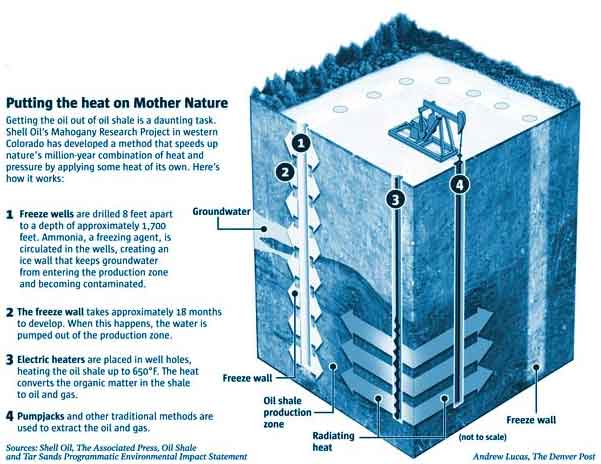
He noted that Shell, which is one of the corporate sponsors of his institute, is working on a process involving the stripping away of the surface, followed by the drilling of numerous bore holes to be used to heat the “extraction zone” to a temperature of some 700 degrees Fahrenheit. Other bores are drilled around the extraction zone, to be used to freeze the area around the zone to prevent the oil and other contaminants from flowing into nearby ground water. Once the oil has been extracted, he said, the process calls for the injection of water into the bore-holes that turns to steam and scours out the area once permeated by the kerogen. That water is then to be treated and recycled, he said…

“But it will be pretty disruptive of the surface,” he said of that technology, which would involve in-situ plants that would move from one zone to another, scraping topsoil and drilling holes. He said reclamation would be easily accomplished using the same topsoil that had been removed prior to the process. Boak indicated that some of the new technological processes are said to consume relatively little water, but conceded that studies are needed to determine how much water is available for such uses, and what might be the effects of oil shale extraction on area water supplies and water quality. In addition, he said, there are potential impacts to the general ecology of the area that must be identified, as well as the socio-economic effects on the region’s communities.

More oil shale coverage here and here.

USGS: Piceance Basin water quality map now online

Here’s a release from the United States Geological Survey:

The U.S. Geological Survey today launched a website that provides water quality data for the Piceance Basin area of Western Colorado.

The site, created and administered by the USGS, was developed to better address concerns about water quality in the Basin. It consists of a common data repository with the most comprehensive collection of water-quality sampling information available in a single location (visit the Piceance Watershed Water-Quality Data Repository site).

“The purpose of the website is to provide all stakeholders with equal access to this important information,” said USGS hydrologist Judith Thomas. “A database such as this is an important tool in understanding changes in water quality over time.”

The need for the repository was identified by energy producers and local governments to address concerns regarding potential changes to surface and ground-water resources as large-scale energy development occurs in the area.

“There is a tremendous amount of water sampling data out there—from government entities, water districts and energy companies, said Sam Potter, president of the West Divide Water Conservancy District. “Until now, however, it hasn’t been aggregated and presented in a format that is easily accessible to the public. This repository is a boon for anyone with an interest in understanding water quality in this region—landowners, energy companies, regulators, and public officials.”

The website is the result of a collaborative data-sharing and water resource assessment process that included local citizens, industry, government agencies, and conservancy districts. A baseline water-quality assessment will be published by the USGS as a result of the compilation of this database.

The database will also identify data gaps and redundancies in water quality information. This information can be used to understand current conditions and inform future monitoring in the Piceance Basin area.

The $1.3 million dollar project is funded through contributions from federal, state and local governments, water conservancy districts, and energy companies, and is matched by grants from the Colorado Department of Local Affairs (DOLA).

Project collaborators included: the USGS, the Bureau of Land Management, West Divide Water Conservancy District, the Colorado Oil and Gas Conservation Commission, the Colorado River Water Conservation District, Garfield, Delta, and Rio Blanco counties, the cities of Rifle and Grand Junction, the towns of De Beque, Palisade, Parachute, Carbondale, Silt, and Rangely; EnCana Oil & Gas (USA) Inc., Natural Soda, Oxy (Occidental Petroleum Corporation), Chevron, Petroleum Development Corporation (PDC), Shell Oil Company, Williams Production, and Marathon Oil.

More Coyote Gulch groundwater coverage here.