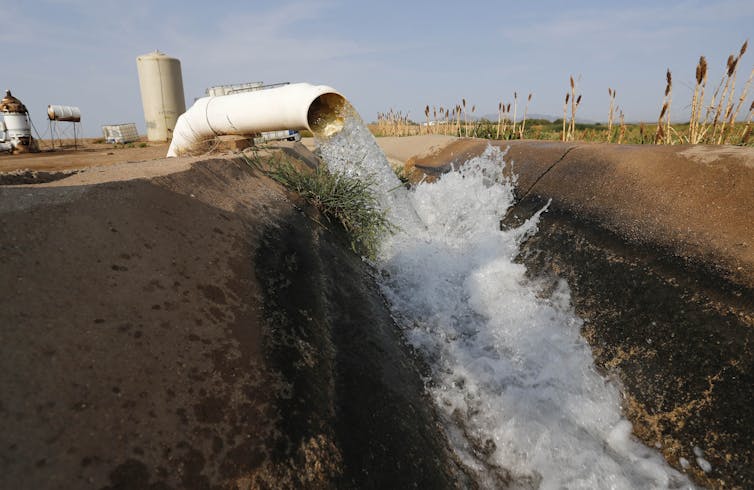
The U.S. government announced its first-ever water shortage declaration for the Colorado River on Aug. 16, 2021, triggering future cuts in the amount of water states will be allowed to draw from the river. The Tier 1 shortage declaration followed the U.S. Bureau of Reclamation’s forecast that the water in Lake Mead – the largest reservoir in the U.S., located on the Arizona-Nevada border – will drop below an elevation of 1,075 feet above sea level, leaving less than 40% of its capacity, by the end of 2021.
The declaration means that in January 2022 the agency will reduce water deliveries to the Lower Colorado River Basin states of Arizona and Nevada and to Mexico, but not to California – yet.
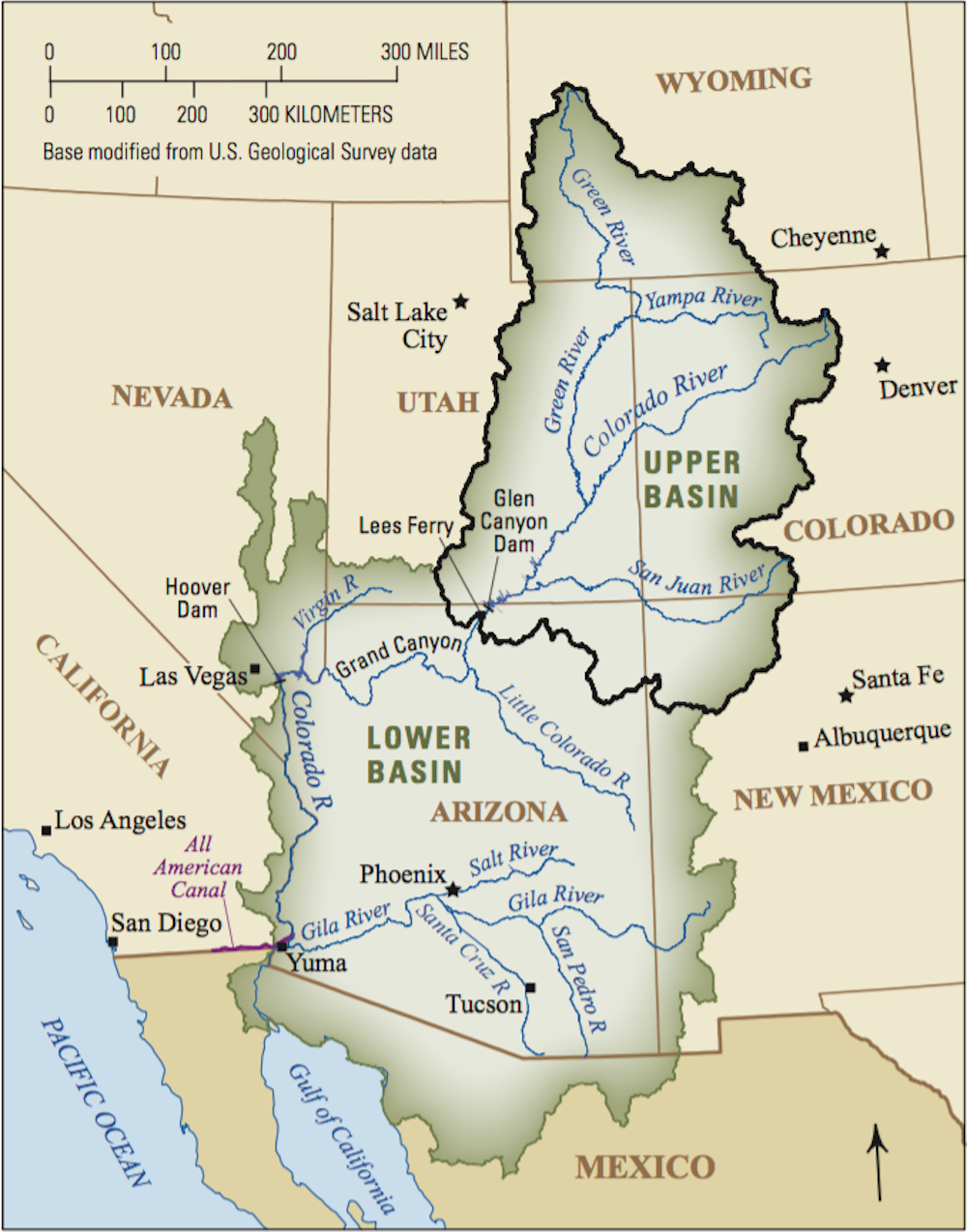
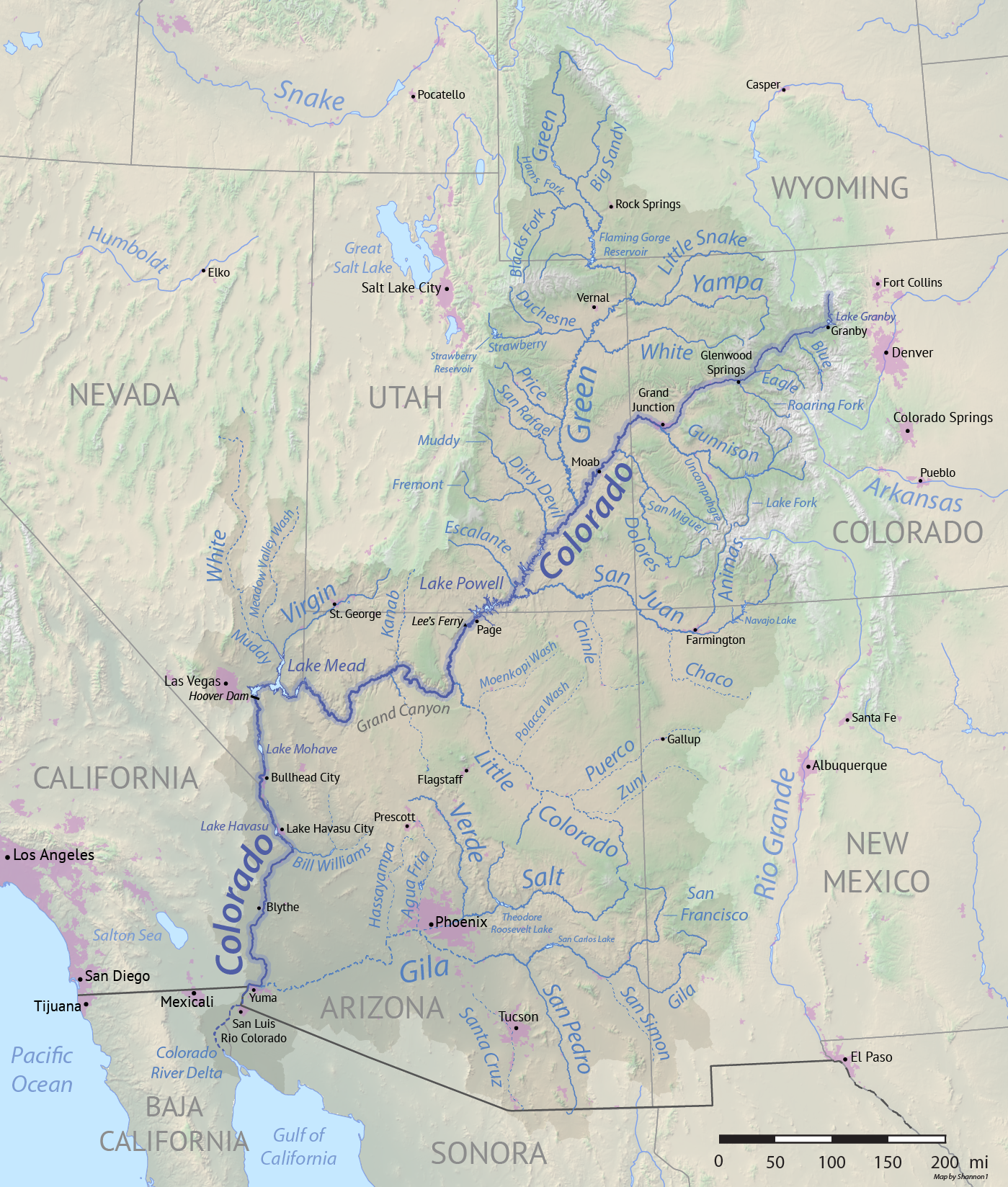
The Colorado River Basin drains seven western states. The Lower Basin is more heavily developed than the Upper Basin and consumes more water. USGS
Arizona will lose the most water: 512,000 acre-feet, nearly a fifth of its total Colorado River allocation of 2.8 million acre-feet. Nevada will lose 21,000 and Mexico 80,000. An acre-foot is enough water to cover an acre of land, which is roughly the area of a football field, to a depth of one foot – about 326,000 gallons.
Central Arizona farmers are the big losers in this first round of cuts. The cities are protected because they enjoy the highest priority in Arizona for water delivered through the Central Arizona Project, a 330-mile canal from the Colorado River. From my experience analyzing Western water policy, I expect that this declaration won’t halt growth in the affected states – but growth can no longer be uncontrolled. Increasing water supply is no longer a viable option, so states must turn to reducing demand.
Conservation remains the low-hanging fruit. Water reuse – treating wastewater and using it again, including for drinking – is also viable. A third option is using pricing and trading to encourage the reallocation of water from lower-value to higher-value uses.
Interstate collaboration
The Colorado River Basin states have formally negotiated who can use how much water from the Colorado River since they first inked the Colorado River Compact in 1922. In 2007 they negotiated interim shortage guidelines that specified how much each state would reduce its use depending on the elevation of Lake Mead. A series of subsequent agreements included Mexico, increased the scale of reductions and authorized the secretary of the Interior, ultimately, to impose truly draconian cuts.
California does not take a cut until the level in Lake Mead drops even lower. But that could happen as soon as 2023. The water level is dropping partly because of the Western drought but also because of the shape of Lake Mead, which was created by damming Boulder Canyon in 1936.
Like most Western river canyons, Boulder Canyon is wide at the rim and narrow at its base, like a martini glass. As its water elevation drops, each remaining foot in the lake holds less water.
Lake Mead, the largest U.S. reservoir, has lost 5 trillion gallons of water in the past 20 years.
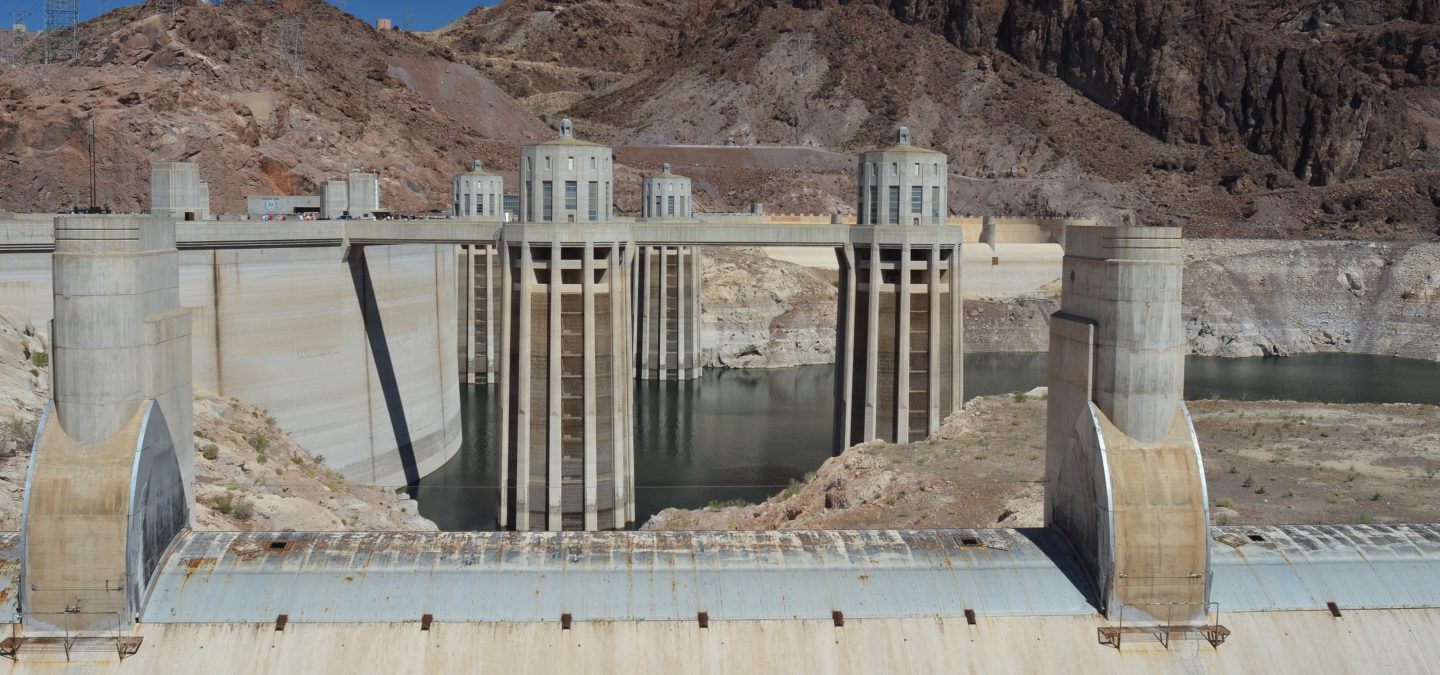
Lake Mead feeds Hoover Dam, one of the largest hydroelectric generating facilities in the country. The plant produces electricity by moving water through turbines. When Lake Mead is high, Hoover Dam’s generating capacity is more than 2,000 megawatts, which produces enough electricity to supply some 450,000 average households in Nevada, Arizona and California.
But the plant has lost 25% of its capacity as Lake Mead has dropped. If the water level declines below about 950 feet, the dam won’t be able to generate power.
Sending water south
The Upper Basin states – Colorado, Wyoming, Utah and New Mexico – will also suffer.
That’s because the Colorado River Compact obligates the Bureau of Reclamation to release an annual average of 8.23 million acre-feet from Lake Powell, the nation’s second-largest reservoir, which extends from southern Utah into northern Arizona.
The Bureau of Reclamation predicted in mid-July that runoff into Lake Powell for 2021 will total just 3.23 million acre-feet, or 30% of average. To make up for this shortfall, the bureau will release more water from three Upper Basin reservoirs: Flaming Gorge in Utah, Blue Mesa in Colorado and Navajo on the Colorado-New Mexico border.
The ultimate problem facing the Colorado River Basin states is simple. There are more water rights on paper than there is water in the river. And that’s before considering the impact of climate change and evaporation loss from Lakes Mead and Powell.
The urgency of the Tier 1 shortage declaration has generated wild-eyed proposals to import water from far-flung places. In May 2021, the Arizona legislature passed a bipartisan resolution calling on Congress to study a pipeline from the Mississippi River that would augment the Colorado River. Space does not permit me to elaborate all the obstacles to this idea, but here’s a big one: the Rocky Mountains.
Similarly, the city of St. George in southwest Utah has proposed building a 140-mile pipeline from Lake Powell to augment its supply. St. George has some of the highest water consumption and lowest water prices in the country.
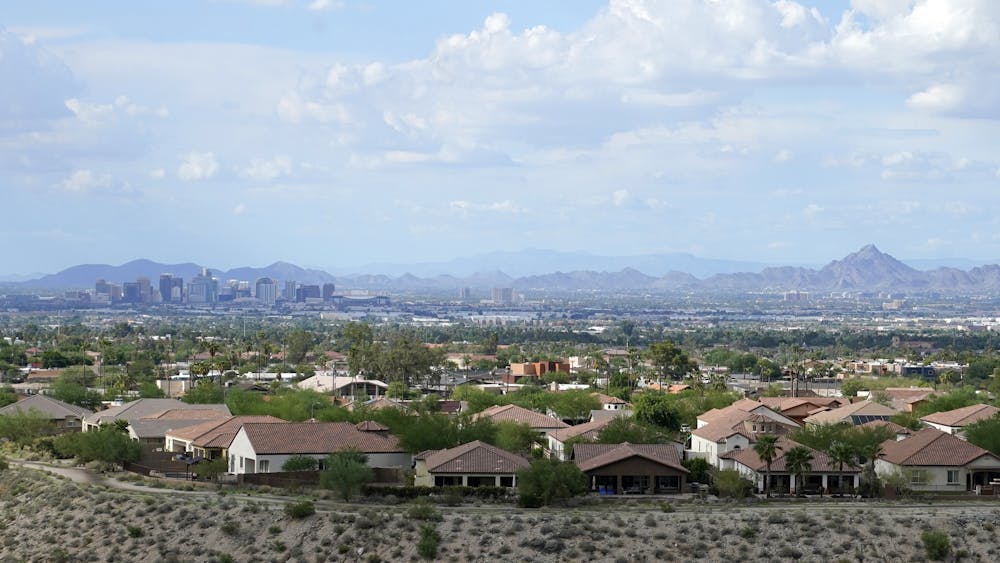
According to data released on Aug. 12, 2021, from the 2020 Census, Phoenix was the fastest-growing large city in the U.S. AP Photo/Ross D. Franklin
The gospel of growth still motivates some cities. Buckeye, Arizona, on the west side of Phoenix, has a planning area of 642 square miles, which is larger than Phoenix. The city has approved 27 housing developments that officials project will increase its population by 800,000 people by 2040. Yet its water supply depends on unsustainable groundwater pumping.
Other communities have faced reality. In early 2021 Oakley, Utah, east of Salt Lake City, imposed a construction moratorium on new homes, sending shivers up the spines of developers across the West.
Enabling farmers to be more efficient
The Tier 1 declaration gives states and local communities reason to remove barriers to transferring water. Market forces are playing an increasingly critical role in water management in the West. Many new demands for water are coming from voluntary transfers between willing sellers and desperate buyers.
Water markets threaten rural communities because farmers cannot hope to compete with cities in a free market for water. Nor should they have to. Water remains a public resource. I believe the states need a process to ensure that transfers are consistent with the public interest – one that protects the long-term viability of rural communities.
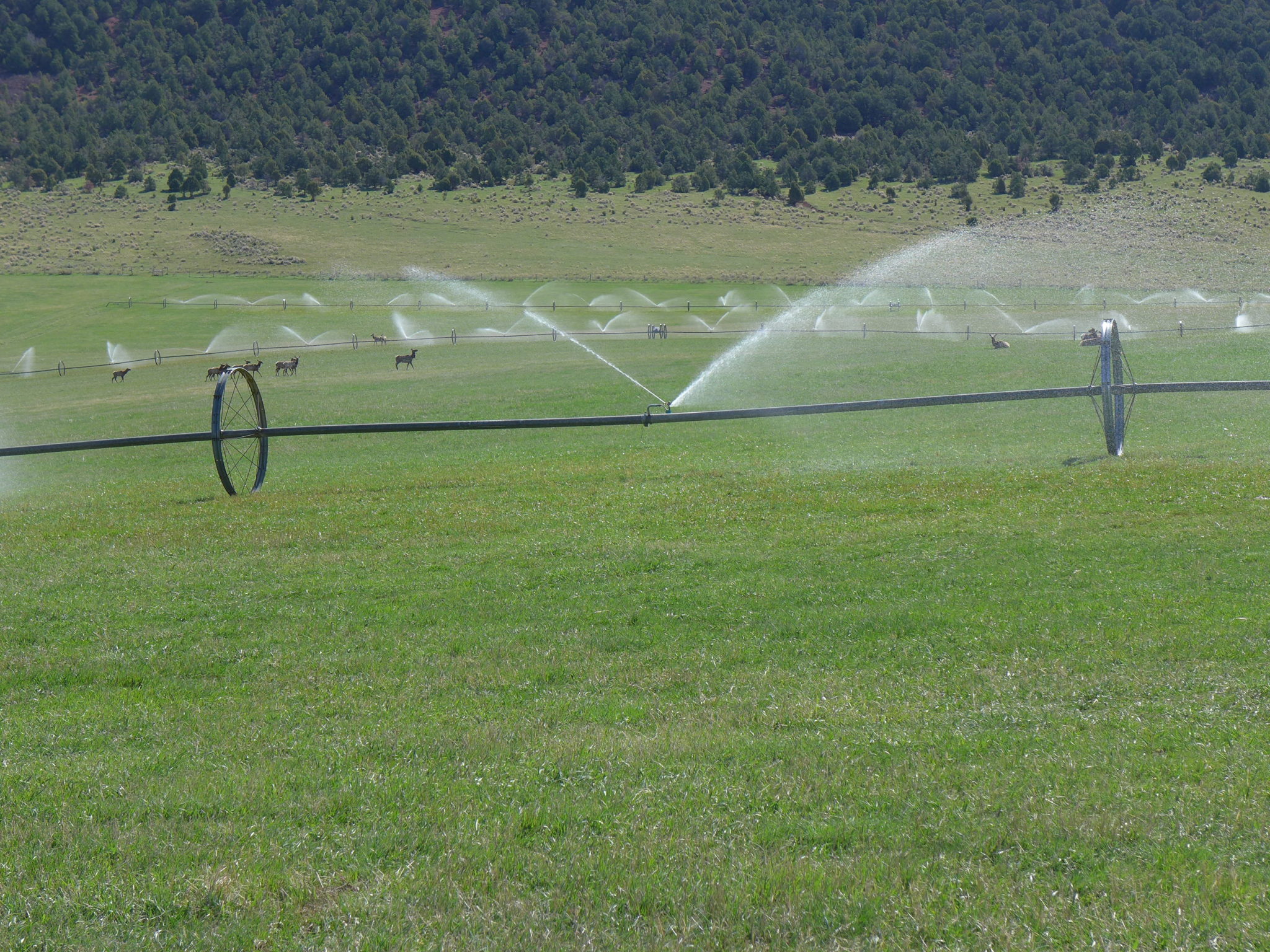
As the West enters an era of water reallocation, most of the water will come from farmers, who consume more than 70% of the region’s water. Cities, developers and industry need only a tiny fraction of that amount for the indefinite future.
What if municipal and industrial interests created a fund to help farmers install more efficient irrigation systems instead of simply flooding fields, a low-tech approach that wastes a lot of water? If farmers could reduce their water consumption by 5%, that water would be available to cities and businesses. Farmers would continue to grow as much food as before, thus protecting the stability of rural communities. This could be a win-win solution to the West’s water crisis.
More than 50 people ranging from legislative aides to state department heads participated in an on-the-ground opportunity to learn about the extreme drought in Northwest Colorado during this week’s Drought Impacts Tour in the Yampa and White River Basins.
On two warm, hazy days, state and local leaders conversed during bumpy bus rides and educational stops at ranches, lakes and the Yampa River in Routt and Moffat counties. During the tour, participants and educators discussed many aspects of drought impacts such as agricultural livelihood, recreation, tourism, wildlife, water, wildfires and forest management.
“I have been learning way more than I ever expected on this drought tour. Hearing directly from ranchers and the things that they are experiencing is truly eye-opening and wonderful,” said Becky Bolinger, Ph.D., assistant state climatologist who works at the Colorado State University Colorado Climate Center. “We do know that the climate is warming, and with that warming climate, we are experiencing more frequent droughts, more severe droughts. These are things that all Coloradans are going to have to deal with.”
Bolinger said a key point people need to realize is how to make the connection between climate science information and residents’ own changes in work practices, especially in agricultural and tourism businesses. Bolinger said the facts of the shifting climate need to translate into changes in business practices and seasonal offerings in order to prepare for a warmer, drier future in Colorado.
“Knowing that they are already prepared by improving their management practices and other things to mitigate the impacts but also to adapt, hopefully it’s not always going to be this doom and gloom situation when we are talking about climate change,” Bolinger said.
The atmospheric scientist said Coloradans should focus on “always working on actionable solutions and getting through this together.”
The tour was organized by the Colorado Drought Task Force, which includes directors of multiple state departments such as natural resources and agriculture. The task force operated in past times of drought and was activated again by the governor in 2020. Task force information listed online (http://cwcb.colorado.gov/drought) notes that water year 2020 concluded as the 12th warmest water year on record in Colorado since 1895 and the third driest water year on record, trailing only 2002 (driest) and 2018 (second driest)…
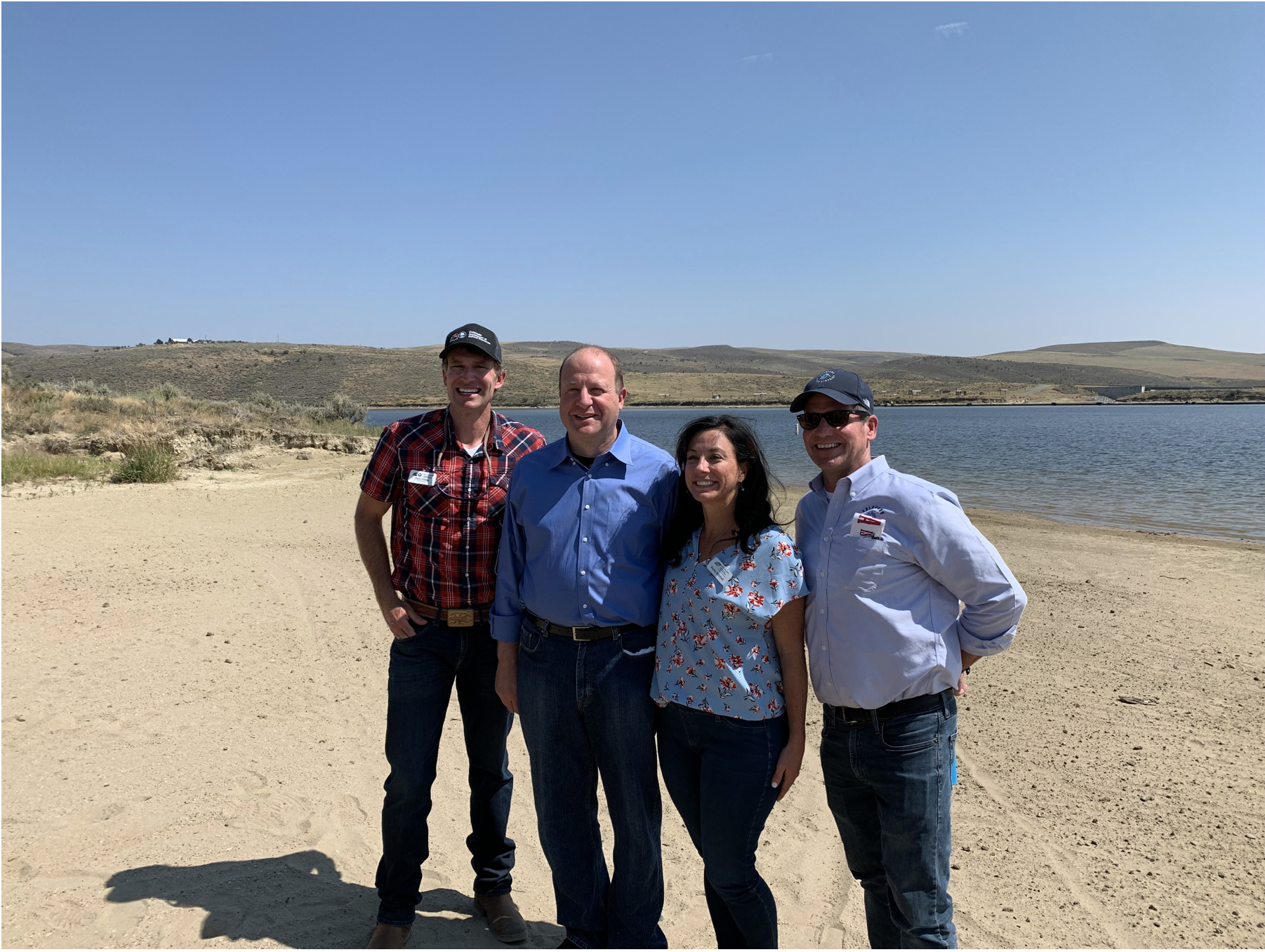
Gov. Jared Polis joined for part of the tour on Wednesday in Moffat County including a picnic at Loudy-Simpson Park south of Craig…
One message from the tour is that drought-related financial assistance and grant opportunities are broad and plentiful at this time. Leonard encouraged agencies, nonprofits and agricultural producers to review funding options found at http://cwcb.colorado.gov/drought-assistance.
For example, the Colorado Department of Agriculture is promoting new stimulus funding available as of July 1, including $2.5 million to expand market opportunities for funding for Colorado Proud producers, $5 million to expand agricultural efficiency and soil health initiatives, $30 million for agricultural revolving loan and grant programs including for individual farmers and ranchers, and more than $1.8 million for agriculture drought resiliency activities that promote the state’s ability to anticipate, prepare for, mitigate, adapt to or respond to drought.
The CWCB Agricultural Emergency Drought Response Program has a $1 million fund available on a rolling basis that provides immediate aid for emergency augmentation water during drought years in the form of loans or grants.
Residents who would like to share drought-related impact stories with state leaders can contribute to Colorado Drought Stories via the interactive website http://engagecwcb.org/agricultural-task-force.
Ralph Parshall squats next to the flume he designed at the Bellevue Hydrology Lab using water from the Cache la Poudre River. 1946. Photo Credit: Water Resource Archive, Colorado State University, via Legacy Water News.
From email from DWR (Chris Arend):
The Division of Water Resources is holding a webinar on a number of West Slope water issues and water issues of concern to all Coloradans, including upcoming measurement rules and consideration of establishing the Yampa River Basin in certain select areas as over-appropriated.
The webinar will discuss the phases and timing of measurement rulemaking and how the public and interested parties can provide comments or participate in upcoming stakeholder events. Also to be discussed are explanations of short-term and medium-term activities and plans to prepare for potential rulemaking for Compact Administration Rules. Time will be left towards the end of the webinar for questions and answers from participants.
WHO: State Engineer, Kevin Rein and Deputy State Engineer, Mike Sullivan, Colorado Division of Water Resources
WHAT: Webinar on Upcoming West Slope Measurement Rules and other water issues WHEN: Thursday, August 19, 2021, 6 PM to 7 PM
A working group submitted a report on Friday that includes several “concepts” that it says the Colorado Water Resources Review Committee should consider when exploring how to bolster the state’s anti-speculation law.
The 22-member group, which includes members from the legal, nonprofit, municipal, and agricultural sectors, convened due to the passage of Senate Bill 20-048. The group submitted a total of 19 “concepts” organized into five categories that the committee will consider when making future regulations.
Some of the recommendations include modifying current legal proceedings to give water courts a more active role in anti-speculation cases, encouraging local governments and state police to invest in water speculation, and establishing a maximum water rate increase with corresponding tax penalties for those who overcharge.
In its final report, the working group said it does not recommend any of the concepts for implementation due in part to the drawbacks members identified during their sessions and a lack of consensus among the group.
Instead, it recommended that lawmakers “gather additional feedback from multiple and diverse stakeholders within Colorado for any change in law considered.”
Water speculation – defined as obtaining a water right without a plan to put the water to beneficial use – is a foundational issue for the state of Colorado.
The state’s constitution expressly provides that water is “declared to be the property of the public, and the same is dedicated to the use of the people of the state.” This means that no one in the state can horde water without a legitimate need.
The approach has become known colloquially as the “Colorado Doctrine” in the water court system, according to the working group’s report.
Anti-speculation laws are also gaining more public attention as drought conditions are causing issues for some Colorado ranchers.
Gov. Jared Polis recently visited with the local agricultural communities in Craig and Steamboat Springs and declared that the recent “historic” water plan won’t be enough to help ease the conditions. The plan will spend $50 million to increase conservation and address the gap between supply and demand.
“This is an important part of who we were, who we are and who we will be now in the future,” Polis told the Craig Daily Press.
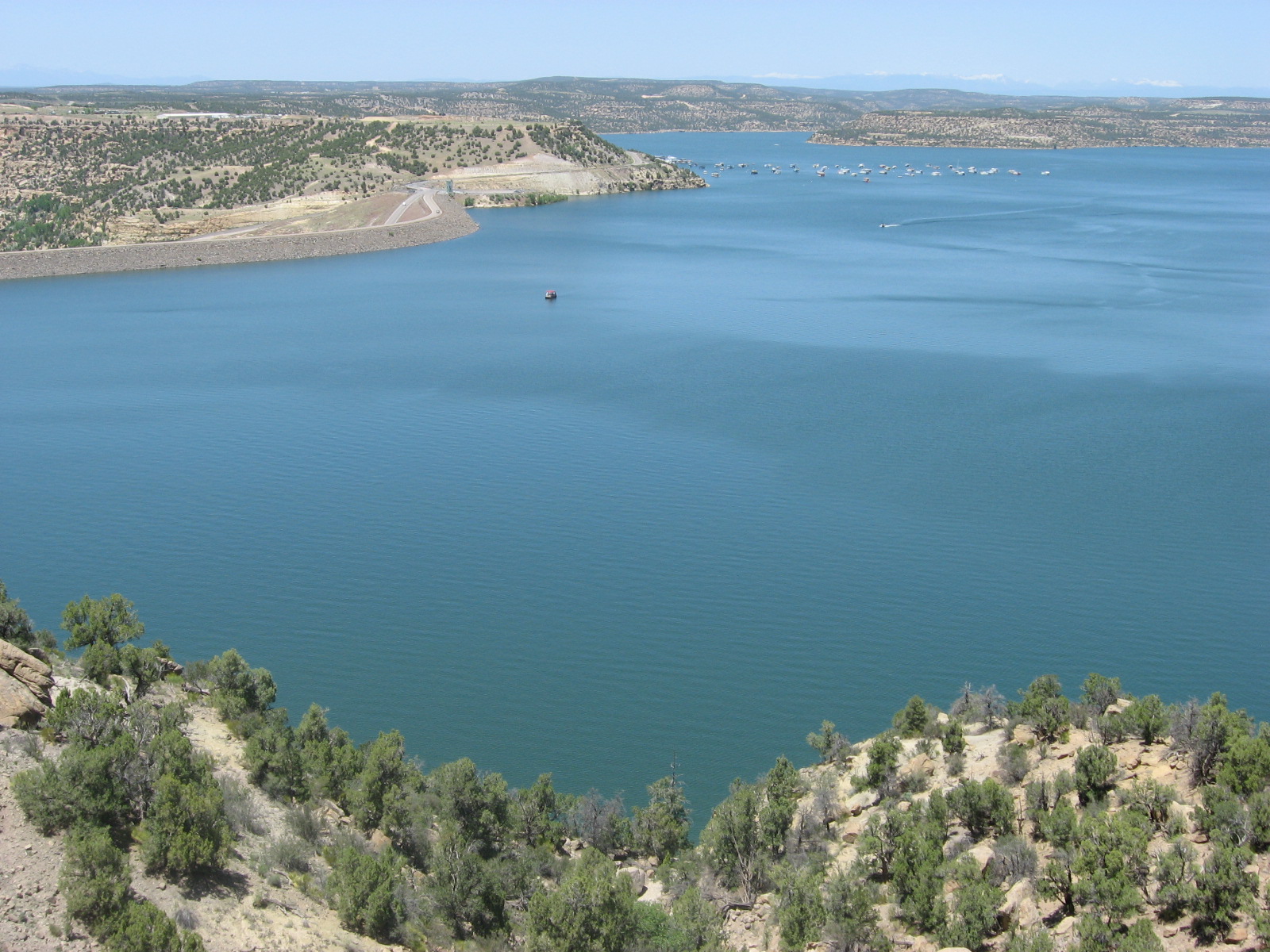
Navajo Reservoir, New Mexico, back in the day.. View looking north toward marina. The Navajo Dam can be seen on the left of the image. By Timthefinn at English Wikipedia – Transferred from en.wikipedia to Commons., Public Domain, https://commons.wikimedia.org/w/index.php?curid=4040102
From email from Reclamation (Susan Novak Behery):
The City of Farmington Hydroelectric Power Plant will be taken offline today, Tuesday, August 17th, at 1:00 PM for unscheduled work. The Bureau of Reclamation will open the Auxiliary 4×4 release at that time, to 700 cubic feet per second (cfs) (a reduction from the current release of 800 cfs). The Auxiliary will continue releasing for a period of up to a week while work continues at the Power Plant.
Releases are made for the authorized purposes of the Navajo Unit, and to attempt to maintain a target base flow through the endangered fish critical habitat reach of the San Juan River (Farmington to Lake Powell). The San Juan River Basin Recovery Implementation Program recommends a target base flow of between 500 cfs and 1,000 cfs through the critical habitat area. The target base flow is calculated as the weekly average of gaged flows throughout the critical habitat area from Farmington to Lake Powell.
Here’s the release from the Bureau of Reclamation (Patti Aaron and Becki Bryant):
The Bureau of Reclamation today released the Colorado River Basin August 2021 24-Month Study. This month’s study projections are used to set annual operations for Lake Powell and Lake Mead in 2022. Releases from these massive reservoirs are determined by anticipated reservoir elevations.
General map of the Colorado River Basin, depicting the Upper and Lower Basins, and the Grand Canyon ecoregion. Map credit: ResearchGate
Most of the flow of the Colorado River originates in the upper portions of the Colorado River Basin in the Rocky Mountains. The Upper Basin experienced an exceptionally dry spring in 2021, with April to July runoff into Lake Powell totaling just 26% of average despite near-average snowfall last winter. The projected water year 2021 unregulated inflow into Lake Powell—the amount that would have flowed to Lake Mead without the benefit of storage behind Glen Canyon Dam—is approximately 32% of average. Total Colorado River system storage today is 40% of capacity, down from 49% at this time last year.
Given ongoing historic drought and low runoff conditions in the Colorado River Basin, downstream releases from Glen Canyon Dam and Hoover Dam will be reduced in 2022 due to declining reservoir levels. In the Lower Basin the reductions represent the first “shortage” declaration—demonstrating the severity of the drought and low reservoir conditions.
“Like much of the West, and across our connected basins, the Colorado River is facing unprecedented and accelerating challenges,” said Assistant Secretary for Water and Science Tanya Trujillo. “The only way to address these challenges and climate change is to utilize the best available science and to work cooperatively across the landscapes and communities that rely on the Colorado River. That is precisely the focus of the White House Interagency Drought Working Group—a multi-agency partnership created to collaborate with States, Tribes, farmers and communities impacted by drought and climate change to build and enhance regional resilience.”
“Today’s announcement of a Level 1 Shortage Condition at Lake Mead underscores the value of the collaborative agreements we have in place with the seven basin states, Tribes, water users and Mexico in the management of water in the Colorado River Basin,” said Reclamation Deputy Commissioner Camille Touton. “While these agreements and actions have reduced the risk, we have not eliminated the potential for continued decline of these critically important reservoirs. Reclamation is committed to working with all of our partners in the basin and with Mexico in continuing to implement these agreements and the ongoing work ahead.”
Plans that have been developed over the past two decades lay out detailed operational rules for these critical Colorado River reservoirs:
Based on projections in the study, Lake Powell will operate in the Mid-Elevation Release Tier in water year 2022 (October 1, 2021 through September 30, 2022), and Lake Mead will operate in its first-ever Level 1 Shortage Condition in calendar year 2022 (January 1, 2022 through December 31, 2022).
Lake Powell Mid-Elevation Release Tier: The study projects Lake Powell’s January 1, 2022, elevation to be 3,535.40 feet – about 165 feet below full and about 45 feet above minimum power pool. Based on this projection, Lake Powell will operate in the Mid-Elevation Release Tier in water year 2022. Under this tier, Lake Powell will release 7.48 million acre-feet in water year 2022 without the potential for a mid-year adjustment in April 2022.
Lake Mead Level 1 Shortage Condition: The study projects Lake Mead’s January 1, 2022, elevation to be 1,065.85 feet – about 9 feet below the Lower Basin shortage determination trigger of 1,075 feet and about 24 feet below the drought contingency plan trigger of 1,090 feet. Based on this projection, Lake Mead will operate in a Level 1 Shortage Condition for the first time ever. The required shortage reductions and water savings contributions under the 2007 Colorado River Interim Guidelines for Lower Basin Shortages and Coordinated Operations of Lake Powell and Lake Mead, 2019 Lower Basin Drought Contingency Plan and Minute 323 to the 1944 Water Treaty with Mexico are:- Arizona: 512,000 acre-feet, which is approximately 18% of the state’s annual apportionment
– Nevada: 21,000 acre-feet, which is 7% of the state’s annual apportionment
– Mexico: 80,000 acre-feet, which is approximately 5% of the country’s annual allotment
In July 2021, drought operations to protect Lake Powell were implemented under the Upper Basin Drought Response Operations Agreement which project releasing up to an additional 181,000-acre feet of water from upstream initial units of the Colorado River Storage Project to Lake Powell.
Relying on the best available scientific information to guide operations, investing in water conservation actions, maximizing the efficient use of Colorado River water and being prepared to adopt further actions to protect the elevations of Lake Powell and Lake Mead remains Reclamation’s priority and focus.
Lake Mead. Photo: Chris Richards/Flickr (CC BY-NC-ND 2.0) via Audubon
The U.S. Bureau of Reclamation today announced that 2022 will bring unprecedented water shortages to Arizona, Nevada and the Republic of Mexico. The shortage determination follows release of a forecast of water supply in the Colorado River’s reservoirs, indicating that levels continue precipitous decline.
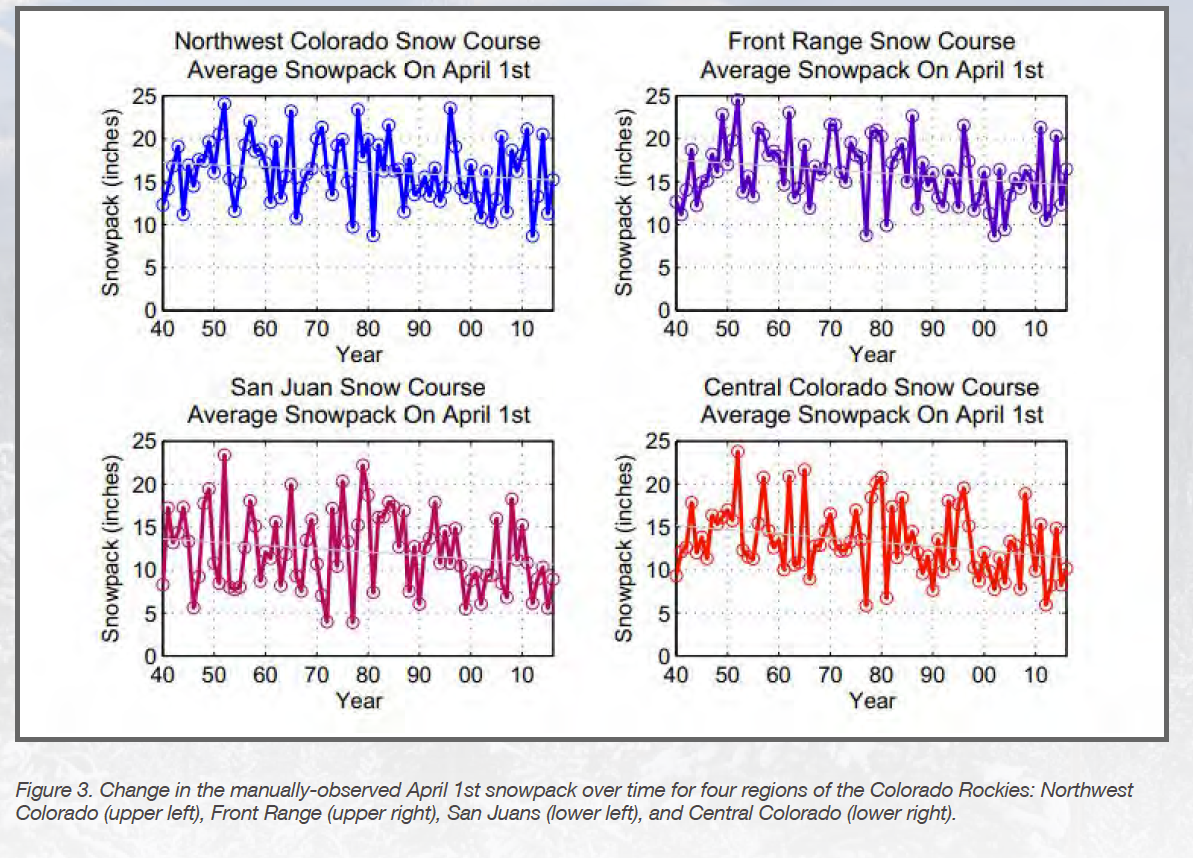
While last year’s snowpack was decent, extraordinarily warm temperatures through the spring meant that by the time the snow melted and flowed into Colorado River reservoirs much of it had evaporated, and the year’s water supply was only 32% of the 30-year average. Since 2000, the decline in Colorado River reservoir elevations has been dramatic, and scientists studying climate change tell us there is no end in sight.
As we watch climate change impacts unfold before our eyes, we worry about the birds and other wildlife that depend on Colorado River (and tributary) habitats. We worry about the communities that rely on Colorado River water supply. We also worry about how decision-makers will respond, because in a crisis, environmental resources will be at risk.
Graphic via Audubon
In recent years, the U.S. and Mexican federal governments and states that share the Colorado River have adopted shortage rules (2007 Interim Guidelines, Minute 323, Colorado River Drought Contingency Plans). That is important, because it allows water users to plan ahead for dry times with some predictability, even in extraordinary drought. Arizona, Nevada and Mexico all have known the 2021 shortage is coming. On a short-term basis, they have plans to mitigate the shortages. Arizona, which will take by far the biggest cuts, will employ diverse strategies including temporarily buying water from willing sellers (funded by Arizona taxpayers and philanthropies), increased water releases from in-state reservoirs, and increased groundwater pumping.
These are good strategies for the short-term, but what about 2023 and beyond? Historically, water management was based on the premise that drought would be followed by wet years. Climate change means we can no longer make that assumption. Good short-term solutions may not be sustainable: Will public and philanthropic funds remain available over the long term? Local reservoirs will need to be refilled with Colorado River water, so what happens once they are emptied? How long can water users rely on fossil groundwater before that resource is threatened as well?
A recent report from Audubon and conservation partners suggests that we need to start investing now in solutions for the long term, including improving forest health, wetlands restoration, and regenerative agriculture. These practices improve soil health such that over time more of the snowpack will translate into water supply as well as improved resilience of the entire watershed.
Good planning and robust investments can help minimize the pain of Colorado River water shortages, and are critical to maintaining reliable water supplies for people and nature alike. It is reassuring that the United States and Mexico have held fast to their commitments to provide a small volume of water to the Colorado River Delta, and the river has been flowing to the sea this summer.
The Colorado River is due for new operating rules in 2026, and Audubon will be working hard to ensure that the results are designed for the 21st century, starting with a process that includes all stakeholders, including Native American tribes with Colorado River water rights and environmental interests. Our goals include a new management framework that stabilizes reservoirs as the water supply declines, robust public investment in long-term strategies to improve the water supply and the basin’s resilience, measures that ensure tribes benefit from their water rights, and that decision-makers do not raid the last drops of water supporting habitats Colorado River habitats.
“deeper levels of shortage are likely in the next few years… additional reductions to CAP water users are likely to occur pursuant to the DCP. Such reductions would include impacts to CAP water currently available to some central AZ municipalities and tribes.” #AZWater#CORiverhttps://t.co/NFHTtB0cNp
Director Buschatzke of @azwater notes that another key trigger has been reached: Lake Mead is projected to hit 1030’. This requires AZ, CA and NV to reconvene to decide what additional steps they will take to keep Mead from falling below 1,020’. #CORiver#AZWater
Due to the low levels of water, the federal government has declared a Tier 1 water shortage in the Colorado River for the first time ever. This declaration reduces the amount of water that Arizona, Nevada and Mexico can claim from the river.
“The Tier 1 shortage declaration highlights the challenges facing the Colorado River Basin; however, this did not come as a surprise,” says Taylor Hawes, The Nature Conservancy’s Colorado River Program Director. “The Colorado River has witnessed a steady decline in flows since 2000 that impacts communities, agriculture, industry, and the health of our rivers in the region. Even as flows decreased, our demand reductions have not kept pace.”
The declaration not only reduces the amount of water available for cities, but it will likely restrict water supplies for farmers. Some farmers may be forced to sell cattle, switch to different crops, or use groundwater from wells.
Colorado River Hit Hard by Climate Change
The Colorado River provides drinking water for more than 40 million people, hydroelectric power to meet the needs of over 7 million people, and water for 30 Native American Tribes. It irrigates around 5 million acres of fields that supply vegetables to the entire world and supports a thriving $26-billion recreation and tourism economy, as well as a wide variety of wildlife.
But climate change is hitting the Colorado River hard. The West has been in the grip of a drought for over 20 years that scientists believe is the worst in a thousand years, and the river is starting to feel the pinch. Its flows are powered by snowmelt in the Rocky Mountains, and as precipitation declines across the region, the river’s supply has dwindled too. Higher year-round temperatures also mean that the water evaporates faster while water use increases. These challenges make it harder and harder to balance the needs of people and the fish and wildlife that depend on healthy, flowing rivers.
“The Colorado River can be a model for resiliency and sustainability but not without a concerted and significant effort by stakeholders in the region,” Says Hawes. “While stakeholders have been developing solutions and adapting to a drier future, we must all accelerate the pace. We need short term solutions to stabilize the system while also working on longer term solutions. These include reducing water use across sectors, modernizing infrastructure, improving forest health, enhancing natural infrastructure, using technology to bolster groundwater levels, and improving stream and river health.”
Already, water levels in Lake Powell and Lake Mead, the two major reservoirs that store the Colorado River’s water, are down to 34% of their capacity and may soon drop too low to spin the hydroelectric turbines in their dams. Some smaller reservoirs began emergency releases in summer 2021 to prop up water levels in these lakes.
The situation is serious, but there’s plenty we can do to improve it. We know that the West will continue to get hotter and drier due to climate change. By proactively working together and planning for this future, we can share the Colorado River’s water equitably among all those who need it, including nature. We can use water more efficiently in our homes and businesses, improve agricultural irrigation infrastructure, adopt innovative water sharing approaches, and plant crops that use less water. With proper planning, the river will have enough water for fish and animals as well as people.
“Water issues are complex and require partnership and collaboration,” says Hawes. “The Nature Conservancy has worked in the Colorado River Basin for 20 years and appreciates the critical importance of partnerships in charting a sustainable and resilient future. However, the river system has changed more quickly than we have adapted. We must accelerate our efforts and think more broadly and creatively than ever before to chart a sustainable course. We must work together, testing ideas, sharing knowledge and investing in both short-term and long-term solutions in order to have the greatest impact in a short amount of time. This approach is our best path forward to minimize more future shortages on the river.”
With our contacts in the region and our history of bringing diverse stakeholders together, TNC is ideally situated to broker agreements that keep the Colorado River healthy. In Colorado, we developed the Yampa River Fund, a compact in which downstream users pay to protect the health of their water supply near its source. In Arizona, we developed a groundwater recharge system and helped farmers switch to water-efficient crops. We helped Mexicali, Mexico, invest in wastewater treatment solutions to leave more water available for nature. We are supporting policies at local, regional, and national levels that safeguard water supplies in the arid West.
Las Vegas has reduced its water consumption even as its population has increased. (Source: Southern Nevada Water Authority)
Here’s a release from the Southern Nevada Water Association (Bronson Mack):
Low water levels in Lake Mead prompted the federal government today to issue a water shortage declaration on the Colorado River, which will reduce the amount of water Southern Nevada will be allowed to withdraw from Lake Mead beginning in January 2022.
Combined with existing water reductions outlined in the Drought Contingency Plan, the declared shortage will cut Southern Nevada’s annual water allocation of 300,000 acre-feet from Lake Mead—the source of 90 percent of the community’s supply—by a total of 21,000 acre-feet (nearly 7 billion gallons of water) in 2022.
“During the past two decades, Southern Nevada has taken significant steps to prepare for these cuts, including constructing Intake 3 and Low Lake Level Pumping Station and storing unused water in reserve for our community’s future use,” said Southern Nevada Water Authority (SNWA) General Manager John Entsminger. “But water conservation remains our most effective management tool, and now is the time for all of us to redouble our conservation efforts in order to remain ahead of the curve and continue protecting the investments we have all made in our community.”
Entsminger said Southern Nevada must continue to reduce outdoor water consumption—which accounts for about 60 percent of the region’s overall water use—by following mandatory seasonal watering restrictions, replacing unused grass landscapes with drip-irrigated trees and plants through the SNWA’s Water Smart Landscapes rebate program (WSL), and preventing and reporting water waste (water flowing off a property into the gutter) to local water utilities.
“Southern Nevada has the capability, the obligation, and the need to be the most water-efficient community in the nation,” Entsminger said. “We already safely treat, recycle and return indoor water use back to Lake Mead, so conserving the water we use outdoors will help us achieve that goal and ensure our long-term sustainability.”
While the shortage declaration is the first of its kind, it is not the first time Southern Nevada was required to reduce its water use in response to drought conditions and a hotter, drier climate. When the drought was first declared in 2002, Southern Nevada was using more than its legal entitlement of 300,000 acre-feet of Colorado River water. However, the community’s commitment to conservation led to a 23 percent decline in water use since 2002 despite the addition of nearly 800,000 new residents.
But conservation progress has stalled in recent years. As an example, only about half of single-family households comply with the year-round seasonal watering restrictions, which limits the number of days landscapes can be watered each season. If every water user diligently followed these restrictions each season, Southern Nevada could save more water than is being cut under the shortage conditions.
In addition, tens of millions of gallons go to waste each year as poor irrigation practices result in water flowing off properties. Reporting this waste to local water utilities helps educate property owners about the issue and gives them an opportunity to correct it. However, those that continue to waste water receive a violation and a water-waste fee.
“In the face of this unprecedented shortage, we must step-up our commitment to conservation,” Entsminger said. “These efforts are imperative to assure our community’s long-term economic success—and history has shown that they work.”
For information on what you can do to conserve water, including SNWA conservation programs, seasonal watering restrictions, and preventing and reporting water waste, visit http://snwa.com.
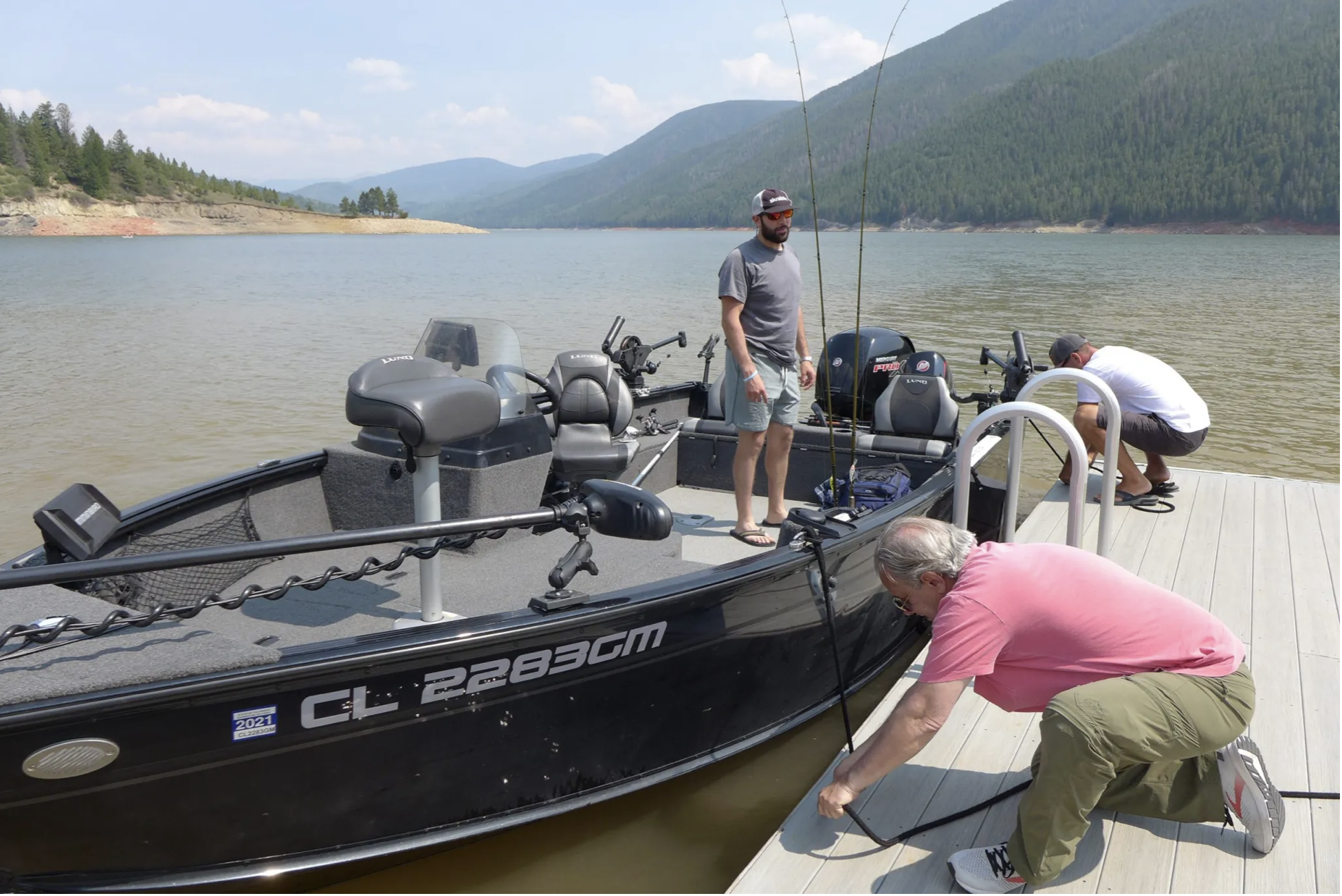
A longer walk from the dock to the water is in store for boaters at the Elk Creek marina, Blue Mesa Reservoir. Blue Mesa is being drawn down to feed critically low Lake Powell, as continued dry weather and rising demand deplete the Colorado River. (Courtesy photo/National Park Service) via the Montrose Daily Press
The federal government declared a water shortage on the Colorado River for the first time since a compact between seven river basin was inked a century ago, with major 2022 water delivery cutbacks for Arizona and a lesser amount for Nevada and the nation of Mexico.
But water resource experts warned Coloradans not to be smug about far-away troubles in Arizona, where central state farming methods and production will take a big hit. The duty of Upper Colorado River Basin states to continue delivering set quotas of water under the treaty is one of the next big climate change battles in the West, and it will force changes here at home.
“The announcement today is a recognition that the hydrology that was planned for years ago, that we hoped we would never see, is here today,” Camille Touton, deputy commissioner for the Bureau of Reclamation, said at a news conference bringing together officials from all the compact states.
“It’s really a threshold moment,” said Bart Miller, healthy rivers program director for the nonprofit Western Resource Advocates. “They are words a water manager doesn’t like hearing: unprecedented, never done this before. That short-term response is a good one, but the longer term response might be most interesting.”
At the news conference Monday, the U.S. Bureau of Reclamation officially announced what its previous reports had warned was coming: Drought and climate change have drained so much water from the Lower Basin compact states’ main pool, Lake Mead, that the most junior rights on the lower river must be suspended until supplies are restored.
“They will not be delivered the water,” said Tom Buschatzke, director of Arizona Department of Water Resources. “They will physically not have the water, and they will have to figure out how to deal with the ramifications of that outcome.”
Arizona, with primarily junior water rights for its Central Arizona Project canals that take farm water into the desert, will lose more than 500,000 acre-feet from its projected allotment for 2022. That’s about 18% of the state’s usual allotment from the Colorado River.
Nevada will lose 21,000 acre-feet, or about 7% of its planned 2022 allotment; Mexico, which has a treaty with the U.S. over Colorado River water, will lose 80,000 acre-feet, or about 5% of its annual total.
Though the 22-year drought in the West prompted years of contingency planning for the river that delivers water to 40 million people, failing snowpack and dry soils that drink up runoff have forced federal regulators to speed their efforts…
Earlier this summer, another contingency move triggered by the drops at Mead and Powell included partial draining of Blue Mesa Reservoir near Gunnison to help refill Powell and keep its pool above the minimum level needed for generating hydroelectric power. Federal regulators also moved water down to Powell from Flaming Gorge Reservoir on the Wyoming-Utah border, and Navajo Reservoir straddling the Colorado-New Mexico border.
All the compact states will have to contribute to solutions as the drought continues, federal and state officials warned.
“We also recognize the very real possibility that the hydrology that was planned for years ago may not be the worst that the basin may see in the future,” Touton said…
There are a few ways Colorado and federal water managers are working on to leave more water in the river, Miller said:
Improving the efficiency of agriculture — which uses 85% of the water available in Colorado — through fixing canals and ditches and moving to drip irrigation when possible. Capital costs could be funded in part by the infrastructure bill on the verge of passage by Congress, some of which was earmarked for water projects.
Changing crops to those that take less water. Arizona gets criticized for using Colorado River water to irrigate cotton, alfalfa and other high-water crops in an arid climate, but most of western agriculture takes place in a high desert. Colorado farmers could switch from alfalfa and other fodder to rye or other crops.
Letting water go through “demand management.” Cities have been drying up farms for their water rights for decades, raising the anger of rural Colorado. Demand management, by contrast, can rent the water from farmers for a set number of years in a given period, without drying up the land or the water rights entirely. Renting the water takes big money, though, another possible use of infrastructure stimulus.
City water conservation. Front Range cities have come a long way providing household water to millions of new residents without taking more water overall, Miller said, but those efficiency gains are slowing. Still, the cities could make additional trims: Las Vegas spends large amounts buying up lawn grass and paying homeowners to keep low-water or zero-water plantings.
“There’s still more there,” Miller said.
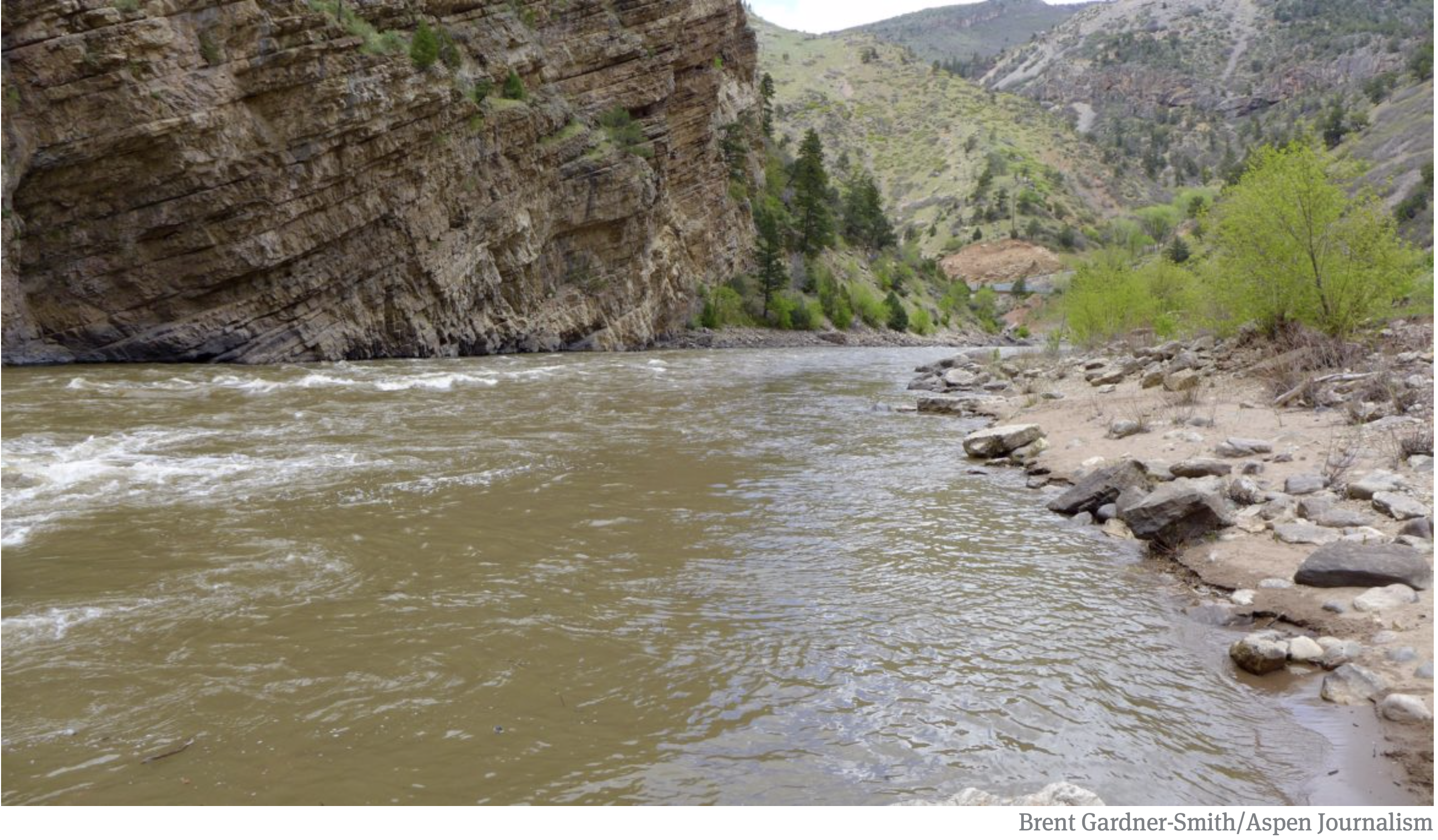
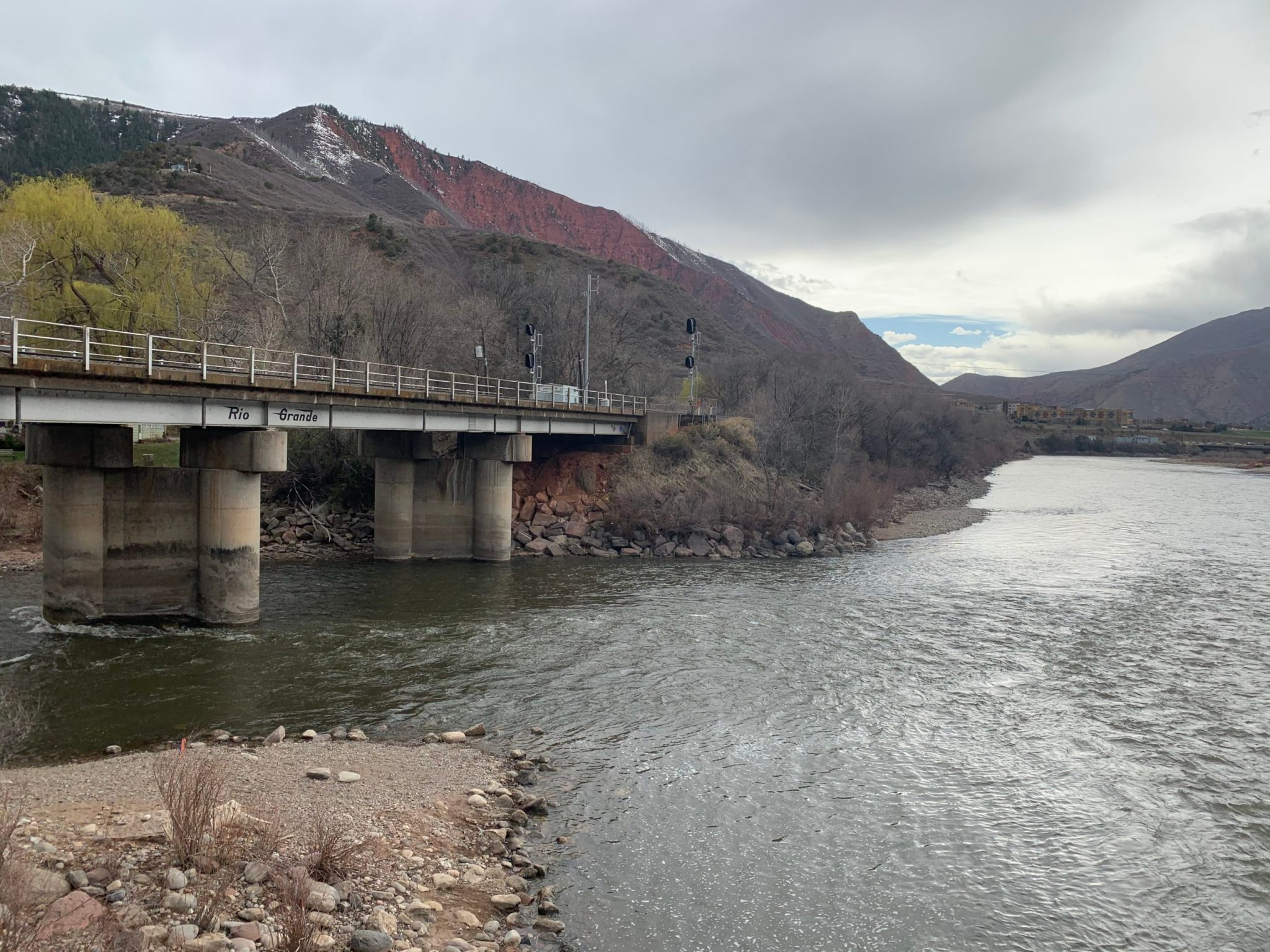
The Roaring Fork River (left) joins with the Colorado River in downtown Glenwood Springs. CREDIT: HEATHER SACKETT/ASPEN JOURNALISM
FromColorado Public Radio (Michael Elizabeth Sakas):
What does this water shortage mean for Colorado? Nothing, legally.
Lake Mead stores water for the states in the lower Colorado River basin — that’s Nevada, Arizona and California. Because Lake Mead has dropped below 1,075 feet, the U.S. Bureau of Reclamation can mandate water cuts in Arizona and Nevada…
Currently, Colorado and this group of states are complying with the water-sharing agreement. The upper basin is not legally at fault for the low levels in Lake Mead.
“When we hear a shortage declaration, that definitely causes angst,” said Becky Mitchell, director of the Colorado Water Conservation Board. “But I do feel like it’s a call to action both in the upper basin and the lower basin.”
Mitchell said all of the states in the Colorado River basin are working to manage “this very precious resource,” so that federal emergency actions like this are rare.
The official shortage declaration in the lower-basin states does add pressure to renegotiations of the Colorado River’s existing management guidelines, which are set to expire in 2026.
“It is much easier to make decisions in times of plenty,” [Rebecca] Mitchell said. “But the decisions are more important in times like now, and they have a greater impact.”
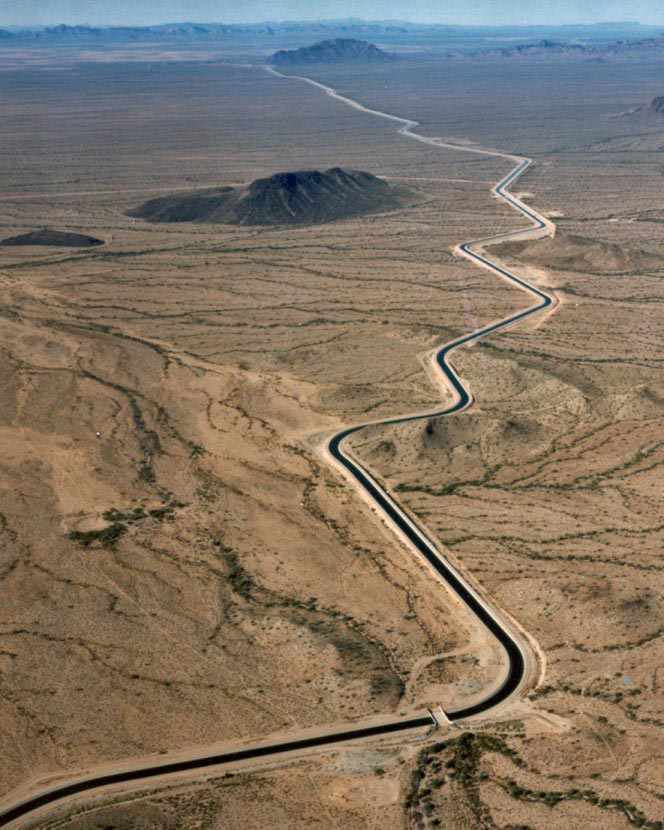
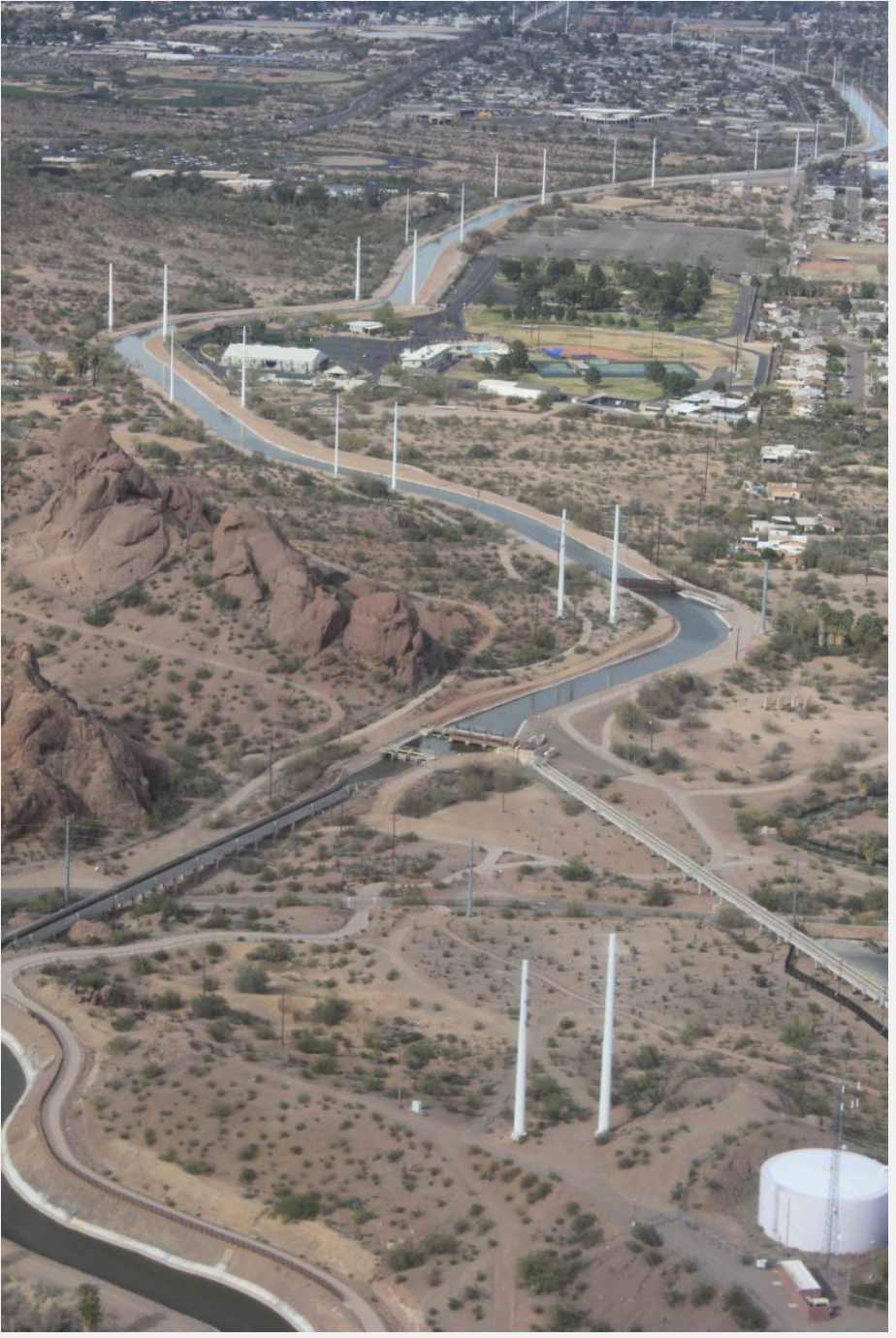
Aerial photo – Central Arizona Project. The Central Arizona Project is a massive infrastructural project that conveys water from the Colorado River to central and southern Arizona, and is central to many of the innovative partnerships and exchanges that the Gila River Indian Community has set up. Public Domain, https://commons.wikimedia.org/w/index.php?curid=326265
But additional cuts affecting more people may be coming more quickly than anticipated until now, officials said at a news conference called to make the formal announcement of the river’s first shortage declaration.
The shortage declaration by the bureau will reduce deliveries to the Central Arizona Project by roughly one-third, or 512,000 acre-feet.
Besides farmers, these cuts will also affect some Indian tribes, “excess water” deliveries to parties who normally buy water that other users don’t have contracts for and recharge of CAP water into various underground storage basins.
The cuts for Arizona, Nevada and Mexico together will be about 613,000 acre-feet, although California will have no cuts in 2022. An acre-foot is enough water to cover a football field one-foot deep with water. The cuts were all prescribed by the 2019 drought contingency plan, an agreement among the seven Colorado River Basin states including Arizona that sought to prop up Lakes Mead and Powell by gradually reducing the states’ take of that water when reservoirs declined to low enough elevations.
But Arizona’s water chief indicated at the news conference that to keep already ailing Lake Mead from falling too low, the three Lower Colorado River Basin states including Arizona will need to take additional water-saving actions beyond what’s already planned. That additional action is legally required under the three-state drought contingency plan, because the latest bureau forecast says it’s possible that Mead could drop to close to critically low levels by June 2023.
The state representatives have already started meeting to discuss possible future cuts, Tom Buschatzke, Arizona Department of Water Resources director, told the news conference without providing much more detail.
“The tools we have to achieve the goal are conserving more water in Lake Mead and reducing water use,” Buschatzke said. “This is a serious turn of events, not a crisis…
…at a separate news conference held after the one held by officials, a group of environmentalists and the head of a huge Southern California irrigation district blasted as grossly inadequate the efforts of federal and state officials to respond to declines in Colorado River flows that have drastically lowered its reservoirs’ water levels since 2000.
They said that despite the much-touted drought plan the basin states approved in 2019, the states and feds really don’t have a long-term plan to bring the river into balance between how much water people use and how much nature provides.
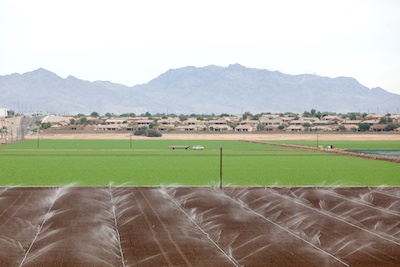
Spray irrigation on a field in the Imperial Valley in southern California. This type of irrigation is a lot better than the extremely water inefficient type of flood irrigation that is popular in this region. Still, in the high temperatures of this desert region a lot of the water evaporates, leaving the salts, that are dissolved in the colorado River water that is used, on the soil.
“This is not the time for small steps, this is a time for large ones,” said J.C. Hamby, director of the Imperial Irrigation District, headquartered in El Centro, California, near Yuma. “This is a tremendous problem that requires tremendous solutions, bold solutions, to respond to the continued drawdown on Powell and Mead.”
The drought contingency plan is only a plan to manage reservoir levels, not to truly adapt to long-term declines in river flows triggered by climate change and the accompanying warming weather, added Zachary Frankel, director of the Utah Rivers Council.
“There is not a climate plan for the Colorado River, it’s just the federal government and states watching the reservoir levels drop,” Frankel said.
The bureau’s CAP cuts for 2022 will take away about 60 percent of the Pinal farmers’ current CAP supplies of about 250,000 acre feet a year, said Paul Orme, a Phoenix attorney representing four Central Arizona irrigation districts. In 2023, the Pinal farmers’ share of CAP will shrink to zero, as prescribed by the 2019 drought plan, he said…
The latest bureau forecast for the end of 2022 is more dire still. The most likely lake level then will be barely above 1,050 feet, the bureau’s monthly 24-month study said. If Mead drops below 1,050 feet at the end of any calendar year, additional cuts kick in, affecting some Phoenix-area cities, Indian tribes and some industrial users, although Tucson wouldn’t be affected.
Arizona, Nevada and Mexico would lose a total of 613,000 acre-feet under that scenario, although California would lose no Colorado River water unless the lake drops below 1,045 feet…
But the bureau’s latest forecast also predicts that under the worst case climate scenario, Lake Mead could hit 1,030 feet by June 2023. If a forecast predicts the lake will fall that low within the next two years, the drought contingency plan requires the basin states to start meeting and find additional water use cuts to keep Mead.
The purpose of such cuts would be to keep Mead from dropping to 1,020 feet or below. The 1,020 foot level is five feet below the lowest level now planned for in the drought contingency plan, a level that would for the first time require cuts to Tucson’s CAP supply of 144,000 acre-feet…
The environmentalists and Hamby, however, said the reservoirs’ continued declines shows that it’s folly for Upper Basin states such as Utah and Wyoming to keep pushing to build more water diversion projects such as the Lake Powell pipeline. It would take 86,000 acre-feet a year of water — almost as much as Tucson Water customers use in a given year — from the lake to fast-growing St. George, Utah.
Lake Powell Pipeline map via the Washington County Water Conservancy District, October 25, 2020.
Cuts to Colorado River apportionments announced Monday by the U.S. Bureau of Reclamation triggered a new flood of protests against St. George’s Lake Powell Pipeline project, the largest proposed diversion of additional water from this river that serves the needs of 40 million people throughout the West.
“St. George is not going to get their pipeline,” said Robin Silver, a founder of the Center for Biological Diversity and a former Phoenix emergency-room physician, in a press conference hosted by environmental groups on Monday afternoon following the one held by the Bureau of Reclamation. “Whether they’re listening or not, they’re going to have no choice. But it’d be nice if they were listening so we could all figure out how to get out of this fix.”
The Lake Powell Pipeline is the Washington County Water Conservancy District’s (WCWCD) solution to the current rate of population growth outpacing its estimation of the local water supply. The project, which has been pursued by the state since the 1990s, would transport up to 28 billion gallons of water per year — enough to support around 150,000 households — from the Colorado River at Lake Powell 140 miles through the desert in a buried pipeline to Sand Hollow Reservoir for use by future St. George residents.
Despite the long history of the project and the $40 million the state of Utah has already spent on feasibility and environmental studies for it, however, the current megadrought has created a region-wide political climate where additional diversions from the Colorado River are becoming increasingly controversial.
Colorado River February 2020. Photo: Abby Burk via Audubon Rockies.
The declaration of a shortage by the U.S. Bureau of Reclamation has been anticipated for months and was triggered by the spiraling decline of Lake Mead, which stores water used by Arizona, Nevada, California and Mexico…
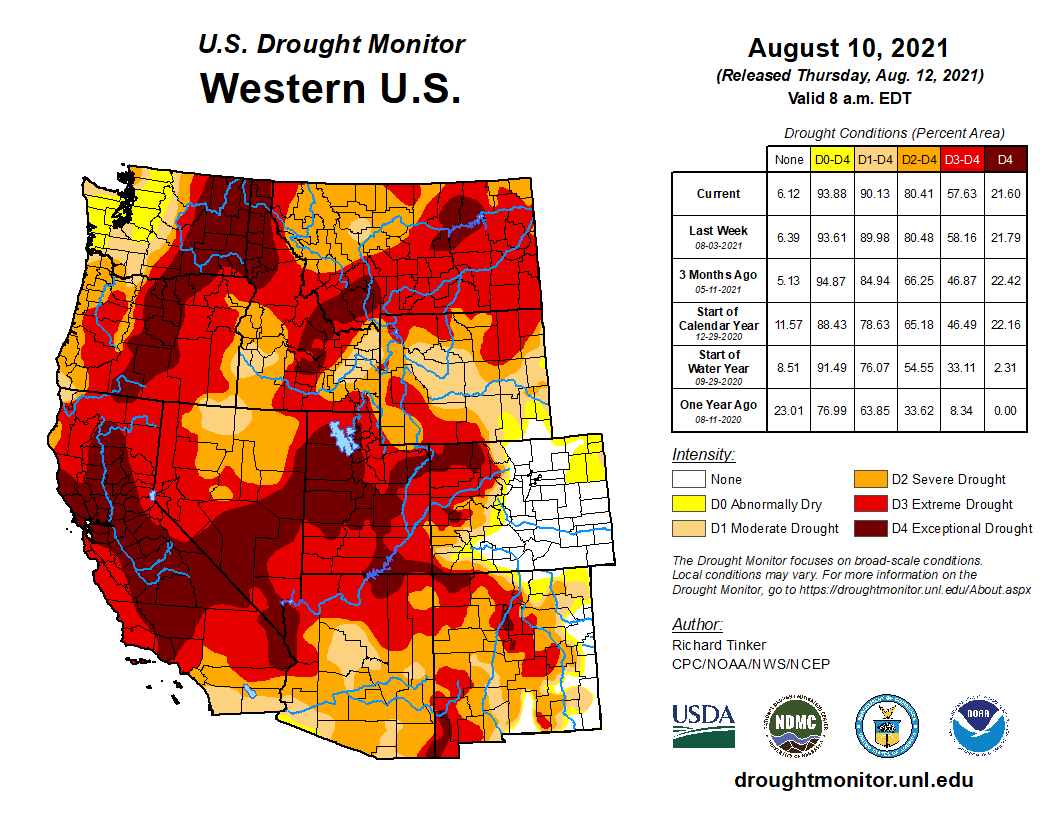
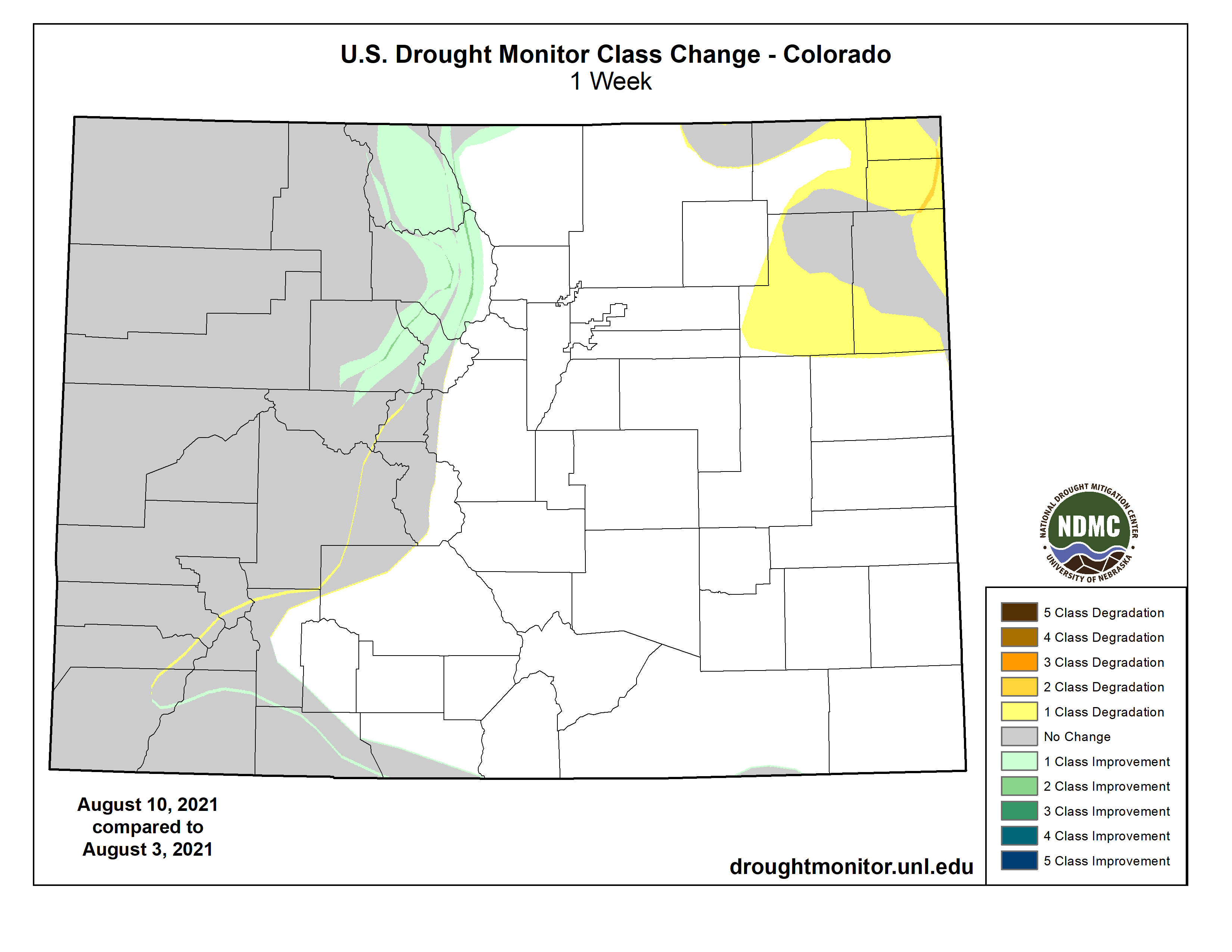
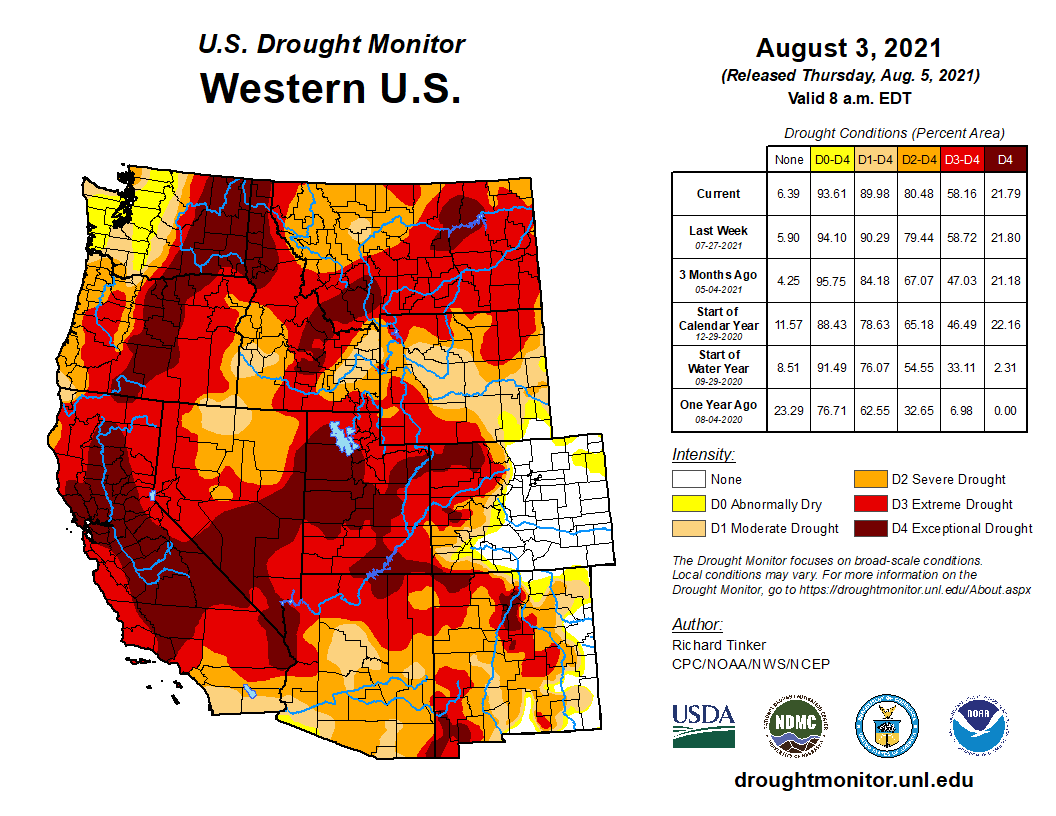
West Drought Monitor map August 10, 2021.
Federal water managers said the first shortage declaration shows how severe the drought has become and how climate change is having serious effects on the river…
“The Bureau of Reclamation cannot control the hydrology. And we also recognize the very real possibility that the hydrology that was planned for years ago may not be the worst that the basin may see in the future,” Touton said. “This may also mean that additional actions will likely be necessary in the very near future.”
[…]
The cuts will be the largest to date on the river, shrinking the flow of water through the 336-mile Central Arizona Project Canal, which for more than three decades has supplied Arizona’s growing desert cites and vast stretches of farmlands.
Farmers in part of central Arizona will face major cutbacks in water deliveries next year, and they’re preparing for the supplies to be entirely shut off in 2023. The reductions will force growers in Pinal County to leave some fields dry and unplanted, while the state is providing funds to help local irrigation districts drill wells to pump more groundwater.
“The cutbacks are happening. The water’s not there,” said Will Thelander, whose family has been farming in Arizona for three generations. “We’ll shrink as much as we can until we go away. That’s all the future basically is.”
[…]
The announcement from the Bureau of Reclamation, which is based on projected reservoir levels over the next two years, also shows that even bigger cuts are possible in 2023 and 2024, meaning some Arizona cities could begin to see their water deliveries slashed as well.
The level of Lake Mead is projected to end the year at an elevation of 1,065 feet, putting the river’s Lower Basin in what’s called a tier-one shortage. The government’s estimates show the reservoir is likely to continue to fall in subsequent years toward lower-level shortages that would bring larger cuts.
The reductions are taking effect under a 2019 agreement called the Drought Contingency Plan, which was aimed at reducing the risks of Lake Mead falling to critical lows. But as extreme heat and unrelenting drought have persisted across much of the watershed, the levels of the Colorado’s largest reservoirs have fallen faster than had been expected.
“There’s no doubt that climate change is real. We’re experiencing it every day in the Colorado River Basin and in other basins in the West,” Assistant Secretary for Water and Science Tanya Trujillo said. “I think the best strategy for planning is to think about a broad range of scenarios and a broad range of potential hydrology, and to work closely with our partners in the basin to try to think through all of those scenarios.”
The 2019 drought agreement included a backstop provision that called for the states to reconvene to consider additional measures, if necessary, to guard against the risk of Lake Mead falling to critically low levels below the elevation of 1,020 feet. Tom Buschatzke, director of the Arizona Department of Water Resources, said the state’s officials have begun to meet to discuss options with representatives of California and Nevada.
While they haven’t yet determined exactly what additional actions they may take, Buschatzke said, the possible steps include reducing the amounts taken from Lake Mead and conserving water in the reservoir…
Representatives of Nevada and California echoed that willingness to cooperate.
“We must adapt to the new reality of a warmer, drier future,” said John Entsminger of the Southern Nevada Water Authority. “While the future is sobering, we are in this together.”
[…]
With Lake Mead projected to continue dropping, water researchers have also warned that the cuts agreed to under the 2019 agreement now are insufficient to deal with the severity of the situation, and that the region will soon need bigger efforts to adapt.
“We’re in an all-hands-on-deck situation. And we have to figure out how we get along with less Colorado River water coming into the state,” said Sarah Porter, director of the Kyl Center for Water Policy at Arizona State University. “I would say that everything’s on the table. How do we continue to have our cities and our economy and quality of life and prosperity on significantly less Colorado River water?”
Porter said the rapid declines of the river’s reservoirs show that the 2019 drought deal won’t be enough and that Arizona and neighboring states need to “figure out strategies to make sure that the Colorado system can stay functional” over the next several years…
Growers in Pinal County have said they may have to stop irrigating about a third of the area’s farmlands, leaving them dry and fallow…
Growers in Pinal County have known for years that their supply of CAP water would eventually be cut off, with a 2004 settlement outlining a schedule of decreasing water deliveries between 2017 and 2030. But the 2019 shortage agreement and the deteriorating conditions at Lake Mead have meant that Pinal farmers will lose their supply of Colorado River water much sooner…
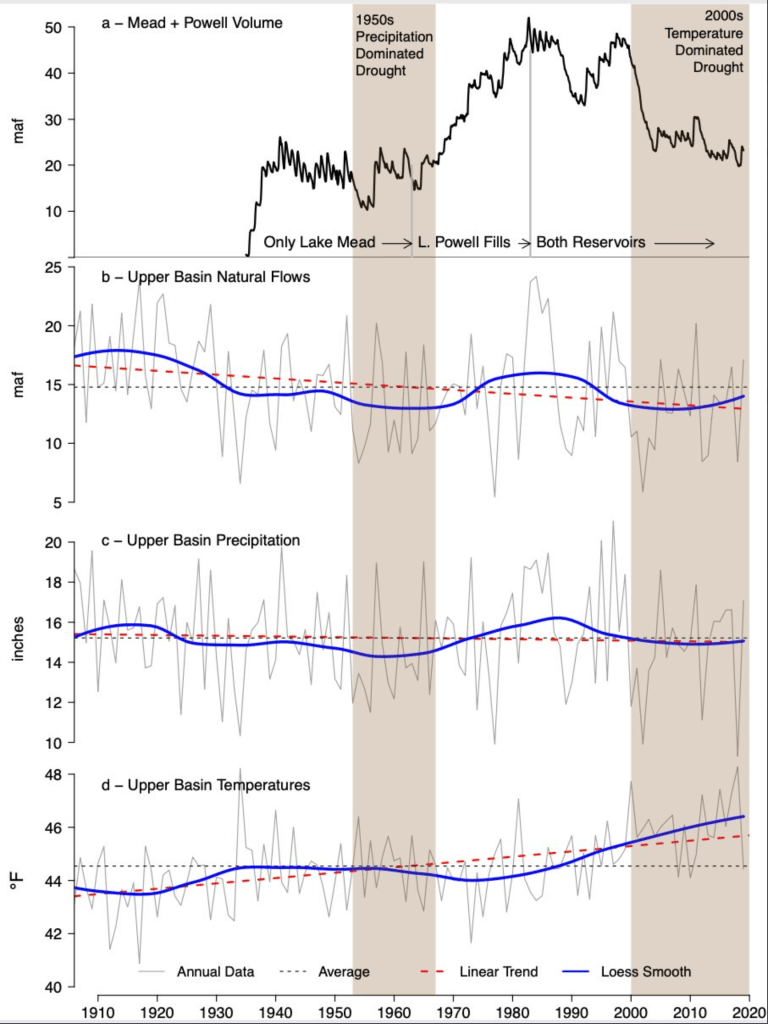
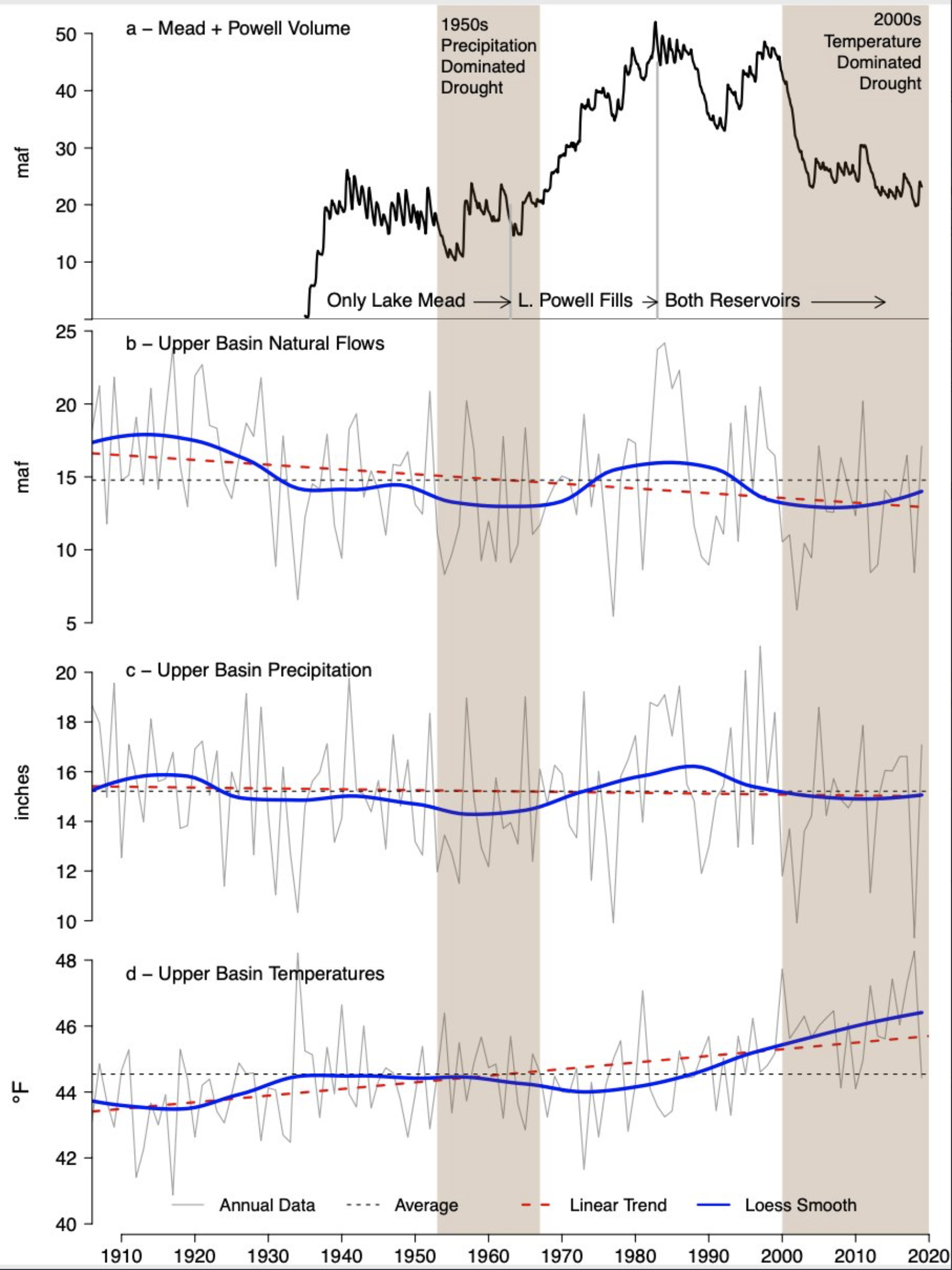
Brad Udall: Here’s the latest version of my 4-Panel plot thru Water Year (Oct-Sep) of 2019 of the #coriver big reservoirs, natural flows, precipitation, and temperature. Data goes back or 1906 (or 1935 for reservoirs.) This updates previous work with @GreatLakesPeck
Water’s retreat has accelerated
The Colorado River provides water for cities, tribal nations and about 4.5 million acres of farmland from Wyoming to the U.S.-Mexico border. About 70% of the water diverted from the river in the U.S. is used for agriculture, flowing to fields of hay and cotton, fruit orchards and farms that produce much of the country’s winter vegetables.
The watershed has been hit by one of the driest 22-year periods in centuries. Scientists describe the past two decades as a megadrought worsened by climate change, and say long-term “aridification” of the Colorado River Basin will require the region to adopt substantial changes to adapt to getting less water from the river.
In 2000, Lake Mead was nearly full. Since then, the water level in the reservoir has fallen about 147 feet, leaving a growing “bathtub ring” of minerals coating the rocky shores. The water’s retreat has accelerated over the past year during months of severe drought and extreme heat…
Arizona and Nevada took less water from the river in 2020 and 2021 under the agreement among Lower Basin states, and Mexico has been contributing water agreed under a separate accord to help the levels of Lake Mead.
California agreed to start taking cuts at a lower trigger point (1,045 feet) if the reservoir continues to fall — which the latest projections show could occur in 2024.
When the deal was signed, some of the states’ representatives described the agreement as a temporary “bridge” solution to lessen the risks of a crash and buy time through 2026, by which time new rules for sharing shortages will need to be negotiated and adopted.
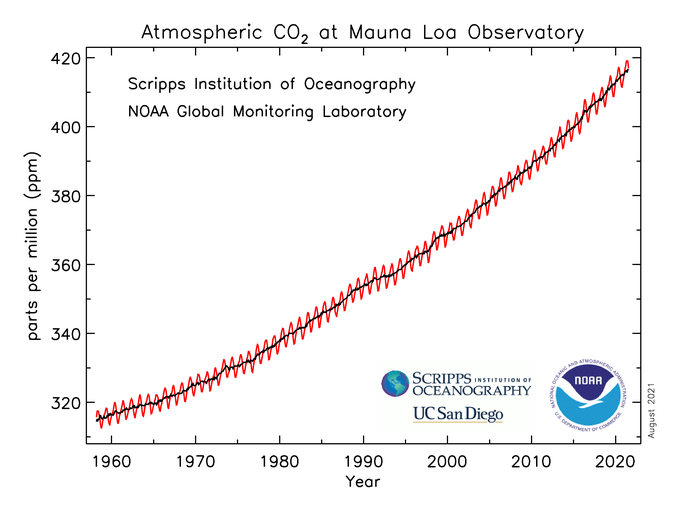
Atmospheric CO2 at Mauna Loa Observatory August 7, 2021.
Climate change ‘is making us face this reality quicker’
The deal wasn’t intended to prevent a shortage, which managers of water agencies have been expecting for the past few years. But the shortage has arrived sooner than officials and observers had hoped.
“We are in unprecedented territory,” said Haley Paul, policy director for the National Audubon Society in Arizona…
“In the end, hydrology is catching up to us and climate change is here and we’re hitting this new threshold,” Paul said. “Climate change is making us face this reality quicker than we would have otherwise. And we have no other choice but to learn to live with this smaller river.”
Scientific research has shown that the Colorado River watershed is sensitive to the higher temperatures caused by climate change, which intensify dry conditions and evaporate more moisture from the landscape. In a 2018 study, researchers found the river’s flow since 2000 had dropped 19 percent below the average of the past century, and that about half of the trend of decreasing runoff was due to unprecedented warming in the river basin.
Paul said the shortage might spur more water-efficiency innovation on top of what’s already been done, or more cultivation of crops that require less water.
“Does this shift how we farm? Both in the crops and the traditional ways of farming?” Paul said. “I think that it’s an opportunity for sure.”
One such crop is guayule, a shrub that tire manufacturer Bridgestone has been paying some farmers to grow while researching the crop as a new source of natural rubber for tires. Thelander said he’s one of two growers in his area who are experimenting with guayule, which requires much less water than cotton or alfalfa.
Dixon said he thinks there’s still a future for agriculture in Arizona if farmers make water-saving changes, like switching to drip irrigation, planting less water-intensive crops and improving management of watersheds. Dixon said he already has drip irrigation installed on some of his cotton fields, which he leases to another farmer, and plans to convert the remaining 120 acres to a drip system to save more water.
A canal delivers water to Phoenix. Photo credit: Allen Best
Cities face no cutbacks for now
Under a shortage, Arizona faces the largest reductions of any state.
Arizona gets about 36% of its water from the Colorado River, while other sources include groundwater and rivers such as the Salt and Verde. The state next year will lose 18% of its supplies from the Colorado River.
Arizona’s plan for dealing with the shortages involves deliveries of “mitigation” water to help temporarily lessen the blow for some farmers and other entities, as well as payments for those that contribute water. The state and CAP officials approved more than $100 million for these payments, with much of the funds going to the Colorado River Indian Tribes and the Gila River Indian Community for water they contributed…
The river’s shrinking flows have coincided with warnings from experts about insufficient water supplies for some of Arizona’s growing cities and suburbs.
Porter and fellow ASU researcher Kathleen Ferris said in a recent report that Arizona doesn’t have adequate measures in place to sustain groundwater, and that the state’s existing laws have allowed for unsustainable over-pumping in many areas. They said state leaders should reform the groundwater rules to safeguard these finite water reserves.
The state’s water agencies have for years been storing some imported Colorado River water in underground aquifers with the aim of using these reserves in the future when needed. The water has flowed into a network of basins, where the water has soaked down to recharge aquifers. The reductions in deliveries through the CAP Canal, however, have eliminated water that would have been available for replenishing groundwater…
Managers of the Arizona Department of Water Resources have also sought to halt approvals for new development dependent on groundwater in Pinal County.
In 2019, the agency’s officials said their data showed the county doesn’t have enough groundwater to provide for all of its planned subdivisions over the coming decades. And during a meeting this June, Deputy Director Clint Chandler laid out the agency’s position: “The days of utilizing native groundwater for development in Pinal are over. It’s done.”
He said ADWR won’t approve new “assured water supply” applications for development reliant on groundwater in Pinal. Those who want to develop in Pinal, he said, “will need to bring their own, non-groundwater supplies.”
In Pinal and other areas, new subdivisions have often been built on former agricultural land. Porter said farmers in Pinal have been “waking up to the fact” that if they heavily draw down the groundwater in the years to come, that could lead to long-term declines in the value of their land…
A new approach to managing the river?
The sorts of struggles that farmers are facing in Pinal could soon spread to other parts of the Southwest.
Paul said dealing with the new reality on the Colorado River will require looking at a wide range of short-term and long-term approaches for adapting to less water, and also examining in detail how severe the shortages might become as negotiations move forward on plans for new rules after 2026…
And while this summer’s monsoon rains have brought flooding and a burst of green vegetation in the Arizona desert, much of the Colorado River watershed remains in an extreme drought.
To address the chronic water deficit on the Colorado River, managers of water agencies have been discussing a variety of other possible steps, such as investing in more wastewater recycling and desalination, and scaling up programs that pay farmers to temporarily leave some fields dry.
But critics have argued that the Colorado River needs to be managed differently as climate change and drought take a worsening toll on the watershed…
“You have this largest reservoir in the nation going empty. There is more water coming out than there is going in,” said J.B. Hamby, vice president of California’s Imperial Irrigation District, which holds the largest single water entitlement on the river.
“Things like continued sprawl, demands for new sources of water being taken from this declining stream, which is the Colorado River, does not make sense when we’re dealing with what could be potentially catastrophic,” Hamby said.
He said everyone needs to recognize the Colorado River is now in “an era of limits” that requires everyone along the river to understand that water use must be limited. He and others stressed that the water level at Lake Mead has been getting closer to 895 feet, a point called “dead pool” at which water would no longer pass at Hoover Dam.
Graphic via the Arizona Department of Water Resources and the Central Arizona Project
Here’s a release from the Arizona Department of Water Resources and the Central Arizona Project:
The Colorado River Basin continues to experience drought and the impacts of hotter and drier conditions. Based on the Jan. 1 projected level of Lake Mead at 1,065.85 feet above sea level, the U.S. Secretary of the Interior has declared the first-ever Tier 1 shortage for Colorado River operations in 2022.
This Tier 1 shortage will result in a substantial cut to Arizona’s share of the Colorado River – about 30% of Central Arizona Project’s normal supply; nearly 18% of Arizona’s total Colorado River supply; and less than 8% of Arizona’s total water use. Nearly all the reductions within Arizona will be borne by Central Arizona Project (CAP) water users. In 2022, reductions will be determined by Arizona’s priority system – the result will be less available Colorado River water for central Arizona agricultural users.
While Arizona will take the required mandatory reductions under a Tier 1 shortage, the reductions to CAP water users will be partially mitigated by resources that have been set aside in advance for this purpose.
“The 2019 Drought Contingency Plan put in place agreements and Arizona water users have taken collective action to mitigate reduced CAP water for affected municipalities, tribes and CAP agriculture,” said Ted Cooke, general manager, Central Arizona Project. “These DCP near-term actions will provide relief from reductions that will occur in 2022 as a result of a Tier 1 shortage.”
Given the recent intensification of the drought, deeper levels of shortage are likely in the next few years. As impacts of drought persist, additional reductions to CAP water users are likely to occur pursuant to the DCP. Such reductions would include impacts to CAP water currently available to some central Arizona municipalities and tribes.
The near-record low runoff in the Colorado River in 2021 significantly reduced storage in Lake Powell. The reduction in storage, combined with projections for future months, has triggered provisions of the 2019 Drought Contingency Plan designed to protect critical elevations in Lake Powell and Lake Mead through additional collective actions.
“ADWR and CAP are working collaboratively with Arizona stakeholders and the Basin States to deploy more adaptive measures consistent with the Drought Contingency Plan and associated agreements,” said Tom Buschatzke, director, Arizona Department of Water Resources. “At the same time, ADWR and CAP will continue to work with partners within Arizona and across the Basin to develop and implement longer-term solutions to the shared risks we all face on the Colorado River now and into the future.”
Buschatzke continued, “We in Arizona have acted and will continue to act to protect the water resources of our state and of the Colorado River system overall.”
From the Colorado Conservation Tillage Association via The Sterling Journal-Advocate:
The Colorado Conservation Tillage Association will offer certified crop adviser credits for 29 sessions at the High Plains No-Till Conference on Aug. 24-25 in Burlington. One continuing education credit for licensed qualified supervisors, certified operators, and private applicators will also be available.
Geared toward supporting producers in the High Plains region, this year’s event will take place at the Burlington Community and Education Center. Joni Mitchek, CCTA Coordinator, said the crop adviser credits approved include seven in Nutrient Management, three in Soil and Water Management, one in Integrated Pest Management, 15 in Crop Management, and three in Professional Development.
“We are excited to be able to offer this selection of credits and educational sessions for this year,” Mitchek said. “Whether attendees would like to learn more about cover crops and grazing management or carbon markets and estate planning, there will be a great slate of speakers to hear from throughout the conference.”
Among the speakers scheduled to present at the event are keynotes Alejandro Carrillo, Loran Steinlage, and Dr. James White. Carrillo specializes in adaptive grazing in brittle environments, while Steinlage is a no-till producer from Iowa, and Dr. White is a professor of plant biology at Rutgers University.
Other highlights for the High Plains No-Till Conference include an ag-specific trade show, outdoor equipment display, and Beer & Bull Social. A full schedule and more information about the High Plains No-Till Conference can be found online at http://www.HighPlainsNoTill.com.
Online registration is available through Aug. 20, and walk-ins are welcome for the event. The $180 registration fee includes lunches, snacks, and access to all sessions and the trade show for both days.
Additional questions may be directed to Joni Mitchek at 1-833-466-8455 or coordinator@highplainsnotill.com.
The one item on the agenda was Ordinance 11-21 (passed unanimously) which amends chapter 13.24 of the Estes Park Municipal Code (MC) regarding agreements to provide raw water.
According to a memo to the board from Utilities Director Rueben Bergsten and Water Superintendent Chris Eshelman, the amendment is to assure the responsible management of water resources by requiring Town Board approval for raw water agreements lasting more than a year.
“The responsible management of our raw water resources, I think we would all agree, is becoming more and more important,” [Rueben] Bergsten said at the meeting….
The question for the state as a whole, and Estes Park itself, is how many entities to allow access to our water resources and for how much?
“We do anticipate, as time goes by, more and more and more property owners are going to be coming to the Town of Estes Park asking for what’s called replacement water,” Bergsten told the board. “We do this for a lot of people. It’s a matter of keeping the local economy healthy.”
A typical client seeking replacement water is someone using well water, or river water for irrigation and have water needs that still outweigh their supply.
“The Town owns 300 acre-feet of Windy Gap water rights. Windy Gap water can fulfill augmentation plan requirements for replacement water,” the memo said. “The Town has occasionally entered into long-term agreements with entities to supply replacement water.”
The most recent agreements made were: Preuss in July 2020, Idlewild in April 2019, and Cheley Camp in May 2012.”
Bergsten and Eshelman believe these raw water lease agreements are beneficial to the local economy and the surrounding communities; however, they tie up the town’s water rights.
“Town Staff foresee an increase in the number of replacement water requests as the State Water Commissioner increases their effort to audit augmentation plans,” the memo said. “Their audits included private wells.”
While requiring Town Board approval for raw water agreements lasting more than a year does have advantages such as reducing the administrative workload required to account for water use and augmentation, and supporting the responsible management of the town’s water, Bergsten and Eshelman are mildly concerned they may appear to be over reaching.
“Requiring properties to connect to our system might appear heavy-handed; however, their alternative requires them to pay an engineering firm to develop an augmentation plan, hire a lawyer to process the augmentation through water court, and secure replacement water from the Town,” the memo explains.
The San Juan River’s Navajo Dam and reservoir. Photo credit: U.S. Bureau of Reclamation
From email from Reclamation (Susan Novak Behery):
In response to increasing flows in the critical habitat reach and a forecast wetter weather pattern, the Bureau of Reclamation has scheduled a decrease in the release from Navajo Dam from 900 cubic feet per second (cfs) to 800 cfs on Tuesday, August 17th, starting at 4:00 AM. Releases are made for the authorized purposes of the Navajo Unit, and to attempt to maintain a target base flow through the endangered fish critical habitat reach of the San Juan River (Farmington to Lake Powell).
The San Juan River Basin Recovery Implementation Program recommends a target base flow of between 500 cfs and 1,000 cfs through the critical habitat area. The target base flow is calculated as the weekly average of gaged flows throughout the critical habitat area from Farmington to Lake Powell.
“As Congress looks to build toward America’s future it should also help bring birds back,” said Sarah Greenberger, senior vice president of conservation policy, National Audubon Society. “The Migratory Bird Protection Act will strengthen baseline protections for birds at a critical time. We have lost 3 billion birds in North America since 1970 and climate change threatens extinction for two-thirds of bird species. Birds are telling us they are in trouble and we are running out of time to act.”
In an effort to strengthen the century-old Migratory Bird Treaty Act, a bipartisan group of co-sponsors in the U.S. House of Representatives, led by Rep. Alan Lowenthal (D-CA) and Rep. Brian Fitzpatrick (R-PA), introduced the Migratory Bird Protection Act [July 29, 2021]. The new bill will reinforce longstanding bird protections that have been under attack while creating more certainty for business and creating incentives for innovation to protect birds. It was also introduced in the last Congress where it passed out of committee and gained more than 90 Democratic and Republican cosponsors.
The bill would secure protections for birds and direct the Fish and Wildlife Service (FWS) to develop a permitting process for “incidental take” through which relevant businesses would implement best management practices and document compliance, further driving innovation in how to best prevent bird deaths.
“Under these changes, we’ll be able to reduce avoidable harm to birds from industrial hazards and improve our understanding of impacts to bird populations, all while providing businesses the certainty they want and need from the MBTA,” said Erik Schneider, policy manager for the National Audubon Society.
If passed, the MBPA would establish a new fee paid by industry that will increase funding for the conservation of birds impacted by these industrial hazards and an additional fund to establish a new federal research program that will study industry impacts on birds and best management practices.
The Biden administration is also pursuing a rulemaking process that similarly aims to reinstate “incidental take” protections stripped away by the previous administration. The change by the Trump administration was aimed at limiting the MBTA’s protections only to activities that purposefully kill birds, exempting all industrial hazards from enforcement. Any “incidental” death—no matter how inevitable, avoidable or devastating to birds—became immune from enforcement under the law. If this change had been in place in 2010, BP would have faced no consequences under the MBTA for the more than one million birds killed in the Deepwater Horizon oil spill.
“This bill would build on the administration’s actions and strengthen the MBTA for the future,” added Schneider.
The reversal by the Trump administration generated widespread and bipartisan opposition. More than 25 states, numerous tribal governments, scientists, sportsmen, birdwatchers, and 250,000 people submitted comments opposing the proposed rule change, and several conservation organizations and eight attorneys general filed litigation to challenge the rule change.
“Over the last century the MBTA has been critical to protecting birds, including spurring the recovery of the Snowy Egret, the Sandhill Crane, and the Wood Duck,” said Schneider.
Facts and figures on industrial causes of bird mortality in the United States:
The effects of climate change are being exacerbated by a century of bad policy
There are two main reasons water shortages loom. The first is climate change. Both reservoirs straddle the Colorado River as it meanders from its headwaters in the Rocky Mountains down through the desert south-west to northern Mexico (see map). Warmer winters caused by rising greenhouse-gas emissions have diminished the snowpack that melts into the river each spring. In addition, parched soils have soaked up some of the runoff before it can reach Mead and Powell. Since 2000, when the so-called “Millennium Drought” began, the river’s annual flow has shrunk by nearly 20%. Multiple studies in the past five years have attributed up to half of that decline to human-caused climate change.
Second, poor policy choices 100 years ago all but guaranteed that the water available to westerners could never meet expectations. After laws such as the Homestead Act encouraged white settlers to move West in the second half of the 19th century, the federal government financed the dams and pipelines needed for cities and agriculture to thrive in the desert. “By moving water around from more water-rich areas to water-poor areas, we sort of enabled these people to migrate and settle,” says Newsha Ajami of Stanford University. “Regardless of the fact that it’s dry, or it’s hot—if the water is flowing, you think anything is possible.”
Boosterism for shiny new reclamation projects in the early 1900s led to dubious decision-making. The Colorado River Compact, which divvied up the river in 1922, used data from historically wet years to estimate the average annual flows. John Fleck, the director of water resources at the University of New Mexico, says a government scientist was ignored when he testified in the 1920s that the river could not meet its projected demands. The compact and its addendums, known as “the law of the river”, hold that the seven states and Mexico are to split 20.4bn cubic metres of water each year (or in American terms 16.5 million acre-foot of water, where an acre-foot is the amount of water it would take to submerge one acre of land one foot deep.) The river has not lived up to those aspirational figures, says Brad Udall, a climate scientist at Colorado State University. Between 1906 and 1999 annual flows averaged 15.2m acre-feet; since 2000 the river has mustered only 12.4m.
Drought almost seems too puny a word to describe the water scarcity that the south-west is experiencing. “In some ways drought implies that it’s ephemeral,” says Kristen Averyt, Nevada’s climate policy coordinator. But the region’s future could be hotter and drier still, according to the most recent report from the Intergovernmental Panel on Climate Change. When discussing the outlook for Las Vegas, John Entsminger, who runs the Southern Nevada Water Authority (SNWA), prefers to talk in terms of aridification, or the long-term drying of the region. “I’m past talking about droughts,” he says.
The region’s rich cities have been planning for this. Los Angeles, San Diego, Phoenix and Las Vegas all get water from the Colorado River—and all have diversified their water supplies. Investing in conservation, recycling programmes and desalination technology has allowed south-western metros to save water even while their populations have soared.
Perhaps no place is more spooked by Lake Mead’s decline than the Las Vegas valley, which gets 90% of its water from the nearby reservoir. That dependence has spurred innovation. All water that goes down a drain is recycled, according to SNWA, and the city has ripped out grass in favour of desert landscaping. These measures, along with water restrictions and incentives, helped the valley cut its water use by 23% since 2002 while adding about 800,000 residents to its population. “People always assume that population growth and water consumption is more or less a one-to-one correlation,” says Mr Entsminger. But “you can add more people to the equation and simultaneously use less water.”
A herd of elk could be seen roaming amid the irrigation sprinklers of Crystal River Ranch on Thursday. Ranch owner Sue Anschutz-Rodgers has told the state she is making progress toward building two dams and reservoirs on the property. Photo credit: Heather Sackett/Aspen Journalism
But cities only account for a fraction of water use on the Colorado. Irrigated agriculture slurps up about 70% of the river each year. Cuts to the water supply may push farmers to grow different crops, fallow fields or return to pumping groundwater to get by. Pumping isn’t a sustainable option either. Years of overuse have depleted aquifers in parts of Arizona and California.
Meanwhile, some demands on the river are growing. Thanks to generations of neglect, many Native American households do not have access to clean drinking water. Tribes also lack the plumbing needed to take the water they already have rights to. The bipartisan infrastructure bill that passed the Senate last week includes $6bn to help remedy that. As the river shrinks, will such attempts to right enduring wrongs go down the drain?
Lake Mead behind Hoover Dam. Lake Mead last month fell to its lowest level since the Hoover Dam was built in 1936. The shoreline has dropped 45 meters since the reservoir was last full in 2000. Photo by Ken Neubecker via American Rivers
Oh, this level of shortage will be painful, especially for farmers in Pinal County who are losing their only source of renewable water. They have no option other than to turn back to groundwater, which already has dwindled to the point that it cannot meet the long-term demands of all Pinal users. Some farmers are already beginning to make tough choices about which fields to fallow and which of their most productive lands are worth saving.
But cities in metro Phoenix will not yet feel any ill effects of a Tier 1 shortage (and few will notice the impacts of a deeper Tier 2 shortage, a growing possibility for 2023). And those with the highest priority on-river water are even more insulated from pain, even if things get worse than that.
A Tier 1 shortage isn’t our problem now
Arizona has known for years that this day would come. We planned for it in a statewide implementation plan, which provides a complex web of temporary water supplies and compensation to help those who must shoulder these cuts. The plan gets progressively more painful, especially once we hit a Tier 3 shortage that will impact even the largest cities in metro Phoenix, but it’s all spelled out.
Brad Udall: Here’s the latest version of my 4-Panel plot thru Water Year (Oct-Sep) of 2019 of the #coriver big reservoirs, natural flows, precipitation, and temperature. Data goes back or 1906 (or 1935 for reservoirs.) This updates previous work with @GreatLakesPeck
If anything, the measured progression of cuts provides a bit of certainty in the chaos of the hotter, drier, more unpredictable future we face.
So, while I know everyone will be talking about this first shortage because it’s new, and for those who haven’t been following the situation, reading the words “water shortage” will seem scary, forgive me if I view it as old hat.
The Tier 1 declaration isn’t our problem. It’s the other numbers contained in the reports that also will be released on Aug. 16, which have turned grim with a speed that has surprised even the experts. The upstream Lake Powell is dropping quickly, thanks to already low lake levels and near-record low runoff this year. The lower Powell falls, the less water Lake Mead gets.
That’s our problem.
It’s likely that we are in for multiple years of 7.48 million acre-feet releases, down from the 8.23 million acre-feet (or more) releases on which we have come to rely. This is consequential, considering that until now we’ve only had one 7.48 million acre-feet release in 2014, when Lake Mead was nowhere near shortage levels.
Lake levels never recovered from that lower release.
Less water from Lake Powell is driving the tank
And now Mead, which is V-shaped, is significantly lower in elevation – meaning it takes progressively less water to lower lake levels. Multiple years of 7.48 million acre-feet releases will cause lake levels to plummet (the forecast already says two in a row are likely, and that there’s a decent chance of them continuing through 2025).
In fact, the latest modeling suggests there may be nearly a 40% chance of Lake Mead reaching a Tier 3 shortage – the most severe for which we have planned – by 2025.
And if the projections hold, the states that rely on Mead could be meeting as soon as November to decide what other actions we can take (likely, it’ll be even more cuts) to keep the lake from falling below a critically low level of 1,020 feet of elevation. The modeling suggests that if we do nothing additional, the lake could drop to near 1,000 feet in a worst case by 2025.
Consider that. Arizona could take its worst-case 720,000 acre-feet of cuts in a Tier 3 shortage and still the lake could tank.
We must conserve – and by “we,” I don’t just mean Arizona. Demand certainly drives part of the equation for why Mead is dropping, which means we all need to use less. Permanently.
But so does supply, and if the lake could get 750,000 acre-feet less than usual for several years – or maybe from here on out, in an effort to keep Lake Powell from tanking – this can’t just fall on Arizona’s shoulders, even if we are the state with the junior-most water rights.
Whatever we do, it must be a shared sacrifice
The good news is that other basin states seem to recognize this, that if the lakes have any hope at sustainability, it’s going to require an additional shared sacrifice to get them there.
What that sacrifice looks like is anyone’s guess. Everyone knows it will be painful, which also will make it hard for everyone to swallow. The name of the game will be to choose actions that everyone can live with, not one that everyone likes.
Because we’ve entered a new era of shortage. This is our reality, our new normal – and, in fact, it probably won’t be long before we consider a Tier 1 shortage as a time of excess.
It can and probably will get worse from here, and yes, we’re planning for that, too. So that when that day arrives, we can say we’ve got this.
It’s going to hurt. But there is no need to freak out.
Reach Allhands at joanna.allhands@arizonarepublic.com. On Twitter: @joannaallhands.
The Julesburg Town Board may be changing directions on its waste water project after listening to Brad Simons with MMI Water Engineers. Simons told the board that after reviewing the plans previously provided to him, he is agreeing more with former Trustee Todd Blochowitz that the town may be putting the cart before the horse. Blochowitz had made the remarks earlier in the year at a public meeting. Simons said after reviewing the proposed wastewater project that the design may still not meet the state’s required effluent discharge.
He suggested that the town pause briefly and research reversing their priorities and focus on the water project which may have a larger effect on correcting the problem at the wastewater facility. The water project would include upgrading of the reverse osmosis equipment that is 20 years old.
Northern Water’s board of directors unanimously overturned the city of Fort Collins’ denial of infrastructure associated with the Northern Integrated Supply Project, clearing the way Wednesday for construction of a pipeline and Poudre River diversion in city limits.
Fort Collins’ Planning and Zoning Commission rejected a SPAR (site plan advisory review) application for NISP infrastructure in a 3-2 vote on June 30. But state law allows governing boards to overrule denials of SPAR applications for public infrastructure with at least a two-thirds majority vote.
The Northern Water board’s decision means the water district, after getting the necessary city permits, should be able to build a river diversion on the Poudre at Homestead Natural Area and about 3.4 miles of pipeline in city limits. The diversion and pipeline are part of Northern Water’s plan to release between 18-25 cubic feet per second of the project’s Poudre River diversions through a 12-mile section of the river in Fort Collins before piping it to NISP participants.
NISP would take water from the Poudre and South Platte rivers to deliver an estimated 40,000 acre-feet of water annually to 15 small municipalities and water districts in Northern Colorado, including Fort Collins-Loveland Water District and Windsor. The water would be stored in two new reservoirs: Glade Reservoir, with a capacity of 170,000 acre-feet located northwest of Fort Collins at the mouth of the Poudre Canyon, and Galeton Reservoir, with a capacity of 45,600 acre-feet located northeast of Greeley.
New plating at the Glenwood Springs water intake on Grizzly Creek was installed by the city to protect the system’s valve controls and screen before next spring’s snowmelt scours the Grizzly Creek burn zone and potentially clogs the creek with debris. (Provided by the City of Glenwood Springs)
Glenwood Springs mayor, staff express confidence in $3.2 million water system investment in wake of 2020’s Grizzly Creek Fire
Recent upgrades to Glenwood Springs’ water infrastructure likely prevented a July 31 and Aug. 1 deluge from overcoming the city’s water filtration system, Glenwood Springs Public Works director said.
The record-breaking rainfall, which dumped up to 2 inches of precipitation in an hour near Coffee Pot Road and caused severe mudslides, pushed a significant amount of sediment-laden water toward the city’s water intakes at Grizzly Creek/No Name Creek and Roaring Fork River within a matter of hours.
“The water we had simply wasn’t usable at that point,” Public Works Director Matt Langhorst said, explaining the water’s turbidity levels during the storms shot up to 4,000 Nephelometric Turbidity Units, a measurement of water cloudiness.
The city’s intakes typically experience a turbidity level of about 4-7 NTU in a system that treats about 4.5 million to 4.7 million gallons of water daily during the summer. It might have taken days to drain the storm-induced sediment out of the city’s settling tanks without the city’s $3.2 million infrastructure upgrade, Langhorst said…
Below is a look at the city’s upgrades at work during the storms:
• Bank armoring at the No Name and Grizzly Creek intakes stabilized the earth around the intakes during the heavy rain and mud events.
• The automated gate at No Name Tunnel quickly gauged elevated levels of sediment in the intake and closed off the pipeline to the water treatment plant, preventing water lines from becoming inundated with mud.
• The treatment plant’s stainless steel settling plates, which replaced plastic settling plates, increased the settling area square-footage by 28%, allowing the new sediment pumps to push sediment out of the water system at a much faster rate, according to Glenwood Springs spokesperson Bryana Starbuck and Water Treatment Plant Chief Operator Mike Hedrick.
New census data puts a number to how popular Colorado has become. The state expanded by more than 700,000 people from 2010 to 2020.
Denver and El Paso counties grew by more than 100,000 people in that same time frame, according to an analysis by 9Wants to Know. All of that is putting pressure on systems that were already stressed.
“Transportation systems, housing systems, food systems, water and energy,” said Brenna Simmons-St. Onge, Executive Director of the Alliance Center, which works on sustainability solutions.
As cost of living goes up, there are more developments farther out, which can mean longer commutes and more emissions.
More people are also settling down in the wildland urban interface, which becomes a problems with wildfire…
When it comes to water, resources from the Colorado River were already over-allocated from a pact dating back to the 1920s. Couple that with warming temperatures and drought, Assistant State Climatologist Becky Bolinger said that is adding more pressure.
July 2021 was the warmest July on record for the globe; global land surface was also record warm
The global temperature for July 2021 was the highest for July in the 142-year NOAA record, which dates back to 1880. The year-to-date (January-July) global surface temperature tied as the sixth highest on record. According to NCEI’s Global Annual Temperature Rankings Outlook, it is very likely that the year 2021 will rank among the 10 warmest years on record.
This monthly summary, developed by scientists at NOAA’s National Centers for Environmental Information, is part of the suite of climate services NOAA provides to government, business, academia and the public to support informed decision-making.
Monthly Global Temperature
The July 2021 global surface temperature was 1.67°F (0.93°C) above the 20th-century average of 60.4°F (15.8°C) — the highest for July in the 142-year record. This value was only 0.02°F (0.01°C) higher than the previous record set in 2016, and tied in 2019 and 2020. The seven warmest Julys have all occurred since 2015. July 2021 marked the 45th consecutive July and the 439th consecutive month with temperatures, at least nominally, above the 20th-century average.
Climatologically, July is the warmest month of the year. With July 2021 the warmest July on record, at least nominally, this resulted in the warmest month on record for the globe.
The global land-only surface temperature for July 2021 was 2.52°F (1.40°C) above average and the highest July for the land-only surface temperature on record, surpassing the previous record set in 2020 by 0.31°F (0.17°C). The warmth across the global land surfaces was mainly driven by the very warm Northern Hemisphere land, which also had its highest July temperature at 2.77°F (1.54°C) above average.
During the month, temperatures were much warmer than average across parts of North America, Europe, northern and southern South America, northern Africa, the southern half of Asia, Oceania and parts of the western and northern Pacific, the Atlantic and Indian Oceans. Temperatures were cooler than average across parts of northeastern Canada, the south-central and southeastern contiguous U.S., southern Africa, northern Russia and the southeastern Pacific Ocean.
Regionally, Asia had its warmest July on record, besting the previous record set in 2010. Europe had its second-warmest July (tied with 2010) on record, trailing behind the record warm July set in 2018. Meanwhile, North America, South America, Africa and Oceania had a top-10 warm July on record.
July Tropical Cyclones
In the Atlantic basin, one named storm formed during July 2021. Hurricane Elsa, which formed on July 1, was the earliest-forming fifth named storm in the Atlantic basin. The Eastern North and Western Pacific basins each had three named storms. Overall, the global tropical cyclone activity from January-July was above-normal for named storms.
July Sea Ice
July 2021 Arctic (left) and Antarctic (right) sea ice extent maps
The July 2021 Arctic sea ice extent was 687,000 square miles below the 1981-2010 average and was the fourth-smallest July sea ice extent in the 43-year record, according to an analysis by the National Snow and Ice Data Center (NSIDC) using data from NOAA and NASA. Only Julys of 2012, 2019 and 2020 had a smaller sea ice extent in July. The 10 smallest July sea ice extents for the Arctic have occurred since 2007.
The Antarctic sea ice extent during July 2021 was above average. The July Antarctic sea ice extent was 6.32 million square miles — the largest July sea ice extent since 2015 and the eighth highest in the 43-year record.
Elwood Mead in 1928. By Underwood & Underwood – This image is available from the United States Library of Congress's Prints and Photographs divisionunder the digital ID cph.3b30798.This tag does not indicate the copyright status of the attached work. A normal copyright tag is still required. See Commons:Licensing for more information., Public Domain, https://commons.wikimedia.org/w/index.php?curid=15933145
Biological carbon sequestration is the long-term storage of carbon in soils and vegetation resulting from applications of compost and mulch to land. Soils hold more carbon than the atmosphere or plant and animal life combined. Climate experts say no strategy to reduce climate change is complete without using the vast carbon sinks available in the world’s soils. Over the centuries, human activities have degraded soil, resulting in the loss of a significant portion of their carbon content to the air. Graphic credit: Cal Recycle
July 2021 has earned the unenviable distinction as the world’s hottest month ever recorded, according to new global data released today by NOAA’s National Centers for Environmental Information.
“In this case, first place is the worst place to be,” said NOAA Administrator Rick Spinrad, Ph.D. “July is typically the world’s warmest month of the year, but July 2021 outdid itself as the hottest July and month ever recorded. This new record adds to the disturbing and disruptive path that climate change has set for the globe.”
July 2021 by the numbers
Around the globe: the combined land and ocean-surface temperature was 1.67 degrees F (0.93 of a degree C) above the 20th-century average of 60.4 degrees F (15.8 degrees C), making it the hottest July since records began 142 years ago. It was 0.02 of a degree F (0.01 of a degree C) higher than the previous record set in July 2016, which was then tied in 2019 and 2020.
The Northern Hemisphere: the land-surface only temperature was the highest ever recorded for July, at an unprecedented 2.77 degrees F (1.54 degrees C) above average, surpassing the previous record set in 2012.
Regional records: Asia had its hottest July on record, besting the previous record set in 2010; Europe had its second-hottest July on record—tying with July 2010 and trailing behind July 2018; and North America, South America, Africa and Oceania all had a top-10 warmest July.
Extreme heat and global climate change
With last month’s data, it remains very likely that 2021 will rank among the world’s 10-warmest years on record, according to NCEI’s Global Annual Temperature Rankings Outlook.
Extreme heat detailed in NOAA’s monthly NCEI reports is also a reflection of the long-term changes outlined in a major report released this week by the Intergovernmental Panel on Climate Change offsite link.
“Scientists from across the globe delivered the most up-to-date assessment of the ways in which the climate is changing,” Spinrad said in a statement. “It is a sobering IPCC report that finds that human influence is, unequivocally, causing climate change, and it confirms the impacts are widespread and rapidly intensifying.”
A map of the world plotted with some of the most significant climate events that occurred during July 2021. Please see the story below as well as more details in the report summary from NOAA NCEI at http://bit.ly/Global202107. (NOAA NCEI)
Other notable highlights from NOAA’s July global climate report
Sea ice coverage varied by hemisphere: The Arctic sea ice coverage (extent) for July 2021 was the fourth-smallest for July in the 43-year record, according to analysis by the National Snow and Ice Data Center offsite link. Only July 2012, 2019 and 2020 had a smaller sea ice extent. Antarctic sea ice extent was above average in July — the largest July sea ice extent since 2015 and the eighth highest on record.
The tropics were busier than average: In the Atlantic basin, the season’s earliest fifth-named storm, Elsa, formed on July 1. The Eastern North and Western Pacific basins each logged three named storms. Overall, global tropical cyclone activity this year so far (through July) has been above-normal for the number of named storms.
Colorado Water Trust partnered with the city of Aspen on August 10, 2021 to reduce diversions from the Roaring Fork River at the Wheeler Ditch to help boost river flows. The project added up to three cubic feet per second to the river’s flow, which will help maintain sustainable water levels. A view of the Wheeler Ditch headgate, looking upriver on the Roaring Fork River. Photo credit: Brent Gardner-Smith / Aspen Journalism
A 10-year agreement between the city of Aspen and Colorado Water Trust will help keep the Roaring Fork River flowing at a healthy rate through the remainder of the summer season…
The project is meant to boost river flows and added up to three cubic feet per second of water to the river’s flow, which will help maintain sustainable water levels, according to a press release from Colorado Water Trust…
“The Roaring Fork is bone low,” Aspen’s utility resource manager Steve Hunter said. “I think every little bit helps — every little bit of water that we can leave in the Roaring Fork, anything we can do to help the fish, the wildlife, the recreation, all those things. Three cfs is a very small number, but we’re doing the best we can with what we have.”
The city uses a headgate at the Wheeler Ditch to store water, and on Tuesday, staff members adjusted it to allow one cfs into the ditch so that the rest of the water stays in the river, Hunter said. He added that it’s important for everyone in the Roaring Fork Valley, not only in Aspen, to do their best to conserve water, especially in back-to-back drought years.
“As we adapt to climate change in Colorado, we’re fortunate to have flexible water sharing tools like the one that allows the city to leave a portion of their Wheeler Ditch water right in the Roaring Fork River,” Colorado Water Trust Program Director Mickey O’Hara said in the press release. “These tools allow communities to build flow restoration projects that support the natural environment while boosting flows for the benefit of the local community.”
The next Aspinall Unit Operation Coordination Meeting will be conducted using Microsoft Teams (link). We are again using this format as an alternative to allow interactive participation, as we are not yet able to meet in person. No special software is required. Please contact me at rchristianson@usbr.gov or (970) 248-0652 if you have any questions. The proposed agenda:
Aspinall Unit Operation
Coordination Meeting
August 19th, 2021
Introductions and Purpose of Meeting
Gunnison Basin Water Supply Outlook – (CBRFC)
Weather Outlook – Aldis Strautins (NWS)
DROA Overview – Ed Warner (Reclamation)
Aspinall Unit Operations – Erik Knight (Reclamation)
American Whitewater Request
Special Flow Requests and Discussion
Reports of Agencies and Organizations – All
Conclusions
(Next meeting date – January 20th?)
Aspinall Unit
Aspinall Unit dams
Crystal Dam, part of the Colorado River Storage Project, Aspinall Unit. Credit Reclamation.
Morrow Point Dam spilling June 2014 via USBR
Morrow Point Dam, on the Gunnison River. Photo: Brent Gardner-Smith/Aspen Journalism
Crystal dam spilling May 2009
Blue Mesa Dam
A longer walk from the dock to the water is in store for boaters at the Elk Creek marina, Blue Mesa Reservoir. Blue Mesa is being drawn down to feed critically low Lake Powell, as continued dry weather and rising demand deplete the Colorado River. (Courtesy photo/National Park Service) August 2021.
Blue Mesa Reservoir, Curecanti National Recreation Area. Photo credit: Victoria Stauffenberg via Wikimedian Commons
Blue Mesa Reservoir September 2017
Blue Mesa Reservoir
Part of the memorial to Wayne Aspinall in Palisade. Aspinall, a Democrat, is a legend in the water sector, and is the namesake of the annual award given by the Colorado Water Congress. Photo: Brent Gardner-Smith/Aspen Journalism
Nanci Griffith, a Grammy-winning singer and songwriter who kept one foot in folk and the other in country and was blessed with a soaring voice equally at home in both genres, died on Friday. She was 68…
While Ms. Griffith often wrote political and confessional material, her best-loved songs were closely observed tales of small-town life, sometimes with painful details in the lyrics, but typically sung with a deceptive prettiness. Her song “Love at the Five and Dime,” for example, tracks a couple’s romance from its teenage origins when “Rita was 16 years/Hazel eyes and chestnut hair/She made the Woolworth counter shine” through old age, when “Eddie traveled with the barroom bands/till arthritis took his hands/Now he sells insurance on the side.”
The song was a country hit in 1986 — but for Kathy Mattea, not for Ms. Griffith. Similarly, while Ms. Griffith was the first person to record “From a Distance,” written by Julie Gold, the song was later a smash hit for Bette Midler.
Ms. Griffith sometimes affected a folkie casualness toward mainstream success. She told Rolling Stone in 1993 that she didn’t mind that Ms. Mattea had the hit version of “Love at the Five and Dime”: “It feels great that Kathy has to sing that for the rest of her life and I don’t.”
Nanci Caroline Griffith was born on July 6, 1953, in Seguin, Texas, about 35 miles northeast of San Antonio, to Marlin Griffith, a book publisher and singer in barbershop quartets, and Ruelen Strawser, a real estate agent and amateur actress. “I come from a basically really dysfunctional family,” she told Texas Monthly in 1999. “I had very, very irresponsible parents.”
When she was a child, her family moved to Austin…
By the time she was 12, Ms. Griffith was writing songs and playing in Austin clubs. A formative experience came when, as a teenager, she saw a performance by the melancholy Texas troubadour Townes Van Zandt; she particularly identified with his song “Tecumseh Valley,” about a doomed young woman named Caroline, and it became a staple of her songbook.
She told The New York Times in 1988: “When I was young I listened to Odetta records for hours and hours. Then when I started high school, Loretta Lynn came along. Before that, country music hadn’t had a guitar-playing woman who wrote her own songs.”
After attending the University of Texas, Ms. Griffith stayed in Austin. She worked as a kindergarten teacher while she pursued music, performing alongside the likes of Lucinda Williams, Lyle Lovett and Jimmie Dale Gilmore. She put aside finger paints when she won a songwriting award at the Kerrville Folk Festival in Texas; she released her first album, “There’s a Light Beyond These Woods,” in 1978. It was the first of four folk albums she would make for tiny labels in an eight-year span, during which she also toured constantly…
Ms. Griffith was a living link not just to earlier songwriters, but also to the music of Ireland (she played with the Chieftains) and Texas (she toured with the surviving members of Buddy Holly’s band, the Crickets)…
She kept playing through two bouts of cancer and a painful case of Dupuyten’s contracture, an abnormal thickening of the skin on the hand, which severely limited the mobility of her fingers…
In 1993, at age 39, when she had not yet won a Grammy and her commercial prospects were uncertain, Ms. Griffith told Rolling Stone what motivated her:
“Longevity — I guess that’s the brass ring for me. I still want to hear my music coming back to me when I’m 65.”
This intermittent stream is in a flowing state in April (left) and a dry state in September (right). North Fork of Bakers Fork, Wayne National Forest, Ohio, looking upstream. Photo credit: EPA
Small streams that dry up for part of the year are easy to overlook. But these intermittent streams are everywhere, making up more than half of Earth’s waterways. They help purify surface water and provide crucial habitat for creatures such as the Sonoran Desert toad, fairy shrimp, and Wilson’s warbler. Now, a study has found that ephemeral streams across the continental United States have become less reliable over the past 40 years, likely as a result of climate change. Some are dry for 100 days longer per year than in the 1980s. “That’s really shocking,” says Sarah Null, a watershed scientist at Utah State University.
The findings, reported last month in Environmental Research Letters, come from a study of data collected between 1980 and 2017 by flow gauges on 540 intermittent streams around the United States. Most of the gauges were on small waterways in river headwaters, but a few tracked large rivers that are intermittent in places, such as the Rio Grande, which flows sporadically in New Mexico and Texas. The sample covered just a small fraction of intermittent streams, the authors note, and left out some states, such as Nebraska and Maine, that don’t have any long-term gauges on these streams. Still, the analysis revealed some eye-opening regional shifts, says Sam Zipper, one of the authors and an ecohydrologist with the Kansas Geological Survey.
More than half of the gauges showed changes in the streams’ flow patterns since 1980. Some now shrivel earlier in the year and remain dry for longer, for example, or they dwindle more quickly than before. At some 7% of gauges, dry periods expanded by 100 days or more.
The drying trend is clearest in arid regions, such as the Southwest. But even in the Southeast, which is relatively wet, streams are drying earlier and staying dry longer. In contrast, in the northern United States ephemeral rivers are now flowing longer. One possible reason: Winters are warmer and shorter, meaning frozen landscapes thaw earlier, allowing streams to flow.
In some cases, human activities such as operating dams, irrigation, and groundwater pumping could be contributing to dewatering. But a warming climate appears to be “the overarching organizer” of the shifts, Zipper says. “I definitely didn’t expect the pattern to be so regionally clear.”
The San Juan River, below Navajo Reservoir. Photo: Brent Gardner-Smith/Aspen Journalism
From email from Reclamation (Susan Novak Behery):
In response to decreasing flows in the critical habitat reach, the Bureau of Reclamation has scheduled an increase in the release from Navajo Dam from 800 cubic feet per second (cfs) to 900 cfs on Saturday, August 14th, starting at 4:00 AM. Releases are made for the authorized purposes of the Navajo Unit, and to attempt to maintain a target base flow through the endangered fish critical habitat reach of the San Juan River (Farmington to Lake Powell).
The San Juan River Basin Recovery Implementation Program recommends a target base flow of between 500 cfs and 1,000 cfs through the critical habitat area. The target base flow is calculated as the weekly average of gaged flows throughout the critical habitat area from Farmington to Lake Powell.
As directed by the General Assembly, Dan Gibbs, the Executive Director of the Department of Natural Resources, convened the Work Group to explore ways to strengthen current water anti-speculation law. The Work Group included a diverse collection of Coloradans from the legal, nonprofit, municipal, and agricultural communities and from a variety of water basins throughout Colorado, and was co-chaired by Scott Steinbrecher, Assistant Deputy Attorney General and Kevin Rein, State Engineer as members.
The Work Group Co-chairs provided the following statement on the release of the final report:
”The quality and comprehensive nature of the report is the direct result of the extraordinary effort of the Work Group, which was composed of members with different backgrounds, experiences, and perspectives. The diversity in perspectives and each member’s willingness to contribute based on their experience and unique background was what led to a final report that will be informative to the Water Resources Review Committee, giving them the information needed in order to decide whether to make changes to Colorado’s body of anti-speculation law.”
On July 1, the Blue River below Dillon was flowing at 221 cubic feet per second. On Aug. 5, it jumped up to 455 cfs. Nathan Elder, manager of water supply for Denver Water, explained that in the first week of August, the Blue River’s flow reached the 450 mark and has slowly declined since. On Tuesday, Aug. 10, it was 340 cfs, which he said is slightly above normal for this time of year.
Denver Water manages Dillon Reservoir, which the Blue River flows into and out of.
“We’re trying to match outflow with inflow and send that water downstream to Green Mountain Reservoir,” Elder said…
The increase in water to Green Mountain Reservoir is welcome, as the reservoir was over 50,000 acre-feet below normal in late July, and a downstream call for irrigation rights was placed on the reservoir. As of Aug. 11, the reservoir, which is full at about 154,000 acre-feet of water, was holding 100,243 acre-feet of water.
Summit County saw its wettest July in 10 years, which is what has contributed to the increase in outflow, Elder said. He noted that not only has the rain on the Western Slope helped, but rain on the Front Range has lowered water demands on that side of the Continental Divide. That has reduced the need to send water through Roberts Tunnel, which has kept more water in Dillon Reservoir and made way for the release of more water down the Blue River and into Green Mountain Reservoir…
Dillon Reservoir started out the year lower than normal, and less water flowed in from the melting snowpack. In late June, Elder reported that the reservoir was full but only because much less water was released from the reservoir to the Blue River than in an average year. The lack of water flowing into the Blue River meant two things: Less water went to Green Mountain Reservoir, and commercial rafting couldn’t happen on the river this year…
Goose Pasture Tarn. Photo credit: City of Breckenridge
As for the Goose Pasture Tarn, which is currently lowered due to the rehabilitation of the dam, Elder said the tarn’s water that is being stored in Dillon Reservoir has a “very small impact.” For context, the tarn is 771 acre-feet, whereas Dillon Reservoir is over 257,000. Once it’s time for the tarn to be refilled, it will be given priority for water rights.
Denver Water relies on a network of reservoirs to collect and store water. The large collection area provides flexibility for collecting water as some areas receive different amounts of precipitation throughout the year. Image credit: Denver Water.
Colorado water commissioners declined to upgrade water quality rules for the urban stretch of river, though conservation groups say they are finally being heard.
Public officials, conservation groups and citizen speakers pleaded with the Colorado Water Quality Control Commission [August 9, 2021] to reverse a 2020 decision and strengthen protections for the South Platte River in north Denver and Adams County, but the commissioners declined.
Opponents of the commission’s decision last year thought they had one last chance in a “town hall” feedback format to urge the commissioners to revisit the controversial vote, which rejected a staff recommendation to upgrade the South Platte to higher water quality protections. They pointed to the recent weeks of high heat and air pollution in metro Denver, as well as a new climate change report showing irrefutable and irreversible damage to the environment, as more reasons to protect the river with tougher regulations…
“We cannot wait five more years to upgrade or revisit what’s happening to the communities in north Denver,” said Ean Tafoya, Colorado director of the nonprofit GreenLatinos.
The commissioners, who are appointed by Gov. Jared Polis to oversee the Water Quality Control Division of the Colorado Department of Public Health and Environment, said they would not reverse their 2020 decision now. The coalition favoring more protections said after the town hall they would consider trying to force the commission to reconsider through a petition process, by taking legal action…
The Platte River plods through downtown Denver, a small workhorse with a big load. Photo/Allen Best
But some commissioners appeared to leave the door open to further discussions and to seek more community input on future river decisions…
Those who want to elevate the South Platte’s urban stretches used the commission’s town hall comment period to attack the 2020 decision. The staff of the water quality division last year had recommended that the South Platte River through north Denver and Adams County, long plagued by industrial releases and wastewater effluent, be upgraded to the next higher level of stream protections.
Metropolitan Wastewater Reclamation District Hite plant outfall via South Platte Coalition for Urban River Evaluation
The higher level would have forced existing polluters in that section, like Metro Wastewater, Suncor or Molson Coors, to avoid further degrading water quality with any new activity unless they could prove it was essential to their continuing business. As it stands now, those existing polluters have “protected use” status that permits them to degrade the water, even though water quality in those central urban streams has improved in recent decades.
The Colorado division of Parks and Wildlife, the Environmental Protection Agency, the Adams County Commissioners and others had supported the staff request for a river protection upgrade. The water commissioners rejected the idea last year, and then again in June.
Adams County Commissioner Steve O’Dorisio said he wanted to be frank with the water commissioners that not enough opponents were prepared for the discussion ahead of the 2020 decision.
“Back in 2020 we did not know how this specific decision would affect our river and our communities,” O’Dorisio said.
Jeff Neuman-Lee, describing himself as a citizen speaker for the town hall forum, pointed to Colorado’s air fouled by wildfire smoke and heat-generated ozone in recent weeks.
“We’ve been just degrading our Earth over and over and over again, and we can’t tolerate any more,” he said. “It’s depressing to see that we’re allowing water quality to go unheeded; to create stretches of our rivers and say we don’t care about them, we’re just going to let them go.”
[…]
Sunrise along the Clear Creek Trail August 12, 2021.
Some of Monday’s speakers said they were concerned that leaving the South Platte’s water quality protection where it is now will weaken the current permit renewal process underway for the Suncor refinery, which borders Sand Creek as it empties into the South Platte. The state health department is reviewing and answering public comments on Suncor’s permit application, and conservationists and neighborhood groups want Suncor’s water and air pollution caps cut way back.
“This idea of grandfathered legacy pollution,” Tafoya said, “just because they always have, doesn’t mean they should continue to.”
Officials in Lower Colorado River Basin states want to slow the decline of Lake Mead’s water levels over the next few years by paying Southern California farmers not to plant crops.
It’s not a plan that Bill Hasencamp, manager of Colorado River resources for the Metropolitan Water District of Southern California, considers a “drought buster,” but it will reduce lake level decline by up to 3 feet over the next three years, he said.
The Southern Nevada Water Authority, Metropolitan Water District of Southern California and Central Arizona Water Conservation District have all approved an agreement for the plan. The U.S. Bureau of Reclamation has not yet signed the agreement, but Hasencamp said additional water is already being saved in the Palo Verde Irrigation District in Southern California.
The program comes as the Lower Colorado River Basin braces for the first federally declared water shortage in Lake Mead, a determination that should come Monday when the Bureau of Reclamation releases water level projections.
Under existing river agreements, Nevada, Arizona and Mexico will take cuts to their allocations of water next year…
The farms of the Palo Verde Valley draw water from the Colorado River. Visual: Dicklyon / Wikimedia Commons
Building on existing program
The new agreement between the federal government and water agencies in California, Nevada and Arizona builds on a 2004 agreement between the Metropolitan Water District and Palo Verde Irrigation District.
The original agreement allows the water district to pay farmers in the Palo Verde Irrigation District to temporarily not plant crops on portions of land. Water saved by not irrigating that farmland is then made available for urban use in Southern California.
Because the Metropolitan Water District’s water reserves are so high, the existing program is now operating at the minimum level outlined in the agreement, Hasencamp said.
That presented an opportunity to use the remaining capacity of the program to benefit Lake Mead. Hasencamp said he approached the other agencies participating in the program in May.
The Metropolitan Water District will continue to get water from Palo Verde at the minimum level outlined in the original agreement, but the difference between that and the total water savings under the new agreement will be banked in Lake Mead to slow the decline of water levels.
The federal government will pay for half of the program cost under the new agreement, with the three water districts splitting the rest.
Officials estimate the program could keep up to 180,000 acre-feet — equal to 60 percent of Nevada’s annual river water allocation — in the lake…
Lower Basin cooperation
Part of the significance of the agreement is the Palo Verde Irrigation District’s willingness to contribute some of its water to Lake Mead, said Chuck Cullom, manager of Colorado River programs for the Central Arizona Project…
Palo Verde will not contribute any more water than the maximum amount that was outlined in the original 2004 agreement.
Those gamboling across the tundra of Colorado’s high mountains this summer have been posting photographs of prolific wildflower displays to social media sites.
But what all has been happening up there beyond the dazzle?
It’s been warming, of course, like all other places. Research published in June has found that warming temperatures are causing plants to stay green longer and flower earlier. But their reproductive cycles are not responding in the same way.
A research team at the University of Colorado Boulder synthesized 30 years of experimental warming data from 18 different tundra sites, both in Arctic and Alpine areas, across the globe. What they found confounded simplistic explanations.
“This research shows how difficult it is to make broad-scale predictions about what’s going to happen with global climate change, because even with 30 years of data at 18 sites, there’s still very complex responses that are happening,” said Courtney Collins, a postdoctoral researcher in the Institute of Arctic and Alpine Research at CU Boulder and the lead author of the study that was published in Nature Communications.
The research included studies on Niwot Ridge, located in the Front Range of Colorado northwest of Boulder.
“The tundra is warming much more rapidly than other parts of the world. In some places, it’s happening at twice the rate of warming (of the rest of the globe), and so these changes are occurring extremely fast and they’re happening as we speak,” said Collins in a story issued by the university.
Warming of Arctic areas of permafrost had long worried climate scientists. As the Washington Post noted in a story this week, they call it the “methane bomb.” They worry about melting of the vast permafrost in Siberia. Photo credit: Peggy Williams via Big Pivots
“What we do know with quite a lot of confidence is how much carbon is locked up in the permafrost. It is a big number, and as the Earth warms and the permafrost thaws, that ancient organic matter is available to microbes for microbial processes, and that releases CO2 and methane,” said Robert Max Holmes, a senior scientist at the Woodwell Climate Research Center.
Holmes was consulted by the Washington Post’s Steven Mufson after a new report was published in the Proceedings of the National Academy of Sciences about a surge of methane emissions from Siberia’s permafrost. This was a different source than expected. Thawing wetlands release microbial methane from the decay of soil and organic matter. Thawing limestone – or carbonate rock – releases hydrocarbons and gas hydrates from both below and within the permafrost.
This is from Big Pivots 43. For subscription information click here.
Surface temperatures during the heat wave in Siberia had soared to 10.8 degrees Fahrenheit above the norms of the 20th century.
Holmes, the scientist, called the finding intriguing. “It’s not good news if it’s right. Nobody wants to see more potentially nasty feedbacks, and this is potentially one.”
In Colorado, temperatures have been rising for decades. A study conducted since the 1980s at the Rocky Mountain Biological Laboratory near Crested Butte has attempted to predict the future of mountain meadows with rising temperatures. The bottom line: more sagebrush, fewer wildflowers.
Also at Gothic, site of the outdoor laboratory, David Inouye studied wildflower blooms for decades. In 2014, he reported results of his 39 years of study. More than two-thirds of alpine flowers had changed their blooming patterns, he found. The blooming season that had formerly run from late May through early September now lasts from late April to late September.
The spring peak, when masses of wildflowers burst into bloom, had moved up by five days per decade, he found.
After almost two years of a horrific pandemic that’s killed almost 620,000 Americans and deadly, faster-spreading variants emerging because selfish and ignorant people refuse to get vaccinated — those of us who have tried to do everything right have no more f**ks left to give.
Anti-vaxxers, COVID conspiracy theorists and right-wing politicians have made the pandemic far more hellacious than it ever needed to be. We have been lectured endlessly by pundits and attention seekers on social media that we musn’t ever make them feel bad about their awful choices — no matter how many public, violent scenes they cause over health rules, heavily armed protests they organize to intimidate us and how much the death toll soars.
Their feelings have been deemed more important than the health and well-being of our families, because somehow if we kowtow to the worst people in our society, a few will supposedly be nice enough to get vaccinated or wear masks.
Nope.
Knuckle-draggers do not deserve veto power over our safety. The only way we will make COVID an occasional nuisance instead of a mortal threat to everyone’s health is with vaccine mandates for everything from school to concerts to travel.
–
If you refuse to get vaccinated — and this goes double if you are someone with enough of a platform to influence others — you are to blame for the fourth wave. You are the reason why more children are being hospitalized, so spare me your family values bloviation. You are why good people who have done their part and gotten their shots are getting breakthrough cases.
I am tired of sugarcoating it. I am tired of the perennial hectoring to “both sides” the pandemic like we mindlessly do with political coverage.
GET THE MORNING HEADLINES DELIVERED TO YOUR INBOX
The 40% who can’t be bothered to get jabbed because they know more than doctors or they understand freedom better than the rest of us or just know that the magnetic 5G is gonna be injected in their veins are why people continue to needlessly die. And they are why life continues to be hell for the rest of us.
Yes, there is a political divide in vaccination rates — and Republicans are on the wrong side of it. Let’s stop denying the obvious or making excuses for a party whose pandemic response has been a mix of crass pandering to their base and sociopathic stupidity.
For almost a year and a half, most of us have stayed home as much as we could, helped our neighbors, homeschooled our children, faithfully worn masks and gotten our shots when it was our turn. Health care workers, in particular, have seen the most unfathomable human suffering, been forced to isolate from their families and have desperately pleaded with people to follow simple health rules and get vaccinated so that we can put COVID-19 behind us.
We were promised that by sacrificing, working hard and playing by the rules, we could put an end to mass death and finally get back to some of the things that bring us joy: having parties, going to festivals, traveling beyond our backyards and more.
But the dream of post-COVID normalcy is fading fast as Delta and other variants have ripped through our country, even infecting some of the vaccinated.
That’s also threatening our economic recovery, which is why you’re seeing corporate America step up with major companies like Walmart and Google finally issuing vaccine mandates.
Let’s be clear. Vaccine passports should have been mandatory from the jump. Counting on people to do the right thing has worked for most people during the pandemic — but there are millions who have proven they could care less about keeping others — or even themselves — alive.
But it seems to be in our DNA as Americans to cower in the face of an angry (white) minority, and so President Biden and many Democratic politicians were convinced that mandates wouldn’t work. Of course, even efforts by Michigan Gov. Gretchen Whitmer and other leaders to essentially bribe people into getting vaccinated with lottery-style raffles were deemed by Republicans as slightly less offensive than critical race theory.
Yes, there is a political divide in vaccination rates — and Republicans are on the wrong side of it. Let’s stop denying the obvious or making excuses for a party whose pandemic response has been a mix of crass pandering to their base and sociopathic stupidity.
–
Knuckle-draggers do not deserve veto power over our safety. The only way we will make COVID an occasional nuisance instead of a mortal threat to everyone’s health is with vaccine mandates for everything from school to concerts to travel.
How did we get to a point where the proudly ignorant wield this much power, anyway?
Well, in my more than 20-year career in journalism, there has been one constant: You are never, ever to make people who are loudly anti-intellectual, knowingly spew lies and publicly pat themselves on the back for it, feel dumb. That is the sin of elitism and there is nothing worse, you see. Even casting the argument in positive terms, like lauding the value of higher education, is considered looking down on nice folks who insist that the Earth is flat and their theories should command the same respect as those of Galileo.
We’re told there’s nothing worse than living in liberal bubbles (even though those in the media and on the left are obsessed with trying to understand red state America). But you know what? Living in a blue enclave is a pretty great way to survive a plague. Nobody yells at you for wearing a mask at the gas station. Schools actually care about our kids’ safety. Officials aren’t trying to score political points off of our misery.
And so when I have taken publications to task for knowingly printing lies about COVID-19, particularly from GOP leaders who know exactly what they’re doing, the reaction is always dreadfully boring. A seasoned journalist (read: white and male) takes it upon himself to lecture me that I know nothing of journalism (even though I’ve run two publications and they typically have run none), and people must be trusted to make up their own minds and sift between facts and B.S.
How’s that working out as we’re facing another fall and winter trapped in our homes as unvaccinated-propelled variants crash across the country?
After this much unneeded agony, I’m done coddling the craven and crazy. And I know I’m not alone.
SUPPORT NEWS YOU TRUST.
Colorado Newsline is part of States Newsroom, a network of news bureaus supported by grants and a coalition of donors as a 501c(3) public charity. Colorado Newsline maintains editorial independence. Contact Editor Quentin Young for questions: info@coloradonewsline.com. Follow Colorado Newsline on Facebook and Twitter.
Click here to read the discussion and for the figures:
CLIMATE PREDICTION CENTER/NCEP/NWS
and the International Research Institute for Climate and Society 12 August 2021
ENSO Alert System Status: La Niña Watch
Synopsis: ENSO-neutral is favored for the remainder of summer (~60% chance in the July- September season), with La Niña possibly emerging during the August-October season and lasting through the 2021-22 winter (~70% chance during November-January).
Recently, sea surface temperatures (SSTs) were near-to-below average in the central and east- central equatorial Pacific, with above-average SSTs in the far eastern Pacific. In the last week, most Niño indices were slightly negative (-0.2oC to -0.3oC) except for the Niño-1+2 index, which was +0.7oC. Subsurface temperatures cooled considerably in July, becoming quite negative (averaged from 180-100oW, reflecting the emergence of below-average subsurface temperatures east of the DateLine. Low- level wind anomalies were easterly over the east-central Pacific Ocean, while upper-level wind anomalies were westerly across the eastern Pacific. Tropical convection was suppressed over the western Pacific Ocean and enhanced over a small region near Indonesia. Given the surface conditions, the ocean-atmosphere system reflected ENSO-neutral.
Compared to last month, forecasts from the IRI/CPC plume are generally cooler in the Niño-3.4 SST region during the fall and winter 2021-22. Recent model runs from the NCEPCFSv2 and the North American Multi-Model Ensemble suggest the onset of a weak La Niña in the coming months, persisting through winter 2021-22. The forecaster consensus continues to favor these models, which is also supported by the noticeable decrease in the observed subsurface temperature anomalies this past month. In summary,ENSO-neutral is favored for the remainder of summer(~60% chance in the July-September season), with La Niña possibly emerging during the August-October season and lasting through the 2021-22 winter (~70% chance during November-January; click CPC/IRI consensus forecast for the chances in each 3-month period).
I keep hearing Klaus Wolter’s warning from 2011, “Beware a second year La Niña.”
Click on a thumbnail graphic to view a gallery of drought data from the US Drought Monitor.
US Drought Monitor map August 10, 2021.
High Plains Drought Monitor map August 10, 2021.
West Drought Monitor map August 10, 2021.
Colorado Drought Monitor map August 10, 2021.
Click here to go to the US Drought Monitor website. Here’s an excerpt:
This Week’s Drought Summary
Monsoonal moisture was squelched this week, in contrast to the heavy rainfall that had been pelting the southern Rockies and – to a lesser extent – much of the interior West. Totals between 1 and 2 inches were limited to a few patches in southeastern Arizona, central and south-central New Mexico, and scattered higher elevations in central Colorado and central Montana. West of the Plains, only part of northwestern Montana and northwestern Washington saw fairly widespread amounts of 1.5 to locally 3.0 inches. Farther east, significant rainfall evaded most areas of dryness and drought from the Plains to the Atlantic Seaboard, with a few dramatic exceptions. Most of interior Wisconsin recorded 2 to 5 inches of rainfall from north of Milwaukee into far southeastern Minnesota. Moderate to heavy rains were not as widespread elsewhere, with amounts exceeding an inch covering relatively small areas. The scattered areas of heavy rain included northeastern and part of southern North Dakota, northeastern South Dakota, a few areas from central Minnesota southward into central Iowa and southeastern Nebraska. Similarly, widely-scattered areas of 1 to locally 3 inches dotted the Midwest, lower Ohio Valley, central and southern Appalachians, and northern New England. But most of these regions recorded light precipitation, and other areas of dryness and drought across the contiguous states saw little or no precipitation. As a result, dry areas in the western Great Lakes region experienced significant improvement, but otherwise improvement was limited to relatively small, scattered areas where the heavy rains fell. Increased drought coverage and intensity was more common, as a large majority of these areas recorded light precipitation at best. Crops have been damaged by the lack of precipitation, with spring wheat and barley most significantly impacted. In primary producing states, 46 percent of the barley crop was in poor or very poor condition, compared to only 4 percent at this time last year. Similarly, about 60 percent of spring wheat in the primary producing states was in poor or very poor condition, compared to 7 percent at this time last year…
Similar to some other regions, small scattered areas of heavy rain induced localized improvement, but most areas received little rainfall at best, leading to increasing moisture deficits and thus expansion and intensification of dryness and drought. Some improvement was noted in southwestern North Dakota, but much broader areas of deterioration were observed across eastern North Dakota and many areas from South Dakota through Nebraska and Kansas. Drought intensities of D3 and D4 now cover large portions of the Dakotas. Limited precipitation fell on Colorado and Wyoming, but decreased impacts and localized moderate rains led to 1-category improvements in central Colorado and southwestern Wyoming…
Colorado Drought Monitor one week change map ending August 10, 2021.
Little or no precipitation fell on most of the region, and drought intensity remained unchanged from last week in most areas. Some improvement from recent monsoonal rains were introduced in southern Utah while conditions deteriorated in central Washington and a few isolated patches in northern Utah, western California, and northern Oregon. Crops in Washington have suffered because of the drought, with 93 percent of their spring wheat and 66 percent of barley in poor or very poor conditions. The dryness, exacerbated by periods of intense heat, has led to the rapid development and expansion of wildfires. The Dixie Fire in northern California has scorched hundreds of thousands of acres, making it the second-largest fire in the state’s history. Fires in the western half of the contiguous states (including Colorado and Wyoming) have burned, on average, 30 square miles of total area every day since early June – an area approaching half the size of Washington, DC…
Areas of dryness and drought remained restricted to a few relatively small areas, but coverage increased from last week, and surface moisture depletion was exacerbated by abnormally hot weather. New or expanded patches of D0 dotted Tennessee, Oklahoma, and Texas, with broader D0 coverage introduced in central and northeastern Arkansas. Dry conditions are relatively short-lived in this region, but the hot, dry weather is quickly depleting soil moisture, and the region could see more substantial expansion and intensification of dryness as August progresses. A small area of moderate drought was introduced within the D0 in the eastern Red River Valley where 60-day precipitation totals were under half of normal…
Looking Ahead
During the next 5 days (August 12 – 16, 2021) should see a resurgence of monsoonal moisture in the southern Rockies. Generally 1.5 to locally over 4.0 inches are forecast in the southeastern quarter of Arizona, the southern half of New Mexico, and part of northwestern Texas, with moderate rain expected in adjacent areas. Farther east, 1.0 to 3.0 inches of rain are expected from the North Carolina mountains into central Virginia, with isolated larger totals in the higher elevations. Moderate to heavy rains (1 to 2 inches) are anticipated in a swath from central Kansas into the southern Great Lakes Region, and across western Pennsylvania. Light to locally moderate rainfall (0.5 to 1.5 inches) should fall in northernmost New England, and in a broken pattern from northern Arkansas through the Middle Ohio Valley. Other areas in the central Plains and the lower Mississippi Valley can anticipate light to locally moderate rainfall. Little if any precipitation is forecast from the western Great Lakes Region across the northern half of the Rockies to the entire length of the West Coast, and over most of central and southern Texas. Temperatures will be near or above normal through most of the contiguous states, particularly from the central and northern Plains westward, where many locations could average 6 to 10 degrees F above normal. The only area expecting subnormal readings are the southern halves of Arizona and New Mexico, where unusually heavy precipitation will keep daytime highs 3 to 9 degrees F below normal.
The CPC 6-10 day extended range outlook (August 17 – 21, 2021) favors subnormal rainfall from the Northeast into the central Great Lakes Region, and southward into the Middle Atlantic Region. Dryness is also favored – though with lower confidence – in southern Texas, and from the Great Basin to the Oregon and lower Washington coasts. Enhanced chances for surplus rainfall cover a broad area across the Rockies, Plains, lower Ohio Valley, part of the lower Mississippi Valley, and the southeastern quarter of the country. Odds also favor above-normal precipitation in the areas of dryness and drought across Alaska. Meanwhile, warmer than normal weather is expected from the central and northern Plains eastward into the Middle Atlantic Region and Northeast to the Atlantic Coast. Chances for abnormal warmth top 70 percent from the northern half of the Great Lakes Region through New England, topping 80 percent in Maine and adjacent Vermont and New Hampshire. Increased chances of warmth also cover the Gulf Coast Region, southern Texas, and northern California. In contrast, mild conditions are favored in the Pacific Northwest, the Southwest, much of the Rockies, the southern High Plains, and across the Carolinas and much of Georgia.
US Drought Monitor one week change map ending August 10, 2021.
The news in the blockbuster IPCC Climate Change report has the head of the United Nations calling it “A code red for humanity,” with grim and wide ranging predictions. In Colorado, climate science has been talked about for decades with effects being felt in the colder altitudes and warmer cities.
It’s been tangible in recent summers with poor air quality caused by fires which experts say are being worsened by climate change…
In the mountains, there’s a very visible effect at times.
“Climate change is the biggest force that’s going to affect our business and it’s an existential threat,” said Auden Schendler, senior vice president of sustainability for Aspen Skiing Company. “We’ve lost a month of winter since 1980. This is just measured on the ground here.”
As averages rise so do extremes. More record heat and more problematic drought. A warmer atmosphere evaporates more moisture. Drier mountains mean more forest fire danger.
“Right now people can’t get to Aspen because Glenwood Canyon is closed because of fires which the climate scientists told us would happen and then floods and runoff which the scientists told us would follow,” said Schendler. “The thesis historically was that people will, in a climate change world, would want to escape, say Denver where it’s 100 degrees, to come to the mountains, but last night I woke up choking because of that dense smoke here.”
“The fixes to these problems are not impossible, we know how to solve climate we’ve got the technology we’ve got the policies on the shelf, we can deploy them it’s going to be way, way cheaper to do that than to continue to see the kinds of catastrophes we’re seeing.”
The ski industry itself profits from people travelling great distances, for the most part using fossil fuels.
“Skiers didn’t say, ‘Hey get me to the ski resort in the most damaging way possible,’” he said. “The answer is this isn’t your fault, because you drive an SUV, the answer is there’s a systems problem and we’re going to fix it systematically and we have the technology to do it.”
Former U.S. Sen. Ken Salazar of Colorado was unanimously confirmed by the U.S. Senate as the new ambassador to Mexico.
“Colorado is proud that one of our great statesmen will be representing the United States in Mexico,” Gov. Polis said in a press release Wednesday morning. “Ken Salazar was confirmed this morning by the United States Senate as Ambassador to Mexico. I congratulate my good friend Ambassador Salazar on his confirmation and look forward to working with him to expand our economic and cultural ties between Mexico and Colorado.”
GET THE MORNING HEADLINES DELIVERED TO YOUR INBOX
Salazar was the first Latino elected to statewide office in Colorado when he was elected as the Colorado attorney general in 1998. Salazar also served in the U.S. Senate, representing Colorado from 2005 until 2009, when he retired from the Senate after being nominated by former President Barack Obama to serve as the secretary of the Interior Department.
Salazar, a fifth-generation Coloradan, was born in Alamosa and raised on a family ranch. Salazar joined WilmerHale, a law firm with a branch in Denver, in 2013, according to the WilmerHale website.
On June 15, President Joe Biden announced Salazar and eight others as the ambassadors that he would submit to the Senate for confirmation. Both Colorado Sens. Michael Bennet and John Hickenlooper supported Salazar’s nomination.
“Ken Salazar is an exceptional leader who has served Colorado and our country at the highest levels. As ambassador to Mexico he will revitalize the relationship with a neighbor, ally, and one of our biggest trading partners,”Hickenlooper said in a press release on June 15.
“President Biden has made a terrific choice in nominating Ken Salazar as the next Ambassador to Mexico,” Bennet said in the same press release. “Ken is a tremendous public servant with a strong record of bipartisanship in the United States Senate. He has always led with integrity, and I have great confidence in his ability to represent the United States.”
An ambassador is the U.S. president’s representative to a country, and normally leads the embassy in the country he or she is the ambassador to, according to the National Museum of American Diplomacy website.
SUPPORT NEWS YOU TRUST.
Colorado Newsline is part of States Newsroom, a network of news bureaus supported by grants and a coalition of donors as a 501c(3) public charity. Colorado Newsline maintains editorial independence. Contact Editor Quentin Young for questions: info@coloradonewsline.com. Follow Colorado Newsline on Facebook and Twitter.
Utilities with goals of producing 100 percent renewable energy in Colorado must figure out how to reliably deliver electricity when relying upon resources, primarily wind and sunshine, that aren’t always reliable.
The answer may lie in water, and some of that water may come from Colorado’s Yampa River.
Colorado’s two largest electrical utilities, Xcel Energy and Tri-State Generation and Transmission, are talking about the potential for green hydrogen and other possible storage technologies associated with their existing coal-fired power plants, at Hayden and Craig, in the Yampa Valley. Both plants are scheduled to shut down, with Hayden slated to close by 2028 and Craig by 2030.
Duane Highley, the chief executive of Tri-State, told member cooperatives in a meeting Aug. 4 that Tri-State and the State of Colorado have partnered in a proposed Craig Energy Research Station.
Hydrogen has been described as the missing link in the transition away from fossil fuels. It can be produced in several ways. Green hydrogen, the subject of the proposal at Craig, is made from water using electrolysis. The oxygen separated from the H2O can be vented, leaving the hydrogen, a fluid that can be stored in tanks or, as is in a demonstration project in Utah, in salt caverns. The hydrogen can then be tapped later as a fuel source to produce electricity or, for that matter, put into pipelines for distribution to fueling stations.
How much water will be required to produce green hydrogen isn’t clear. But the Yampa Valley’s existing coal-fired plants have strong water portfolios that could be used to create green hydrogen or another storage technology called molten salt. The latter is the leading candidate at the Hayden plant, co-owned by Xcel Energy and its partners.
Craig Generating Station in 2021 is projected to use 7,394 acre-feet of water, according to a Tri-State filing with the Colorado Public Utilities Commission. By 2029, the last year of coal generation at Craig, Tri-State projects water use will decline to 4,270 acre-feet.
Xcel Energy also has water rights associated with its somewhat smaller two-unit Hayden Generating Station.
When Tri-State first announced last year its plans to close its coal units, some hoped the utility would allow the water to continue downstream, aiding fish and habitat in the Yampa Valley. The Yampa, arguably Colorado’s least trammeled river, since 2018 has been plagued by drought. In early August, water managers placed a call on the middle section of the Yampa River for only the third time ever.
Western Resource Advocates, which works in both energy and water, has supported the green hydrogen proposal. But there’s also hope that a water dividend will still be realized in this transition, resulting in more water available for the Yampa, which is a major tributary to the Colorado River.
“If we do it right, we have the chance to equitably share the impacts and solutions to climate change all across Colorado and the West, with benefits for communities, economies and the environment,” says Bart Miller, director of the Healthy Rivers Program for Western Resource Advocates.
Green hydrogen, similar to wind and solar in the past, has a cost hurdle that research at Craig, if it happens, will seek to dismantle. The federal government’s Energy Earthshots Initiative announced in June hopes to drive the costs down 80% by the end of the decade. That is the program in which Tri-State hopes to participate.
Tri-State’s Highley suggested at the meeting last Thursday that the Craig site should swim to the top of the proposals, because it is an existing industrial site, and the Craig and Hayden units also have high-voltage transmission lines. This is crucial. Those lines dispatch electricity to the Front Range and other markets but they can also be used to import electricity from the giant wind farms being erected on Colorado’s Eastern Plains as well as solar collectors on rooftops and in backyards.
In addition, Craig and Hayden have workforces that, at least in theory, could be transitioned to work in energy storage projects.
Western Resource Advocates, in a June 30 letter to the Department of Energy, made note of that consideration. “A green, zero-carbon hydrogen project at Craig Station is an opportunity to demonstrate how the clean energy transition can also be a just transition for fossil fuel-producing communities,” said the letter signed by Erin Overturf, the Clean Energy Program director.
Several state agencies will likely play a role, said Dominique Gomez, deputy director of the Colorado Energy Office, including the Office of Just Transition that was established in 2019 and the Office of Economic Development and International Trade.
Craig Station in northwest Colorado is a coal-fired power plant operated by Tri-State Generation & Transmission. Photo credit: Allen Best
At Craig, the vision is “to provide researchers access to the key resources necessary to perform their research, including water, transmission and site space,” Tri-State spokesman Mark Stutz said in an e-mail. “As the initial step, Tri-State and the state plan to engage a group of stakeholders to facilitate the development of the center.”
The Department of Energy has not indicated when it expects to announce the finalists or grant funding.
Hayden Station. Photo credit: Allen Best/The Mountain Town News
At Hayden, where the coal units are scheduled to close in 2028, Xcel Energy says it is in the early stages of studying potential for molten salt, the leading energy storage technology at this time, but also green hydrogen.
Water use will depend upon the size of the projects, said Xcel representative Michelle Aguayo in a statement. “It’s important to remember the amount of water used in power generation in Colorado is relatively small, representing 0.3% of water diversion in the state.”
Xcel already participates in a hydrogen pilot project in Minnesota, its home state for operations, and has proposed natural gas plants in North Dakota and Minnesota that are to be designed to use hydrogen technology when it becomes viable and cost-effective.
“As we’ve said before, we’re focused on identifying and exploring technologies that will allow us to bring our customers carbon-free energy by 2050, technologies that are not available or cost effective today,” she said.
Long-time Colorado journalist Allen Best publishes Big Pivots, an e-magazine that covers the energy and other transitions in Colorado. He can be reached at allen@bigpivots.com and allen.best@comcast.net
Photo: DNR Director Dan Gibbs, Gov. Polis, CWCB Director Rebecca Mitchell, Colorado River District General Manager Andy Mueller at Elkhead Reservoir. Photo credit: Colorado Water Conservation Board
From email from the Colorado Water Conservation Board:
The Colorado River District and the Colorado Water Conservation Board (CWCB) announced a partnership to release up to 677 acre-feet of water from Elkhead Reservoir to provide relief to farmers and ranchers in the Yampa Valley impacted by severe drought conditions.
Governor Polis announced this partnership during the Northwest Drought Tour – a two-day event that brought state officials and decision makers through Steamboat Springs and Craig to see first-hand impacts of drought on agriculture and other industries, and to find collaborative solutions and resources for the region.
The Yampa River Basin is one of many in Western Colorado suffering the effects of increasing temperatures, decreasing precipitation, and soil aridity, adding pressure to an already limited water supply.
“I am proud that the Colorado River District and the Colorado Water Conservation Board are doing their part by releasing 677 acre-feet of water from Elkhead Reservoir to local farmers and ranchers free of charge. Northwest Colorado continues to face exceptional drought conditions, with hot temperatures, dry soils, and reduced runoff, which impacts farmers and ranchers,” said Governor Polis. “Partnerships like this one showcase how collaboration and working together can help find local solutions. My administration will continue to work with local and federal entities to assist Coloradans as we navigate this systemic drought’s impact on our agricultural economy and local communities.”
The Colorado River District recently coordinated with the Division of Water Resources in an effort to postpone restrictions or a “call” on the Yampa River with releases from the District’s 2021 Yampa River Flow Pilot Project at Elkhead Reservoir. However, with water flows in the basin remaining low and water demands consistent, there is still the potential for future restrictions or “calls” in the Yampa River Basin.
In advance of this forecast, the River District initiated a financial partnership with the Colorado Water Conservation Board (CWCB) to provide supplemental water for agricultural producers in the Yampa River Basin.
“We are attempting to free up all available resources through innovative partnerships in the face of this ongoing drought,” said Colorado River District General Manager Andy Mueller. “This hotter, drier climate is hitting the small family farms and ranches along the Yampa River hard. We’re taking quick action to protect our constituents and the communities relying on these farmers and ranchers across the basin and the state.”
The agreement with CWCB will allow the River District to provide water to local agricultural stakeholders on a first-come, first-serve basis in Irrigation Year 2021, specifically for crop and/or livestock production. Through the CWCB, the state will provide the financial support necessary to pay for the stored water in Elkhead Reservoir for late season use by ranchers and farmers who depend on the Yampa River for irrigation and watering their livestock.
“As we continue to see compounded drought years that impact all Coloradans, including our agricultural producers, it is critical that we work together on collaborative solutions to meeting our future water needs,” said CWCB Director Rebecca Mitchell. “We are proud to support the Colorado River District in their efforts to provide additional water to the Yampa Valley farmers and ranchers in need.”
Available water through the Elkhead Reservoir release is limited, however, and therefore is available on a first-come, first-serve basis. Those interested in applying should contact the Colorado River District’s Director of Asset Management, Hunter Causey, at hcausey@crwcd.org.
Yampa River at the mouth of Cross Mountain Canyon July 24, 2021.
Conceptual framework, on the San Juan. Photo: Brent Gardner-Smith/Aspen Journalism
From email from Reclamation (Susan Novak Behery):
In response to decreasing flows in the critical habitat reach, the Bureau of Reclamation has scheduled an increase in the release from Navajo Dam from 700 cubic feet per second (cfs) to 800 cfs for THURSDAY, August 12th, starting at 4:00 AM. Releases are made for the authorized purposes of the Navajo Unit, and to attempt to maintain a target base flow through the endangered fish critical habitat reach of the San Juan River (Farmington to Lake Powell).
The San Juan River Basin Recovery Implementation Program recommends a target base flow of between 500 cfs and 1,000 cfs through the critical habitat area. The target base flow is calculated as the weekly average of gaged flows throughout the critical habitat area from Farmington to Lake Powell.
While recent monsoonal moisture has been a welcome relief for drought-stricken North Fork Valley, residents in Hotchkiss need to continue to conserve water. That message came late during a special water work session held by the town council last week.
“I would think that we’re going to keep our water restrictions at this point and time”, said Mayor Larry Wilkening. “I think the rains that have been coming through are great, but until we get snow pack and rain and maybe two years worth of good water then I think we need to have them.”
The water work session was scheduled to help the town council get a better grip on how Hotchkiss water works and to sort out how they should handle ongoing out-of-town water tap requests.
Mayor-Pro tem Mary Hockenbery requested the water work session last month in the absence of the mayor saying she’d like to have some kind of guidelines for issuing out-of-town water taps…
Fagan and Public Works Director Mike Owens provided the council with a detailed overview of the town’s water system including the town’s raw water supply and demand, water transmission, treatment, storage, distribution and future water challenges.
Fagan showed a map of the water system overview beginning with the raw water supply primarily coming from the Carl Smith Reservoir north of Hotchkiss and then flowing into the Leroux Creek in the Leroux Creek Watershed.
The raw water flows in Leroux Creek to the Highline Canal where the town diverts the water through a sand trap and then to a pipe that carries water to the pre sedimentation ponds above the water treatment plant, Fagan said.
After the water settles, it flows to the water treatment plant where a microfiltration system is used year round to screen out all particles larger than one micron. According to Fagan’s slide presentation, during the warmer months the water is pre-treated with a coagulant, flocculated and settled in clarifiers before running through microfiltration modules…
Fagan said while the town treats water for Rogers Mesa it does not supply the raw water. Paul Schmucker, water commissioner, discussed the town’s water rights and how they affect future usage and storage. There was also a lengthy discussion on the town’s bulk water system usage. Fagan explained that the bulk system is a fraction of the town’s water usage.
A longer walk from the dock to the water is in store for boaters at the Elk Creek marina, Blue Mesa Reservoir. Blue Mesa is being drawn down to feed critically low Lake Powell, as continued dry weather and rising demand deplete the Colorado River. (Courtesy photo/National Park Service) via the Montrose Daily Press
“The inescapable truth is that the Colorado River system is seeing declining flows and for the foreseeable future, is likely to continue on that trend. So we have to adjust expectations and water use accordingly,” [Andy Mueller] said…
Year after year of dry conditions hammered the river and, this year, dropped Powell so low that Blue Mesa Reservoir and others in the Upper Basin had to release water to keep Powell’s power turbines turning.
“It’s our water balance. Last year and this year have been terrible,” said Anne Castle, former assistant Secretary of the Interior for Water and Science during the Obama Administration, during an Aug. 5 webinar hosted by the Colorado River District. Castle is currently senior fellow at the Getches-Wilkinson Center for Natural Resources, Energy and the Environment at the University of Colorado law School…
Given climate science predictions, the poor water years have not been a surprise, she said — but Powell dropped 50 feet last year, equating to 4 million acre feet of water no longer available. The reservoir is projected to drop within six months to the dreaded 3,525 feet elevation, the baseline for power generation and meeting the river compact requirements…
On top of it, the compact prohibits the Upper Basin from depleting more than 75 million acre feet over 10 years (so that it can deliver an average of 7.5 million acre feet a year to the Lower Basin)— a “guarantee,” as far as the Lower Basin sees things, while the Upper Basin’s perception is Lower Basin states are vastly overusing their water.
Under that rolling 10-year average, the Upper Basin has delivered 92 million acre feet, which is well above its obligation, but that is projected to drop to 82 million over 10 years and, if poor hydrology continues, could plunge even further, which stands to put the Upper Basin below its obligations…
Lake Powell not only provides a “savings account” to meet the Upper Basin’s compact obligations, but generates hydropower that is used throughout the basin, [Steve] Wolff said.
That hydropower in turn generates revenue, which flows back to the Upper Basin for infrastructure, Endangered Species Act compliance programs and salinity control…
Changing the rules will have ripple effects on both users and the economy, she said. Although the Upper Basin sees overuse by the Lower, the Lower Basin says it has cut use; is doing what the compact allows, and that the Upper does not have a plan for demand management, [Castle] also said.
“Everyone’s got their grievances and their legal theories. … There’s not enough water for any of the lawyers to be right 100%,” Castle said.
The task is to equitably manage use — and that means reducing it, she said.
Powell is sitting at 32% full and Mead, at 35% full, Mueller said…
The Colorado River Compact accords to the Lower Basin an additional 1 million acre feet. The Upper Basin’s argument is that this is supposed to account for use from the Gila River, a tributary. The 1.5 million acre feet to Mexico under treaty is to be provided from surplus, unless there is a shortage on the river.
What constitutes a shortage is a point of contention between Upper and Lower Basin states, but Mueller said it’s the Upper Basin’s position that the Lower Basin is undercounting its consumptive use.
The Upper Basin uses 4 million to 4.5 million acre feet per year, well below its allocation, while the Lower Basin and Mexico (most years) use their full allotments.
The Lower Basin has use of 2 million to 2.5 million acre feet in tributaries and loses another 1 million to 1.3 million acre feet in federal reservoir evaporation or loss during transit.
Mueller said that evap is not accounted for in the Lower Basin’s consumptive use, which even without it is at 7.5 million acre feet. Evaporation from the Upper Basin’s reservoirs, including Blue Mesa, is counted as consumptive use, and the Upper Basin is still only using 4.5 million acre feet of its allocation, Mueller said…
Through reservoir evap, transit losses, system losses, Lower Basin tributary consumption (excluding Mexico deliveries), species conservation and purported inefficiencies having to do the groundwater storage in Arizona, more than 1.1 to 1.3 million acre feet a year is being lost. Taking the low end of those estimates, over 10 years, more than 11 million acre feet of water would be available in the system had the overuse been addressed, Mueller said…
Climate change and rising temperatures concern everyone in the Southwest, [Mueller] also said.
“It’s not a political statement from me. It’s a fact we’re seen that temperature increase,” Mueller said Aug. 5, referring to data between 1895 – 2018.
For every 1 degree rise in temperature, streamflow in the Colorado River system decreases 3 to 8%, he said, citing U.S. Geological Survey data.
“The bottom line is, we have seen and should expect to continue to see decreasing flows in a system that is already stressed,” Mueller said…
For the Upper Basin, such parched conditions in areas that don’t operate below large federal reservoirs mean a cut in consumptive use — or even near-cessation. Upper sub-basin ranchers and farmers on direct flow ditches don’t have water…
The Uncompahgre and Grand Valley systems do have some reservoir storage above them and can continue to produce…
Farmers and ranchers have been feeling the pinch for the past two decades. They cull herds because there is insufficient water for cattle and/or to grow their feed.
Brad Udall: Here’s the latest version of my 4-Panel plot thru Water Year (Oct-Sep) of 2019 of the #coriver big reservoirs, natural flows, precipitation, and temperature. Data goes back or 1906 (or 1935 for reservoirs.) This updates previous work with @GreatLakesPeck
The National Weather Service has officially issued a La Niña Watch and if that forecast holds true, it will have an impact on what this winter looks like in Colorado…
With the winter of 2021-2022 shaping up to be a La Niña year, Coloradans can expect weather in their state to be a bit drier than the norm, with stronger winds and less snow. This can amplify issues of drought that may intensify during the summer and fall – likely to be particularly problematic on the western side of the state in upcoming months. La Niña conditions were also present last year, with Colorado having below-median snow throughout the season on a statewide scale.
In contrast to Colorado being drier, La Niña seasons tend to mean more snow for the Pacific Northwest…
Here are the typical outcomes from both El Niño and La Niña for the US. Note each El Niño and La Niña can present differently, these are just the average impacts. Graphic credit: NWS Salt Lake City office
So there you have it – expect a cold winter in Colorado without too much snow.
Climatologists at Colorado State University began reviewing a new report from the United Nations on Monday detailing the speed and impact of human-caused global warming. They noticed some are universal around the world while others are more focused by region.
The Calwood Fire approaches Boulder, CO. Photo credit: Malachi Brooks via Water for Colorado
They plan to study the findings further to help understand the outlook for Colorado, but already see the same concerns underlined from past research.
“We certainly know from previous reports, previous summaries that have been specifically for Colorado and the west,” said Russ Schumacher, a climatologist at CSU. “This report narrows down the range of what the human influence on the climate system can be and what that may look like going forward.”
The head gate to Grand Lake’s hydro power plant is blocked by trees washed up during Saturday’s flash flooding. You can see the head gate on the right side of the picture. Photo credit: Town of Grand Lake
Fires and floods as well as heatwaves and drought overseas and across the U.S. demonstrated global warming is rapidly hitting every region of the world in an unprecedented way, according to the U.N. report. Carbon dioxide levels are higher than at any time in at least 2 million years.
Melting ice and rising sea levels are irreversible, even if emissions are limited. Scientists say we have made the world almost two degrees hotter than pre-industrial levels…
Denver smog. Photo credit: NOAA
Drought in western Colorado and the Colorado River Basin highlight the climate issues most unique to our region. Reducing greenhouse gases, which trap heat and make the earth warmer, is a first step to fighting climate change.
Methane contributes to climate change and ground-level ozone, leading to environmental, economic, and public health issues. (Photo Credit: Delfino Barboza via Unsplash) via Writers on the Range
New Mexico, the third-ranking U.S. oil producer, has moved to curtail methane pollution from the oil and gas industry, moving it closer to neighboring Colorado’s leadership. Methane is a dangerous greenhouse gas that contributes to climate change and also damages human health.
With the United States among the world’s top methane polluters and the Biden administration promising tighter nationwide rules, these two Western states set a bar for other states to follow.
For decades, the oil and gas industry has freely discharged the colorless pollutant from tens of thousands of wells as a cost-savings measure. Then, this March, New Mexico banned the wasteful venting and flaring of natural gas, which is comprised almost entirely of methane. New Mexico is only the third state, after Colorado and Alaska, to ban the practice.
This May, New Mexico also proposed a final rule to staunch the leaking of methane from across the state’s oil and gas supply chain, which includes part of the mammoth Permian Basin it shares with Texas. The leaking occurs at well pads, pipelines, compressors, storage facilities, and more.
It’s a system-wide problem that generates methane plumes large enough to detect from space.
The proposed rule on leaking, now up for public comment, improves on a December draft that offered broad loopholes. When it’s made final, it will require regular inspection and repair of leaky equipment, which today goes largely unmitigated as yet another industry cost-savings measure.
The United States is among the world’s top methane producers, and methane hotspots are prevalent in the oil-rich West. (Photo Credit: U.S. Environmental Protection Agency) via Writers on the Range
The state effort means New Mexico is catching up with Colorado. In 2014, Colorado became the first state to regulate methane and has twice strengthened its original rule. Colorado has also modernized its oil and gas regulatory agency’s mission so that it includes safeguarding public health. And it is reworking oil and gas bonding requirements so taxpayers don’t get burdened with plugging leaky “orphan wells” abandoned by producers.
Colorado’s rules were a model for the first national methane regulations, implemented under President Obama in 2016. Unfortunately, the Trump administration dismantled those rules.
Controlling methane is a climate imperative. Because the gas has 80 times the heat-trapping potential of carbon dioxide, it’s a potent driver of climate change. NASA says it has fueled a whopping 25 percent of the human-caused global warming that today increasingly jeopardizes Western water, agriculture, and recreation.
Research also shows that methane is entering the atmosphere from sources such as wetlands or thawing permafrost. In the latter, warming tied to methane begets more methane. It is the ominous type of feedback loop that global warming alarmists have warned us about for decades.
But the good news is that methane only survives in the atmosphere for about 10 years, unlike the centuries-long lifespan of carbon dioxide. Consequently, methane rules today could produce swift returns on climate as the world grapples with the harder problem of carbon dioxide.
But methane and associated pollutants also contribute to harmful ground-level ozone, which is linked to premature birth, respiratory sickness, and other illnesses. New Mexico Gov. Michelle Lujan Grisham made this part of her campaign for regulation, pointing out that poor air quality disproportionately harms poor communities.
That concern helped build support from Indigenous and other groups, outweighing fears that new regulations would detract from drilling royalties, which provide over a third of New Mexico’s revenue for education, health, and other services.
Part of the New Mexico governor’s strategy in winning support for methane control was focusing on fiscal accountability. Venting, flaring, and leaking — all monumentally wasteful practices — send an estimated $43 million in potential state revenue into New Mexico’s thin air every year.
At the national level, President Biden campaigned on restoring federal methane regulations rolled back under Trump. Biden issued executive orders on his first day in office that set a September goal for proposing a new strategy. Crafting new federal rules is expected to take years, but New Mexico and Colorado now offer strong examples. By applying rules to both new and existing oil and gas infrastructure, they exceed the original Obama regulations, which only addressed new permits.
Today, Western states, along with heavy oil producers Texas and North Dakota, offer only a patchwork of tax incentives and voluntary targets. Limited rules, however, often tilt in industry’s favor. Now, with fossil fuel production ramping back up and global temperatures rising, New Mexico and Colorado show that tougher regulations are the way to go.
Tim Lydon is a contributor to Writers on the Range, http://writersontherange.org, a nonprofit dedicated to spurring lively conversation about the West. He writes from Alaska.
The boat ramp at Ruedi Reservoir allows motor boats to access the water. The Bureau of Reclamation is projecting that the reservoir will fall to 55,000 acre-feet this winter. CREDIT: HEATHER SACKETT/ASPEN JOURNALISM
Bureau of Reclamation warns of potential impacts to Aspen hydro plant, water contract holders
Water levels at Ruedi Reservoir could fall so low this winter that the city of Aspen could have difficulty making hydro-electric power and those who own water in the reservoir could see shortages.
That’s according to projections by the Bureau of Reclamation, which operates the reservoir near the headwaters of the Fryingpan River. At the annual Ruedi operations meeting on Aug. 5, officials estimated the reservoir will fall to around 55,000 acre-feet this winter, what’s known as carry-over storage. According to Tim Miller, a hydrologist with the Bureau of Reclamation who manages operations at Ruedi, the lowest-ever carry-over storage for the reservoir was just over 47,000 acre-feet in 2002, one of the driest years on record. Last year’s carry-over was about 64,000 acre-feet.
At 55,000 acre-feet, the elevation of the water is about 7,709 feet. That’s about two feet lower than Aspen officials would like.
“We don’t like being below 7,711,” said Robert Covington, water resources/hydroelectric supervisor for the city.
That’s because the hydro plant needs a certain amount of water pressure to operate. The higher the water elevation, the more water pressure there is.
According to Covington, power providers Xcel Energy and Holy Cross Energy sometimes temporarily and quickly shut down the hydro-electric plant when there are problems with transmission lines or they need to do repairs.
“It’s very common for these types of plants to automatically shut down,” Covington said.
The problem is that restarting the plant requires a larger amount of water than the 40 cubic feet per second that is roughly the minimum amount required to operate the plant efficiently.
“It’s very difficult for us to get back online so we end up pushing more water through for a very short period of time,” he said.
If Aspen has to shut down the plant because flows are too low, the city could purchase more wind power to maintain its 100% renewable portfolio.
“When we go lower on hydro, we go with wind, which is generally the most cost-effective,” said Steve Hunter, utilities resource manager with the city.
Anglers dock at Ruedi Reservoir on Aug. 5. Bureau of Reclamation officials project that low carry-over storage combined with another low runoff year could lead to shortages for water contract holders. CREDIT: HEATHER SACKETT/ASPEN JOURNALISM
Shortages to contract holders
Another consequence of low carry-over storage means that Ruedi will start out even lower next spring when the snow begins to melt and the reservoir begins to fill again. That means if there is below-average runoff again, some contract holders who own water in Ruedi could have to take shortages, something that has never happened before, Miller said.
There are 32 entities that have “contract water” in Ruedi, which the bureau releases at their request. This is water that has been sold by the bureau to recover the costs of building and operating the reservoir. The contract pool is separated into two rounds and contract holders will take a previously agreed upon shortage amount depending on which round they are in.
“If we get another similar type of runoff this year, there will be shortages most likely to the contract pool,” Miller said.
The 15-Mile Reach is located near Grand Junction, Colorado
But there are still uncertainties in predicting how low the reservoir will go. The biggest of these is how much water will be released for the benefit of the endangered fish in the 15-mile reach of the Colorado River near Grand Junction.
There is a 10,412 acre-foot pool available for the fish, but in dry years entities that store water in Ruedi will sometimes coordinate to release more fish water in the late summer and fall. This would draw down the reservoir even further. It’s still not clear how much water will be released this fall for the four species of endangered fish.
“The release defines the carry-over,” Miller said.
Despite initial bureau forecasts in April that projected Ruedi could probably fill to its entire 102,373 acre-foot capacity, Ruedi ended up only about 80% full this year. July 11 was the peak fill date at 83,256 acre-feet and an elevation of 7,745 feet.
“It was probably a little over-optimistic,” Miller said of the April forecast. “But at the time our snowpack was average. It was a reasonable forecast given the conditions.”
As climate change worsens the drought in the Western U.S., Ruedi is not the only reservoir to face water levels so low that they threaten the ability to produce hydroelectric power. Last month, the bureau began emergency releases from Upper Basin reservoirs, including Blue Mesa on the Gunnison River, to prop up levels in Lake Powell and preserve the ability to produce hydropower at Glen Canyon Dam.
This story ran in the Aug. 10 edition of The Aspen Times.
Colorado River “Beginnings”. Photo: Brent Gardner-Smith/Aspen Journalism
Click here to read the paper. Here’s the introduction and summary:
Introduction
The first two decades of the 21st Century have been characterized by prolonged periods of drought in the Colorado River Basin, causing some to argue that the region’s hydrologic system has shifted into long-term aridification. One effect has been to highlight the disparity between the amounts of water allocated for use under various legal arrangements and the physical availability of water, even in a system with over sixty million acre-feet (maf) of storage. This prolonged and deepening shortage of water also highlights other disagreements in the legal framework governing uses of the system’s total water supply. Serious disagreements respecting key provisions of the Law of the River were largely avoided when the system contained enough water to satisfy all interests. That is no longer the case. The purpose of this working paper is to explore some of the uncertainties in the Law of the River most likely to cause conflicts in times of water shortage and to consider ways for their resolution. The paper concludes that some long-standing assumptions about aspects of the Law of the River must give way to the realities of growing water scarcity. The paper begins with a brief summary of the conclusions from each of the six areas of uncertainty.
Summary
1. Uncertainties Concerning Mainstream Water Use Entitlements in the Lower Basin Interpretation: Consumptive uses of water from the main Colorado River for the three mainstream states are not a fixed allocation but aspirational and adjustable according to water availability after accounting for water for Mexico and losses and need to be adjusted accordingly.
2. Uncertainties Respecting Uses of Water from Lower Basin Tributaries Interpretation: All beneficial consumptive uses of tributary water in the Lower Basin are included within the Articles III (a) and (b) apportionment and need to be fully identified and accounted for annually. The effect of these uses on water availability in the main Colorado must be taken into account. Uses exceeding 8.5 maf/year may constitute a violation of the Law of the River under certain circumstances such as if their existence causes a failure to meet treaty obligations with Mexico.
3. Uncertainties Respecting the Status of Article III (b) Water Interpretation: Authorization for the Lower Basin to increase its consumptive uses an additional one million acre-feet (maf) resulted in an agreement limiting the Lower Basin to total protected consumptive uses of 8.5 maf/year, including those in the tributaries. Uses exceeding 8.5 maf are contingent and need to be identified and managed, if necessary.
4. Uncertainties Respecting the Meaning of Article III (d) in an Era of Climate Change- Induced Water Shortages Interpretation: The Upper Basin’s obligation not to deplete flows at Lee Ferry below 75 maf over consecutive ten-year periods (75/10) must take into account climate-change-induced reductions in water availability unrelated to Upper Basin depletions and find more flexible ways to satisfy this obligation that reflect actual water availability.
5. Uncertainties Respecting the Sources of Water to Satisfy the Mexico Treaty Obligation Interpretation: The traditional view that the Upper Basin has an obligation to provide 750,000 acre-feet per year to meet the Treaty obligation to Mexico needs to be reconsidered when Lower Basin uses exceed 8.5 maf/year, when Mexico adjusts its delivery requirements to reflect shortages, and in view of the fact that, in some manner, the treaty water is a national obligation.
6. Uncertainties Respecting Uses of Tribal Water Rights, including Existing but Unquantified Rights Interpretation: Tribes with reservations in the basin have rights to more than 20% of the system’s water. The states and the United States should search out opportunities to enter into voluntary, compensated agreements with willing tribes to forego uses of portions of their water rights as needed to help maintain and increase system water.
John Fleck takes a look at the uncertainties in this post on Inkstain, “Sources of Controversy in the Law of the River – Larry MacDonnell.”:
As we lumber toward a renegotiation of the operating rules on the Colorado River, one of the challenges folks in basin management face is the differing understandings of the Law of the River. There’s stuff we all know, or think we know, or stuff Lower Basin folks think they know that Upper Basin people may disagree with, and stuff Upper Basin folks think they know that Lower Basin people may disagree with.
Larry MacDonnell, one of the Law of the River’s great legal minds, has written a terrific treatise to help us untangle this. It’s clearly written from an Upper Basin perspective (“Yay!” said the guy – me – who drinks Upper Basin water!), so Lower Basin folks may disagree with some of what Larry is saying. That’s OK, the important thing is to understand that the answers to these questions are not given – that there are genuine disagreements on this stuff, and the negotiations to come need to wrestle with these questions.
Extreme heat, ongoing drought and wildfires plague much of the western contiguous U.S. during July
The July 2021 contiguous U.S. temperature was 75.5°F, 1.9°F above the 20th-century average, tying with 1954 and 2003 for 13th warmest in the 127-year record. For the year-to-date, the national temperature was 53.0°F, 1.8°F above average, ranking 14th warmest on record.
The July precipitation total for the contiguous U.S. was 3.36 inches, 0.58 inch above average, and sixth-wettest in the 127-year period of record. The year-to-date precipitation total for the Lower 48 was 18.00 inches, 0.09 inch below average, ranking in the middle one-third of the historical record.
This monthly summary fromNOAA National Center for Environmental Information is part of the suite of climate services NOAA provides to government, business, academia, and the public to support informed decision-making.
July 2021
Temperature
Temperatures were above average to record warm across the West, much of the northern Plains and portions of the mid-Atlantic and Southeast. Washington, Oregon, California and Nevada each had their warmest July on record with five additional states across the West and northern Plains having a top-10 warm month.
Temperatures were below average across portions of the southern and central Plains, Midwest, Southeast and Northeast.
A ridge of high pressure across the western U.S and a trough across the eastern U.S. for most of July kept the temperatures well-above average across the West and more moderate across the central and eastern states. This pattern remained in place for the duration of the month. An eastward shift in the ridge mid-month allowed the southwestern monsoon to kick off.
The Alaska average July temperature was 53.7°F, 1.0°F above the long-term mean and ranked in the warmest third of the historical record for the state.
Areas that experienced above-average precipitation across western Alaska during July also had temperatures that were below average.
Above-average temperatures occurred across much of the eastern half of Alaska and across the Aleutians.
The Alaskan wildfire season, to-date, is well-below average.
Precipitation
Precipitation was above average across much of the Northeast, Southeast, and South; portions of the Midwest, Ohio Valley, and Great Lakes; and much of the Southwest. New York and Massachusetts had their wettest July on record with nine additional states across the Northeast, South and Southwest experiencing a top-10 wettest July.
The Southwest monsoon season began in earnest during the second half of July, bringing some rainfall to the drought-stricken region. Portions of Colorado, Nevada, New Mexico, Utah and Arizona saw some improvement in the drought intensity, but still remain entrenched in drought.
Much of the West, particularly the Northwest, remained entrenched in exceptional drought conditions, which was reflected in very high wildfire activity throughout the month.
Precipitation was below average across much of the Northwest, Northern Tier and portions of the central Plains, Midwest and central Appalachians. Minnesota ranked second driest while Washington ranked fourth driest.
Hurricane Elsa formed in the Atlantic Ocean in early July and made landfall in Cuba before reemerging in the Gulf of Mexico and making landfall as a tropical storm in Florida.
Elsa brought flooding, tornadoes and damage to portions of Georgia and the Carolinas as well as flooding in parts of the Northeast. At least 17 were injured and one fatality was reported.
Elsa was the earliest fifth-named storm on record.
Alaska received near-average precipitation during July, but regional amounts varied greatly. Precipitation was above average across much of western Alaska and below average across eastern Alaska.
Kotzebue had its wettest July and month on record while Nome and Bethel each had their wettest July since the 1920s.
According to the August 3 U.S. Drought Monitor, approximately 46 percent of the contiguous U.S. was in drought, down from about 47 percent at the end of June. Drought intensified and/or expanded across portions of the northern Plains, northern Rockies, Northwest and from the Great Basin to the Pacific Coast.
Drought also emerged across portions of Alaska and intensified across Maui in Hawaii. Drought severity lessened across the Northeast, Great Lakes and portions of the Southwest and central Rockies. Nearly 90 percent of the 11 states across the western U.S. are experiencing some level of drought.
Year-to-date (January-July 2021)
Temperature
January-July temperatures were above average across the West, northern and central Plains, Great Lakes, Northeast, mid-Atlantic and portions of the Southeast. California, Oregon and Nevada each had their fourth-warmest year-to-date period on record with 11 additional states across the West, northern Plains, Northeast and Southeast experiencing a top-10 warmest January-July.
Temperatures were below average across portions of the South.
The Alaska statewide average temperature for this year-to-date period was 27.1°F, 1.3°F above average and ranked in the middle one-third of the record. Temperatures were above average across much of Bristol Bay, Northwest Gulf and the Aleutian regions with near-average temperatures present across much of the rest of the state.
Precipitation
Precipitation was above average from the southern and central Plains to the Midwest and into portions of the Southeast. Mississippi ranked sixth wettest for the first seven months of the year.
Precipitation was below average from the West Coast to the western Great Lakes. Minnesota and North Dakota each ranked third driest while Montana ranked fourth driest on record.
Precipitation across Alaska ranked in the wettest third of the historical record.
Other Notable Events
Wildfire activity exploded across the drought-stricken portions of the West, especially the Northwest, during July. As of July 31, 37,650 fires have burned through 2,982,960 acres during the first seven months of 2021. This is nearly 1 million more acres than were consumed by this time last year and about 1 million fewer acres burned than the 2011-2020 year-to-date average.
With multiple large fires burning across the West, forecasts for worsening conditions and a potential shortage of resources, on July 14, the National Multi-Agency Coordination Group raised the national Preparedness Level (PL) to the highest category — level 5. This is the earliest PL5 issued in the past 10 years.
As of July 31, the largest fire across the U.S., the Bootleg Fire, located in Oregon, has consumed more than 413,000 acres and was 56 percent contained.
The second largest fire in the U.S., the Dixie Fire, located in northern California, burned more than 240,000 acres and was 24 percent contained.
Heavy smoke from these and many other fires across the western U.S. and Canada contributed to low air quality across the U.S. during July.
A blistering international report on the global effects of climate change says action is needed now to cut emissions and chart a new path for humanity.
The United Nations Intergovernmental Panel on Climate Change, which represents nearly 200 member nations, made clear the planet is warming at an even faster rate than scientists previously thought and those warming trends are causing chaos in every corner of the world.
Utah’s Salt City Lake International Airport, as an example, experienced the warmest July on record since records first started being kept in 1874, and the state, like the entire West, is in the grip of a protracted drought.
U.N. Secretary General António Guterres described the report released Monday as “a code red for humanity.”
One of the U.S.-based authors of the report, Kim Cobb, a professor of earth and atmospheric sciences at the Georgia Institute of Technology, said the report’s findings are dire.
“There’s really one key message that emerges from this report: We are out of time. And this report really provides compelling, scientific linkages between the headlines that we see today and what we know about the physics of the climate system and how it’s being impacted by rising greenhouse gases.”
Some key takeaways include:
Climate change is intensifying the water cycle. This brings more intense rainfall and associated flooding, as well as more intense drought in many regions.
Climate change is affecting rainfall patterns. In high latitudes, precipitation is likely to increase, while it is projected to decrease over large parts of the subtropics. Changes to monsoon precipitation are expected, which will vary by region.
For cities, some aspects of climate change may be amplified, including heat (since urban areas are usually warmer than their surroundings), flooding from heavy precipitation events and sea level rise in coastal cities.
Logan Mitchell, an atmospheric scientist with the University of Utah, echoed Cobb’s concerns.
“The thing that really strikes me is I thought that many of these climate impacts were going to hit us in a few decades in 2040 or 2050, but we are seeing them today with the wildfires, the smoke, these extreme heat events.”
Jessica Tierney, associate professor of geosciences at the University of Arizona and one of the authors of the report, noted the widespread impacts in the West.
“So we keep hearing more and more in the news about these extreme events, and the takeaway message from this new report is that these events are just going to occur more and more often as global temperatures rise. And they may get more and more intense. And so in the western U.S., for example, we need to think hard about issues like water conservation and water storage in order to sort of weather through these increasingly extreme events.”
Credit: Colorado Water
Tierney went on to add that snowpack in the western United States is almost certain to decline in the future.
“And that has implications for water availability, because a lot of the stream flow in the Western United States — for example, the Colorado River — depends on snow. So we have increased confidence that we’re going to see less flow through our river systems in the western U.S., which means that we’re going to be even more prone to drought. And in fact, if emissions continue, then there is a very good chance that we’re going to see a level of drought and aridity that we haven’t seen in at least a thousand years.”
FromThe Washington Post (Brady Dennis and Sarah Kaplan):
U.N. chief calls findings ‘a code red for humanity’ with worse climate impacts to come unless greenhouse gas pollution falls dramatically
More than three decades ago, a collection of scientists assembled by the United Nations first warned that humans were fueling a dangerous greenhouse effect and that if the world didn’t act collectively and deliberately to slow Earth’s warming, there could be “profound consequences” for people and nature alike.
The scientists were right.
On Monday, that same body — the Intergovernmental Panel on Climate Change — described how humans have altered the environment at an “unprecedented” pace and detailed how catastrophic impacts lie ahead unless the world rapidly and dramatically cuts greenhouse gas reductions.
The landmark report states that there is no remaining scientific doubt that humans are fueling climate change. That much is “unequivocal.” The only real uncertainty that remains, its authors say, is whether the world can muster the will to stave off a darker future than the one it already has carved in stone.
The sprawling assessment, compiled by 234 authors relying on more than 14,000 studies from around the globe, bluntly lays out for policymakers and the public the most up-to-date understanding of the physical science on climate change. Released amid a summer of deadly fires, floods and heat waves, it arrives less than three months before a critical summit this November in Scotland, where world leaders face mounting pressure to move more urgently to slow the Earth’s warming.
Photo credit: Kim Delker/University of New Mexico
U.N. Secretary General António Guterres called the findings “a code red for humanity” and said societies must find ways to embrace the transformational changes necessary to limit warming as much as possible. “We owe this to the entire human family,” he said in a statement. “There is no time for delay and no room for excuses.”
From left, President François Hollande of France; Laurent Fabius, the French foreign minister; and United Nations Secretary General Ban Ki-moon during the climate change conference [December 2015] in Le Bourget, near Paris. (Credit Francois Mori/Associated Press)
But so far, the collective effort to slow climate change has proved gravely insufficient. Instead of the sort of emission cuts that scientists say must happen, global greenhouse gas pollution is still growing. Countries have failed to meet the targets they set under the 2015 Paris climate accord, and even the bolder pledges some nations recently have embraced still leave the world on a perilous path.
“What the world requires now is real action,” John F. Kerry, the Biden administration’s special envoy for climate, said in a statement about Monday’s findings. “We can get to the low carbon economy we urgently need, but time is not on our side.”
It certainly is not, according to Monday’s report.
Humans can unleash less than 500 additional gigatons of carbon dioxide — the equivalent of about 10 years of current global emissions — to have an even chance of limiting warming to 1.5 degrees Celsius (2.7 Fahrenheit) above preindustrial levels.
But hopes for remaining below that threshold — the most ambitious goal outlined in the Paris agreement — are undeniably slipping away. The world has already warmed more than 1 degree Celsius (1.8 degrees Fahrenheit), with few signs of slowing, and could pass the 1.5-degree mark early in the 2030s.
“Unless we make immediate, rapid and large-scale reductions in greenhouse gas emissions, limiting warming to 1.5C will be beyond reach,” said Ko Barrett, vice chair of the IPCC and senior adviser for climate at the National Oceanic and Atmospheric Administration. “Each bit of warming will intensify the impacts we are likely to see.”
Already, we are living on a changed and changing planet.
Each of the past four decades has been successively warmer than any that preceded it, dating to 1850. Humans have warmed the climate at a rate unparalleled since before the fall of the Roman Empire. To find a time when the level of carbon dioxide in the atmosphere changed this much this fast, you’d need to rewind 66 million years to the end of the age of the dinosaurs.
Carbon dioxide in the atmosphere has risen to levels not seen in 2 million years, the authors state. The oceans are turning acidic. Sea levels continue to rise. Arctic ice is disintegrating. Weather-related disasters are growing more extreme and affecting every region of the world.