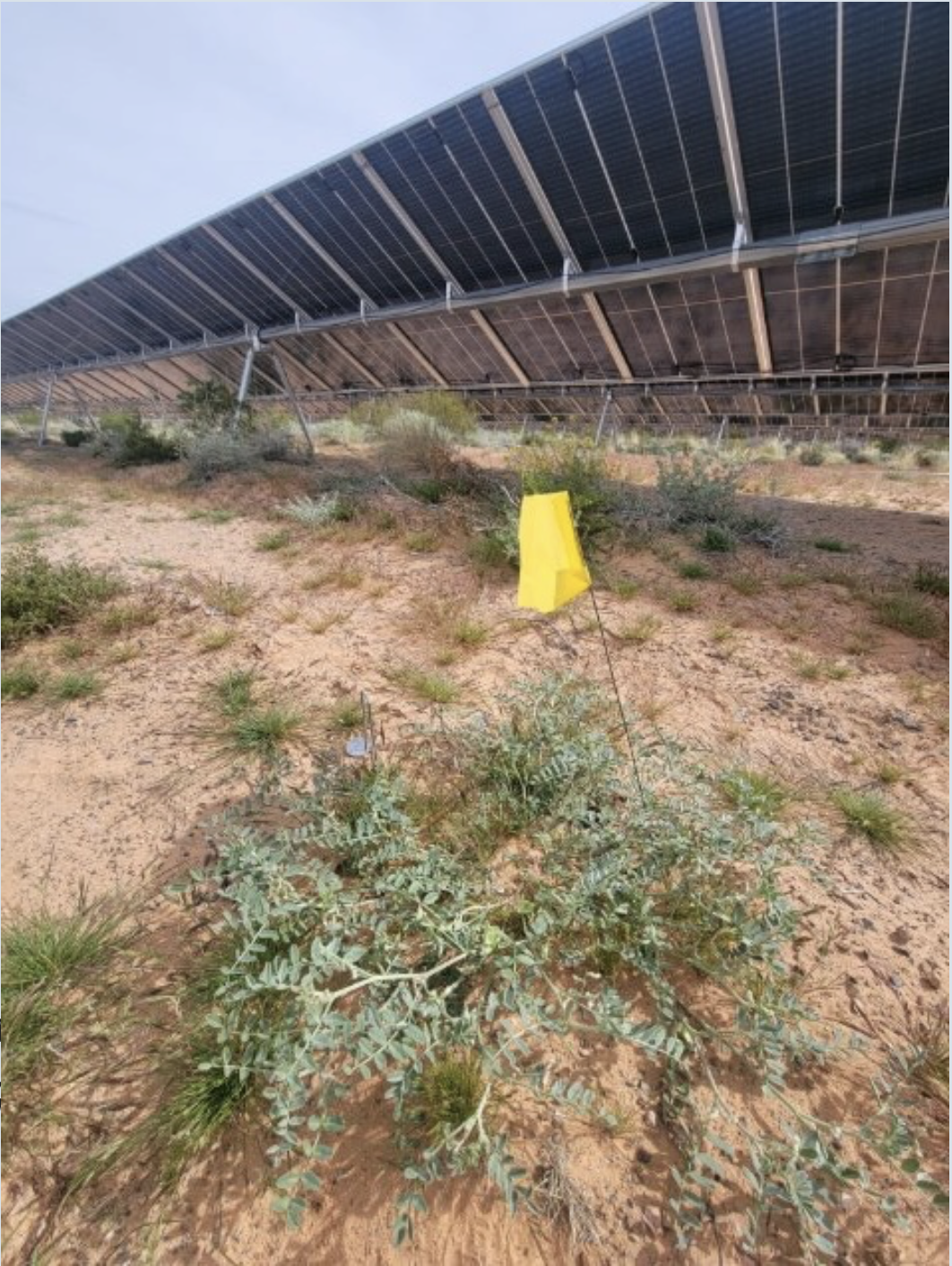
Threecorner milkvetch growing at the Gemini Solar Project.
Click the link to read the release on the DRI website:
January 13, 2026
Surveys of threecorner milkvetch at the Gemini Solar Project two years after construction show promising results for advancing renewable energy projects while balancing ecosystem preservation
Although sunlight is one of the cleanest forms of renewable energy available, clearing large swathes of desert habitat to build solar arrays has consequences for the plants and animals it displaces. Researchers are trying to find better ways to preserve desert landscapes without impeding solar energy development. Now, a new study demonstrates that with careful planning and consideration for the ecosystem around it, at least one desert plant is surviving — and thriving — amidst the solar panels helping to power Las Vegas.
The research, published late November in Frontiers in Ecology and Evolution, was led by DRI ecologist Tiffany Pereira. She and her team monitored the Gemini Solar Project for a rare plant called threecorner milkvetch two years after solar panel installation. The results were striking, with 93 plants found on site in 2024 compared to 12 plants found before construction in 2018. This demonstrates that the plant’s seeds not only survived construction, but that the species returned in numbers. By comparing threecorner milkvetch plants at Gemini to those at a nearby site where the habitat was undisturbed, the research is able to relate the differences between the two populations to the solar panel’s impacts, and not just changes in weather patterns.
“We were curious to see how the seed bank would be impacted by the construction,” Pereira said. “What we found was that not only did the seed bank survive, but the plant came up. And these were big plants, they were larger in every metric we measured — width, height, number of flowers and fruits, leaf length — than the plants that we measured off the site. That was really cool and surprising.”
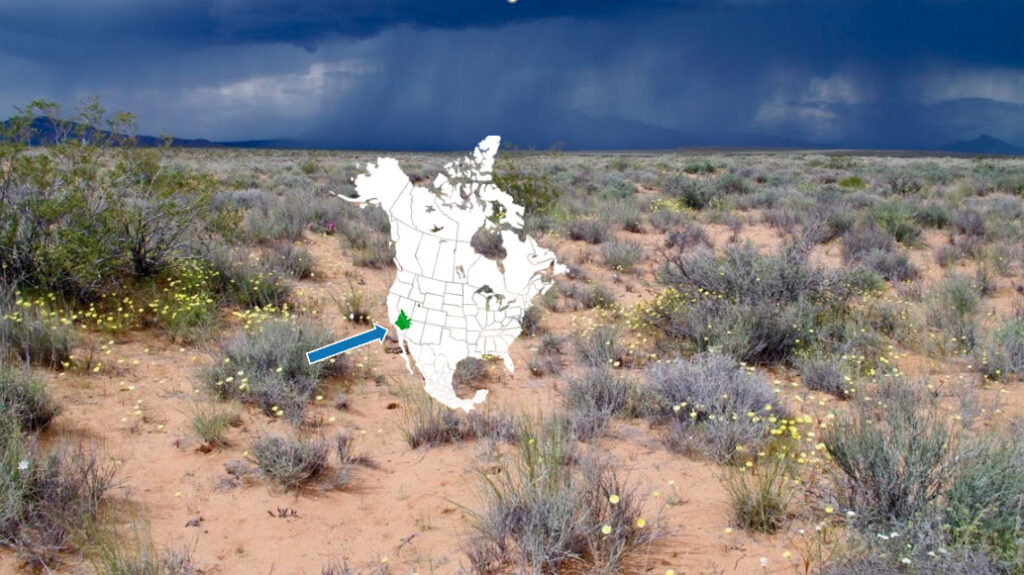
Intact desert habitat near the Gemini Solar Project outside of Las Vegas, Nevada. Photo and graphic credit: Tiffany Pereira
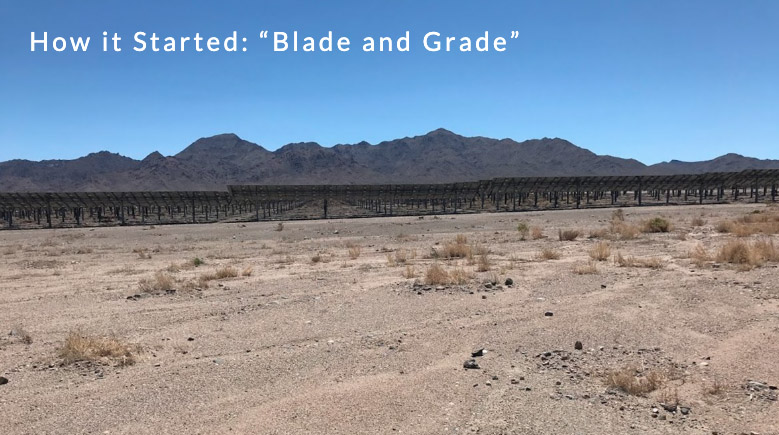
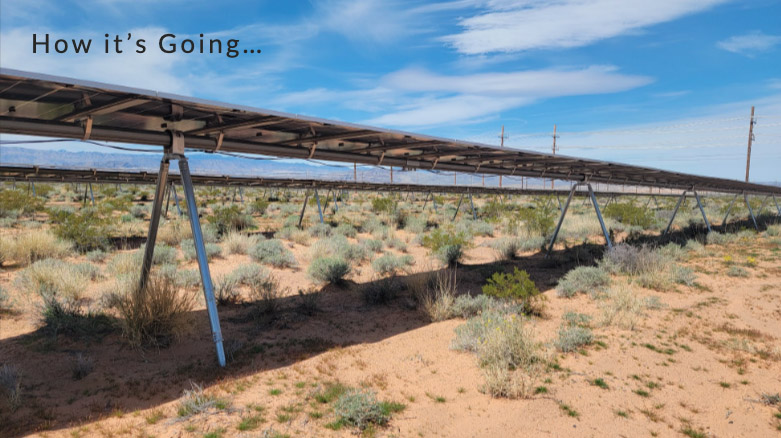
The Gemini Solar Project is unique because it made efforts to preserve the desert plants and animals on site during and after construction. Most large-scale solar arrays use a method known as “blade and grade” which involves tearing up the plants and soils before installing the solar panels. This method not only denudes the landscape, it also destroys the fragile seed bank preserved in the top layers of the soil, preventing the habitat from recovering. For these reasons, scientists and conservation practitioners have expressed concerns about the impacts of large solar installations on fragile desert landscapes. Efforts at Gemini show that the push for renewable energy development can be better paired with habitat preservation efforts.
The plant at the center of the research, threecorner milkvetch, is a rare species in the pea family that is under consideration for listing under the Endangered Species Act. The State of Nevada has categorized it as Critically Endangered and Fully Protected, and the Bureau of Land Management considers it a Special Status Species. Like other plants in this parched part of the world, its persistence is highly dependent on rainfall. As an annual species, it can be impossible to find during dry years and then found in significant numbers when higher rainfall brings the desert back to life. It’s this relationship with water that Pereira and the study team suspect is responsible for the plant’s higher growth rates at Gemini.
“Subsequent years of monitoring will help us unpack this,” Pereira said, “but the soil moisture content on Gemini is higher after rainfall events. The water is retained in the ground for longer after rainstorms, so it takes longer to dry out. The plants might just be soaking up that extra water.”
A comparison of the impacts of traditional solar array construction methods vs. The less destructive methods used at Gemini. Credit: Tiffany Pereira
A comparison of the impacts of traditional solar array construction methods vs. The less destructive methods used at Gemini. Credit: Tiffany Pereira
Pereira emphasizes that the results of this study only represent one year of surveys following construction, and that she will continue surveying Gemini for threecorner milkvetch plants to determine if this pattern holds. Her team also noted in the study that although the plants at Gemini seemed to be thriving, they only found one plant growing in the shaded area beneath a solar panel. This could mean that there continue to be tradeoffs in habitat reduction, as the species may now be limited to germinating in the limited space between solar panels. Pereira is planning to conduct a germination study to verify this limitation.
“Our main goal for land managers is always avoidance,” she said. “When it comes to rare plant habitat, avoid if possible, and then these alternative construction methods can be used to preserve habitat in areas where it can’t be avoided.”
The study offers hope for powering humanity’s needs with fossil fuel-free, plentiful sunlight, without sacrificing the sweeping desert vistas that are the allure of the Southwest.
“Our desert species are amazing,” Pereira said. “These seedbanks can withstand a lot — they persist in the soil for years, just waiting for the right conditions to germinate, and now we know that they can even survive through more gentle construction methods. With a little ingenuity, we can address both habitat and renewable energy concerns. These things can work together.”
More information: The full study, Rare milkvetch persistence at a utility-scale solar energy facility in the Mojave Desert, is available from Frontiers in Ecology and Evolution at https://doi.org/10.3389/fevo.2025.1697878
Colorado transmountain diversions via the State Engineer’s office
Here’s the release from Northern Water (Jeff Stahla):
November 2026
Dry years like this one take on a special meaning in Colorado water policy. What we once called a “2002 year” or a “2012 year” will now be described as a “2026 year,” a year when the snow failed to come, and summer monsoons offered only brief, scattered relief. Now imagine receiving that same paltry water supply every year, not because of drought, but because of something completely avoidable.
Many Colorado communities have experienced the damaging effects of “buy & dry” practices. “Buy & dry” involves the transfer of water from agriculture to urban uses, which has led to the permanent loss of valuable water supply and devastated economies, the environment, and the social fabric of once-vibrant communities. Historically, the greatest impacts have occurred when water is transferred from agricultural to urban uses tens or even hundreds of miles away. Once water is severed from the land, adverse effects are felt year in and year out as that vital community building block is put to use in areas that are geographically, socially, and economically disconnected from where it originated.
A story published on Sept. 9 by the Colorado Sun noted the potential for, yet again, a permanent water transfer from farm properties in the Arkansas River basin to the city of Aurora. It would not be the first such transfer, and likely not the biggest. In fact, during the same time that Aurora has been acquiring farmland in the Lower Arkansas Basin, it has been equally busy pursuing land and water assets in Northern Colorado. The recent reporting by the Colorado Sun highlights a concerning trend that should sound the alarm for every rural community in the state.
For decades, Metro Area water providers have been claiming to work with agriculture in a way that allows cities to thrive, while protecting agriculture. What they describe as “water sharing” frequently involves nondisclosure agreements and working with faceless third parties that quietly accumulate farm assets. Assets are later sold to cities, often to the surprise of local communities when deals are finally daylighted. Only after the water and land is under control of the cities, are they interested in talking to farmers about how it will be divided up between historic and future uses. Although the word “sharing” implies some level of equity between agricultural and municipal parties, the transfer of power has already occurred: it is the cities that end up with ultimate control, leverage, and say in how, where, and when water will be used.
In the 1930s, Colorado leaders recognized the need for additional water supplies on the Front Range and beyond, and they passed legislation that created water conservancy districts to look out for those who needed additional water – but they also required them to mitigate damages that occurred if water was going to cross from the Colorado River basin to points beyond. In the case of three of those users, they paid for or contributed to the costs of building Green Mountain Reservoir, Wolford Mountain Reservoir and Ruedi Reservoir. If those sound familiar, it’s because they have been very important water supplies throughout their life spans, and especially this year.
he concept of mitigating impacts when developing water projects is not new, but thus far has been inadequate in the context of transfers from agriculture to urban uses. While progress continues to be made as it relates to issues like revegetating formerly irrigated lands, progress is too slow and our rural communities are bearing too great of a burden for decisions made along our urban Front Range Corridor.
The closer we look at these recent and ongoing water export schemes, the more we see an unwillingness by communities like Aurora to look beyond themselves. Colorado has been having conversations about balancing growth and preserving irrigated agriculture for decades. Yet the transfers continue, and with each one, more agricultural water and the communities it supports are permanently diminished, if not totally sacrificed. It is time for Colorado to come together and ask a fundamental question: At what point is enough, enough? How much agricultural water can we permanently transfer before we acknowledge that we are dismantling the character, economic, and food-producing capacity of our state? Colorado’s water future belongs to all of us, and so does the responsibility to decide what we are willing to sacrifice to meet the growing demands of the Metro Area.
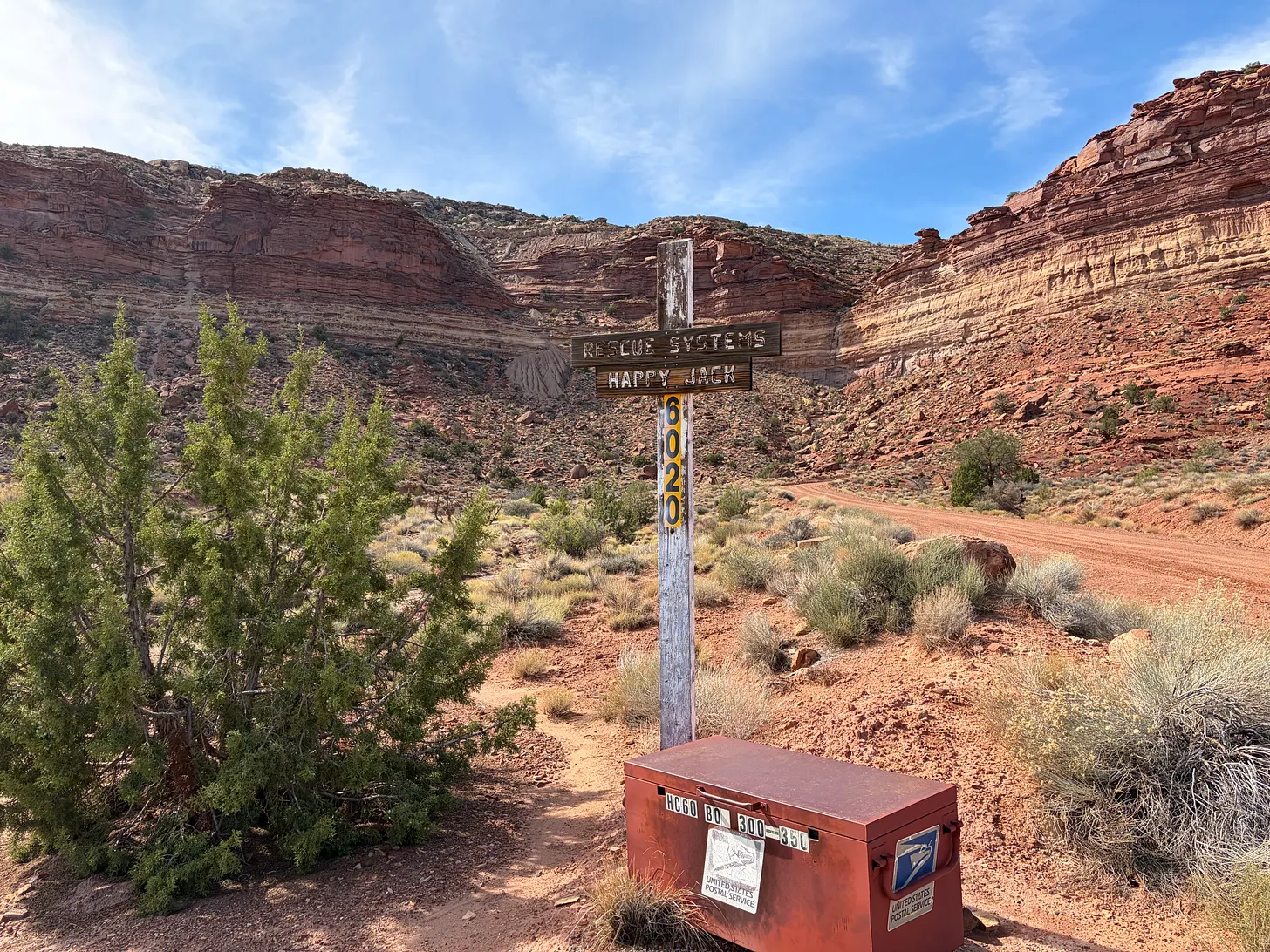
Post office box at the entrance to the Happy Jack Mine in White Canyon. The historic mine is located within the original boundaries of Bears Ears National Monument, but it and the entire White Canyon drainage were removed from the monument by President Donald Trump’s shrinkage. Jonathan P. Thompson photo.
The rush to stake mining claims in areas removed from Bears Ears National Monument in July continues, even as more lawsuits are filed challenging the legality of President Donald Trump’s shrinkage of the monument.
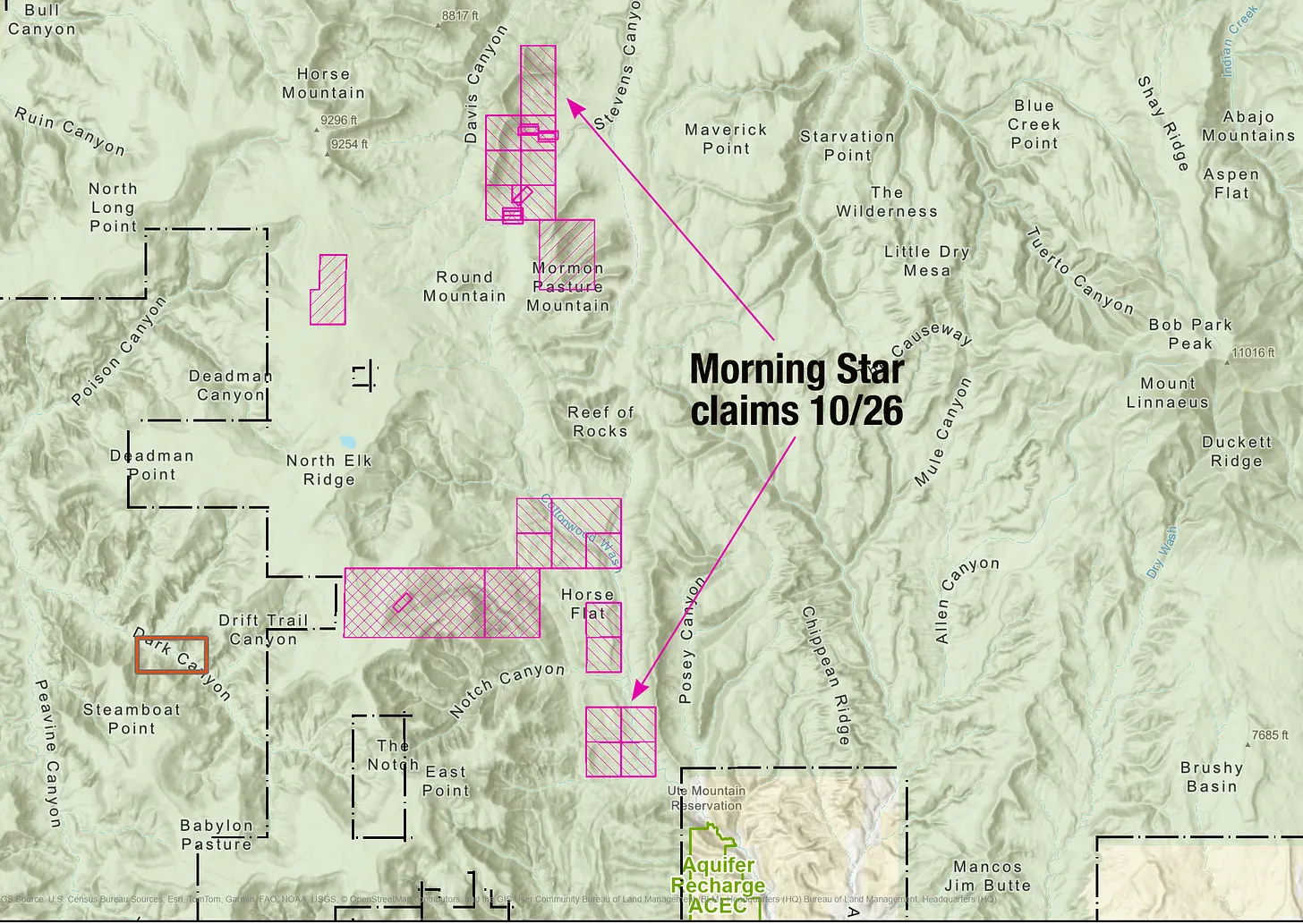
Last month, an entity calling itself Morning Star filed 16 new 20.66-acre lode claims within the original BENM boundaries, and two additional claims just east of the boundary. This brings the grand total of new claims staked since the shrinkage took effect on Sept. 11 to 88. Fifty-two of those have been filed with the BLM. An additional 36 were filed with the San Juan County Clerk, but have yet to be added to the BLM’s database.
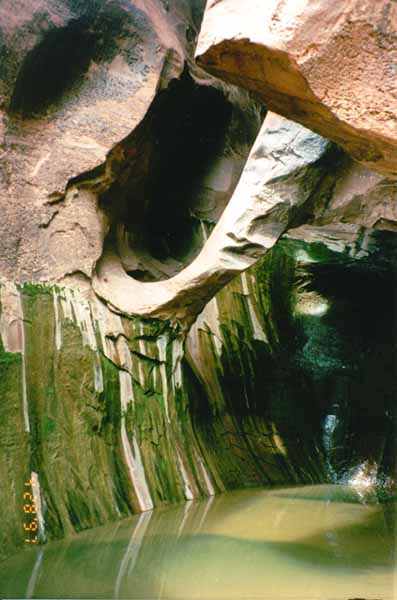
In Stevens Canyon near the confluence with the Escalante River. Photo credit: Joe Ruffert
Morning Star’s new claims are in four different clusters. One is in the White Canyon drainage on Wingate Mesa; another is between Davis and Stevens Canyons adjacent to a cluster of new claims filed in September by Land Survey Associates; and a third is in the North Cottonwood Creek drainage west of Posey Canyon just outside the Allen Canyon Ute Mountain Ute land. The fourth cluster is about one mile outside of the original BENM boundaries and east of Cottonwood Wash.
Two of the clusters of Morning Star claims filed with the BLM in Oct. 2026. The other pink rectangles are a mix of post-shrinkage claims (mostly staked by Land Survey Advisors) and claims that were staked prior to the monument’s establishment. Source: BLM
As is often the case with mining claimants, Morning Star is somewhat enigmatic, and could very well be acting on behalf of a different entity. It provides only a residential Blanding address on its BLM filing and no other information.
Its certificate of location filed with San Juan County is signed by Ben Carden, apparently Morning Star’s agent, as well as Kelly Dearth. While I could find no link between Carden and any mining activity, I did find that a Kelly Dearth was an officer with NX Uranium up until 2018, when the firm abandoned the mining business and went into cannabis production. Dearth appears to have been involved with a Morning Star Inc. out of Grand Junction, though that entity is no longer registered with the state.
The Diggings, a comprehensive mining website, lists Kelly Dearth of Grand Junction as the claimant on 38 active mining claims in Emery County, Utah, and another 13 in San Juan County.
These new claims appear to be Morning Star’s only active claims on BLM land, though other firms with the same name but different address have held claims elsewhere in Utah in the past. (BLM, San Juan County, The Diggings)
Wyoming-based DISA Uranium, the newish firm that uses something called high-pressure slurry ablation to extract minerals from old waste dumps, is working to stake its own sort of claim on the Four Corners landscape.
It has touted numerous agreements with other firms to reprocess their waste dumps and hopes to use its process at abandoned mines on the Navajo Nation. So far, however, it has only been fully permitted for one project, at the Mary Ann Mine on BLM land in western Colorado. It invited local, regional, and tribal leaders and pro-nuclear advocates to a site visit in late October to promote its patented technology.
Sign near the defunct Rio Algom Lisbon Valley Mill site. Jonathan P. Thompson photo.
Now the company is proposing to construct its own conventional uranium mill in the Lisbon Valley in southeastern Utah. The preliminary location would be at the defunct and reclaimed Rio Algom Lisbon Valley Mill, where a plume of contaminated groundwater continues to spread out from the large tailings depositories still at the site.
The concept is in its very early stages, and the company hasn’t formally initiated the permitting process with federal or state agencies yet, according to Sarah Fields, of Uranium Watch. Energy Fuels’ White Mesa mill near Blanding, Utah, is currently the only operating uranium mill in the U.S.. Anfield Energy has said it hopes to reopen its Shootaring Mill near Ticaboo, but the timeline keeps getting pushed back (it is now shooting for 2028), and Western Uranium and Vanadium has proposed new mills in both Green River and in the Paradox Valley in Colorado, but has not made any progress on either venture.
DISA merged with IsoEnergy in August to form DISA Uranium, with Iso bringing its Tony M, Diners, Rim, Sage Plain, and Flatiron mines to the partnership. The company has received backing from the likes of BHP Ventures and Halliburton Labs.
Thirty-six of the new mining claims staked by Land Survey Advisors in areas removed from Bears Ears National Monument were on historic mining sites with associated waste piles, leading to speculation that DISA is behind the claims. DISA did not respond to Land Desk queries concerning the matter.
The Atomic Safety and Licensing Board grants New Mexico’s Justice Department’s petition to intervene in Laramide Resources’ application to renew the Crownpoint Uranium Project’s federal license for its in-situ operations near Crownpoint and Church Rock. This is considered a victory for advocates and residents opposed to the project, which would occur near the site of the disastrous 1979 Church Rock Uranium Mill spill that contaminated the Rio Puerco and associated groundwater wells for miles downstream. “This is a significant and unprecedented step forward in holding uranium mining companies accountable for the risks their projects pose to New Mexico communities,” said New Mexico Attorney General Raúl Torrez. (NM DoJ)
Gamma Resources stakes an additional 12 mining claims at its Mesa Arc uranium project in the Chama Basin in northern New Mexico, bringing its total landholdings to 238 lode claims covering about 4,760 acres of national forest land. Although only in its exploratory phase, the project has elicited strong local and regional opposition. (Junior Mining Network
Anson Resources says it has completed permitting for its Green River lithium extraction project, allowing the company to move into the financing phase and conduct its definitive feasibility study. (TipRanks)
Southwest Wyoming braces for an economic blow as WE Soda announces it will lay off 350 workers from its trona mine and soda ash complex in Sweetwater County as it transitions from underground mining to less labor-intensive drill-and-pump extraction methods. The London-based firm blames a soda ash glut caused by product from China and Mongolia flooding the global market. (WyoFile)
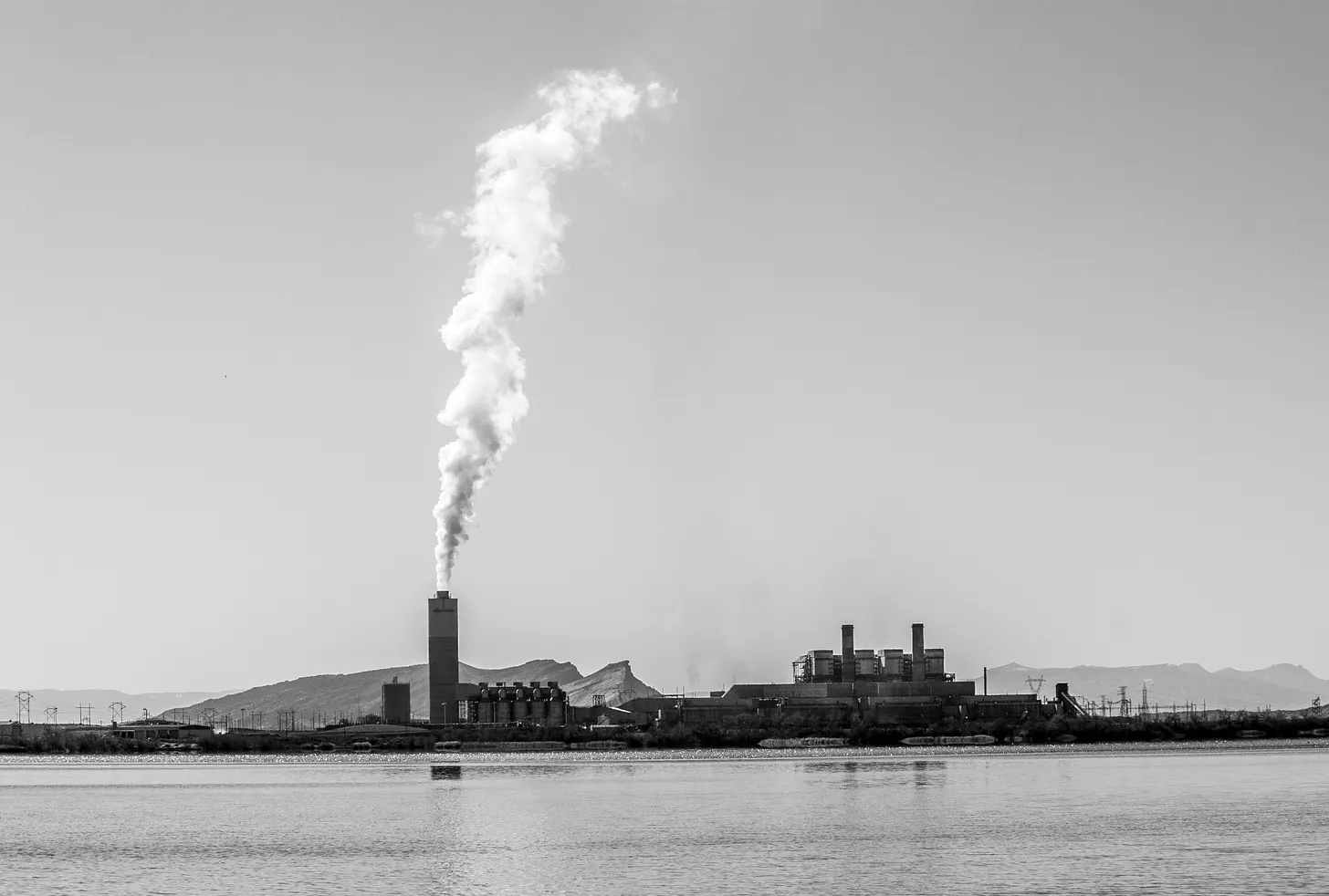
The Navajo Tribal Utility Authority proposes to work with private developers to establish a “multi-function energy park” and data center on the shores of Morgan Lake, the Four Corners Power Plant’s reservoir. Jonathan P. Thompson photo.
The Navajo Tribal Utility Authority looks to develop a “multi-function energy park” on almost 600 acres in the Nenahnezad Chapter of the Navajo Nation in northwestern New Mexico adjacent to the Four Corners coal plant. The proposed project would include a data center, a natural gas plant, a solar-plus-battery-storage installation, and an advanced energy component manufacturing facility. The Navajo Nation Tribal Council is expected to take up the issue in coming weeks. Diné CARE has pushed back on the proposal, raising concerns about water and energy use, and the climate and air quality impacts of the gas plant. (Diné CARE,Searchlight New Mexico)
Humpback Chub, Gila cypha, George Andrejko, Arizona Game And Fish Department
🐟 COLORADO RIVER CHRONICLE 💧
The Center for Biological Diversity plans to file a lawsuit challenging federal operations at Glen Canyon Dam, saying they are violating the Endangered Species Act by imperiling native Colorado River fish. Lower reservoir levels increase the risk that nonnative, warm water fish will escape Lake Powell and enter the river downstream from the dam, where they compete with and prey on endangered native fish. Yet federal dam operators have ceased “cool-mix flows” designed to limit invasive fish reproduction downstream from the dam, choosing instead to send all releases through the hydroelectric turbines. That could further harm the humpback chub and razorback sucker. (Center for Biological Diversity)
🦫 WILDLIFE WATCH 🦅
The National Park Service partners with the BLM, Utah’s Division of Wildlife Resources, and Utah State University on a comprehensive study of desert bighorn sheep — including disease, population, and habitat — in and around Arches, Canyonlands, and Capitol Reef national monuments in southern Utah. (The Insider)
🛢️ FOSSIL FUEL FOLLIES 📈
Transwestern, an Energy Transfer subsidiary, proposes the 124-mile Springerville Lateral natural gas pipeline project stretching from around Thoreau, New Mexico, to the Coronado and Springerville coal plants in eastern Arizona. The line, which is in the pre-filing phase with the Federal Energy Regulatory Commission, is designed to support Salt River Project’s conversion of the plants to run on methane rather than coal. It would cross the Zuni Mountains, pass just west of El Morro National Monument, and skirt around Zuni Pueblo land. The project and others like it would benefit from the permitting reform legislation making its way through Congress. (FERC)
🏠 RANDOM REAL ESTATE ROOM 🤑
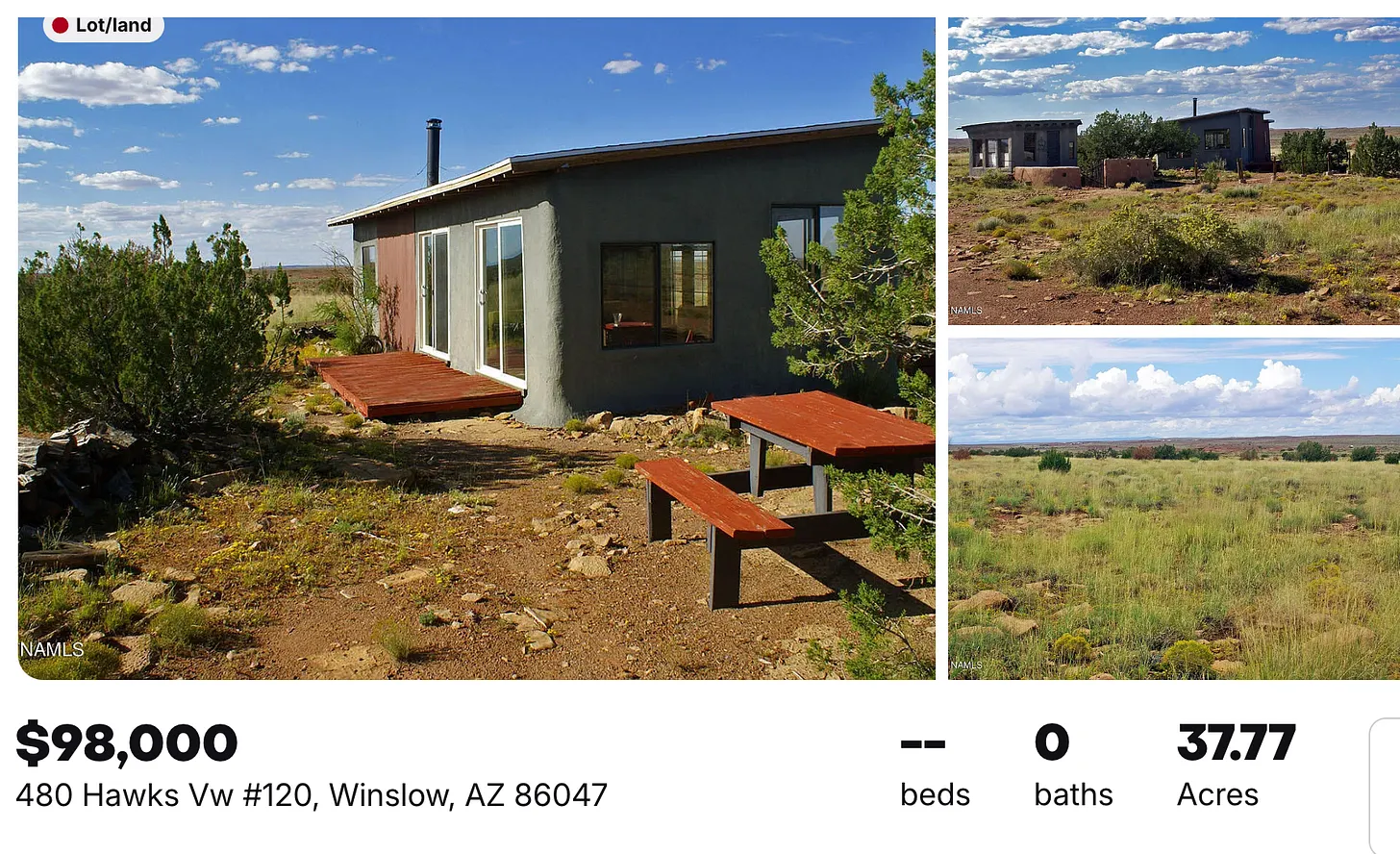
That old procrastination-hobby of mine — surfing Zillow in search of affordable and not-so-crappy housing in the West — has mostly lost its shine in these gentrified days. The lowest priced housing in even the old affordability strongholds is usually in the $200k to $300k neighborhood. But every once in a while you can still stumble onto a slightly affordable gem, as long as being off-the-grid, in the middle of nowhere, is appealing. Here’s one that’s in the desert south of Winslow, Arizona, that’s being peddled as a glamping retreat. Screw that, it’s a pretty nice home, if you ask me, with 38 acres to boot. And it comes in just under $100,000 — a rarity in this day and age. (Zillow)
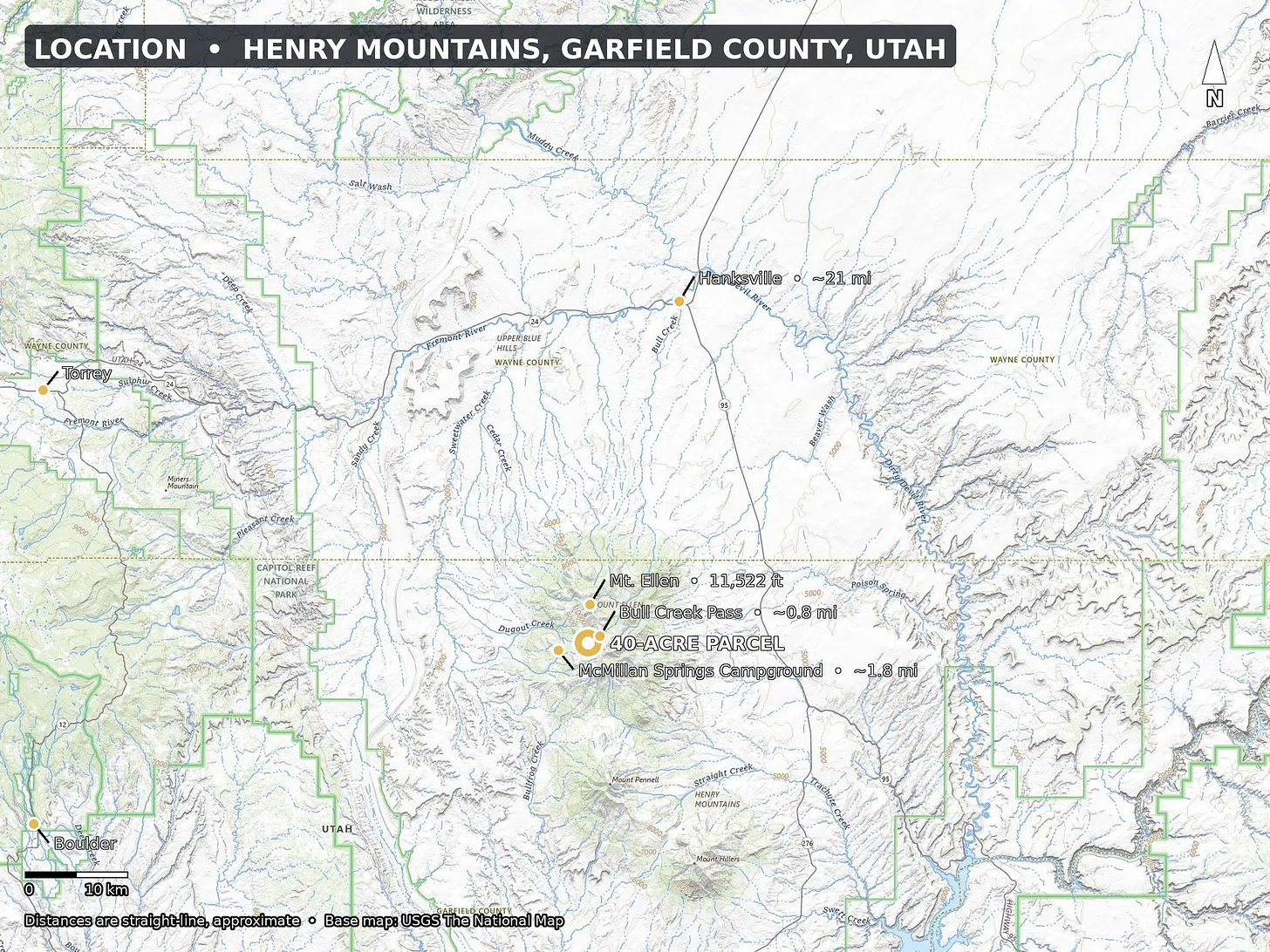
I’m always a little taken aback when I see a parcel of land for sale in a place like the Henry Mountains in southern Utah. It just doesn’t seem right that anyone could own a piece of that landscape, let alone sell it for cash. But what should be is often not the same as what is, and actually there are quite a few blocks of private and state land in the Henries, along with oodles of unpatented mining claims, and one 40-acre plot south of Mt. Ellen is for sale for $44,900. (Exp Realty)
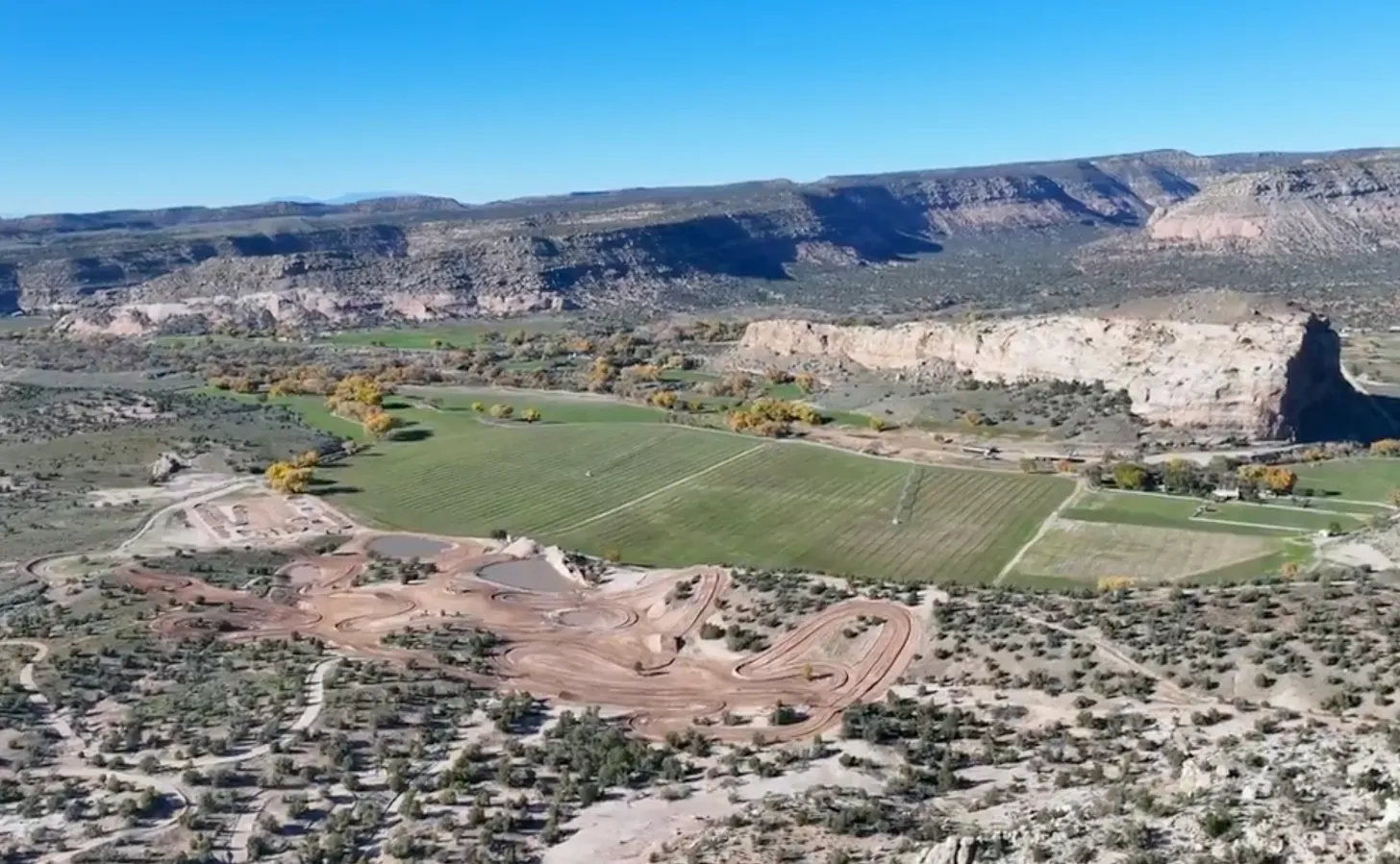
Oh, and if you happen to have an extra $7.5 million lying around, you can be the next steward of 800 acres in McElmo Canyon. It’s not just any ol’ ranch, either, it’s mountain bike legend John Tomac’s Flying T ranch, complete with a motocross track, a trail network, a huge workshop, a vineyard, a hay operation, and a fancy house. If you happen to buy it, you could donate (tax deductible!) a little corner to the Land Desk for its HQ. Just saying. (Sotheby’s)
Screenshot from Sotheby’s real estate listing for John Tomac’s Flying T ranch in McElmo Canyon, Colorado.
📸 PARTING SHOT 🎞️
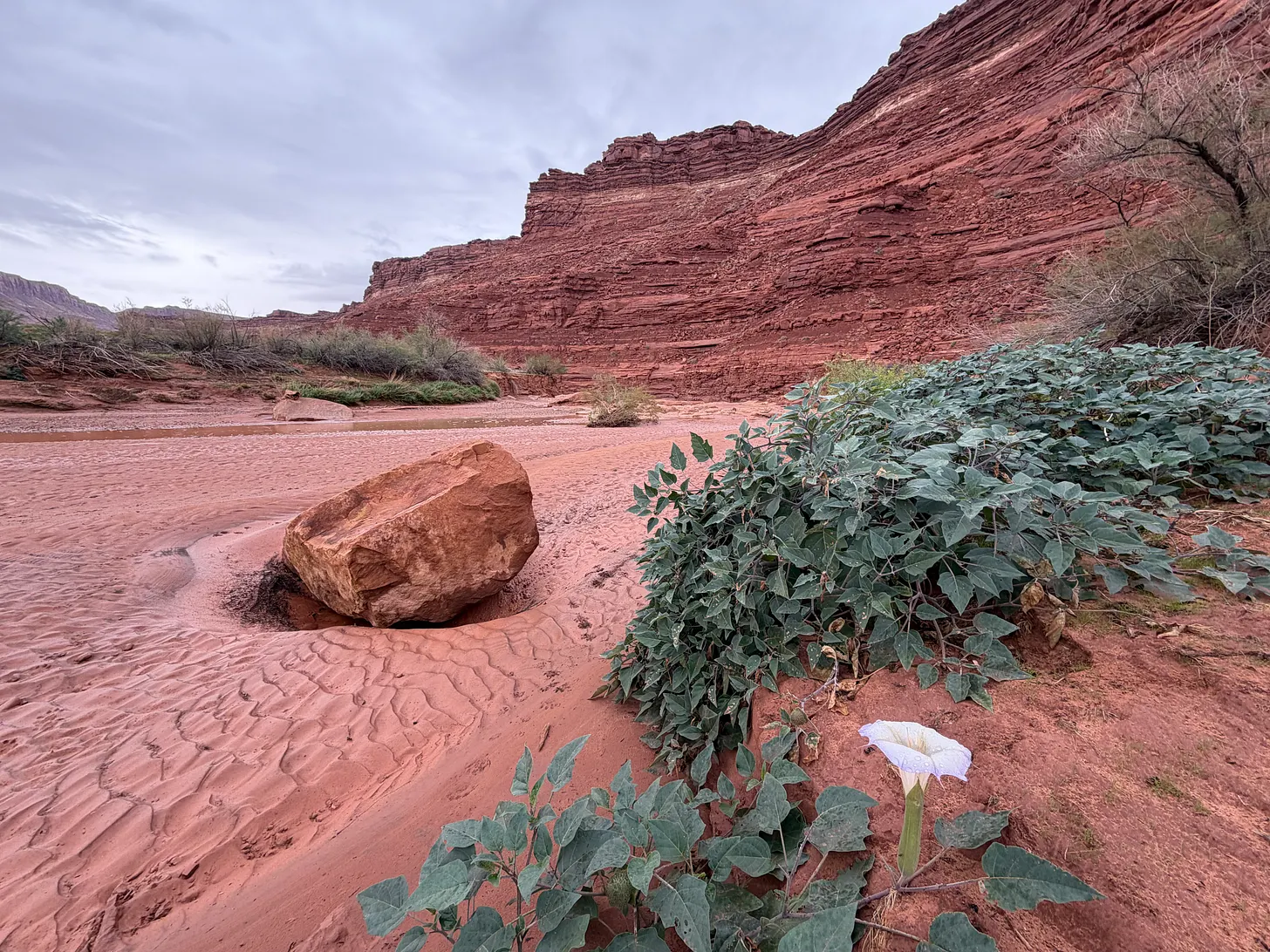
Sacred datura plant in White Canyon, Utah. Jonathan P. Thompson photo.