
San Luis Valley: Rio Grande Water Conservation District’s first groundwater sub-district meeting recap

A picture named slvdischargerecharge.jpg

From the Valley Courier (Ruth Heide):

The approximately 100 people attending Tuesday’s meeting, plus hundreds more, will be affected in some way by the decisions of the board of managers for the first water sub-district of the Rio Grande Water Conservation District (RGWCD.) Some audience members expressed concern, for example, that if the sub-district’s fees were too high, some farmers might go out of business, have less money to spend with local retailers who would then be negatively affected, or turn to other crops that might create overproduction problems.

Ultimately the sub-district board approved its 2011 budget, the first for the group, that sets the fees farmers within the sub-district boundaries will have to pay next year. The sub-district board will decide within the next few weeks the amount that will be assessed farmers as a variable fee in 2012 so farmers can plan ahead accordingly. The variable fee could be as much as $75 per irrigated acre. Those fees will help make water purchases required by the sub-district management plan and the court to replace injurious deletions to surface water rights, one of the main goals of the sub-district. Other fees will be assessed for operational costs and Conservation Reserve Enhancement Program application expenses.

RGWCD engineer Allen Davey provided a water history lesson about the Valley’s aquifer declines, the most dramatic of which occurred around the time of the 2002 drought. The aquifer experienced some recovery in more recent years. However, Davey said this last year (September to September) the unconfined aquifer, which he has studied for more than 30 years, experienced a decline of 106,000 acre feet. One of the goals of the sub-district is to replenish the aquifer…

Davey also provided cost estimates Tuesday night to give the sub-district board a basis for deciding how much to charge for variable fees. He said groundwater modeling has placed the amount the first sub-district has to replace to senior water rights as a result of depletions from well pumping in the range of 7,000-8,000 acre feet per year, primarily to the Rio Grande…

Sub-district board member Brian Brownell said the variable fee would be set annually, just like the budget. Sub-district board member Carla Worley said the purpose of the sub-district is to restore the aquifer, and once that goal is accomplished, “there’s no point in us existing so that fee goes away … It will probably take us 20 years to get there.”[…]

Rio Grande Water Users Association Attorney Bill Paddock added, “If the sub-district does not comply with the plan of water management, then your well will be shut off.” Colorado Division of Water Resources Division III Engineer Craig Cotten added, “Be very clear about this. The state engineer does have authority to shut down the wells in sub-district 1 if the plan is not workable.”
More Rio Grande River basin coverage here and here.

Energy policy — nuclear: Cotter Corp sues the state over cleanup order at the Schwartzwalder mine

A picture named uranium.jpg

From The Denver Post (Bruce Finley):

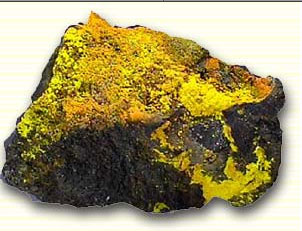
The lawsuit, recently filed in Denver District Court, accuses Colorado’s Mined Lands Reclamation Board of abusing its discretion when it ordered Cotter to pump out and treat uranium-tainted water that inspections have shown to be rising toward the rim of Cotter’s defunct Schwartzwalder mine…

At issue is whether state regulators had enough evidence to order the cleanup and impose fines. Cotter is seeking a judge’s order to reverse both of those actions…

The lawsuit is the latest step in a standoff between Cotter and the state. Regulators have moved to increase a $55,000 fine against Cotter for failing to comply with cleanup orders. Since April, they’ve repeatedly ordered Cotter, a subsidiary of San Diego-based General Atomics, to pump and treat toxic water filling the mine along Ralston Creek. The creek, which flows into Denver Water’s Ralston Reservoir, contains uranium at levels far exceeding health standards for drinking water. Cotter in July began pumping contaminated water from surface alluvial ponds along the creek. But the most- contaminated water in the 2,000-foot- deep mine shaft is untouched. Cotter contends the water in the mine shaft is not connected to groundwater. State mining regulators argue that water in the mine is connected to groundwater and the creek.

More nuclear coverage here and here. More Schwartzwalder mine coverage here.

Castle Creek: Hope Mine restoration project is test bed for biochar

A picture named biocharproduction.jpg

From the Aspen Daily News (Andrew Travers):

The effort at Hope Mine could mark a new, carbon-negative approach to reclamation projects on the 23,000 abandoned mines in Colorado’s forests. Carbondale’s Flux Farm Foundation and Axe Trucking are providing technical assistance for the undertaking, which will use biochar to re-vegetate the area and restore soil ravaged by tailings and heavy metals left behind by miners. Biochar is a charcoal-like substance made from heated biomass. It is used to both increase the health of the soil it’s mixed into and to sequester carbon emitted by grass, shrubs and trees…

“Our project intends to show, for the first time, that biochar can be successfully used at scale to reclaim a former mine site,” said Flux Farm director Morgan Williams. “This is a big opportunity for Aspen to make a meaningful contribution to the science of biochar.”

The Hope Mine project is being funded with $90,000 of For The Forest money. The non-profit, founded by former Aspen Mayor John Bennett, for the last two summers also has partnered with the forest service, City of Aspen and Pitkin County to treat and remove trees on Smuggler Mountain hit by bark pine beetle infestation. Bennett said he hopes eventually to process local beetle-killed trees into biochar for local mine reclamation projects — essentially using one forest problem to solve another…

Work on the site begins Sunday, with a volunteer effort launched to coincide with the “10/10/10 Global Work Party,” an outreach campaign by the climate change awareness website 350.org. A geochemist will assist volunteers and Flux Farm’s Williams with laying out 10-foot-by-10-foot “test plots” on the site, trying out various recipes of biochar, compost and other materials in the soil. They have planned seven days of work to follow, including more compost/biochar mixing, treating mine tailings and hydro-mulching.

More restoration coverage here.